
Puck, 1877-05 · page 7 of 16
Puck — May 1877 — page 7: what you’re looking at
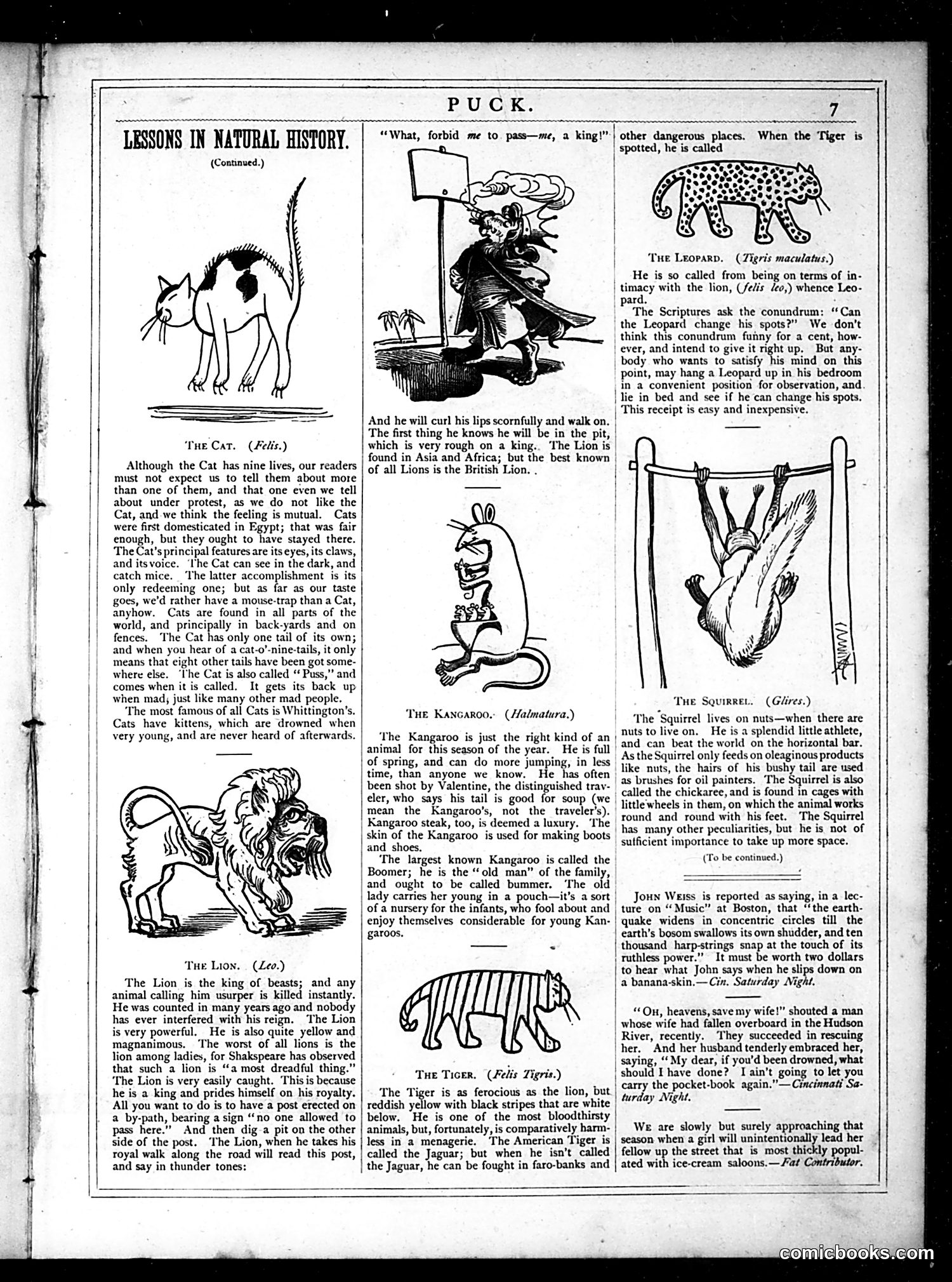
What you’re looking at
This is an educational feature rather than political satire. The page presents illustrated lessons about animals with humorous commentary. The content includes entries on: - **The Cat** (Felis): Notes cats' hunting abilities and nine lives - **The Lion** (Leo): Describes lions as "king of beasts" - **The Kangaroo** (Halmaturus): Discusses its jumping ability and culinary value - **The Leopard** (Tigris maculatus): References the biblical question "Can the Leopard change his spots?" - **The Tiger** (Felis Tigris): Describes its ferocity - **The Squirrel** (Sciurus): Notes its acrobatic abilities The tone is gently satirical, using animal characteristics to make oblique commentary on human nature and behavior. The page mixes genuine natural history information with whimsical observations and period-appropriate humor.
📄 Transcribed text from this page (OCR, searchable)
Machine-transcribed from the original scan — historical spelling and the odd misread are preserved.
PUCK. 7 LESSONS IN NATURAL HISTORY. (Continued.) “What, forbid me to. pass—me, a king!” j ; ‘THe Cat. (Felis.) Although the Cat has nine lives, our readers must not expect us to tell them about more than one of them, and that one even we tell about under protest, as we do not like the Cat, and we think the feeling is mutual. Cats were first domesticated in Egypt; that was fair enough, but they ought to have stayed there. ‘The Cat's principal features are its eyes, its claws, and itsvoice. ‘Ihe Cat can see in the dark, and catch mice. only redeeming one; but as far as our taste goes, we'd rather have a mouse-trap than a Cat, anyhow. Cats are found in all parts of the world, and principally in back-yards and on fences. The Cat has only one tail of its own; and when you hear of a cat-o’-nine-tails, it only means that eight other tails have been got some- where else. ‘I'he Cat is also called “ Puss,” and comes when it is called. It gets its back up when mad, just like many other mad people. ‘The most famous of all Cats is Whittington’s. Cats have kittens, which are drowned when very young, and are never heard of afterwards. ‘Tue Lion. (Leo.) The Lion is the king of beasts; and any animal calling him usurper is killed instantly. He was counted in many years ago and nobody has ever interfered with his reign. The Lion is very powerful. He is also quite yellow and magnanimous. The worst of all lions is the lion among ladies, for Shakspeare has observed that such a lion is ‘a most dreadful thing.” ‘The Lion is very easily caught. This is because he is a king and prides himself on his royalty. All you want to do is to have a post erected on a by-path, bearing a sign “no one allowed to pass here.” And then dig a pit on the other side of the post. ‘The Lion, when he takes his royal walk along the road will read this post, and say in thunder tones: ‘The latter accomplishment is its | And he will curl his lips scornfully and walk on, The first thing he knows he will be in the pit, which is very rough on a king.. The Lion is | found in Asia and Africa; but the best known of all Lions is the British Lion. . ‘THe Kancaroo. (/almatura.) | ‘The Kangaroo is just the right kind of an | animal for this season of the year. He is full | of spring, and can do more jumping, in less time, than anyone we know. He has often been shot by Valentine, the distinguished trav- eler, who says his tail’ is good for soup (we mean the Kangaroo’s, not the traveler's). Kangaroo steak, too, is deemed a luxury. ‘The skin of the Kangaroo is used for making boots and _ shoes. ‘The largest known Kangaroo is called the Boomer; he is the ‘old man” of the family, | and ought to be called bummer. The old | lady carries her young in a pouch—it’s a sort | of a nursery for the infants, who fool about and | enjoy themselves considerable for young Kan- garoos. Tue Ticer, (Felis Tigris.) The Tiger is as ferocious as the lion, but reddish yellow with black stripes that are white below. “He is one of the most bloodthirsty animals, but, fortunately, is comparatively harm- less in a menagerie. The American Tiger is called the Jaguar; but when he isn’t called | the Jaguar, he can be fought in faro-banks and other dangerous places. When the Tiger is | spotted, he is called 2S ‘Tue Leoparp. ( Zigris maculatus.) He is so called from being on terms of in- | timacy with the lion, (felis Zeo,) whence Leo- pard. The Scriptures ask the conundrum: “Can the Leopard change his spots?” We don't think this conundrum funny for a cent, how- ever, and intend to give it right up. But any- body who wants to satisfy his mind on this point, may hang a Leopard up in his bedroom j in a convenient position for observation, and \lie in bed and see if he can change his spots. | This receipt is easy and inexpensive. Tue Squirret. (Gilires.) ‘The Squirrel lives on nuts—when there are | nuts to live on. He is a splendid little athlete, and can beat the world on the horizontal bar. ‘As the Squirrel only feeds on oleaginous products like nuts, the hairs of his bushy tail are used as brushes for oil painters. The irrel is also called the chickaree, and is found in cages with little'wheels in them, on which the animal works round and round with his feet. The Squirrel has many other peculiarities, but he is not of sufficient importance to take up more space. (To be continued.) Joun Weiss is reported as saying, in a lec- ture on “Music” at Boston, that ‘the earth- | quake widens in concentric circles till the | earth’s bosom swallows its own shudder, and ten | thousand harp-strings snap at the touch of its | Tuthless power.”” It must be worth two dollars | to hear what John says when he slips down on | a banana-skin.— Cin. Saturday Night. “Ou, heavens, save my wife!” shouted a man whose wife had fallen overboard in the Hudson | River, recently. They succeeded in rescuing her. And her husband tenderly embraced her, saying, “My dear, if you'd been drowned, what | should I have done? I ain't going to let you | carry the pocket-book again.” — Cincinnati Sa- | turday Night. | We are slowly but surely approaching that season when a girl will unintentionally lead her fellow up the street that is most thickly popul- ated with ice-cream saloons.— Fat Contributor.