
A complete issue · 400 pages · 1916

Tom Anderson, Dare-Devil: A Young Virginian in the Revolution
# What's on This Page This is a **library ownership and restriction label**, not a penny dreadful page itself. It's a printed insert pasted into a book, indicating the volume belongs to the Reference Library of the Houghton Mifflin Company (a Boston publisher) located at 2 Park Street. The label warns that the book cannot be removed from the shelves without the librarian's permission—a common practice for valuable reference materials in the late 19th and early 20th centuries. The decorative emblem at center appears to be the publisher's mark. This label tells us the penny dreadful was preserved in an institutional library collection.
# Page Description This is a library stamp page, not a content page from the penny dreadful itself. The image shows an oval red stamp from the "Reference Library * Houghton Mifflin Co. * Boston Mass." marking this as part of their Archive Collection. The stamp states that the book may not leave the offices and must be returned within seven days if borrowed. The green paper beneath shows age and discoloration typical of Victorian-era materials.

This is a title or cover page for a digitized Victorian publication. The page displays a classical building facade (featuring a triangular pediment and four columns) rendered in a faded greyscale. Overlaid on this architectural image is text indicating that the work was "Digitized by the Internet Archive in 2023 with funding from Boston Public Library," along with a URL to the archive. The OCR'd text at the bottom is largely illegible, suggesting significant degradation of the original print. The page appears to be the front matter of a digitized penny dreadful rather than the actual story content.
# Title Page Analysis This is a **title page** from a Victorian penny dreadful. The visible text reads: **"TOM ANDERSON, DARE-DEVIL"** **"A YOUNG VIRGINIAN IN THE REVOLUTION"** The page appears to be the cover or opening leaf of a serialized story featuring a protagonist named Tom Anderson, characterized as a "Dare-Devil," set during the American Revolutionary War era. The heavily aged, discolored paper with visible foxing and wear is typical of nineteenth-century cheap serial fiction publications. The OCR text is heavily corrupted by the page's condition, but the title remains clearly legible in the image itself.
This appears to be a heavily degraded or poorly scanned page from a Victorian penny dreadful, with minimal legible text visible. The OCR output is largely unintelligible, consisting of scattered characters and fragments that don't form coherent words or sentences. The image itself shows a worn, textured surface with discoloration in purples, pinks, and greens, suggesting age and damage to the original document. There is a watermark reading "comicbooks.com" at the bottom. The page quality makes it impossible to determine whether this is prose, an illustration, or a title page, or to extract any meaningful narrative content.

# Assessment This image appears to be a heavily degraded or damaged page from a Victorian publication, with significant color distortion and noise throughout. The page is predominantly light blue-gray in the center, surrounded by pink and reddish tones at the borders. However, the OCR text provided is blank or unreadable, and the visual quality of the image itself is too compromised to discern whether this is a title page, illustration, or prose text. Small black marks are visible but illegible. The watermark "comicbooks.com" appears at the bottom right. Without legible text or clear visual content, I cannot accurately determine what this penny dreadful page contains or conveys.
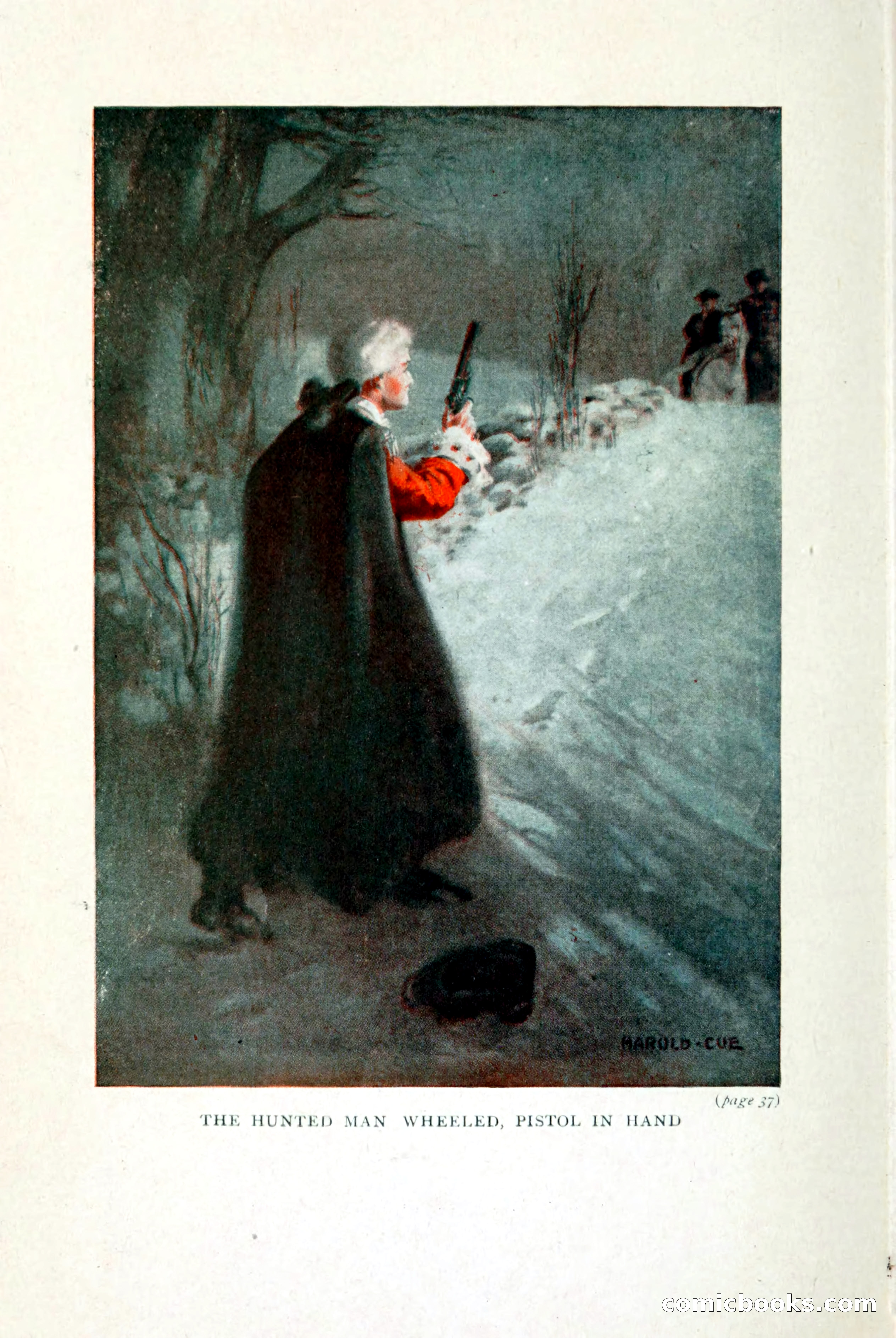
This page features an illustration signed by Harold Cue, depicting a dramatic winter scene. A figure in dark clothing and a white cap turns while holding a pistol, positioned on a snowy slope near bare trees. Other figures are visible in the distance. The caption beneath reads "THE HUNTED MAN WHEELED, PISTOL IN HAND," indicating a moment of action or confrontation. This is a typical sensational illustration from Victorian penny dreadful fiction, emphasizing drama and suspense through visual narrative. The page number "(Page 37)" appears at bottom, confirming this is interior content from a serialized story rather than a cover or title page.
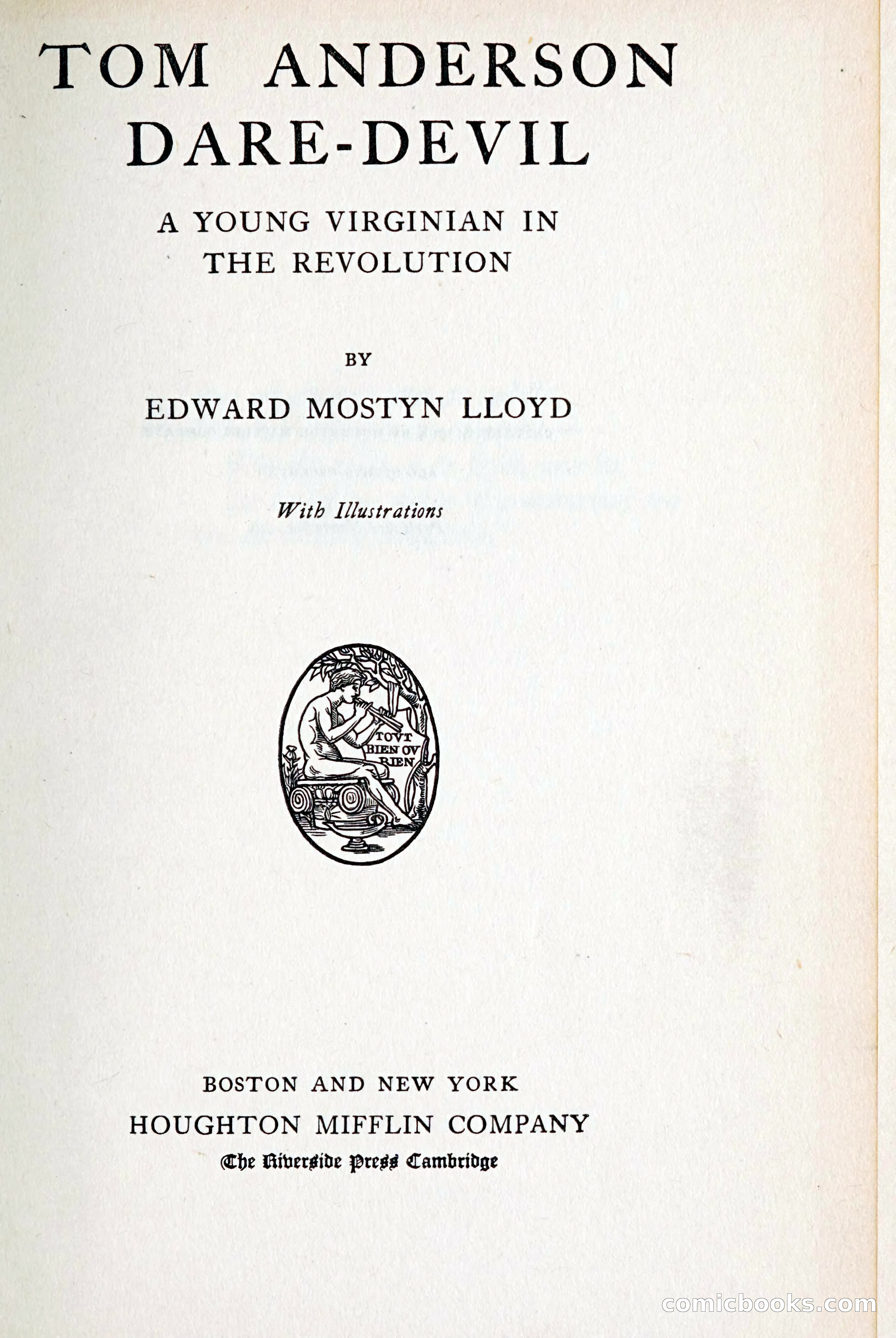
This is a title page for a book called *Tom Anderson Dare-Devil: A Young Virginian in The Revolution* by Edward Mostyn Lloyd, published by Houghton Mifflin Company in Boston and New York (printed by The Riverside Press, Cambridge). The page indicates the book includes illustrations. The title suggests a work of popular fiction about a young man's adventures during the American Revolution, though whether this is a Victorian penny dreadful or a later commercial publication cannot be determined from the image alone. A decorative oval vignette appears at the center of the page.
# Description This is a **title or copyright page** from a book published in November 1916 by Houghton Mifflin Company. The page displays a copyright notice stating "COPYRIGHT, 1916, BY HOUGHTON MIFFLIN COMPANY" and "ALL RIGHTS RESERVED." The heavily faded and degraded condition of the image makes most other text illegible, though there appears to be additional printed matter above and below the visible copyright statement. This is a formal front matter page rather than narrative content.
This is a text page from a Victorian penny dreadful containing an italicized poetic passage. The verse describes a figure—whether seated or riding, frowning or smiling, feasting or fighting—who hears the sound of an unnamed sea on an undiscovered island. The passage suggests a narrative moment emphasizing the character's constancy or presence across different circumstances, with mysterious or exotic setting imagery. The page appears to be prose or narrative interrupted by quoted verse, typical of sensational fiction's theatrical style.

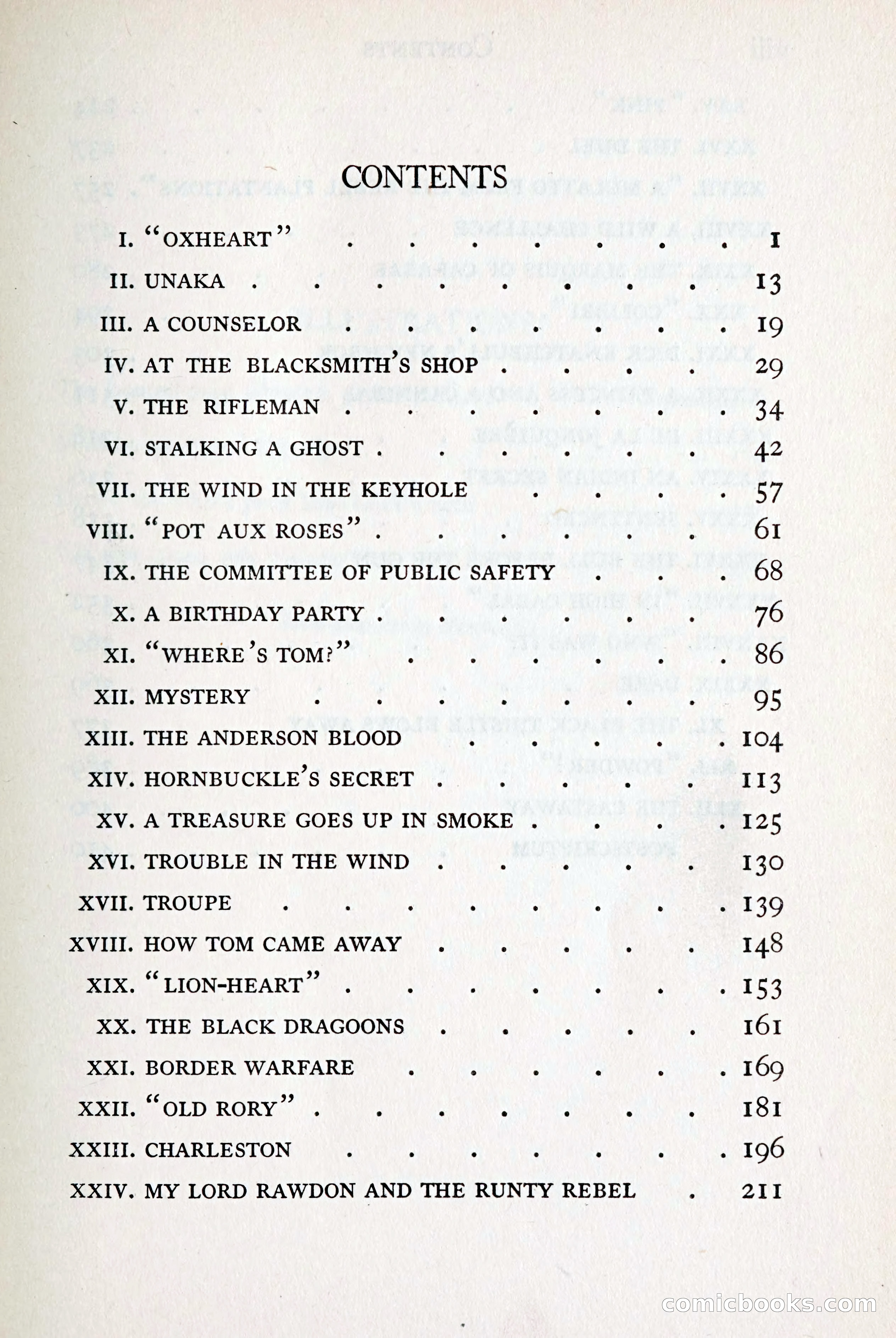
# Contents Page from a Victorian Penny Dreadful This is a **table of contents page** listing twenty-four chapters or installments of a serialized narrative. The text shows chapter titles with corresponding page numbers, ranging from "Oxheart" (page 1) through "My Lord Rawdon and the Runty Rebel" (page 211). The chapter titles suggest a story involving frontier or colonial adventure—references to blacksmiths, riflemen, ghosts, treasure, and military figures like "Lord Rawdon" and "Black Dragoons." The setting and nomenclature appear to reference American Revolutionary or frontier themes, though the specific plot and authorship are not visible on this page alone.
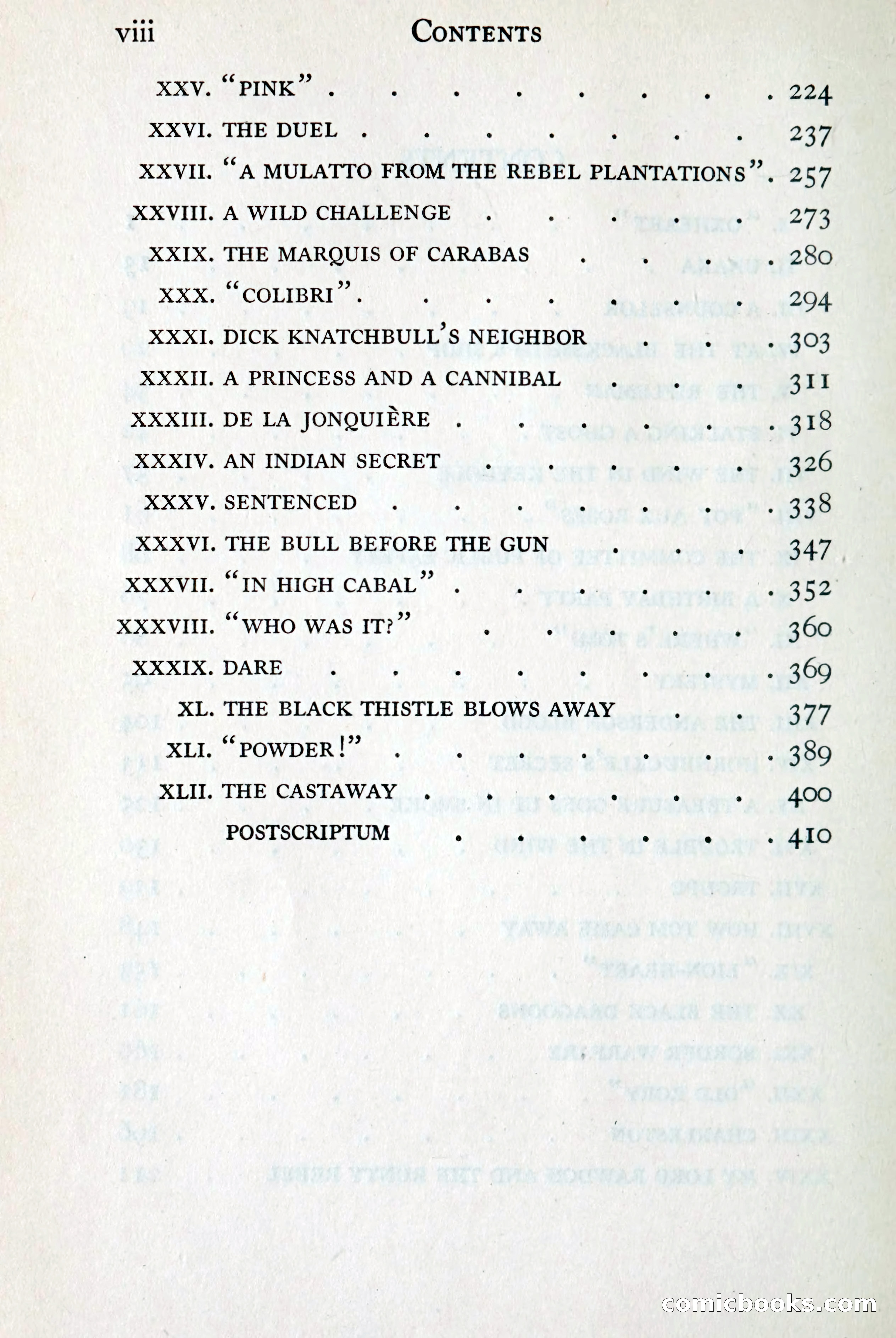
# Contents Page from a Victorian Penny Dreadful This is a **contents page** listing the chapters or installments of a serialized narrative. The page displays chapter numbers (XXV through XLII) paired with dramatic titles—"The Duel," "A Princess and a Cannibal," "An Indian Secret," "Sentenced"—alongside their corresponding page numbers (224–410). The titles suggest sensational melodrama typical of penny dreadfuls, featuring themes of violence, exotic locations, and moral transgression. The postscriptum at page 410 indicates this represents the conclusion of the work.
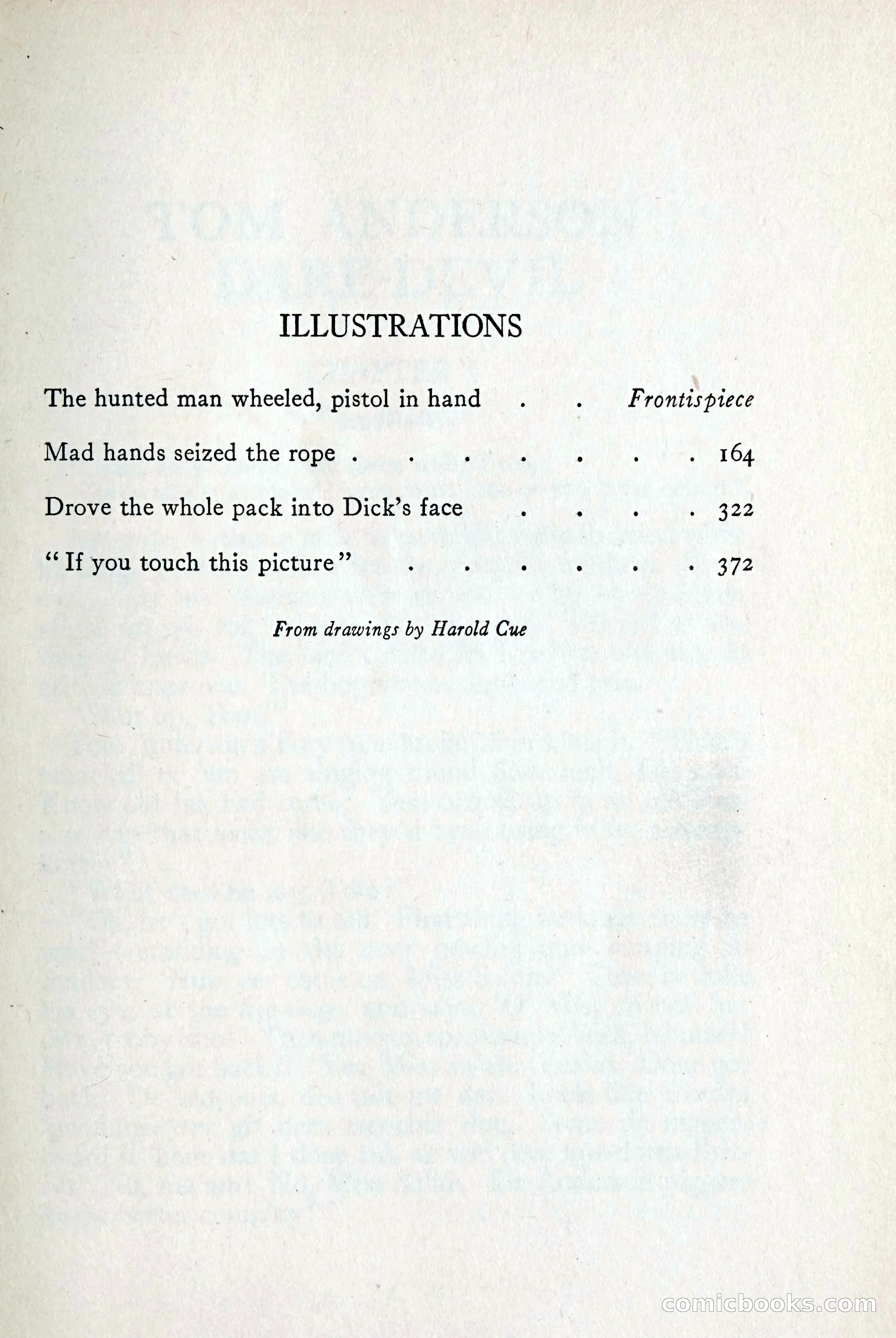
# Analysis This is an **illustrations index page** from a Victorian penny dreadful. It lists four illustrations by artist Harold Cue, with their corresponding page numbers: a frontispiece showing "the hunted man wheeled, pistol in hand"; an illustration on page 164 titled "Mad hands seized the rope"; one on page 322 depicting "Drove the whole pack into Dick's face"; and another on page 372 captioned "If you touch this picture." The page serves as a guide to locate dramatic scenes throughout the serialized story, featuring action involving weapons, violence, and apparent danger to a character named Dick.
# Analysis This is a **text page** from the opening of a penny dreadful serial titled *Tom Anderson Dare-Devil*. The page shows Chapter I, headed "Oxheart," and contains prose narrative introducing the protagonist Tom Anderson singing a Tory song during what appears to be the American Revolutionary era. Two listeners are present: a bird (joree) and a boy named Peachy Lewis. The text then shifts to dialogue between the boys discussing someone named Ish who has returned with news, reporting in dialect about redcoats and trenches. The page contains no illustrations, only printed text in a standard Victorian serif typeface.
This is a page of running prose from a penny dreadful titled *Tom Anderson, Dare-Devil*. Set in November 1779 in Virginia during the Revolutionary War, it depicts dialogue between two boys riding horseback who discuss military news, British strength, and American commanders like Lincoln and Clinton. Tom Anderson emerges as an impetuous, action-driven character who passionately argues for aggressive military tactics, while his companion Peachy admires but is sometimes unsettled by Tom's vehemence. The page concludes with Peachy mentioning that the Governor has ordered Pat Carr to manufacture tomahawks for Gates's army.
# Page Analysis This is a page of running prose from chapter 3 of a work titled *Oxheart*. The text depicts a conversation between boys—Peachy, Tom, and others—discussing Virginia's military straits during the American Revolution. They debate stories about the Governor of Virginia's desperate measures to arm troops, discuss Tom's admired brother Troupe's military equipment, and speculate about finding a new lead vein to replace one that has allegedly run out for musket-ball production. The dialogue mixes boyish bravado about pirates and combat with serious concerns about the shortage of military supplies.
# Page Analysis This is a page of running prose from what appears to be a Victorian-era serialized adventure story titled "Tom Anderson, Dare-Devil" (page 4). The text depicts Tom Anderson parting ways with a companion named Peachy at a road fork. Tom cryptically references a hidden lead-mine in Georgia, then rides alone while planning to consult with Carr, a one-legged Irish blacksmith in Charlottesville. The passage provides Carr's backstory: he lost his leg in an alligator fight in the Okefinokee Swamp, acquired a Choctaw wife and Cherokee stepson, and later enlisted with Lincoln during what appears to be the American Civil War before returning to his blacksmith shop. The text includes period dialect and uses language reflecting 19th-century racial attitudes.
# Page Analysis This is a page of running prose narrative from what appears to be Chapter 5 ("Oxheart") of a Victorian penny dreadful. The text introduces a sixteen-year-old white boy named Tom Anderson and describes his appearance and clothing in detail as he rides along a road on an autumn evening. The narrative establishes that Tom has befriended a Cherokee boy named Unaka, who possesses unexplained power over animals, and provides extensive description of Tom's garments—a mulberry coat, red waistcoat, breeches, and accessories—detailing their origins within a planter household economy that relied on enslaved and indentured labor.
This is a page of running prose from the penny dreadful *Tom Anderson, Dare-Devil*. The text depicts the young protagonist Tom Anderson's ambitions to serve in the American Revolution and his scheme to hunt for lead in Georgia to supply the Virginia Line, followed by a detailed description of Oxheart Plantation—a grand Virginia mansion with a log-house core predating Thomas Jefferson's settlement at Shadwell, expanded over generations with brick additions and a Grecian portico.
This is a page of running prose from what appears to be a Victorian-era serialized narrative titled "Oxheart" (page 7). The text describes an evening scene at a Virginia plantation house and introduces the Anderson family—a widow, her son Major Audley Anderson (connected to Washington's army), and his three children including young Tom. The passage establishes that Tom enlisted under military commander Lachlan McIntosh to conduct a campaign against Native Americans on the western frontier, foreshadowing dramatic events to come in the story.
This is a page of running prose from a Victorian penny dreadful titled "Tom Anderson, Dare-Devil" (page 8). The text describes the character Dare Anderson—a young girl fond of outdoor pursuits—and her resourceful nature, including an anecdote about her treating a rattlesnake bite by applying warm bird flesh to the wound. The passage then introduces household members at Oxheart, including a French governess named Mimi and discusses the Anderson family's French Catholic heritage and French language practices.
# Page Analysis This is a page of running prose from chapter 9 of *Oxheart*, a Victorian serial narrative. The text describes tension within a household regarding a small religious statue of the Virgin Mary ("La Vierge") that the character Mimi treasures but must hide from her grandmother, Mrs. Anderson, a Church of England woman who objects to Catholic imagery. The passage establishes Mrs. Anderson as a formidable matriarch managing a large estate while her son and grandson are away fighting (apparently in an American conflict), and portrays her as a woman of considerable authority, medical skill, and charitable works despite her religious prejudices.
# Page Content Analysis This is a running prose page (page 10) from the penny dreadful *Tom Anderson, Dare-Devil*. The text describes domestic wartime activities at Oxheart plantation, where Mrs. Anderson and her granddaughter make overcoats for Virginia troops while the household maintains production of textiles, preserved foods, and cordials. The passage includes dialogue between the children Tom and "Dare" about Mr. Carter, the Episcopal minister, and his drinking habits, followed by characterization of the grandmother Sarah Anderson as an educated woman proficient in classical languages, literature, and music—described as "absolute" in her authority.
# Analysis of Page from "Oxheart" This is a page of running prose from Chapter II of what appears to be a Victorian novel titled *Oxheart*. The text discusses a character named Dare (christened Mary Josephine) and her grievance with her grandmother over her nickname, rooted in Protestant-Catholic family tensions. The passage then describes an old portrait of "Lady Dare" dating before the Restoration, mocking its subject's appearance, before digressing into commentary on colonial-era craftsmen like the cabinet-maker McClarity who worked on the plantation. The page contains dialect speech from enslaved characters named Tom and Dilsey.
This is a page of running prose from a Victorian penny dreadful titled "Tom Anderson, Dare-Devil." The text describes how a character named Ole, an old Swedish saddle-maker whose name "Olaf Fauchetegoat" has been a source of jokes, was set to making cavalry saddles. The passage characterizes Ole as an excellent but extremely slow workman, comparing his sluggishness to something that would make even a tortoise envious. The page number is 12, indicating this is mid-narrative rather than an opening or title page.
# Page Description This is running prose from Chapter II, titled "Unaka." The page depicts Tom's arrival at an estate where he encounters two young women, Dare and Mimi, described in vivid Victorian detail. Tom receives a letter (not a handkerchief as initially thought) brought by the Governor's express, which he reads. The letter, from what appears to be a military figure addressing "Madam," requests that a servant named Ishmael be sent immediately with clothing and supplies to Indian Land, mentioning the "enemy" and referencing a defeat at Savannah—suggesting a Revolutionary War or Civil War context. The sender also notes his English mare has been sent home due to illness.
# Page from "Tom Anderson, Dare-Devil" (Victorian Penny Dreadful) This is running prose from page 14 of a serialized adventure tale. The page depicts a letter from a Southern officer (apparently named Troupe de Berrien Anderson) written during the American Revolution, discussing his absence and expressing affection through romantic verse. The narrative then shifts to a scene where Tom and others receive the letter and a visitor arrives—a coarse, muscular man with prominent teeth who speaks in rough dialect about tobacco prices and the British occupation, before greeting "Miss Dare" familiarly. The footnote clarifies the letter is based on an actual historical document from a Southern officer during the conflict with Britain.
# Page Analysis This is running prose from page 15 of a Victorian penny dreadful titled *Unaka*. The narrative depicts a Southern American household during wartime, where a boy dismisses his father's overseer, and an eavesdropping figure (Egger) overhears mocking verse about the Devil. Grandmother Anderson gathers the household to hear a historical account read aloud, then sends servants to summon Ishmael and prepare supplies. Mrs. Anderson conveys a letter from "the Heir" regarding military movements and General Lincoln's retreat to Charleston, discussing whether a mare has been stolen. The scene involves dialogue in dialect and spans domestic and military concerns during what appears to be the American Civil War era.
This is a page of running prose from *Tom Anderson, Dare-Devil*, a Victorian penny dreadful. The text depicts a farewell scene in which Mrs. Anderson prepares a man named Ishmael for a journey, providing him with a militia coat and warning him of redcoats and smallpox. Young people have written letters sealed with wax and keepsakes for someone named Troupe. The passage ends with Tom, restless during a Bible reading, stealing away to hunt an owl outside, where someone unexpectedly touches his shoulder.
This is a page of running prose from a penny dreadful titled "Unaka" (page 17). The text describes a Cherokee boy named Unaka possessing seemingly supernatural abilities to communicate with animals. Tom, a white boy, witnesses Unaka use a leaf-whistle to summon various birds—a great horned owl, waxwings, bluebirds, a nighthawk, and a logcock—which gather around the Indian in an apparently magical display. The narrator emphasizes the extraordinary nature of what Tom observes, asserting "That he actually saw what is here set down, I aver."
This is a page of running prose from page 18 of *Tom Anderson, Dare-Devil*, a Victorian penny dreadful. The text describes a chaotic scene in which numerous birds—linnets, thrushes, wrens, robins, and a hundred-year-old blue heron—suddenly swarm around a character named Unaka (described as Cherokee). Tom watches eagerly as a great horned owl perches on Unaka's wrist; when Tom asks whether to wring its neck, Unaka commands the bird to leave, and then mysteriously vanishes himself.
# Page Analysis This is a page of running prose from Chapter III ("A Counselor") of what appears to be a Victorian-era serialized novel. The text depicts a tense nighttime confrontation at Ishmael's cabin, where Tom arrives to find a man named Egger already present and angry. The dialogue, rendered in heavy dialect, involves threats and discussion of livestock and discipline; Egger appears to be Ishmael's overseer or employer, while Tom defends his father's enslaved servants from mistreatment. The scene combines melodramatic tension (shadow of a clenched fist) with period vernacular speech suggesting an American Southern setting, though the work's exact origin and title remain unclear from this page alone.
# Page Analysis This is a page of running prose from the penny dreadful *Tom Anderson, Dare-Devil* (page 20). The text presents an extended dialogue in heavily dialectalized speech between what appears to be an overseer named Lum Egger and a character addressed as Master Tom. Egger defends his harsh management of enslaved and poor white laborers on a plantation, boasting of his authority and physical control. The passage then shifts to third-person narration acknowledging the overseer's reputation and Tom's discomfort with Egger's aggressive argument. The content reflects the sensationalist, violent tone typical of Victorian penny dreadfuls, with the dialect and brutal subject matter characteristic of the genre's melodramatic style.
# Page 21: Running Prose This is a page of running prose from chapter "A Counselor" (page 21). A young man confronts an overseer about his abusive language toward an elderly family servant named Ishmael, defending the servant's dignity and warning that his father would not tolerate such treatment. After the overseer leaves with veiled threats, Ishmael speaks with the young man (apparently named Tom) in dialect, mentioning someone called "Marse Troupe" who appears to be away, possibly in military service. The dialogue employs heavy dialect spelling characteristic of the period.
This is a page of running prose from *Tom Anderson, Dare-Devil*, a Victorian penny dreadful (page 22). The text presents two interconnected scenes: first, a dialect-heavy anecdote told by a character named Ish about a Revolutionary War encounter between Captain Ben Taliaferro and a British officer, emphasizing Taliaferro's defiant pride; second, Tom's reaction to a bundle of clothes sent by Mrs. Anderson, followed by Ishmael's mention of someone named Peake Dangeridge—a name the narrator hints will prove significant to Tom's future.
# Page Analysis This is a page of running prose text from Chapter 23 titled "A Counselor." The text appears to be dialect narrative—likely a character recounting a story in heavily phonetic Southern American English. The passage describes a poor white boy named Peake who, lacking family and resources, grows up to become an eccentric figure known for drilling a blue bull like a military recruit, using commands from military manuals ("Steuben and Duane"). The narrator humorously details how Peake eventually asks a Major (Audley) for permission to drill the militia using similar methods. The writing style is characteristic of nineteenth-century popular fiction employing exaggerated dialect for comic effect.
# Page Analysis This is a page of running prose from a Victorian penny dreadful novel titled "Tom Anderson, Dare-Devil" (page 24). The text consists of two narrative passages: the first is a lengthy dialect monologue describing a drill sergeant named Peake brutally training militia in intense heat, and the second shifts to a scene where a character named Tom notices a spy watching through a fireplace. A character named Ishmael confronts the intruder, who reveals himself as "Fool Billy," a deformed ten-year-old of mixed Shawnee and African descent. The passage employs heavy phonetic dialect and sensational melodramatic language typical of the genre.
# Page Analysis This is a page of running prose from a Victorian penny dreadful novel titled *A Counselor*. The text depicts a scene in which characters named Ishmael and Billy (a dwarf with black wool hair) interact with someone called Tom, discussing witches and apples. The dialogue is written in heavy dialect featuring racist language and caricatured speech patterns typical of period entertainment. The passage describes Billy hiding in a meal-sack and being offered apples while characters converse about supernatural afflictions and mischief.
# Page Analysis This is running prose from page 26 of *Tom Anderson, Dare-Devil*, a Victorian penny dreadful. The text depicts a tense nocturnal conversation between characters named Tom, Ishmael, and Billy (described as "the Fool"). Billy mentions a man sleeping in the Old Graveyard and speaks of freeing someone called "Big Busher," while threatening to harm a character named Egger. Billy then departs singing a bawdy song about marriage and dancing. The passage uses heavily dialectal speech (likely representing African American vernacular of the period) and concludes with Ishmael warning Tom that something is wrong, referencing Egger's knowledge of recent events.
# A Page of Dialogue from a Victorian Penny Dreadful This is a page of running prose (page 27, titled "A Counselor") containing dramatic dialogue in heavily dialectalized speech. The conversation concerns a character named Egger attempting to bribe another character into carrying a letter to Colonel Prevost at Savannah via British lines during what appears to be the American Revolution. When the bribe is refused, Egger angrily threatens the character and accuses him of disloyalty. A third character (Tom) responds with outrage, calling Egger "a Tory" and "the traitor," while another voice counsels caution, suggesting they should "crope mighty slow." The passage depicts wartime espionage and divided loyalties.
# Analysis This page contains **running prose dialogue** from the narrative of Tom Anderson, Dare-Devil (page 28). The text depicts a conversation between characters discussing a traitor overseer at a plantation called Oxheart during what appears to be the American Revolutionary period. One speaker urges the young "Marse Tom" to act like a man and watch the overseer, warning that British forces are approaching and the overseer may aid them by providing supplies and enslaved people. The dialogue is written in heavily dialectalized vernacular that reflects period stereotypes about enslaved and working-class characters. No illustrations or title elements appear on this page.
# Page Analysis This is a running prose page from Chapter IV of what appears to be a Victorian-era novel or serial fiction. The text describes a blacksmith's shop on the Charlottesville road, owned by a man named Carr, who has an Indian wife named Sehoy. It focuses on Tom Anderson's visits to this household and his relationships with Carr, Unaka (a Cherokee youth), and the animals kept there—including a dog, parrot, and pigeons. The passage emphasizes the domestic scene and cross-cultural interactions within this frontier household.
# Page Analysis: Tom Anderson, Dare-Devil This is a page of running prose (page 30) from the penny dreadful serial *Tom Anderson, Dare-Devil*. The text depicts a character (apparently named Carr) telling frontier stories in dialect about hunting and survival in frontier swamps, followed by a description of his cabin filled with tamed animals. The passage concludes with a shift to narrative about a schoolboy in Charlottesville who receives a secret from someone named Ishmael before a snowstorm arrives, and mentions the boy preparing to read "Dispatches from Gaul" aloud—though the text's significance remains unclear at this point.
# Page Analysis: "At the Blacksmith's Shop" This is a page of running prose narrative text (page 31) from what appears to be a serialized story. The text describes a young boy's arrival at a blacksmith's shop after school, where he encounters the blacksmith Carr, a Native American character named Unaka making arrows, and others working at the forge. The passage includes dialogue in dialect and a folk song about "Bryan o' Lynn," and depicts the boy taking a turn working the anvil while the blacksmith shapes a horseshoe. The narrative blends scenes of manual labor with descriptions of craftwork, including detailed description of an ornate Native American blow-gun.
# Page Description This is a page of running prose (page 32) from the penny dreadful *Tom Anderson, Dare-Devil*. The text presents a dialogue in heavily phonetic Irish dialect between characters discussing historical correspondence between French and British military commanders during what appears to be the American Revolutionary War, specifically involving Savannah. One character recounts humorous anecdotes about overhearing letters between Count D'Estaing and Colonel Prevost, culminating in a comedic exchange where Prevost allegedly responds to a French surrender demand with "You-go-ter-hell!" The passage exemplifies the penny dreadful's characteristic blend of serialized narrative, dialect humor, and dramatic historical reference.
# Page Analysis This is a page of running prose from a Victorian penny dreadful (page 33, titled "At the Blacksmith's Shop"). The text consists of dialogue and narrative describing a conversation between characters named Pat and Tom. Pat recounts military experiences—apparently from the American Revolution, mentioning battles at Horsepittle Hill and Savannah, and figures like Pulaski and General James Jackson. He quotes letters and official correspondence in mock-Irish dialect, describing combat and injury. The passage ends with Tom announcing he plans to go to Georgia, interrupted by someone calling from a blacksmith's shop—an event described as setting "the train of events" affecting the Anderson family. The narrator emphasizes young Anderson's reaction to hearing this voice as a soul-defining moment.
This is a page of running prose from Chapter V ("The Rifleman") of a Victorian penny dreadful. The text depicts a mysterious young stranger arriving on horseback at a blacksmith's forge in snowy weather, requesting urgent horseshoe repairs. As the blacksmith and his assistants work, the stranger's impatience becomes apparent, and when torchlight reveals his clothing—muddy riding-boots and a flash of scarlet military uniform beneath his cloak—his true identity as a soldier is exposed, suggesting a plot element involving a military figure in hiding or on urgent business.
This is a page of running prose from *The Rifleman*, a Victorian penny dreadful. The text depicts a dramatic scene in which Tom and a Cherokee named Unaka discover a British officer and plot to capture him by bewitching his horse, the Gray Goose. The mare becomes spooked, throws her bridle, and gallops frantically across a moonlit field while the officer struggles to control her. The passage mixes action, dialogue, and sensational description typical of the genre.
This is a page of running prose from a Victorian penny dreadful titled *Tom Anderson, Dare-Devil* (page 36). The text describes Tom witnessing a woman flee on horseback through snow, then a soldier abandoning his horse on foot—apparently a British spy. Tom, excited at the prospect of capturing a "redcoat," pursues along a snowy road until a mysterious, extraordinarily tall man on horseback with bandaged jaws gallops up, silently beckons Tom forward with urgent gestures, and Tom follows him. The narrative emphasizes melodramatic action and Tom's youthful daring.
This is a page of running prose from a Victorian penny dreadful titled *The Rifleman* (page 37). The text depicts an action sequence in which a boy named Tom and a skilled rifleman on horseback pursue and shoot a man in a black riding-cloak trudging through snow. Tom attempts to warn the fugitive but faints at the sight of the man being shot. The rifleman, wearing a coon-skin cap and with bandaged jaws, then revives Tom and mysteriously signals him to follow into the night. The passage combines frontier action with dramatic melodrama typical of the genre.
# Page 38: Tom Anderson, Dare-Devil This is a page of running prose from a Victorian penny dreadful. The text describes Tom discovering that a wounded man's horse (the Gray Goose) is bleeding, then feeling remorse for having taken the animal. Tom and companions set out in heavy snow to find the injured man near some bushes, but when they search with a lantern, they discover no body at the location where the man was supposedly lying. The passage emphasizes Tom's mounting distress and confusion as the search yields nothing.
# The Rifleman, Page 39 This is running prose text from what appears to be the middle of a serialized narrative. The passage depicts characters discovering mysterious footprints and discussing an apparent abduction, then shifts to a character named Tom returning home to find the household in disarray—servants missing, stable keys gone, and what he suspects is deliberate sabotage ("spite work"). The dialogue employs Irish dialect and period vernacular typical of Victorian sensation fiction.
This is a page of running prose from a Victorian penny dreadful titled "Tom Anderson, Dare-Devil" (page 40). The text depicts a confrontation between Tom and a man named Egger over stable keys, followed by Tom's arrival at a house where he encounters servants and his grandmother. The dialogue is written in heavy dialect representing working-class and rural speech patterns. Tom appears distressed and snow-covered as he enters his grandmother's room, where she sits alert with her Bible, apparently waiting to question him about something significant.
This is a page of running prose from the middle of a Victorian penny dreadful serial titled "The Rifleman" (page 41). The text depicts a domestic scene where a young man returns home to Sarah Anderson, who offers him supper and hospitality despite sensing he is troubled and distracted. He has apparently been absent since leaving school and is preoccupied with recent events involving an overseer and Major Anderson's son, as well as some unspecified promise to "be on his guard." The prose combines melodramatic dialogue with psychological observation of the characters' emotional states.
# Page Description This is a page of running prose from Chapter VI, titled "Stalking a Ghost." The text describes two boys investigating a mysterious incident involving a dead redcoat, only to find the trail obscured by cattle. The narrative then shifts to Tom returning home to find Mrs. Anderson (apparently his grandmother) ill, with a doctor in attendance. Through dialogue between Tom and his sister Dare, hints emerge that the grandmother may be delirious or "out of her head," as she has apparently sent an urgent message requesting to speak to someone—likely Tom's father. The passage suggests an atmosphere of concern and mystery around the grandmother's condition and the father's whereabouts.
This is a page of running prose narrative from a Victorian penny dreadful titled "Stalking a Ghost" (page 43). The text depicts a dramatic domestic scene in which a character named Tom learns from a servant named Dilsey that his grandmother is seriously ill with fever. Tom expresses conflict between staying to care for her and attending to some urgent matter elsewhere; Dilsey reassures him the doctor will arrive soon. The passage concludes with Tom departing on horseback at dusk across a snowy landscape, muttering about his dilemma. The dialect-heavy dialogue and melodramatic emotional intensity are characteristic of the genre.
# Page 44: Running Prose from "Tom Anderson, Dare-Devil" This page contains running prose text from what appears to be a serialized penny dreadful adventure story. The passage describes Tom Anderson and a companion (Unaka) venturing into snow-choked woods where they encounter a starved, half-tamed wolf called "the Governor," hear mysterious singing about Cornwallis, and glimpse what they believe to be a supernatural apparition—a ghastly-faced figure in a red coat carrying a sword. Frightened by what seems a spirit, both boys flee into the darkness as a mournful howl sounds from the woods.
This is a page of running prose from a Victorian penny dreadful titled "Stalking a Ghost" (page 45). The text describes a tense scene in which characters pursuing a wolf discover a dead body—"the corpse in the red coat"—propped in church pews, along with a terrified girl who nearly shoots the wolf. The passage emphasizes gothic atmosphere through descriptions of moonlight, the abandoned church, and the macabre discovery of the uniformed corpse with a sword beside it.
# Page 46 of Tom Anderson, Dare-Devil This is a page of running prose from a Victorian penny dreadful serial. The text describes Dare visiting a sick Irish immigrant woman named Molly Randy, then accompanying Mimi to a church to retrieve a Madonna statue left behind at a christening. In the darkened church, Mimi encounters a mysterious, haggard young man who identifies himself as "Tarleton." The passage emphasizes Gothic atmosphere—the dim light, Mimi's terror, the stranger's bloodshot eyes and disordered appearance—building suspense about this apparition's identity and intentions.
# Page 47 of "Stalking a Ghost" This is a page of running prose from a Victorian penny dreadful. The narrative depicts a dramatic scene in which a character named Dare discovers a wounded British cavalry officer, Colonel Tarleton, collapsed in a church pew. A French girl named Mimi rides for help while Dare remains to tend the officer, giving him water and loosening his stock. The passage ends ominously with a wolf's howl echoing through the darkness, creating suspense about an impending danger.
This is a page of running prose (page 48) from the penny dreadful *Tom Anderson, Dare-Devil*. The text describes a dramatic scene in which a starved wolf attacks an injured soldier, a girl nearly shoots it, and Tom stops her. Dr. Pratt then arrives and discovers the wounded man is Colonel Tarleton, described as "the arch-fiend of the British army." The passage ends with the characters realizing the significance of having captured this notorious British enemy as a patient, hinting at future complications and dramatic possibilities.
This is a page of running prose from the penny dreadful *Stalking a Ghost* (page 49). The text depicts a dramatic scene in which characters debate whether to secretly transport an injured British officer—apparently Colonel Tarleton—to a house for concealment. Tom and Dr. Pratt argue over the plan while snow falls around them, providing cover. They load the wounded man into a gig (carriage) and arrive at what appears to be the Anderson estate, where Dr. Pratt cautions Tom not to alarm Mrs. Anderson. The passage emphasizes the dangerous, clandestine nature of their undertaking during what appears to be the American Revolutionary War era.
This is a page of running prose from the penny dreadful "Tom Anderson, Dare-Devil" (page 50). The text describes a mysterious strong man named Peter Francisco arriving through the snow to help carry a wounded man into a house, and subsequently a character named Dilsey learning of the plan and expressing fear about hiding this injured man—apparently a redcoat (British soldier)—in the house without the knowledge of Miss Sarah or others in the community. The passage emphasizes Francisco's extraordinary strength and his refusal of payment for his assistance.
# Page Analysis This is a running prose page (page 51) from the penny dreadful *Stalking a Ghost*. The text depicts enslaved servants—particularly a woman named Dilsey—discussing how to hide a man (apparently a British soldier or fugitive) from militia who intend to execute him. Dilsey protests the plan to conceal him in the loom-room, citing practical obstacles with her work, but ultimately complies and prepares a bed there with help from other servants. The passage includes dialect-heavy dialogue rendered in period conventions and narrative description of the servants' actions and motivations.
# Page 52 of Tom Anderson, Dare-Devil This is a running prose page from a Victorian penny dreadful serial. The text describes Dr. Pratt arriving to treat a wounded man (Tarleton, apparently a British officer) who has been shot. Upon examination, the doctor discovers the rifle ball lodged in Tarleton's brass belt-buckle, which saved his life. Tom witnesses this discovery with emotional relief, having previously blamed himself for the man's injury. A footnote notes the incident is "not fiction, but fact."
# Page Analysis: *Stalking a Ghost*, Page 53 This is a page of running prose from the middle of a Victorian penny dreadful serialization. A doctor has just examined a wounded, feverish man in hiding—apparently a soldier or "Terrible British Dragon"—warning those sheltering him to maintain absolute secrecy or "it's all up with him." The narrative then shifts to describing how the Anderson family, using a secret door in their schoolroom known only to grandmother, has moved the patient to a hidden room in the house's extension, where the doctor later checks on him and grimly tells the young people attending him that he is critically ill but urges them not to give up.
# Page Description This is running prose from page 54 of *Tom Anderson, Dare-Devil*, a Victorian penny dreadful. The text describes a household in crisis: Mrs. Anderson is mysteriously ill and confined, a dying man is hidden in the loom-room, and visitors are strictly forbidden entry. Tom and Dare maintain self-control despite their distress. The passage then shifts to Dilsey, a servant, managing domestic complications—keeping the looms running despite the freezing weather while concealing the household's true situation. Dare grows suspicious that Dilsey's claims of the mistress improving may be false, noticing the absence of any message from the supposed convalescent.
# Page Content Analysis This is a page of running prose from chapter 55 of "Stalking a Ghost," a Victorian penny dreadful. The narrative follows Tom and a character named Dare as they navigate suspicious circumstances involving a hidden person (referred to as "Mimi") and a potentially threatening overseer named Egger. The text depicts tension at a supper table, dialogue in dialect, and Tom secretly bringing Dare to a schoolroom where someone is apparently being concealed. The prose emphasizes secrecy, surveillance anxiety, and melodramatic suspicion typical of the sensation fiction genre.
This is a page of running prose from the penny dreadful "Tom Anderson, Dare-Devil" (page 56). The text describes a girl entering a loom-room—an old section of a house that resembles a ship in construction—which now appears strange and unfamiliar to her despite her familiarity with it. The passage emphasizes her nervous state through atmospheric language, noting how she seems compelled to enter "as if led by 'a spirit in her feet.'" The descriptive style employs nautical and architectural imagery to convey both the room's physical qualities and the girl's heightened emotional tension.
This is a page of running prose from Chapter VII ("The Wind in the Keyhole") of a Victorian penny dreadful. The text depicts a sickroom scene where a character named Dare grieves over a dying man (apparently a British soldier or "redcoat" named Tarleton, referred to as "the Enemy of Our Country") while Tom expresses loyalty to him despite political divisions. A doctor diagnoses pleuro-pneumonia and praises the patient's youth and his nurse. The passage concludes with description of a ten-day snowstorm isolating the mansion in deepening gloom, establishing an atmosphere of suspense and melodrama typical of the genre.
# Page 58: Running Prose from "Tom Anderson, Dare-Devil" This page contains continuous narrative prose from a Victorian penny dreadful. The text describes a young woman named Dare observing mysterious activity in a house where servants have been dismissed and secrets are being kept. A doctor (Dr. Pratt) appears to be hiding a dangerous guest named Oxheart. Dare grows increasingly anxious about concealed secrets, and the passage culminates with her awakening to sounds of multiple men moving through the house at night—which she suspects may be soldiers. The prose emphasizes gothic atmosphere and melodramatic tension.
This is a page of running prose from the novel *The Wind in the Keyhole*, page 59. A young girl, awaiting news of her father's return, awakens and becomes increasingly distressed. She sneaks upstairs to Mrs. Anderson's locked room, where she hears an eerie, mournful sound—wind whistling through the keyhole—though the windows are closed. The passage combines gothic atmosphere with melodramatic tension typical of Victorian sensation fiction, focusing on the child's growing anxiety and the supernatural mystery of the unexplained sound.
# Page Analysis This is a page of running prose from a Victorian penny dreadful serial titled *Tom Anderson, Dare-Devil* (page 60). The text describes a dramatic moment in which a female character—apparently named Dare—discovers an emptied, ransacked room. She kneels in distress, praying urgently ("O God, don't let it be!"), then stumbles onto a balcony to find the furniture stripped away, the hearth filled with black cinders, and everything "dismantled" and "desolate." The passage culminates in her losing consciousness for the first time in her life. The prose is highly melodramatic, typical of sensation fiction aimed at working-class Victorian readers.
# Page Description This is a page of running prose from Chapter VIII, titled "Pot aux Roses." The text depicts a scene in which a character named Dare awakens after an illness to find her grandmother, Mrs. Anderson, present. Mrs. Anderson reveals she has recovered from smallpox and credits her survival to Dr. Pratt and Dilsey's care. The passage emphasizes emotional reunion and gratitude, with detailed description of the domestic setting (a horsehair sofa, a room called "Cousin Elinor's room") and the serving of tea and biscuits. No illustrations appear on this page.
# Page 62: Running Prose This is a page of running prose narrative from the penny dreadful *Tom Anderson, Dare-Devil*. A grandmother recounts to an unnamed listener how she survived smallpox without scarring by using red silk curtains, screens, and a mask—a remedy based on old Elizabethan medical tradition inherited from an ancestor, Sir Humphrey Denny, who served as councilor to Henry the Eighth. She also describes burning furniture, including carved rosewood, as part of infection precautions, and compares her resourcefulness to her grandson Tom's similar problem-solving nature.
# Page Analysis This is a page of running prose (page 63) from a Victorian sensation novel titled *Pot aux Roses*. The text depicts dialogue revealing how the narrator's grandmother contracted smallpox: she received a letter from a soldier at a campfire near Charlottesville, noticed he appeared ill with smallpox, and deliberately burned the letter to prevent contagion—sacrificing news from her son. The page continues with lighter conversation among characters including Dare, Mimi, Tom, and Peachy Lewis, who arrives on horseback with gossip about a dispute between the Governor and General Washington, and mentions supplies sent from Monticello for the grandmother's recovery.
This is a page of running prose from the penny dreadful "Tom Anderson, Dare-Devil" (page 64). The text depicts a conversation among young characters discussing a letter from General-in-Chief Washington regarding military supplies and strategy. After Tom mentions the letter's contents, the narrative shifts to describe a visit by three young people—Mimi, Dare, and Tom—to call on a recovering Colonel Tarleton, whom the text portrays as a charming gentleman with striking blue eyes and fair hair tied back with a black ribbon.
This is a page of running prose (page 65) from a Victorian penny dreadful titled "Pot aux Roses." The text depicts a dramatic scene in which servants and household members discuss a recovering soldier's remarkable improvement in health, speaking in exaggerated dialect. The passage then shifts abruptly to violence: a man named Egger whips a character called Billy in the garden while another character named Tom attempts a desperate rescue by climbing down ivy from a window, injuring his hands in the process. The scene emphasizes melodramatic tension and social conflict.
This is a page of running prose from page 66 of a penny dreadful titled *Tom Anderson, Dare-Devil*. The text describes a violent fight between Tom and a man named Egger over a boy called "Fool Billy," whom Egger has been whipping. Tom defeats Egger, knocking out his front tooth, and threatens him with jail if he harms Billy again. Egger retaliates with his own threat before departing. The passage concludes with dialect-heavy comic banter among Black characters, one of whom makes a joke about Billy's appetite.
This is a page of running prose from a Victorian penny dreadful titled "Pot aux Roses" (page 67). The text depicts a dramatic scene in which a character called "the Fool" approaches someone addressed as "Marse Tom," claiming to have obtained something (indicated by "Got 'em"). The Fool then holds what appears to be bloody teeth and speaks in dialect, mentioning witches and someone named Egger. The passage emphasizes sensational horror and violence typical of penny dreadful fiction.
# Page Analysis This is running prose from Chapter IX of a Victorian penny dreadful. The chapter, titled "The Committee of Public Safety," depicts Tom coming downstairs with news that a Colonel and "madam" (apparently guests) are recovering from illness. Tom and his sister are instructed to shield their grandmother from any distressing news. The passage then describes ten days during which the young people grow attached to their "distinguished guest," who entertains them by singing London songs, teaching chess, and sharing a new Scottish ballad he claims was written by someone he knows—though he won't name the author lest it spoil the song.
# Analysis of Page 69 This is a page of running prose from chapter titled "The Committee of Public Safety." The text depicts a dramatic moment in which a mysterious, unnamed Colonel—hiding at Oxheart House to escape hanging—reveals that a sketch drawn by a governess depicts Leslie Park in Sussex, his own home. The revelation distresses him deeply. The scene then shifts to a missing waxen Madonna statue that vanishes from the mantelpiece, sparking comic dialogue among servants (Tom, Dilsey, and Ole) who debate whether a rat or supernatural forces are responsible. The prose combines melodramatic tension with dialect humor typical of Victorian penny dreadfuls.
# Page Content Description This is a page of running prose (page 70) from the penny dreadful *Tom Anderson, Dare-Devil*. The text describes a dramatic sequence: a one-eyed cat becomes terrified at a wax image on a mantelpiece and flees into the fireplace; later that night, Tom and an Englishman play chess when they hear what sounds like cavalry outside. Mounted men ride around the house and ring the doorbell loudly, alarming Tom. The passage emphasizes Gothic suspense and mystery, with a servant named Dilsey fleeing in superstitious fear and the protagonists wondering whether a spy approaches.
# Page 71: Running Prose from "The Committee of Public Safety" This is a page of running prose narrative (page 71) from a serialized penny dreadful. The text depicts a tense scene in which a man and his companion flee through a house as armed men arrive searching for a British officer. The men hide in a four-poster bed's corniced frame while armed pursuers, identifying themselves as the "Committee of Public Safety," conduct a search below. The passage emphasizes suspense through descriptions of darkness, urgent movement, and the approaching danger of discovery.
# Page 72: Running Prose from "Tom Anderson, Dare-Devil" This is a page of running prose narrative from a penny dreadful serial. The text describes Tom Anderson hiding a telltale red coat and accidentally striking his head while fleeing from a Vigilance Committee searching the mansion. The committee finds Tom unconscious and discovers a locked chamber—apparently used to quarantine smallpox victims—containing only ashes, soot, and a large horned owl. Old Seaborn, the butler, reports indignantly to Mrs. Anderson that the midnight intruders were not after British officers, and that the vigilantes found nothing suspicious in the plague-room.
# Page Analysis This is a page of running prose from Chapter 73 of what appears to be a Civil War-era penny dreadful titled "The Committee of Public Safety." The text depicts a tense scene at Oxheart House where characters learn that armed vigilance men have been searching for someone (apparently a Colonel). Tom has been knocked unconscious during their visit, and the enslaved character Dilsey reveals the Colonel is hidden in a room with smallpox patients. The dialogue, rendered in period dialect, suggests suspense and danger involving vigilante violence and what may be political conflict.
# Page Description This is a page of running prose (page 74) from the penny dreadful *Tom Anderson, Dare-Devil*. The text describes a spy named Billy climbing a chimney at night to peek through a window at people inside a house, stealing a small Madonna figurine, and being caught by an overseer. It concludes with a character named Egger apparently discovering a "red-coat" (likely a soldier or authority figure) and riding urgently to Charlottesville to report something that will bring "disaster to the Anderson family." The narrative emphasizes suspense and melodrama typical of Victorian sensation fiction.
This is a page of running prose from what appears to be the middle of a serial story. The page header identifies it as part of "The Committee of Public Safety" (page 75). The text describes a character named Ole who, after mending the Colonel's riding-boots, puts them on along with a gold-laced coat and hat, then admires himself in a mirror in a schoolroom. Someone named Egger witnesses this, which apparently triggers the arrival of "the Committee of Public Safety" at a place called Oxheart House. The passage suggests a moment of discovery that prompts a larger consequence or plot development.
# Page Description This is running prose text—specifically the opening of Chapter X titled "A Birthday Party" from a Victorian penny dreadful. The passage describes Pat Carr's arrival at Oxheart House bearing venison during an approaching storm, and his discovery that the schoolroom has been transformed into a festive space to celebrate someone's birthday. The text details the decorated room's appearance—filled with greenery, wax lights, flowers, and dressed-up inhabitants—and notes the various characters present, including Mimi, Dare, and Ole. The narrative tone is characteristic of Victorian sensation fiction, mixing domestic detail with hints of prior drama.
This page contains running prose from Chapter 77, titled "A Birthday Party." The text describes a mysterious tall young man arriving at a birthday celebration, dressed in fine claret-colored velvet finery. Characters Pat and Tom react with surprise and emotion upon recognizing him as someone they had previously helped—apparently a wounded man they had sheltered during snow and siege conditions. The passage includes dialogue in Irish and other dialects, with references to a Vigilance Committee investigation and suspicions directed at someone called Oxheart. The scene depicts a reunion among friends with undertones of danger and past conflict.
This is a page of running prose from page 78 of *Tom Anderson, Dare-Devil*, a Victorian penny dreadful. The text describes a birthday celebration for a character called "the Colonel," where various international characters (a Frenchwoman, a Swede, an Irishman, a Virginia boy, and others) gather around a elaborate white cake decorated with frosting details. Tom serves as toastmaster while guests offer successive toasts to the Colonel's health, each in their own characteristic voice and manner, culminating in Tom's final Upsee-English toast.
This is a page of running prose from a Victorian penny dreadful titled "A Birthday Party" (page 79). The text depicts a birthday celebration where guests offer toasts, including one to a Colonel and another prompted by a parrot named Don Miguel who shouts "God save the King!" A young gentleman in ball dress repeats this toast, and immediately thereafter a violent thunderbolt strikes, shaking the house. The characters react with alarm, though one character named Tom dismisses concerns and another named Dilsey expresses ominous foreboding about the coincidence of pledging the King's health indoors.
# Page Analysis: Tom Anderson, Dare-Devil This is a page of running prose (page 80) from a Victorian penny dreadful serialization. The text depicts a birthday celebration scene in which characters gather around a fire during a storm, eating cake and singing period songs—including Revolutionary-era ballads and folk songs like "Malbrouck" and "Loudon's Bonny Banks and Braes." The passage emphasizes the festive atmosphere while a character named Dare performs a melancholic verse suggesting separation caused by war and vengeance. No illustrations appear on this page.
# Page Analysis This is a page of running prose from a Victorian penny dreadful titled "A Birthday Party" (page 81). The text depicts a dramatic scene in which a lightning flash frightens servants in an old schoolroom, and a mysterious tall woman emerges from the shadows claiming to be "the mistress of this house." A character named Pat attempts to defuse the tension by quoting from something called the "Official Correspondence," while other characters interrupt rudely—one throwing an apple core from the rafters. An Englishman then steps forward to introduce himself to the woman. The narrative emphasizes melodrama, provincial dialect speech, and supernatural tension characteristic of the genre.
# Page 82 of "Tom Anderson, Dare-Devil" This is a page of running prose from a Victorian penny dreadful serial. The passage depicts a dramatic domestic confrontation: Tom introduces a British officer he believes to be Colonel Tarleton to his grandmother, Mrs. Anderson, in what appears to be a Rebel (American) household during wartime. Mrs. Anderson is horrified and accuses the man of treason, but Tom then reveals that while the officer *called himself* "Tarleton" in delirium, they only referred to him as "the Colonel"—suggesting possible mistaken identity. The text emphasizes melodramatic emotion: fainting, shock, patriotic outrage, and dramatic revelations.
# Page Analysis This is a page of running prose from Chapter 83, titled "A Birthday Party." The text depicts a dramatic scene in which a mysterious Englishman reveals himself to be Arthur Leslie, eldest son of Sir Edward Fortescue Leslie of Sussex—not the fugitive "Tarleton" as previously believed. Sarah Anderson and her grandson decide to shelter him despite learning he is British, with Mrs. Anderson ordering candles lit and doors locked. The scene concludes with Peachy Lewis arriving with cryptic knowledge about someone called "Marse Troupe," while rumors of a Vigilance Committee visit and a British fugitive circulate in the background.
This is a page of running prose from the penny dreadful *Tom Anderson, Dare-Devil* (page 84). The text describes a scheme to help a young man escape danger: after Tom's story reassures Mrs. Anderson about her son's bravery, the characters decide to write a letter to Mrs. Grattan in Philadelphia, asking her discretely to help smuggle "Leslie" away using her traveling teams. Tom volunteers to deliver the letter immediately on horseback, riding a swift mule called Ma'y Jane, expecting to return before midnight.
# Page Analysis This is a page of running prose narrative (page 85) from a Victorian penny dreadful titled "A Birthday Party." The text describes characters saying farewell—particularly someone named Leslie departing in a Conestoga wagon driven by the spirited Mrs. Grattan. The passage depicts the dawn arrival of trading wagons carrying pelts to Philadelphia market, with vivid sensory details of noise and activity. Leslie appears to be leaving with a surgeon (or perhaps disguised as one), and the narrative emphasizes the emotional weight of the goodbye, with characters trembling and weeping. The scene concludes with Leslie boarding the wagon, which then departs.
# Page Description This is a running prose page from Chapter XI of what appears to be a Victorian penny dreadful. The chapter title poses the question "Where's Tom?" and depicts domestic servants discovering that Tom has not yet returned home after riding all night, despite being expected before midnight. The text reveals that a Colonel has departed early (heard leaving by bugle at dawn), and Mrs. Anderson's maid excitedly displays gifts Tom has received—including money, a watch, diamond shoe-buckles, and a note from someone named "Arthur" regarding a Gray Goose. The dialogue is written in heavy dialect, and servants puzzle over Tom's absence while preparing his room. The page contains no illustrations.
# Page 87: Running Prose This is a page of running narrative prose from a Victorian penny dreadful titled "Where's Tom?" The text describes the alarm raised when young Tom Anderson goes missing from Oxheart plantation. After Tom fails to return home, search parties are organized with riders from neighboring plantations and towns gathering at the house. An approaching storm forces the searchers to shelter their horses. The passage notes that someone knows the secret of Tom's disappearance but remains silent, and mentions a character named Dare rising from prayer to find the great hall crowded with people.
This is page 88 of running prose from *Tom Anderson, Dare-Devil*, a Victorian penny dreadful. The passage depicts a dramatic moment during a storm at a house called Oxheart: despite calamity, a grand dinner is being prepared for stormbound guests. The protagonist Dare, emotionally exhausted from hours of maintaining composure, breaks down when learning that servants fear starting a search in the terrible weather. She then rushes outside toward a rearing horse called Gray Eagle, demanding a stirrup, apparently preparing to ride out herself.
This is a page of running prose from a Victorian penny dreadful (page 89, titled "WHERE'S TOM?"). The text depicts a dramatic scene in which a young woman named Miss Dare seizes control of a horse during a violent thunderstorm and rides it desperately through dangerous weather, apparently searching for someone named Tom. A witness named Pat Carr later recounts seeing her ride past like a "sperrit" (spirit), soaked and pale. The prose emphasizes melodramatic action and dialogue, with vivid descriptions of lightning, wind, and danger typical of sensational Victorian fiction.
# Page Content Analysis This is a page of running prose from the penny dreadful *Tom Anderson, Dare-Devil* (page 90). The text presents a dramatic narrative in heavy Irish-American dialect, recounting a storm rescue. A narrator describes how a drowned man arrived seeking "Miss Anderson," then explains how he and another man assisted an injured young woman ("the little Lady Pantoufle") after a storm. The passage concludes with the young man beginning to tell the narrator that he was dismounting at "Oxheart" when "Miss Dare" appeared wildly on horseback. The prose is densely written with period dialect spelling and conveys melodramatic action typical of Victorian sensation fiction.
# Page Description This is a page of running prose—specifically narrative fiction written in heavily stylized Irish-American dialect. The text appears to be from the middle of a story called "Where's Tom?" (page 91). The narrator recounts encountering Lieutenant Brevard of the North Carolina troops, who is searching for someone named Tarleton through the Dismal Swamp. The passage then describes the arrival of Mistress Morton's coach carrying Miss Dare (who is asleep), the Governor, and others. The narrator details how Miss Dare was cared for by characters named Sehoy and Bryan before being carried home, with Sehoy accompanying them in a carriage for the first time. The dialect and melodramatic tone are typical of Victorian penny dreadful serialized fiction.
# Victorian Penny Dreadful Page Analysis This is a **running prose page** (numbered 92) from the serialized story "Tom Anderson, Dare-Devil." The text consists of dialogue and narrative in heavily dialectalized Irish-American vernacular, depicting a conversation where Mr. Carr is questioned by "the Governor" about the whereabouts of Tom, who has apparently disappeared—possibly having gone to Philadelphia with a Colonel. Carr defends Tom's character as brave and loyal, refusing to betray confidences, while describing an earlier comedic scene involving a horse-drawn carriage and various passengers. The prose employs exaggerated phonetic spelling typical of penny dreadful sensationalism.
# Analysis of Page 93 This is running prose from the narrative interior of a penny dreadful titled "Where's Tom?" (page 93). The passage, written in heavily stylized Irish-inflected dialect, describes a scene where a Governor questions a Cherokee man named Unakerr about the whereabouts of a character named Tom. The narrator reveals that Tom has apparently gone missing while traveling with a group, and the Governor suspects Tom may have been impressed into service as a guide by escaped British prisoners from Charlottesville who are heading to New York. The text emphasizes the Governor's agitation and the mystery surrounding Tom's disappearance.
This is a page of running prose from the penny dreadful *Tom Anderson, Dare-Devil* (page 94). The text is an Irish-accented narrative account in which a character describes how a Cherokee man named Unakerr agrees to pursue someone (apparently "Tom") who has been taken to New York, and how the Governor of Virginia provides him with a pass and gold guinea for the journey, while a horse named the Gray Goose—belonging to Tom—catches the Governor's attention at a blacksmith's shop.
This is a page of running prose from Chapter XII ("Mystery") of a Victorian penny dreadful. The text describes Tom completing a secret errand—delivering a letter to smuggle a young English officer named Arthur to Philadelphia—and then encountering a character named Billy in the woods at night, who reluctantly reveals he is hiding a horse-pistol. The passage reflects on the significance of firearms as family heirlooms in this era, naming several weapons from a gun-case at a place called Oxheart.
# Page Description This is a page of running prose from a Victorian penny dreadful titled "Tom Anderson, Dare-Devil" (page 96). The text describes Tom and a character named Billy discovering a man sleeping in a graveyard, which leads to a violent physical struggle between Tom and the mysterious man. The passage employs dialect and sensational language typical of the genre, culminating in the two combatants crashing through rotting masonry into an underground brick-lined structure. No illustrations appear on this page.
This is a page of running prose from a Victorian penny dreadful serialized novel. The text, numbered "Mystery 97," depicts a dramatic sequence in which the protagonist Tom regains consciousness after a fall in a crypt, then finds himself kidnapped—gagged, bound, and transported on horseback by unknown captors through the night and into a remote mountain cabin. The passage emphasizes sensational details: the dust-choked crypt collapse, Tom's confused awakening, his captors' mysterious movements, and the final arrival at an isolated, desolate location where he is led blindfolded through an underground passage before being confined in a dark room.
This is a page of running prose from a Victorian penny dreadful titled "Tom Anderson, Dare-Devil" (page 98). The text describes Tom Anderson imprisoned in a log cabin by a lean, wildcat-eyed captor who kicks him brutally and ties his feet. Tom realizes a letter he was carrying has gone missing, and his captor—having searched Tom's pockets and found only a knife and shillings—begins sharpening a hunting-knife while a hurricane approaches the mountain. The scene emphasizes Tom's physical distress and mounting dread.
# Page Analysis This is a page of running prose from a Victorian penny dreadful (page 99, titled "Mystery"). The text depicts a violent confrontation in which a man named Tom fights back against a kidnapper who attempts to scalp him. After Tom strikes his attacker, the kidnapper instead cuts off Tom's hair and forces him to undergo a "diabolical transformation"—his clothes are exchanged for rags, and his body and face are dyed with a mixture of barks and ocherous ore. The passage follows Tom's subsequent captivity, where he is chained during the day and kept unchained at night, enduring hunger and deprivation while his captor remains cryptically threatening.
# Page Analysis This is a page of running prose (page 100) from "Tom Anderson, Dare-Devil," a Victorian penny dreadful. The text describes Tom's captivity in an isolated cabin in a cedar-rough area. A kidnapper holds him prisoner, and Tom torments himself with unanswered questions about his captor's identity and motives, while worrying about his family. The passage culminates in a nighttime scene where a man named Egger, described as bulky and wearing a ragged hat and Indian poncho, wakes Tom by dripping burning rosin on his legs. Tom knocks the torch away, igniting the cornstalks beneath him, and Egger's frightened reaction suggests the fire holds some significance Tom doesn't yet understand.
# Page Analysis This is a page of running prose from a Victorian penny dreadful novel titled "Mystery" (page 101). The text depicts a dramatic confrontation in a cabin between characters named Tom, Hornbuckle, and Egger. Tom, who appears to be a captive, has been burned and demands release; Hornbuckle accuses Egger of involvement in Tom's kidnapping and imprisonment. The passage reveals that Egger has orchestrated a plot against Tom and is connected to schemes undermining "the Anderson fortunes." The scene concludes with Tom observing the morning star (Lucifer) through cracks in the cabin logs and philosophizing about fate, employing melodramatic dialogue heavy with dialect and sensational emotion typical of the genre.
This is a page of running prose from a Victorian penny dreadful serial titled "Tom Anderson, Dare-Devil" (page 102). The text depicts Tom, bound and exhausted, negotiating with Hornbuckle, his captor. Tom awakens and attempts to convince Hornbuckle to loosen his restraints by promising not to escape and arguing that Hornbuckle will suffer when another man named Egger discovers him gone. The dialogue is written in heavy dialect, with Hornbuckle expressing greedy speculation about Tom's suffering and Tom making calculated appeals to self-interest. The passage emphasizes Tom's physical deterioration and the tense psychological struggle between captor and captive.
# Page Analysis This is a page of running prose from a Victorian penny dreadful titled "Mystery" (page 103). The text depicts a scene involving characters named Tom and Hornbuckle, apparently in a frontier or wilderness setting. Tom has made an oath, and Hornbuckle frees him from restraints using a hunting-knife. The passage includes dialect-heavy dialogue and ends with Tom whispering excitedly to a chipmunk that "the rawhides are off"—apparently referring to his bonds. The overall tone is melodramatic adventure fiction with rough, colloquial language typical of the period's sensational serials.
# Page Analysis This is a page of running prose from Chapter XIII, titled "The Anderson Blood." The text describes a prisoner confined to a cabin on the Blue Ridge, watched by a man named Hornbuckle. The prisoner occupies himself with traps and snares while struggling with loneliness and isolation. A key moment occurs when he encounters an old wolf he recognizes and names "Governor," whom he believes may have been sent by someone called Unaka. The passage concludes with the prisoner discovering a water source below a cliff, which is destroyed overnight when wind tears away a cedar tree anchoring it.
# Page Analysis This is a page of running prose from the novel *The Anderson Blood* (page 105). The text describes a character named Tom discovering a hidden limestone cavern containing a pristine underground spring, which he names "the Spring of the Angels." The narrative then shifts to an eerie scene where Tom hears mysterious voices—one mentioning a "White filly" and another, more sinister, referencing "Ole man Cornwallis" and plans to hang a "Rebel Governor" in Charlottesville. The page ends with Tom pressing his ear to the ground, hearing the voice emerge from the earth itself, his heart pounding with alarm.
# Page Description This is a page of running prose from a Victorian penny dreadful titled "Tom Anderson, Dare-Devil" (page 106). The text describes Tom hiding in a hut while evading detection by hostile forces—apparently "murderous Tories" and "Hornbuckle's gang"—while concerned about warning someone named Unaka. After weeks of isolation, Tom ventures out at twilight to fetch water from a spring in a cavern, where he is startled to hear an unexpected human voice calling out a name in the darkness. The narrative emphasizes Tom's stoic refusal to complain despite his perilous circumstances.
# The Anderson Blood, Page 107 This is a page of running prose from what appears to be a serialized Victorian sensation novel. The text describes Tom being blindfolded and led by a man named Hornbuckle into a hidden cavern hideout filled with men and horses. Inside the cave, Tom overhears a man invoke the orders of "Major-General Arthur Leslie," stating he would "rather hang a Rebel than eat my breakfast." The passage establishes the hideout's secret location and suggests political/military conflict, though the specific historical context remains unclear from this excerpt alone.
This is a page of running prose from page 108 of *Tom Anderson, Dare-Devil*, a Victorian penny dreadful. The text depicts Tom in an underground camp surrounded by soldiers who greet him and offer him drink. When someone offers a toast "to the redcoat" (a British soldier), Tom accepts and raises a cup to "Success to Washington," prompting confused reactions from the American soldiers around him. The passage shows Tom navigating a tense moment among armed men, with cryptic references to his loyalties and allegiances during what appears to be a Revolutionary War setting.
This is a page of running prose from a Victorian penny dreadful titled *The Anderson Blood* (page 109). The text depicts an intense fight scene in a cave between Tom Anderson and a Tory, with a character named Hornbuckle intervening. After the confrontation, Anderson makes an angry declaration to Major-General Leslie, then flees through an underground tunnel. The passage ends with Anderson emerging exhausted on a plateau and later discovering a cabin nearby, while he anxiously wonders about the Tories' intentions toward him.
This is a page of running prose from a penny dreadful titled "Tom Anderson, Dare-Devil" (page 110). The text depicts a dramatic scene in which the protagonist Tom awakens bound hand and foot, confronted by a man named Lum Egger who has imprisoned him. Egger threatens Tom with torture, specifically branding him with a red-hot iron marked with the letter "A" on his face as revenge. The dialogue is written in dialect and captures the menace of the moment, with Egger taunting the bound boy and preparing to inflict his brutal punishment.
# The Anderson Blood - Page 111 This is a page of running prose narrative from what appears to be the third installment of a serialized penny dreadful titled "The Anderson Blood." The text describes a violent confrontation between a white man named Egger, a Cherokee warrior named Unaka, and a captive named Anderson. A man (Unaka) descends the chimney during the struggle, fights Egger with a scalping knife, drives him into a desperate flight through the dark forest, and then returns to free the bound Anderson. The passage ends with Anderson rendered emotionally overwhelmed and voiceless upon his rescue, while Unaka grieves upon learning of some unnamed misfortune that has befallen "his white brother."
This is a page of running prose from chapter 112 of "Tom Anderson, Dare-Devil," a Victorian penny dreadful. The text describes Tom tending to his injured Cherokee companion Unaka after a fight, their deepening bond of friendship, and Tom's subsequent worry that authorities will pursue Unaka for jailing. The passage concludes with Tom convincing Unaka to leave the area for his own safety, though the exact circumstances remain unclear from this excerpt alone.
# Page Content Analysis This is running prose from Chapter XIV of a Victorian penny dreadful. The text describes Tom's discovery that Hornbuckle has contracted smallpox. After a mysterious horn signal causes men to flee the cabin in panic, Tom finds Hornbuckle delirious and plague-stricken. The passage focuses on Tom's moral conflict: though he fears infection and the pursuing Tories threaten his life, he cannot abandon the dying man. The chapter ends with Tom recognizing he cannot escape—both from the pestilence and from his moral obligation.
# Page Analysis This is a page of running prose from a Victorian penny dreadful serial titled *Tom Anderson, Dare-Devil* (page 114). The text depicts Tom witnessing what appears to be a supernatural or delirious vision—a luminous, greenish humanoid figure with outstretched arms that carries him back to his campfire—before he realizes the apparition was actually Unaka, a Cherokee, who has smallpox. Tom then struggles with the moral dilemma of helping the sick man while quarantined on a mountain, while also addressing an absent figure called "Lord Leslie" in an agitated monologue about honor, parole, and a promised future confrontation.
# This Page This is running prose from the narrative body of a Victorian penny dreadful titled "Hornbuckle's Secret" (page 115). The text describes a tense moment where a character named Tom, hiding in the thicket, confronts the wounded overseer Egger—a man who has apparently attempted to murder young Anderson. Tom wrestles with the temptation toward revenge, initially planning to let Egger walk into plague-infected areas. However, he is arrested by the memory of a chivalrous motto ("Sans peur et sans reproche"), which compels him to abandon his cruel plan and instead warn Egger by running toward him through the bushes.
# Page 116: Running Prose from *Tom Anderson, Dare-Devil* This is a page of running prose narrative from a Victorian penny dreadful. The text depicts a confrontation between Tom (the protagonist) and a man named Egger, whom Tom threatens with violence, invoking smallpox to drive him away. Egger flees in terror, pursued by Tom. Later that night, a Cherokee Indian named Unaka arrives at Tom's campfire bearing news from home, though he has no word from someone called Oxheart. The passage emphasizes melodramatic dialogue, physical danger, and emotional intensity typical of the genre.
# Page 117: Running Prose from "Hornbuckle's Secret" This is a page of running prose text from what appears to be a serialized Victorian penny dreadful. The narrative concerns Tom, a captive, and Unaka, a Cherokee ally who uses phosphorescent "fox-fire" to frighten Tory pickets and enable escape. Hornbuckle confesses that Tom was kidnapped to punish Major Anderson for conscripting mountain Tories. The dialogue reveals Hornbuckle's resentment: he and other mountaineers deserted the military, were hunted with rewards offered, and hid in an old Indian graveyard. The text mixes standard English narration with heavily dialectical mountain speech.
# Page 118 of *Tom Anderson, Dare-Devil* This is a page of running prose from a Victorian penny dreadful. The text depicts dialogue and narrative describing Tom's captivity by a character named Egger, who allegedly planned to kidnap and send him to foreign parts. Tom later discovers a mysterious voice emanating from a hollow tree root that naturally connects to the Tories' Cave—a natural "speaking-tube"—through which he hears news of a British fleet arriving at Savannah during what appears to be the American Revolutionary War. Tom, bound by oath and hidden on a mountain peak, reflects bitterly on his helpless situation.
# Page Description This is a page of running prose (page 119) from a Victorian penny dreadful titled "Hornbuckle's Secret." The text depicts a deathbed scene in which a dying man named Hornbuckle reveals to Tom that he is actually Tom's father, confesses to kidnapping him years ago, and discloses a hidden fortune buried beneath a boulder—including forty-seven valuable horses and treasure brought from encounters with Indigenous peoples and Spanish forces. The dialogue uses heavy dialect to convey the speaker's rough character and regional speech.
# Analysis of Page 120 from "Tom Anderson, Dare-Devil" This page contains running prose from a Victorian penny dreadful narrative. A character confesses to drowning a man in the Meacham River, initially believing the victim was an English soldier who had bewitched him into the act. The narrator later retrieves the drowned man's saddle and blanket and subsequently contracts smallpox from these items. Tom, the protagonist, realizes this drowned man may be connected to a mysterious sick soldier who delivered a contagious letter to Mrs. Anderson and has since disappeared. The passage suggests supernatural or fateful consequences unfolding, with Tom sensing further revelations to come regarding Hornbuckle's involvement in the death.
This is a page of running prose from a Victorian penny dreadful titled "Hornbuckle's Secret" (page 121). The text depicts a deathbed scene in which the dying Hornbuckle reveals to a boy named Tom Anderson that he has inherited property and a cave hideout, and imparts a crucial secret that causes Tom to leap to his feet in shock. Hornbuckle then dictates his will using ink and a wild-turkey quill, instructing Tom to have someone named Egger jailed first. The dialogue employs heavy phonetic dialect spelling characteristic of American frontier fiction.
# Analysis This is a page of running prose from the penny dreadful *Tom Anderson, Dare-Devil* (page 122). The text depicts Tom writing out Buck Hornbuckle's will in favor of "Thomas Cecil Calvert Anderson," using a turkey quill and makeshift materials. Hornbuckle dies that night, and Tom—now free—faces the problem of keeping the death secret from desperadoes in a nearby underground camp, fearing he and his companion Unaka will be ambushed if the outlaw's death is discovered. The passage is set during the American Revolutionary War period and emphasizes Tom's dilemma about escaping while concealing Hornbuckle's death.
This is a page of running prose from the penny dreadful "Tom Anderson, Dare-Devil" (page 124). The text describes Tom standing with his rifle, lost in thought about a white-haired woman from Oxheart, when a strange voice emerges from the thicket chanting in French. The voice calls out Tom's name—apparently a name only one person in the world uses—prompting Tom to demand to know who is addressing him. The passage creates suspense through the mysterious appearance of this unexpected visitor.
This is a page of running prose from Chapter XV of a Victorian penny dreadful. Two brothers—Troupe Anderson (now a military Captain) and Tom Calvert—reunite unexpectedly at a campsite. Tom initially mistakes his brother for a ghost, then learns Troupe has been promoted to Captain for battlefield gallantry. The chapter is titled "A Treasure Goes Up in Smoke," though the visible text does not yet explain what that treasure is or how it will be destroyed.
# Analysis This is a page of running prose (page 126) from the penny dreadful serial "Tom Anderson, Dare-Devil." The text depicts a dialogue between two characters—Tom Calvert and someone named Troupe—who meet at a boulder on the Blue Ridge Mountains. Tom has survived the entire winter alone on the peak living as "a savage," while Troupe, recovering from malaria, has been sent home on leave by General McIntosh and traveled from Charlottesville. The conversation reveals that Tom had built a signal fire hoping to contact a Cherokee boy, but it attracted Troupe instead. Troupe mentions passing through a line of Tory pickets to reach the location.
# Page Description This is a page of running prose (page 127) from a Victorian penny dreadful titled *A Treasure Goes Up in Smoke*. The text presents a dramatic monologue in which a character named Troupe recounts his wartime adventures: discovering his English mare tied at a groggery, stealthily following a mountaineer's cart up a mountain, narrowly escaping Tory soldiers by using a countersign, and eventually finding his way to the narrator's campfire. The passage emphasizes danger, suspense, and narrow escapes characteristic of the sensation fiction genre.
# Page 128: Running Prose from "Tom Anderson, Dare-Devil" This is a page of running narrative prose from a Victorian penny dreadful. Two men, Tom and Troupe, are reunited after time apart. Troupe listens intently as Tom recounts events beginning in November 1779, including stories of Lord Leslie's ingratitude, Egger's crimes, a branding-iron incident, and the death of someone named Hornbuckle. The passage describes their emotional reactions—Troupe's anger at the injustices and his vow of vengeance—before he briefly leaves, asking Tom if he has a key to something. The text emphasizes their bond and Tom's noble character.
# Page Description This is a page of running prose—page 129 of what appears to be a Victorian penny dreadful titled "A Treasure Goes Up in Smoke." The text depicts a dramatic scene in which characters flee a cabin that has caught fire after someone (Troupe) deliberately set dry cornstalks alight. Tom rushes back to rescue a dog named Unaka, and the passage climaxes with an explosive destruction of the cabin described in vivid, sensational language—flames sweeping through the roof, a tremendous roar, and volcanic smoke shooting skyward. The scene ends with darkness and silence falling over the forest.
# This Page: Running Prose This is page 131 of the running narrative text from "Trouble in the Wind." The passage describes the aftermath of an explosion that destroyed a cabin (apparently Tom's former prison), followed by the arrival of a tall young man in moonlight whom Tom greets with joy. The text then depicts an emotional exchange between Tom Calvert, a Cherokee character named Unaka, and a man named Troupe, in which Tom credits Unaka with saving his life and introduces him to Captain Anderson as his brother, pledging friendship to "the Indian boy."
This page contains running prose from a Victorian penny dreadful serial titled *Tom Anderson, Dare-Devil*. The text depicts a dramatic dialogue between three characters discussing an accidental powder explosion in a wilderness setting during what appears to be the American Revolutionary War. After the explosion, a mysterious yell from the night prompts them to suspect approaching "Tories" (enemies), leading to tense strategic discussion about their dire situation—three armed individuals facing a force of forty-five to fifty opponents. The passage emphasizes melodramatic action and suspenseful tension typical of the genre.
# Page Analysis This is a page of running prose from a Victorian penny dreadful titled "Trouble in the Wind" (page 133). The text depicts a scene where characters named Tom, Troupe, Unaka, and a child called Easta hide in a white cavern on a cliff to escape pursuing men on horseback—apparently "Tories" and "bushwhackers" engaged in some conflict. Tom devises a plan to erase their footprints and escape to the cave, where they cook game. When soldiers arrive, Tom expresses confidence they will eventually leave, believing no one else knows of the hideout. The passage ends with Tom enthusiastically imagining returning home with his companions.
# Page Analysis: Tom Anderson, Dare-Devil This is a page of running prose from what appears to be the middle of a serialized story (page 134). The narrative describes a group sheltering in a cave on a mountain after outlaws have withdrawn. A character named Troupe gives a pistol to Unaka, a Cherokee boy, as a gift, which deeply moves him. The page concludes with the protagonist Tom falling ill with fever and delirium by day's end. The text contains dialogue in dialect and depicts frontier conflict involving references to "Tories' Den" and militia, suggesting a Revolutionary War or similar period setting.
# Page Analysis: "Trouble in the Wind," Page 135 This is a page of running prose from a serialized narrative. The text depicts a tense scene in which a character named Troupe discusses sending for medical help for a sick boy named Tom Calvert, who is hidden in a cave on the Blue Ridge near Hornbuckle's Clearing. Troupe writes a message on a piece of boot leather and fastens it to a dog's collar (apparently named Easta) to carry to an armed posse. The passage then shifts to Troupe traveling to Charlottesville at nightfall, approaching a mansion through shrubbery and peering through a library window, where he observes the arrival of Dr. Pratt. The narrative involves apparent conflict with "Tories" and suggests a Revolutionary War-era setting.
# Page 136 of Tom Anderson, Dare-Devil This is running prose from a Victorian penny dreadful. The passage depicts a dramatic scene in which a character named Dare, watching family members through a window, believes she sees her brother Tom's ghostly face outside. She faints in shock. Dr. Pratt later rationalizes the vision as a trick of light cast by a white syringa bush near the glass, but Dare insists she saw her brother's face and mouth close to the pane. The scene ends with Dare and another character named Mimi weeping.
# Page Analysis This is a page of running prose from a Victorian penny dreadful titled "Trouble in the Wind" (page 137). The text depicts a dramatic nighttime scene in which Dr. Pratt, after dismissing two distressed girls from his home, is startled by a mysterious figure at his window. The figure identifies himself as "Troupe" and urgently requests the doctor's help for a desperately ill man named Tom Calvert. Dr. Pratt agrees to assist, and the page ends as Troupe begins explaining the circumstances of their predicament while riding behind the doctor on horseback.
# Page 138 of Tom Anderson, Dare-Devil This is a page of running prose from a Victorian penny dreadful serial. The text depicts a dramatic scene in which characters hiding on a mountain with a sick boy (apparently suffering from smallpox) receive a visit from Dr. Pratt. After the doctor treats and recovers the patient, he agrees to keep their location secret before departing down the mountain. The passage emphasizes the danger posed by "bushwhackers" and militia from Charlottesville, and the characters' dependence on secrecy for survival.
# Page Analysis: Chapter XVII - Running Prose This is a page of running prose text from Chapter XVII, titled "TROUPE." The narrative describes Tom recovering from illness on a mountain and preparing for a journey with companions including Troupe and someone named Pratt. The characters wash away contagion, retrieve supplies (clothing and moccasins) hidden in a cabin, and discuss plans to retrieve buried gold. The chapter ends as Tom falls asleep from exhaustion and the sound of approaching horses is heard. The page appears to be from an action-adventure penny dreadful involving mountain rescue, treasure, and potential danger.
This is a page of running prose from the penny dreadful "Tom Anderson, Dare-Devil" (page 140). The text describes characters named Troupe and Unaka planning to stop horse thieves who intend to steal Tom Calvert's horses from a cave and ship them to Charleston for the British. Troupe prepares to leave at dawn with an Indian companion, warning a young man to stay hidden on the mountain. The passage contains references to American frontier settings, including Cherokee characters and Revolutionary War-era conflicts involving "Tory's Den" and British forces.
# Page Description This is a page of running prose from the penny dreadful "Troupe" (page 141). The text describes an action sequence in which the character Troupe and his companion Unaka ambush armed Tory soldiers sheltering in a mountain cavern. They trick the soldiers into surrendering by claiming authority from the Governor of Virginia, and when one man fires and wounds Troupe in the arm, Troupe shoots him dead. The soldiers disarm without further resistance, though one attempts to resist during their forced march down the mountain. The passage ends noting that Troupe's wound is bleeding and poses a danger.
# Page Analysis This is running prose from page 142 of *Tom Anderson, Dare-Devil*, a Victorian penny dreadful. The text describes an action sequence: Troupe, apparently wounded and losing blood, rides toward Valley while struggling to remain conscious. An old man gives him a horse. Meanwhile, military drill sergeant Bob Brevard trains recruits nearby; Peachy Lewis spots what appears to be prisoners being escorted by an Indian (Unaka) and Troupe, and rushes to investigate, only to recognize Troupe. A gilded lieutenant then arrives on horseback. The passage emphasizes suspense, physical danger, and melodramatic detail characteristic of the genre.
# Page Analysis This is a page of running prose (page 143) from a Victorian penny dreadful titled "Troupe." The text describes a wounded character named Troupe recovering in a doctor's guest room after being injured—apparently shot by a Tory during some kind of conflict. A companion named Peachy recounts how Troupe was brought to safety by friends including Bob Brevard and someone called Unaka. The passage includes detailed, somewhat sentimental description of Troupe's sickbed in the "company room," complete with muslin curtains, musk roses, and a classical bust, ending with a quoted verse about fine linens and Flemish lace.
This is a page of running prose from page 144 of *Tom Anderson, Dare-Devil*, a Victorian penny dreadful. The text depicts a scene where Dr. Pratt tends to the wounded Troupe Anderson after he has apparently captured or defeated a group of Tories. Troupe is given a Cherokee honorific name meaning "He-Who-Slays-the-Enemy-in-his-Path," and a Cherokee named Unaka mentions going to "Emathla" (apparently a mountain location). Dr. Pratt becomes excited upon learning that Tom Anderson, presumably Troupe's relative, is alive and safe, though he determines to keep this news secret for the moment.
This is a page of running prose (page 145) from a Victorian penny dreadful titled "Troupe." The text depicts a domestic scene during wartime: Troupe Anderson shares news that "Tom lives" with his family, and a doctor reports on a wounded officer's condition, comparing him to a Greek hero. When Bob Brevard arrives at the house, he discovers the wounded officer asleep while a young woman named Dare kneels beside him in prayer, moved to tears. The dialogue includes dialect speech from a servant character named Martha.
This is a page of running prose from a Victorian penny dreadful titled "Tom Anderson, Dare-Devil" (page 146). The text describes a wounded boy's dramatic awakening to a violent tornado near midnight, followed by the character Troupe's decision to saddle a horse and ride into the mountains through fog, apparently searching for an old cabin. The narrative emphasizes atmospheric horror and suspense, with vivid descriptions of the storm and Troupe's grim determination to proceed despite danger.
This is a page of running prose from a Victorian penny dreadful titled "Troupe" (page 147). The text describes a character discovering the remains of a cabin in a forest clearing, apparently destroyed by some violent force. The character attempts to call out for someone named Tom but is suddenly attacked from behind by unseen assailants who knock him unconscious. A voice asks if he is "Anderson," suggesting confusion about his identity. The passage emphasizes Gothic atmosphere through descriptions of devastation and supernatural dread.
This is a page of running prose from Chapter XVIII of a Victorian penny dreadful. The text describes Tom awakening in a cabin after sleeping on corn-husks, finding himself recovered and dressed in a doctor's clothes. He's in his own house but becomes aware of a coachwhip snake escaping through the chimney. The passage then shifts to Tom reflecting on Troupe's daring raid against Tories the previous day, and his anxious thoughts about former inhabitants and Shawnees in nearby fields. The narrative concerns itself with adventure, conflict between colonial factions, and frontier themes.
# Page Analysis This is a page of running prose from a Victorian penny dreadful titled "How Tom Came Away" (page 149). The text describes a tense, Gothic scene: Tom and Unaka shelter in a cabin as an ominous storm approaches. A mysterious serpent (earlier coiled in the fireplace) has vanished, and Tom celebrates news of a military victory. As the moon disappears and darkness falls, strange animal sounds emanate from the forest, and someone or something suddenly crashes through the cabin door with violent force, leaving it hanging by a single hinge. The passage blends frontier melodrama with supernatural dread.
# Page Analysis This is a page of running prose from page 150 of a Victorian penny dreadful titled *Tom Anderson, Dare-Devil*. The text describes the aftermath of a cabin being swept over a cliff during a supernatural storm called the "Hollow Wind." Egger, who had sheltered in the cabin, regains consciousness in a treetop with two other survivors—including Tom Anderson, whom Egger believed dead. Egger learns that Anderson's unexpected survival threatens the Tory conspirators' plans, and he rushes to warn his associates that the prisoners will be hanged. The passage combines melodramatic action with period dialect and supernatural elements typical of the penny dreadful genre.
This is a page of running prose from a Victorian penny dreadful titled "How Tom Came Away" (page 151). The text describes a violent confrontation in a treetop between the character Egger (who appears to be a murderer) and two other men—Tom and someone called Unaka, who is apparently Native American. After a brutal struggle in mid-air, Tom forces Egger away, sparing his life despite having the opportunity to kill him. Tom and Unaka then depart to pursue horses, which Tom declares more urgent than dealing with their antagonist.
# Page Analysis This is a page of running prose (page 152) from a Victorian penny dreadful titled "Tom Anderson, Dare-Devil." The text describes Tom and Unaka's escape from a mountain hideout with captured horses and British weapons, intending to reach Charleston and join Marion's scouts. The passage emphasizes Tom's exhilaration at freedom and their bond ("whatever comes, we'll pull together"), then ends with a cliffhanger: as they descend the Blue Ridge with nearly fifty horses, their companion Troupe is suddenly seized by bushwhackers. The narrative appears set during the American Revolutionary War era, referencing Sumter, Clark, and the Swamp Fox.
This is a page of running prose from Chapter XIX, titled "Lion-Heart," from a Victorian penny dreadful. The text describes bushwhackers discovering an abandoned underground camp after a raid by militia, and debating what to do with their prisoner, a wounded man named Troupe whom they have mistaken for someone else. The passage emphasizes Troupe's dangerous predicament—disarmed and surrounded by armed men who view him as an encumbrance—and his grim resolve to escape despite the odds against him.
This is a page of running prose from a Victorian penny dreadful titled "Tom Anderson, Dare-Devil" (page 154). The text depicts a tense confrontation between a character named Troupe and Tory guards, where Troupe claims to have information that could save condemned men's lives and leverage to prevent executions. When threatened with a pistol, Troupe maintains his composure and moral authority, speaking of volunteers and his promise to spare lives. The passage emphasizes Troupe's courage and integrity under mortal threat, employing melodramatic language and dialect to convey the high stakes of the scene.
# Lion-Heart, page 155 This is running prose from a Victorian penny dreadful novel. The page depicts a dramatic scene in which a character named Troupe de Berrien Anderson, a Captain in McIntosh's Army, agrees to write a letter to Governor Thomas Jefferson of Virginia on behalf of captured Tory prisoners. When asked what he'll write on, Troupe uses a dog's skull as his writing surface, composing an urgent military report requesting the Governor's protection of the prisoners' lives under the terms of surrender. The scene emphasizes urgency and desperation through dialect-heavy dialogue between rough frontier characters.
This is a page of running prose from the penny dreadful *Tom Anderson, Dare-Devil* (page 156). The text depicts the aftermath of a wounded boy named Troupe's mysterious escape from Dr. Pratt's house. A military messenger delivers urgent orders to ride to the Governor, then threatens his prisoner. When Troupe vanishes from his sickbed without a trace, Dr. Pratt faces the difficult task of explaining the disappearance to Mrs. Anderson, who arrives at the house. The passage describes the abandoned bedchamber where only a sword and a watchful Indian dog remain.
This is a page of running prose from the penny dreadful "Lion-Heart" (page 157). The text describes Dr. Pratt's realization that Troupe Anderson, a wounded young officer, rode off into a tornado in fear for someone named Tom's safety. The doctor assembles a search party to investigate, while visitors—Mr. Jefferson and Baron Steuben—arrive to congratulate the "daring" young officer. The narrative focuses on explaining Troupe's desperate midnight gallop and its apparent connection to a distant storm that devastated a plantation near Hornbuckle's Clearing on the Blue Ridge.
This is a page of running prose from page 158 of a penny dreadful titled *Tom Anderson, Dare-Devil*. The text describes a mysterious situation where Tom Anderson may be alive despite presumed dead, and a Troupe's daring midnight ride to the Blue Ridge is discussed among crowds gathered around Mr. Jefferson's coach. A mountaineer on a mule approaches Jefferson with an urgent, mysteriously important letter, speaking in dialect, creating suspense about what the letter contains.
# Page Analysis This is running prose from page 159 of a Victorian penny dreadful titled *Lion-Heart*. The text describes a dramatic scene where characters discover a hound's skull marked with writing in a coach, then shifts to Dr. Pratt arriving at Monticello with urgent news for Jefferson: three people—Troupe, Tom Anderson, and Unaka—have vanished without trace following a failed search for a Tory camp. Pratt dreads informing Jefferson's household of their disappearance, particularly the women of the family.
# Page 160: Running Prose This is a page of running prose from *Tom Anderson, Dare-Devil*. Mrs. Anderson receives visitors who bring extraordinary news: Tom is alive and well, though he is currently a prisoner of the Tories. Mr. Jefferson reads aloud a dispatch from someone named Troupe reporting the capture of nineteen armed Tories, saved from execution by "one intrepid boy"—apparently Tom. The report was written under the captors' eyes and contains no explanation. Mr. Jefferson consoles Mrs. Anderson by praising the heroism of her sons, declaring that a country producing such men need never fear decline.
# Page Analysis This is running prose text, specifically Chapter XX titled "The Black Dragoons" from what appears to be a serialized adventure narrative. The passage describes a character named Tom traveling south toward Charleston during what seems to be the American Revolution (references to siege, Tarleton, and militia combat suggest this historical period). The text details Tom's journey, an encounter with a wounded militiaman, and his management of a horse drover—including an Indian character named Unaka who controls the animals through mysterious means. The narrative emphasizes the practical challenges of travel: forage supplies, natural food sources, and animal management during wartime conditions.
# Page Description This is running prose text from page 163 of *The Black Dragoons*, a Victorian penny dreadful. The narrative depicts a confrontation during what appears to be the American Revolution, wherein two men traveling with horses for the Southern army are surrounded by armed "levies" and accused of being spies. The passage describes their interrogation, the discovery of a mysterious bullet scratched with an initial and containing a film of paper hidden in one character's shot-pouch—a revelation described as "a tremendous shock to Tom."
This is a page of running prose from a Victorian penny dreadful titled *Tom Anderson, Dare-Devil* (page 164). The text describes a dramatic execution scene: a Cherokee man accused of being a spy is about to be hanged by angry levies, but a girl named Sukey Wade and a man called Going Snake intervene to cut the rope and free him. The passage emphasizes melodramatic emotion—the prisoner's impassioned plea of innocence, the girl's anguished screams, and the violent chaos of the attempted rescue.
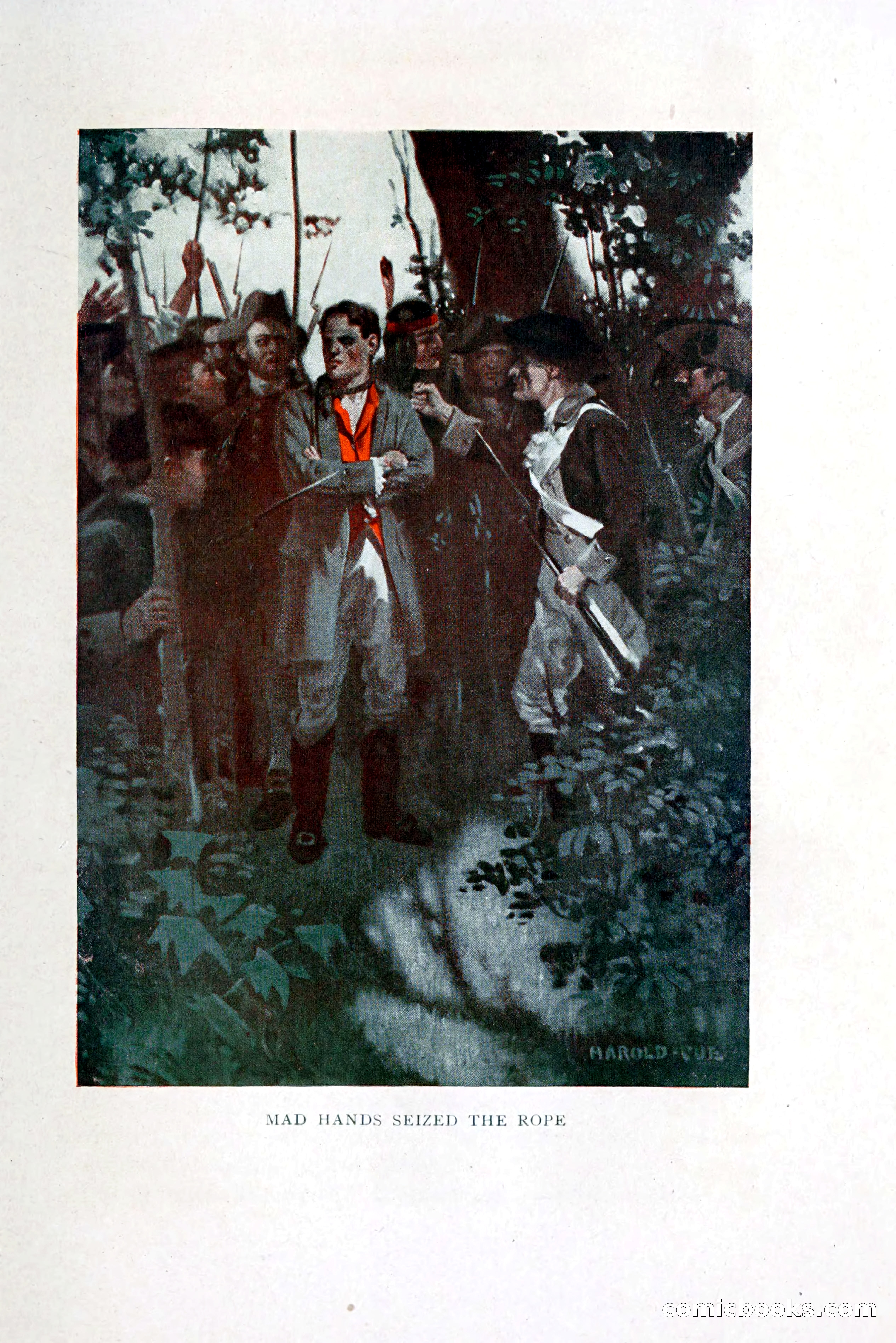
This is an illustration page from a Victorian penny dreadful. The image shows a dramatic outdoor scene with multiple men in period dress gathered around what appears to be a rope or cord, with vegetation visible in the foreground and background. The caption beneath reads "MAD HANDS SEIZED THE ROPE," suggesting a moment of violent or frenzied action. The illustration is signed "HAROLD COKE" in the lower right corner. The OCR text is largely corrupted, but the caption clearly conveys a sensational moment typical of penny dreadful melodrama—the kind of dramatic, urgent scene designed to grip readers' attention and drive the narrative forward.

This appears to be a heavily degraded or damaged page from a Victorian publication, with the watermark "comicbooks.com" visible at the bottom. The image quality is extremely poor, showing primarily a grainy, textured surface with faint discoloration in purple, blue, and pink tones scattered across a mostly gray-white background. No readable text is discernible in the actual image itself—only the website attribution is clear. The OCR text provided (consisting merely of a colon, asterisk, and "micbooks.com") confirms that no substantive content is legible on this particular page. Whether this represents an illustration, text, or advertising cannot be determined from the available visual information.
# Page Analysis This is a page of running prose (page 165) from a penny dreadful titled *The Black Dragoons*. The text describes a violent confrontation in which cavalry troops intervene to stop a mob from executing an Indian man named Unaka. A military captain orders the chaos stopped and demands the prisoner step forward, revealing himself as young Anderson of Virginia. The captain recognizes Anderson's voice and identifies himself as Peake Dangeridge, claiming to have been Audley Anderson's best friend. The passage appears to depict a Revolutionary War-era scene involving British forces, American colonists, and Native Americans, written in sensational melodramatic style typical of Victorian serial fiction.
This is a page of running prose from a Victorian penny dreadful serial. The text depicts a scene where Tom writes an official military document at the dictation of Captain Peake Dangeridge, warning horse-thieves in De Kalb's army that they will be hanged if they steal horses. The passage then narrates Tom's subsequent presentation to Colonel du Buysson at military headquarters and his receipt of a protective passport, before briefly mentioning news of Charleston's fall reaching De Kalb's forces at Deep River.
This is a page of running prose from a Victorian penny dreadful titled "The Black Dragoons" (page 167). The text describes a violent military engagement during what appears to be the American Revolutionary War, focusing on a character named Tom fighting against British cavalry (Tarleton's Legion, called the "Black Dragoons") near a creek in the Carolinas. The passage emphasizes the chaos and brutality of hand-to-hand combat, with Tom desperately fighting mounted soldiers while defending horses that his regiment has brought hundreds of miles.
This is a page of running prose from a Victorian penny dreadful titled "Tom Anderson, Dare-Devil" (page 168). The text describes a violent scene in which a dying plough-boy identifies someone called "the Butcher" as the character Tarleton. Tom Anderson, who has long desired to see Tarleton, looks toward him but is struck by a saber-stroke before he can fully observe him. The passage is action-driven melodrama typical of the genre, emphasizing violence, suspense, and emotional intensity.
This is a page of running prose from Chapter XXI, titled "Border Warfare." The text depicts an injured man named Tom regaining consciousness in a crowded room filled with wounded men being tended by a woman and others. A lean man with blue eyes—apparently a surgeon—examines Tom's wound, discovering a white mark on his shoulder that another character mysteriously identifies as a "Proclamation! Issued by God Almighty." The dialogue employs dialectal speech suggesting a frontier or border setting, and references to "the Blue Hen's chickens" and "the Butcher" suggest prior violent conflict, though the specific context remains unclear from this excerpt alone.
# Page Analysis This is a page of running prose text from the penny dreadful *Tom Anderson, Dare-Devil* (page 170). The passage describes Tom Anderson recovering from a saber wound inflicted by "the Butcher." A surgeon treats him while banter fills the scene; after twenty-four hours of fever-induced delirium focused on porridge, Tom awakens to find a lively freckled boy working a fly-brush beside him. The boy's cheerful manner and colloquial dialect ("Lordy!" "hit afore") provide comic relief as Tom drifts back toward sleep, having apparently missed eating leftover turkey.
This is a page of running prose from a Victorian penny dreadful titled "Border Warfare" (page 171). The text depicts a dialogue between a wounded man named Tom and a young boy with a freckled face at Waxhaw meeting-house. The boy describes a massacre at a creek involving Buford's men and Black Dragoons, which triggers an anguished scream from another wounded soldier. The passage hints that Tom will become "the Coming Man"—a future American military and political leader—and describes women caring for the wounded with silent heroism.
This is a page of running prose from the penny dreadful serial "Tom Anderson, Dare-Devil" (page 172). The text describes post-Revolutionary War activities in the Carolinas, focusing on young Andy's ambitions to raise a military force and Tom's involvement with partisan warfare under Marion. The passage mentions rumors of General Marion's escape from Charleston and a secret expedition to fetch lead, culminating in Tom's decision to join McClure's Mounted Riflemen for border guerrilla operations against enemies in swamps and forests.
# Page Description This is running prose text from page 173 of a work titled *Border Warfare*. The passage describes military action during what appears to be the American Revolutionary War, focusing on a character named Tom and his superior officer Sumter. The text recounts a surprise attack by Tarleton's "Black Dragoons" cavalry on Sumter's encamped forces near Camden, the wounding or near-death of Tarleton, the rescue and retreat of Sumter under fire, and Tom's decision to return to the battlefield to search for a missing companion named Unaka rather than accompany the retreating body-guard toward Charlotte.
# Page from Tom Anderson, Dare-Devil (Victorian Penny Dreadful) This is a page of running prose text (page 174) from a serialized adventure story. The passage describes a lone rider arriving at a burning battlefield on Fishing Creek at nightfall. After discovering the enemy has departed for Camden, apparently taking a prisoner named Unaka, the protagonist Tom Anderson disguises himself in a dead British dragoon's uniform and cavalry horse to pursue them. Despite the danger of being mistaken for a King's soldier and shot by Whig forces, he resolves to rescue Unaka, saying he'll "swing for a spy" if caught. The narrative combines Civil War-era American setting with sensational melodrama typical of penny dreadfuls.
# Page Description This is a page of running prose from Chapter 175 of a serial fiction work titled *Border Warfare*. The text describes action during what appears to be the American Revolutionary War: a boy in a British uniform sings taunting songs to rebels and prisoners, encounters a Cherokee man named Unaka who is bound to a wagon, and then helps Unaka escape during a night march to Camden by throwing the dragoon's coat and hat into a river. The passage concludes with Captain Steele pursuing the fugitives. The narrative emphasizes melodramatic action and dialogue typical of Victorian sensation fiction.
# Running Prose Page from a Victorian Penny Dreadful This is a page of running prose narrative (page 176) from a Victorian penny dreadful titled *Tom Anderson, Dare-Devil*. The text describes a Revolutionary War-era adventure: Tom Anderson, a courier nicknamed "Dare-Devil," is sent to locate a military leader named Clark and warn him that Ferguson's forces intend to capture him in South Carolina. After searching unsuccessfully across the countryside, Anderson encounters a mysterious figure emerging from the forest on a lean pony—someone wearing a travel-stained women's riding skirt, apparently traveling from Charleston. The narrative builds suspense as the courier awaits to discover who this unexpected visitor is.
# Victorian Penny Dreadful Page Analysis This is a page of running prose (page 177) from a serialized melodrama titled "Border Warfare." The text describes Tom's discovery of a dead woman in a tent—identified as Andrew Jackson's mother—who died of prison-fever after traveling 160 miles to Charleston to aid friends imprisoned during what appears to be the American Revolution. Tom receives a letter from his imprisoned father and subsequently encounters a frontiersman hunting soldiers. The passage references Clark's Rifles, Ferguson, and King's Mountain, suggesting a historical setting during Revolutionary-era conflicts in the American South.
# Page Description This is a page of running prose (page 178) from a Victorian penny dreadful titled *Tom Anderson, Dare-Devil*. The text describes Civil War military action, including Ferguson's failed pursuit of Clark's Georgians and a subsequent British bayonet attack on mountaineers at King's Mountain. It then shifts to a scene where General Sumter introduces his aide, Colonel Wemyss (nicknamed "Dare-Devil" for his reckless gallantry), to Tom Anderson. The passage ends with Unaka, appearing to be Cherokee, arriving to speak with Tom in Cherokee language. A final paragraph mentions Tarleton and Blackstock's house, suggesting the narrative will continue on the next page.
# Page Analysis This is a page of running prose from a Victorian penny dreadful titled *Border Warfare* (page 179). The text describes a Revolutionary War battle involving Georgian and Virginia soldiers, focusing on a character named Tom who participates in a cavalry charge against British officer Tarleton. The narrative includes dialogue from various participants recounting the action—how Tom fired at Tarleton, was struck by a broadsword (which his buckle deflected), was knocked unconscious, and awoke as a prisoner in a covered wagon. The page contains no illustrations, only densely printed text in period typography.
This is a page of running prose from the penny dreadful "Tom Anderson, Dare-Devil" (page 180). The text describes a character being transferred to a galley on a river with three men, their journey downstream over several days, their passage by Fort Motte (a military depot), and the eventual transfer of "Sumter's aide" to a small brig called the Nancy Ireson at the river's mouth. The narrative emphasizes dramatic movement and military activity during what appears to be a Revolutionary War setting.
# Page Description This is running prose text from Chapter XXII, titled "Old Rory." The passage describes Tom's discovery that the ship *Nancy Ireson* is a slave vessel. After attempting escape, Tom is imprisoned below deck with over two hundred enslaved people in horrific conditions. The chapter details the ship's mysterious cargo operations, Tom's failed escape attempt, and his subsequent confinement in the dark hold, where he reflects on his predicament with bitter irony about his heritage even as he suffers physical illness.
This is a page of running prose from a Victorian penny dreadful titled "Tom Anderson, Dare-Devil" (page 182). The text describes Tom being summoned to meet Captain Higgins, who reveals that the ship's previous captain is dead and enlists Tom as the new ship's boy. Higgins orders Tom to prepare the dead captain's body for burial at sea by wrapping it in a blanket and weighting it with scrap-iron. Tom conceals the corpse and hides himself nearby, his heart pounding with anxiety as he awaits further events.
# Old Rory, Page 183 This is a page of running prose from a Victorian penny dreadful novel. The text depicts a dramatic sea rescue: a character named Tom, apparently thrown overboard wrapped in a winding-sheet, manages to free himself and swim desperately toward a ship's galley while a shark pursues him. He is rescued by sailors and pulled aboard, where he encounters a mysterious cloaked man whom the narrative suggests is remarkably handsome, though Tom finds him even more so than the chronicler admits.
# Analysis This is a page of running prose from a Victorian penny dreadful titled "Tom Anderson, Dare-Devil" (page 184). The text depicts a scene in a boat where Tom, having just emerged from the water, encounters several men: a small, elegant dandy named Troupe; an elderly Scottish Highlander named Rory McIntosh (described as the "Quixote of Georgia"); Sir Æneas McIntosh; and a bagpiper. The passage focuses on dialogue and character introductions, with Scottish dialect and period attitudes toward Americans and class distinctions. The narrative concerns itself with offering Tom brandy and establishing the social dynamics among the assembled characters.
# Page Description This is a page of running prose from *Old Rory* (page 185), a Victorian penny dreadful. The text depicts a dialogue between characters—including Sir Æneas, a baronet, and McIntosh, a Highlander—discussing plans to capture someone called "the Swamp Fox" in Charleston during what appears to be the American Revolutionary period. The conversation reveals that rebels are hiding in the city, and references are made to a character named Marion. The dialogue is written in heavy Scottish and dialect English, with characters employing period slang and colloquialisms typical of the genre's sensational style.
This is a page of running prose from a Victorian penny dreadful titled *Tom Anderson, Dare-Devil*. Two British officers discuss a colorful Scottish character nicknamed "Old Rory" (Roderick McIntosh), recounting his exploits during what appears to be the American Revolution, including his actions at Charleston, Savannah, and Sunbury. The dialogue is humorous in tone, with the speakers marveling at Rory's boldness—particularly his solo, unarmed demand for the surrender of Fort Sunbury, accompanied only by his dagger, confidence, and enslaved servant.
# Old Rory, Page 187 This is a page of running prose from a Victorian penny dreadful titled "Old Rory." The text recounts dramatic scenes featuring a character named Rory (apparently Major or Colonel McIntosh), including a confrontation at a fort where he refuses to surrender to rebel forces, an escape from French soldiers, and a dinner scene where he delivers florid toasts in Scottish dialect. The narrative celebrates Rory's proud bearing and colorful speech, with supporting characters and observers praising his character. The page ends mid-sentence with Rory directing a servant.
This is a page of running prose from a Victorian penny dreadful titled "Tom Anderson, Dare-Devil" (page 188). The text describes a drenched boy named Tom who has escaped from a ship in Charleston and is being aided by a Scottish Highlander named Rory McIntosh and companions. Tom, desperate and poorly dressed, is taken through the city by Rory, who wraps him in a plaid and treats him to food at a pastry-cook's shop while a piper plays Scottish tunes in the street. The narrative combines melodramatic tension (Tom fears recapture and execution) with colorful Scottish dialect dialogue.
This is a page of running prose from what appears to be a Victorian penny dreadful titled "Old Rory" (page 189). The text depicts a scene in which a character named McIntosh welcomes a guest named Tom into his home, offers him hospitality and wine looted from a Spanish officer after the battle of Musa, and then recounts—with some moral ambivalence—how he shot a Spanish captain of Grenadiers from the bushes during combat. McIntosh also mentions Colonel McIntosh (Sir Æneas), whom he compares to the fallen Spanish officer for his fine dress and bearing. The dialogue is rendered in Scottish dialect throughout.
# Page 190: Running Prose from *Tom Anderson, Dare-Devil* This is a page of running prose text from a Victorian penny dreadful serial. The narrative follows Tom, who faces desperate circumstances: pursuit by a slaver, danger of execution if recognized, and knowledge of a nearby prison-ship. While an old Scotchman discusses General Lachlan McIntosh (a historical Rebel general), Tom gazes anxiously from a window at Charleston harbor, resolving to find his father. The dialogue employs Scottish dialect, and a character named Rory makes sardonic observations about the McIntosh clan's courage and Cherokee ancestry.
# Page from "Old Rory" (Page 191) This is a page of running prose from a Victorian penny dreadful. The text depicts a dramatic scene in which Major Roderick McIntosh (nicknamed "Old Rory") entertains a mysterious man named Tom. After sharing a meal and toasting King George III, McIntosh becomes enraged when Tom refuses to drink to the sovereign's health, draws his dirk in anger, and demands Tom reveal his identity. Tom responds coolly, claiming to be "as white as Sir Æneas" and called "Dare-Devil"—apparently an alias suggesting he may not be what he seems. The passage emphasizes Scottish dialect and working-class military camaraderie before building tension through McIntosh's volatile patriotic outrage.
# Tom Anderson, Dare-Devil This is a page of running prose from what appears to be a serialized adventure story (page 192). The text depicts a tense dialogue between a young character named Tom and a man named Roderick McIntosh, written largely in Scottish dialect. Tom refuses to drink to the King's health, claiming the monarch is not his sovereign, which provokes McIntosh's anger—though he becomes impressed by Tom's courage and honesty. Tom reveals he is seventeen years old and fought at the Battle of King's Mountain, apparently for the American side. The passage ends with McIntosh gripping Tom's hand after hearing his full story.
# Old Rory, Page 193 This is a page of running prose from what appears to be a Victorian penny dreadful serial. The text depicts a conversation between an old Scottish soldier named Rory and a young boy named Tom (apparently a kidnapped Rebel). Rory promises to help Tom and offers him shelter and food. The passage describes their growing companionship and shows Rory making arrangements to obtain venison for a dinner, while discussing the dangers of Charleston and Tom's need to avoid public notice. The dialect is heavily Scottish throughout.
This is a page of running prose from a Victorian penny dreadful titled "Tom Anderson, Dare-Devil" (page 194). The text depicts a Scottish character named Rory entertaining Tom with commentary on education and French upbringing, then preparing Tom to meet Sir George Claiborne by outfitting him in Highland dress. Tom protests that the kilt doesn't cover his knees, prompting Rory's indignant response defending Highland clothing customs. The scene concludes with Rory purchasing moccasins to complete Tom's outfit. The dialogue is rendered in thick Scottish dialect.
# Old Rory, Page 195 This is a page of running prose from the serialized narrative "Old Rory." The text depicts an emotional scene between an old Scottish soldier named McIntosh (or "Major") and a younger man named Tom (called "Tammie"), who has appeared in Highland dress. McIntosh, moved by Tom's story and appearance, offers him land, property, and inheritance if he will stay and take the McIntosh name, though Tom declines, stating he must return to his military command. The passage concludes with bagpipes sounding from the street below, playing a tune called "My Boy Tammie." The writing employs Scottish dialect heavily throughout.
This is a page of running prose from Chapter XXIII, titled "Charleston." The text depicts a scene where characters named Rory and Tom are traveling by rowboat to a prison-ship off Sullivan's Island. Rory, a McIntosh, plans to use his family's influence and a nobleman's letter of introduction to bypass permit requirements. The dialogue, written in Scottish dialect, shows Rory boasting of his connections while Tom expresses relief that his companion lacks formal education, having been prevented from attending Oxford or Cambridge due to war. The passage appears to be from an adventure or historical fiction narrative set during a period of military conflict.
# Charleston, Page 197 This is running prose from a Victorian penny dreadful serial. The page depicts a scene in Charleston harbor where a character in disguise converses with an old Scotchman about local geography and ships. A man named Roderick discusses the harbor's channels and sandbars, points out a slave ship called the Nancy Ireson, and makes cryptic remarks about a ship's skipper. The passage concludes with Rory spotting an approaching official—"the Commandant"—in a galley, suggesting imminent danger or confrontation for the disguised protagonist.
This is a page of running prose from a Victorian penny dreadful titled *Tom Anderson, Dare-Devil* (page 198). The text depicts a dramatic scene in which a character named Rory, presenting credentials from Sir Æneas McIntosh, approaches a prison-ship to secure a brief interview with Major Audley Anderson, a captured Rebel officer from Washington's army. Though initially denied by the Commandant due to prison-fever restrictions, Rory succeeds in obtaining permission for a five-minute supervised meeting. The passage builds suspense as they row toward the vessel, with Rory maintaining studied composure while awaiting the Major's arrival.
# Page Content Analysis This is a running prose page (page 199) from a serialized Victorian penny dreadful titled *Charleston*. The text depicts an emotional scene in which a man named Tom approaches a prisoner—Major Audley Anderson—by boat to deliver messages from Anderson's son John, who is apparently serving as an aide to someone named Sumter and is known by the nickname "Dare-Devil." Anderson, imprisoned and physically diminished, experiences a surge of hope and emotion upon learning his son is alive and in military service in North Carolina. The passage emphasizes melodramatic sentiment through descriptions of Anderson's "hollow eyes" and "prison-bleach," typical of the genre's emotional intensity.
This is a page of running prose from the novel *Tom Anderson, Dare-Devil* (page 200). The text depicts an emotionally charged prison-ship encounter where a prisoner receives news that his son Captain Anderson is safe at the surrender of the Capital. After exchanging courtesies with Major Roderick McIntosh, the prisoner and his visitor part ways. The narrative then follows characters named Rory and Tom as they travel to Lord Rawdon's Headquarters, accompanied by a piper playing "Who'll be King but Charlie." The passage concludes with a Scots-dialect description of a wealthy Charleston woman who hosts British officers in her seized home despite her Rebel sympathies.
# Description of Page This is a page of running prose from a Victorian penny dreadful (page 201, titled "Charleston"). The text depicts a scene set during the American Revolution in Charleston, where characters Tom and Rory move through the occupied city. Tom has secretly visited his father and must now hide that Rory harbors Sumter's aide—a dangerous secret that could lead to execution if discovered by Royalists. The passage describes deserted mansions draped in mourning crape (their owners fled since British occupation) and Rory's conspicuous behavior eating from street vendors while drawing attention from British dragoons. The narrative employs Scottish dialect throughout.
This is a page of running prose from a Victorian penny dreadful titled "Tom Anderson, Dare-Devil" (page 202). The text depicts a scene in Charleston during what appears to be the American Revolution, where Scottish character Rory comments on Rebel women wearing black mourning clothes to avoid socializing with Royalists. The narrative then shifts to describe the approach of a beautiful young Rebel woman called "the Beauty o' Charleston" toward Lord Rawdon's mansion, where two vain young officers from his command wager money that they can make her acknowledge them.
This is a page of running prose from a Victorian penny dreadful (page 203, titled "Charleston"). The text describes a street confrontation in which a young Royalist named Paris offers roses to a female Rebel and kisses her without consent. Her companion Tom attacks Paris in rage, and the two begin fighting with sword and dirk. At the moment of combat, a character named Rory intervenes, and Sir Æneas McIntosh arrives unnoticed from his carriage. The passage emphasizes melodramatic action, class conflict between Royalists and Rebels, and physical violence.
# Page Analysis This is a running prose page from the penny dreadful *Tom Anderson, Dare-Devil*. It depicts a confrontation between a character named Paris (a Loyalist officer) and his colonel, Sir Æneas, who witnesses Paris behaving improperly with a young woman called "the Belle of Charleston." Sir Æneas reprimands Paris for conduct unbecoming an officer, threatening a whipping. The scene then shifts to redcoat officers discussing the incident on a piazza, gossiping about a wager Paris made, the girl who boxed his ears, and reciting romantic poetry. The text employs dialect spelling and racial slurs typical of period sensational fiction.
# Charleston (Page 205) This page contains running prose from a serialized narrative set in Charleston. It depicts a dramatic street encounter where a young woman named Miss Elliott is courted by two men: Sir Æneas (a British baronet and "The McIntosh") and Tom, a Virginian. When Sir Æneas offers his escort, Tom challenges him, declaring "I'll see you dead first!" in passionate defiance. Miss Elliott, though surrounded by twenty British officers, ultimately chooses Tom's company, placing her hand on his sleeve and departing with him, delivering a graceful but firm rejection of the baronet. The scene emphasizes Southern pride and youthful romance amid apparent colonial-era tensions.
# Page Description This is a page of running prose (page 206) from the penny dreadful *Tom Anderson, Dare-Devil*. The text depicts a dialogue between a woman in mourning dress and a swarthy Highlander after bagpipes play "The De'il is in the Lassies, O!" Bystanders observe them curiously. The man reassures the woman about her honor in acknowledging him, and they engage in flirtation—he threatens not to ring a doorbell for her if she thanks him. The passage ends with her promising to learn information from someone who wears black for Charleston, living near Roupel's house (Roupel being identified as Postmaster-General and a Loyalist).
# Page Analysis: Victorian Penny Dreadful Running Prose This is a page of running prose narrative (page 207) from a serialized Victorian penny dreadful set in Charleston during what appears to be the American Revolution. The text describes a protagonist named Tom's bewildering encounter with a patriotic woman who mysteriously knows his identity and a family pet name ("Dare"), unmasking him as someone in disguise. Confused and troubled by this revelation, Tom resolves to remain indoors, fearing detection in the dangerous occupied city where rebels are being executed. His companion Rory agrees after returning home from a street fight.
# Page 208 of "Tom Anderson, Dare-Devil" This is a page of running prose from a Victorian penny dreadful serial. The text depicts dialogue between characters discussing a recent fight involving Captain Valentine Pair-ris in Charleston. One character boasts about the combat's outcome—that Pair-ris lost his velvet coat to "the niggers"—while another character (Rory) privately worries that his identity as the mysterious "auld fellow" who drew his sword has been discovered through town gossip. The narrative reveals tension between maintaining secrecy and the difficulty of controlling information in a gossiping community.
# Page Analysis This is a page of running prose—dialogue and narrative from a penny dreadful set in Charleston during what appears to be the American Revolutionary War. The text recounts gossip about Miss Elinor Elliott, a local heiress and rebel sympathizer whose American lover escaped capture by swimming a river; she boldly turned away British troops searching her estate. The speaker reveals that the listener (apparently a character named Valentine) previously risked trouble for this woman's sake, and questions whether he understood her rebel sympathies at that time.
This is a page of running prose from the penny dreadful *Tom Anderson, Dare-Devil* (page 210). The text depicts a dialogue between characters named Tammie and Rory, using Scottish dialect. Tammie announces he must hide during the day, venture to Charleston at night, and depart tomorrow. Rory objects, urging him to return to his command, but Tammie remains resolved. The passage suggests foreshadowing—Rory "little dreamed" Tammie would never ride forth with someone named Sumter again—indicating potential tragedy ahead. The narrative tone is melodramatic, typical of Victorian sensation fiction.
This is a page of running prose from Chapter XXIV of a Victorian penny dreadful titled "My Lord Rawdon and the Runty Rebel." The text describes a character named Tom (later called Anderson) arriving at a house in Tradd Street on a dangerous nighttime mission during what appears to be the American Revolution or Civil War. He seeks to communicate with a gentleman in hiding, assuring a stately woman of the household—who turns pale upon his cryptic description—that he is not a traitor but works for Sumter's staff, implying he supports the American cause.
This page contains running prose from a Victorian penny dreadful serial titled "Tom Anderson, Dare-Devil" (page 212). The text depicts a dramatic scene in which Tom, disguised as a Highlander, is led through a hidden room in a house and encounters an old army chaplain whom he recognizes as a General. Tom warns the General that the British are coming to search the house and urges him to flee, claiming he heard this directly from Lord Rawdon. The passage emphasizes melodramatic tension through descriptions of concealment, disguise, and imminent danger during what appears to be the American Revolutionary War period.
# Analysis of Page 213 This is a page of running prose from a Victorian penny dreadful titled *My Lord Rawdon and the Runty Rebel*. The text depicts a dramatic escape scene where Tom helps a fugitive "Rebel" (likely a Scottish Highlander) evade capture by exchanging clothes with him and disguising him as a chaplain. When soldiers arrive demanding surrender, Tom stalls them by playing chess with a woman (apparently named Marion or associated with her) in a drawing-room, while the disguised fugitive prepares to flee. A servant named Tempe appears at the scene's end carrying a key-basket, as armed redcoats surround the house demanding the rebel's surrender.
# Page 214: Running Prose from "Tom Anderson, Dare-Devil" This is a page of running prose text from a Victorian penny dreadful serial. The passage depicts a dramatic scene during the American Revolution in which British soldiers search a house for the rebel leader Marion. A woman protects Marion's hiding place while Tom, apparently working as a British sergeant, subtly aids her deception. When the Commandant Lord Rawdon arrives frustrated that Marion has escaped, he interrogates Tom—whom the woman claims is a missionary to the Indians—with evident suspicion and disdain. The text emphasizes the tension between loyalty and hidden sympathy for the American cause.
This is a page of running prose from a Victorian penny dreadful titled "My Lord Rawdon and the Runty Rebel." The text depicts a confrontation in Charleston between Lord Rawdon and a missionary named Anderson who arrives by ship, followed by a scene where a character named Tom becomes aware he is being followed through the streets. The passage ends with the street suddenly erupting into chaotic crowds apparently intent on vengeance, though Tom cannot determine the cause. The narrative concerns itself with espionage, pursuit, and Revolutionary War-era colonial intrigue.
# Page Analysis This is running prose text from page 216 of *Tom Anderson, Dare-Devil*, a Victorian penny dreadful. The passage depicts Tom, apparently a fugitive, evading a mob calling for execution ("To the gibbet!"), then slipping into St. Michael's Church while an elderly sexton is locking up after a wedding. Tom hides in the organ loft, steals the church keys, and begins climbing the spiral steeple stairs toward the highest window, seeking escape or vantage point as moonlight breaks.
# Page Description This is a page of running prose from a Victorian penny dreadful serial titled "My Lord Rawdon and the Runty Rebel" (page 217). The text describes a character named Tom observing Charleston from a church belfry at night, learning that someone called Valentine Paris (or Captain Paris) has been murdered. Tom himself had fought with Paris hours earlier and fears suspicion may fall upon him. The passage combines dramatic narration with Tom's internal anxieties about the murder mystery and his homesick reflections on the James River.
This is a page of running prose from a Victorian penny dreadful titled "Tom Anderson, Dare-Devil" (page 218). The text describes four characters playing cards at an estate called Marley when a mysterious serenade interrupts them—a tenor singing "Hunters of Kentucky" beneath the drawing-room window. The passage involves romantic intrigue: a young woman called "the beautiful Rebel" in sapphire damask has apparently recognized someone in disguise, though he does not recognize her. The prose emphasizes melodramatic tension and describes the characters' appearances and reactions to the unexpected musical interruption.
# Page Content Analysis This is running prose from page 219 of *My Lord Rawdon and the Runty Rebel*, a Victorian penny dreadful. The page contains a sung toast celebrating a "gallant girl" who opposed Tories, followed by a narrative scene in which a drawing-room falls silent after the performance. Sir Æneas, apparently angered or disturbed by the song's seditious sentiment, leaves abruptly. The prose then describes him pursuing a young man through the grounds at Marley, a fellow wearing faded military uniform who carries a guitar and quickens his pace upon seeing the baronet approach.
This is a page of running prose from a Victorian penny dreadful serial. The narrative depicts a tense encounter between Sir Aeneas and a paroled American prisoner of war named Troupe de Berrien Anderson, set during what appears to be the American Revolution. Sir Aeneas experiences jealous rage upon spotting a rose in the prisoner's buttonhole—the same flower a woman had worn moments before. The page reproduces the full text of Anderson's parole document, dated December 1780, in which he swears to remain near Haddrell's Point and avoid aiding the enemy, before Anderson makes a remark about the Prison Commissioner.
# Page Description This is a page of running prose narrative (page 221) from a Victorian penny dreadful titled *My Lord Rawdon and the Runty Rebel*. The text depicts a tense conversation between Sir Æneas (a British baronet) and Captain Anderson (an American prisoner of war). Sir Æneas confronts Anderson about singing rebel songs near his house and questions him regarding a young woman named Miss Elliott. Anderson refuses to discuss the lady, asserting that while he is a prisoner under British military authority, Miss Elliott is not subject to military censorship. The exchange grows heated, with Anderson maintaining defiant dignity despite his captive status.
# Page Analysis This is a **running prose page** from the penny dreadful *Tom Anderson, Dare-Devil* (page 222). The text depicts a dramatic confrontation between an American man and Sir Æneas, a British officer who becomes jealous after learning the American visited a young lady and was present when she defied Tarleton's troops. Sir Æneas challenges the American to a sword duel that night, with seconds appointed. The scene concludes with the American leaving, whistling "The Hunters of Kentucky," while an arrogant young Englishman in a waiting carriage watches him depart and wonders where Sir Æneas has gone. The narrative suggests military conflict during what appears to be the American Revolution era.
This is a page of running prose from page 223 of a Victorian penny dreadful titled "My Lord Rawdon and the Runty Rebel." The text narrates how a character named Troupe came to be imprisoned in Charleston during what appears to be the American Revolutionary War: he escaped his Tory captors, swam to visit a woman named Elinor Elliott at Marley plantation, was betrayed by a spy, narrowly escaped again with Elinor's help, but was captured by British forces twenty-four hours later. The passage concludes with a revelation that other characters—including one called "Tom Calvert"—did not realize Troupe was the American officer they had heard about in a story.
# This Page This is a **page of running prose** from the body of a Victorian penny dreadful novel. Chapter XXV, titled "Pink," sets the scene for an eventful night in Charleston during what appears to be the American Revolution (references to Royalists, Loyalists, and an American officer suggest this setting). The narrator describes multiple dramatic incidents occurring that evening: Lady Savage's ball, the mysterious assassination of Captain Valentine Paris, a duel between Sir Æneas McIntosh and an American officer, and an unspecified climactic event. The text then backtracks in time to follow Marion's escape from a house on Tradd Street, establishing the chronology of the night's events.
# Page 225 from "Pink" This is a page of running prose from what appears to be a serialized Victorian penny dreadful. The text depicts an action sequence: a man named Marion, apparently a patriot fugitive, flees on horseback through moonlit terrain near a river, using the password "The McIntosh!" to pass checkpoints. He is pursued by Captain Valentine Paris, a Royalist officer seeking revenge for being knocked down. Marion gallops through a burned-out warehouse ruin to evade his pursuer. The passage ends ambiguously with Paris emerging from the ruins having "dragged" something from a stirrup that allegedly throws "the Royalists of Charleston into a frenzy"—the outcome unclear. The final lines mention Sir Aeneas and Colonel Lloyd preparing to visit "Lady" (name cut off).
This is a page of running prose from a Victorian penny dreadful titled *Tom Anderson, Dare-Devil* (page 226). The text depicts a conversation between Sir Æneas and Colonel Lloyd about American prisoners of war housed at "Hungry Hall," followed by a carriage encounter with a young man named Troupe. The dialogue concerns a duel and dance the colonel must attend, and includes discussion of American rebel officers and their apparent ability to survive without commissary support. The page ends as Troupe recognizes someone in the passing carriage.
This is a page of running prose from a Victorian penny dreadful (page 227, titled "Pink"). The text describes a nighttime encounter between British and American characters—a baronet invites an American captain for drinks, but the captain prefers walking and cryptically mentions a "Swamp Fox" and a swamp as "salvation." A Scottish character observes this exchange with suspicion, wondering if American officers know of a secret attempt to seize someone called the "Swamp Fox." The passage concerns itself with honor, intrigue, and apparent espionage, with characters assessing each other's courage and composure as their coach arrives at a city after nine o'clock.
# Analysis of Page 228 This is running prose (body text) from a Victorian penny dreadful titled "Tom Anderson, Dare-Devil." The page depicts a dramatic street scene: while Sir Æneas travels toward Lady Savage's ball, a commotion erupts involving grenadiers, bagpipes, and a stretcher bearing a murdered officer. The victim is identified as Valentine Paris. Despite this omen, Sir Æneas proceeds to the ball at the old Savage house—now quarters for paroled American officers—which stands damaged and desolate from bombardment. The narrative blends melodramatic elements (murder, bagpipe laments, omens) typical of penny dreadful sensation fiction.
# Page Description This is a page of running prose (page 229) from a Victorian penny dreadful titled *Pink*. The text depicts a scene where a man named Troupe enters a room containing several captured American Revolutionary officers (including Lachlan McIntosh, David Meriwether, and Ben Taliaferro) who have refused British protection. The officers, sheltering in makeshift quarters with improvised furniture, are engaged in lighthearted banter about spilled pepper and a serenader, while Troupe observes them with admiration as "inexorable patriots." The scene concludes with Anderson sharing chestnuts from his pockets as the men prepare a meal together.
# Page Content Description This is a page of running prose from a Victorian penny dreadful titled "Tom Anderson, Dare-Devil" (page 230). The text consists of dialogue and narrative describing a confrontation between characters named Deveaux and Williamson. Deveaux recounts to General McIntosh and others how he encountered Williamson—described as a "renegade" who accepted British protection—at a pie-shop uptown. The passage details Williamson's insulting behavior toward Deveaux, culminating in Deveaux throwing an oyster-shell at Williamson's face. The narrative appears set during or after a conflict involving "Rebs" (Confederates) and "Hungry Hall," suggesting American Civil War-era subject matter, though the penny dreadful's historical accuracy is unclear.
# Page Analysis This is a page of running prose from a Victorian penny dreadful titled "Pink" (page 231). The text depicts a dramatic narrative account: a character named Deveaux recounts a brawl in a shop involving an oyster-shell, a redcoat named Williamson, and Major Roderick McIntosh of the Scottish Militia, who intervenes and breaks Williamson's sword with his dirk. The passage then shifts to a scene where a black butler from Madame La Motte's household enters a hall carrying a silver salver with a pasty, apparently delivering it to General Lachlan McIntosh. The prose emphasizes action, dialect, and melodramatic confrontation typical of the genre.
# Page 232: Running Prose from "Tom Anderson, Dare-Devil" This is a page of running prose (body text, no illustrations) from page 232 of a penny dreadful titled "Tom Anderson, Dare-Devil." The passage depicts officers receiving food and entertainment, including a discussion of a goose-liver pie sent by someone's mistress, followed by a musical performance by a singer called "Pink," whom the assembled men eagerly call for encores. The text combines polite dinner conversation with rowdy enthusiasm for the performer.
# Page 233 of "Pink": Running Prose This is a page of running prose from what appears to be a Victorian serial novel set in Charleston during the American Revolution. The text describes the entrance of a seventeen-year-old boy named Pinckney—a charming, well-dressed, spoiled member of an old Royalist family raised by his wealthy grandmother, Lady Arabella Savage. Despite his family's British loyalties, he sympathizes with the American cause but is too young and rich to face consequences. The passage portrays him as welcome in both British and American camps, and shows him arriving at a social gathering in his fashionable London coat, boasting about attending a ball.
This is a page of running prose from a Victorian penny dreadful serial titled "Tom Anderson, Dare-Devil" (page 234). The text depicts a dramatic scene in a military mess-hall where a character named Troupe writes an important letter and departs, leaving the other soldiers in tense silence. When Troupe returns, he announces he has accepted a duel challenge from someone called "The McIntosh," shocking General McIntosh, who himself once fought a duel against one of the Declaration of Independence signers.
# Page 235 of "Pink" This is a page of running prose from what appears to be a serialized Victorian fiction (the header reads "PINK 235"). The text depicts a dramatic scene in which characters discuss an impending duel between Captain Troupe Anderson and an unnamed opponent, to take place at midnight in the Governor's deserted mansion. A character named Pinckney offers to help Anderson prepare for the duel by fetching fine clothing and grooming supplies, treating the serious matter with comedic irreverence. The narrative includes a flashback in which the elderly McIntosh recalls a previous deadly encounter near Savannah.
This is a page of running prose from a Victorian penny dreadful titled "Tom Anderson, Dare-Devil" (page 236). The text depicts characters named Troupe and Pink preparing for a secret meeting, with dialogue revealing that someone named Tom Calvert is hiding as a fugitive in St. Michael's tower. Pink suggests using the church for a clandestine gathering, leveraging his grandmother's connection to the church sexton to obtain keys. The passage concludes with Captain Taliaferro and Colonel Lloyd agreeing to hold their meeting inside the old church rather than outdoors.
# Page Analysis This is running prose from Chapter XXVI, titled "The Duel." Tom awakens to sense an unseen presence approaching him in darkness. Gripped by fear, he draws a weapon, only to discover the "pursuer" is his dog Luath, who has found him in what appears to be a tower. After reuniting joyfully with the dog, Tom encounters a character named Rory (holding a lantern) and someone called "Major," who makes a quip about Tom's unusual appearance in chaplain's clothing. The passage mixes suspenseful Gothic atmosphere with humor and Scottish dialect.
This is a page of running prose from the penny dreadful serial *Tom Anderson, Dare-Devil* (page 238). Two characters—apparently Rory (a Major) and Tom (the titular Dare-Devil)—discuss a murder: a young gentleman named Captain Paris has been found dead, and Tom is a suspect because he fought with the Captain earlier that day. Rory explains how he found Tom hiding in an old church tower wearing someone else's clothes, which makes Tom look guilty. Tom responds that circumstantial evidence pointed to him, so he went into hiding until the streets emptied. The dialogue is written in Scottish dialect.
# Page Analysis This is a page of running prose (page 239) from a Victorian penny dreadful titled *The Duel*. The text consists of dialogue and narrative describing characters' movements and a confrontation at a church. McIntosh and another character (apparently named Tom) discuss how they located someone taking sanctuary at St. Michael's kirk, involving a young well-dressed man, a dog named Luath, and an elderly sexton. The passage uses Scottish dialect throughout and contains references to stolen church keys and suspicious circumstances surrounding someone named Valentine Paris's death.
# Tom Anderson, Dare-Devil (Page 240) This is a page of running prose from the penny dreadful serial. The text depicts a tense midnight scene in what appears to be a church or similar building. An older man with a Scottish accent tries to persuade the protagonist "Daur-Deevil" (Tom Anderson) not to leave on a dangerous journey at midnight, urging him to rest and have supper instead. The scene then shifts as three cloaked figures enter the darkened space where Tom, hidden with a dog named Luath, observes them. A character named Pinckney St. John excitedly directs Ben Taliaferro to light candles in preparation for some imminent arrival, suggesting an illicit or dramatic gathering is about to occur.
# Page from "The Duel" (Page 241) This is a page of running prose from a Victorian penny dreadful novel titled *The Duel*. The text describes a clandestine nighttime gathering in a church where characters prepare for what appears to be a secret wedding. Tom and Rory hide while observing others—including men in military dress—arriving at the altar. The narrative builds suspense as two officers are identified as Sir Æneas and Colonel Francis Lloyd, with Tom's reaction suggesting an unexpected revelation is about to occur.
This is running prose from page 242 of a Victorian penny dreadful titled *Tom Anderson, Dare-Devil*. The passage depicts a tense confrontation where Tom and Rory secretly witness a man named Troupe, dressed fashionably with a red rose on his breast, apparently about to duel with Sir Æneas. Tom is distressed, believing Sir Æneas will be killed, but Rory reassures him that Sir Æneas is an accomplished swordsman. The scene culminates with a night watchman's cry announcing "Captain Paris murdered!" and a clock striking twelve.
This is a page of running prose from a Victorian penny dreadful titled "The Duel" (page 243). The text depicts a dramatic sword fight between two men, observed by characters named Tom and Rory. After the duel ends with one man falling, chaos erupts as characters rush to aid the injured figure. The passage includes Scottish dialect and melodramatic descriptions of violence, with Rory's passionate Scottish loyalty emphasized as he prepares to carry the injured "Chief" (apparently Roderick McIntosh) to safety. The prose emphasizes sensation and emotional intensity characteristic of the genre.
# Analysis of Page 244 This is a page of running prose from the penny dreadful *Tom Anderson, Dare-Devil*. The text depicts the aftermath of a violent confrontation in a church. After a fight between characters named Troupe and a baronet, Tom discovers Troupe has survived and departed unharmed. Tom then finds a discarded ivory fan inscribed "Ellie Elliott, Marley" with Troupe's pencil sketches on it—a discovery that troubles him, as he fears Troupe may be in danger. The passage emphasizes melodramatic emotion through florid language ("warrior angel," "brave heart") typical of sensation fiction.
# Page Analysis This is a page of running prose (page 245) from a Victorian penny dreadful titled *The Duel*. The text depicts a chaotic scene in Charleston following the assassination of Captain Paris. A character anxiously seeks his brother while evading suspicion of shooting Paris, fearing arrest. Meanwhile, others rush toward British Headquarters with what appears to be a body ("Rory and his burden"), drawing crowds. The passage concludes with a young man named Pinckney St. John halting a carriage to speak with his aunt and a young woman in pink, then arranging for someone called Colonel Lloyd to be placed in his carriage—though the sentence cuts off mid-page.
# Page Analysis: *Tom Anderson, Dare-Devil* This is a page of running prose from a Victorian penny dreadful serial (page 246). The text depicts a scene in which characters named Pink, Colonel Lloyd, St. John, and Captain Anderson are organizing the transport of an unconscious man (Sir Æneas) to Lord Rawdon's Headquarters. Pink's sister Peggy arrives, and Captain Anderson considers escorting her home. The passage includes light banter about politics—Pink makes a quip about the king that prompts Peggy to accuse him of treason, to which he responds with a Virginia patriot's aphorism about making "the most of" treason. The scene involves quick movements between locations and romantic/social tension among the characters.
This page contains running prose from Chapter 14 ("The Duel") of a Victorian penny dreadful. The text depicts a conversation between siblings Pinckney St. John and his sister Peggy, who question a young man named Troupe (Captain Anderson) about a duel that has just occurred in Charleston. The dialogue reveals social tensions—Peggy scolds Pinckney for his rough language and association with "ruffian Rebels," while Pinckney boasts of his Confederate sympathies and ambitions to raise a military battery for Washington, establishing this as American Civil War-era fiction.
# Page from "Tom Anderson, Dare-Devil" This is a page of running prose (page 248) from a penny dreadful serialized story. The text depicts a dialogue between characters discussing Captain Anderson, described as a talented but politically suspect "Rebel" officer. A character named Pinckney recounts being insulted by a Scottish officer in the King's Militia and threatens retaliation. His companion Peggy expresses fear about political consequences—hanging and confiscation—while Pinckney reveals his intention to search for the wounded Sir Æneas. The passage concludes by noting that Charleston society is distracted by multiple tragedies, including the unsolved murder of Captain Paris, with rumors spreading among Royalists, Loyalists, and Rebels alike.
# The Duel — Page 249 This is a page of running prose from a Victorian penny dreadful novel titled *The Duel*. The text describes the chaotic aftermath of a duel in which Sir Aeneas McIntosh is reported killed. News of the event spreads from a ballroom, causing panic; carriages race through the streets toward British Headquarters, where crowds gather. A character named Tom secretly positions himself on a nobleman's carriage to search for someone called Troupe, while a man named Pink (Pinckney St. John) eagerly attempts to spread news of what he calls "the most brilliant affaire d'honneur" to occur in the Capital.
This is a page of running prose from the penny dreadful *Tom Anderson, Dare-Devil* (page 250). The text depicts a dramatic street scene in Charleston where a character named Pink addresses a crowd from a carriage, claiming that Sir Aeneas McIntosh's wound came from a duel rather than assassination. As Tom listens intently, a uniformed soldier suddenly seizes a shabby chaplain and produces a document, speaking in German. The passage emphasizes sensational melodrama through excited crowds, urgent dialogue, and sudden interruption.
This is a page of running prose from a Victorian penny dreadful titled "The Duel" (page 251). The text depicts a tense scene in which a prisoner in black is brought before Lord Rawdon, a commandant, in a mahogany library. A young man named Habersham searches the prisoner's pockets and discovers personal effects including a silk handkerchief, tobacco, a pen-knife, a pamphlet by De Foe, a hunting-knife, and an ivory fan. The passage emphasizes the crisis and drama of the moment, with hints that multiple characters face difficult circumstances that night.
# Page Content Description This is running prose from page 252 of *Tom Anderson, Dare-Devil*, a Victorian penny dreadful. A Commandant interrogates Tom Anderson about a romantic poem inscribed on a fan referencing "Miss Elliott" and "Sir Æneas." Tom claims he found the fan in St. Michael's church while fleeing someone following him from Tradd Street, where he witnessed two men fighting a duel. This revelation startles Lord Rawdon, who hopes to extract crucial information from Tom's account.
# Page Analysis This is a page of running prose from a Victorian penny dreadful titled "The Duel" (page 253). The text depicts a tense interrogation scene in which a character named Tom is being questioned by a Commandant about his arrest leaving a "Rebel nest on Tradd Street." Tom realizes with mounting horror that an officer whose voice he recognizes—someone named Wemyss—is in an adjoining room and has been summoned to identify him. The passage ends with Tom's despairing realization: "I have betrayed myself!" The narrative emphasizes suspense, military occupation, and Tom's growing sense of imminent danger.
This is a page of running prose from a Victorian penny dreadful titled "Tom Anderson, Dare-Devil" (page 254). The text depicts a dramatic scene in which a mysterious prisoner named Anderson is revealed to be "Dare-Devil," a notorious half-breed scout and aide to the rebel general Sumter. As various British officers recognize him—including Colonel Wemyss, Colonel Tarleton, and others—they realize he is responsible for past attacks against them, leading Rawdon to denounce him as a spy. The passage emphasizes melodramatic tension through exclamations and physical reactions (fist-pounding, jumping from chairs).
# Page Description This is a page of running prose from a Victorian penny dreadful titled "The Duel." The narrative depicts a dramatic courtroom or formal inquiry scene in which a prisoner is confronted by a man named Hopwood Higgins, skipper of the Nancy Ireson, who identifies the accused as Anderson, a cabin-boy. The prisoner remains silent when questioned by Lord Rawdon about the accusations, creating tension and mystery. The text emphasizes the dramatic atmosphere and the prisoner's stoical refusal to speak, leaving Lord Rawdon suspicious that "something extraordinary" underlies the case.
# This Page from "Tom Anderson, Dare-Devil" This is a page of running prose (page 256) from a Victorian penny dreadful serial. The text depicts a dramatic confrontation: a man named Higgins produces a bill of sale claiming ownership of Tom Anderson, whom he describes in dehumanizing racial terms. Tom draws a knife in protest, but is suddenly distracted by the appearance of someone in a mirror who resembles his friend Arthur Leslie. A stranger then enters—an older man who identifies himself as Lord Ouseley, Arthur Leslie's cousin, and demands to know Tom's identity. The scene combines sensational elements typical of the genre: property disputes, violence, mistaken identity, and melodramatic surprise revelations.
# Page Description This is a page of running prose from Chapter XXVII of a Victorian penny dreadful. The text depicts a dialogue between a military Commandant and a slave trader regarding a fugitive person described as "a mulatto from the rebel plantations." The Commandant agrees to surrender the captive on condition of deportation, warning he will be hanged if he returns to Charleston. The passage then describes the captive—called "Tom"—being placed in chains in the hold of a slave ship called the *Nancy Ireson*, where he is confined below deck for three weeks while other enslaved people are occasionally allowed on deck for sanitation purposes.
# Page 258 of *Tom Anderson, Dare-Devil* This is a page of running prose from a Victorian penny dreadful serialization. The text describes a prisoner named Tom being transported by ship across Caribbean waters as human cargo, stopping at various islands (Antigua, Guadeloupe, Martinique) before arriving at Carlisle Bay, Barbados. A Spaniard removes his irons and brings him on deck; Tom, weakened from imprisonment and poor rations, experiences the shock of sunlight and open air while observing the island's geography—its bay, cocoa palms, town, and Mount Hillaby. The passage reflects Tom's emotional state: he repeatedly reassures himself that loved ones Marion and Rory (and someone named Troupe) remain safe, while obsessing over their welfare.
# Page Analysis This is a page of running prose (page 259) from the serialized novel *A Mulatto from the Rebel Plantations*. The text describes a character named Tom arriving by ship at Barbados on Christmas Day, then being surprised by the sudden appearance of his friend Unaka, a Cherokee man working as a slave aboard the vessel. The passage ends with dialogue about a slave ship in the harbor, where characters debate whether to call enslaved people "black cattle" or "slaves."
# Victorian Penny Dreadful Page: Prose Narrative This is a page of running prose from *Tom Anderson, Dare-Devil*, a penny dreadful serial. The text introduces the Governor's household in Barbados—Lady Amy Dalton, her young brother Lord Harry (future Earl of Mulgrave), and their companion Mrs. Council—and describes their morning on the mansion's piazza overlooking the bay. A visitor, Mr. Knatchbull, arrives, and young Harry engages him in conversation about the French phrase "ami de la maison" (house-cat/familiar friend), with Knatchbull promising to become tame before returning to Guadeloupe. The passage establishes colonial setting and social dynamics while introducing a recurring character.
This is a page of running prose from a Victorian penny dreadful novel titled "A Mulatto from the Rebel Plantations" (page 261). The dialogue concerns characters discussing the arrival of a slave ship in a colonial port. A man named Knatchbull describes pursuing an enslaved vessel and mentions acquiring plantations; conversation turns to a trader's offer of a "mulatto from the Rebel Plantations" reportedly skilled in singing and banjo-playing. The text reflects the period's popular entertainment focused on colonial adventure and slavery-era commerce, rendered in dialogue among apparently upper-class British characters.
# Page from "Tom Anderson, Dare-Devil" This is a page of running prose (page 262) from a Victorian penny dreadful serial. The text depicts dialogue between characters about attending a Christmas sermon and riding to Colibri, followed by a detailed description of Dick Knatchbull's expressive eyebrows. The narrative then shifts to describe a slave auction in Bridgetown, where characters named Unaka (identified as Cherokee) and Tom communicate covertly, revealing that Unaka has smuggled himself aboard a ship departing Charleston Harbor with a letter from Chief Sumter.
This is a page of running prose from a Victorian penny dreadful titled "A Mulatto from the Rebel Plantations" (page 263). The text describes a slave auction where Tom, a formerly enslaved Virginian man, is being sold on the auction block. The auctioneer attempts to generate buyer interest by having Tom play a banjo after a prospective buyer (Dick Knatchbull) expresses dissatisfaction with Tom's appearance and asks where "that boy that sings" is. The auctioneer plans to use Tom's musical talent to manipulate the crowd of approximately three hundred potential buyers.
This is a page of running prose from a Victorian penny dreadful titled "Tom Anderson, Dare-Devil" (page 264). The text depicts an auctioneer in Barbados selling an enslaved person, employing biblical references and witty banter with the crowd to conduct the sale. When heckled about confusing King Solomon with King David, the auctioneer makes a pointed political quip about Americans having "got the wrong king by the ear," which draws roaring approval from the audience. The passage illustrates the sensational, rapid-fire dialogue and morally troubling subject matter typical of this genre.
This is a page of running prose from the novel "A Mulatto from the Rebel Plantations" (page 265). The text describes an auction scene in which a character named Tom, being sold to the highest bidder, is persuaded to sing. Instead of performing as expected, Tom sings a Scottish ballad about Britain's loyalty and military courage—lines beginning "Loudon's bonny banks and braes." The passage captures the dramatic moment when his unexpected song choice provokes applause and increased bidding from the assembled Barbados planters. The page portrays this as an ironic, even darkly humorous scene of an enslaved person's artistic performance amid a human auction.
# Analysis This is a page of running prose from *Tom Anderson, Dare-Devil*, a Victorian penny dreadful (page 266). The text depicts an auction scene where an auctioneer conducts a heated bidding war over what appears to be enslaved people (referred to as "boys"). Dick Knatchbull ultimately wins the auction at two thousand pounds. The passage emphasizes the frenetic excitement of the bidding through rapid-fire dialogue and comparison to a horse-race, while the auctioneer's commentary mocks Knatchbull's competitive bidding style. The text makes clear this is a slave auction, though specific plot details beyond this scene are not visible on the page.
# Page 267: Running Prose from "A Mulatto from the Rebel Plantations" This is a page of running prose narrative (page 267) from what appears to be a Victorian penny dreadful. The text describes a dramatic scene at a slave auction where a young enslaved man named Tom, identified as "mulatto from the Rebel Plantations," attacks his trader Hopwood Higgins after being insulted, striking his head against a brick pillar. The passage then shifts forward a week, detailing Higgins's sale of Tom to Richard Knatchbull for two thousand pounds and the departure of the ship Nancy Ireson from Carlisle Bay, before closing with Tom's confinement in a Bridgetown jail awaiting further orders.
This is a page of running prose from the penny dreadful *Tom Anderson, Dare-Devil* (page 268). The text depicts Tom being removed from a jail cell in Bridgetown and taken to the whipping-post on the authority of an owner's written order for twenty lashes, which Tom protests vehemently, asserting he is "no negro, no slave." The passage then describes the jail building itself—a large, well-ventilated structure in Barbados where the Legislative Council and Court of Common Pleas also meet—and shows Tom being led into a walled court, where he desperately observes the sparse attendance in the legislative hall above.
# A Page from a Victorian Penny Dreadful This is running prose text (page 269) from a serialized narrative titled "A Mulatto from the Rebel Plantations." The scene depicts a dramatic intervention at a whipping-post within brick walls, where a man of noble birth—apparently a marquis, described as slim, well-dressed, and possessing "charm of manner"—arrives to halt a flogging. A white soldier or man of rank is being whipped, crying out against the degradation, while onlookers gather at windows and from an Assembly Hall. The passage emphasizes class, authority, and theatrical confrontation typical of sensation fiction melodrama.
# Page Analysis: Tom Anderson, Dare-Devil This is a page of running prose from a Victorian penny dreadful serial titled "Tom Anderson, Dare-Devil" (page 270). The text depicts a tense scene in Barbados where Tom, identified as a white American, confronts colonial authorities by baring his back and daring them to whip him, while local officials debate jurisdiction over what appears to be a mixed-race individual. A doctor is summoned, arriving with dry humor about the heat. The dialogue employs heavy dialect and period-specific racist language reflecting the colonial Caribbean setting and the sensation fiction genre's sensationalism.
This is a page of running prose from a Victorian penny dreadful novel titled "A Mulatto from the Rebel Plantations" (page 271). The text depicts a dialogue scene in which a young American man, apparently imprisoned in Barbados, claims to be white and freeborn, having been wrongfully enslaved. A doctor named Macglashan examines him skeptically, while another character (Tom) intervenes to protect the prisoner from a man named Higgins by obtaining signatures from Council members forbidding any punishment. The passage employs heavy dialect and period racial language to dramatize a conflict over the prisoner's legal status and identity.
# Page Description This is running prose from page 272 of *Tom Anderson, Dare-Devil*, a Victorian penny dreadful. The text depicts a jail scene in which a prisoner—described as a white man—is released into the custody of Mr. Knatchbull's groom via a written order signed by "Horwood Higgins." A Marquis then commandeers the situation, insisting on personally conveying the young man uptown in Mr. Knatchbull's carriage, surprising onlookers by traveling with a "plantation-hand." The passage employs heavy dialect transcription and period colonial setting details.
# Analysis This is a page of running prose from a Victorian penny dreadful. Chapter XXVIII, titled "A Wild Challenge," depicts a dramatic confrontation in what appears to be a Caribbean colonial setting. Dick Knatchbull, angry that someone has escaped by sea, discusses whether a purchased person is of mixed racial descent ("octoroon") or white, threatening to return him to a calaboose (jail) if he doesn't comply. The scene shifts to observing a brown man in the street greeting "a ragged, well-nigh naked savage." The text concerns property ownership, enslavement, and racial classification within a sensational melodramatic framework typical of the genre.
# Description of Page 274 This is a page of running prose from "Tom Anderson, Dare-Devil," a Victorian penny dreadful. The text depicts Tom introducing himself to a French character named De la Jonquiére, then being invited to meet various colonial officials including a doctor and the Bishop of Barbados. The passage describes how these various characters—representing "English, Scottish, British West-Indian, French, American, and savage-American blood"—gather at a government office in Barbados. The narrative style is melodramatic, with the narrator commenting on the "incongruous, significant, intensely interesting" assembly of colonial figures.
This is a page of running prose from a Victorian penny dreadful titled "A Wild Challenge" (page 275). The text describes a dramatic conference scene in which a young man named Tom presents a Cherokee man to colonial officials in Barbados, including the Bishop and Lord Mulgrave. Tom reveals that he speaks multiple languages—French, Latin, Cherokee, and English—impressing the assembled dignitaries with his dignity and eloquence despite his ragged appearance. The passage emphasizes the profound effect his straightforward manner has on his listeners.
This is a page of running prose from the penny dreadful *Tom Anderson, Dare-Devil* (page 276). The text depicts a dialogue in which Tom Anderson, questioned by Bishop Coleridge about his English connections, claims descent from a Virginia family and describes how male relatives have suffered in war—imprisoned, enslaved, or killed. When skeptics doubt his story lacks proof, Tom hotly proposes an audacious plan: to commandeer a ship and pursue a slaver to rescue someone named Higgins. A character named De la Jonquière enthusiastically agrees to join the venture. The passage emphasizes melodramatic family tragedy and adventure-seeking heroism typical of the genre.
# Description of Page 277 This is a page of running prose dialogue from chapter titled "A Wild Challenge" in what appears to be a Victorian sensation novel. The text depicts a heated confrontation between characters including Knatchbull, Tom (apparently a man of mixed race), and Lord Mulgrave, concerning Tom's legal status and ownership. The exchange involves accusations about slavery, racial identity, and a bill of sale, with Knatchbull claiming ownership of Tom based on documentation listing him as "mulatto." Tom attempts to establish his legitimacy by referencing military service, but Knatchbull counters that this would not prove identity. The language throughout employs period racial terminology in dialogue that reflects the novel's apparent engagement with themes of slavery, identity, and colonial society.
# Page Description This is running prose text from page 278 of *Tom Anderson, Dare-Devil*, a Victorian penny dreadful. The passage depicts a heated confrontation between several male characters—Tom, Knatchbull (dressed in white pongee), Bishop Coleridge, and others—centered on a dispute over Knatchbull's purchase of Tom at a slave market and questions about someone's race or status. The scene emphasizes passionate exchanges, wounded pride, and dramatic tension among the assembled men.
This is a page of running prose from a Victorian penny dreadful titled "A Wild Challenge" (page 279). The text depicts a dramatic confrontation in which a character named Tom challenges Richard Knatchbull to a sword duel, with the stakes being that the loser becomes the winner's slave or bond-servant for life. The passage culminates in Knatchbull raising his fist in response while a Cherokee character named Going Snake appears with a knife, suggesting imminent violence. The melodramatic language and sensational stakes are typical of the genre.
# Page Analysis This is a running prose page from Chapter XXIX, titled "The Marquis of Carabas." Bishop Coleridge recounts a dramatic confrontation that occurred in a ship-broker's office, describing how a man named Dick challenged an American and a Cherokee to a dangerous standoff involving drawn knives. The passage depicts Victorian melodrama with period racial attitudes, showing characters becoming agitated as the Bishop narrates the escalating tension of the encounter.
This is a page of running prose from *The Marquis of Carabas*, page 281. The text depicts a scene on a terrace after dinner where various characters—including Dick Knatchbull, Dr. Macglashan, Mrs. Council, and Lady Amy—engage in witty banter and social tension. The passage describes an earlier incident involving a "savage" and Lord Mulgrave, then moves to an evening scene illuminated by bronze statues with pink-globed lamps, where apparent conflict is brewing between Mrs. Council and "Mac" (likely Dr. Macglashan).
This is a page of running prose from the penny dreadful *Tom Anderson, Dare-Devil* (page 282). The text depicts a conversation among aristocratic characters recounting a dramatic confrontation between an American, a Cherokee companion, and a man named Dick Knatchbull. The American defends his honor against insults about his racial heritage, and the exchange escalates into a multilingual verbal altercation involving French and Carib before the American and Cherokee depart. A bishop comments on the theatrical quality of the scene, and a young Lord Harry begins to speak at the page's end.
This is a page of running prose from the novel *The Marquis of Carabas* (page 283). The text describes a conversation in which Lord Mulgrave reveals that "the American" (a mysterious young man sought by several gentlemen) actually belongs to Knatchbull's cousin Dick, not to Mulgrave. Knatchbull rejects him and offers a pony instead. The passage then depicts Bishop Coleridge's fruitless search for the American and his servant among fishmongers and laborers along the waterfront, followed by his unsuccessful inquiries in nearby towns—all apparently occurring about ten days after Tom's earlier challenge to Knatchbull.
This is a page of running prose from a Victorian penny dreadful titled "Tom Anderson, Dare-Devil" (page 284). The text describes Tom, apparently an American street musician, performing a cabin-song while standing on a street corner in what appears to be the Caribbean, playing a banjo for an audience that includes Lady Amy and the Marquis de la Jonquière. The passage includes the full lyrics of the song he performs and ends with him receiving applause and coins from his audience.
# Page Content Analysis This is a page of running prose from *The Marquis of Carabas* (page 285), depicting a street encounter in what appears to be Barbados. A barefooted American musician called "The Marquis of Carabas" by locals is accosted by an acquaintance, then by the Bishop of Barbados, who has been searching for him for a week. Tom explains he and his companion Unaka have been camping on a nearby sand reef, catching turtles and recovering from their time in a slave ship's hold. The Bishop, initially perplexed by this vagabond's audacious manner, is sufficiently charmed that he offers his card and proposes a social call. The passage emphasizes class disruption through the gentleman's respectful treatment of the barefooted street singer.
# Page Analysis This is a page of running prose from a Victorian penny dreadful serial titled *Tom Anderson, Dare-Devil* (page 286). The text depicts a social gathering on a terrace in Barbados where an American named Tom charms the company by singing. A character named Dick resents Tom's status and makes scornful remarks about him being a beggar who should labor in cane-fields. Tension escalates when Dick and a woman named Aimée exchange bitter remarks; she breaks a guitar string and he mutters cynically. The passage concludes with Bishop Coleridge reflecting that he cannot foresee the dramatic consequences to come, followed by a brief exchange about shark lifespans.
This is a page of running prose from Chapter 287 of *The Marquis of Carabas*, a Victorian penny dreadful. The text depicts Tom on a Caribbean beach, troubled by a summons from his commander Sumter to return to military duty. A visitor arrives by boat—a young nobleman identified as "De la Jonquiere" or "the Marquis"—and greets Tom warmly, commenting on the cooking fish. The passage blends military intrigue, adventure, and colonial setting typical of the genre.
# Page Analysis This is a page of running prose from the penny dreadful *Tom Anderson, Dare-Devil* (page 288). The text depicts Tom Anderson and a French Marquis (Eugène Volney de Treviso, Marquis de la Jonquière) camping together and sharing a meal of fish and turtle eggs. After supper by the sea, the two young men exchange confidences about their lives. The Marquis, born in Barbados to an English mother, recently turned twenty-one and confesses that he has accomplished nothing, merely "battened" his entire life, while Tom begins responding skeptically to this claim.
# The Marquis of Carabas, Page 289 This is a page of running prose dialogue from what appears to be a serialized Victorian novel (marked as page 289). Two characters—identified as the Marquis de la Jonquière and someone named Tom—discuss colonial politics in the British West Indies. The Marquis offers Tom employment as a Latin tutor at Codrington College and offers to cover his clothing expenses through a tailor in Bridgetown. Tom refuses, expressing anxiety about his status as a "half-blood" and concern that others like "Dick Knatchbull" would reject him. The conversation ends with Tom asking how he might serve "an officer from the Rebel Plantations" instead.
# Page Analysis: Tom Anderson, Dare-Devil This is a page of running prose (page 290) from a Victorian penny dreadful serial. The text depicts dialogue between characters including the Marquis of Carabas and De la Jonquiére, discussing money, pride, and a mysterious dispatch dated after the Battle of Blackstock's Hill. The scene shifts to a French tailor's shop where the tailor excitedly describes a barefooted Black gentleman customer with money who ordered a suit, remarking on his physical appearance and refined taste in fabrics. The passage uses period stereotypes and dialect writing typical of Victorian sensational fiction.
# Page 291: Running Prose from "The Marquis of Carabas" This is a page of running prose narrative from a Victorian penny dreadful serial. The text depicts a comic scene in a tailor's shop where a mysterious gentleman, claiming to be the Marquis de la Carabas, is being fitted for clothes. A young nobleman (Marquis de la Jonquière) enters, and a tailor obsesses over the gentleman's "ten toes" and princely instep as marks of aristocratic distinction. The passage then shifts to describe a boy with a banjo who has become a local entertainment in Bridgetown, appearing at sunset in a leaky canoe to perform for crowds. The tone mixes satire with melodramatic local color.
This is a page of running prose from the penny dreadful *Tom Anderson, Dare-Devil* (page 292). The text describes Tom performing songs at an evening concert attended by colonial gentry, including a mysterious invalid woman in a sedan chair whom Tom becomes curious about. The passage culminates in an interruption when an old enslaved man named Ishmael recognizes Tom and questions why he is "barefooted en' blacked up," apparently shocked to find what he believes is his former master's son in this condition. The narrative involves colonial settings, performance, and a moment of dramatic recognition.
This is a page of running prose from a Victorian penny dreadful titled "The Marquis of Carabas" (page 293). The text depicts an emotional reunion between Tom and Ishmael, an enslaved man, set during the American Revolution after the fall of Charleston. Ishmael, who was separated from Tom and sold to the West Indies, has been reunited with him. The passage includes dialect speech and concludes with a scene where Tom destroys a banjo—apparently a cherished possession—in despair, swearing never to sing in the streets again.
# Victorian Penny Dreadful Page Analysis This is a running prose page from Chapter XXX, titled "Colibri." The text describes the evening social gatherings of colonial planters and their acquaintances beneath coconut trees, where a young singer with a celebrated voice typically performs. The passage details the appearance of a copper-haired girl riding a London hunter horse, mentions a boy who has received a pony as a birthday gift, and notes the growing reputation of this boy's singing voice—with characters comparing him favorably to Charles Incledon (a famous cathedral chorister) and discussing Bishop Coleridge's intention to take him to London. The narrative emphasizes the anticipation and social excitement surrounding the mysterious young singer's appearances.
# Page Description This is running prose text from page 295 of a Victorian penny dreadful titled *Colibri*. The narrative concerns De la Jonquiére's concern about a young man named Tom's disappearance from public view, an encounter between a messenger and a Marquis involving a sealed note, and De la Jonquiére's subsequent introduction of Tom to a Dutch sugar-merchant as a language correspondent. The text employs dialect for comic effect and hints at mysterious circumstances surrounding the characters and a secret camp on a reef.
# Page 296 from Tom Anderson, Dare-Devil This is a running prose page from a Victorian penny dreadful. The text describes Tom's double life as a clerk by day and a runaway slave by night, living on a Caribbean island. De la Jonquière shows Tom the island's landmarks, including Mount Hillaby and "Scotland" (the island's highlands), while discussing Tom's encounters with Dick Knatchbull and his entourage. The passage ends with a mysterious reference to a dangerous reef, which De la Jonquière calls "the mastiff on the doorstep"—suggesting it will prove significant to the story's climax.
# Page Content Analysis This is a page of running prose from what appears to be a serialized Victorian novel (page 297, titled "Colibri"). The text describes a conversation between characters—the Marquis and De la Jonquière—touring a Scottish estate called the Knatchbull place. They discuss a man named Dick who has business interests across Caribbean islands, then tour the property to view an ornamental spring featuring a marble lion's head sculpture that feeds into an elaborate basin surrounded by roses, cactus hedges, and colored marble mosaics. The prose is descriptive and atmospheric, detailing the architecture and tropical aesthetic of this remote location.
# Page from "Tom Anderson, Dare-Devil" This is a page of running prose from a Victorian penny dreadful serial. The text describes a tropical estate called "Colibri," detailing four life-size statues positioned around a marble basin—works depicting water-carriers from various cultures (including one by sculptor Thomas Banks). The passage emphasizes exotic scenery: banana plants, hummingbirds of different species, and references to Caribbean geography. Characters named Dick and De la Jonquière discuss the statues and the property's name, which appears to derive from a Carib word for hummingbird. The tone is descriptive and sensational, typical of Victorian adventure fiction set in colonial settings.
# Page Analysis This is a page of running prose from what appears to be the middle of a serialized narrative (page 299, titled "Colibri"). Two men discuss the beauty of a location, then observe a sedan chair pass by carrying the mysterious Princess Oczakoff, an Irishwoman married to a Russian prince. One man recounts her story: she is confined to Mount Hillaby and has not walked in years, requiring daily transport down the mountain by sedan chair to Bridgetown, where she has reportedly written to someone called "the Marquis of Carabas" and watches a street singer perform at sunset.
This is a page of running prose from the penny dreadful *Tom Anderson, Dare-Devil* (page 300). The text depicts Tom arranging, through the Marquis de la Jonquière, to visit the Princess Oczakoff, an invalid. When a sedan chair arrives on Sunday to convey Tom to her house in Bridgetown, he protests vehemently against riding in it, finding the conveyance humiliating. The Marquis persuades him that declining would be discourteous and that Bridgetown society will approve of the Princess's attention to him. The passage uses colloquial dialogue and period-specific language reflecting colonial Bridgetown social conventions.
This is a page of running prose from what appears to be a serialized Victorian fiction (page 301, titled "COLIBRI"). The text depicts drawing-room gossip in Bridgetown, where characters discuss the Marquis de la Jonquière's social entanglements with Princess Oczakoff and someone referred to as "that Zambo." Dick Knatchbull mocks the Princess's pretensions to aristocracy and suggests she amuses herself with the Marquis now that her French poodle ("Tiny") is aging, teaching him Russian to pass the time—a passage marked by barbed social commentary and class satire typical of Victorian sensation fiction.
# Page Analysis This is a page of running prose from a Victorian penny dreadful serial. Page 302 continues the narrative of "Tom Anderson, Dare-Devil." The text describes how the "Marquis of Carabas" (apparently a nickname for Tom) has become the protégé of someone named De la Jonquiére. It explains that the two friends spend considerable time together, particularly on Sundays and water outings, where a character named Unaka leads their canoe explorations into sea-caves and volcanic formations. The passage emphasizes the protagonist's popularity and adventurous activities.
# Page Description This is a page of running prose from Chapter XXXI of what appears to be a Victorian penny dreadful novel. The chapter, titled "Dick Knatchbull's Neighbor," depicts Tom's arrival at Hawk's Nest, the Barbados estate of Princess Oczakoff, where he is joyfully reunited with a young man named Ishmael. The text describes Tom's luxurious journey through Scotland and the Caribbean landscape, his elegant appearance, and his warm greeting from Ishmael, who works on the estate and expresses confusion about the Princess's unfamiliar foreign name.
# Page Analysis This is a page of running prose text from page 304 of *Tom Anderson, Dare-Devil*, a Victorian penny dreadful. The passage depicts dialogue between characters at a location called Hawk's Nest. A servant named Ish, formerly of Virginia, discusses his employment with the Princess Oczakoff, who owns horses at the estate. Tom then visits the Princess—described as an elderly, sharp-minded woman—and converses with her and a man named De la Jonquière about financial matters in Barbados, including references to "Codrington money" and a man named Dick Knatchbull. The dialogue uses exaggerated dialect for the Black servant character.
# Dick Knatchbull's Neighbor, Page 305 This is a page of running prose from what appears to be Chapter or Section 305 of a Victorian serialized novel titled "Dick Knatchbull's Neighbor." The text depicts a flirtatious social scene in which a woman (addressed as "Madame la Princess") interrogates a man named Tom about Dick's whereabouts and social engagements, offers critical commentary on the poet Coleridge, examines Tom's physical appearance, and discusses a song he has sung to her. The passage concludes with mysterious narrative commentary suggesting the woman is unaware that "the great Irish poet" has already arrived and is an infant with curls cutting his first tooth.
This is a page of running prose from a Victorian penny dreadful serial titled "Tom Anderson, Dare-Devil" (page 306). The text depicts a social scene in which a young man named Tom, a not-yet-eighteen-year-old Rebel soldier, entertains a Princess (apparently named Oczakoff) and her circle by singing songs and performing, beginning with guitar music and culminating in an energetic rendition of "Arthur Bradley's Weddin'." The passage includes references to Thomas Jefferson and the American war, and shows the Princess's delighted response to Tom's performances.
# Dick Knatchbull's Neighbor, Page 307 This is a page of running prose from what appears to be chapter 307 of a serialized Victorian narrative. A young man named Tom recounts his life story to an elderly, worldly Irish woman of aristocratic bearing (addressed as "Madame la Princesse"). After dinner on her veranda, she interrogates him about his past—his grandmother Sarah Anderson of Virginia, his home at Oxheart, and notably a duel involving someone named Troupe, whom Tom describes as a De Berrien "beautiful as a Greek god." The woman listens intently, swearing softly in Russian by the passage's end. The text emphasizes her penetrating gaze and commanding presence.
This is a page of running prose from the penny dreadful *Tom Anderson, Dare-Devil* (page 308). The text depicts a conversation between a man (Tom) and a woman (apparently "Madame la Princesse") in Barbados. Tom reveals he is delaying his return to the Rebel service because he has discovered his father's former enslaved servant and is working to buy back this man to take him home. The woman expresses surprise and apparent admiration at his commitment. The passage ends with a description of a late supper with imported wine and fruit.
This is a page of running prose from a Victorian penny dreadful serial titled "Dick Knatchbull's Neighbor" (page 309). The text depicts a scene in which an elderly, lame hostess entertains guests, including two young men she compares physically while holding candles. She mentions a servant named Mazouk, references a Russian antique tray, and cryptically warns one guest (Tom/the Marquis of Carabas) about a man named Huyck. The passage combines domestic hospitality with hints of intrigue and menace typical of sensation fiction.
# Page Analysis This is a page of running prose from the penny dreadful *Tom Anderson, Dare-Devil* (page 310). A character, apparently a woman speaking in affected French, expresses her preference for fair, auburn-haired people and references someone named Lady Amy Dalton. She mentions needing to write to someone called Klopstock about removing dye, then launches into a poetic, somewhat rambling monologue comparing herself to an old white moth drawn to the flame of youth before bidding goodnight. The tone suggests melodramatic, sensational dialogue typical of Victorian penny dreadfuls.
# Page Analysis This is a **running prose page** from Chapter XXXII of a Victorian penny dreadful. The text describes Princess Oczakoff writing urgent letters late into the night. She contacts an eminent German chemist named Klopstock, requesting he develop a chemical preparation to remove a mysterious dye that has disfigured someone's complexion—apparently to help a character named Tom. She encloses a blank signed check to fund his research. The passage emphasizes her desperation and determination, noting she writes through the night with servants bringing fresh candles.
# Page 312 of *Tom Anderson, Dare-Devil* This is a page of running prose from a Victorian penny dreadful. The text shows a character named Nora Cashel Mouravieff, apparently in Barbados, who has just completed some significant written work (sealed papers locked away). She reflects on her decisive action, exchanges banter with an unseen companion about being called "the lame Goddess of Riches," and as dawn breaks, summons her servant Nannie to put her to bed, declaring triumphantly that what she has written is done. The passage then shifts to mention that elsewhere, in a cock-loft near stables, someone named Ishmael is conducting a separate "queer interview" of interest to the title character Tom.
This is a page of running prose from chapter 313 of a penny dreadful titled *A Princess and a Cannibal*. The text describes a trade negotiation involving a Voodoo charm allegedly capable of bleaching skin, with characters named Dick Knatchbull, Ishmael, and Macaya (a Carib man) discussing cards and the charm's purported powers. The dialogue employs heavily stereotyped dialect and centers on Ishmael evasively claiming to belong to "the Princess" while being questioned about his owner's identity and knowledge of a man called the Marquis of Carabas.
This is a page of running prose from the penny dreadful *Tom Anderson, Dare-Devil* (page 314). The text depicts a dramatic scene in which a Carib character delivers a Voodoo charm—a carved snake's head talisman—to a character named Ishmael, who is anxious about another character named Macaya following him. The dialogue is written in heavily stylized dialect representing enslaved or working-class speech, and the scene involves supernatural elements typical of Victorian sensation fiction, with Ishmael ultimately deciding to hide the charm and threatening violence against Macaya, whom he now fears as a cannibal.
# Analysis of Page 315 This is a page of running prose from the penny dreadful *A Princess and a Cannibal*. The text describes Tom, an American character, discovering a valuable treasure—a silver ring set with an emerald—buried in sand near a campfire where he and a companion named Unaka are staying. The passage also includes dialogue establishing that Tom has become unwittingly involved in mysterious schemes orchestrated by a mysterious "Princess," and that he plans to return to a place called Sumter. The narrative mingles frontier adventure with hints of intrigue and danger.
This is a page of running prose from the penny dreadful serial *Tom Anderson, Dare-Devil* (page 316). The text describes Tom's discovery of an ancient emerald fish-shaped jewel, which he believes will bring him fortune. When he shows it to the Princess, she recognizes it as possibly an Aztec artifact of great value. The passage then shifts to Tom consulting with Lord Mulgrave, Eugène, and Lady Amy about his newfound wealth. De la Jonquiére urges Tom toward education in Paris, but Tom insists on returning home to raise an army for Sumter, suggesting the narrative involves American Civil War themes.
This is a page of running prose from the penny dreadful *A Princess and a Cannibal* (page 317). The text describes social events surrounding a jewel called "the Aztec Ring"—a character known as Tom, "the Heir of the Aztec Ring," works for a French merchant and becomes the talk of society. At a card-party, a sharp-tongued Englishman named Dick arrives and trades insults with Tom over his fashionable dress. Lady Amy Dalton then mentions Dick's past romantic involvement with Rose Joséphine, a woman from Martinique who now lives in France, causing Dick visible distress as Tom escorts Lady Amy away.
# Page Content Description This is a page of running prose from Chapter XXXIII ("De la Jonquière") of a Victorian penny dreadful. The text concerns Dick Knatchbull's growing resentment toward an American rival on the island of Barbados. Knatchbull, a descendant of the prominent Codrington family, finds himself humiliated as an "Aztec ring romance" involving the American captures the island's attention and fashion. Rumors swirl that the American and the Marquis de la Jonquière plan to raise an army in France to retake Guadeloupe, sparking speculation about whether the American should be held as a prisoner-of-war. Knatchbull experiences his first real taste of humiliation as the Marquis becomes a lesser rival to this newcomer.
This is a page of running prose from what appears to be a serialized novel (page 319, titled "De la Jonquiere"). The text describes a romantic entanglement involving characters named Dick, Lady Amy, and references to the Oczakoff and a mysterious "Aztec Ring." A conversation occurs at the Governor's mansion where characters gossip about the source of someone's wealth, with one character (Knatchbull) making veiled accusations about an older man (Oczakoff) being involved in something suspicious—the passage cuts off mid-sentence with a pun about "the Puss-in-" (likely "Puss-in-Boots").
This page contains running prose from page 320 of *Tom Anderson, Dare-Devil*, a Victorian penny dreadful. The text depicts dialogue and narrative among characters including Lady Amy, Dick, and Tom, centered on matters of money, jewels (an "Aztec Ring"), and romantic entanglements. Lady Amy makes cutting remarks about Dick's romantic prospects and mentions a Princess who wishes Tom to join her on a yacht cruise and offers him money. Tom expresses reluctance, fearing bad luck. The Princess then addresses Tom emotionally, revealing her affection for him and recalling a time she overheard him speaking sternly to someone named Bambouk. The page shows no illustrations—only text.
This page is running prose from a Victorian penny dreadful. It depicts a dramatic confrontation at a dinner party where Tom (De la Jonquière, an American) wins at cards, prompting Dick to insult him with the remark that one must "play like a scoundrel in order to live like a gentleman." Tom throws the cards in Dick's face, demands satisfaction as a gentleman, but is refused on grounds of "ambiguous birth." De la Jonquière then intervenes, threatening to fight Dick himself if he won't duel Tom, calling him to account for his words.
This is a page of running prose from a Victorian penny dreadful serial titled *Tom Anderson, Dare-Devil* (page 322). The text describes the aftermath of a challenge or quarrel between characters named Dick, De la Jonquière, and Tom. De la Jonquière has apparently accepted a duel with Dick Knatchbull, whom the surgeon identifies as "the best swordsman from Trinidad to Havana," leading the assembled soldiers to regard De la Jonquière as effectively a dead man. The passage depicts the tense departure of De la Jonquière and Tom on horseback, with barracks fellows watching solemnly in the moonlight.
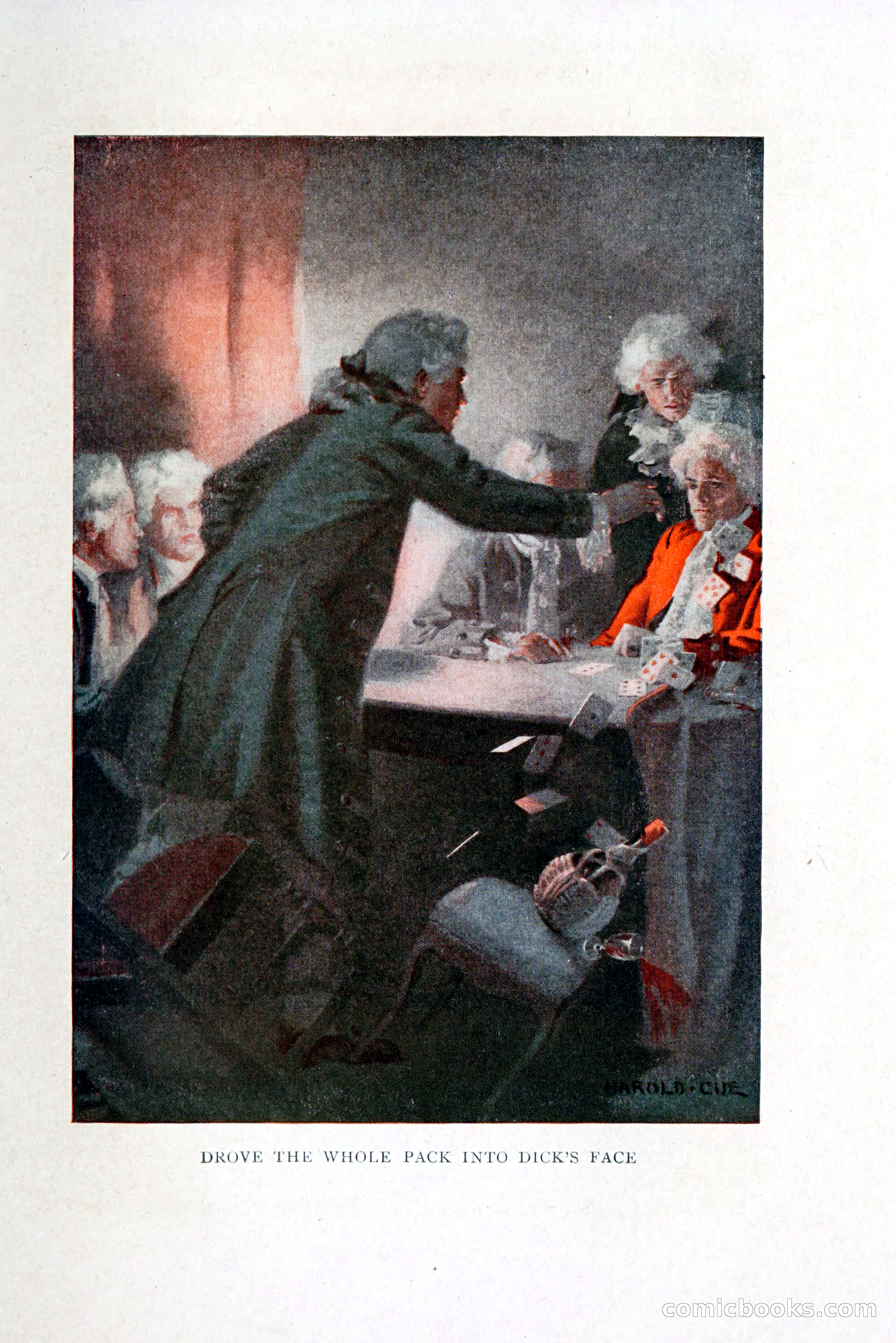
This page is an illustration from a Victorian penny dreadful, featuring a dramatic scene of violence. The image shows a man in a dark coat striking or attacking another man's face during what appears to be an indoor gathering of gentlemen in 18th-century dress. Several onlookers witness the altercation around a table. The caption beneath reads "DROVE THE WHOLE PACK INTO DICK'S FACE," though the OCR text is partially garbled. This suggests a violent confrontation involving a character named Dick, depicted as a sensational moment of action meant to thrill readers. The illustration's style and hand-colored execution are typical of penny dreadful visualization techniques.

# Victorian Penny Dreadful Page Analysis This page is **severely degraded and largely illegible**. The image shows what appears to be a printed text page with massive deterioration—the OCR'd text is nearly incomprehensible, consisting almost entirely of scattered punctuation marks, symbols, and fragments with no readable sentences or coherent content visible. The page's physical condition (discoloration, staining, heavy pixelation in the center area displaying iridescent purple-blue tones) suggests water damage, age-related decay, or severe scanning/reproduction errors. **No reliable text content can be determined** from either the image or OCR. Whether this is prose, illustration, advertisement, or title page cannot be established with confidence.
This is a page of running prose from a Victorian penny dreadful novel titled "De la Jonquière" (page 323). The text depicts a tense dramatic scene in which characters appear to be preparing for a duel at sunrise on Mount Hillaby involving weapons described as broadswords. Anderson, Eugène, Tom, and a Virginian character discuss arrangements while visiting the Governor's mansion, with references to a character named Dick (apparently jealous and the instigator), Lady Amy, and concern about whether Dick might be present at the location. The passage conveys urgency and anxiety through dialogue and brief narrative description.
This is a page of running prose from "Tom Anderson, Dare-Devil," a Victorian penny dreadful (page 324). The text depicts Tom seeking help from a doctor and then visiting an Indian named Unaka to enlist aid in saving a friend named Dick from a man called Knatchbull. When Tom expresses his love and desperation in Cherokee, Unaka mysteriously prepares a hollowed goat carcass as a container, ties it to his back, and appears ready to act. The passage combines melodramatic emotion with exotic adventure elements typical of the genre.
# Page Content This is a page of running prose from what appears to be a narrative text titled or featuring "De la Jonquiere" (page 325). The visible text describes a tense moment between characters—one anxious and questioning whether it's time to leave, while another character identified as "the Cherokee" silently takes the oars of what appears to be a boat. The passage concludes with a poetic image of the moon setting into the sea at dawn. The page is mostly blank space below the text, suggesting either the end of a chapter or section break.
# Analysis of Page Content This page contains running prose from Chapter XXXIV of a Victorian penny dreadful. The chapter title is "An Indian Secret." The text describes four men—including De la Jonquière (the Marquis) and Dr. Pomeroy—riding before dawn to Mount Hillaby, where they dismount in a glade. Tom asks about proximity to Hawk's Nest, and the Marquis indicates a château is visible on the next plateau. The passage builds tension around an impending confrontation: the first sunbeam rising over the sea will apparently signal antagonists to attack, described as a duel or "field of honor" rather than mere violence. The setting is clearly colonial (references to Codrington College, the Windwards, and a "red-headed lassie") and the tone is melodramatic, befitting the sensation fiction genre.
# What This Page Contains This is a page of running prose from a Victorian penny dreadful titled "An Indian Secret" (page 327). The text depicts a tense dramatic scene in which characters—a surgeon named Dr. Pomeroy, a Scotsman, and others—await someone named Dick Knatchbull for what appears to be a duel. As dawn breaks, a messenger (described as a "naked Carib") bursts from the bushes and delivers a fragment of paper to the surgeon, who begins to read it aloud. The passage emphasizes suspense and mounting tension through vivid sensory details and dialogue.
# Analysis of Page 328 This is a page of running prose from the penny dreadful *Tom Anderson, Dare-Devil*. The text describes an urgent rescue scene: Captain Tulloch has sent an emergency message summoning help, and a group including two physicians rushes to a pool where they find an unconscious man (Knatchbull) on a makeshift stretcher. They carry him to a house and the physicians begin attending to him while enslaved workers and Caribs gather outside, simultaneously alarmed and excited by the drama unfolding. The passage emphasizes Knatchbull's reputation as a kind master and the servants' emotional investment in his fate.
This is a page of running prose from the penny dreadful "An Indian Secret" (page 329). The text depicts a dramatic medical emergency scene where multiple men urgently work to revive an apparently dying man named Dick—applying hot blankets, mustard plasters, and stimulants while a music-box plays in the background. A character named Macglashan announces Dick is "coming round," and the men express relief, with discussion suggesting Dick narrowly escaped death by mere minutes.
This is a page of running prose from a Victorian penny dreadful titled "Tom Anderson, Dare-Devil" (page 330). The text depicts a tense confrontation between characters—Tulloch, Dr. Pomeroy, and Macglashan—regarding a patient who has been mysteriously drugged or "narcotized" before a scheduled duel. The characters argue about the drug's identity and how it was administered, with the dialogue becoming increasingly heated. The passage ends with Macglashan's revelation that there is an unusual smell in the victim's hair, prompting shocked reactions from the gathered men.
# Page Analysis: "An Indian Secret" This is a **page of running prose** from a Victorian penny dreadful (page 331). The text consists of dialogue and narrative describing a dramatic incident: a character named Tulloch explains to companions what happened to a man named Dick, who nearly drowned in a pool. According to Tulloch's account, Dick went for a swim in a bath-robe, was found almost submerged and unconscious, and was rescued only because his arms rested on a marble step above the water's surface. The passage emphasizes how close Dick came to drowning—"two inches lower" would have been fatal—and ends with Tulloch suggesting that if Dick had actually drowned, even someone named Mac couldn't have claimed it wasn't a seizure, implying suspicion of foul play.
This is a page of running prose from a Victorian penny dreadful titled *Tom Anderson, Dare-Devil*. The text describes a medical scene where characters named Mac, Tulloch, and others examine an apparently unconscious man named Knatchbull, debating whether he suffered a seizure or something else (with one character suggesting "voodooed"). A servant named Catulle is summoned for coffee, and reveals that his master Knatchbull left unusually early that morning on horseback. The passage concludes with Macglashan walking to a pool where Knatchbull nearly died. The language includes Scottish dialect and period racial slurs typical of Victorian-era fiction.
This is a page of running prose from a Victorian penny dreadful titled *An Indian Secret* (page 333). The text describes a man named Saunders Macglashan admiring a tropical garden and marble pool, particularly praising a statue called "the Ganges Woman." It then shifts to depict another character, Macaya, crouching by the water's edge who deliberately drowns a butterfly—an "Emperor of Morocco"—in what appears to be a casual, troubling act of cruelty.
# Tom Anderson, Dare-Devil (page 334) This is a page of running prose from a Victorian penny dreadful serial. The narrative follows Dr. Macglashan's confrontation with a character named Macaya by a pool, where the doctor forcibly extracts white hairs or threads from Macaya's hand using a lancet, apparently to preserve evidence. The text then details the doctor's busy day attending to various patients—a tooth extraction, a croupy baby, a sailor's broken leg—before he arrives home for supper, where his wife protests his intention to stay up late smoking and writing important correspondence.
This is a page of running prose from the serialized story "An Indian Secret" (page 335). A character in his study reads from a history book about an indigenous plant called "hai arry," a vine whose narcotic root the Indians use to poison water for fishing. Excited by this discovery—apparently seeking a method to accomplish some unstated purpose—he paces about, declaring he's outwitted someone called "Voodoo" and identifying his quarry as "the deepest devil i' the Windward Islands." Before leaving his study, he retrieves two vegetable objects from his wallet (text cuts off mid-sentence).
# Page Analysis This is a page of running prose from the penny dreadful serial "Tom Anderson, Dare-Devil" (page 336). It contains a formal letter from a Dr. Saunders Angus Macglashan, dated April 16th, 1781, describing poisonous fibers allegedly used to incapacitate Richard Knatchbull, Esq., to prevent his duel with the Marquis de la Jonquière. The page then shifts to narrative prose describing how the poisoning sparked local scandal, and shows Dick Knatchbull recovering on a veranda, spotting a yacht and conversing with Captain Tulloch about its passenger, the Princess Oczakoff. The text emphasizes sensational elements typical of the genre: poison, conspiracy, scandal, and mysterious aristocratic intrigue.
# Description This is a page of running prose from the story "An Indian Secret," page 337. The visible text shows dialogue between characters discussing guest lists for what appears to be a social gathering. One speaker mentions Lady Amy Dalton, Lord Mulgrave, De la Jonquiére, Major Wray and his daughters, and "that American." Another character responds sarcastically, questioning why two individuals named Tikki and Macaya weren't invited. The bulk of the page below the dialogue is blank, typical of penny dreadful formatting where chapters often ended mid-page.
# Page Description This is running prose from Chapter XXXV ("Sentenced") of a Victorian penny dreadful. The page depicts a scene aboard a yacht called the Flamingo anchored in Carlisle Bay. Characters observe Dr. Romeyn departing on another vessel (the Southwark) carrying something called the "Aztec Ring" to Paris for jewelers' appraisal. The chapter then shifts to Bridgetown, where military authority has been established during the Governor-General's absence, and a mysterious commotion draws large crowds to gather at an old cistern platform, with everyone's attention focused in one direction—suggesting an impending dramatic revelation or event.
This is a page of running prose from a Victorian penny dreadful, numbered 339 and titled "Sentenced." The passage depicts a dramatic scene in Bridgetown where a character named Tom, observing military activity from a yacht, suddenly dives into the water and rushes ashore on horseback through a crowded, hostile street. He encounters a courier who informs him that someone named Dick Knatchbull has been stabbed and is scheduled for execution by court martial at sundown. The text emphasizes melodramatic action—swimming, riding, dust, bayonets, and urgent dialogue—typical of sensational Victorian serial fiction.
This is running prose from page 340 of a Victorian penny dreadful titled *Tom Anderson, Dare-Devil*. The text recounts a violent street incident in Barbados involving a character named Unaka (identified as Cherokee), who attacks Dick Knatchbull over a stolen Voodoo charm. The resulting chaos draws military intervention, and Unaka is court-martialed and condemned to death—a verdict that troubles Tom Anderson and others who question the trial's validity, particularly the use of an interpreter and Colonel Forbes's insistence on a death sentence.
# Page Analysis This is a page of running prose (page 341) from what appears to be a Victorian penny dreadful novel titled "Sentenced." The text describes the aftermath of a court martial verdict affecting a character named Dick Knatchbull, who appears to be a wealthy benefactor of Barbados. The passage depicts Colonel Forbes arguing that Knatchbull's life should not be lost "at the hands of a savage," while others—including a Bishop, the Marquis de la Jonquiére, and an Archdeacon—discuss the sentence with apparent helplessness and distress. The scene culminates with the Bishop expressing emotional anguish about the "awful thing" occurring.
# Page Analysis This is a page of running prose from a Victorian penny dreadful serialized as "Tom Anderson, Dare-Devil" (page 342). The text depicts a dramatic scene in a guard-room where two characters, Unaka (Cherokee) and Tom, stand by a barred window. Unaka gives Tom sacred objects—a Voodoo emblem and a knife—connected to a conflict involving Cherokee honor and a man named Emathla. The passage culminates in Tom telling a lie when questioned about two enslaved workers seen on the parade-ground, followed by a bugle-call and the arrival of Tom's friends as a column of grenadiers enters. The prose emphasizes emotional intensity, honor codes, and mounting tension typical of melodramatic sensation fiction.
# Page Analysis: Running Prose from a Victorian Penny Dreadful This is a page of running narrative prose (page 343, titled "SENTENCED") from a serialized Victorian sensation tale. The text describes Lady Amy Dalton, daughter of the Governor-General of the Windward Islands, being denied entry at a gate by a soldier following orders. She rides away in anger, then returns dramatically on horseback to leap her horse over the enclosure wall to reach condemned prisoners—apparently including a Cherokee man and a Marquis—who stand facing execution. The passage emphasizes melodramatic moments: Lady Amy's shock at denial, the condemned men's final moments, and her daring rescue attempt. No illustrations appear on this page.
This is a page of running prose from the Victorian penny dreadful *Tom Anderson, Dare-Devil*. The text depicts a dramatic rescue scene: a young woman (the Governor of Barbados's daughter) on horseback intervenes to prevent the execution of a Cherokee prisoner by positioning herself before armed soldiers. As a Bishop begins prayers for the condemned man's death, a tropical hurricane suddenly strikes the scene, causing chaos. The passage ends with urgent calls to save the woman as a mass of people panic in the storm.
This is a page of running prose from a Victorian penny dreadful, numbered 345 and titled "SENTENCED." The text describes the catastrophic aftermath of a hurricane on the island of Barbados, focusing on Tom's desperate rescue efforts during the storm—he carries an insensible woman through chaos while hearing Amy Dalton's cries for help. The passage then catalogs deaths and destruction: five people shelter in a grave dug for someone named Unaka (including Amy Dalton, Tom, the Princess, the Marquis de la Jonquière, and Unaka himself), while Bishop Coleridge, Bambouk, and Mazouk are killed. It concludes with casualty figures—between four and five thousand dead on Barbados and property damage approximating two and a half million pounds sterling—with a footnote indicating the hurricane occurred October 10, 1780.
# Page Description This is running prose from page 346 of a Victorian penny dreadful titled *Tom Anderson, Dare-Devil*. The text describes a dramatic rescue scene where three men—Tom, the Marquis de la Jonquière, and Unaka—save the injured and bury the dead. It then introduces Dick Knatchbull, described as a figure under sentence of death who directs rescue efforts from a litter while carried by Caribs and followed by "cannibals." The passage climaxes with the revelation that witnessing Knatchbull's actions inspires three observers to "exchange forgiveness" with him. The prose is melodramatic and sensational in typical penny dreadful fashion.
# Analysis of Page Content This is a page of running prose from Chapter XXXVI of a Victorian penny dreadful. Old Rory McIntosh searches for his brother Tom the morning after a duel involving Sir Æneas. Rory visits the Savage house seeking Tom, where he meets a man named Troupe (described as Virginian). Rory initially mistakes Troupe's identity but soon learns that Tom Calvert is not in Charleston. The passage reveals that Major Anderson is imprisoned on a prison-ship, and Rory spends four weeks searching jails and attempting to contact prisoners, apparently without success. The narrative mixes Scottish dialect with standard English and suggests themes of family separation and wartime imprisonment.
# Analysis of Page 348 This is a page of running prose text from the penny dreadful *Tom Anderson, Dare-Devil*. The passage describes Troupe's search for a missing boy called "the Indian Missionary" (apparently Tom Anderson) in Charleston during the American Revolutionary War. After finding an unsigned note suggesting the boy has joined Sumter's forces, Troupe enlists in Morgan's command and participates in Revolutionary battles (Cowpens, Cowan's Ford, the Dan River crossing). The text ends with Governor Jefferson's correspondence about deploying American forces against the British in the South, presumably addressing fears of Benedict Arnold's ("the Red Judas") treachery.
# Page 349 of "The Bull Before the Gun" This is a page of running prose from a Victorian penny dreadful novel. The text describes a Revolutionary War narrative: Major-General Arthur Leslie has landed at Portsmouth with fifteen thousand men, prompting emotional reactions from a character named Troupe. The passage then shifts to battle scenes at Guilford Courthouse and Hobkirk's Hill, focusing on a prisoner of war named Andy watching from a jail stockade in Camden. After Troupe awakens wounded in a wagon during Greene's retreat, chaos erupts among the injured men—apparently caused by the arrival of British redcoats. The prose combines melodramatic sentiment with action and dialogue typical of the penny dreadful genre.
# Page from "Tom Anderson, Dare-Devil" This is a page of running prose (page 350) from a Victorian penny dreadful serial. The passage depicts a chaotic military scene where oxen pulling an artillery gun have panicked and collapsed in a creek, halting the column. As soldiers struggle to move the animals, a wounded man recognizes the lead ox as "Old Ball" and begins shouting military commands at it—"Attention, Company Ball! Fall into line!"—as if rallying troops. The text employs dialect heavily and builds toward the remarkable moment when the exhausted bull appears to respond to these commands, its sides heaving as if preparing to obey.
# "The Bull Before the Gun" — Page 351 This is a page of running prose from what appears to be a Victorian penny dreadful. The text describes a chaotic military or hunting scene involving soldiers charging, a large animal (a bull), and artillery fire. Characters shout military commands ("Charge—Bayonets!", "Forward!") and rally around someone named Peake Dangeridge while a cannon is fired from a creek, causing tremendous noise and commotion. The dialogue is rendered in heavy dialect, capturing soldiers' exclamations and a character identifying an animal by distinctive physical markings. The scene emphasizes violent action and military fervor.
This is a page of running prose from Chapter XXXVII, titled "In High Cabal." The passage describes Major Roderick McIntosh waiting at his house at Mallow at sundown in springtime, when three young men arrive on horseback. One appears to be a boy named Tammie whom McIntosh loves as a son; the other two are identified as the Marquis de la Jonquière and an indigenous man named Unaka Nung-noh-hut-tar-hee, grandson of a chief. McIntosh welcomes them warmly. The text references historical conflict with "Spaniards and Indians" and includes Scottish dialect phrases, suggesting a colonial American setting.
This is a page of running prose (page 353) from a Victorian penny dreadful titled "In High Cabal." The text describes four men gathered by firelight—Rory, De la Jonquière, a Cherokee, and the narrator Unaka—as Tom recounts his story of carrying Sir Æneas from a church in Charleston to Florida. The passage details each man's racial and social background, describes Unaka's fine clothing and an engraved sword awarded him by Barbados, and ends with Rory responding emotionally to Tom's tale of capture during the American Revolution, mentioning Roderick McIntosh and Lord Rawdon's Headquarters.
# Victorian Penny Dreadful Page Analysis This is a **page of running prose** from the serialized story "Tom Anderson, Dare-Devil" (page 354). The text depicts a dramatic conversation between Rory and Tom, in which Tom recounts a tale of shipwreck and treasure-hunting. He describes how a ship called the Southwark sank off Barbados with the "Aztec Ring" (an emerald jewel) aboard; Tom later recovered it from the corpse of Dr. Romeyn and sold it to Lord Mulgrave for profit. Tom then purchased a French merchant vessel, L'Indienne, and invited Rory to sail home with him. The passage ends by listing passengers aboard the ship in Chesapeake Bay, including Tom Anderson himself.
This is a page of running prose from a Victorian penny dreadful titled "In High Cabal" (page 355). The text describes a French privateer ship called L'Indienne carrying contraband—sugar hogsheads containing gunpowder and molasses barrels containing lead—sailing unmolested up a river during wartime. The crew discovers Richmond burned, a Frenchman commanding American troops, and learns that the Marquis de la Fayette is leading forces nearby. De la Jonquière visits Lafayette to share the secret of the privateer's cargo, though Tom withholds knowledge that he carries diplomatic papers from Count de Grasse to the General-in-Chief. The passage appears set during the American Revolution.
# Page Description This is a page of running prose (page 356) from the serial fiction *Tom Anderson, Dare-Devil*. The text describes Tom's party traveling toward Charlottesville during what appears to be the American Revolutionary War era, involving characters connected to Lafayette and Washington. While camped in the forest, they encounter two young men—Troupe and Peake Dangeridge—emerging from the woods. Troupe is injured (bandaged), and his appearance causes Rory to exclaim emotionally in Gaelic. The page contains no illustrations, only dense typeset narrative text with period dialogue.
# Page 357 of "In High Cabal" This is a page of running prose from what appears to be a serialized novel (page 357). The text describes Tom's emotional reunion with companions named Troupe and Peake at a campfire, followed by a tense encounter the next day when a large detachment of troops under General Simcoe suddenly appears on the road. Rory, apparently leading the group, stops the soldiers by invoking the King's name and presenting passports, claiming to be Major Roderick McIntosh escorting two gentlemen from the British West Indies—though the narrative hints that at least one member of the party is actually a dispatch-bearer to Washington, raising tension about whether they'll be searched.
# Page Analysis: Running Prose from Victorian Penny Dreadful This is a page of running prose text (page 358) from *Tom Anderson, Dare-Devil*, a Victorian penny dreadful. The narrative describes a tense moment where Tom and companions have obtained passports, but two men (Troupe and Peake) possess only questionable credentials signed by "Nathanael Greene." A British troop departs with dispatches, and Tom fears a raid on Oxheart House—Audley Anderson's Virginia plantation—where defenseless people remain. The Major experiences conflicting loyalties between devotion to Tom and loyalty to his sovereign. Tom then diplomatically praises the Major's diplomacy regarding someone named Simcoe, and the group decides to shelter near an abandoned log meetinghouse in the woods.
This is a page of running prose from chapter or section "In High Cabal" (page 359). The text describes Tom's discovery of a ragged, commanding man filling his cap at a spring beneath an elm tree. Tom initially addresses him as "Major Anderson," but the man corrects himself as "Audley Anderson." When a tall, bronzed young fellow steps forward, Tom—apparently the father—recognizes him with the realization "It is my boy!" The passage emphasizes the man's dignity despite his tattered appearance and the emotional weight of this apparent reunion.
This is a page of running prose from Chapter XXXVIII of what appears to be a Civil War-era American novel. The chapter depicts a character named Dare riding urgently homeward after learning that her friend Mimi is to marry an unexpected suitor. The plantation bell sounds an alarm—recalling a previous emergency when "Tom was lost"—and Dare encounters British military pickets (soldiers in shakos and red coats) on the road. She gallops past them toward the avenue gates, displaying skilled horsemanship. The text suggests a narrative of wartime danger and domestic upheaval, likely set during the American Revolutionary War based on references to Arnold, Jefferson, and British occupation.
This is a page of running prose from a Victorian penny dreadful serial (page 361). The text describes a young woman named Dare arriving at Oxheart estate on horseback, surrounded by red-coated soldiers. After being helped from her pony, she composes herself and is asked to sing at the harpsichord. The passage ends as she begins performing a emotional ballad for the assembled men, with the sunset casting dramatic light through an open window. The narrative suggests military occupation and Dare using her musical talent in a moment of apparent tension or danger.
# Page Content This is a page of running prose (page 362) from the penny dreadful *Tom Anderson, Dare-Devil*. The text describes a dramatic encounter in which a character named Dare hears her own song sung aloud, then meets the man who wrote it—a British military officer who identifies himself as Banastre Tarleton. He grants her family mercy from his Black Dragoons in exchange for the song's sentimental hold on his heart. The passage emphasizes Dare's emotional turmoil and the officer's imposing military presence as she leaves the scene.
This is a page of running prose from a Victorian penny dreadful (page 363, titled "Who was It?"). The text depicts a dramatic scene in which a young woman named Dare encounters Arthur Leslie at Oxheart House. After a tense exchange where she accuses him of being a "false friend and open enemy," he enters the hall despite her rejection. A gunshot rings out, and Dare rushes downstairs to find a motionless figure surrounded by soldiers in red uniforms. The page ends with a girl's scream revealing the victim is "General Leslie."
# Victorian Penny Dreadful Page Analysis This is a page of running prose narrative from *Tom Anderson, Dare-Devil*, a serialized Victorian sensation story. The text depicts the dramatic aftermath of a shooting: a young man named Arthur (Captain Leslie) has been shot and lies unconscious; the protagonist Dare faints upon learning this, then awakens to find herself in the library attended by Dr. Pratt and others. The passage establishes that the shooter has escaped unidentified, that a pistol belonging to Tarleton's Legion was used, and that British officers were present at the scene. The narrative emphasizes mystery and confusion—no clue to the shooter's identity has been found.
This is a page of running prose from a Victorian penny dreadful (page 365). The text describes the aftermath of an attempted murder on someone named Leslie. A character named Dare realizes she has made a terrible mistake—she insulted a wounded man, believing him to be a "General Leslie" leading an invasion, when he was actually her beloved Arthur. The passage reflects on how events repeat themselves in life, with Dare now anxiously waiting for news of Arthur's condition while her grandmother Mrs. Anderson lies confined to her bedroom.
# Page Analysis This is running prose from page 366 of Tom Anderson, Dare-Devil (a Victorian penny dreadful). The passage depicts a dramatic domestic scene during what appears to be a military occupation: Black Dragoons have invaded a plantation house, cooking suppers and creating chaos. A character named Dare overhears a soldier auctioning the location of a wine-cellar. When Colonel Tarleton's officer arrives demanding an interview with the house's mistress, the grandmother (ill in bed) sends a polite refusal. Dr. Pratt then arrives with news that British officers are searching for someone who shot a man named Leslie, and that Colonel Tarleton wishes to question a young woman called Miss Mary Josephine.
# Page Description This is a page of running prose (page 367) from a Victorian penny dreadful titled "Who was It?" The text depicts an interrogation scene: Captain Leslie has been shot by an unknown assassin who escaped despite being surrounded by officers. A young woman named Miss Anderson is questioned about the shooter—she admits knowing him and that he owes his life to her brother and Dr. Pratt. As she denies suspicion of who the culprit is, she suddenly wonders about someone named Ole, recalling his boastful threat about shooting British soldiers when they arrived. The passage emphasizes mystery and mounting tension around the shooter's identity.
# Page from Tom Anderson, Dare-Devil This is a page of running prose (page 368) from what appears to be a serialized penny dreadful titled *Tom Anderson, Dare-Devil*. The text depicts a tense dramatic moment: a character reflects on a shooting incident in a dark hall, uncertain whether the shooter recognized their victim. A woman experiences a rush of guilt or suspicion that causes her to blush deeply, and she then faces interrogation from someone named Tarleton, who demands to know the victim's identity. She resists answering his demanding question. The passage emphasizes emotional intensity and melodramatic sensation typical of Victorian popular fiction.
This is a page of running prose from Chapter XXXIX, titled "DARE," in what appears to be a Victorian sensational novel. The text describes a crisis unfolding at a plantation called Oxheart: Dr. Pratt warns that outbuildings will be burned and livestock seized unless a would-be murderer is found by daybreak. After midnight, soldiers arrive, break into the wine-cellar, become drunk, and begin looting and burning tobacco-houses while Mrs. Anderson observes the chaos. The passage ends with drunken soldiers forcing their way into the upper rooms of the house.
This is a page of running prose from the penny dreadful *Tom Anderson, Dare-Devil* (page 370). The text depicts a chaotic scene where a drunken mob ransacks a room containing bridal finery, and a woman wielding an axe attempts to break into a locked oak press. The protagonist Dare intervenes, discovering that the axe-wielding woman is a mulatto character from the plantation quarters, and that imprisoned in the press is a man named Ole hiding from Tarleton's Dragoons (appears to be a Revolutionary War reference). The passage combines melodrama, social transgression, and violent action typical of the genre.
# Page Analysis: Victorian Penny Dreadful This is a page of running prose (page 371) from a serialized sensation novel titled *Dare*. The text depicts a chaotic scene in which the protagonist Dare confronts a drunken mob vandalizing portraits in a drawing-room. After discovering a blood-stained coat and pistols in a sick-room, she arms herself and enters the chaos, where she uses a pistol to defend the portraits and demonstrate her courage. A witness (Pratt) later describes her actions admiringly, comparing her to "a white doe in a pack of wolves." The passage emphasizes her inherited nerve and depicts her protecting family property and honor against rowdy, intoxicated men.
This is a page of running prose from a Victorian penny dreadful serial titled *Tom Anderson, Dare-Devil* (page 372). The text describes an action scene in which a female character named Dare defends a bridal portrait from destruction by a rowdy crowd, firing pistols to protect it. When a man named Arthur Leslie calls out from a sickroom asking whether she retrieved a dispatch for Colonel Tarleton, Dare finds a folded military document in Leslie's coat signed by "Arthur Leslie, Major-General Commanding British Troops in Virginia"—marked "Immediate" and addressed to Colonel Banastre Tarleton. The passage suggests espionage or military intrigue during the American Revolutionary War period.
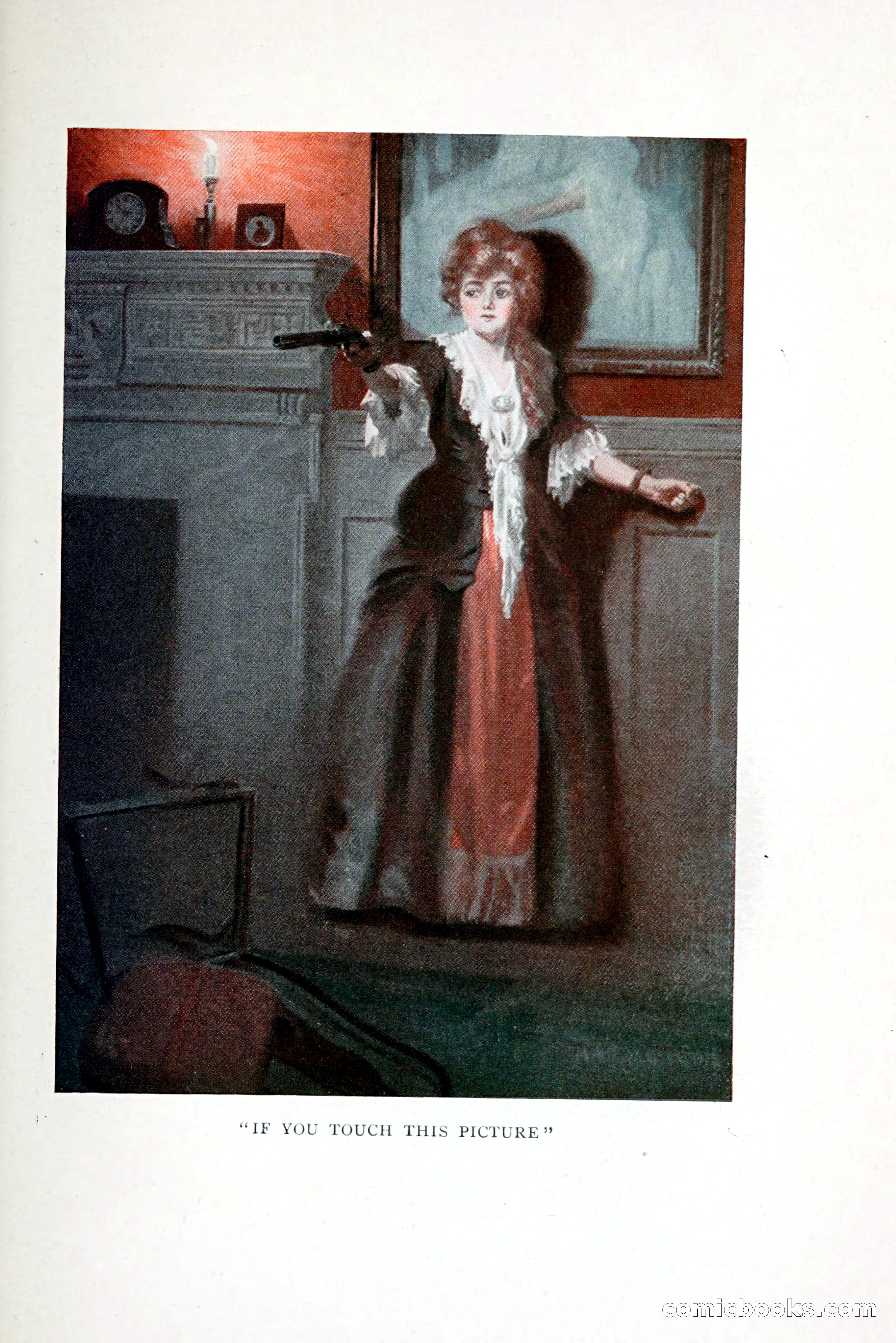
This page displays a hand-colored illustration with a caption reading "IF YOU TOUCH THIS PICTURE" beneath it. The image shows a woman with reddish hair in Victorian dress (dark jacket with white lace collar and cuffs, red skirt) standing in an interior room. She appears to be gesturing or reacting with alarm. Behind her is a fireplace with clocks on the mantle and paneled walls. The incomplete caption suggests this is likely part of a serialized story or sensational narrative, though the full text or context for what would happen "if you touch this picture" is not visible on this page. This appears to be an illustration page from a Victorian penny dreadful.

# Assessment This page is largely illegible and appears to be a degraded scan or photograph of a printed surface. The image shows a heavily textured, mottled background in pale cream and white tones with scattered spots and discoloration. Color shifts toward green and blue appear on the right edge. The only clearly visible text is the watermark "comicbooks.com" at the bottom right corner, which is a modern attribution rather than original Victorian content. No Victorian penny dreadful text, illustrations, or meaningful content is discernible from this page. It may represent significant paper deterioration, scanning error, or blank space from an original publication. Without readable text or imagery, I cannot determine whether this is a title page, illustration, or prose section.
# Page 373 of "Dare" This is a page of running prose from a Victorian penny dreadful serial. The text depicts a woman (apparently named Dare) taking urgent action during a military raid on a plantation. After learning that raiders have taken nearly all available horses, she instructs a man named Busher to steal two horses from the invaders and hide them, then slips out a window herself to reach the slave quarters, her heart racing as she navigates the chaos of burning tobacco-houses and a retreating caravan of soldiers, livestock, and enslaved people moving along a road.
# Tom Anderson, Dare-Devil (Page 374) This is a page of running prose from a Victorian penny dreadful serial. The text describes a dramatic nighttime escape: a character called "Dare" and a Welshman named Busher flee on horseback across fields and highways to evade a cavalry-led caravan. The passage details their journey through darkness and dawn, the horses' behavior, and the surrounding landscape, while also referencing earlier plot elements including a deaf paralytic woman ("Billy's Granny") calling for someone called the Fool. The narrative emphasizes mystery and impending danger as morning approaches and the horses become increasingly alert.
This is a page of running prose from a Victorian penny dreadful novel titled "Dare" (page 375). The text depicts a dramatic encounter during what appears to be the American Revolutionary War, in which a young woman named Dare (also called the "Oxheart Beauty") rides toward British redcoats at dawn to deliver a sealed dispatch from Major-General Leslie to Colonel Tarleton. After Tarleton discovers she opened the dispatch, he questions her boldness, then sends an officer away to carry out the orders within it—which concern restoring livestock and slaves to a place called Oxheart. The scene ends with Tarleton asking Dare whether she knows who attempted to murder Captain Leslie.
This page contains running prose from a Victorian penny dreadful titled *Tom Anderson, Dare-Devil* (page 376). The text depicts a dramatic encounter: a female character named Dare, after saying farewell to a departing soldier, is approached by a dark-complexioned, elegantly dressed rider. Without warning, he seizes her bridle, embraces her, and kisses her while her companion Busher does nothing to intervene. The passage ends with a dialectal exclamation suggesting familiarity between the mysterious rider and Dare. The narrative emphasizes romantic melodrama and sudden, improper physical contact typical of Victorian sensation fiction.
This is a page of running prose from Chapter XL of a Victorian penny dreadful. The text describes a chaotic scene in which a character called Fool Billy, hidden under a hall table during a military skirmish at a place called Oxheart, has stolen a pistol and contemplates using it. The passage depicts Billy's confused mental state as various people and animals move around him, and ends with a character named Leslie momentarily frozen after being rebuked by someone named Dare, while "the Black Thistle" appears in the final line (seemingly a character epithet).
# Page from Tom Anderson, Dare-Devil This is a page of running prose (page 378) from a Victorian penny dreadful titled *Tom Anderson, Dare-Devil*. The text describes violent action: a character named Billy shoots a man, then hides in a boot-closet and is discovered and ejected from a house. The narrative follows the character's subsequent movements through the night and into the following day, as he hides in the woods near Carter's Mountain, apparently evading pursuit for shooting Captain Leslie. The dialect-heavy prose depicts the character's hunger, recovery from injury, and interaction with an agitated catbird.