
Penny Dreadfuls, 1916 · page 22 of 400
Tom Anderson, Dare-Devil: A Young Virginian in the Revolution — page 22: what you’re looking at
What you’re looking at
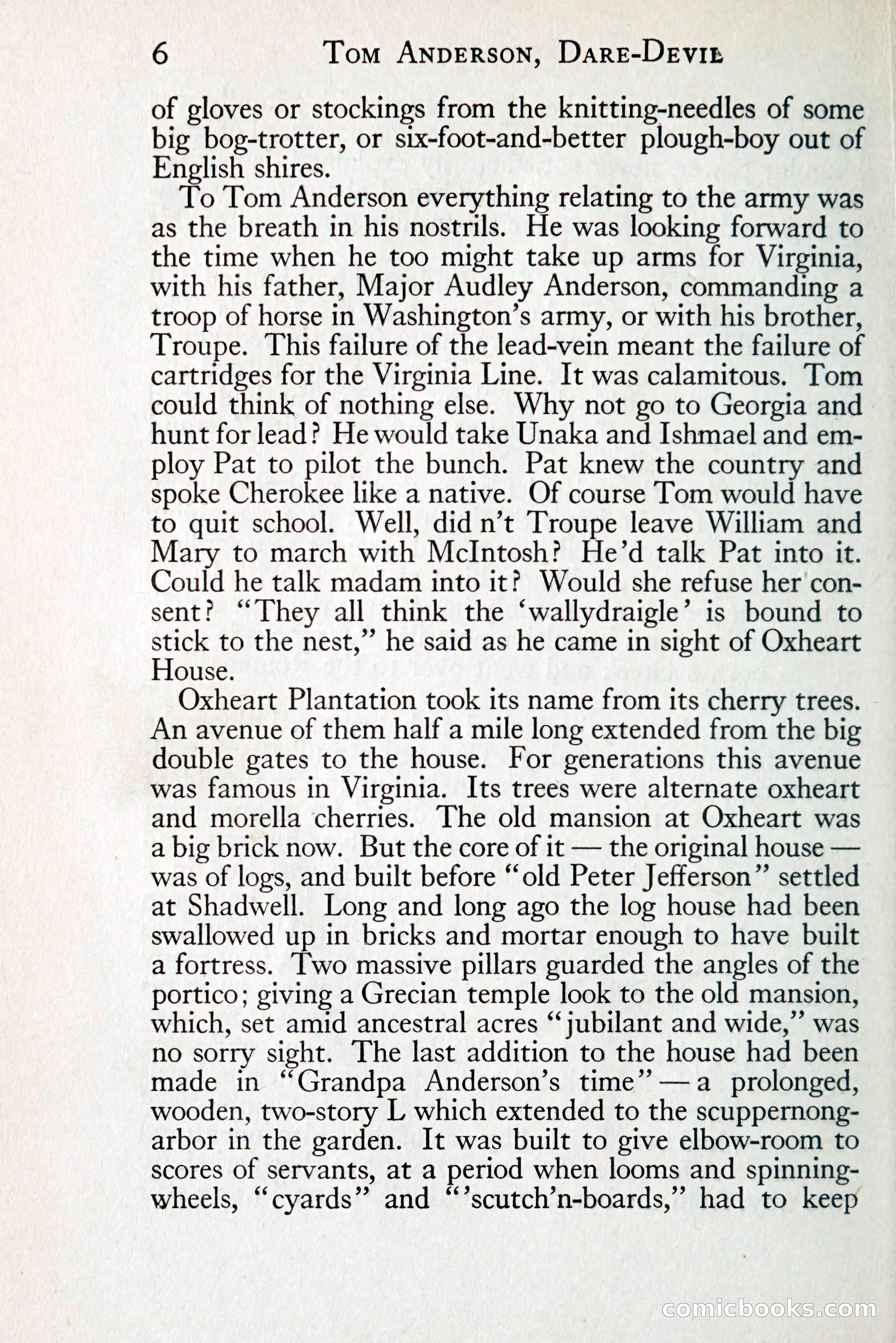
This is a page of running prose from the penny dreadful *Tom Anderson, Dare-Devil*. The text depicts the young protagonist Tom Anderson's ambitions to serve in the American Revolution and his scheme to hunt for lead in Georgia to supply the Virginia Line, followed by a detailed description of Oxheart Plantation—a grand Virginia mansion with a log-house core predating Thomas Jefferson's settlement at Shadwell, expanded over generations with brick additions and a Grecian portico.
📄 Transcribed text from this page (OCR, searchable)
Machine-transcribed from the original scan — historical spelling and the odd misread are preserved.
6 Tom ANDERSON, Dare-DeEvit of gloves or stockings from the knitting-needles of some big bog-trotter, or six-foot-and-better plough-boy out of English shires. To Tom Anderson everything relating to the army was as the breath in his nostrils. He was looking forward to the time when he too might take up arms for Virginia, with his father, Major Audley Anderson, commanding a troop of horse in Washington’s army, or with his brother, Troupe. This failure of the lead-vein meant the failure of cartridges for the Virginia Line. It was calamitous. Tom could think of nothing else. Why not go to Georgia and hunt for lead? He would take Unaka and Ishmael and em- ploy Pat to pilot the bunch. Pat knew the country and spoke Cherokee like a native. Of course Tom would have to quit school. Well, didn’t Troupe leave William and Mary to march with McIntosh? He’d talk Pat into it. Could he talk madam into it? Would she refuse her con- sent? “They all think the ‘wallydraigle’ is bound to stick to the nest,”’ he said as he came in sight of Oxheart House. Oxheart Plantation took its name from its cherry trees. An avenue of them half a mile long extended from the big double gates to the house. For generations this avenue was famous in Virginia. Its trees were alternate oxheart and morella cherries. The old mansion at Oxheart was a big brick now. But the core of it — the original house — was of logs, and built before “old Peter Jefferson” settled at Shadwell. Long and long ago the log house had been swallowed up in bricks and mortar enough to have built a fortress. Two massive pillars guarded the angles of the portico; giving a Grecian temple look to the old mansion, which, set amid ancestral acres “‘jubilant and wide,” was no sorry sight. The last addition to the house had been made in “Grandpa Anderson’s time’ —a_ prolonged, wooden, two-story L which extended to the scuppernong- arbor in the garden. It was built to give elbow-room to scores of servants, at a period when looms and spinning- wheels, “cyards” and “’scutch’n-boards,” had to keep Gomicbooksreom