
Penny Dreadfuls, 1916 · page 202 of 400
Tom Anderson, Dare-Devil: A Young Virginian in the Revolution — page 202: what you’re looking at
What you’re looking at
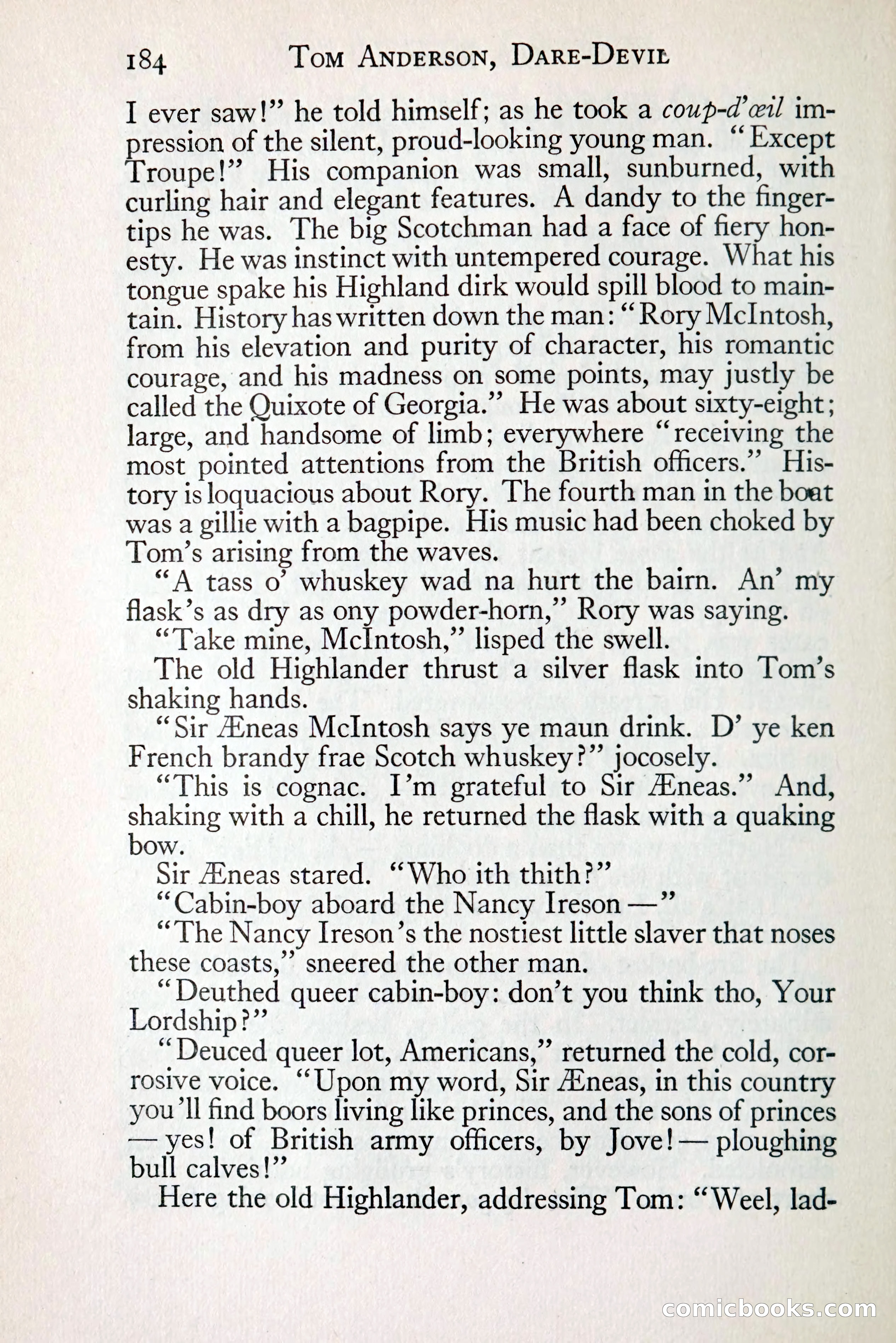
# Analysis This is a page of running prose from a Victorian penny dreadful titled "Tom Anderson, Dare-Devil" (page 184). The text depicts a scene in a boat where Tom, having just emerged from the water, encounters several men: a small, elegant dandy named Troupe; an elderly Scottish Highlander named Rory McIntosh (described as the "Quixote of Georgia"); Sir Æneas McIntosh; and a bagpiper. The passage focuses on dialogue and character introductions, with Scottish dialect and period attitudes toward Americans and class distinctions. The narrative concerns itself with offering Tom brandy and establishing the social dynamics among the assembled characters.
📄 Transcribed text from this page (OCR, searchable)
Machine-transcribed from the original scan — historical spelling and the odd misread are preserved.
184 Tom ANDERSON, DareE-DEVIL I ever saw!” he told himself; as he took a coup-d’eil im- pression of the silent, proud-looking young man. “ Except Troupe!” His companion was small, sunburned, with curling hair and elegant features. A dandy to the finger- tips he was. The big Scotchman had a face of fiery hon- esty. He was instinct with untempered courage. What his tongue spake his Highland dirk would spill blood to main- tain. History has written down the man: “ Rory McIntosh, from his elevation and purity of character, his romantic courage, and his madness on some points, may justly be called the Quixote of Georgia.” He was about sixty-eight; large, and handsome of limb; everywhere “receiving the most pointed attentions from the British officers.” His- tory is loquacious about Rory. The fourth man in the boat was a gillie with a bagpipe. His music had been choked by Tom’s arising from the waves. “A tass o whuskey wad na hurt the bairn. An’ my flask’s as dry as ony powder-horn,” Rory was saying. “Take mine, McIntosh,” lisped the swell. The old Highlander thrust a silver flask into Tom’s shaking hands. “Sir 4Eneas McIntosh says ye maun drink. D’ ye ken French brandy frae Scotch whuskey?” jocosely. “This is cognac. I’m grateful to Sir A‘neas.” And, shaking with a chill, he returned the flask with a quaking bow. Sir A‘neas stared. “Who ith thith?”’ ‘Cabin-boy aboard the Nancy Ireson —”’ “The Nancy Ireson’s the nostiest little slaver that noses these coasts,” sneered the other man. “Deuthed queer cabin-boy: don’t you think tho, Your Lordship ?”’ | ‘ Deuced queer lot, Americans,”’ returned the cold, cor- rosive voice. “Upon my word, Sir Aineas, in this country you ll find boors living like princes, and the sons of princes — yes! of British army officers, by Jove! — ploughing bull calves!”’ Here the old Highlander, addressing Tom: “Weel, lad- Gomicbooks. Go m