
Penny Dreadfuls, 1916 · page 323 of 400
Tom Anderson, Dare-Devil: A Young Virginian in the Revolution — page 323: what you’re looking at
What you’re looking at
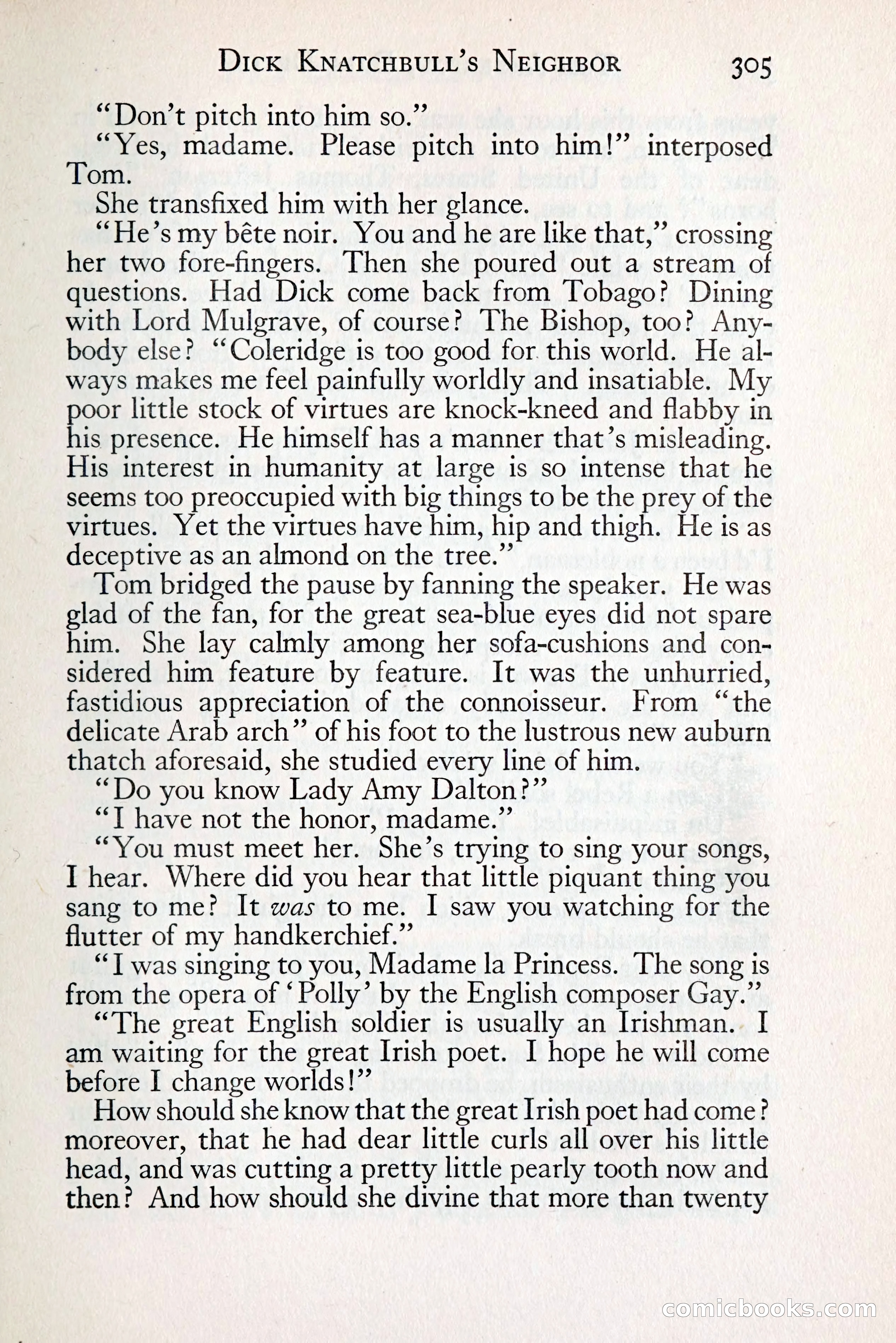
# Dick Knatchbull's Neighbor, Page 305 This is a page of running prose from what appears to be Chapter or Section 305 of a Victorian serialized novel titled "Dick Knatchbull's Neighbor." The text depicts a flirtatious social scene in which a woman (addressed as "Madame la Princess") interrogates a man named Tom about Dick's whereabouts and social engagements, offers critical commentary on the poet Coleridge, examines Tom's physical appearance, and discusses a song he has sung to her. The passage concludes with mysterious narrative commentary suggesting the woman is unaware that "the great Irish poet" has already arrived and is an infant with curls cutting his first tooth.
📄 Transcribed text from this page (OCR, searchable)
Machine-transcribed from the original scan — historical spelling and the odd misread are preserved.
Dick KNATCHBULL’s NEIGHBOR 305 “Don’t pitch into him so.” “Yes, madame. Please pitch into him Tom. She transfixed him with her glance. ‘“He’s my béte noir. You and he are like that,” crossing her two fore-fingers. Then she poured out a stream of questions. Had Dick come back from Tobago? Dining with Lord Mulgrave, of course? The Bishop, too? Any- body else? “Coleridge is too good for. this world. He al- ways makes me feel painfully worldly and insatiable. My poor little stock of virtues are knock-kneed and flabby in his presence. He himself has a manner that’s misleading. His interest in humanity at large is so intense that he seems too preoccupied with big things to be the prey of the virtues. Yet the virtues have him, hip and thigh. He is as deceptive as an almond on the tree.”’ Tom bridged the pause by fanning the speaker. He was glad of the fan, for the great sea-blue eyes did not spare him. She lay calmly among her sofa-cushions and con- sidered him feature by feature. It was the unhurried, fastidious appreciation of the connoisseur. From “the delicate Arab arch” of his foot to the lustrous new auburn thatch aforesaid, she studied every line of him. “Do you know Lady Amy Dalton?” “| have not the honor, madame.”’ “You must meet her. She’s trying to sing your songs, I hear. Where did you hear that little piquant thing you sang to me? It was to me. I saw you watching for the flutter of my handkerchief.”’ “T was singing to you, Madame la Princess. ‘The song is from the opera of ‘ Polly’ by the English composer Gay.” “The great English soldier is usually an Irishman. | am waiting for the great Irish poet. I hope he will come before I change worlds!”’ How should she know that the great Irish poet had come? moreover, that he had dear little curls all over his little head, and was cutting a pretty little pearly tooth now and then? And how should she divine that more than twenty ide interposed GomiGcsoo “eS (C©) im