
Penny Dreadfuls, 1916 · page 251 of 400
Tom Anderson, Dare-Devil: A Young Virginian in the Revolution — page 251: what you’re looking at
What you’re looking at
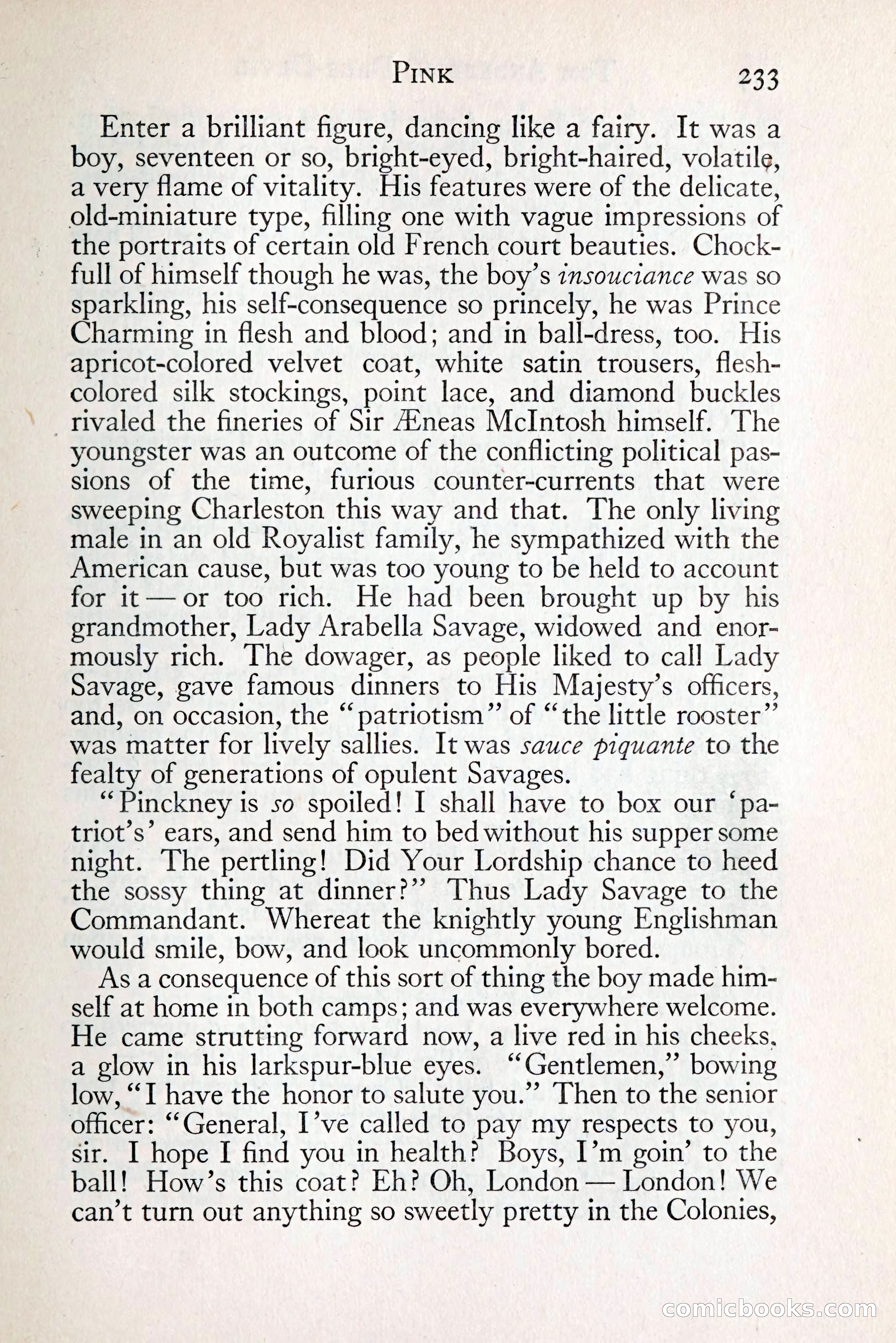
# Page 233 of "Pink": Running Prose This is a page of running prose from what appears to be a Victorian serial novel set in Charleston during the American Revolution. The text describes the entrance of a seventeen-year-old boy named Pinckney—a charming, well-dressed, spoiled member of an old Royalist family raised by his wealthy grandmother, Lady Arabella Savage. Despite his family's British loyalties, he sympathizes with the American cause but is too young and rich to face consequences. The passage portrays him as welcome in both British and American camps, and shows him arriving at a social gathering in his fashionable London coat, boasting about attending a ball.
📄 Transcribed text from this page (OCR, searchable)
Machine-transcribed from the original scan — historical spelling and the odd misread are preserved.
PINK 232 Enter a brilliant figure, dancing like a fairy. It was a boy, seventeen or so, bright-eyed, bright-haired, volatile, a very flame of vitality. His features were of the delicate, old-miniature type, filling one with vague impressions of the portraits of certain old French court beauties. Chock- full of himself though he was, the boy’s znsouciance was so sparkling, his self-consequence so princely, he was Prince Charming in flesh and blood; and in ball-dress, too. His apricot-colored velvet coat, white satin trousers, flesh- colored silk stockings, point lace, and diamond buckles rivaled the fineries of Sir A‘neas McIntosh himself. The youngster was an outcome of the conflicting political pas- sions of the time, furious counter-currents that were sweeping Charleston this way and that. The only living male in an old Royalist family, he sympathized with the American cause, but was too young to be held to account for it—or too rich. He had been brought up by his erandmother, Lady Arabella Savage, widowed and enor- mously rich. The dowager, as people liked to call Lady Savage, gave famous dinners to His Mayjesty’s officers, and, on occasion, the “patriotism”’ of “the little rooster”’ was matter for lively sallies. It was sauce piquante to the fealty of generations of opulent Savages. ‘Pinckney is so spoiled! I shall have to box our ‘pa- triot’s’ ears, and send him to bed without his supper some night. The pertling! Did Your Lordship chance to heed the sossy thing at dinner?’’ Thus Lady Savage to the Commandant. Whereat the knightly young Englishman would smile, bow, and look uncommonly bored. As a consequence of this sort of thing the boy made him- self at home in both camps; and was everywhere welcome. He came strutting forward now, a live red in his cheeks, a glow in his larkspur-blue eyes. “Gentlemen,” bowing low, “I have the honor to salute you.” Then to the senior officer: “General, I’ve called to pay my respects to you, sir. I hope I find you in health? Boys, I’m goin’ to the ball! How’s this coat? Eh? Oh, London — London! We can’t turn out anything so sweetly pretty in the Colonies, GomiGcsoo SS (E() im