
Penny Dreadfuls, 1916 · page 45 of 400
Tom Anderson, Dare-Devil: A Young Virginian in the Revolution — page 45: what you’re looking at
What you’re looking at
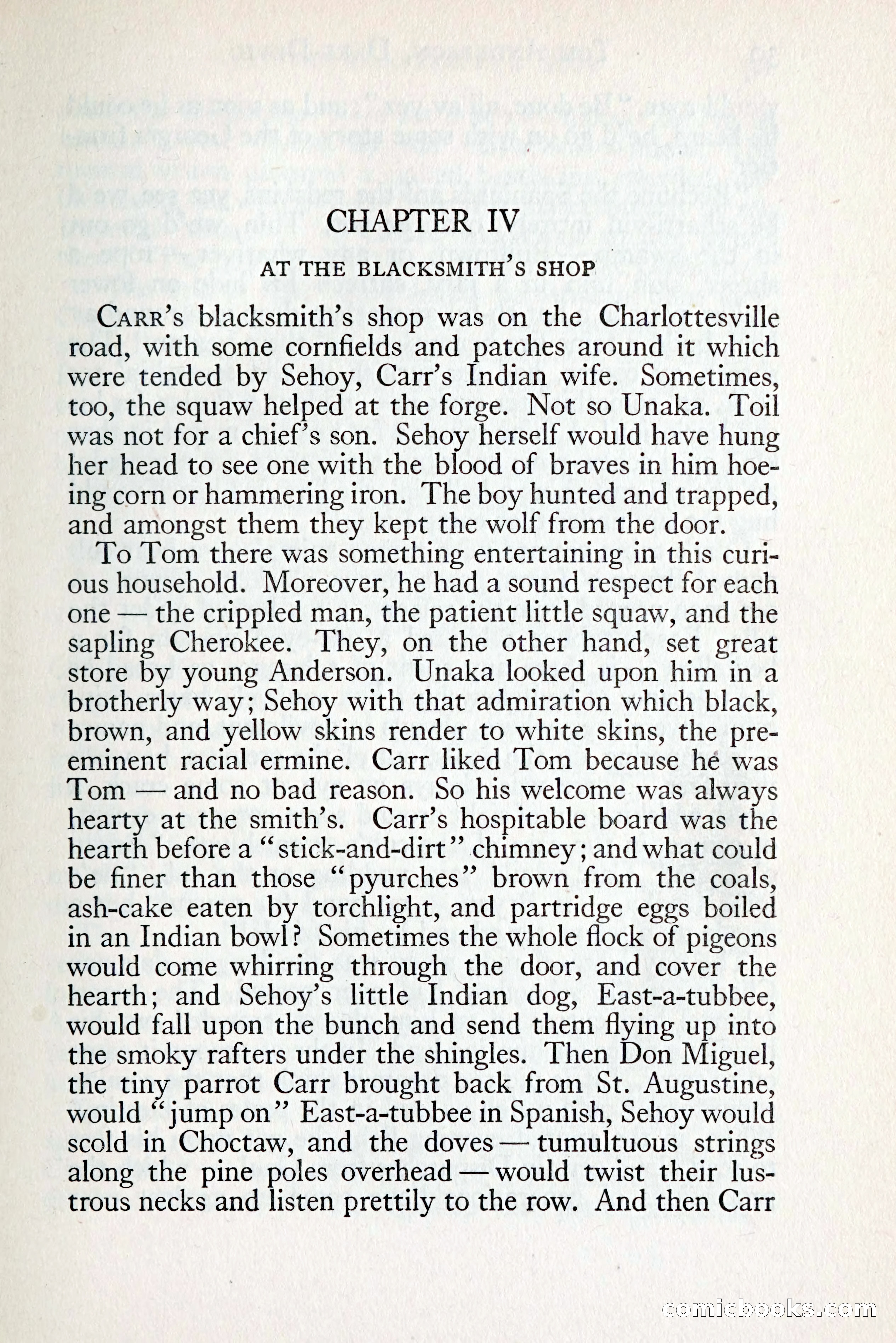
# Page Analysis This is a running prose page from Chapter IV of what appears to be a Victorian-era novel or serial fiction. The text describes a blacksmith's shop on the Charlottesville road, owned by a man named Carr, who has an Indian wife named Sehoy. It focuses on Tom Anderson's visits to this household and his relationships with Carr, Unaka (a Cherokee youth), and the animals kept there—including a dog, parrot, and pigeons. The passage emphasizes the domestic scene and cross-cultural interactions within this frontier household.
📄 Transcribed text from this page (OCR, searchable)
Machine-transcribed from the original scan — historical spelling and the odd misread are preserved.
CHAPTER IV AT THE BLACKSMITH S SHOP Carr’s blacksmith’s shop was on the Charlottesville road, with some cornfields and patches around it which were tended by Sehoy, Carr’s Indian wife. Sometimes, too, the squaw helped at the forge. Not so Unaka. Toil was not for a chief’s son. Sehoy herself would have hung her head to see one with the blood of braves in him hoe- ing corn or hammering iron. [The boy hunted and trapped, and amongst them they kept the wolf from the door. To Tom there was something entertaining in this curi- ous household. Moreover, he had a sound respect for each one — the crippled man, the patient little squaw, and the sapling Cherokee. They, on the other hand, set great store by young Anderson. Unaka looked upon him in a brotherly way; Sehoy with that admiration which black, brown, and yellow skins render to white skins, the pre- eminent racial ermine. Carr liked ‘Lom because hé was Tom — and no bad reason. So his welcome was always hearty at the smith’s. Carr’s hospitable board was the hearth before a “stick-and-dirt”’ chimney; and what could be finer than those “pyurches” brown from the coals, ash-cake eaten by torchlight, and partridge eggs boiled in an Indian bowl? Sometimes the whole flock of pigeons would come whirring through the door, and cover the hearth; and Sehoy’s little Indian dog, East-a-tubbee, would fall upon the bunch and send them flying up into the smoky rafters under the shingles. Then Don Miguel, the tiny parrot Carr brought back from St. Augustine, would “jump on”’ East-a-tubbee in Spanish, Sehoy would scold in Choctaw, and the doves — tumultuous strings along the pine poles overhead — would twist their lus- trous necks and listen prettily to the row. And then Carr CONRNICLMOO® SS) (C(O)