
Penny Dreadfuls, 1916 · page 20 of 400
Tom Anderson, Dare-Devil: A Young Virginian in the Revolution — page 20: what you’re looking at
What you’re looking at
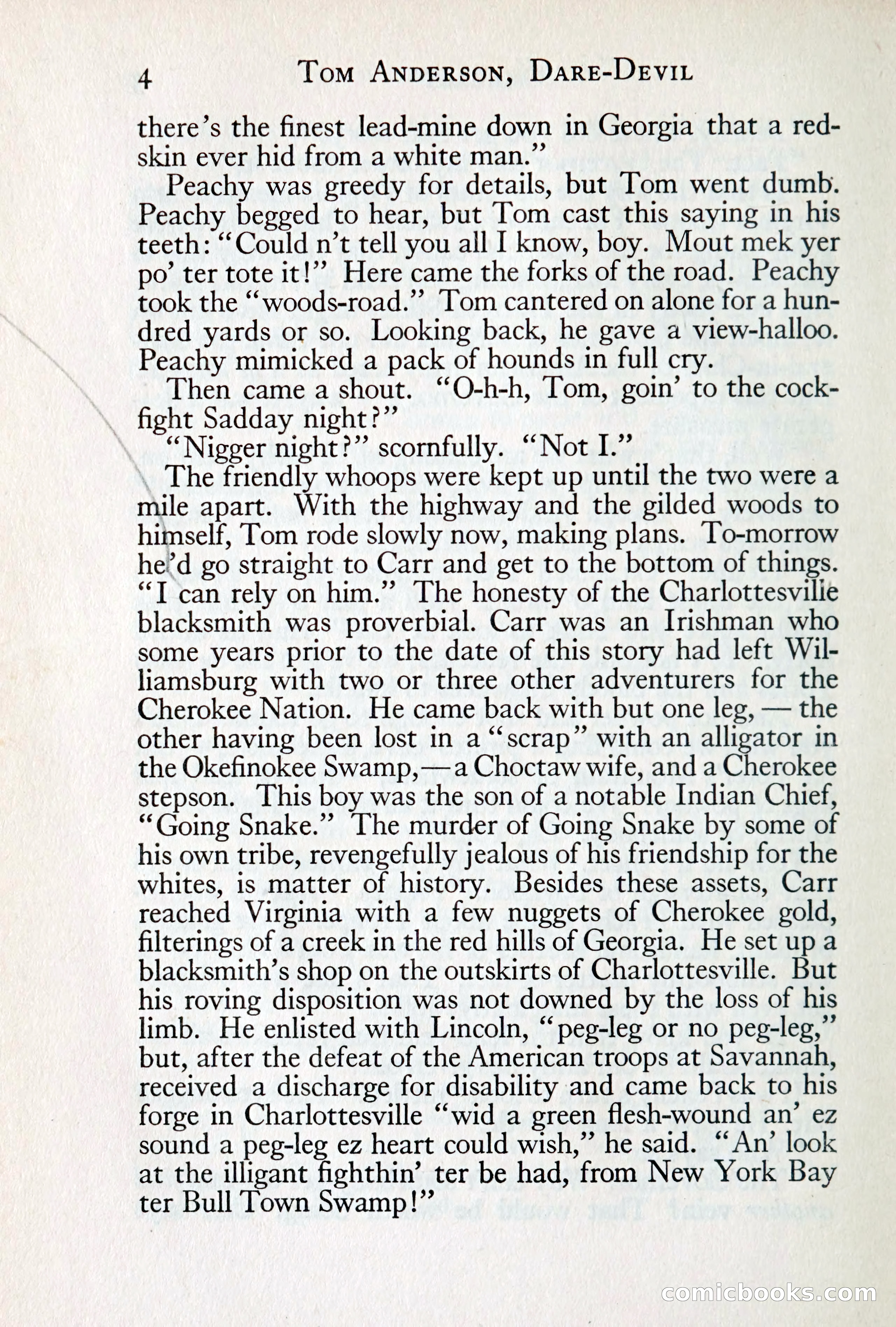
# Page Analysis This is a page of running prose from what appears to be a Victorian-era serialized adventure story titled "Tom Anderson, Dare-Devil" (page 4). The text depicts Tom Anderson parting ways with a companion named Peachy at a road fork. Tom cryptically references a hidden lead-mine in Georgia, then rides alone while planning to consult with Carr, a one-legged Irish blacksmith in Charlottesville. The passage provides Carr's backstory: he lost his leg in an alligator fight in the Okefinokee Swamp, acquired a Choctaw wife and Cherokee stepson, and later enlisted with Lincoln during what appears to be the American Civil War before returning to his blacksmith shop. The text includes period dialect and uses language reflecting 19th-century racial attitudes.
📄 Transcribed text from this page (OCR, searchable)
Machine-transcribed from the original scan — historical spelling and the odd misread are preserved.
4 Tom ANpERSON, DareE-DEVIL there’s the finest lead-mine down in Georgia that a red- skin ever hid from a white man.” Peachy was greedy for details, but Tom went dumb. Peachy begged to hear, but Tom cast this saying in his teeth: “Could n’t tell you all I know, boy. Mout mek yer po’ ter tote it!’’ Here came the forks of the road. Peachy took the “woods-road.”’ Tom cantered on alone for a hun- dred yards or so. Looking back, he gave a view-halloo. Peachy mimicked a pack of hounds in full cry. Then came a shout. “QO-h-h, Tom, goin’ to the cock- fight Sadday night?”’ “Nigger night?” scornfully. “Not I.” The friendly whoops were kept up until the two were a mile apart. With the highway and the gilded woods to himself, Tom rode slowly now, making plans. [To-morrow he’d go straight to Carr and get to the bottom of things. “T can rely on him.” The honesty of the Charlottesvilie blacksmith was proverbial. Carr was an Irishman who some years prior to the date of this story had left Wil- liamsburg with two or three other adventurers for the Cherokee Nation. He came back with but one leg, — the other having been lost in a “scrap” with an alligator in the Okefinokee Swamp,—a Choctaw wife, and a Cherokee stepson. This boy was the son of a notable Indian Chief, “Going Snake.” The murder of Going Snake by some of his own tribe, revengefully jealous of his friendship for the whites, is matter of history. Besides these assets, Carr reached Virginia with a few nuggets of Cherokee gold, filterings of a creek in the red hills of Georgia. He set up a blacksmith’s shop on the outskirts of Charlottesville. But his roving disposition was not downed by the loss of his limb. He enlisted with Lincoln, “peg-leg or no peg-leg,” but, after the defeat of the American troops at Savannah, received a discharge for disability and came back to his forge in Charlottesville “wid a green flesh-wound an’ ez sound a peg-leg ez heart could wish,” he said. “An’ look at the illigant fighthin’ ter be had, from New York Bay ter Bull Town Swamp!” ECORNICLOOOKS nO