
Penny Dreadfuls, 1916 · page 308 of 400
Tom Anderson, Dare-Devil: A Young Virginian in the Revolution — page 308: what you’re looking at
What you’re looking at
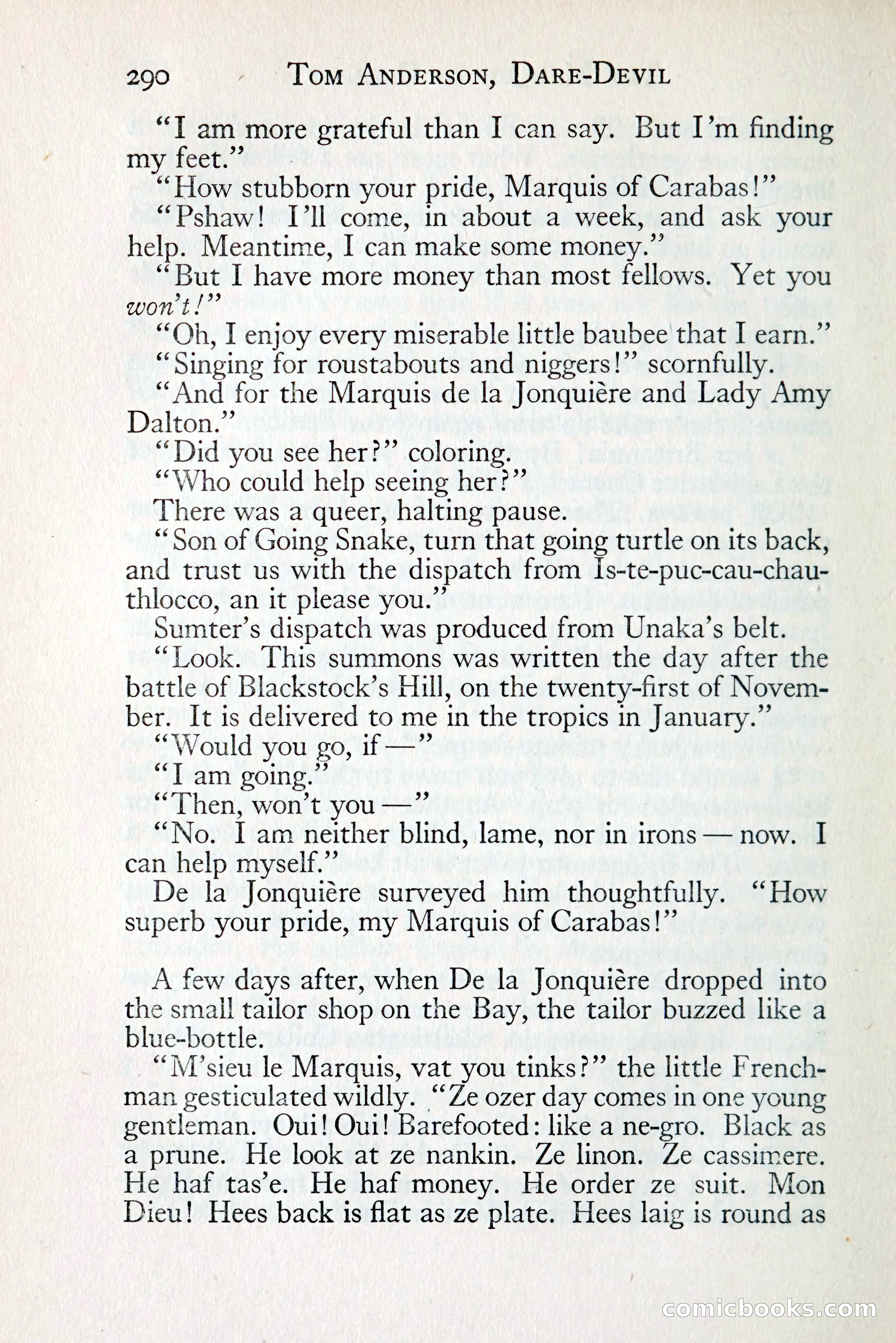
# Page Analysis: Tom Anderson, Dare-Devil This is a page of running prose (page 290) from a Victorian penny dreadful serial. The text depicts dialogue between characters including the Marquis of Carabas and De la Jonquiére, discussing money, pride, and a mysterious dispatch dated after the Battle of Blackstock's Hill. The scene shifts to a French tailor's shop where the tailor excitedly describes a barefooted Black gentleman customer with money who ordered a suit, remarking on his physical appearance and refined taste in fabrics. The passage uses period stereotypes and dialect writing typical of Victorian sensational fiction.
📄 Transcribed text from this page (OCR, searchable)
Machine-transcribed from the original scan — historical spelling and the odd misread are preserved.
290 - Tom Anperson, Dare-DEVIL “T am more grateful than I can say. But I’m finding my feet.” “How stubborn your pride, Marquis of Carabas!” “Pshaw! I'll come, in about a week, and ask your help. Meantime, I can make some money.” “But I have more money than most fellows. Yet you eon t!”’ “Oh, I enjoy every miserable little baubee that I earn.” “Singing for roustabouts and niggers!’ scornfully. “And for the Marquis de la Jonquiére and Lady Amy Dalton.” “Did you see her?” coloring. “Who could help seeing her?” There was a queer, halting pause. “Son of Going Snake, turn that going turtle on its back, and trust us with the dispatch from |s-te-puc-cau-chau- thlocco, an it please you.”’ Sumter’s dispatch was produced from Unaka’s belt. “Look. This summons was written the day after the battle of Blackstock’s Hill, on the twenty-first of Novem- ber. It is delivered to me in the tropics in January.” “Would you go, if —”’ “Tam going.” “Then, won’t you —”’ “No. I am neither blind, lame, nor in irons — now. I can help myself.” De la Jonquiére surveyed him thoughtfully. “How superb your pride, my Marquis of Carabas!”’ A few days after, when De la Jonquiére dropped into the smail tailor shop on the Bay, the tailor buzzed like a blue-bottle. ‘“M'sieu le Marquis, vat you tinks?”’ the little French- man gesticulated wildly. “Ze ozer day comes 1n one young gentleman. Oui! Oui! Barefooted: like a ne-gro. Black as a prune. He look at ze nankin. Ze linon. Ze cassimere. He haf tas’e. He haf money. He order ze suit. Mon Dieu! Hees back 1s flat as ze plate. Hees laig is round as EONMMICLMOOOKS nO m