
Penny Dreadfuls, 1916 · page 327 of 400
Tom Anderson, Dare-Devil: A Young Virginian in the Revolution — page 327: what you’re looking at
What you’re looking at
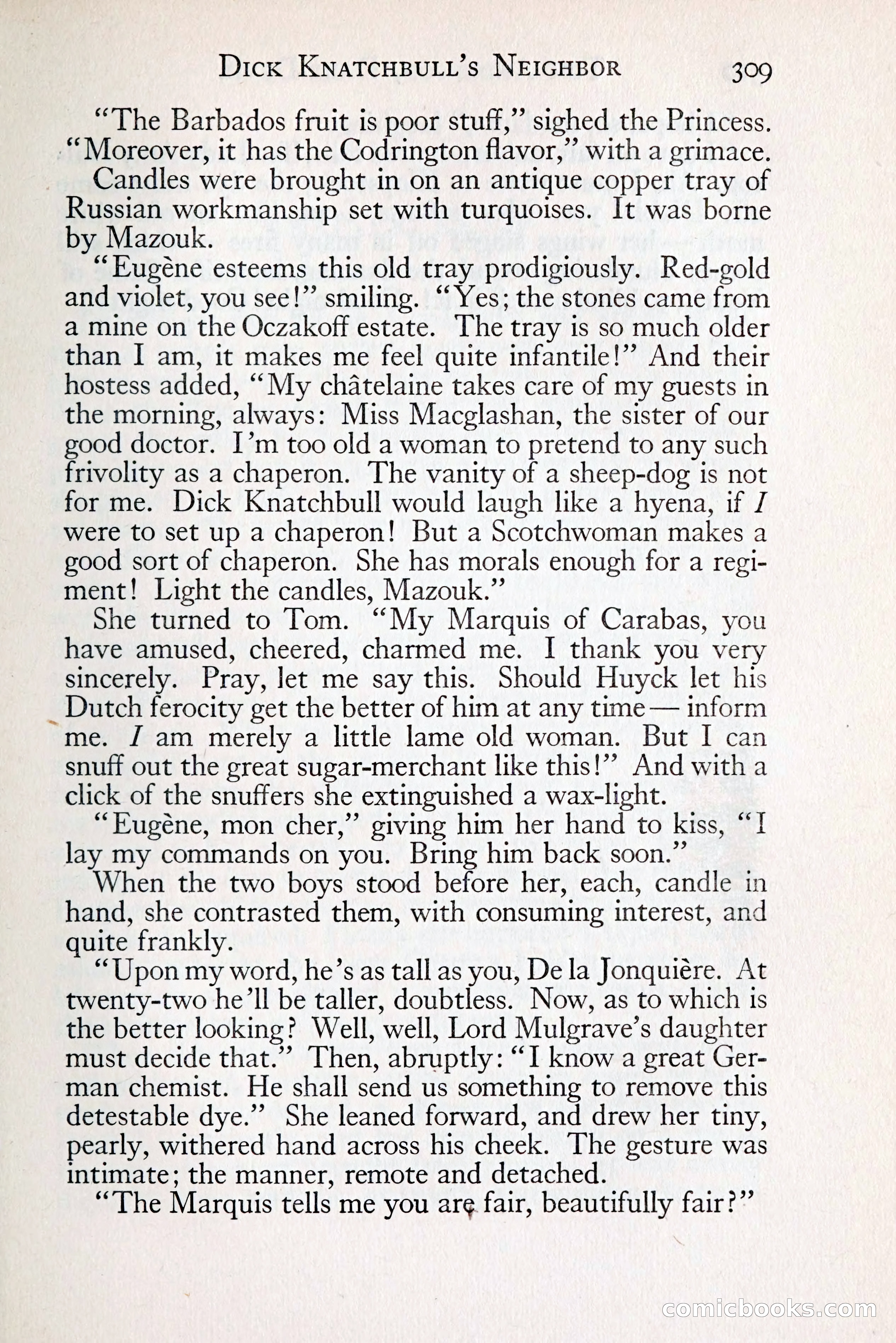
This is a page of running prose from a Victorian penny dreadful serial titled "Dick Knatchbull's Neighbor" (page 309). The text depicts a scene in which an elderly, lame hostess entertains guests, including two young men she compares physically while holding candles. She mentions a servant named Mazouk, references a Russian antique tray, and cryptically warns one guest (Tom/the Marquis of Carabas) about a man named Huyck. The passage combines domestic hospitality with hints of intrigue and menace typical of sensation fiction.
📄 Transcribed text from this page (OCR, searchable)
Machine-transcribed from the original scan — historical spelling and the odd misread are preserved.
Dick KNATCHBULL’s NEIGHBOR 309 “The Barbados fruit is poor stuff,” sighed the Princess. “Moreover, it has the Codrington flavor,” with a grimace. Candles were brought in on an antique copper tray of Russian workmanship set with turquoises. It was borne by Mazouk. ‘“Fugéne esteems this old tray prodigiously. Red-gold and violet, you see!”’ smiling. “Yes; the stones came from a mine on the Oczakoff estate. The tray is so much older than I am, it makes me feel quite infantile!” And their hostess added, “My chatelaine takes care of my guests in the morning, always: Miss Macglashan, the sister of our good doctor. I’m too old a woman to pretend to any such frivolity as a chaperon. The vanity of a sheep-dog is not for me. Dick Knatchbull would laugh like a hyena, if J were to set up a chaperon! But a Scotchwoman makes a good sort of chaperon. She has morals enough for a regi- ment! Light the candles, Mazouk.” She turned to Tom. “My Marquis of Carabas, you have amused, cheered, charmed me. | thank you very sincerely. Pray, let me say this. Should Huyck let his _ Dutch ferocity get the better of him at any time — inform me. J am merely a little lame old woman. But I can snuff out the great sugar-merchant like this!”” And with a click of the snuffers she extinguished a wax-light. ‘“Eugéne, mon cher,” giving him her hand to kiss, “I lay my commands on you. Bring him back soon.” When the two boys stood before her, each, candle in hand, she contrasted them, with consuming interest, and quite frankly. “Upon my word, he’s as tall as you, De la Jonquiére. At twenty-two he'll be taller, doubtless. Now, as to which 1s the better looking ? Well, well, Lord Mulgrave’ s daughter must decide that.”’ Then, abruptly: “T know a great Ger- man chemist. He shall send us something to remove this detestable dye.”’ She leaned forward, and drew her tiny, pearly, withered hand across his cheek. The gesture was intimate; the manner, remote and detached. “The Marquis tells me you arg fair, beautifully fair?” CORDICLIOO® SS) (C©) im