
Penny Dreadfuls, 1916 · page 267 of 400
Tom Anderson, Dare-Devil: A Young Virginian in the Revolution — page 267: what you’re looking at
What you’re looking at
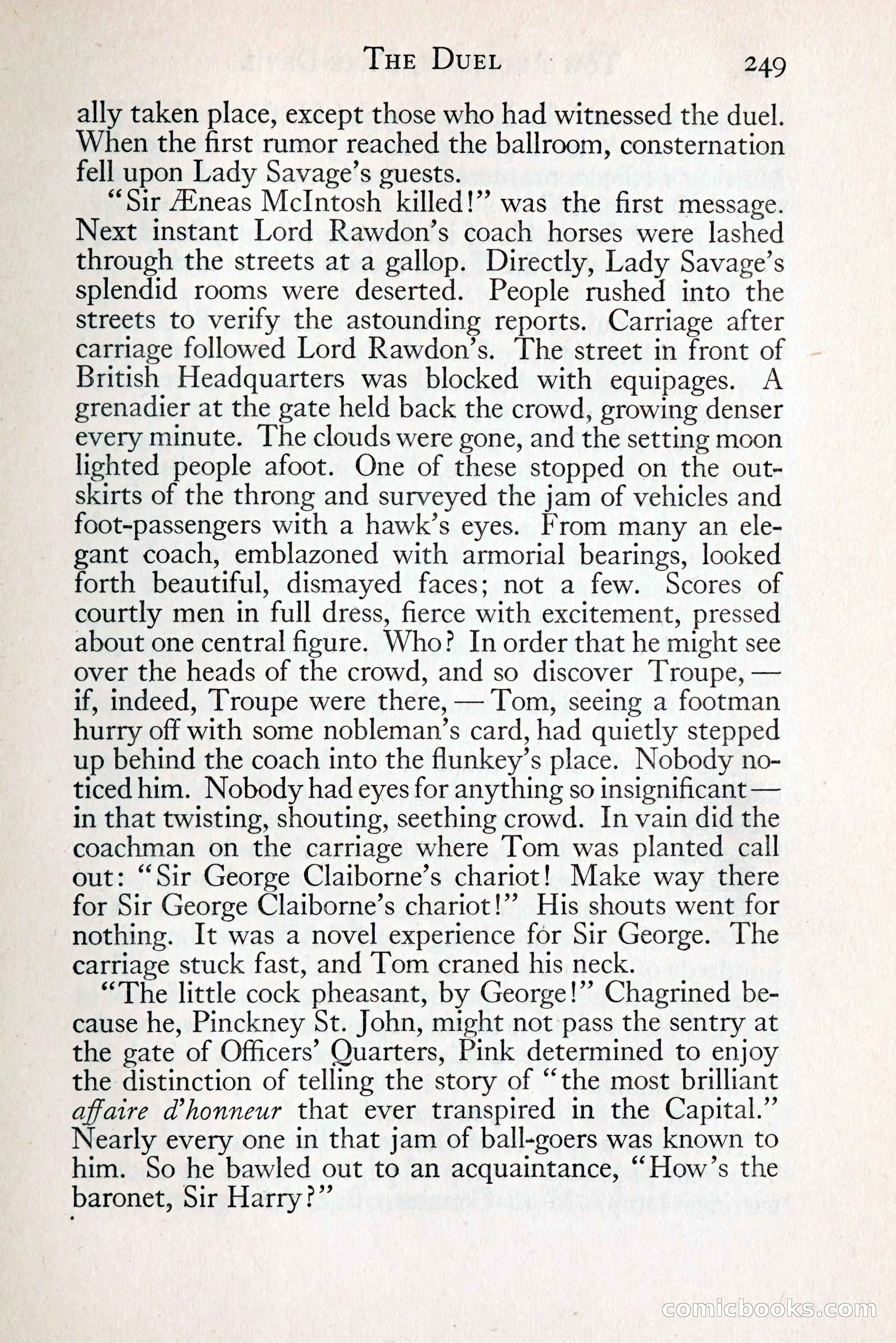
# The Duel — Page 249 This is a page of running prose from a Victorian penny dreadful novel titled *The Duel*. The text describes the chaotic aftermath of a duel in which Sir Aeneas McIntosh is reported killed. News of the event spreads from a ballroom, causing panic; carriages race through the streets toward British Headquarters, where crowds gather. A character named Tom secretly positions himself on a nobleman's carriage to search for someone called Troupe, while a man named Pink (Pinckney St. John) eagerly attempts to spread news of what he calls "the most brilliant affaire d'honneur" to occur in the Capital.
📄 Transcribed text from this page (OCR, searchable)
Machine-transcribed from the original scan — historical spelling and the odd misread are preserved.
THE DuEL © 249 ally taken place, except those who had witnessed the duel. When the first rumor reached the ballroom, consternation fell upon Lady Savage’s guests. “Sir Aineas McIntosh killed!’’ was the first message. Next instant Lord Rawdon’s coach horses were lashed through the streets at a gallop. Directly, Lady Savage’s splendid rooms were deserted. People rushed into the streets to verify the astounding reports. Carriage after carriage followed Lord Rawdon’s. The street in front of British Headquarters was blocked with equipages. A grenadier at the gate held back the crowd, growing denser every minute. [he clouds were gone, and the setting moon lighted people afoot. One of these stopped on the out- skirts of the throng and surveyed the jam of vehicles and foot-passengers with a hawk’s eyes. From many an ele- gant coach, emblazoned with armorial bearings, looked forth beautiful, dismayed faces; not a few. Scores of courtly men in full dress, fierce with excitement, pressed about one central figure. Who? In order that he might see over the heads of the crowd, and so discover Troupe, — if, indeed, Troupe were there, — Tom, seeing a footman hurry off with some nobleman’s card, had quietly stepped up behind the coach into the flunkey’s place. Nobody no- ticed him. Nobody had eyes for anything so insignificant — in that twisting, shouting, seething crowd. In vain did the coachman on the carriage where Tom was planted call out: “Sir George Claiborne’s chariot! Make way there for Sir George Claiborne’s chariot!’’ His shouts went for nothing. It was a novel experience for Sir George. The carriage stuck fast, and Iom craned his neck. “The little cock pheasant, by George!”’ Chagrined be- cause he, Pinckney St. John, might not pass the sentry at the gate of Officers’ Quarters, Pink determined to enjoy the distinction of telling the story of “the most brilliant affaire d@honneur that ever transpired in the Capital.” Nearly every one in that jam of ball-goers was known to him. So he bawled out to an acquaintance, “How’s the baronet, Sir Harry?” CORNICLOO@ SS) (C©) mn