
Penny Dreadfuls, 1916 · page 121 of 400
Tom Anderson, Dare-Devil: A Young Virginian in the Revolution — page 121: what you’re looking at
What you’re looking at
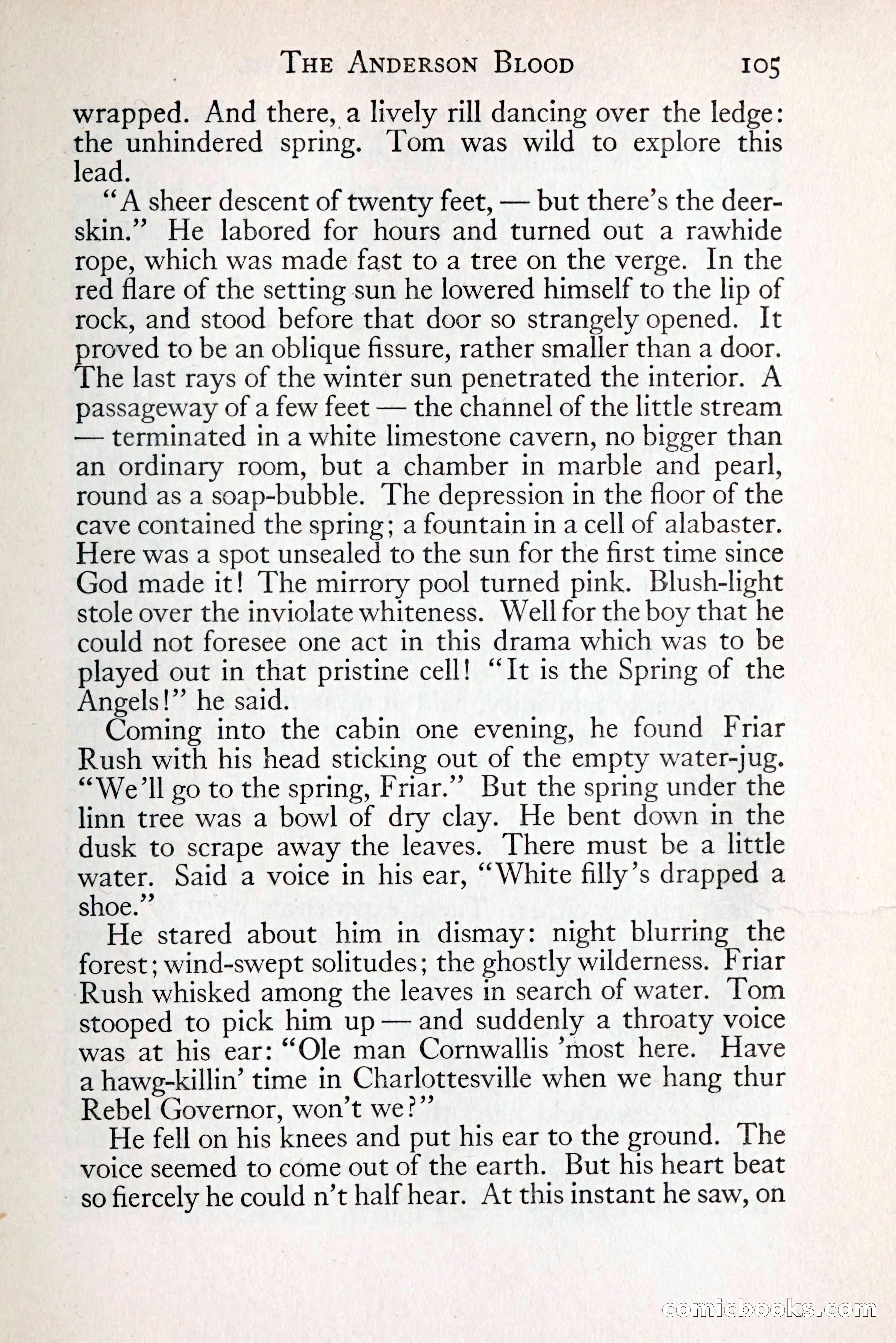
# Page Analysis This is a page of running prose from the novel *The Anderson Blood* (page 105). The text describes a character named Tom discovering a hidden limestone cavern containing a pristine underground spring, which he names "the Spring of the Angels." The narrative then shifts to an eerie scene where Tom hears mysterious voices—one mentioning a "White filly" and another, more sinister, referencing "Ole man Cornwallis" and plans to hang a "Rebel Governor" in Charlottesville. The page ends with Tom pressing his ear to the ground, hearing the voice emerge from the earth itself, his heart pounding with alarm.
📄 Transcribed text from this page (OCR, searchable)
Machine-transcribed from the original scan — historical spelling and the odd misread are preserved.
Tue ANDERSON BLoop 105 wrapped. And there, a lively rill dancing over the ledge: Sia spring. lom was wild to explore this ead. ‘A sheer descent of twenty feet, — but there’s the deer- skin.” He labored for hours and turned out a rawhide rope, which was made fast to a tree on the verge. In the red flare of the setting sun he lowered himself to the lip of rock, and stood before that door so strangely opened. It proved to be an oblique fissure, rather smaller than a door. The last rays of the winter sun penetrated the interior. A passageway of a few feet — the channel of the little stream — terminated in a white limestone cavern, no bigger than an ordinary room, but a chamber in marble and pearl, round as a soap-bubble. The depression in the floor of the cave contained the spring; a fountain in a cell of alabaster. Here was a spot unsealed to the sun for the first time since God made it! The mirrory pool turned pink. Blush-light stole over the inviolate whiteness. Well for the boy that he could not foresee one act in this drama which was to be played out in that pristine cell! “It is the Spring of the Angels!” he said. Coming into the cabin one evening, he found Friar Rush with his head sticking out of the empty water-jug. “We'll go to the spring, Friar.’’ But the spring under the linn tree was a bowl of dry clay. He bent down in the dusk to scrape away the leaves. There must be a little water. Said a voice in his ear, “White filly’s drapped a shoe.”’ He stared about him in dismay: night blurring the forest; wind-swept solitudes; the ghostly wilderness. Friar Rush whisked among the leaves in search of water. Tom stooped to pick him up — and suddenly a throaty voice was at his ear: “Ole man Cornwallis most here. Have a hawe-killin’ time in Charlottesville when we hang thur Rebel Governor, won’t we?”’ He fell on his knees and put his ear to the ground. The voice seemed to come out of the earth. But his heart beat so fiercely he could n’t half hear. At this instant he saw, on CORNICMOO SS (CO) m