
A complete issue · 36 pages · 1928
Life — November 23, 1928
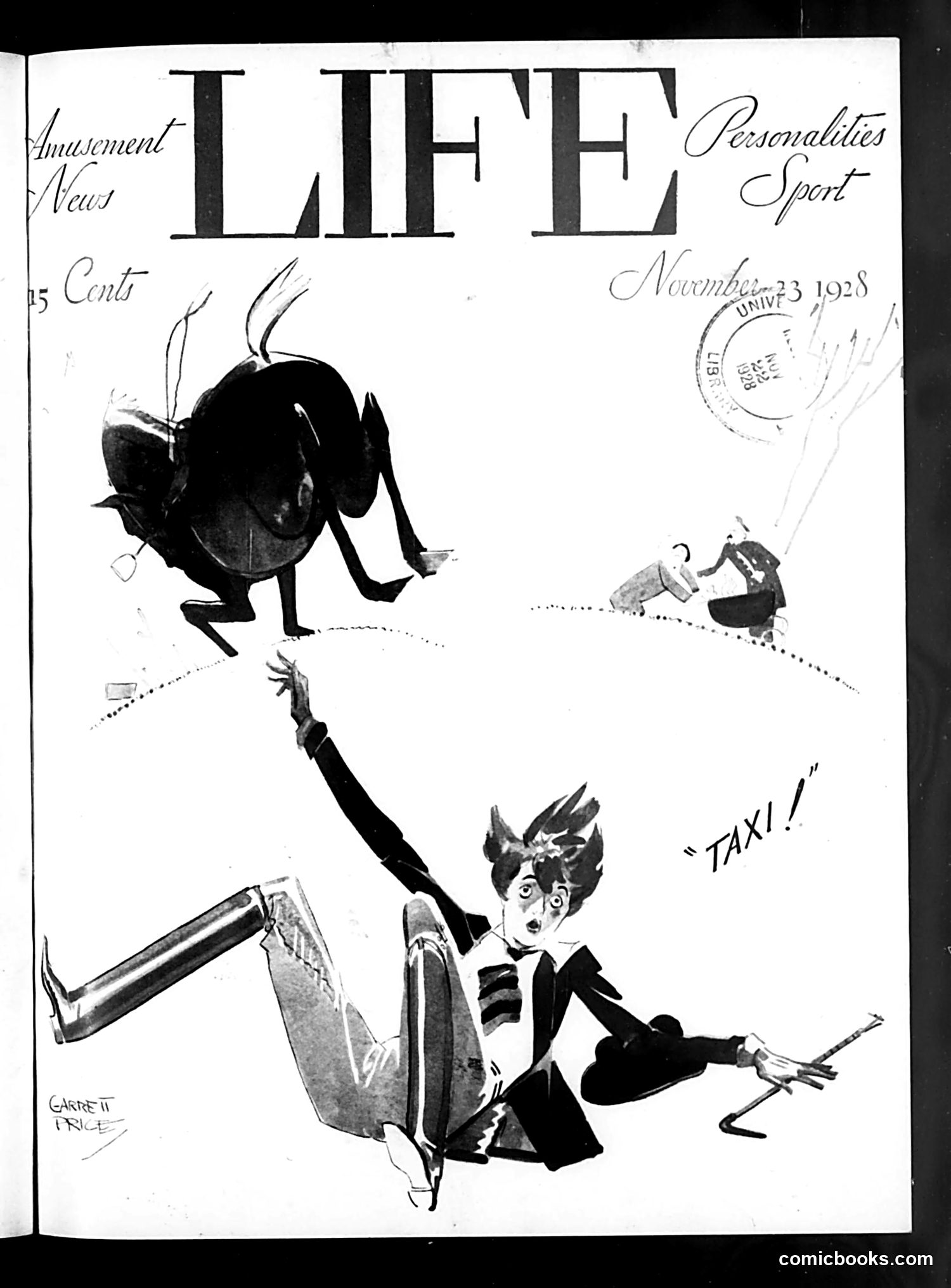
This satirical cover depicts a woman in 1920s flapper attire calling "TAXI!" while fleeing from a giant anthropomorphic insect. The illustration, credited to Garrett Price, appears to be a humorous commentary on urban life and the prevalence of insects in cities. The joke likely plays on the era's anxieties about pest control and sanitation in modern American cities, combined with the fashionable woman's desperate attempt to escape. The exaggerated insect and her theatrical reaction create comedic absurdity typical of Life's satirical style. The cover's sections promise "Amusement News," "Personalities," and "Sport"—standard Life magazine content from this era. Without additional context about specific contemporary events, the cartoon appears primarily to offer general social humor rather than targeted political satire.
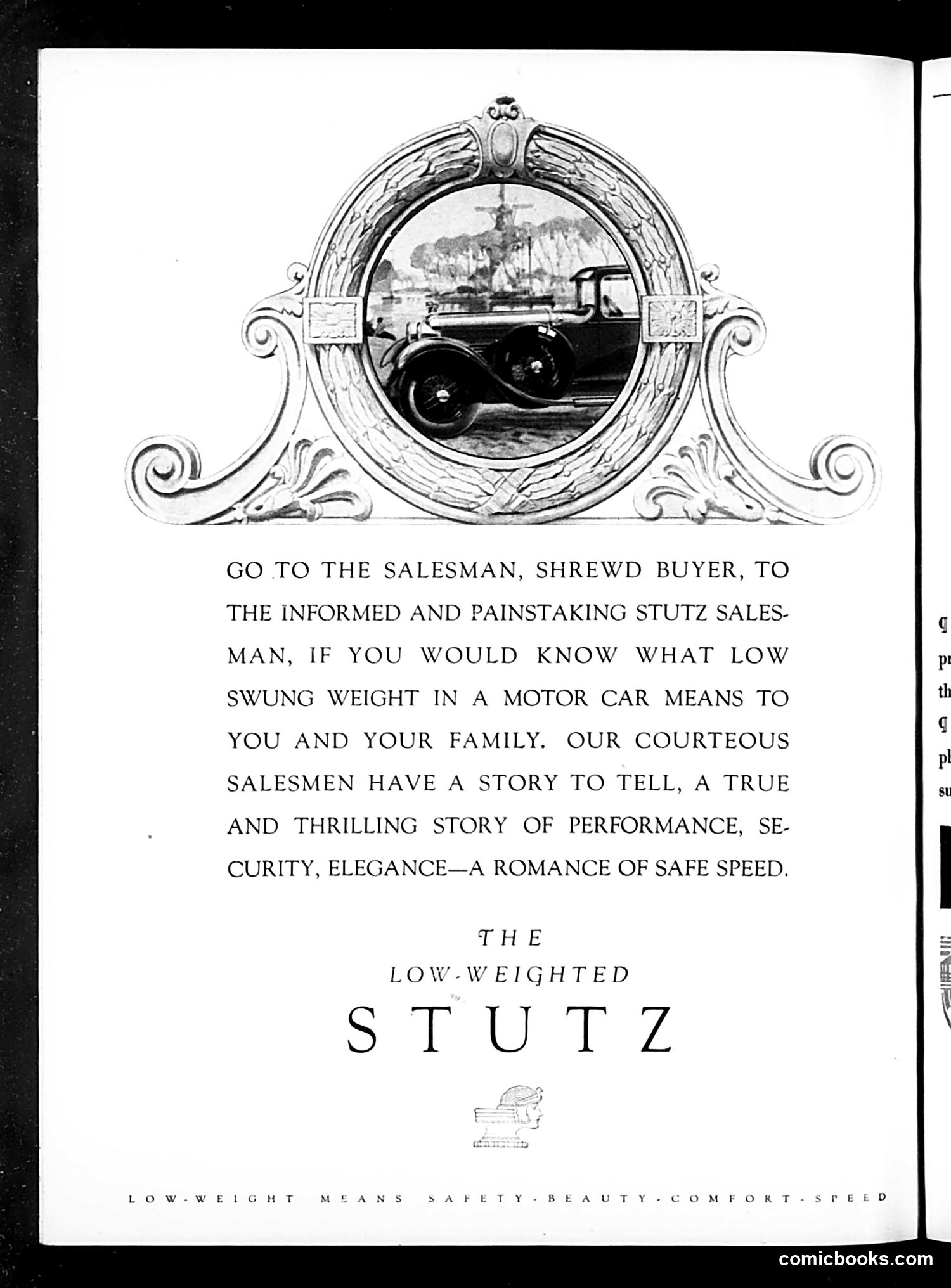
This is a **Stutz automobile advertisement**, not political satire. The page appeals to potential car buyers by addressing "the shrewd buyer" and emphasizing that low weight in motor cars means superior "performance, security, elegance—a romance of safe speed." The ornate circular frame contains an image of a vintage Stutz automobile, showcasing the product. The advertisement uses flowery language typical of 1920s-era marketing, linking the car's lightweight design to safety and comfort for "you and your family." The tagline at bottom—"LOW-WEIGHT MEANS SAFETY-BEAUTY-COMFORT-SPEED"—summarizes the sales pitch. This represents early automotive advertising that equated engineering features with lifestyle benefits and family values, a common marketing strategy of the era.

This page is primarily **advertising, not satire**. It promotes the Kolster Model K23 radio, a seven-tube floor model with "Dynamic Reproducer" and "distinguished design." The decorative art deco borders framing the page are ornamental rather than satirical. The text emphasizes quality and user satisfaction ("Kolster is a fine set!"), claiming the phrase reflects firsthand experience. The ad announces a weekly radio program: "Enjoy the Kolster Program every Wednesday evening at 10 P.M. Eastern Standard Time over the nation-wide Columbia Chain." This represents **early 1920s radio advertising**, when radio sets were luxury consumer goods and manufacturers sponsored programming to build brand loyalty. The ornate design reflects the era's aesthetic conventions rather than political commentary.
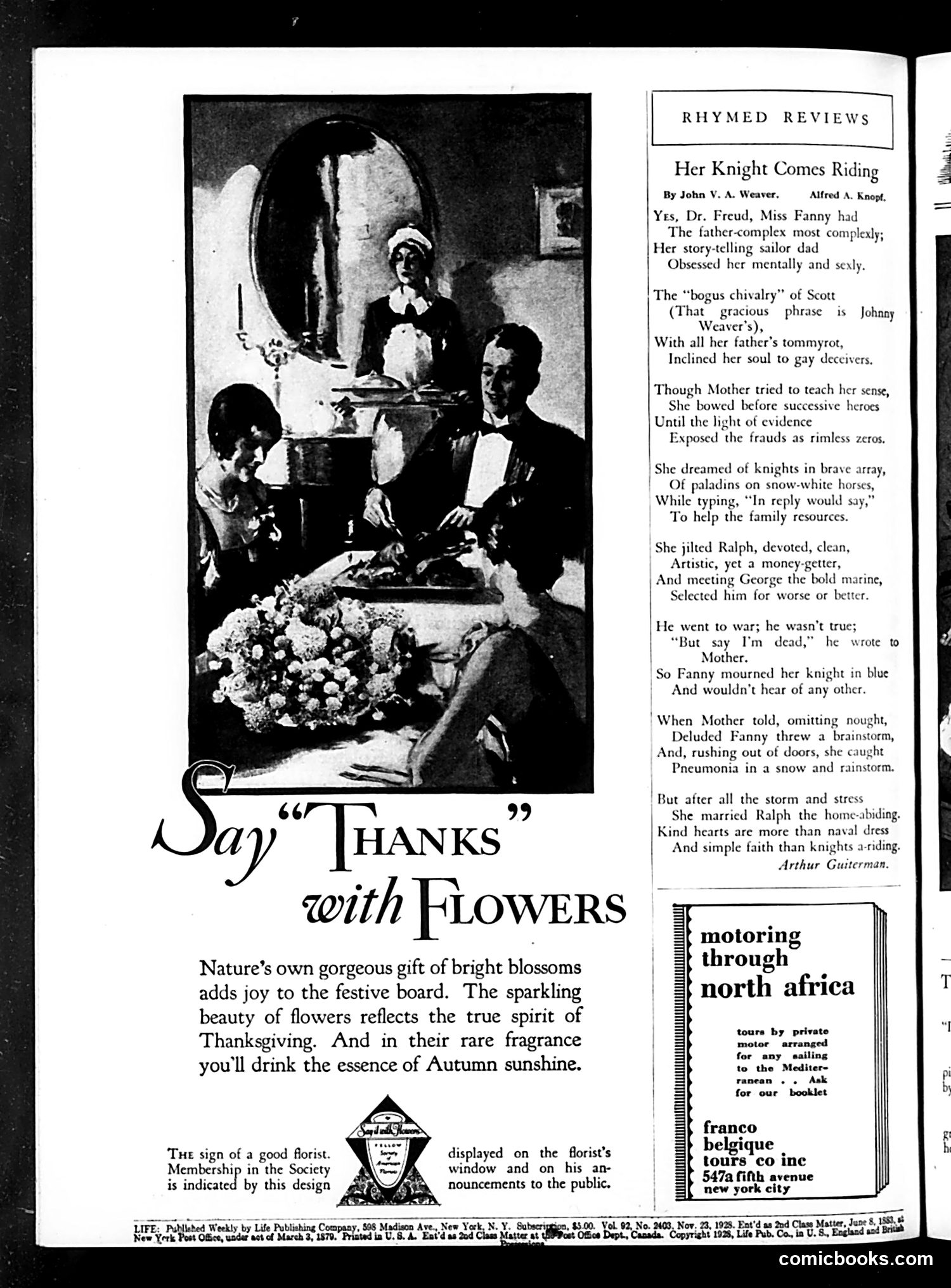
This page contains two distinct elements: **Left side:** A flower advertisement ("Say 'Thanks' with Flowers") promoting floral gifts for Thanksgiving, emphasizing flowers as a festive table decoration that embodies autumn's spirit. **Right side:** A satirical poem titled "Her Knight Comes Riding" by John V. A. Weaver and Alfred A. Knopf, with commentary by Arthur Guiterman. The poem mocks romantic idealism through the story of a woman named Fanny who romanticizes knights and chivalry (influenced by her father's tales), dreams of brave suitors, but ultimately settles for practical, unromantic Ralph. The satire critiques naive feminine idealism and suggests that pragmatic domesticity trumps romantic fantasy—a modernist critique of outdated notions of courtship and marriage. The page reflects 1920s sensibilities about gender, romance, and reality.
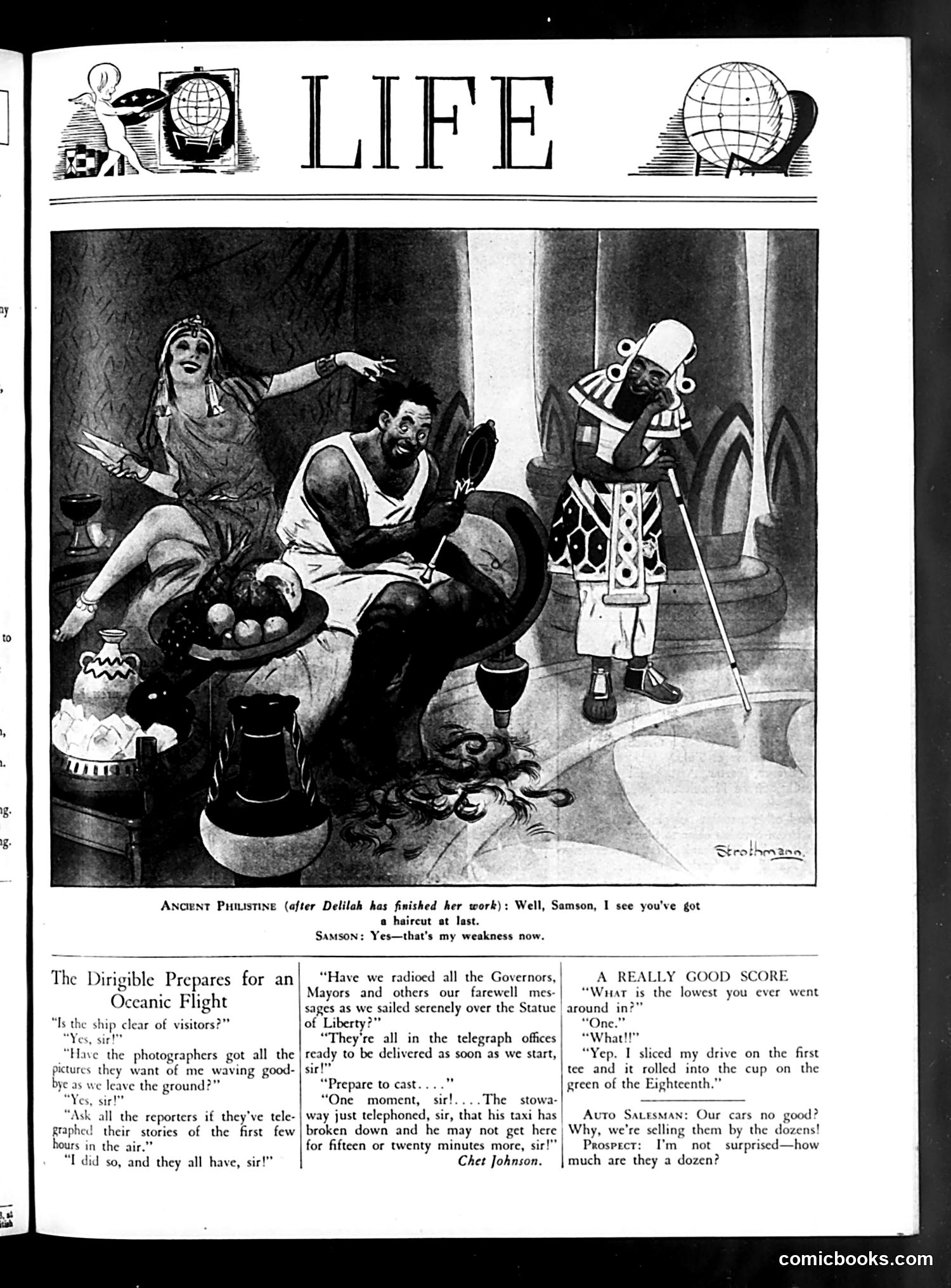
**Main Cartoon:** "Ancient Philistine" depicts a biblical scene where Samson (center, muscular man) has just had his hair cut by Delilah (reclining woman, left). An Egyptian official (right, in ornate dress) observes. The caption is Delilah's taunt: "Well, Samson, I see you've got a haircut at last!" with Samson admitting "Yes—that's my weakness now." This uses the Samson/Delilah story as satire, likely about male vulnerability or betrayal through romance—a common theme in period humor. **Lower Section:** Three brief comedic sketches about modern life: dirigible flight preparations, radio communication mishaps, and automobile sales jokes. These appear unrelated to the main cartoon, representing typical satirical commentary on contemporary technology and commerce circa 1920s-1930s.
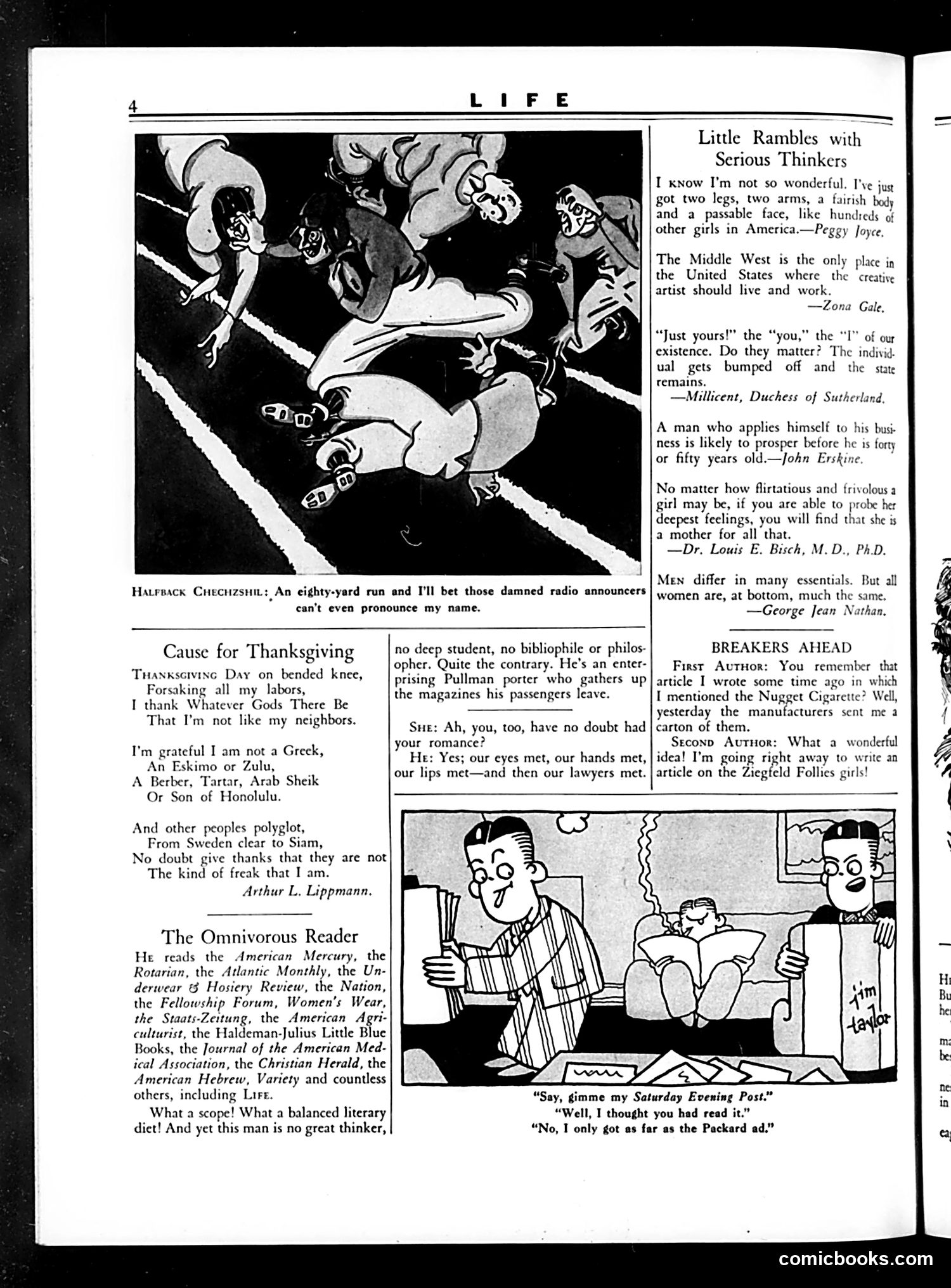
**Top Cartoon:** Depicts a female athlete doing a horizontal bar routine. The caption jokes that radio announcers cannot pronounce her name ("Halfback Checkzski"). This satirizes both the rise of women in competitive athletics during this era and the difficulty American media had with Eastern European names—likely referencing 1920s-30s immigration and Olympic competition. **Bottom Comic:** Shows a man asking his wife about her reading. She claims she read the Saturday Evening Post, but he skeptically notes she only got "as far as the Packard ad." This mocks common consumer behavior—people browsing magazines primarily for advertisements rather than editorial content—a critique of advertising's dominance in American print media. Both pieces reflect early 20th-century social anxieties about women's roles, ethnic identity, and commercial culture.
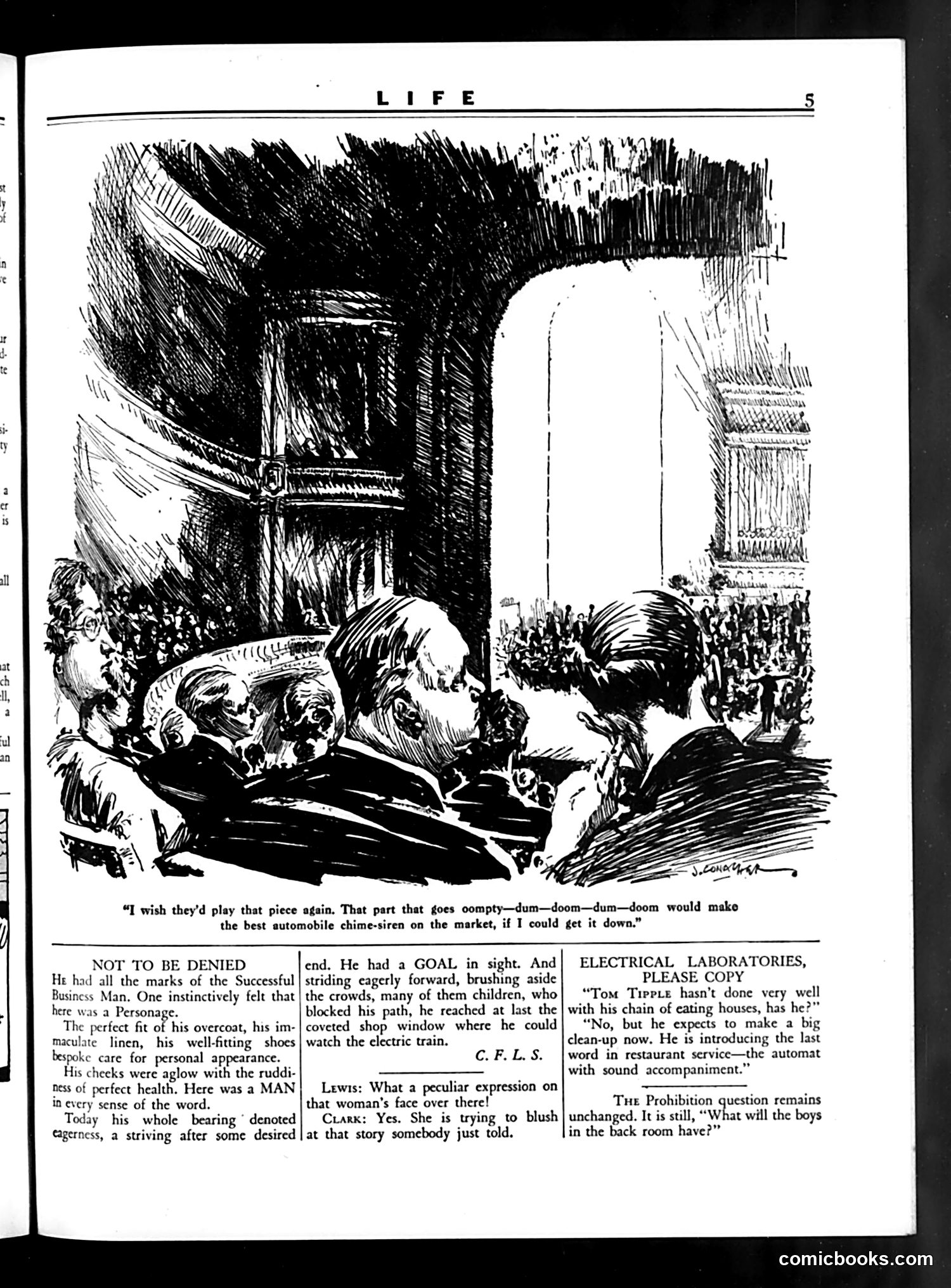
This page contains a satirical cartoon about ambition and social climbing. The main illustration shows a well-dressed man in formal attire at what appears to be a grand public event or gathering, with crowds visible in the background under an ornate arch. The accompanying text "Not to Be Denied" describes a "Successful Business Man" with all the external markers of success—proper appearance, good health, confident bearing. The satire suggests his ambition remains unsatisfied despite achieving material success. The cartoon's caption includes a joke about wanting to recreate an automobile chime sound ("oompty-dum-doom-dum-doom"), mocking the man's desire to commercialize or profit from even trivial things. The page also includes brief editorial comments about social topics, including a reference to Prohibition, reflecting early 20th-century American concerns.
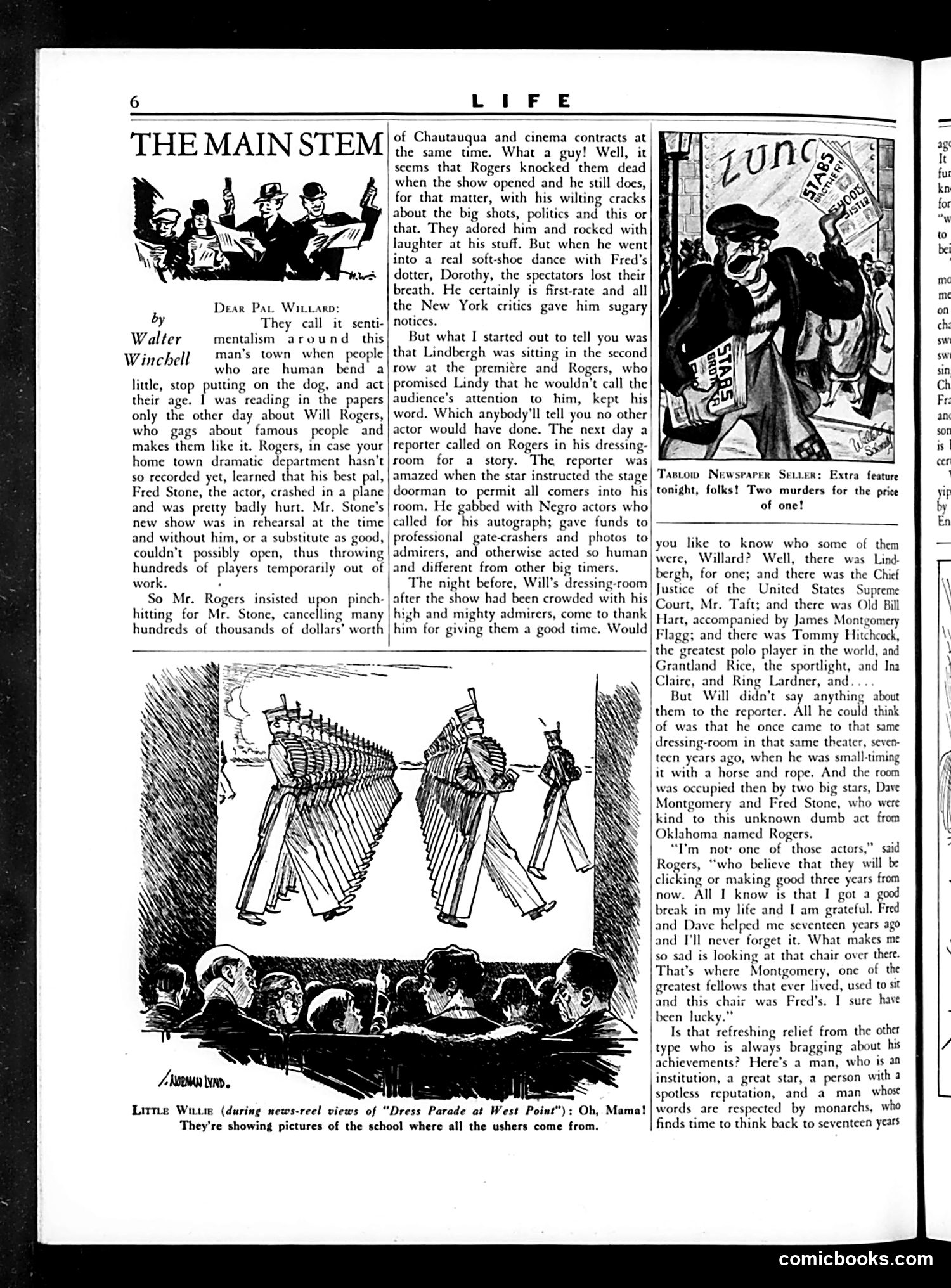
This column discusses **Will Rogers**, a famous entertainer of the era. The article describes Rogers' success in vaudeville and film, noting his ability to mock famous people and politics while remaining beloved. The key satirical point: Rogers had recently cancelled a lucrative contract with impresario Stone, costing the producer hundreds of thousands of dollars. According to Winchell, Rogers did this to secure better treatment for himself—an unusual power move by an actor against a studio head at that time. The accompanying illustration of soldiers relates to Rogers' appearance in the film "Dress Parade at West Point," referenced in the caption. The overall tone suggests admiration mixed with surprise at Rogers' boldness in challenging studio authority.
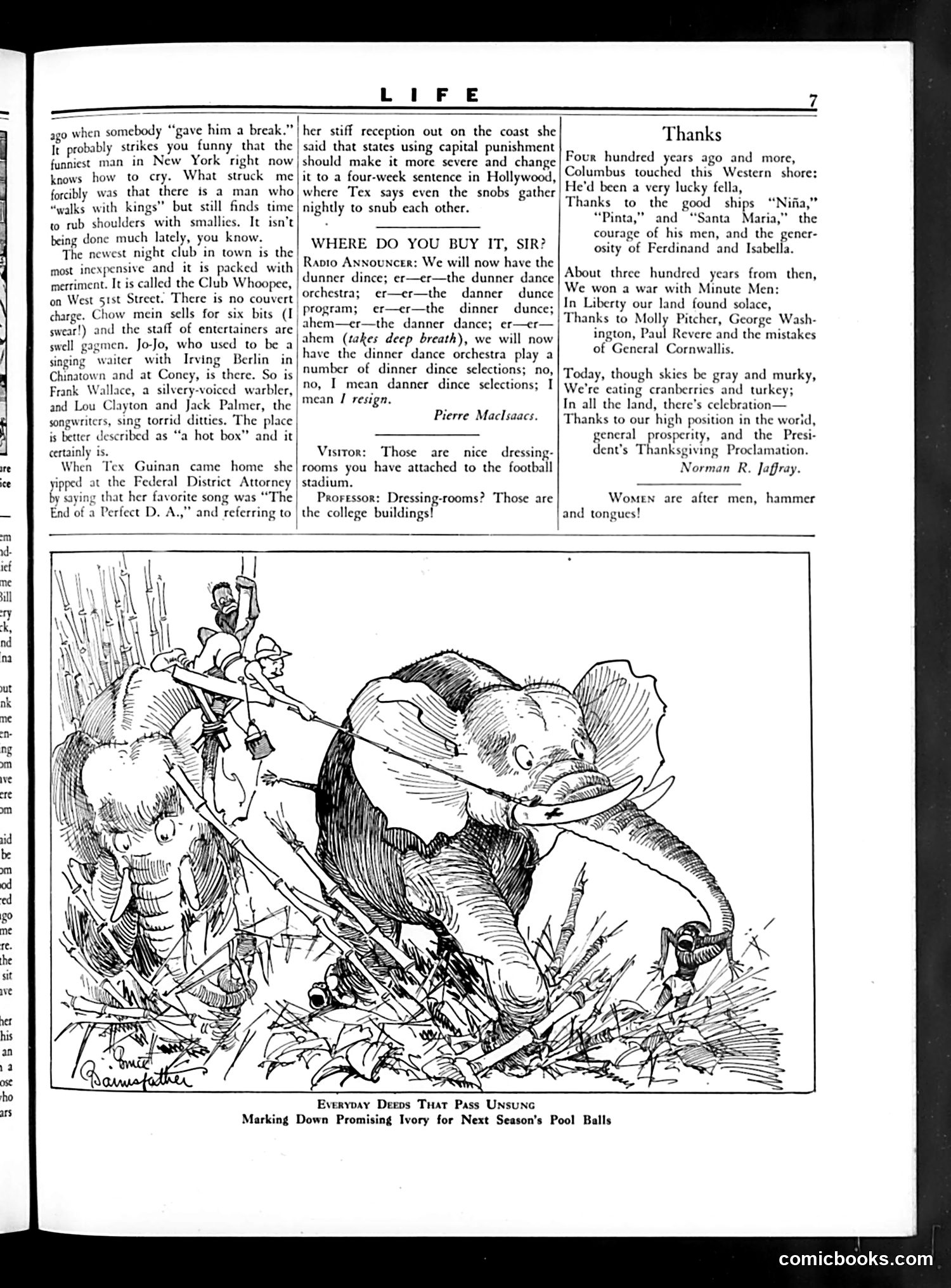
This cartoon satirizes the ivory trade and elephant hunting in Africa. The image shows colonial hunters with rifles marking down an elephant—depicted as if "marking" it for future use as pool balls (billiard balls made from ivory). The caption "Marking Down Promising Ivory for Next Season's Pool Balls" is the satirical point: it treats the slaughter of elephants as a casual commercial enterprise, with hunters casually "shopping" for future materials. The exaggerated, comedic style of the drawing emphasizes how routine and unremarkable such hunting was to Western consumers who benefited from ivory products. The satire critiques both the exploitation of African wildlife and the detached commercialism of Western leisure culture.
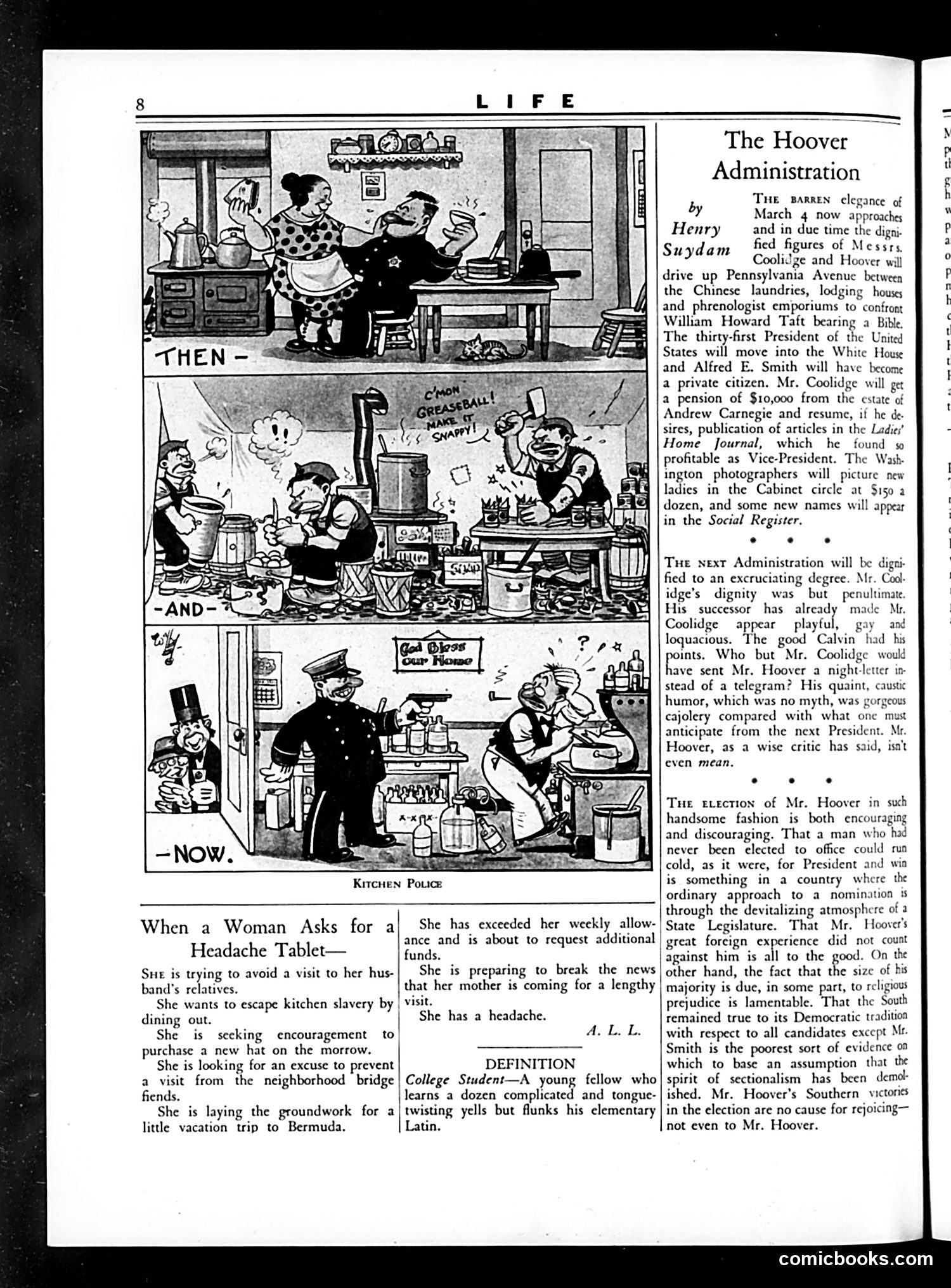
This three-panel cartoon by Henry Suydam satirizes the transition to Herbert Hoover's presidency. The panels show a kitchen's transformation "THEN—AND—NOW," depicting escalating chaos among domestic workers and kitchen staff. The satire mocks the contrast between the outgoing Coolidge administration (orderly) and the incoming Hoover administration (chaotic). The "Kitchen Police" title suggests governmental disorder. The accompanying text critiques Hoover's election, noting the South's reluctant support despite his foreign policy experience. It characterizes Hoover as "playful, gay and boisterous," contrasting him with Coolidge, whose "quaint, caustic humor" was deemed superior. The overall message: Hoover's arrival brings confusion and disarray to established governmental operations.
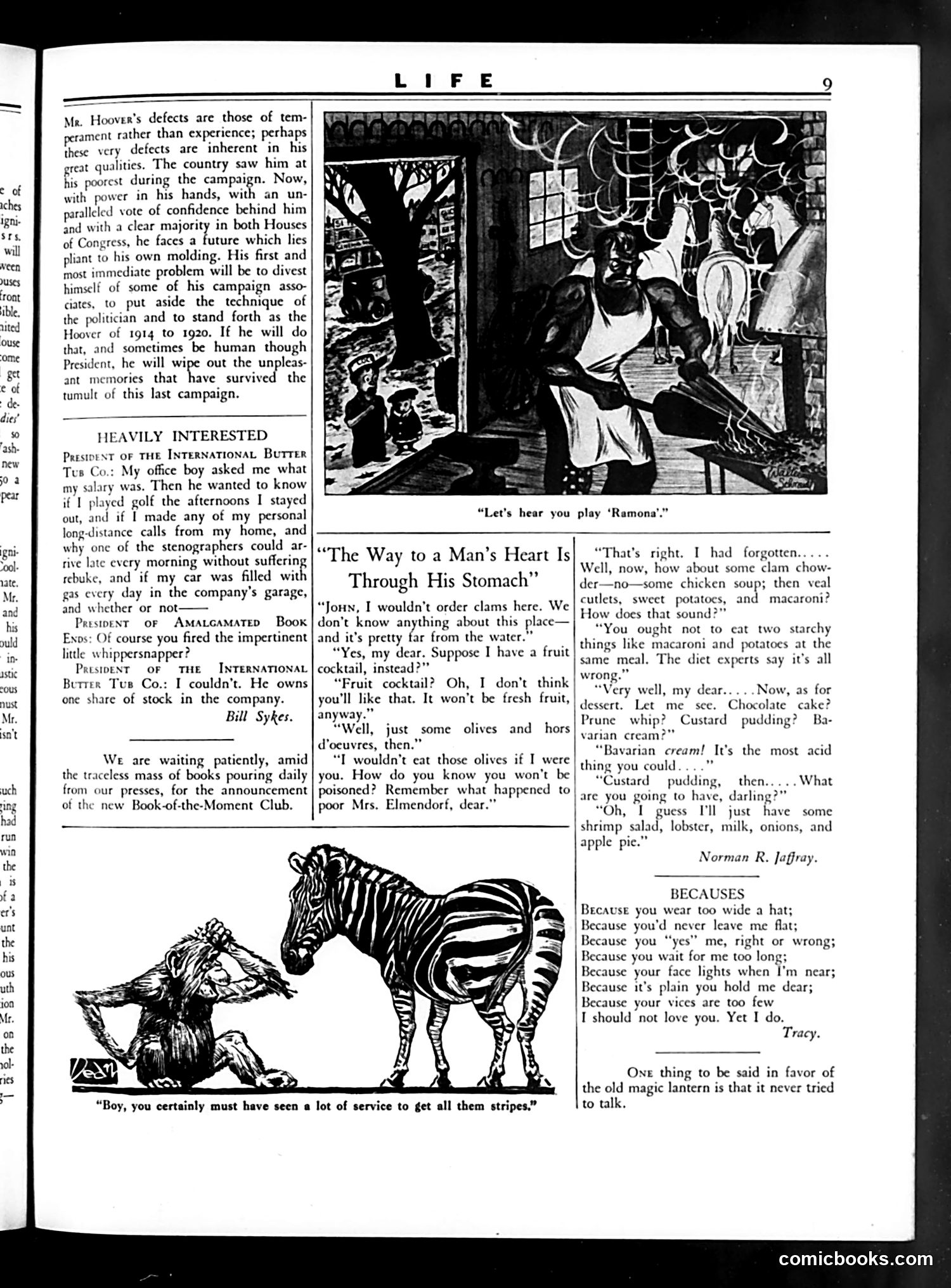
This page contains political commentary and humor typical of Life's satirical approach. The main text discusses **Mr. Hoover's** defects as a temperament rather than experience—likely referring to Herbert Hoover during a campaign period (references "1914 to 1920"). The sidebar anecdotes mock various business leaders' ignorance and pretension: a butter company president unfamiliar with clams, a book publisher clueless about stocks. The **zebra cartoon** at bottom—captioned "Boy, you certainly must have seen a lot of service to get all them stripes"—is a visual pun satirizing either military service or corporate rank-climbing through accumulated experience rather than merit. The overall page satirizes American business and political leadership as out-of-touch with practical knowledge.
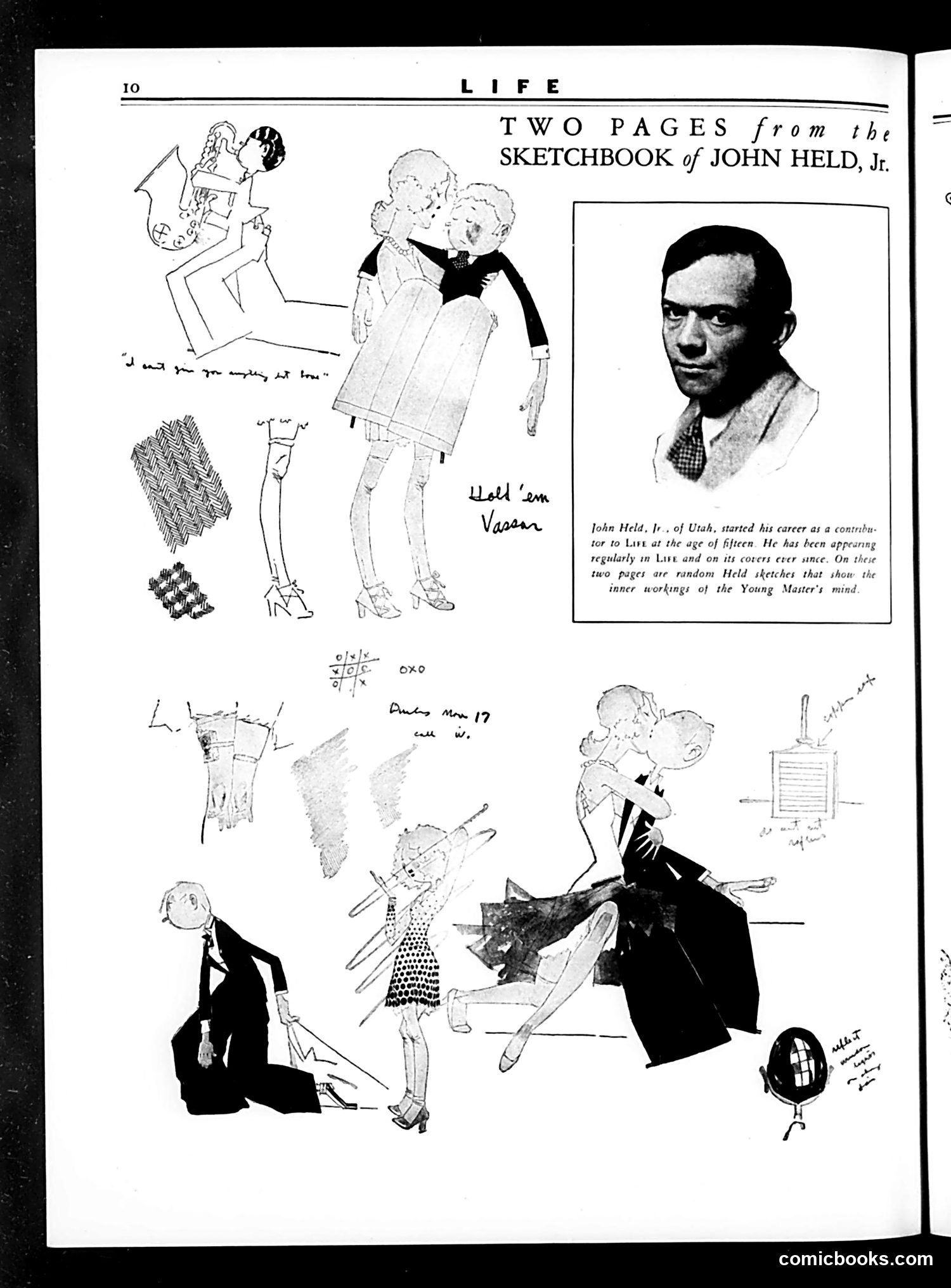
This page showcases cartoonist John Held Jr.'s satirical sketches from the 1920s era. The content appears to be social satire focused on flapper culture and Jazz Age youth behavior. The sketches depict exaggerated female figures in fashionable dress engaging in what appears to be scandalous or frivolous activities—dancing, socializing, and general revelry. The humor targets young women's perceived moral looseness and rejection of Victorian propriety during the post-WWI period. Held Jr.'s distinctive elongated figure style emphasizes the era's fashion trends (short skirts, bobbed hair) while mocking what conservative observers viewed as dangerous social changes. The biographical text confirms Held started his career as a Life contributor at age fifteen, becoming the era's definitive visual chronicler of youth culture's perceived excesses and moral decline.
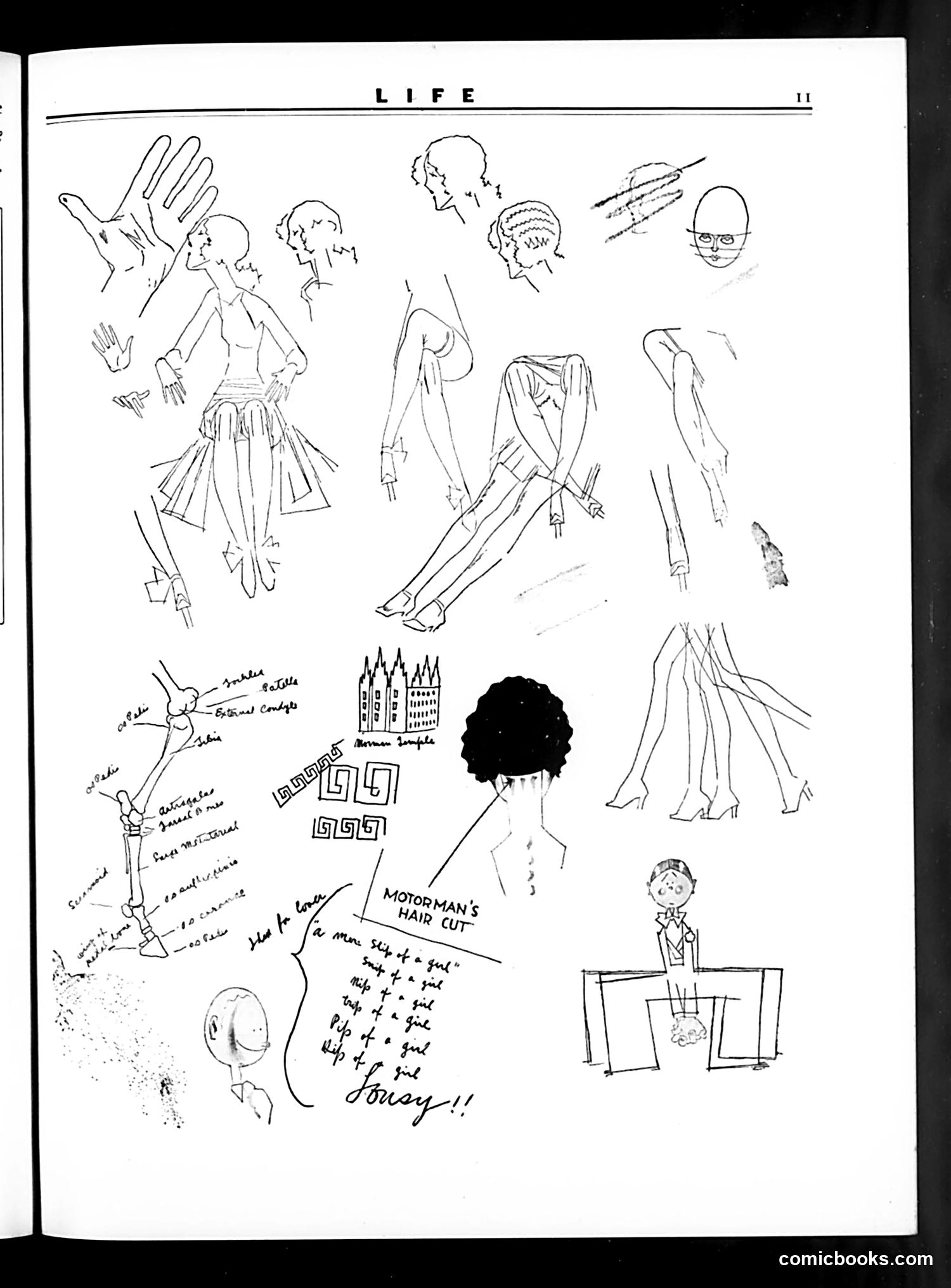
This page displays fashion and design sketches rather than political satire. The content includes: **Fashion Studies:** Multiple figure drawings showing women's clothing designs, including a pleated skirt outfit, various leg/foot positions, and dress studies—typical of fashion illustration. **Architectural/Decorative Elements:** Greek key pattern designs and what appears to be a classical building sketch, suggesting interior design or architectural references. **Notable Sketch:** A prominent drawing labeled "MOTORMAN'S HAIR CUT" shows a woman's silhouette with an afro hairstyle, with handwritten notes including what appears to be satirical commentary about a "girl" repeated multiple times, suggesting mockery of either the hairstyle itself or contemporary attitudes toward it. **Bottom Right:** An illustration of a person at a desk, possibly editorial content. This appears to be a general illustration/design page rather than political commentary.
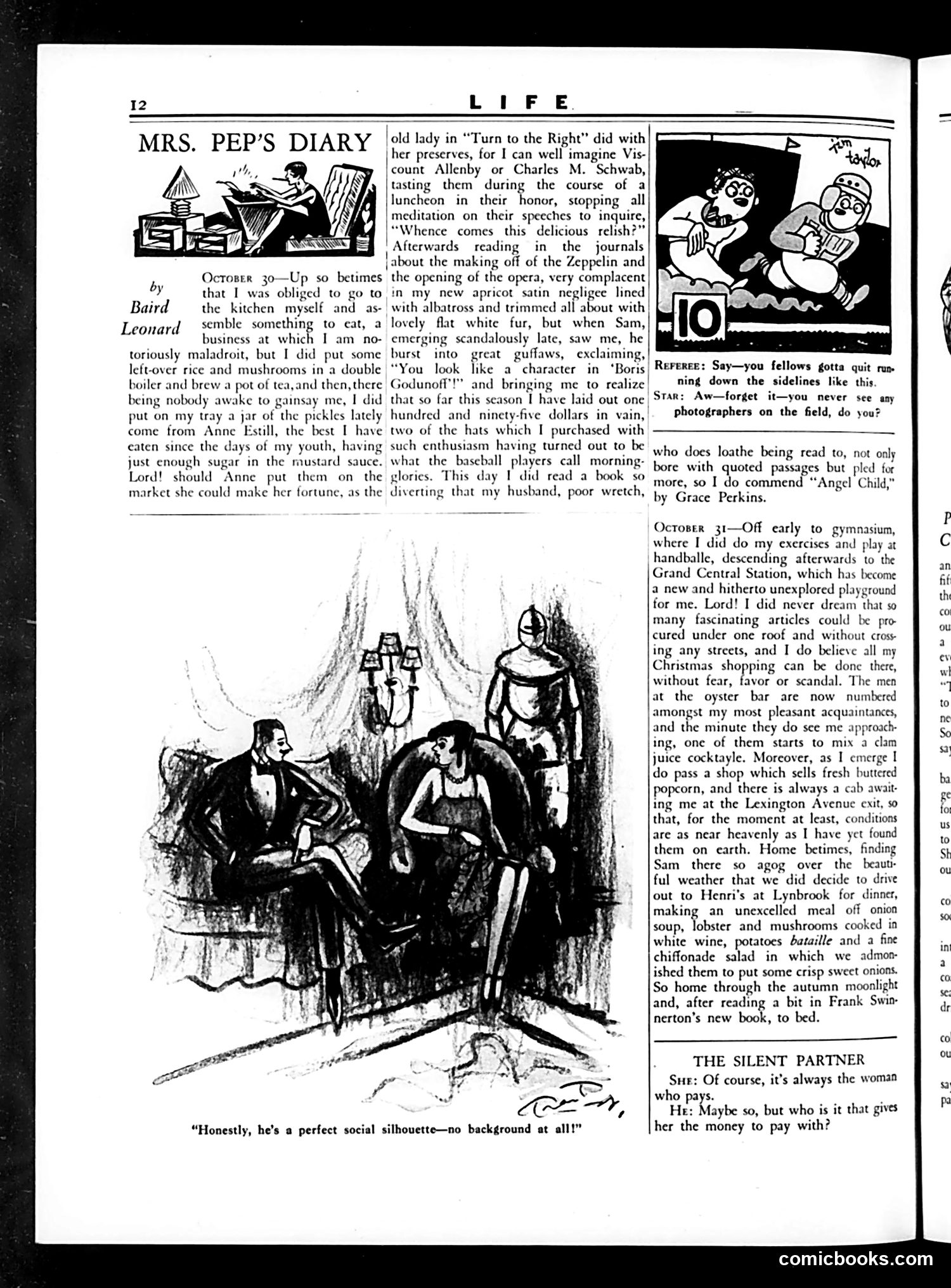
This page from *Life* magazine contains Mrs. Pep's Diary by Baird Leonard, a humor column about domestic life. The main cartoon depicts a woman introducing a man to others with the caption: "Honestly, he's a perfect social silhouette—no background at all!" The joke satirizes social climbing and superficiality in the 1920s-30s era. "Social silhouette" suggests the man presents an impressive *appearance* or outline in society, but has no actual substance, wealth, or noteworthy background. The humor mocks both the man's lack of credentials and the woman's willingness to present him favorably despite this emptiness—reflecting period anxieties about social pretense and the visibility of class distinctions in fashionable circles. The diary entries humorously document Mrs. Pep's mundane domestic frustrations.
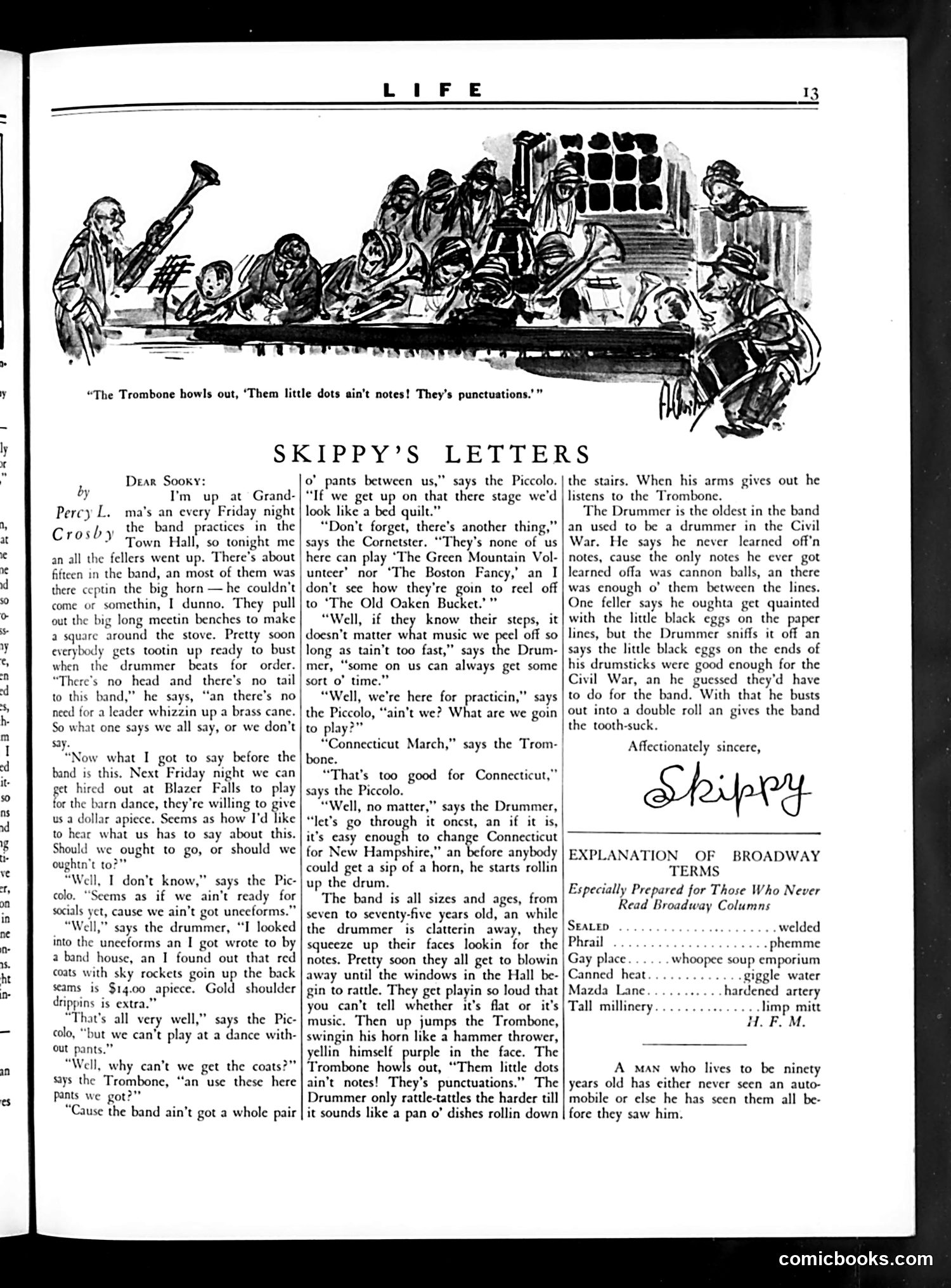
This page features a humorous letter column from "Skippy," a popular comic strip character writing to "Dear Spooky." The content satirizes a school band's struggles during practice. The cartoon at top shows a conductor and band members, with the joke: "The Trombone howls out, 'Them little dots ain't notes! They's punctuations.'" This is a visual pun—the trombonist cannot read musical notation, confusing dots and marks on sheet music with punctuation marks. The letter discusses band members' complaints about uniforms, rehearsal conditions, and instrument difficulties. The satire gently mocks amateur musicians and school band culture, presenting characters with regional/working-class dialect complaining about the rigors of musical training. This represents typical early 20th-century American humor targeting everyday institutions.
This page contains editorial analysis of the recent presidential election (Herbert Hoover's victory). The text critiques both parties but argues the Republican victory reflects Americans' "religious faith" in prosperity and protective tariffs rather than genuine political commitment. The cartoons appear to be satirical illustrations supporting this argument. One cartoon depicts what appears to be political figures or concepts in a somewhat chaotic scene—likely representing the disorganization or confusion of political opposition. The style is typical of Life's editorial commentary during this era. The article's main point: Hoover's win wasn't a mandate for Republican ideology but rather voters' pragmatic faith that Republicans would maintain economic prosperity. The author suggests Americans prioritize material success over ideological commitments to either party.
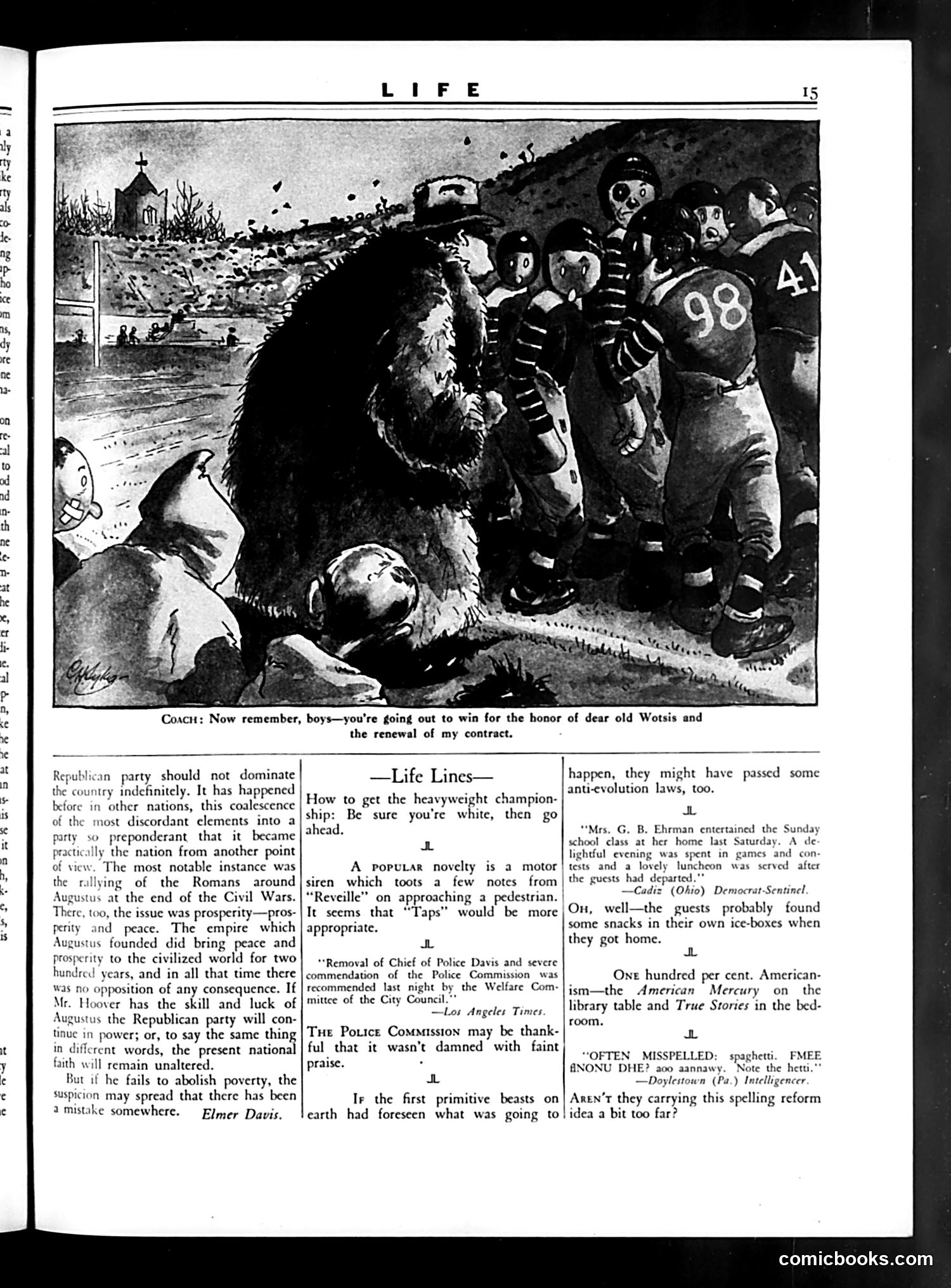
This cartoon satirizes coaching in American football, likely from the early 20th century. A large bear (representing "dear old Wetsis" — possibly a university mascot or coach) addresses uniformed football players before a game. The coach's motivational speech—"you're going out to win for the honor of dear old Wetsis and the renewal of my contract"—reveals the satire's target: coaches who exploit players' idealism to serve their own career advancement and job security. The humor exposes the gap between the *stated* noble purpose (team honor) and the *actual* motivation (the coach's self-interest in contract renewal). This critiques the commercialization of college athletics and the cynical self-serving behavior of coaching staff.
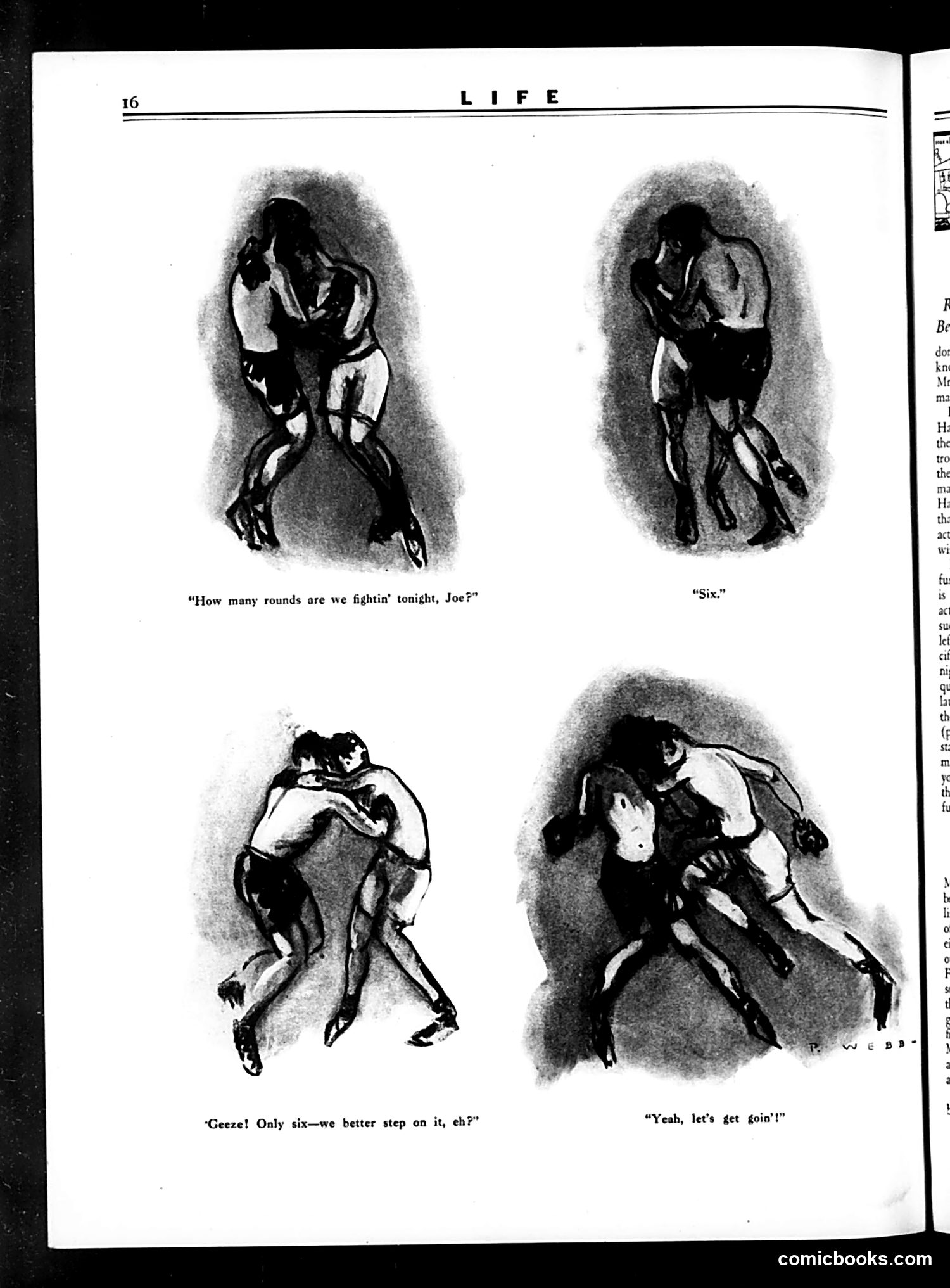
This page presents a four-panel comic strip depicting a boxing match conversation. The humor centers on the fighters' discussion about the number of rounds scheduled for their bout. **The sequence:** 1. One fighter asks "How many rounds are we fightin' tonight, Joe?" 2. Joe answers "Six" 3. The first fighter responds "Geeze! Only six—we better step on it, eh?" (suggesting they need to hurry/intensify their efforts) 4. Joe agrees: "Yeah, let's get goin'!" The satire appears to mock boxers or boxing culture—possibly their limited endurance, intelligence, or the rushed, performative nature of fights. The casual dialogue and the fighters' apparent concern about fitting adequate action into only six rounds suggests commentary on either boxing standards or athletes' physical capabilities of the era.
This page reviews several Broadway productions. The main text discusses Robert Benchley's critique of Harry Wagstaff Gribble's play "Revolt," which features a suicide scene and employs dark comedy. Benchley notes Gribble's tendency toward morbid subjects. The page also reviews "Tin Pan Alley," "These Few Ashes," and mentions Charles Hopkins's production of "The Unknown Warrior." The small cartoons appear to be decorative theatrical illustrations rather than political commentary. The "Confusion of Tongues" letter at bottom humorously complains about reading newspapers over someone's shoulder in the street—a relatable social annoyance. This is primarily entertainment criticism rather than political satire.
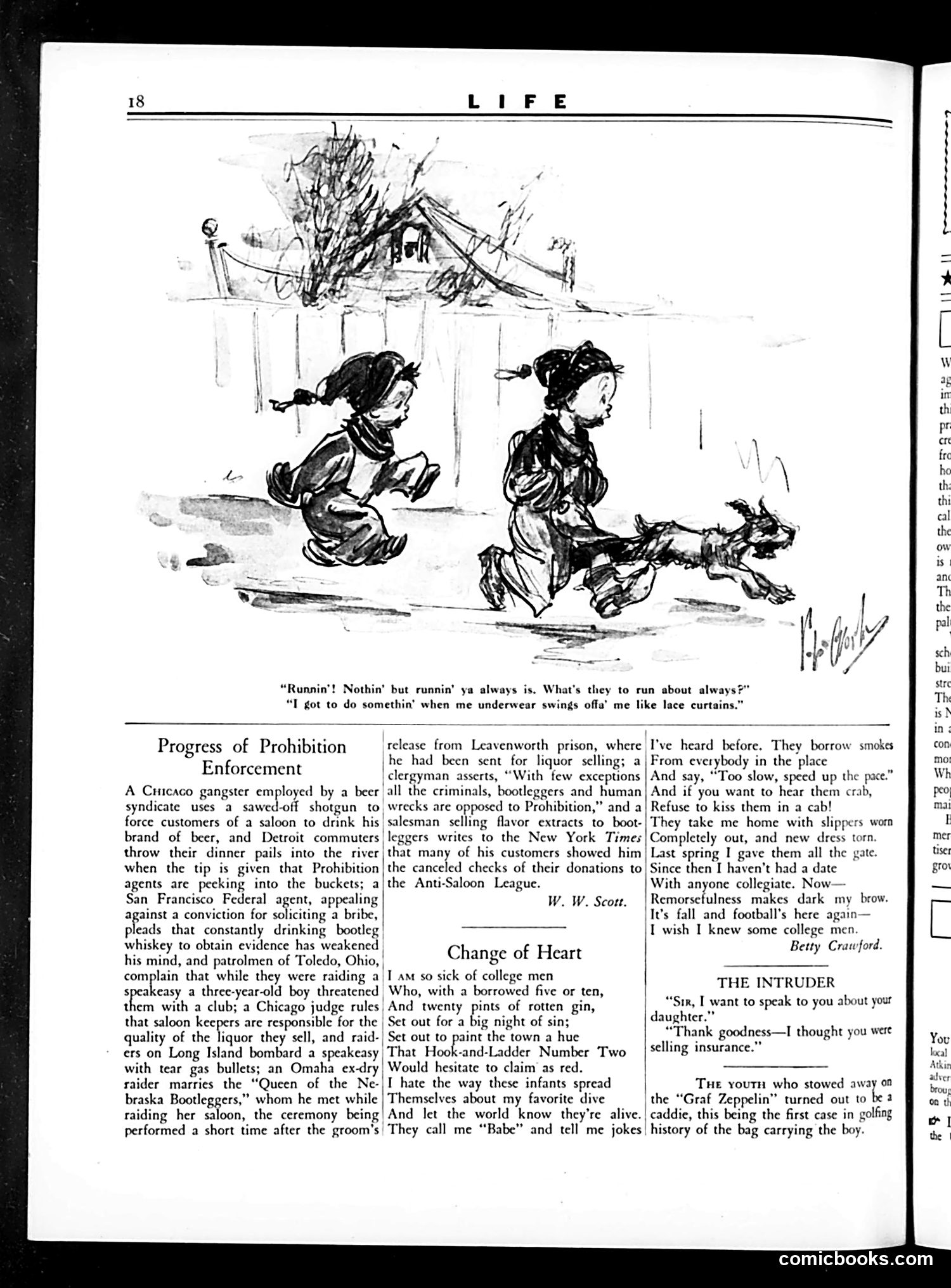
This page contains satirical commentary on Prohibition enforcement (1920s-1933) and social commentary through humor. **Top Cartoon:** Two children run past a burning house. The dialogue mocks the absurdity of Prohibition—the child complains about running because their underwear flaps like "lace curtains," a crude joke about poverty and inadequate clothing. The satire suggests Prohibition enforcement disrupts ordinary life chaotically. **"Progress of Prohibition Enforcement":** This article-essay sarcastically catalogs the chaos and corruption created by Prohibition laws. Examples include: gangsters forcing customers to buy specific beer brands at gunpoint, judges ruling saloon keepers liable for liquor quality, Prohibition agents themselves becoming corrupt (soliciting bribes), and even a three-year-old threatening police during raids. The point: Prohibition creates more problems than it solves. **"Change of Heart" and "The Intruder":** Brief humorous pieces about dating and social interaction. The overall message: Prohibition enforcement is absurd, corruptive, and counterproductive—a common anti-Prohibition satirical stance during this era.
This is a **satirical commentary page** from *Home Life*, a family-oriented weekly. The main content is **not a political cartoon** but rather **editorial commentary on local and regional news**, organized by geography. The **central editorial argument** warns against mail-order shopping, claiming it drains money from local communities and prevents towns from funding infrastructure (schools, paved streets). The editor argues this creates a vicious cycle of deteriorating conditions. The **regional sections** ("Minnesota," "New England," "California," "Colorado," "Michigan") contain **humorous local observations and gossip**—brief satirical notes about regional figures, events, and follies. Examples include: - A joke about Harvard-Yale game betting - Wordplay on a Boston Post editor's pen name - Gentle mockery of a prohibition-era still explosion in Roxbury - Observations about local personalities and their priorities The satire is **mild and domestic**, targeting small-town vanities and behaviors rather than major political figures. This reflects the magazine's focus on family entertainment and community life rather than hard-hitting political satire.
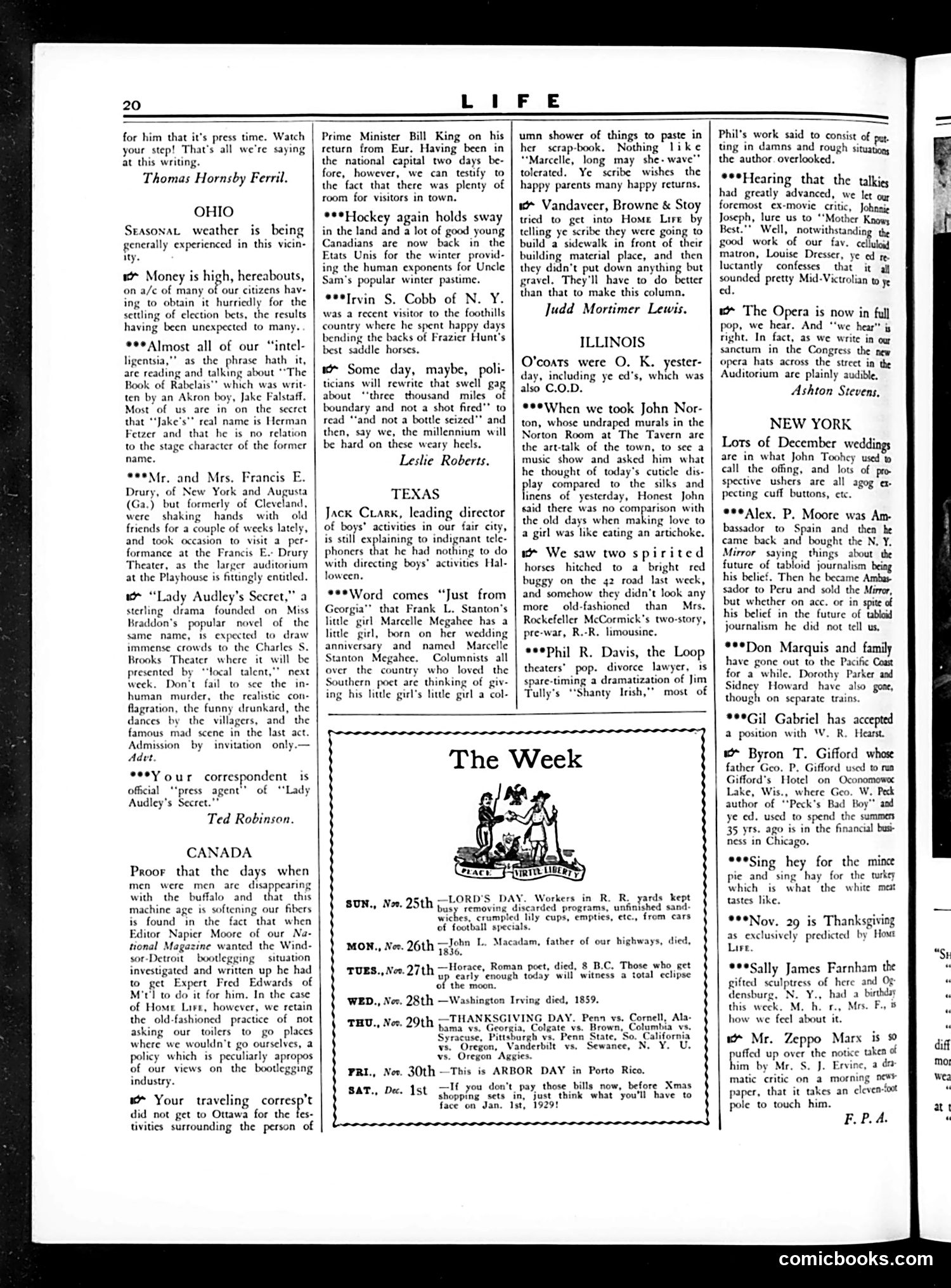
This page contains a small illustration labeled "The Week" showing figures gathered around what appears to be a calendar or schedule. The cartoon serves as a visual header for the upcoming week's notable dates and events listed below it. The accompanying text box lists significant dates and events for the week of November 25-December 1, including: - Lord's Day (workers in R.R. yards kept busy) - John L. Masadam's death (described as "father of our highways") - Horace, a Roman poet, died in 8 B.C. - Washington Irving's death in 1859 - Thanksgiving Day (with various college football games) - Arbor Day in Porto Rico - Reference to paying bills before Christmas The cartoon itself appears to be a simple, generic illustration meant to frame these weekly announcements rather than deliver specific political or social satire. It functions as a decorative organizational device for this "Life" magazine's calendar section.
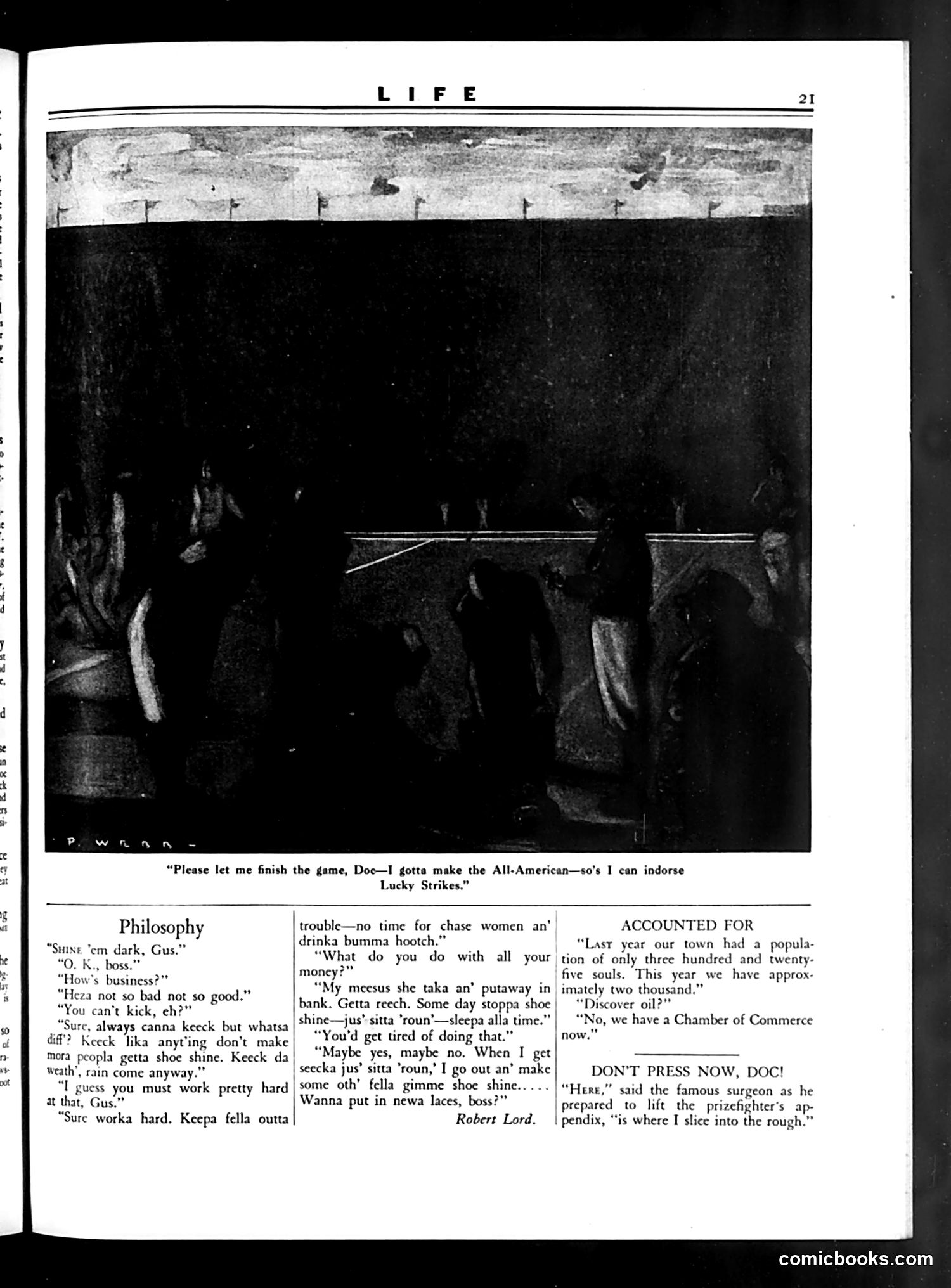
The main cartoon depicts a prizefighter asking his doctor to let him finish a boxing match so he can achieve "All-American" status—enabling him to endorse Lucky Strike cigarettes. This satirizes the commercialization of sports and athletes, mocking how athletic achievement had become merely a stepping stone to lucrative endorsement deals rather than an end in itself. The lower section contains humorous dialogue featuring working-class characters speaking in exaggerated ethnic dialects (likely Italian immigrants), discussing shoe-shining work and small-town economics. The tone is comedic rather than malicious. The final joke about a surgeon performing a prizefighter's appendectomy, referring to the incision as "where I slice into the rough" (golf terminology), plays on the boxer's athletic background for a pun. The page satirizes American commercialism, celebrity endorsements, and working-class immigrant life, using humor typical of early-to-mid 20th century American magazines.
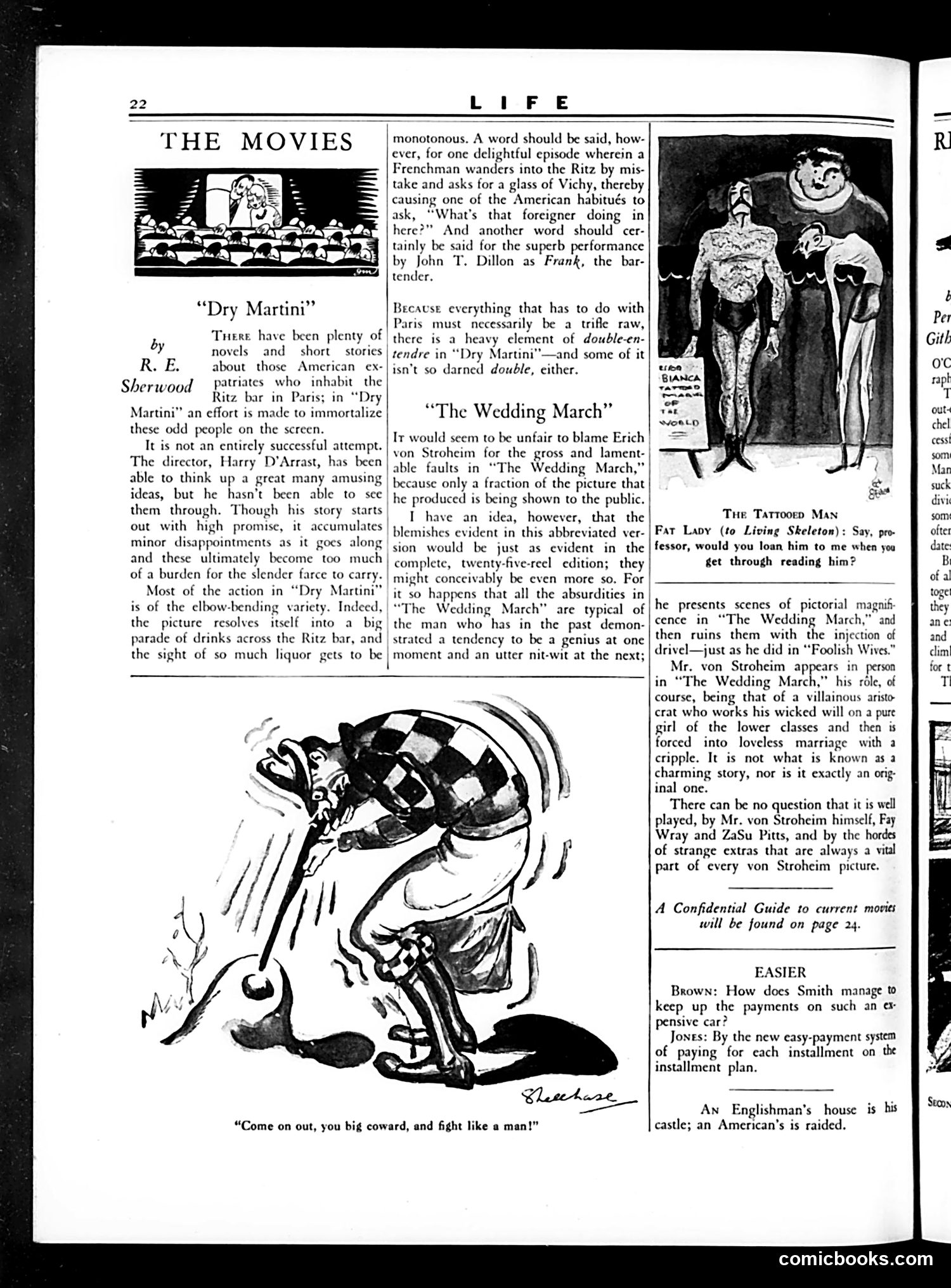
This page reviews two silent films and includes carnival sideshow humor. **"Dry Martini"** is critiqued as a mediocre film about American expatriates drinking at Paris's Ritz bar. The reviewer (R.E. Sherwood) praises one scene where a Frenchman orders Vichy water, causing shock among the American drinkers, and commends actor John T. Dillon's bartender performance. The film relies heavily on double entendres (sexual innuendo). **"The Wedding March"** features director Erich von Stroheim, who plays a villainous aristocrat seducing a poor girl forced into loveless marriage with a cripple. The reviewer criticizes von Stroheim's inconsistency—capable of brilliance but also "utter nit-wit" moments—though praising the performances by von Stroheim, Fay Wray, and ZaSu Pitts. The cartoon shows a tattooed man and "fat lady" (circus freaks), with one joking about "borrowing" the other as reading material—crude sideshow humor typical of the era.
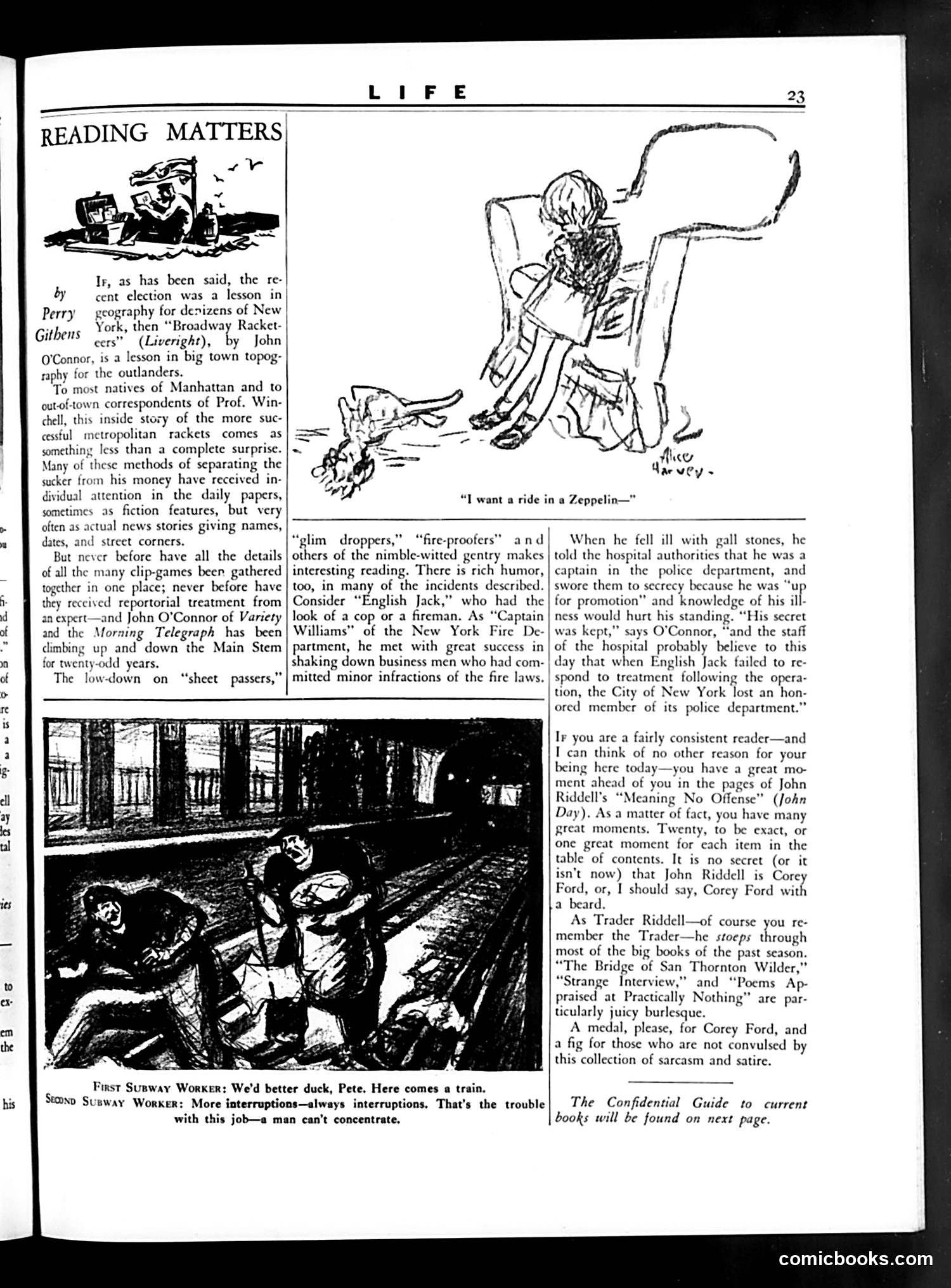
This "Reading Matters" column reviews recent books, primarily focusing on John O'Connor's "Broadway Racketeers"—an exposé of New York City con games and criminal schemes. O'Connor, a Variety and Morning Telegraph reporter with twenty years on the job, catalogs various swindles: "sheet passers," "glim droppers," and fake authority figures. One example describes "English Jack," who impersonated a Fire Department captain to extort money from businessmen, later posing as a police captain at a hospital. The accompanying cartoons satirize mundane urban life: a sketch showing someone wanting "a ride in a Zeppelin" (escape fantasy), and a subway workers' exchange about constant interruptions preventing concentration—commentary on working-class frustrations. The column also reviews Corey Ford's humor collection disguised as "Trader Riddell," containing parodies of contemporary literary works. The satire targets both metropolitan crime and highbrow culture through witty burlesques of books by Thornton Wilder and others.
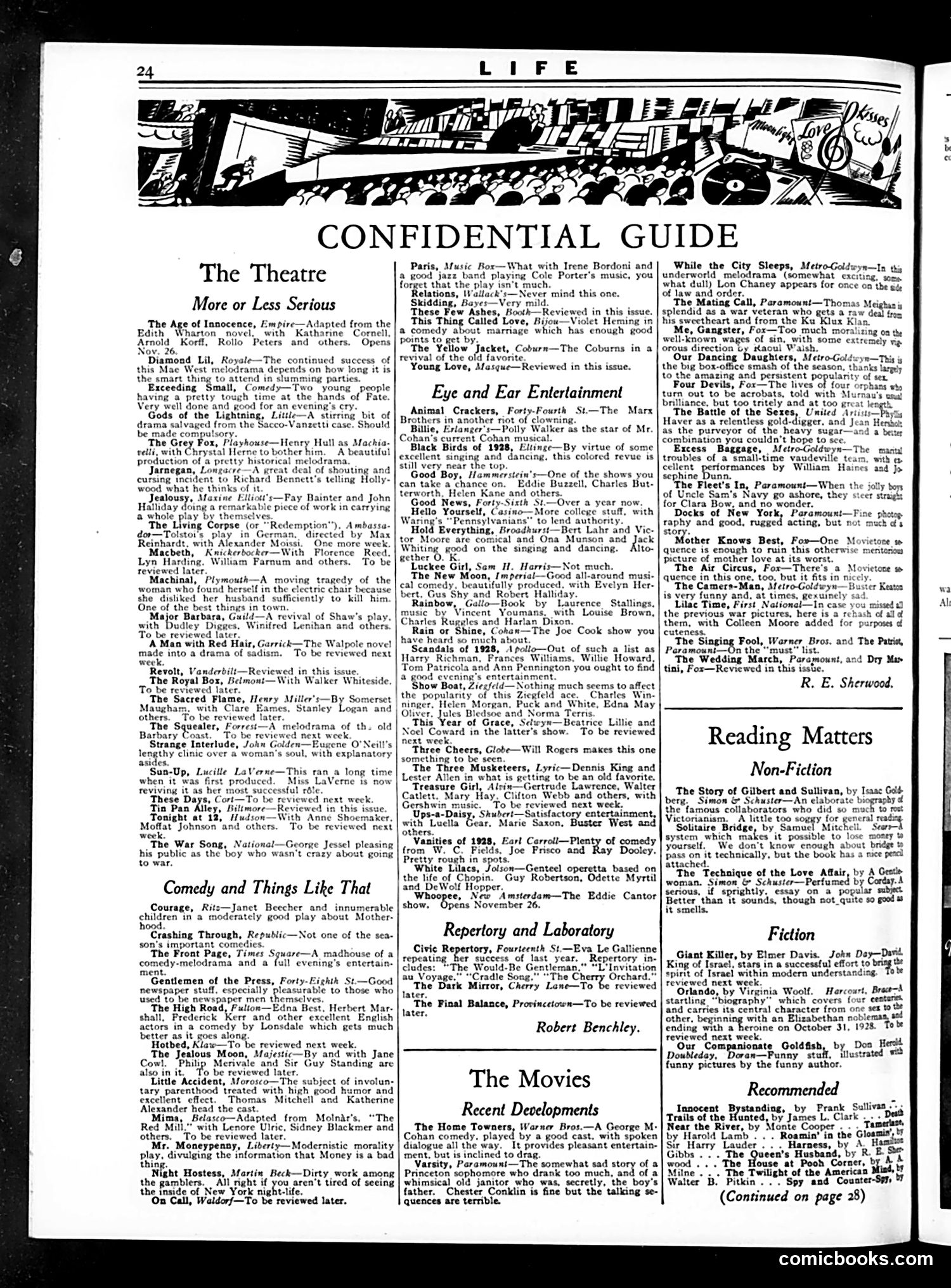
This is a **theatre and entertainment guide page**, not a political cartoon. It contains no satirical imagery or caricatures to analyze. The page presents "Confidential Guide" reviews of Broadway productions from what appears to be **late 1928**. It covers theatrical categories: "More or Less Serious" plays, "Comedy and Things Like That," and brief mentions of films and reading recommendations. Notable entries include Mae West's *Diamond Lil*, Eugene O'Neill's *Machinal* (described as "moving tragedy of the woman who found herself in the electric chair"), and various comedies. The guide offers quick critical assessments—some dismissive ("Not one of the season's important comedies"), others enthusiastic ("A full evening's entertainment"). This represents a typical entertainment listing of the Jazz Age period, reflecting contemporary theatrical tastes and social preoccupations (including references to the Sacco-Vanzetti case in *Gods of the Lightning*).
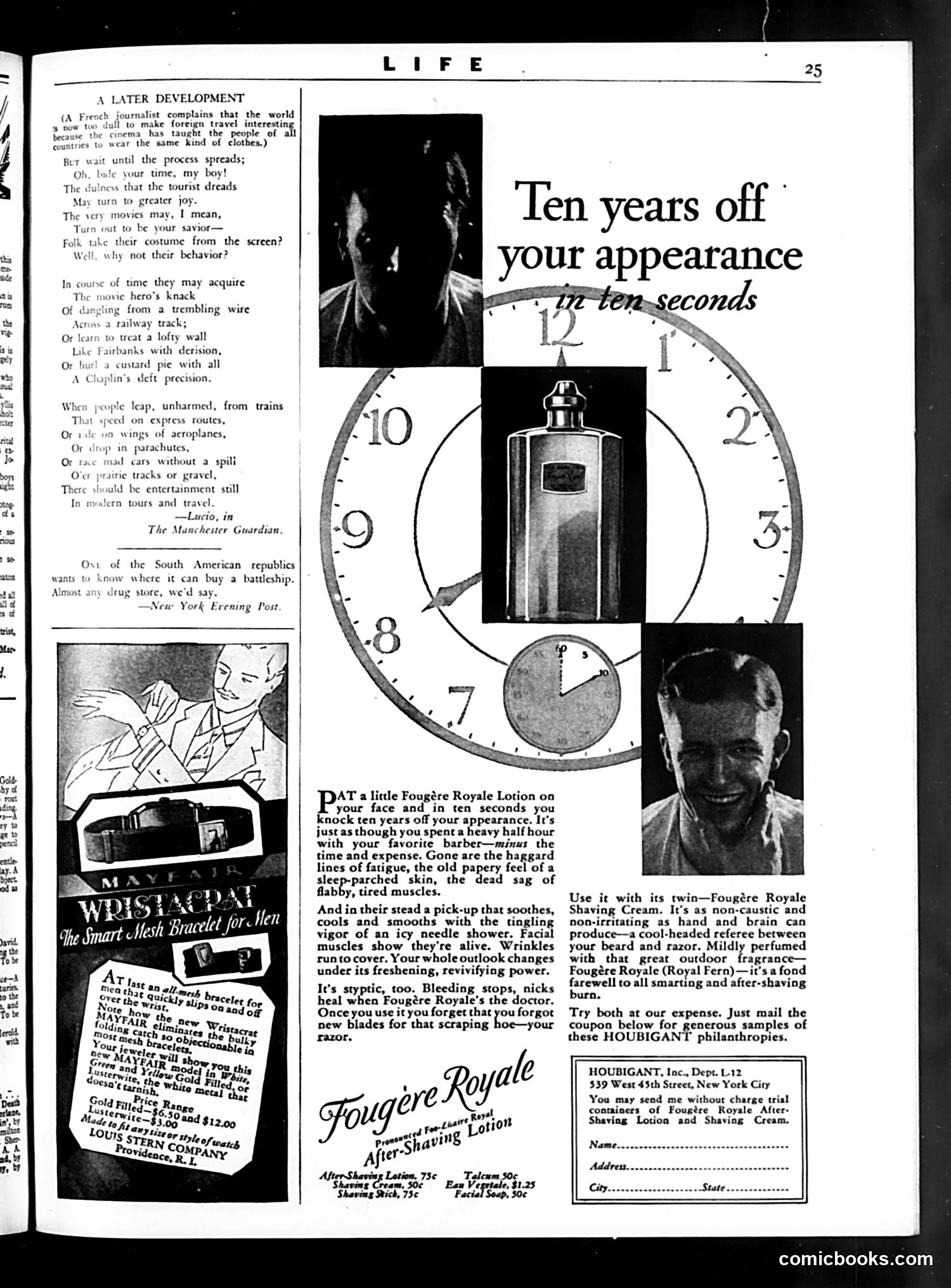
This page contains two distinct elements: a humorous poem and a beauty product advertisement. **The Poem "A Later Development":** The satirical verse critiques how cinema has homogenized world culture—tourists now dress identically everywhere. But the poet suggests an ironic "silver lining": if movies have taught everyone the same fashions, perhaps they'll also adopt movie characters' *behaviors*. The joke escalates absurdly—people might leap from trains unharmed, hurl custard pies, or drop from parachutes, mimicking silent-film stunts by Douglas Fairbanks and Charlie Chaplin. This creates dark comedy about cinema's pervasive influence on real-world behavior and the potential dangers of imitating fictional heroics. **The Advertisement:** Most of the page promotes Fougère Royale After-Shaving Lotion and Shaving Cream, targeting men. The ad claims the lotion removes ten years from one's appearance in seconds, reducing wrinkles and fatigue lines. It emphasizes the product as a quick alternative to visiting a barber. The advertisement includes a mail-in coupon for free samples.
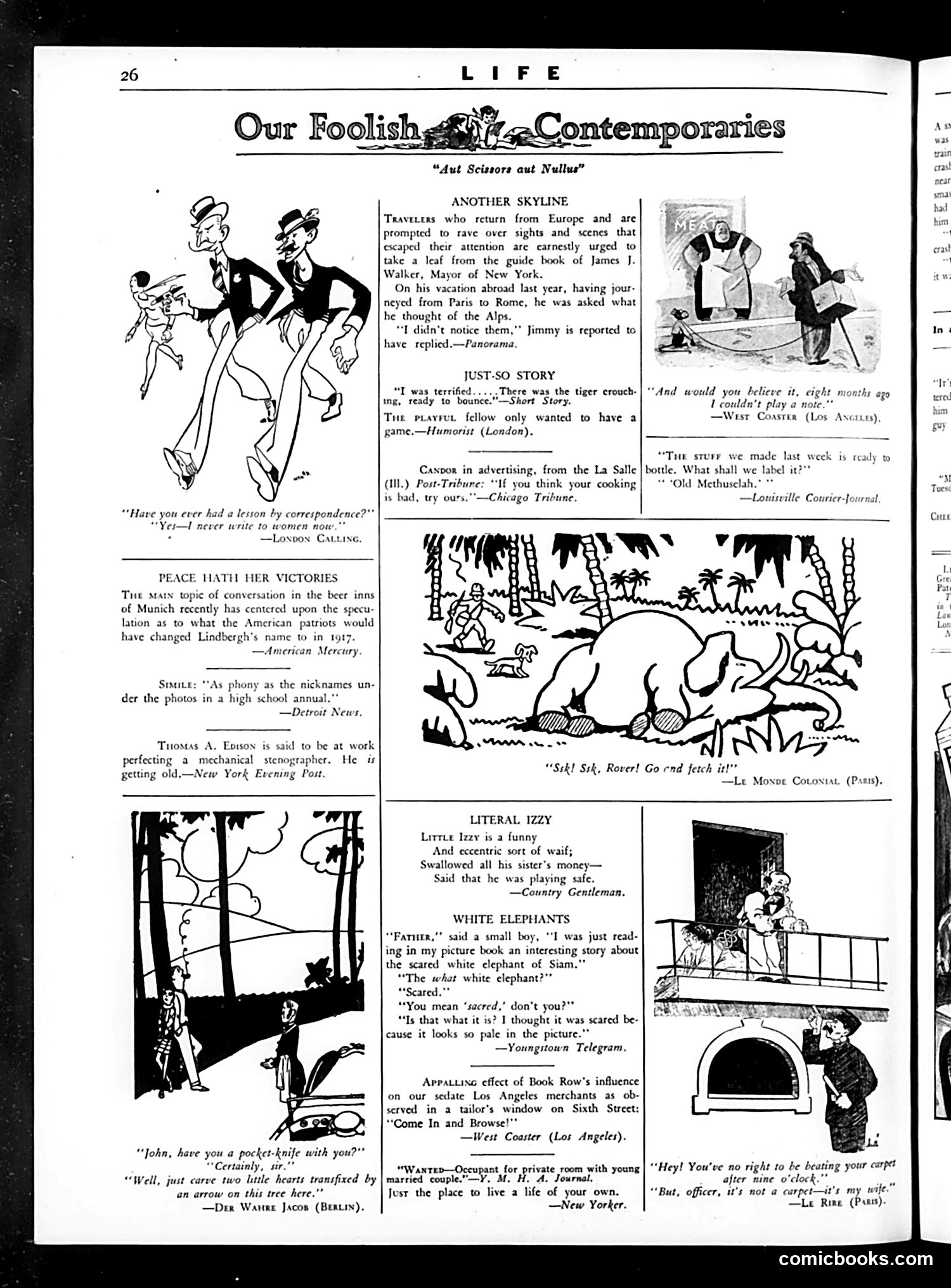
This is a humor section collecting short jokes and quips from newspapers and magazines worldwide, mocking social absurdities of the era. Key items include: **"Peace Hath Her Victories"** — A joke about Charles Lindbergh, the famous aviator. It speculates that had America entered WWI in 1917 (rather than 1917), they would have changed his German-sounding name. This mocks wartime anti-German sentiment and naming prejudices. **Mayor Jimmy Walker joke** — NYC's mayor reportedly claimed he didn't notice the Alps while vacationing in Europe, satirizing tourists who miss obvious landmarks or feign indifference to famous sights. **Various one-liners** — Include jokes about cooking disasters, advertising mishaps, and marital discord (the final Paris joke equating a wife with a carpet to be beaten). The cartoons illustrate selected jokes—correspondence lessons, a tiger surprising someone, a child misunderstanding "sacred" as "scared" white elephant. The overall tone mocks human foolishness: pretension, obliviousness, poor judgment, and domestic strife.
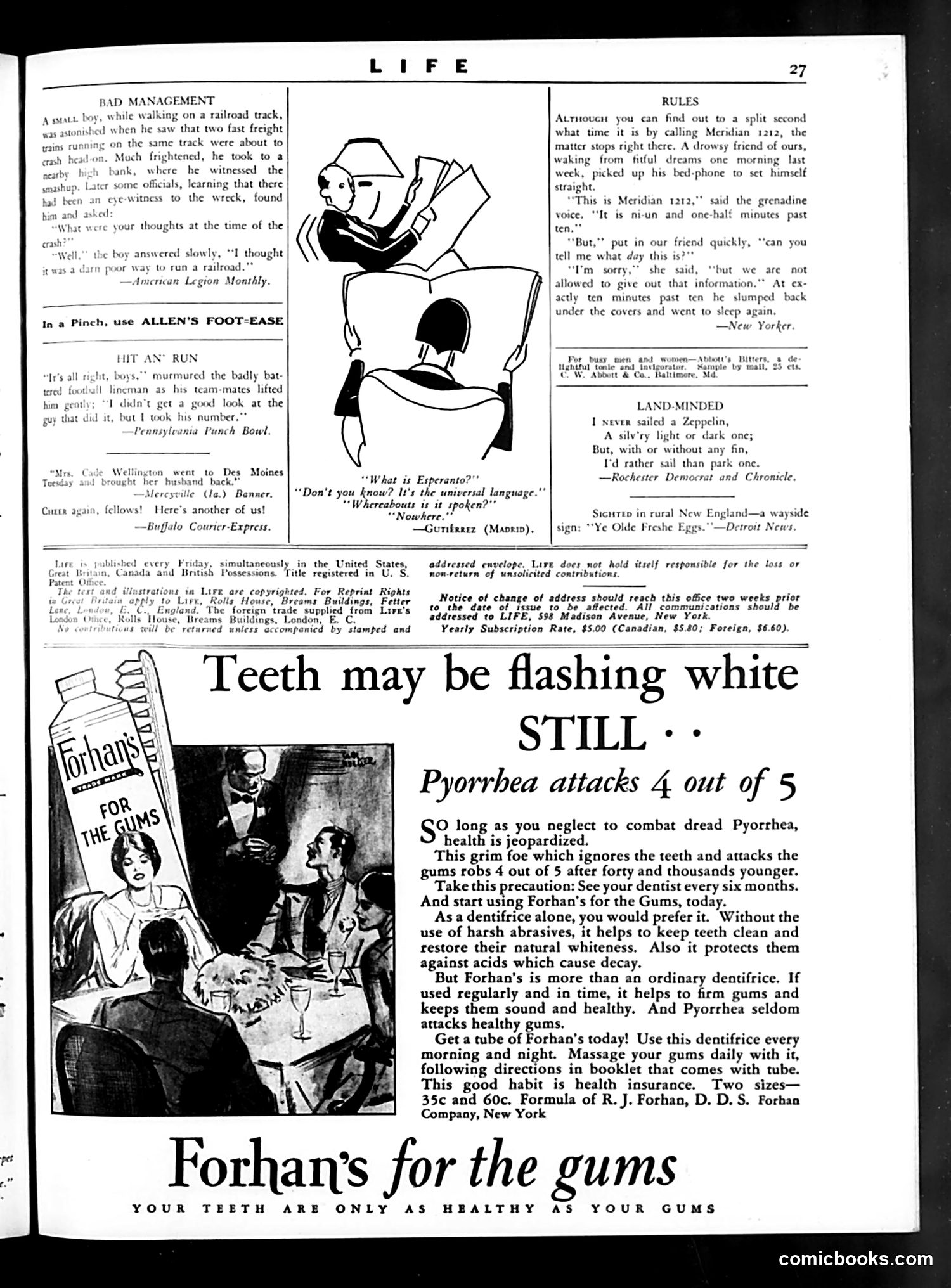
This page contains brief humorous anecdotes and advertisements typical of 1920s-era *Life* magazine. The cartoons illustrate short jokes: a boy witnesses a railroad crash and pragmatically observes it's "a poor way to run a railroad"; a baseball player consoles himself he "didn't get a good look" despite his team's loss; a woman returns from Des Moines with her husband. These use deadpan humor common to the era. The "Rules" section mocks modern telephone service—a caller phones "Meridian 1212" for the time but cannot get the date, illustrating frustration with rigid, unhelpful automated systems. "Land-Minded" is light verse about preferring sailing to parking. The dominant element is a **Forhan's toothpaste advertisement** warning that pyorrhea (gum disease) affects "4 out of 5" people over forty. It promotes the product as both a dentifrice and gum treatment—reflecting early 20th-century marketing linking oral hygiene to overall health and social respectability.
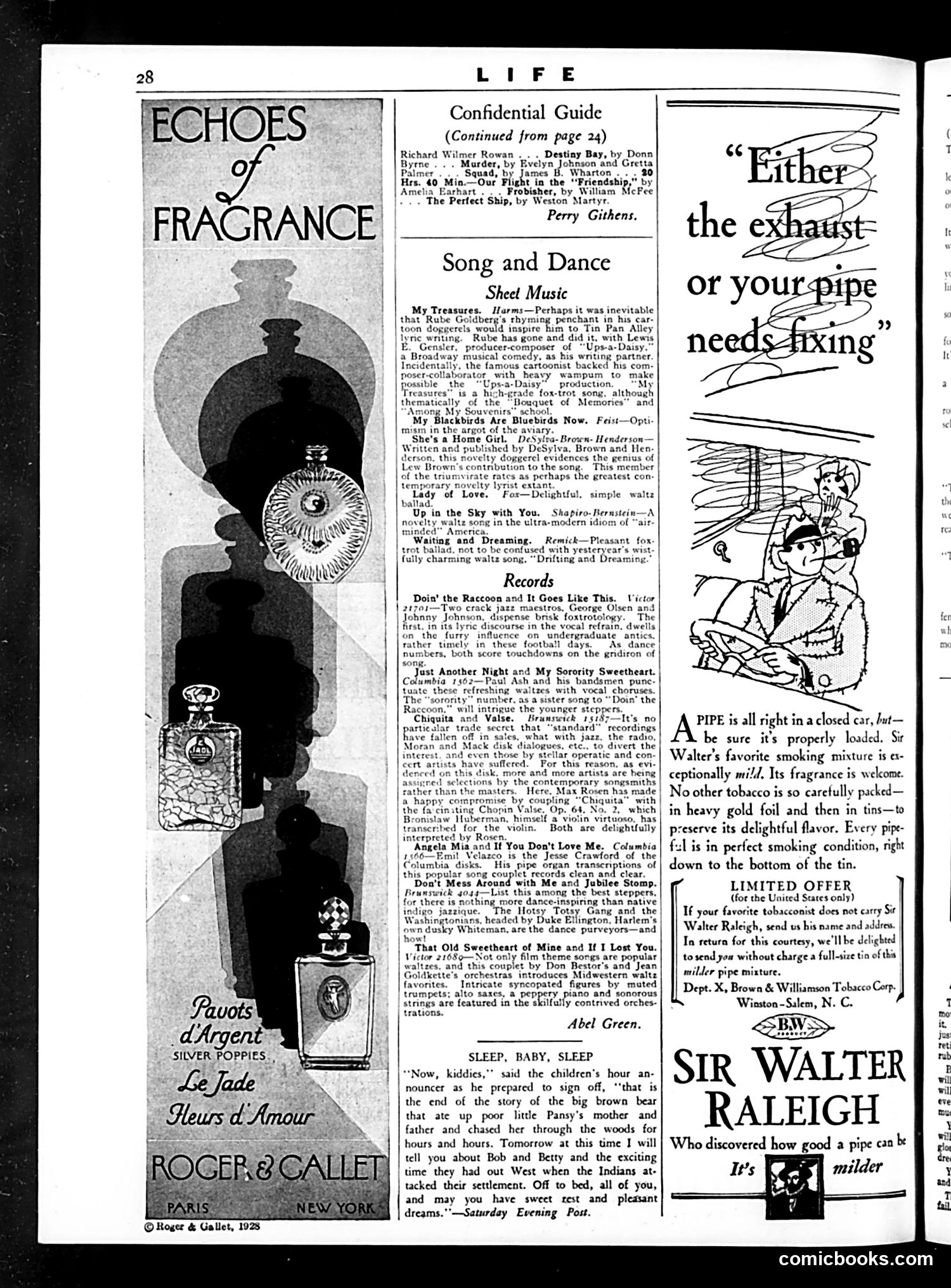
This page is primarily **advertising and entertainment content** from Life magazine, circa 1928. The left side features a **fragrance advertisement** for Roger & Gallet's "Echoes of Fragrance" and "Pavots d'Argent" perfumes, using Art Deco styling with silhouetted bottles. The center contains **entertainment listings**: book reviews, sheet music recommendations, and phonograph records—typical cultural coverage for the era. References to "jazz maestros," "Tin Pan Alley," and contemporary composers like Rube Goldberg show 1920s popular culture. The right side advertises **Sir Walter Raleigh pipe tobacco**, with a cartoon showing men smoking and the tagline "Either the exhaust or your pipe needs fixing." This is straightforward product advertising playing on the ubiquity of pipe smoking among men. The brief "Sleep, Baby, Sleep" section at bottom appears to be children's story content. There is **no significant political satire** on this page—it's primarily consumer advertising and entertainment reviews typical of Life's commercial content during the Jazz Age.
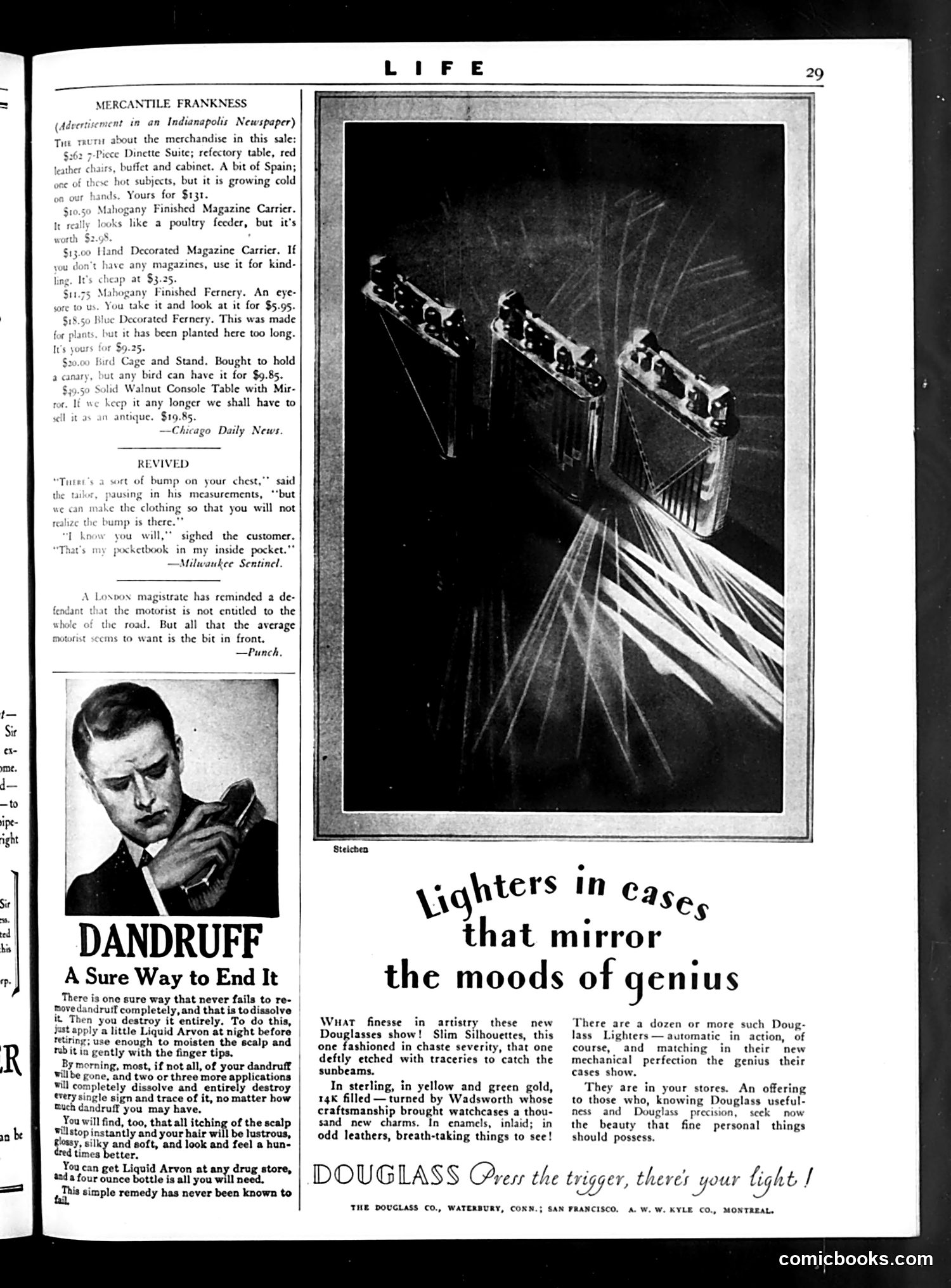
This page contains three distinct humor pieces and advertisements: **"Mercantile Frankness"** reprints brutally honest classified ads from a Chicago newspaper. The joke: a furniture store describes items with refreshing bluntness—a magazine carrier "looks like a poultry feeder," a fernery "has been planted here too long," a bird cage they can't "keep any longer." The satire mocks typical advertising's false enthusiasm by showing what store owners actually think. **"Revived"** contains two brief jokes about tailors and motorists using self-deprecating humor—a tailor admits to hiding a customer's chest bump, a magistrate reminds motorists they don't own the road. **The main image** shows a dramatic photograph of a Douglass automatic cigarette lighter with the caption "Lighters in cases that mirror the moods of genius." This is a straightforward luxury goods advertisement praising the aesthetic design and craftsmanship of Douglass lighters. **"Dandruff" section** advertises Liquid Arvon remedy with testimonial-style copy. The page blends satirical commentary on commerce with product advertising—typical for Life magazine's format.
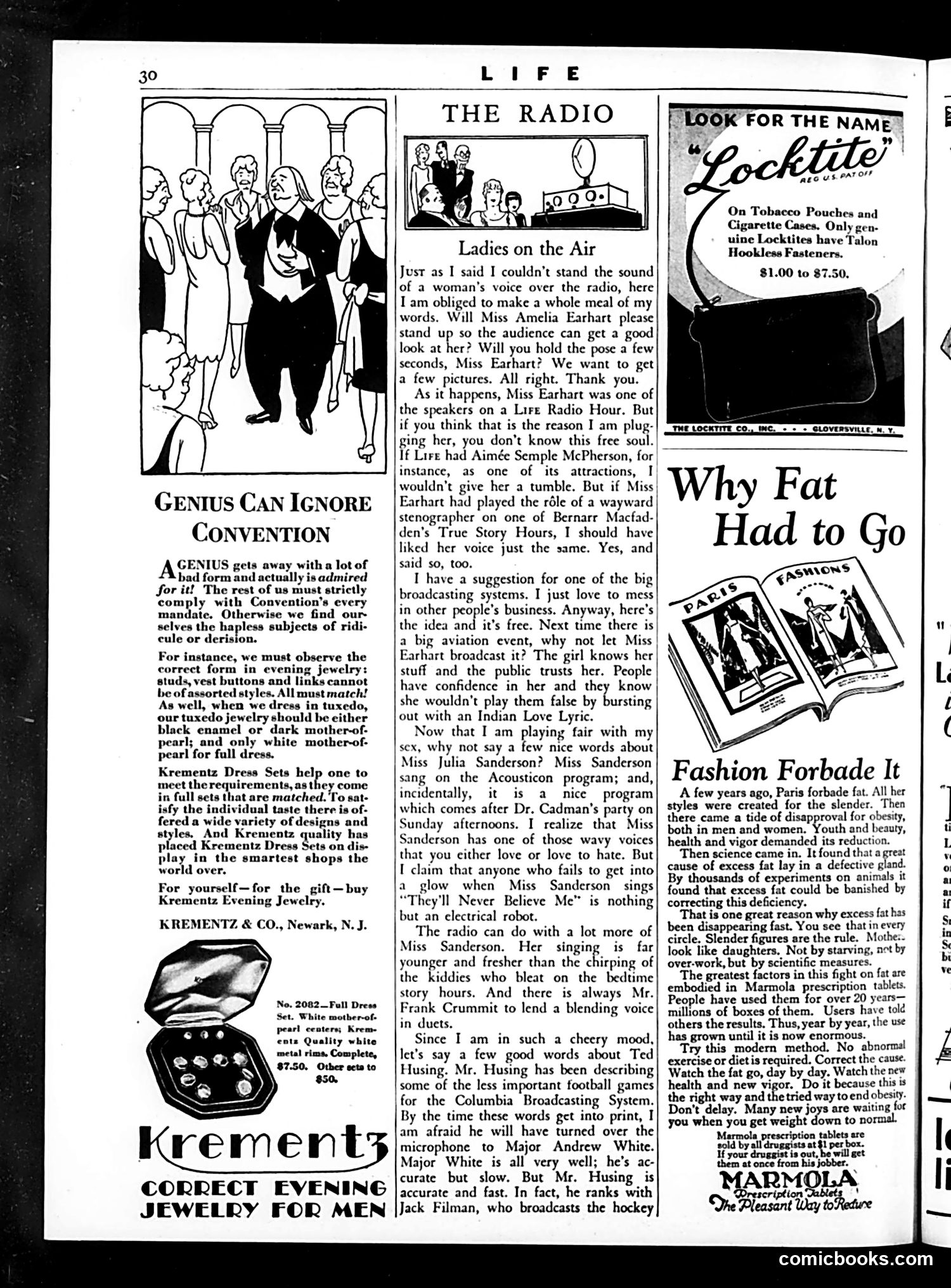
The page consists primarily of **advertisements and radio criticism**, not political satire. ## Main Content: **"Genius Can Ignore Convention"** is a tongue-in-cheek **jewelry advertisement** for Krementz dress sets. It humorously argues that while geniuses can flout social rules, ordinary people must follow strict conventions—like matching evening jewelry. The joke is light social commentary: conformity is expected from everyone except the exceptional. **"The Radio" section** is **radio criticism** praising specific broadcasters. The author praises **Amelia Earhart** (the famous aviator) as a radio speaker, suggests she should broadcast aviation events, and compliments singers **Julia Sanderson** and sportscaster **Ted Husing**. The tone is gossipy and promotional rather than satirical—the author is essentially endorsing these radio personalities. **"Why Fat Had to Go"** is a **Marmola weight-loss advertisement**, claiming science has proven obesity can be corrected with their tablets. The page is primarily **commercial content with light entertainment commentary**, not political or social satire requiring specialized historical knowledge.
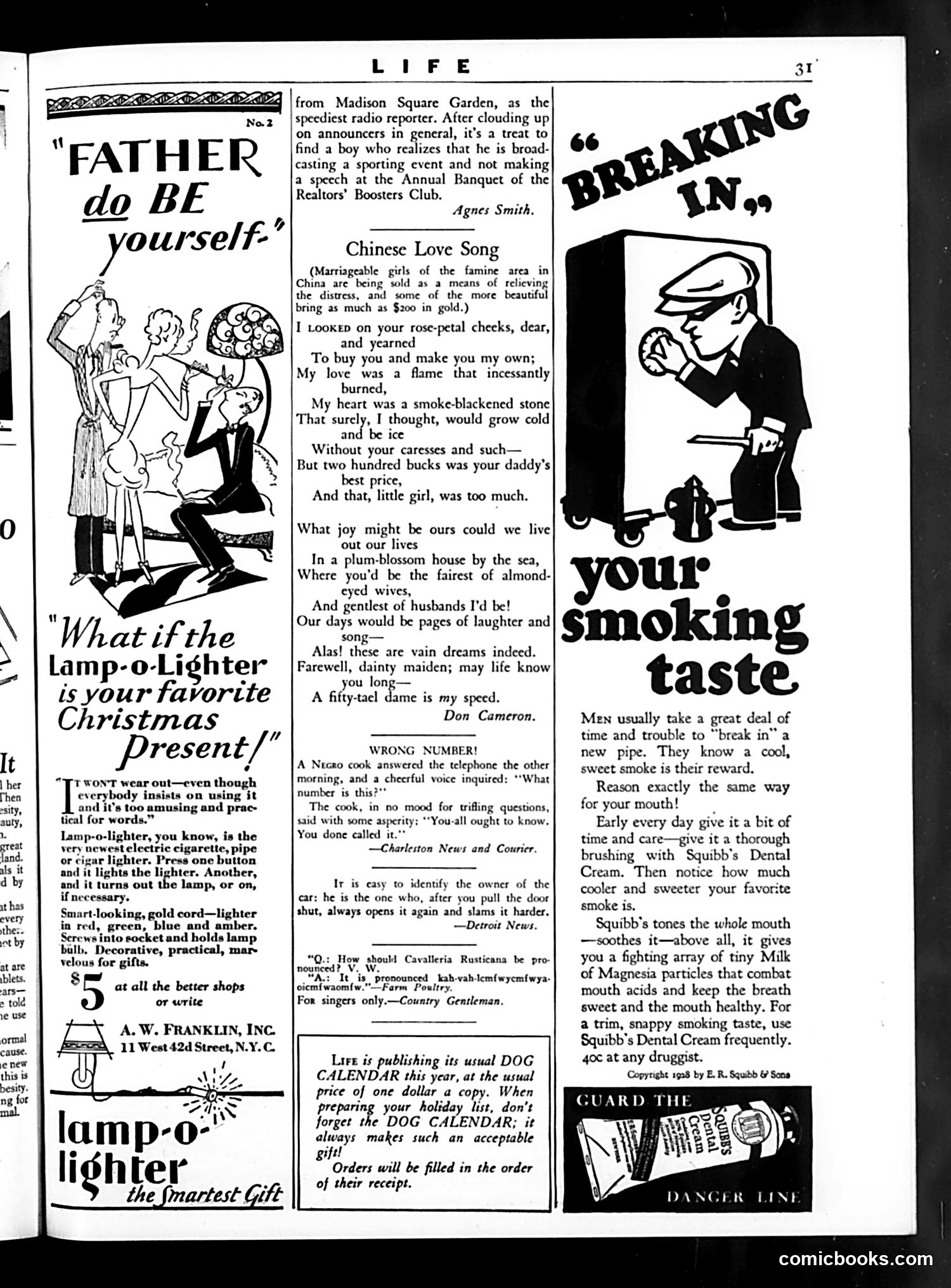
This page mixes satirical commentary with advertising typical of 1920s American magazines. **"Chinese Love Song"** is a darkly ironic poem critiquing the Chinese famine relief crisis, where impoverished families were selling daughters into marriage. The narrator romanticizes a girl but ultimately cannot afford her $200 dowry—the satire exposes how poverty reduces human beings to commodities while highlighting Western indifference to Eastern suffering. **"Wrong Number!"** is a brief comedic anecdote about a Black cook answering a telephone and responding sarcastically to a caller asking what number they've reached. The humor relies on period stereotypes. **"Breaking In Your Smoking Taste"** advertises pipe tobacco and Squibb's Dental Cream, suggesting careful pipe maintenance ensures pleasant smoking. **Left column** features the Lamp-o-Lighter cigarette lighter and other gift advertisements. The page reflects 1920s attitudes: casual racial humor, commercial frivolity juxtaposed with reports of international tragedy, and early consumer marketing culture.
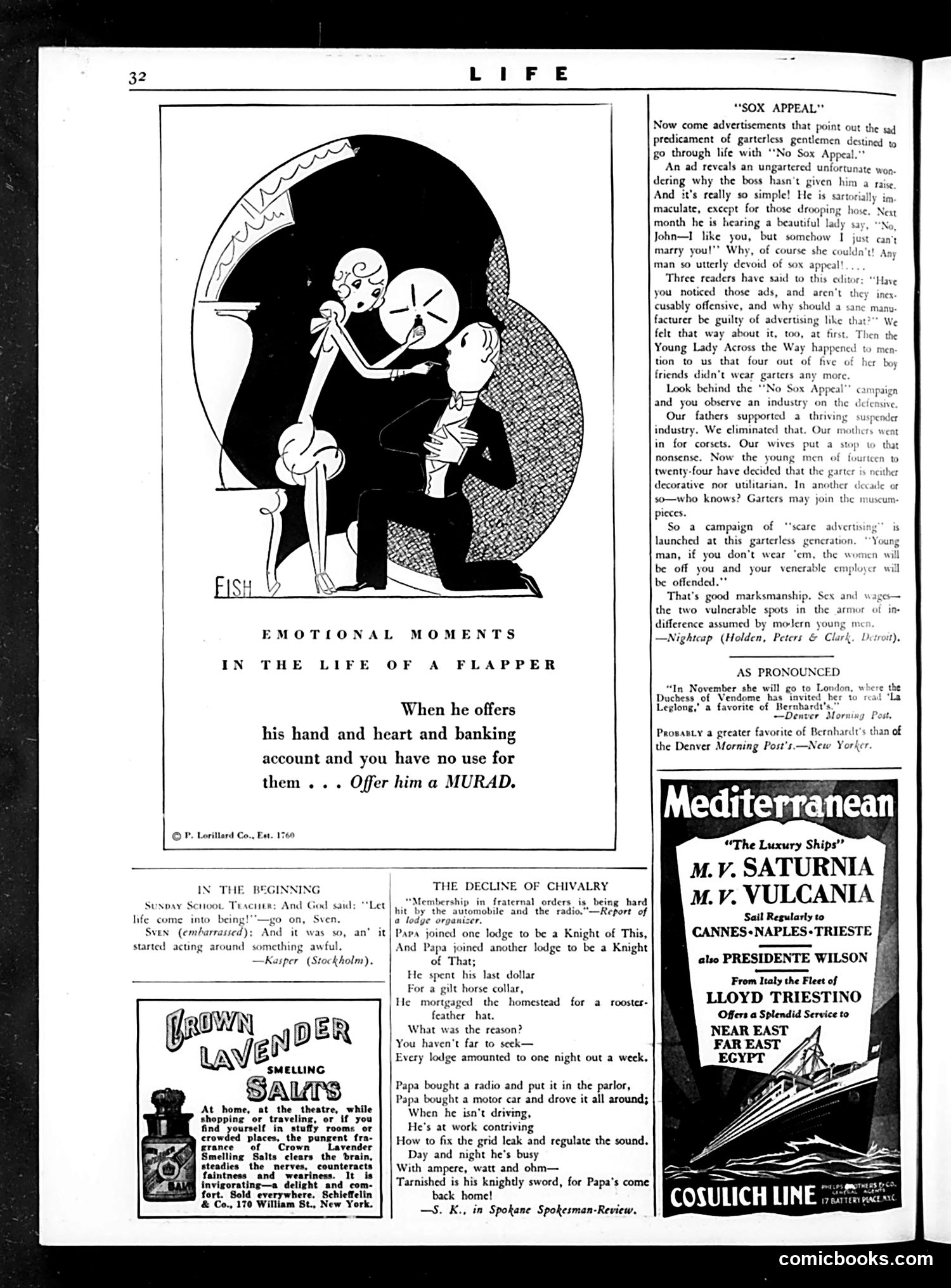
This page contains satirical commentary on 1920s social changes, particularly targeting modern courtship and declining traditions. **Main Cartoon ("Flapper" illustration):** Shows a young woman rejecting a suitor's marriage proposal. The caption suggests offering him a Murad cigarette instead—a humorous deflection of serious romantic intentions. This mocks the "flapper" generation's rejection of traditional marriage proposals. **"Sox Appeal" Article:** Satirizes new advertising campaigns targeting unmarried men, claiming their lack of garters makes them unattractive to women and employers. The piece critiques this manipulative marketing while acknowledging that younger men genuinely abandoned garters—reflecting how advertising exploits modern anxieties about masculinity and social acceptance. **"Decline of Chivalry" Poem:** Laments how modern conveniences (radios, automobiles) have replaced fraternal lodge membership and traditional masculine pursuits, reducing men to tinkerers rather than knights. Overall, the page humorously documents generational anxieties about rapidly changing social customs—women's independence, technology's impact on tradition, and advertising's growing power to shape behavior.
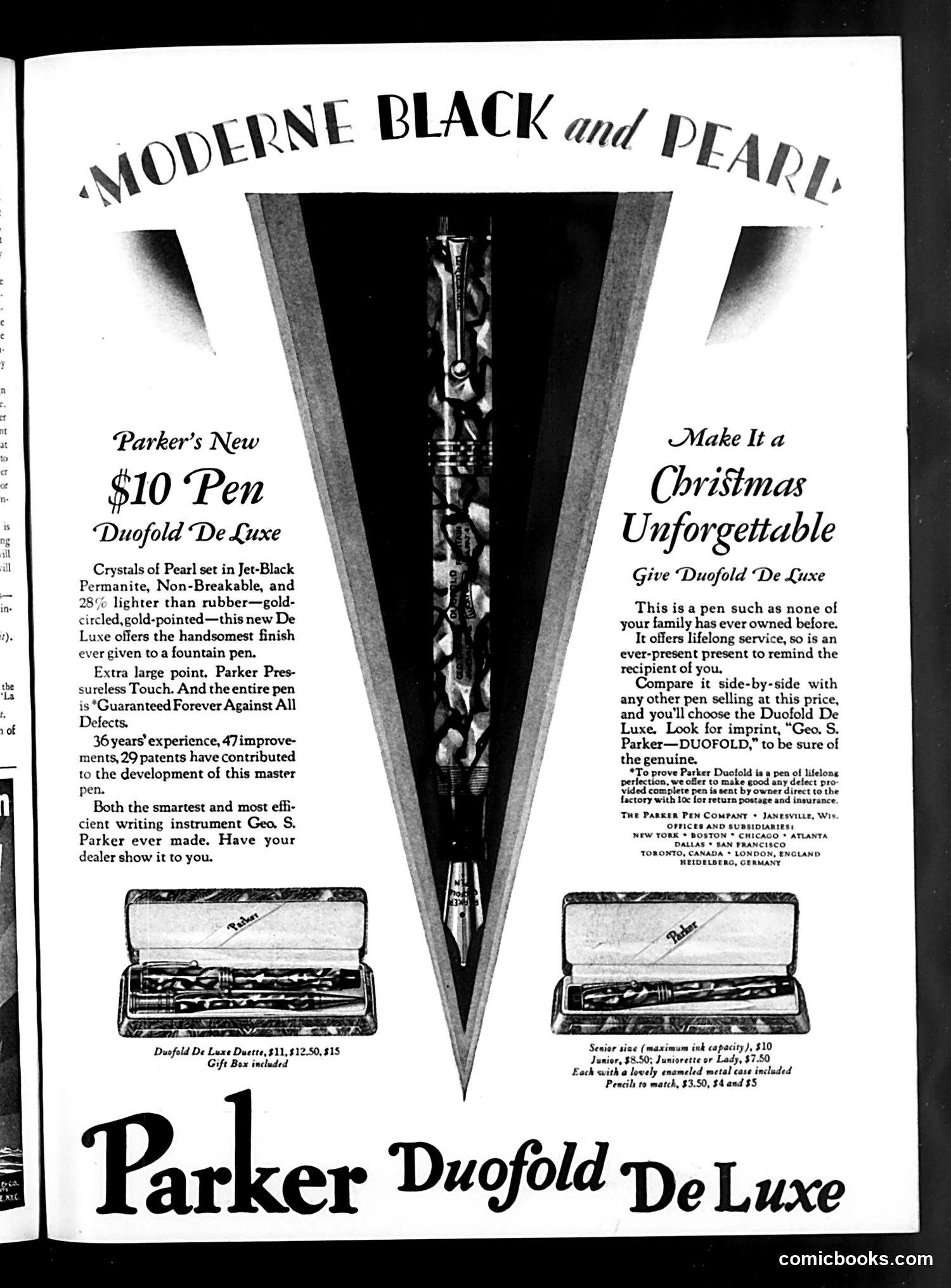
This is not a cartoon or satire page—it's a full-page **advertisement for Parker Duofold De Luxe fountain pens**, positioned as a luxury Christmas gift. The page uses striking black-and-white design: a large central image of the pen itself, flanked by product boxes. The ad emphasizes prestige through appeals to craftsmanship ("36 years' experience, 47 improvements") and exclusivity (pearl-studded, jet-black design, lifetime guarantee). The "Modern Black and Pearl" headline and Christmas gift messaging target affluent consumers seeking status gifts. The extensive text about the pen's engineering and durability suggests fountain pens were still significant luxury purchases in this era (likely 1920s-1930s, based on style and pricing). There is no political or satirical content here—this is straightforward commercial advertising typical of *Life* magazine during the interwar period, when it carried substantial advertising alongside editorial content.
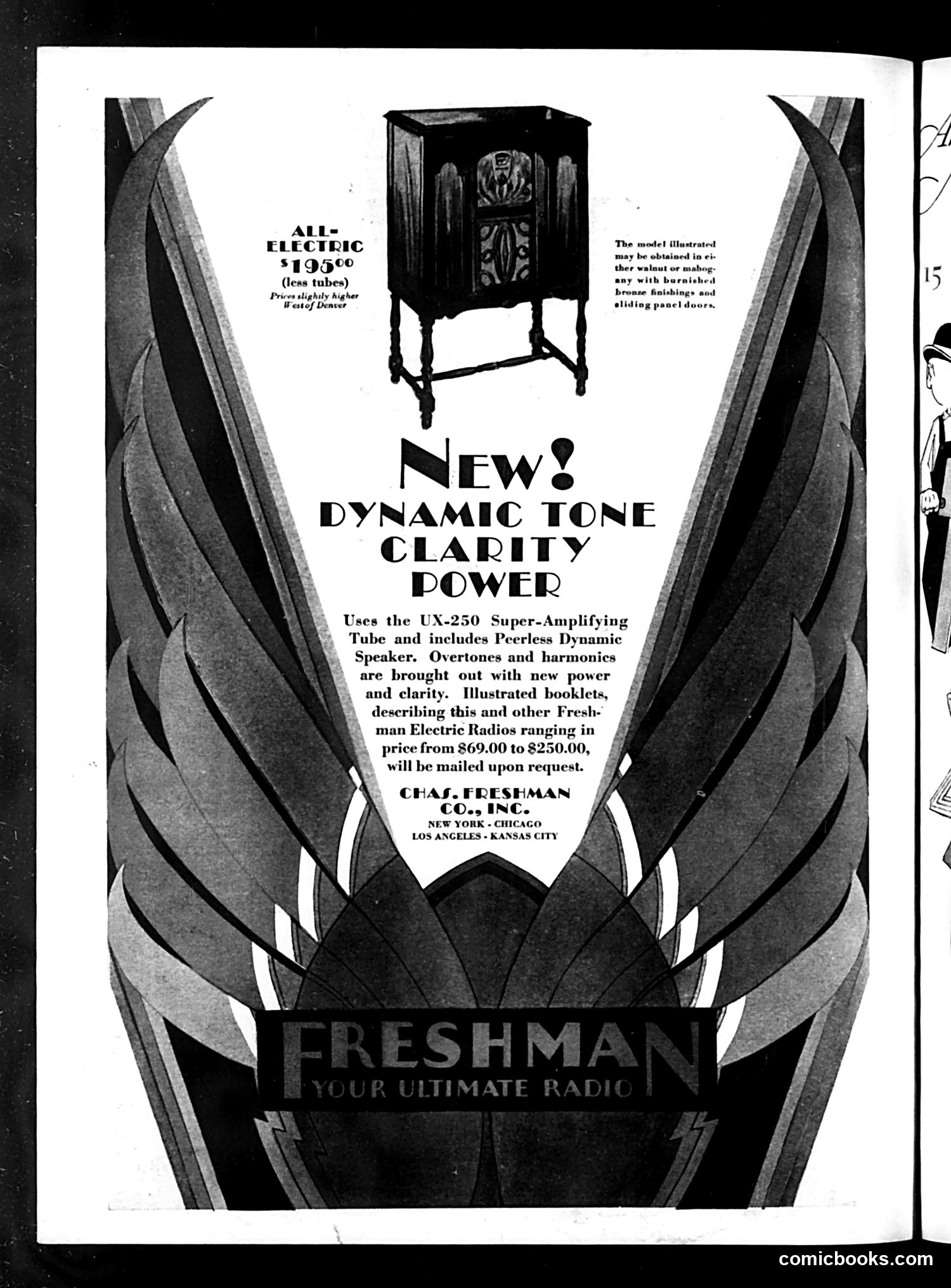
This is a **radio advertisement**, not political satire. It promotes a Freshman Electric Radio model priced at $195 (less tubes), emphasizing its "Dynamic Tone Clarity Power" through a UX-250 Super-Amplifying Tube and Peerless Dynamic Speaker. The page uses Art Deco design—dramatic curved shapes and geometric patterns—common in 1920s-30s advertising. The ornamental framing creates visual impact to showcase the cabinet-style radio set displayed at top center. The text highlights technical innovations ("overtones and harmonics brought out with new power and clarity") to appeal to consumers interested in radio quality. Multiple price points ($69-$250) suggest various models available. The company had locations in New York, Chicago, Los Angeles, and Kansas City. This reflects the era when radios were luxury consumer goods and advertising emphasized technological advancement as a selling point.