
Life, 1928-11-23 · page 16 of 36
Life — November 23, 1928 — page 16: what you’re looking at
What you’re looking at
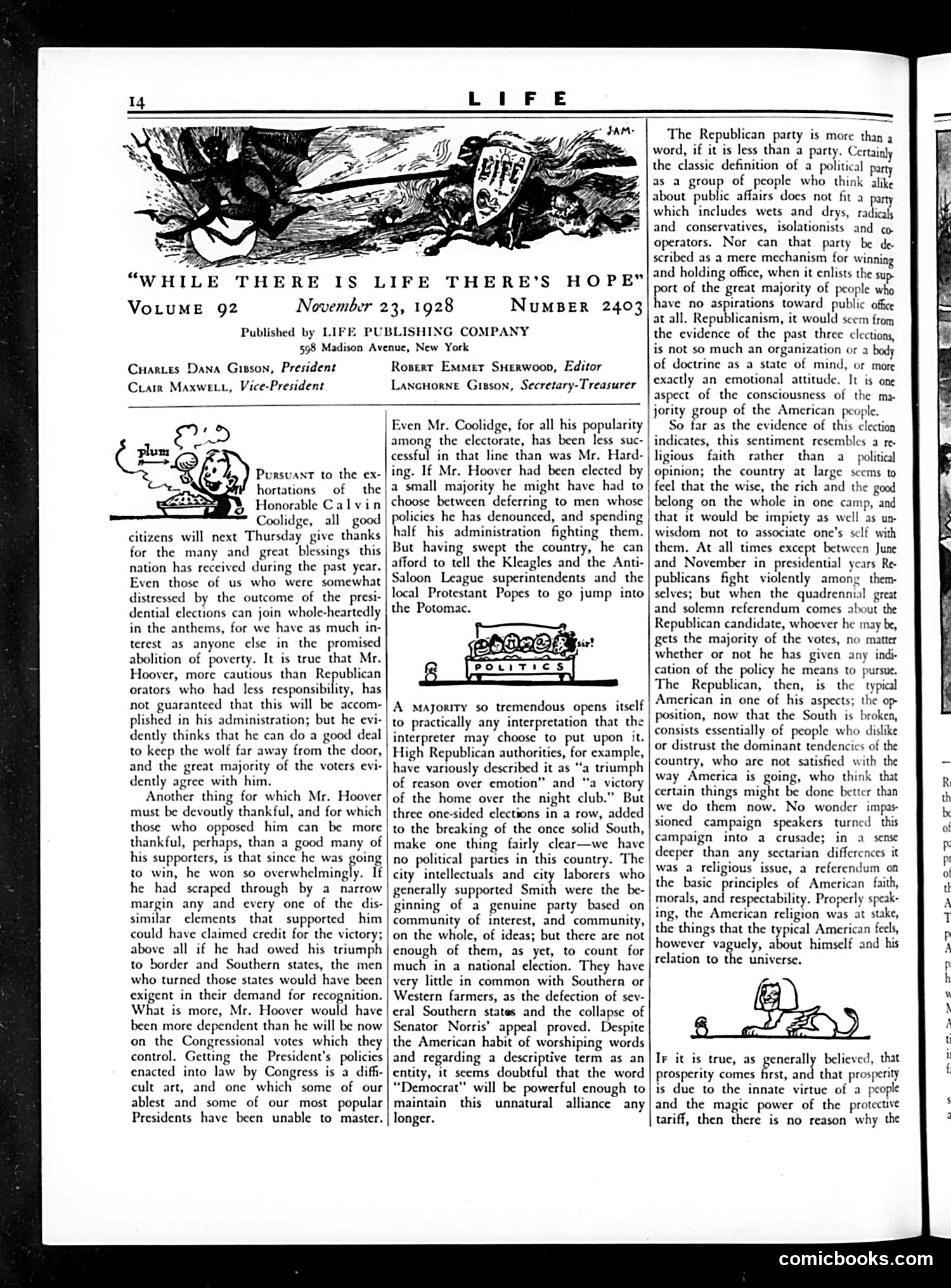
This page contains editorial analysis of the recent presidential election (Herbert Hoover's victory). The text critiques both parties but argues the Republican victory reflects Americans' "religious faith" in prosperity and protective tariffs rather than genuine political commitment. The cartoons appear to be satirical illustrations supporting this argument. One cartoon depicts what appears to be political figures or concepts in a somewhat chaotic scene—likely representing the disorganization or confusion of political opposition. The style is typical of Life's editorial commentary during this era. The article's main point: Hoover's win wasn't a mandate for Republican ideology but rather voters' pragmatic faith that Republicans would maintain economic prosperity. The author suggests Americans prioritize material success over ideological commitments to either party.
📄 Transcribed text from this page (OCR, searchable)
Machine-transcribed from the original scan — historical spelling and the odd misread are preserved.
VoLUME 92 Published by LI November 23, 1928 PUBLISHING COMPANY NuMBER 2403 598 Madison Avenue, New York Cuarces Dana Gisson, President Crain Maxwett, Vice-President Rosert Emmet SHerwoop, Editor LancHorne Grason, Secretary-Treasurer Pursuant to the ex- hortations of the} §, Honorable Calvin Coolidge, all good citizens will next Thursday give thanks for the many and great blessings this nation has received during the past year. Even those of us who were somewhat distressed by the outcome of the presi- dential elections can join whole-heartedly in the anthems, for we have as much in- terest as anyone else in the promised abolition of poverty. It is true that Mr. Hoover, more cautious than Republican orators who had less responsibility, has not guaranteed that this will be accom- plished in his administration; but he evi-| dently thinks that he can do a good deal to keep the wolf far away from the door, and the great majority of the voters evi- dently agree with him. Another thing for which Mr. Hoover must be devoutly thankful, and for which those who opposed him can be more thankful, perhaps, than a good many of his supporters, is that since he was going to win, he won so overwhelmingly. If he had scraped through by a narrow margin any and every one of the dis-| similar clements that supported him could have claimed credit for the victory; | above all if he had owed his triumph to border and Southern states, the men who turned those states would have been exigent in their demand for recognition. What is more, Mr. Hoover would have been more dependent than he will be now | on the Congressional votes which they | control. Getting the President's policies enacted into law by Congress is a diffi- cult art, and one which some of our ablest and some of our most popular Presidents have been unable to master. | generally supported Smit Even Mr. Coolidge, for all his popularity among the electorate, has been less suc- cessful in that line than was Mr. Hard- ing. If Mr. Hoover had been elected by a small majority he might have had to choose between deferring to men whose policies he has denounced, and spending half his administration fighting them. But having swept the country, he can afford to tell the Kleagles and the Anti- Saloon League superintendents and the local Protestant Popes to go jump into the Potomac. A Majority so tremendous opens itself to practically any interpretation that the interpreter may choose to put upon it. High Republican authorities, for example, have variously described it as “a triumph of reason over emotion” and “a victory of the home over the night club.” But three one-sided elections in a row, added to the breaking of the once solid South, make one thing fairly clear—we have no political parties in this country. The city intellectuals and city laborers who were the be- ginning of a genuine party based on community of interest, and community, on the whole, of ideas; but there are not enough of them, as yet, to count for much in a national election. They have very little in common with Southern or Western farmers, as the defection of sev- eral Southern states and the collapse of Senator Norris’ appeal proved. Despite the American habit of worshiping words and regarding a descriptive term as an entity, it seems doubtful that the word “Democrat” will be powerful enough to maintain this unnatural alliance any longer. The Republican party is more than word, if it is less than a party. Certainly the classic definition of a political pa as a group of people who think alike about public affairs does not fit a pa which includes wets and drys, radicals and conservatives, isolationists and ¢o operators. Nor can that party be de. scribed as a mere mechanism for w Inning and holding office, when it enlists the su port of the great majority of people who ave no aspirations toward public office at all. Republicanism, it would seem from the evidence of the past three clections, is not so much an organization or a body of doctrine as a state of mind, or more exactly an emotional attitude. It is one aspect of the consciousness of the ma- jority group of the American people. So tar as the evidence of this clection indicates, this sentiment resembles a re- ligious faith rather than a__ political opinion; the country at large seems to feel that the wise, the rich and the good belong on the whole in one camp, and that it would be impiety as well as un- wisdom not to associate one’s self with them. At all times except between June and November in presidential years Re- publicans fight violently among them- selves; but when the quadrennial great and solemn referendum comes about the Republican candidate, whoever he may be, gets the majority of the votes, no matter whether or not he has given any indi- cation of the policy he means to pursue. The Republican, then, is the typical American in one of his aspects; the op- position, now that the South is broken, consists essentially of people who dislike or distrust the dominant tendencies of the country, who are not satisfied with the way America is going, who think that certain things might be done better than we do them now. No wonder impay sioned campaign speakers turned this campaign into a crusade; in a sense deeper than any sectarian differences it was a religious issue, a referendum on the basic principles of American faith, morals, and respectability. Properly speak- ing, the American religion was at stake, the things that the typical American feels, however vaguely, about himself and his relation to the universe. Tr it is true, as generally believed, that prosperity comes first, and that prosperity is due to the innate virtue of a people and the magic power of the protective tariff, then there is no reason why the comicbooks.com R