
Life, 1928-11-23 · page 19 of 36
Life — November 23, 1928 — page 19: what you’re looking at
What you’re looking at
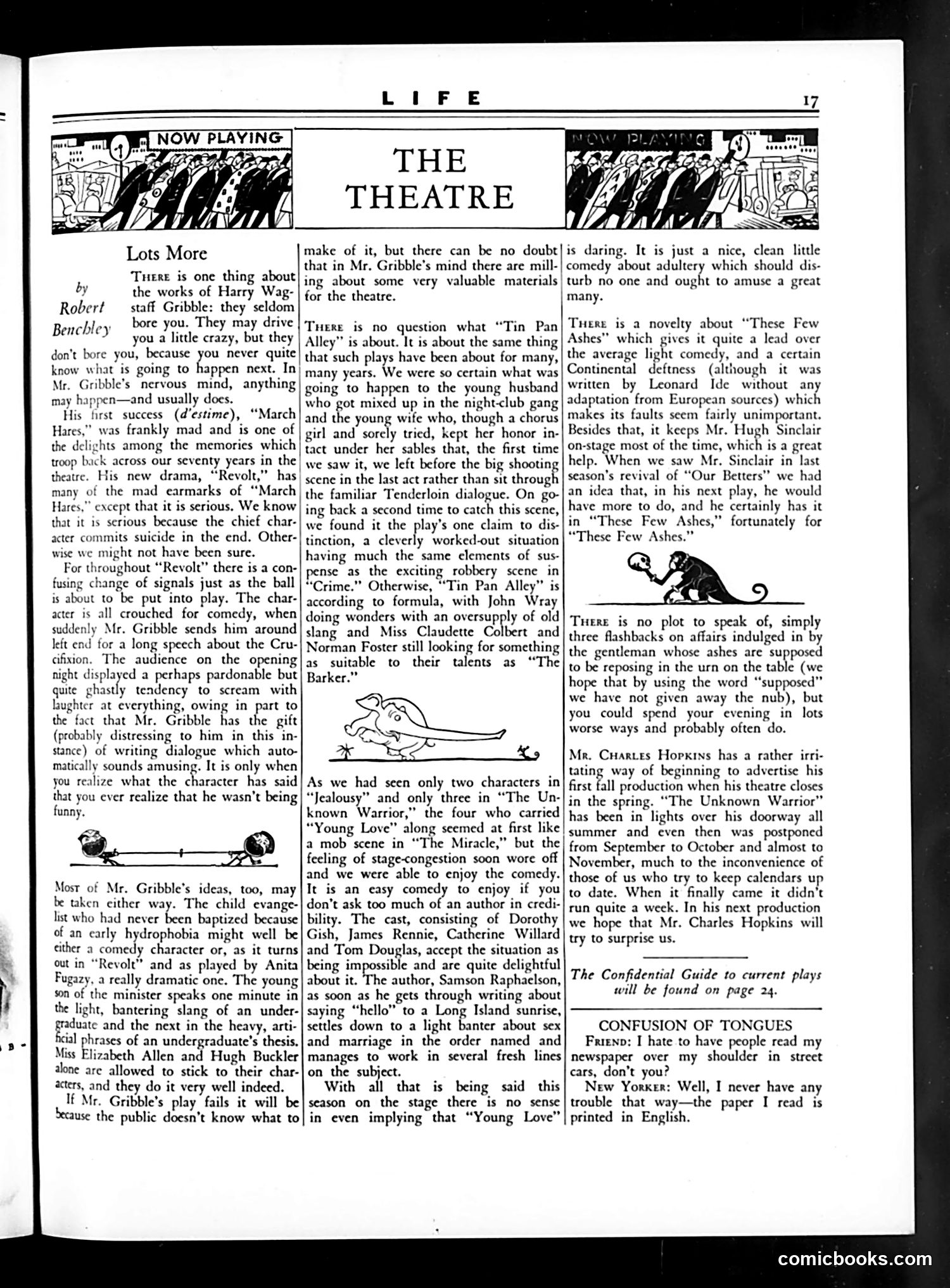
This page reviews several Broadway productions. The main text discusses Robert Benchley's critique of Harry Wagstaff Gribble's play "Revolt," which features a suicide scene and employs dark comedy. Benchley notes Gribble's tendency toward morbid subjects. The page also reviews "Tin Pan Alley," "These Few Ashes," and mentions Charles Hopkins's production of "The Unknown Warrior." The small cartoons appear to be decorative theatrical illustrations rather than political commentary. The "Confusion of Tongues" letter at bottom humorously complains about reading newspapers over someone's shoulder in the street—a relatable social annoyance. This is primarily entertainment criticism rather than political satire.
📄 Transcribed text from this page (OCR, searchable)
Machine-transcribed from the original scan — historical spelling and the odd misread are preserved.
Mace Oca la Lots More Tuere is one thing about the works of Harry Wag- staff Gribble: they seldom bore you. They may drive you a little crazy, but they don’t bore you, because you never quite know what is going to happen next. In Mr. Gribble’s nervous mind, anything may happen—and usually does. His first’ success (d’estime), “March Hares,” was frankly mad and is one of the delights among the memories which troop back across our seventy years in the} theatre. His new drama, “Revolt,” has many of the mad earmarks of “March Hares,” except that it is serious. We know that it is serious because the chief char- acter commits suicide in the end. Other- wise we might not have been sure. For throughout “Revolt” there is a con- fusing change of signals just as the ball is about to be put into play. The char- acter is all crouched for comedy, when y Mr. Gribble sends him around left end for a long speech about the Cru- cifixion, The audience on the opening by Robert Benchley night displayed a perhaps pardonable but quite ghastly tendency to scream with laughter at everything, owing in part to the fact that Mr. Gribble has the gift (probably distressing to him in this in- stance) of writing dialogue which auto- matically sounds amusing. It is only when you realize what the character has said that you ever realize that he wasn’t being funny. ‘dy ©) Most of Mr. Gribble’s ideas, too, may be taken either way. The child evange- list who had never been baptized because of an carly hydrophobia might well be cither a comedy character or, as it turns out in “Revolt” and as played by Anita Fugazy, a really dramatic one. The young son of the minister speaks one minute in the light, bantering slang of an under- graduate and the next in the heavy, arti- ficial phrases of an undergraduate’s thesis. Miss Elizabeth Allen and Hugh Buckler alone are allowed to stick to their char- acters, and they do it very well indeed. If Mr. Gribble’s play fails it will be because the public doesn’t know what to THE THEATRE make of it, but there can be no doubt that in Mr. Gribble’s mind there are mill- ing about some very valuable materials for the theatre. There is no question what “Tin Pan Alley” is about. It is about the same thing that such plays have been about for many, many years. We were so certain what was going to happen to the young husband who got mixed up in the night-club gang and the young wife who, though a chorus girl and sorely tried, kept her honor in- tact under her sables that, the first time we saw it, we left before the big shootin; scene in the last act rather than sit through | the familiar Tenderloin dialogue. On go- ing back a second time to catch this scene, we found it the play's one claim to dis- tinction, a cleverly worked-out situation having much the same clements of sus- pense as the exciting robbery scene in “Crime.” Otherwise, “Tin Pan Alley” is according to formula, with John Wray doing wonders with an oversupply of old slang and Miss Claudette Colbert and Norman Foster still looking for something as suitable to their talents as “The Barker.” EN es. As we had seen only two characters in “Jealousy” and only three in “The Un- known Warrior,” the four who carried “Young Love” along seemed at first like a mob scene in “The Miracle,” but the feeling of stage-congestion soon wore off and we were able to enjoy the comedy. It is an easy comedy to enjoy if you don’t ask too much of an author in credi- bility. The cast, consisting of Doroth Gish, James Rennie, Catherine Willard and Tom Douglas, accept the situation as being impossible and are quite delightful about it. The author, Samson Raphaelson, as soon as he gets through writing about saying “hello” to a Long Island sunrise, settles down to a light banter about sex and marriage in the order named and manages to work in several fresh lines on the subject. With all that is being said this season on the stage there is no sense in even implying that “Young Love” is daring. It is just a nice, clean little comedy about adultery which should dis- turb no one and ought to amuse a great many. Tuere is a novelty about “These Few Ashes” which gives it quite a lead over the average light comedy, and a certain Continental deftness (although it was written by Leonard Ide without any adaptation from European sources) which makes its faults seem fairly unimportant. Besides that, it keeps Mr. Hugh Sinclair on-stage most of the time, which is a great help. When we saw Mr. Sinclair in last season's revival of “Our Betters” we had an idea that, in his next play, he would have more to do, and he certainly has it in “These Few Ashes,” fortunately for “These Few Ashes.” Tuere is no plot to speak of, simply three flashbacks on affairs indulged in by the gentleman whose ashes are supposed to be reposing in the urn on the table (we hope that by using the word “supposed” we have not given away the nub), but you could spend your evening in lots worse ways and probably often do. Mr. Cuarces Hopkins has a rather irri- tating way of beginning to advertise his first fall production when his theatre closes in the spring. “The Unknown Warrior” has been in lights over his doorway all |summer and even then was postponed from September to October and almost to November, much to the inconvenience of those of us who try to keep calendars up to date. When it finally came it didn’t run quite a week. In his next production 'Y | we hope that Mr. Charles Hopkins will try to surprise us. The Confidential Guide to current plays will be found on page 24. CONFUSION OF TONGUES Frienp: I hate to have people read my newspaper over my shoulder in street cars, don’t you? New Yorker: Well, I never have any trouble that way—the paper I read is printed in English. comicbooks.com