
Life, 1928-11-23 · page 10 of 36
Life — November 23, 1928 — page 10: what you’re looking at
What you’re looking at
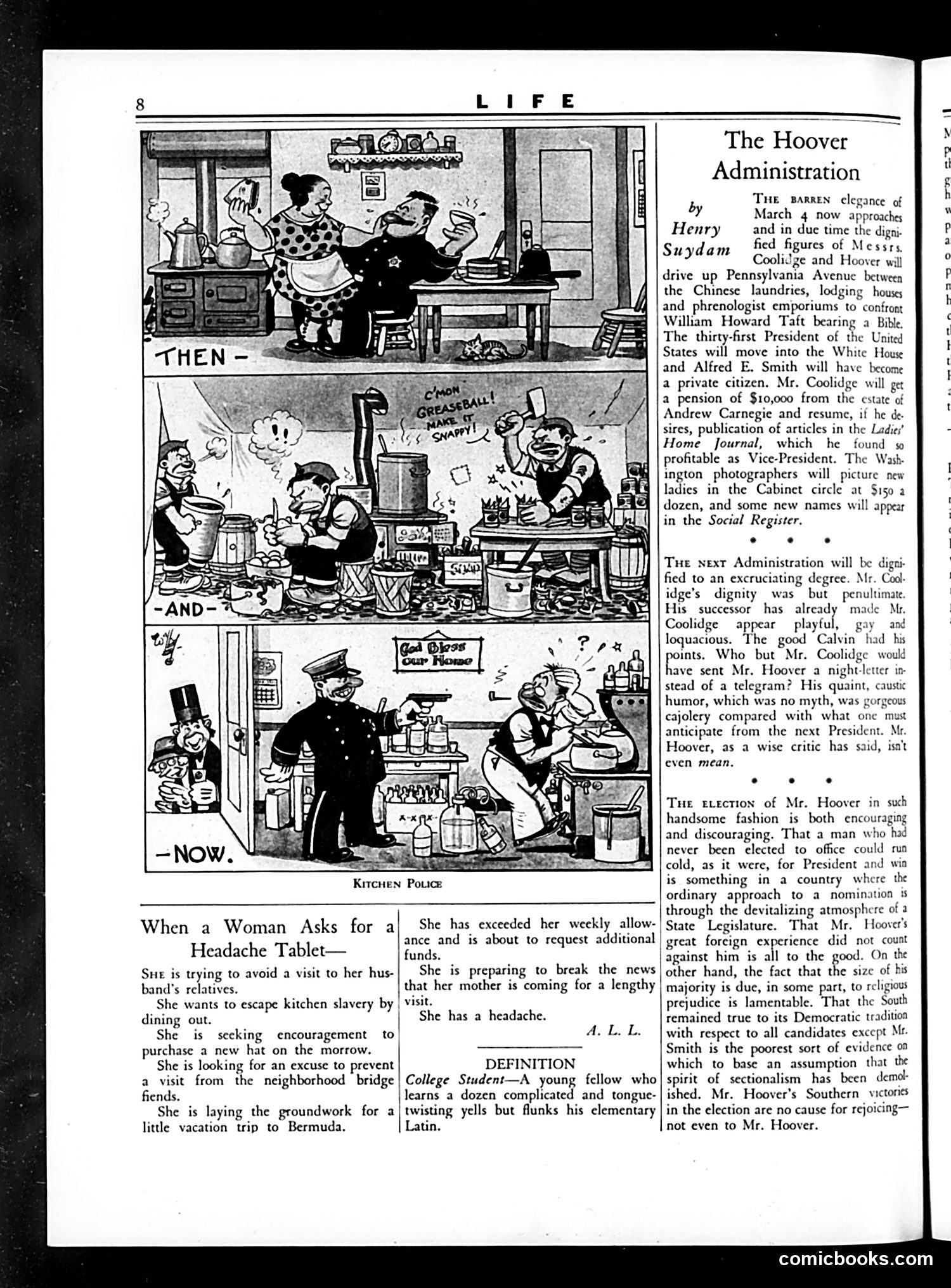
This three-panel cartoon by Henry Suydam satirizes the transition to Herbert Hoover's presidency. The panels show a kitchen's transformation "THEN—AND—NOW," depicting escalating chaos among domestic workers and kitchen staff. The satire mocks the contrast between the outgoing Coolidge administration (orderly) and the incoming Hoover administration (chaotic). The "Kitchen Police" title suggests governmental disorder. The accompanying text critiques Hoover's election, noting the South's reluctant support despite his foreign policy experience. It characterizes Hoover as "playful, gay and boisterous," contrasting him with Coolidge, whose "quaint, caustic humor" was deemed superior. The overall message: Hoover's arrival brings confusion and disarray to established governmental operations.
📄 Transcribed text from this page (OCR, searchable)
Machine-transcribed from the original scan — historical spelling and the odd misread are preserved.
Kitcuen Pouce When a Woman Asks for a Headache Tablet— Sue is trying to avoid a visit to her hus- band’s relatives. She wants to escape kitchen slavery by dining out. She is seeking encouragement purchase a new hat on the morrow. She is looking for an excuse to prevent to a visit from the neighborhood bridge | fiends. She is laying the groundwork for a little vacation trip to Bermuda. She has exceeded her weekly allow- ance and is about to request additional funds. She is preparing to break the news that her mother is coming for a lengthy visit. She has a headache. A. L. L. DEFINITION College Student—A young fellow who learns a dozen complicated and tongue- twisting yells but flunks his elementary Latin. The Hoover Administration THE BARREN elegance of March 4 now approaches and in due time the digni. fied figures of Messrs, Coolidge and Hoover will drive up Pennsylvania Avenue between the Chinese laundries, lodging houses and phrenologist emporiums to confront William Howard Taft bearing a Bibl. The thirty-first President of the United States will move into the White House and Alfred E. Smith will have become a private citizen. Mr. Coolidge will ger a pension of $10,000 from the estate of Andrew Carnegie and resume, if he de- sires, publication of articles in the Ladies’ Home Journal, which he found profitable as Vice-President. The Wash. ington photographers will picture new ladies in the Cabinet circle at $150 a dozen, and some new names will appear in the Social Register. by Henry Suydam Tue next Administration will be digni- fied to an excruciating degree. Mr. Cool- idge’s dignity was but penultimate. His successor has already made Mr. Coolidge appear playful, gay and loquacious. The good Calvin had his ints. Who but Mr. Coolidge would have sent Mr. Hoover a night-letter in- stead of a telegram? His quaint, caustic humor, which was no myth, was gorgeous cajolery compared with what one must anticipate from the next President. Mr. Hoover, as a wise critic has said, isn’t even mean, Tue Evection of Mr. Hoover in such handsome fashion is both encouraging and discouraging. That a man who had never been elected to office could rua cold, as it were, for President and win is something in a country where the ordinary approach to a nomination is through the devitalizing atmosphere of a | State Legislature. That Mr. Hoover's | great foreign experience did not count | against him is all to the good. On the other hand, the fact that the size of his majority is due, in some part, to religious prejudice is lamentable. That the South remained true to its Democratic traditioa with respect to all candidates except Mr. Smith is the poorest sort of evidence 00 which to base an assumption that the spirit of sectionalism has been demol- ished. Mr. Hoover's Southern victories in the election are no cause for rejoicing— not even to Mr. Hoover. comicbooks.com