
Life, 1928-11-23 · page 24 of 36
Life — November 23, 1928 — page 24: what you’re looking at
What you’re looking at
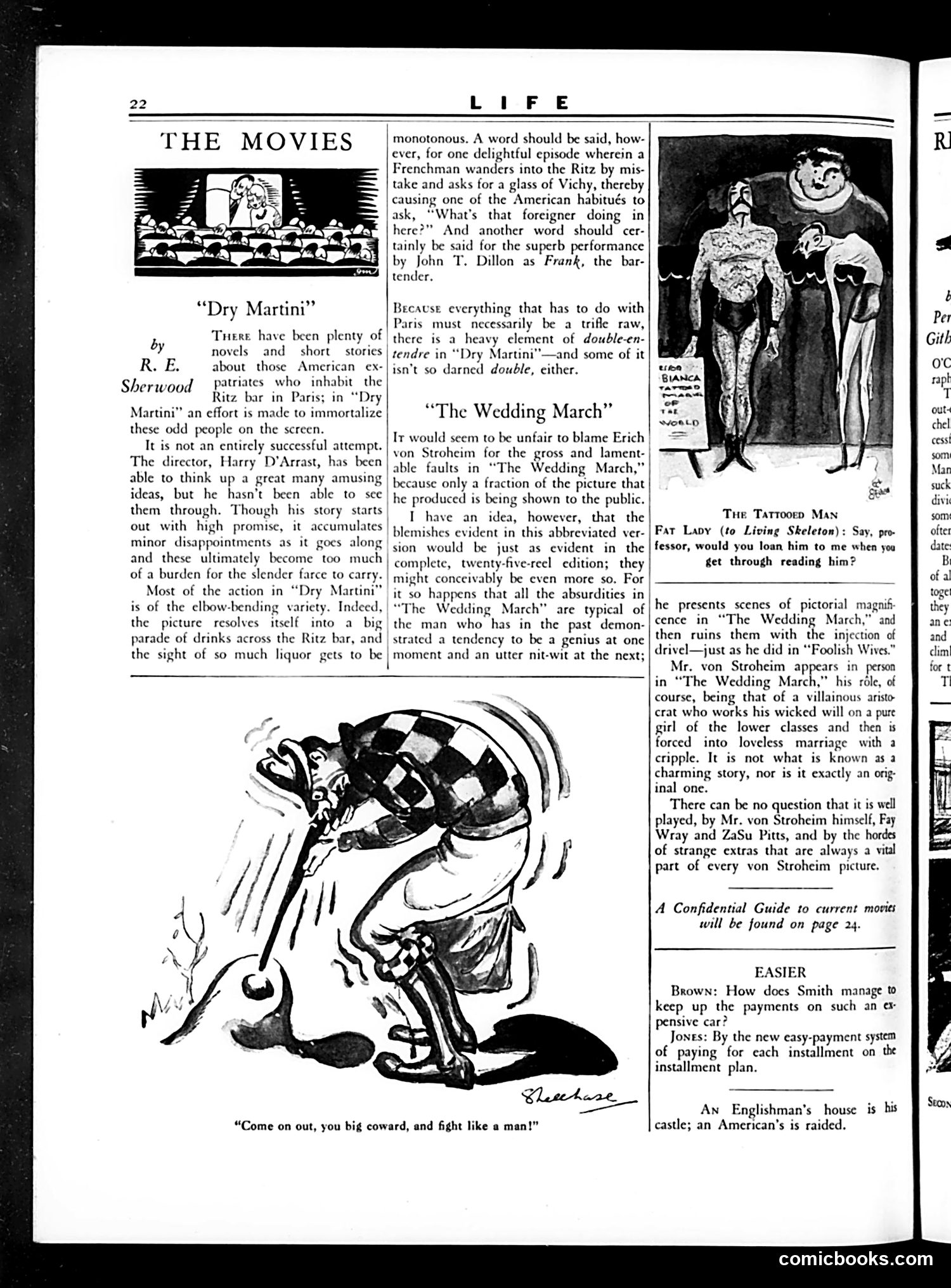
This page reviews two silent films and includes carnival sideshow humor. **"Dry Martini"** is critiqued as a mediocre film about American expatriates drinking at Paris's Ritz bar. The reviewer (R.E. Sherwood) praises one scene where a Frenchman orders Vichy water, causing shock among the American drinkers, and commends actor John T. Dillon's bartender performance. The film relies heavily on double entendres (sexual innuendo). **"The Wedding March"** features director Erich von Stroheim, who plays a villainous aristocrat seducing a poor girl forced into loveless marriage with a cripple. The reviewer criticizes von Stroheim's inconsistency—capable of brilliance but also "utter nit-wit" moments—though praising the performances by von Stroheim, Fay Wray, and ZaSu Pitts. The cartoon shows a tattooed man and "fat lady" (circus freaks), with one joking about "borrowing" the other as reading material—crude sideshow humor typical of the era.
📄 Transcribed text from this page (OCR, searchable)
Machine-transcribed from the original scan — historical spelling and the odd misread are preserved.
22 T H E M oO V I ES | monotonous. A word should be said, how- “Dry Martini” Tuere have been plenty of novels and short stories about those American ex- patriates. who inhabit the Ritz bar in Paris; in “Dry Martini” an effort is made to immortalize these odd people on the screen. It is not an entirely successful attempt. The director, Harry D'Arrast, has been able to think up a great many amusing ideas, but he hasn’t been able to see them through. Though his story starts out with high promise, it accumulates minor disappointments as it goes along and these ultimately become too much of a burden for the slender farce to carry. Most of the action in “Dry Martini” is of the elbow-bending variety. Indeed, the picture resolves itself into a big parade of drinks across the Ritz bar, and by R. E. Sherwood the sight of so much liquor gets to be | FE Lil ever, for one delightful episode wherein a Frenchman wanders into the Ritz by mis- take and asks for a glass of Vichy, thereby | causing one of the American habitués to Jask, “What's that foreigner doing in here?” And another word should cer- tainly be said for the superb performance by John T. Dillon as Frank, the bar- tender, Because everything that has to do with Paris must necessarily be a trifle raw, there is a heavy element of double-en- tendre in “Dry Martini’—and some of it isn’t so darned double, either. “The Wedding March” Ir would seem to be unfair to blame Erich von Stroheim for the gross and lament- |able faults in “The Wedding March,” because only a fraction of the picture that he produced is being shown to the public. I have an idea, however, that the blemishes evident in this abbreviated ver- sion would be just as evident in the complete, twenty-five-reel edition; they might conceivably be even more so. For it so happens that all the absurdities in | he Wedding March” are typical of the man who has in the past demon- strated a tendency to be a genius at one moment and an utter nit-wit at the next; “Come on out, you big coward, and fight like a man!” Tue Tatrooep Man Fat Lavy (to Living Skeleton): Say, pro- fessor, would you loan him to me when you get through reading him? he presents scenes of pictorial magnif- cence in “The Wedding March,” and then ruins them with the injection of drivel—just as he did in “Foolish Wives.” Mr. von Stroheim appears in person in “The Wedding March,” his role, of course, being that of a villainous aristo crat who works his wicked will on a pure girl of the lower classes and then is forced into loveless marriage with a cripple. It is not what is known as a charming story, nor is it exactly an orig- inal one. There can be no question that it is well played, by Mr. von Stroheim himself, Fay Wray and ZaSu Pitts, and by the hordes of strange extras that are always a vital part of every von Stroheim picture. A Confidential Guide to current movies will be found on page 24. EASIER Brown: How does Smith manage to keep up the payments on such an e pensive car? Jones: By the new easy-payment system of paying for each installment on installment plan. An Englishman's house is his castle; an American’s is raided. Stam comicbooks.com