
A complete issue · 42 pages · 1928
Life — March 1, 1928
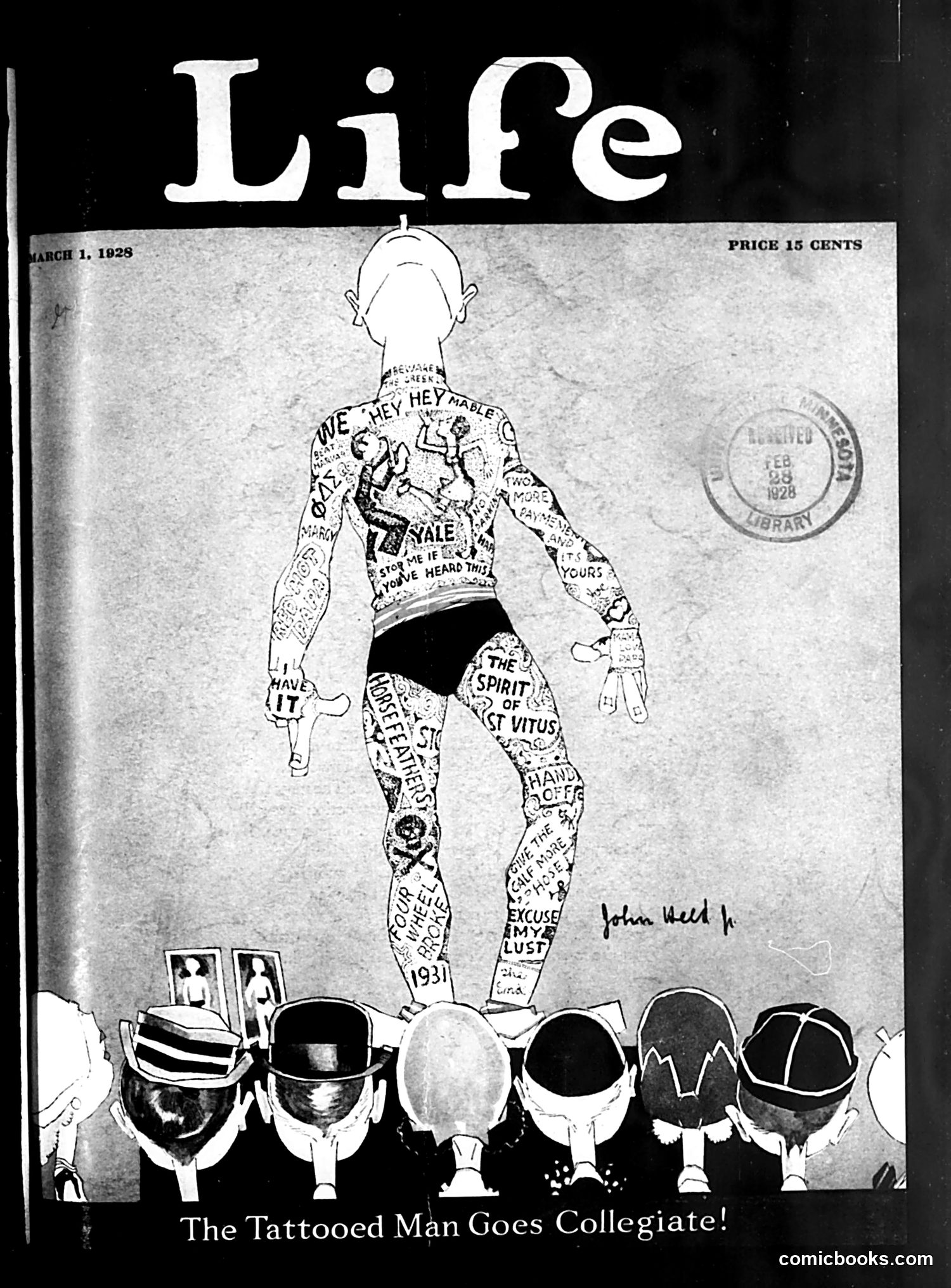
This satirical cover depicts a human figure completely covered in tattoos of college slang, songs, and catchphrases popular among 1920s students ("Hey Hey," "Yale," "Spirit of St. Vitus," "Lust"). The figure stands above a row of six onlookers wearing various hats and formal attire, gazing upward. The satire mocks collegiate culture and the superficiality of 1920s youth — suggesting college students were merely absorbing fashionable phrases and attitudes rather than genuine education. The "tattooed man" represents how college identity had become superficial decoration. The onlookers' varied headwear likely represents different social types observing this spectacle of youth culture. This reflects broader 1920s generational anxieties about modern youth's values and frivolousness.
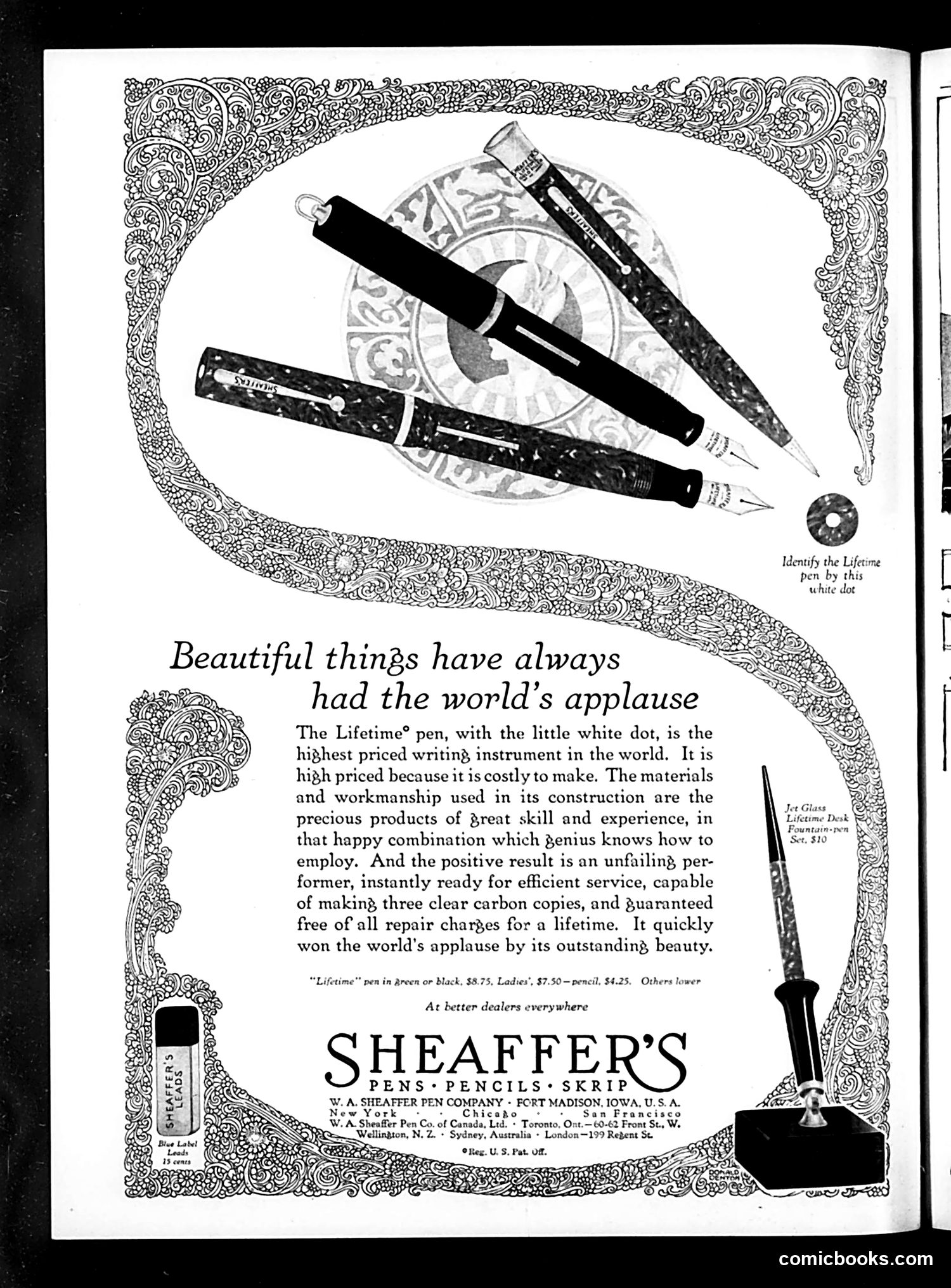
This page is **primarily an advertisement**, not political satire. It's a Sheaffer pen company ad from Life magazine promoting their "Lifetime" fountain pen model. The ad uses the tagline "Beautiful things have always had the world's applause" to market luxury writing instruments. The copy emphasizes the pen's high price, quality materials, skilled craftsmanship, and lifetime guarantee (free repairs). It claims the pen can make three carbon copies and is "instantly ready for efficient service." The decorative ornamental border and elegant presentation reflect early 20th-century advertising aesthetics targeting affluent consumers. There is **no political cartoon or satire present** — this is straightforward luxury goods marketing designed to appeal to professional and wealthy buyers.
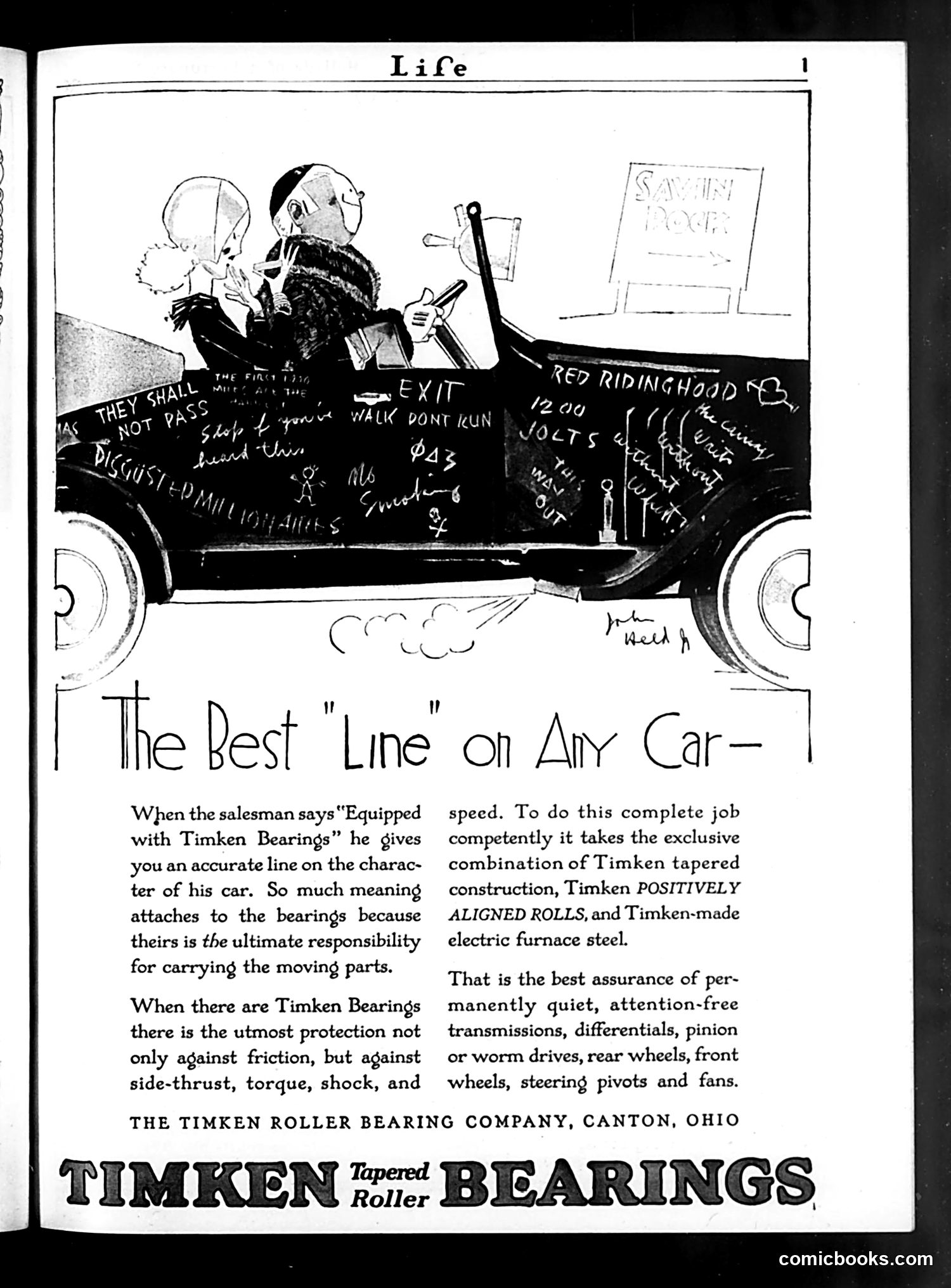
This page is primarily **advertising for Timken Tapered Roller Bearings**, not political satire. The cartoon depicts two figures in a car covered with handwritten notes and graffiti—likely representing the accumulated "wear and tear" or accumulated claims about a vehicle's performance. The figures appear to be a salesman pitching the car to a potential buyer. The advertisement's "joke" is that Timken Bearings provide "the best line on any car"—a pun on "line" meaning both sales pitch and mechanical component. The satire gently mocks car salesmen's exaggerated claims, suggesting that with proper Timken bearings, a vehicle will perform reliably rather than requiring constant excuses. This reflects 1920s-era consumer advertising humor targeting automotive buyers skeptical of sales tactics.
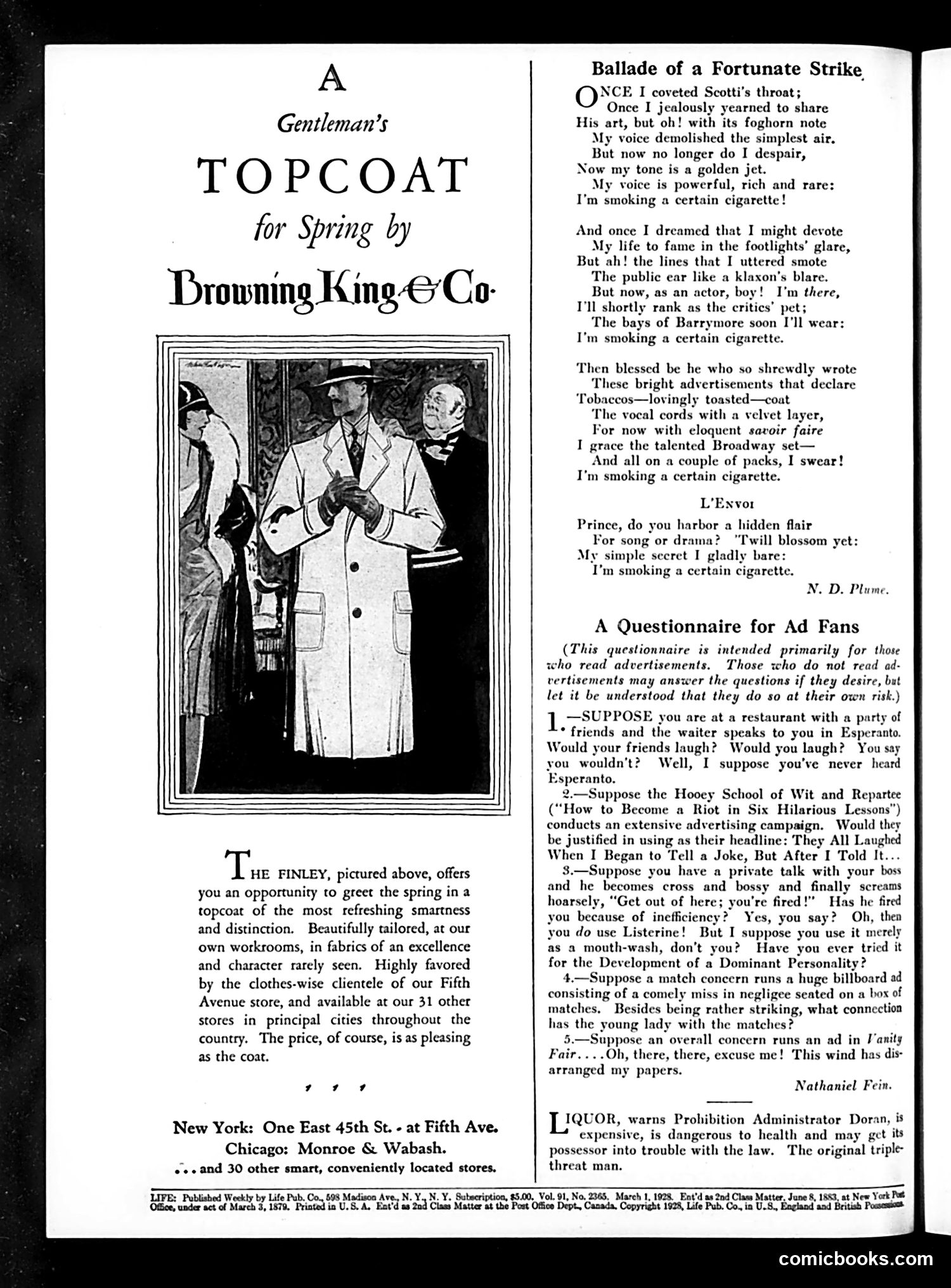
This page is primarily **advertising for Browning King & Co.'s topcoat**, featuring an illustration of three men in 1920s attire examining a light-colored coat. The accompanying content includes: 1. **"Ballade of a Fortunate Strike"** — a satirical poem by N.D. Plume celebrating cigarette smoking, with repeated refrain "I'm smoking a certain cigarette." The poem mocks theatrical ambition and social climbing through tobacco use—likely satire on cigarette advertising's exaggerated claims about enhancing one's status and talents. 2. **"A Questionnaire for Ad Fans"** — humorous hypothetical scenarios questioning advertising claims' truthfulness (Esperanto in restaurants, joke-school advertising, etc.). 3. **A brief note about Prohibition enforcement.** The page satirizes both consumer advertising's manipulative appeals and the era's social pretensions, using humor to critique how ads promised transformation and success.
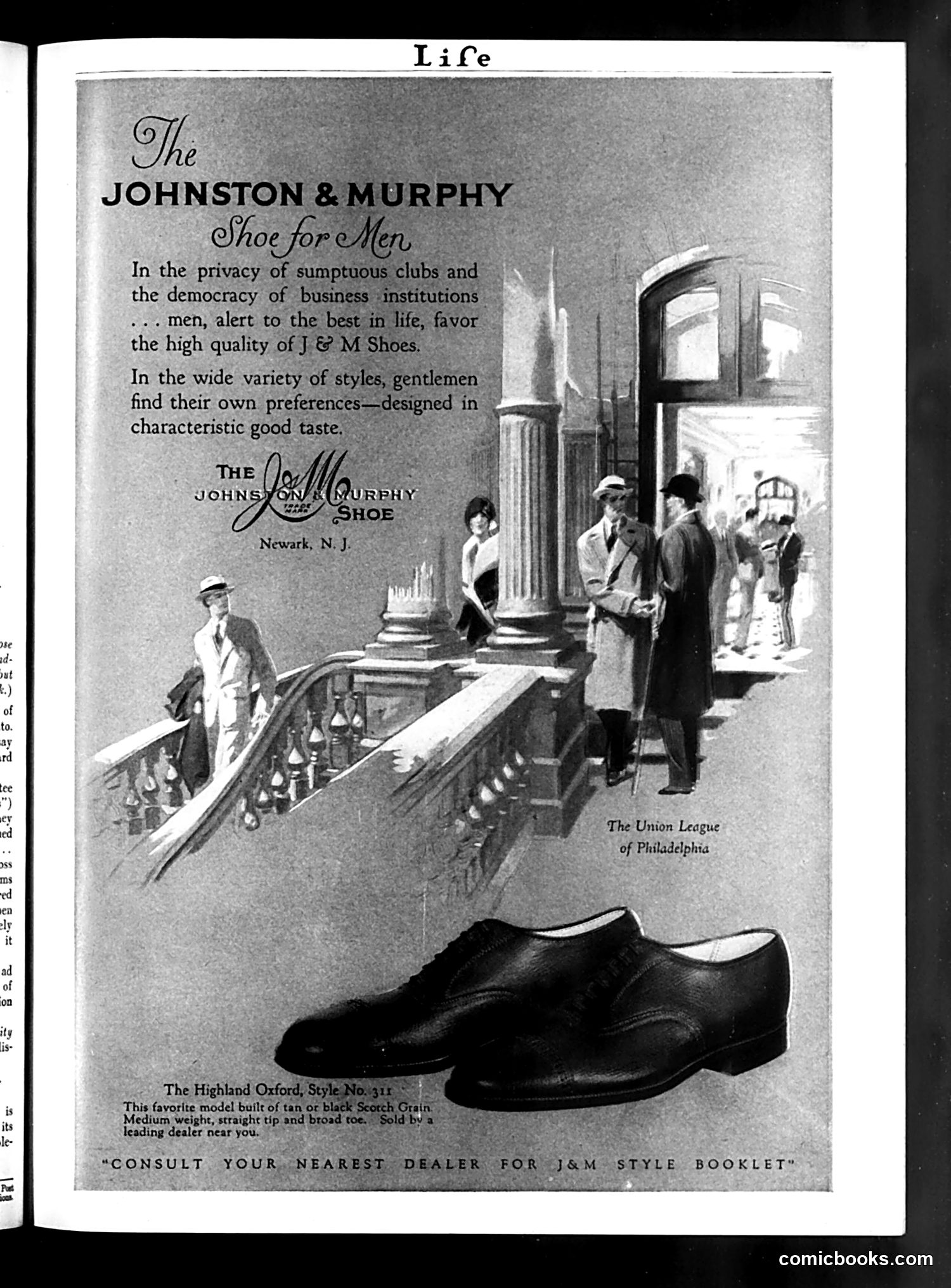
This page is **primarily advertising**, not satire or editorial content. It's a Johnston & Murphy shoe advertisement from their Newark, N.J. factory. The ad uses aspirational marketing typical of the era: the illustration depicts well-dressed businessmen and gentlemen in what appears to be an exclusive club or institutional setting (possibly the Union League of Philadelphia, as labeled). The message promises that J&M shoes are favored by successful, discerning men in both private clubs and democratic business institutions. The featured shoe—"The Highland Oxford, Style No. 311"—is described as built from tan or black Scotch grain leather, emphasizing quality craftsmanship. There is no political satire here; rather, it's a period example of aspirational consumer marketing linking shoe quality to social status and masculine success.
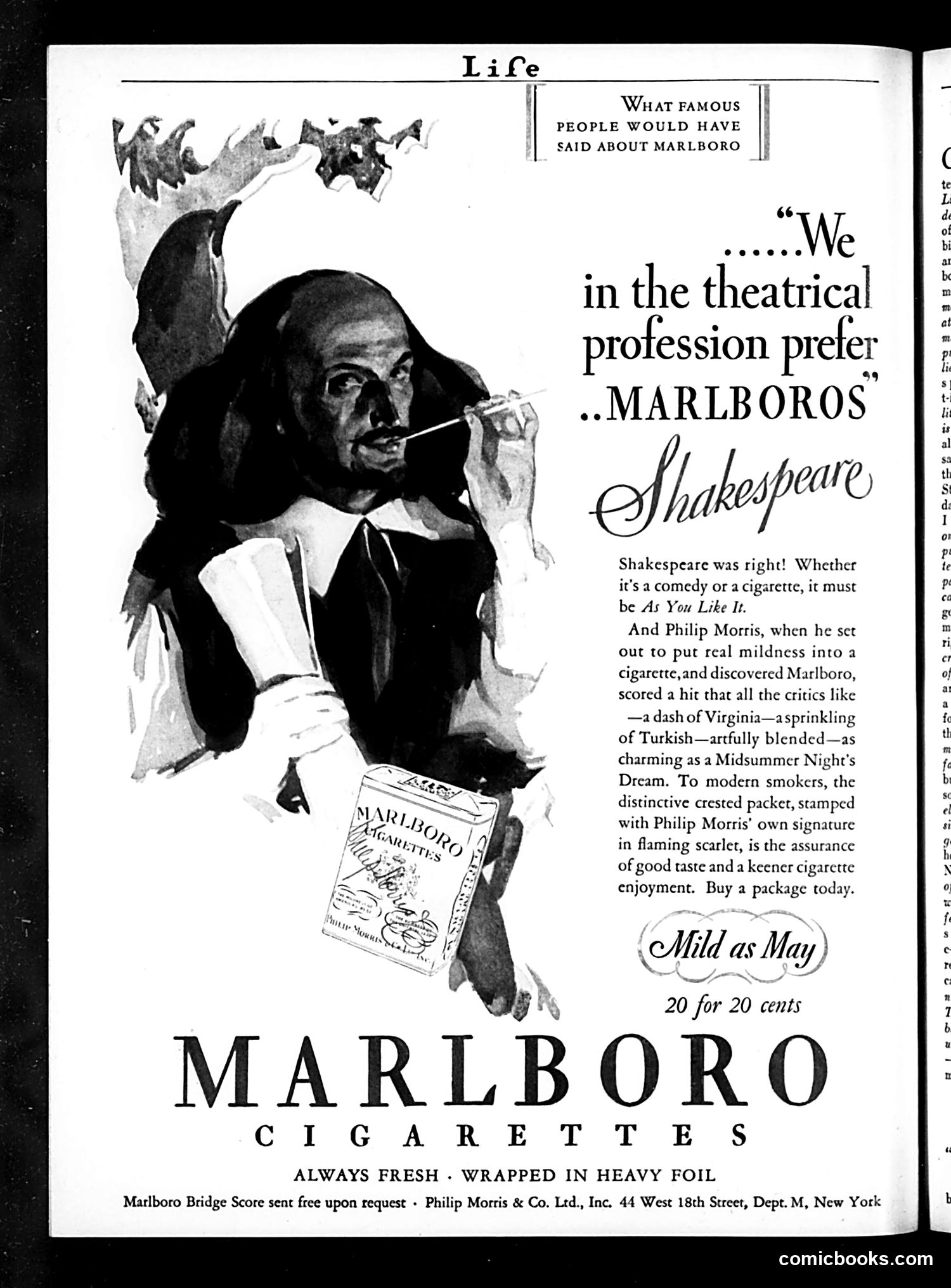
This is primarily a **cigarette advertisement**, not satire. The page features a caricatured figure (appearing to represent a theatrical character or jester) smoking a Marlboro cigarette. The ad employs a marketing strategy common in early-to-mid 20th century advertising: it **attributes credibility through false celebrity endorsement**. The quote attributed to Shakespeare—"We in the theatrical profession prefer Marlboros"—is fabricated. The copy then credits Philip Morris for developing Marlboro's blend, claiming it appeals to sophisticated smokers. The accompanying text presents this as fact rather than advertising, a deceptive practice standard for the era. The price listed ("20 for 20 cents") and slogan "Mild as May" were typical period marketing appeals. This reflects pre-regulation advertising standards, before tobacco health warnings became mandatory.
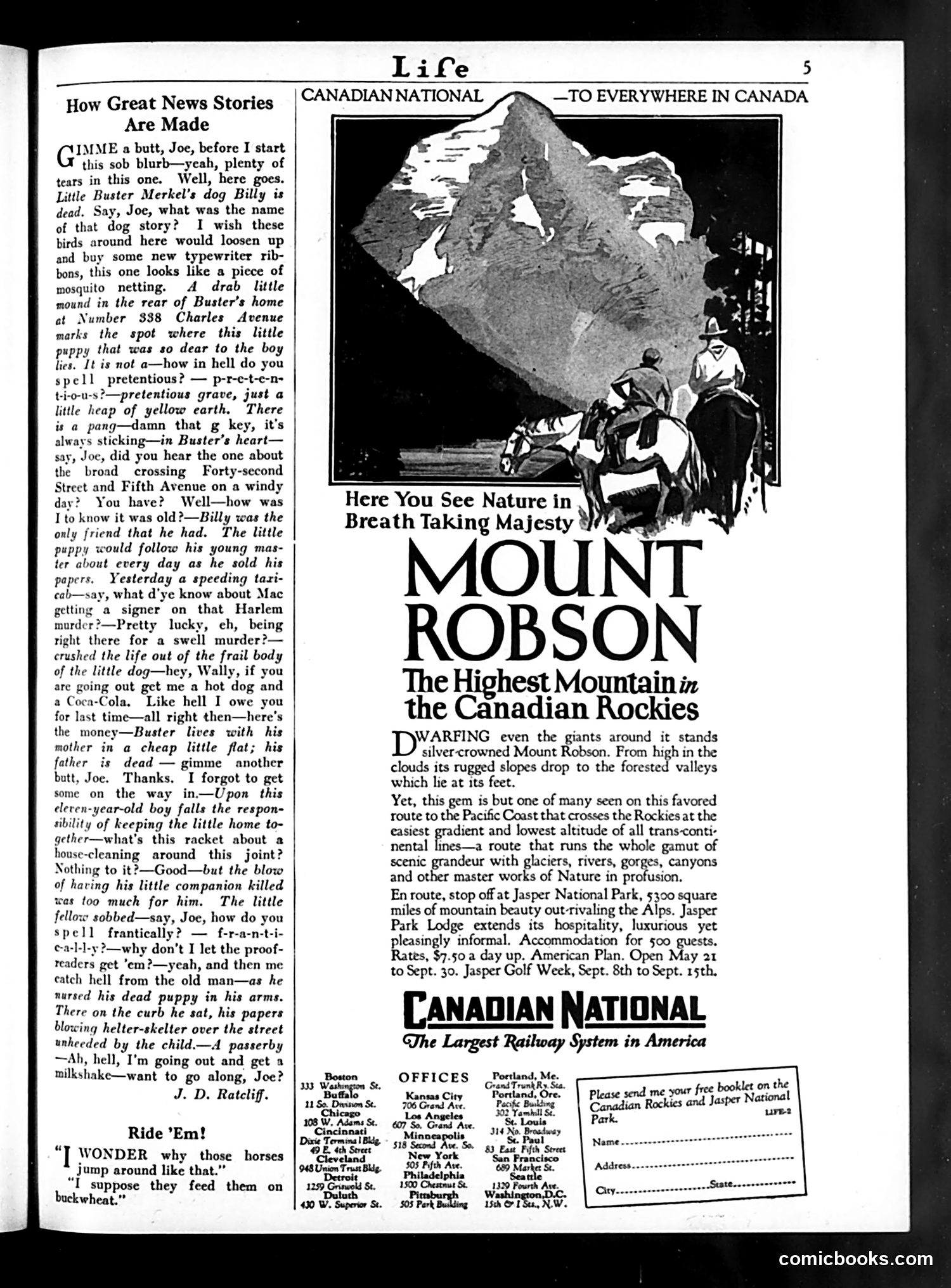
This page contains a humorous article titled "How Great News Stories Are Made" by J.D. Ratcliff, mocking sensationalist journalism. The narrator critiques how reporters exaggerate trivial events—a dog's death becomes a melodramatic human-interest story through embellished details and overwrought language. The satire targets the gap between mundane reality and sensational newspaper coverage, poking fun at journalists who manufacture emotional impact from minor incidents. The remainder of the page is a Canadian National Railway advertisement for Mount Robson, promoting travel to "the Highest Mountain in the Canadian Rockies" via their rail system. A small joke at bottom ("Ride 'Em!") makes a lighthearted comment about horse feeding. The page reflects early-20th-century concerns about yellow journalism and advertising's dominance in magazines.
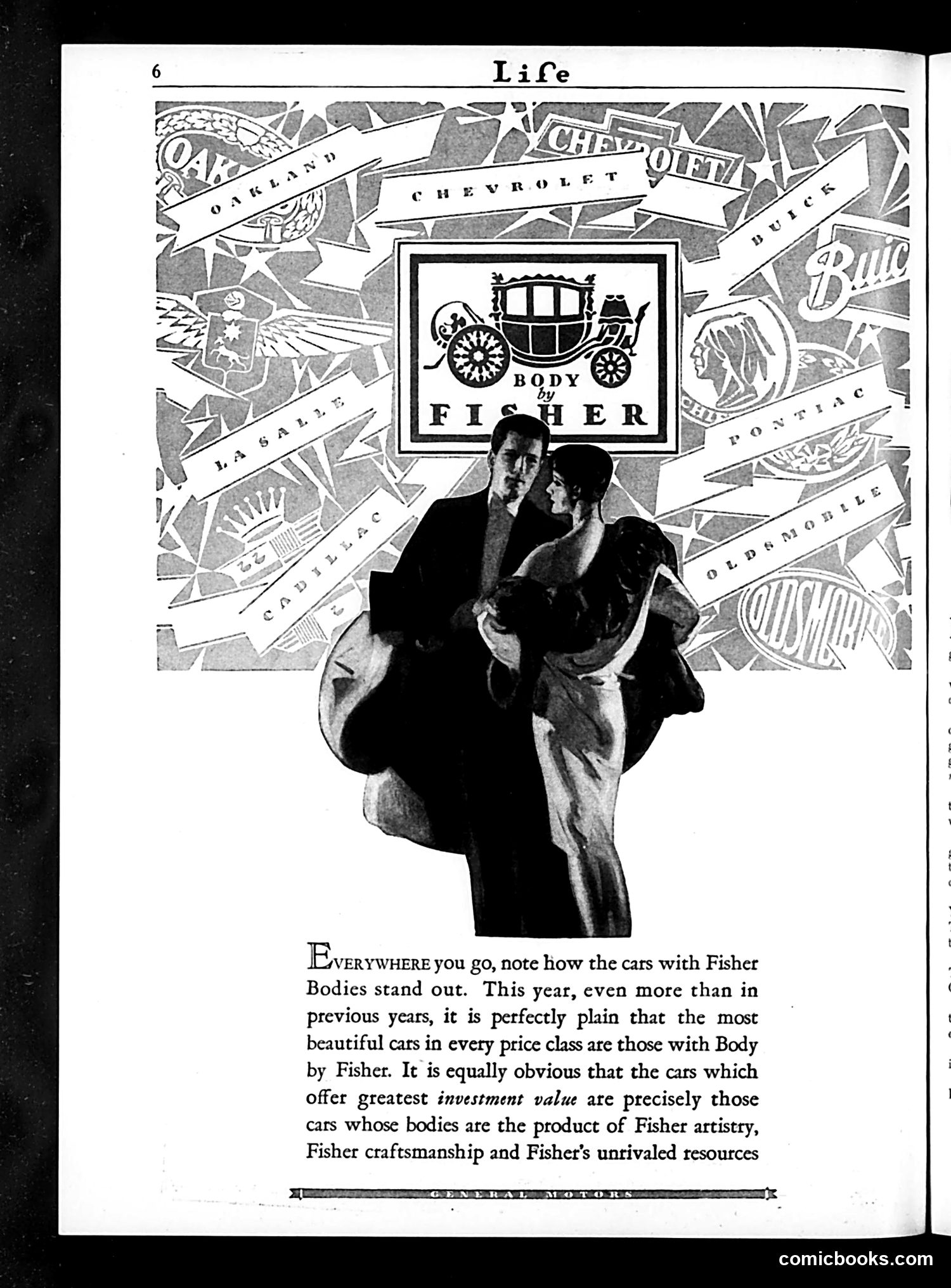
This is primarily an advertisement for Fisher Body automobiles, not political satire. The page features a romantic illustration of a couple, with the man holding a woman, positioned beneath a "Body by Fisher" logo surrounded by competing car brand names (Chevrolet, Buick, Cadillac, Pontiac, Oldsmobile, LaSalle, and others). The ad's text argues that Fisher-bodied cars are the most beautiful and best investment across all price classes, attributing this to "Fisher artistry, Fisher craftsmanship and Fisher's unrivaled resources." This appears to be General Motors advertising highlighting Fisher's reputation as a premium body manufacturer within GM's vehicle lineup during what seems to be the 1920s-1930s era.
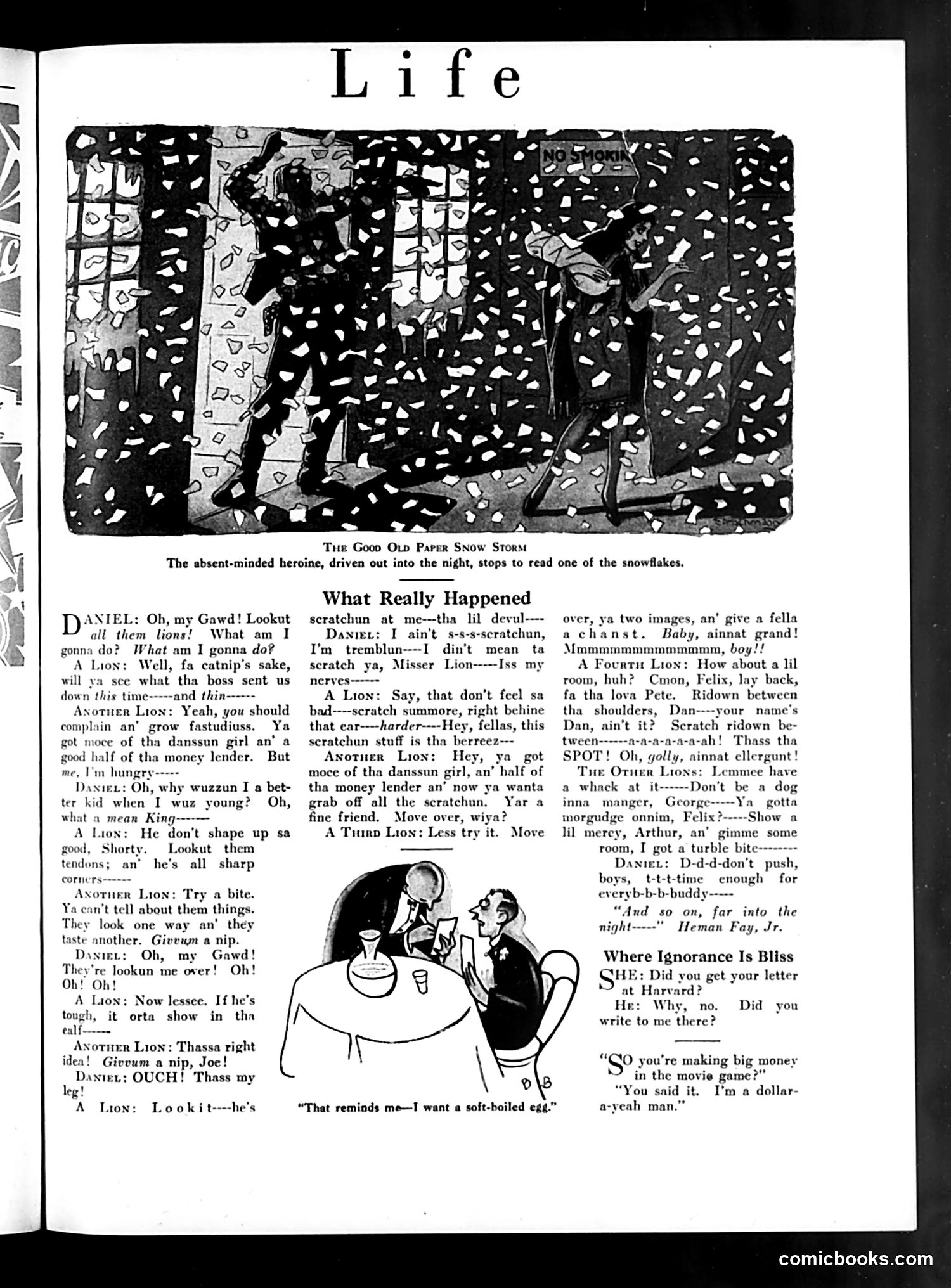
This page contains humor pieces rather than political cartoons. "The Good Old Paper Snow Storm" shows an absent-minded woman reading falling paper scraps during what she mistakes for snow—a visual gag about distraction. "What Really Happened" depicts lions discussing scratches, using dialect humor common to early 20th-century American comedy. The joke appears to rely on humorous mispronunciations and exaggerated speech patterns. The illustration shows two men at a table; one mentions wanting "a soft-boiled egg," likely the setup for a joke about miscommunication or mistaken orders. "Where Ignorance Is Bliss" is a brief exchange about someone not receiving a letter from Harvard, with wordplay about making money in "the movie game." The humor relies on slapstick, dialect comedy, and puns typical of 1920s-era Life magazine content.
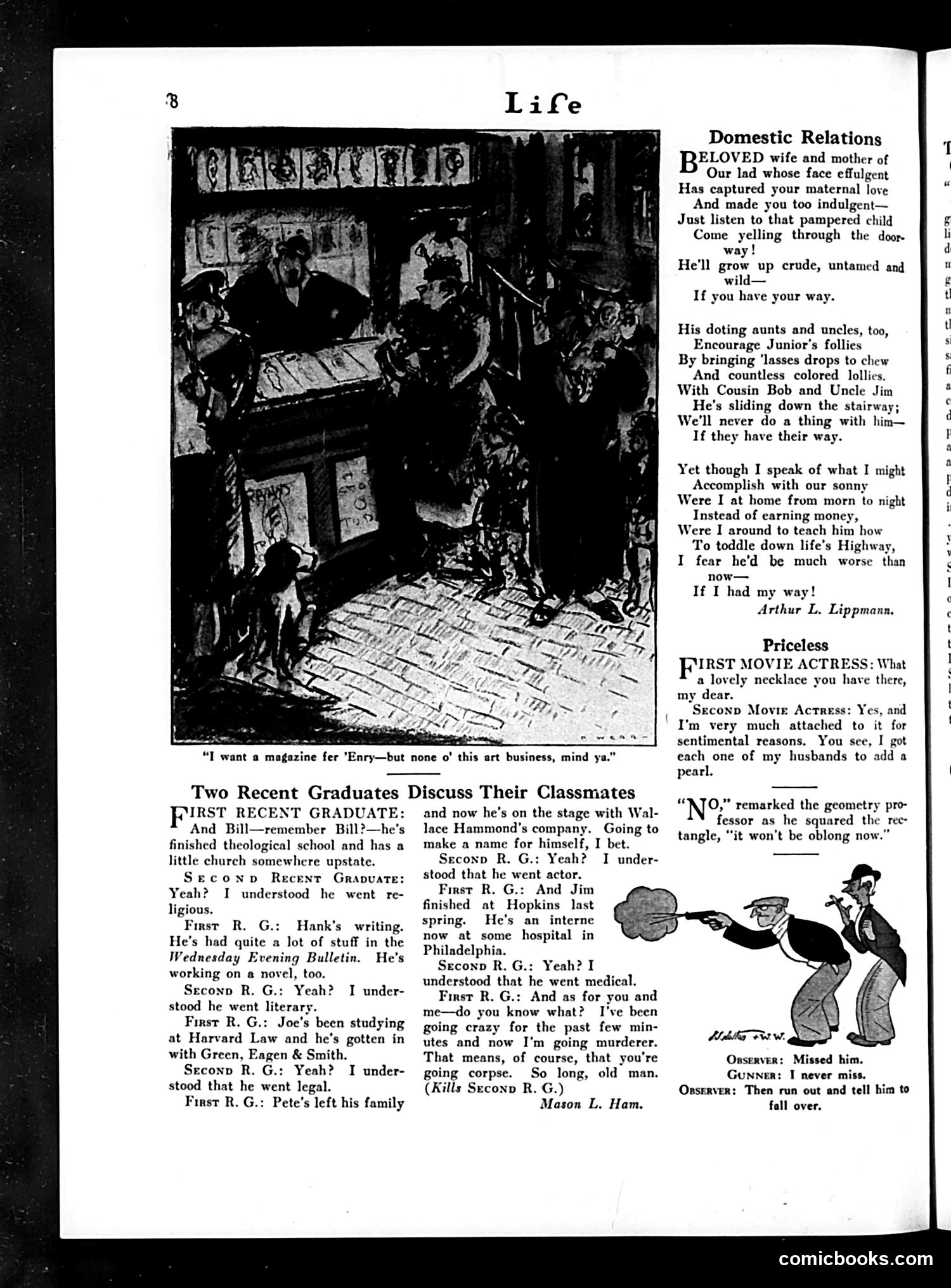
This page contains **satirical humor pieces** rather than political cartoons: 1. **"Domestic Relations"** - A poem by Arthur L. Lippmann critiquing indulgent parenting. It mocks wives who spoil their sons with leniency, contrasting this with the speaker's preference for discipline ("toddle down life's Highway"). 2. **"Two Recent Graduates Discuss Their Classmates"** - A dialogue satirizing what became of seminary and law school graduates. The humor lies in their career outcomes: one became a stage actor, another a hospital intern, another in the legal profession—with the punchline suggesting the speaker is "going murderer" (dark humor about becoming cynical). 3. **"Priceless"** - A brief joke about movie actresses and necklaces, playing on materialism. The cartoons mock early 20th-century social pretensions and changing career paths of educated men.
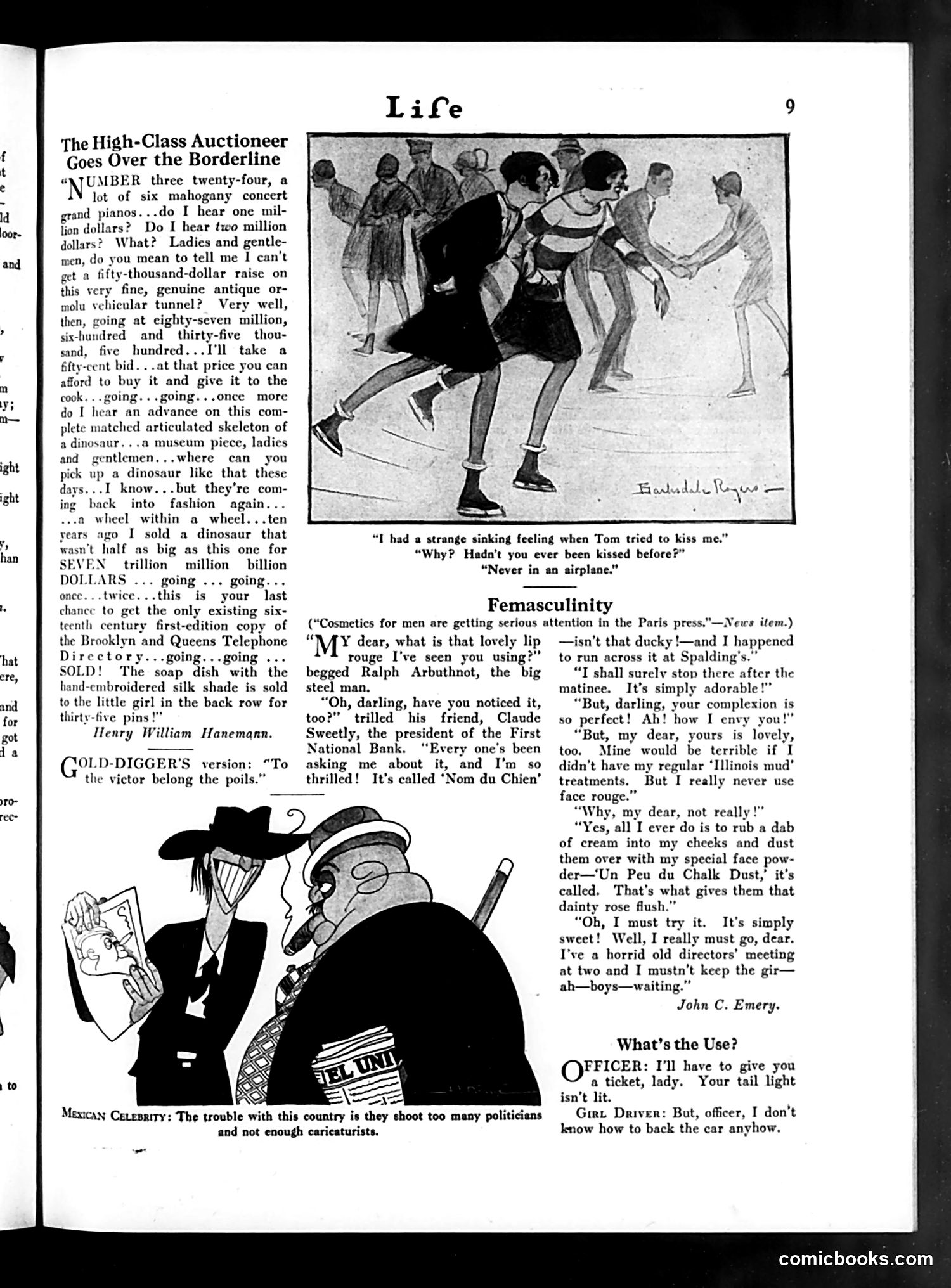
**Top Cartoon:** Shows a woman being kissed by a man while others watch. The caption reads: "I had a strange sinking feeling when Tom tried to kiss me." Responses: "Why? Hadn't you ever been kissed before?" "Never in an airplane." This is a straightforward joke about the novelty and awkwardness of romantic encounters in aircraft—a modern luxury in this era. **Bottom Cartoon:** Labeled "Mexican Celebrity," depicts a man in a sombrero showing another figure a newspaper. The caption states: "The trouble with this country is they shoot too many politicians and not enough caricaturists." This is political satire commenting on Mexican political instability and violence of the period, with dark humor comparing politicians to targets.
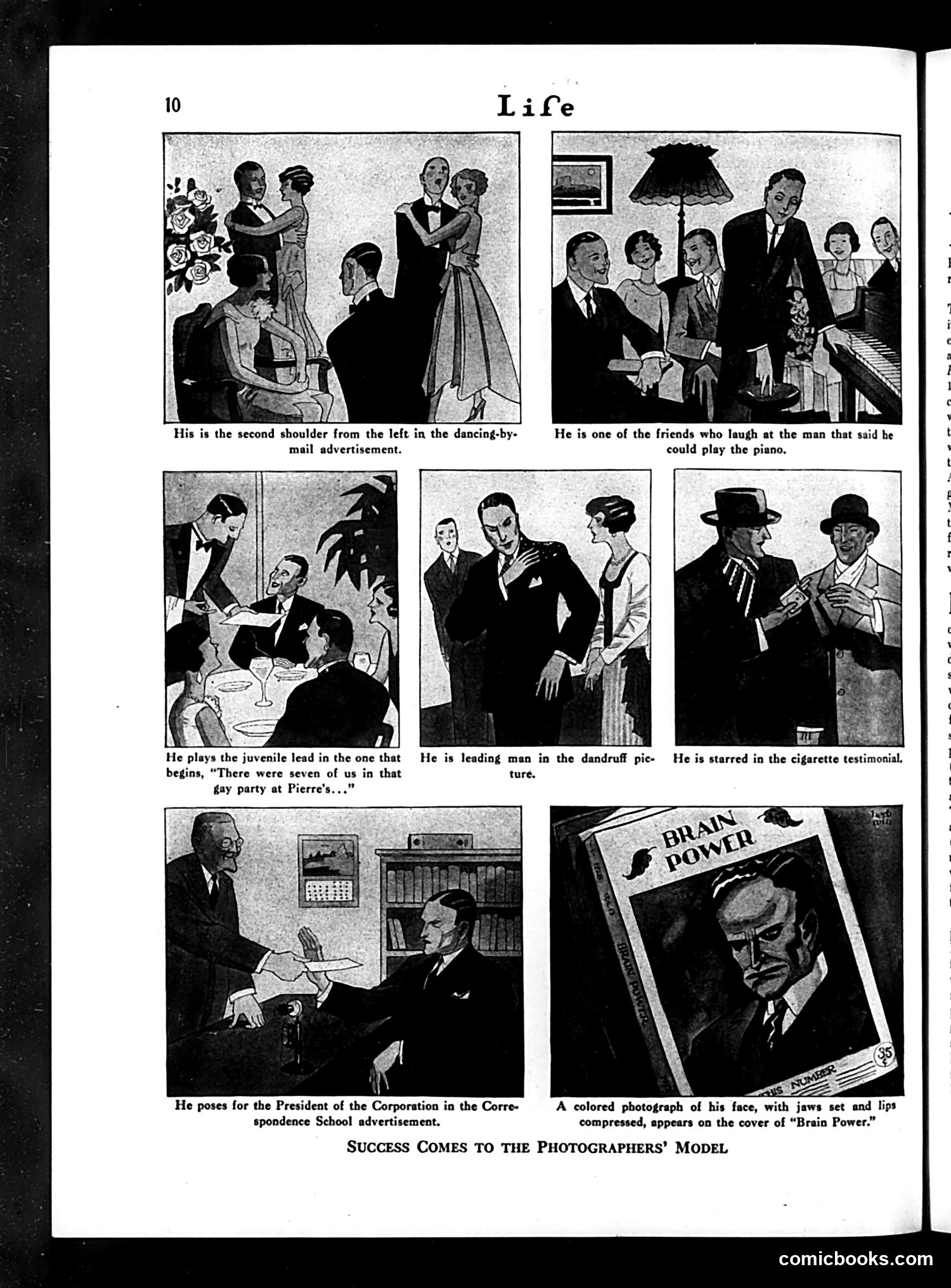
This page documents a successful "photographers' model"—a man who appears in various commercial advertisements and promotional materials. The captions track his career progression through different ad campaigns: a dancing-by-mail advertisement, a piano testimonial, a gay party scene, a dandruff product advertisement, a cigarette endorsement, and a correspondence school advertisement where he poses as a corporate president. The satire mocks the absurdity of advertising culture: the same actor/model portrays wildly different personas (incompetent pianist, sophisticated businessman, etc.) across competing products, yet audiences accept these fabricated endorsements as genuine. The final image—his face on a "Brain Power" book cover—suggests the irony that someone paid to fake credibility in advertisements has become a recognizable "authority." The joke targets both advertising's deceptiveness and consumer gullibility.
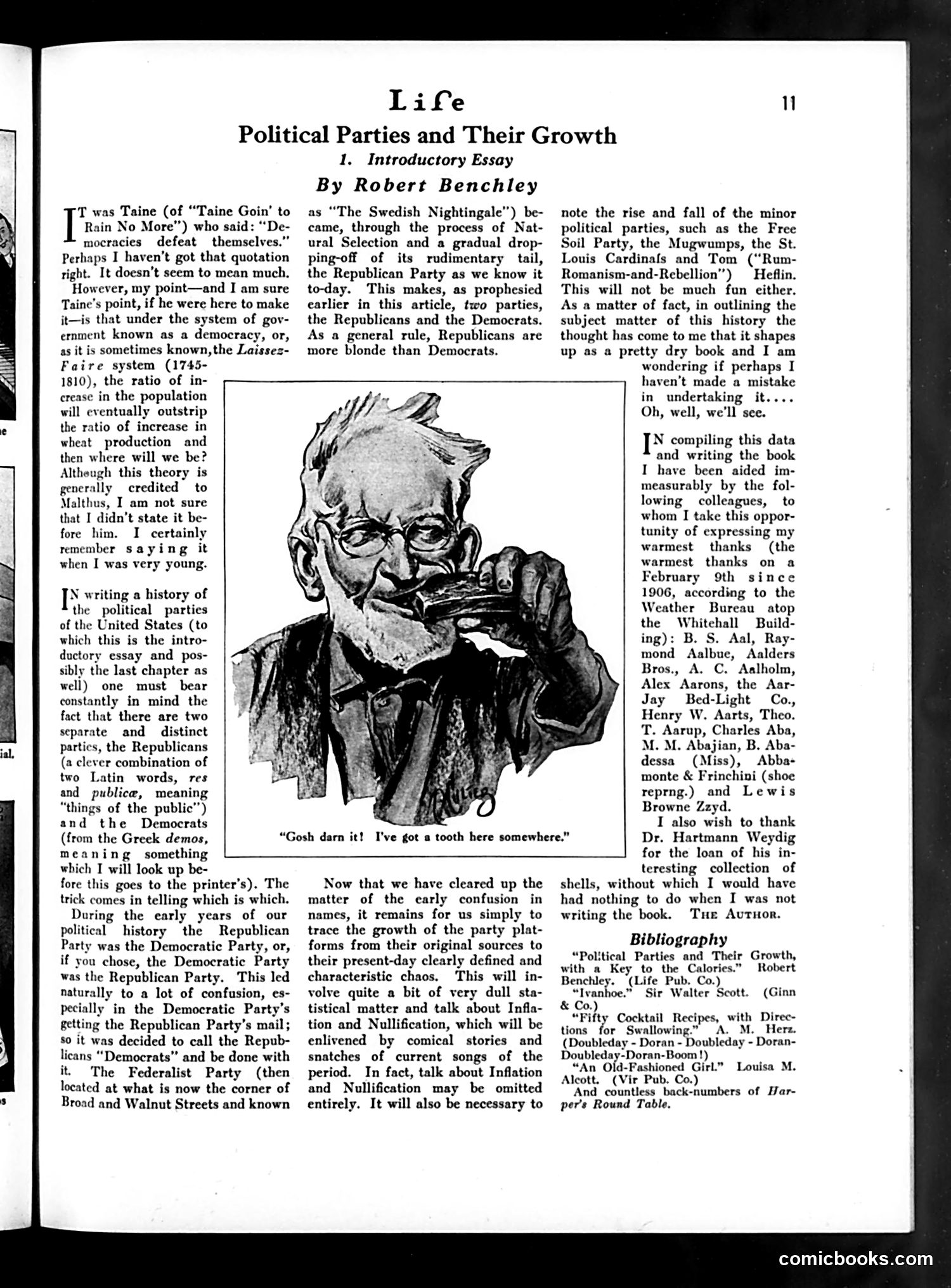
This page introduces Robert Benchley's essay on American political parties. The central cartoon depicts an elderly man with glasses examining his own mouth, captioned "Gosh darn it! I've got a tooth here somewhere." The image appears to be **political satire about aging party systems**—likely representing an elderly Republican or Democratic Party struggling to maintain relevance or find its core principles. The "missing tooth" metaphor suggests the party has lost something essential, or perhaps searches uselessly for identity. Benchley's text discusses how Republicans and Democrats emerged from earlier parties (Federalists, Democratic-Republicans), with Republicans being "more blonde than Democrats"—a curious racial characterization typical of early 20th-century satire. The essay promises to trace these parties' evolution and clarify their distinctions.
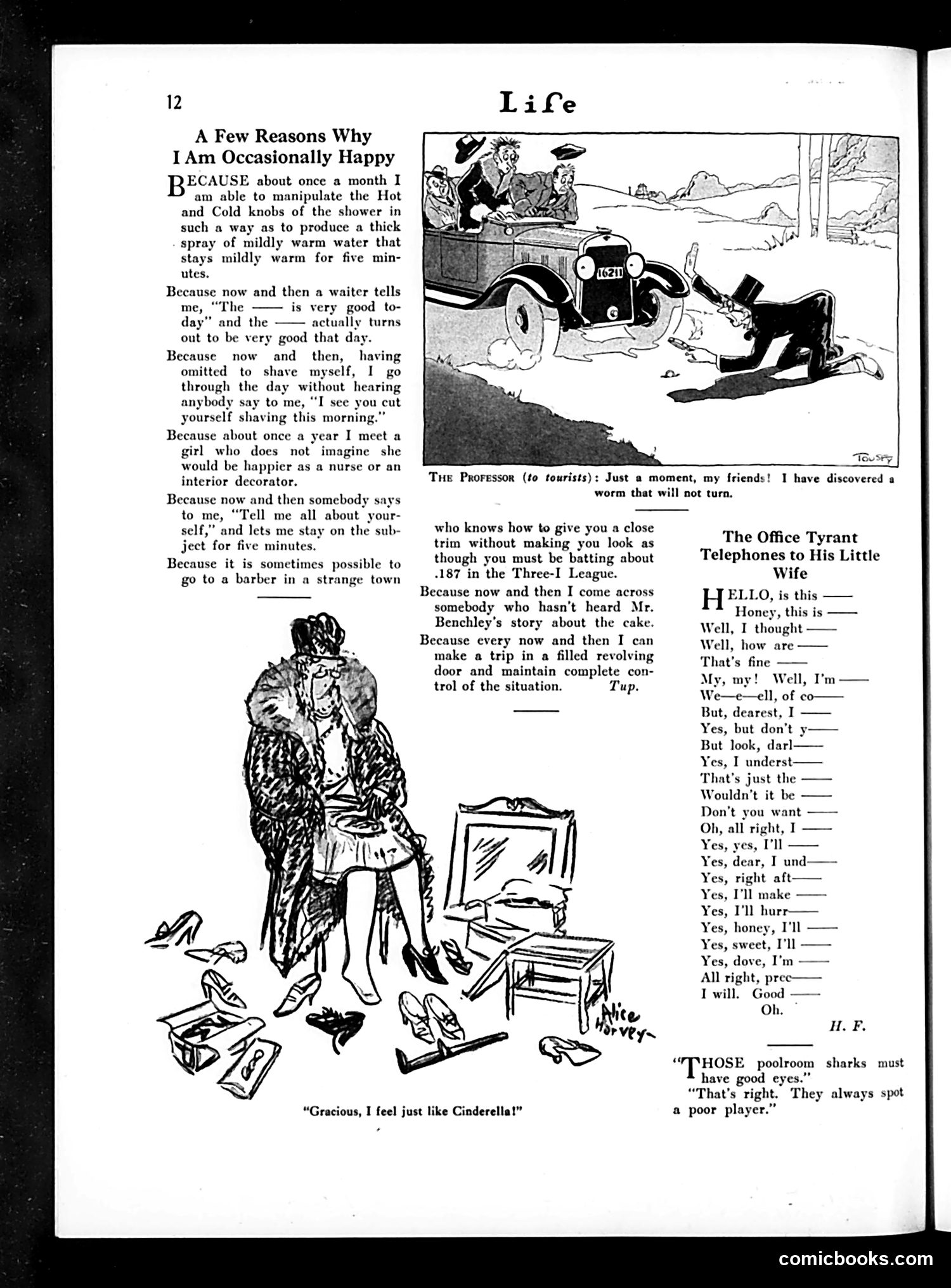
This page contains three satirical pieces typical of early 20th-century humor: 1. **"A Few Reasons Why I Am Occasionally Happy"** — A humorous essay listing absurd life observations, including shower temperature control and avoiding shaving comments. 2. **"The Professor (to tourists)"** — A cartoon showing a car accident where a professor claims he's discovered "a worm that will not turn," a pun on the proverb "even a worm will turn" (meaning even the meek will resist if pushed too far). 3. **"The Office Tyrant Telephones to His Little Wife"** — A sketch showing a domineering husband interrupting his wife with repeated phone calls and contradictory demands, satirizing controlling workplace behavior and domestic power dynamics. The bottom cartoon mockingly captioned "Gracious, I feel just like Cinderella!" shows a woman surrounded by shoes, ironically comparing shoe-shopping to servitude.
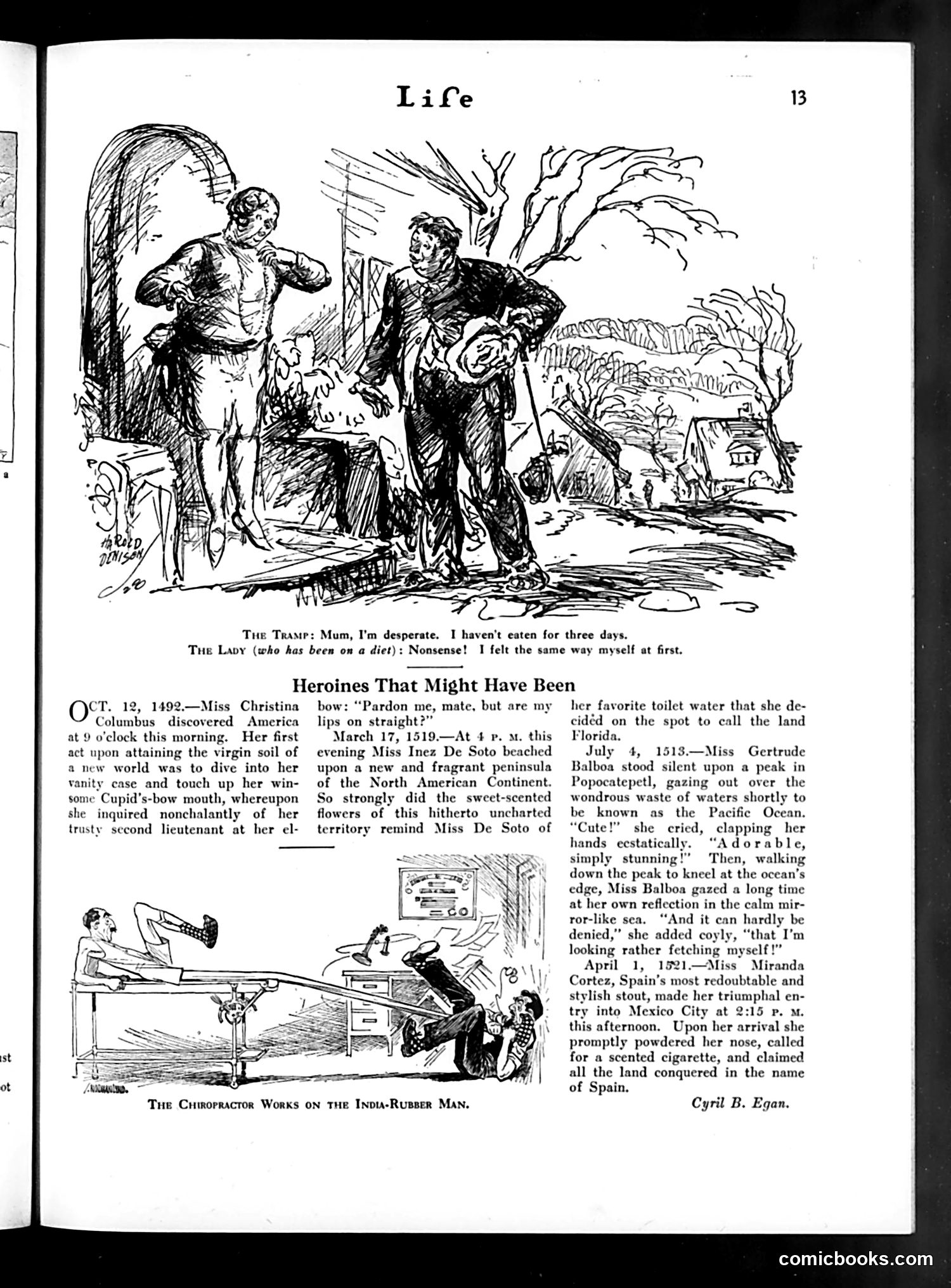
**Top Cartoon:** Shows a tramp asking a lady for food after three days without eating. Her response—that she once felt desperate but got over it—mocks the wealthy's dismissal of poverty as a temporary condition rather than systemic hardship. The satire critiques callous attitudes toward the poor. **"Heroines That Might Have Been":** A humorous article listing historical female explorers and adventurers with exaggerated, tongue-in-cheek accounts. Examples include Columbus's daughter "discovering America" and a woman conquering Mexico. The piece satirizes how history overlooks or reimagines women's actual achievements, presenting fictional "what-ifs" to highlight this erasure. **Bottom Cartoon:** "The Chiropractor Works on the India-Rubber Man" depicts someone being stretched/manipulated on a treatment table—satirizing the then-popular chiropractic profession as pseudoscientific quackery.
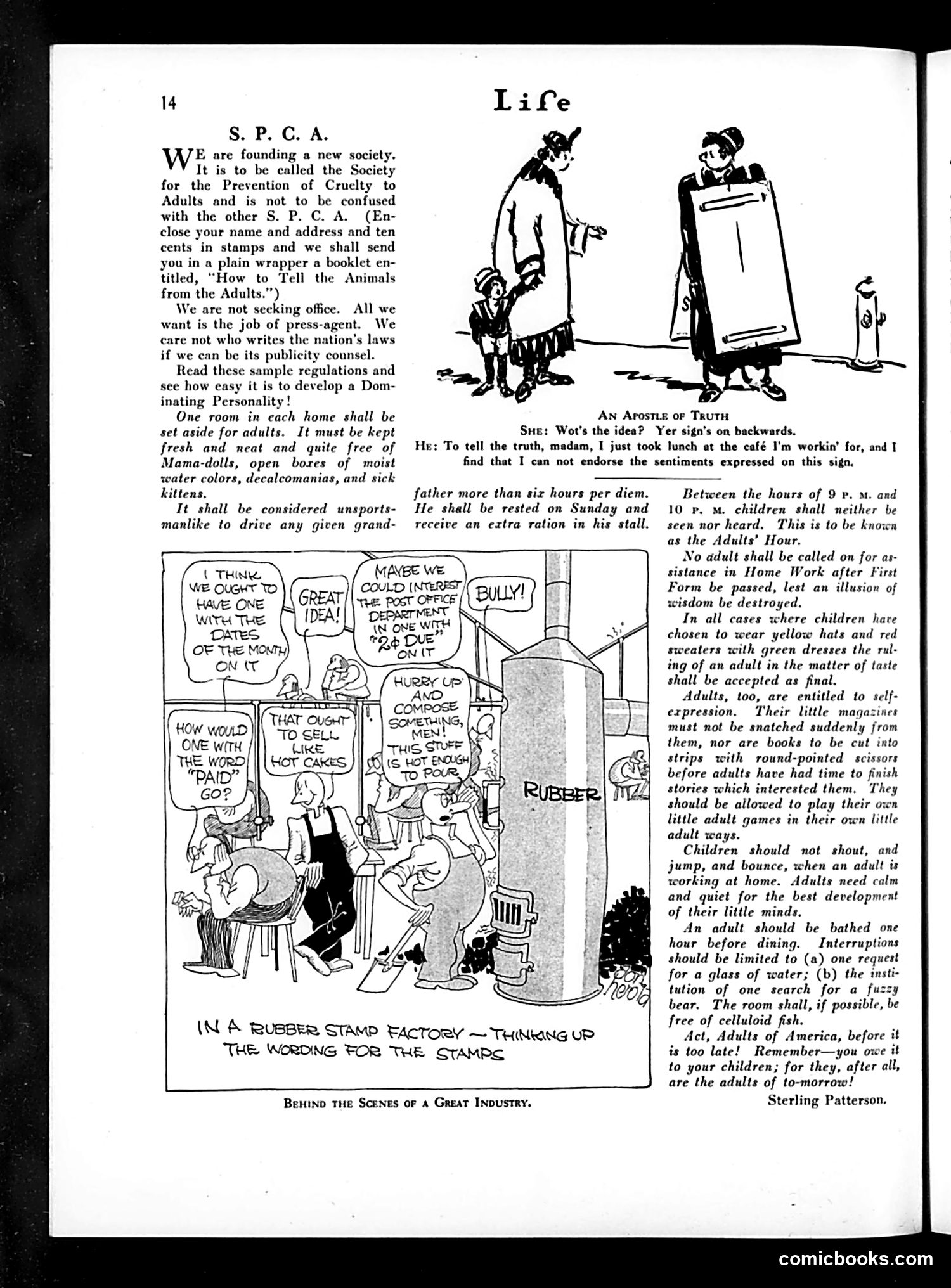
This page satirizes workplace hypocrisy regarding child labor. The top cartoon shows a woman confronting a man about endorsing child labor at his workplace while claiming moral authority—he ate lunch at a café and now pretends not to know what happens there. The main comic strip depicts rubber factory workers brainstorming advertising slogans. One suggests "the word 'JOY'" as their marketing angle, while another proposes "hot cakes" messaging. The satire is sharp: these factory workers are cynically manufacturing feel-good propaganda for an industry that presumably exploits children (referenced in the S.P.C.A. announcement above). The joke exposes the gap between corporate marketing rhetoric and actual labor practices—selling "joy" while profiting from exploitation.
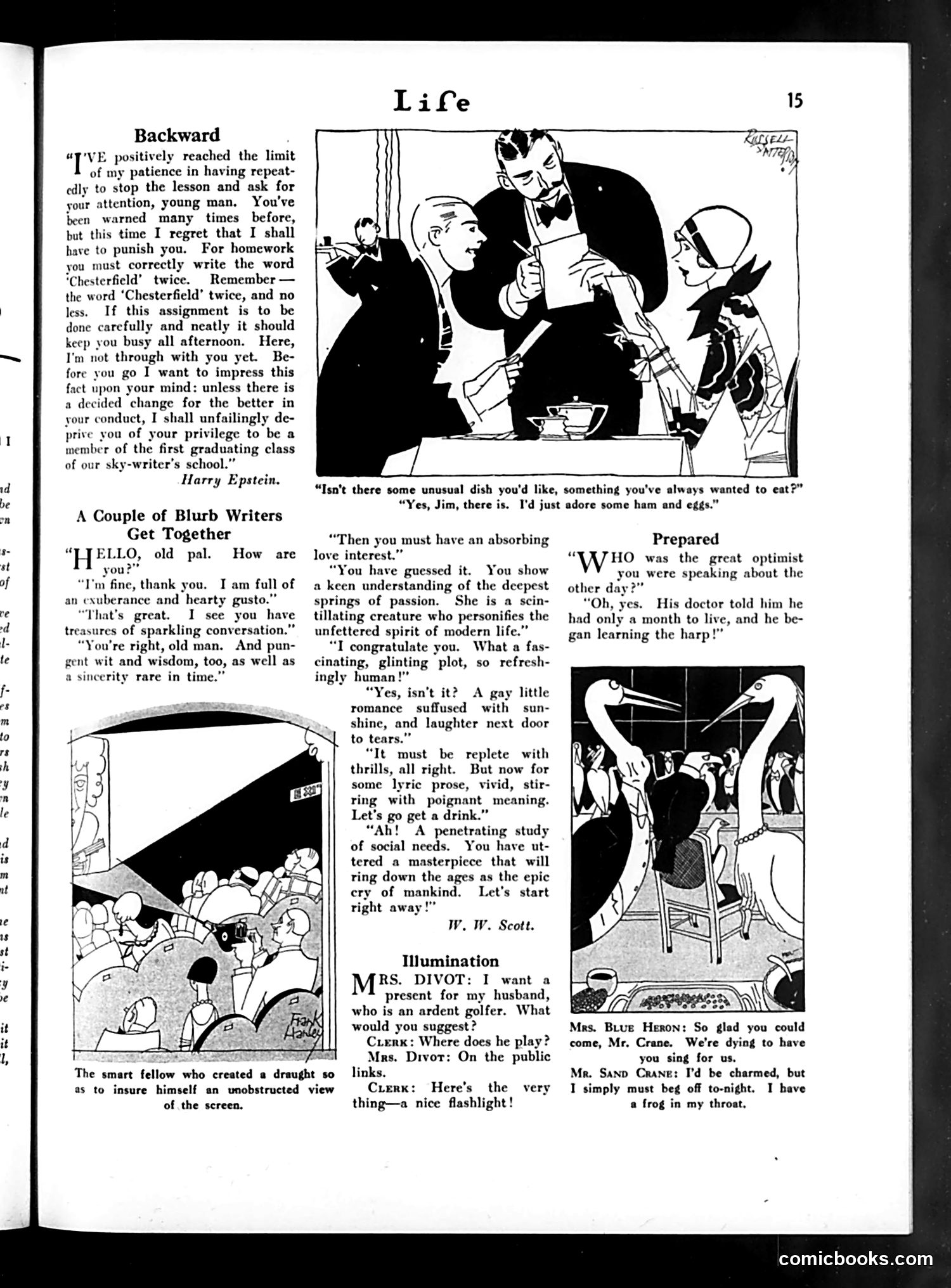
This page contains three satirical pieces about writing and social behavior: **"Backward"** shows a stern teacher (Harry Epstein) scolding a student about repeatedly misspelling "Chesterfield," threatening punishment and expulsion. **"A Couple of Blurb Writers Get Together"** features two men exchanging effusive, overwrought compliments about each other's work—satire of the literary back-scratching and mutual praise common among writers and publishers. **"Illumination"** cartoons a man at a theater who created an obstruction to improve his view of the screen—humorous commentary on selfish movie-going behavior. **"Prepared"** depicts a social gathering where Mr. Crane declines to sing, claiming "a frog in my throat"—a common polite excuse. The page satirizes pretension, affectation, and social hypocrisy typical of early 20th-century magazine humor.
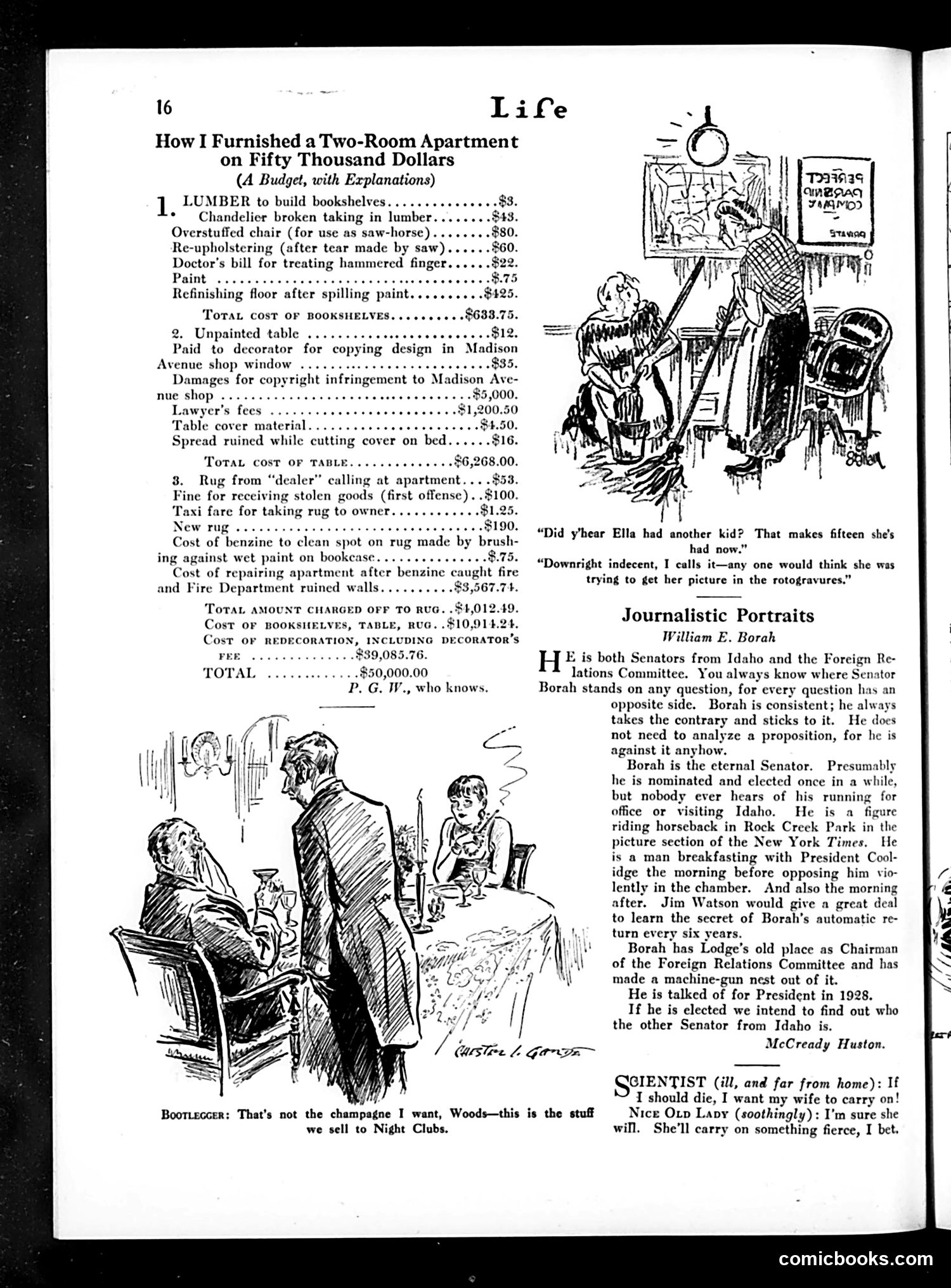
This page from *Life* magazine contains two distinct sections: **Left side:** A humorous budget breakdown titled "How I Furnished a Two-Room Apartment on Fifty Thousand Dollars," satirizing the absurdly inflated costs of furnishing an apartment—including items like a "$3,000 rug" and "$1,200.50" lawyer's fees. The accompanying cartoon shows a bootlegger selling champagne, mocking Prohibition-era black-market dealings. The joke targets both wasteful spending and illegal alcohol commerce. **Right side:** "Journalistic Portraits" featuring Senator William E. Borah of Idaho, described as consistently opposing whatever position his colleagues take. The satirical portrait characterizes him as predictably contrarian and perpetually absent from Idaho. Below is a brief quip from an unnamed scientist expressing darkly humorous wishes about his wife's loyalty after death.
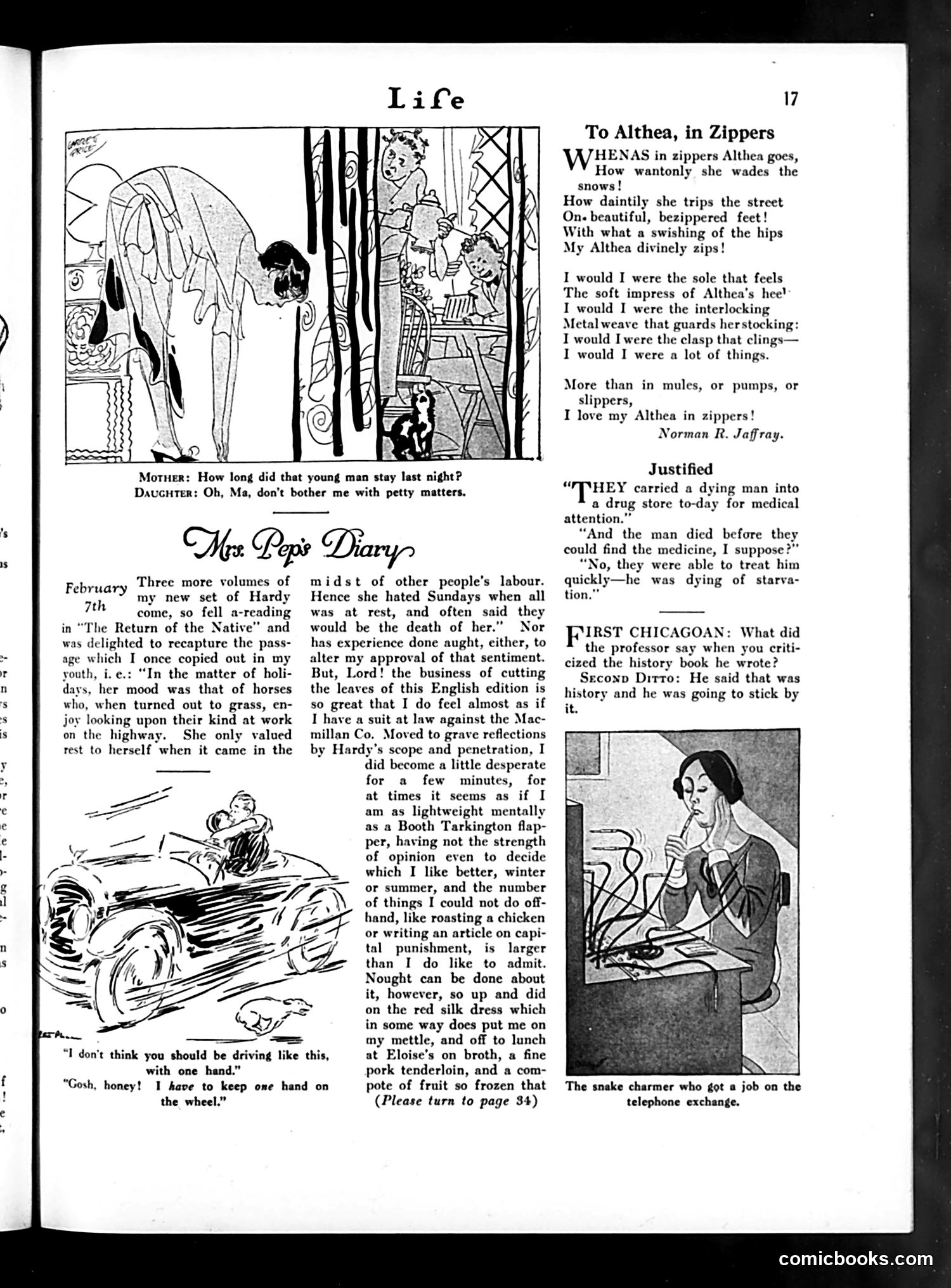
This page contains several humor pieces typical of early 20th-century Life magazine: **"To Althea, in Zippers"** is a poem by Norman R. Jaffray celebrating women's fashionable footwear, with accompanying art deco-style illustrations of elegantly dressed women. **"Mrs. Pep's Diary"** is a domestic humor column describing the author's frustrations with a new set of Hardy books and her conflicted feelings about English literature and social obligations. **"Justified"** is a brief joke about a dying man brought to a drugstore, playing on the irony of medical intervention. **The driving cartoon** shows a woman at the wheel with the caption about keeping "one hand on the wheel"—likely satirizing either new female drivers or relaxed automotive safety standards of the era. **"First Chicagoan"** concludes with an illustration labeled "The snake charmer who got a job on the telephone exchange."
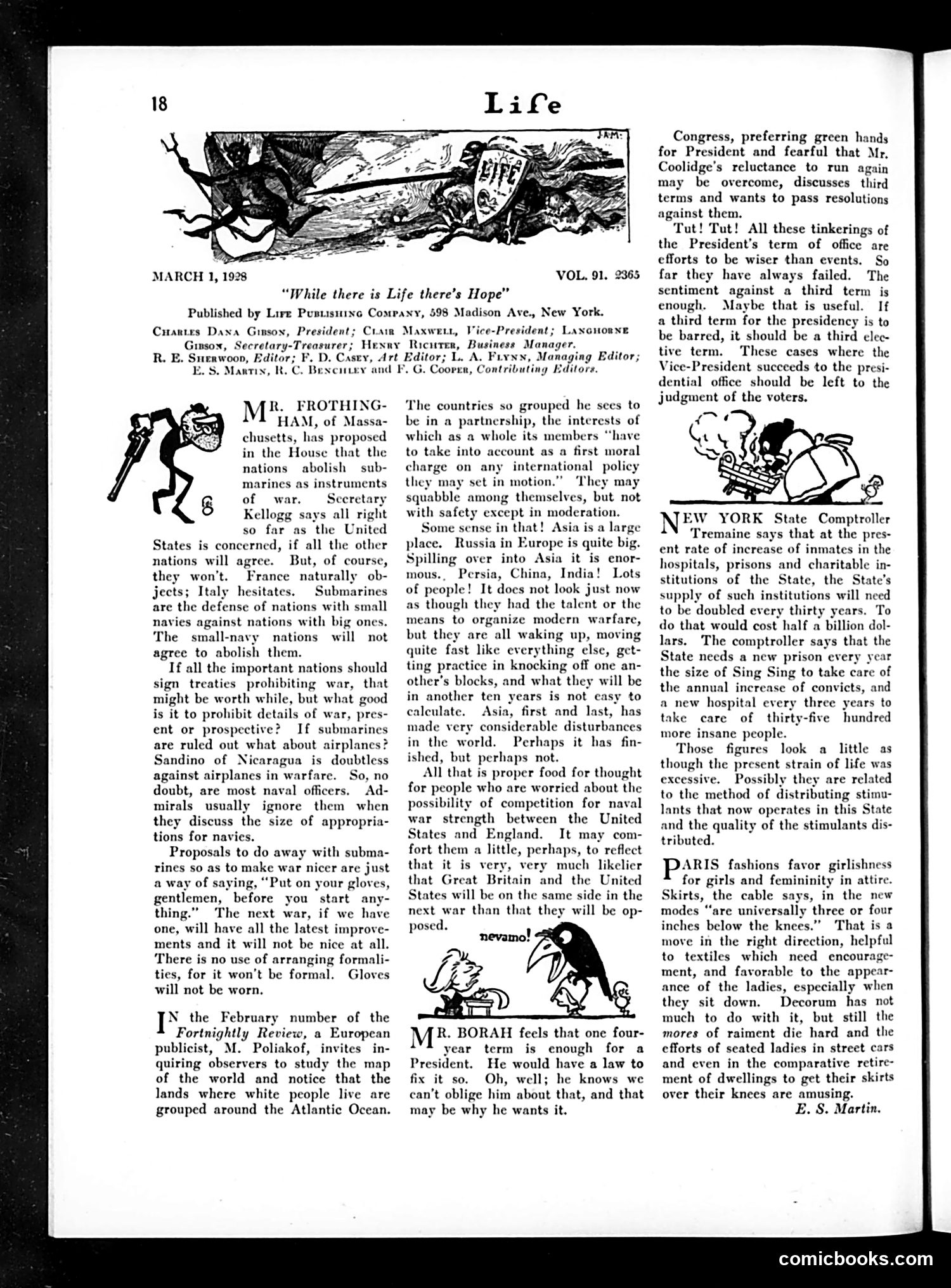
This page contains satirical editorials typical of *Life* magazine's political commentary. The main topics are: **Submarine abolition proposal**: Rep. Frothingham proposed banning submarines. The editor mocks this as naïve—nations won't agree, especially smaller ones who rely on subs against larger navies. The satire: proposing "rules" for war (like gentlemen wearing gloves) is pointless when future wars will use all available weapons. **Atlantic partnership theory**: M. Poliakof (European publicist) suggested white Atlantic nations should partner strategically. The editor finds merit in this given Asia's rising power, though he notes Asia has historically caused "considerable disturbances." **Presidential term limits**: Senator Borah wants a one-term limit; Congress opposes it fearing Coolidge might run again. The editor dismisses these constitutional debates as futile efforts to "be wiser than events." The cartoons (unclear in detail) appear to illustrate these points visually. The overall tone: political tinkering cannot prevent future conflicts or control history's trajectory.
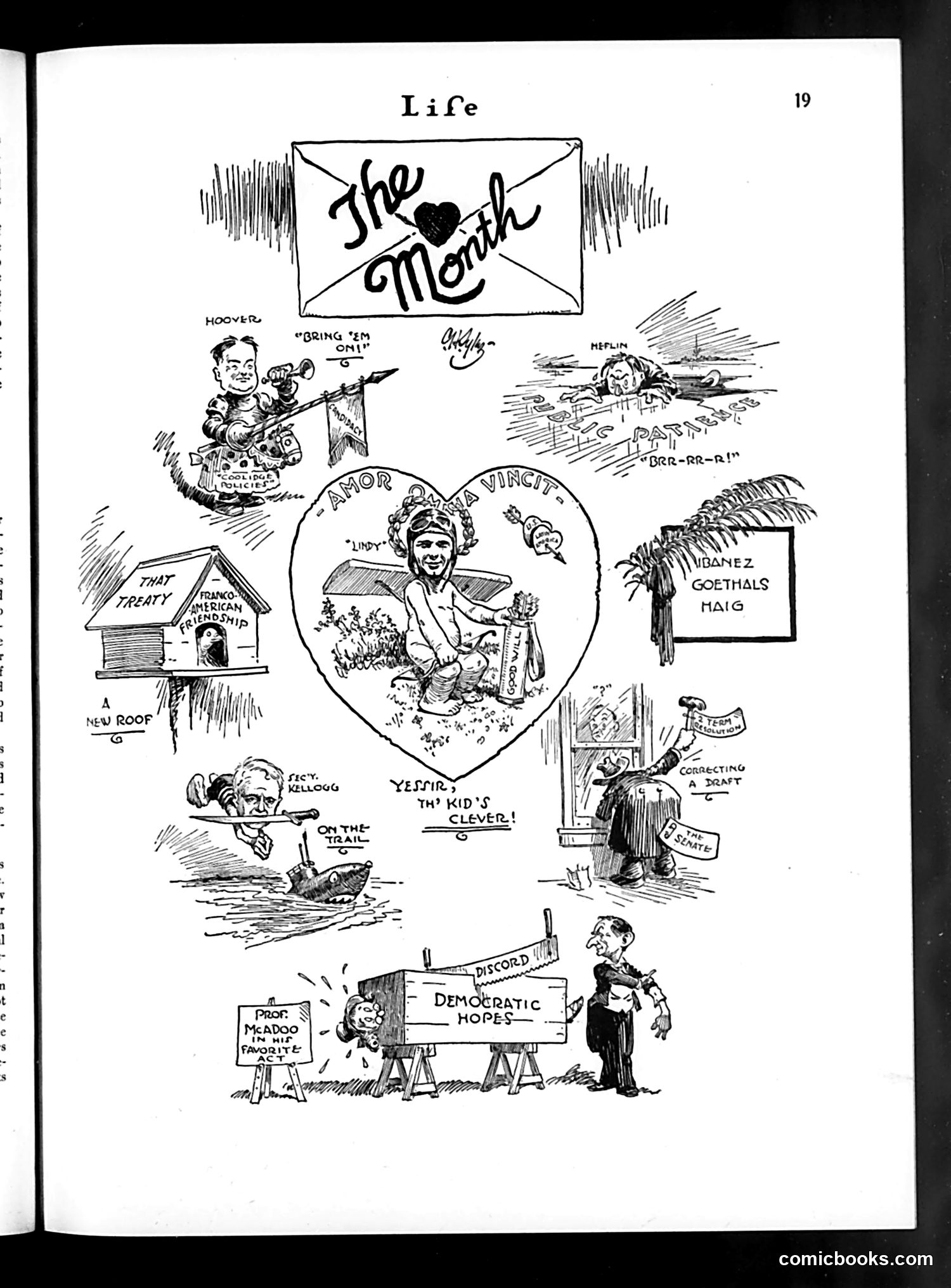
This satirical page presents seven vignettes mocking contemporary political figures and events. Central is a heart containing "Lindy" (likely Charles Lindbergh), labeled "Amor Vincit" ("Love Conquers"). Surrounding figures include: - **Hoover** (President Herbert Hoover), "bring 'em on" - **Helfin**, making noise - **Ibáñez**, labeled "Goethals Haig" - **Fish Kellogg**, "on the trail" - **Franco-British Friendship** (a house labeled "A New Roof") - **Correcting a Draft** (Senate figure) - **Prof. Meadoo** and "Discord" threatening "Democratic Hopes" The cartoons satirize political incompetence, international relations failures, and threats to Democratic Party unity during what appears to be the late 1920s-early 1930s era.
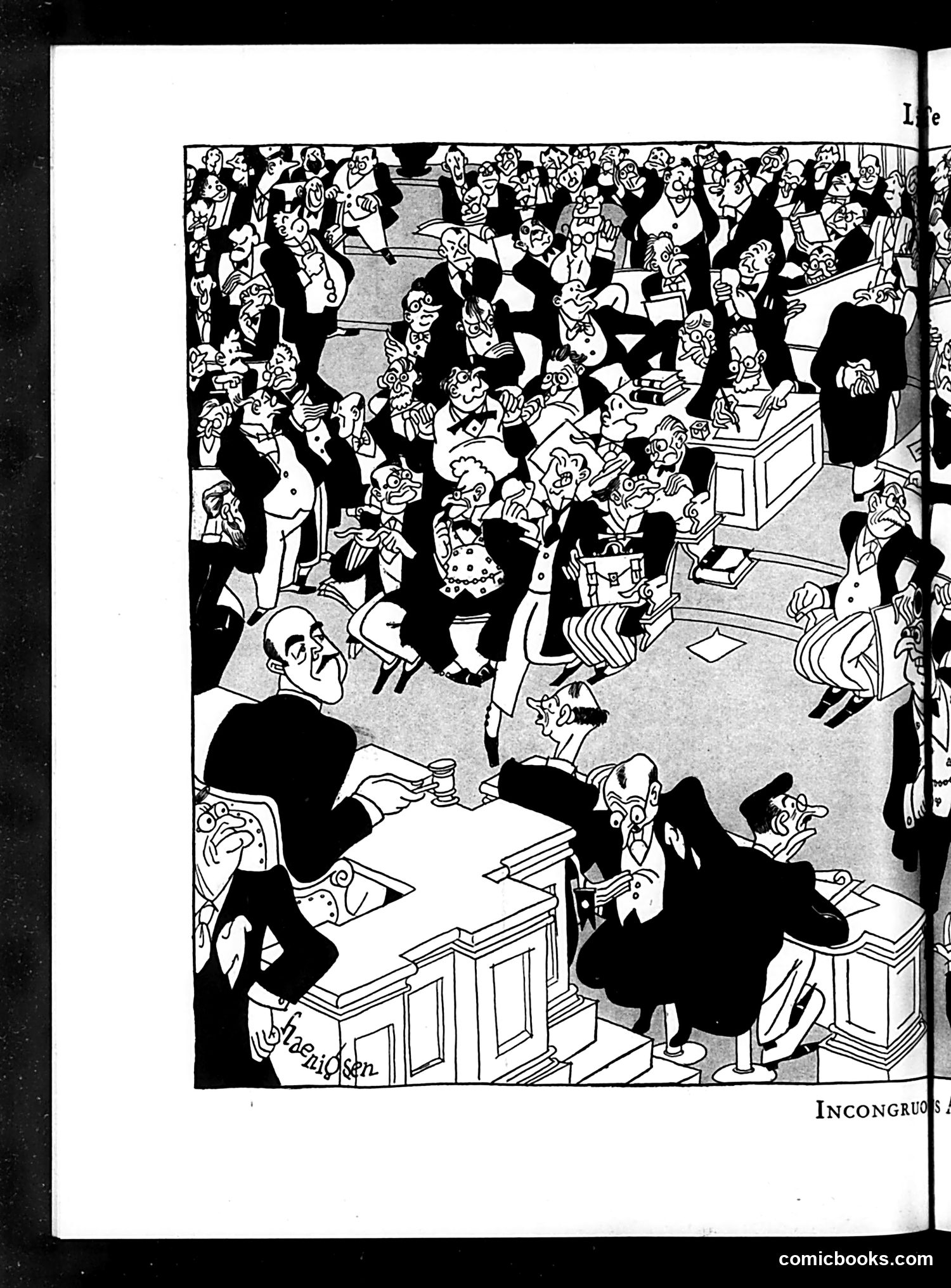
This satirical cartoon depicts a crowded courtroom with judges or officials seated at an elevated bench while spectators and participants pack the room. The title "Incongruous" suggests the humor lies in a mismatch or contradiction within the legal proceedings. The cartoon likely satirizes courtroom chaos, judicial incompetence, or the absurdity of legal proceedings—a common target of *Life* magazine's satire. The crowded, disorderly scene contrasts with the formal solemnity expected in courts. However, **without readable captions or clearer identification of specific figures**, the exact political or legal situation being mocked remains unclear. This appears to be general social commentary on American legal institutions rather than reference to a specific case or event.
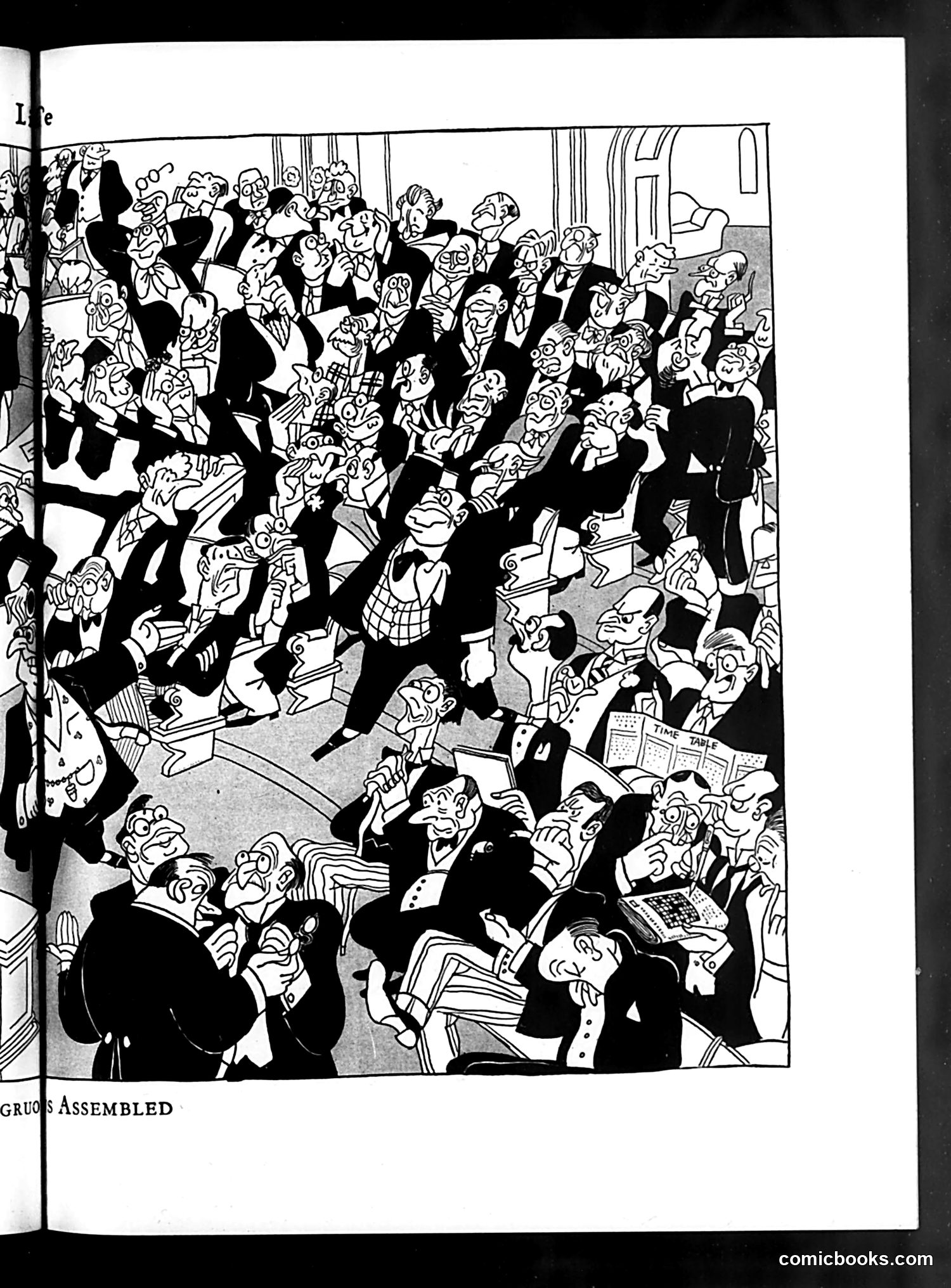
The caption reads "GRUOS ASSEMBLED" (likely "GROUPS ASSEMBLED"). This is a satirical cartoon depicting a crowded gathering of formally-dressed men in suits and tuxedos, rendered in exaggerated caricature style typical of early-to-mid 20th century *Life* magazine. The satire appears to mock a formal assembly or convention—possibly political, business, or social—by reducing the assembled figures to indistinguishable, grotesque caricatures with emphasized facial features. The overcrowding and uniform formal dress suggest conformity and the interchangeability of powerful men. Without clearer OCR text or visible date, I cannot identify the specific event referenced. The style and subject matter suggest commentary on elite gatherings, institutional power, or political conventions, common targets of *Life's* satirical humor.
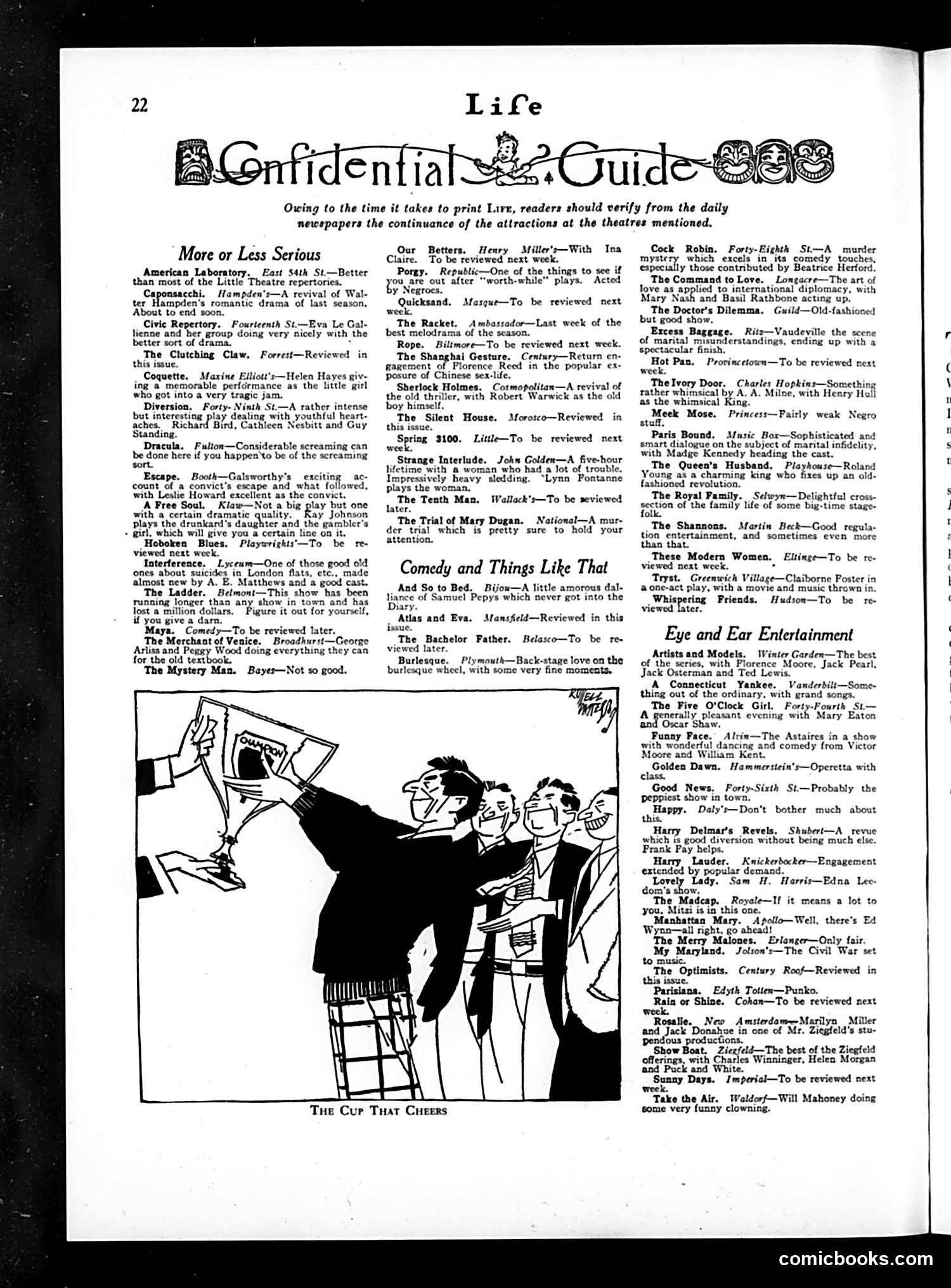
This page is a **theater review section** from Life magazine listing Broadway and off-Broadway productions. The cartoon "The Cup That Cheers" illustrates the appeal of theater-going itself: a well-dressed man at what appears to be a box office or theater counter raises a cup in celebration, surrounded by other eager patrons. The image captures the social excitement and communal pleasure of attending live theater during the 1920s. The cartoon likely satirizes theater as an escapist "drink" or intoxicant for audiences seeking entertainment and excitement. The reference to a "cup that cheers" evokes both social conviviality and the Prohibition era (alcohol was illegal 1920-1933), making theater a legal alternative to drinking establishments. The reviews themselves cover both serious drama (Eva Le Gallienne's Civic Repertory) and lighter fare, reflecting the diverse theatrical landscape of the period.
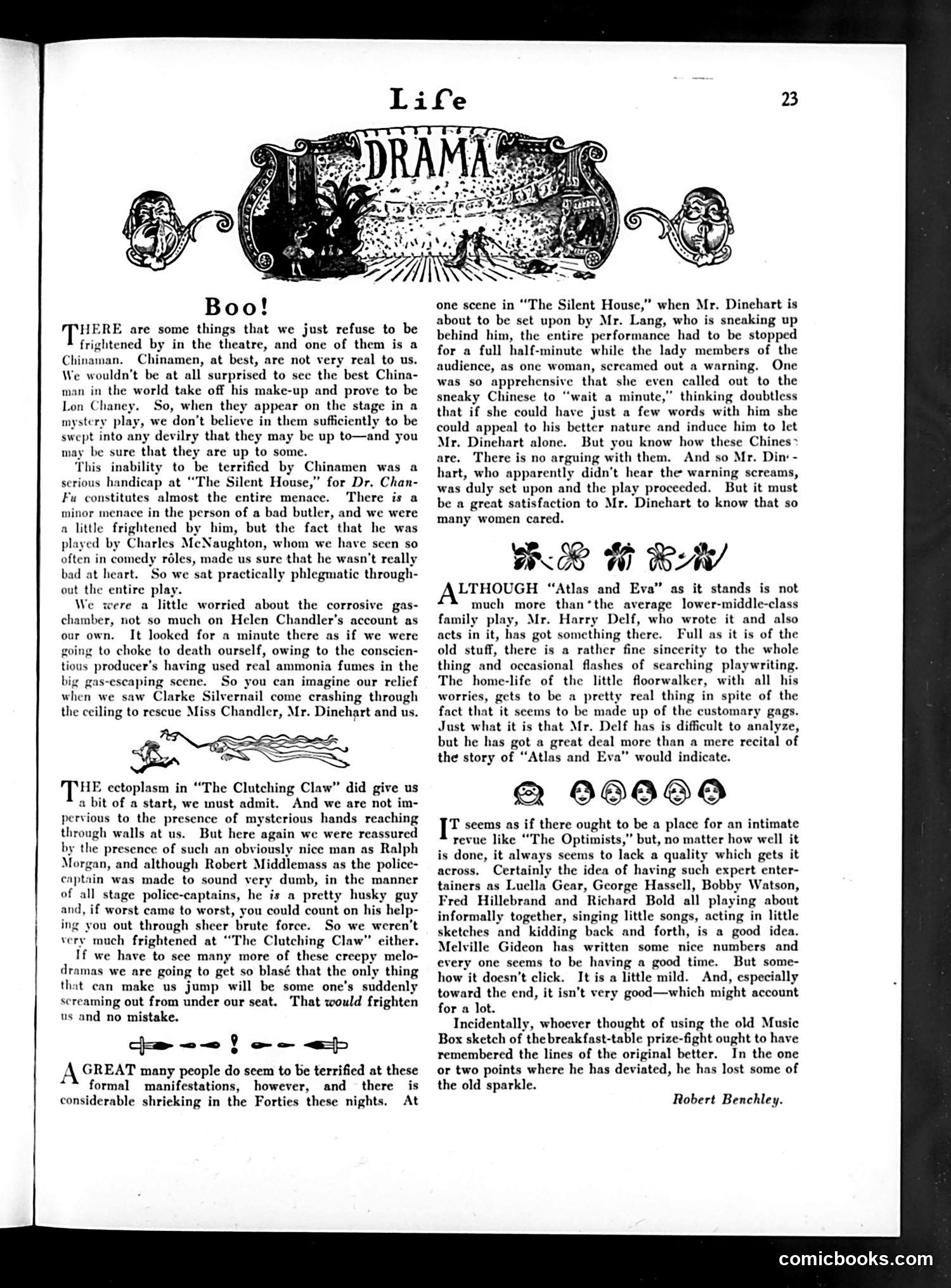
This theater review critiques three Broadway plays with satirical observations about audience psychology and racial attitudes. The author dismisses the menace of Chinese villains in "The Silent House," asserting that audiences won't find them genuinely threatening because they assume any convincing Chinese character must be actor Lon Chaney in makeup. This reflects early 20th-century skepticism about Asian performers' authenticity in American theater. The review notes the irony when female audience members screamed warnings to the villain, even appealing to his "better nature"—satirizing how emotion overrides logic in theater-goers. For "The Clutching Claw," the critic finds supernatural horror (ectoplasm, mysterious hands) less frightening than expected, reassured by the presence of capable male actors like Ralph Morgan who could "help you out through sheer brute force." The author concludes these melodramas are losing their power to frighten jaded audiences—a commentary on shifting theatrical tastes in the Jazz Age.
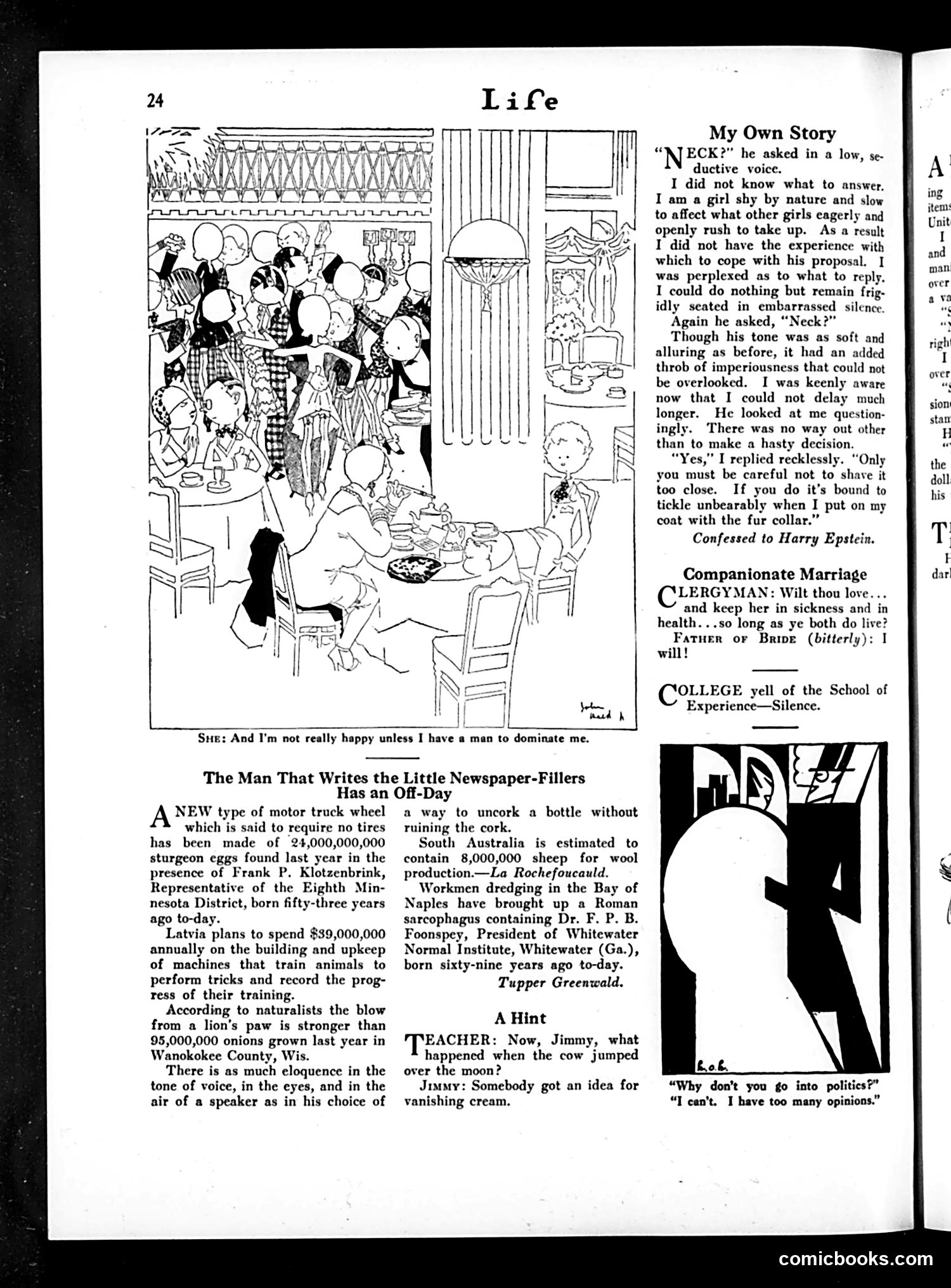
This page satirizes early 1920s American culture through several pieces: **"The Man That Writes Little Newspaper-Fillers Has an Off-Day"** mocks the absurd filler content newspapers published—random facts mixing trivial statistics with oddly specific names and dates. The piece parodies the formulaic, nonsensical "factoids" editors used to pad space, combining meaningless comparisons (lion's paw strength vs. onions grown) with fabricated biographical details. **"My Own Story"** plays on contemporary dating anxieties. A shy woman receives a proposal to "neck" (kiss/make out), wrestling with social pressure to participate in modern courtship rituals. Her punchline—worrying about fur collar tickling—deflates the romantic tension by treating it as a grooming problem, satirizing both female reluctance and the era's emerging sexual frankness. **The marriage and politics jokes** mock institutional hypocrisy and political discourse, suggesting clergy and politicians are equally insincere. The page overall satirizes 1920s modernity: newspaper superficiality, changing dating norms, and institutional phoniness.
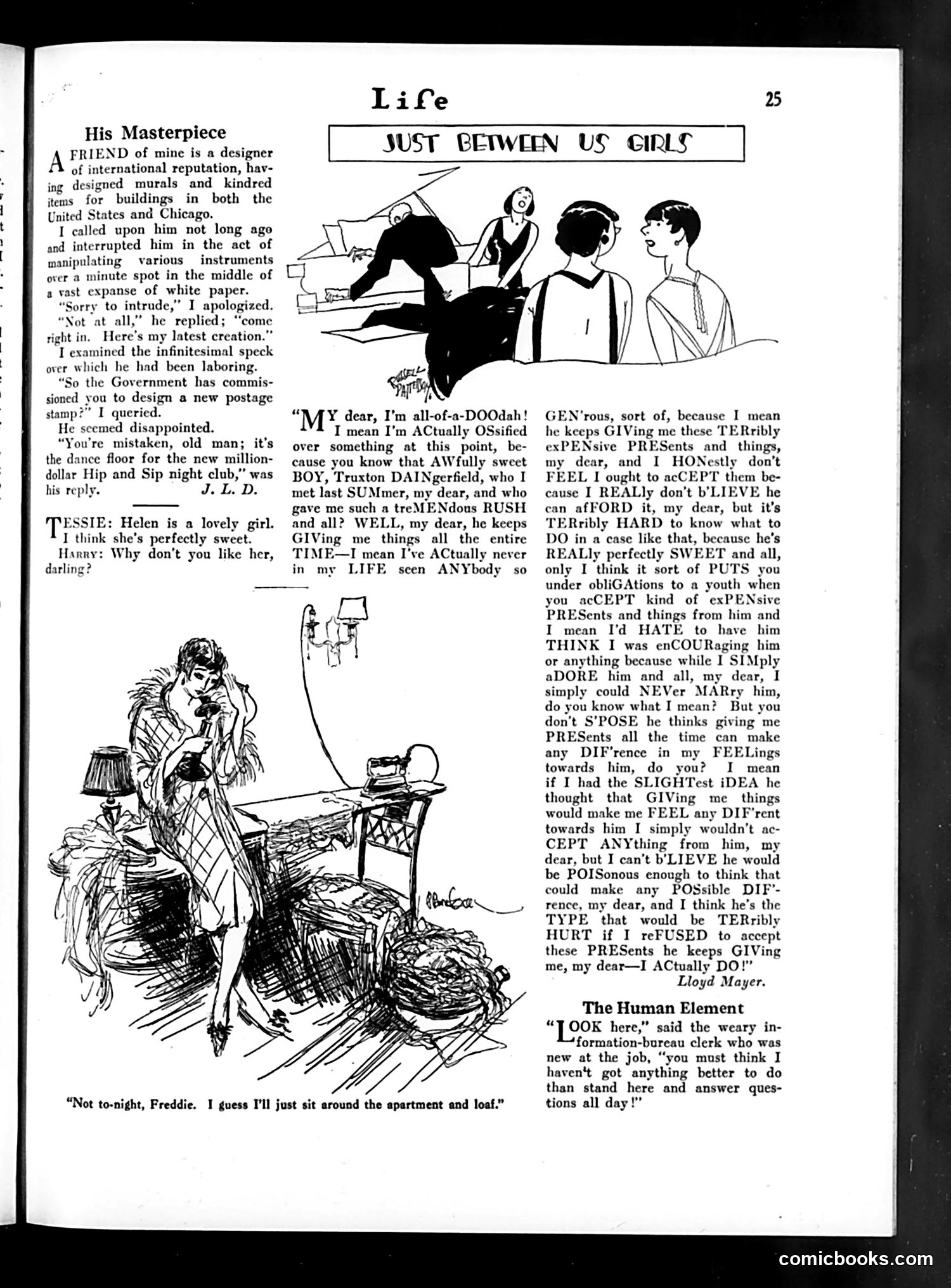
This page contains three satirical pieces from Life magazine: **"His Masterpiece"**: A designer of murals and buildings is shown laboring intensely over an infinitesimal speck on a vast blank page. The joke: he claims it's a dance floor for an expensive nightclub, mocking the pretension and absurdity of modernist minimalism in design—the ironic contrast between grand ambitions and comically tiny results. **"Just Between Us Girls"**: A rambling monologue (with emphasized syllables indicating affected speech) from a woman fretting about accepting expensive gifts from an admirer. The satire targets vapid, self-absorbed socialites of the era who talk in circles, claim poverty-stricken motives while accepting luxury, and obsess over propriety while being transparently mercenary. **"The Human Element"**: A brief caption showing a weary information-bureau clerk snapping at visitors—satire on bureaucratic indifference and poor customer service. All three target contemporary social pretension and human folly through exaggeration and irony.
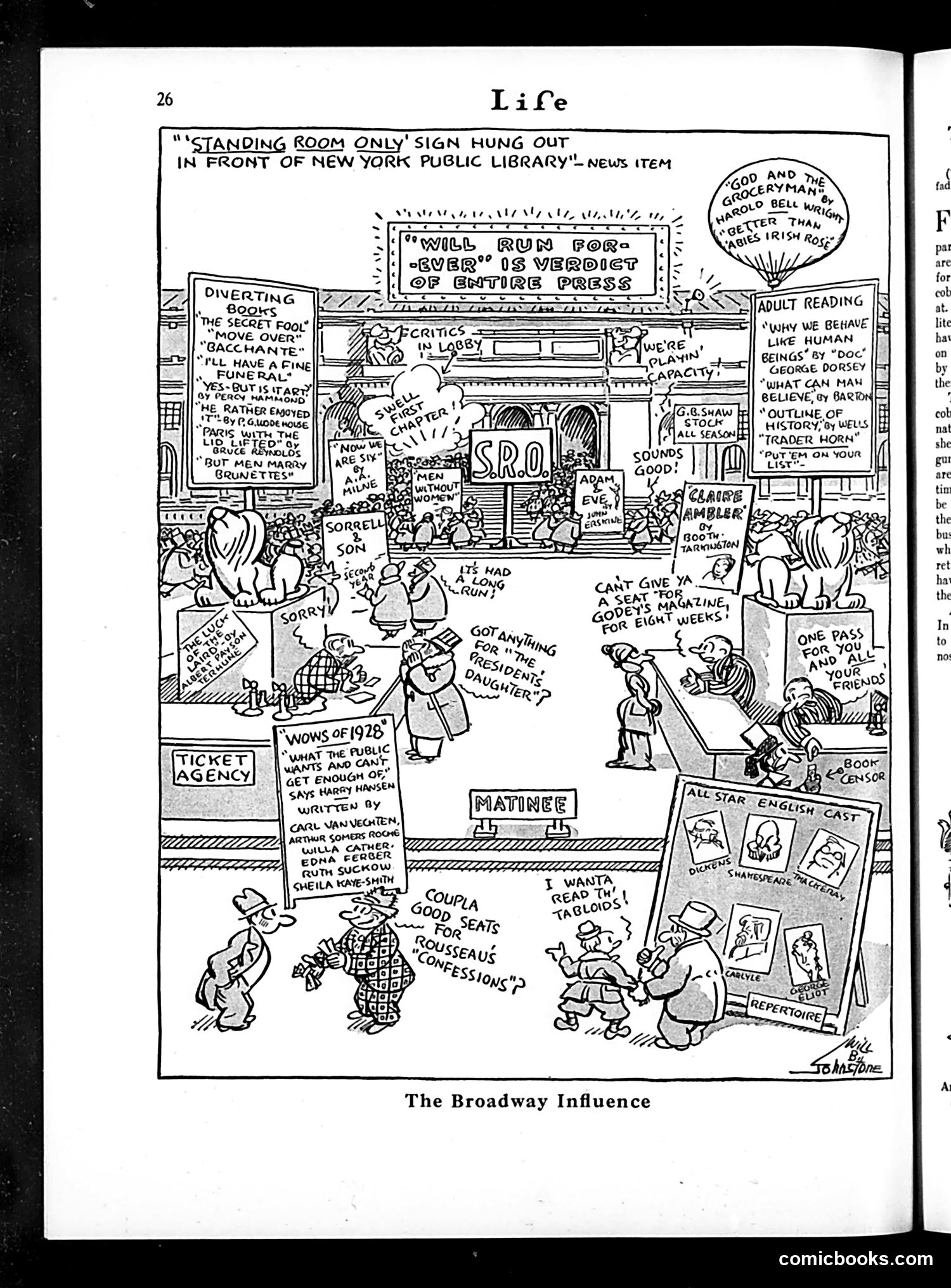
This cartoon satirizes how Broadway theater culture has infiltrated the New York Public Library, supposedly a serious intellectual institution. The humor derives from the contrast between the library's dignified purpose and patrons now treating it like a Broadway playhouse. The "standing room only" sign references actual theater terminology. Inside, we see library visitors discussing books as if they were theatrical productions—requesting "matinee" times, discussing "all-star casts," and using theater-industry language. Book titles visible include popular works and plays of the era. The satire targets 1920s American mass culture: Broadway's massive popularity has made even book-browsing feel like entertainment-seeking rather than serious scholarship. Patrons want excitement and celebrity appeal ("Wows of 1928") rather than intellectual substance. The cartoon mocks this shift toward treating literature as mere entertainment, reflecting anxieties about lowbrow culture overtaking highbrow institutions during the Jazz Age.
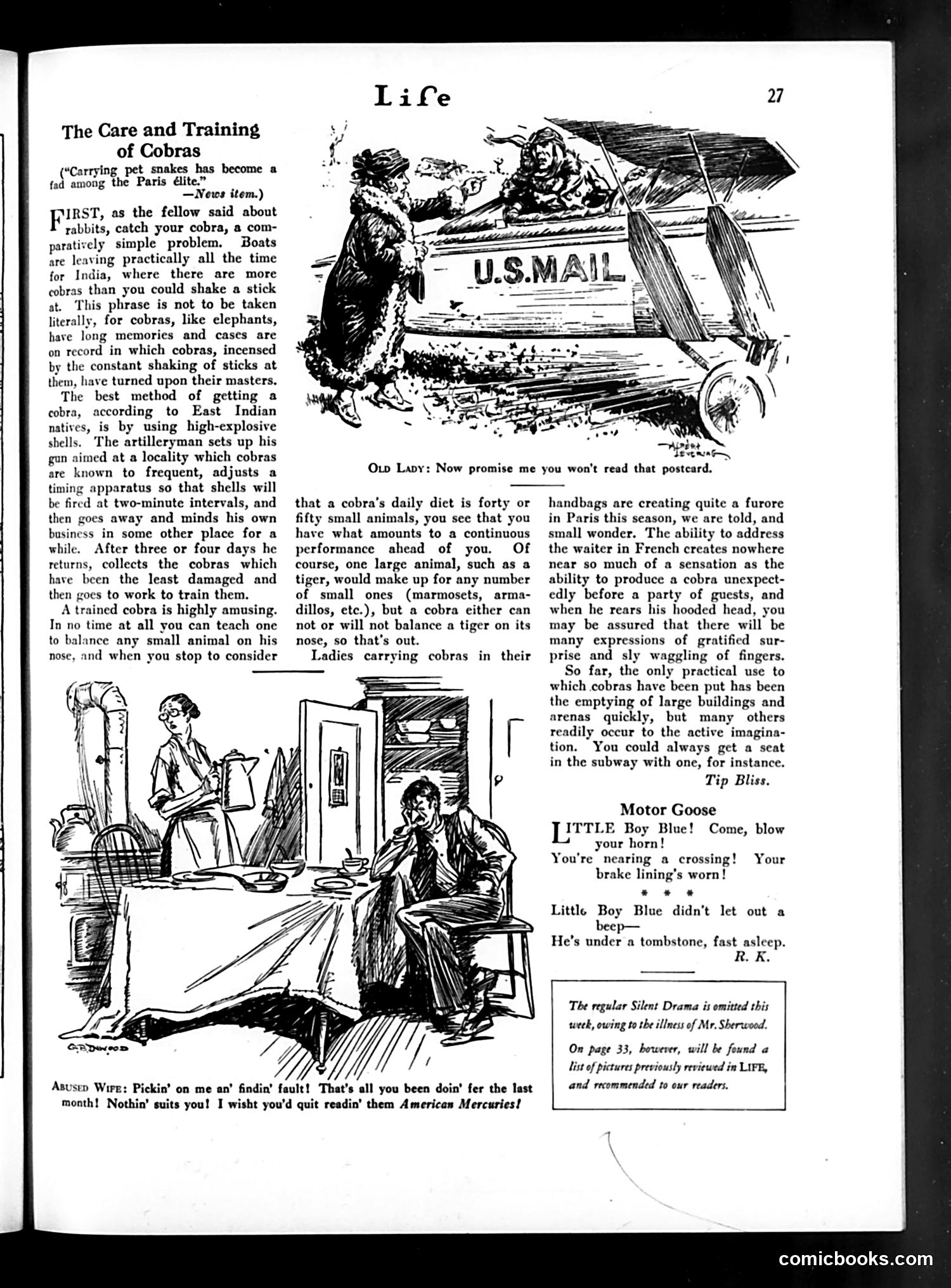
This page contains two satirical pieces mocking contemporary fads and safety concerns. **"The Care and Training of Cobras"** ridicules the fashionable craze among wealthy Parisians of keeping pet cobras. The article humorously describes acquiring and training cobras, culminating in the absurd image of Parisian ladies carrying them in handbags as status symbols. The satire lies in treating this dangerous practice as an elegant social affectation—suggesting that owning a cobra has become a mark of sophistication among the "Paris élite," despite its obvious impracticality and danger. **The two cartoons** at bottom show domestic frustrations: one depicts a nagging wife criticizing her husband's reading habits (specifically American magazines); the other, "Motor Goose," parodies the nursery rhyme "Little Boy Blue," reimagining it as a tragic commentary on automobile accidents and worn brake linings—a contemporary safety hazard. Together, these pieces reflect Life's satirical approach: mocking both European pretension and American consumer culture and its dangers.
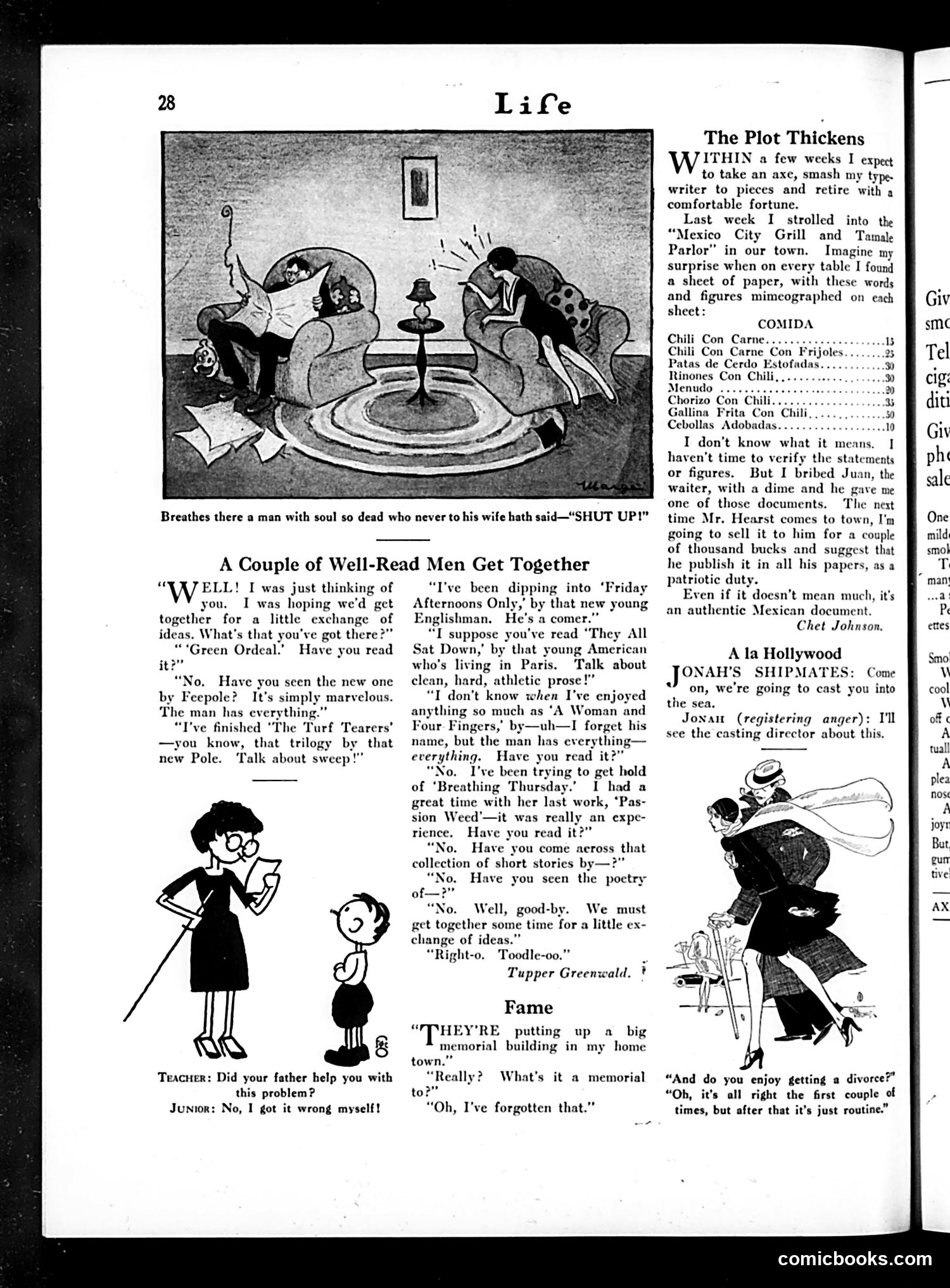
**"A Couple of Well-Read Men Get Together"**: This satirizes intellectuals who name-drop obscure, likely fictional books and authors to appear cultured. The joke is their entire conversation consists of asking "Have you read?" about works with pretentious titles—none of which exist. They part ways having exchanged no actual ideas, only demonstrated their shared affectation. This mocks the performative nature of literary snobbery. **"The Plot Thickens"**: A humorous anecdote where the narrator claims to have discovered a Spanish-language menu at a Mexican restaurant and plans to sell it to newspaper magnate William Randolph Hearst as an "authentic Mexican document," implying Hearst will publish anything for sensationalism or patriotic appeal. **The Teacher-Junior exchange** is a brief joke about a student solving a math problem incorrectly on his own, playing on parental expectations. All three pieces use satire to mock contemporary social pretense: intellectual posturing, media sensationalism, and educational anxiety.
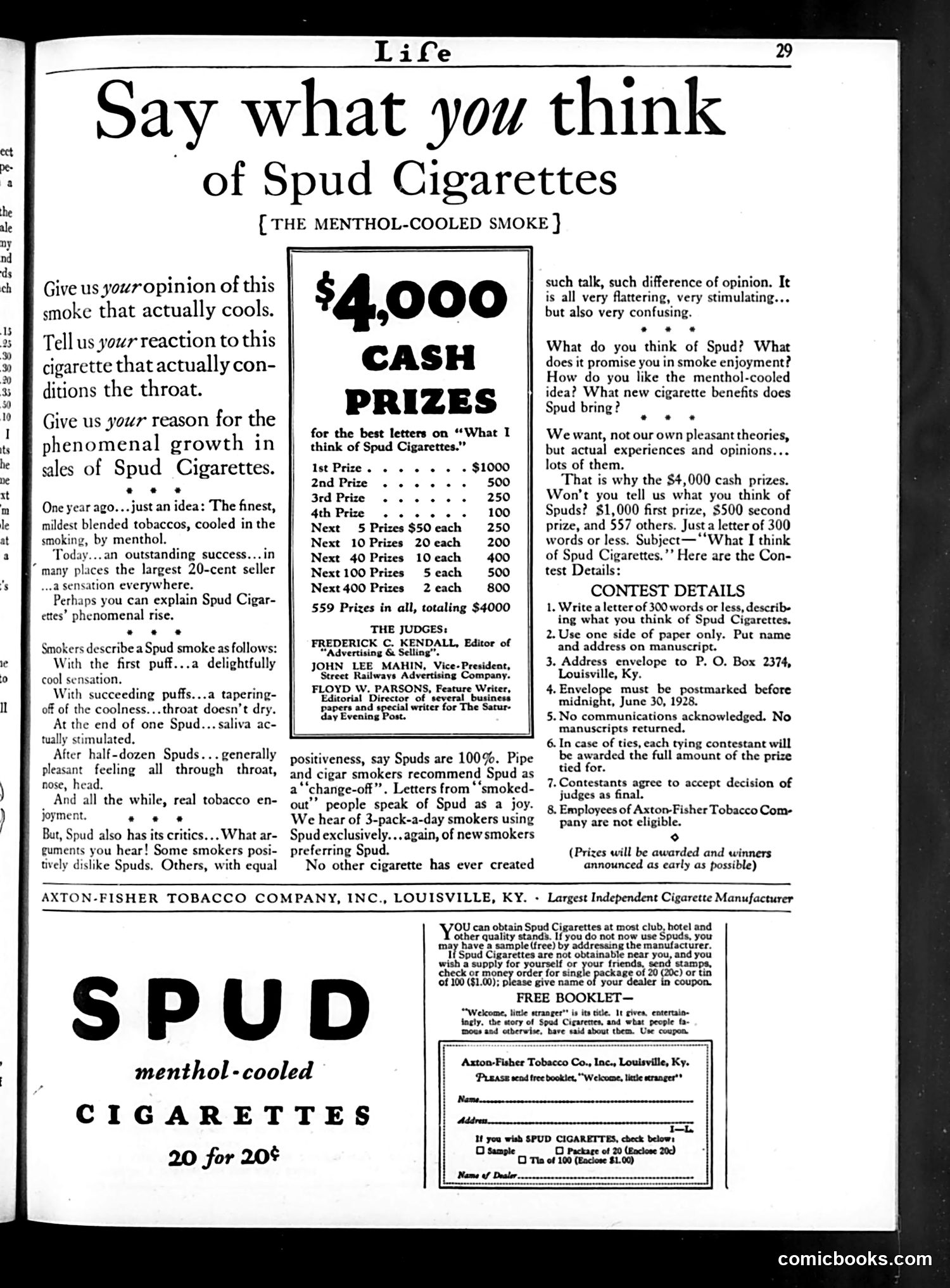
This is primarily a **cigarette advertisement**, not political satire. The Axton-Fisher Tobacco Company is promoting Spud, a menthol-cooled cigarette, by offering $4,000 in cash prizes for consumer testimonials. The advertisement uses a quasi-journalistic tone to create the *impression* of objective reporting. It describes smokers' reactions (throat cooling, saliva stimulation, pleasant feelings) and acknowledges that Spuds are "controversial"—some smokers love them, others dislike them. This manufactured debate actually serves the marketing purpose: it makes the product seem novel and discussed. The contest itself is the hook: readers are incentivized to write letters praising (or critiquing) the cigarettes, with first prize at $1,000. The judges listed are advertising and journalism professionals, lending credibility. There is no cartoon or satire here—this is straight advertising disguised as consumer journalism, a common 1920s marketing technique.
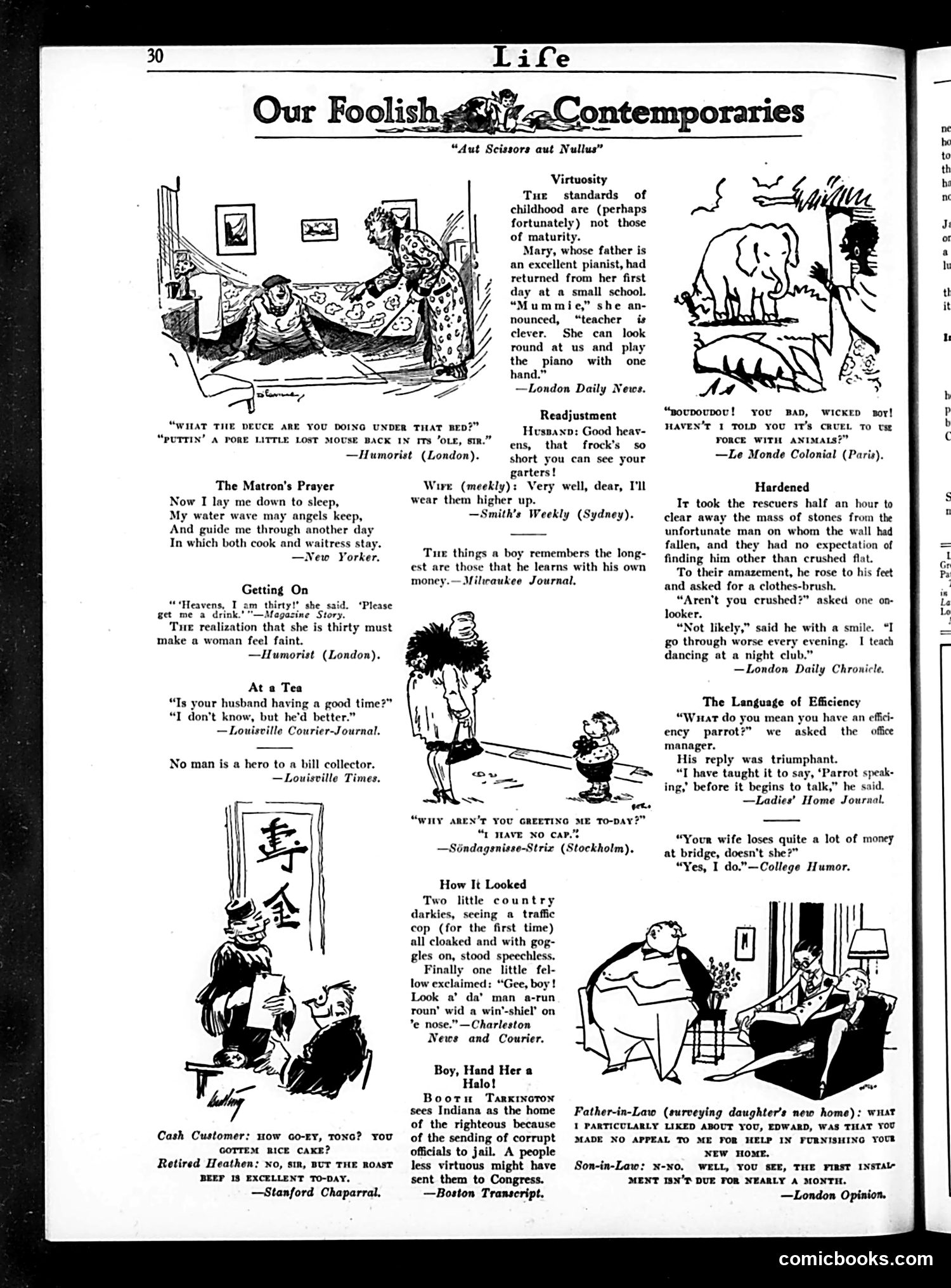
This is a humor compilation page featuring short jokes and anecdotes from various international publications, satirizing everyday social situations of the era. **Key targets:** - **Domestic life**: Wife-husband dynamics (wives controlling husbands, wives losing money at bridge) - **Class anxieties**: Servants leaving employment, the difficulty of managing household staff - **Gender roles**: A woman's crisis turning thirty; changing hemlines and exposed garters causing scandal - **Social pretension**: A child naively praising her teacher for playing piano "with one hand" (implying incompetence elsewhere) - **Colonial attitudes**: A caption from "Le Monde Colonial" sarcastically criticizing animal cruelty while implying indifference to native peoples - **Bureaucratic incompetence**: Corrupt officials sent to jail rather than Congress The humor relies on period-specific anxieties: servants' independence, women's changing fashion and social freedom, marital power dynamics, and class consciousness. Most jokes center on the gap between appearance and reality—what people *claim* versus what they actually do.
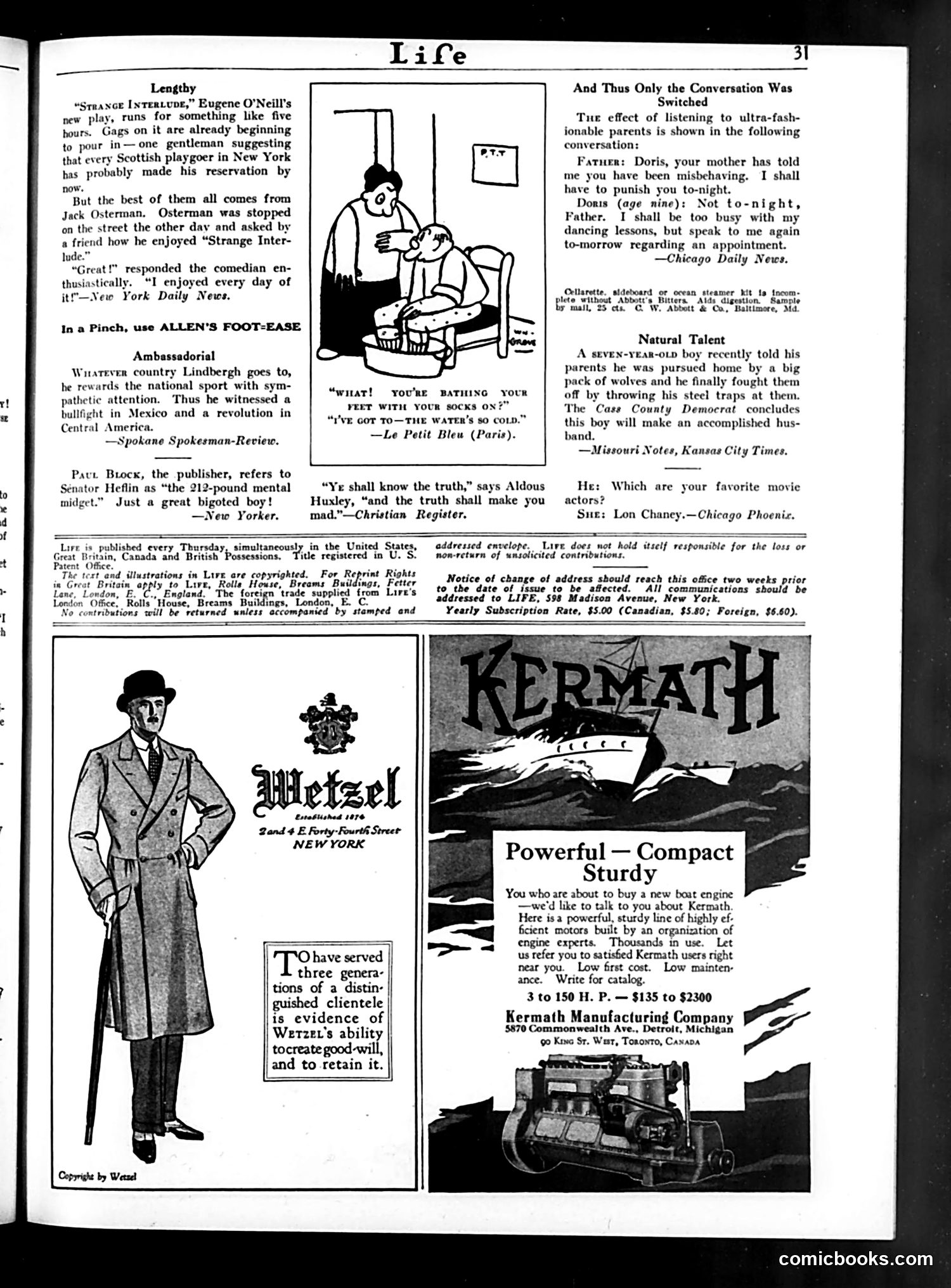
This page contains several brief humorous anecdotes typical of Life's satirical style, plus advertisements. **The Main Jokes:** 1. **Eugene O'Neill's "Strange Interlude"** — A joke about the play's notorious length (it ran over five hours). The humor: a Scottish playgoer supposedly made his reservation "by now," suggesting even before seeing it he'd need advance notice for such a time commitment. 2. **Lindbergh's Tourism** — Mocks Charles Lindbergh's tendency to witness national spectacles wherever he travels (bullfights in Mexico, revolutions in Central America), presenting him as a curiosity-seeker following the local "sport." 3. **The Parent-Child Conversation** — Satirizes ultra-fashionable parents and their overly formal, appointment-driven interaction with their nine-year-old daughter, who responds with equal formality rather than childlike spontaneity. 4. **The Seven-Year-Old's Exaggeration** — Gently mocks a boy's tall tale about fighting off wolves with steel traps, concluding he'll make "an accomplished husband" (ironic understatement). The advertisements for Wetzel clothing and Kermath boat engines occupy the lower half of the page.
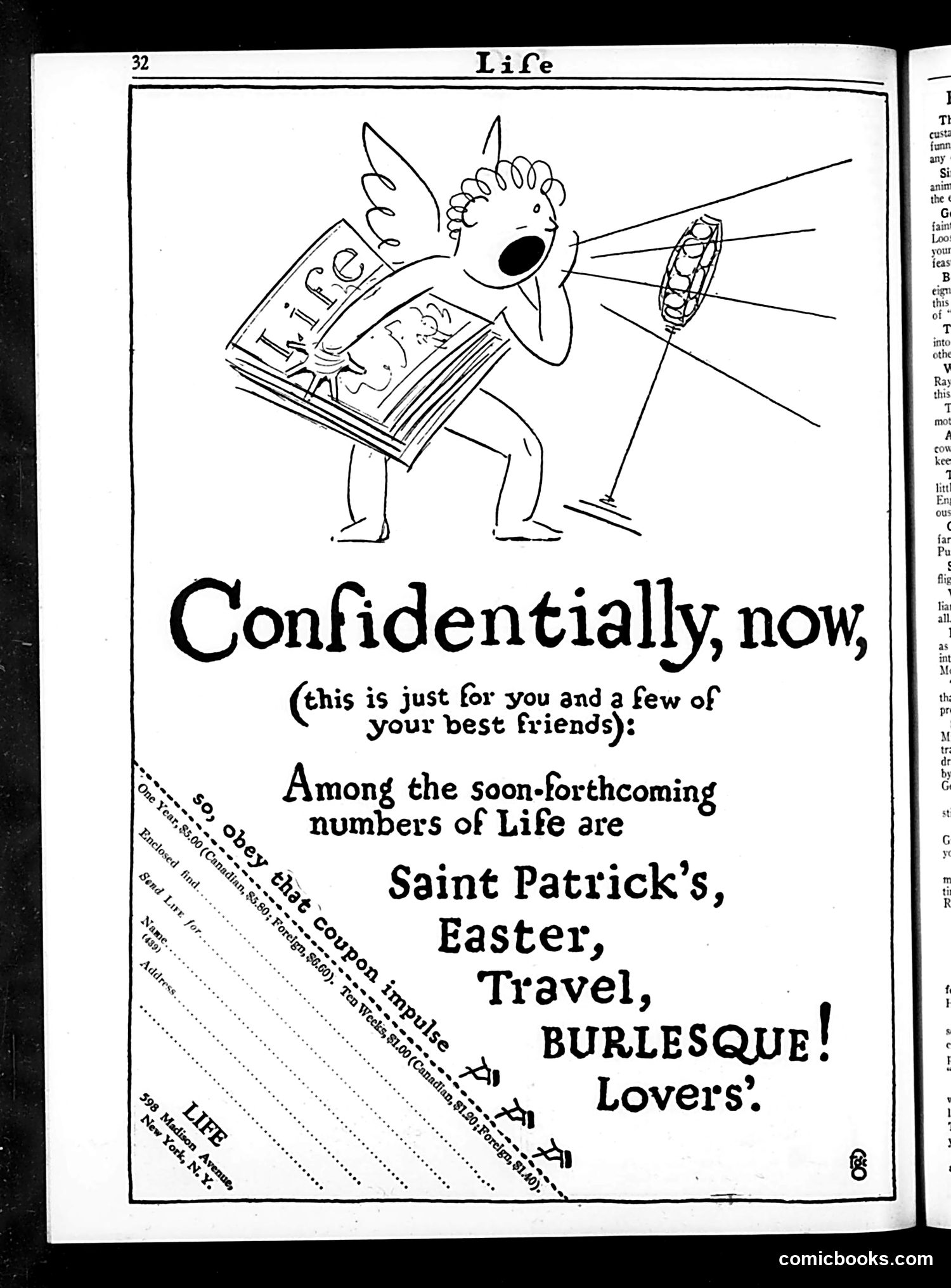
This is primarily an **advertisement** for upcoming issues of *Life* magazine. The cartoon shows an excited, winged figure clutching a magazine labeled "LIFE" while operating what appears to be a telescope or viewing device—likely satirizing how readers eagerly anticipate new issues. The ad promotes five forthcoming themed editions: Saint Patrick's Day, Easter, Travel, Burlesque, and "Lovers'" issues. The phrase "Confidentially, now (this is just for you and a few of your best friends)" uses mock-conspiratorial language to create urgency and exclusivity around these special issues. The humor lies in treating magazine releases like closely-guarded secrets, and the juxtaposition of religious holidays (Saint Patrick's, Easter) with entertainment-focused content (Burlesque, Lovers'), reflecting *Life*'s approach as a satirical general-interest magazine covering diverse topics with irreverent humor.
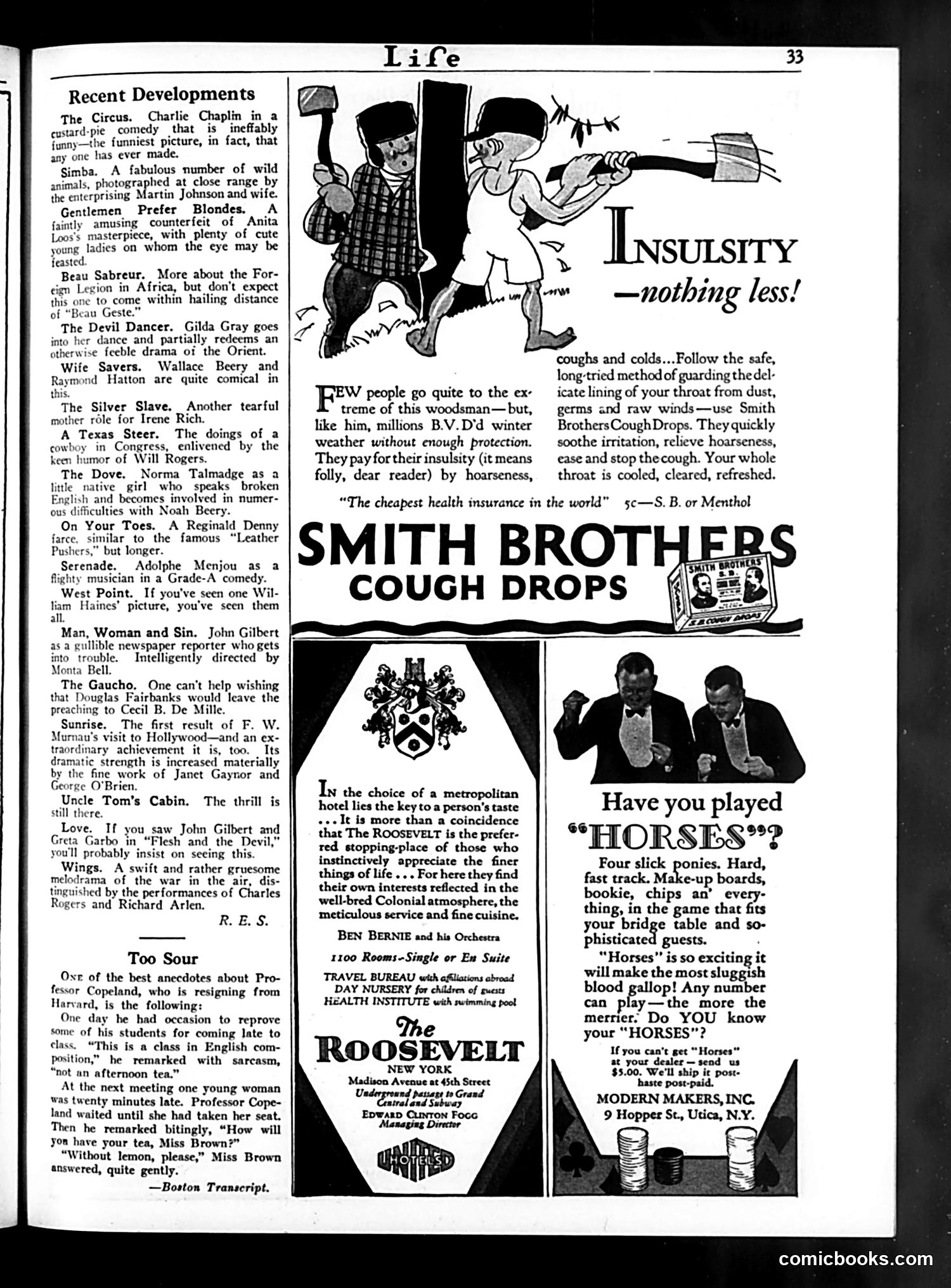
This is primarily **a movie review column and advertisements** from the 1920s. The "Recent Developments" section reviews current films, several starring famous actors like Charlie Chaplin, Greta Garbo, and Douglas Fairbanks. The reviews are brief and sardonic—typical of Life magazine's satirical style. The main satirical content is a small anecdote called "Too Sour" about **Professor Copeland of Harvard**, mocking his pretentious sarcasm toward late students. When he insults a tardy student by comparing class to "afternoon tea," she calmly responds by asking for tea "without lemon," turning his sarcasm back on him—a gentle joke about comeuppance. The rest of the page features **period advertisements**: Smith Brothers cough drops (using a cartoonish woodsman), the Roosevelt Hotel in New York, and "Horses" board game. These ads reflect 1920s consumer culture and are presented straightforwardly, not satirically.
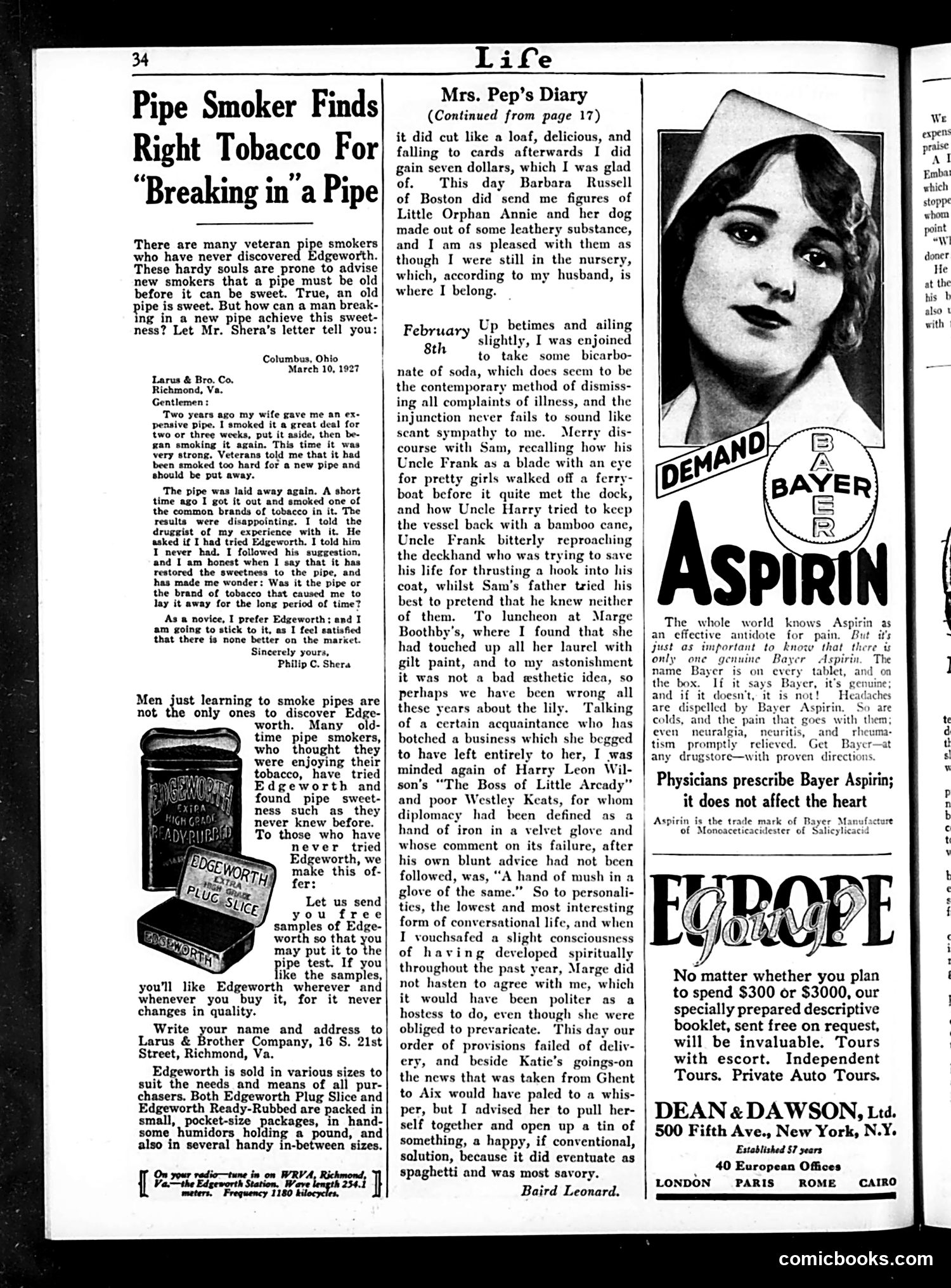
This page contains two distinct elements: **Left side:** An advertisement for Edgeworth pipe tobacco, presenting a testimonial letter from a satisfied customer claiming the tobacco "broke in" his new pipe successfully. The ad uses a common marketing technique: customer endorsement suggesting the product solves a specific problem (making new pipes smokable without the traditional long aging period). **Right side:** "Mrs. Pep's Diary," a humorous social column documenting genteel domestic life. The February 8th entry contains gentle satire of upper-class leisure: the writer mentions gaining money at cards, receiving Little Orphan Annie figurines as gifts (treating them as nursery items despite adult ownership), and anecdotes about eccentric relatives—including Uncle Frank's reckless ferry-boat incident and Uncle Harry's absurd attempt to stop it with a bamboo cane. The humor relies on deadpan understatement and mild mockery of wealthy society's pretensions. The diary also advertises Bayer Aspirin, reflecting the era's heavy advertising throughout editorial content.
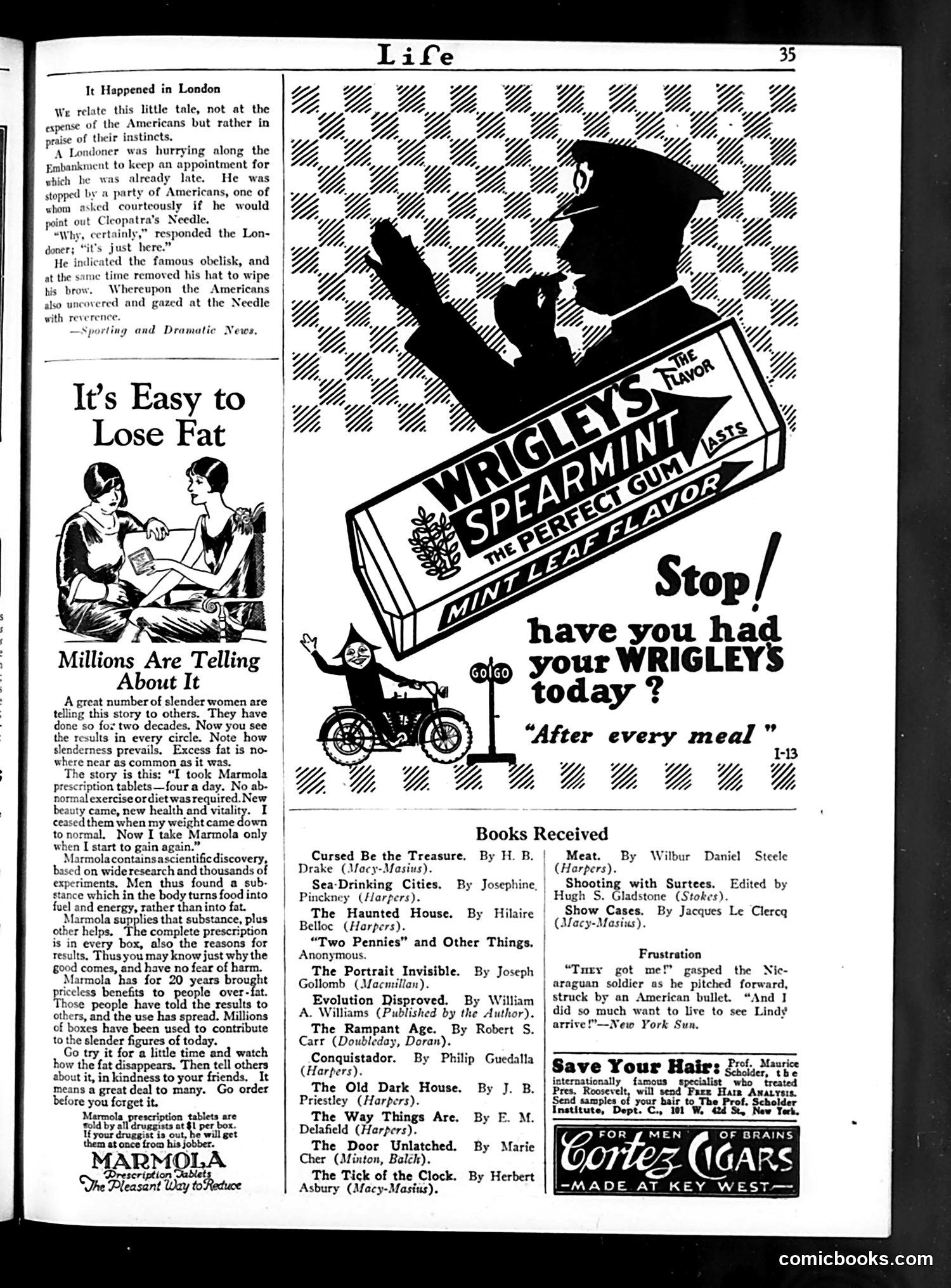
This page contains two main satirical pieces: **"It Happened in London"** mocks American tourists abroad. A hurried Londoner stops to point out Cleopatra's Needle (an ancient Egyptian obelisk on London's Embankment). When he removes his hat to wipe his brow, the American tourists respectfully uncover their heads, treating the monument with reverence. The joke: Americans show more respect for foreign antiquities than locals do—satirizing both American earnestness and British indifference to cultural treasures. **"It's Easy to Lose Fat"** advertises Marmola tablets, a weight-loss product marketed to women. The ad claims millions have used it successfully for 20 years with no exercise or diet needed. This reflects 1920s-30s attitudes about women's appearance and the era's unregulated diet-pill market (many such products were ineffective or dangerous). The page also includes book reviews and advertisements for Wrigley's gum and Cortes cigars typical of the period.
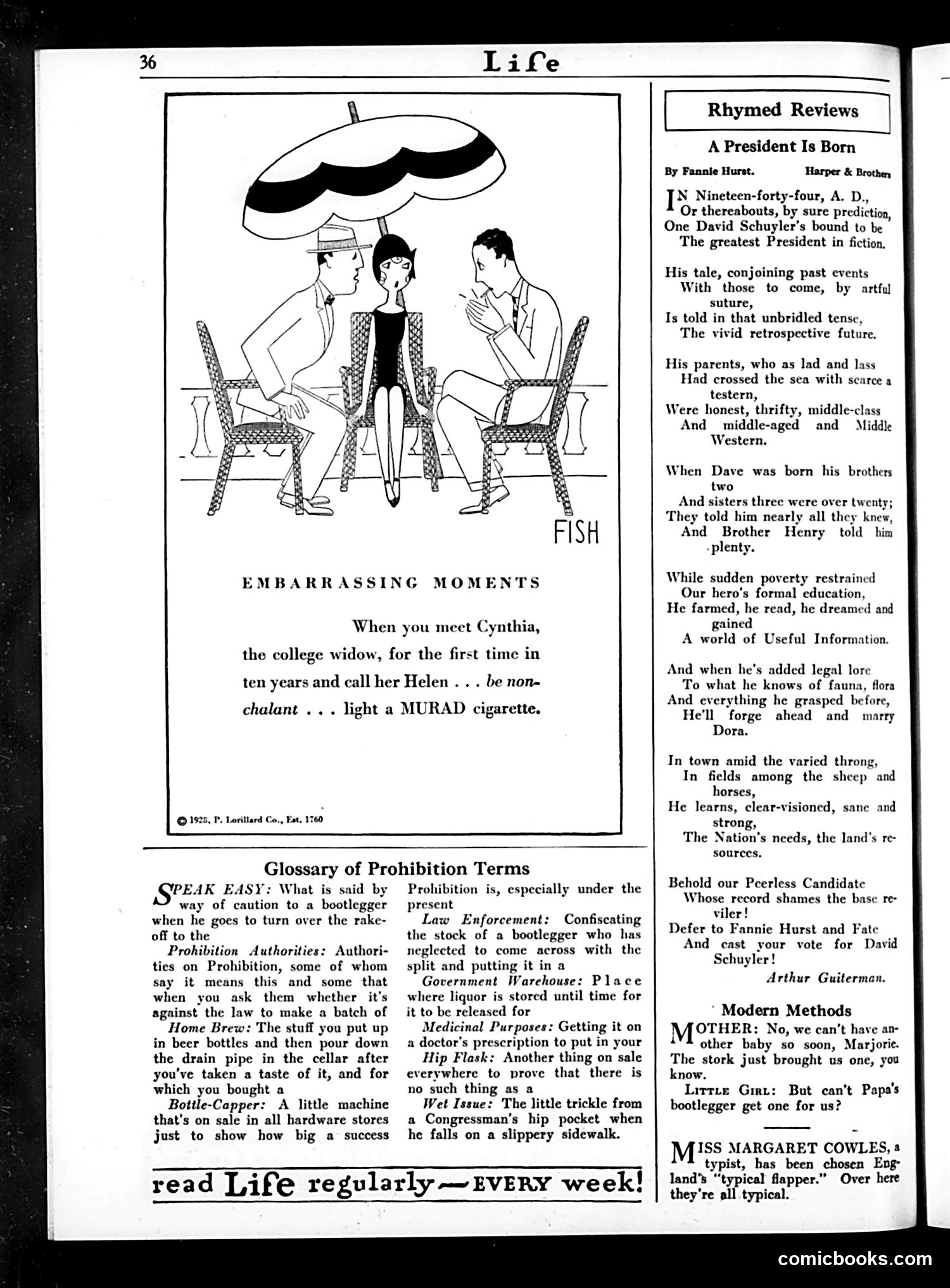
This 1925 *Life* magazine page satirizes Prohibition-era America through multiple pieces: **Main Cartoon ("Embarrassing Moments"):** Shows three people under an umbrella. The caption jokes about social awkwardness—meeting someone after a decade and forgetting their name—solved by coolly lighting a MURAD cigarette (product placement/advertising). **"Glossary of Prohibition Terms":** A cynical humor piece mocking Prohibition's failure. It defines terms like "Law Enforcement" as confiscating bootleggers' stock, "Government Warehouse" as where seized liquor is stored (implying it's later released), and "Wet Issue" as liquor leaking from a congressman's hip flask. The satire suggests Prohibition authorities are corrupt and the law is widely flouted. **"A President Is Born" (Book Review):** A poem reviewing Fannie Hurst's novel about an idealized future president (David Schuyler). It's earnest promotional verse about a farmboy who learns to lead. **"Modern Methods":** A brief joke where a child asks if her father's bootlegger can obtain a baby, suggesting black-market bootleggers can procure anything during Prohibition. The page captures 1920s cynicism about Prohibition's ineffectiveness.
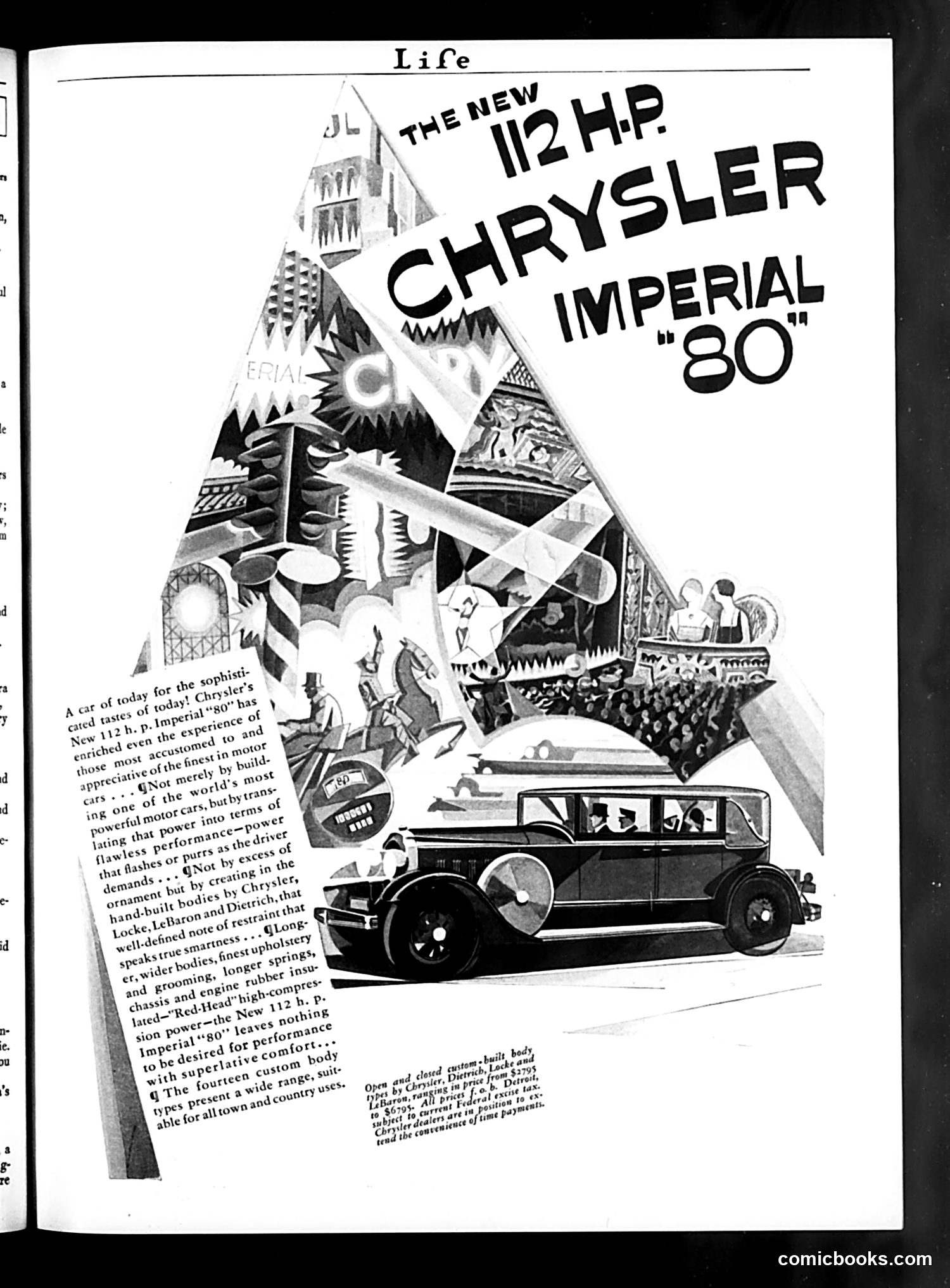
This is a **Chrysler automobile advertisement**, not political satire or editorial cartoon. The page promotes the "New 112 H.P. Chrysler Imperial '80'" with a large stylized illustration showing the car alongside an ornate, fantastical tower or structure filled with decorative architectural and mechanical imagery. The tower appears designed to visually convey luxury, sophistication, and engineering prowess—metaphorically "building" the car's prestige. The accompanying text emphasizes the vehicle's performance features: 112 horsepower, advanced engineering, quality craftsmanship by named designers (Locke, Lebaron, Dietrich), and comfort amenities. The "Imperial '80" designation references the model name. This is a straightforward commercial advertisement typical of 1920s-30s magazines, using elaborate visual metaphor to market automotive luxury rather than containing editorial satire or political commentary.
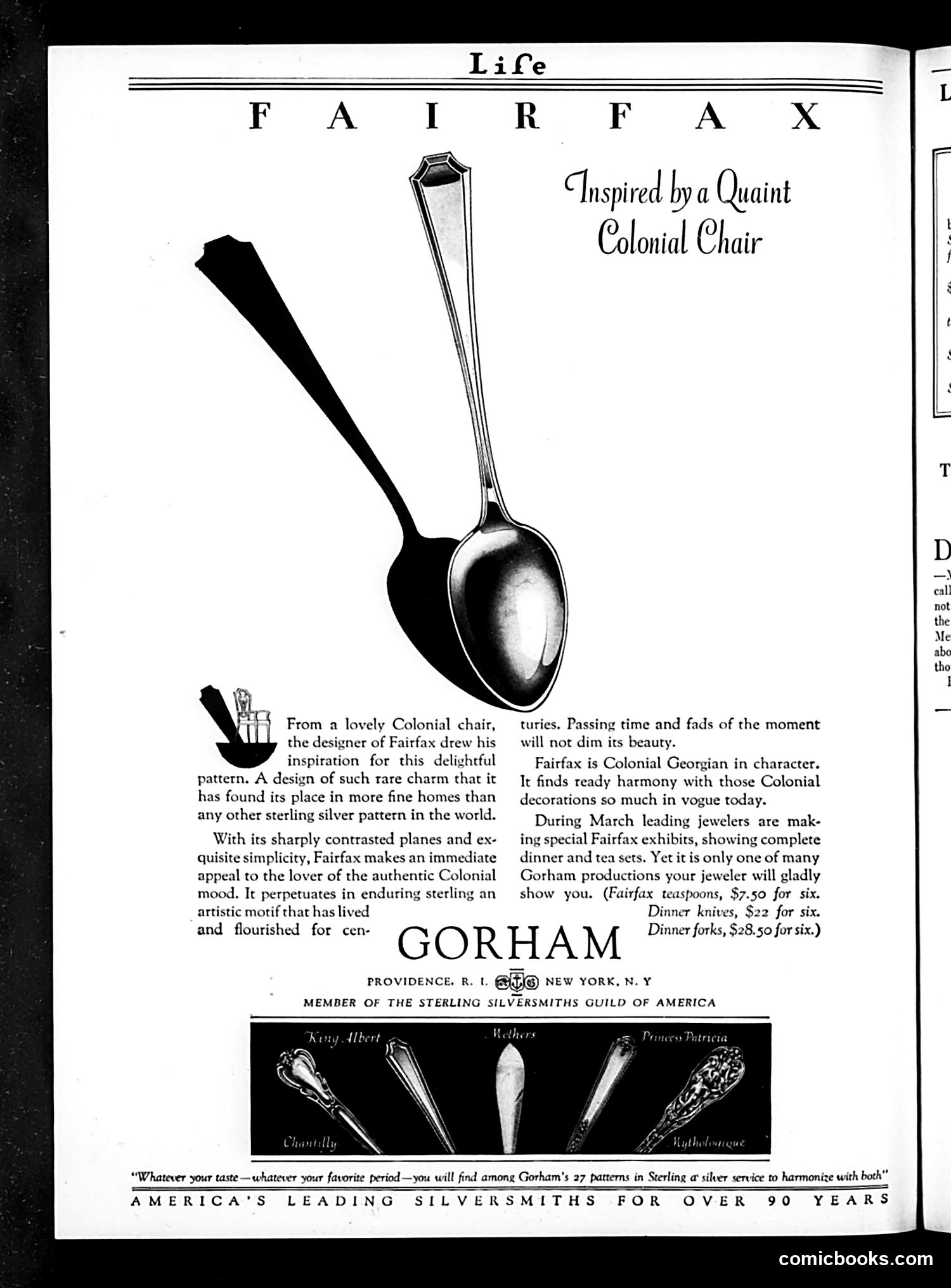
This is not a political cartoon but a **full-page advertisement** for Gorham silverware, a major American manufacturer. The "Fairfax" pattern shown is a sterling silver spoon design inspired by Colonial Georgian furniture design. The ad appeals to early 20th-century consumer taste by marketing "authentic Colonial" aesthetics as timeless and sophisticated—the text claims the pattern appears in "more fine homes than any other sterling silver pattern in the world." The Colonial Revival style was fashionable among affluent Americans during this era. The large spoon illustration dominates the layout, with pricing for matching pieces (teaspoons, dinner knives, forks). At bottom, smaller utensils from competing Gorham patterns are displayed. The tagline emphasizes product variety: 27 patterns available to match any decorative preference. This represents aspirational marketing directed at middle- to upper-class households seeking prestigious tableware aligned with period revival aesthetics.
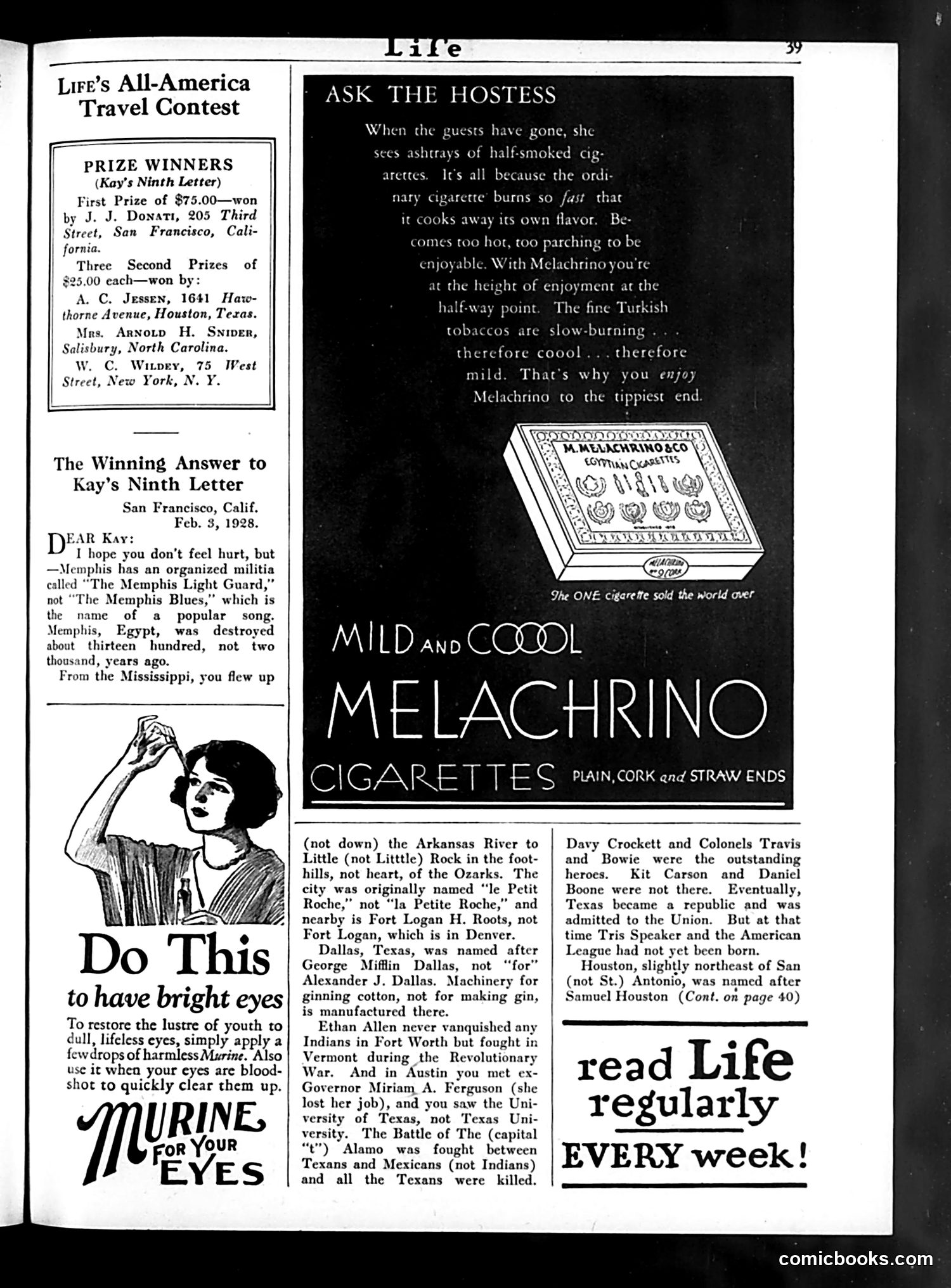
This page primarily contains **advertisements and contest results** rather than political satire. The main content includes: **Contest Section:** Life magazine ran a travel trivia contest where readers answered geography questions about America. The "winning answer" shown corrects factual errors about Texas and Tennessee locations—for example, clarifying that Memphis, Tennessee (not Egypt) was the reference, and that Little Rock sits in foothills, not the heart of the Ozarks. **Advertisements:** The page features two product ads: Murine eye drops (promising to restore youthful brightness to dull eyes) and Melachrino cigarettes (emphasizing they burn slowly and stay cool, with a drawing of a woman applying eye drops as visual humor about bright eyes). The satirical element is minimal—mainly the irony of promoting "bright eyes" while advertising cigarettes on the same page. This reflects 1920s advertising practices before health warnings existed.
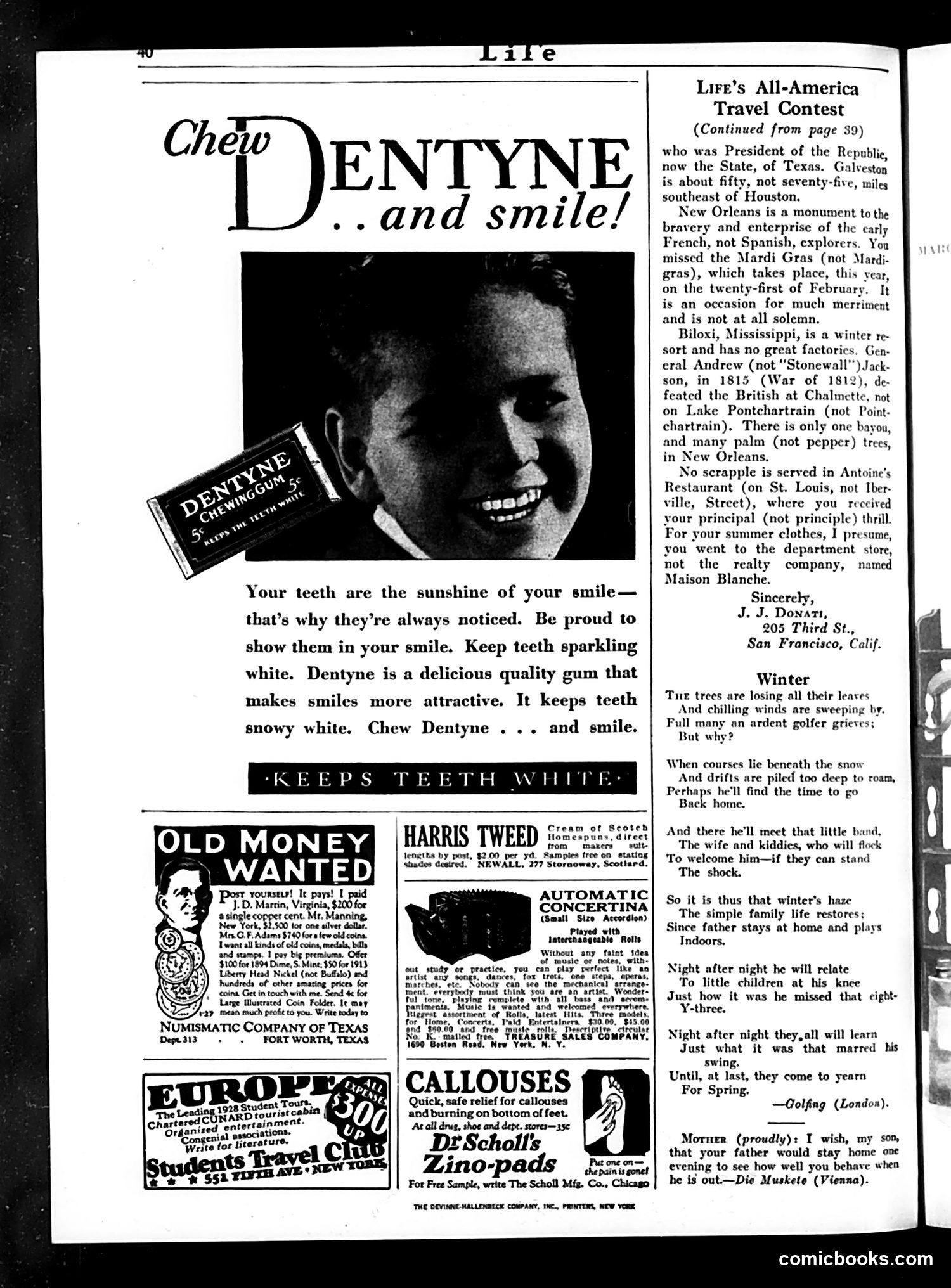
This page is primarily **advertising with editorial content**, not political satire or comics. The main feature is a **Dentyne chewing gum advertisement** using a smiling man's face to promote teeth whitening. The tagline "Chew Dentyne and smile" connects dental hygiene to attractiveness—typical early 20th-century consumer marketing linking products to personal appeal. The page also contains: - **"Old Money Wanted"** ad: a coin dealer seeking rare coins/currency - **Harris Tweed** fabric samples advertisement - **Automatic Concertina** (accordion-like instrument) ad - Various other consumer product ads (callus relief, travel services) - **Editorial section**: "Life's All-America Travel Contest" correcting a reader's answers about Southern US geography and landmarks (Galveston, New Orleans, Mardi Gras, etc.) - **Poetry section** titled "Winter" about a golfer forced indoors There is **no political cartoon or satire** on this page. It's a standard 1920s-era magazine page mixing commercial advertising with light editorial content.