
Life, 1928-03-01 · page 25 of 42
Life — March 1, 1928 — page 25: what you’re looking at
What you’re looking at
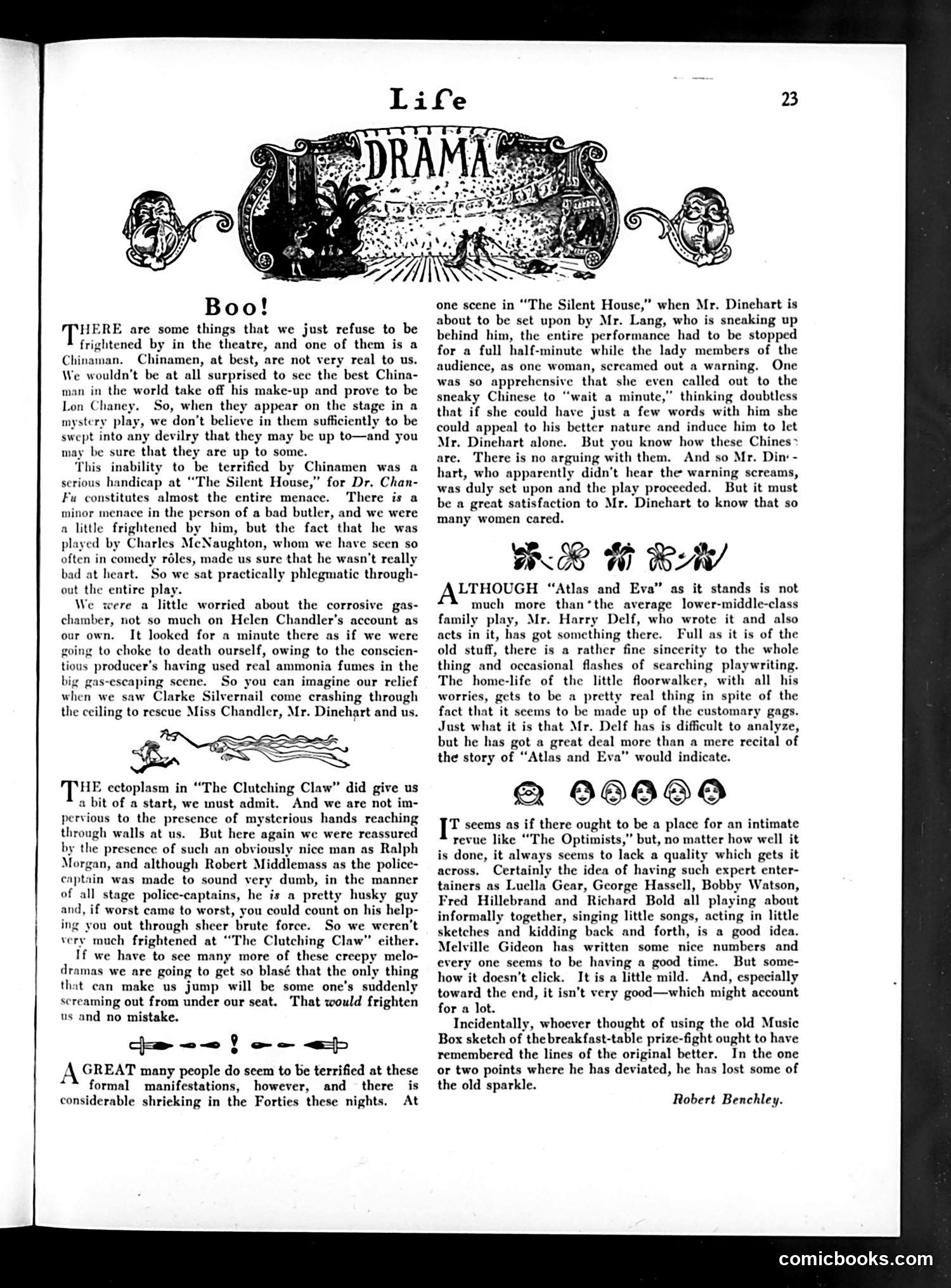
This theater review critiques three Broadway plays with satirical observations about audience psychology and racial attitudes. The author dismisses the menace of Chinese villains in "The Silent House," asserting that audiences won't find them genuinely threatening because they assume any convincing Chinese character must be actor Lon Chaney in makeup. This reflects early 20th-century skepticism about Asian performers' authenticity in American theater. The review notes the irony when female audience members screamed warnings to the villain, even appealing to his "better nature"—satirizing how emotion overrides logic in theater-goers. For "The Clutching Claw," the critic finds supernatural horror (ectoplasm, mysterious hands) less frightening than expected, reassured by the presence of capable male actors like Ralph Morgan who could "help you out through sheer brute force." The author concludes these melodramas are losing their power to frighten jaded audiences—a commentary on shifting theatrical tastes in the Jazz Age.
📄 Transcribed text from this page (OCR, searchable)
Machine-transcribed from the original scan — historical spelling and the odd misread are preserved.
THERE are some things that we just refuse to be frightened by in the theatre, and one of them is a Chinaman. Chinamen, at best, are not very real to us. We wouldn't be at all surprised to see the best China- man in the world take off his make-up and prove to be Lon Chaney. So, when they appear on the stage in a mystery play, we don’t believe in them sufficiently to be swept into any devilry that they may be up to—and you may be sure that they are up to some. This inability to be terrified by Chinamen was a serious handicap at “The Silent House,” for Dr. Chan- Fu constitutes almost the entire menace. There is a minor menace in the person of a bad butler, and we were a little frightened by him, but the fact that he was played by Charles McNaughton, whom we have seen so often in comedy réles, made us sure that he wasn’t really bad at heart. So we sat practically phlegmatic through- out the entire play. We were a little worried about the corrosive gas- chamber, not so much on Helen Chandler's account as our own. It looked for a minute there as if we were going to choke to death ourself, owing to the conscien- tious producer’s having used real ammonia fumes in the big gas-escaping scene. So you can imagine our relief when we saw Clarke Silvernail come crashing through the ceiling to rescue Miss Chandler, Mr. Dinehart and us. HE ectoplasm in “The Clutching Claw” did give us a bit of a start, we ust admit. And we are not im- pervious to the presence of mysterious hands reaching through walls at us. But here again we were reassured by the presence of such an obviously nice man as Ralph Morgan, and although Robert Middlemass as the police- aptain was made to sound very dumb, in the manner of all stage police-captains, he is a pretty husky guy and, if worst came to worst, you could count on his help- i ou out through sheer brute force. So we weren't very much frightened at “The Clutching Claw” either. If we have to see many more of these creepy melo- dramas we are going to get so blasé that the only thing that can make us jump will be some one’s suddenly screaming out from under our seat. That would frighten us and no mistake. Cpe mm § oe = GREAT many people do seem to be terrified at these formal manifestations, however, and there is considerable shrieking in the Forties these nights. At one scene in “The Silent House,” when Mr. Dinehart is about to be set upon by Mr. Lang, who is sneaking up behind him, the entire performance had to be stopped for a full half-minute while the lady members of the audience, as one woman, screamed out a warning. One was so apprehensive that she even called out to the sneaky Chinese to “wait a minute,” thinking doubtless that if she could have just a few words with him she could appeal to his better nature and induce him to let Mr. Dinehart alone. But you know how these Chines> are. There is no arguing with them. And so Mr. Din: - hart, who apparently didn’t hear the warning screams, was duly set upon and the play proceeded. But it must be a great satisfaction to Mr. Dinehart to know that so many women cared. WW BAY LTHOUGH “Atlas and Eva” as it stands is not much more than‘the average lower-middle-class family play, Mr. Harry Delf, who wrote it and also acts in it, has got something there. Full as it is of the old stuff, there is a rather fine sincerity to the whole thing and occasional flashes of searching playwriting. The home-life of the little floorwalker, with all his worries, gets to be a pretty real thing in spite of the t it seems to be made up of the customary gags. Just what it is that Mr. Delf has is difficult to analyze, but he has got a great deal more than a mere recital of the story of “Atlas and Eva” would indicate. AQ B8OHHOH It seems as if there ought to be a place for an intimate revue like “The Optimists,” but, no matter how well it is done, it always seems to lack a quality which gets it across. Certainly the idea of having such expert enter- tainers as Luella Gear, George Hassell, Bobby Watson, Fred Hillebrand and Richard Bold all playing about informally together, singing little songs, acting in little sketches and kidding back and forth, is a good idea. Melville Gideon has written some nice numbers and every one seems to be having a good time. But some- how it doesn’t click. It is a little mild. And, especially toward the end, it isn’t very good—which might account for a lot. Incidentally, whoever thought of using the old Music Box sketch of the breakfast-table prize-fight ought to have remembered the lines of the original better. In the one or two points where he has deviated, he has lost some of the old sparkle. Robert Benchley. comicbooks.com