
Life, 1928-03-01 · page 20 of 42
Life — March 1, 1928 — page 20: what you’re looking at
What you’re looking at
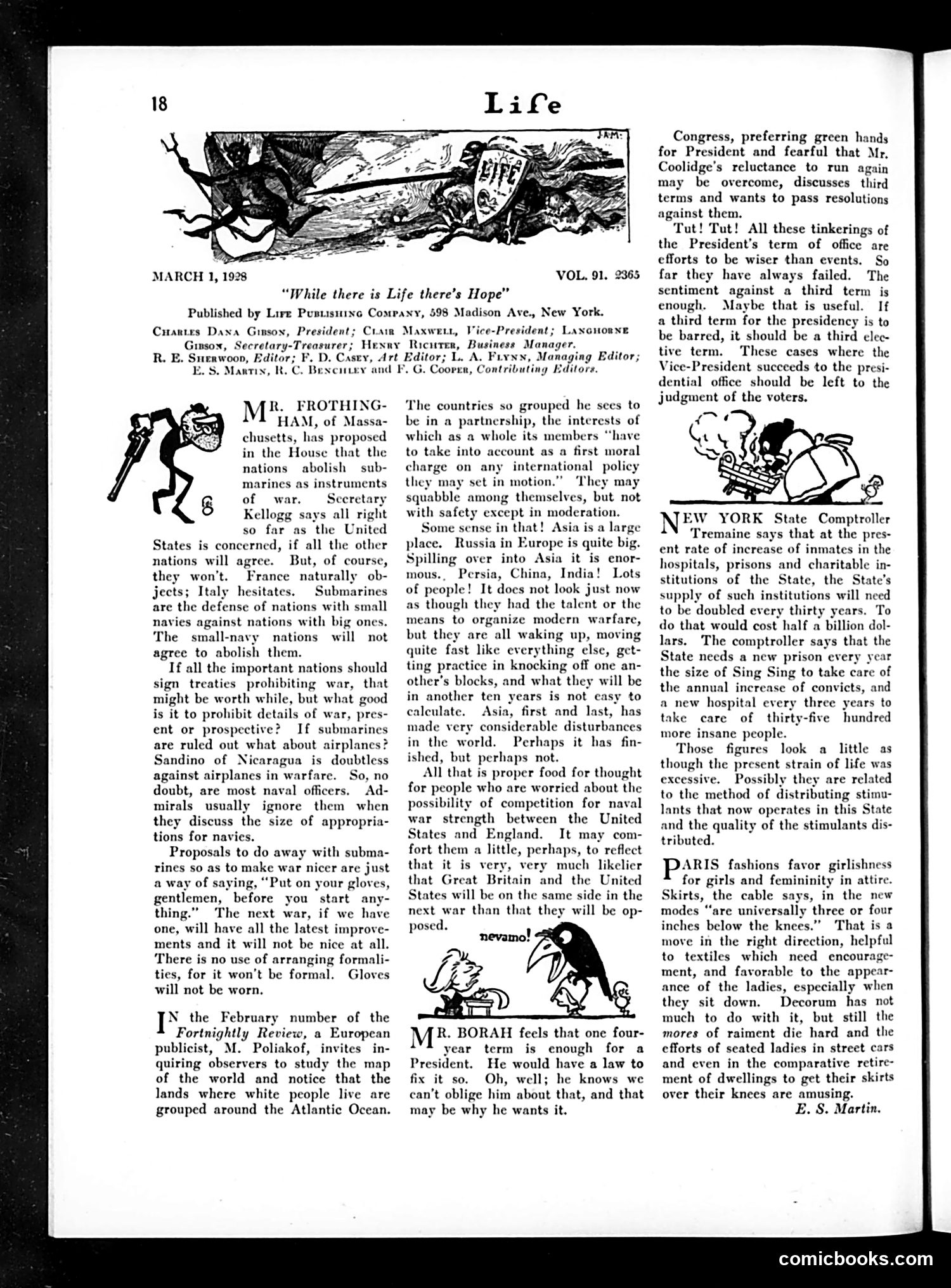
This page contains satirical editorials typical of *Life* magazine's political commentary. The main topics are: **Submarine abolition proposal**: Rep. Frothingham proposed banning submarines. The editor mocks this as naïve—nations won't agree, especially smaller ones who rely on subs against larger navies. The satire: proposing "rules" for war (like gentlemen wearing gloves) is pointless when future wars will use all available weapons. **Atlantic partnership theory**: M. Poliakof (European publicist) suggested white Atlantic nations should partner strategically. The editor finds merit in this given Asia's rising power, though he notes Asia has historically caused "considerable disturbances." **Presidential term limits**: Senator Borah wants a one-term limit; Congress opposes it fearing Coolidge might run again. The editor dismisses these constitutional debates as futile efforts to "be wiser than events." The cartoons (unclear in detail) appear to illustrate these points visually. The overall tone: political tinkering cannot prevent future conflicts or control history's trajectory.
📄 Transcribed text from this page (OCR, searchable)
Machine-transcribed from the original scan — historical spelling and the odd misread are preserved.
VOL, 91. 2365 “While there is Life there’s Hope” Published by Lire Puntisuinc Company, 598 Madison Ave., New York. Cuartes Dana Ginson, President; Cram Maxw Ginsox, Secretary-Treasurer; Hexny D. Casey, Art E Sexcurey and F. G. Cooper, Contributing R. E. Suerwoon, Editor; » Martin, B.C. R. FROTHING- HAM, of Massa- chusetts, has proposed in the House that the nations abolish sub- marines as instruments of war, Sceretary Kellogg says all right so far as the United States is concerned, if all the other nations will agree. But, of course, they won't. France naturally ob- jects; Italy hesitates. Submarines are the defense of nations with small navies against nations with big ones. The small-navy nations will not agree to abolish them. If all the important nations should sign treaties prohibiting war, that might be worth while, but what good is it to prohibit details of war, pres- ent or prospective? If submarin are ruled out what about airplanes? Sandino of Nicaragua is doubtless against airplanes in warfare. So, no doubt, are most naval officers. Ad- mirals usually ignore them when they discuss the size of appropria- tions for navies. Proposals to do away with subma- rines so as to make war nicer are just a way of saying, “Put on your gloves, gentlemen, before you start any- thing.” The next war, if we have one, will have all the latest improve- ments and it will not be nice at all. ‘There is no use of arranging formali- ties, for it won't be formal. Gloves will not be worn. N the February number of the Fortnightly Review, a European publicist, M. Poliakof, invites in- quiring observers to study the map of the world and notice that the lands where white people live are grouped around the Atlantic Ocean. Vice-President; Laxcnonxe Business. Manager. itor; L. A. Fuxx~, Managing Editor; itors. The countries so grouped he sees to be in a partnership, the interests of which as a whole its members “have to take into account as a first moral charge on any international policy they may set in motion.” They may squabble among themselves, but not with safety except in moderation. Some sense in that! A: a large place. Russia in Europe is quite big. Spilling over into Asia it is enor- mous., Persia, China, India! Lots of people! It does not look just now as though they had the talent or the means to organize modern warfare, but they are all waking up, moving quite fast like everything else, get- ting practice in knocking off one an- other's blocks, and what they will be in another ten years is not casy to calculate. Asia, first and last, has made very considerable disturbances in the world. Perhaps it has fin- ished, but perhaps not. All that is proper food for thought for people who are worried about the possibility of competition for naval war strength between the United States and England. It may com- fort them a little, perhaps, to reflect that it very, very much likelier that Great Britain and the United States will be on the same side in the next war than that they will be op- posed. \f R. BORAH feels that one four- year term is enough for a President. He would have a law to fix it so. Oh, well; he knows we can't oblige him about that, and that may be why he wants it. Congress, preferring green hands for President and fearful that Mr, Coolidge’s reluctance to run again may be overcome, discusses third terms and wants to pass resolutions against them. Tut! Tut! All these tinkerings of the President’s term of office are efforts to be wiser than events. So far they have always failed. The sentiment against a third term is enough. Maybe that is useful. If a third term for the presidency is to be barred, it should be a third elec- ive te’ These cases where the President succeeds to the presi- dential office should be left to the judgment of the voters. EW YORK State Comptroller Tremaine says that at the pres- ent rate of increase of inmates in the hospitals, prisons and charitable in- stitutions of the State, the State's supply of such institutions will need to be doubled every thirty years. To do that would cost half a billion dol- lars. The comptroller says that the State needs a new prison every the size of Sing Sing to take care of the annual increase of convicts, and a new hospital every three years to take care of thirty-five hundred more insane people. Those figures look a little as though the present strain of life was excessive. Possibly they are related to the method of distributing stimu- lants that now operates in this State and the quality of the stimulants dis- tributed. ARIS fashions favor girlishness for girls and femininity in attire. Skirts, the cable says, in the new modes “are universally three or four inches below the knees.” That is a move in the right direction, helpful to textiles which need encourage- ment, and favorable to the appear- ance of the ladies, especially when they sit down. Decorum has not much to do with it, but still the mores of raiment die hard and the efforts of seated ladies in street cars and even in the comparative retire- ment of dwellings to get their skirts over their knees are amusing. E. S. Martin. comicbooks.com