
Life, 1928-03-01 · page 13 of 42
Life — March 1, 1928 — page 13: what you’re looking at
What you’re looking at
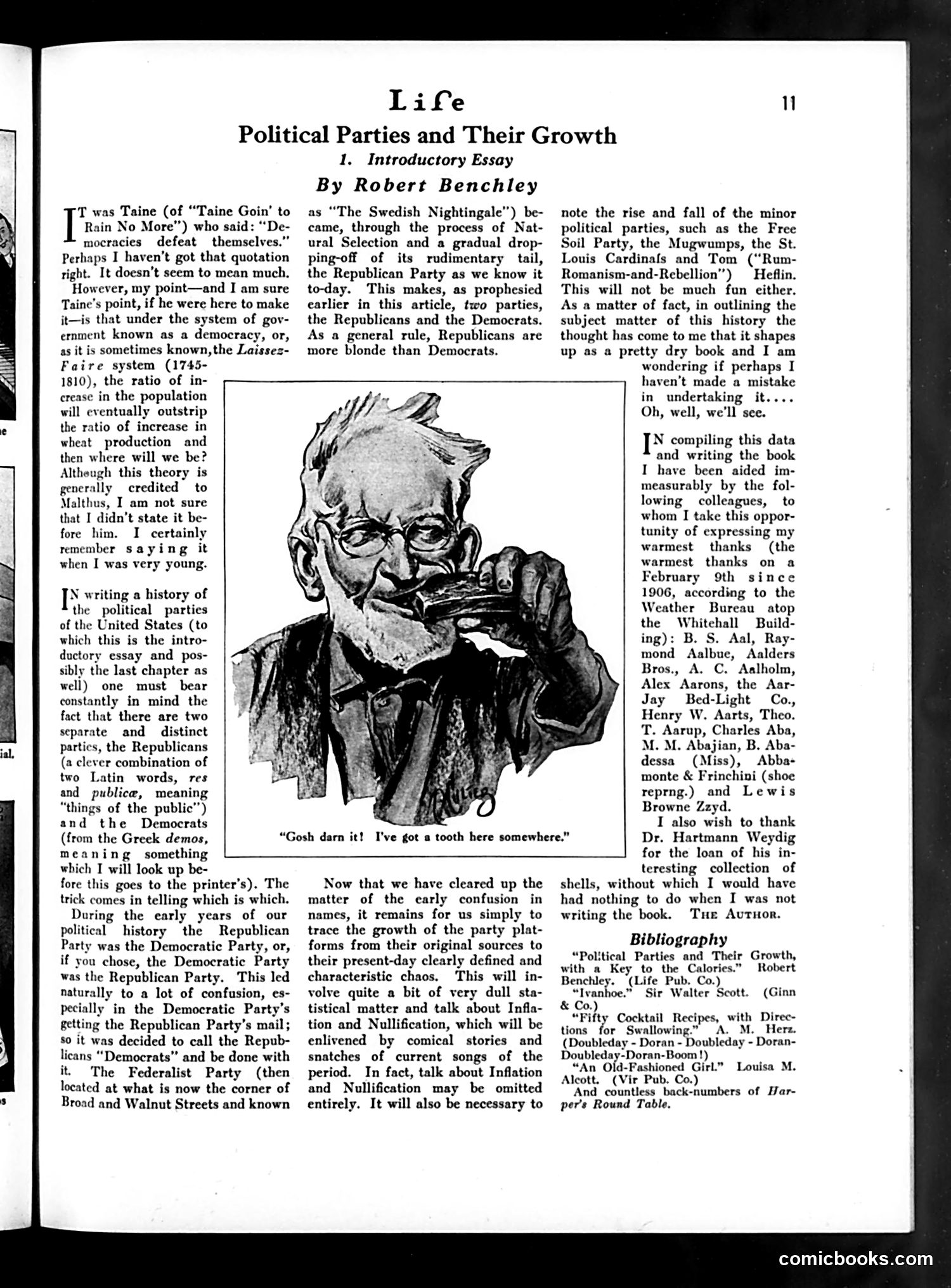
This page introduces Robert Benchley's essay on American political parties. The central cartoon depicts an elderly man with glasses examining his own mouth, captioned "Gosh darn it! I've got a tooth here somewhere." The image appears to be **political satire about aging party systems**—likely representing an elderly Republican or Democratic Party struggling to maintain relevance or find its core principles. The "missing tooth" metaphor suggests the party has lost something essential, or perhaps searches uselessly for identity. Benchley's text discusses how Republicans and Democrats emerged from earlier parties (Federalists, Democratic-Republicans), with Republicans being "more blonde than Democrats"—a curious racial characterization typical of early 20th-century satire. The essay promises to trace these parties' evolution and clarify their distinctions.
📄 Transcribed text from this page (OCR, searchable)
Machine-transcribed from the original scan — historical spelling and the odd misread are preserved.
e Life Political Parties and Their Growth Rain No More’) who said: “‘De- mocracies defeat themselves.” Perhaps I haven't got that quotation right. It doesn’t seem to mean much. However, my point—and I am sure Taine’s point, if he were here to make it—is that under the system of gov- ernment known as a democracy, or, as it is sometimes known, the Laissez- Faire system (1745- I was Taine (of “Taine Goin’ to 1. Introductory Essay By Robert Benchley as “The Swedish Nightingale”) be- came, through the process of Nat- ural Selection and a gradual drop- ping-off of its rudimentary tail, the Republican Party as we know it to-day. This makes, as prophesied earlier in this article, two parties, the Republicans and the Democrats. As a general rule, Republicans are more blonde than Democrats. note the rise and fall of the minor political parties, such as the Free Soil Party, the Mugwumps, the St. Louis Cardinals and Tom (“Rum- Romanism-and-Rebellion”) Heflin. This will not be much fun either. As a matter of fact, in outlining the subject matter of this history the thought has come to me that it shapes up as a pretty dry book and I am wondering if perhaps I haven’t made a mistake 1810), the ratio of in- crease in the population will eventually outstrip the ratio of increase in wheat production and then where will we be? Altheugh this theory is generally credited to Malthus, I am not sure that I didn’t state it be- fore him. I certainly remember saying it when I was very young. N writing a history of the political parties of the United States (to which this is the intro- ductory essay and pos- sibly the last chapter as well) one must bear constantly in mind the fact that there are two separate and _ distinct parties, the Republicans (a clever combination of two Latin words, res and publice, meaning “things of the public’’) and the Democrats [ (from the Greek demos, meaning something “Gosh darn it! which I will look up be- fore this goes to the printer's). The trick comes in telling which is which. During the early years of our political history the Republican Party was the Democratic Party, or, if you chose, the Democratic Party was the Republican Party. This led naturally to a lot of confusion, es- pecially in the Democratic Party’s getting the Republican Party’s mail; so it was decided to call the Repub- licans “Democrats” and be done with it. The Federalist Party (then located at what is now the corner of Broad and Walnut Streets and known Now that we have cleared up the matter of the carly confusion in names, it remains for us simply to trace the growth of the party plat- forms from their original sources to their present-day clearly defined and characteristic chaos. This will in- volve quite a bit of very dull sta- tistical matter and talk about Infla- tion and Nullification, which will be enlivened by comical stories and snatches of current songs of the period. In fact, talk about Inflation and Nullification may be omitted entirely. It will also be necessary to T've got a tooth here somewhere.” in undertaking it.... Oh, well, we'll see. IX compiling this data and writing the book I have been aided im- measurably by the fol- lowing colleagues, to whom I take this oppor- tunity of expressing my warmest thanks (the warmest thanks on a February 9th since 1906, according to the Weather Bureau atop the Whitehall Build- ing): B. S. Aal, Ray- mond Aalbue, Aalders Bros., A. C. Aalholm, Alex Aarons, the Aar- Jay Bed-Light Co., Henry W. Aarts, Theo. T. Aarup, Charles Aba, M. M. Abajian, B. Aba- dessa (Miss), Abba- monte & Frinchini (shoe reprng.) and Lewis Browne Zzyd. I also wish to thank Dr. Hartmann Weydig for the loan of his in- teresting collection of shells, without which I would have had nothing to do when I was not writing the book. Tue Autuor. Bibliography “Political Parties and Their Growth, with a Key to the Calories.” Robert Benchley. (Life Pub. Co.) “Ivanhoe.” Sir Walter Scott. & Co.) “Fifty Cocktail Recipes, with Direc- tions for Swallowing.” A. M. Herz. (Doubleday - Doran - Doubleday - Doran- Doubleday-Doran-Boom!) “An Old-Fashioned Girl.” Alcott. (Vir Pub. Co.) And _ countless back-numbers of Har- pers Round Table, (Ginn Louisa M, comicbooks.com