
A complete issue · 48 pages · 1927
Life — October 20, 1927
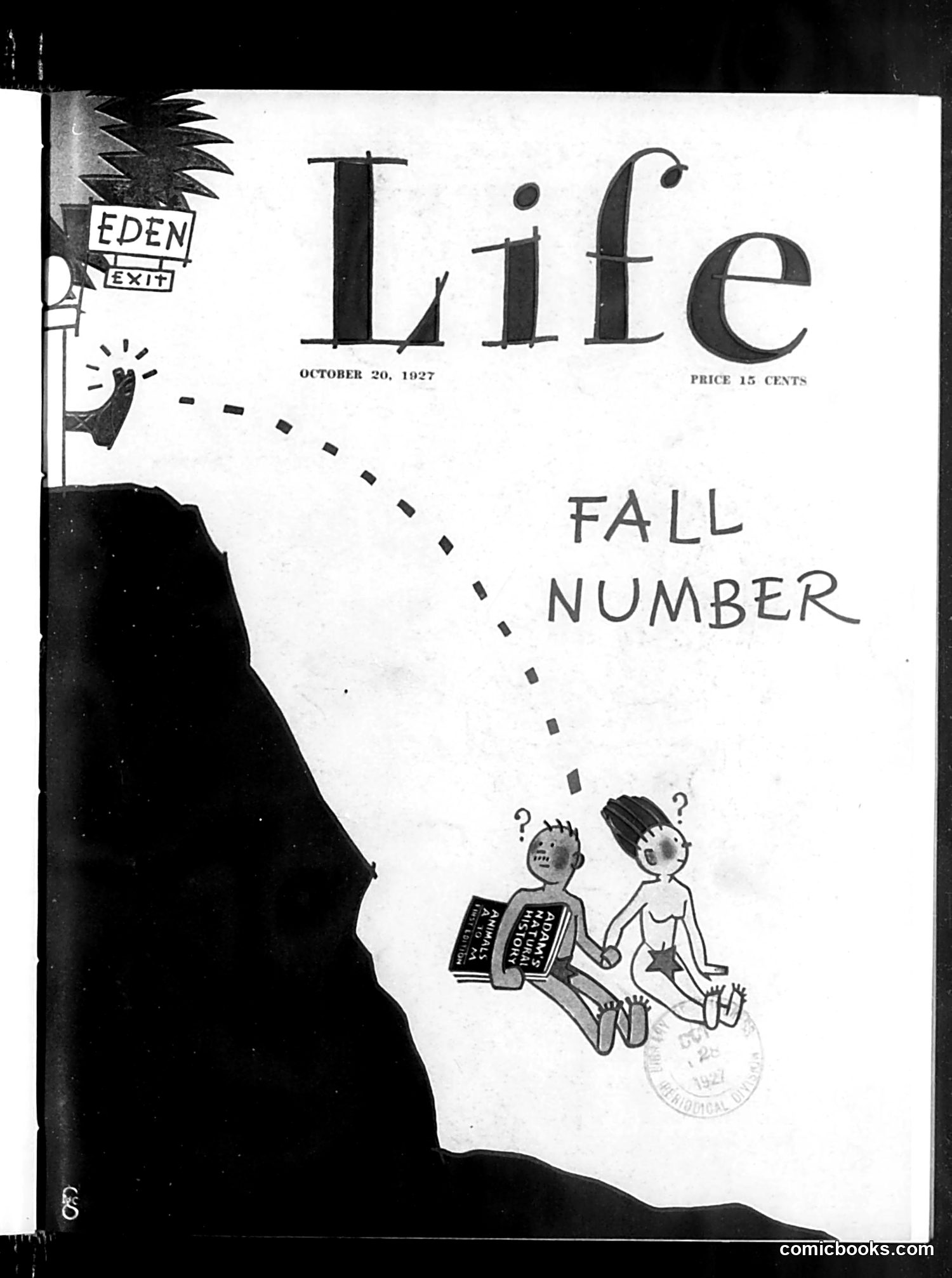
This is the **October 20, 1927 Fall issue** of Life magazine (price 15 cents). The cover depicts two figures sitting below the Garden of Eden, holding what appear to be **tablets inscribed with religious law** (likely the Ten Commandments), with **question marks above their heads**. A dashed line connects them upward to the Eden exit sign. The satire appears to address the tension between **religious tradition and modern secular life in 1920s America**. The figures seem confused about religious guidance in contemporary society—the questions and ambiguous path suggest anxiety about whether traditional religious authority remains relevant as society modernizes. This reflects broader 1920s cultural debates between fundamentalism and modernity.
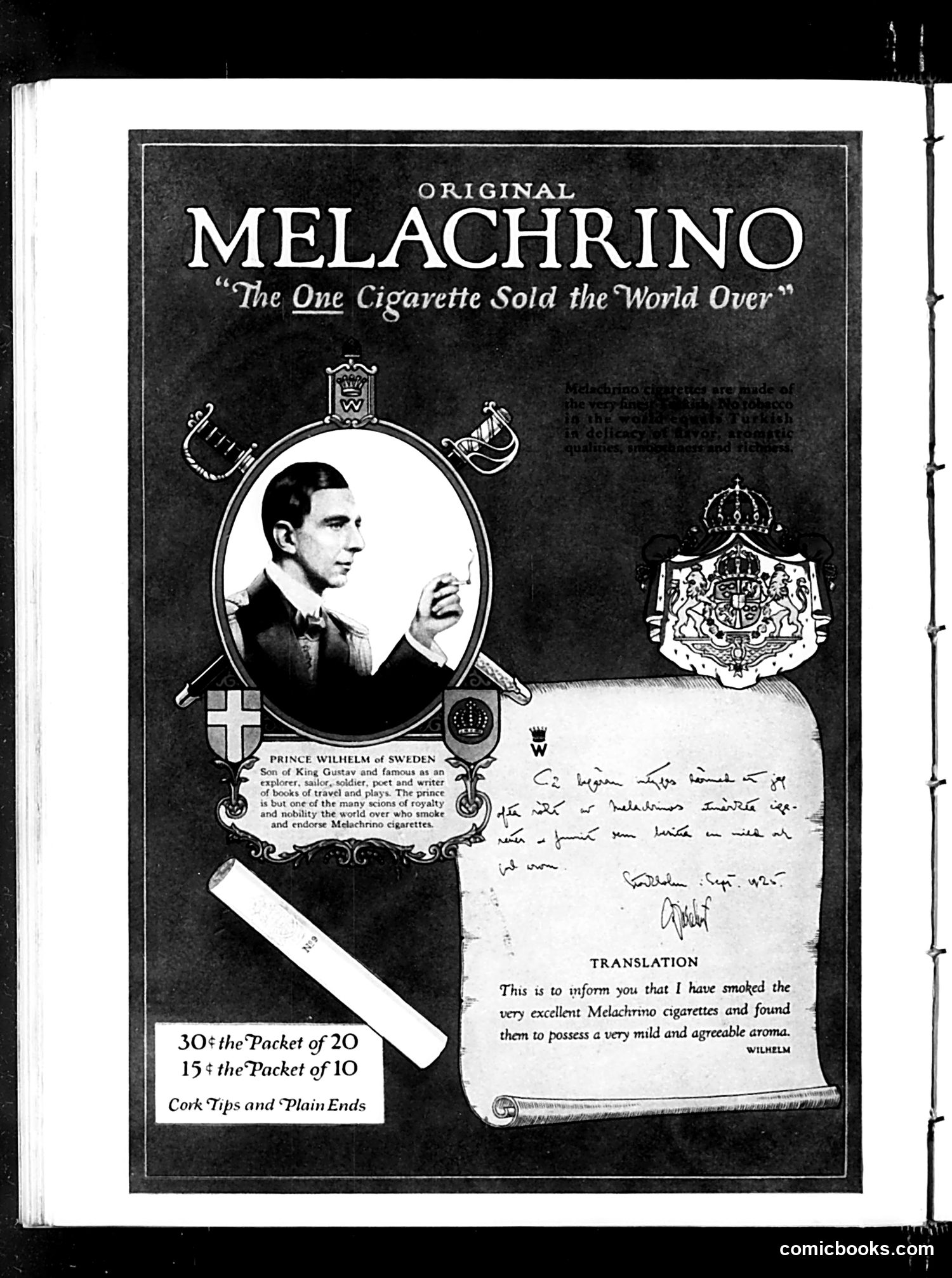
This is an **advertisement, not satire or political commentary**. It promotes Melachrino cigarettes using a royal endorsement strategy common in early 20th-century marketing. The central figure is **Prince Wilhelm of Sweden**, identified by the cross emblem and heraldic shields. The ad claims he is "known far and wide as an ardent lover of good books of travel and plays" and endorses Melachrino cigarettes, stating they possess "a very mild and agreeable aroma." A handwritten note (purporting to be from the Prince) is included as testimonial. The pricing shows 30¢ for twenty cigarettes, 15¢ for ten. This exploits royal prestige to market cigarettes—a now-banned advertising practice. Modern readers would recognize this as misleading celebrity endorsement and health-hazardous product promotion.
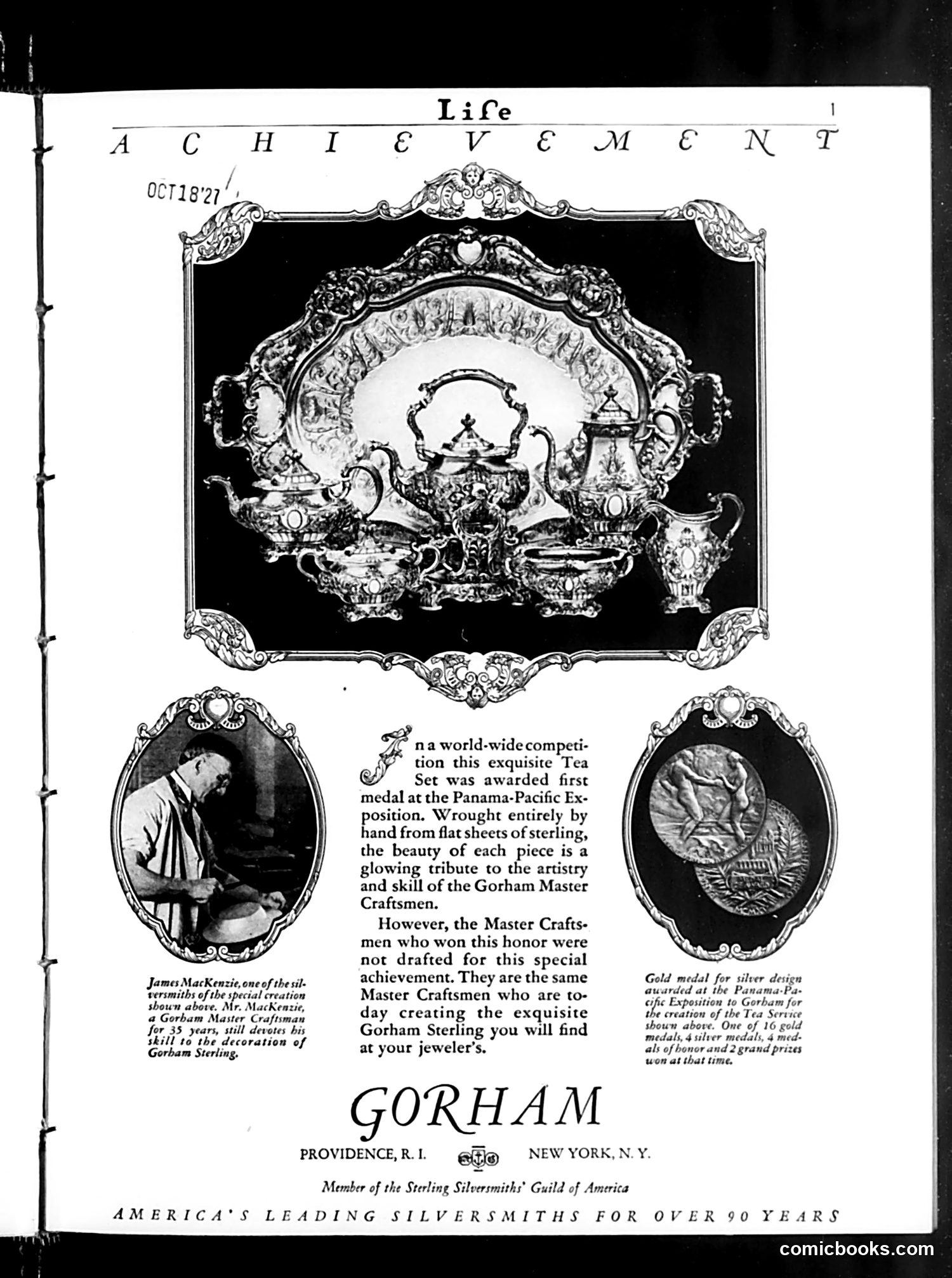
This is **primarily a Gorham silverware advertisement**, not satire or political commentary. The page showcases an ornate sterling silver tea service that won first medal in a world-wide competition at the Panama-Pacific Exposition. The images show: - **Top**: The elaborate tea service itself (teapot, kettle, serving pieces, decorative plate) - **Bottom left**: James MacKenzie, identified as one of the Gorham Master Craftsmen who created the piece - **Bottom right**: A commemorative medal awarded at the Panama-Pacific Exposition The text emphasizes these craftsmen's skill and the hand-wrought quality of the sterling silver work. This appears in *Life* magazine likely because such luxury goods were marketed to its affluent readership. It's commercial promotion dressed in prestige language, not satire.
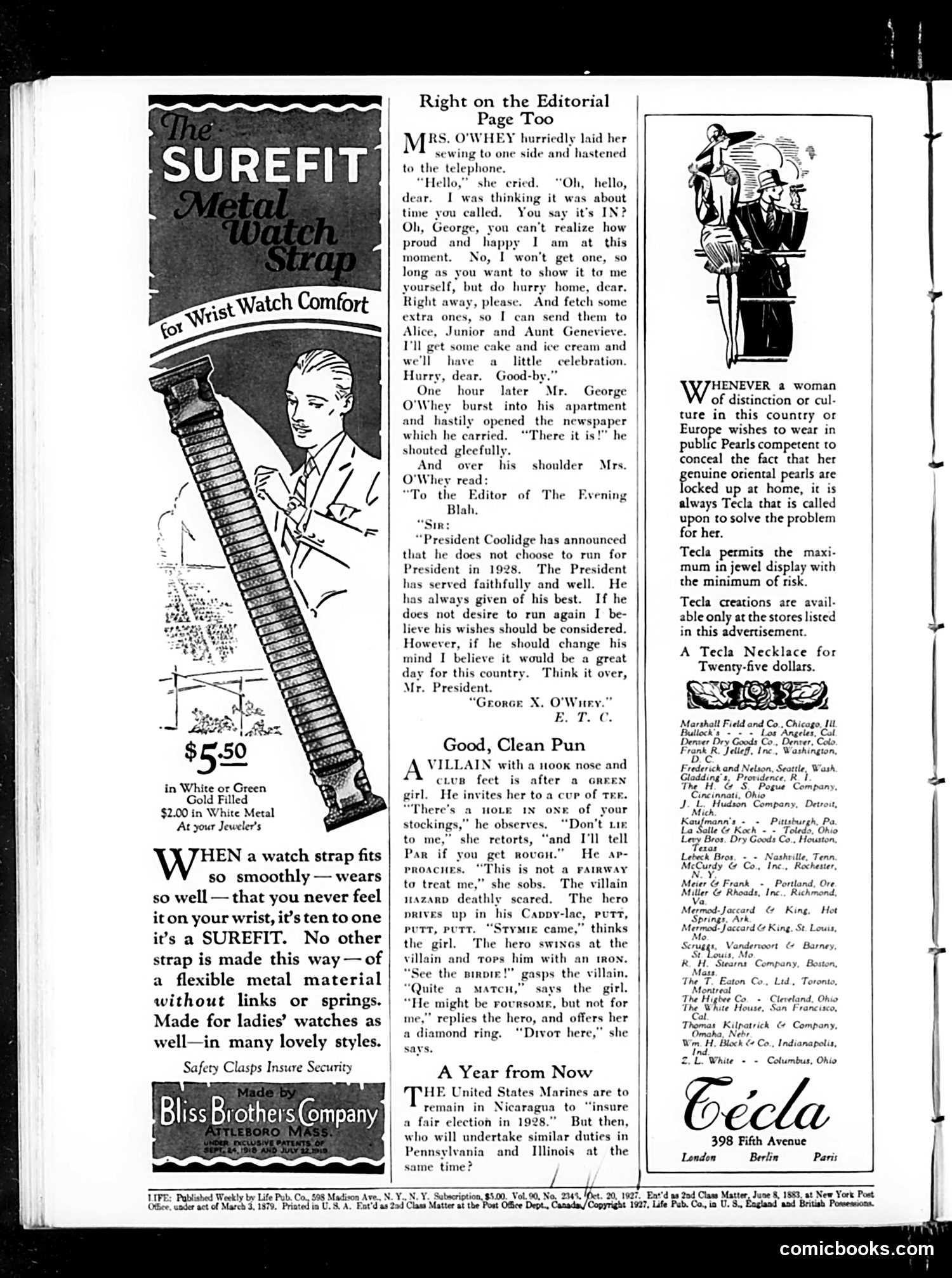
This page is primarily **advertising and light editorial content** from Life magazine (April 29, 1927). The main cartoon illustrates a humorous domestic scene where Mrs. O'Whey receives a telephone call from her husband George, who's excited about a newspaper article. The joke plays on marital dynamics—she's pragmatically unimpressed by his enthusiasm, more concerned with practical matters like fetching cake and ice cream for a family celebration. Below, a brief satirical piece titled "Good, Clean Pun" depicts a villain with a hook nose pursuing a girl, featuring crude physical comedy (the hero swings an iron at him). The page is dominated by advertisements: a **Surefit metal watch strap** (prominently featured) and **Tecla jewelry** (lower right). These ads reflect 1920s consumer culture and luxury goods marketing to middle-class readers.
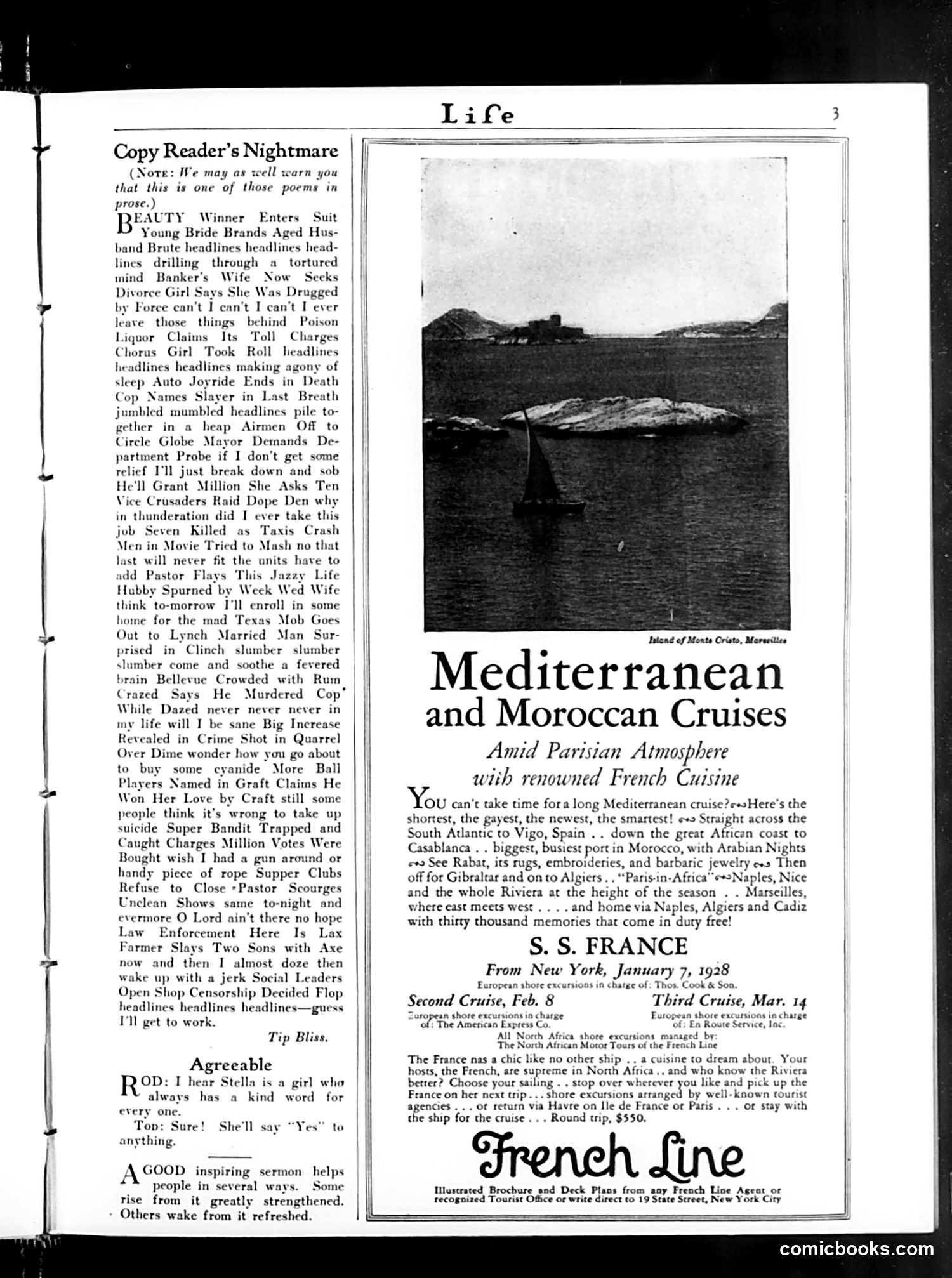
This page is primarily **advertising rather than satirical content**. The right side features a full-page advertisement for the S.S. France cruise ship, promoting Mediterranean and Moroccan voyages departing January 7, 1928. The left side contains: 1. **"Copy Reader's Nightmare"** — a humorous poem listing absurd newspaper headlines in rapid succession, satirizing sensationalist journalism and the chaos of newsroom production. 2. **"Agreeable"** and **"A Good Inspiring Sermon"** — brief, unrelated humorous anecdotes. The visual content appears to be a photograph of what the caption identifies as the "Island of Monte Cristo, Marseilles," accompanying the cruise advertisement. This is essentially a **travel advertisement with filler humor content**, typical of Life magazine's mixed editorial/commercial format of the 1920s.
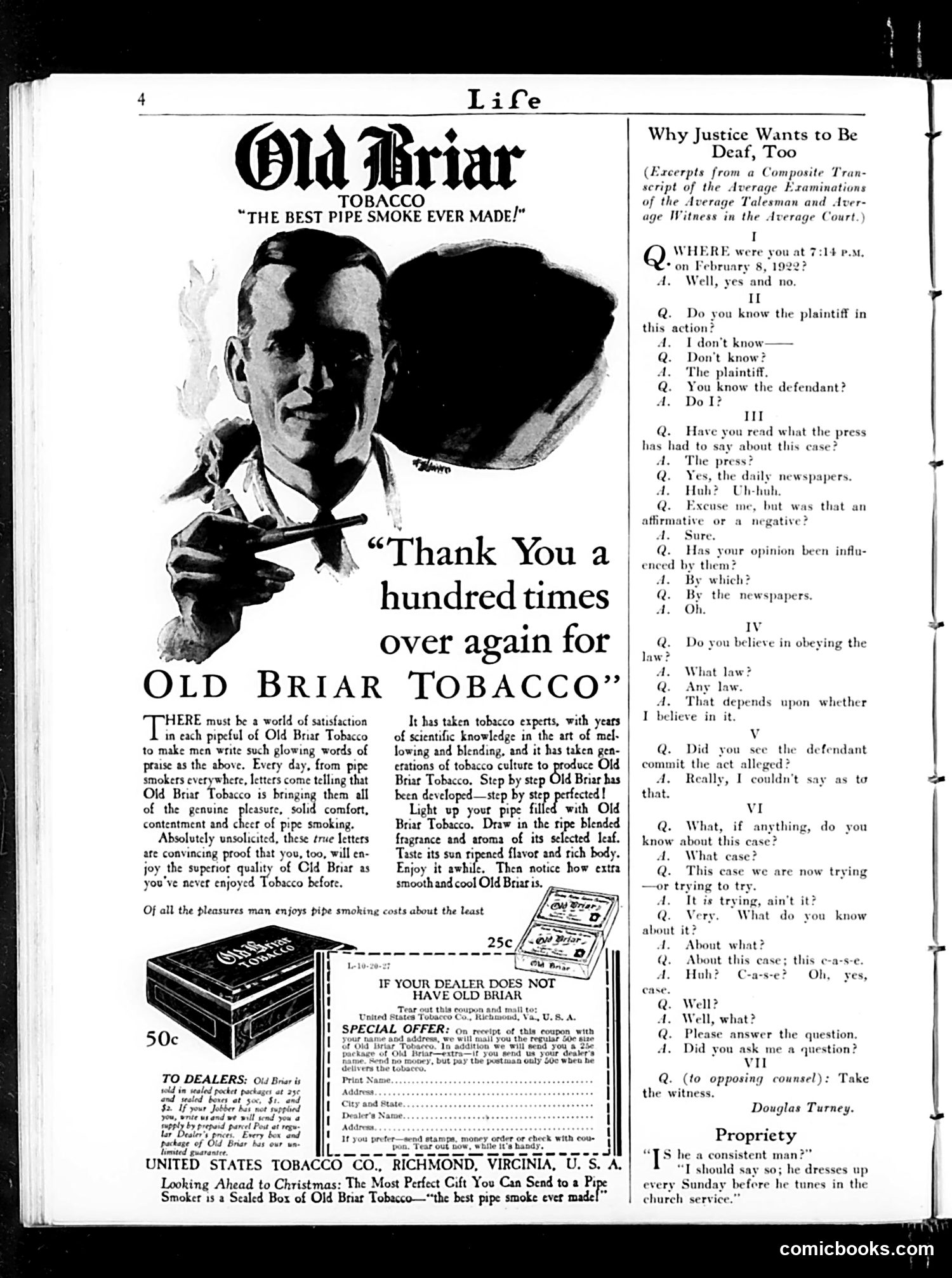
This page is primarily **commercial advertising** for Old Briar Tobacco, not political satire. The large left illustration shows a man smoking a pipe, endorsing the product with "Thank You a hundred times over again for OLD BRIAR TOBACCO." The right column contains **"Why Justice Wants to Be Deaf, Too"**—a legal satire featuring courtroom testimony excerpts. The humor mocks a witness's evasive, contradictory answers during cross-examination (claiming both "yes and no," admitting influence by newspapers, etc.). This is social satire about courtroom incompetence rather than political commentary. The page reflects early 20th-century Life magazine's mix of advertisements and light satirical commentary on everyday institutions and human behavior.
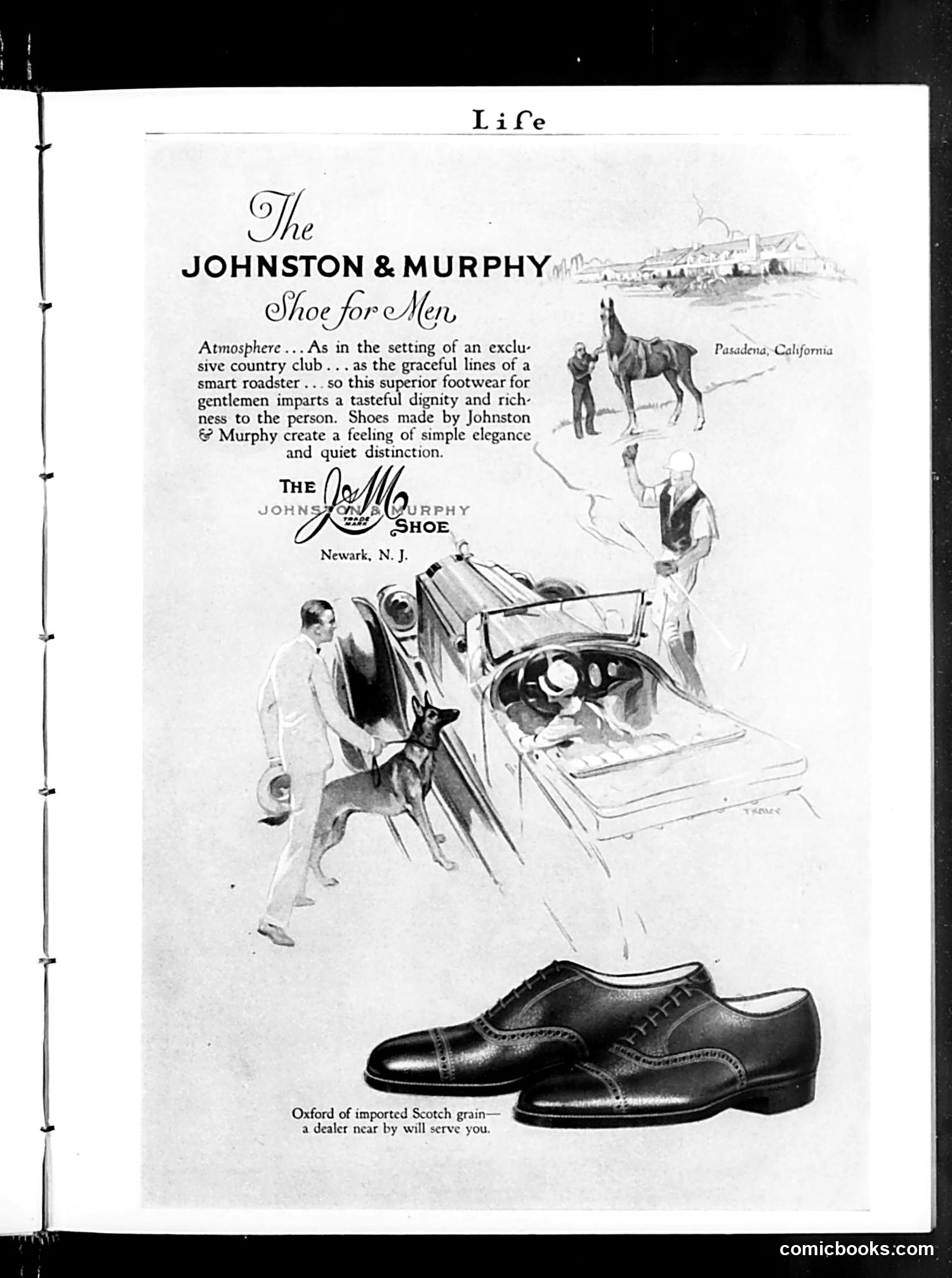
This is a straightforward **advertisement**, not satire or political commentary. The page advertises Johnston & Murphy shoes for men, marketed as elegant footwear conveying "tasteful dignity and richness." The ad uses aspirational imagery: a sketch of Pasadena, California (an upscale location), and illustrations of well-dressed men in leisure activities—one with a horse, another in an automobile—depicting wealth and leisure. This establishes the brand's association with affluent, refined gentlemen. The actual shoe (an Oxford style in imported Scotch grain leather) is shown at bottom. The messaging emphasizes that quality footwear signals social status and distinction—a common luxury marketing strategy of the era, targeting affluent male consumers who could afford premium shoes and the lifestyle they symbolized.
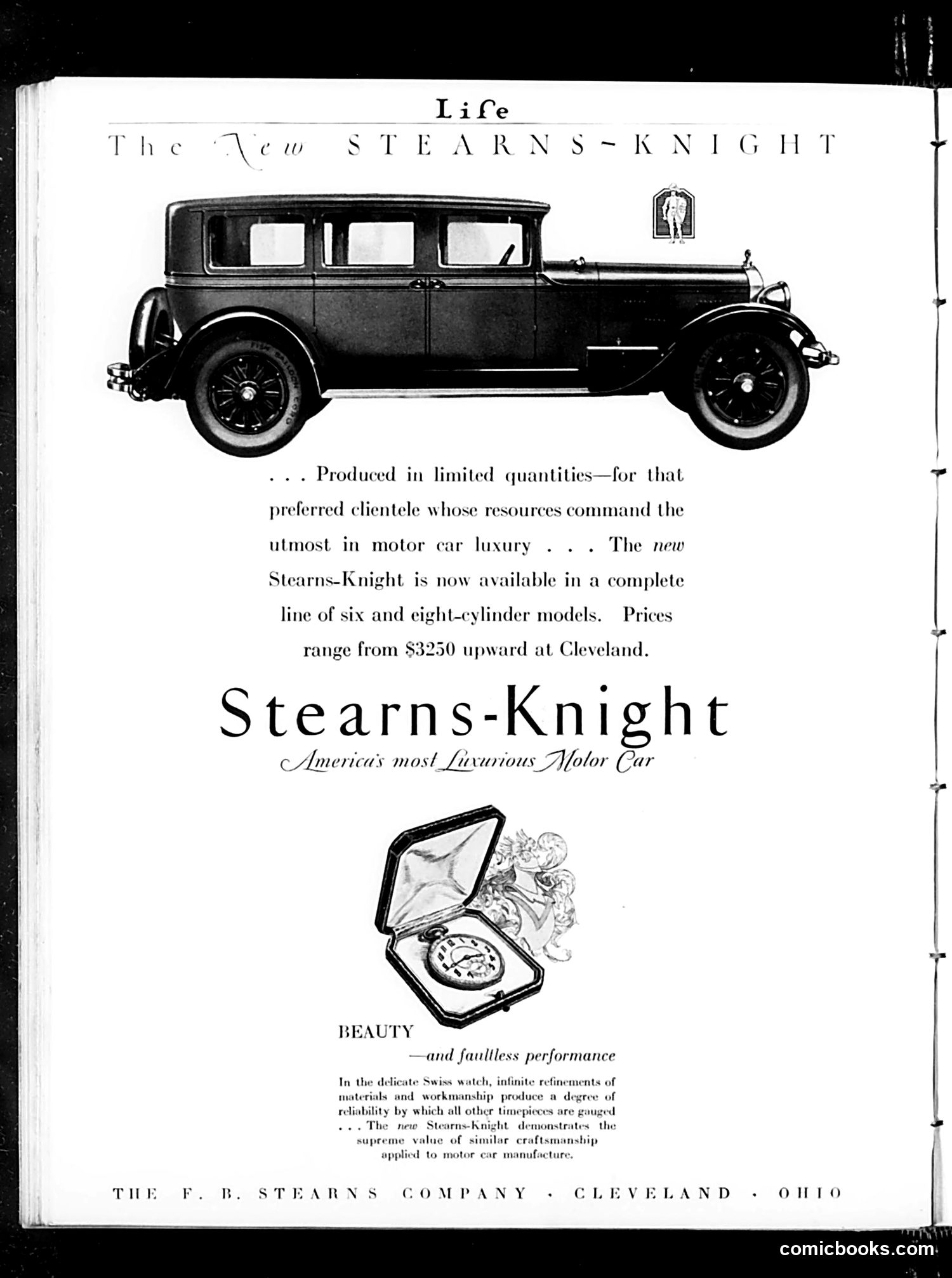
This is primarily a **luxury automobile advertisement**, not a political cartoon. The page features "The New Stearns-Knight," a high-end motor car produced by The F.B. Stearns Company of Cleveland, Ohio. The advertisement targets wealthy buyers, emphasizing exclusivity ("produced in limited quantities") and premium pricing (starting at $3,250—substantial in this era). The tagline calls it "America's most luxurious Motor Car." The Swiss watch imagery below reinforces the luxury message, comparing the car's craftsmanship to precision watchmaking. This is pure commercial messaging aimed at affluent readers of *Life* magazine, with no satirical or political content visible. The page exemplifies how early 20th-century magazines mixed editorial content with upscale advertising.
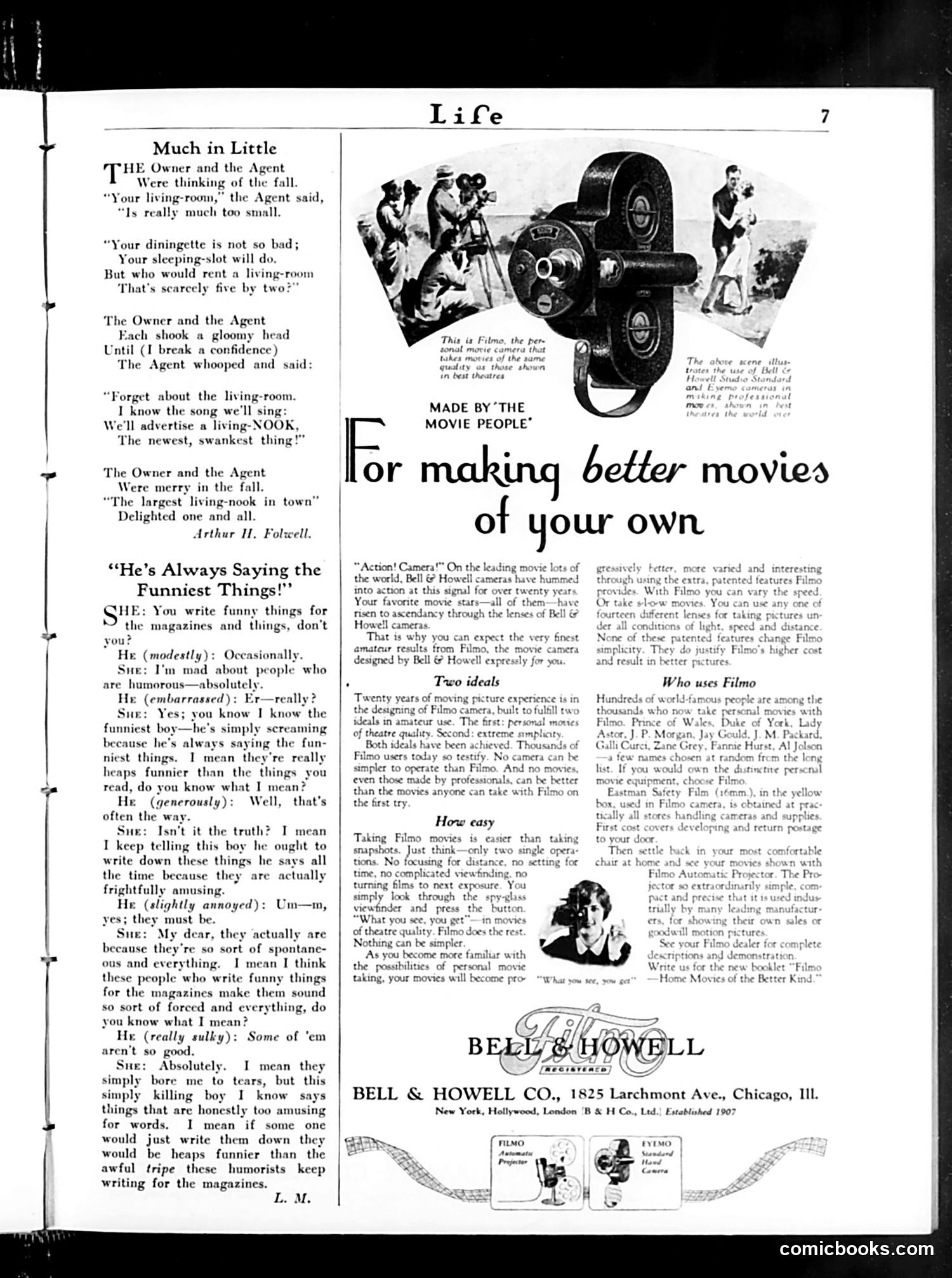
This page is primarily **advertising for Filmo movie cameras** by Bell & Howell, disguised as editorial content. The left column contains a dialogue poem titled "Much in Little: The Owner and the Agent," satirizing real estate agents who oversell cramped apartments as spacious living quarters. The joke: an agent dismisses a tiny "living-room" but proposes advertising a "living-nook" instead—rebranding the problem rather than solving it. This reflects 1920s urban housing complaints. The right side advertises Filmo cameras for amateur filmmaking, claiming they enable "better movies of your own." The ad lists famous actors and directors who used Bell & Howell equipment, positioning amateur cinematography as achievable for ordinary people. The satire's point: just as real estate agents use language tricks to sell inadequate spaces, advertisers use celebrity endorsements to sell expensive equipment to amateurs.
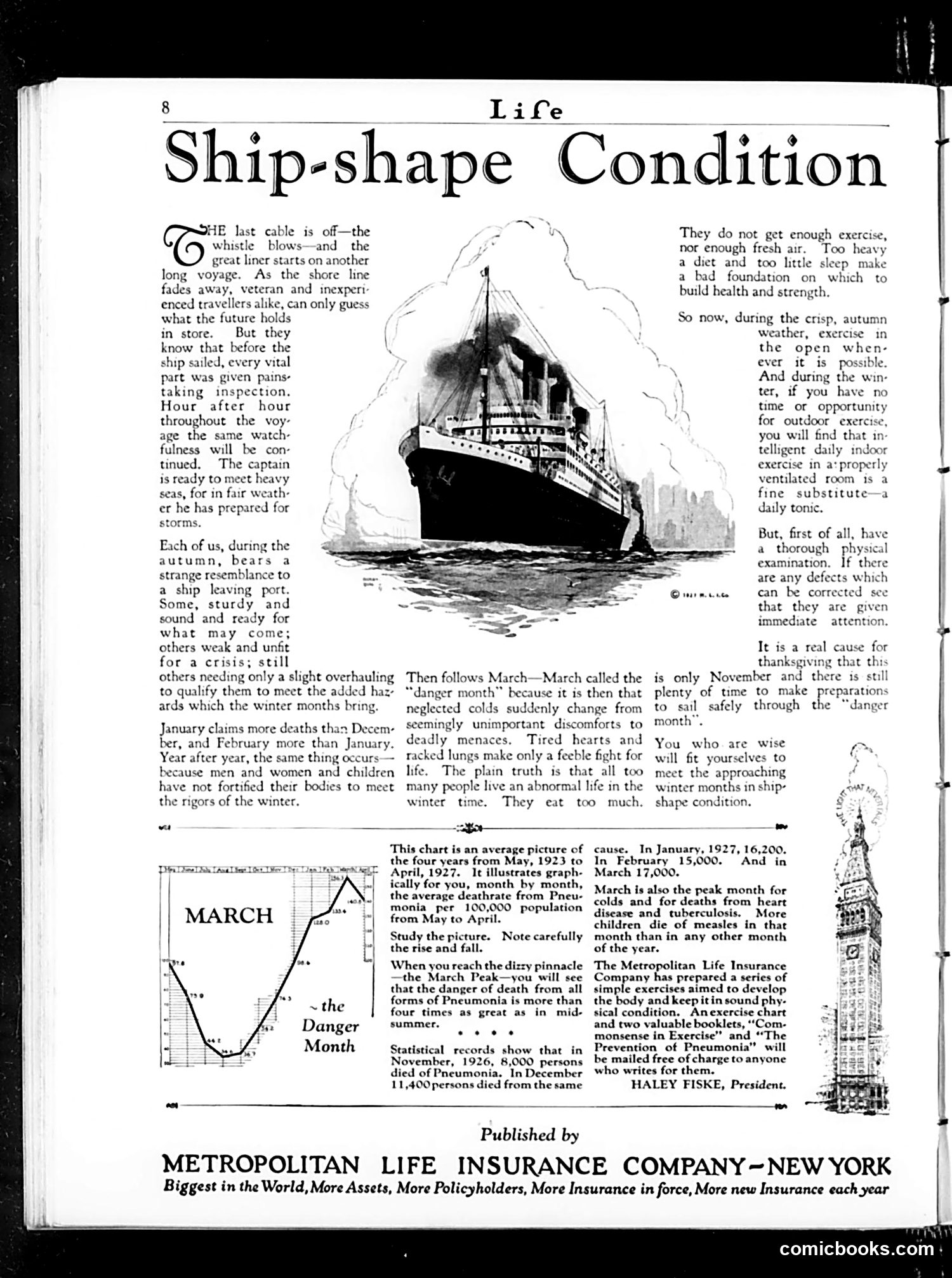
This page is primarily **health/wellness advertising** by Metropolitan Life Insurance, not political satire. The title uses a ship metaphor to discuss maintaining physical health through autumn and winter months. The central image shows a large ocean liner, illustrating the human body as a "ship" that must be kept in good condition. The accompanying chart labeled "MARCH—the Danger Month" graphs mortality rates from pneumonia and related diseases, showing March peaks dangerously high. The message is practical: get physical examinations, exercise outdoors when possible, maintain proper ventilation indoors, and prepare your body for winter's health hazards. The ship metaphor emphasizes that bodies, like vessels, require preventive maintenance and inspection to weather approaching dangers safely.
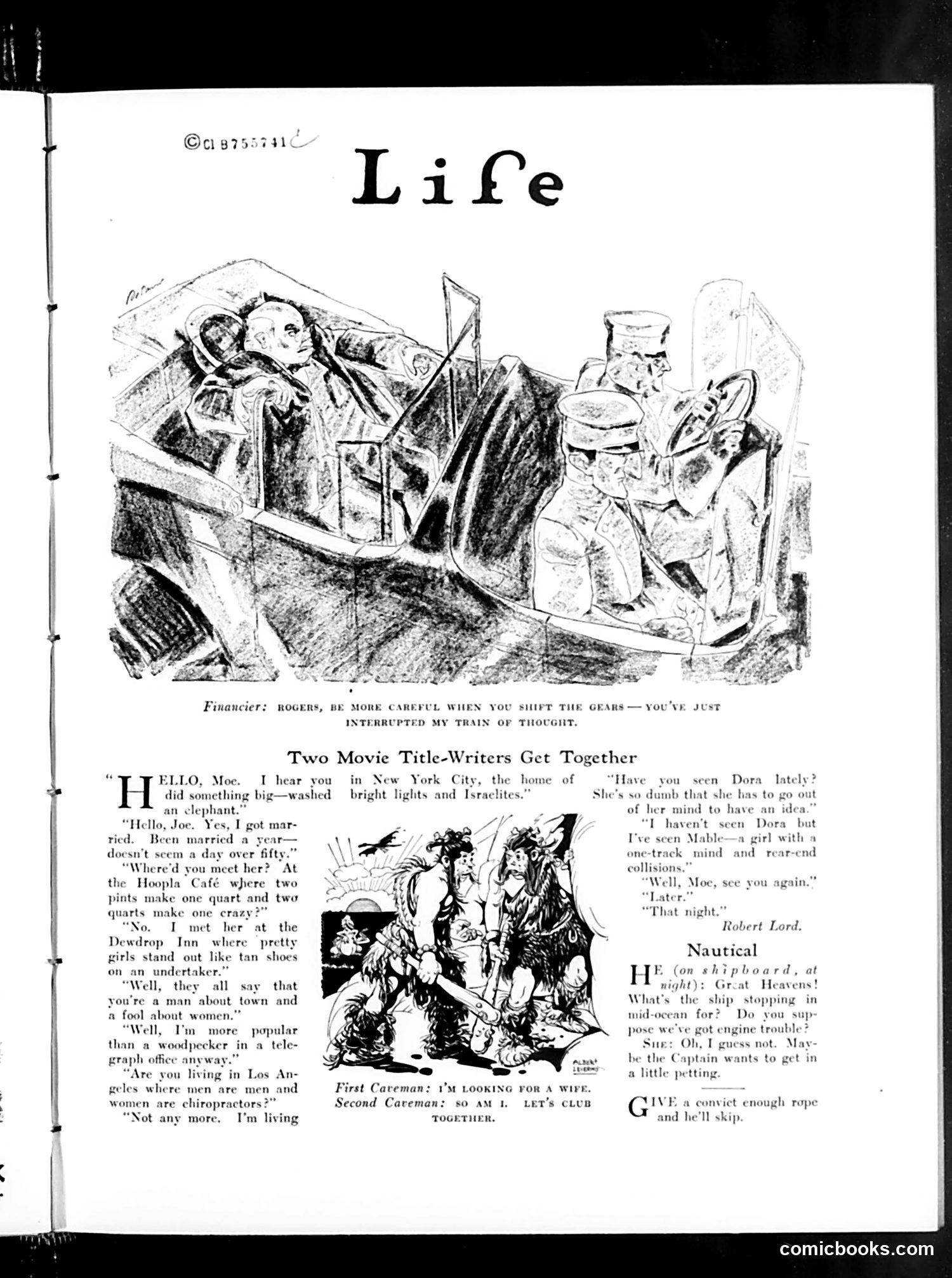
This page contains humorous dialogue and illustrated vignettes typical of Life's satirical style. The top cartoon shows a frustrated man at a steering wheel being interrupted by passengers, satirizing the annoyance of backseat drivers disrupting one's concentration. Below are two separate comic sketches: "Two Movie Title-Writers Get Together" depicts screenwriters discussing their work and romantic encounters in Hollywood, and "Nautical" shows sailors discussing ship engine trouble at sea. The humor relies on wordplay, romantic misadventures, and everyday frustrations. The cartoons mock movie industry pretension, male-female relationship complications, and maritime mishaps through exaggerated dialogue and expressive ink drawings typical of 1920s-era Life magazine's comedic approach.
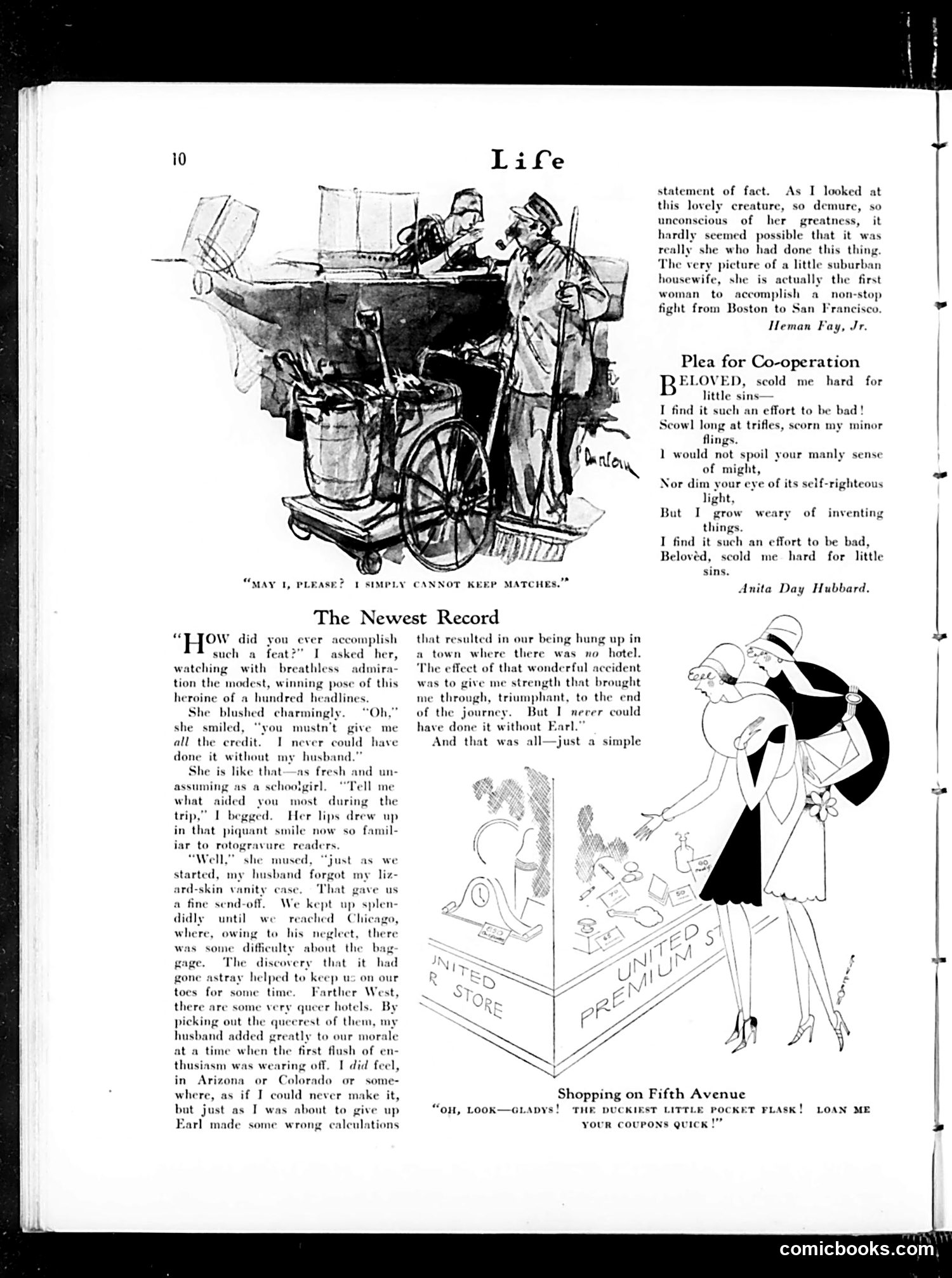
This page contains three distinct pieces: 1. **Top illustration**: Shows a woman with a bicycle cart, captioned "May I, please? I simply cannot keep matches." The accompanying text credits Herman Fay, Jr., and describes a woman who accomplished a non-stop flight from Boston to San Francisco—likely referencing an early aviation achievement. 2. **"Plea for Co-Operation"**: A poem by Anita Day Hubbard expressing exasperation with a husband's minor faults and her own exhaustion "inventing things" (likely excuses or justifications). 3. **Bottom cartoon**: Titled "Shopping on Fifth Avenue," depicts a woman at a store counter asking to borrow coupons, satirizing consumer culture and women's shopping habits during what appears to be a rationing or coupon period. The page satirizes domestic life, women's independence, and consumer behavior.
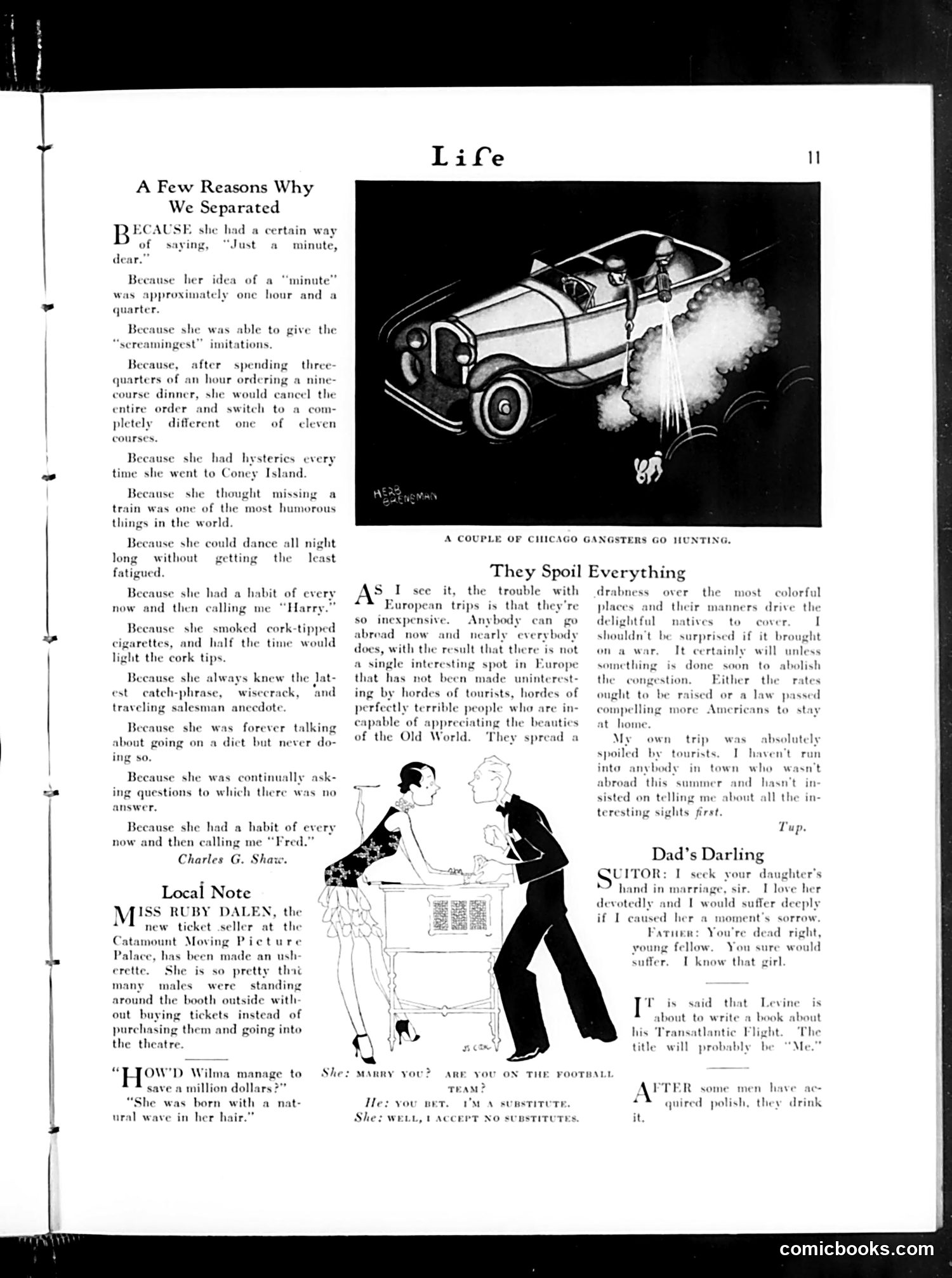
This page contains several satirical pieces typical of Life's humor magazine format. **"A Few Reasons Why We Separated"** (left column) lists humorous complaints about a woman's annoying habits—her vague timekeeping, loud voice, dietary indecision, hysteria about Coney Island, obsession with missing trains, constant dancing, and relentless questioning. **"They Spoil Everything"** critiques American tourists in Europe, claiming they're so numerous and unappreciative that they've made travel uninteresting. The author notes their own European trip was "spoiled by tourists." **The cartoon** shows a couple on what appears to be a date, with dialogue about football and substitutes—a domestic joke about disagreement. **"Dad's Darling"** is a brief suitor-father exchange about marriage, suggesting parental concern over losing a daughter. The content reflects 1920s-era social satire about gender relations, travel culture, and family dynamics.
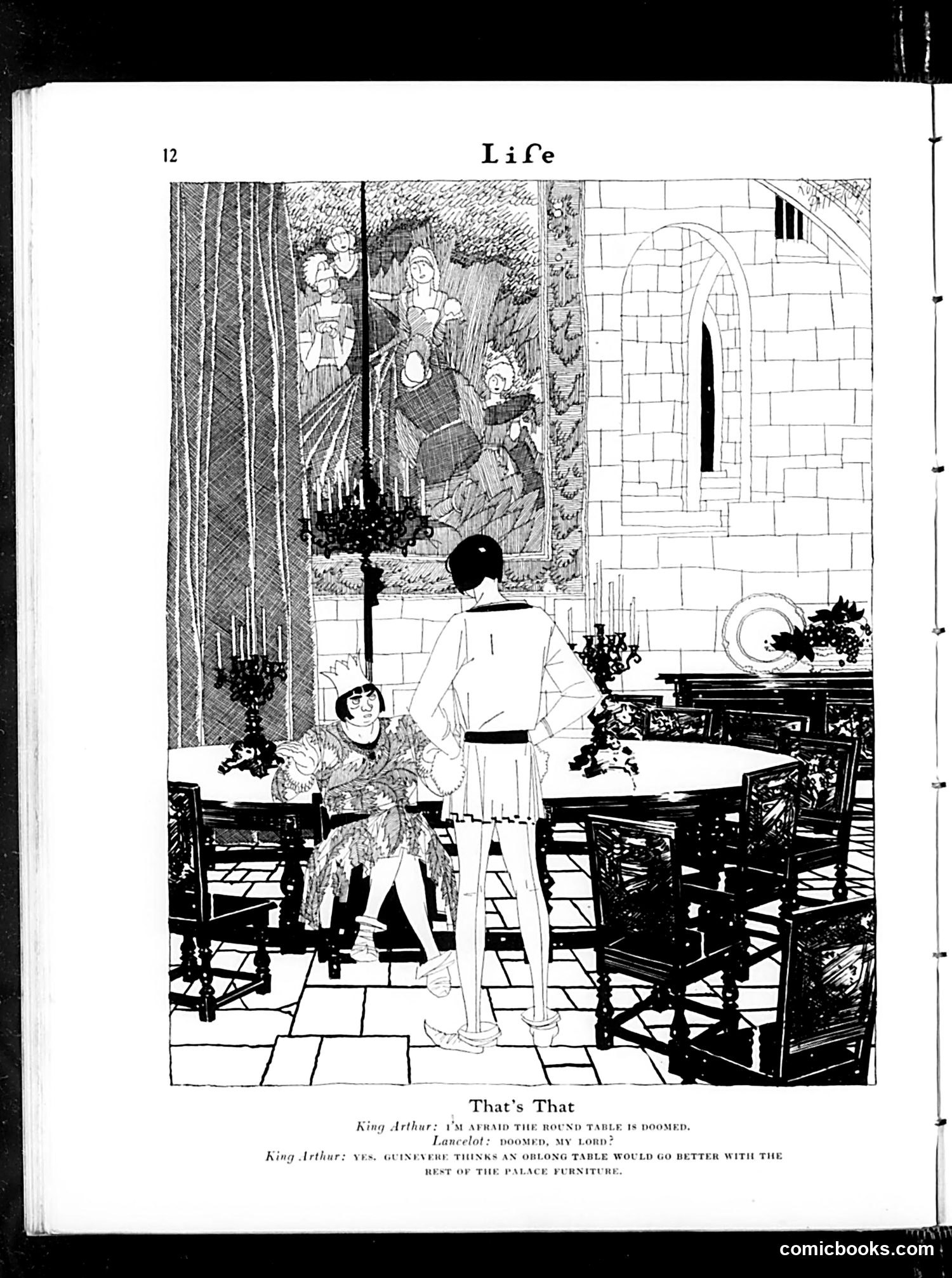
This cartoon satirizes King Arthur and the legend of the Round Table. The dialogue shows King Arthur expressing fear that "the round table is doomed," while Lancelot responds that he thinks "an oblong table would go better with the best of the palace furniture." The joke is a play on the famous Arthurian legend: the Round Table symbolizes equality among knights (no head position), but here it's being dismissed as impractical furniture. Lancelot's suggestion to replace it with an "oblong table" for aesthetic reasons mocks modern interior design priorities over legendary tradition. The illustration depicts a medieval hall with period furnishings, where the characters discuss this absurdly practical solution to what should be a sacred, symbolic object—poking fun at how contemporary concerns trivialize historical significance.
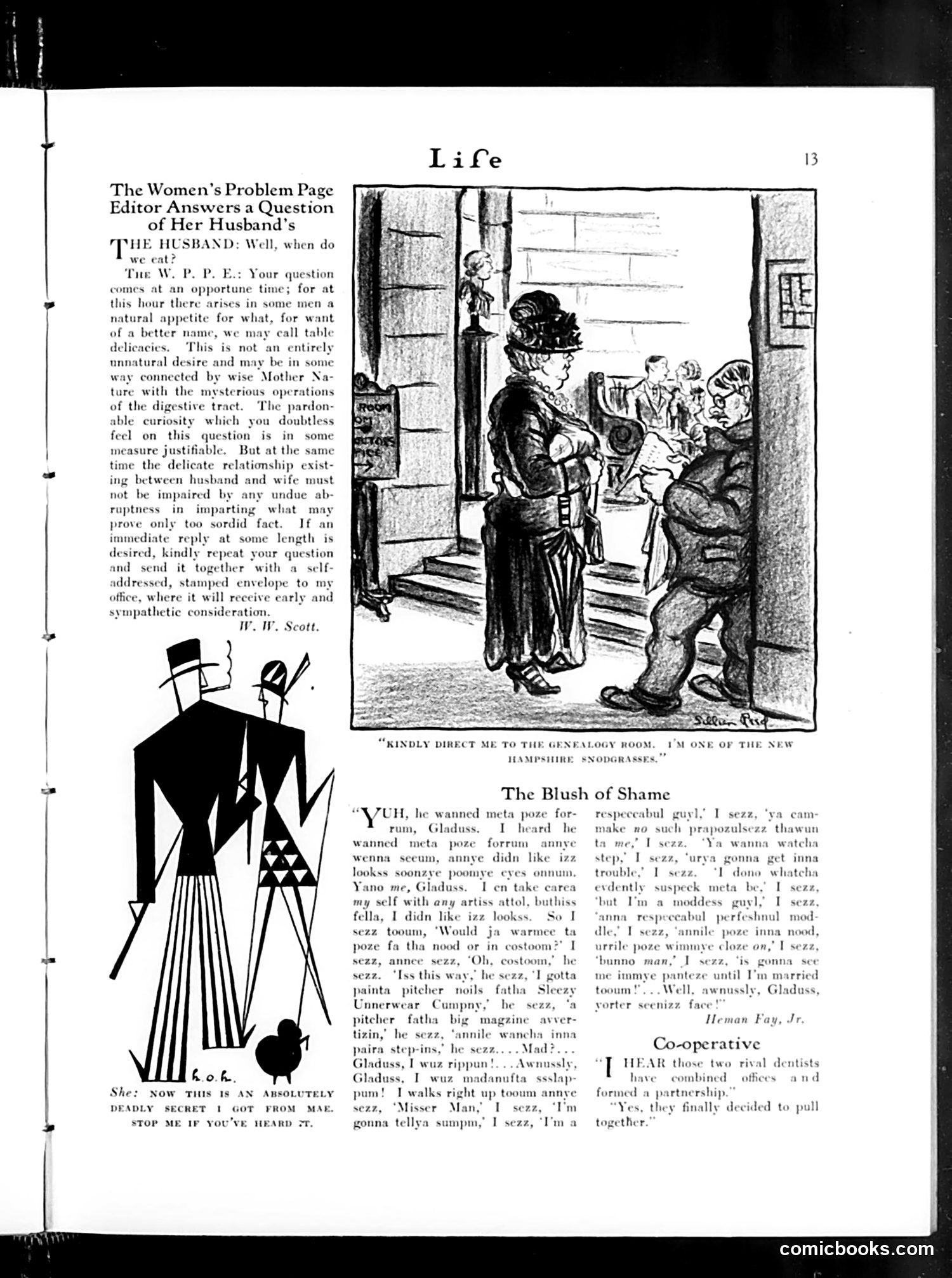
This page presents early 20th-century domestic advice alongside satirical illustrations. The main cartoon shows a well-dressed woman at a doorway being directed to a "genealogy room," with the caption "KINDLY DIRECT ME TO THE GENEALOGY ROOM. I'M ONE OF THE NEW HAMPSHIRE 'SNOBGRASSES.'" The satire targets social climbing and pretentious genealogy claims—the woman's fancy hat and clothing contrast with her invented aristocratic lineage. "Snobgrasses" appears to be a fictional name the cartoonist created to mock nouveau riche families fabricating noble ancestry. Below, "The Blush of Shame" presents a young woman's flustered recounting of a man's crude advances, rendered in dialect and colloquial speech for comedic effect. The advice column offers earnest guidance on delicate matters. The decorative illustration at left shows a fashionable woman, likely mocking contemporary fashion trends.
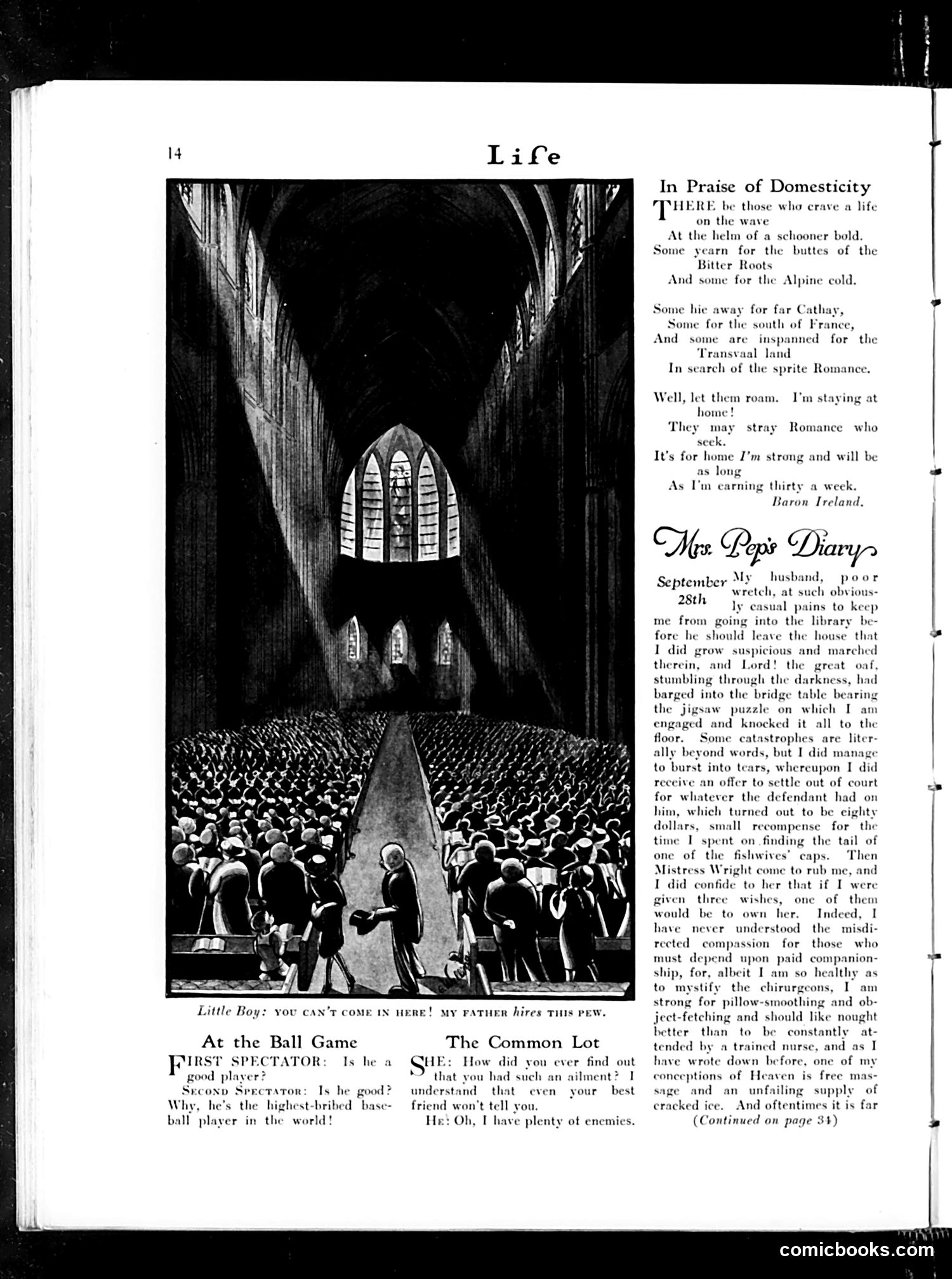
The page contains three distinct pieces: 1. **"In Praise of Domesticity"** (poem by Baron Ireland): A satirical poem mocking those seeking adventure while the speaker chooses domestic life and earning "thirty a week." 2. **The cathedral woodcut illustration** with caption "Little Boy: you can't come in here! my father hires this pew" — satirizing wealthy parishioners who essentially "own" church pews through financial contributions, excluding the poor from worship spaces. 3. **"Mrs. Peps' Diary"** and **"At the Ball Game"/"The Common Lot"** sections: Humorous domestic and social vignettes depicting everyday middle-class life, relationship frustrations, and class consciousness. The page's overall theme mocks genteel pretension, class divisions, marital discord, and the gap between romantic ideals and mundane reality—typical early 20th-century Life magazine satirical content targeting middle and upper-class readers.
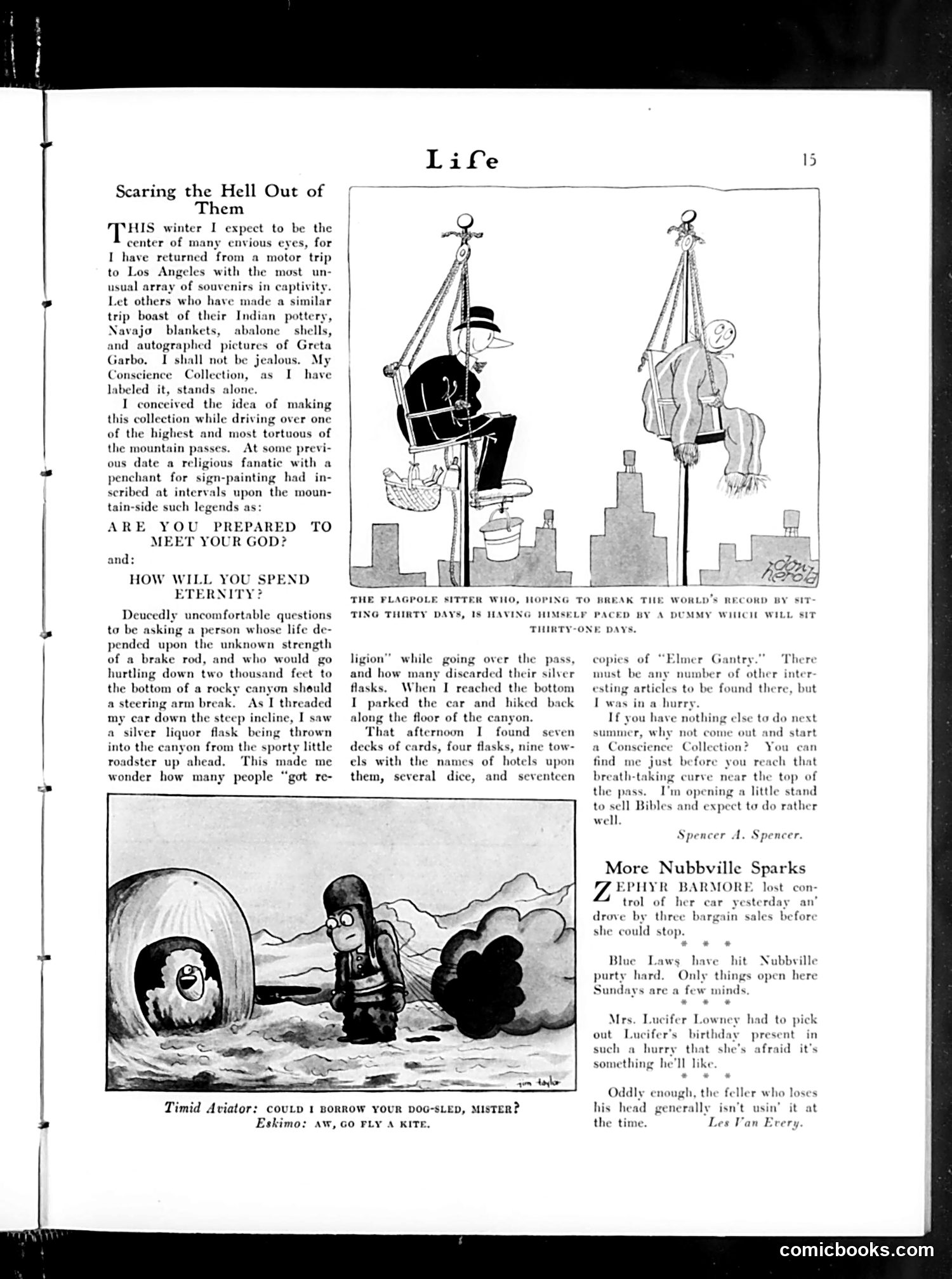
This page from *Life* magazine contains humorous observations about 1920s American culture. The main article describes collecting souvenirs during a Los Angeles trip, with the author planning to create a "My Conscience Collection" of religious objects and signs encountered. The top cartoon satirizes extreme religious fervor—depicting someone suspended by pulleys surrounded by bottles and religious paraphernalia, attempting to set a flagpole-sitting record while maintaining piety. This mocks the 1920s fad of flagpole sitting (endurance stunts) and the era's simultaneous obsession with public religiosity. The lower cartoon shows an Eskimo and aviator in a humorous exchange about borrowing a dog-sled, satirizing the collision between modern aviation technology and traditional Arctic life. The "More Nubbville Sparks" section offers brief local satirical notes about car troubles and petty social situations.
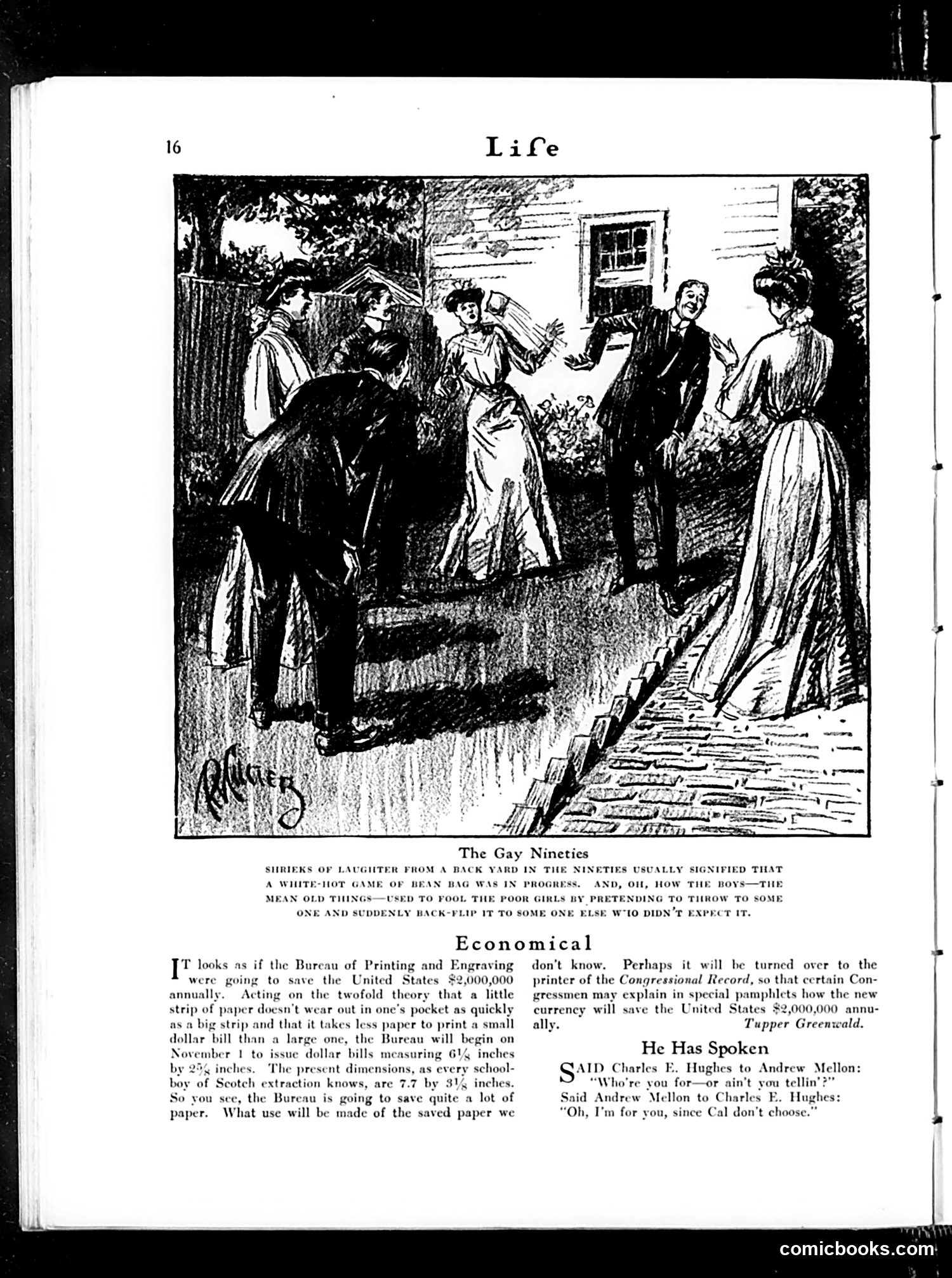
This cartoon depicts well-dressed young men and women in 1890s attire engaged in what the caption describes as a common prank: throwing a "bean bag" to unsuspecting people. The humor relies on the contrast between the refined appearance of these wealthy young people and their juvenile behavior—pretending to throw something at poor girls to fool them, then laughing at their reactions. The satire mocks the "Gay Nineties" era's upper-class youth culture, suggesting that despite their sophistication, these privileged young people amused themselves through mean-spirited tricks targeting vulnerable working-class women. It's social commentary on class divisions and youthful cruelty dressed up in fashionable clothing.
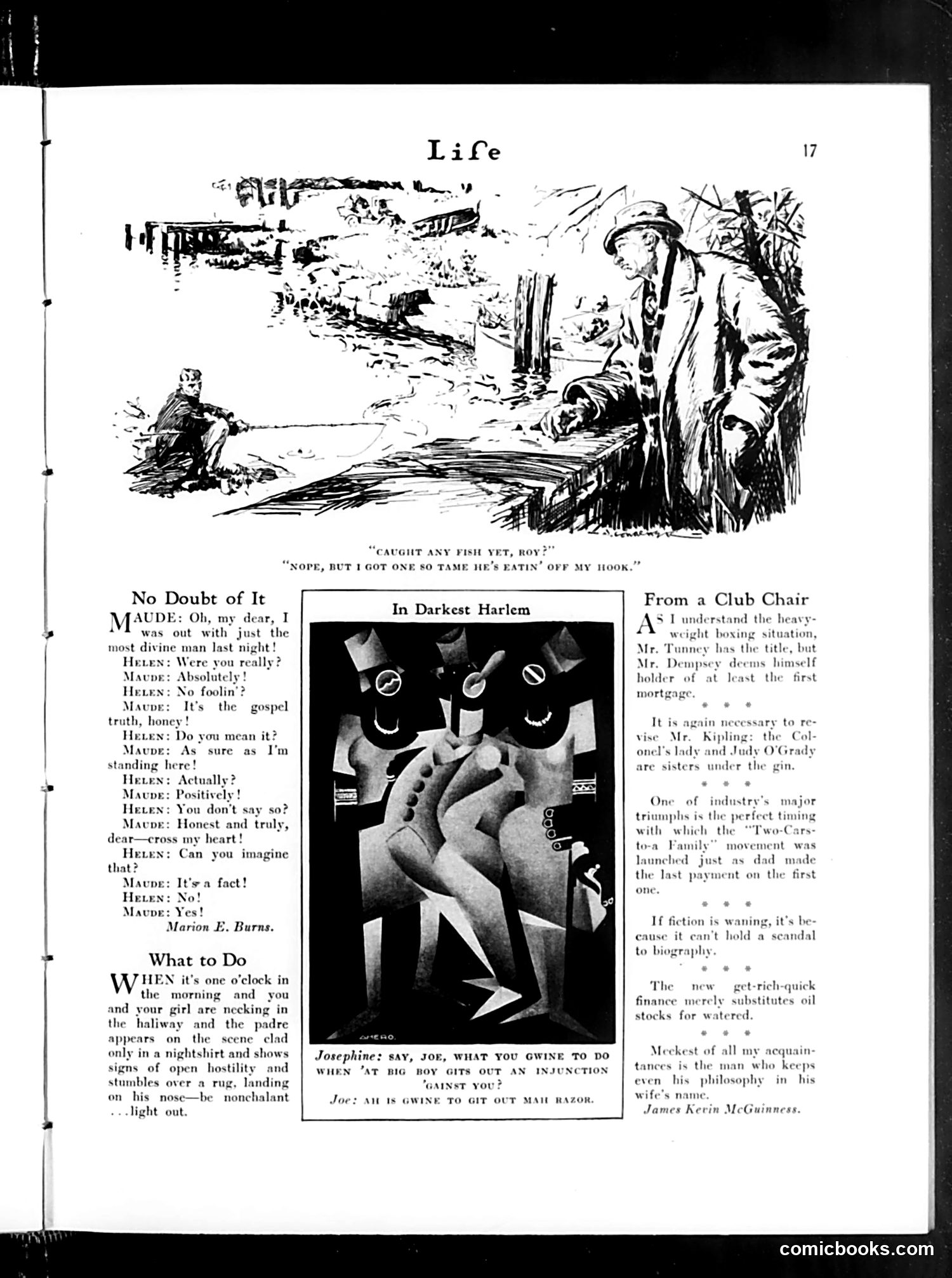
This page from *Life* magazine contains three separate satirical pieces: 1. **Top cartoon**: A fishing scene with dialogue about catching fish "so tame he's eatin' off my hook"—likely mocking gullible people or easy marks. 2. **"No Doubt of It"**: A dialogue between Maude and Helen where Maude claims to have met "the most divine man" who is "the gospel truth." Helen's skeptical responses suggest satire of women's gossipy credulity or romantic naivety. 3. **"In Darkest Harlem"**: A photograph with caption implying racial caricature, though the specific reference remains unclear without additional context. 4. **"From a Club Chair"**: Brief commentary on boxing (Tunney/Dempsey), automotive finance, and social observations—typical magazine commentary. The page reflects early 20th-century satirical humor targeting romantic delusions, gullibility, and contemporary social trends.
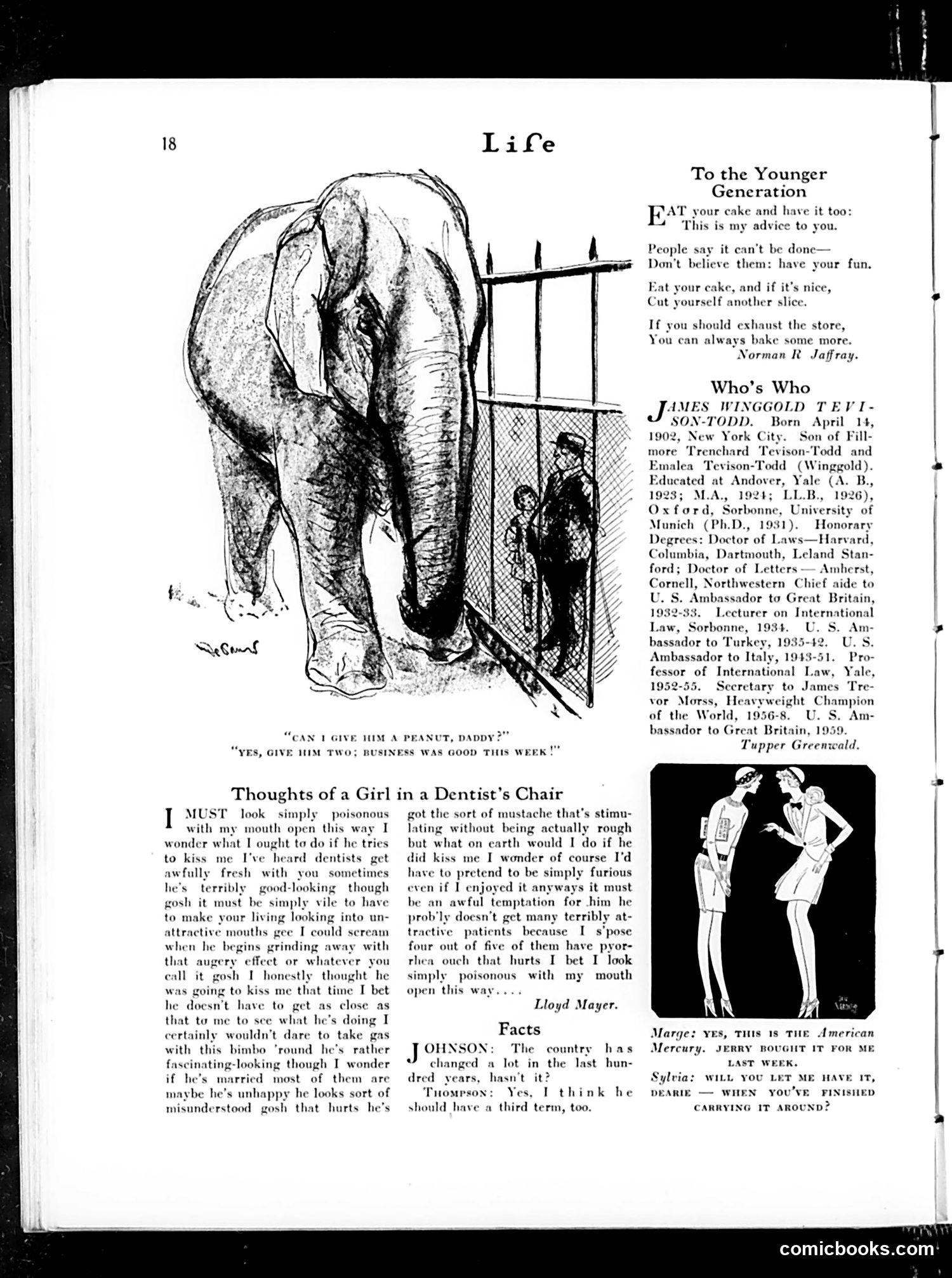
**The Elephant Cartoon**: A father permits his child to feed peanuts to an elephant, joking that "business was good this week." This reflects 1930s-40s economic optimism—disposable income allows small luxuries like visiting zoos or circuses. **"Thoughts of a Girl in a Dentist's Chair"**: Lloyd Mayer's stream-of-consciousness piece satirizes shallow, distracted thinking. A young woman obsesses over her dentist's attractiveness while he works, fantasizing about romantic scenarios despite professional inappropriateness. The humor derives from the gap between her imagined drama and mundane reality. **"To the Younger Generation"**: Norman R. Jaffray's poem ironically advises indulgence—"eat your cake and have it too"—mocking post-Depression attitudes toward pleasure and consumption. These pieces collectively capture interwar American frivolity and romantic preoccupation typical of Life's satirical tone.
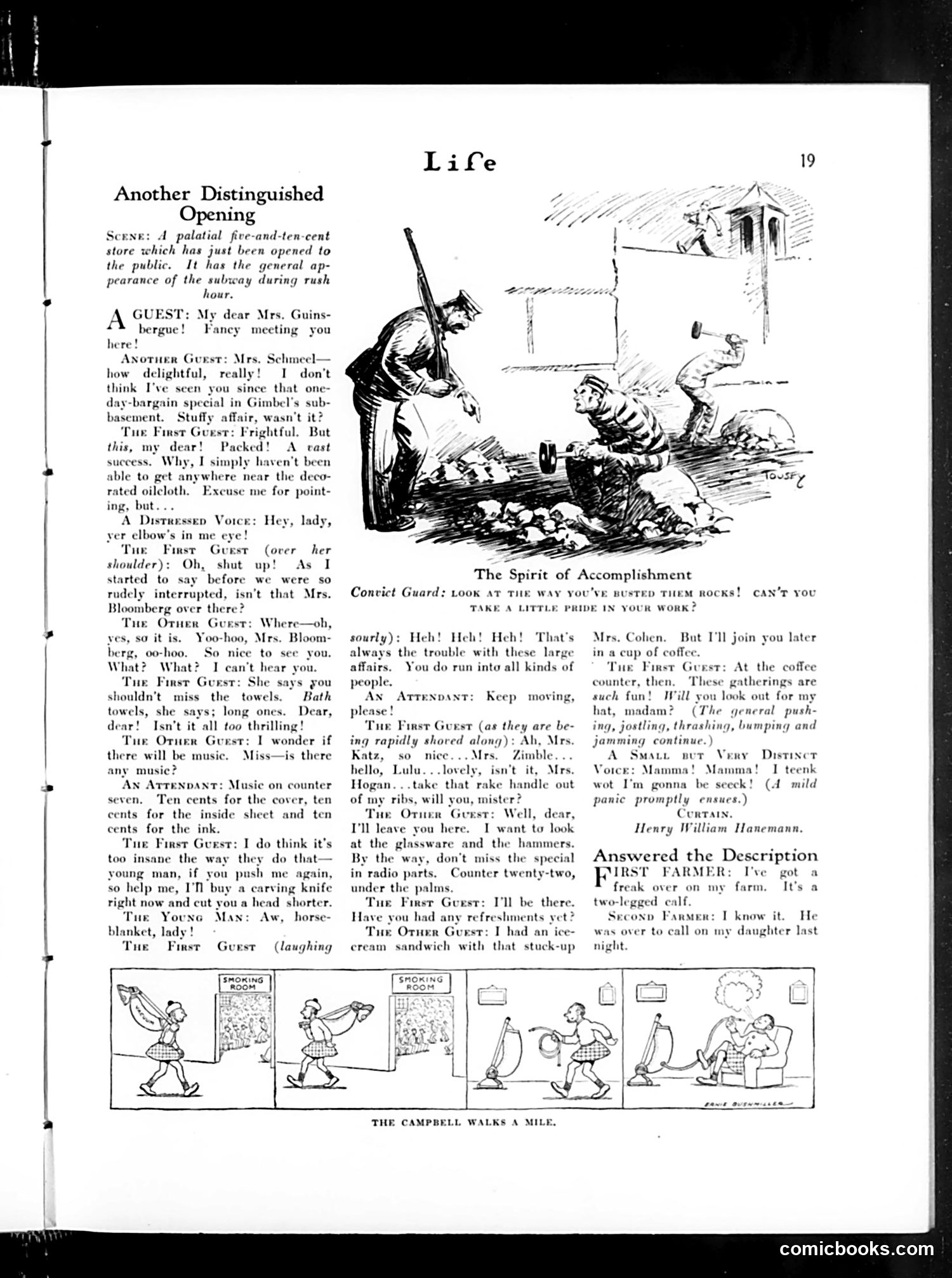
This page satirizes the opening of a new five-and-ten-cent store (like Woolworths or Kresge's), mocking both the wealthy patrons and the chaotic shopping experience. **The main sketch**: "Another Distinguished Opening" depicts upper-class women treating the bargain store's opening as a social event, name-dropping and gossiping while literally crushing working-class and immigrant shoppers around them. The satire targets their obliviousness—they discuss amenities ("decorated oilcloth," towels) while rudely dismissing people whose elbows they're blocking and whose ribs they're jabbing with rake handles. **The joke**: The contrast between the genteel pretense of "distinguished opening" and the subway-like mob chaos reveals class hypocrisy. Wealthy women find prestige in bargain shopping while simultaneously treating poorer customers with contempt. **Secondary content**: "The Spirit of Accomplishment" (a convict breaking rocks) and "The Campbell Walks a Mile" (bottom strip) are unrelated comic items, likely filler on the page. The satire reflects early-20th-century anxieties about mass retail and class mixing in public spaces.
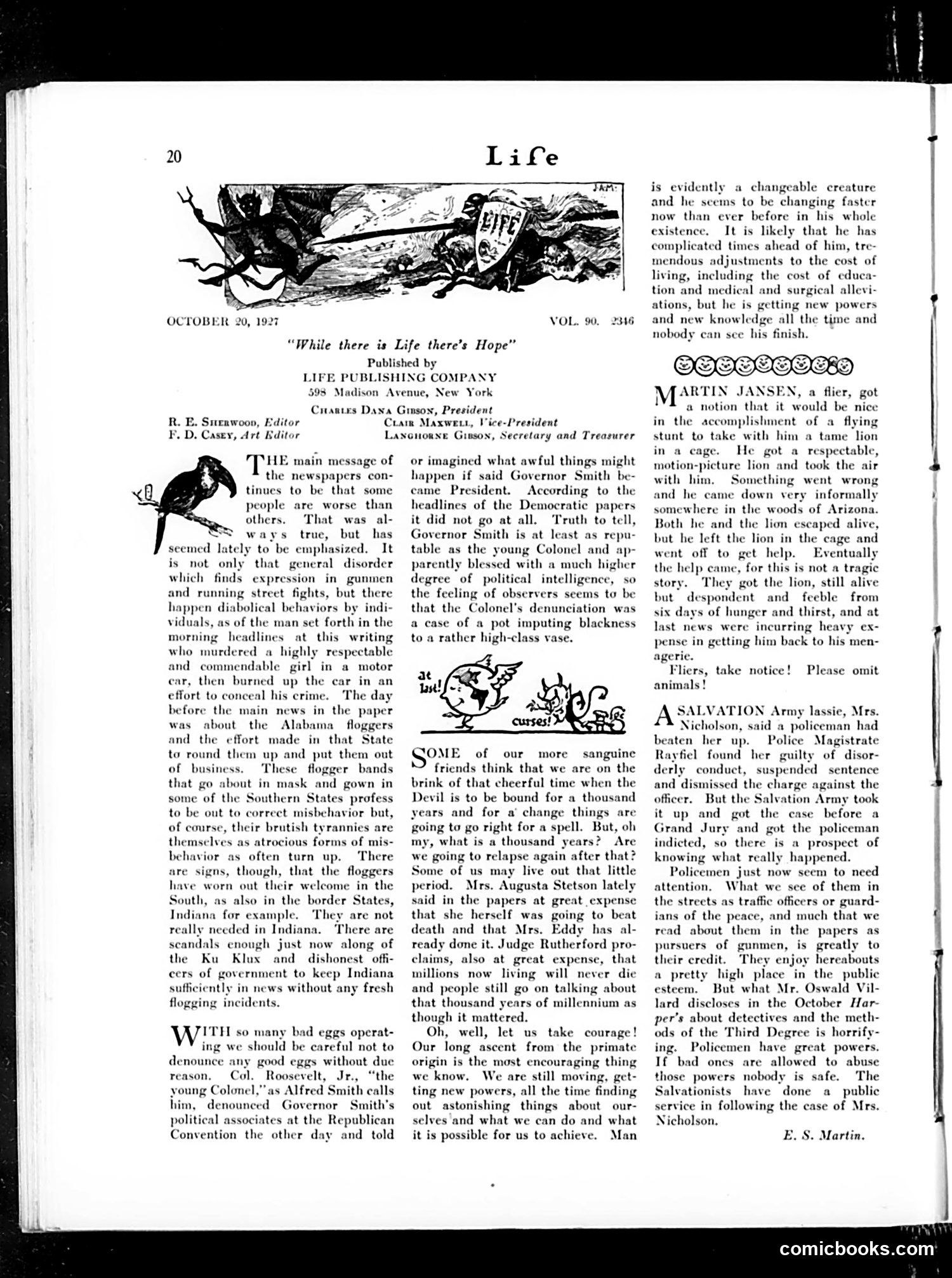
This editorial page addresses contemporary social disorder and political attacks. The main cartoon (upper left) depicts **Death** or a skeletal figure amid chaos, illustrating the magazine's concern about crime and violence dominating newspaper headlines. The editorial criticizes **Colonel Roosevelt Jr.** for attacking Governor **Al Smith** at the Republican Convention without justification—calling it a case of "a pot imputing blackness to a rather high-class vase." Smith appears to be more intelligent and reputable than his young critic. The piece also references the **Ku Klux Klan** and vigilante "flogging bands" operating in Southern and border states, suggesting their brutal practices are themselves criminal, though they claim to enforce morality. References to **Mrs. Augusta Stetson** and **Judge Rutherford** concern religious claims about immortality and millennium prophecies—satirized as expensive public declarations disconnected from reality. The overall message: Americans face genuine social problems, but should judge people fairly and remain hopeful about human progress rather than succumbing to sensationalism.
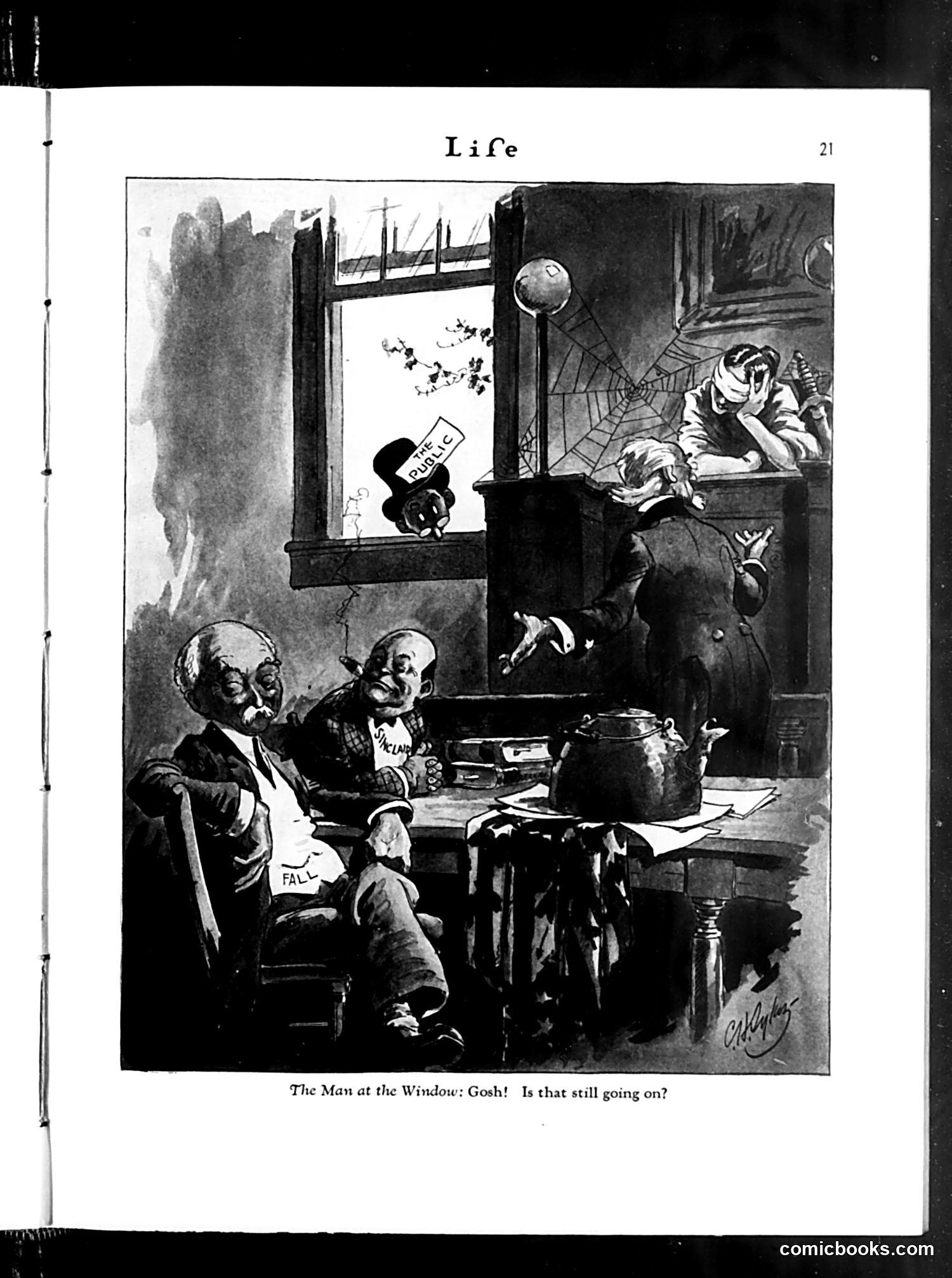
This cartoon satirizes what appears to be a prolonged, tedious situation. Two men sit indoors at a table, while a third man peers out the window at activity continuing outside. The caption—"Gosh! Is that still going on?"—suggests exasperation with something that won't end. The cartoon likely comments on a contemporary event or trend that had overstayed its welcome in public attention. Without the magazine's date visible, the specific reference is unclear, but the satire targets public fatigue with repetitive news, scandals, or social phenomena that dominate discourse longer than the audience finds tolerable. The style and context suggest this is from the early-to-mid 20th century. The cartoon's humor relies on readers recognizing what "that" refers to—a contemporary controversy or spectacle.
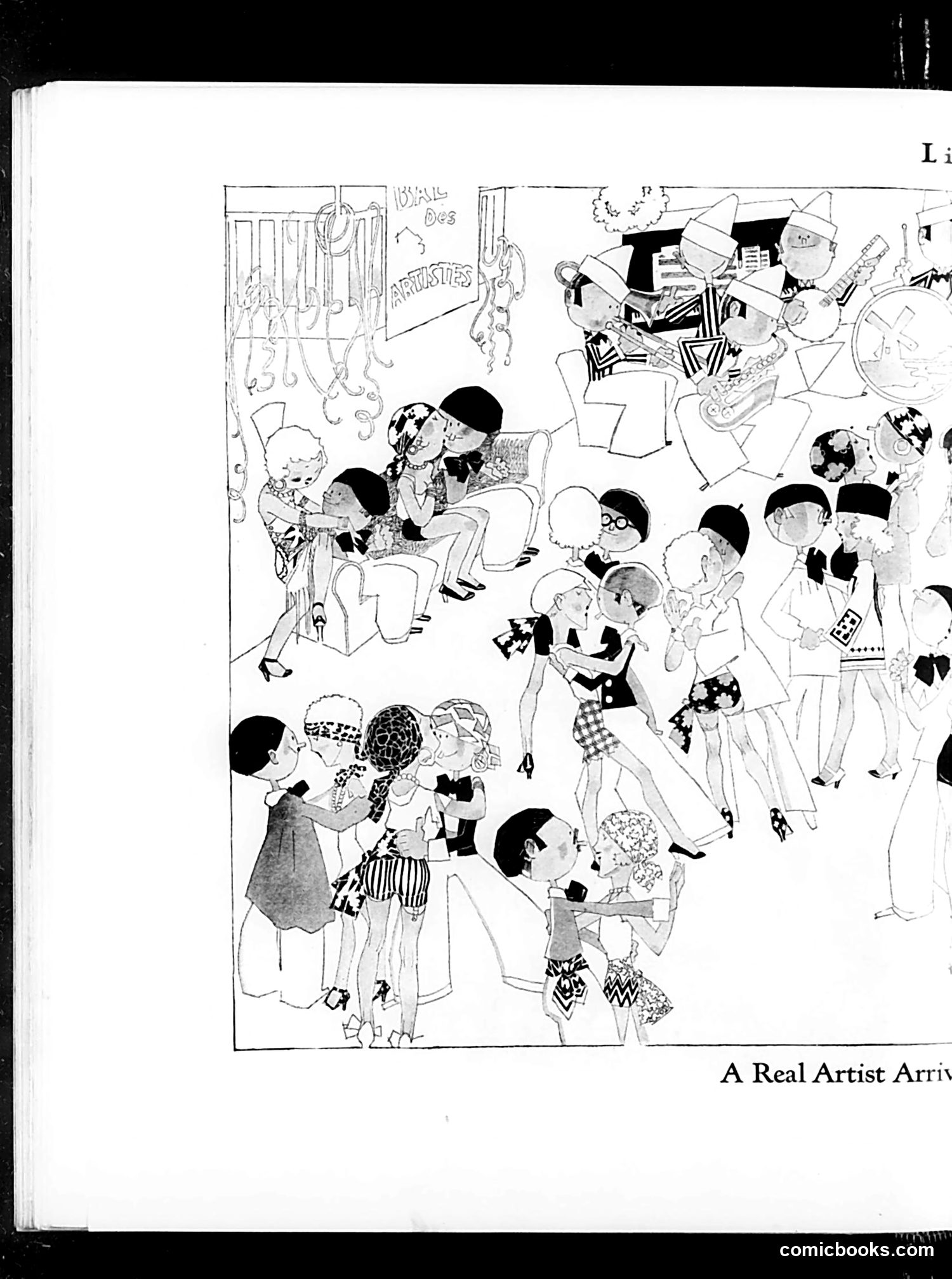
This cartoon depicts a fashionably dressed person (likely a painter or visual artist) arriving at what appears to be a social gathering or salon. The figure is greeted enthusiastically by numerous well-dressed attendees who cluster around them with evident excitement. The satire targets the pretentious art world and high society's fawning reception of artists. The crowd's animated response—some gesturing dramatically, others crowding in—mocks how the wealthy and socially prominent treat creative figures as celebrities or exotic attractions. The title "A Real Artist Arrives" suggests irony: the cartoon questions whether genuine artistic merit warrants such superficial social worship, or whether this reception reveals society's shallow celebrity-obsession rather than authentic appreciation for art. The detailed fashion sketches throughout emphasize the social/fashionable context rather than artistic substance.
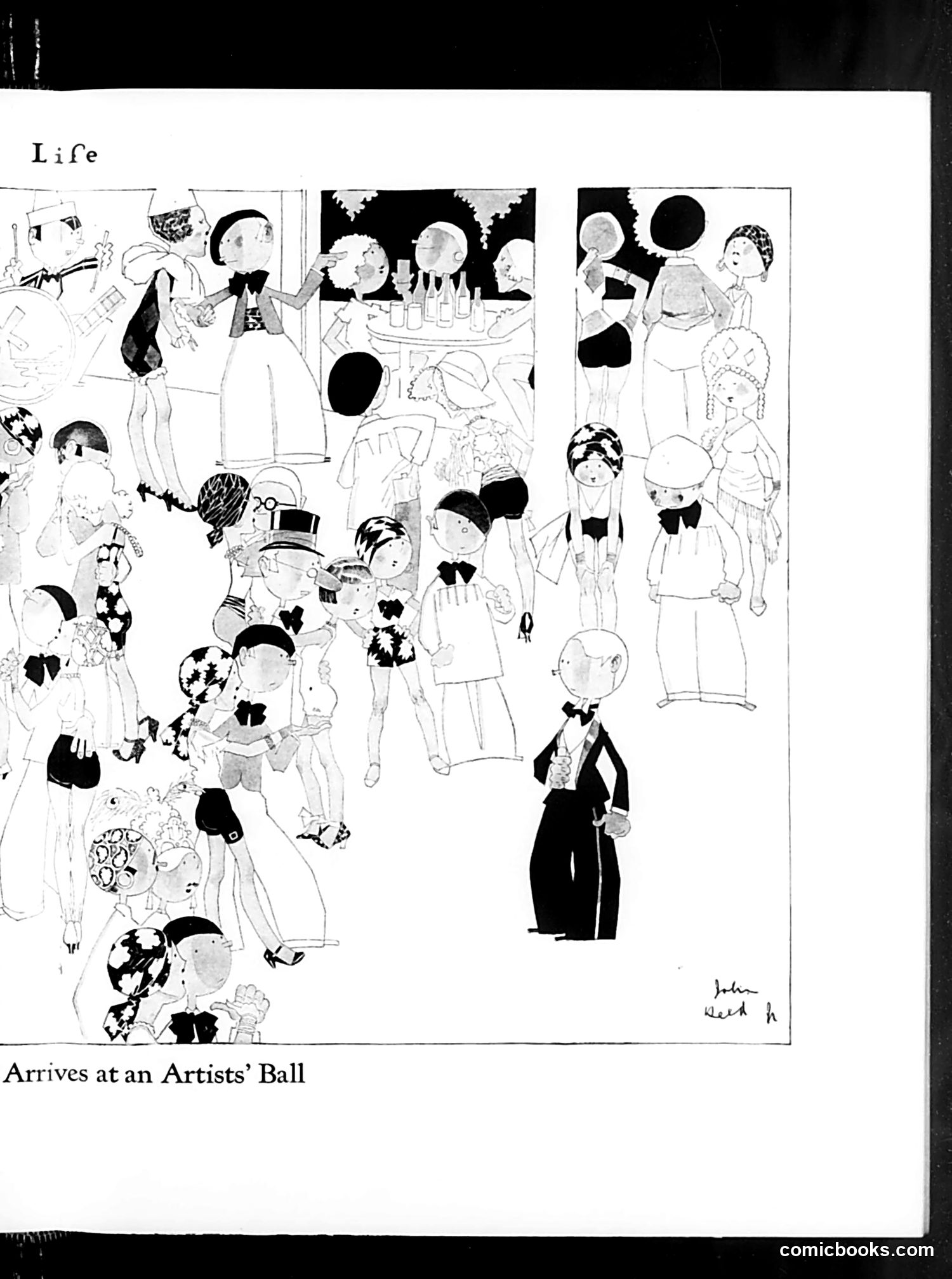
This satirical illustration depicts the social scene at an exclusive Artists' Ball, a formal event where wealthy patrons and society figures gathered. The cartoon mocks the pretension and fashion consciousness of high-society attendees through exaggerated depictions of their elaborate costumes and affected poses. The left side shows a crowded arrival scene with figures in fashionable evening wear, while the right panel presents a more orderly procession of formally dressed guests. The artist emphasizes the absurdity of their posturing through sketchy linework and caricatured proportions. The satire targets the self-importance of this social elite and the performative nature of such gatherings—guests treating the event as an opportunity for display rather than genuine artistic appreciation. This reflects Life magazine's tradition of lampooning upper-class pretension.
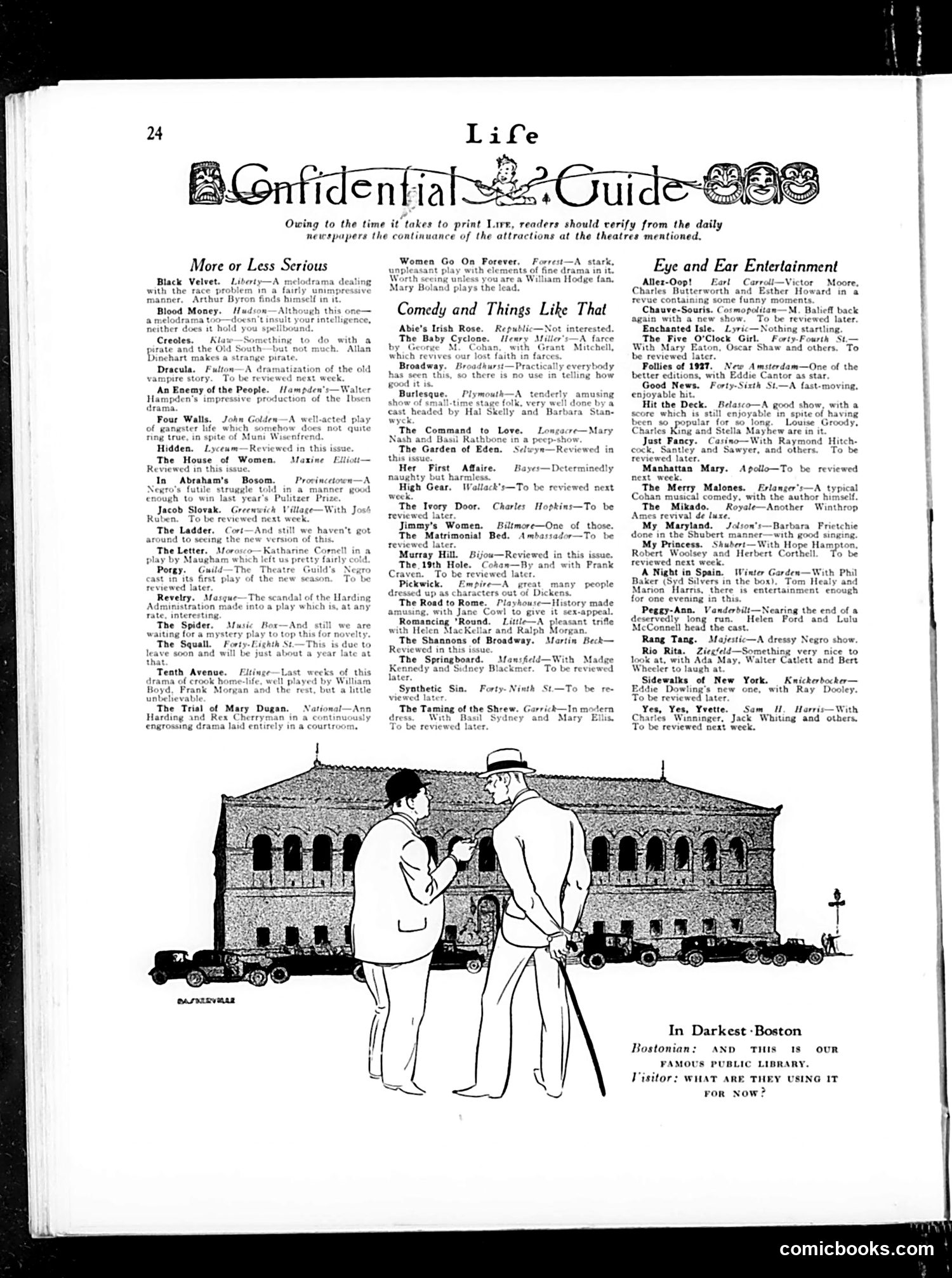
This page is from Life magazine's theater review section. The main cartoon at the bottom depicts two men outside Boston's Public Library (identifiable by the classical building architecture). One man, labeled "Bostonian," is explaining the library to a "Visitor." The joke's punchline reads: "AND THIS IS OUR FAMOUS PUBLIC LIBRARY. Visitor: WHAT ARE THEY USING IT FOR NOW?" The satire mocks Bostonians for apparently no longer using their prestigious public library for its intended purpose—reading and borrowing books. The cartoon suggests the library has been repurposed for something else entirely, though the specific alternative use isn't stated. This likely reflects 1920s anxieties about declining literacy, changing leisure habits, or the library being converted to other community uses. The humor derives from the visitor's naive question exposing what locals take for granted: their famous institution is no longer functioning as designed.
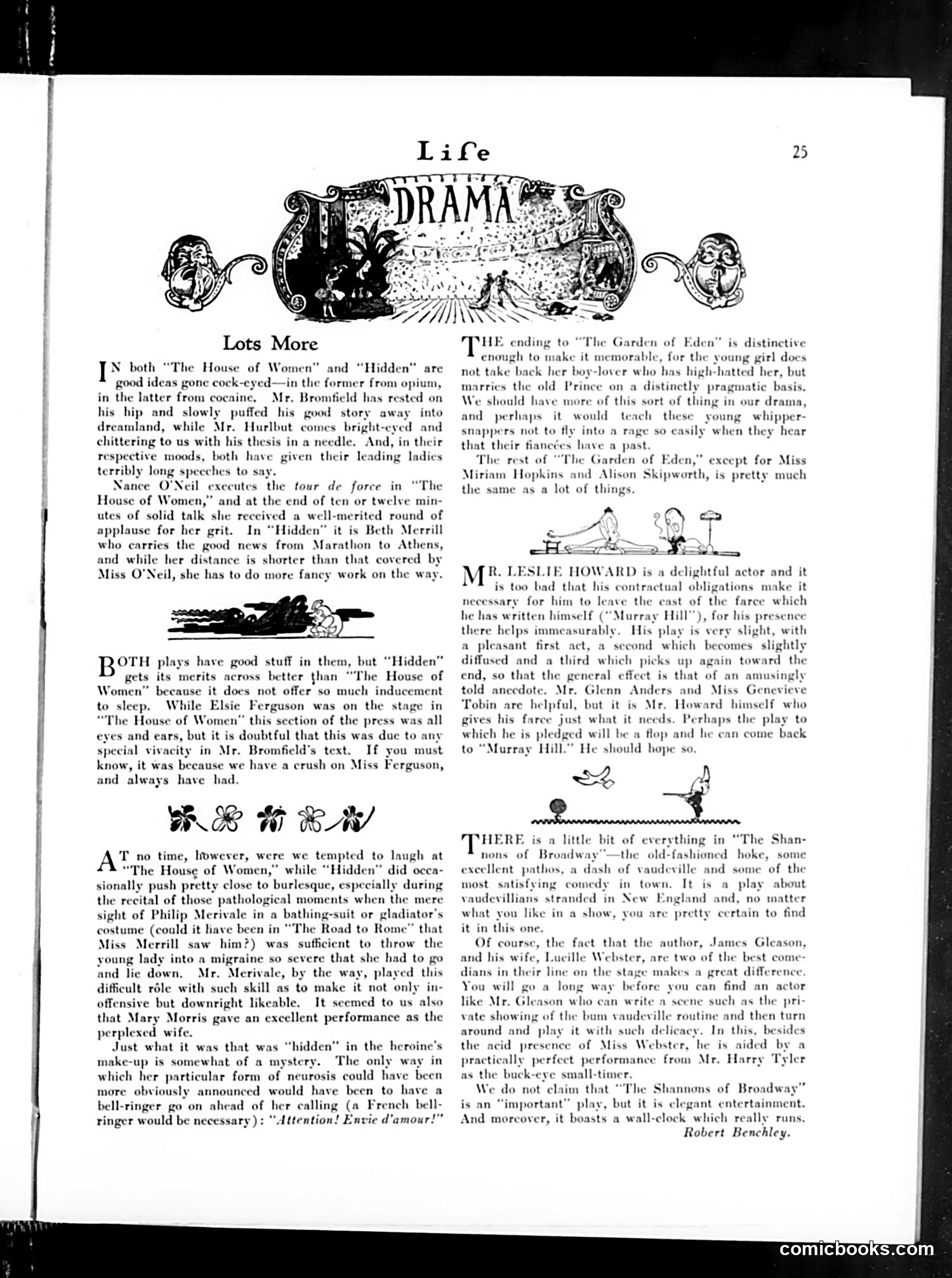
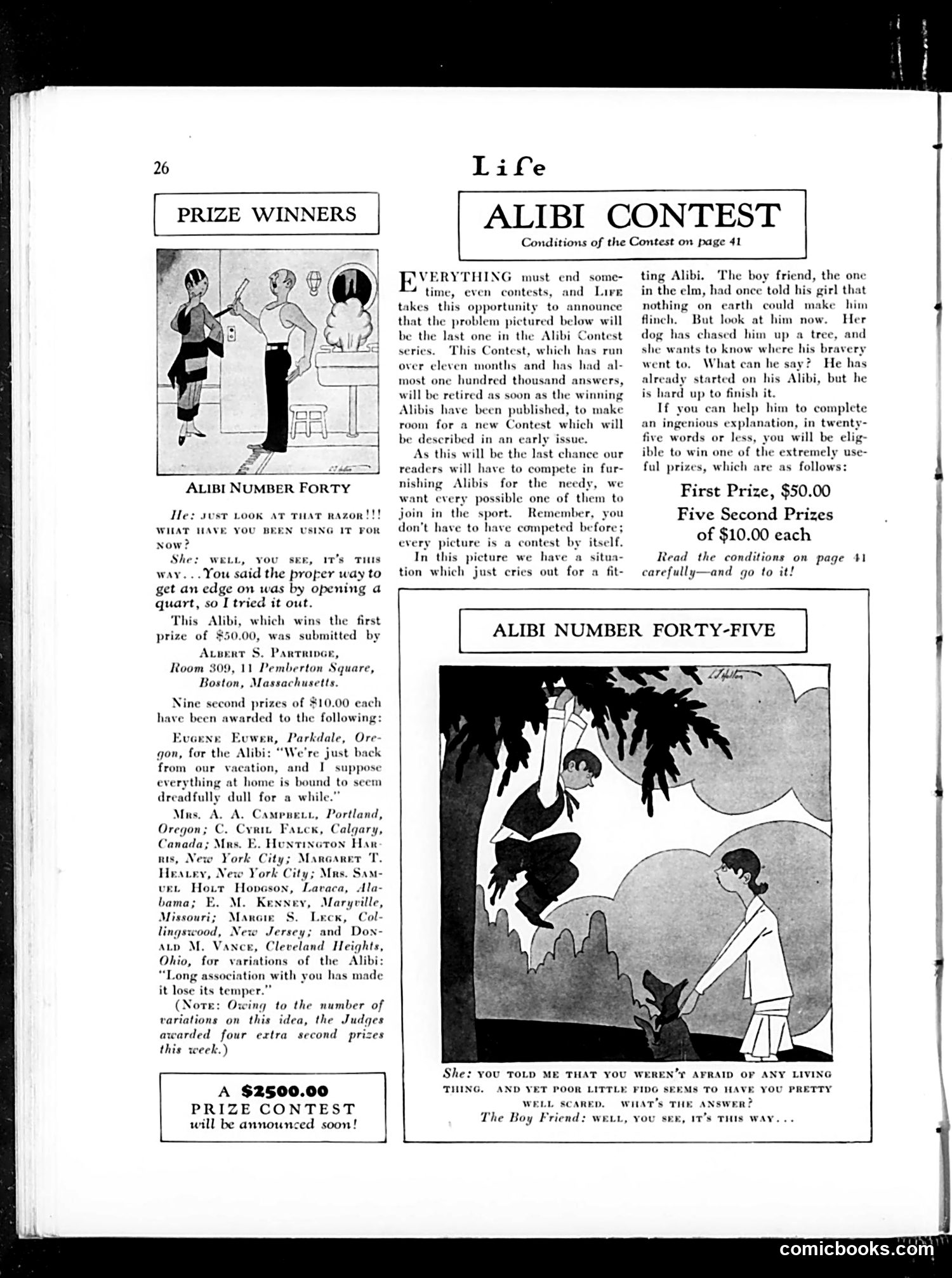
This page showcases *Life* magazine's popular "Alibi Contest"—a humor competition running eleven months. Readers submit creative excuses ("alibis") explaining absurd situations depicted in cartoons. **Alibi Number Forty** (prize winner): A husband claims he used his razor to open a quart bottle, explaining his dull blade. The joke: his wife misunderstood his advice about "getting an edge" by "opening a quart"—implying drinking alcohol sharpens one's wit. **Alibi Number Forty-Five** (the contest prompt): A boy is trapped in a tree by a small dog, contradicting his earlier boast that nothing frightens him. Readers must complete his embarrassed explanation in 25 words or fewer to win prizes ($50 first prize, $10 second prizes). The contest reflects *Life*'s satirical humor style: playing on misunderstandings, marital dynamics, and masculine pride. These were apparently popular enough to sustain an eleven-month run before retiring to launch a new contest.
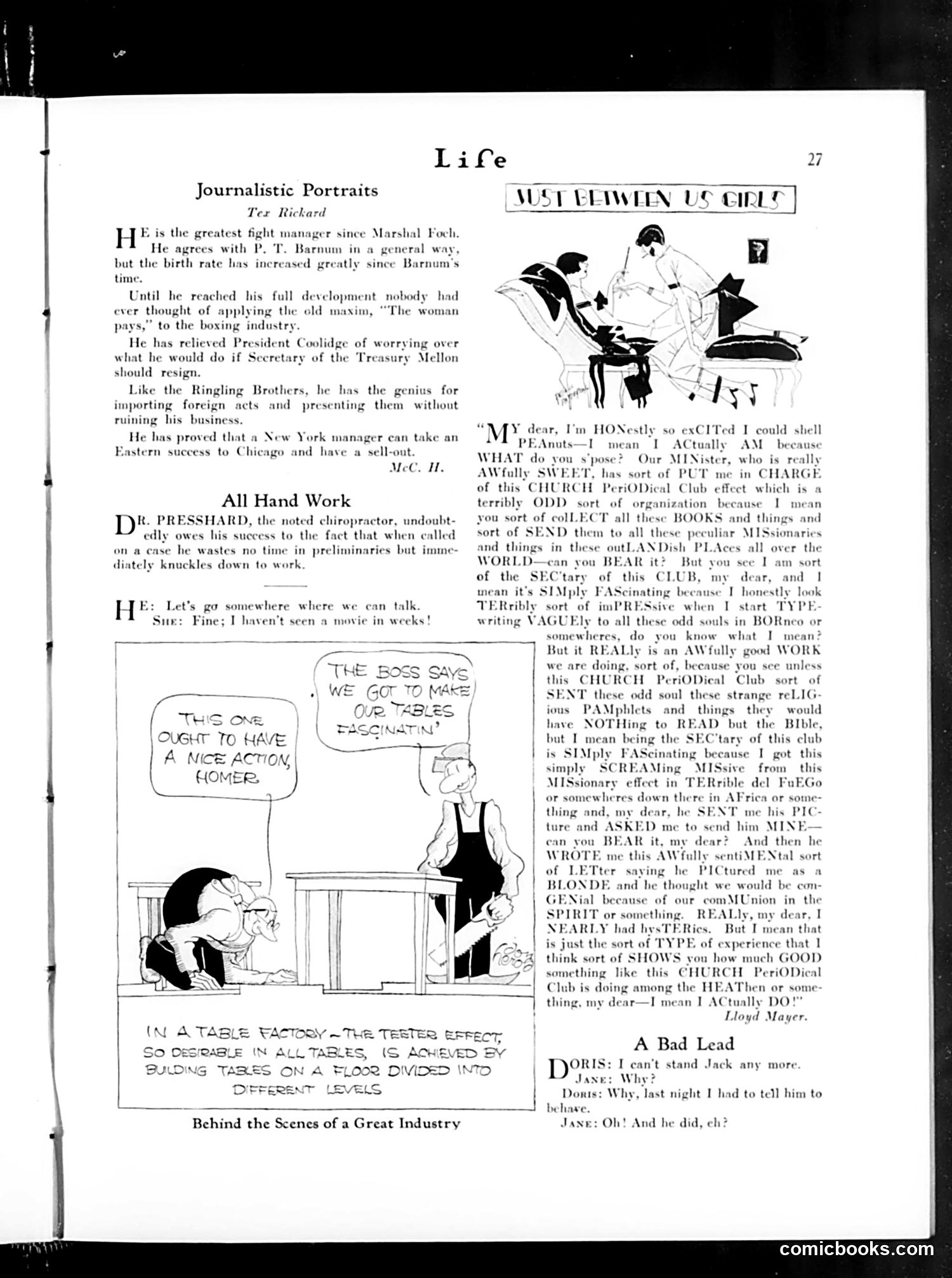
This page from *Life* magazine satirizes early 20th-century American figures and social pretensions. **"Journalistic Portraits: Tex Rickard"** mocks the famous boxing promoter, comparing him to P.T. Barnum and Marshal Foch. The satire suggests Rickard's success comes from understanding mass spectacle and profit—he's brought entertainment principles to boxing while relieving President Coolidge of concerns about Treasury Secretary Mellon's potential resignation (likely a reference to contemporary political anxieties). The **cartoons below** depict workplace/domestic scenes with period humor about class and romance. **"Must Between Us Girls"** (right panel) mockingly exaggerates a woman's affected speech patterns and breathless enthusiasm about leading a church periodical club—sending books to missionaries. The humor targets upper-class female pretension, artificial excitement, and naive romantic entanglements with foreign missionaries. The exaggerated capitalization of random words emphasizes her affected, gossipy delivery. **"A Bad Lead"** (bottom right) is a brief joke about relationship troubles, playing on "lead" as a social cue versus romantic interest. The overall page satirizes American materialism, religious sentimentality, and social climbing.
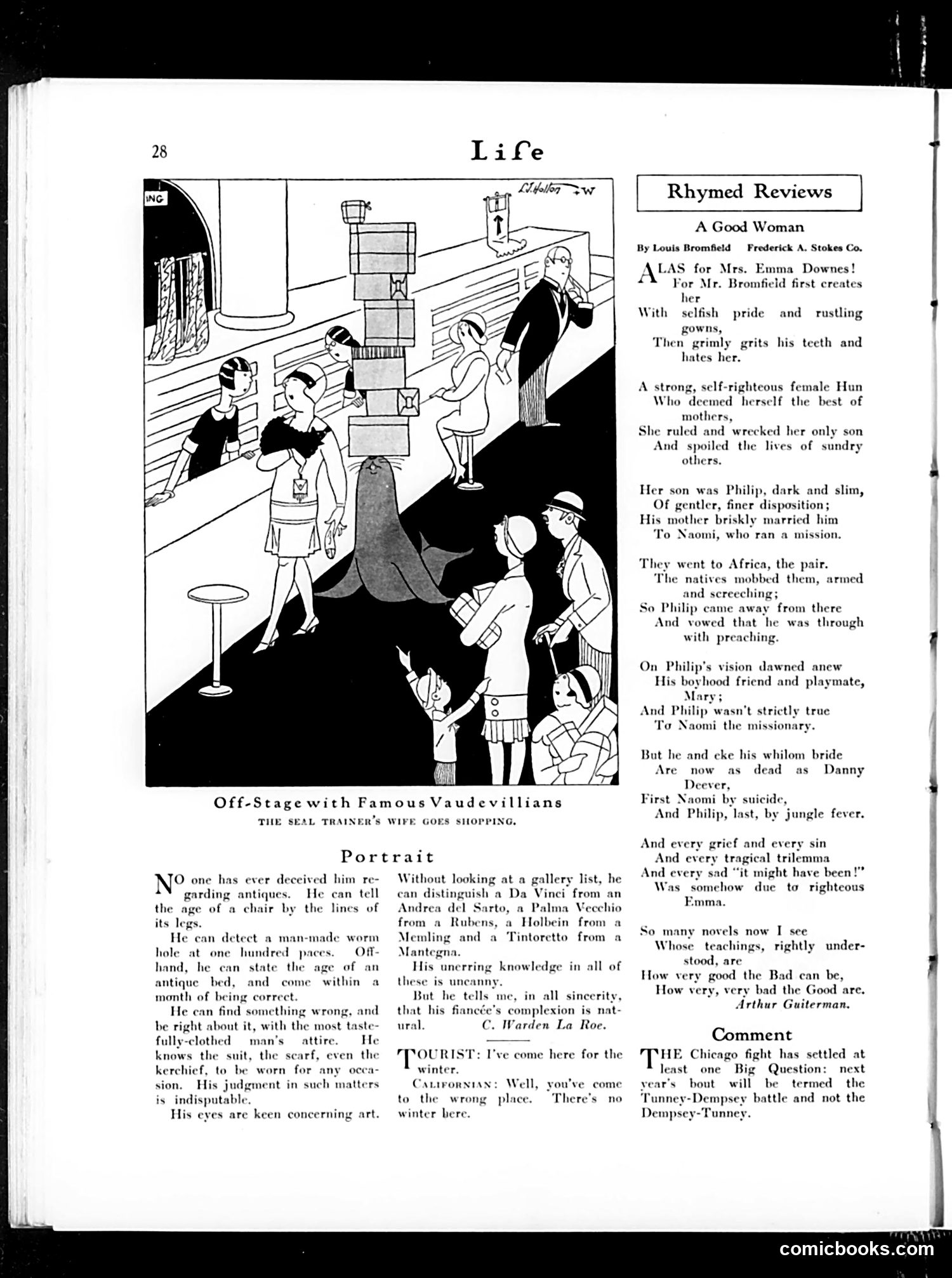
**The Cartoon:** "Off-Stage with Famous Vaudevillians—The Seal Trainer's Wife Goes Shopping" depicts a scene in what appears to be a department store or public space, showing a woman (the seal trainer's wife) in an exaggerated pose while other patrons and staff observe. The humor relies on the implied contrast between her dignified husband's profession and her undignified public behavior while shopping. **Context:** In early 20th-century Life magazine, vaudeville was popular entertainment, and "off-stage" glimpses of performers' private lives were satirical fodder. The joke mocks both the pretensions of show business figures and women's shopping habits—a common comedic target of the era. **The Other Content:** The page includes book reviews in verse (typical of Life's format) and a brief joke about Californian weather, representing the magazine's mix of theatrical satire, literary commentary, and short humor pieces.
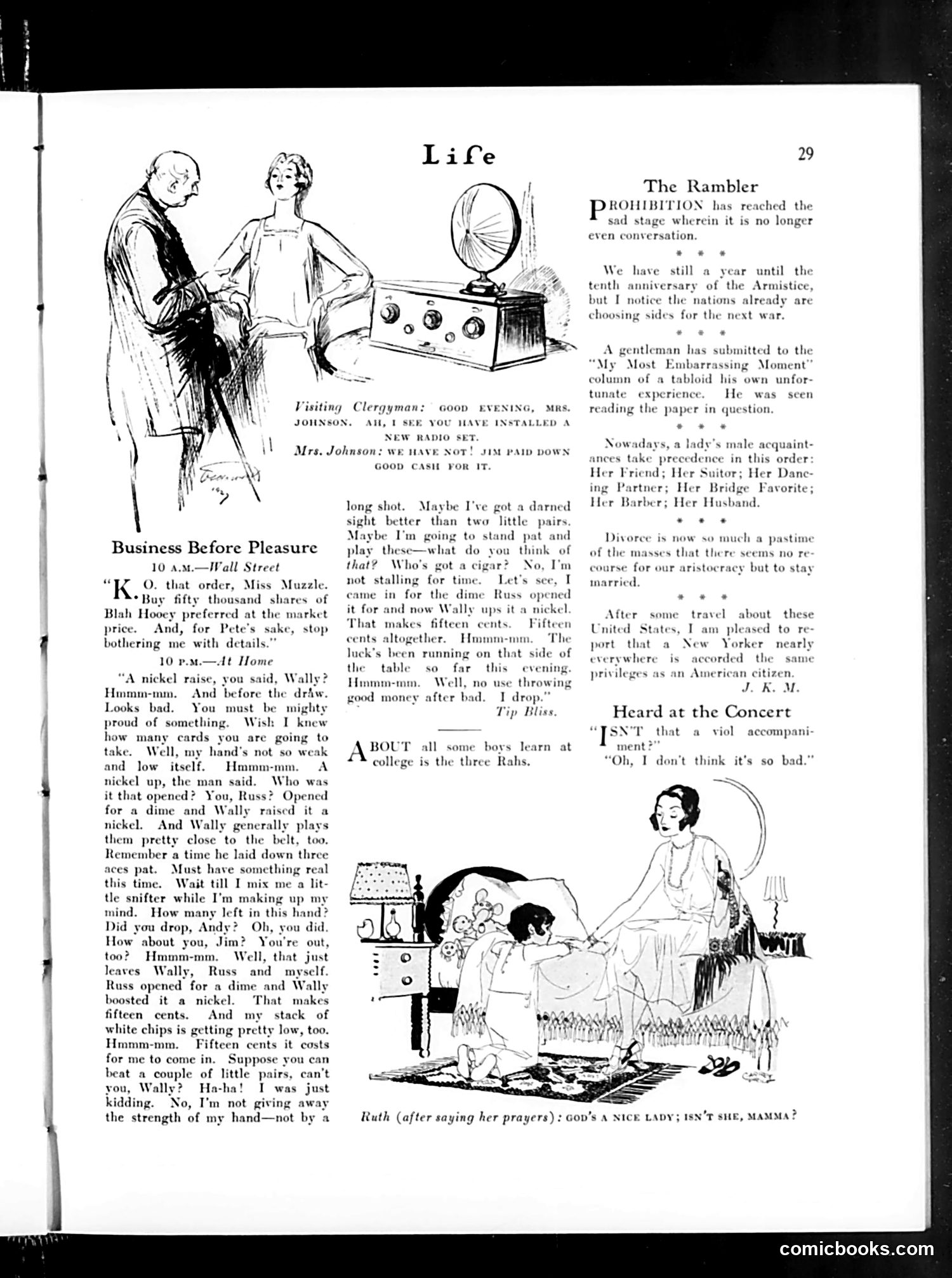
This page contains three satirical pieces mocking American social and economic behaviors in the 1920s. **"Business Before Pleasure"** contrasts a Wall Street broker's casual dismissal of financial details ("stop bothering me with details") with his meticulous, anxious poker playing at home—revealing hypocrisy about what truly matters to him. **The radio joke** depicts a clergyman congratulating Mrs. Johnson on her new radio, only to learn her husband bought it with cash rather than installment credit—implying widespread consumer debt and the false status symbols of modern life. **"The Rambler"** column offers cynical observations: Prohibition has become so normalized it's no longer even debated; nations are already preparing for another war a decade after WWI; divorce has become fashionable among the masses, forcing the wealthy to stay married to appear exclusive; and New Yorkers receive special treatment abroad. The bottom cartoon shows a child asking if God is "nice," gently mocking religious instruction or parental piety.
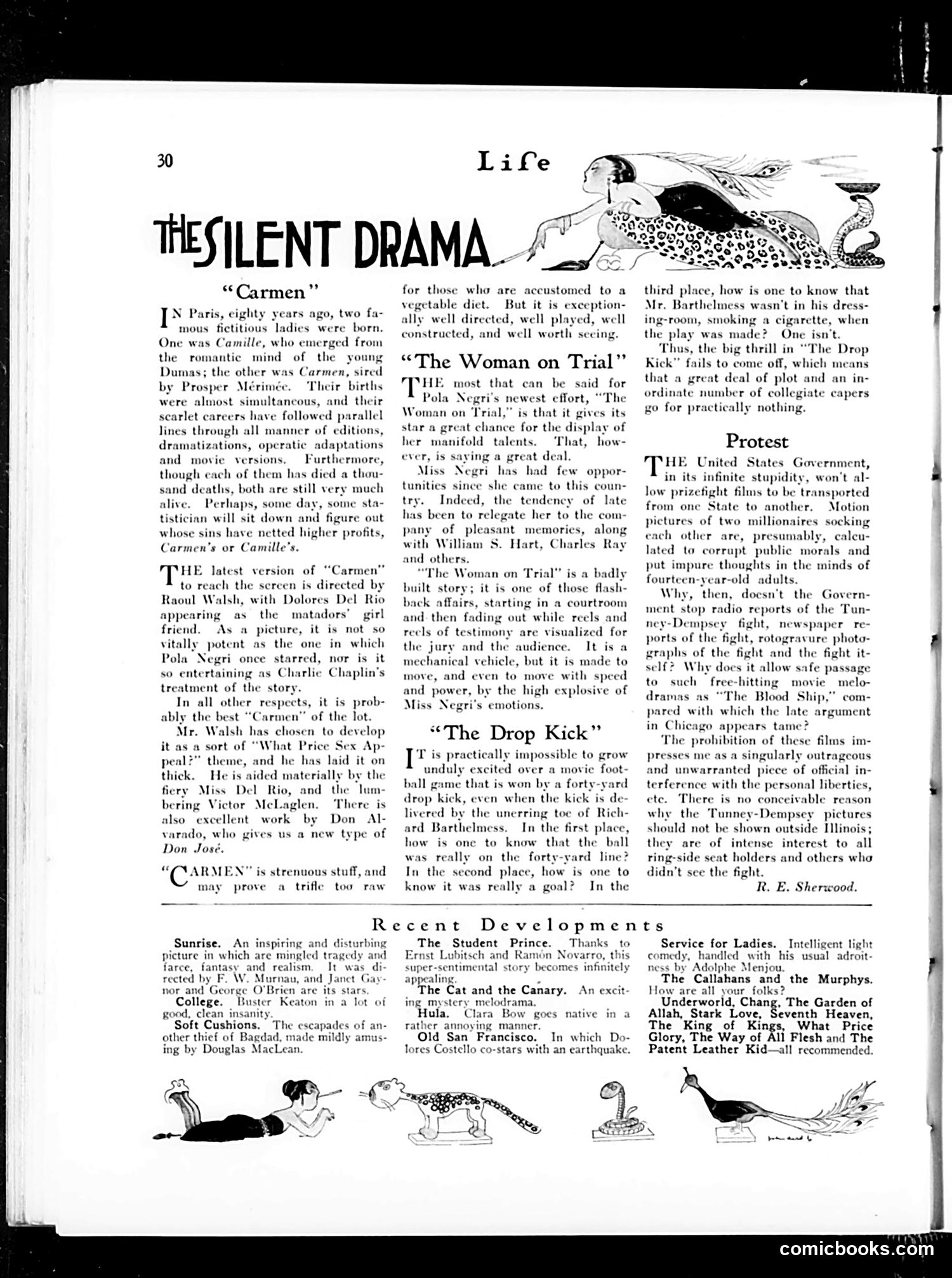
This page contains film reviews from Life magazine's "Silent Drama" column, reviewing three 1920s movies. The critic discusses *Carmen* (starring Dolores Del Rio, directed by Raoul Walsh), *The Woman on Trial* (featuring Pola Negri), and *The Drop Kick* (with Richard Barthelmess). The reviews are largely straightforward critiques of these silent films' plot construction and performances. However, the "Protest" section at bottom satirizes U.S. Government censorship: the author mocks the federal ban on transporting prizefight films between states as hypocritical "stupidity," arguing the government inconsistently allows radio reports, newspapers, and violent action movies to circulate freely while restricting boxing footage—supposedly to protect "fourteen-year-old adults'" morals. The satire attacks government overreach and arbitrary censorship standards.
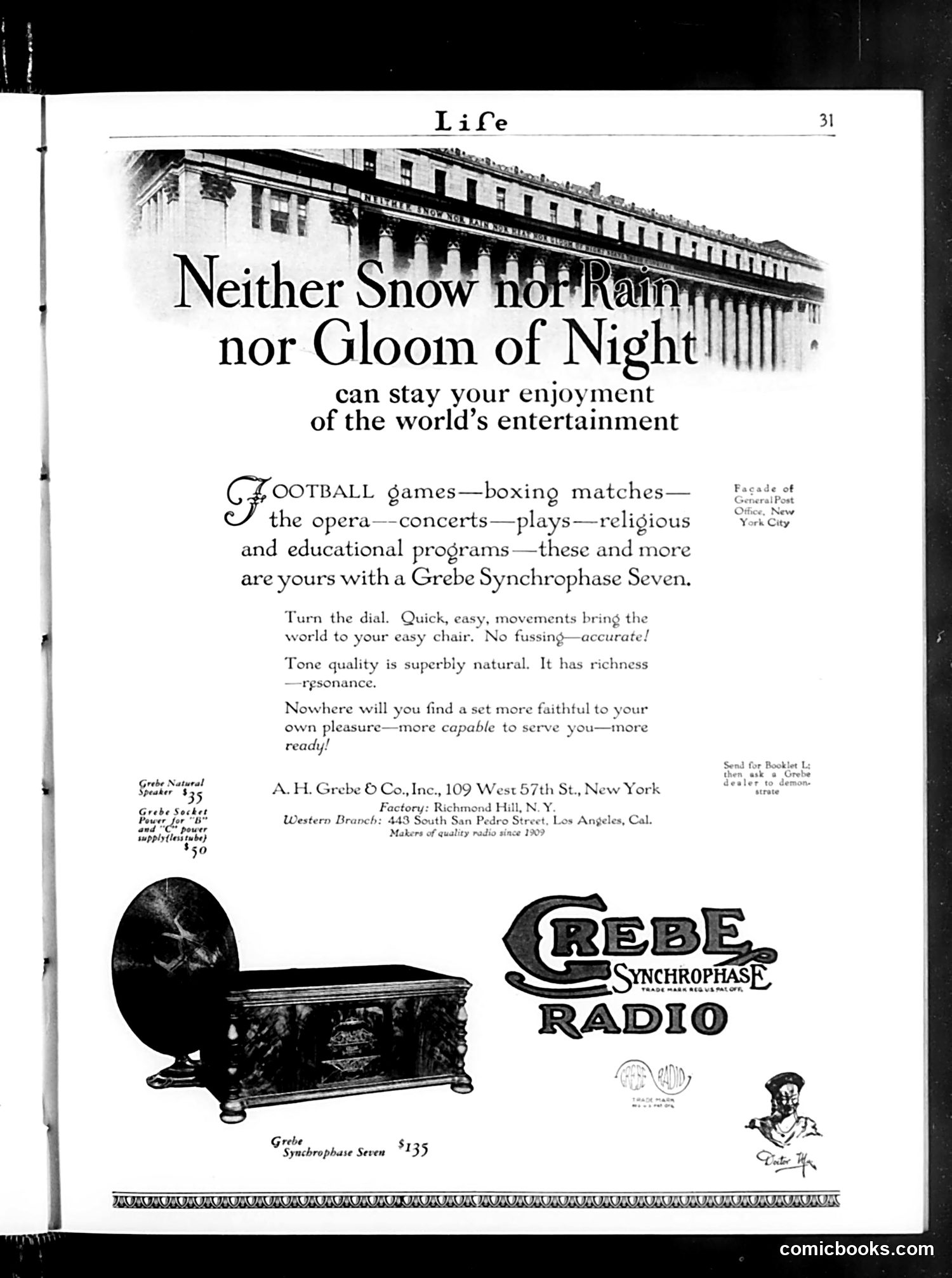
This is a **radio advertisement**, not a political cartoon. It promotes the Grebe Synchrophase Seven radio receiver (priced at $135). The headline parodies the U.S. Postal Service motto ("Neither snow nor rain nor heat nor gloom of night..."), humorously suggesting that radio entertainment is equally reliable and unstoppable. The ad emphasizes the radio's ability to bring diverse programming—football, boxing, opera, concerts, plays, religious and educational content—directly into the home with easy tuning and superior sound quality. The ornate radio pictured represents 1920s consumer technology marketed as an essential household device. This reflects the era when radio was transforming American entertainment and information access, positioning the Grebe brand as the quality choice for discerning listeners seeking convenient, faithful home entertainment regardless of weather conditions.
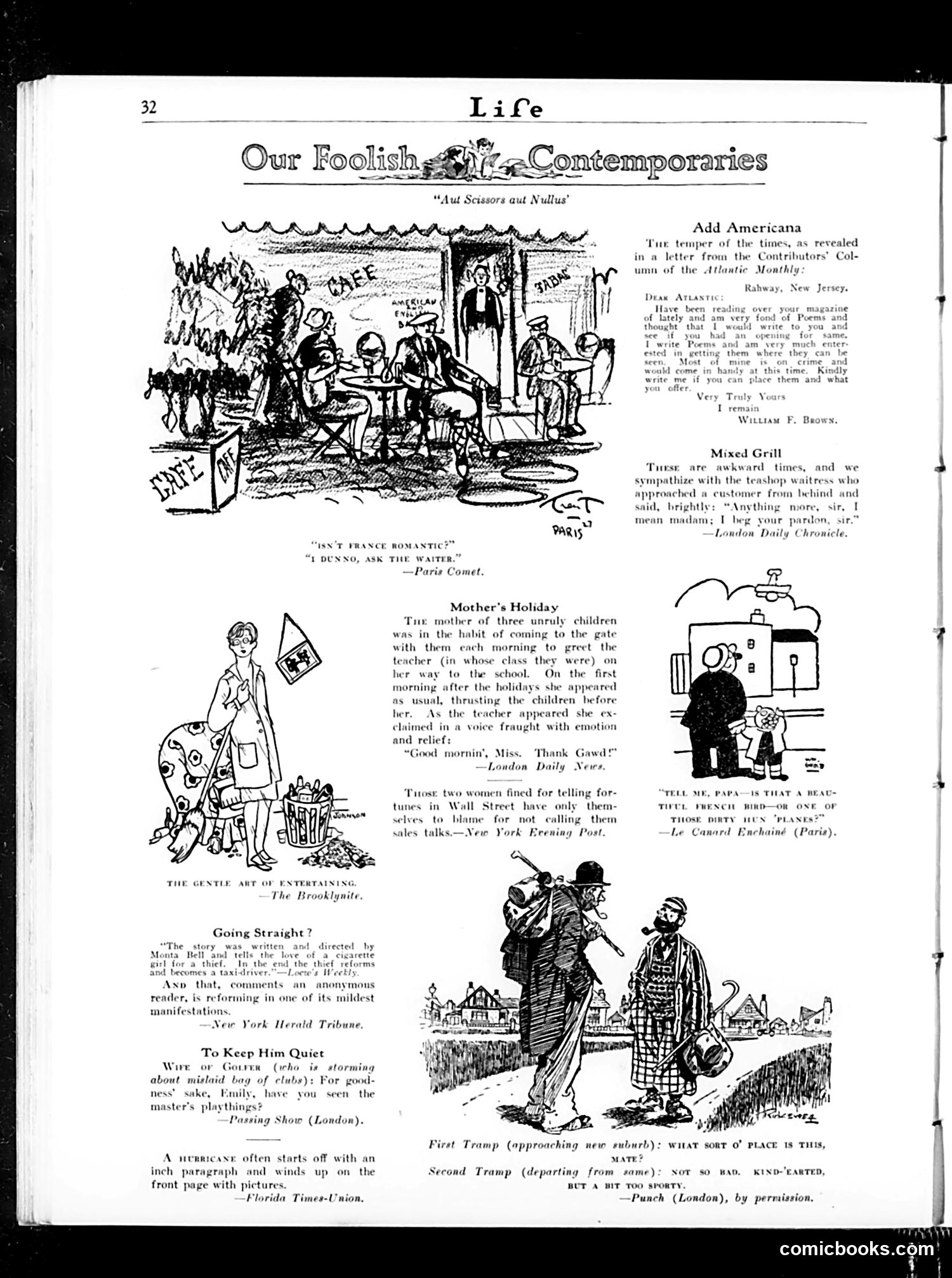
This page collects humorous anecdotes and cartoons satirizing everyday social awkwardness and wartime attitudes. Key items: **"Isn't France Romantic?"** mocks American tourists' romantic notions of France—a waiter's blunt "I dunno, ask the waiter" deflates the fantasy. **"Mother's Holiday"** depicts a relieved teacher greeting a mother returning children after break, expressing gratitude the children are back in school (not her problem). **"First Tramp/Second Tramp"** shows two vagrants discussing a new suburb—one describes it as "kind-hearted, but a bit too sporty," apparently meaning the residents are inhospitably athletic or active. **The "Beautiful French Bird" reference** appears to contrast a lovely bird with "dirty Hun planes," likely a WWI-era jab at German aircraft. The page's theme is gentle mockery of modern manners, tourist pretension, and wartime attitudes through reader submissions and reprints from international publications.
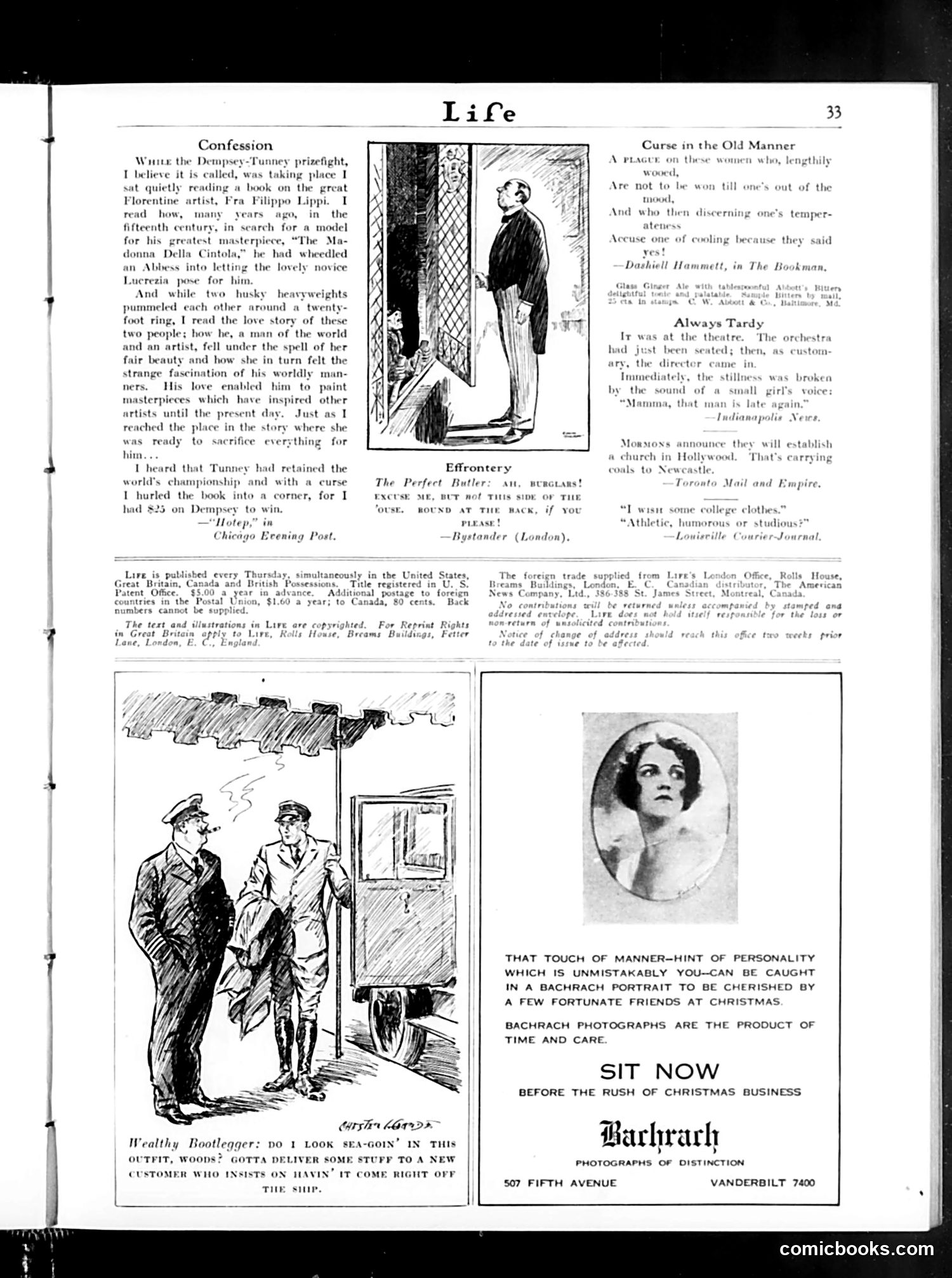
This page contains three distinct pieces of satire from the 1920s: **"Confession"** mocks the Dempsey-Tunney boxing championship. The narrator reads about Renaissance artist Fra Filippo Lippi's romantic muse while two heavyweight boxers fight. When Tunney (the underdog) defeats Dempsey, the narrator curses and throws his book away—his $25 bet lost. The satire contrasts high culture with low sports gambling, suggesting readers abandon intellectual pursuits for prizefight excitement. **"Always Tardy"** jokes about theater interruptions: an orchestra director arrives late, broken by a small child's voice announcing "Mamma, that man is late again." **"Wealthy Bootlegger"** references Prohibition-era criminality. A bootlegger in fancy clothes asks his driver whether his outfit looks "sea-going" for delivering illegal alcohol to a wealthy customer. The satire mocks how organized crime had infiltrated upper-class society during the dry years. The page also contains a Bachrach photography advertisement.
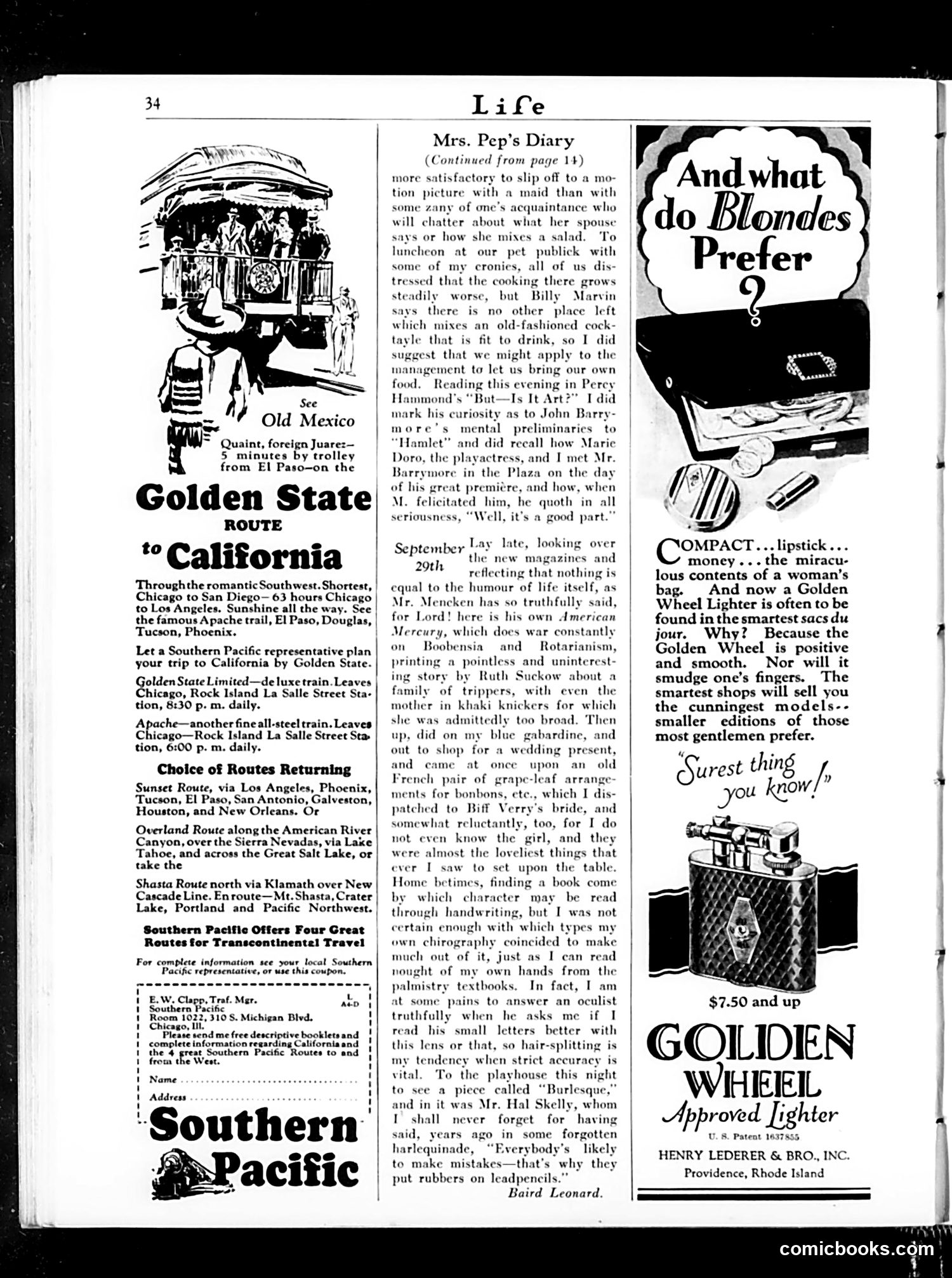
This page is primarily **advertising** for Southern Pacific Railways and Golden Wheel lighters, interspersed with diary content. **The "Mrs. Pep's Diary" column** (center/right) is satirical social commentary typical of *Life* magazine's humor. It mocks upper-class affectations through a wealthy woman's pretentious observations: complaining about restaurant cocktails, name-dropping theatrical celebrities (John Barrymore, Marie Doro), dismissing magazine stories by Ruth Suckow, and fussing over handwriting analysis and palmistry. The satire targets her vapid preoccupations and social snobbery. **The Golden Wheel lighter advertisement** (right sidebar) plays on the humor of the era: "And what do Blondes Prefer?" uses period sexism/stereotyping to market lighters as compact, elegant accessories—positioning the product as something sophisticated women desire. **The Southern Pacific advertisement** (left) simply promotes California travel routes without satirical intent. The page reflects 1920s consumer culture, class anxieties, and casual gender stereotyping presented as humor.
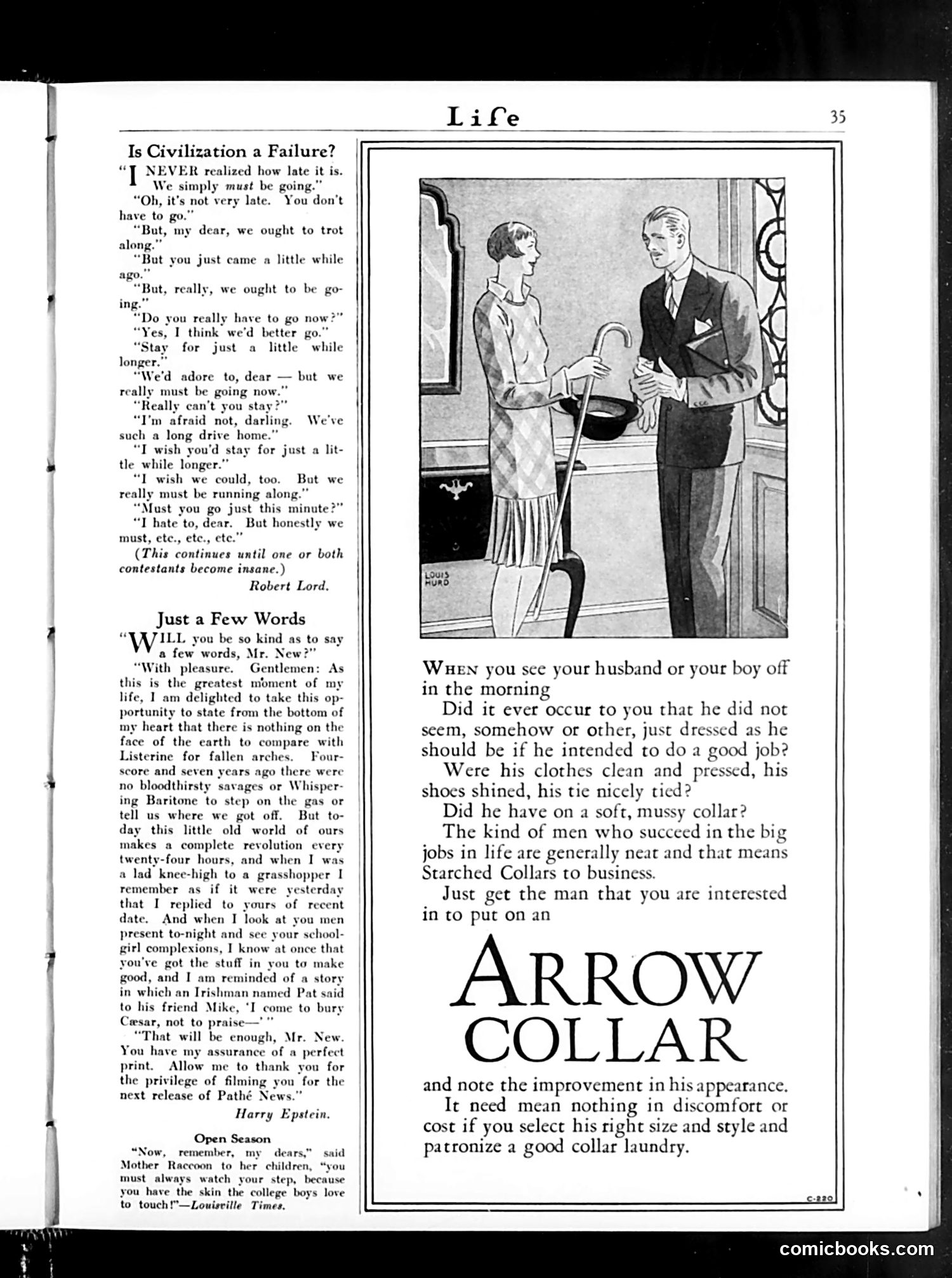
This page combines satirical humor with advertising. The main content features three pieces: **"Is Civilization a Failure?"** by Robert Lord satirizes the exhausting social ritual of guests overstaying their welcome while hosts insist they must leave. The repetitive back-and-forth dialogue mocks the politeness conventions of the era, suggesting both parties are trapped in an absurd performance that continues "until one or both contestants become insane." **"Just a Few Words"** lampoons the rambling, incoherent after-dinner speech—a speaker digresses from topic to topic (Listerine, history, Irish anecdotes) in one long, meaningless monologue. **"Open Season"** is a brief joke about college boys pursuing young women, using animal metaphor. The page's dominant feature is an **Arrow Collar advertisement** showing an elegantly dressed couple. It argues that wearing starched Arrow collars signals competence and success—appeals to masculine vanity and social aspiration. The ad promises appearance improvements require no discomfort or cost. Together, the satirical pieces and advertisement reflect 1920s concerns with social performance, etiquette, and the commercialization of respectability.
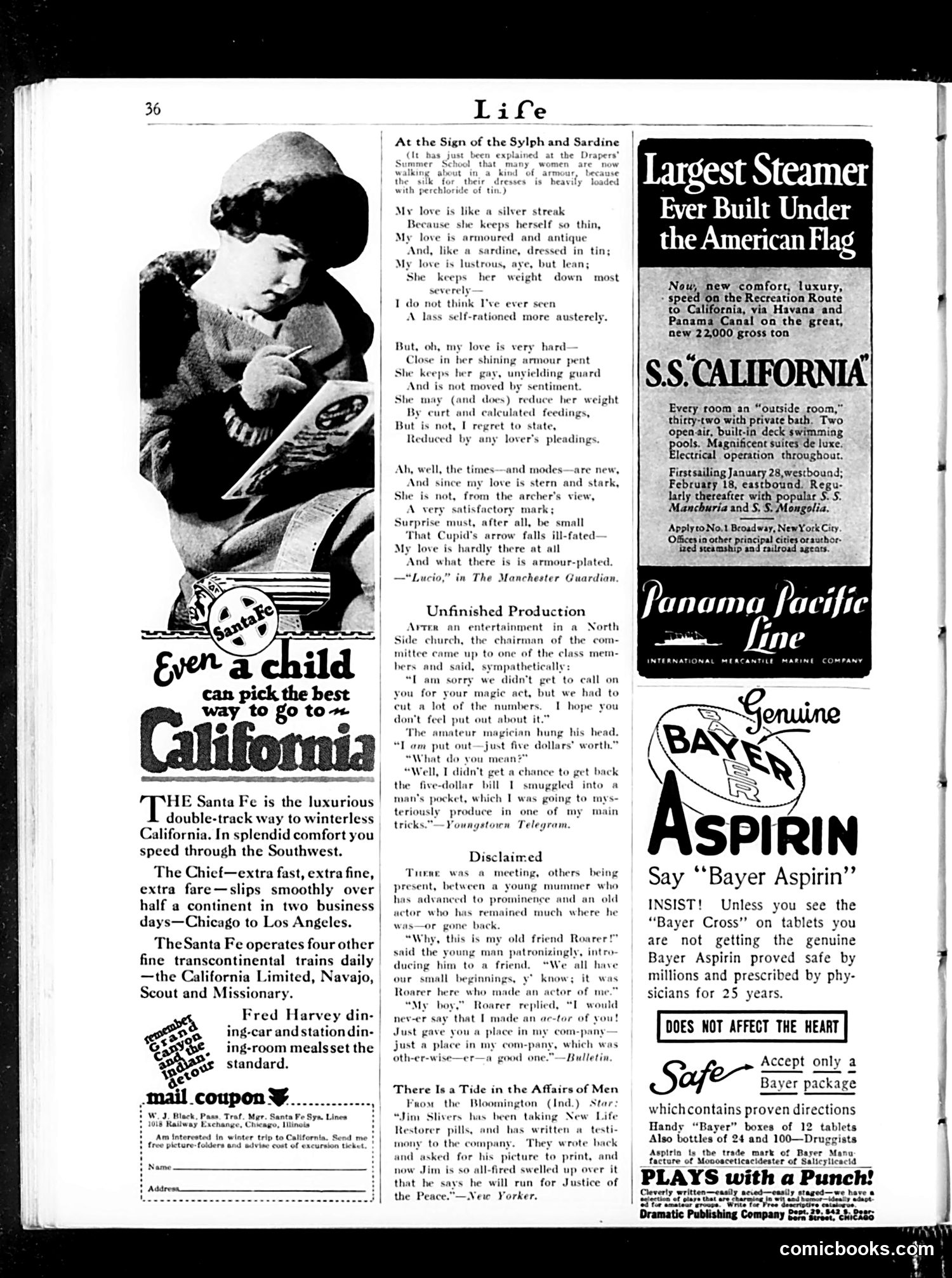
This page contains three humorous anecdotes and period advertisements (circa 1920s). **The Poetry ("At the Sign of the Sylph and Sardine"):** A satirical love poem mocking the modern fashionable woman—thin, armor-like, emotionally guarded, and resistant to romantic sentiment. The "sardine dressed in tin" metaphor critiques the era's extreme dieting and corseting trends among wealthy women. **"Unfinished Production":** A magician's disappointment when his act is cut from a church entertainment, losing the chance to perform his signature trick (making money appear). **"Disclaimed":** An old actor denies responsibility for mentoring a now-successful young performer, humorously refusing credit for launching his rival's career. The advertisements promote luxurious transcontinental rail travel (Santa Fe Railway), ocean cruises to California (S.S. California), and Bayer Aspirin—reflecting 1920s consumer culture and the emerging pharmaceutical industry's marketing strategies.
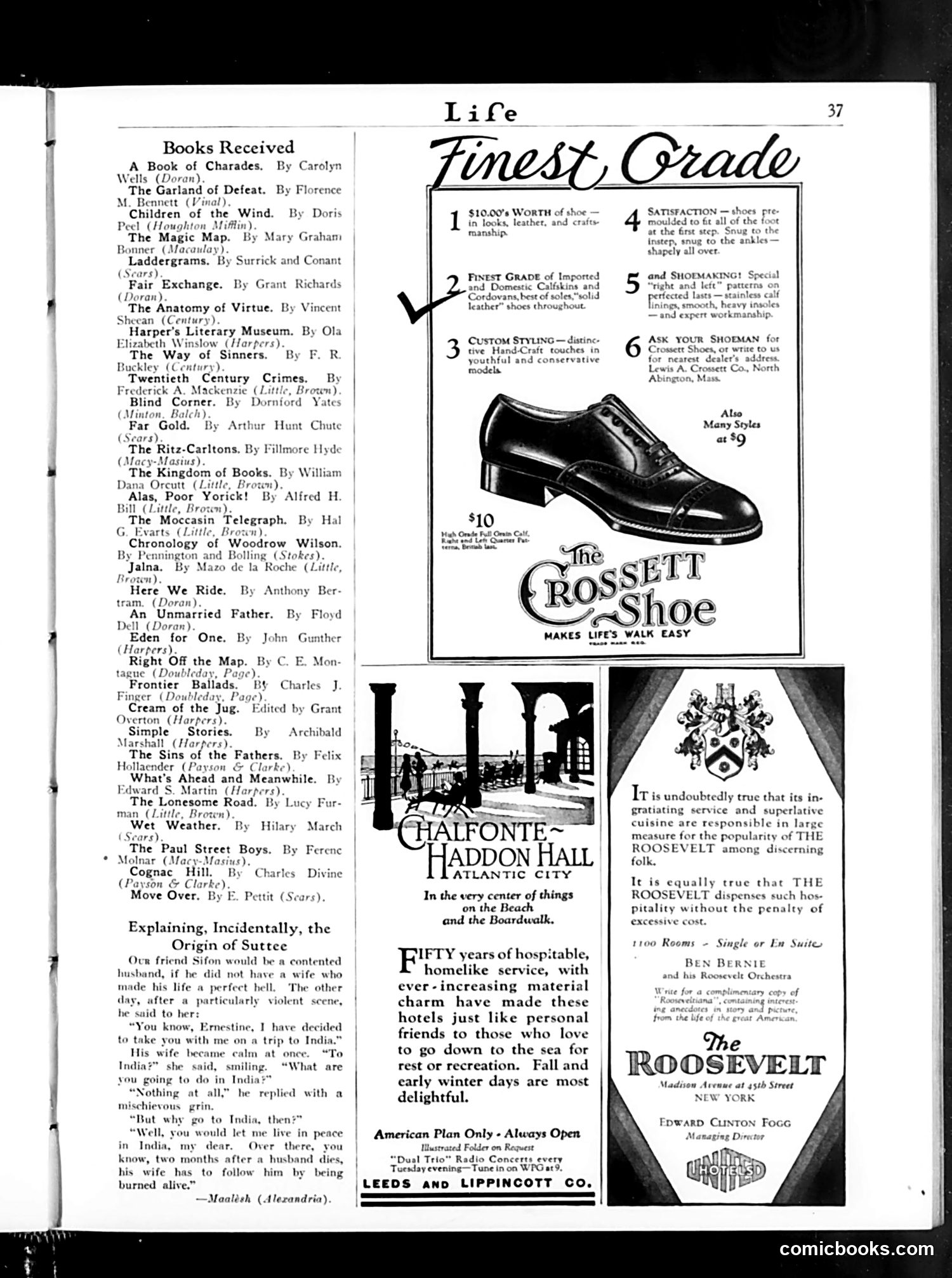
This page from *Life* magazine contains a satirical short story titled "Explaining, Incidentally, the Origin of Suttee" (the historical practice of widows self-immolating on their husbands' funeral pyres in India). The joke portrays a contemporary husband, Sifon, so desperate to escape his nagging wife Ernestine that he proposes taking her to India—and jokes that she'll be obligated by custom to burn herself alive two months after he dies. The satire targets the husband's marital misery while simultaneously treating the actual historical practice of suttee as material for flippant humor. The rest of the page contains book reviews and advertisements (Crosett shoes, Roosevelt Hotel, Haffonte-Haddon Hall hotel). The period illustration style and tone reflect early 20th-century attitudes toward both domestic tensions and colonial-era non-Western practices.
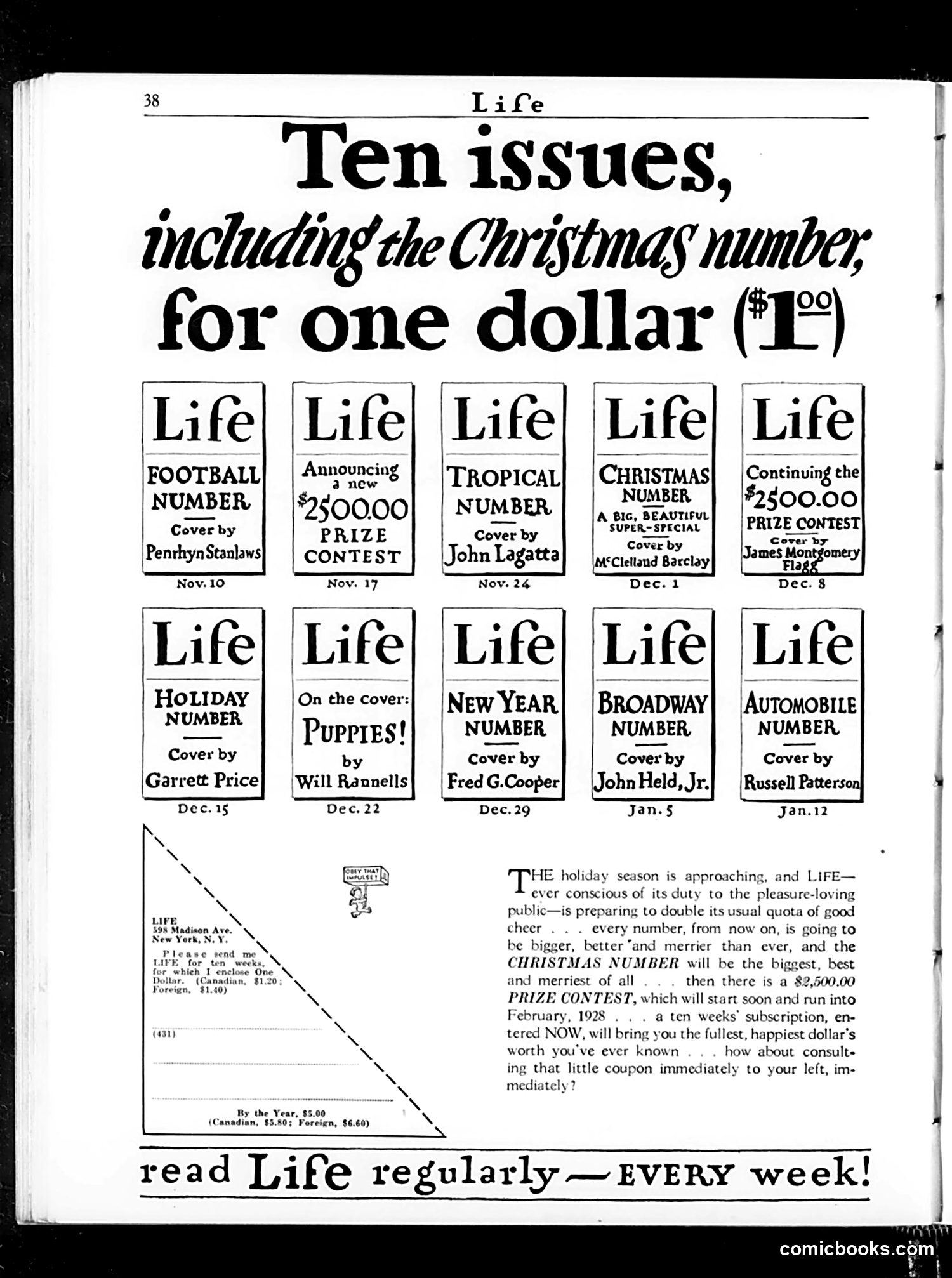
This is a **subscription promotion**, not a political cartoon. Life magazine advertises ten issues (including a special Christmas number) for one dollar, highlighting upcoming themed issues: Football, Prize Contest announcement, Tropical, Christmas, Prize continuation, Holiday, Puppies cover, New Year, Broadway, and Automobile numbers. The text emphasizes the holiday season and mentions a **$2,500 prize contest** running into February 1928, encouraging immediate subscription via coupon. Notable cover artists listed include Penrhyn Stanlaws and John Held Jr., prominent illustrators of the 1920s. The appeal targets pleasure-seeking readers with promises of "bigger, better and merrier" content. The pricing ($1 for ten issues, with annual rates of $5) reflects 1920s purchasing power. This represents Life's marketing strategy during a prosperous pre-Depression period.
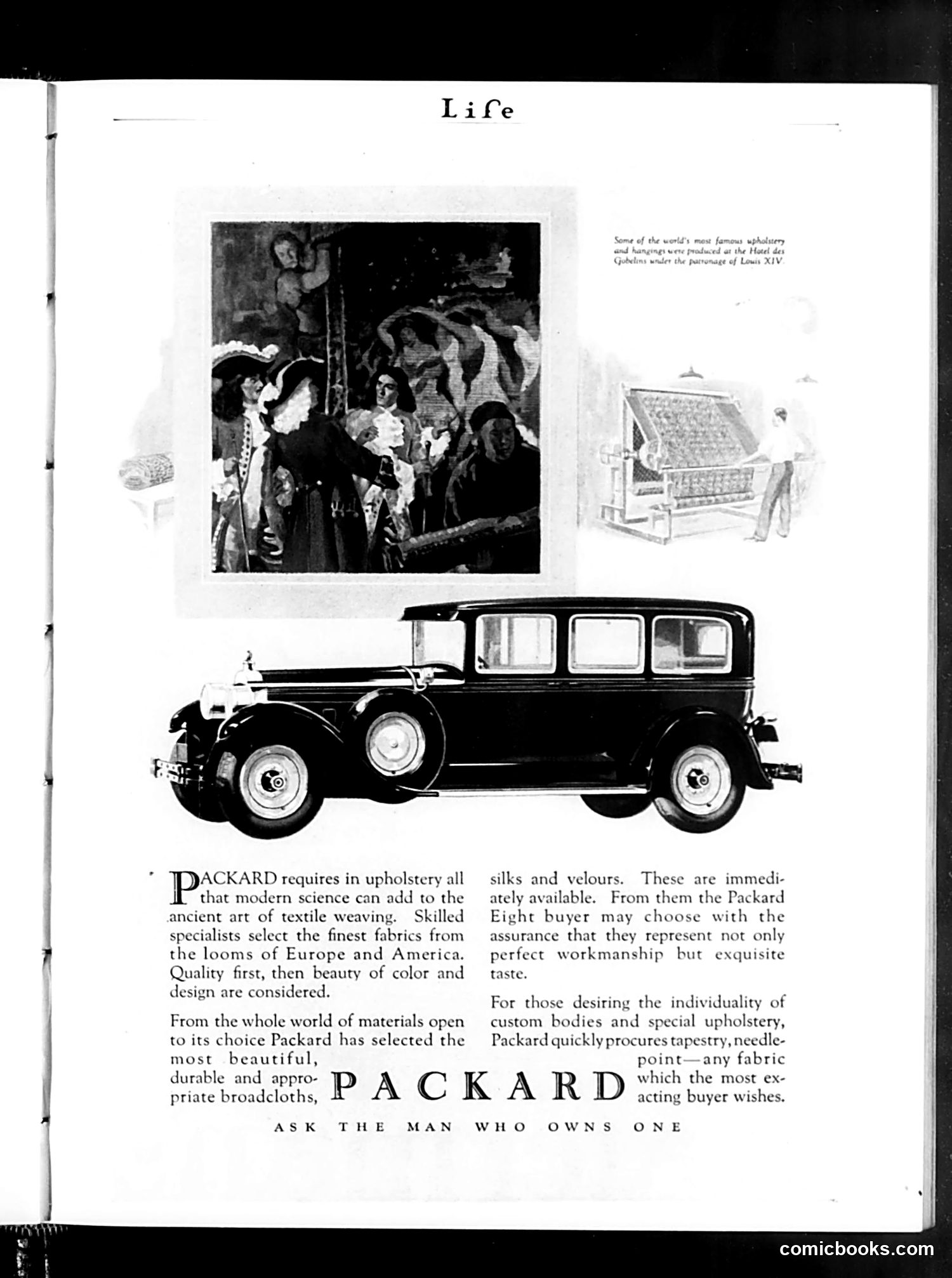
This is **not a cartoon or satire page** — it's a **luxury automobile advertisement** for Packard automobiles, positioned within *Life* magazine. The page features a 1920s-era Packard sedan automobile illustration alongside promotional text emphasizing upholstery quality. There are two supplementary images: a historical painting (apparently depicting wealthy patrons of the arts under Louis XIV) and a sketch of what appears to be a coach-building workshop. The advertisement's strategy connects Packard automobiles to refined taste and European craftsmanship tradition. The tagline "Ask the man who owns one" was Packard's actual famous slogan, implying that satisfied wealthy owners themselves would validate the brand's prestige. This represents early 20th-century aspirational marketing — selling not transportation but status and cultural sophistication to affluent readers.
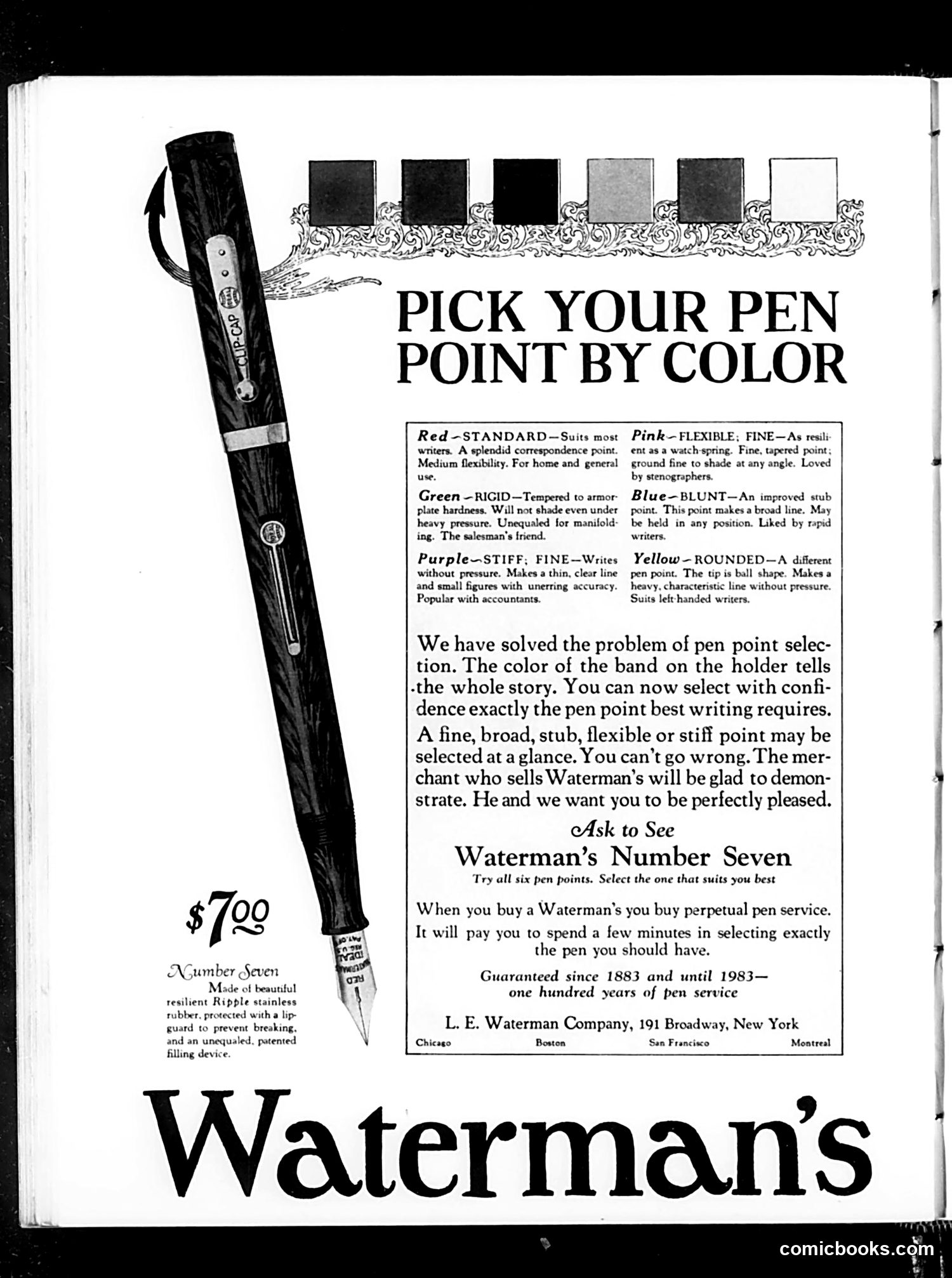
This is a **product advertisement**, not a political cartoon or satire. It's a Waterman's fountain pen ad from *Life* magazine promoting their "Number Seven" model priced at $7.20. The page uses a color-coding system as its marketing hook: each pen point type is identified by a colored band on the holder—Red (standard), Green (rigid, for salesmen/manifolding), Purple (fine, for accountants), Pink (flexible, for stenographers), Blue (blunt, for rapid writers), and Yellow (rounded, for left-handed writers). The appeal is practical: buyers can instantly identify which pen suits their profession or writing style without guessing. The ad emphasizes reliability ("Guaranteed since 1883 and until 1983—one hundred years of pen service") and invites customers to try all six points before selecting. There is no satire here—it's straightforward early-20th-century commercial messaging designed to solve a genuine consumer problem: pen point selection.
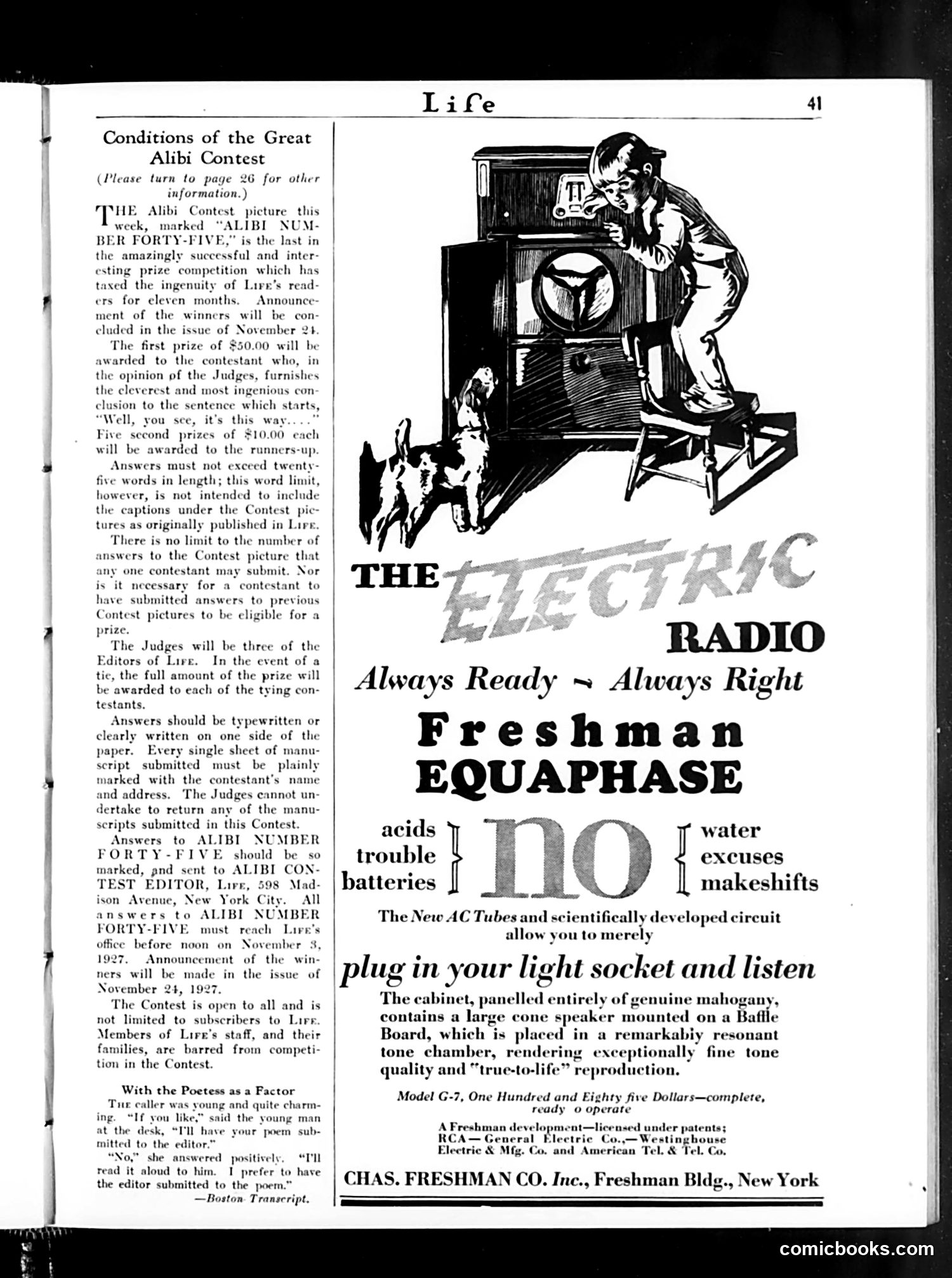
This page contains **two unrelated elements**: a writing contest and a radio advertisement. **The Alibi Contest:** Life magazine ran an eleven-month "Alibi Contest" where readers submitted humorous conclusions to the sentence "Well, you see, it's this way..." The illustrated cartoon (number 45, the final one) shows a man gesturing defensively while two dogs look on—a visual setup prompting readers to imagine his excuse. This was a popular participatory feature that engaged readers' creative writing skills. The first prize was $50, with five $10 second prizes. **The Advertisement:** The bulk of the page promotes the Freshman "Equaphase" electric radio—a relatively new consumer technology in 1927. It emphasizes convenience ("plug in your light socket and listen") and quality, marketing it as solving common radio problems (acids, batteries, water damage). The mahogany cabinet and "Battle Board" speaker represent luxury consumer design of the Jazz Age era.
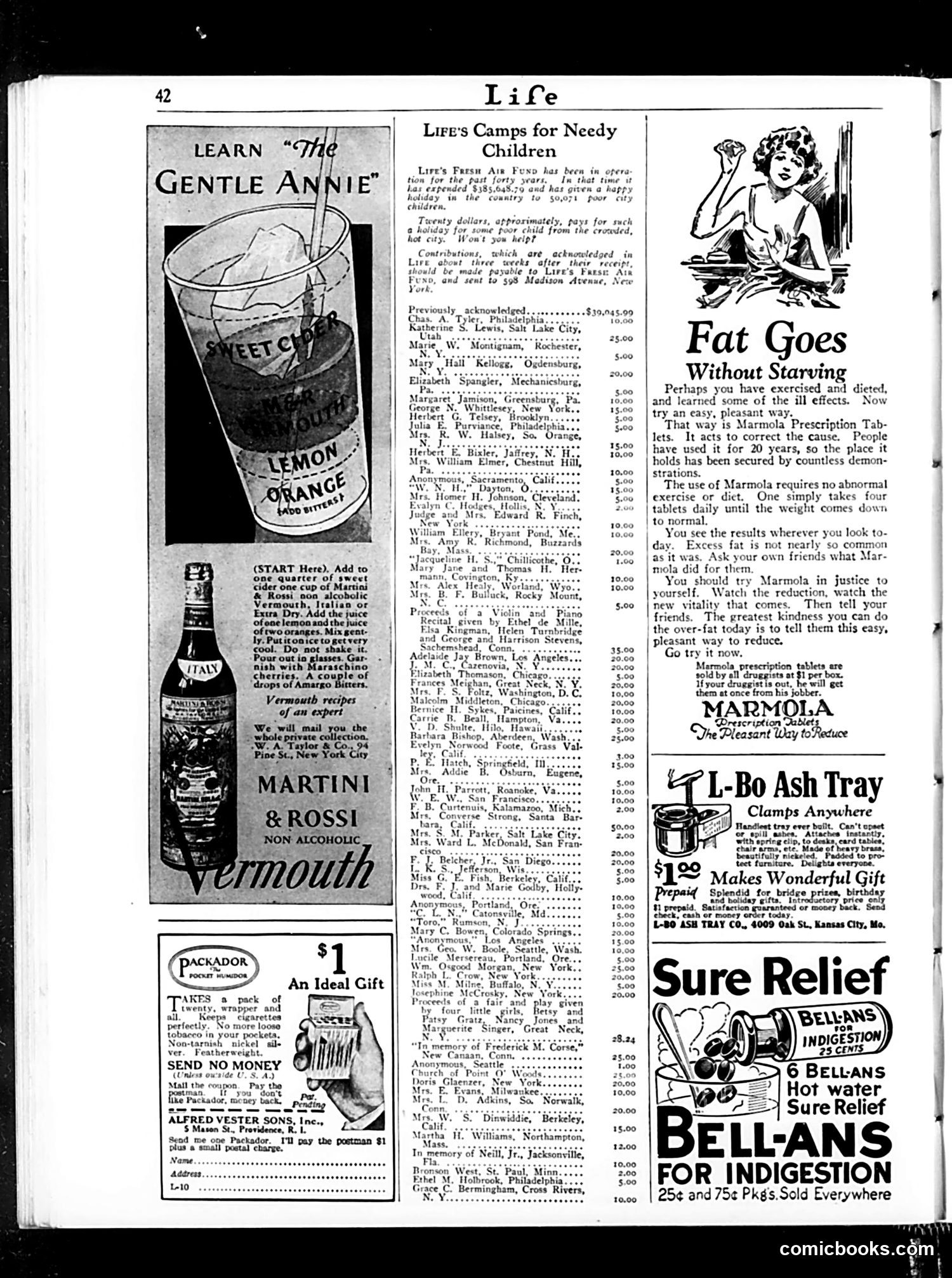
This page is primarily **advertising and charitable content**, not satire or political commentary. The main elements include: **Advertisements** for consumer products: Martini & Rossi vermouth (with a cocktail recipe), Packador cigarettes, Marmola weight-loss tablets, L-Bo ash trays, and Bellans indigestion relief. **A charitable notice** listing donors to Life's Fresh Air Fund, which has operated for 40 years providing summer camps for poor city children. The fund had distributed nearly $390,000 by this point. **A weight-loss advertisement** for Marmola tablets, emphasizing that users can reduce weight "without starving" and without abnormal exercise—notable as this reflects 1920s-era attitudes toward diet products and weight management. The page reflects typical Life magazine content of its era: mixing commercial advertising with charitable fundraising appeals, and promoting various consumer remedies and lifestyle products to its middle-class readership.
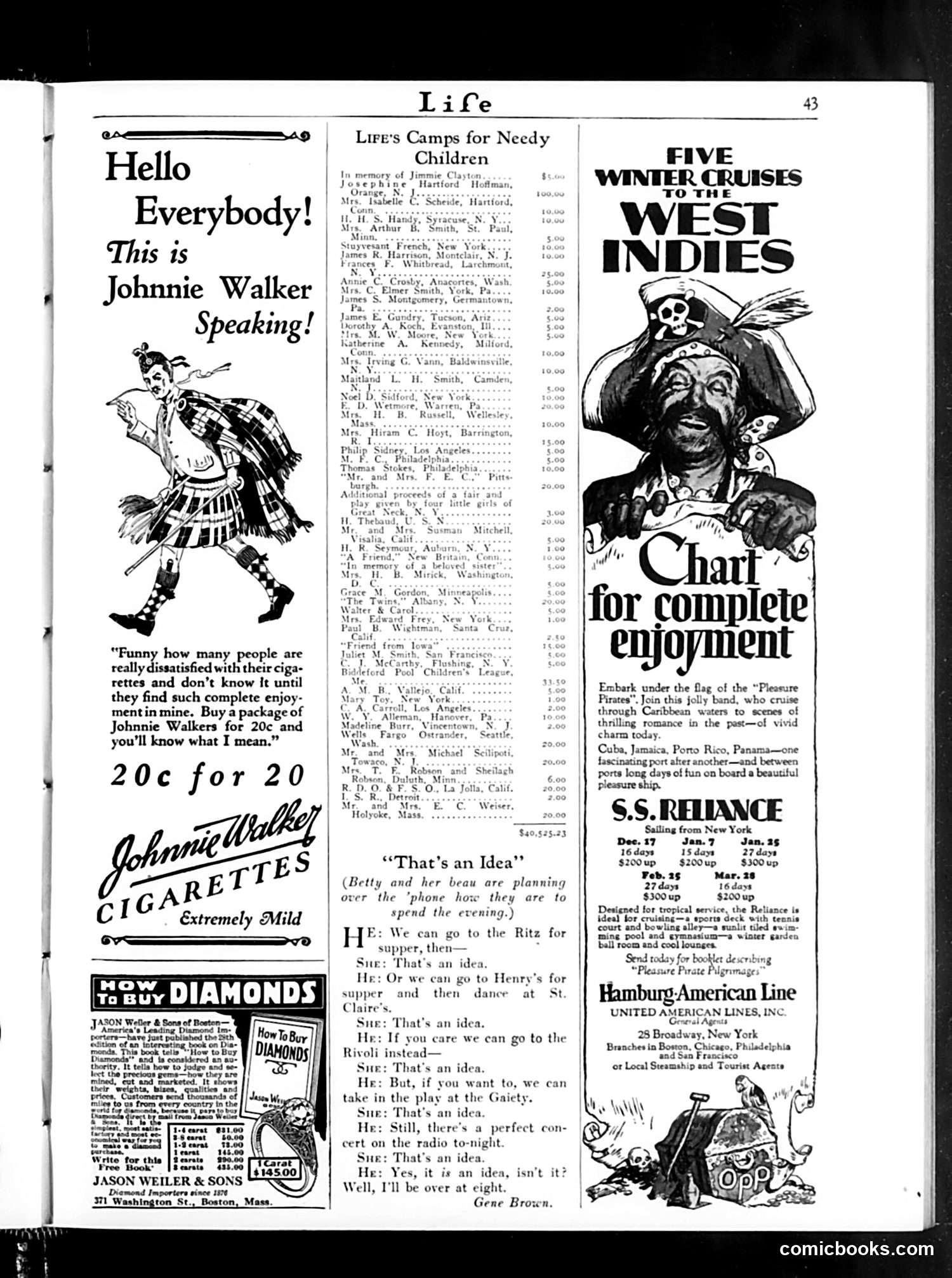
This page combines **advertisements with satirical humor** typical of 1920s Life magazine. The main cartoon, **"That's an Idea"** by Gene Brown, satirizes **passive female dating behavior**. A young woman agrees to every suggestion her boyfriend makes—each time responding "That's an idea"—until he finally exasperates himself noting the absurdity: "Yes, it is an idea, isn't it?" The joke mocks women who lack independent opinions or agency in social planning, reflecting the era's gender stereotypes. The page is dominated by **period advertisements**: Johnnie Walker cigarettes (20 for 20 cents), Jason Weiler & Sons diamonds, Hamburg-American cruise lines, and Life's charitable "Camps for Needy Children" fundraising list. The cigarette ad uses a personified "Johnnie Walker" character (separate from the later Johnnie Walker scotch brand) endorsing the product—a common advertising technique before tobacco restrictions. Together, the content reflects 1920s consumer culture and contemporary attitudes toward gender roles.
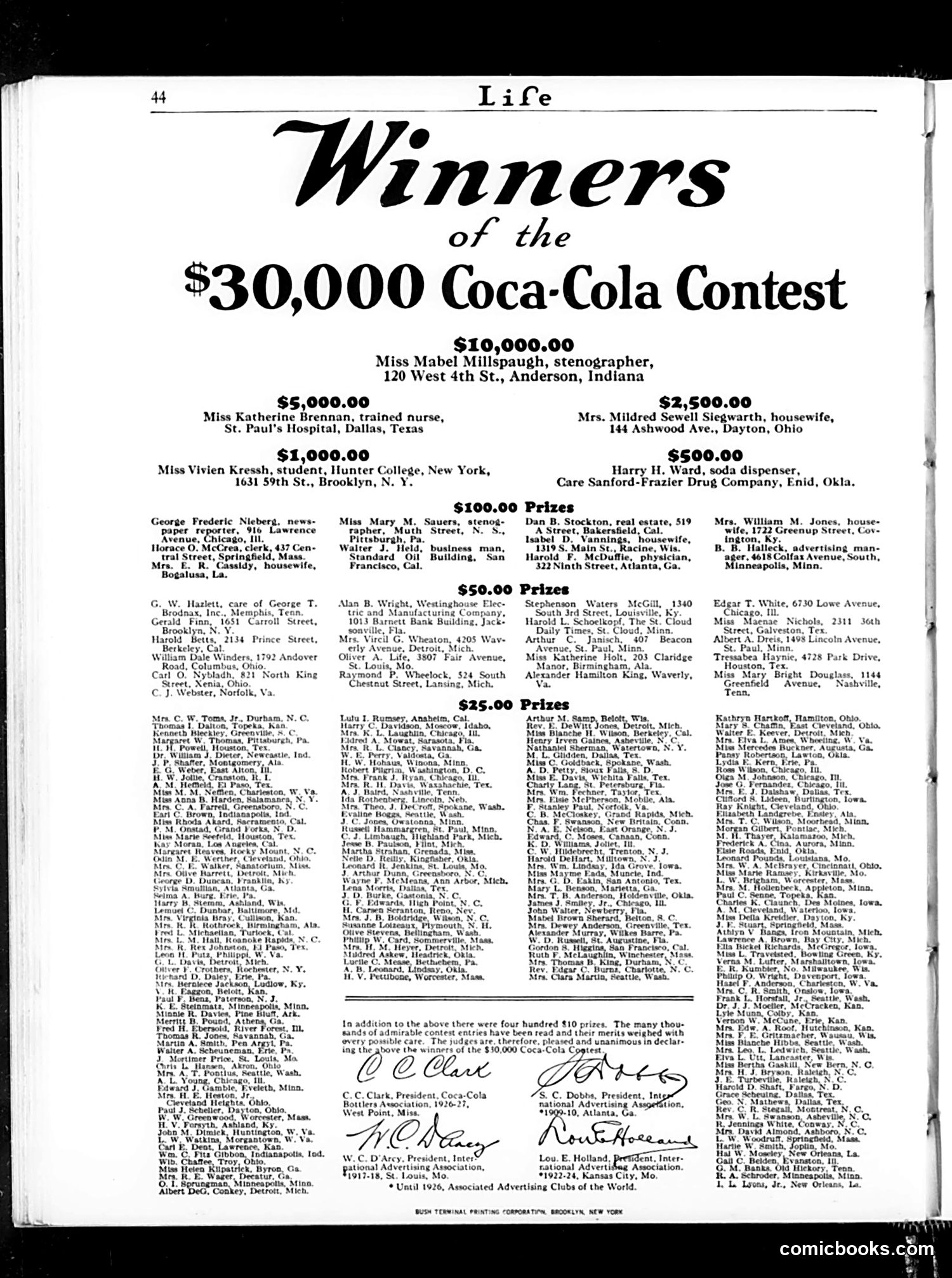
This page is not a cartoon or satirical content—it's simply a **contest results announcement** from *Life* magazine. The page lists winners of a $30,000 Coca-Cola promotional contest, organized by prize amounts ($10,000 down to $25 prizes). The winners are ordinary citizens from across America—stenographers, nurses, housewives, businessmen, and clerks—identified by name, occupation, and address. At the bottom are signatures from contest officials including C.T. Clark (Coca-Cola President), W.C. D'Arcy (International Advertising Association President), and others, certifying the results. This reflects 1920s corporate America: Coca-Cola running a major national marketing contest with substantial prize money, and *Life* magazine publishing the full results as public record. There is no satire here—just advertising and legitimate contest documentation from the era.
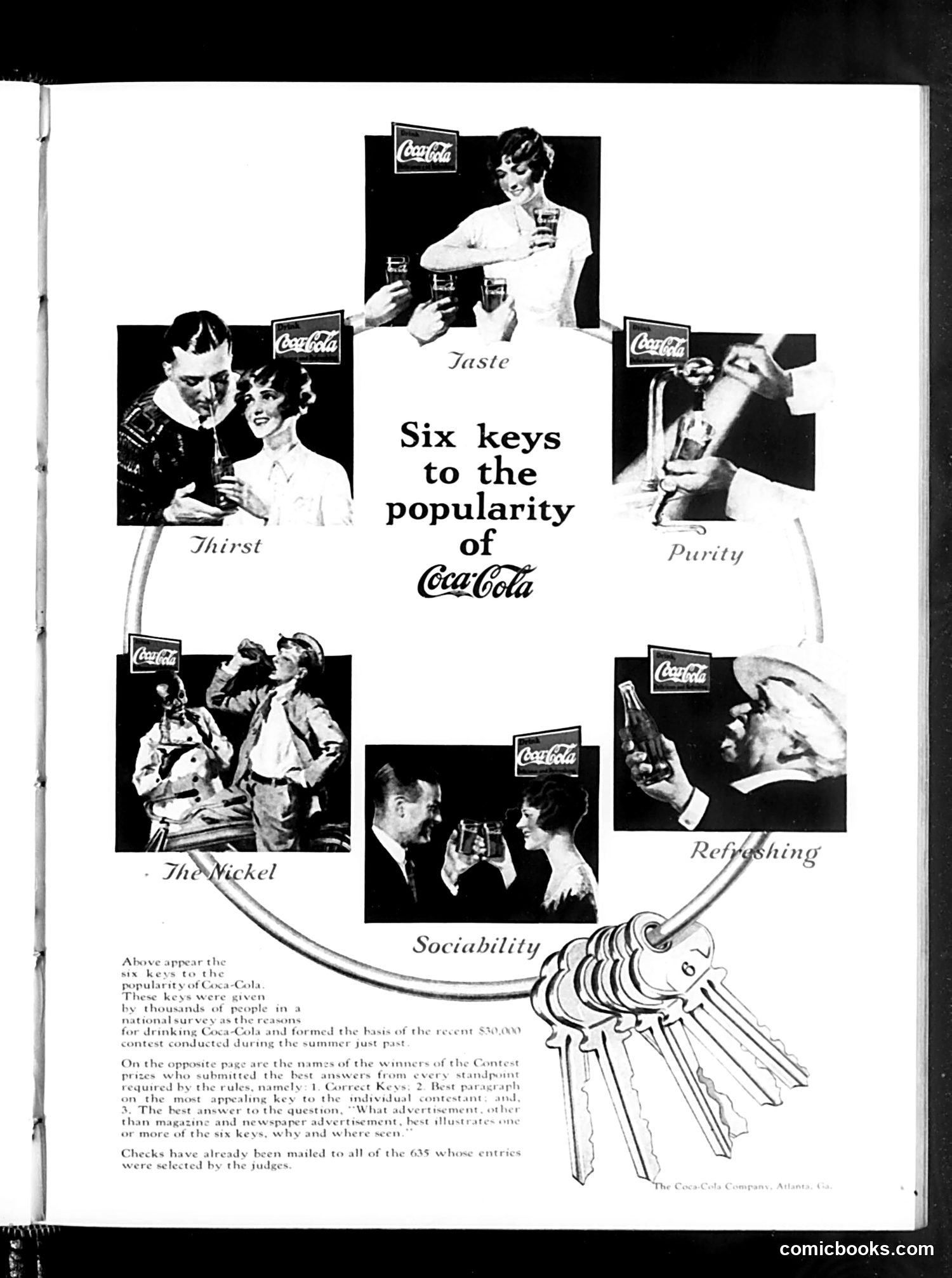
This is a **Coca-Cola advertisement**, not political satire. The page presents six reasons for Coke's popularity through vintage photographs arranged in a wheel pattern around a large key illustration: 1. **Taste** (woman serving) 2. **Thirst** (couple drinking) 3. **Purity** (person drinking) 4. **The Nickel** (couple in casual setting) 5. **Sociability** (formal couple toasting) 6. **Refreshing** (man with bottle) The text mentions a "$50,000 contest" based on surveys about Coca-Cola's appeal. This appears to be early 20th-century corporate marketing emphasizing the product's universal appeal across social situations—from intimate moments to formal occasions—rather than satirizing any particular figure or political event.
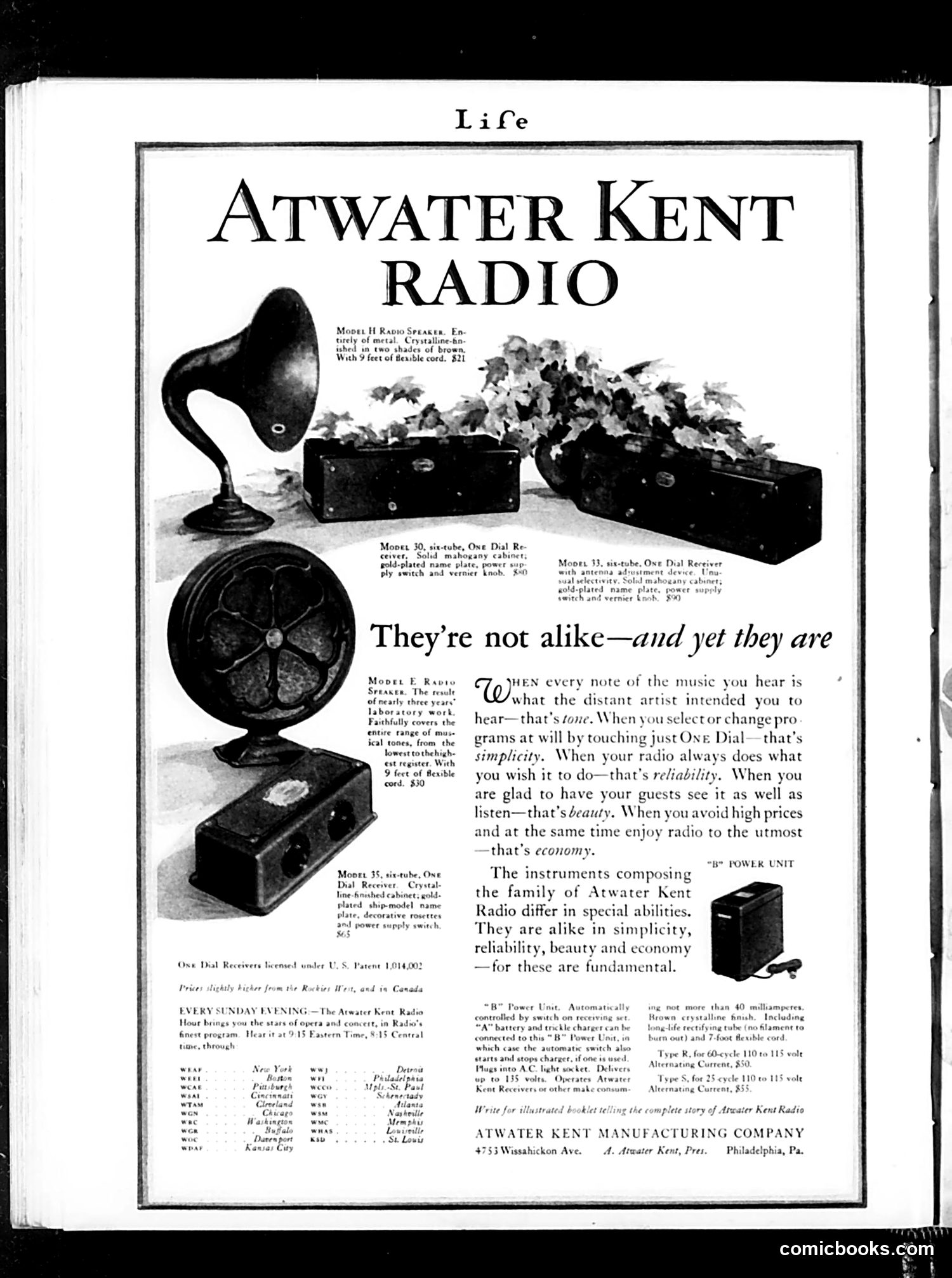
This is not a political cartoon but a **product advertisement** for Atwater Kent radios, a major American radio manufacturer of the 1920s. The page showcases multiple radio models—speakers, receivers, and power units—with descriptive text highlighting their features. The headline "They're not alike—and yet they are" is a marketing strategy emphasizing product variety within a unified brand philosophy. The ad emphasizes five key selling points: **tone, simplicity, reliability, beauty, and economy**—positioning Atwater Kent as offering quality at reasonable prices. The page includes broadcast schedule information for "The Atwater Kent Hour," a popular Sunday evening radio program featuring opera and concert performances—a common marketing tactic to demonstrate receiver quality through associated entertainment content. This represents early-20th-century consumer marketing during radio's golden age, before television supplanted radio as the primary home entertainment medium.