
Life, 1927-10-20 · page 32 of 48
Life — October 20, 1927 — page 32: what you’re looking at
What you’re looking at
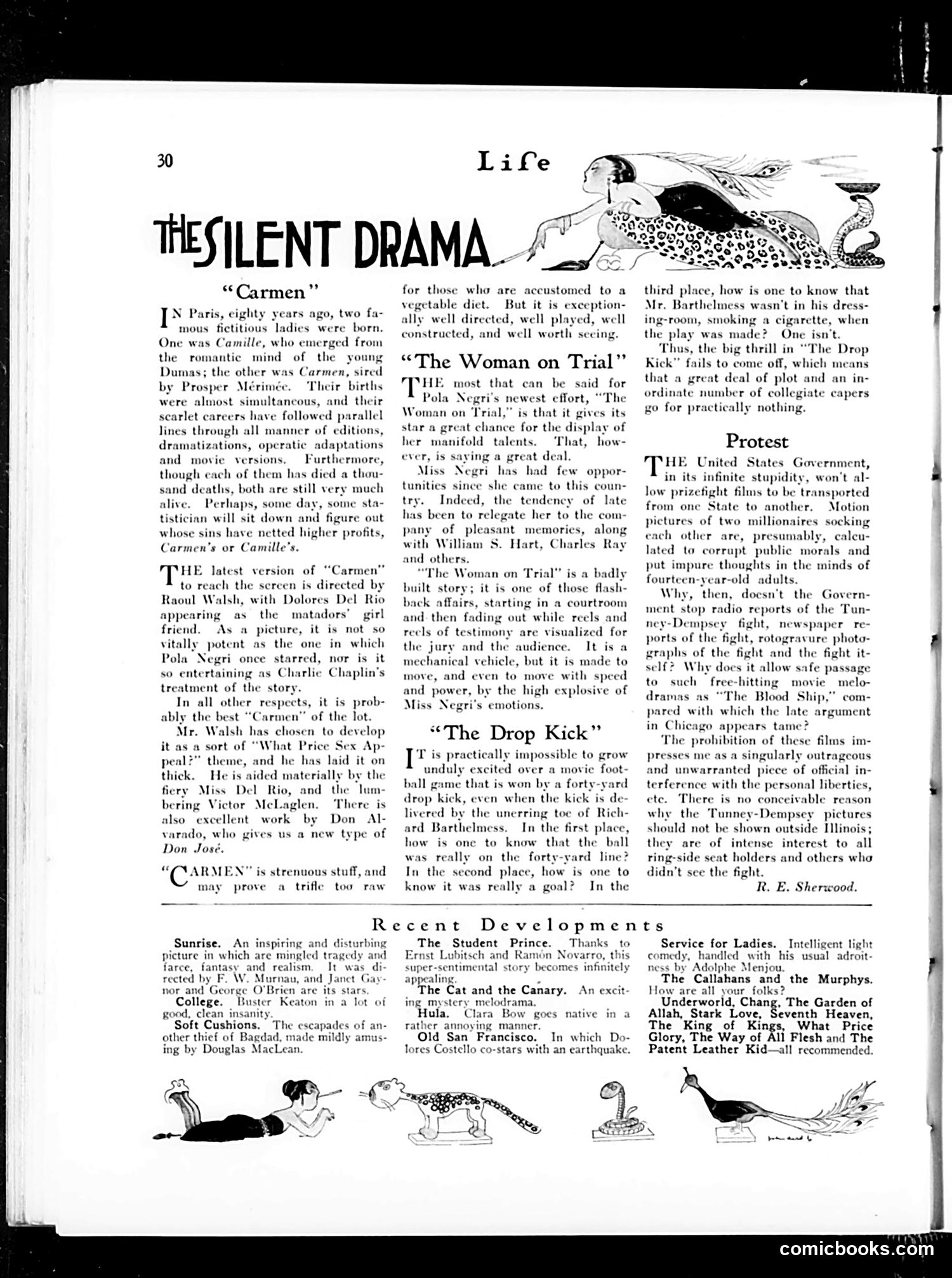
This page contains film reviews from Life magazine's "Silent Drama" column, reviewing three 1920s movies. The critic discusses *Carmen* (starring Dolores Del Rio, directed by Raoul Walsh), *The Woman on Trial* (featuring Pola Negri), and *The Drop Kick* (with Richard Barthelmess). The reviews are largely straightforward critiques of these silent films' plot construction and performances. However, the "Protest" section at bottom satirizes U.S. Government censorship: the author mocks the federal ban on transporting prizefight films between states as hypocritical "stupidity," arguing the government inconsistently allows radio reports, newspapers, and violent action movies to circulate freely while restricting boxing footage—supposedly to protect "fourteen-year-old adults'" morals. The satire attacks government overreach and arbitrary censorship standards.
📄 Transcribed text from this page (OCR, searchable)
Machine-transcribed from the original scan — historical spelling and the odd misread are preserved.
30 TESILENT DRAMA. / “Carmen” N Paris, eighty years ago, two fa- mous fictitious ladies were born. One was Camille, who emerged from the romantic mind of the Dumas; the other was Carmen, sired by Prosper Mérimée. ‘Their births were almost simultancous, and their let careers have followed parallel ns, young lines through all manner of edit dramatizations, operatic adaptations and movie Furthermore, though each of them has died a thou- sand deaths, both are still very much © day, some sta- versions. alive. Perhaps, so! tistician will sit down and figure out whose sins have netted higher profits, Carmen's or Camille's. HE latest version of “Carmen” to reach the screen is directed by Raoul Walsh, with Dolores Del Rio appearing as the matadors’ girl friend. As a picture, it is not so vitally potent as the one in which Pola Negri once starred, nor is it so entertaining as Charlie Chaplin's treatment of the story. In all other respects, it is prob- ably the best “Carmen” of the lot. Mr. Walsh has chosen to de} it as a sort of “What Price Se * theme, and he . He is aided ma fiery Miss Del Rio, « bering Victor Me There is also excellent work by Don Al- varado, who gives us a new type of Don José. “SC ARMEN” is strenuous stuff, and may prove a trifle too raw Ap- has laid it on ially by the AJ, accustomed to a But it is exception- ally well directed, well played, well constructed, and well worth seeing. “The Woman on Trial” TT HIE most that can be said for Pola Negri’s newest effort, “The Woman on Trial,” for those who are is that it gives its star a great chance for the display of her manifold talents. That, how- ever, is saying a great deal. Miss Negri has had few oppor- tunities since she came to this coun- try. Indeed, the tendency of late has been to relegate her to the com- pany of pleasant memories, along with William S. Hart, Charles Ray and others, “The Woman on Trial” is a badly built story; it is one of those flash- back affairs, starting in a courtroom and then fading out while reels and reels of testimony are visualized for the j audience. It is a me vehicle, but it is made to and even to move with speed mov and power, by the high explosive of Miss Negri’s emotions. “The Drop Kick” ly impossible to grow unduly excited over a movie foot- ball game that is won by a forty-yard drop kick, even when the kick is de livered by the unerring toe of Rich- ard Barthelmess. In the first place, how is one to know that the ball was really on the forty-yard line? In the second place, how is one to know it was really a goal? In the third place, how is one to know that Mr. Barthelmess wasn’t in his dress- ing-room, smoking a cigarette, when the play was made? One isn't. hus, the big thrill in “The Drop Kick” fails to come off, which means that a great deal of plot and an in- ordinate number of collegiate capers go for practically sothiing. Protest THE United States Government, in its infinite stupidity, won't al- low prizefight films to be transported from one State to anoth Motion pictures of two millionaires socking each other are, presumably, caleu- lated to corrupt public morals and put impure thoughts in the minds of fourteen-year-old adults. Why, then, doesn’t the Govern- ment stop radio reports of the Tun- ney-Dempsey fight, newspaper re- ports of the fight, rotogravure photo- graphs of the fight and the fight it- self? Why does it allow safe passage to such free-hitting movie melo- dramas as “The Blood Ship,” com- pared with which the late argument in Chicago appears tan’ The prohibition of these films im- presses me i and unwarranted piece of official in- terference with the personal liberties, ete. There is no conceivable reason why the Tunney-Dempsey pictures should not be shown outside Illinois; they are of intense interest to all ring-side seat holders and others wha didn’t see the fight. R. E. Sherwood. R and disturbing Sunrise. An inspir picture in which are mingled tragedy and farce, fantasy and realism. It was_di- rected hy F. W. Murnau, and Janct Gay nor and George O'Brien a College. Buster Kea good, clean insanity Soft Cushions. other thief of Bagd ing by Douglas \ Bos The escapades of a 1, made mildly Lean. cent The Student Prince. Thanks Ernst Lubitsch and Ramon Novarro, th super-sentimental story becomes infinitely appealing The Cat and the Canary. ing mystery melodrama. Hula. Clara Bow gi rather annoying manner. Old San Francisco. In which Do- lores Costello co-stars with an earthquake. to is An excit- $ native in a Developments Service for Ladies. Intelligent light comedy, handled with his usual adroit- ness by Adolphe Menjou. The Callahans and the Murphys. How are all your folks? Underworld, Chang, The Garden of Allah, Stark Love, Seventh Heaven, The King of Kings, What Price Glory, The Way of All Flesh and The Patent Leather Kid—all recommended. comicbooks.com