
Life, 1927-10-20 · page 27 of 48
Life — October 20, 1927 — page 27: what you’re looking at
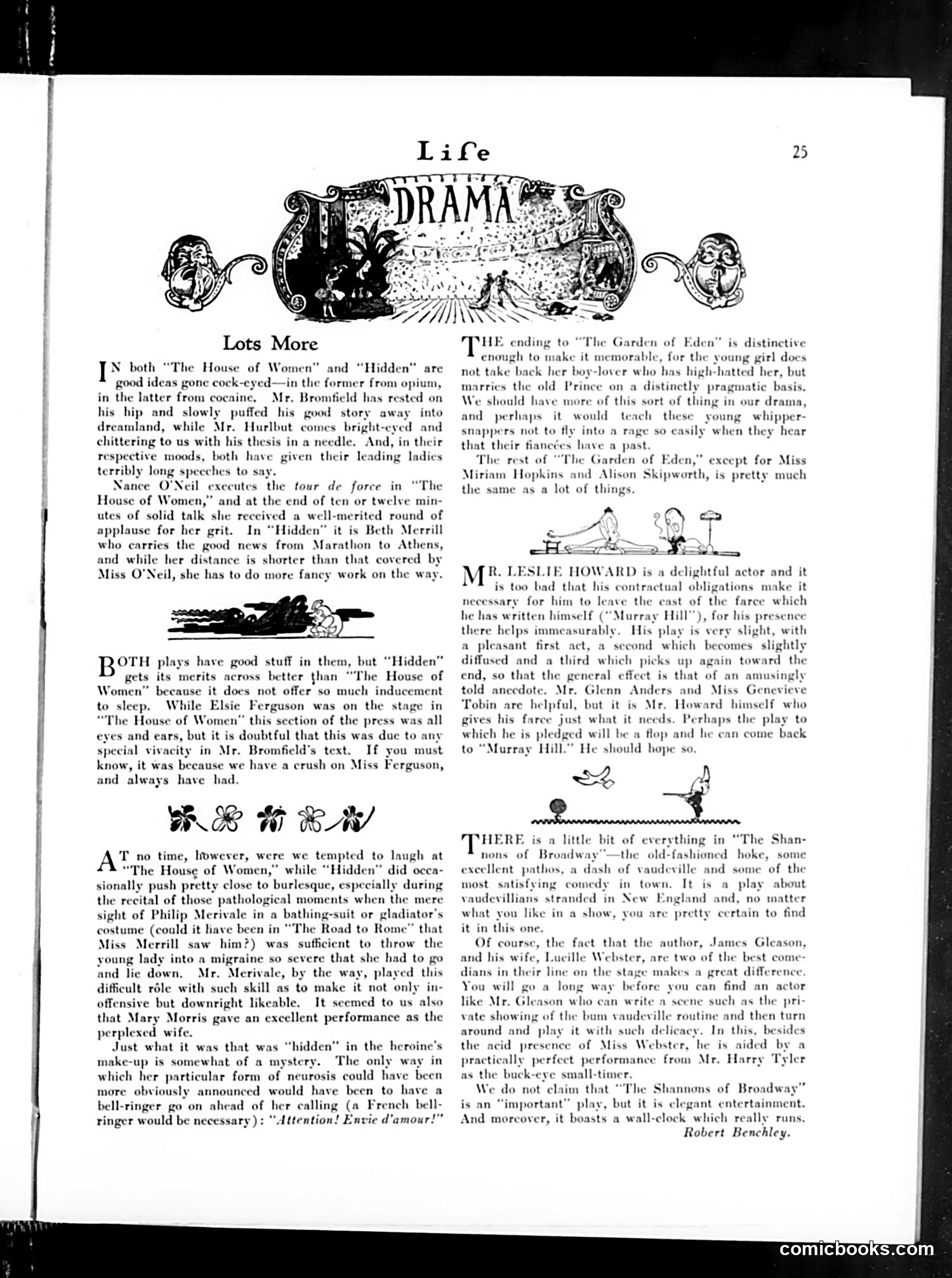
A restored page from Life, 1927-10-20. Page through the whole issue in the reader above.
📄 Transcribed text from this page (OCR, searchable)
Machine-transcribed from the original scan — historical spelling and the odd misread are preserved.
5 { } | Z, Co Oh, Lots More I’ both “The House of Women” and “Hidden” are good ideas gone cock-eyed—in the former from opium, in the latter from cocaine. Mr. Bromfield has rested on his hip and slowly puffed his good story away into dreamland, while Mr. Hurlbut comes bright-eyed and chittering to us with his thesis in a needle. And, in their respective moods, both have given their leading ladies terribly long speeches to say. Nance O'Neil executes the tour de force in “The House of Wome and at the end of ten or twelve min- utes of solid talk she received a well-merited round of applause for her grit. In “Hidden” it is Beth Merrill who carries the good news from Marathon to Athens, and while her distance is shorter than that covered by Miss O'Neil, she has to do more fancy work on the way. —$—aS—— BotH plays have good stuff in them, but “Hidden” gets its me across better than “The House of Women” because it does not offer so much induc to sleep. While Elsie Ferguson was on the sts “The House of Women” this section of the press was all eyes and ears, but it is doubtful that this was due to any 1 vivacity in Mr. Bromfield's text. If you must as because we have a crush on Miss Ferguson, ays have had. ge > WEG BAY A no time, ltwever, were we tempted to laugh at “The House of Women,” while “Hidden” did occa- sionally push pretty close to burlesque, especially during the recital of those pathological moments when the mere sight of Philip Merivale in a bathing-suit or gladiator’s costume (could it have been in “The Road to Rome” that Miss Merrill saw him?) was sufficient to throw the young lady into a migraine so severe that she had to go and lie down, Mr. Merivale, by the way, played this difficult réle with such skill as to make it not only in- offensive but downright likeable. It seemed to us also that Mary Morris gave an excellent performance as the perplexed wife. Just what it was that was “hidden” in the heroine's make-up is somewhat of a mystery. The only way in which her particular form of neurosis could have been more obviously announced would have been to have a bell-ringer go on ahead of her calling (a French bell- ringer would be necessary): “Attention! Envie d’amour!” oS T])\ Ee THE ending to “The Garden of Eden” is distineti enough to make it memorable, for the young girl does not take back her boy-lover who has high-hatted her, but marries the old Pri on a distinctly pragmatic basis. We should have more of this sort of thing in our drama, young whipper- and perhaps it would teach these snappers not to fly into a rage so easily when they hear that their fiancées have a past he rest of “The Garden of Eden,” except for Miss Miriam Hopkins and Alison Skipworth, is pretty much the same as a lot of things. sy N R. LESLIE HOWARD is a delightful actor and it I A is too bad that his contractual obligations make it necessary for him to leave the east of the farce which he has written himself (“Murray Hill"), for his presence there helps immeasurably. His play is very slight, with a pleasant first act, a second which becomes slightly diffused and a third which picks up again toward the end, so that the general effect is that of an amusingly told anecdote. Mr. Glenn Anders and Miss Genevieve Tobin are helpful, but it is Mr. Howard himself who gives his farce just what it needs. Perhaps the play to which he is pledged will be a flop and he can come back to “Murray Hill.” He should hope so. HERE is a little bit of everything in “The Shan- nons of Broadway"—the old-fashioned hoke, some excellent pathos, a dash of vaudeville and some of the most satisfying comedy in town. It is a play about vaudevillians stranded in New England and, no matter what you like in a show, you are pretty certain to find it in this one. Of course, the fact that the author, James Gleason, and his wife, Lucille Webster, are two of the best come dians in their line on the stage makes a great difference You will go a long way before you can find an actor like Mr. Gleason who can write a scene such as the pri vate showing of the bum vaudeville routine and then turn around and play it with such delicacy. In this, besides the acid presence of Miss Webster, he is aided by a practically perfect performance from Mr. Harry Tyler as the buck-eye small-timer. We do not claim that “The Shannons of Broadw is an “important” play, but it is elegant entertainment. And morcover, it boasts a wall-clock which really runs. Robert Benchley. comicbooks.com