
A complete issue · 46 pages · 1927
Life — May 5, 1927
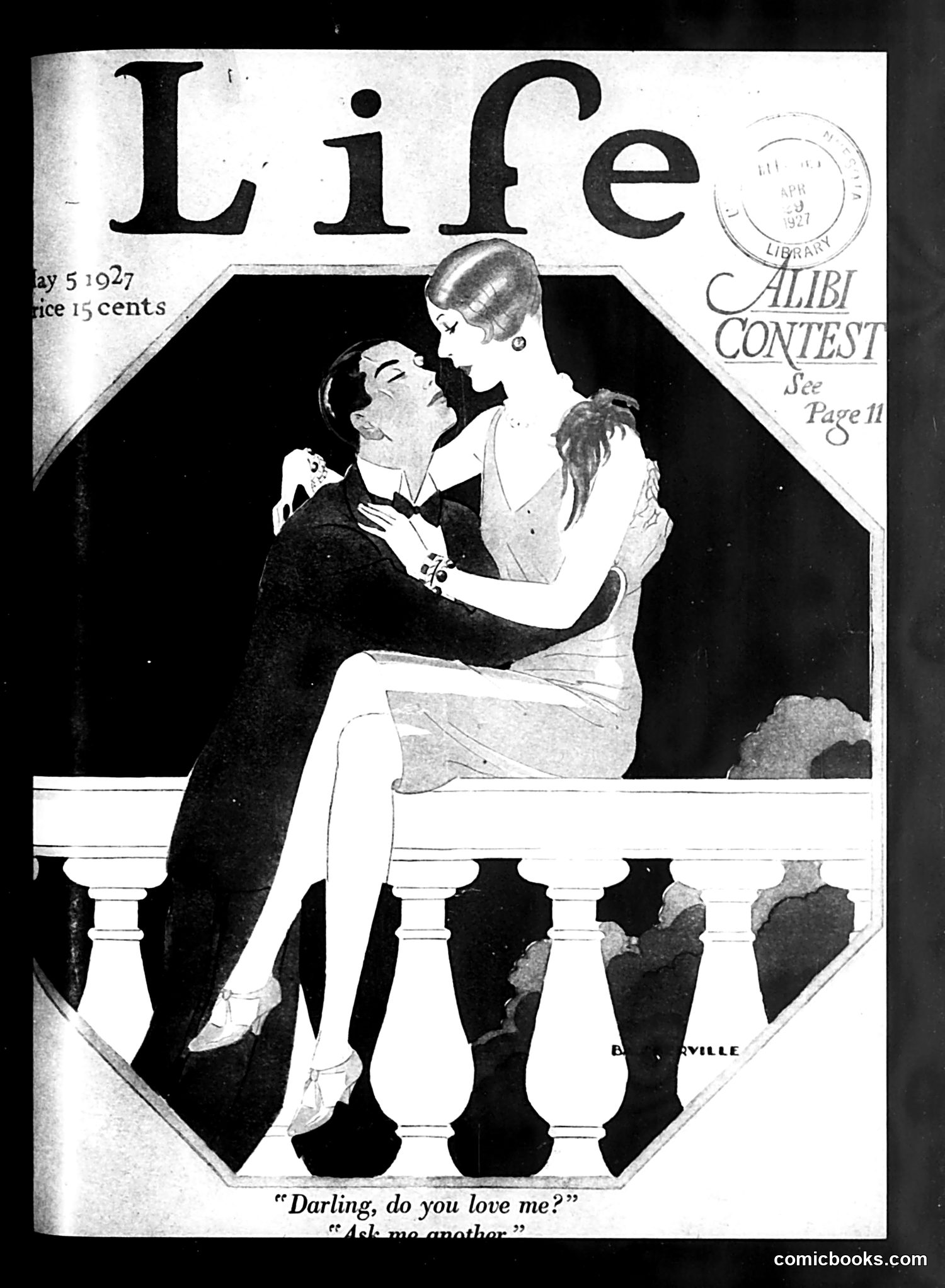
This cover depicts a romantic scene between a well-dressed man in a tuxedo and an elegantly dressed woman seated on a balustrade. The dialogue reads: "Darling, do you love me?" / "Ask me another." The image is a satirical commentary on romantic relationships and courtship conventions of the 1920s. The woman's deflection—"Ask me another"—suggests coy reluctance or evasiveness in answering declarations of love, which was fashionable flirtation behavior of the era. The illustration mocks the theatrical nature of Jazz Age romance and the performance of courtship rituals. The "Alibi Contest" reference on the page indicates this may relate to a humorous competition about romantic excuses or explanations, common in Life's satirical content.
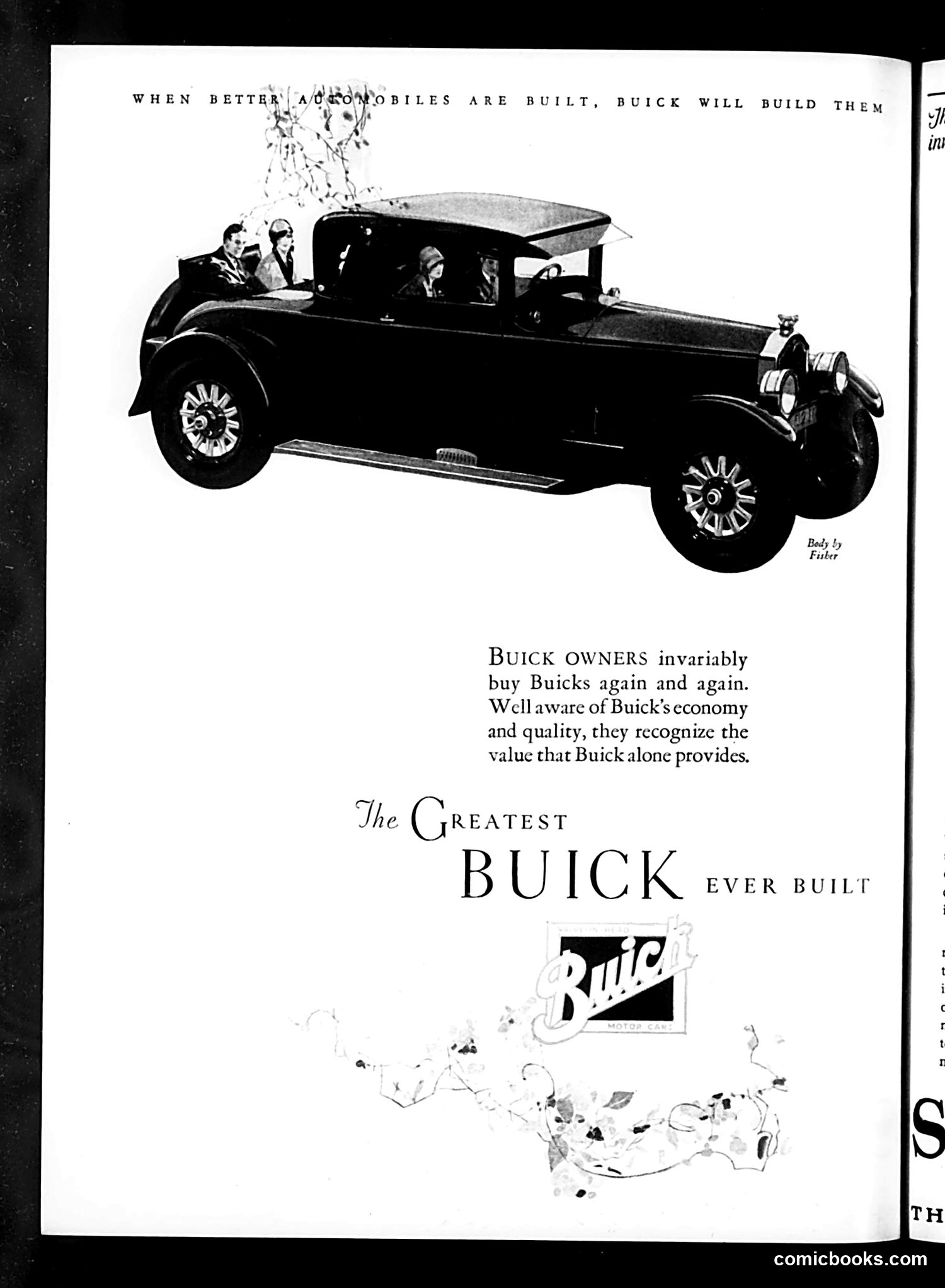
This is a **Buick automobile advertisement**, not political satire or a cartoon. The page promotes Buick cars using the famous company slogan "When better automobiles are built, Buick will build them." The advertisement features: - An illustration of a 1920s-era Buick automobile with well-dressed passengers - Text claiming Buick owners repeatedly purchase Buicks due to the brand's economy and quality - The tagline "The Greatest BUICK ever built" - The Buick Motor Car logo This is straightforward commercial advertising from the early automotive era, emphasizing brand loyalty and vehicle quality. There is no political commentary, satire, or caricature present on this page—only marketing copy and product illustration typical of 1920s-1930s magazine advertisements.
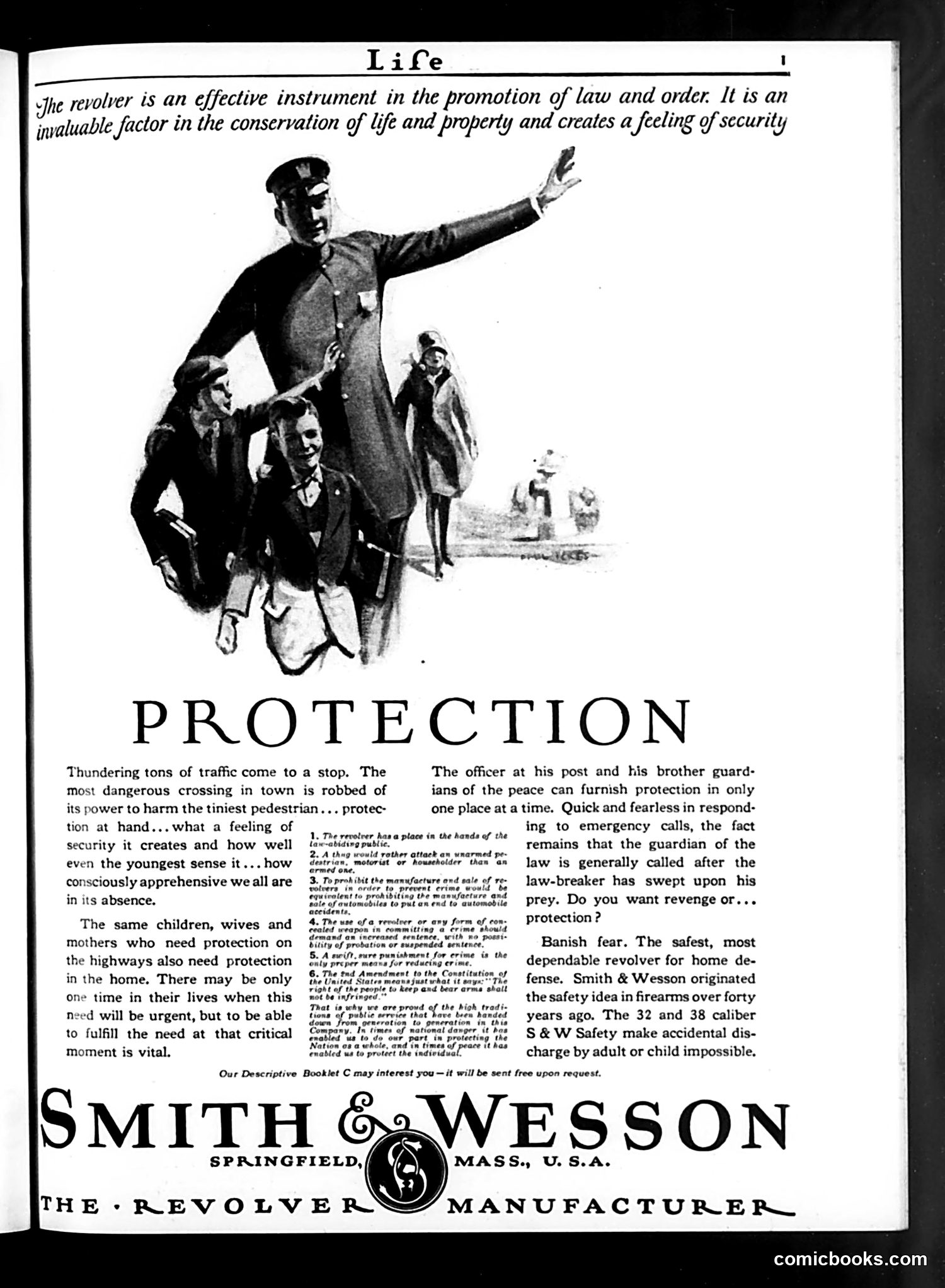
This page is primarily a **Smith & Wesson revolver advertisement**, not satire. The heading "PROTECTION" and accompanying illustration show a police officer sheltering children and civilians, establishing the product's safety theme. The text argues that revolvers are essential for law enforcement and home defense—positioning firearms as necessary for social order and security. The ad emphasizes that S&W revolvers have "safety ideas" making accidental discharge "impossible," addressing contemporary concerns about firearm safety. The rhetoric reflects early 20th-century attitudes normalizing armed protection as fundamental to civilization. There is **no political satire here**—this is genuine period advertising presenting gun ownership as a civic good rather than a controversial issue, which represents a notably different cultural stance than modern firearms debates.
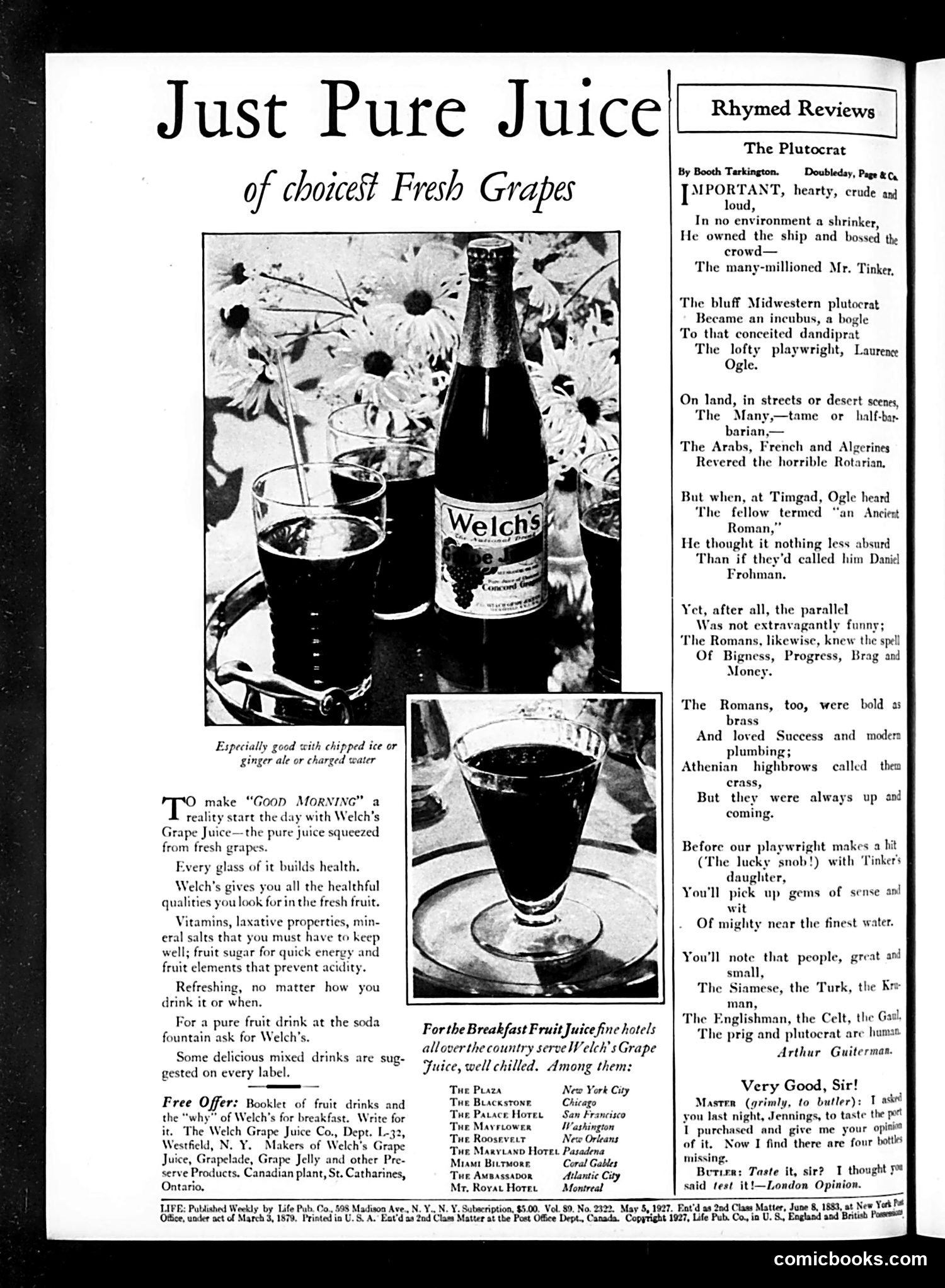
This page is **primarily a Welch's Grape Juice advertisement**, not a political cartoon. The main image shows a bottle of Welch's grape juice with filled glasses and decorative flowers, promoting the product as a healthful breakfast beverage. The right column contains "The Plutocrat," a **humorous poem by Booth Tarkington** satirizing wealthy industrialists. It describes a "bluff Midwestern plutocrat" named Mr. Tinker who becomes conceited after amassing fortune, comparing his inflated ego to historical figures like Ancient Romans and Roman emperors. The satire mocks American robber-baron culture and nouveaux-riches pretensions to grandeur. Below is a separate humor piece, "Very Good, Sir!" — a brief comic dialogue.
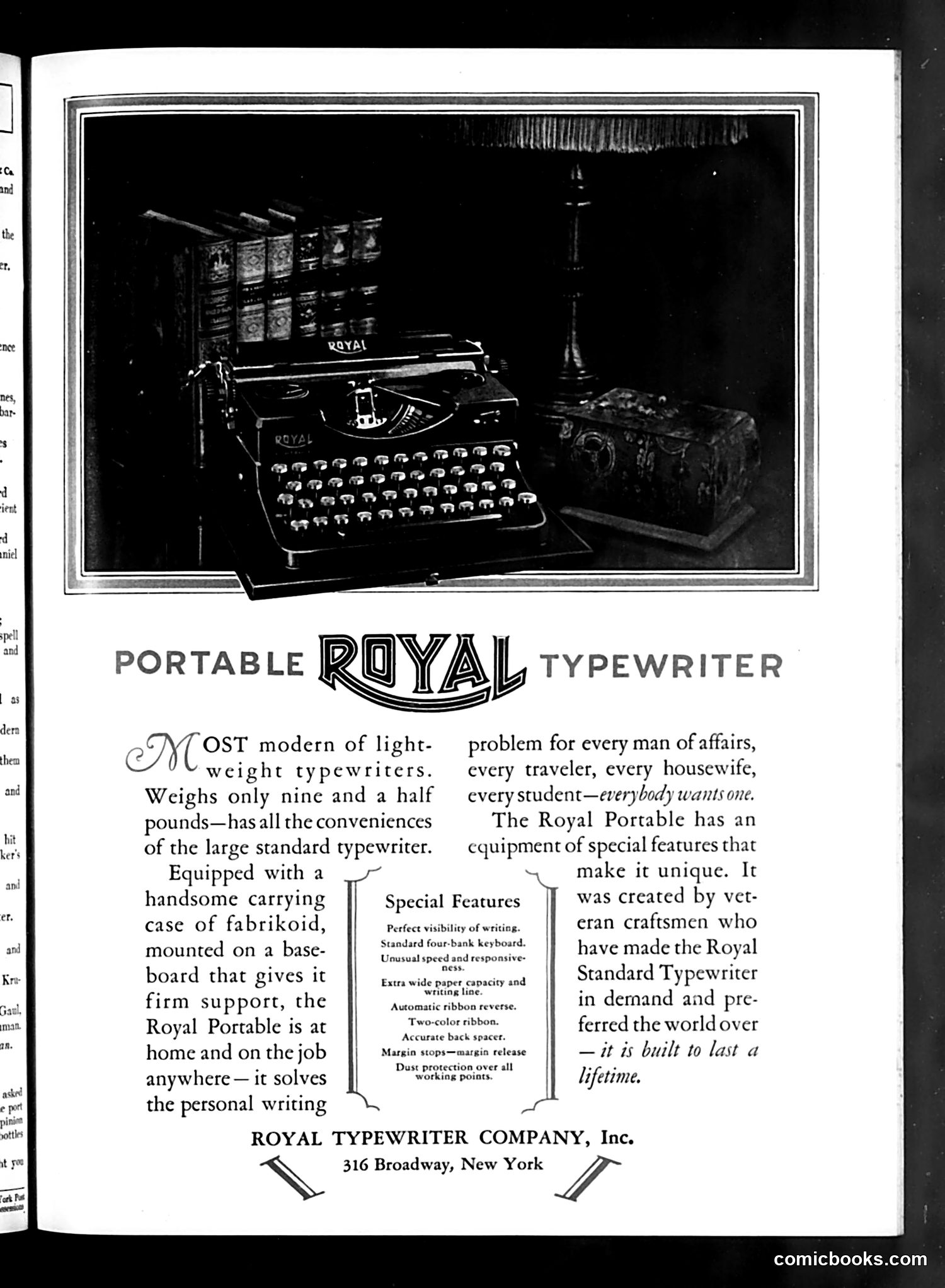
This page contains **advertising, not political satire or comics**. It's a vintage advertisement for the Royal Portable Typewriter from the Royal Typewriter Company, located at 316 Broadway, New York. The ad emphasizes the machine's modern lightweight design (9.5 pounds) and portability, marketed toward "every man of affairs, every traveler, every housewife, every student." The photograph shows the typewriter alongside books and a decorative lamp, suggesting it's a sophisticated tool for personal and professional writing. The "Special Features" box lists practical attributes: visibility, keyboard design, paper capacity, ribbon reverse, spacing accuracy, and dust protection. The tagline "it is built to last a lifetime" appeals to durability and value—typical sales rhetoric of the era. This is straightforward product marketing, not satirical content.
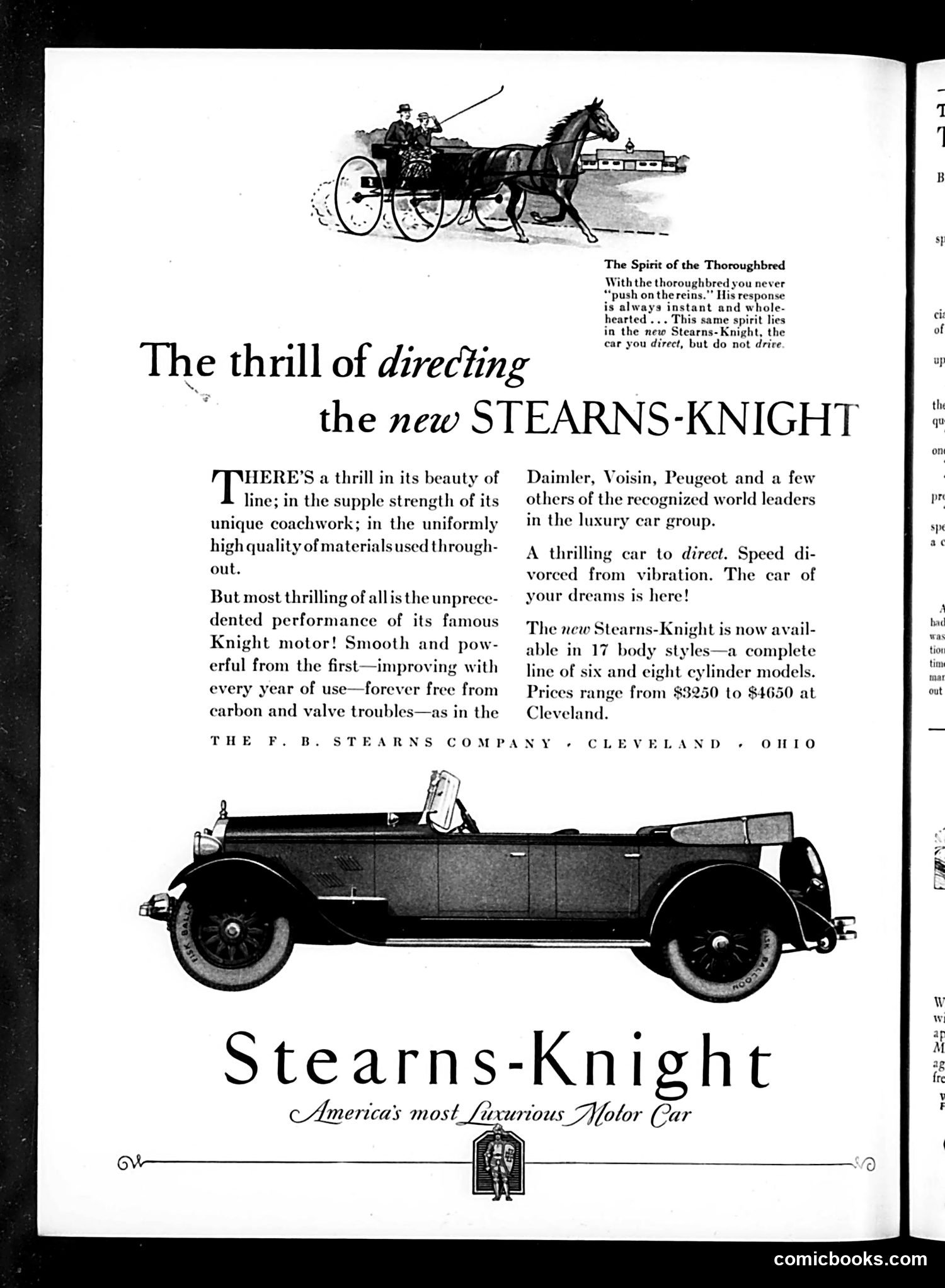
This page is **primarily a luxury automobile advertisement**, not political satire. The Stearns-Knight company (Cleveland, Ohio) markets their car as "America's most luxurious Motor Car." The only cartoon element is the decorative header illustration showing a horse-drawn carriage with a driver—a visual metaphor comparing the car to traditional transportation. The accompanying text "The Spirit of the Thoroughbred" suggests the automobile possesses qualities of a fine horse: responsiveness ("do not drive"), smoothness, and reliability. The ad emphasizes the Knight motor's technical superiority (smooth, powerful, carbon-free), available in 17 body styles, priced $8250–$4650. This is marketing copy exploiting nostalgic associations with equestrian excellence to sell modern automobiles to wealthy consumers.
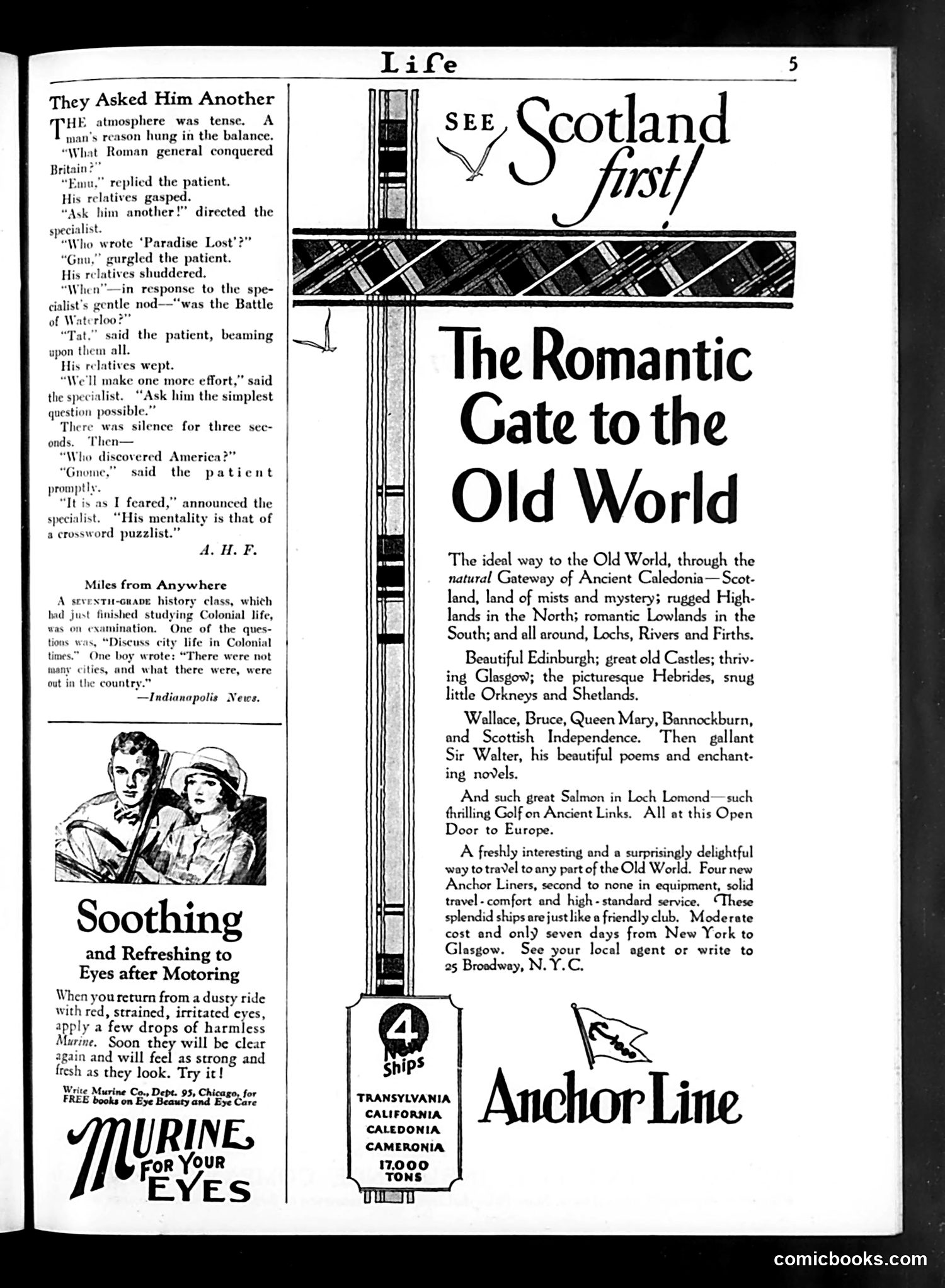
This page is primarily **advertising**, not satire or political commentary. The dominant content is a full-page advertisement for the Anchor Line cruise service, promoting travel to Scotland as "The Romantic Gate to the Old World." The small left-column piece, "They Asked Him Another," appears to be a **joke about historical ignorance**: a patient fails to answer increasingly simple trivia questions (Roman conquest of Britain, "Paradiselost," Battle of Waterloo, and America's discovery), with the punchline that "His mentality is that of a crossword puzzlist." Below this is a **product advertisement for Marine eye drops**, featuring an illustration of two faces, claiming the product soothes tired eyes after activities like motoring. The page reflects early 20th-century American magazine conventions mixing humor, advertising, and commercial content.
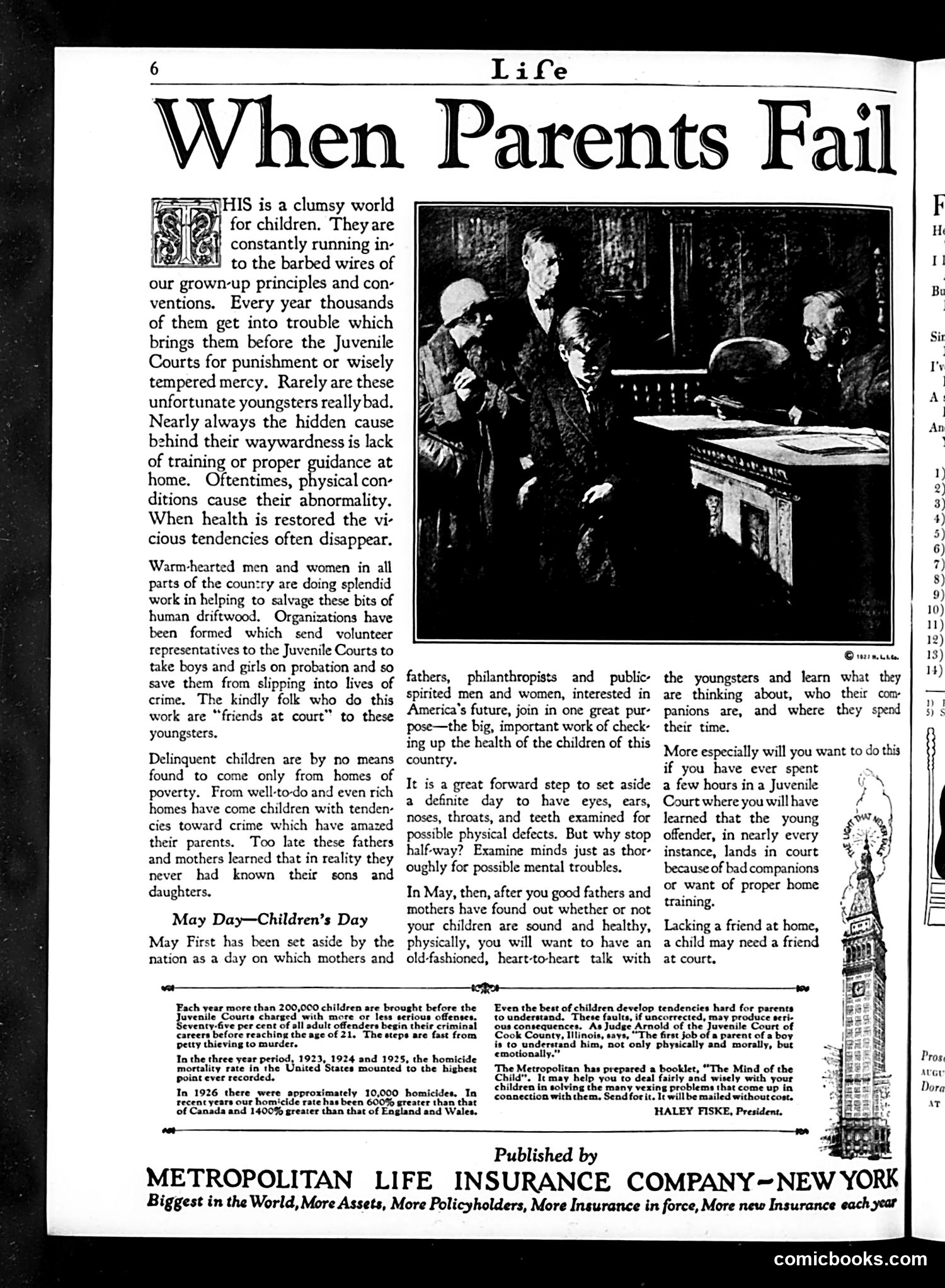
This is primarily **educational/advocacy content rather than satire**. It's a Life magazine article titled "When Parents Fail," addressing juvenile delinquency. The **photograph shows a courtroom scene**: several boys facing what appears to be a judge or court official at a desk, illustrating the article's subject—children appearing before Juvenile Courts. The text argues that delinquent children typically lack proper home training and guidance rather than being inherently "bad." It advocates for philanthropic intervention and "Friends at Court" programs to help troubled youth. The article promotes May Day as "Children's Day," calling for parents and citizens to examine children's physical and mental health. The accompanying **Metropolitan Life Insurance advertisement** frames this as corporate social responsibility. This reflects **Progressive Era attitudes** (early 20th century) emphasizing environmental factors in crime and the importance of institutional reform and child welfare advocacy.
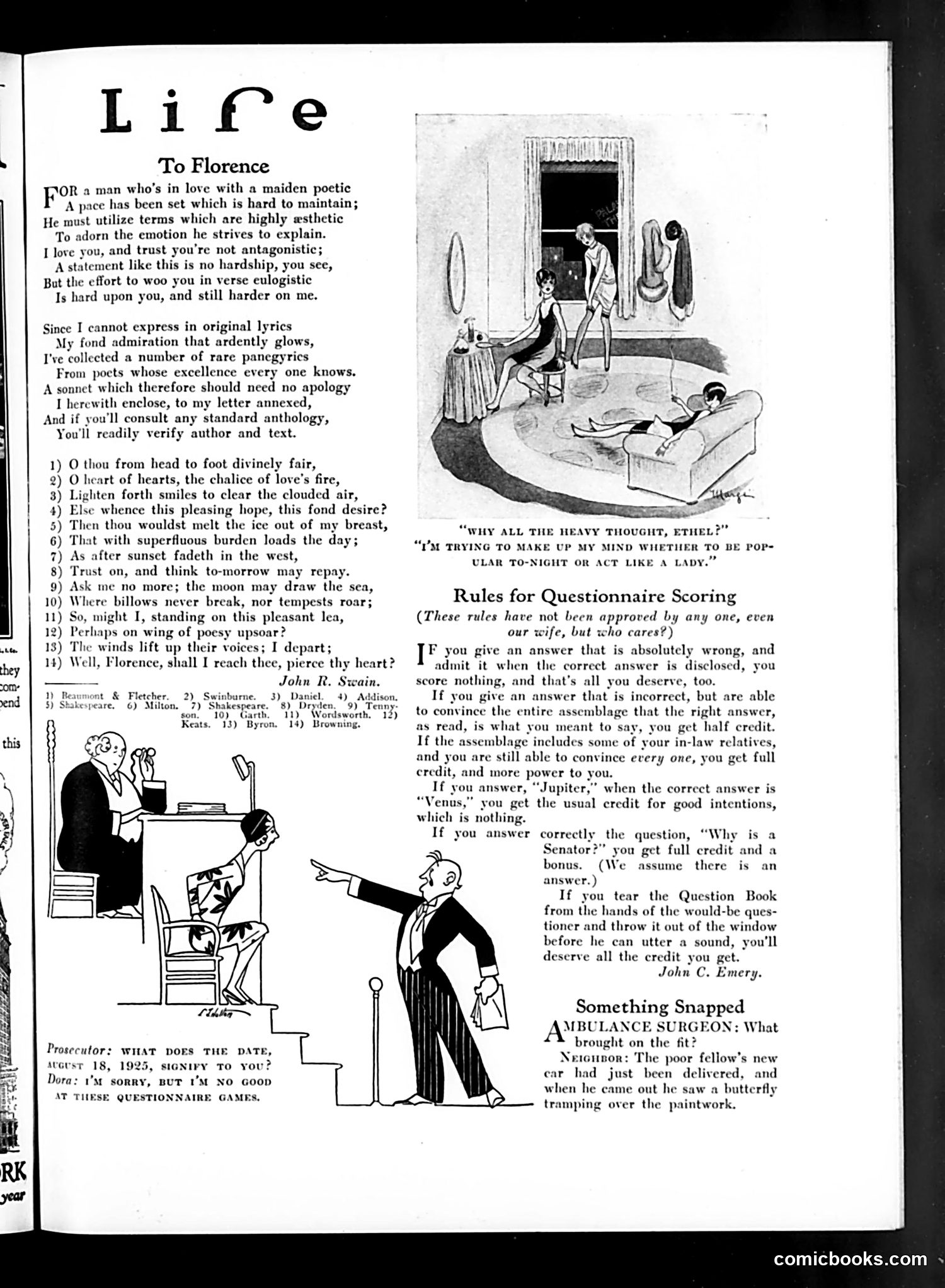
This page from Life magazine (dated August 18, 1925, visible in the lower cartoon) contains poetry and humor rather than political cartoons. The main content is "To Florence," a poem by John R. Swain about courtship difficulties—a man struggling to express love in elevated language to an educated woman. The poem lists literary quotations (numbered 1-13) as examples of this challenge. The two cartoons are light social humor: the upper one shows a woman asking why a man is "trying to make up my mind whether to be popular to-night or act like a lady"—mocking courtship conventions. The lower cartoon depicts a questionnaire-scoring game where a man arrives late, apologizing for missing "these questionnaire games." The "Rules for Questionnaire Scoring" section mockingly explains scoring absurdly—full credit if you convince everyone you're right, even when wrong. This satirizes the era's parlor games and social pretension.
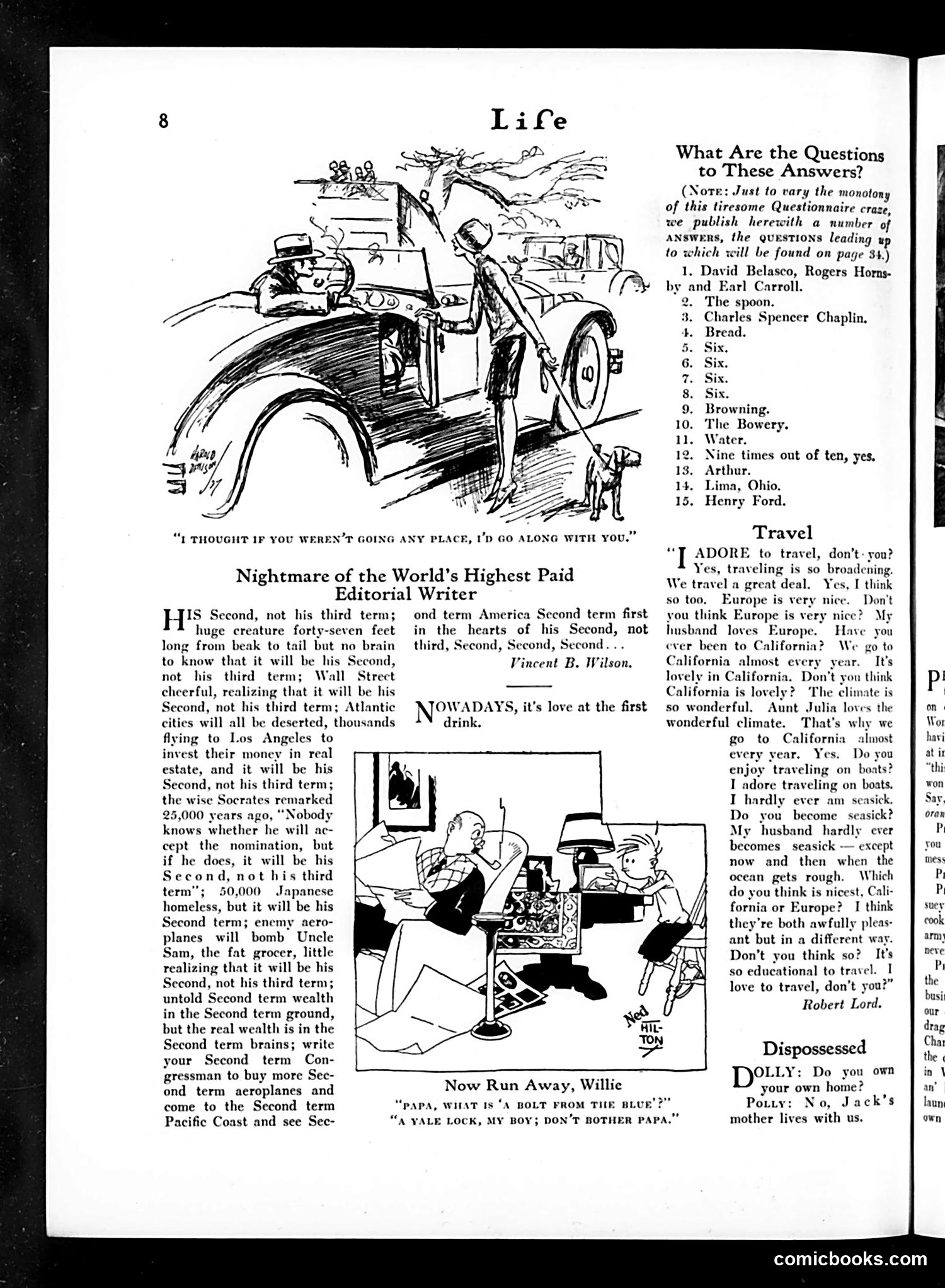
This page contains three distinct humorous pieces: **"Nightmare of the World's Highest Paid Editorial Writer"** (top cartoon) satirizes a successful but anxious writer who obsesses about his second-term status. The joke plays on paranoia about job security despite success—he's repeatedly assured his position isn't threatened, yet remains neurotic about tenure and external validation. **"Now Run Away, Willie"** (center cartoon) depicts a child's mischief, with the caption showing a father's exasperation at his son's claim of a "bolt from the blue" causing trouble. **"Travel" and "Dispossessed"** (right column) are conversational advice pieces discussing the pleasures of travel and housing ownership, written in the magazine's typical witty, gossipy tone aimed at middle-class readers. The page reflects 1920s preoccupations with career anxiety, parenting, and leisure pursuits.
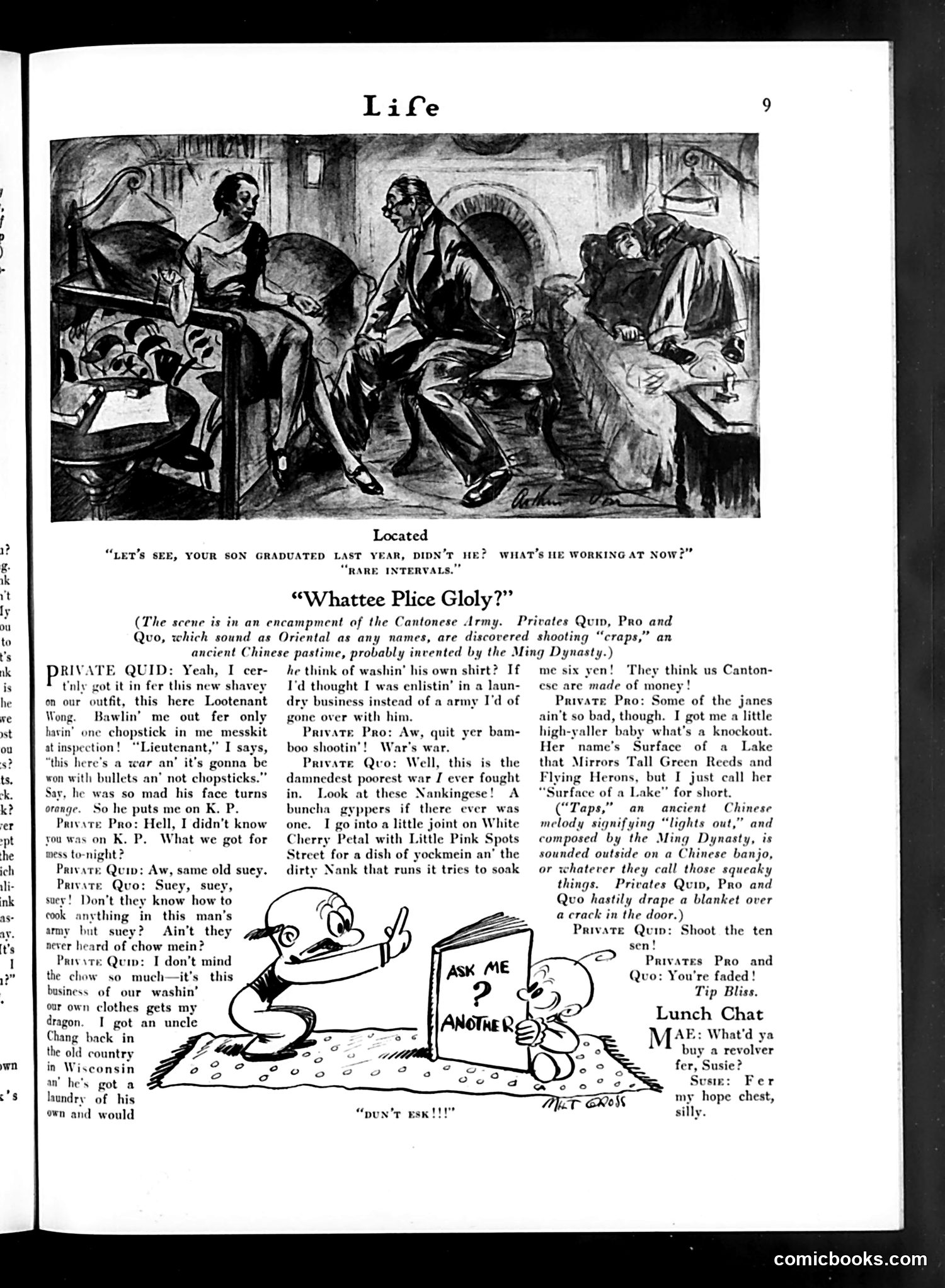
This page satirizes American soldiers' post-WWI employment struggles. The top sketch depicts a domestic scene where a father asks a son about his job after graduation—a common parental question. The dialogue reveals the son works in a laundry doing menial tasks, prompting the father's disappointment. The main comic "Whattee Plice Glory?" features Chinese and Cantonese soldiers discussing the war's worthlessness. They mock the conflict as pointless, noting they're doing laundry work instead of soldiering—mirroring the American soldiers' plight above. The cartoon criticizes how returning soldiers faced unemployment and underemployment despite their service. The Cantonese setting allows satirists to universalize the post-war disillusionment affecting soldiers globally, suggesting military glory yields only menial labor.
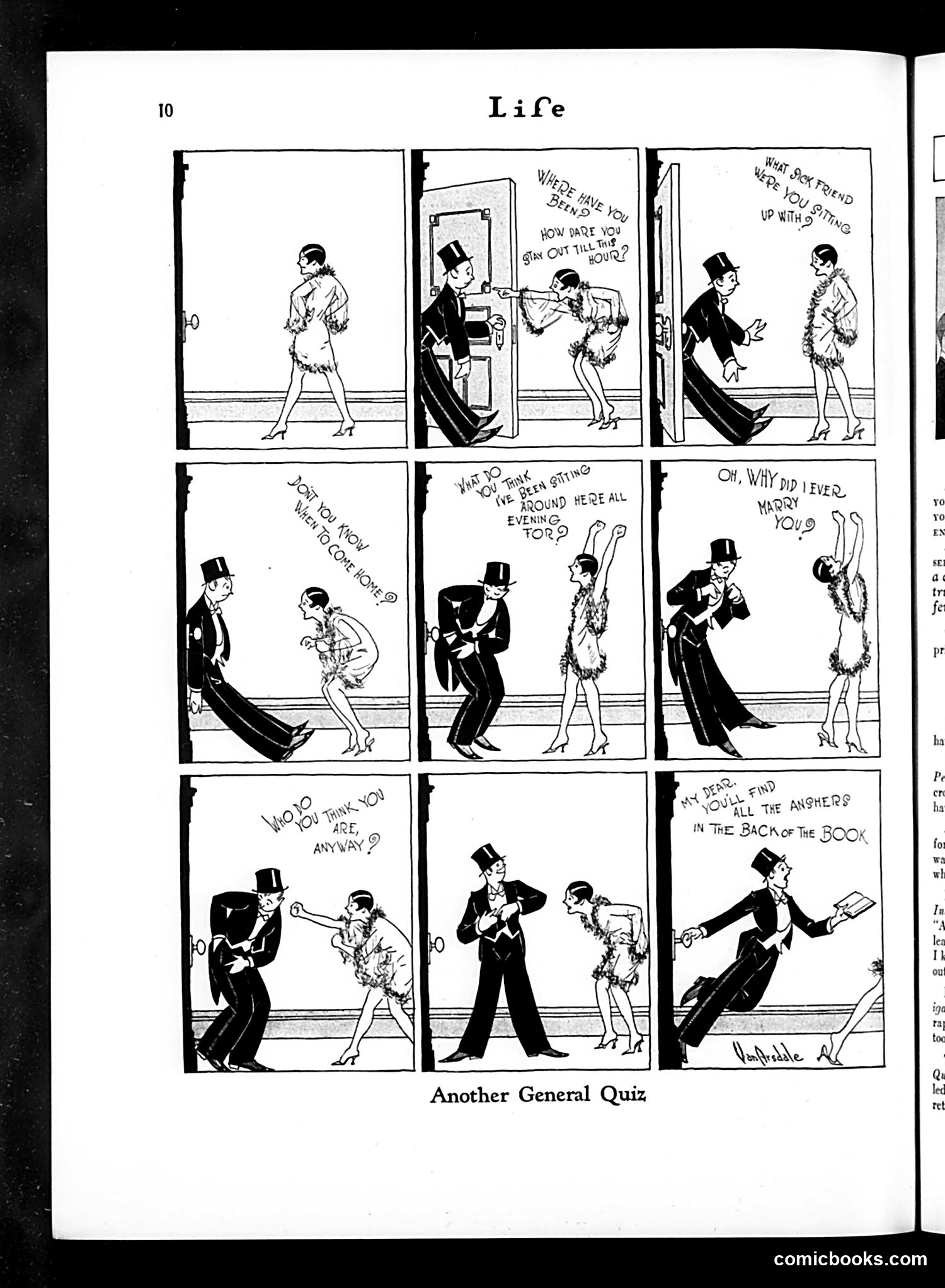
This comic strip satirizes courtship and marriage dynamics through a gentleman in formal attire (top hat and tails) pursuing a woman in a flapper dress. The humor follows a predictable pattern: he attempts romantic advances, she resists or deflects his questions about commitment ("How dare you stay out till this hour?"), he persists with increasingly desperate pleas ("Why did I ever marry you?"), and she ultimately rejects him—literally hanging from the door frame in the final panel. The satire targets both parties: the man's persistent, somewhat bumbling courtship tactics and the woman's complete indifference to his romantic efforts. The title "General Quiz" suggests this represents universal relationship frustrations of the era, likely resonating with 1920s-30s readers navigating modern courtship where women had greater independence and were less predictably compliant than previous generations expected.
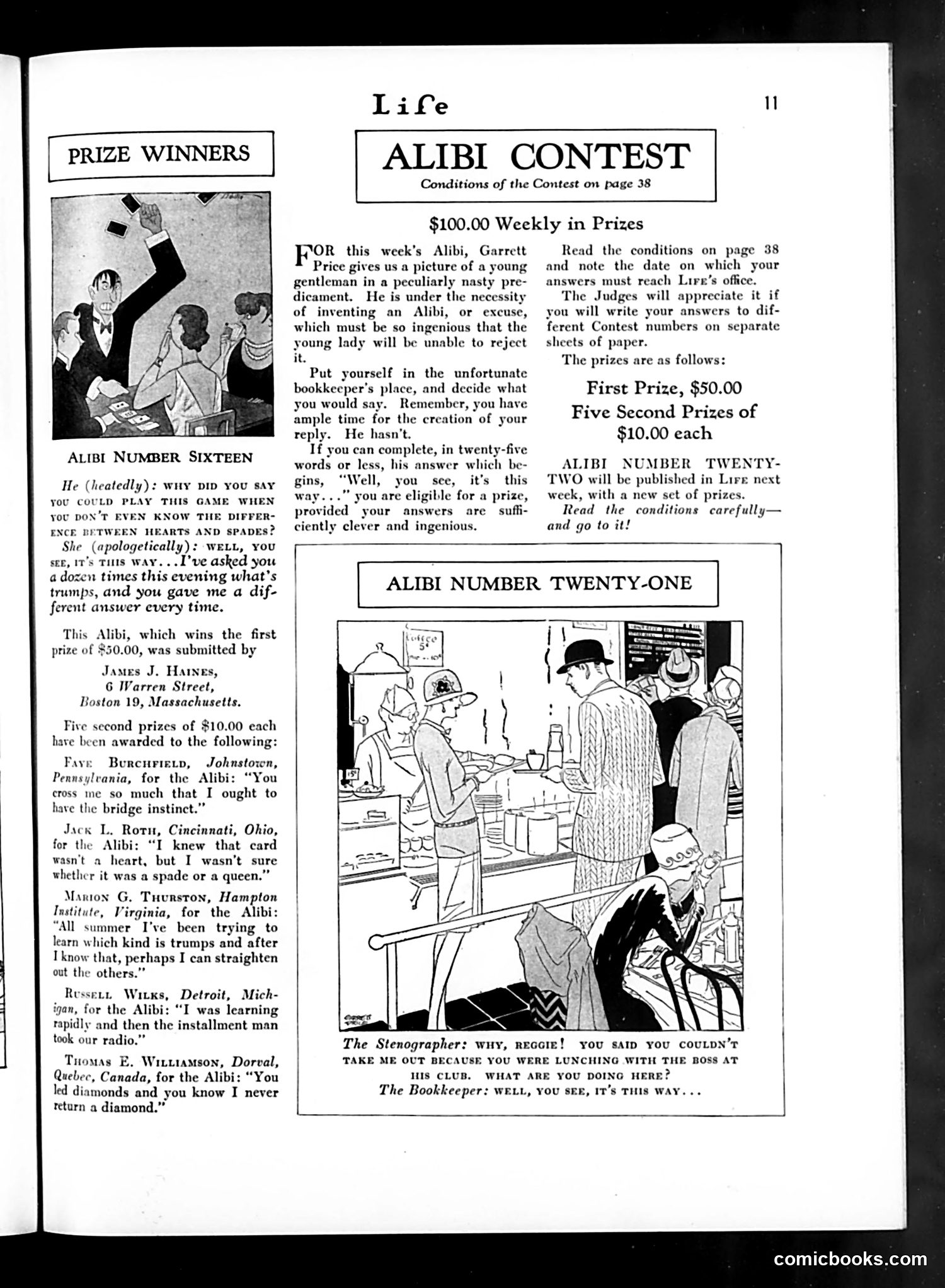
This is a **puzzle/game page**, not a political cartoon. Life magazine is running a weekly "Alibi Contest" where readers submit creative excuses or explanations for awkward situations. **Alibi Number Twenty-One** (the featured puzzle) shows a cartoon scene: a stenographer (secretary) is being confronted at what appears to be a lunch counter or diner. She's caught leaving her office during work hours with a man, supposedly to attend her boss's club. The stenographer must now create a plausible alibi—an excuse explaining why she was out and who she was with. Readers submit their invented alibis in 25 words or less for a chance to win prizes (first prize: $50; five second prizes: $10 each). The humor depends on readers' cleverness inventing believable but unlikely excuses for socially compromising situations—a common entertainment format of the era.
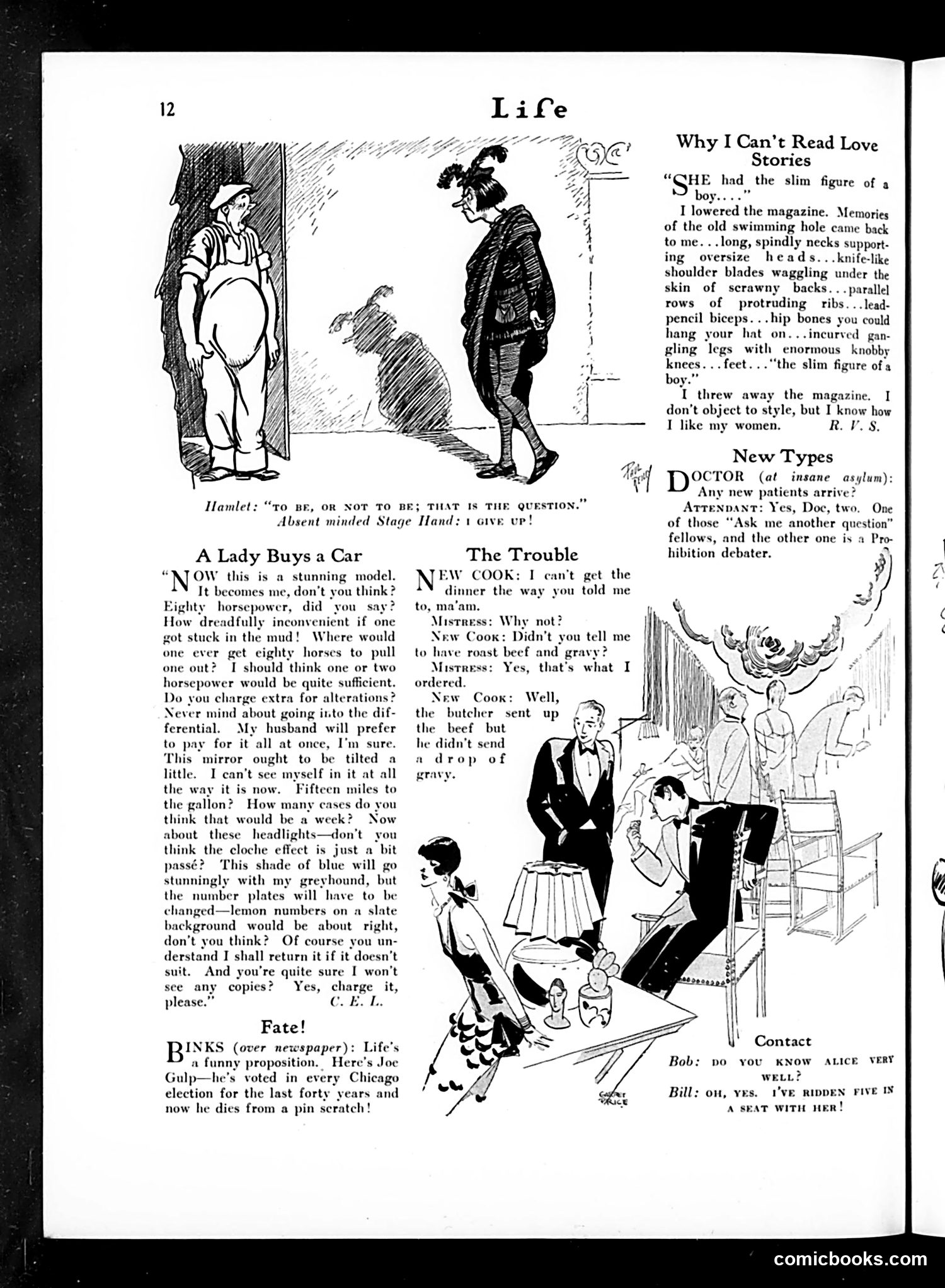
This page from *Life* magazine contains several short humorous sketches typical of early 20th-century satirical publications. **"Why I Can't Read Love Stories"** mocks romantic fiction by cataloging unattractive physical details (protruding ribs, knobby knees, scrawny backs) that contradict the idealized "slim figure of a boy" described in magazines. The author rejects this literary type. **"A Lady Buys a Car"** satirizes the impracticality of early automobiles and the condescension women faced when purchasing them—the dealer dismisses her concerns about horsepower and fuel efficiency as trivial female worries. **"The Trouble"** presents a domestic comedy about a cook's incompetence and a mistress's exasperation with misdirected groceries. **"New Types"** and **"Contact"** offer brief, scattered comic observations about asylum doctors and social encounters. The page emphasizes period anxieties about gender roles, domestic service, and consumer technology.
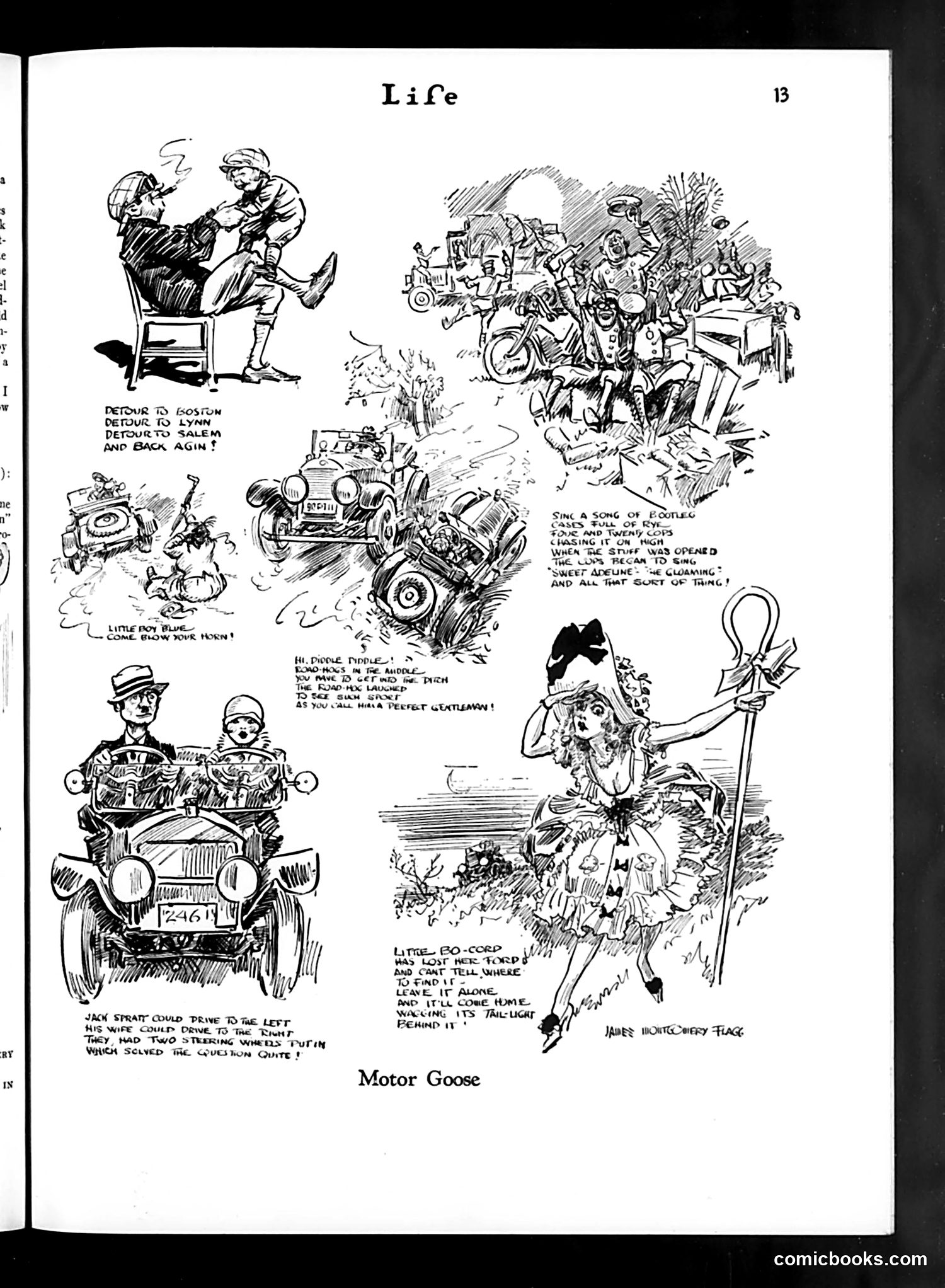
This page satirizes early automobile culture and reckless driving through humorous sketches. The top-left shows a man being violently thrown from a car with text about detours to Boston, Lynn, and Salem—suggesting endless driving mishaps. The center depicts a chaotic traffic scene with multiple vehicles and pedestrians in disarray, accompanied by text about a song celebrating reckless motorists. The bottom-left shows a man and woman in a steering-wheel equipped vehicle, with text describing Jack Spratt's wife driving dangerously with "two steering wheels" hidden in cushions. The right side features a woman in a dress holding a staff or shepherd's crook, apparently representing "Motor Goose"—a feminine personification of automobile culture—with text about lost companions and tail-lights. The satire critiques both dangerous driving and the social chaos automobiles were creating.
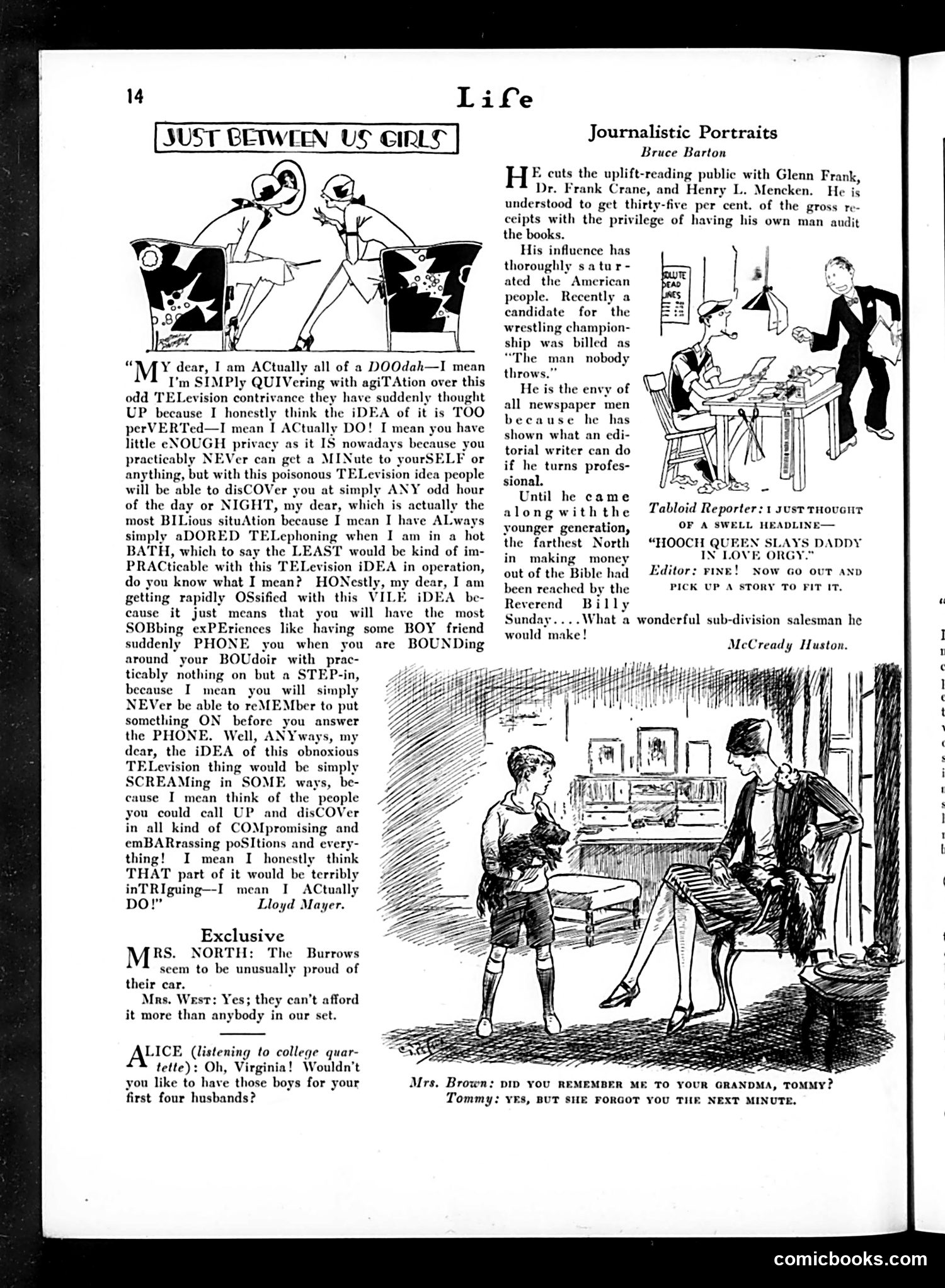
This page contains two distinct sections: **"Just Between Us Girls"** (top): A humorous column mocking the inconvenience of television. The writer complains that TV broadcasts at "ANY odd hour" disrupts daily life, making it impossible to use the telephone or maintain privacy. The satire criticizes how this new medium intrudes on domestic routines—a timely complaint during television's early adoption period. **"Journalistic Portraits" by Bruce Barton** (right): Profiles a powerful newspaper auditor (identity unclear from image) who controls which stories get published. The piece satirizes his significant influence over American public opinion and media narratives. **Bottom cartoon**: Shows a child asking his grandmother if she remembers him; she admits forgetting him immediately after their last visit—a joke about elderly absent-mindedness.
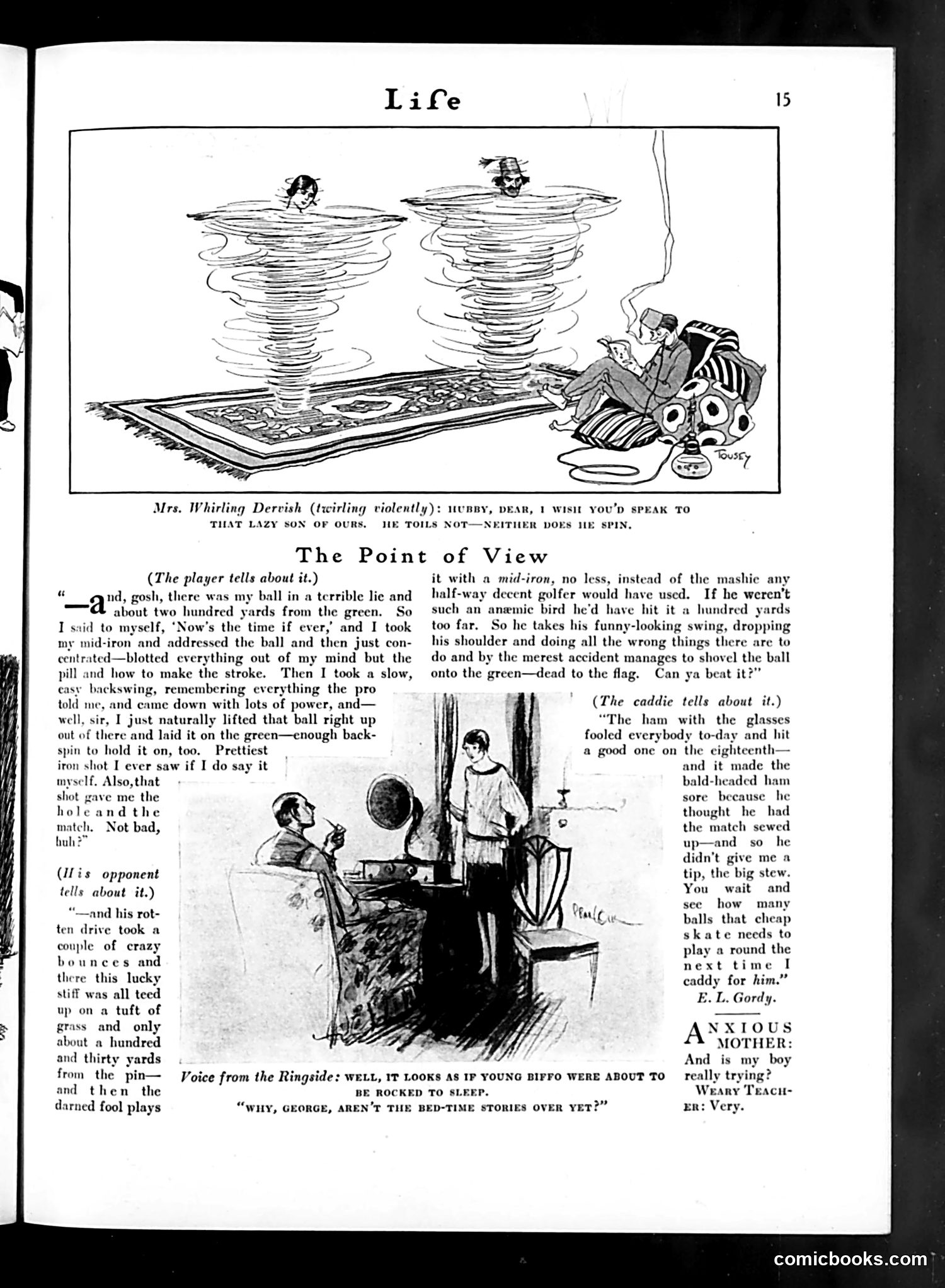
This page contains two distinct pieces: **Top cartoon:** A satirical illustration of "Mrs. Whirling Derrish" (a woman spinning violently like a tornado) scolding a lazy man. The caption reads: "Hubby, dear, I wish you'd speak to that lazy son of ours. He toils not—neither does he spin." This is a visual pun playing on the biblical phrase "toil not, neither do they spin" (Matthew 6:28), mocking a son's idleness by comparing him to lilies of the field. **Bottom section:** "The Point of View" presents golf anecdotes from different perspectives—the player's boastful account, the caddie's deflating version, and the opponent's dismissive take. It humorously illustrates how the same golf shot gets exaggerated or minimized depending on the narrator's bias, satirizing human tendency to self-aggrandize while dismissing others' accomplishments. Both pieces target vanity and self-deception.
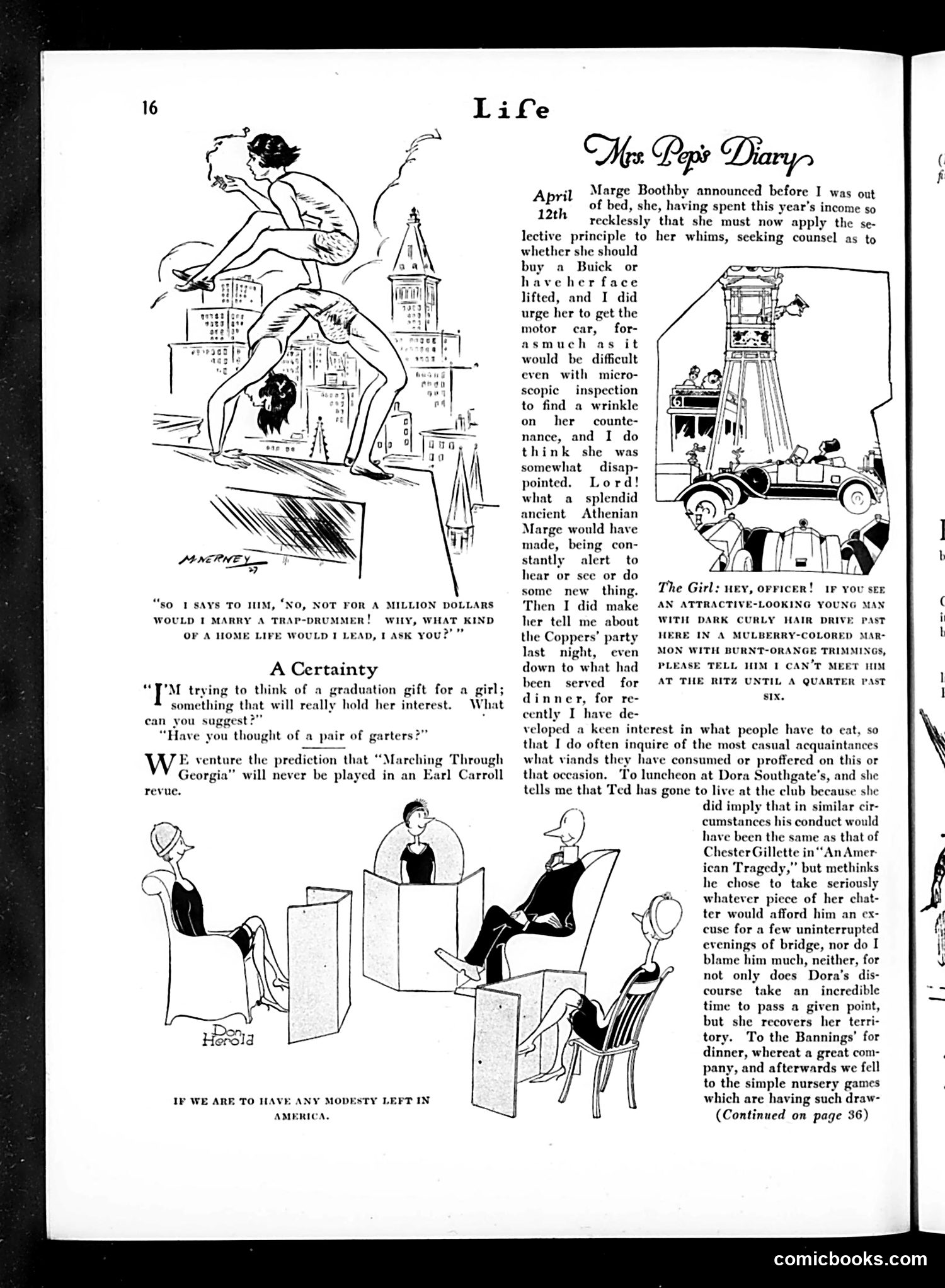
This page contains three distinct pieces of satirical humor: 1. **Top cartoon**: Shows a woman perched atop buildings, apparently distressed about consumer decisions. The caption criticizes women's frivolous spending habits regarding luxury purchases like automobiles and cosmetic procedures—a common 1920s-era stereotype about women's financial irresponsibility. 2. **"A Certainty" section**: A joke about graduation gifts, with the punchline suggesting garters as an appropriate gift for a woman—likely sexual innuendo typical of the era's humor. 3. **Bottom cartoon**: Titled "If we are to have any modesty left in America," depicts what appears to be a social commentary on declining moral standards, showing figures in a somewhat indecorous situation. The overall tone reflects 1920s anxieties about changing gender roles and social propriety.
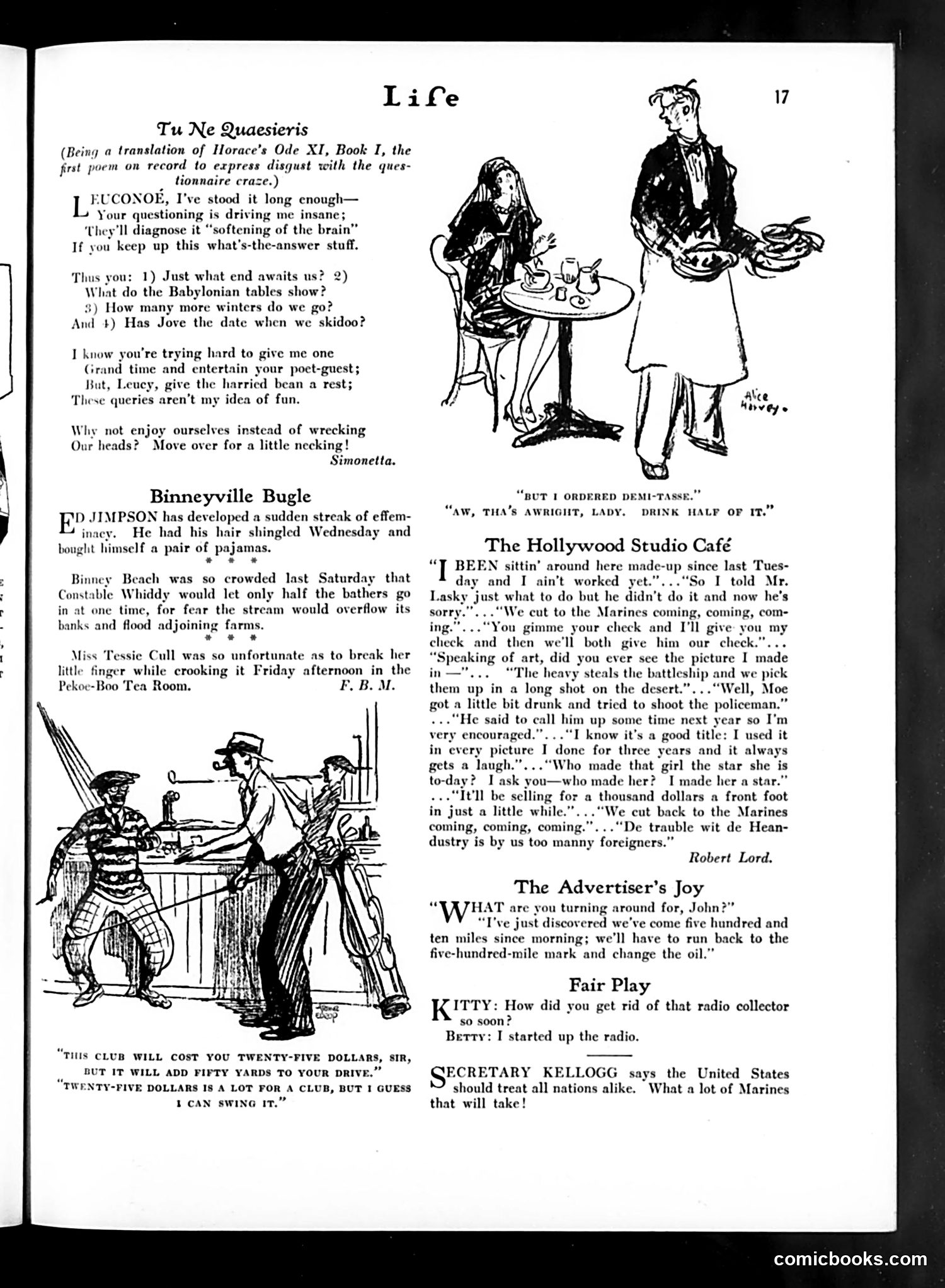
This page contains several brief humorous pieces mocking contemporary social behavior: **"Tu Ne Quaesieris"** satirizes dinner guests who ask tedious questions instead of enjoying themselves—a complaint about pedantic party guests. **"Binneyville Bugle"** reports small-town gossip: a barber's hair-shingling mishap and a woman breaking her finger while cooking. **"The Hollywood Studio Café"** mocks film industry pretension through dialogue about actors, salaries, and filmmaking trivialities. **"The Advertiser's Joy"** jokes about fuel consumption and long-distance driving. The cartoons feature working-class and leisure-class figures in everyday situations. Overall, the page targets American social pretension, small-town gossip culture, and Hollywood vanity through lighthearted satire typical of Life magazine's humor approach.
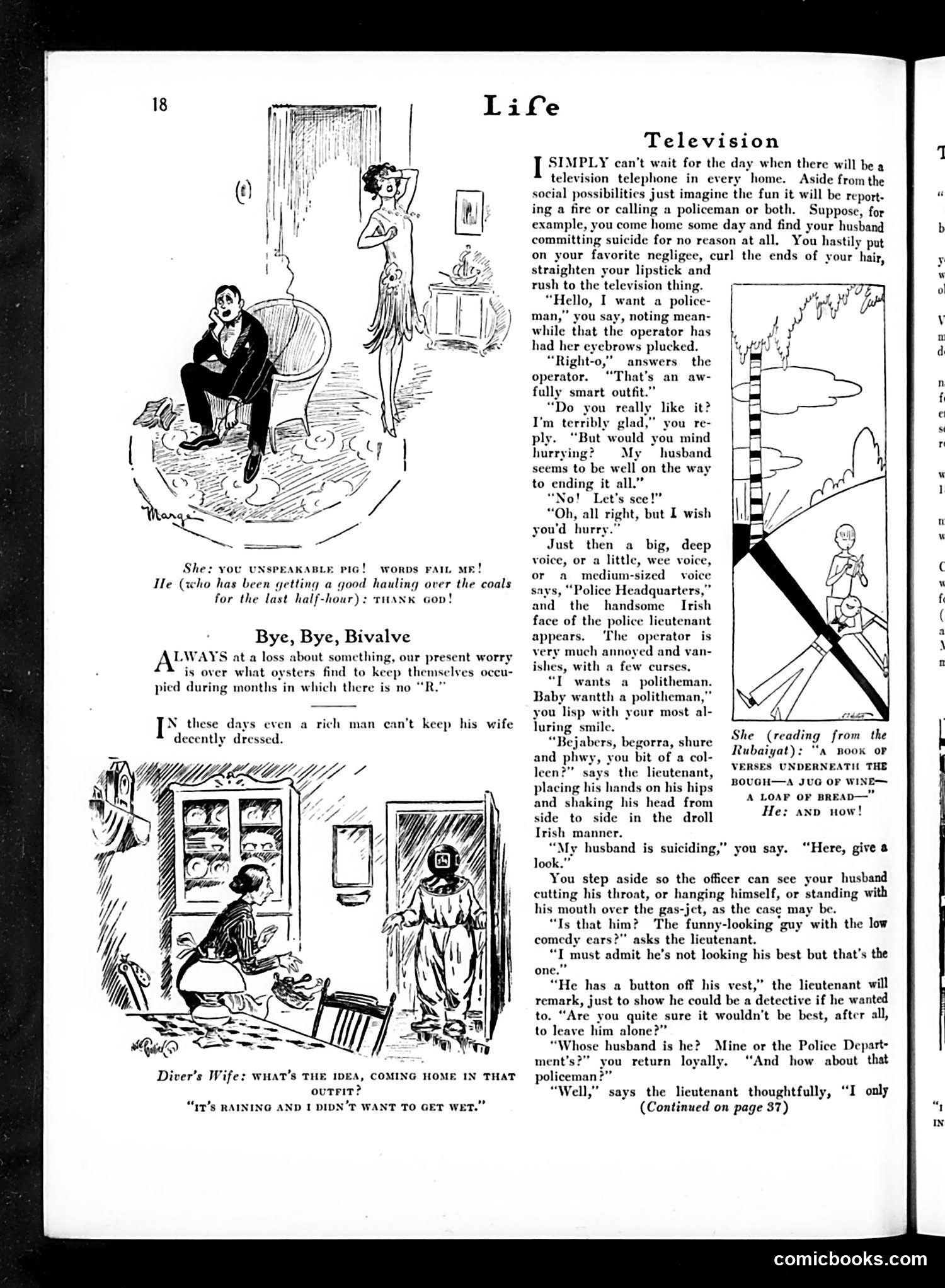
This 1920s *Life* magazine page satirizes the emerging technology of **television telephones**—imagining videophone service in homes. The main article mockingly depicts a woman who finds her husband suicidal but is more concerned with her appearance on camera. She calls police while primping, flirting with the operator and the arriving Irish police lieutenant. The satire targets **female vanity** and the absurdity of conducting emergencies through visual media—the humor lies in her priorities being completely inverted (looking good > saving her husband's life). The sidebars feature two additional jokes: one about a couple arguing (she calls him unspeakable), and another about a diver's wife wearing fancy clothes in the rain. Both reinforce stereotypes about women's impracticality and obsession with appearance. The comedy relies on period gender stereotypes now considered offensive. The "Irish" policeman character uses exaggerated accent humor (common in era). The satire assumes videophone surveillance would primarily enable romantic/vanity scenarios rather than practical emergency response.
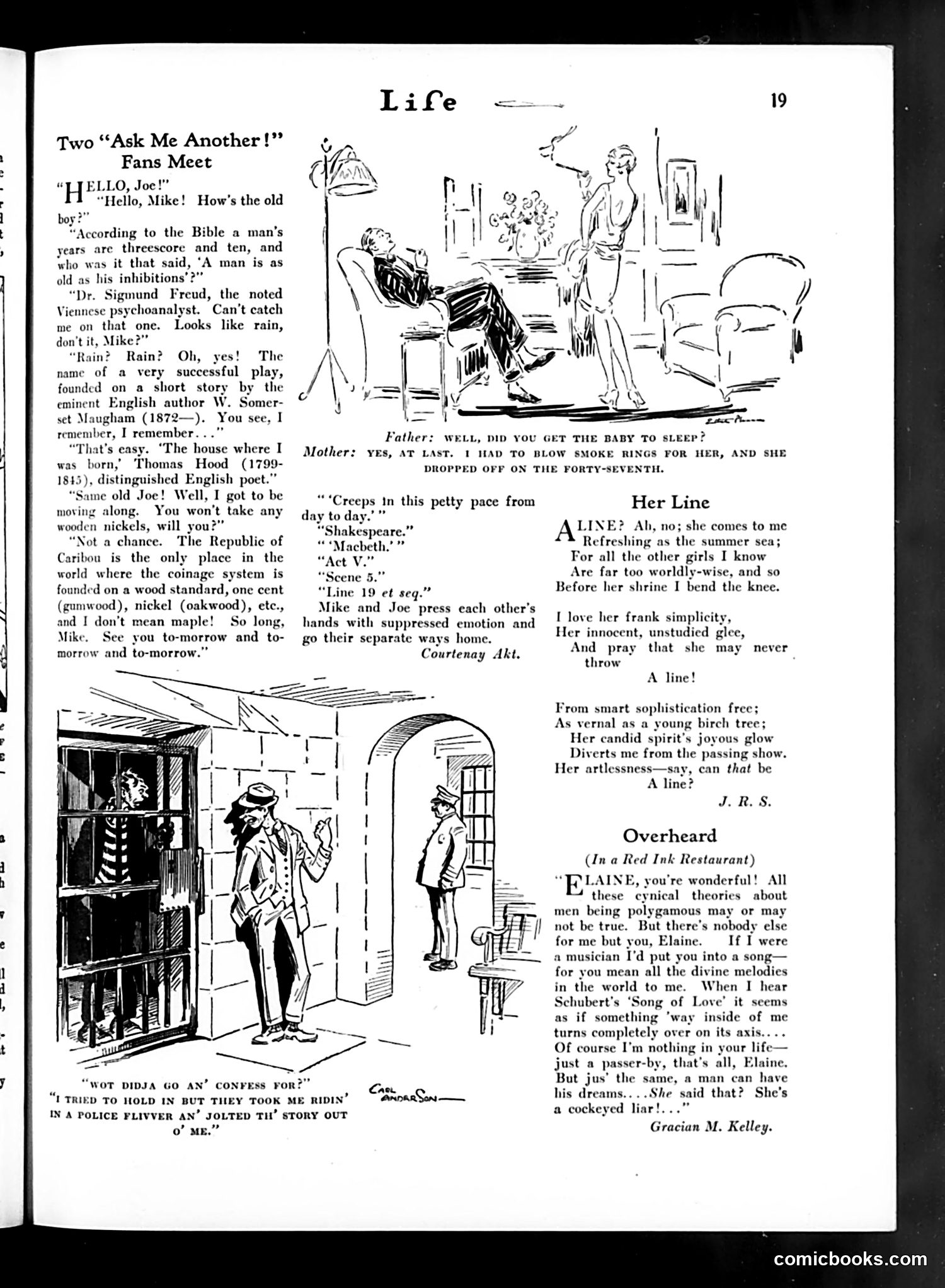
This page collects three distinct comic pieces mocking early 20th-century social trends: **"Two 'Ask Me Another!' Fans Meet"** satirizes trivia obsession. Two men compulsively answer obscure questions (citing Freud, Maugham, Hood) while discussing mundane topics like weather. The joke is their pretentious name-dropping and the absurd digression about "Caribou's wooden nickel currency"—pure nonsense presented as fact. **Father and Mother dialogue** jokes about parenting desperation: the mother had to blow 47 smoke rings to get the baby to sleep, exaggerating the exhausting effort required. **"Her Line"** and **"Overheard"** mock romantic sentimentality. The poem idealizes a woman's "frank simplicity" and innocence, while the overheard restaurant monologue parodies melodramatic suitors claiming absolute devotion—the punchline being the woman calls him a liar, deflating his flowery declarations. The magazine ridicules intellectual posturing, domestic chaos, and insincere romantic performances of the era.
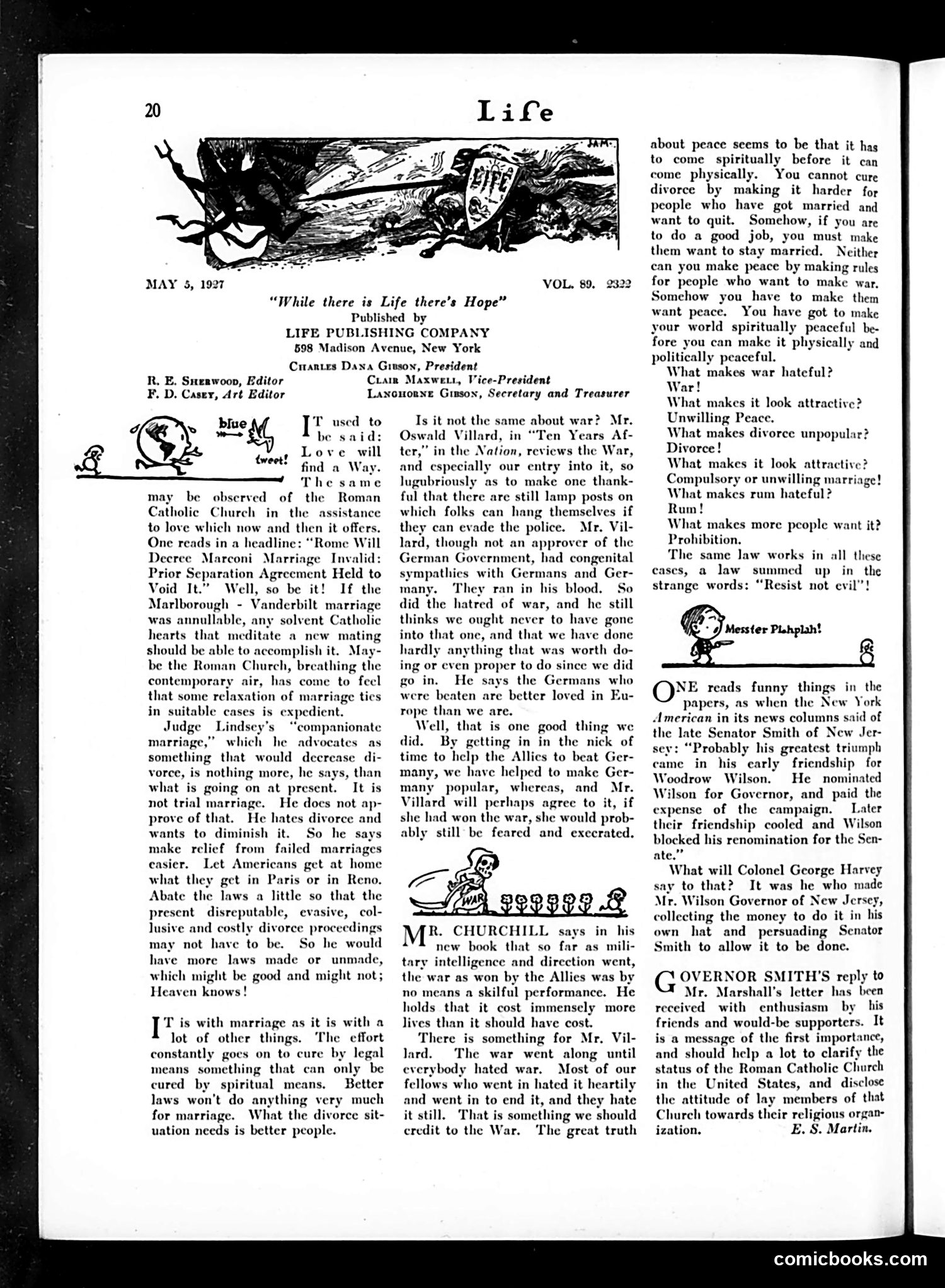
This page presents editorial commentary on marriage, divorce, and war through the lens of spiritual versus legal reform. **Main argument:** The editor argues that legal solutions cannot fix social problems—only spiritual change can. He uses three interconnected examples: 1. **Marriage/Divorce**: References the "Marlborough-Vanderbilt marriage" annulment and Judge Lindsey's "companionate marriage" proposal, arguing that loosening divorce laws won't help; people need better character, not better laws. 2. **War criticism**: Discusses Oswald Villard's anti-war writings in *The Nation*, noting Villard's "congenital sympathies with Germans" (suggesting pacifist bias). The editor credits America's WWI entry with making Germany unpopular—an unintended positive consequence. 3. **Churchill's observation**: References Churchill's new book criticizing Allied military incompetence in WWI, arguing the war's true value was making people hate war itself. **Core satire:** The cartoons (small illustrations, difficult to discern clearly) likely emphasize the disconnect between legal/political attempts at reform and human nature's resistance to change.
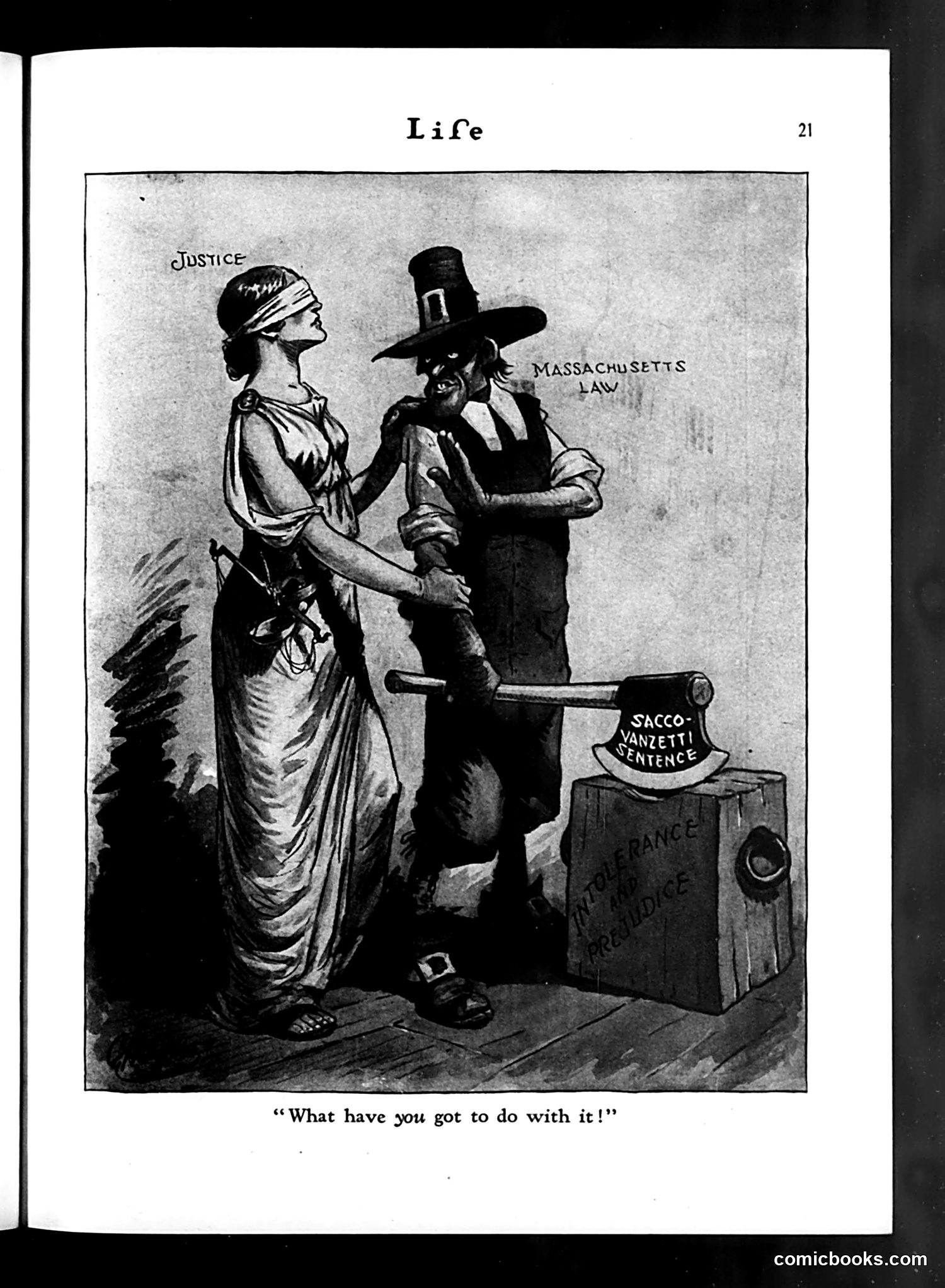
This political cartoon depicts **Justice** (the blindfolded female figure on the left) confronting **Massachusetts Law** (the caricatured figure on the right wearing a top hat). Between them sits a wooden block labeled "SACCO-VANZETTI SENTENCE" with text referencing "INTOLERANCE" and "PREJUDICE." The cartoon satirizes the 1927 execution of Italian anarchists Sacco and Vanzetti in Massachusetts, suggesting the death sentence resulted from prejudice and intolerance rather than justice. Justice's accusatory question—"What have you got to do with it!"—implies Massachusetts Law acted without proper regard for actual justice, condemning the men based on their ethnicity and political beliefs rather than fair legal proceedings. This reflects contemporary criticism of the controversial trial.
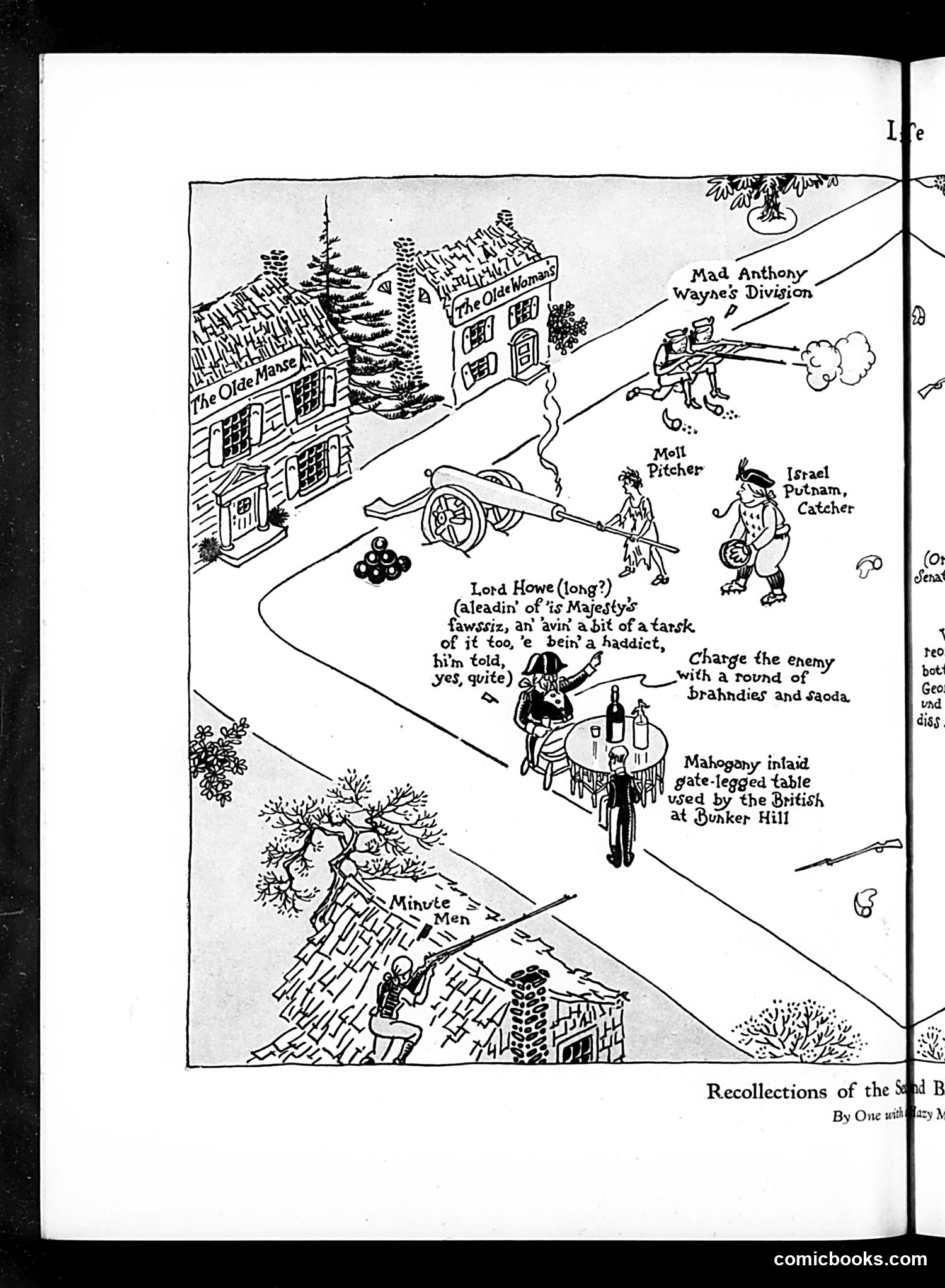
This is a satirical cartoon about the American Revolutionary War, likely from an early 20th-century Life magazine. It depicts British military figures and supplies in a comedic, derogatory manner. The cartoon mocks Lord Howe (British commander) as indulgent and addicted, while showing British soldiers charging with alcohol ("brandies and soda") rather than proper ammunition. References include "The Old Mass" and "The Old Homestead" buildings, and a mahogany table supposedly used at Bunker Hill. The satire ridicules the British military's perceived incompetence, dandyism, and reliance on luxury items during wartime. Characters labeled include "Mad Anthony Wayne's Division," "Moll Pitcher," and "Israel Putnam, Catcher," emphasizing American Revolutionary heroes against caricatured British buffoonery. The humor relies on period stereotypes about British affectation and military ineptitude during the Revolution.
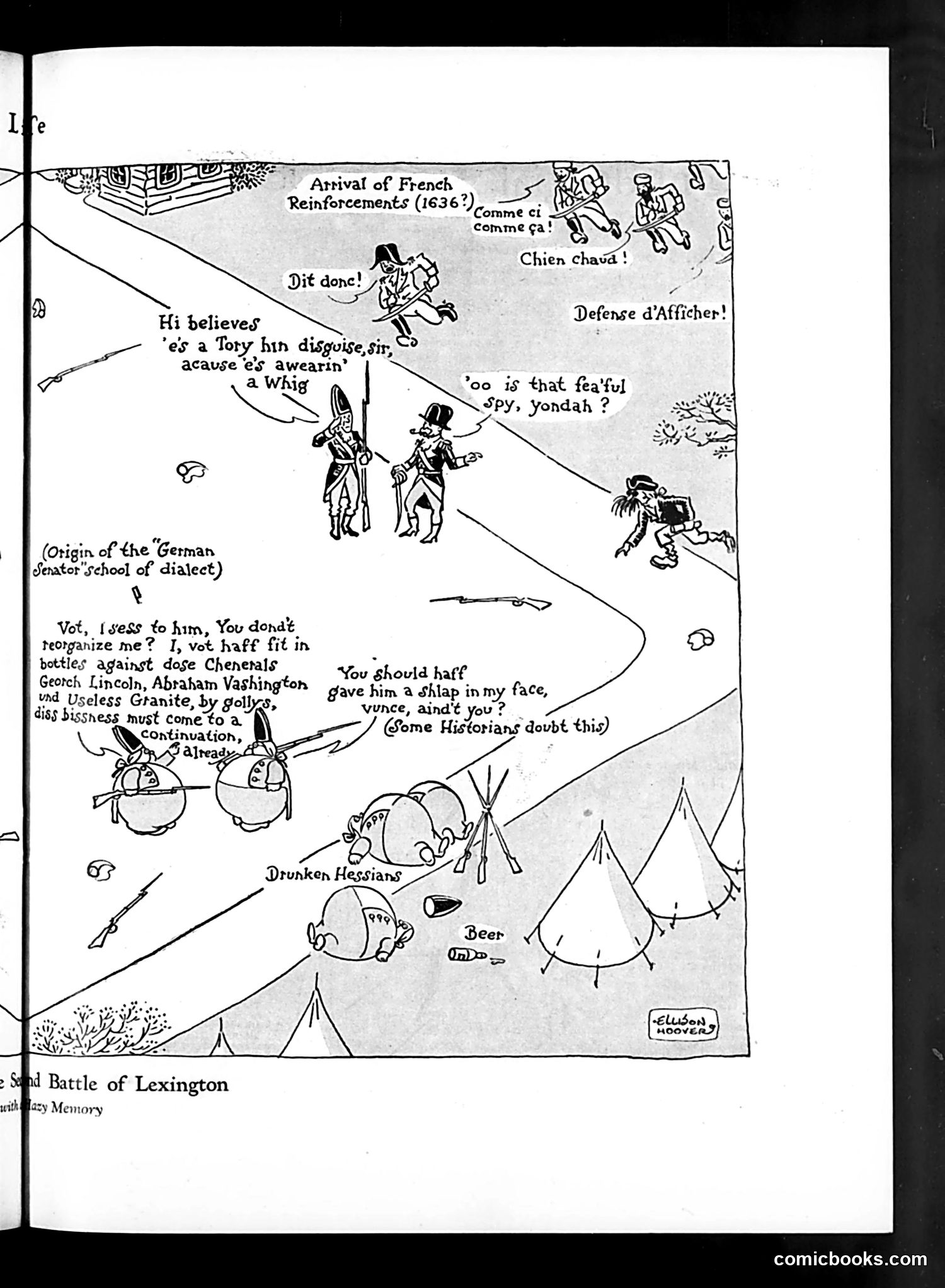
This satirical cartoon mocks competing interpretations of the American Revolution's origins. The central scene depicts British and French figures debating whether French reinforcements arrived in 1636—historically impossible, as the Revolution occurred in 1775. The "Drunken Hessians" (German mercenaries hired by Britain) at bottom represent unreliable historical witnesses. One character, speaking in exaggerated German dialect, ironically claims to have "fought in bottles against those Generals" including George Washington and Abraham Lincoln—conflating historical eras absurdly. The joke satirizes how different nations rewrote Revolutionary War history to suit their narratives. The French claim credit for reinforcements; the British deny it; the Germans are too drunk to remember accurately. The title "Lazy Memory" suggests Americans themselves had sloppy historical recollection. The French phrases ("Comme ça," "Défense d'Afficher") reinforce that this is specifically mocking French historical revisionism.
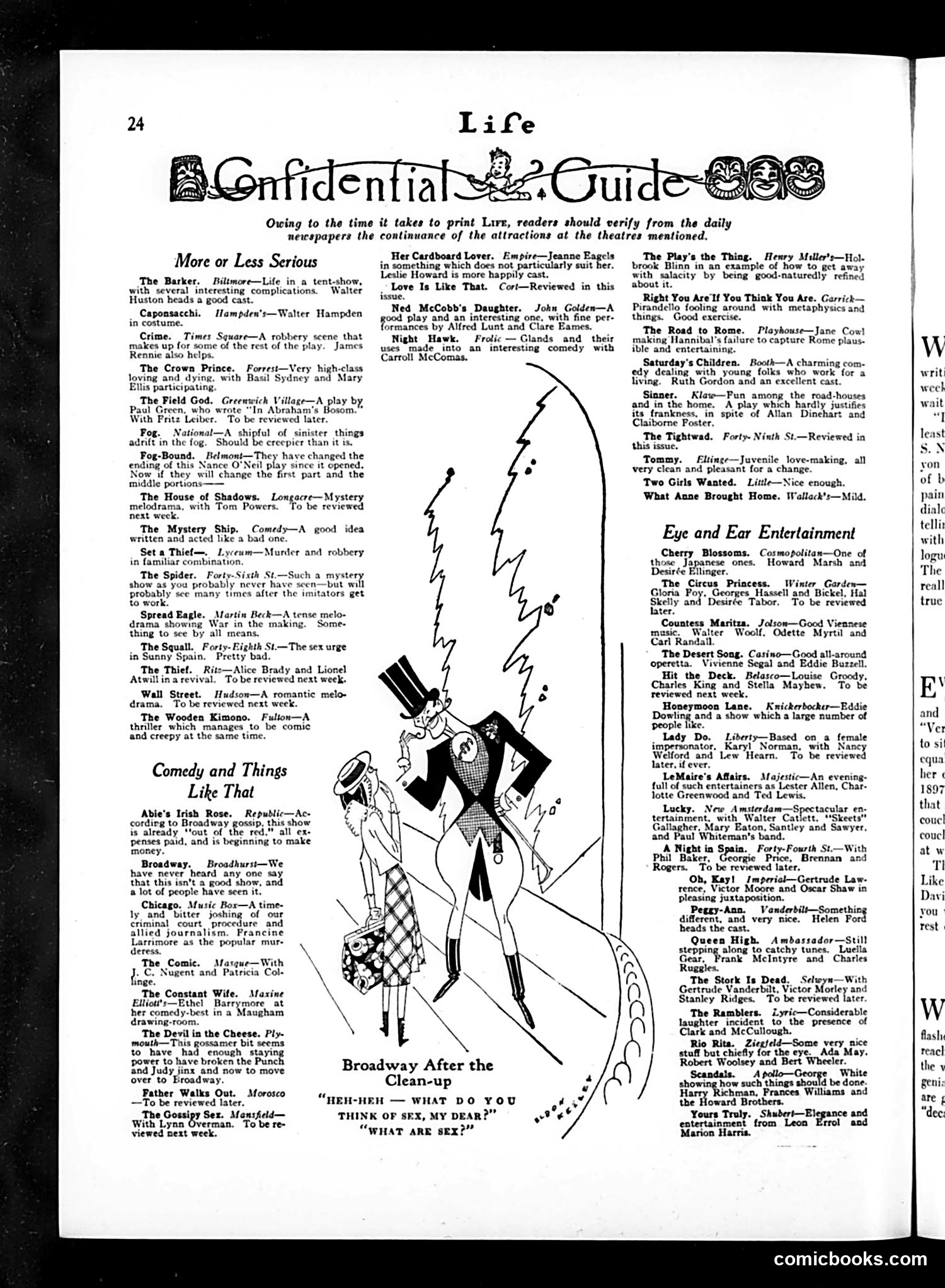
This page from *Life* magazine contains theater reviews and a cartoon satirizing post-WWI sexual attitudes. The large cartoon depicts a man in formal attire (top hat, tuxedo) being struck by lightning labeled with sexual references—a visual metaphor for the era's collision between Victorian propriety and emerging "modern" attitudes about sex. The caption—"HEH-HEH—WHAT DO YOU THINK OF SEX, MY DEAR? 'WHAT ARE SEX?'"—mocks the generational divide: older men nervously joking about sex as scandalous, while younger women (the "modern" type) feign ignorance or indifference, having been sheltered by earlier social codes. The surrounding theater listings reveal the satire's context: many productions listed emphasize "sex urges," "glands," and sexual frankness (*The Squall*, *Night Hawk*). The cartoon critiques how 1920s entertainment increasingly addressed sexual themes while society still maintained superficial prudishness—the lightning strike representing the shocking collision of these forces on conventional morality.
This page from Life magazine contains theater reviews written in a satirical, dismissive tone characteristic of the publication's drama critic. The critic reviews three theatrical productions: 1. **"Love Is Like That"** — co-written by S.N. Behrman and Kenyon Nicholson. The reviewer mocks the play as outdated (comparing it to 1903-1904 theatrical conventions), particularly criticizing a lengthy monologue by actor Rathbone as excessively verbose. Two actresses (Ann Davis and Barbara Bulgakov) receive mild praise as doing "much better than expected," but the overall production is dismissed as "hooey." 2. **"One Glorious Hour"** — described as nearly the season's worst. The plot involves three artistic men in a European lodge whose creative output improves dramatically when a countess in a bathing suit arrives, then deteriorates when she leaves. The reviewer finds the premise absurd. 3. **"The Tightwad"** — briefly mentioned as competent but unlikely to succeed commercially. The reviews exemplify Life's acerbic theater criticism, employing hyperbole and sarcasm to entertain readers while delivering harsh judgments on Broadway productions.
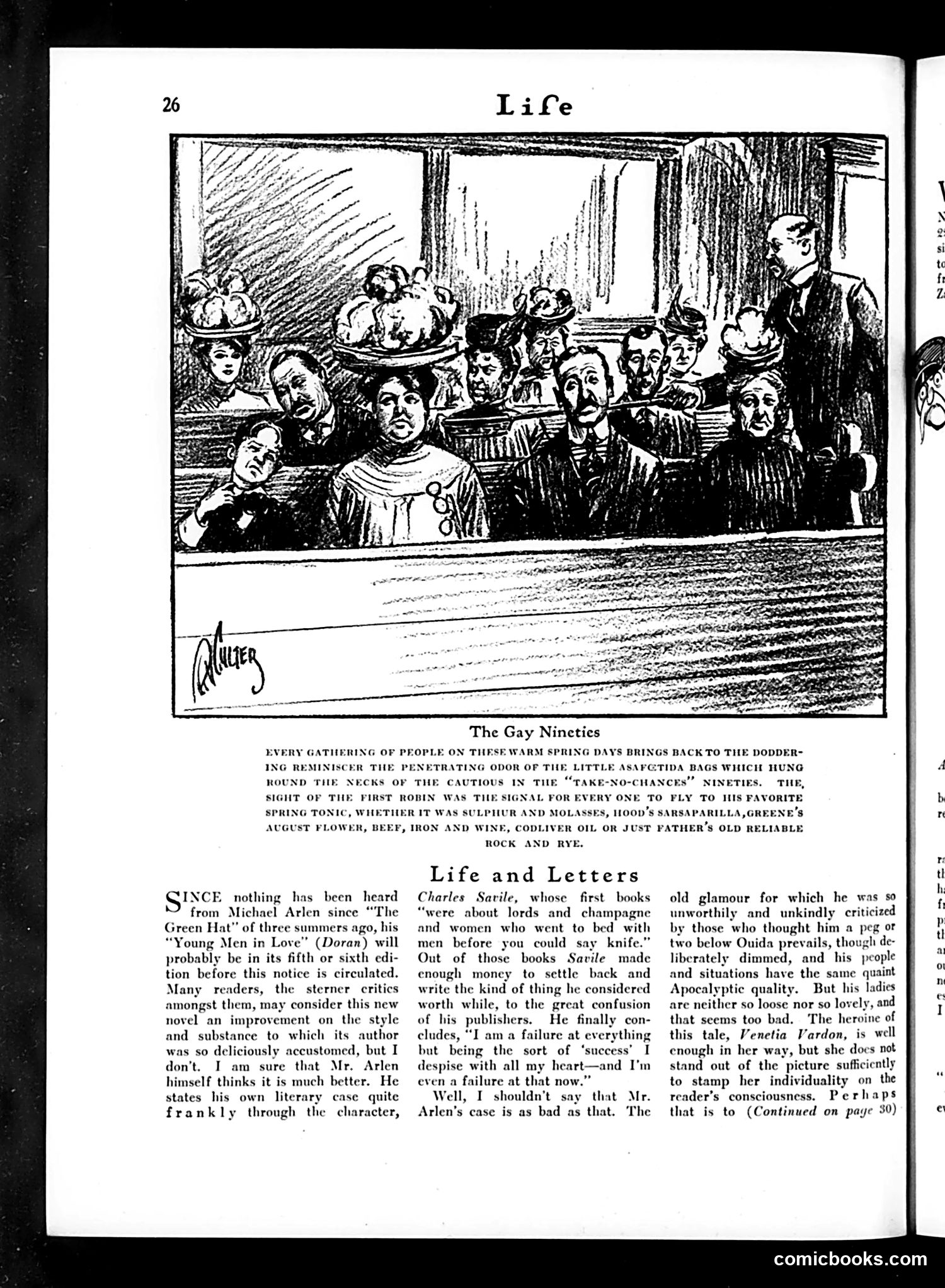
**The Cartoon:** "The Gay Nineties" depicts a crowded theater box or viewing area from the 1890s, with well-dressed patrons wearing elaborate hats. The caption satirizes spring gatherings by mockingly referencing period "spring tonics"—patent medicines like sulphur and molasses, cod liver oil, and whiskey-based remedies that were popular folk cures, often ineffective or unpleasant-tasting. **The Social Satire:** The joke targets the absurdity of 1890s social rituals and dubious health practices. The phrase "penetrating odor of little Asafetida bags" references foul-smelling medicinal charms people wore to ward off illness—clearly uncomfortable for those forced to socialize nearby. **The Literary Section:** Below, critic reviews Michael Arlen's novel "Young Men in Love," suggesting Arlen's earlier success with shallow society fiction ("lords and champagne") prevented him from writing more serious work. The review implies Arlen is trapped by his own commercial success.
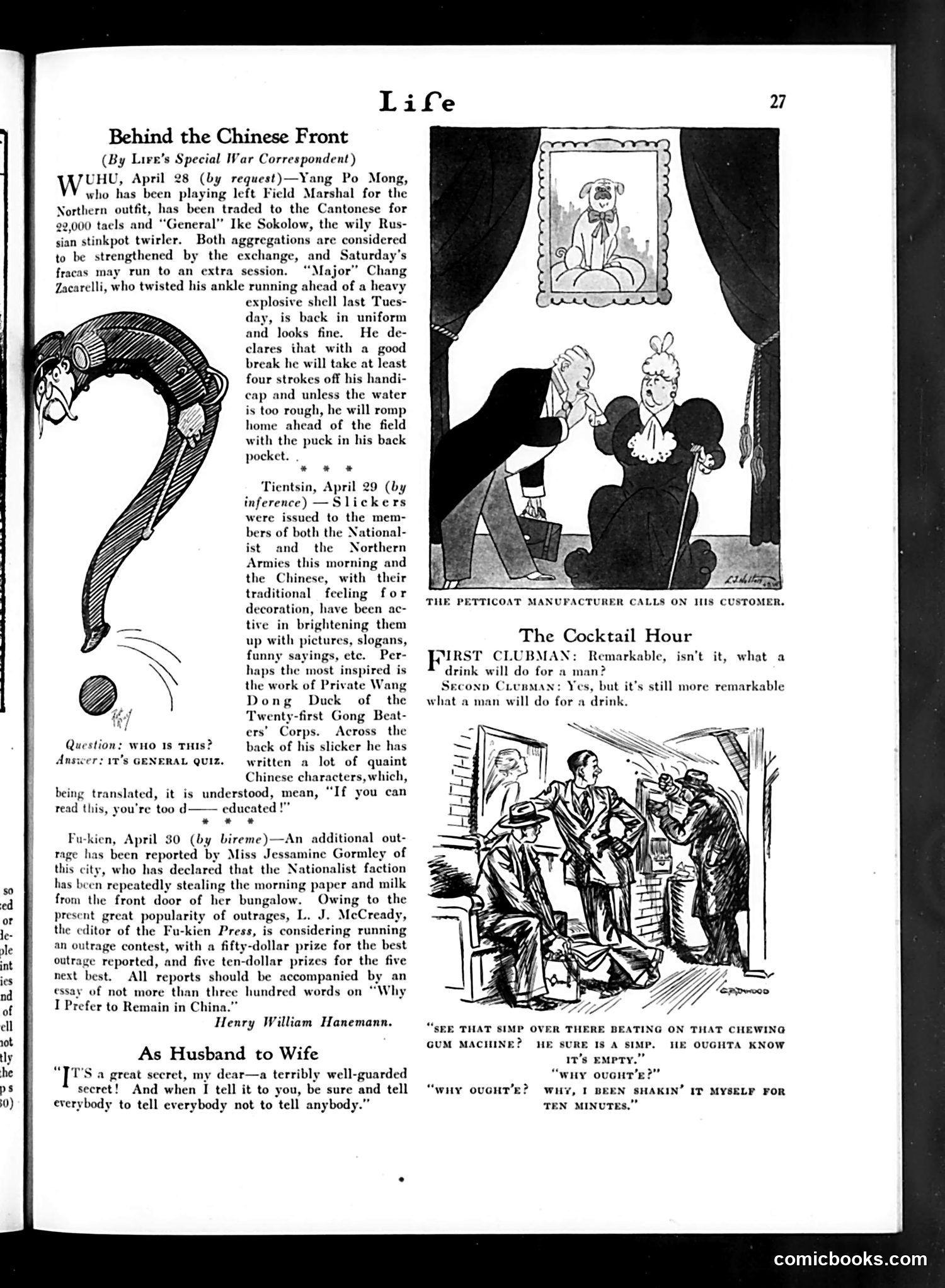
This page satirizes the Chinese Civil War through absurdist humor that deflates the conflict's seriousness. **"Behind the Chinese Front"** mocks military operations by using baseball/sports language: military leaders are "traded" like players, injuries are "handicaps," and combat is framed as a game. The joke is that the Chinese conflict is treated as casually and capriciously as a sports transaction, suggesting the fighting is chaotic and arbitrary rather than ideologically driven. **The slicker inscription joke** continues this theme: a soldier writes untranslatable Chinese characters meaning "If you can read this, you're too educated"—mocking the absurdity and futility of the war effort itself. **"The Cocktail Hour"** and "As Husband to Wife"** are unrelated humorous vignettes typical of Life magazine's satirical style. The overall message: the Chinese Civil War is so confused and senseless that it can only be adequately described through comedic nonsense rather than straightforward reporting.
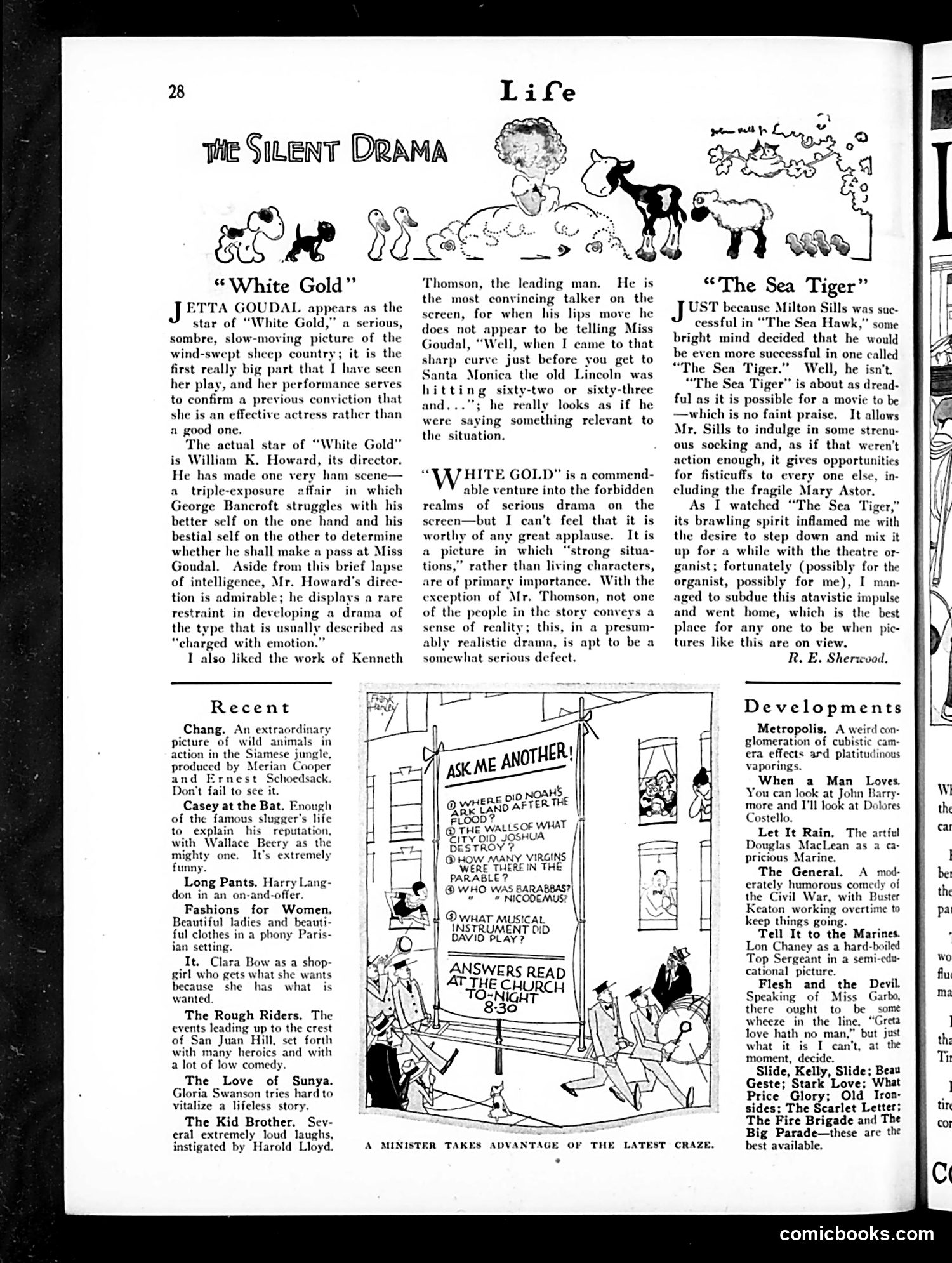
This page reviews several silent films from the mid-1920s. The main reviews critique "White Gold" (starring Jetta Goudal, directed by William K. Howard) as a serious drama with effective direction but weak character development, and "The Sea Tiger" (starring Milton Sills) as poorly executed action melodrama. The central cartoon satirizes a contemporary religious fad: a minister uses a church bulletin board to pose trivia questions from scripture ("Where did Joshua destroy?", "Who was Barabbas?") as a popular entertainment craze. The humor mocks how churches adopted trendy quiz formats to engage congregants—a modern marketing approach to faith that the cartoonist finds absurdly incongruous with spiritual purpose. The "Recent" and "Developments" sections list other current film releases, indicating this represents typical 1920s cinema criticism and entertainment coverage.
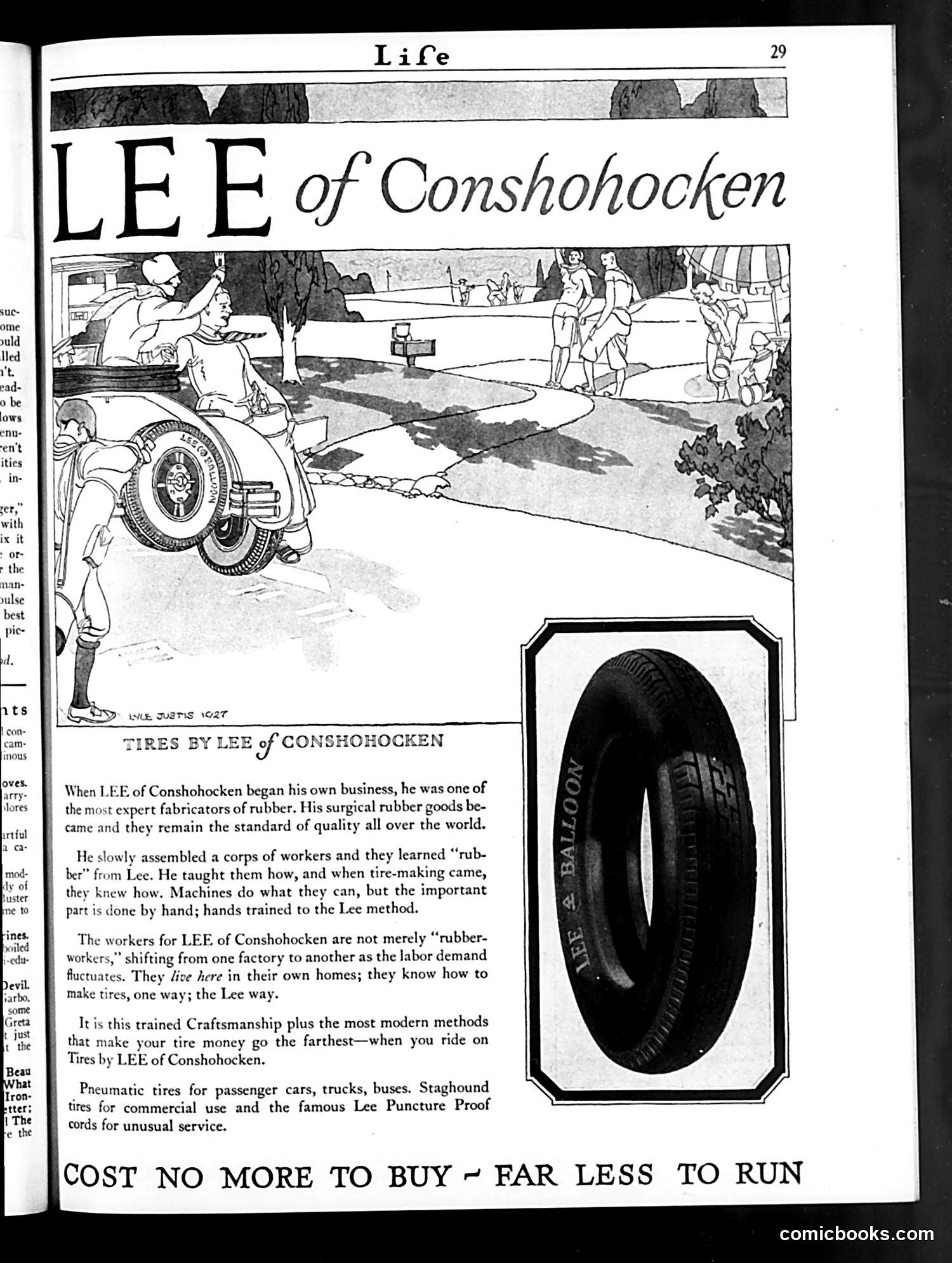
This page is primarily a **product advertisement**, not satire. It promotes tires manufactured by LEE of Conshohocken, a Pennsylvania rubber company. The illustrated scene at top shows a leisurely suburban or resort setting where people enjoy recreational activities—a visual metaphor for the comfort and reliability LEE tires provide. The accompanying tire photograph emphasizes product quality. The advertisement's marketing strategy emphasizes **craftsmanship and worker loyalty**: LEE personally trained skilled workers who remain in their homes rather than shifting between factories. This narrative contrasts "hand-trained" quality against mere machine production, positioning LEE tires as superior through human expertise rather than industrial efficiency alone. The tagline "Cost No More to Buy—Far Less to Run" appeals to value-conscious consumers by claiming durability justifies the purchase price. This reflects early 20th-century advertising that valued artisanal reputation and local community ties as selling points.
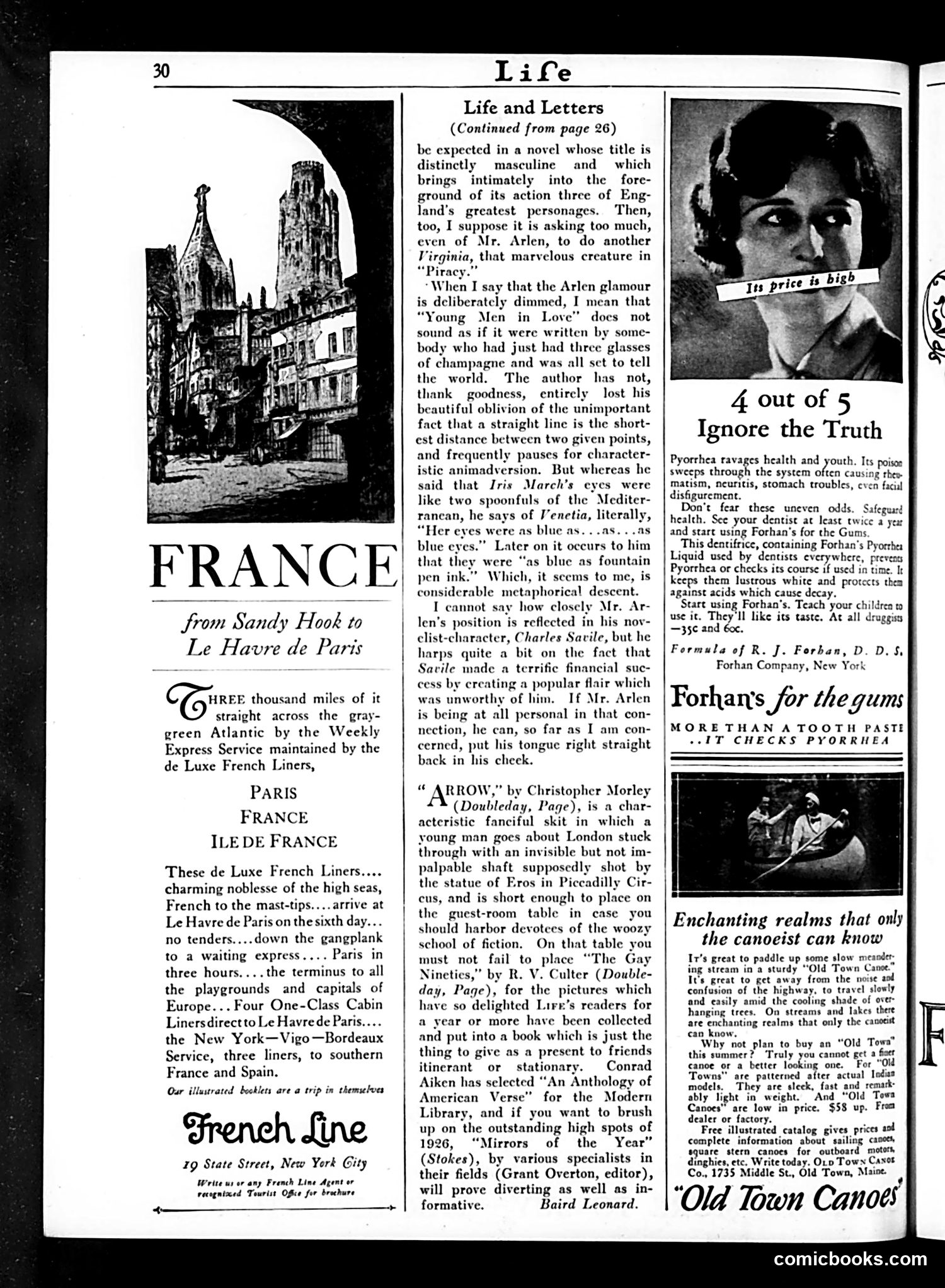
This *Life* magazine page contains two distinct elements: **Left side:** A travel advertisement for French Line steamships, promoting luxury ocean liner service from New York to Le Havre and Paris. The accompanying illustration shows Gothic cathedral architecture, evoking romantic European travel. **Right side:** Book reviews discussing recent literary releases, including Michael Arlen's "Young Men in Love" (criticized for less glamorous prose than his earlier work *The Green Hat*), Christopher Morley's whimsical "Arrow," and an anthology of American verse. **Bottom right:** A toothpaste advertisement for Forhan's, warning against pyorrhea (gum disease) in alarmist health-scare language typical of 1920s advertising. There are no political cartoons on this page. It's primarily a showcase of consumer advertising and literary criticism aimed at *Life*'s affluent readership, reflecting 1920s concerns with European sophistication, literary taste, and modern health anxiety.
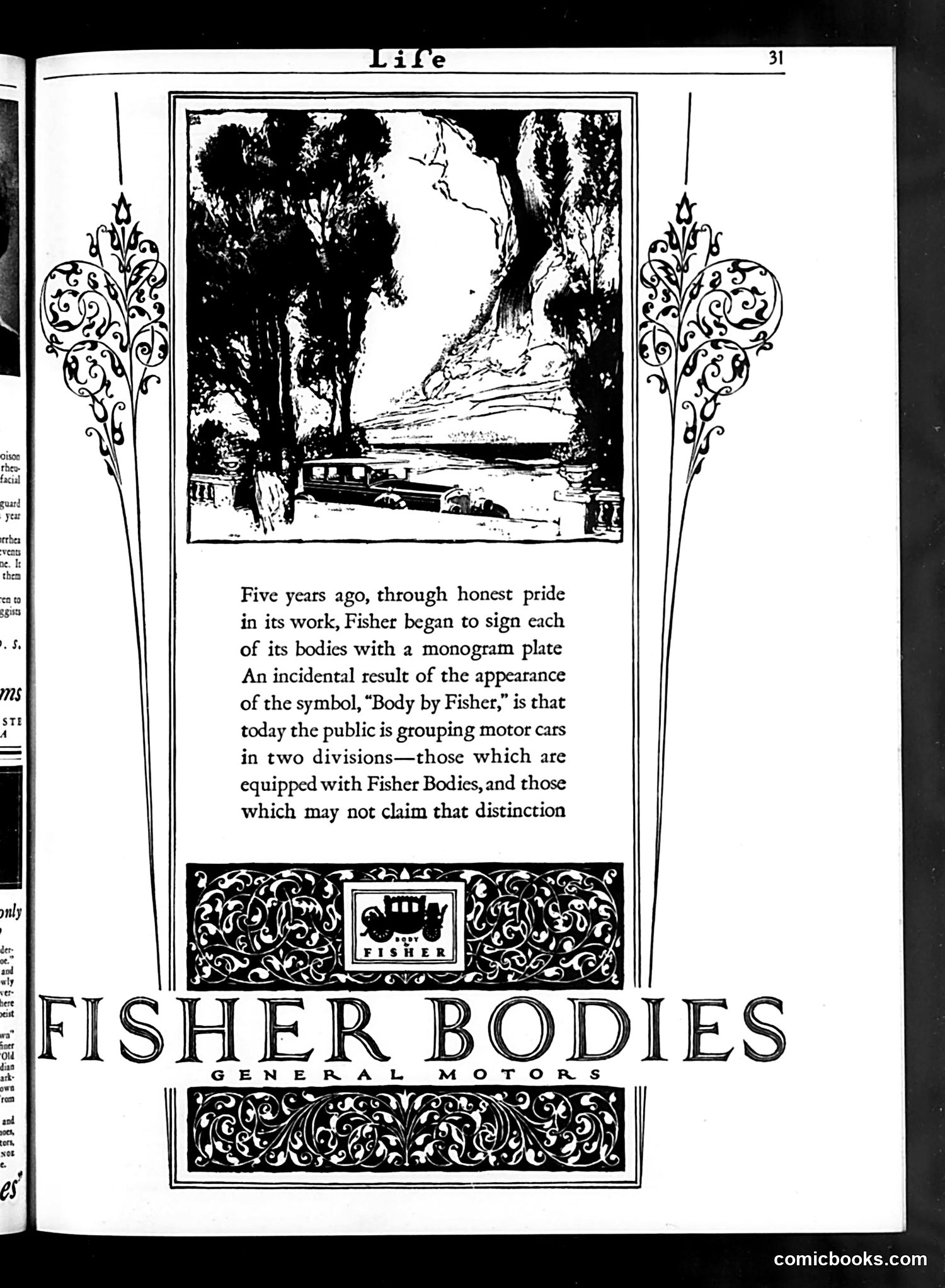
This is a **full-page advertisement** for Fisher Bodies, a General Motors subsidiary that manufactured automobile bodies. It's not satire or political commentary. The ad celebrates that five years prior, Fisher began placing monogram plates on car bodies as a quality marker. The text notes this branding strategy had an unintended but beneficial effect: the public now automatically categorizes automobiles into two groups—those with "Body by Fisher" (implying superior craftsmanship) and those without. The ornamental border, landscape illustration, and decorative typography are typical of early 20th-century luxury advertising. The message is straightforward brand promotion: Fisher's monogram has become a status symbol and mark of distinction in the automobile market. Modern readers might recognize this as an early example of how brand labeling influences consumer perception and creates market segmentation.
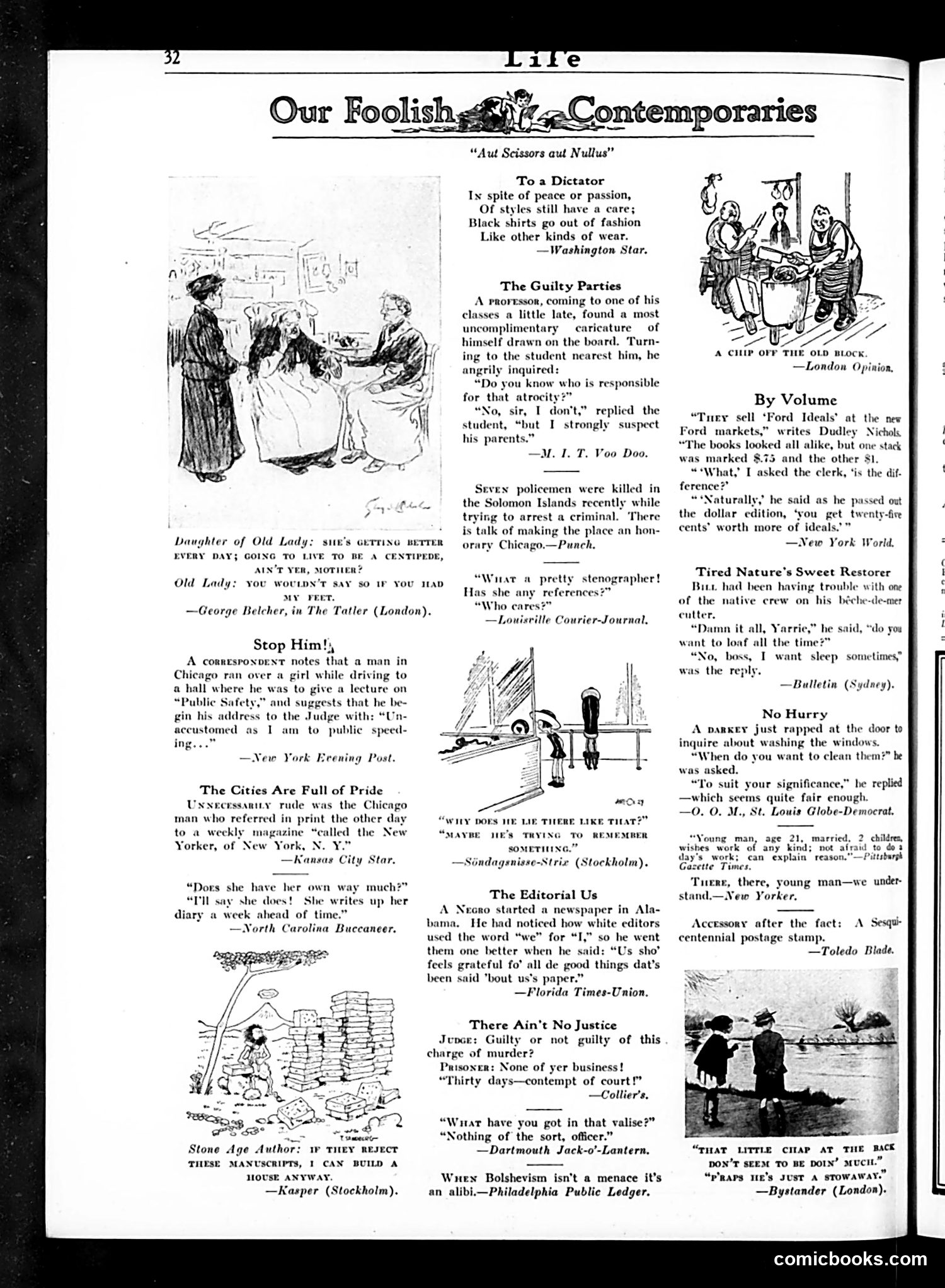
This page compiles brief satirical quips and cartoons mocking contemporary foibles. Key targets include: **Political references**: The "To a Dictator" poem alludes to fascism's rise (mentioning "black shirts"), likely referencing 1930s Mussolini or Hitler. **Social satire**: Multiple items mock American pride and pretension—a Chicago man's rudeness about *The New Yorker*, unnecessary formality in speech, and a newly-arrived Black newspaper editor's awkward mimicry of white editorial language ("Us sho' feels grateful"). **Institutional humor**: Academic professors blaming parents for student misconduct; corrupt justice systems; workplace incompetence. **The cartoons**: Simple line drawings illustrate these scenarios—a woman with a man, someone at a drafting table, figures stacking papers. The overall tone is lightweight social commentary typical of *Life*'s satirical approach: observing human vanity, pretension, and bureaucratic absurdity across class and national lines.
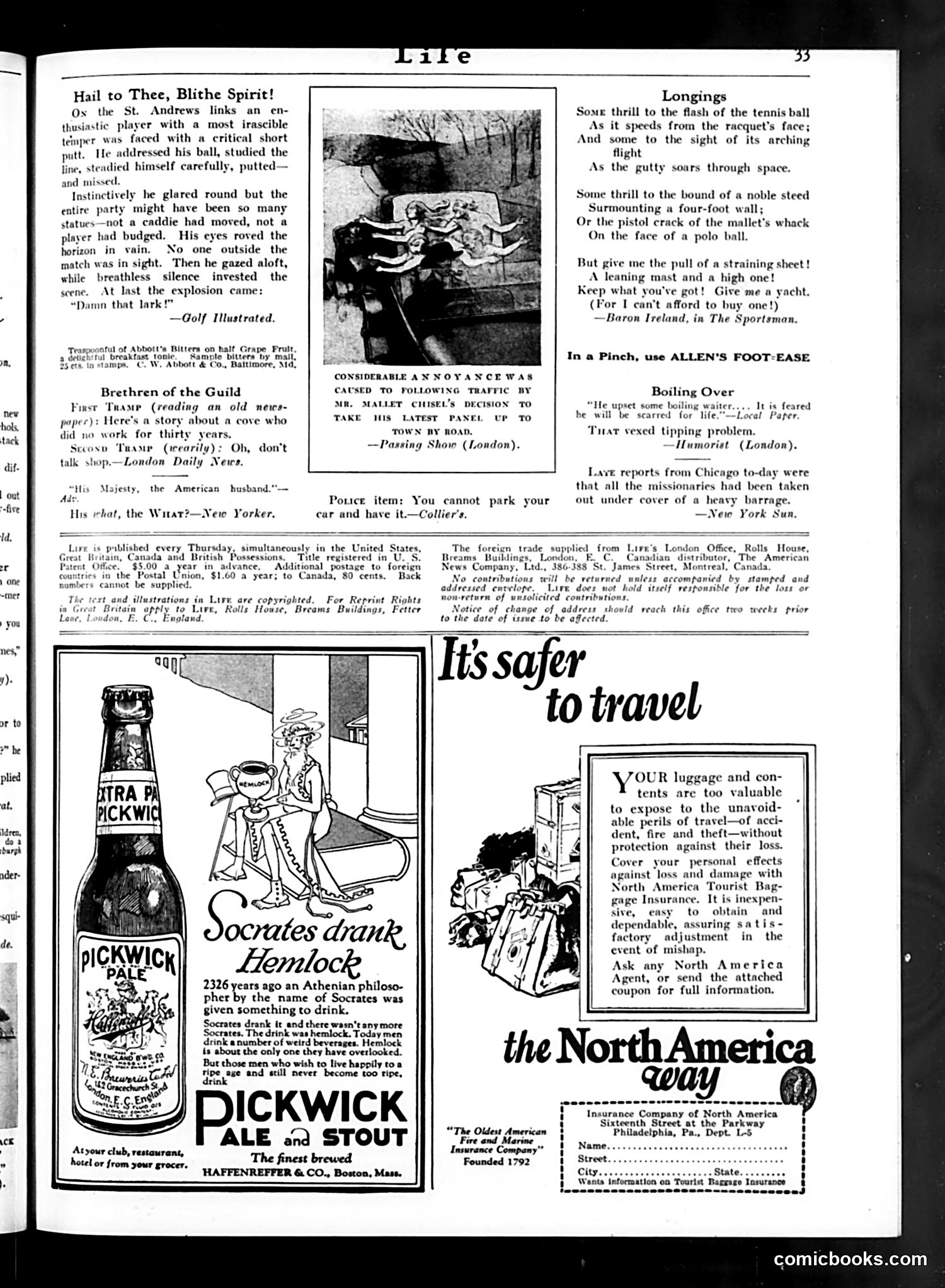
This page contains several brief humorous anecdotes typical of Life's satirical style, plus advertisements. The "Hail to Thee, Blithe Spirit" piece jokes about a golfer at St. Andrews who, after missing a putt, blames a lark (bird) he spots in the sky—a humorous deflection of responsibility for his poor play. "Brethren of the Guild" presents two working-class men: one reads about someone who avoided work for thirty years; the other responds wearily that such talk depresses him, implying he's overworked. The remaining items are brief satirical quips about golf etiquette, American husbands, traffic annoyances, parking regulations, and tipping problems—all contemporary social observations. The advertisements promote Pickwick Ale (invoking Socrates), Allen's Foot-Ease (a patent medicine), and North America Insurance for travelers. These ads reflect early 20th-century consumer marketing. The page is primarily **light humor and advertising** rather than political commentary—typical of Life's entertainment-focused content during this period.
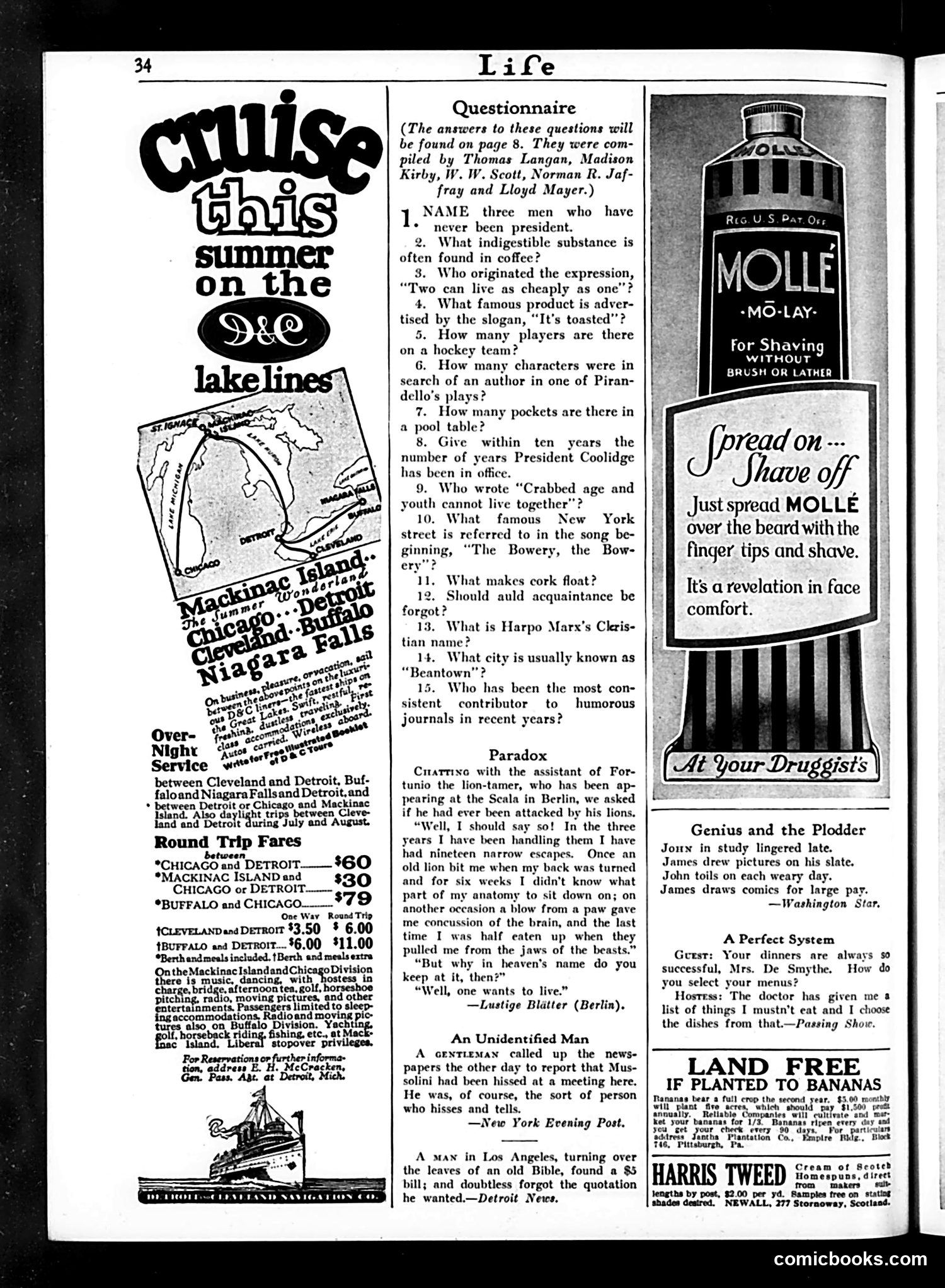
This page from *Life* magazine combines travel advertising, a quiz contest, and short humorous anecdotes typical of 1920s popular entertainment. **The Main Content:** A "Questionnaire" quiz with 15 trivia questions (answers on page 8), covering popular culture, famous quotes, and current knowledge—readers could test themselves or compete. **The Humor Pieces:** Three brief satirical jokes: one about a lion-tamer who stays in a dangerous job because "one wants to live" (dark comedy about necessity); one mocking someone who reports Mussolini was hissed (social gossip); and one about finding money in a Bible (ironic commentary on materialism vs. spirituality). **The Advertising:** Prominent ads for Great Lakes steamship cruises, Mollé shaving cream, and banana plantation land—reflecting Depression-era and agricultural-era commercial interests. The page represents how *Life* mixed intellectual amusement with commerce, assuming readers enjoyed wordplay, current events references, and gentle social satire.
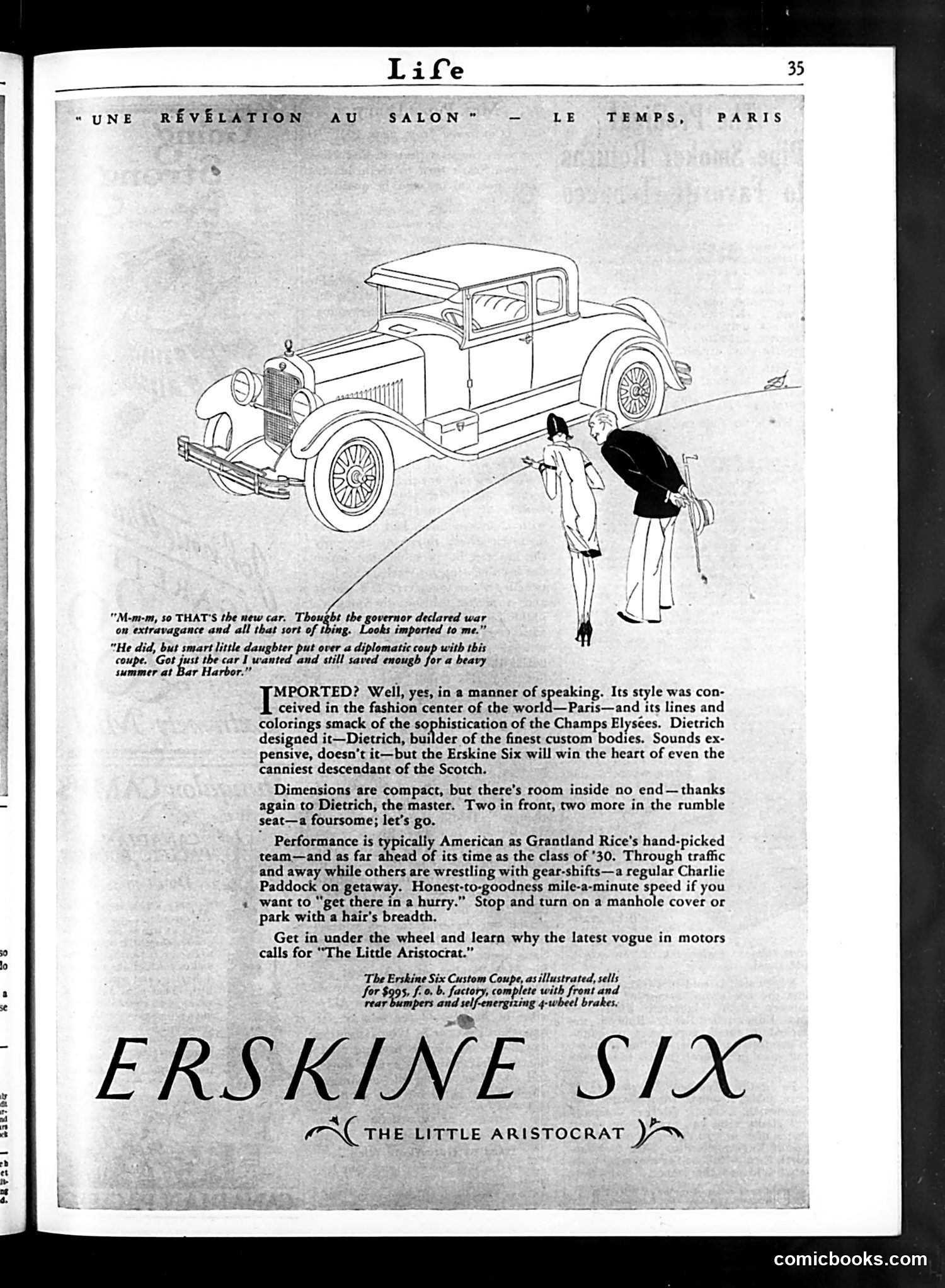
This is a 1920s automobile advertisement disguised as satirical commentary. The cartoon depicts two women discussing a new Erskine Six car, with the joke centered on post-WWI economic hypocrisy. **The Satire:** A governor had declared war on extravagance and waste, yet his "smart little daughter" used diplomatic charm to convince him to buy an expensive imported luxury car anyway—while still saving money for a lavish summer at Bar Harbor (a wealthy vacation destination). The humor lies in the contradiction between public austerity and private indulgence. **The Marketing Angle:** The ad then pivots to selling the Erskine Six as the solution—fashionable and Paris-designed (sophisticated), yet affordable ($995), positioning it as the car for those wanting luxury without excess. References to "Charlie Paddock" (a famous runner) and "The Little Aristocrat" emphasize performance and class aspirations for middle-class buyers. This reflects 1920s consumer culture: the post-war desire for modern goods mixed with lingering Depression-era guilt about spending.
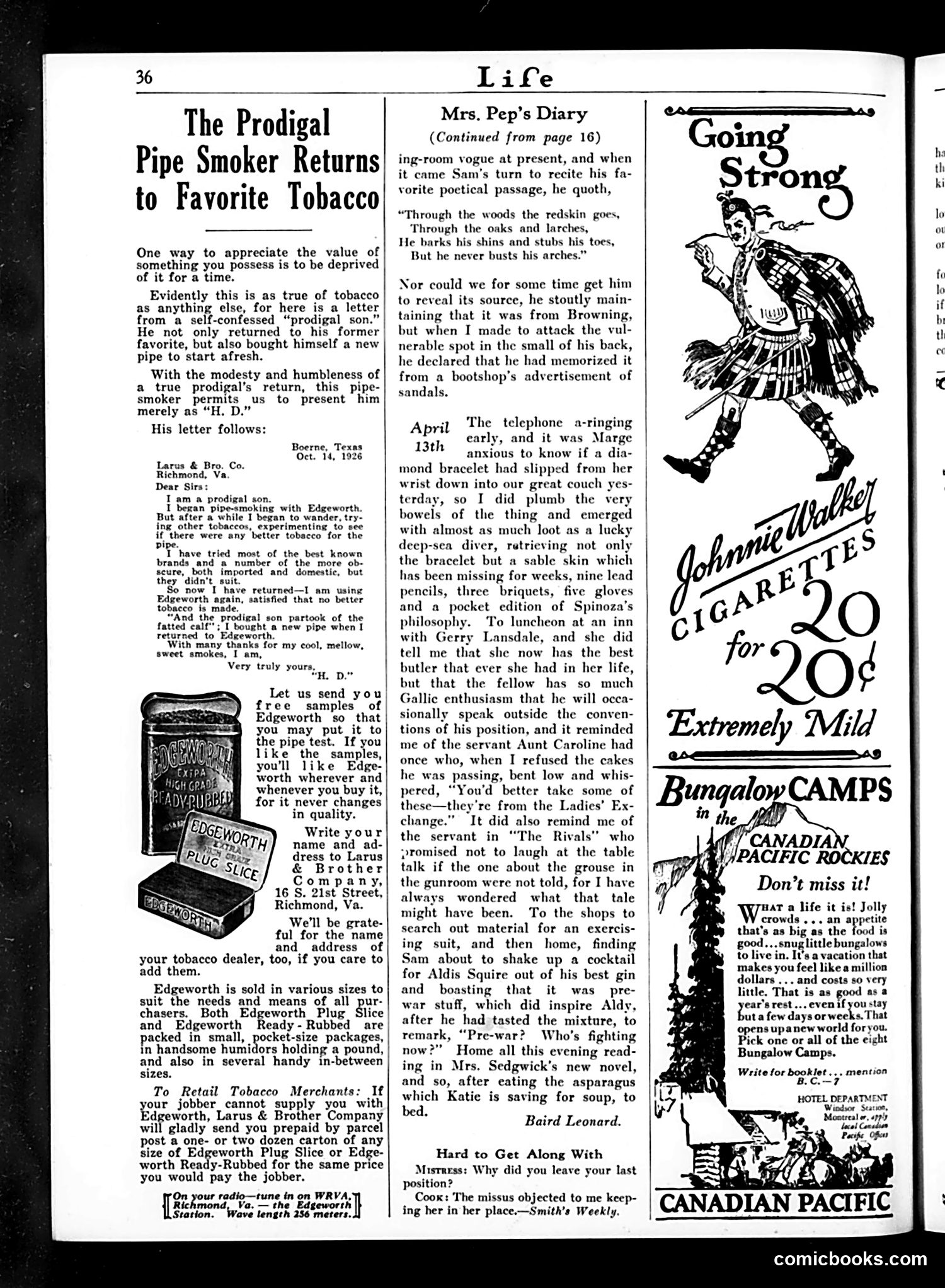
This page contains **primarily advertising**, not political satire. The main content is a tobacco advertisement for Edgeworth pipe tobacco, structured as a testimonial letter from a satisfied customer ("H.D.") who describes himself as a "prodigal son" returning to his former favorite brand after experimenting with competitors. The "prodigal son" reference alludes to the Biblical parable of redemption—the customer strayed to other tobacco brands but has returned, reformed and grateful. This was a common advertising trope: the narrative of a dissatisfied wanderer vindicated by coming home to the superior product. The secondary content includes Mrs. Pep's Diary (a gossip/humor column) and advertisements for Johnnie Walker cigarettes and Canadian Pacific bungalow camps. There is **no political cartoon or satire** on this page—it's a standard 1926 magazine page mixing advertising copy with lifestyle humor columns.
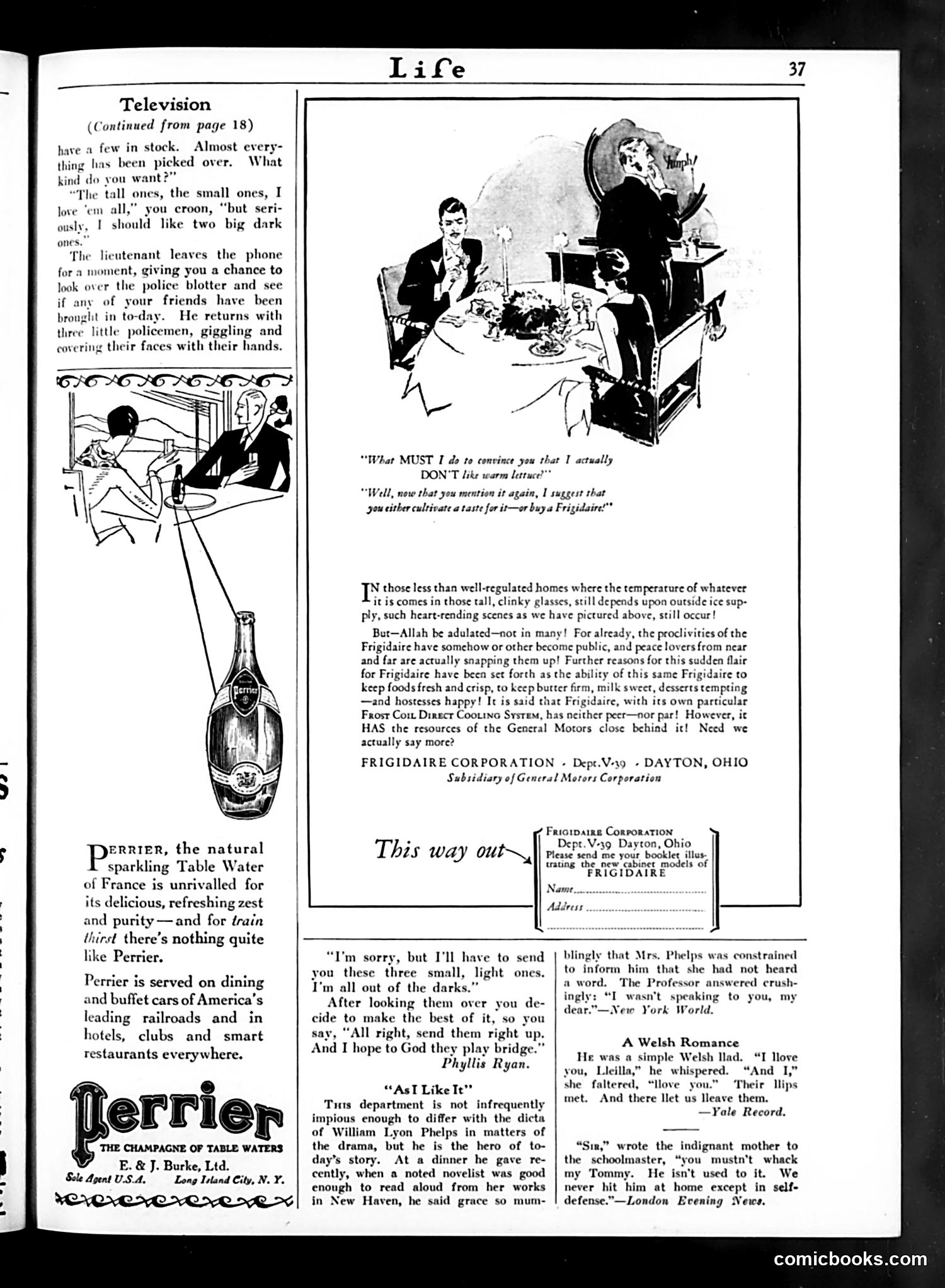
This page contains **advertising and humor content**, not political satire. The main cartoon depicts a domestic dispute over warm lettuce—a husband trying to convince his wife to accept it, she refusing. The joke advertises **Frigidaire refrigerators**, suggesting the appliance solves such marital conflicts by keeping food properly chilled. The ad emphasizes Frigidaire's superiority, backed by General Motors resources. Below are **brief humorous anecdotes**: one about a policeman ordering small drinks instead of large ones (implying he's intoxicated or confused), another about Professor William Lyon Phelps making a cutting remark at a dinner party, and a sentimental Welsh romance snippet. The page also includes an advertisement for **Perrier sparkling water** from France, marketed as refined and sophisticated. These are period advertisements and light humor typical of Life magazine's commercial content—not political commentary.
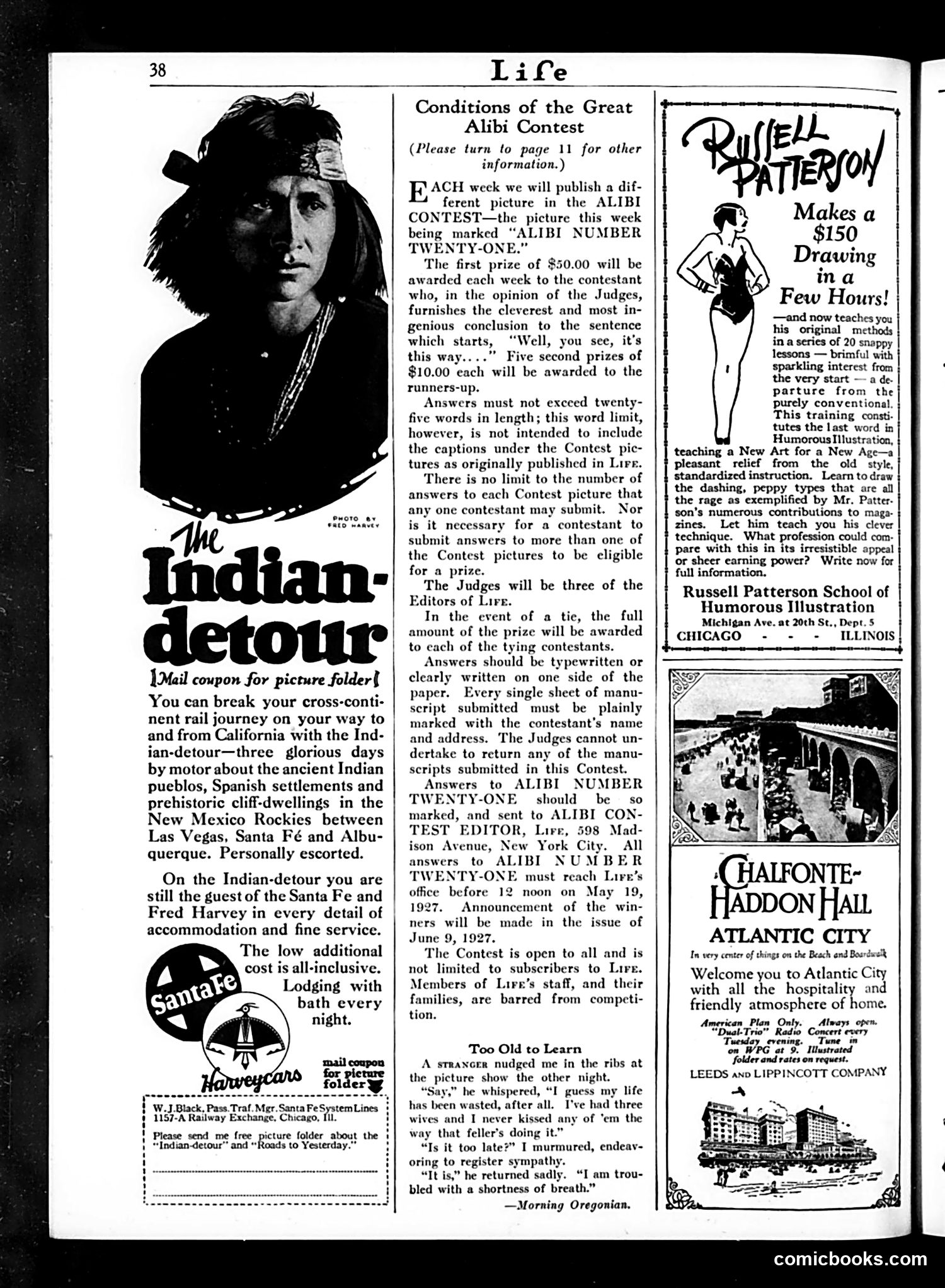
This page is primarily **advertising and contest information**, not political satire. The main content includes: **The "Alibi Contest"**: Life's weekly competition where readers submit humorous endings to a sentence starting "Well, you see, it's this way..." The winner receives $50; runners-up get $10 each. Answers must not exceed 25 words. This reflects 1920s popular culture—contests were common magazine engagement tools. **Advertisements include:** - Santa Fe Railroad's "Indian-detour" promoting tourism to New Mexico pueblos and Spanish settlements - Russell Patterson's school of humorous illustration, teaching cartooning techniques - Chalfonte-Haddon Hall hotel in Atlantic City **"Too Old to Learn"** (bottom): A brief humorous anecdote about an older man at a movie theater regretting he never learned to kiss properly—social commentary on changing courtship customs, perhaps mildly risqué for the era. The page reflects 1920s consumer culture, leisure travel, and amateur creative competitions rather than political content.
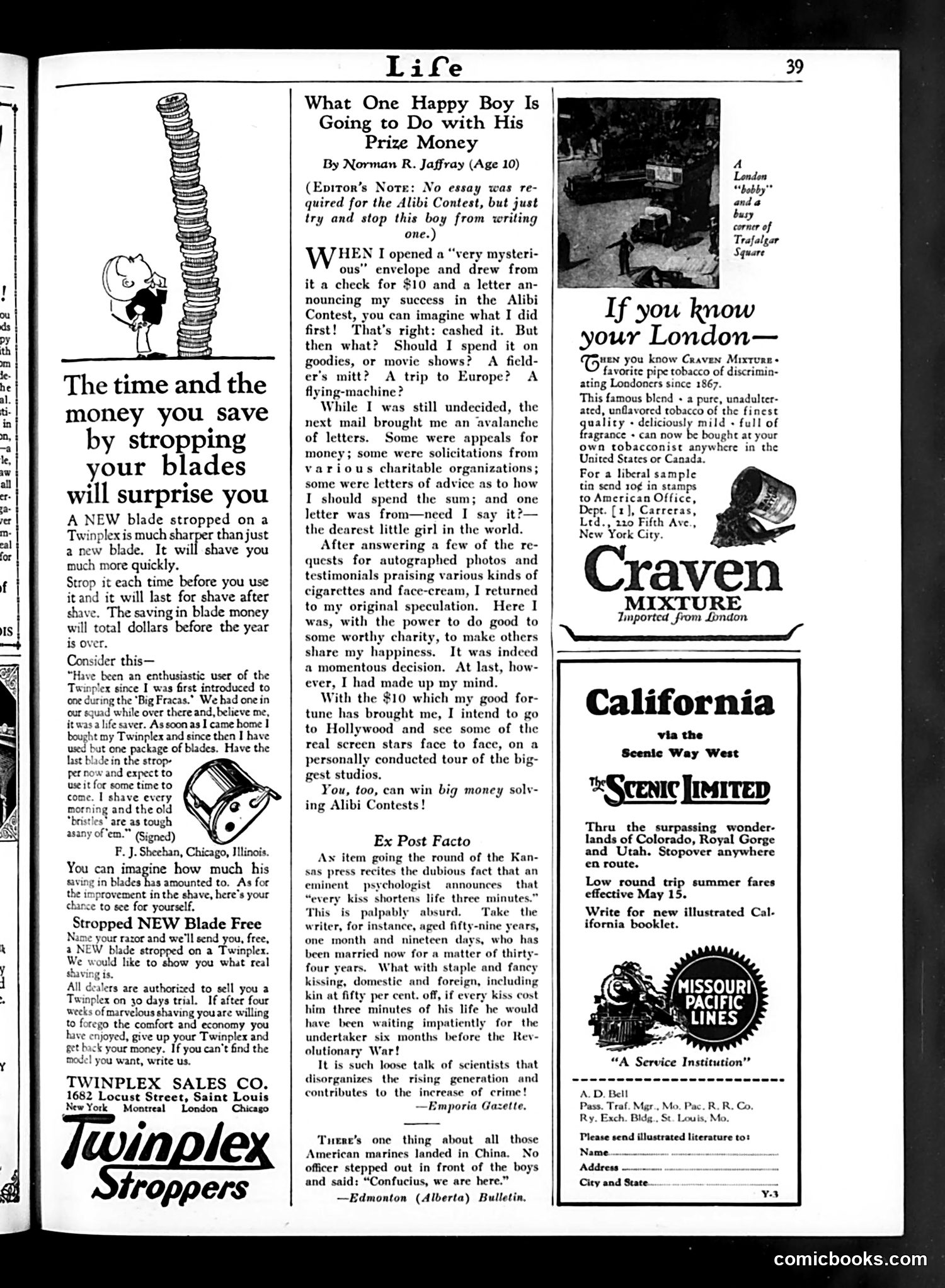
This page contains primarily **advertisements and reader content**, not political satire. The main feature is "What One Happy Boy Is Going to Do with His Prize Money"—a humorous essay by 10-year-old Norman R. Jaffray describing how he won $10 in the magazine's "Alibi Contest" and plans to use it for a Hollywood studio tour. The joke is the boy's overwrought deliberation about a trivial sum, treating his minor prize as a momentous life decision. The "Ex Post Facto" section is a brief comedic debunking: a psychologist supposedly claimed kissing shortens life by three minutes; the author sarcastically notes that a 51-year-old married man would have died centuries ago if true. The remainder consists of ads for **Twinplex razor blade strops**, **Craven tobacco mixture**, California travel, and Missouri Pacific Lines—typical 1920s period advertising with testimonials emphasizing economy and reliability.
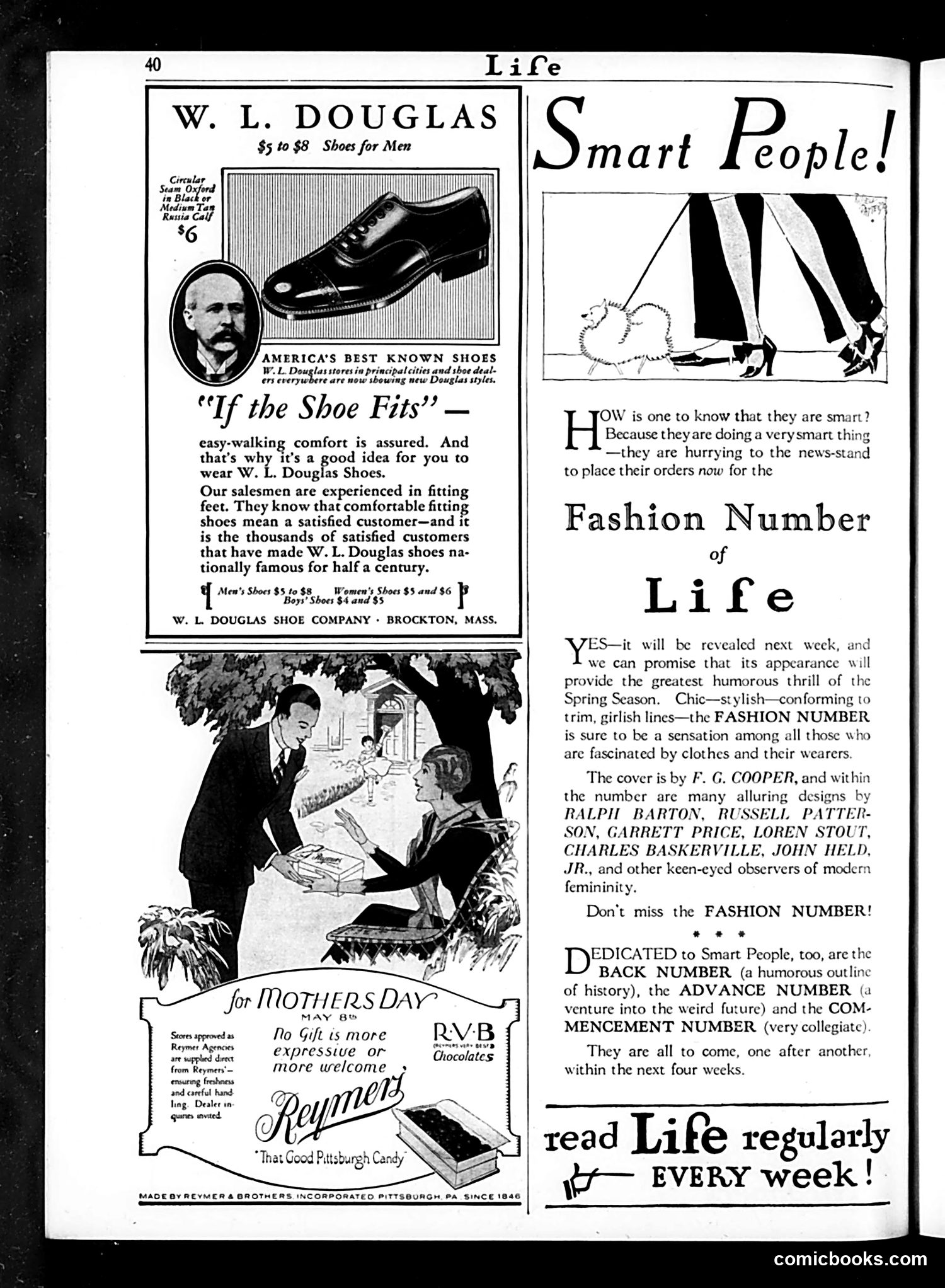
This page is primarily **advertising and promotional content**, not political satire. It contains: 1. **W.L. Douglas Shoes ad** (left): A straightforward product advertisement featuring the company founder, promoting comfortable, affordable shoes ($5-$8 for men's). The "If the Shoe Fits" slogan emphasizes proper fitting. 2. **Mother's Day ad** (bottom left): A sentimental illustration promoting Reymer's chocolates as an appropriate gift, with dealers listed. 3. **Life magazine self-promotion** (right): The bulk of the page announces an upcoming "Fashion Number" issue, teasing it as humorous and stylish. It lists famous fashion illustrators (Ralph Barton, John Held Jr., etc.) and promotes upcoming special issues (Back Number, Advance Number, Commencement Number). The "Smart People" headline is simply marketing copy encouraging readers to order the Fashion issue early. There is **no political cartoon or satirical commentary** on this page—it's a commercial publication promoting products and the magazine itself.
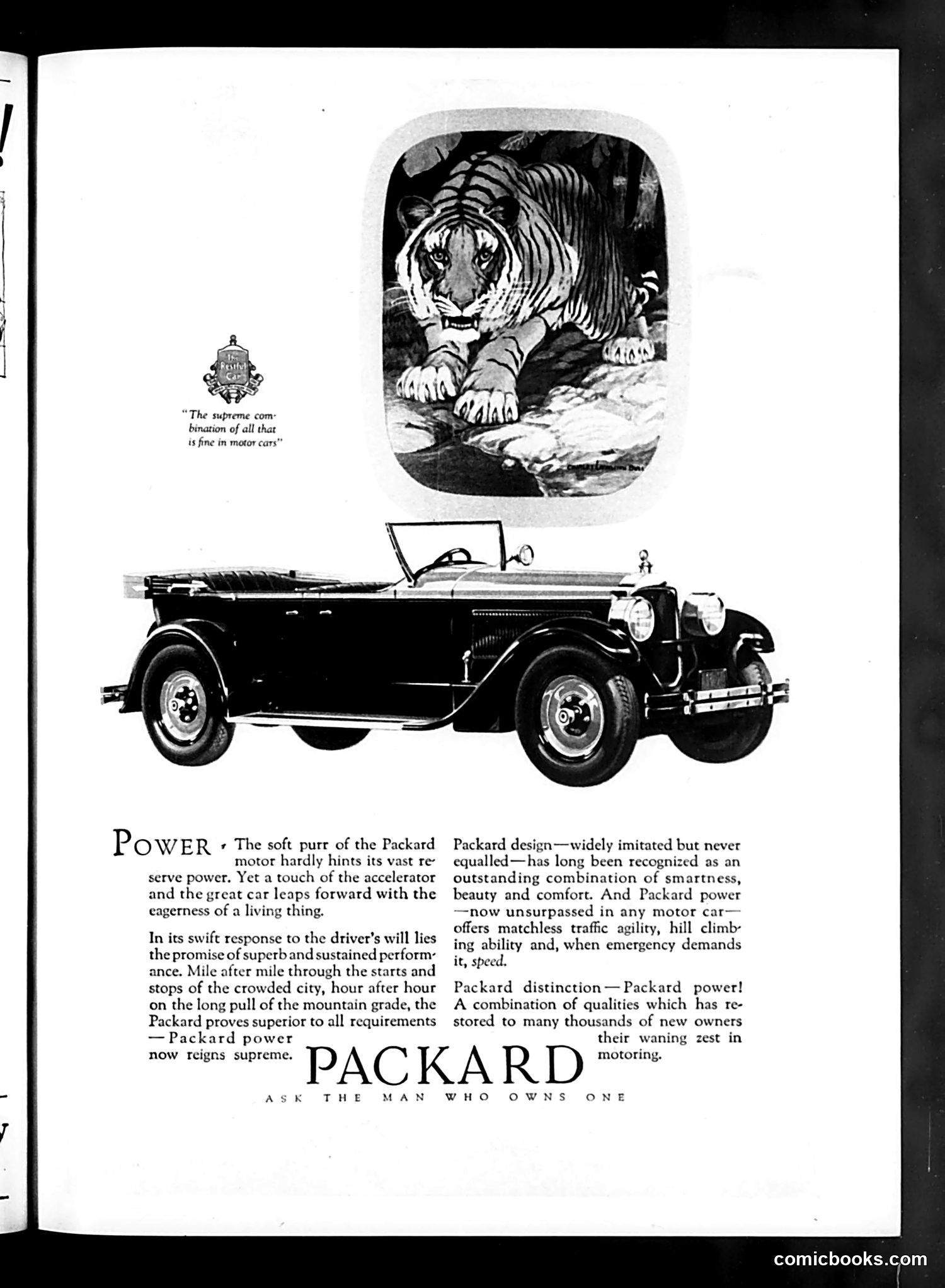
This is a **Packard automobile advertisement**, not a political cartoon or satire. The page features a luxury car ad from what appears to be the 1920s-1930s era. The tiger illustration above the car is purely decorative imagery meant to evoke power and majesty—supporting the ad's central message about the car's "power" and performance. The tagline "The supreme combination of all that is fine in motor cars" positions Packard as the luxury standard. The copy emphasizes Packard's engineering superiority: responsive acceleration, sustained performance through city driving and mountain grades, and unmatched "traffic agility." The closing line "Ask the man who owns one" was Packard's actual advertising slogan, appealing to status-conscious buyers by suggesting owner testimonials validate quality. This reflects 1920s-30s marketing when automobiles were still relatively exclusive luxury goods, and Packard was a prestigious American marque competing against other high-end manufacturers.
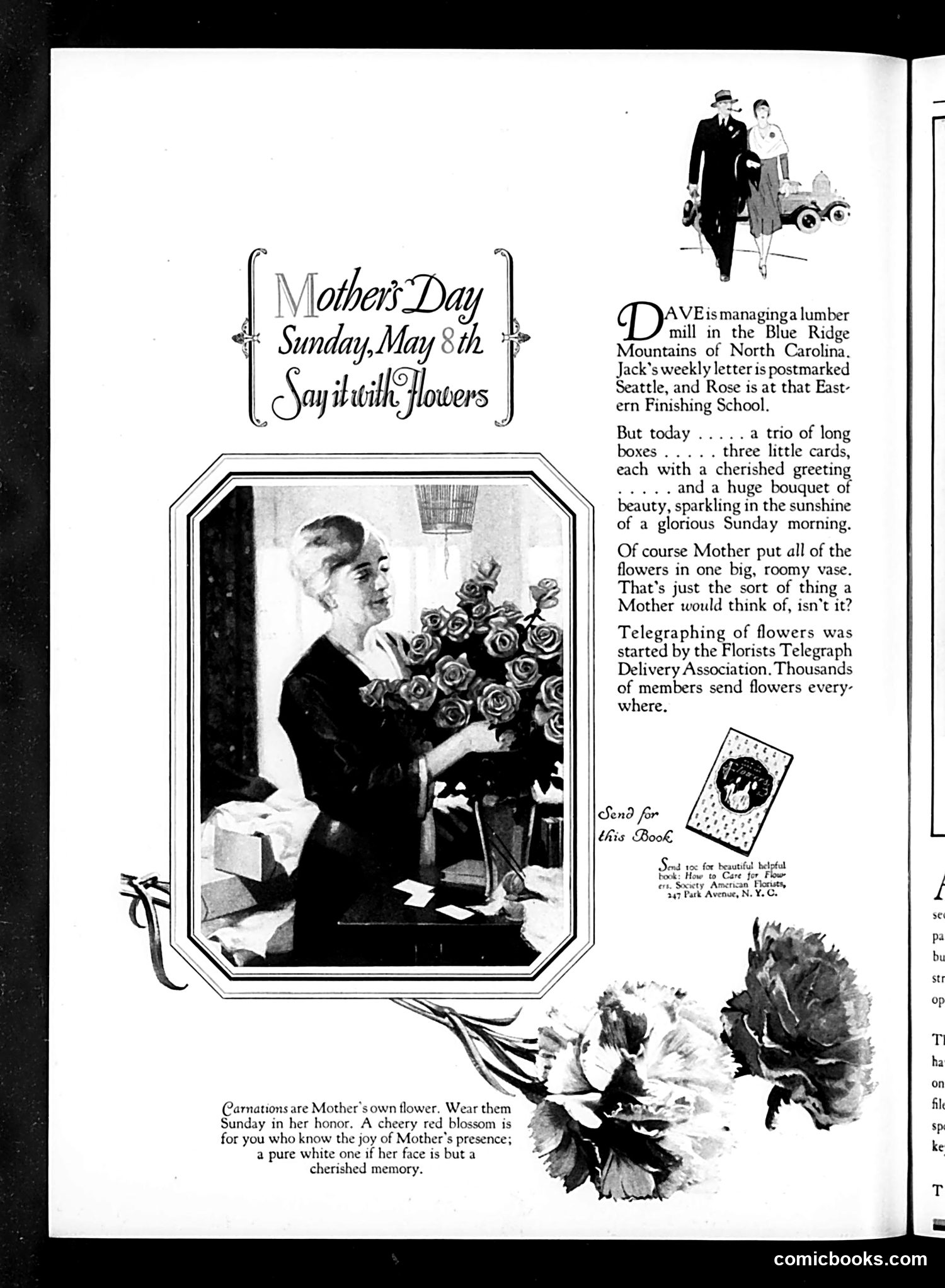
This is not political satire but a **Mother's Day promotional advertisement** (May 8th). The page celebrates the emerging practice of sending flowers by telegraph for Mother's Day—a relatively new service offered by the Florists Telegraph Delivery Association. The narrative describes a son named Dave, working at a lumber mill in North Carolina, sending flowers to his mother via this delivery service. The central image shows an elderly woman receiving and arranging a bouquet of roses. The advertisement promotes: - **Flower telegraphing** as a modern convenience for distant sons and daughters - **Carnations as "Mother's own flower"** with symbolic color meanings: red for living mothers, white for deceased ones - A free care-and-arrangement book from the Society American Florists The "satire" is gentle social commentary on family separation and modern convenience—poking mild fun at Mother's predictable response to put all flowers in one vase, while celebrating the technology enabling emotional connection across distance.
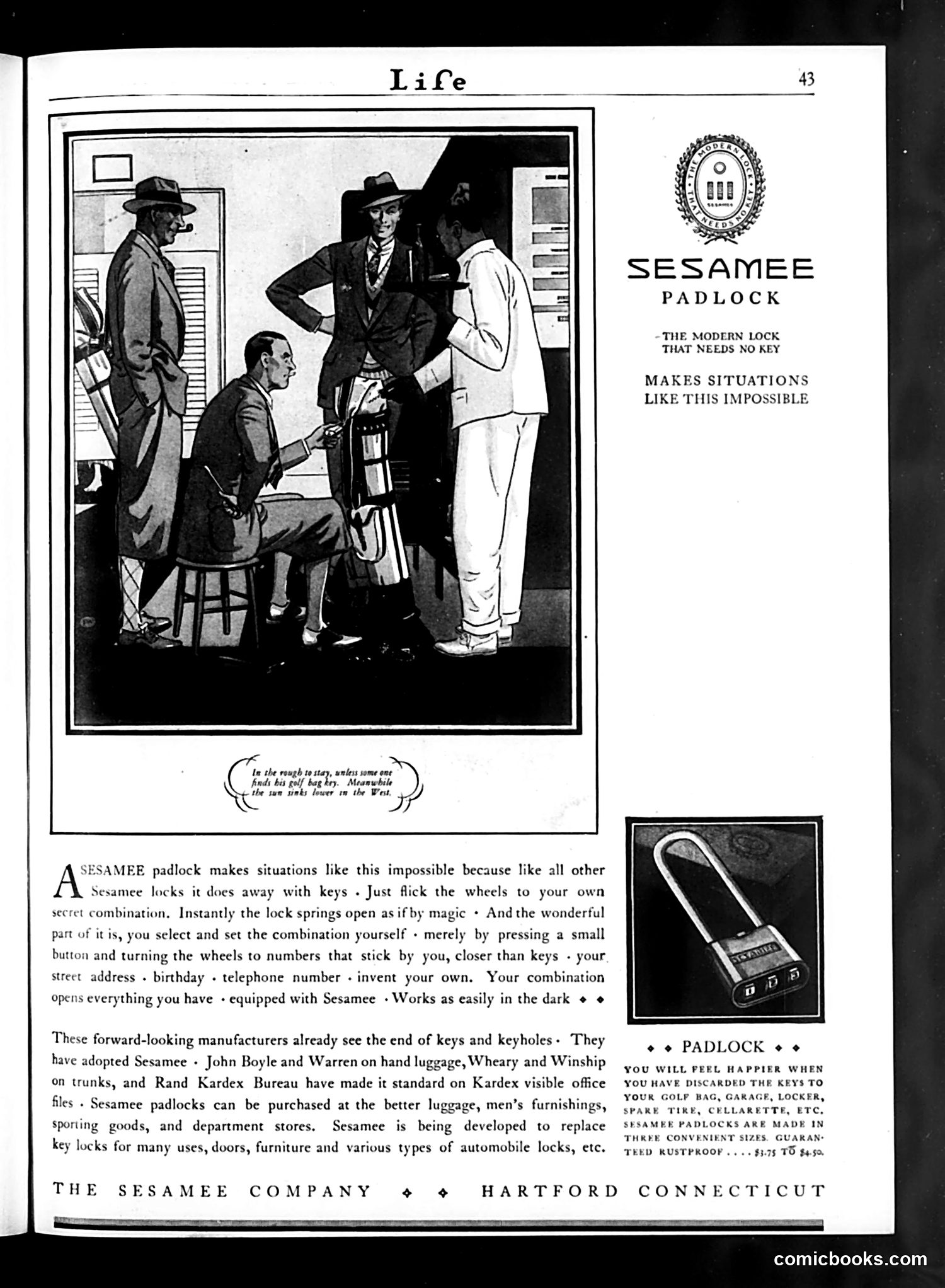
This is primarily a **product advertisement**, not political satire. The cartoon illustrates a humorous scenario where a golfer has lost his keys to his golf bag—a relatable inconvenience of the era when mechanical keys were the only lock option. The ad promotes the "Sesamee padlock," a combination lock that eliminates the need for keys. Users could set personalized number combinations (using birthdays, addresses, etc.) instead of carrying keys. The cartoon's joke: with a Sesamee lock, the golfer wouldn't be stuck waiting as sunset approaches. The text emphasizes modernity—manufacturers like John Boyle and Rand Kardex were already adopting Sesamee for luggage and office equipment. This represents early 1900s optimism about technological progress replacing outdated systems. The satire, if present, is gentle: poking fun at the inconvenience of keys rather than critiquing social issues. It's essentially a clever sales pitch using humor to demonstrate product utility.
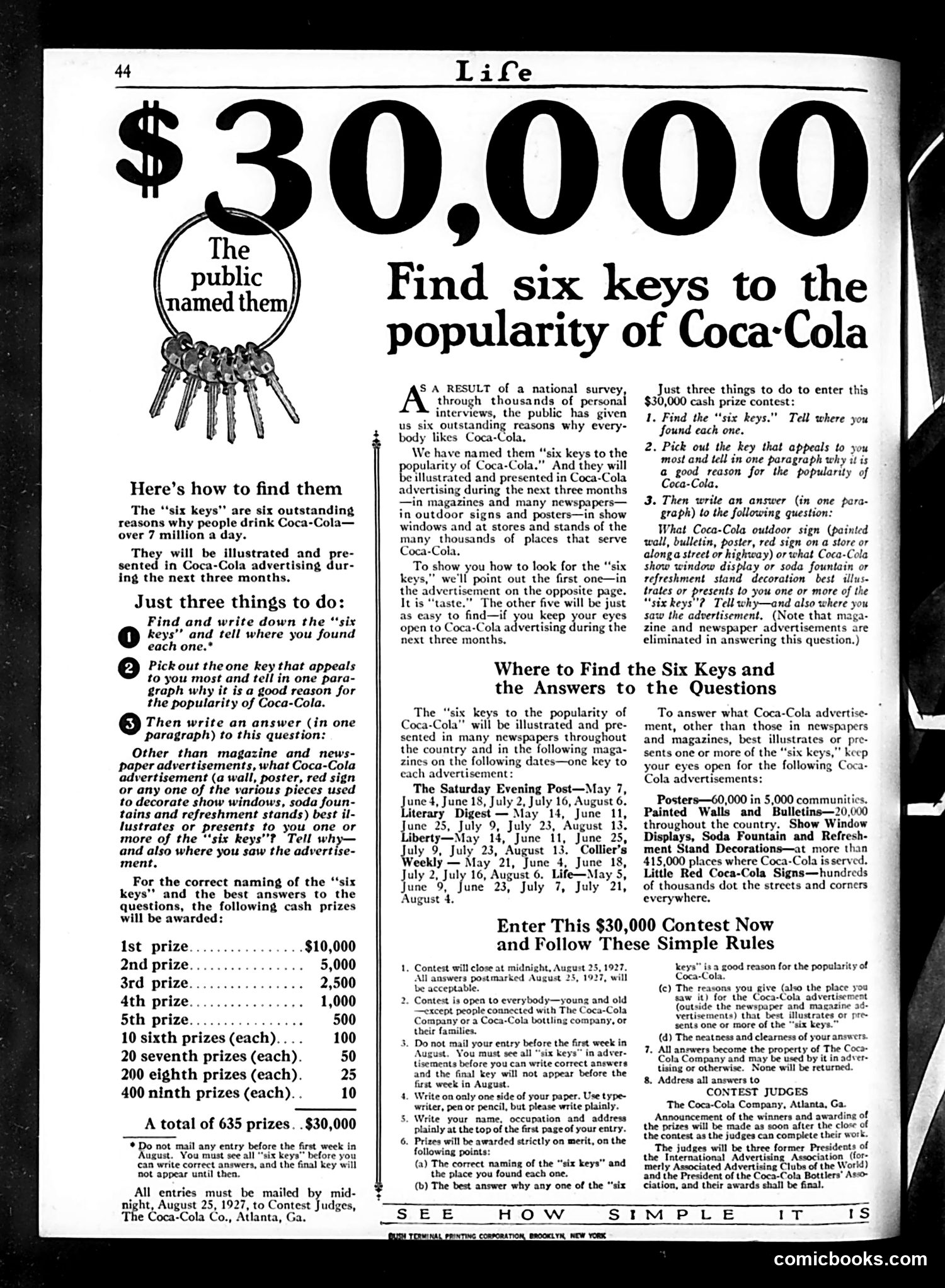
This is a **Coca-Cola advertising contest**, not political satire. Life magazine is publishing an advertisement for a $30,000 prize competition (enormous money in 1927). The contest asks readers to identify "six keys to the popularity of Coca-Cola"—six reasons the company claims people drink their product, which will be revealed gradually through ads in magazines and on outdoor signs over three months. Contestants must: 1. Find and locate all six keys 2. Identify which appeals to them most 3. Describe where they saw the advertising The "six keys" concept reflects 1920s marketing psychology—breaking down a product's appeal into memorable, repeatable reasons. The first key is explicitly "taste." The elaborate prize structure (635 prizes totaling $30,000) shows how companies used contests as major advertising vehicles during this era. This represents early **consumer engagement marketing**—making consumers active participants in advertising rather than passive viewers. The page itself demonstrates Life's willingness to accept substantial commercial advertising.