
Life, 1927-05-05 · page 27 of 46
Life — May 5, 1927 — page 27: what you’re looking at
What you’re looking at
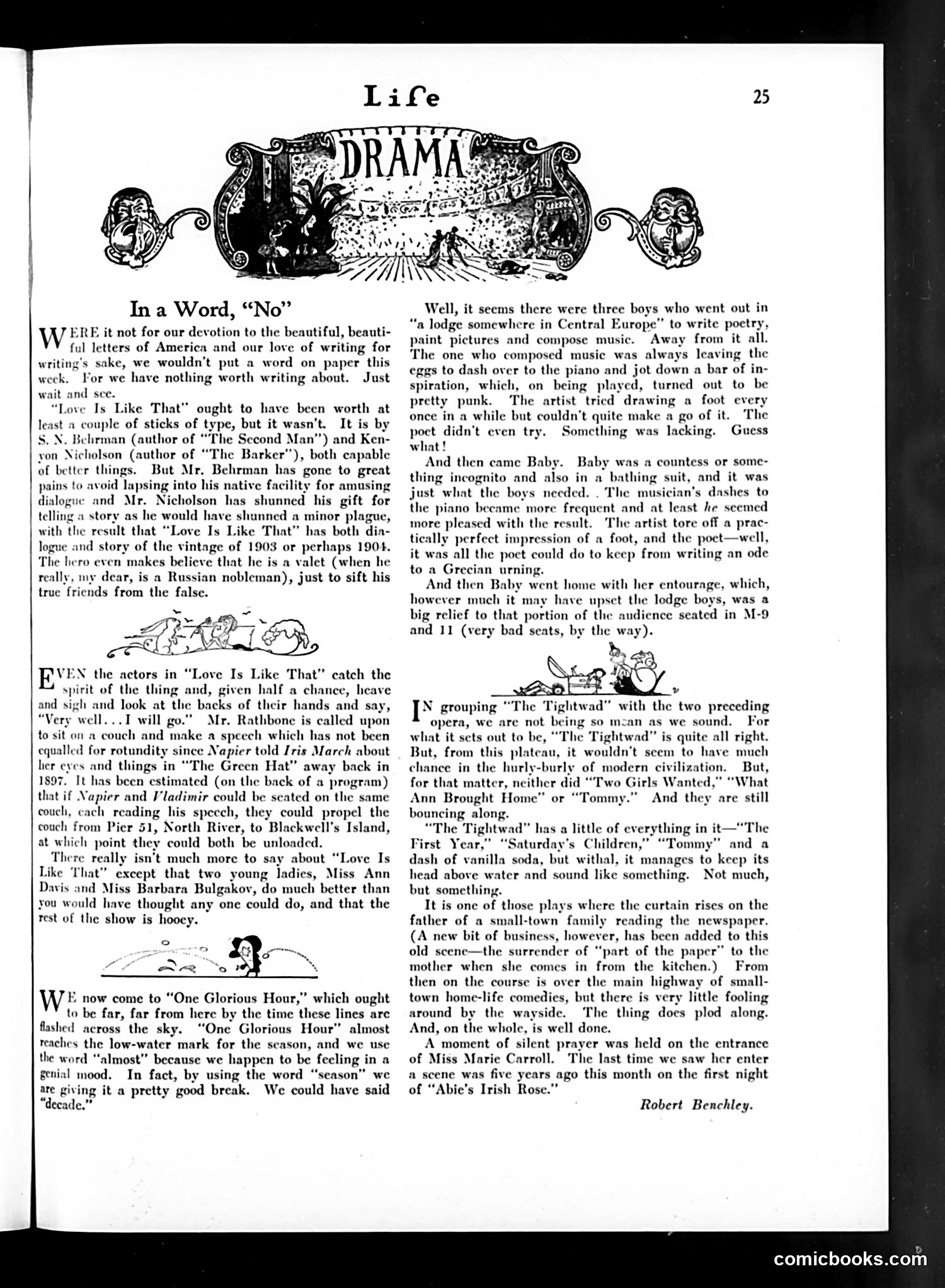
This page from Life magazine contains theater reviews written in a satirical, dismissive tone characteristic of the publication's drama critic. The critic reviews three theatrical productions: 1. **"Love Is Like That"** — co-written by S.N. Behrman and Kenyon Nicholson. The reviewer mocks the play as outdated (comparing it to 1903-1904 theatrical conventions), particularly criticizing a lengthy monologue by actor Rathbone as excessively verbose. Two actresses (Ann Davis and Barbara Bulgakov) receive mild praise as doing "much better than expected," but the overall production is dismissed as "hooey." 2. **"One Glorious Hour"** — described as nearly the season's worst. The plot involves three artistic men in a European lodge whose creative output improves dramatically when a countess in a bathing suit arrives, then deteriorates when she leaves. The reviewer finds the premise absurd. 3. **"The Tightwad"** — briefly mentioned as competent but unlikely to succeed commercially. The reviews exemplify Life's acerbic theater criticism, employing hyperbole and sarcasm to entertain readers while delivering harsh judgments on Broadway productions.
📄 Transcribed text from this page (OCR, searchable)
Machine-transcribed from the original scan — historical spelling and the odd misread are preserved.
In a Word, “No” ERE it not for our devotion to the beautiful, beauti- ful letters of America and our love of writing for writing’s sake, we wouldn't put a word on paper this week. Vor we have nothing worth writing about. Just wait and see. “Love Is Like That” ought to have been worth at least « couple of sticks of type, but it wasn’t. It is by S. N. Behrman (author of “The Second Man’) and Ken- yon Nicholson (author of “The Barker"), both capable of better things. But Mr. Behrman has gone to great pains to avoid lapsing into his native facility for amusing dialogue and Mr. Nicholson has shunned his gift for telling a story as he would have shunned a minor plague, with the result that “Love Is Like That" has both dia- logue and story of the vintage of 1903 or perhaps 1904. The hero even makes believe that he is a valet (when he really, my dear, is a Russian nobleman), just to sift his true friends from the false. =e VG! oa VEN the actors in “Love Is Like That” catch the spirit of the thing and, given half a chance, heave and sigh and look at the backs of their hands and say, “Very well. ..1 will go.” Mr. Rathbone is called upon to sit on a couch and make a speech which has not been equalled for rotundity since Napier told Iris March about her eyes and things in “The Green Hat” away back in 1897. It has been estimated (on the back of a program) that if Napier and Vladimir could be seated on the same couch, cach reading his specch, they could propel the couch from Pier 51, North River, to Blackwell's Island, at which point they could both be unloaded. There really isn’t much more to say about “Love Is Like That” except that two young ladics, Miss Ann Davis and Miss Barbara Bulgakov, do much better than you would have thought any one could do, and that the rest of the show is hooey. E now come to “One Glorious Hour,” which ought to be far, far from here by the time these lines are flashed across the sky. “One Glorious Hour” almost teaches the low-water mark for the season, and we use the word “almost” because we happen to be feeling in a genial mood. In fact, by using the word “season” we are giving it a pretty good break. We could have said “decade.” Well, it seems there were three boys who went out in “a lodge somewhere in Central Europe” to write poetry, paint pictures and compose music. Away from it all. The one who composed music was always leaving the eggs to dash over to the piano and jot down a bar of in- spiration, which, on being played, turned out to be pretty punk. The artist tried drawing a foot every once in a while but couldn't quite make a go of it. The poet didn’t even try. Something was lacking. Guess what! And then came Baby. Baby was a countess or some- thing incognito and also in a bathing suit, and it was t what the boys needed. . The mu 's dashes to the piano became more freque nt and at least he seemed more pleased with the result. The artist tore off a prac- tically perfect impression of a foot, and the poet—well, it was all the poet could do to keep from writing an ode to a Grecian urning. And then Baby went home with her entourage, which, however much have upset the lodge boys, was a big relief to that portion of the audience seated in M-9 and 11 (very bad seats, by the way). N grouping “The Tightwad” with the two preceding opera, we are not being so mzan as we sound. For what it sets out to be, “The Tightwad” is quite all right. But, from this plateau, it wouldn't seem to have much chance in the hurly-burly of modern ci ation. But, for that matter, neither did ““T'wo Girls Wanted,” “What Ann Brought Home” or “Tommy.” And they are still bouncing along. “The Tightwad” has a little of everything in it—The First Year,” “Saturday's Children,” “Tommy” and a dash of vanilla soda, but withal, it manages to keep its head above water and sound like something. Not much, but something. It is one of those plays where the curtain rises on the father of a small-town family reading the newspaper. (A new bit of business, however, has been added to this old scene—the surrender of “part of the paper” to the mother when she comes in from the kitchen.) From then on the course is over the main highway of small- town home-life comedies, but there is very little fooling around by the wayside. The thing does plod along. And, on the whole, is well done. A moment of silent prayer was held on the entrance of Miss Marie Carroll. The last time we saw her enter a scene was five years ago this month on the first night of “Abie’s Irish Rose.” Robert Benchley. comicbooks.com