
Life, 1927-05-05 · page 30 of 46
Life — May 5, 1927 — page 30: what you’re looking at
What you’re looking at
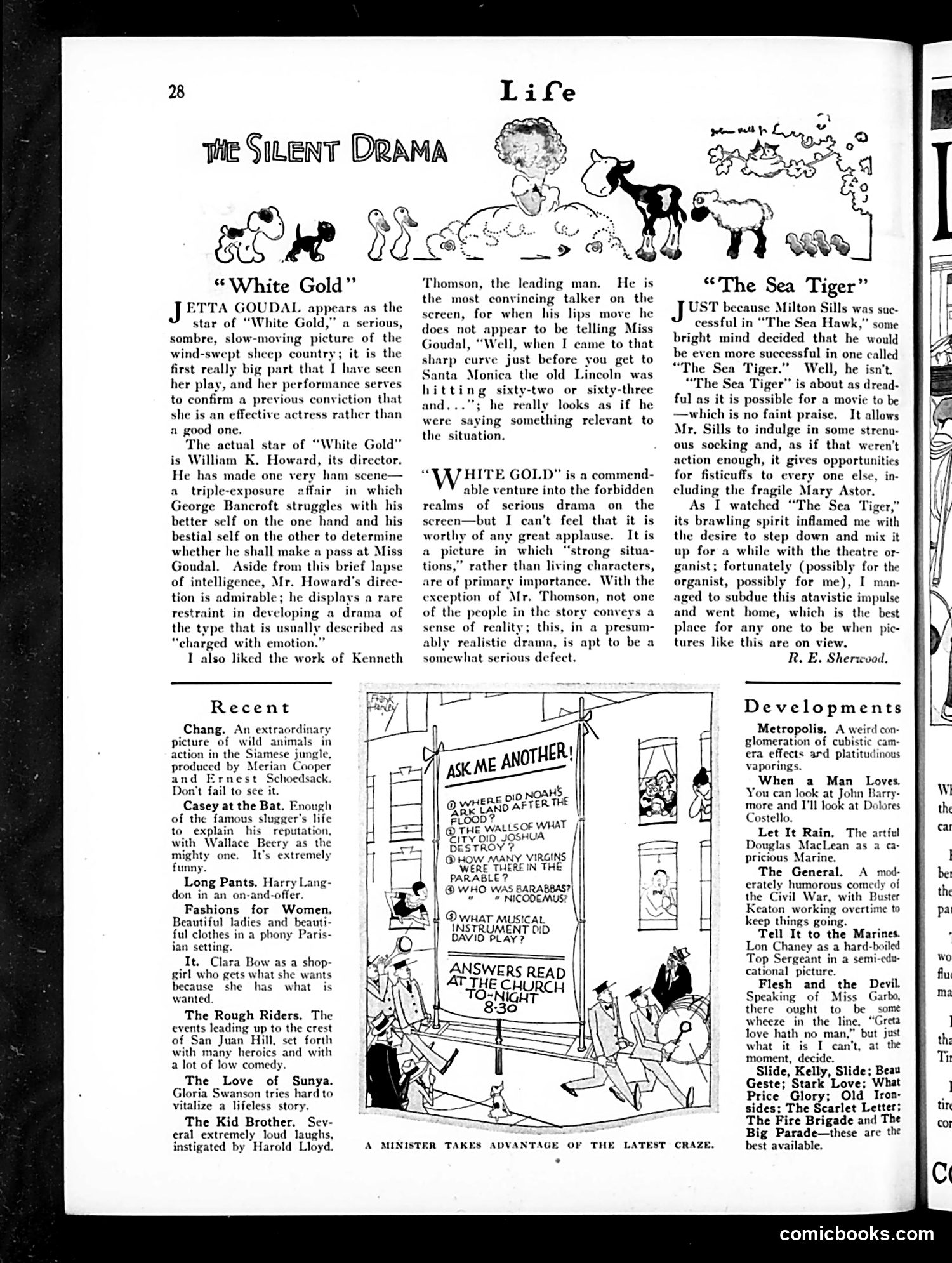
This page reviews several silent films from the mid-1920s. The main reviews critique "White Gold" (starring Jetta Goudal, directed by William K. Howard) as a serious drama with effective direction but weak character development, and "The Sea Tiger" (starring Milton Sills) as poorly executed action melodrama. The central cartoon satirizes a contemporary religious fad: a minister uses a church bulletin board to pose trivia questions from scripture ("Where did Joshua destroy?", "Who was Barabbas?") as a popular entertainment craze. The humor mocks how churches adopted trendy quiz formats to engage congregants—a modern marketing approach to faith that the cartoonist finds absurdly incongruous with spiritual purpose. The "Recent" and "Developments" sections list other current film releases, indicating this represents typical 1920s cinema criticism and entertainment coverage.
📄 Transcribed text from this page (OCR, searchable)
Machine-transcribed from the original scan — historical spelling and the odd misread are preserved.
we Sitenr DRAMA P amii “White Gold” ETTA GOUDAL appears as the star of “White Gold,” a serious, sombre, slow-moving picture of the d-swept sheep country; it is the first really big part that I have seen her play, and her performance serves to confirm a previous conviction that she is an effective actress rather than a good one. The actual star of “White Gold” is William K. Howard, its director. He has made one very ham scene— a triple-exposure affair in which George Bancroft struggles with his better self on the one hand and his bestial self on the other to determine whether he shall make a pass at Miss Goudal. Aside from this brief lapse of intelligence, Mr. Howard's direc- tion is admirable; he displays a rare aint in developing a drama of type that is usually described as “charged with emotion.” I also liked the work of Kenneth Ce Thomson, the leading man. He is the most convincing talker on the screen, for when his lips move he does not appear to be telling Miss Goudal, “Well, when I came to that sharp curve just before you get to Santa Monica the old Lincoln was hitting sixty-two or sixty-three and..."; he really looks as if he were saying something relevant to the situation. & HITE GOLD” is a commend- able venture into the forbidden realms of serious drama on the screen—but I can’t feel that it is worthy of any great applause. It is a picture in which “strong situa- tions,” rather than living characters, are of primary importance. With the exception of Mr. Thomson, not one of the people in the story conveys a sense of reality; this, in a presum- ably realistic drama, is apt to be a somewhat serious defect. Recent Chang. An extraordinary picture of wild animals in action in the Siamese jungle, produced by Merian Cooper and Ernest Schoedsack. Don't fail to sce it. Casey at the Bat. Enough of the famous slugger’s life to explain his reputation, Wallace Beery as the mighty one. It's extremely funny. Long Pants. Harry Lang- don in an on-and-offer. Fashions for Women. Beautiful ladies and beauti- ful clothes in a phony Paris- ian setting. It. Clara Bow as a shop- girl who gets what she wants because she has what is wanted. The Rough Riders. The events leading up to the crest of San Juan Hill, set forth with many heroics and with a lot of low comedy. The Love of Sunya. Gloria Swanson tries hard to vitalize a lifeless story. The Kid Brother. Sev- eral extremely loud laughs, instigated by Harold Lloyd. oO? HE WALLS OF WHAT CITY DIO JOSHUA | DESTROY ? wnziis > MANY V! g WERE THEREIN THE PARABLE ? @ WHO WAS BARABBAS?) > # “@ NICODEMUS? ® wuar MUSICAL INSTRUMENT Di DAVID PLAY ? e ee ANSWERS READ AT THE C 18. Nghe CH A MINISTER TAKES ADVANTAGE OF THE LATEST CRAZE. “The Sea Tiger” UST because Milton Sills was suc- cessful in “The Sea Hawk,” some bright mind decided that he would be even more successful in one called “The Sea Tiger.” Well, he isn’t. “The Sea Tiger” is about as dread- ful as it is possible for a movie to be —which is no faint praise. It allows Mr. Sills to indulge in some strenu- ous socking and, as if that weren't action enough, it gives opportunities for fisticuffs to every one else, in- cluding the fragile Mary Astor. As I watched “The Sea Tiger,” its brawling spirit inflamed me with the desire to step down and mix it up for a while with the theatre or- ganist; fortunately (possibly for the organist, possibly for me), I man- aged to subdue this atavistic impulse and went home, which is the best place for any one to be when pic- tures like this are on view. R, E. Sherwood. Developments Metropolis, A weird con- glomeration of cubistic cam- era effects ard platitudinous vaporings. When a Man Loves. You can look at John Barry- more and I'll look at Dolores Costello. Let It Rain. The artful Douglas MacLean as a ca- pricious Marine. The General. A mod- erately humorous comedy of the Civil War, with Buster Keaton working overtime to keep things going. Tell It to the Marines. Lon Chaney as a hard-boiled Top Sergeant in a semi-edu- cational picture. Flesh and the Speaking of Miss Garbo, there ought to be some wheeze in the line, “Greta love hath no_man,” but just what it is I can't, at the moment, decide. Slide, Kelly, Slide; Beau Geste; Stark Love; What Price Glory; Old Iron- sides; The Scarlet Letter; The Fire Brigade and The Big Parade—these are the best available. Devil. | re Ge | i if | | L \— $$. \ Cor comicbooks.com