
Life, 1927-05-05 · page 22 of 46
Life — May 5, 1927 — page 22: what you’re looking at
What you’re looking at
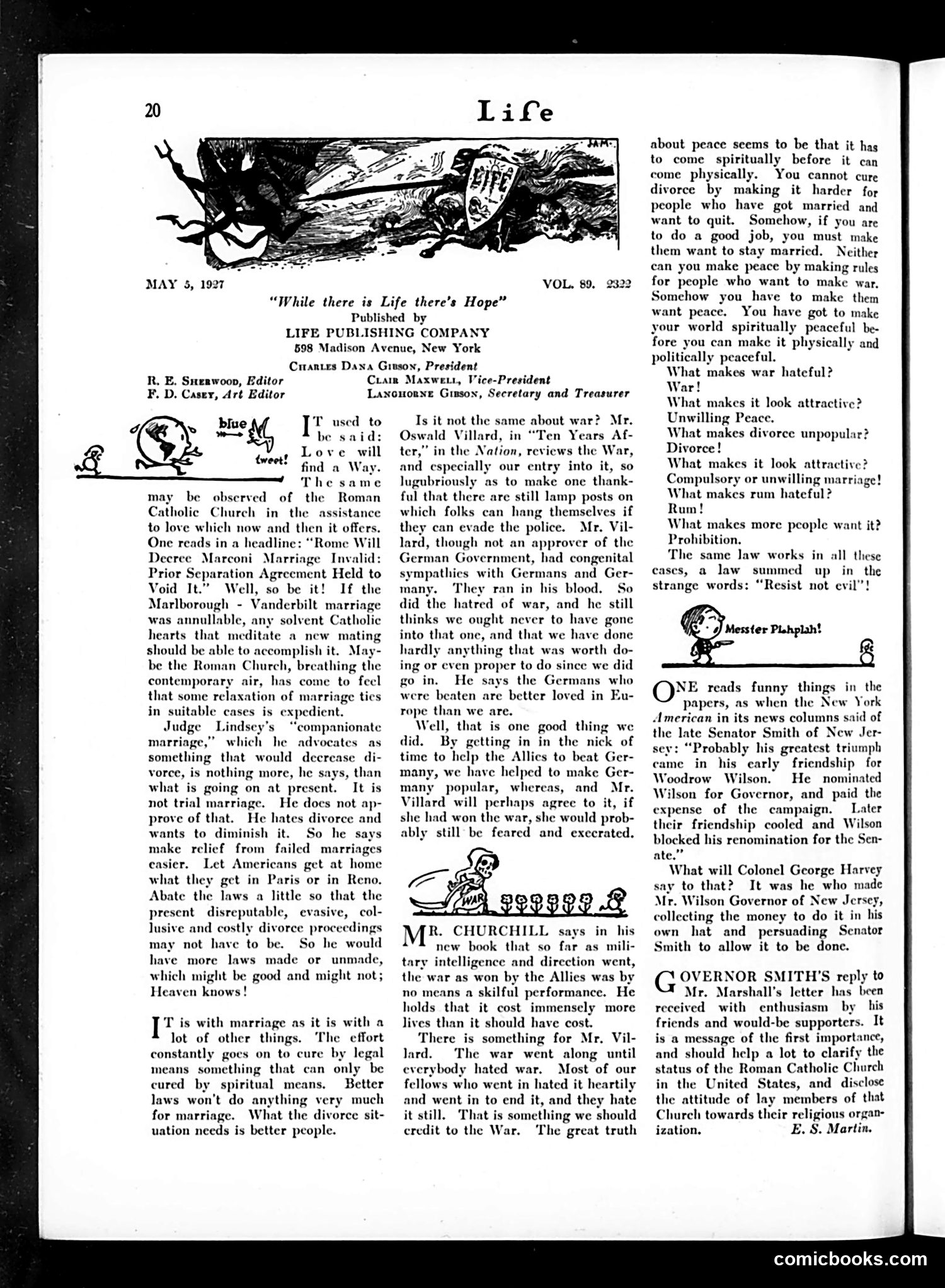
This page presents editorial commentary on marriage, divorce, and war through the lens of spiritual versus legal reform. **Main argument:** The editor argues that legal solutions cannot fix social problems—only spiritual change can. He uses three interconnected examples: 1. **Marriage/Divorce**: References the "Marlborough-Vanderbilt marriage" annulment and Judge Lindsey's "companionate marriage" proposal, arguing that loosening divorce laws won't help; people need better character, not better laws. 2. **War criticism**: Discusses Oswald Villard's anti-war writings in *The Nation*, noting Villard's "congenital sympathies with Germans" (suggesting pacifist bias). The editor credits America's WWI entry with making Germany unpopular—an unintended positive consequence. 3. **Churchill's observation**: References Churchill's new book criticizing Allied military incompetence in WWI, arguing the war's true value was making people hate war itself. **Core satire:** The cartoons (small illustrations, difficult to discern clearly) likely emphasize the disconnect between legal/political attempts at reform and human nature's resistance to change.
📄 Transcribed text from this page (OCR, searchable)
Machine-transcribed from the original scan — historical spelling and the odd misread are preserved.
g S%. weet! MAY 5, 1927 VOL, 89, 2322 “While there is Life there’s Hope” Published by LIFE PUBLISHING COMPANY 598 Madison Avenue, New York Crrantes Dana Ginson, President E, Sueawoon, Editor D. Caser, Art Editor blue T used to “MG be said: Love will find a Way. The same may be observed of the Roman Catholic Church in the assistance to love which now and tl One reads in a headline Decree coni: Marriage Invalid: Prior Separation Agreement Held to Void It.” Well, so be it! If the Marlborough - Vanderbilt marriage solvent Catholic hearts that medit a new mating should be able to accomplish it. } be the Roman Church, breathing the contemporary air, has come to feel that some rela’ ation of marriage ties e xpedie nt. Judge “companionate marriage,” w he advocates as something that would decrease di- vorce, is nothing more, he than what is going on at present. It is not trial marriage. He docs not ap- prove of that. He hates divorce and wants to diminish it. So he says make relief from failed marriages easier. Let Americans get at home what they get in Paris or in Reno. Abate the laws a little so that the present disreputable, evasive, col- lusive and costly divorce proceedings may not have to be. So he would have more laws made or unmade, which might be good and might not; Heaven knows! I is with marriage as it is with a lot of other things. The effort constantly goes on to cure by legal means something that can only be cured by spiritual means. Better laws won't do anything very much for marriage. What the divorce sit- uation needs is better people. Cram Maxwewt, Vice-President Lanouonne Ginson, Secretary and Treasurer Is it not the same about war? Mr. Oswald Villard, in “Ten Years Af- ter,” in the Nation, reviews the War, and especially our entry into it, so lugubriously as to make one thank- ful that there are still lamp pos: which folks can hang themselves if they can evade the police. Mr. Vil- lard, though not an approver of the German Government, had congenital sympathies with Germans and Ger- many. ‘y ran in his blood. So did the hatred of war, and he still thinks we ought never to have gone into that one, and that we have done hardly anything that was worth do- ing or even proper to do since we did go in. He says the Germans who were beaten are better loved in Eu- rope than we are. Well, that is one good thing we did. By getting in in the nick of time to help the Allics to beat Ger- many, we have helped to make Ger- many popular, whereas, and Mr. Villard will perhaps agree to it, if she had won the war, she would prob- ably still be feared and execrated. es R. CHURCHILL says in his new book that so far as mili- tary intelligence and direction went, the war as won by the Allies was by no means a skilful performance. He holds that it cost immensely more lives than it should have cost. There is something for Mr. Vil- lard. The war went along until everybody hated war. Most of our fellows who went in hated it heartily and went in to end it, and they hate it still. That is something we should credit to the War. The great truth about peace seems to be that it has to come spiritually before it can come physically. You cannot cure divorce by making it harder for people who have got married and want to quit. Somehow, if you are to do a good job, you must make them want to stay married. Neither can you make peace by making rules for people who want to make war. Somehow you have to make them want peace, You have got to make your world spiritually peaceful be- fore you can make it physically and politically peaceful. What makes war hateful? War! What makes it look attractive? Unwilling Peace. What makes divorce unpopular? Divorce! What makes it look attr: ? Compulsory or unwilling marriage! What makes rum hateful? Rum! What makes more people want it? Prohibition. The same law works in all these cases, a law summed up in the strange words: ‘Resist not evil”! NE reads funny things in the papers, as when the New York American in its news columns said of the late Senator Smith of New Jer- s “Probably his greatest triumph came in his early friendship for Woodrow Wilson. He nominated Wilson for Governor, and paid the expense of the campaign. — Later their friendship cooled and Wilson blocked his renomination for the Sen- ate.” What will Colonel George Harvey say to that? It was he who made Mr. Wilson Governor of New Jersey, collecting the money to do it in his own hat and persuading Senator Smith to allow it to be donc. OVERNOR SMITH’S reply to Mr. Marshall's letter has been received with enthusiasm by his friends and would-be supporters. It is a message of the first importance, and should help a lot to clarify the status of the Roman Catholic Church in the United States, and disclose the attitude of lay members of that Church towards their religious organ- ization. E. S. Martin. comicbooks.com