
A complete issue · 43 pages · 1927
Life — March 17, 1927
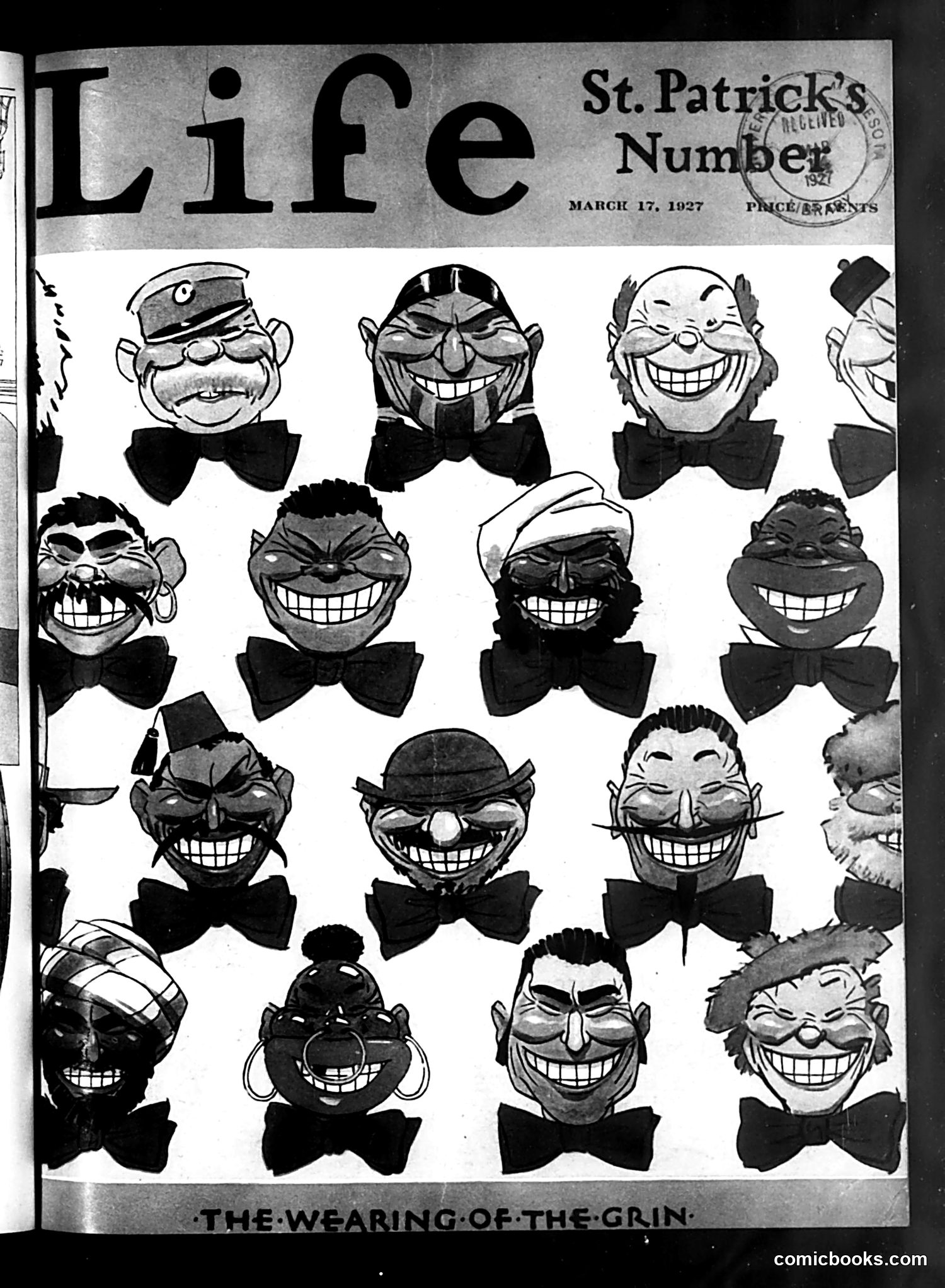
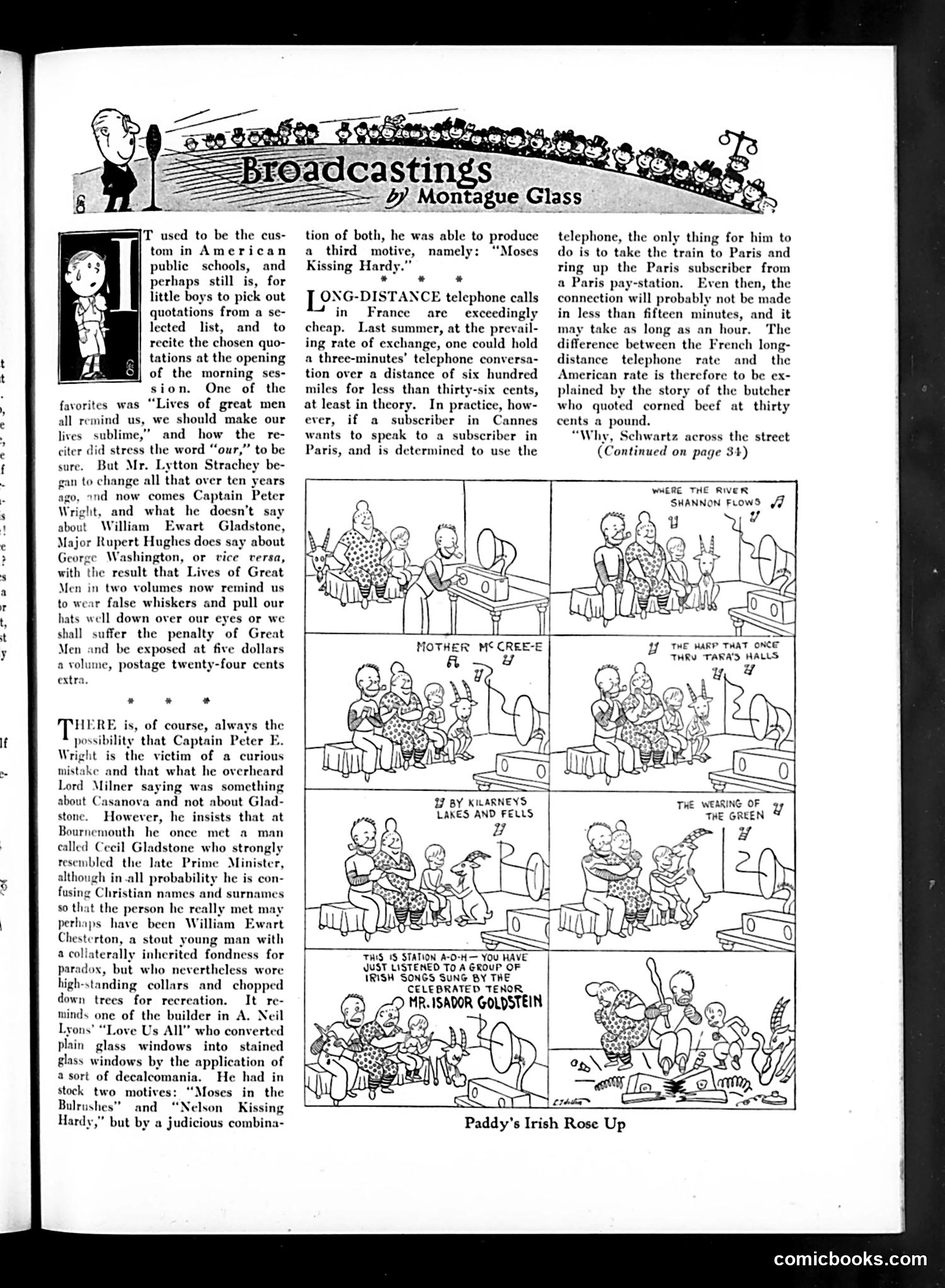
This St. Patrick's Day issue features caricatured heads wearing bow ties, all displaying exaggerated grins. The caption "The Wearing of the Grin" plays on the Irish phrase "the wearing of the green." The imagery appears to mock Irish-American stereotypes prevalent in 1920s popular culture—specifically, the broad, grinning "Irish" character type common in vaudeville, minstrelsy, and early entertainment. By presenting multiple identical grinning faces, the cartoon likely satirizes either: 1. The commercialization of Irish identity for St. Patrick's Day entertainment 2. Stereotypical Irish-American representation in entertainment 3. Generic "Irish character" humor being mass-produced The specific identities of these characters remain unclear without additional context, though they represent a type rather than individuals.
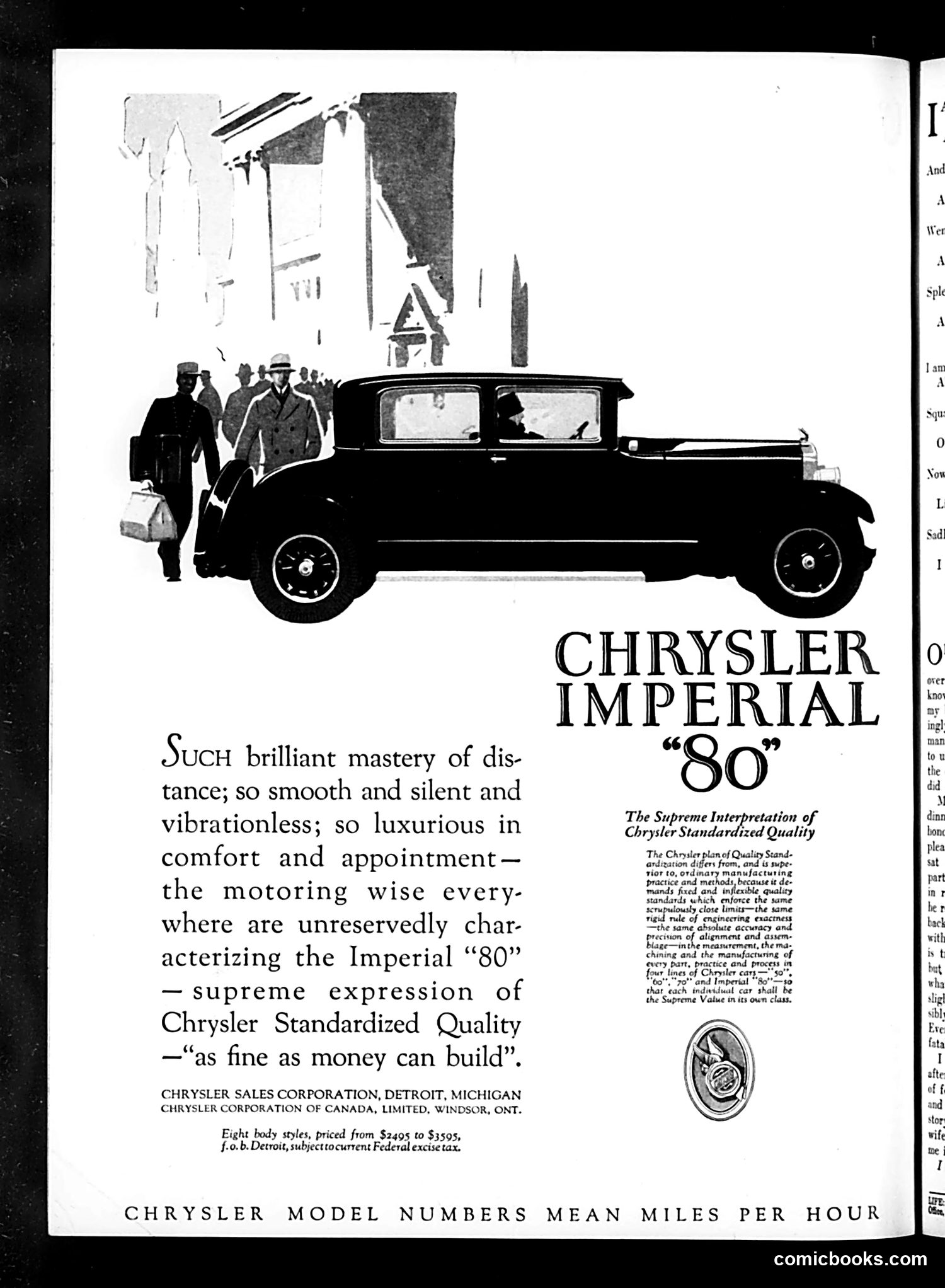
This page is **primarily a Chrysler automobile advertisement**, not political satire. It advertises the Chrysler Imperial "80" model, emphasizing its luxury features with phrases like "brilliant mastery of distance" and "as fine as money can build." The illustration shows a 1920s-era sedan with well-dressed passengers and pedestrians nearby, establishing the car's association with wealth and sophistication. The ad targets affluent buyers by highlighting "Standardized Quality" and listing eight body styles priced from $745 to $1,595. The small-print tagline "Chrysler Model Numbers Mean Miles Per Hour" suggests performance capability. This is straightforward commercial advertising rather than satire—typical of Life magazine's revenue model during the 1920s-30s.
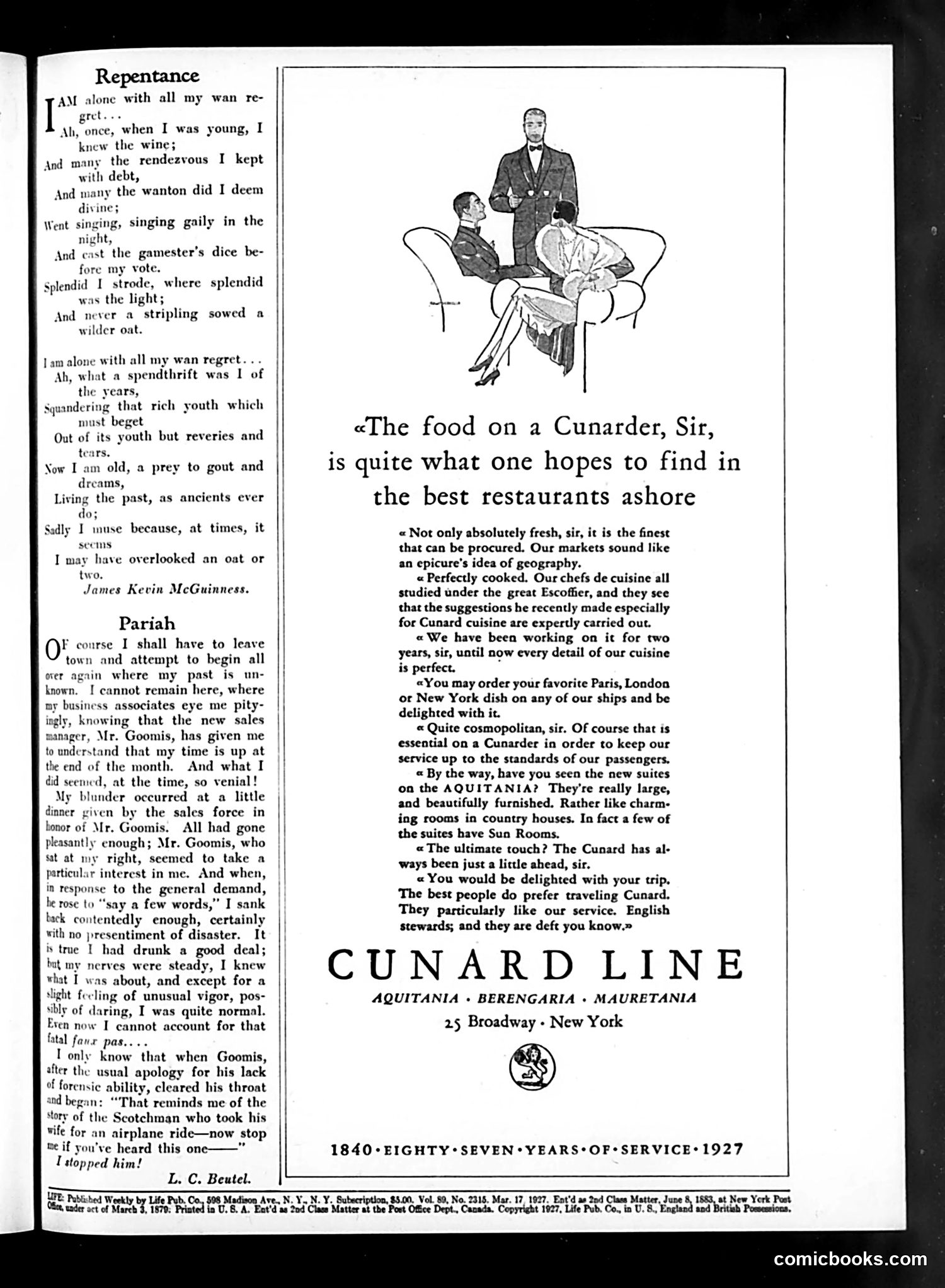
This page combines poetry with advertising. The left column presents two poems—"Repentance" by James Kevin McGuinness and "Pariah" by L.C. Beutel—both exploring themes of regret and social redemption. The poems appear unrelated to the right-side content. The right side is a **Cunard Line advertisement** (not satire or political content). It features an illustration of well-dressed passengers aboard ship and a testimonial-style pitch emphasizing the quality of shipboard dining, service, and accommodations. The ad promotes travel on three Cunard vessels: Aquitania, Berengaria, and Mauretania—major ocean liners of the 1920s era. The emphasis on "English stewards" and "cosmopolitan" service reflects period luxury-travel marketing aimed at affluent American travelers. This is primarily a **magazine advertisement**, not editorial satire.
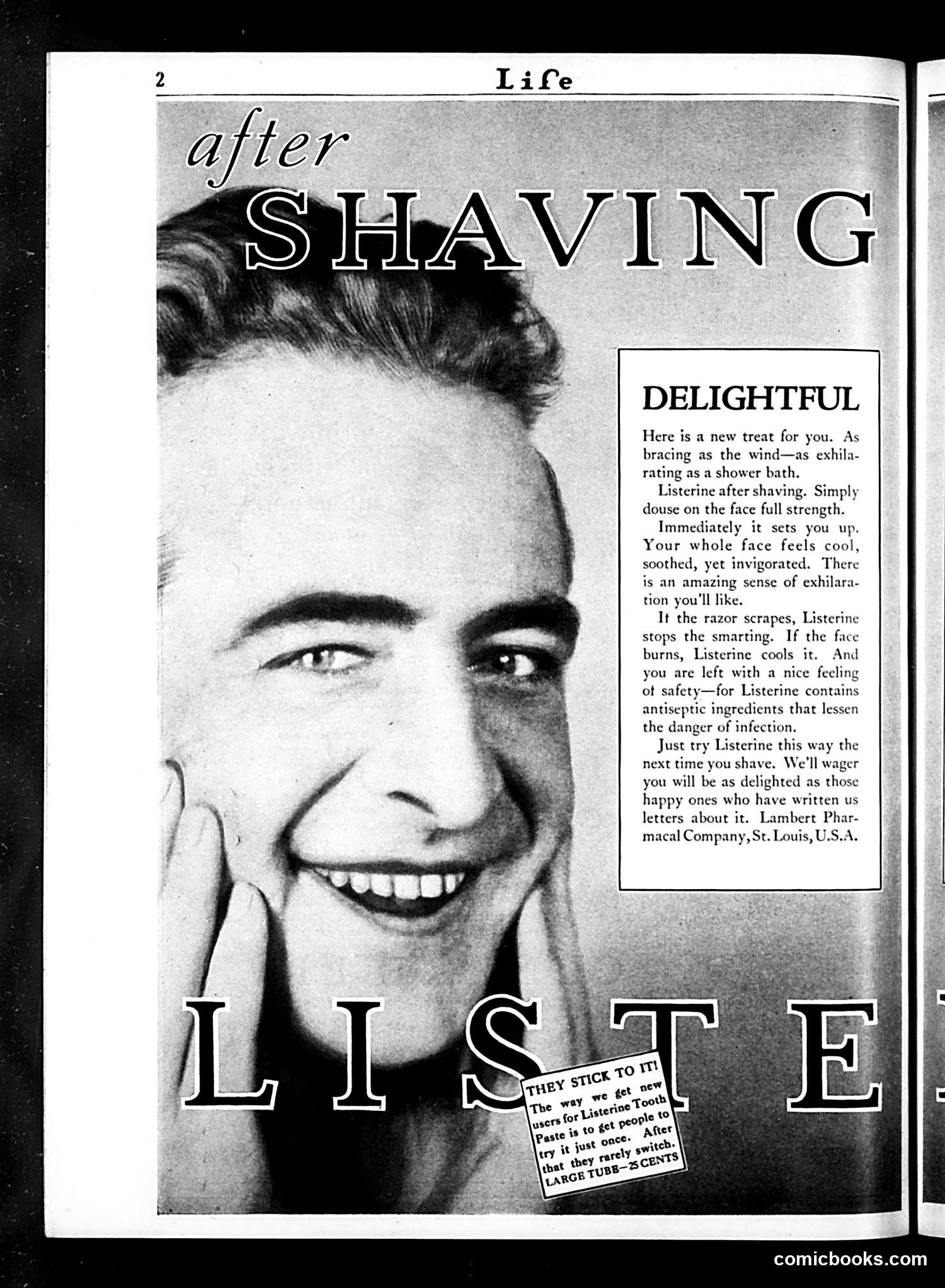
This page is **primarily a Listerine advertisement**, not political satire. The large image shows a man's face with the headline "after SHAVING" and "DELIGHTFUL," promoting Listerine as an after-shave product. The ad copy describes Listerine as refreshing and antiseptic, claiming it stops razor scrapes and prevents infection. A small boxed insert notes that users "rarely switch" after trying it, highlighting the product's supposed superiority. There is **no political cartoon or social satire** on this page. This is straightforward commercial advertising from what appears to be an early-to-mid 20th century magazine, using a testimonial-style approach to promote an oral antiseptic/mouthwash being repurposed as a grooming product.
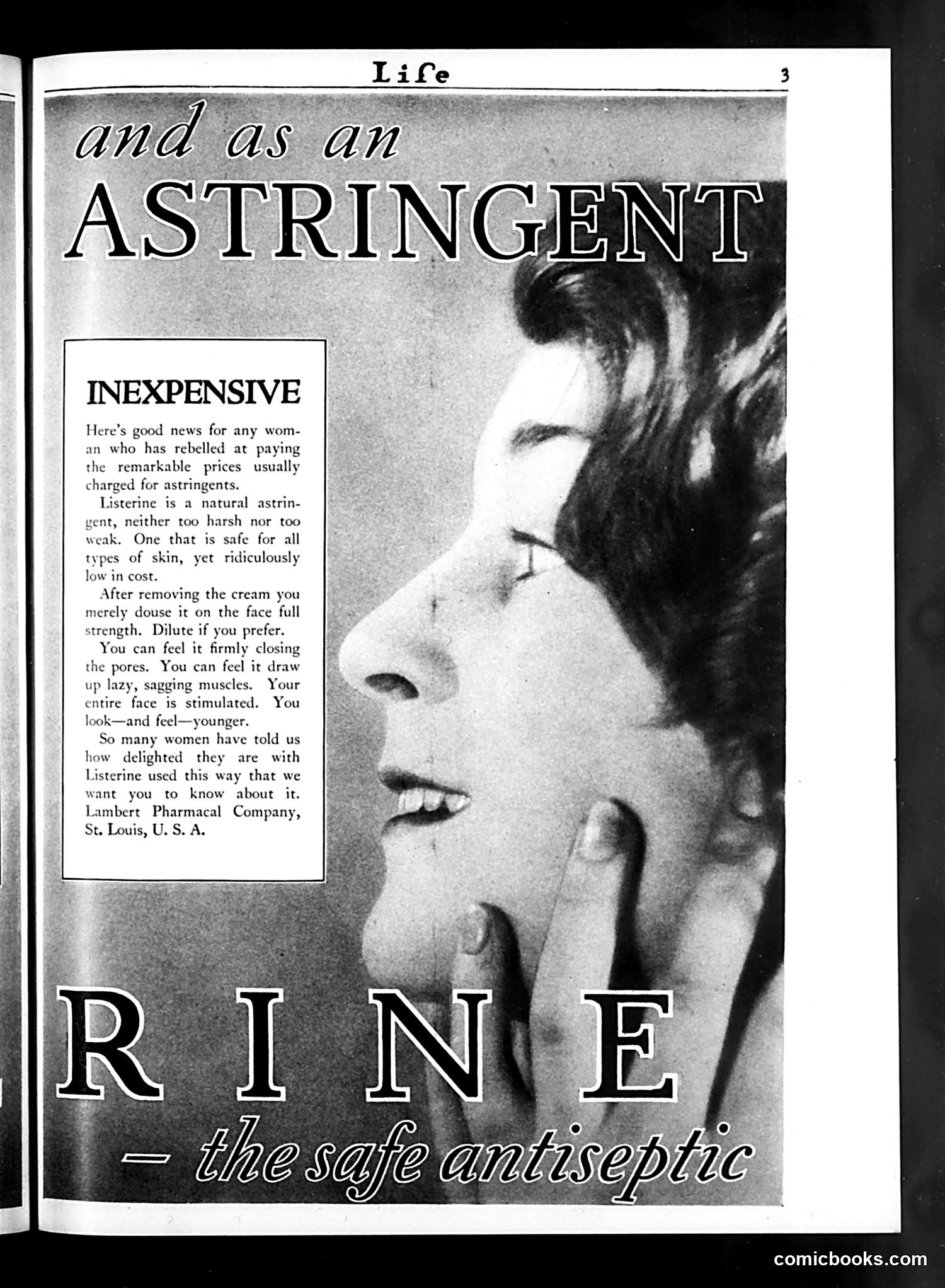
This page is primarily a **Listerine antiseptic mouthwash advertisement**, not a political cartoon. The ad promotes Listerine as an inexpensive astringent for facial skincare, marketed to women. The "INEXPENSIVE" section emphasizes the product's low cost while claiming effectiveness for "all types of skin," promising to tighten pores and stimulate facial muscles, making users "look—and feel—younger." The profile photograph of a woman's face is used as promotional imagery to demonstrate the product's purported cosmetic benefits. The tagline "—the safe antiseptic" suggests Listerine's versatility beyond mouthwash. This reflects **early 20th-century beauty marketing**, when antiseptics were broadly applied to skincare and companies targeted women's anxieties about aging through affordable solutions.
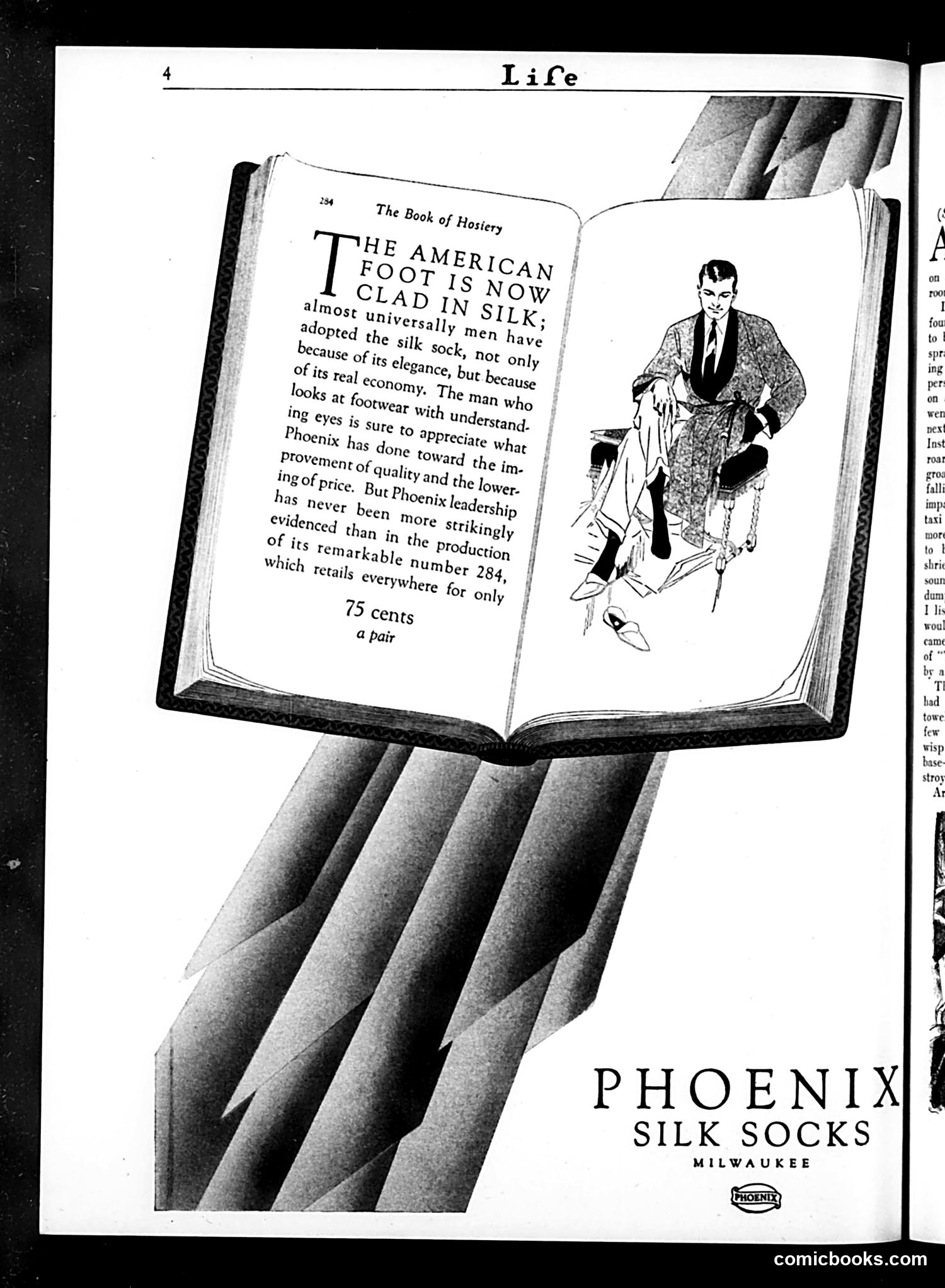
This page is primarily **advertising, not satire or political commentary**. It's a 1920s advertisement for Phoenix Silk Socks from Milwaukee. The ad's text promotes silk socks as a quality American product, citing Phoenix's "remarkable" product #284 that retails for 75 cents per pair. The marketing emphasizes both elegance and economy—positioning silk socks as an affordable luxury for men concerned with appearance. The illustration shows a well-dressed man in a suit examining his socks, reinforcing the message that discerning gentlemen should appreciate quality footwear. The "Book of Hosiery" framing device presents this as authoritative consumer guidance. There is no political satire here—this is straightforward vintage advertising appealing to male consumer consciousness about fashion and value.
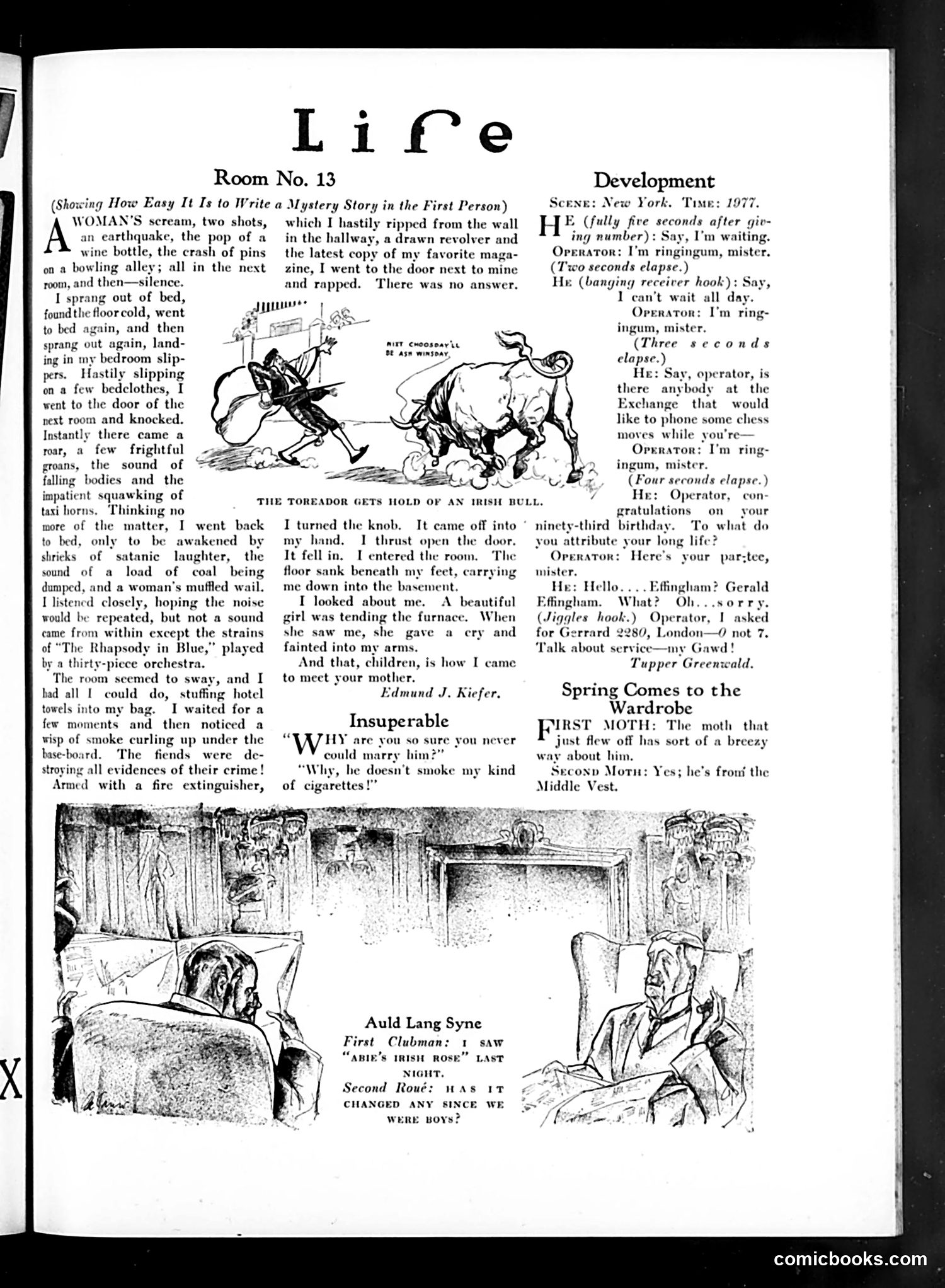
This page contains three separate satirical pieces from Life magazine: 1. **"Room No. 13"** — A humorous short story about writing mystery fiction, featuring illustrations of chaotic domestic scenes (a woman screaming, someone wrestling with what appears to be a bull). The satire mocks the melodramatic tropes of mystery stories. 2. **"Development"** — A comedic telephone exchange between an operator and caller discussing chess moves and birthday wishes, poking fun at inefficient telephone service and awkward social interactions. 3. **"Insuperable"** — A brief joke about cigarette smoking and marriage compatibility. 4. **"Spring Comes to the Wardrobe"** and **"Auld Lang Syne"** — Short humorous pieces about seasonal changes and nostalgia. The page represents Life's typical format: mixing short fiction, jokes, and illustrations for comedic social commentary.
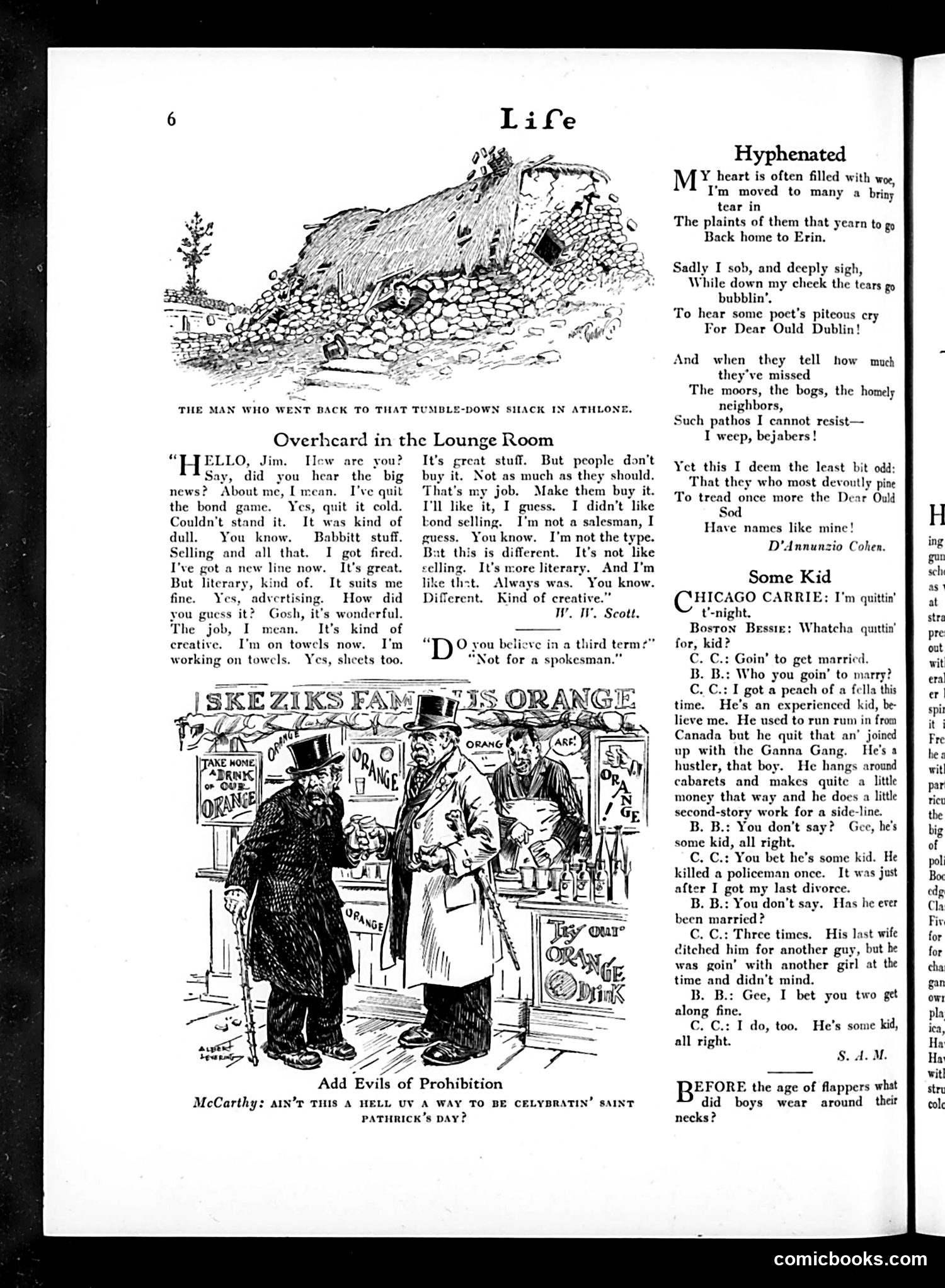
This page satirizes **Prohibition's unintended consequences**. The bottom cartoon, captioned "Add Evils of Prohibition," shows a speakeasy (illegal bar) operating openly behind a storefront labeled "Skeziks Family Orange." A well-dressed man asks McCarthy if this is "a hell of a way to be celebratin' saint patrick's day?" The joke: Prohibition, meant to eliminate alcohol and moral corruption, instead created underground drinking establishments that flourished openly. The irony is that illegal bars operated so brazenly that patrons could celebrate holidays in them without fear—demonstrating that the law's enforcement was toothless and the "cure" worse than the disease. The upper poem "Hyphenated" appears unrelated to this cartoon, expressing nostalgic homesickness.
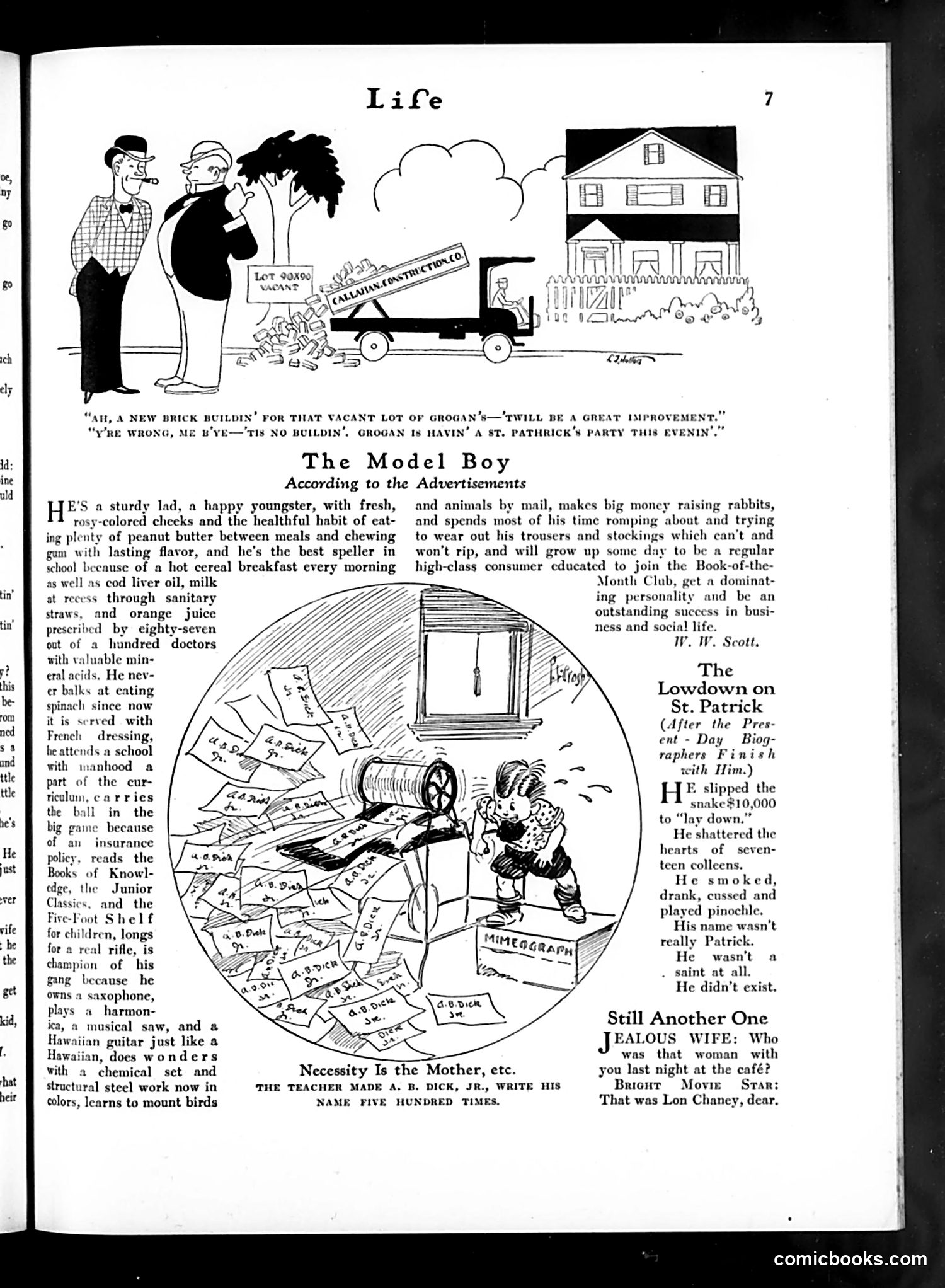
This page contains satirical commentary on consumer culture and advertising's influence on children. **"The Model Boy According to the Advertisements"** is the main feature—a circular illustration showing a boy surrounded by product advertisements and endorsements. The satire mocks how commercial advertising creates an unrealistic ideal child: one who eats specific cereals, uses particular grooming products, plays certain instruments, and owns numerous items—all through constant consumption. **"The Lowdown on St. Patrick"** is a brief joke debunking the romanticized image of the Irish saint, revealing he was actually a slaver and not particularly virtuous—puncturing sentimental mythology. **"Still Another One"** is a short joke about marital jealousy and nightlife. The page satirizes how advertisements manufacture artificial standards of childhood and consumer identity.
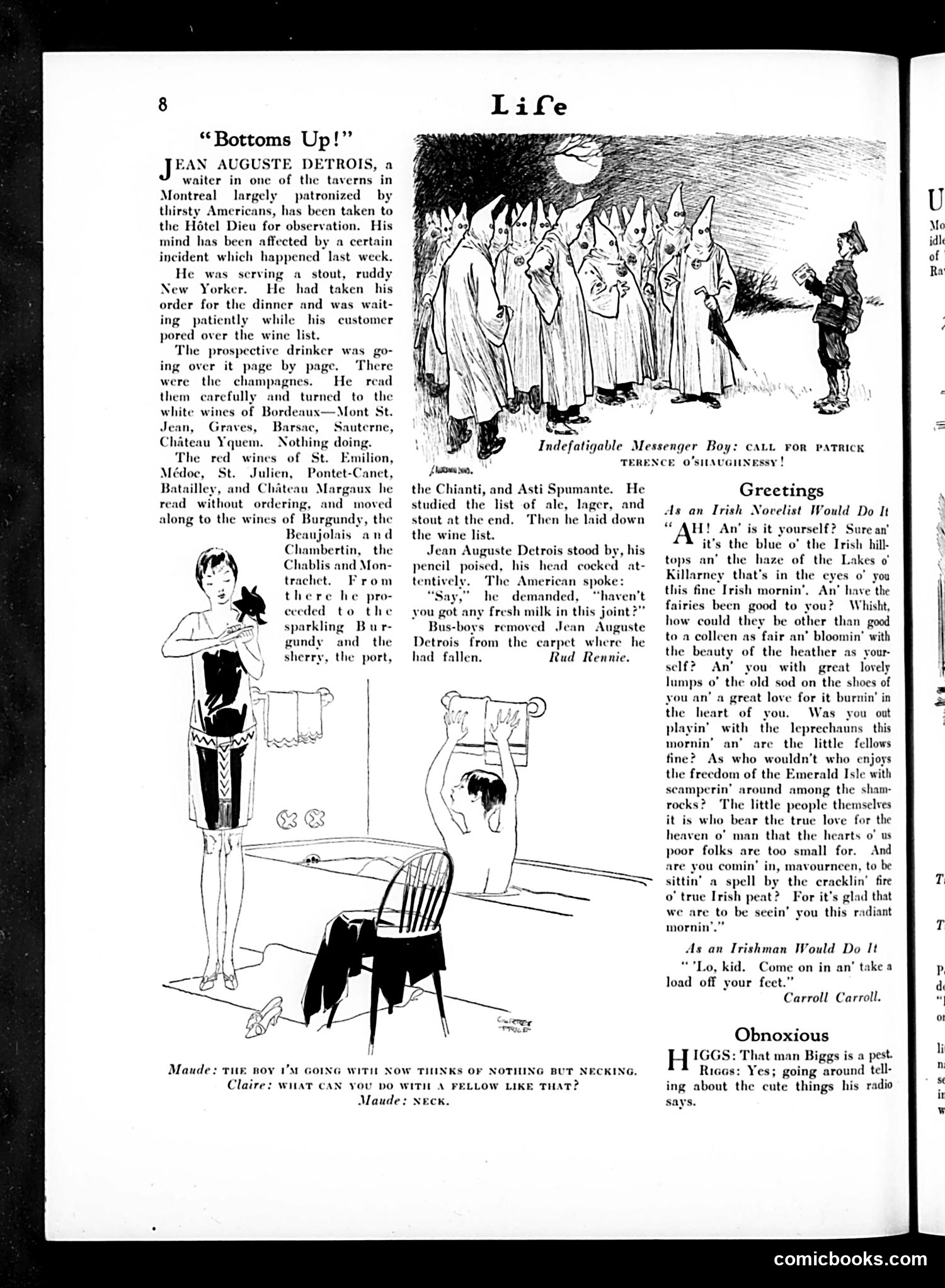
This page contains two separate pieces of humor: **"Bottoms Up!"** (left): A story about Jean Auguste Detroix, a Montreal waiter observed at a fancy hotel. The joke involves him pretending to study an extensive wine list while actually unable to read, then making absurd pronouncements about wines to impress a customer. The humor satirizes both pretentious wine culture and working-class people attempting to fake sophistication. **"Greetings"** (right): An Irish-themed humorous piece written in exaggerated Irish dialect, celebrating Irish romantic sentimentality and love of the landscape. It's lighthearted ethnic humor typical of the era. **The cartoon** (bottom left) depicts a flirtation between two characters named Maude and Claire, with mild innuendo about "necking" — period slang for kissing/intimacy.
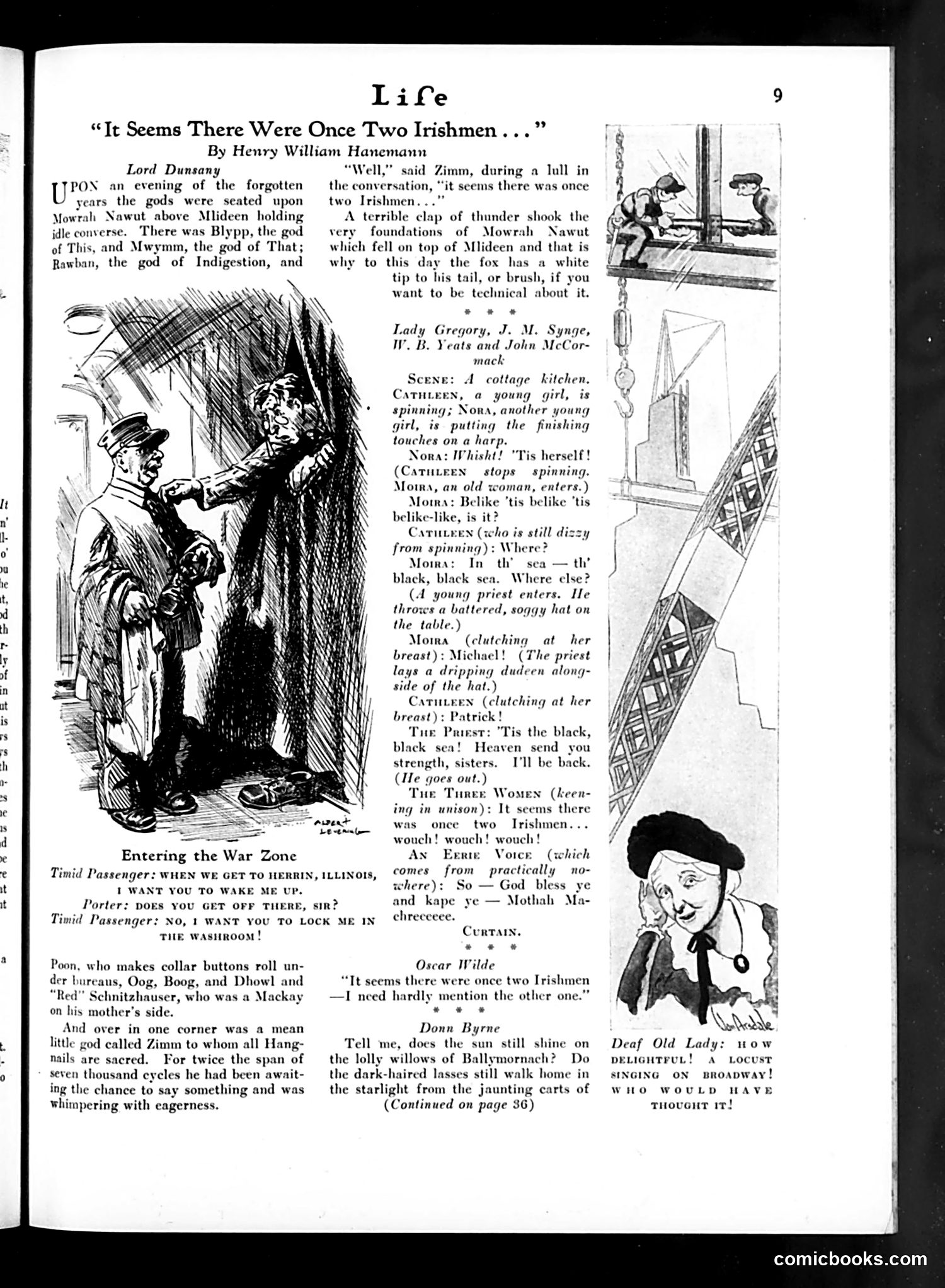
This page contains literary excerpts and illustrations rather than political satire. The main content features: **"It Seems There Were Once Two Irishmen..."** — a sketch by Henry William Hanemann depicting Irish folklore or mythology (references to gods like Mowrah Nawut and Mildeen). **Theatrical content** — a scene from what appears to be a stage play involving characters named Cathleen, Nora, and Moira in a cottage kitchen, with dialogue about spinning and the sea. **"Entering the War Zone"** — a humorous exchange between a timid passenger and porter about using the ship's washroom during wartime travel, suggesting WWI-era anxiety about safety. **Additional literary pieces** by Oscar Wilde, Donn Byrne, and others complete the page. The satire targets everyday wartime anxieties and Irish cultural stereotypes through gentle humor rather than sharp political critique.
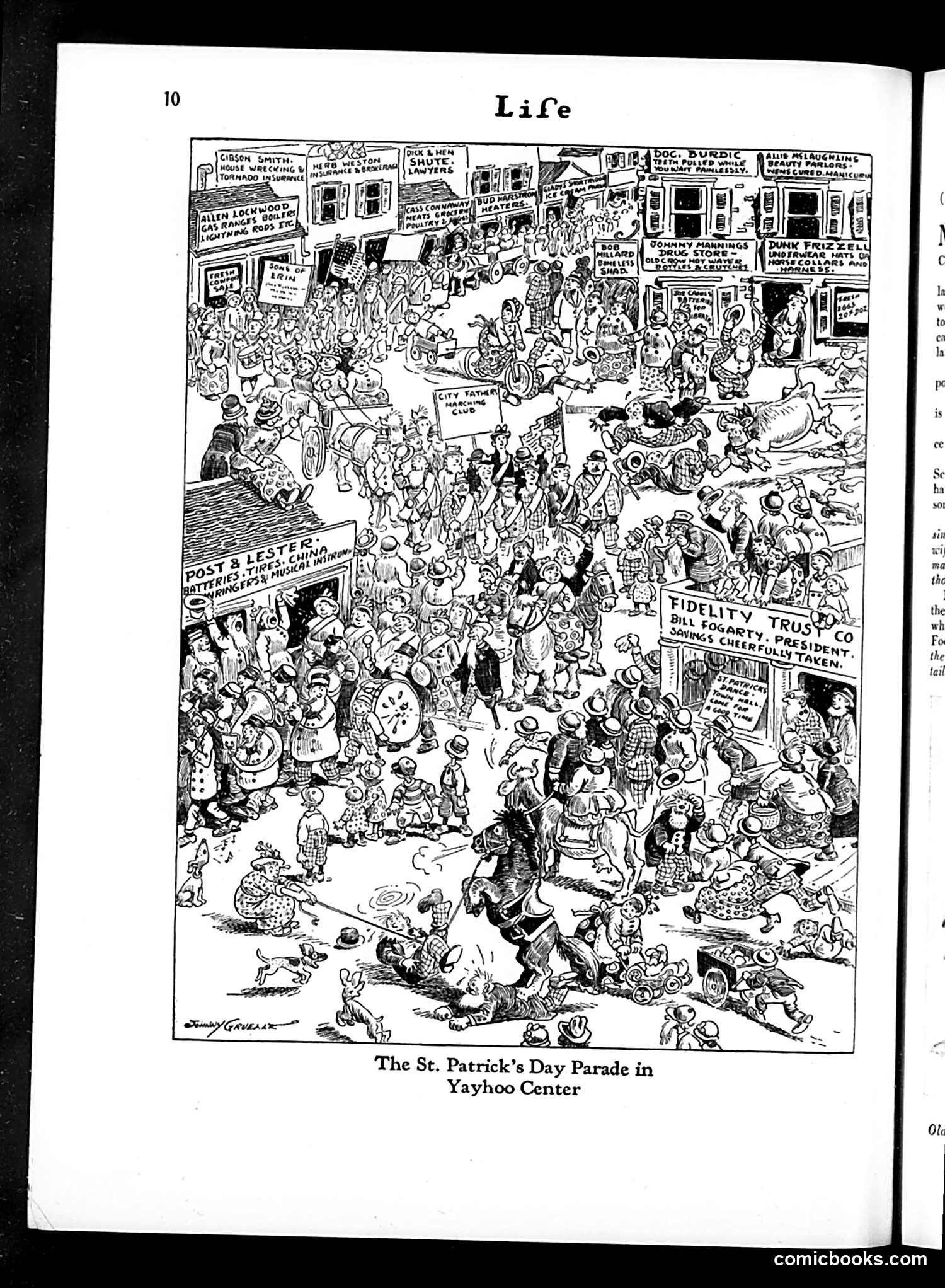
This is a crowded satirical illustration depicting a St. Patrick's Day parade scene. The cartoonist shows numerous storefronts and businesses with signs (including "Gibson Smith," "Doc Burdick," and "Fidelity Trust"), packed crowds, and various characters engaged in parade activities and revelry. The satire appears to target the commercialization of St. Patrick's Day—transforming an Irish cultural celebration into a chaotic, profit-driven spectacle where businesses capitalize on the holiday. The density of commercial signage and the somewhat chaotic mass of celebrants suggest mockery of how American towns turned ethnic celebrations into commercialized public events. The artist signed this work, visible at the lower left.
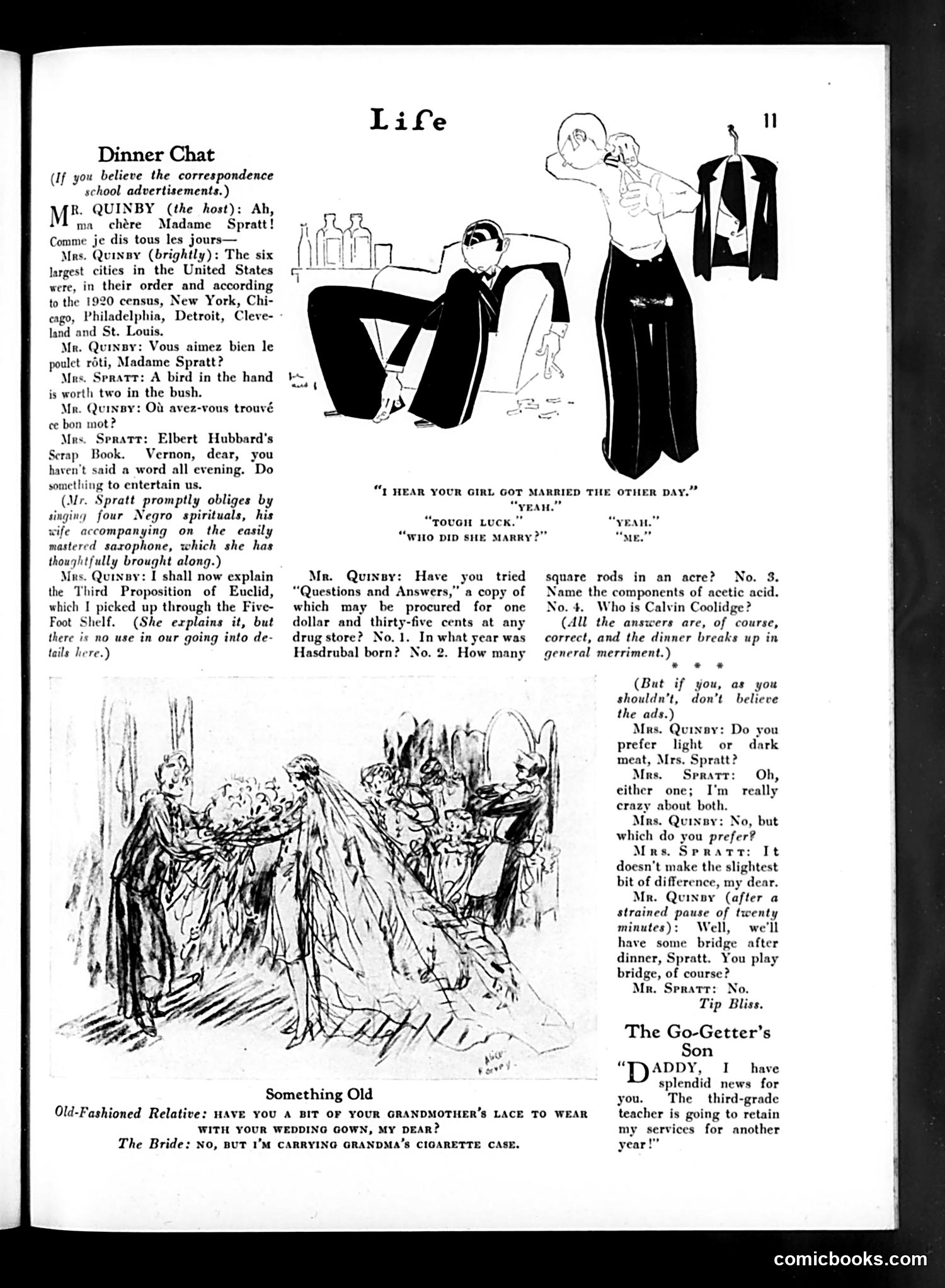
This page contains three separate satirical pieces from *Life* magazine: 1. **"Dinner Chat"**: A comedy sketch mocking correspondence school advertisements. Mr. Quinby questions whether Mrs. Spratt's claimed educational achievements—citing the "six largest cities" and Euclid's Third Proposition—actually work, with her husband Vernon remaining silent throughout the pretentious discussion. 2. **"Something Old"**: A wedding joke about a bride carrying her grandmother's cigarette case as "something old" rather than lace—poking fun at both outdated wedding traditions and women's changing social freedoms (smoking was still scandalous for women in this era). 3. **"The Go-Getter's Son"**: A brief piece about a child whose teacher will be retained for another year, suggesting parental pride in educational investment. The overall tone satirizes American consumerism, education, and social pretension.
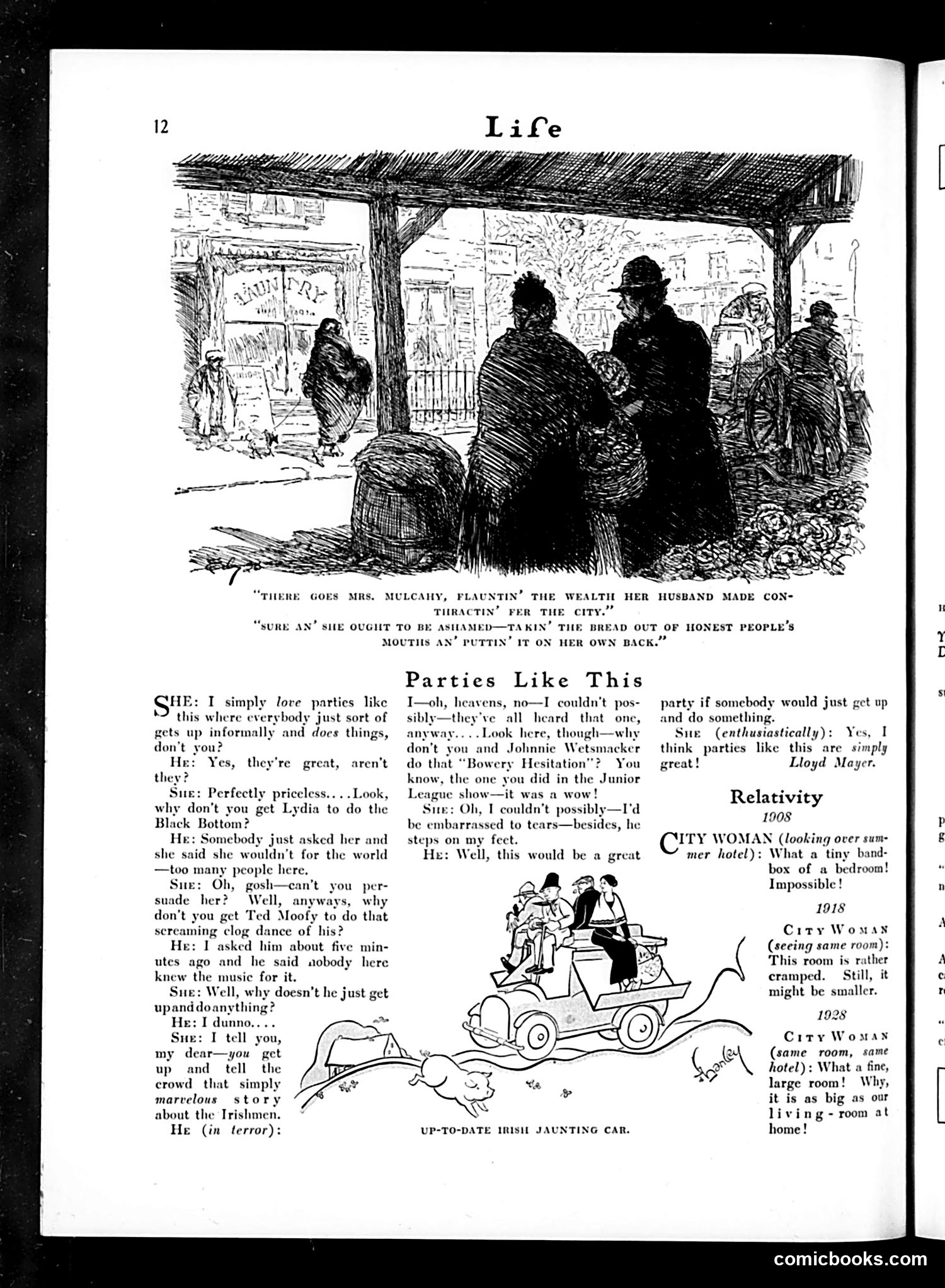
This page from *Life* magazine contains social satire about early 20th-century urban life. The top cartoon mocks wealthy Mrs. Mulcahy, who flaunts her husband's illegally-obtained wealth ("contracting" for the city), while the dialogue suggests hypocrisy—she's taking "bread out of honest people's mouths" by profiting from corruption. The section "Parties Like This" satirizes a socialite's obsession with hosting fashionable gatherings, with her male companion mocking her priorities. The bottom cartoon, "Up-to-Date Irish Jaunting Car," humorously depicts an Irish-themed vehicle, likely poking fun at ethnic stereotypes popular in that era. The "Relativity" section presents a joke about changing hotel room sizes across decades (1908, 1918, 1928)—commentary on shrinking accommodations or inflation.
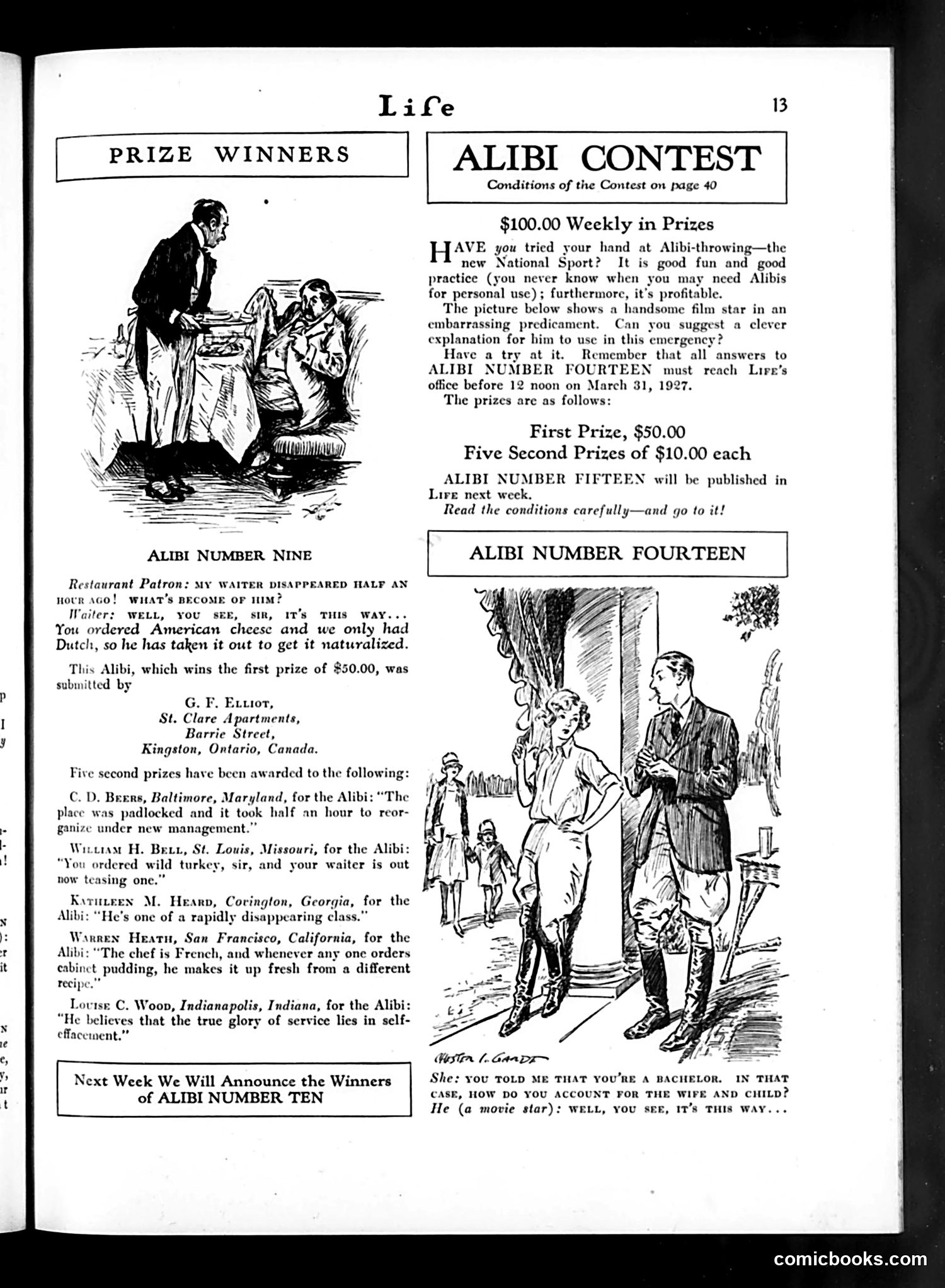
This page announces **Life magazine's "Alibi Contest"** — a humor competition asking readers to submit clever excuses for embarrassing situations. **Alibi Number Nine** (left): A waiter explains why his income doubled after half an hour. The joke: he ordered American cheese and Dutch cheese, then "took it out to get it naturalized" — a pun on immigration/naturalization. The humor mocks both the waiter's absurd scheme and contemporary anxieties about foreign goods. **Alibi Number Fourteen** (right): A movie star explains having a wife and child despite claiming bachelorhood. The illustration depicts confusion at a doorway; his excuse plays on Hollywood's reputation for deception. These alibis satirize everyday dishonesty through exaggeration, reflecting 1920s American humor about social pretense and questionable logic.
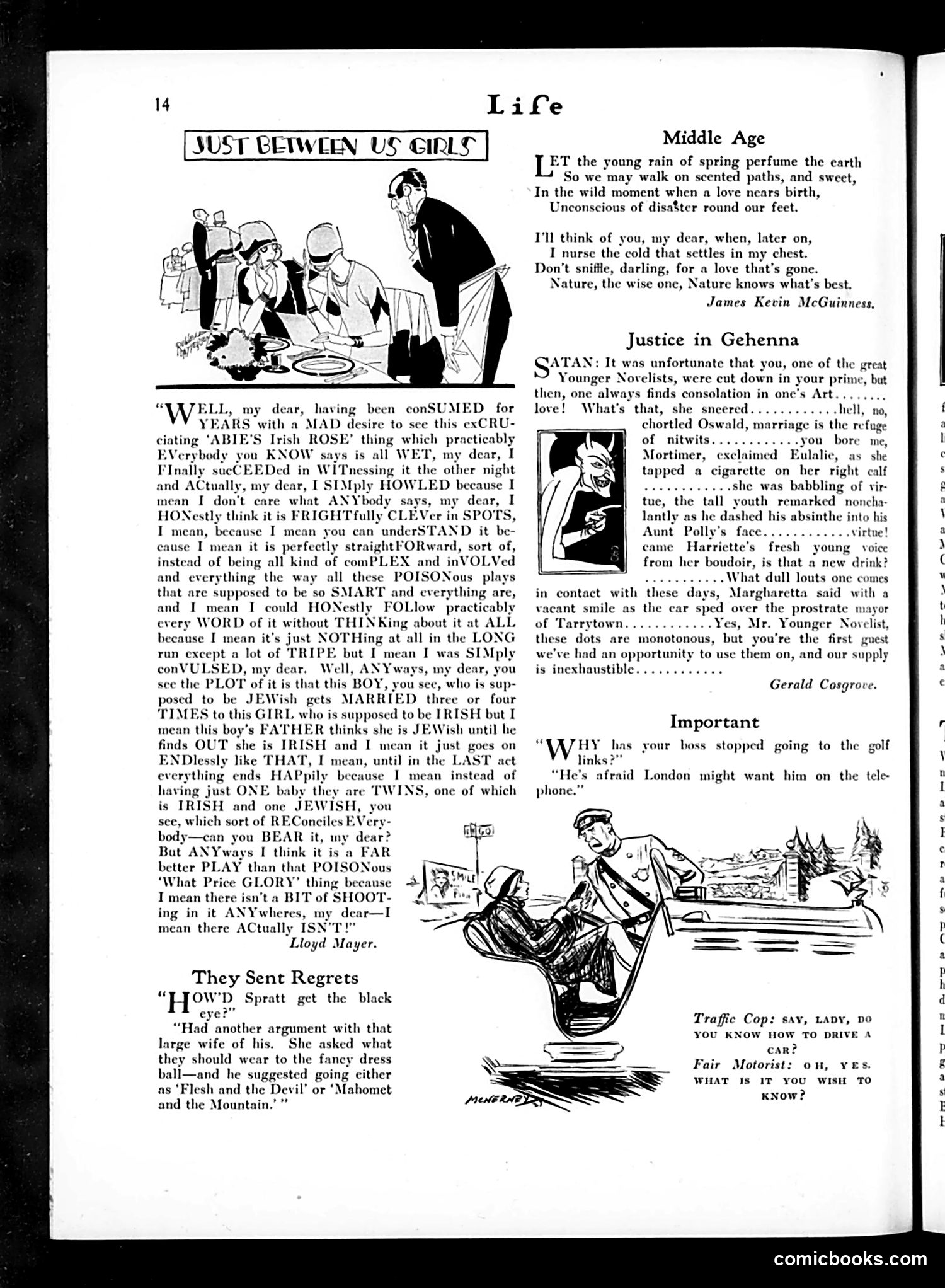
This page contains satirical humor pieces typical of Life magazine's social commentary. The main cartoon "Just Between Us Girls" shows a group socializing, with accompanying text by Lloyd Mayer lampooning overly complicated social etiquette and marriage customs—specifically mocking convoluted rules about religious and ethnic considerations in courtship. The "Justice in Gehenna" section uses a devil illustration to satirize literary figures (Oswald, Mortimer, Harriette) in a gossipy tone about romantic entanglements and virtue. The bottom cartoon "Important" depicts a traffic confrontation between a woman driver and a police officer, playing on period stereotypes about female driving ability—a common satirical target of the 1920s-30s era. The humor relies on assumptions about women being poor drivers.
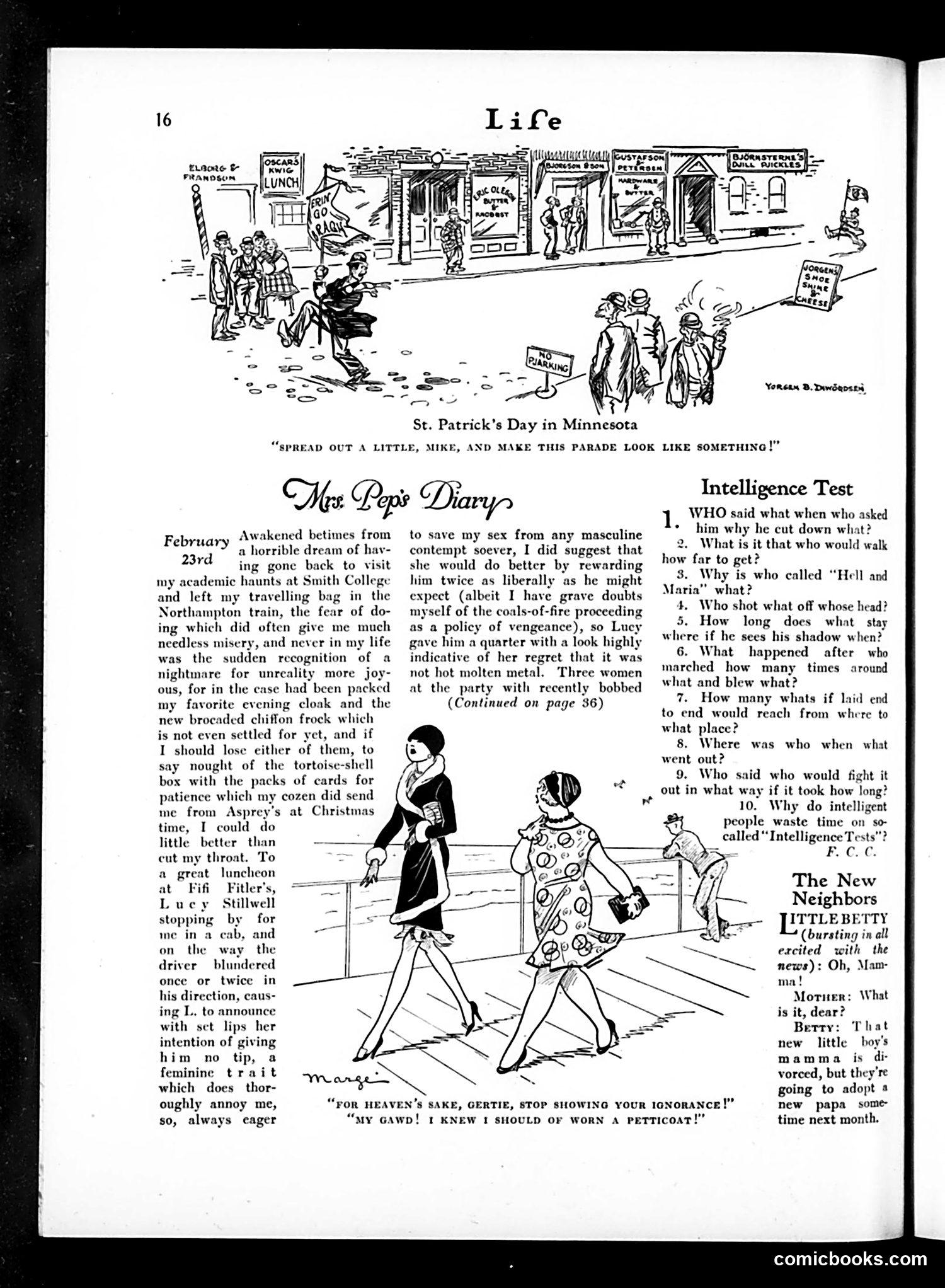
**Top Cartoon - "St. Patrick's Day in Minnesota":** This satirizes a meager St. Patrick's Day parade. The caption jokes about making a small parade "look like something" by spreading participants out. The cartoon depicts sparse crowds and minimal festive activity, likely mocking either Minnesota's modest Irish population or the small-scale nature of regional celebrations compared to major cities. **"Mrs. Pep's Diary":** A dated social commentary entry from February 23rd, discussing the writer's visit to her academic mentor at Smith College. The tone is gossipy and light. **Illustration below the diary:** Two women in 1920s-style dress, with the caption about one woman showing "ignorance" through her fashion choice (wearing a petticoat under a dress), mocking female fashion awareness. **"Intelligence Test" and "New Neighbors":** Brief humor columns typical of period magazines.
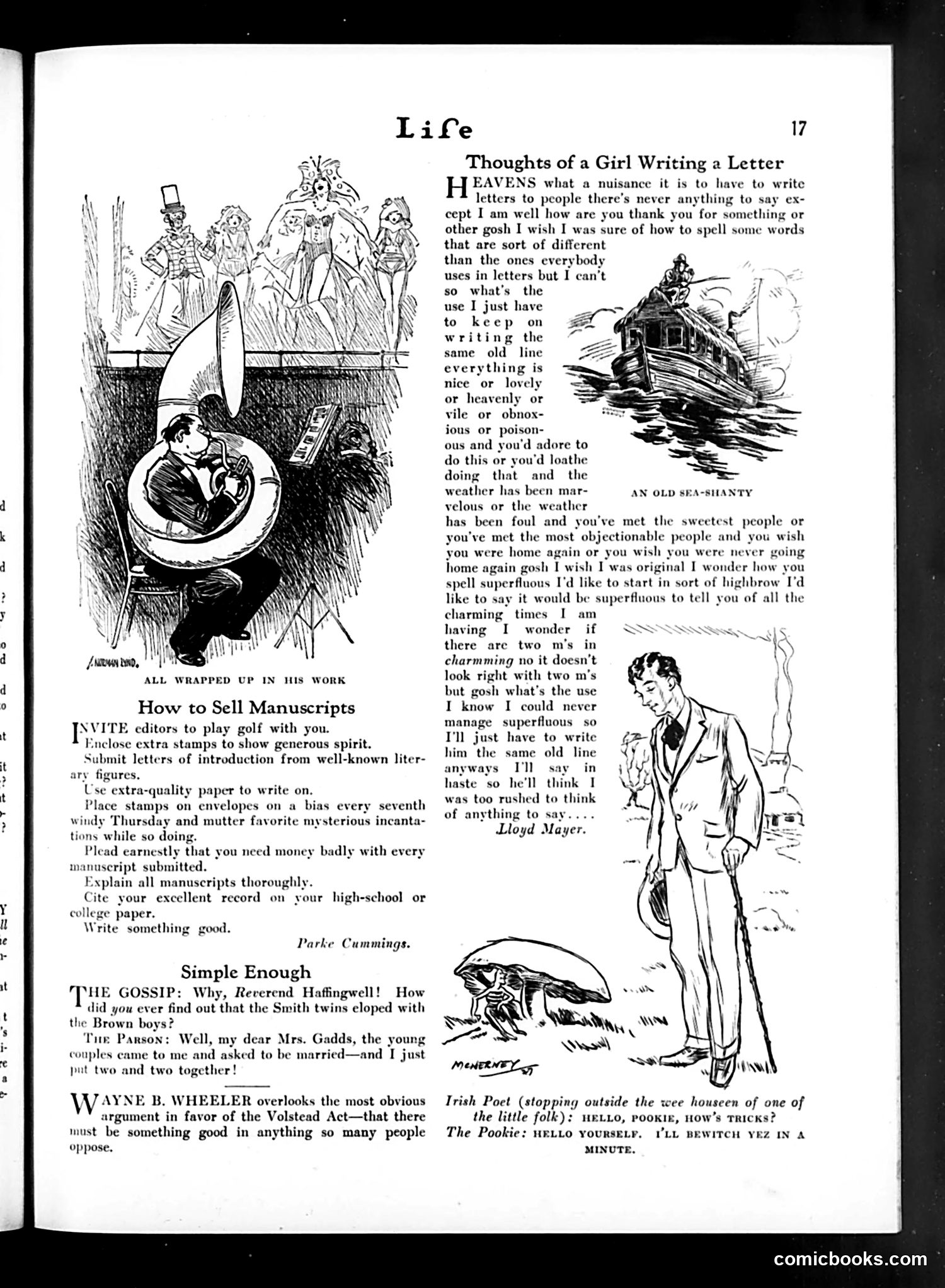
This page contains three satirical pieces targeting early 1900s social conventions: **"Thoughts of a Girl Writing a Letter"** mocks the difficulty of letter-writing etiquette—the girl struggles with proper word choices and phrases, wanting to sound original but constrained by social formality. **"How to Sell Manuscripts"** (attributed to Parker Cummings) humorously advises aspiring writers to use absurd tactics: invite editors to golf, beg for money, mutter "mysterious incantations," and lie about credentials. It's satire on publishing's pretensions. **"Simple Enough"** presents gossip dialogue where a Reverend Haffingwell discusses the "Smith twins" eloping with "Brown boys," while the Parson delivers a pious but circular non-answer—satirizing clergy hypocrisy and society's obsession with scandal. The illustrations are period-appropriate pen-and-ink drawings typical of Life's satirical style.
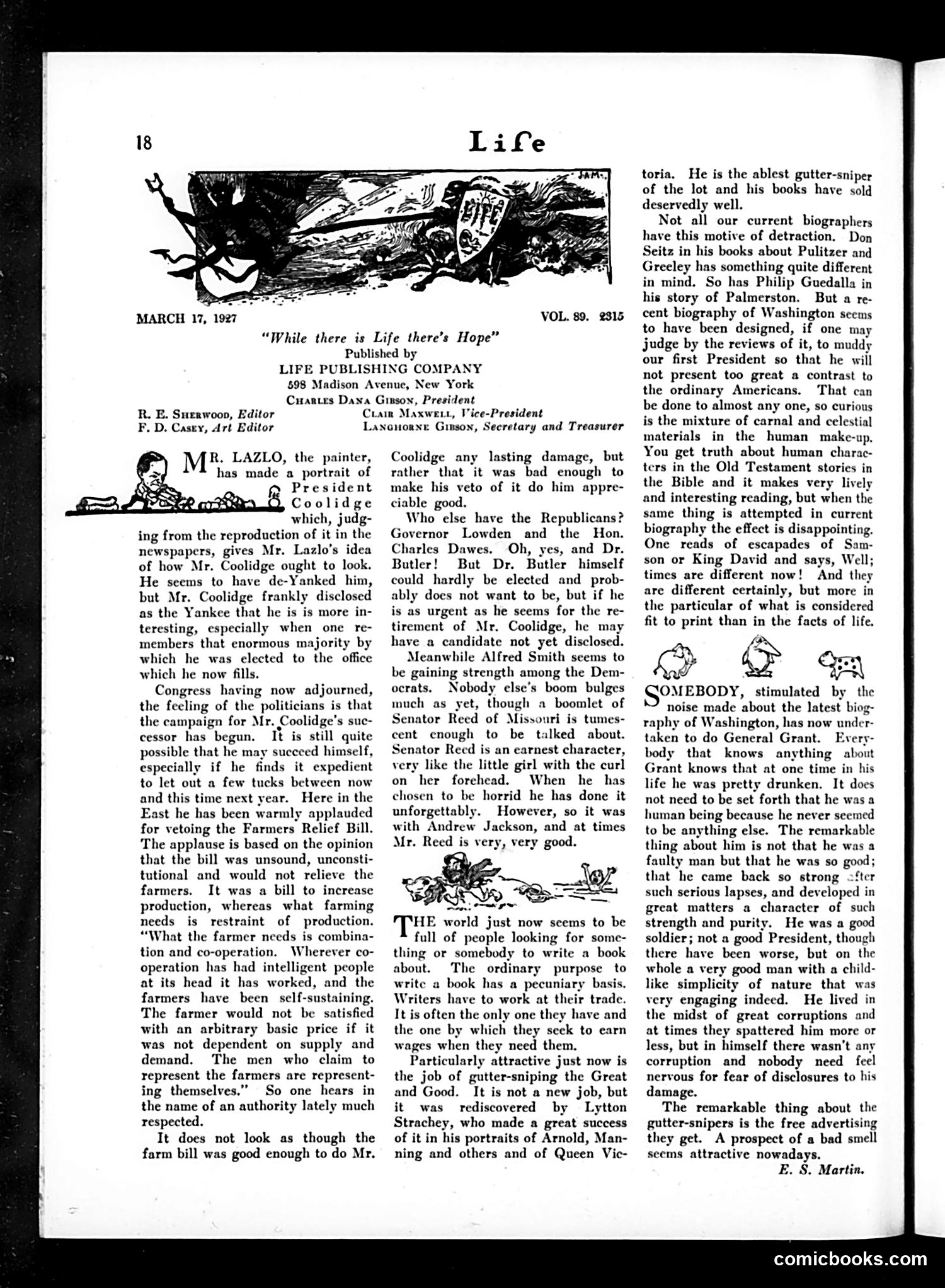
This page contains editorial commentary rather than comic cartoons. The main topics are: **Presidential Politics**: Discussion of President Calvin Coolidge's portrait by painter Lazlo, which allegedly "de-Yanked" him. The piece notes Coolidge remains a strong candidate for re-election despite his veto of the Farmers Relief Bill. Republican alternatives mentioned include Governor Lowden, Charles Dawes, and Nicholas Murray Butler. On the Democratic side, Alfred Smith and Senator Reed of Missouri are gaining traction. **Biography Criticism**: The second section critiques the current trend of debunking biographies. While praising Lytton Strachey's skillful "gutter-sniping" approach to figures like Queen Victoria, the author notes not all contemporary biographers share this negative motive—citing Don Seitz and Philip Guedalla as more balanced writers. A recent Washington biography apparently designed to diminish the first President is implicitly criticized.
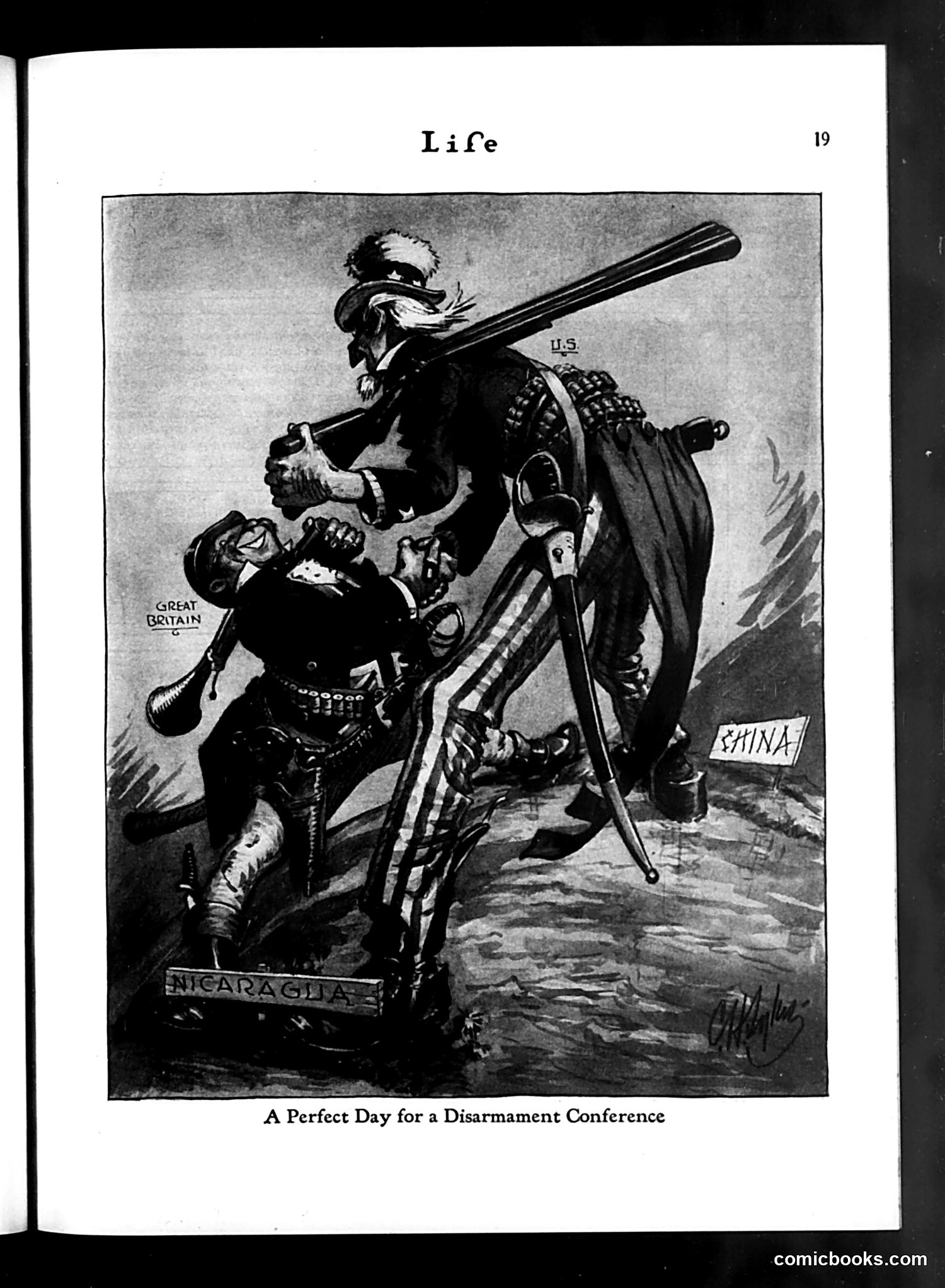
This satirical cartoon depicts a large military figure (labeled "U.S.") wielding a massive gun, standing over smaller figures representing other nations. "Great Britain" appears prostrate below, while "China" and "Nicaragua" are also labeled, suggesting vulnerable or subordinate positions. The satire criticizes the hypocrisy of disarmament conferences—international meetings supposedly aimed at reducing weapons. The cartoon suggests that while nations gather to negotiate peace and arms reduction, powerful countries like the United States maintain overwhelming military superiority, making genuine disarmament negotiations meaningless. The title's irony underscores this: it's only a "perfect day" for disarmament if you already possess dominant military force, rendering others' weapons irrelevant. This reflects early-20th-century anxieties about military power and international diplomacy.
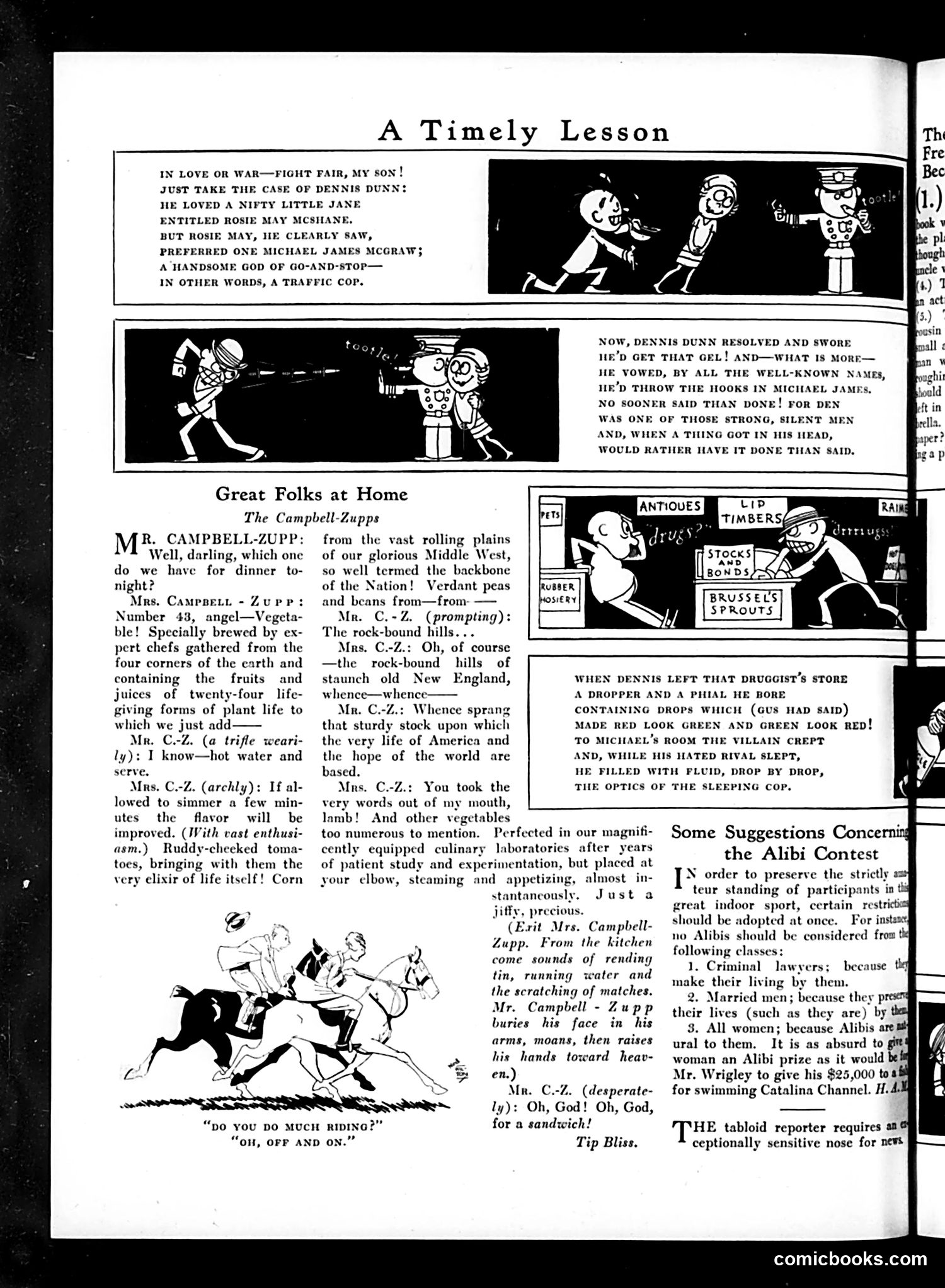
This Life magazine page contains three distinct pieces of humor: **Top: "A Timely Lesson"** - A melodramatic serial about Dennis Dunn, who loves Rosie May McShane but loses her to Michael James McGraw, a traffic cop. Dennis plots revenge with drugged eye-drops to sabotage his rival's vision. The satire mocks both romantic rivalry and the overwrought morality tales popular in early 20th-century fiction. **Middle: "Great Folks at Home - The Campbell-Zupps"** - Satirizes pretentious middle-class dinner conversation. Mrs. Campbell-Zupp elaborately describes a simple vegetable soup using grandiose language about "rolling plains" and "rock-bound hills," while her husband suffers in boredom, ultimately longing for a sandwich. This skewers verbose social affectation and false sophistication. **Right side: Miscellaneous items** including "Some Suggestions Concerning the Alibi Contest" - appears to be separate humor about excuses, excluding lawyers, married men, and women from competitions. The page exemplifies Life's satirical style mocking American pretension and domestic absurdity.
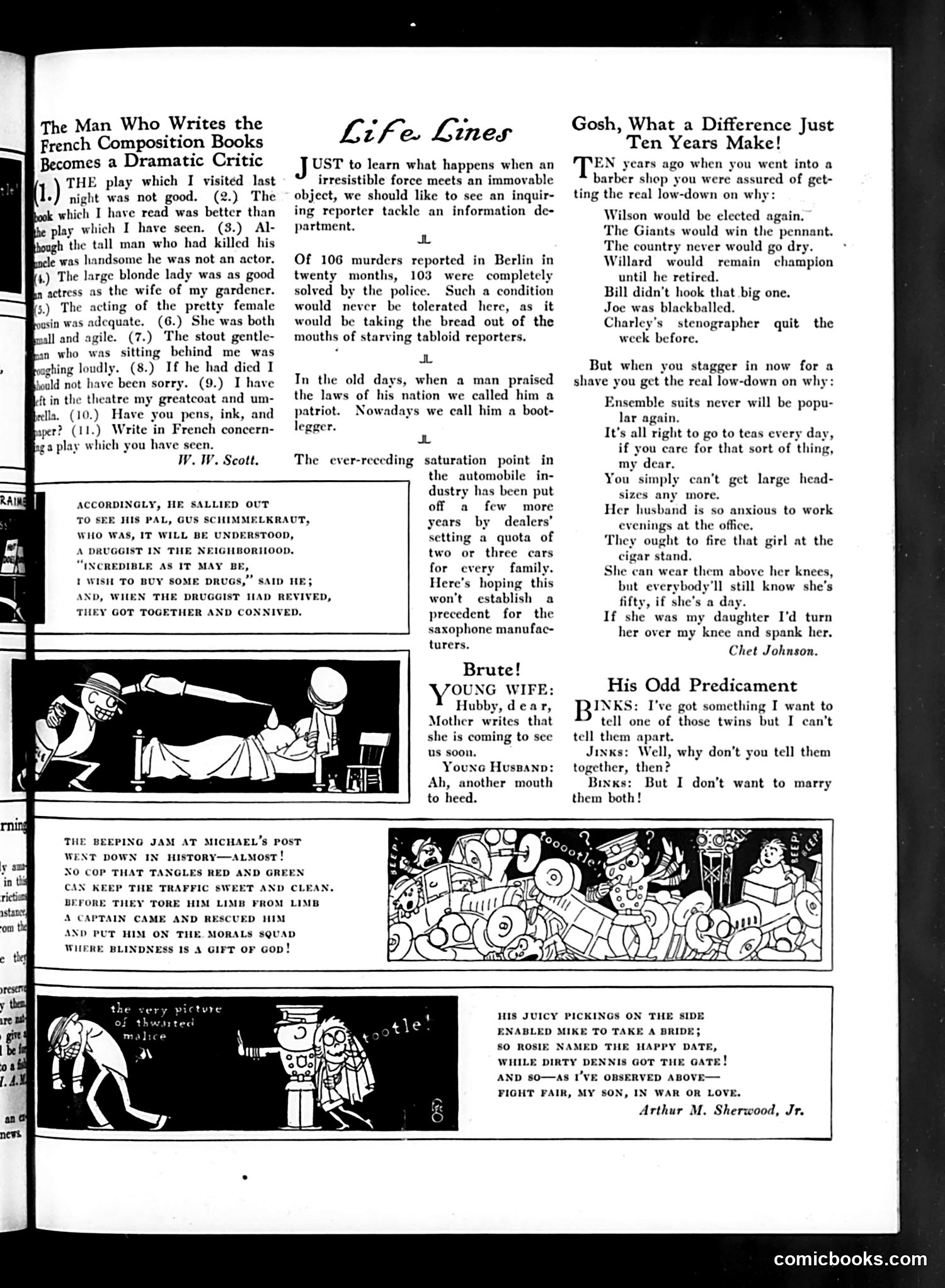
This page lampoons early 20th-century American life through several satirical pieces: **"French Composition Books" column** mocks textbooks' stilted, absurd example sentences by presenting them as dramatic criticism—exposing their artificiality. **"Life Lines" section** contains three social critiques: Berlin's police solving 103 of 106 murders (implying American tabloid reporters profit from unsolved crimes), the shift from patriotism to bootlegging commentary, and automobile dealers artificially limiting car availability. **"Gosh, What a Difference"** contrasts barber-shop gossip from a decade prior (Wilson, baseball, Prohibition, boxing) with current trivial concerns (women's fashion, office hours), satirizing how public discourse has trivialized. **"Brute!" and "His Odd Predicament"** are brief humorous vignettes about domestic life and romantic confusion. **"The Beeping Jam" cartoon** appears to mock police corruption, showing an officer rescued from mob violence, then reassigned where "blindness is a gift of God"—suggesting he profits through overlooking crimes to fund marriage plans. The overall tone critiques social hypocrisy, commercialism, and public indifference.
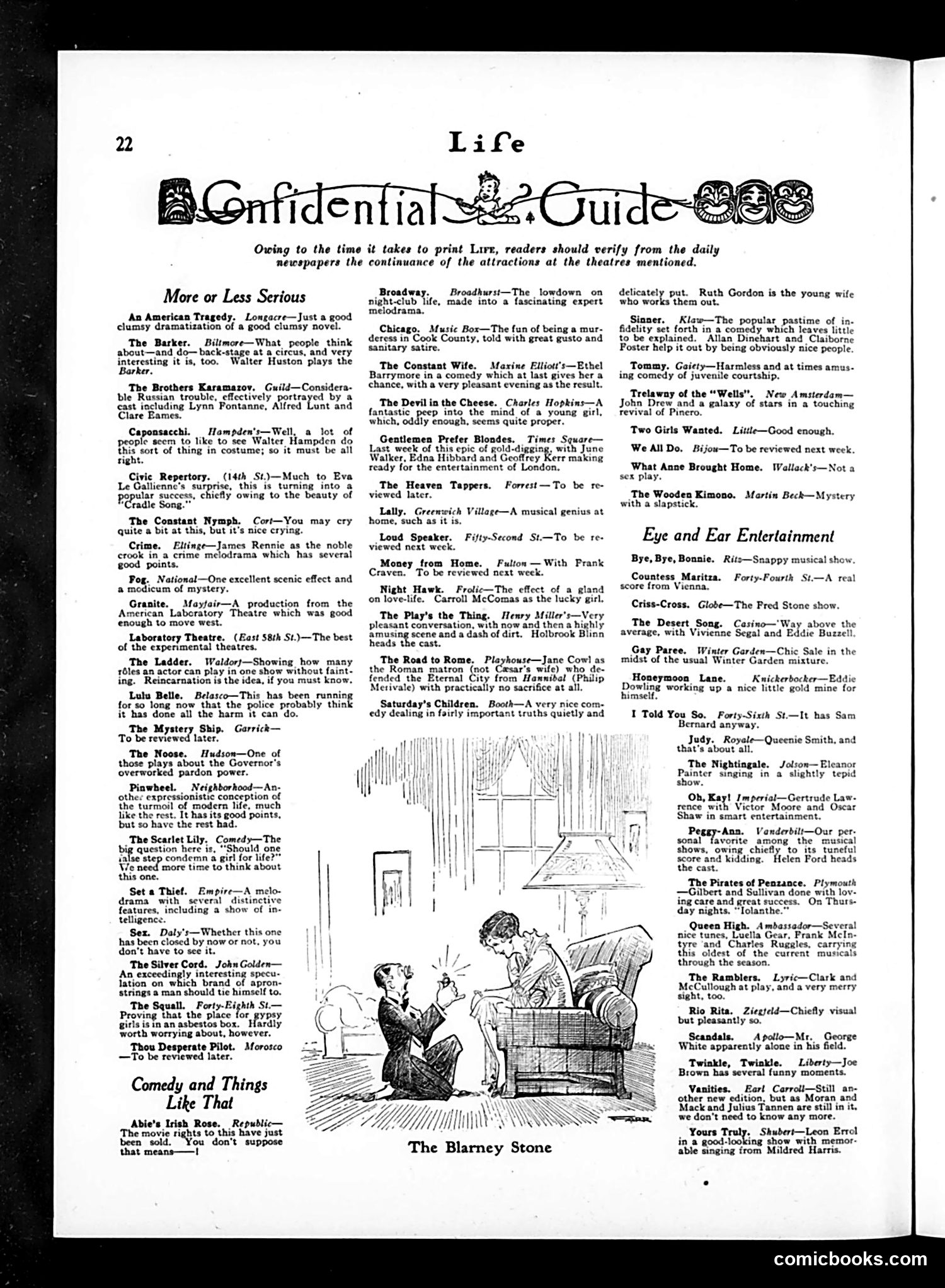
This is a theater review section from *Life* magazine's "Confidential Guide" to Broadway and theatrical productions. The cartoons and text provide entertainment criticism from approximately the 1920s era. The central cartoon titled "The Blarney Stone" depicts a man kissing a stone (likely an Irish tourist trope), illustrating the magazine's satirical approach to entertainment culture. The reviews themselves mock theatrical productions with dry, often dismissive commentary—some sympathetically ("just a good clumsy dramatization"), others harshly ("police probably think it has done all the harm it can do" regarding *Luly Belle*). The "Eye and Ear Entertainment" section reviews musicals and lighter fare. References to specific actors like Ethel Barrymore and production details ground these as contemporary reviews of now-obscure plays. For modern readers, this reveals how *Life* positioned itself as witty cultural arbiter, using brevity and snark to guide readers toward worthwhile entertainment—a function now performed by contemporary review aggregators and critics.
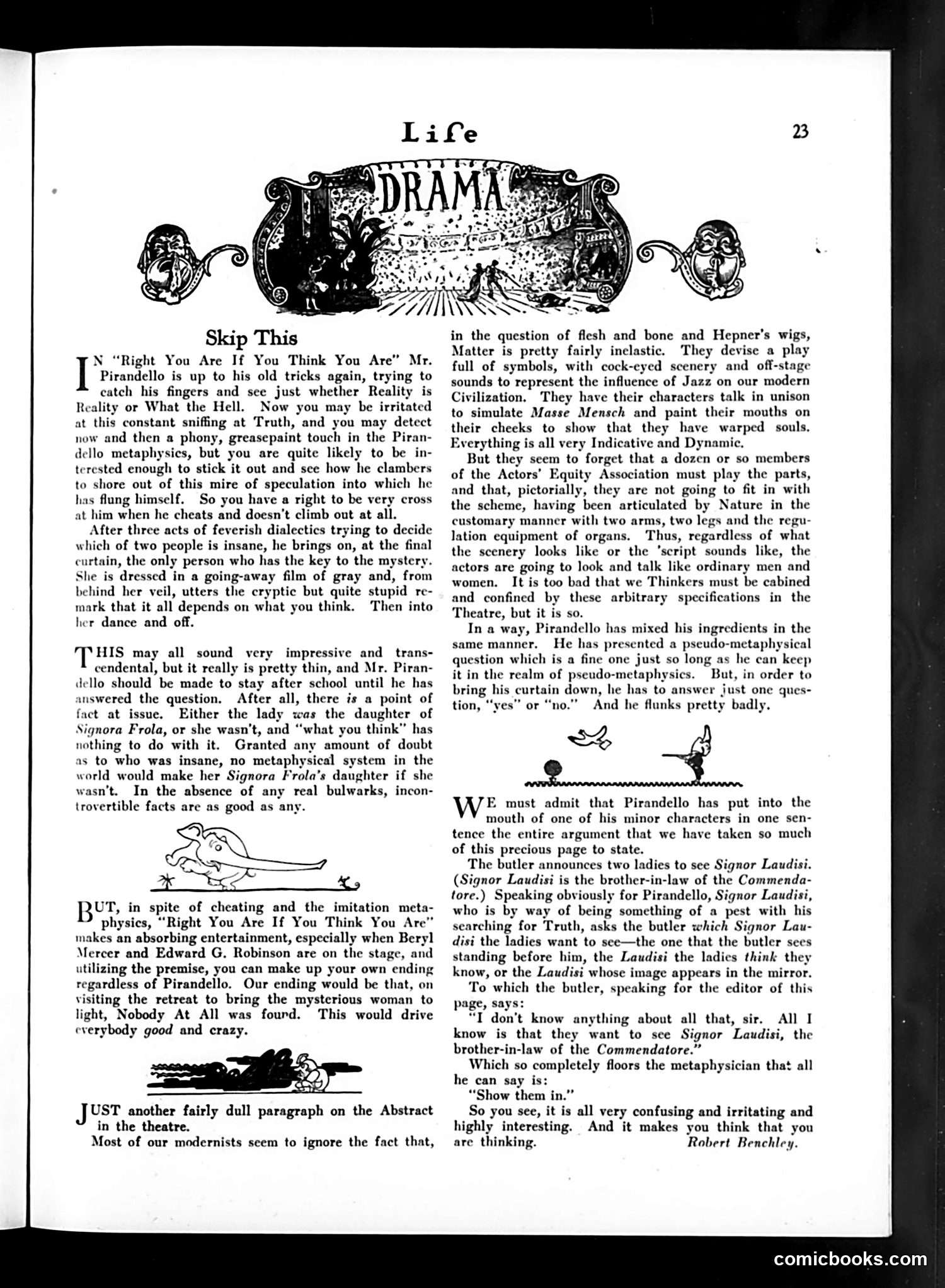
This page reviews Luigi Pirandello's play "Right You Are If You Think You Are," starring Beryl Mercer and Edward G. Robinson. The critic praises the production's entertainment value but attacks Pirandello's philosophical pretensions. **The satire:** The reviewer argues that Pirandello uses pseudo-intellectual "metaphysics" to avoid providing a concrete answer to his play's central mystery—whether a character is actually someone's daughter. The critic mocks modernist theater generally for prioritizing abstract symbolism over practical reality: actors have real bodies with "two arms, two legs," so experimental staging cannot escape human physicality. **The point:** Pirandello "cheats" by ending with a cryptic non-answer ("it all depends on what you think"), which the reviewer finds intellectually dishonest. The critic suggests the play should stay "after school until it answers the question"—treating the playwright like a student avoiding homework. The underlying critique attacks fashionable artistic modernism as pretentious obfuscation masking lazy thinking.
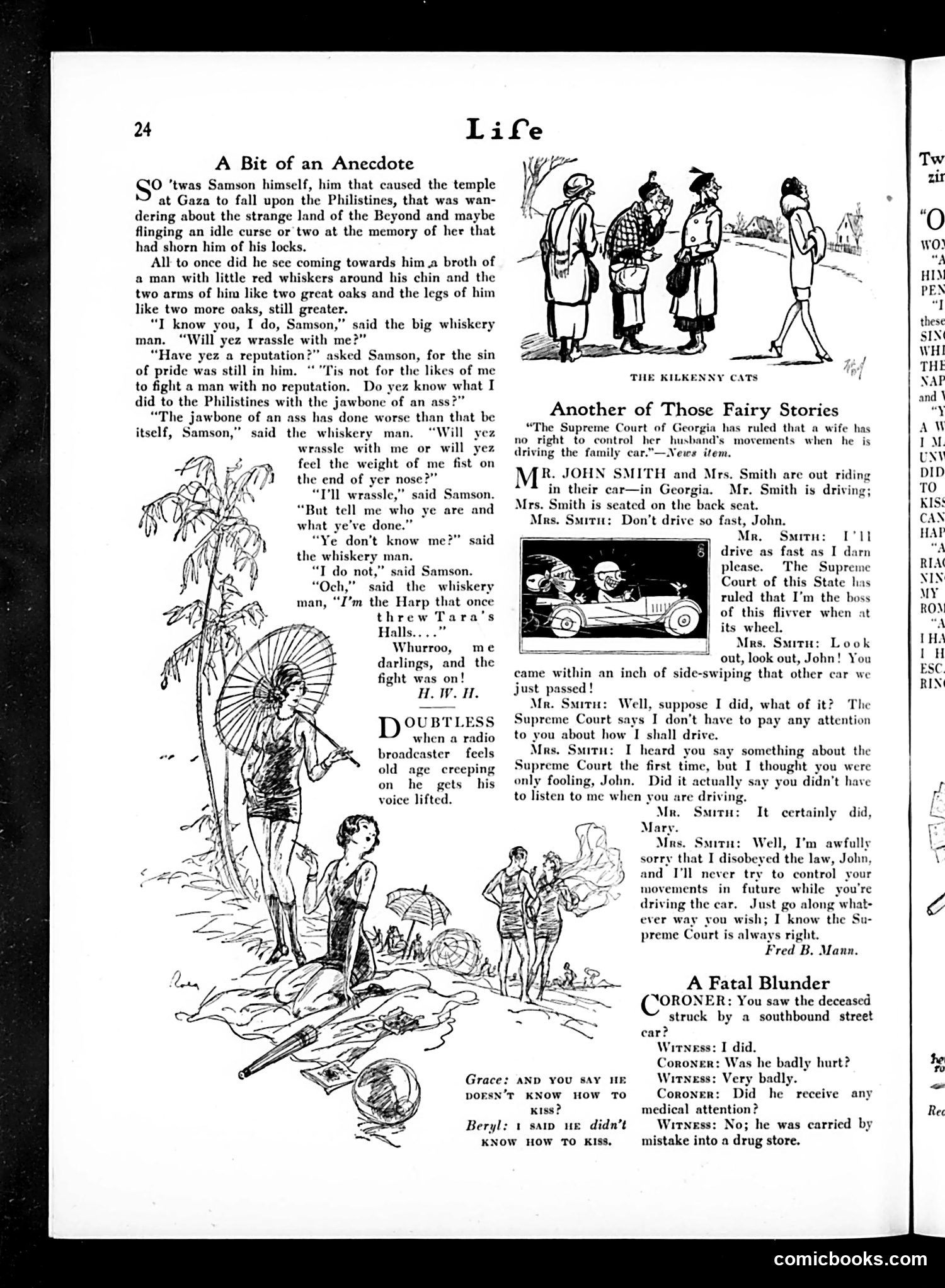
This page contains three satirical pieces typical of Life magazine's humor: **"A Bit of an Anecdote"** (left): An Irish-inflected tall tale about the biblical Samson encountering a boastful Irish giant claiming to have destroyed Tara's Halls. The humor derives from the absurdist setup and ethnic dialect comedy popular in early 20th-century American humor. **"Another of Those Fairy Stories"** (center/right): Sharp social satire on a recent Georgia Supreme Court ruling granting husbands exclusive control of the car while driving. The sketch shows Mr. Smith recklessly driving while Mrs. Smith pleads for safety, then ironically accepts the court's authority. The satire mocks both male arrogance and blind deference to legal rulings, exposing how absurd legal logic can justify dangerous behavior. **"A Fatal Blunder"** (bottom): A coroner's sketch where a man struck by a car wasn't helped because he was mistakenly taken to a drug store instead of medical care—dark humor playing on the era's limited emergency services. The page satirizes male privilege, legal absurdity, and Irish-American stereotypes.
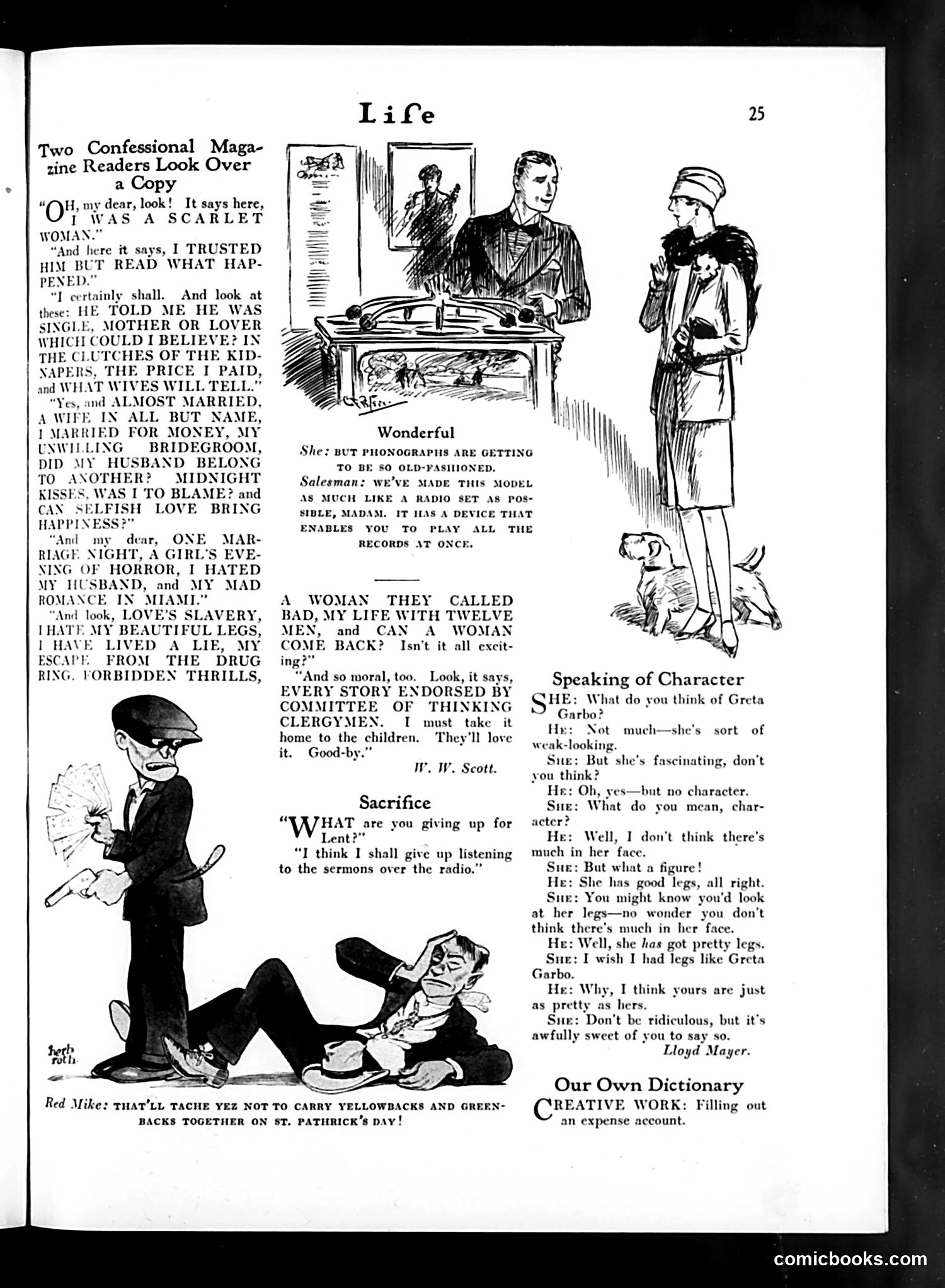
**Main Cartoon (Top Left):** Two women read a confessional magazine, breathlessly exchanging lurid story titles: "Scarlet Woman," "I Trusted Him," "Kidnapped," tales of infidelity and scandal. The satire targets *pulp confession magazines*—cheap publications featuring sensationalized stories of moral transgression that were enormously popular in the 1920s-30s. The joke: these readers treat trash literature as entertainment while ironically noting the stories carry endorsements from a "Committee of Thinking Clergymen," suggesting moral hypocrisy. **Secondary Cartoons:** - **"Wonderful":** A salesman markets a phonograph designed to resemble a radio—mocking how manufacturers adapt outdated products to modern tastes. - **"Red Mike":** An ethnic caricature warns against mixing cash—likely an Irish stereotype joke about St. Patrick's Day. - **"Speaking of Character":** A couple discusses Greta Garbo; he dismisses her as lacking character while fixating on her legs—satirizing shallow male criticism of actresses. The page lampoons popular entertainment, consumerism, and gender attitudes of the era.
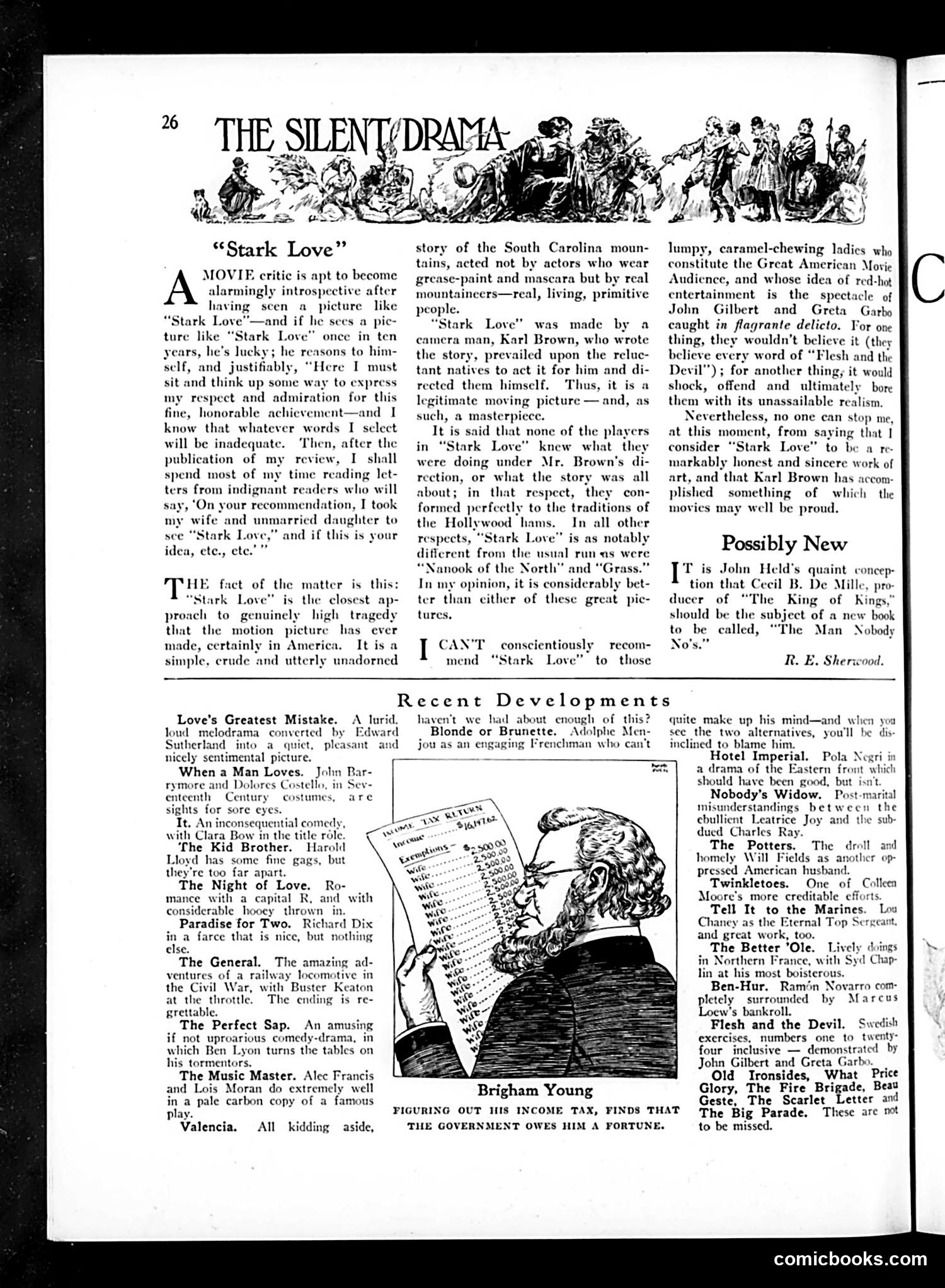
This page from *Life* magazine reviews "Stark Love," a 1921 film about South Carolina mountaineers filmed with non-actors. The critic praises it as genuine tragedy—remarkably honest compared to typical Hollywood melodrama. The cartoon depicts **Brigham Young** (historical Mormon leader, 1801-1877) examining a tax bill, with the caption "FIGURING OUT HIS INCOME TAX, FINDS THAT THE GOVERNMENT OWES HIM A FORTUNE." This is satirical commentary on tax policy: the joke suggests Young's polygamy (he had many wives) would create such complex tax deductions that the government would owe *him* money—absurdist humor mocking both polygamy and tax code complexity. The page also lists brief reviews of other current films, including mentions of John Gilbert, Greta Garbo, Harold Lloyd, and Clara Bow—major silent film stars of the era. The reviews discuss conventional melodramas ("Love's Greatest Mistake," "When a Man Loves") with dismissive brevity, contrasting sharply with the extended praise for "Stark Love's" artistic authenticity.
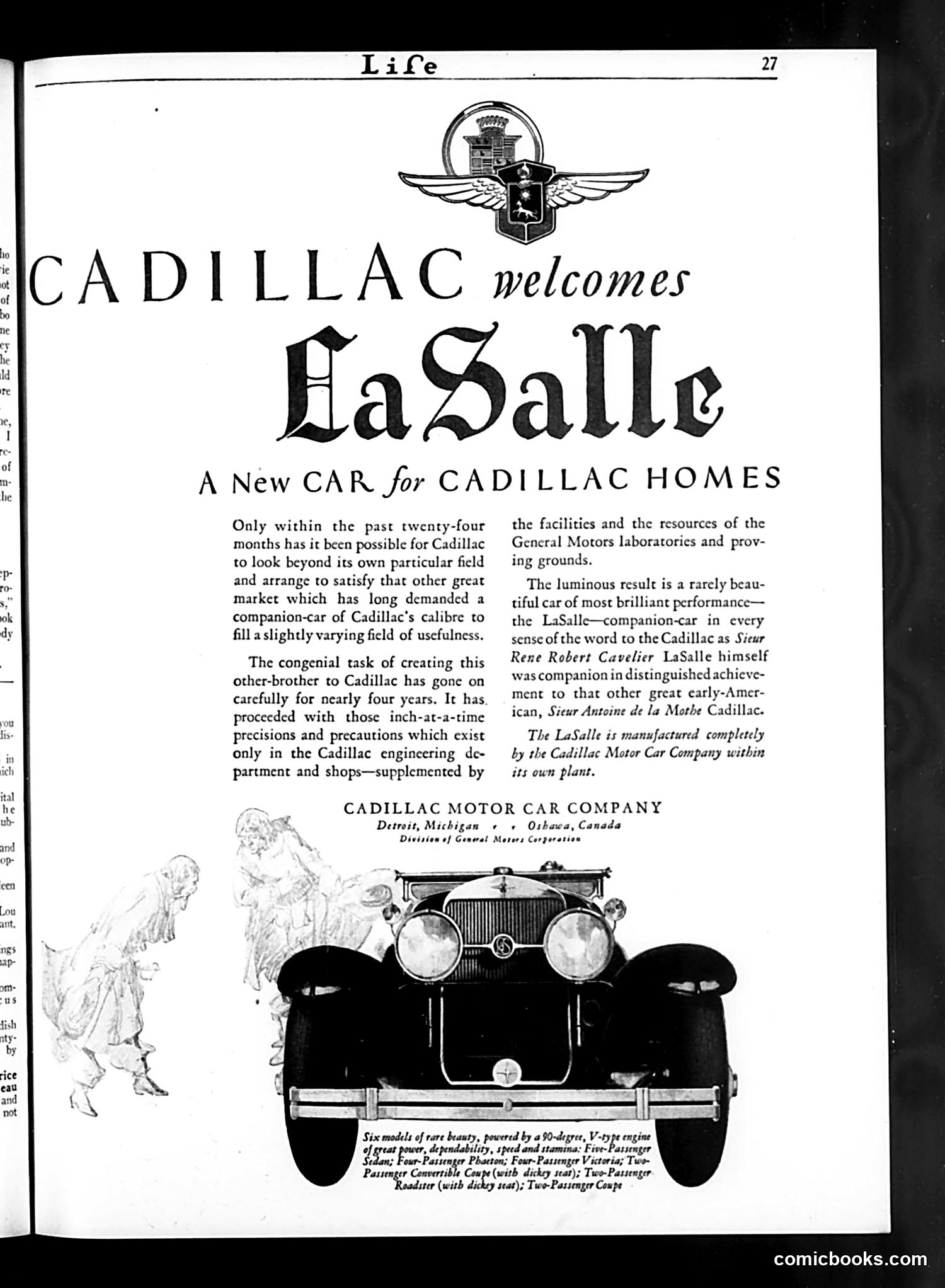
This is **not a cartoon or satire**, but rather a **luxury automobile advertisement** from Life magazine's advertising section. The page announces Cadillac's new companion car, the **LaSalle**, positioned as a slightly less expensive alternative to Cadillac itself—both manufactured by General Motors. The ad uses a historical analogy: just as French explorer René-Robert Cavelier LaSalle was a companion to fellow explorer Antoine de la Mothe Cadillac in early American exploration, the new LaSalle car is a "companion" to the Cadillac automobile. The decorative sketch on the left shows fashionable figures of the era, emphasizing the car's appeal to upscale consumers. The front-view illustration displays the vehicle's prominent headlights and grille. The copy emphasizes engineering precision, General Motors resources, and the car's "rare beauty." Six model variants are listed, all positioned toward affluent "Cadillac homes"—wealthy households. This is straightforward **period advertising**, not satirical commentary.
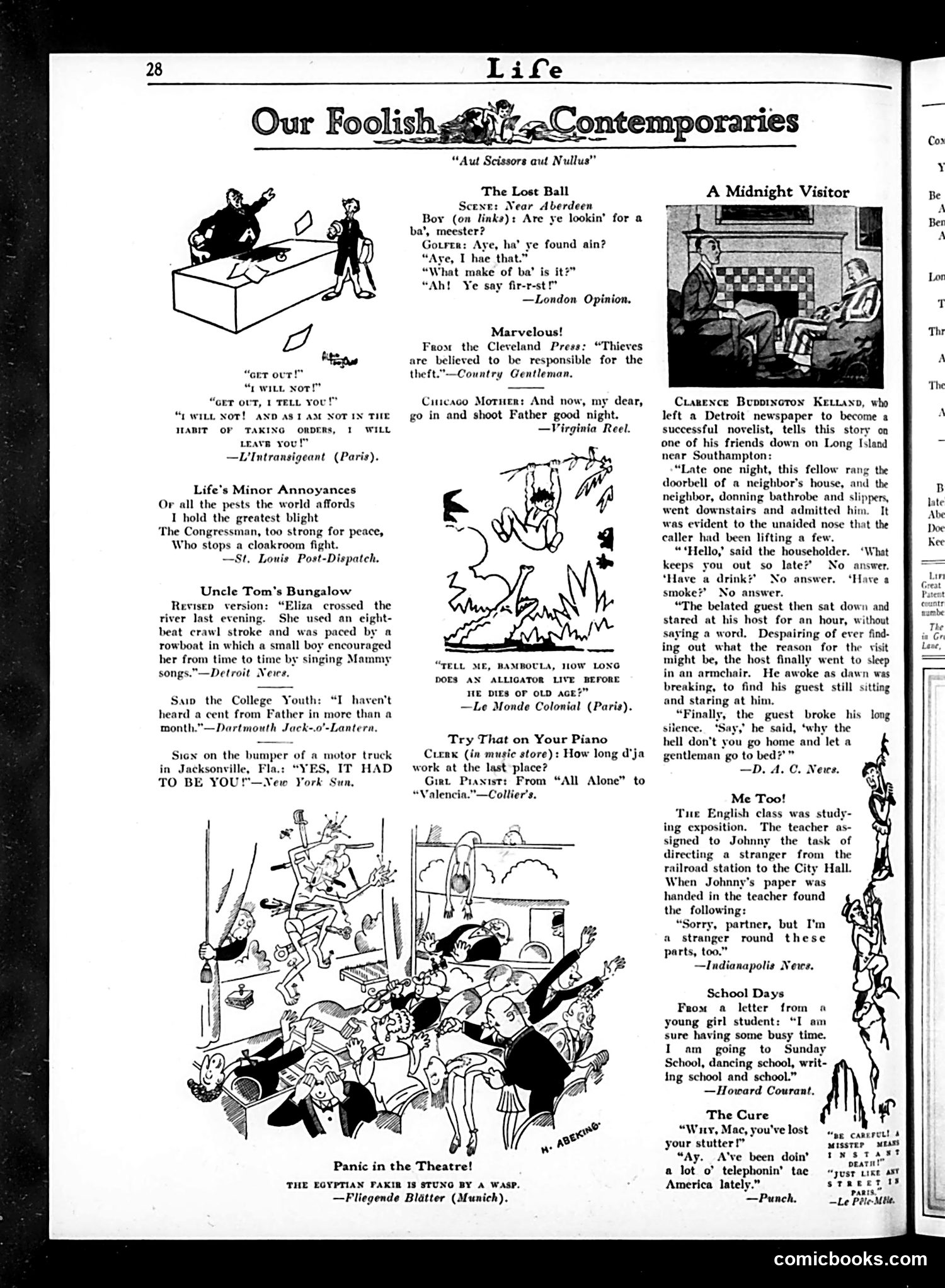
This is a humor compilation page from Life magazine featuring short jokes and satirical observations sourced from newspapers and magazines worldwide. The content reflects early 20th-century sensibilities: **Key items:** - **"The Lost Ball"** and **"Try That on Your Piano"** are gentle workplace/social comedies about misunderstandings - **"Panic in the Theatre"** satirizes overreaction—an Egyptian fakir's dramatic response to a wasp sting causes chaos - **"A Midnight Visitor"** depicts an intoxicated guest's silent, puzzling visit; the punchline mocks his unexplained rudeness - **"Me Too!"** plays on the absurdity of a student unable to give directions because he's also a stranger - The page collects international sources (Paris, Munich, London), emphasizing Life's cosmopolitan sophistication The overall tone is lighthearted social satire targeting human foibles—drunkenness, miscommunication, pomposity—rather than political commentary. The humor reflects pre-WWII middle-class American attitudes and sensibilities.
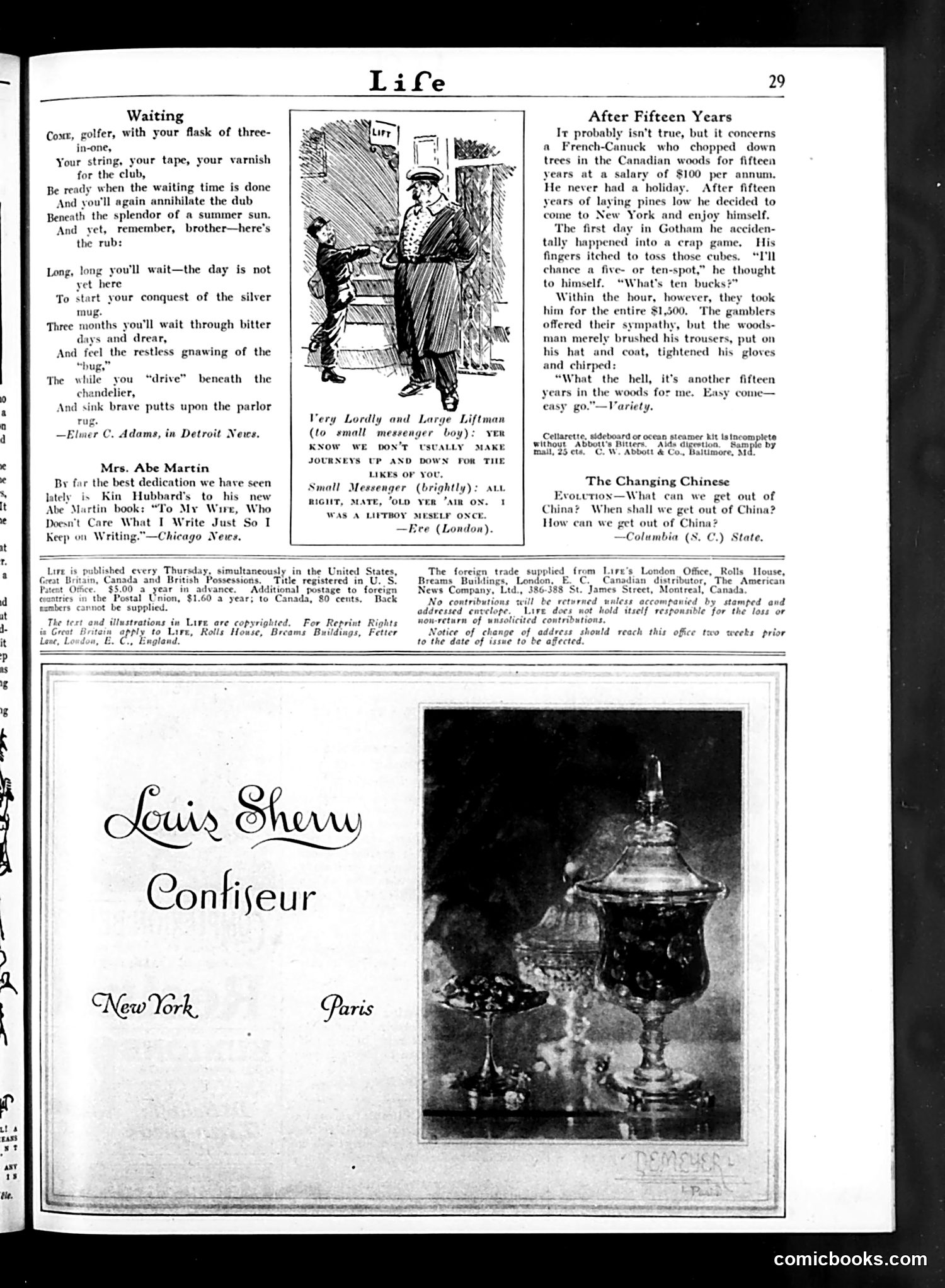
This page contains three humor pieces typical of Life's satirical content: **"Waiting"** (poem by Elmer C. Adams): A golfer's lament about the off-season. He must wait three months through winter before resuming golf, enduring "restless gnawing" until spring returns. The satire mocks golfers' obsessive dedication to the sport and their impatience during forced breaks. **"Mrs. Abe Martin"**: A brief note praising humorist Kin Hubbard's book dedication to his wife, quoted as "To My Wife, Who Doesn't Care What I Write Just So I Keep on Writing." The joke is the wife's indifference to his actual work—she only cares he remains productive/employed. **"Very Lordly and Large Liftman"**: A class-comedy sketch between a snobbish elevator operator and a messenger boy. The operator claims they don't usually transport common folk, but the boy reveals he was *formerly* a liftboy himself, deflating the operator's pretension. British working-class humor. The page also includes unrelated pieces about gambling and China policy, plus a Louis Sherry Confiseur advertisement.
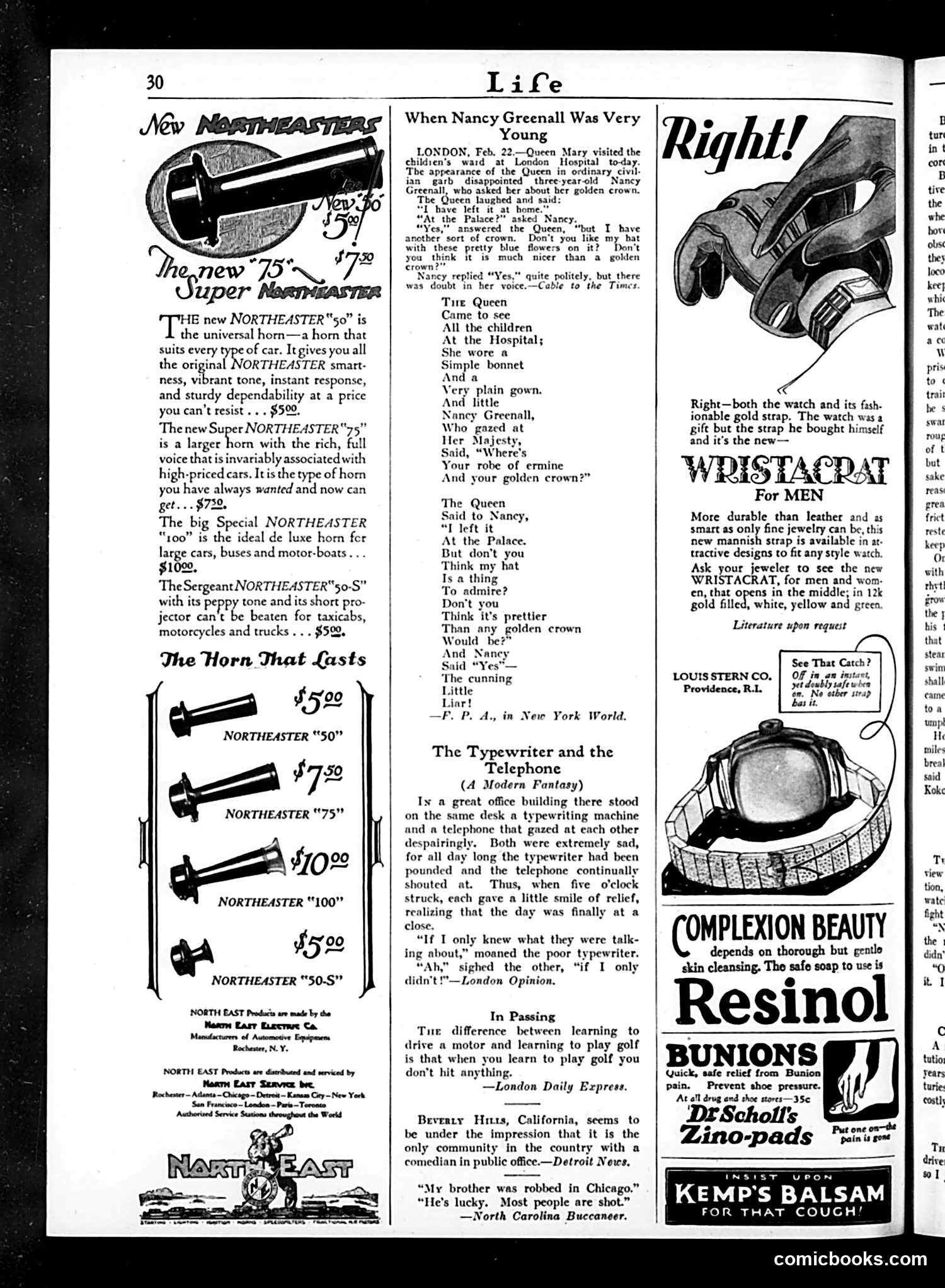
This is primarily an **advertising page** from Life magazine, with some light satirical content interspersed. The main features are: **Northeaster Horn Advertisements**: Left column shows car horn products at various price points ($5-$10), marketed as durable and universal—typical early 20th-century automotive advertising. **"When Nancy Greenall Was Very Young"**: A gentle anecdote (presented as both prose and verse) about Queen Mary visiting a hospital children's ward. A three-year-old expresses disappointment that the Queen wears a simple bonnet rather than her crown and ermine robes. The humor is innocent: the child's honest confusion about royal regalia, with the poem's punchline calling her a "cunning little liar" for politely agreeing the hat is prettier. **"The Typewriter and the Telephone"**: A whimsical short story personifying office equipment as sad colleagues, each frustrated by constant use—mild commentary on modern workplace stress. **Other brief jokes**: Wordplay about learning to drive versus golf; observations about crime in different cities. **Right column**: Product advertisements (Wristacrat watches, Resinol soap, Dr. Scholl's bunion pads).
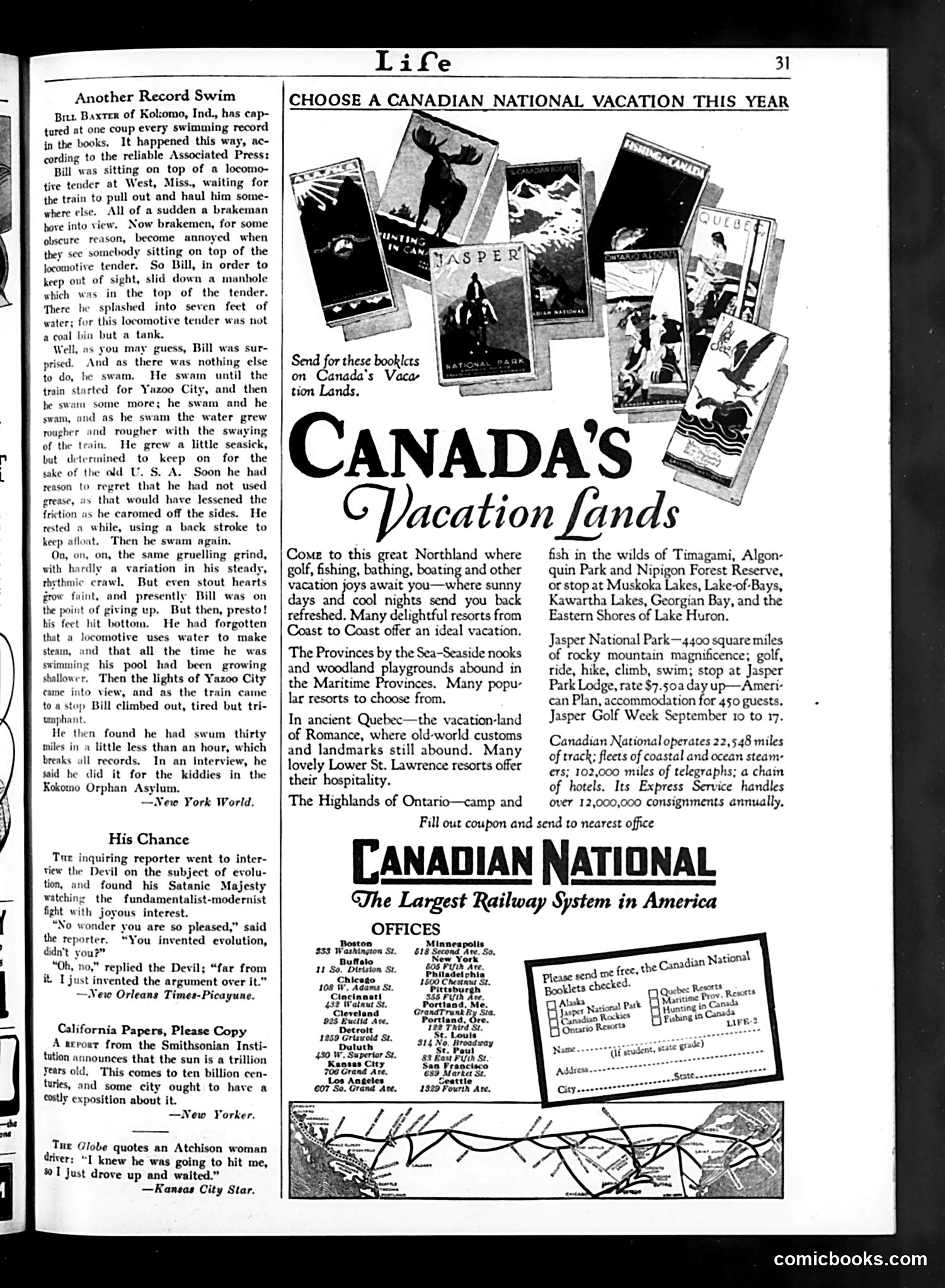
This page contains humorous short stories and an advertisement, not political cartoons. **"Another Record Swim"** is a tall tale about Bill Baxter of Kokomo, Indiana, who accidentally falls into a locomotive tender filled with water while hiding from a brakeman. He swims 30 miles as the train travels to Yazoo City, claiming to break all swimming records. The joke relies on the absurdity of the situation and the tongue-in-cheek claim he did it "for the kiddies in the Kokomo Orphan Asylum"—a maudlin excuse for a ridiculous feat. **"His Chance"** satirizes the 1920s fundamentalist-modernist religious debate by claiming the Devil didn't invent evolution itself, but rather "invented the argument over it"—suggesting the real damage comes from divisive theological fighting rather than the theory itself. The remainder is a Canadian National Railway vacation advertisement encouraging Americans to visit Canada's natural attractions.
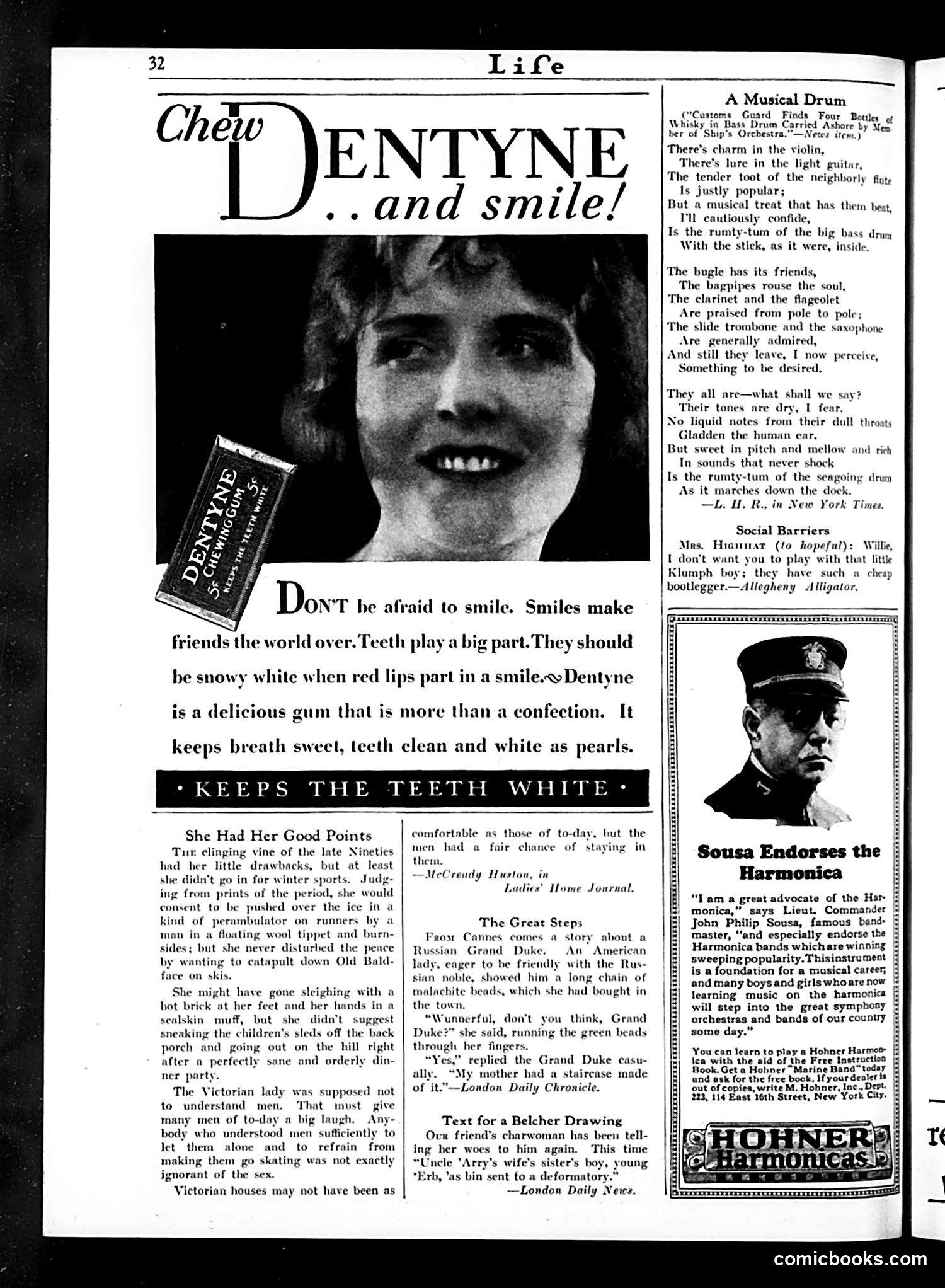
This page is primarily a **Dentyne gum advertisement** featuring a smiling woman with the slogan "Chew Dentyne and smile!" The ad emphasizes that white teeth enhance attractiveness and social success—"Smiles make friends the world over." The surrounding content includes period **humorous essays and anecdotes** typical of Life magazine's satirical format: - "She Had Her Good Points" contrasts Victorian-era women (who were passive and demure) with modern women who engage in active winter sports, suggesting social progress but with implicit criticism of changing gender roles. - "The Great Steps" mocks Russian aristocratic wealth through an anecdote about a Grand Duke's mother owning a malachite staircase. - "A Musical Drum" is a humorous poem about smuggled whisky hidden in a bass drum. The page also includes endorsements (Sousa praising the harmonica) and minor social commentary. The overall effect reflects 1920s-30s American consumer culture blended with light satire of contemporary manners and social change.
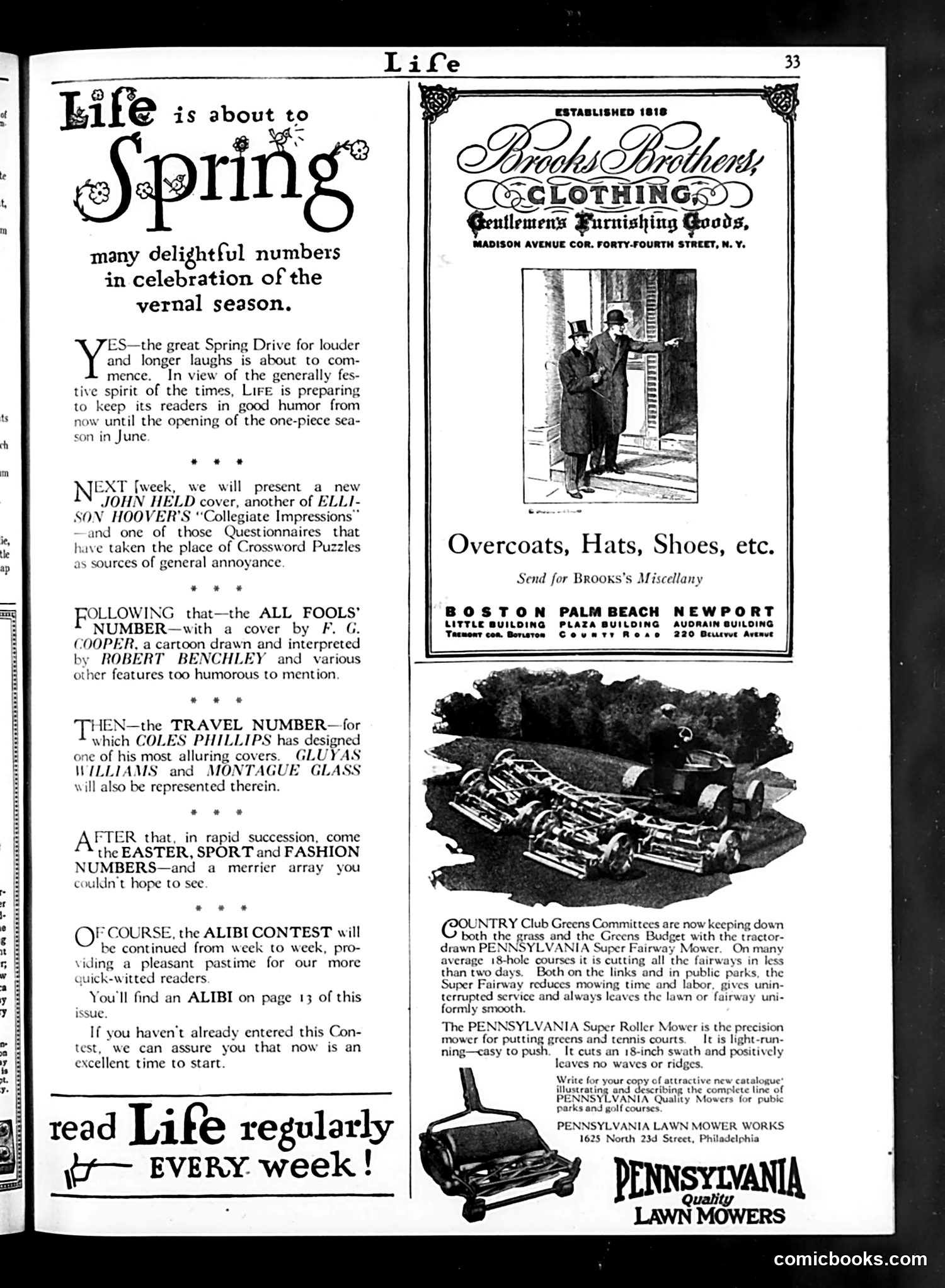
This page is primarily **editorial announcement and advertising** rather than political satire. The left column announces upcoming spring issues of *Life* magazine, teasing readers with themed numbers: a John Held cover, an "All Fools' Number" with cartoonist Robert Benchley, a "Travel Number" by illustrator Coles Phillips, plus Easter, Sport, and Fashion issues. The magazine promotes its "Alibi Contest" as entertainment. The right side contains two unrelated advertisements: Brooks Brothers clothing and Pennsylvania lawn mowers. There are no identifiable political cartoons or satirical figures on this page. The content reflects early 1920s magazine culture—*Life* positioned itself as humor-focused entertainment, with upcoming issues promising lighthearted content featuring popular illustrators and writers of the era.
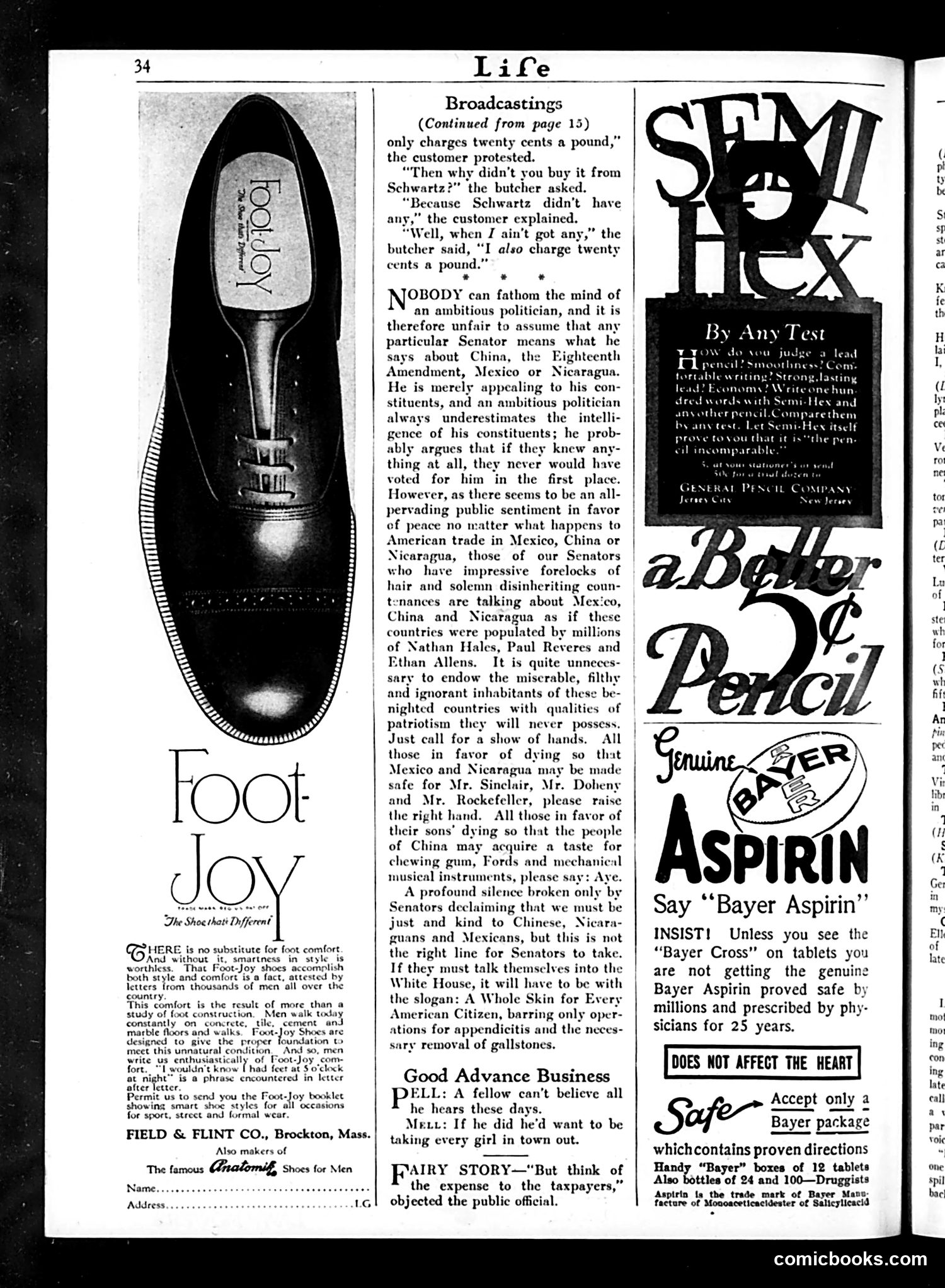
This page is primarily **advertising**, featuring shoe and aspirin ads. However, it includes a notable satirical piece on ambitious politicians. **The Political Satire ("Broadcastings"):** The unnamed author mocks U.S. Senators who publicly support peace regarding Mexico, China, and Nicaragua while actually serving wealthy industrialists' (Sinclair, Doheny, Rockefeller) financial interests. The satire suggests these politicians appeal to constituents' patriotism by invoking American Revolutionary heroes (Nathan Hales, Paul Reveres, Ethan Allens) to justify foreign interventions—when in reality these countries lack such patriotic virtue. The author sarcastically proposes Senators should campaign honestly on "A Whole Skin for Every American Citizen" rather than disguising interventionist agendas as humanitarian or patriotic causes. **Context:** This reflects 1920s debates over American imperialism and intervention in Latin America and Asia, when oil magnates and industrialists influenced foreign policy. The remainder consists of period advertisements for shoes, pencils, and Bayer Aspirin.
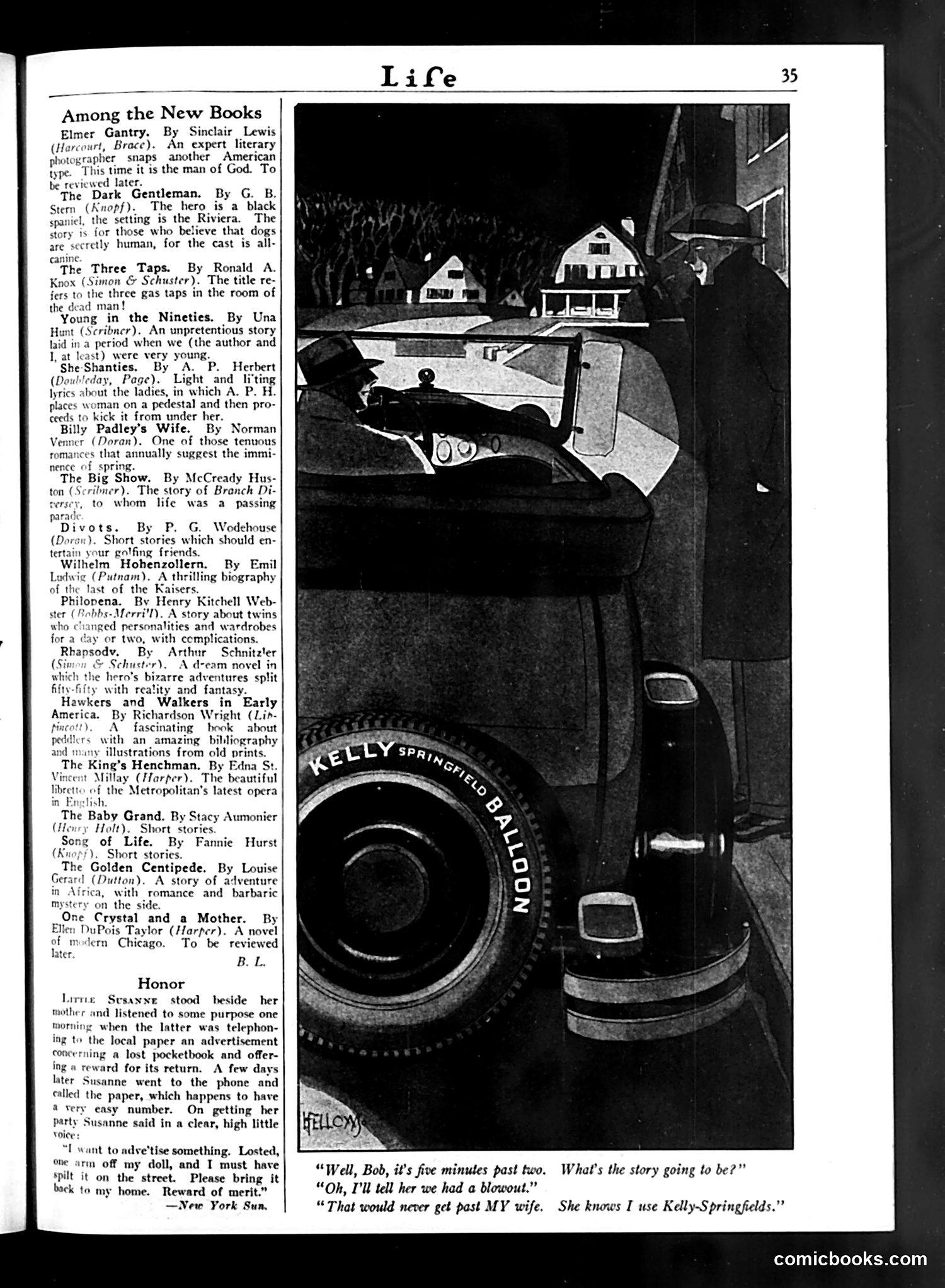
This page contains book reviews and a humorous anecdote, not political cartoons. **The illustration** shows a domestic scene: a man in a car speaks to his wife, who stands nearby. The dialogue reveals the joke's setup—he's making excuses for being late, claiming a "blowout" (tire failure). His wife responds that such an excuse wouldn't work on her because she uses Kelly-Springfield tires (a real tire brand), implying they're reliable and don't blow out. **The humor** is an advertisement disguised as a joke: it's praising Kelly-Springfield brand tires by suggesting they're so dependable that a woman couldn't use a blowout as a cover story for infidelity or tardiness. The "punchline" serves as product endorsement. The page's upper half lists contemporary books (including Sinclair Lewis's *Elmer Gantry*), while the lower section includes a separate anecdote about a child's mock "lost doll" advertisement—innocent period humor, not satire.
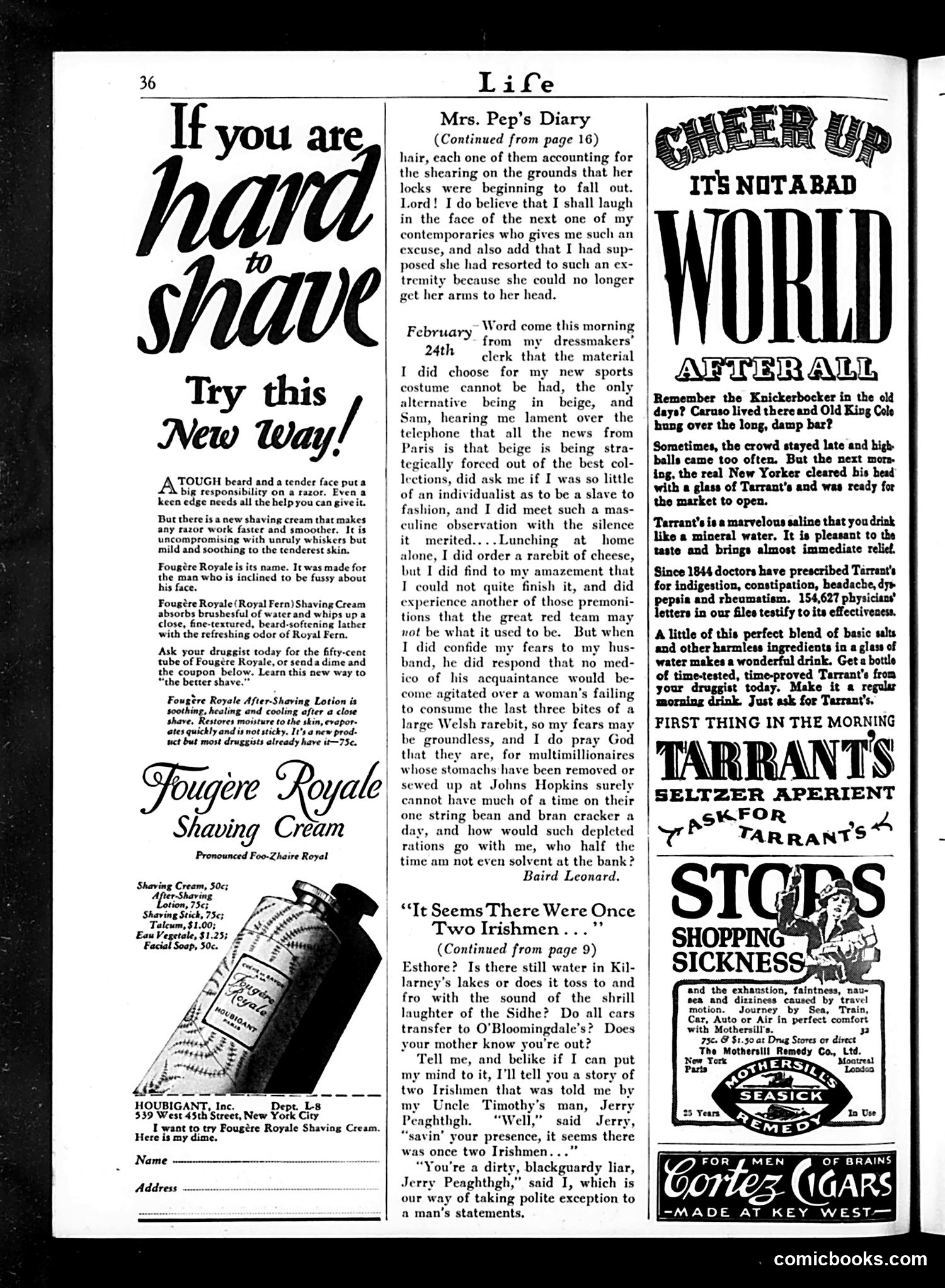
This page is primarily **advertising and light satirical content** rather than political commentary. The main feature is a **Fougère Royale shaving cream advertisement** emphasizing that quality razors need good cream to handle tough beards and tender skin. The ad plays on masculine grooming concerns typical of the era. **"Mrs. Pep's Diary"** is a humor column where a wealthy society woman narrates mundane domestic anxieties—hair loss excuses from female friends, fashion material shortages, and digestive concerns about Welsh rarebit. The satire gently mocks upper-class preoccupations and hypochondria, with her husband dismissively reassuring her that failing to finish cheese is unremarkable. **"It Seems There Were Once Two Irishmen"** appears to be an Irish-themed humorous story fragment. The right column contains period advertisements for Tarrant's (a digestive product), antiseasickness remedies, and Cortiez cigars—typical commercial content for Life magazine of this era. Overall: **This is primarily a commercial and light-humor page with no significant political satire.**
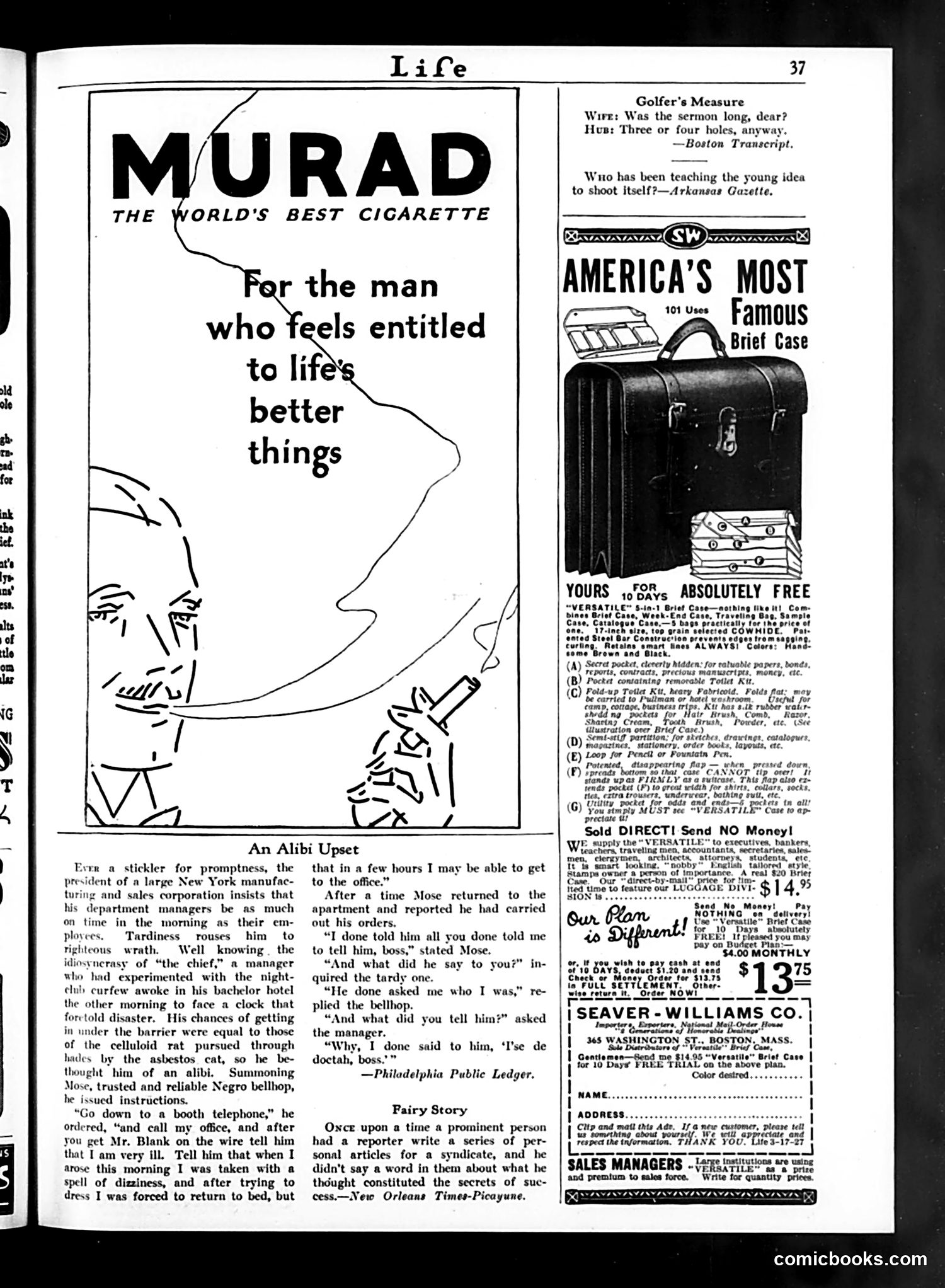
This is a humorous short story (not a political cartoon) playing on racial stereotypes common to 1920s American humor. A late manager instructs his Black bellhop, "Mose," to call his boss and claim he's ill with dizziness. The joke's punchline relies on a dialect-heavy misunderstanding: when the boss asks Mose who he is, Mose replies he's "de doctah" (the doctor)—apparently mishearing or misunderstanding the manager's instructions. The humor derives from the stereotype of African American speech patterns and the ironic failure of the alibi scheme. The satirical target appears to be workplace hypocrisy: a strict manager who demands punctuality from employees while himself being chronically late. However, the execution relies entirely on racist caricature rather than clever social commentary. The piece reflects the casual racial mockery that was normalized in early 20th-century American magazines.
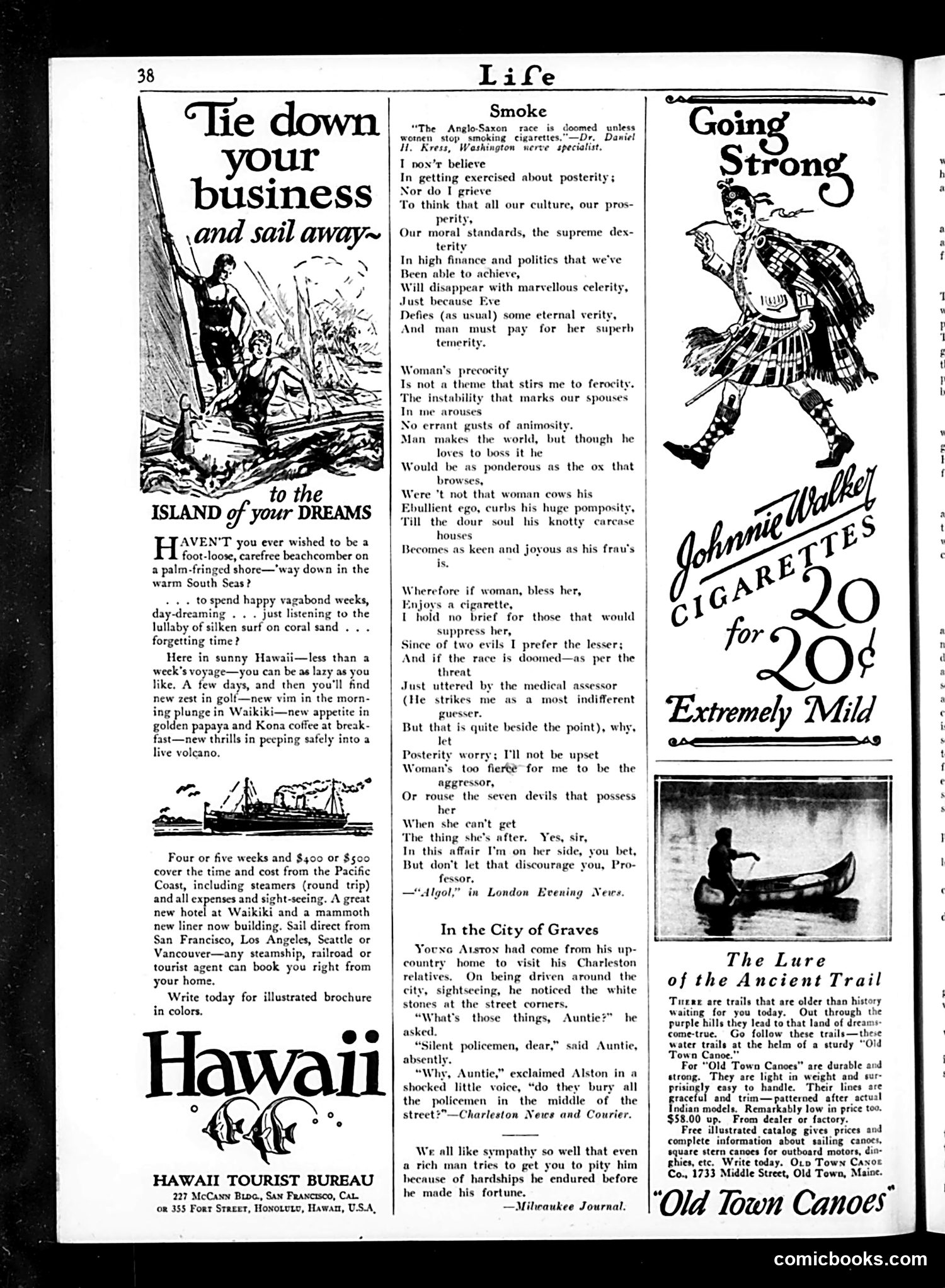
This page combines **advertisements** with **satirical poetry and humor**: **Left side:** A Hawaii Tourist Bureau ad encouraging escapes to tropical leisure—typical 1920s-30s vacation marketing. **Center:** A poem titled "Smoke," attributed to "Algol" in the *London Evening News*, satirizing contemporary debates about women smoking cigarettes. A "medical assessor" has warned the Anglo-Saxon race faces doom unless women stop smoking. The poet humorously argues he won't oppose women's smoking because women's vitality (their "fierceness") keeps men from pomposity—so if the race must decline, so be it. This mocks both anti-smoking moralism and anxieties about "modern woman." **Below:** "In the City of Graves"—a brief joke where a Southern boy mistakes white street corner markers ("silent policemen"—traffic markers) for actual graves of police officers, poking fun at rural ignorance. **Right side:** Johnnie Walker cigarette ad and "Old Town Canoes" advertisement. The page reflects 1920s-30s concerns: women's changing social roles, smoking as modernity, and nostalgic appeals to "ancient trails."
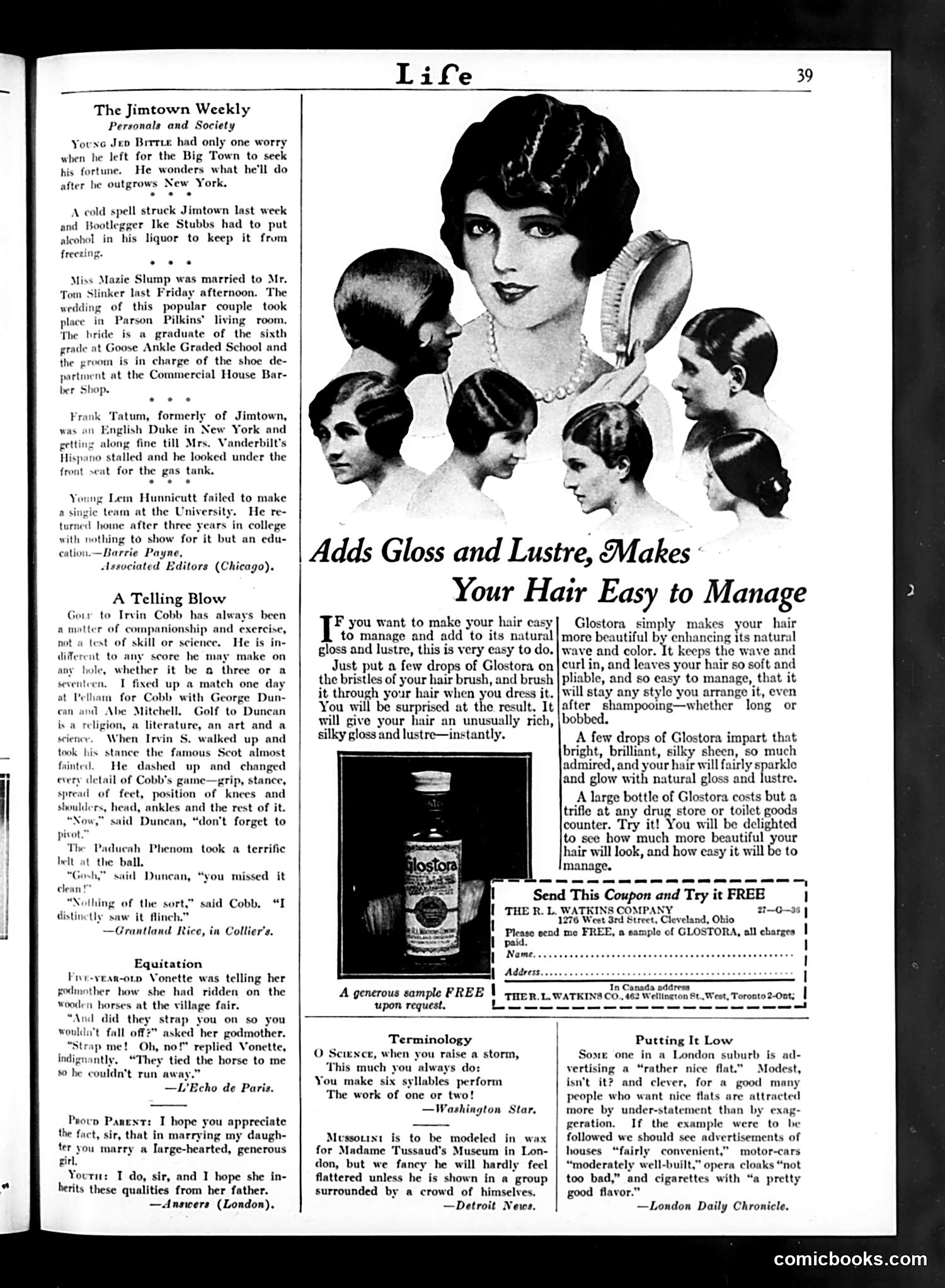
This page is primarily **advertising and light satirical humor** rather than political content. The main feature is a **Glostora hair product advertisement** showing a woman's face surrounded by six profile views of bobbed hairstyles—reflecting 1920s fashion trends. The left column contains short humor pieces from "The Jimtown Weekly," satirizing small-town life and rural America. The jokes mock: - Rural naïveté (a man worried about outgrowing New York) - Prohibition-era bootlegging - Simple country weddings and small-town social climbing Other pieces reference **Ty Cobb** (famous baseball player) and golfer **Abe Mitchell**, using their stories for comedic effect about competitive sports. The satire is gentle and nostalgic rather than biting—poking fun at rural American life for urban readers. The page's real purpose is selling **Glostora** hair product to women seeking the fashionable "bobbed" hairstyles visible in the advertisement's central illustration. This reflects 1920s consumer culture and changing women's beauty standards.
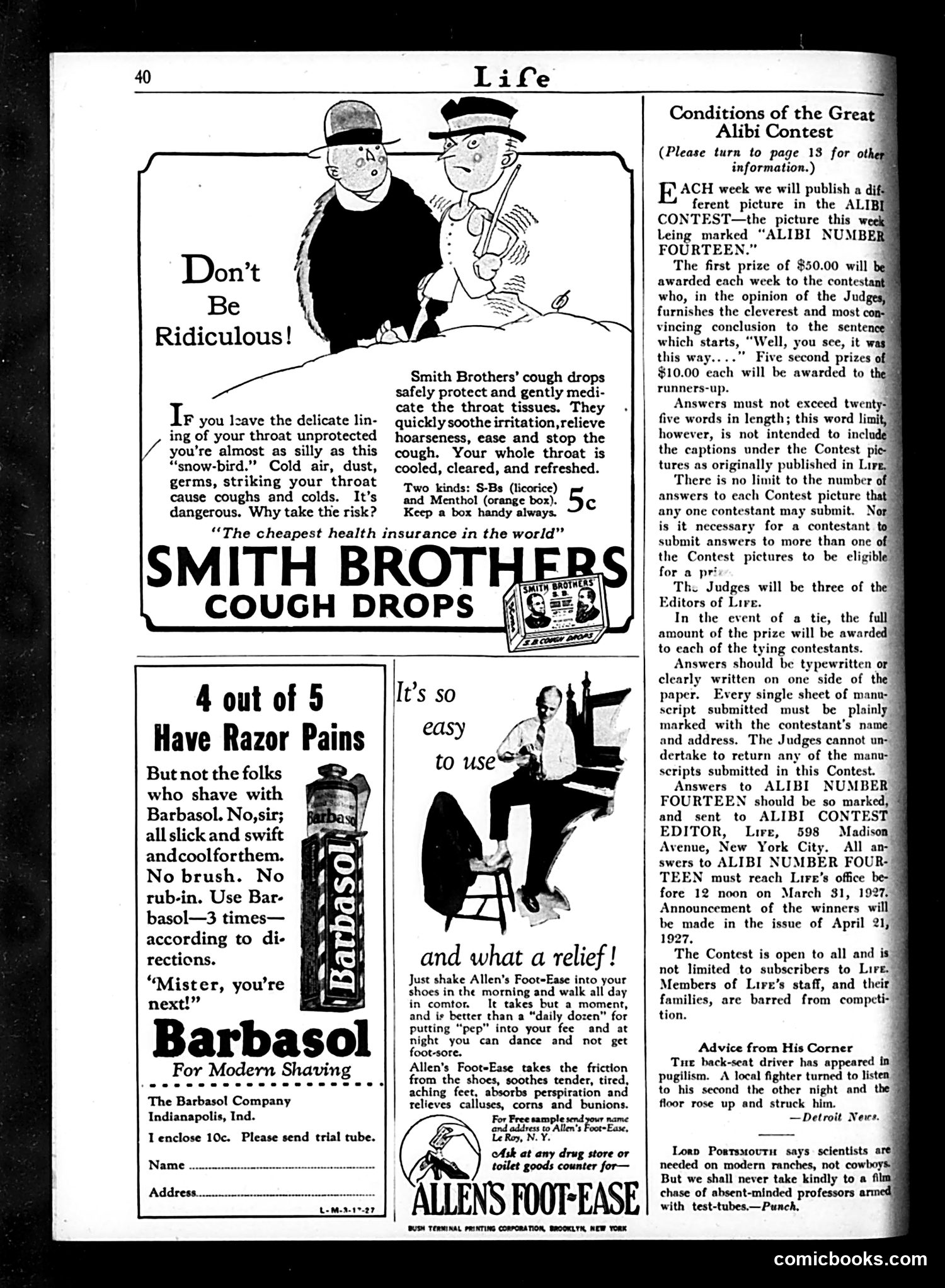
This is primarily a **product advertisement page** from Life magazine (circa 1927), featuring three unrelated consumer ads: Smith Brothers cough drops, Barbasol shaving cream, and Allen's Foot-Ease powder. The top cartoon mocks people who expose their throats to cold without protection—calling them as foolish as a "snow-bird" (appears to mean someone unprepared for winter). It's satirizing health anxiety and selling cough drops as "cheapest health insurance." The other ads use similar fear-based marketing: razors causing pain, sore feet ruining your day. They offer simple solutions to everyday bodily discomforts. The right column announces Life's "Alibi Contest"—readers submit humorous punchlines completing "Well, you see, it was this way..." with prizes up to $50. Small corner items include light humor columns about back-seat drivers and scientific ranching. This reflects 1920s advertising's emphasis on modern convenience and solutions to minor physical complaints.

I can see this is a page from Life magazine, but the image is extremely dark and degraded, making it nearly impossible to discern specific cartoon content, text, or figures with any clarity. While I can make out the white left margin with some text fragments and the "comicbooks.com" watermark at the bottom right, the actual cartoon or content occupying the main area of the page is not legible enough to identify specific political figures, caricatures, or satirical references. To provide an accurate historical analysis as requested, I would need a clearer, higher-contrast version of this page.