
Life, 1927-03-17 · page 24 of 43
Life — March 17, 1927 — page 24: what you’re looking at
What you’re looking at
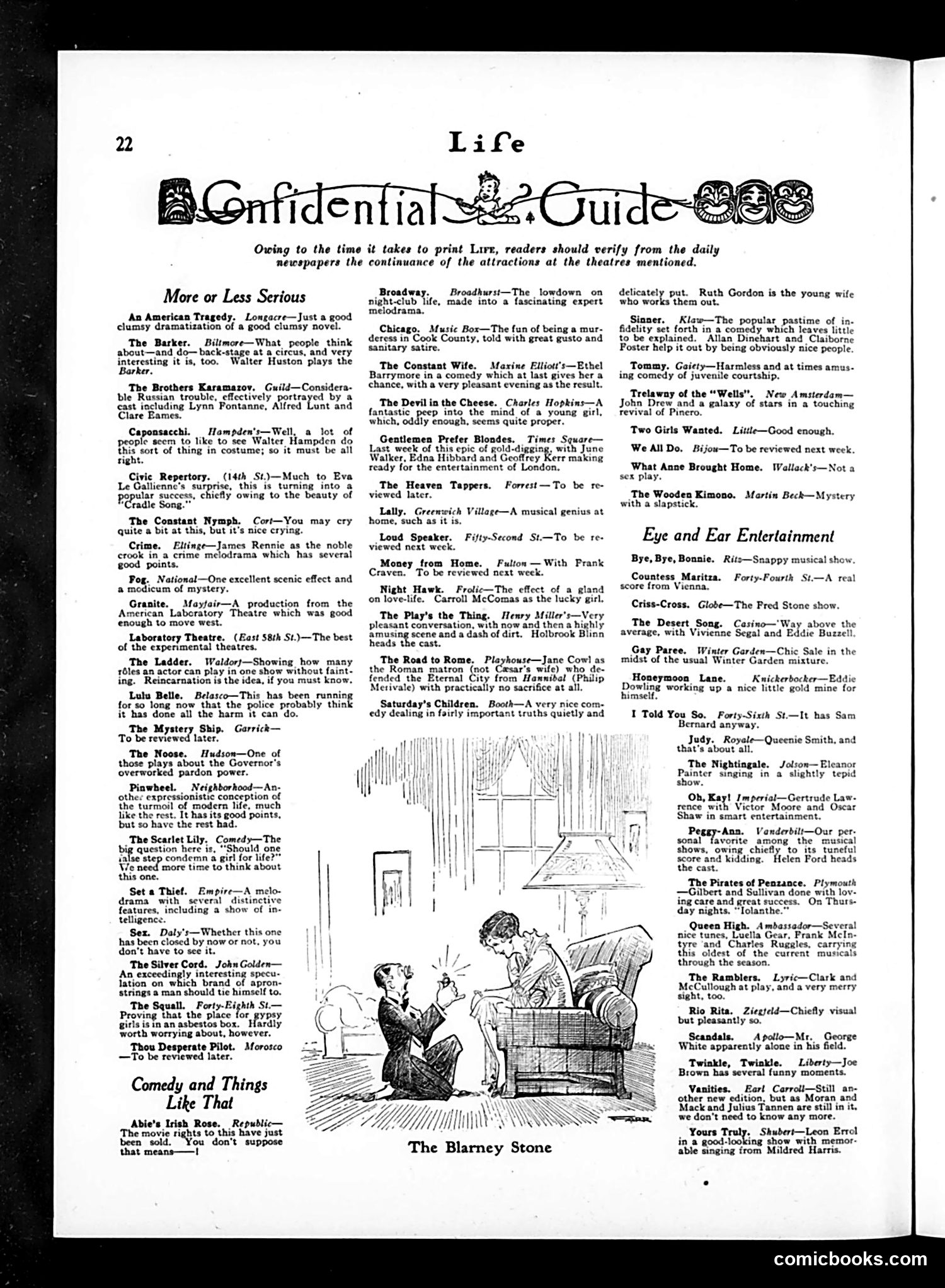
This is a theater review section from *Life* magazine's "Confidential Guide" to Broadway and theatrical productions. The cartoons and text provide entertainment criticism from approximately the 1920s era. The central cartoon titled "The Blarney Stone" depicts a man kissing a stone (likely an Irish tourist trope), illustrating the magazine's satirical approach to entertainment culture. The reviews themselves mock theatrical productions with dry, often dismissive commentary—some sympathetically ("just a good clumsy dramatization"), others harshly ("police probably think it has done all the harm it can do" regarding *Luly Belle*). The "Eye and Ear Entertainment" section reviews musicals and lighter fare. References to specific actors like Ethel Barrymore and production details ground these as contemporary reviews of now-obscure plays. For modern readers, this reveals how *Life* positioned itself as witty cultural arbiter, using brevity and snark to guide readers toward worthwhile entertainment—a function now performed by contemporary review aggregators and critics.
📄 Transcribed text from this page (OCR, searchable)
Machine-transcribed from the original scan — historical spelling and the odd misread are preserved.
Owing to the time it takes to print Lire, readers should verify from the daily newspapers the continuance of the attractions at the theatres mentioned. More or Less Serious An American Tragedy. Longacre—Just a good clumsy dramatization of a good clumsy novel. The Barker. Biltmore—What people think about—and do— back-stage at a circus, and very interesting it is, too. Walter Huston plays the Barker. The Brothers Karamazov. Guild—Considera- ble Russian trouble, effectively portrayed by cast including Lynn Pontanne, Alfred Lunt and Clare Eames. Caponsacchi. people seem to like to see Walter Hampden do this sort of thing in costume; so it must be all right. Civic Repertory. (14th St.)\—Much to E Le Gallienne's surprise, this is turning into a ular success, chiefly owing to the beauty of Peadle Song.” Hampden's—Well, a lot of The Constant Nymph. Cor!—You may cry quite a bit at this, but it’s nice crying. Crime. Eltinge—James Rennie as the noble crook in a crime melodrama which has several good points. Fog. National—One excellent scenic effect and a modicum of mystery. Granite. Mayfair—A production from the American Laboratory Theatre which was good enough to move west. Laboratory Theatre. (East S8th St.)—The best of the experimental theatres. The Ladder. Waldorf/—Showing how many rOles an actor can play in one show without faint- ing. Reincarnation is the idea, if you must know, Luly Belle. Belasco—This. has been running for so long now that the police probably thin it has done all the harm it can do. The Mystery Ship. Garrick— To be reviewed lat The Noose. Hudson—One of those plays about the Governor's overworked pardon power. Pinwheel. Neighborhood—An- other expressionistic conception of the turmoil of modern life, much like the rest, It has its good points, but so have the rest had. ‘The Scarlet Lily. Comedy—The big question here is, “Should one salse st condemn a girl for life?” ie need more time to think about this one. Set a Thiet. Empire—A melo- drama with several distinctive features, including a show of in- telligence. Sex. Daly's—Whether this one has been closed by now or not, you don't have to see it. The Silver Cord. John Golden— An exceedingly interesting specu- lation on which brand of apron- strings a man should tie himself to. The Squall. Forty-Eighth St.— Proving that the place for gypsy girls is in an asbestos box. Hardly worth worrying about, however. Thou Desperate Pilot. Morosco —To be reviewed later. Comedy and Things Like That Abie’s Irish Rose. Republic— The movie rights to this have just been sold. fou don't suppose that means—! Broadway. Broadhurst—The lowdown on night-club life, made into a fascinating expert melodrama. Chicago, Music Box—The fun of being a mur- deress in Cook County, told with great gusto and Sanitary satire. The Constant Wife. Marine Elliott's—Ethel Barrymore in a comedy which at last gives her a chance, with a very pleasant evening as the result. The Devil in the Cheese. Charles Hopkins—A fantastic Bere, into the mind of a young girl, which, oddly enough, seems quite proper. Gentlemen Prefer Blondes. Times Square— Last week of this epic of gold-digging, with June Walker, Edna Hibbard and Geoffrey Kerr making ready for the entertainment of London. The Heaven Tappers. Forrest —To be re- viewed later. Lally. Greenwich Village—A musical genius at home, such as it is, Loud Speaker. Fifty-Second St—To be re- viewed next week. Money from Home. Fulton —With Prank Craven. To be reviewed next week. Night Ha’ Frolic—The effect of a gland on love-life. Carroll McComas as the lucky girl. The Play's the Thing. Henry Miller’s—Very pleasant conversation, with now and then a highly amusing scene and a dash of dirt. Holbrook Blinn heads the cast. The Road to Rome. Playhouse—Jane Cow! as the Roman matron (not Caesar's wife) who de- fended the Eternal City from Hannibal (Philip Merivale) with practically no sacrifice at all, Saturday's Children. Booth—A very nice com- edy dealing in feirly important truths quietly and The Blarney Stone delicately put. Ruth Gordon is the young wife who works them out. Sinner. Klow—The popular pastime of in- fidelity set forth in a comedy which leaves little to be explained. Allan Dinehart and Claiborne Poster help it out by being obviously nice people. _ Tommy. Goiety—Harmless and at times amus- ing comedy of juvenile courtship. Trelawny of the “Wells”. New Amsterdam— John Drew and a galaxy of stars in a touching Tevival of Pinero. Two Girls Wanted. We All Do. Little—Good enough. Bijou—To be reviewed next week. Anne Brought Home. Wallack’s—Not a Whi sex pla: The Wooden Kimono. Martin Beckh—Mystery with a slapstick. Eye and Ear Entertainment Bye, Bye, Bonnie. Rits—Snappy musical show. Countess Maritza. Forty-Fourth St.—A real score from Vienna, Criss-Cross. Globe—The Pred Stone show. The Desert Song. Casino—'Way above the average, with Vivienne Segal and Eddie Buzzell Gay Paree. Winter Garden—Chic Sale in the midst of the usual Winter Garden mixture. Honeymoon Lane. Knickerbocker—Eddic Dowling working up a nice little gold mine for himself, I Told You So. Forty-Sixth St—It has Sam Bernard anyway. Judy. Royale—Queenie Smith, and that’s about all. The Nightingale. Jolson—Eleanor Painter singing in a slightly tepid show. Ob, Kay! Im perial—Gertrude Law- rence with Victor Moore and Oscar ‘Shaw in smart entertainment. Peggy-Ana. Vanderdil!i—Our per- sonal favorite among the musical shows, owing chiefly to its tuneful score and kidding. Helen Ford heads the cast. The Pirates of Penzance. Plymouth Gilbert and Sullivan done with lov- ing care and great success. On Thurs- day nights. “lolanthe.” Queen High. Ambassador—Several nice tunes, Luella Gear, Prank McIn- tyre and ‘Charles Ruggles, carrying this oldest of the current musicals through the season. The Ramblers. Lyric—Clark and McCullough at play, and a very merry sight, too. Rio Rita. Ziegteld—Chiefly visual but pleasantly so. Scandals. Apollo—Mr. George White apparently alone in his field. Twinkle, Twinkle. Liberty—Joe Brown has several funny moments. Vanities. Earl Carroll—Still an- other new edition, but as Moran and Mack and Julius Tannen are still in it, we don't need to know any more. Yours Truly. Shuber—Leon Errol in a good-looking show with memor- able singing from Mildred Harris. comicbooks.com