
Life, 1927-03-17 · page 34 of 43
Life — March 17, 1927 — page 34: what you’re looking at
What you’re looking at
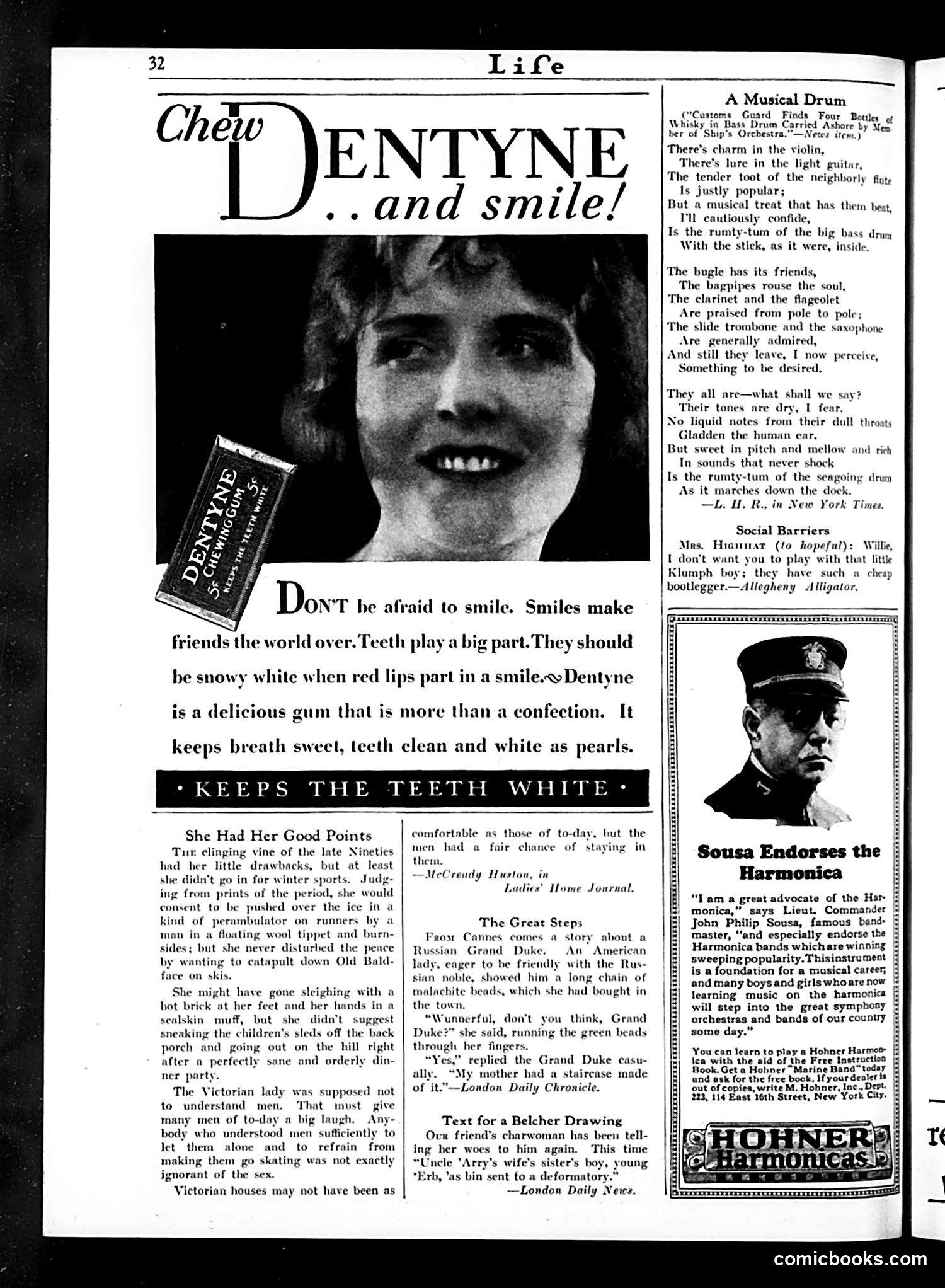
This page is primarily a **Dentyne gum advertisement** featuring a smiling woman with the slogan "Chew Dentyne and smile!" The ad emphasizes that white teeth enhance attractiveness and social success—"Smiles make friends the world over." The surrounding content includes period **humorous essays and anecdotes** typical of Life magazine's satirical format: - "She Had Her Good Points" contrasts Victorian-era women (who were passive and demure) with modern women who engage in active winter sports, suggesting social progress but with implicit criticism of changing gender roles. - "The Great Steps" mocks Russian aristocratic wealth through an anecdote about a Grand Duke's mother owning a malachite staircase. - "A Musical Drum" is a humorous poem about smuggled whisky hidden in a bass drum. The page also includes endorsements (Sousa praising the harmonica) and minor social commentary. The overall effect reflects 1920s-30s American consumer culture blended with light satire of contemporary manners and social change.
📄 Transcribed text from this page (OCR, searchable)
Machine-transcribed from the original scan — historical spelling and the odd misread are preserved.
32 Chew Life ENTYNE ..and smile/ friends the world over.Teeth play a big part. They should be snowy white when red lips part in a smile.wDentyne is a delicious gum that is more than a confection. It keeps breath sweet, teeth clean and white as pearls. PS THE T HITE She Had Her Good Points Tue clinging vine of the late Nineties had her little drawbacks, but at least she didn't go in for winter sports. Judg- ing from prints of the period, she would consent to be pushed over the ice in a kind of perambulator on runners by a man in a floating wool tippet and burn- sides; but she never disturbed the peace by wanting to catapult down Old Bald- ‘¢ on skis. She might have gone sleighing with a hot brick at her feet and her hands in a sealskin muff, but she didn’t suggest sneaking the children’s sleds off the back porch and going out on the hill right after a perfectly sane and orderly din- ner party. The Victorian lady was supposed not to understand men. That must give many men of to-day a big laugh, Any- body who understood men sufficiently to let them alone and to refrain from making them go skating was not exactly ignorant of the sex. Victorian houses may not have been as comfortable as those of to-day, but the men had a fair chance of sta them. —MeCready Huston, in Ladies’ Home Journal. The Great Steps Faoxt Cannes comes a story about a Russian Grand Duke. An American ger to be friendly with the Rus- sian noble, showed him a long chain of malachite beads, which she had bought in the town. “Wunnerful, don't you think, Grand ” she said, running the green beads through her fingers. “Yes,” replied the Grand Duke casu- ally. “My mother had a staircase made of it."—London Daily Chronicle. Text for a Belcher Drawing Ocn friend’s charwoman has been tell- to him again. This time nele *Arry’s wife’s sister's boy, young *Erb, 'as bin’ sent to a deformatory.” —London Daily News. A Musical Drum ("Customs Guard Finds Four B. Whisky in Bass Drum Ashore by Med! ber of Ship's Orchestra, item.) There’s charm in the violin, ‘There's lure in the light guitar, The tender toot of the neighborly flute Is justly popular; But a musical treat that has them beat, I'll cautiously confide, Is the rumty-tum of the big bass drum With the stick, as it were, inside, The bugle has its friends, The bagpipes rouse the soul, The clarinet and the flageolet Are praised from pole to pole; The slide trombone and the saxophone Are generally admired, And still they leave, I now perceive, Something to be desired, They all are—what shall we say? Their tones are dry, I fear. No liquid notes from their dull throats Gladden the human ear. But sweet in pitch and mellow and rich In sounds that never shock Is the rumty-tum of the seagoing drum As it marches down the dock. —L. H. R., in New York Times. Social Barriers Mns. Hiawitat (to hopeful): Willie, I don't want you to play with that little Klumph boy; they have such a cheap bootlegger.—Allegheny Alligator. | ceecererecsesceee sets seessessreeseeerenees SRNSGSS CEREREAAATSTRERL, TREE Sousa Endorses the Harmonica “Lam a great advocate of the Har- monica,” says Lieut. Commander John Philip Sousa, famous band- master, “and especially endorse the Harmonica bands which are winning sweeping popularity. Thisinstrument is a foundation for a musical career, and many boysand girls whoare now learning music on the harmonica will step into the great symphony orchestras and bands of our country some day.” SARAH AAA ARRAN BAER EREAOR ARAN SRSESEAEAEASSAEY RESEREEEEL You can learn to play a Hohner Harmos ica with the aid of the Free Instruction Book. Get a Hohner “Marine Band” todsy and ask for the free book. If your dealer is out of copies, write M. Hohner, Inc., Dept 223, 114 East 16th Street, New York City. PES SSCS TT OSSAeEPEEHACeCLECLEETE A CLEEELELEEELEESEses eA UECE Core EP EES UL UEPUUO OAS ES CECE EEREACL ECL ESEEEEEESESEEES comicbooks.com