
Life, 1927-03-17 · page 25 of 43
Life — March 17, 1927 — page 25: what you’re looking at
What you’re looking at
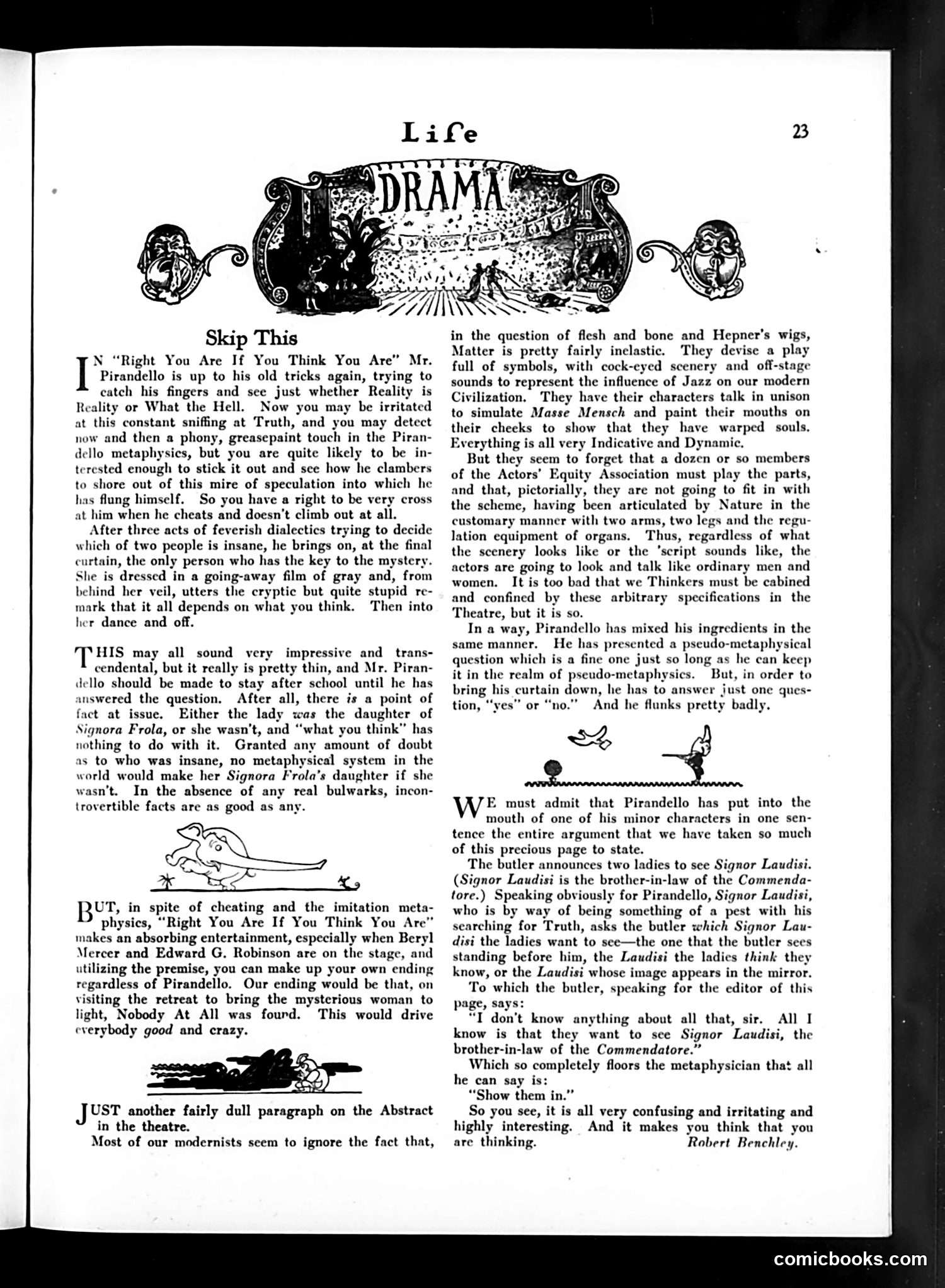
This page reviews Luigi Pirandello's play "Right You Are If You Think You Are," starring Beryl Mercer and Edward G. Robinson. The critic praises the production's entertainment value but attacks Pirandello's philosophical pretensions. **The satire:** The reviewer argues that Pirandello uses pseudo-intellectual "metaphysics" to avoid providing a concrete answer to his play's central mystery—whether a character is actually someone's daughter. The critic mocks modernist theater generally for prioritizing abstract symbolism over practical reality: actors have real bodies with "two arms, two legs," so experimental staging cannot escape human physicality. **The point:** Pirandello "cheats" by ending with a cryptic non-answer ("it all depends on what you think"), which the reviewer finds intellectually dishonest. The critic suggests the play should stay "after school until it answers the question"—treating the playwright like a student avoiding homework. The underlying critique attacks fashionable artistic modernism as pretentious obfuscation masking lazy thinking.
📄 Transcribed text from this page (OCR, searchable)
Machine-transcribed from the original scan — historical spelling and the odd misread are preserved.
N “Right You Are If You Think You Are” Mr. I Pirandello is up to his old tricks again, trying to catch his fingers and see just whether Reality is Reality or What the Hell. Now you may be irritated at this constant sniffing at Truth, and you may detect now and then a phony, greasepaint touch in the Piran- dello metaphysics, but you are quite likely to be in- terested enough to stick it out and sce how he clambers to shore out of this mire of speculation into which he has flung himself. So you have a right to be very cross at him when he cheats and doesn’t climb out at all. After three acts of feverish dialectics trying to decide which of two people is insane, he brings on, at the final curtain, the only person who has the key to the mystery. She is dressed in a going-away film of gray and, from behind her veil, utters the cryptic but quite stupid re- mark that it all depends on what you think. Then into her dance and off. HIS may all sound very impressive and _trans- cendental, but it really is pretty thin, and Mr. Piran- dello should be made to stay after school until he has answered the question. After all, there is a point of fact at issue. Either the lady was the daughter of Signora Frola, or she wasn't, and “what you think” has nothing to do with it. Granted any amount of doubt as to who was insane, no metaphysical system in the world would make her Signora Frola’s daughter if she wasn’t. In the absence of any real bulwarks, incon- trovertible facts are as good as any. GN I UT, in spite of cheating and the imitation meta- physics, “Right You Are If You Think You Are” makes an absorbing entertainment, especially when Beryl Mercer and Edward G. Robinson are on the stage, and utilizing the premise, you can make up your own ending regardless of Pirandello. Our ending would be that, on visiting the retreat to bring the mystcrious woman to light, Nobody At All was fourd. everybody good and crazy. aie Just another fairly dull paragraph on the Abstract in the theatre. Most of our modernists seem to ignore the fact that, This would drive in the question of flesh and bone and Hepner’s wigs, Matter is pretty fairly inelastic. They devise a play full of symbols, with cock-eyed scenery and off-stage sounds to represent the influence of Jazz on our modern Civilization. They have their characters talk in unison to simulate Masse Mensch and paint their mouths on their cheeks to show that they have warped souls, Everything is all very Indicative and Dynamic. But they seem to forget that a dozen or so members of the Actors’ Equity Association must play the parts, and that, pictorially, they are not going to fit in with the scheme, having been articulated by Nature in the customary manner with two arms, two legs and the regu- lation equipment of organs. Thus, regardless of what the scenery looks like or the ‘script sounds like, the actors are going to look and talk like ordinary men and women. It is too bad that we Thinkers must be cabined and confined by these arbitrary specifications in the Theatre, but it is so. In a way, Pirandello has mixed his ingredients in the same manner. He has presented a pseudo-metaphysical question which is a fine one just so long as he can keep it in the realm of pseudo-metaphy But, in order to bring his curtain down, he has to answer just one ques- tion, “yes” or “no.” And he flunks pretty badly. 3% E must admit that Pirandello has put into the mouth of one of his minor characters in one sen- tence the entire argument that we have taken so much of this precious page to state. The butler announces two ladies to see Signor Laudisi. (Signor Laudisi is the brother-in-law of the Commenda- tore.) Speaking obviously for Pirandello, Signor Laudisi, who is by way of being something of a pest with his searching for Truth, asks the butler which Signor Lau- disi the ladies want to see—the one that the butler sees standing before him, the Laudisi the ladies think they know, or the Laudisi whose image appears in the mirror. To which the butler, speaking for the editor of this page, says: “I don’t know anything about all that, sir. All I know is that they want to see Signor Laudisi, the brother-in-law of the Commendatore.” Which so completely floors the metaphysician that all he can say is: “Show them in.” So you see, it is all very confusing and irritating and highly interesting. And it makes you think that you are thinking. Robert Benchley. comicbooks.com