
A complete issue · 43 pages · 1927
Life — February 10, 1927
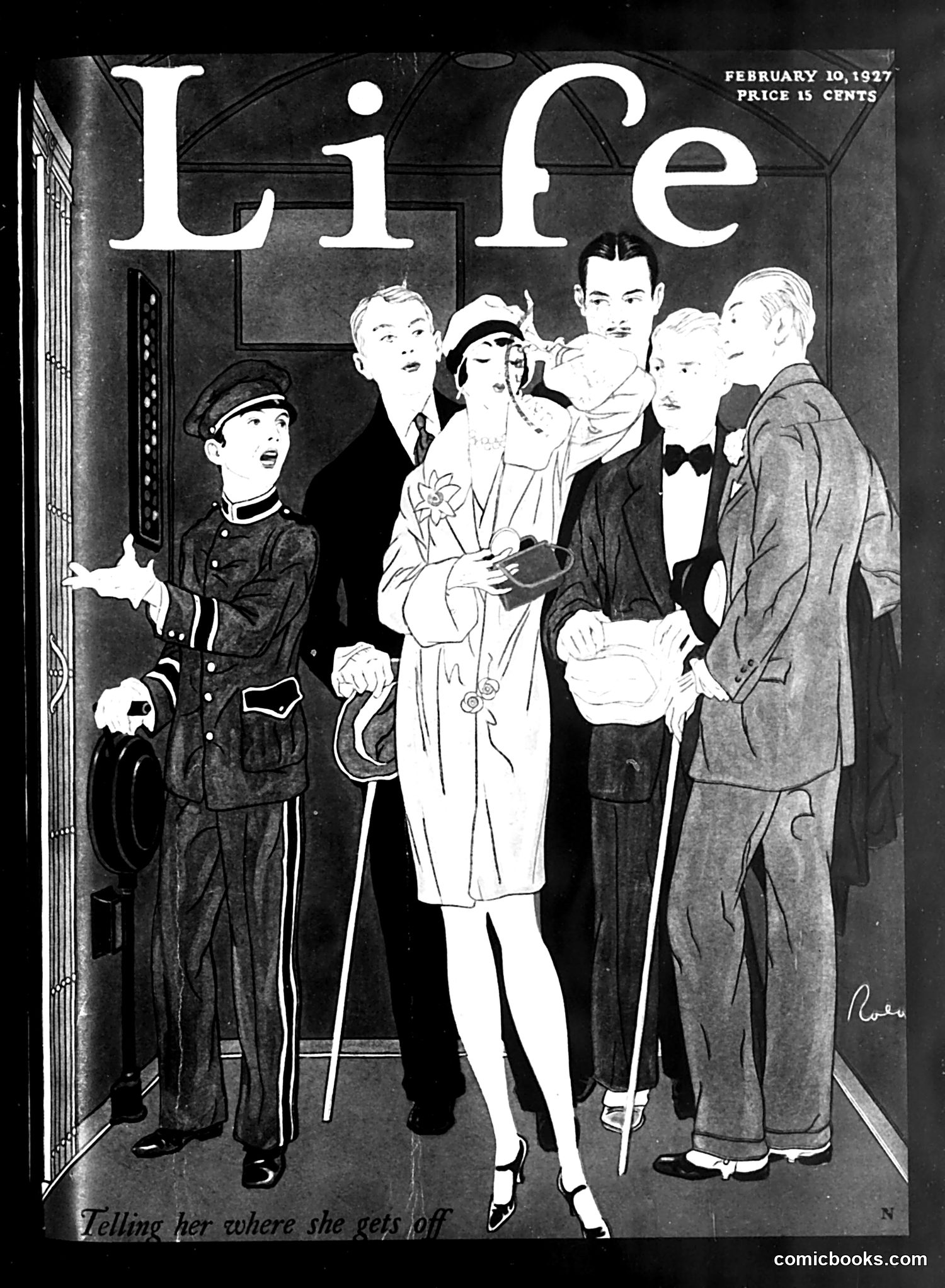
**What We See:** This cover depicts an elevator scene with a uniformed bellhop/operator on the left and several well-dressed men in suits surrounding a woman in a light-colored coat holding what appears to be a small animal or purse. **The Joke:** The caption reads "Telling her where she gets off," which is a double entendre. In 1920s slang, "telling someone where they get off" meant confronting or rebuking them. The humor derives from the literal elevator setting combined with the suggestive phrase—the men appear to be giving this woman some form of social or romantic reprimand or comeuppance, likely playing on contemporary attitudes about women's behavior and social propriety during the Jazz Age. The specific context of this situation remains unclear without additional text.
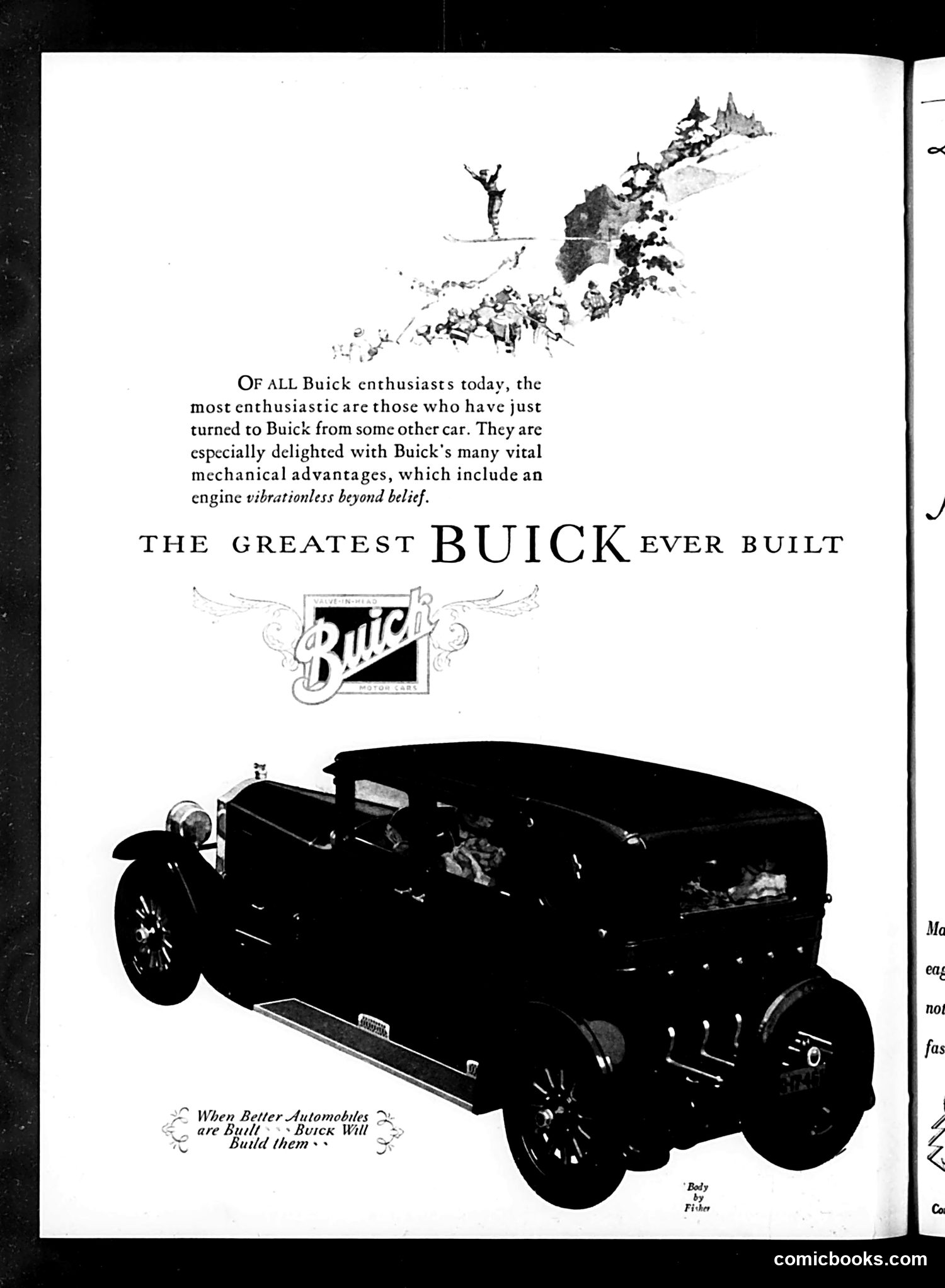
This is primarily **advertising content**, not satire or political commentary. It's a Buick automobile advertisement from an early era (appears to be 1920s based on the vehicle style and design). The page promotes "The Greatest Buick Ever Built" by appealing to recent converts from other car brands, claiming they're most enthusiastic about Buick's mechanical advantages, particularly an engine described as "vibrationless beyond belief." The decorative map at top appears to be purely illustrative branding. The tagline "When Better Automobiles are Built, Buick Will Build Them" is Buick's actual corporate slogan from this period. There is **no political cartoon or satire present**—this is straightforward product marketing using the visual language and design conventions typical of early automobile advertising.
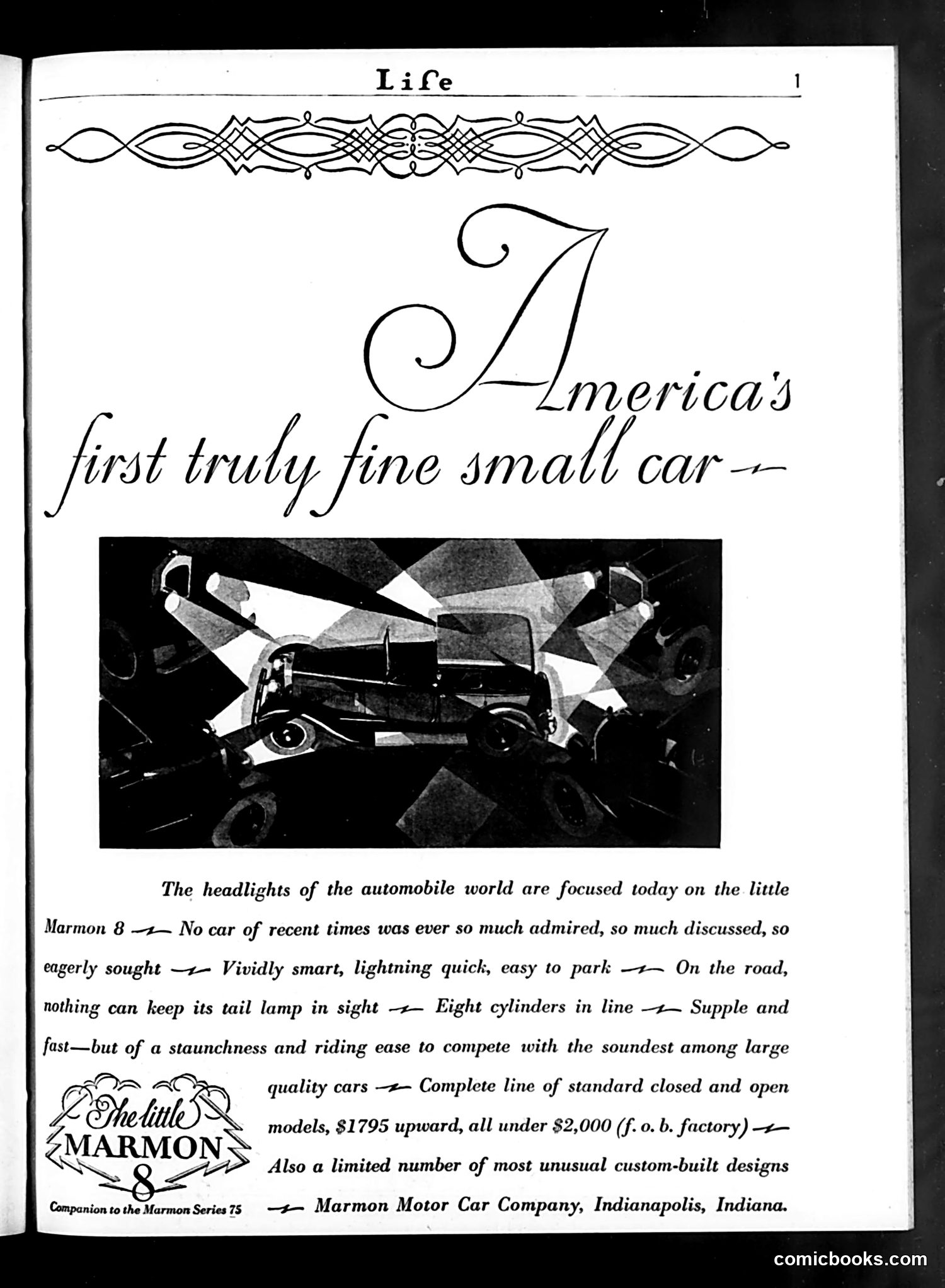
This is **not a cartoon or satire page**—it's a **straightforward advertisement** for the Marmon 8 automobile, published in *Life* magazine (which did run ads alongside humor content). The page promotes the Marmon 8 as "America's first truly fine small car," emphasizing its eight-cylinder engine, quick acceleration, ease of parking, and smooth performance competitive with larger luxury vehicles. The car is priced at $1,795 and up, under $2,000 (factory price). The dramatic photograph shows the car from above at an angle with geometric light patterns, a common modernist advertising aesthetic of the early 20th century. The Marmon Motor Car Company was based in Indianapolis, Indiana. This represents period automotive marketing rather than political or social satire.
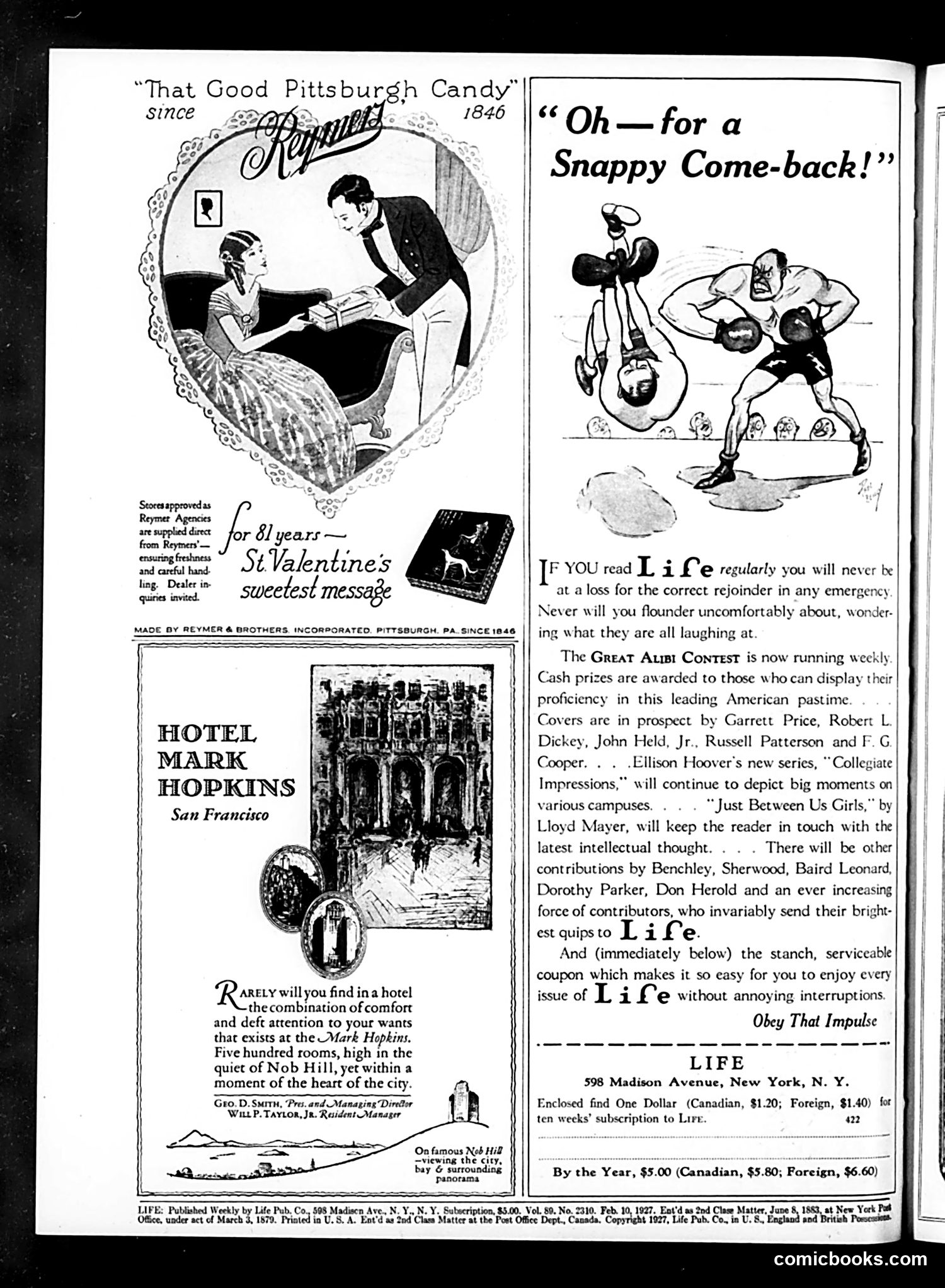
This page is primarily **advertising and magazine promotion** rather than political satire. The left side features a **Reymer candy advertisement** (established 1846) showing a romantic scene—a man presenting chocolates to a woman—tied to St. Valentine's Day messaging. The right cartoon depicts **boxing**, with the caption "Oh—for a Snappy Come-back!" showing a boxer being knocked down, illustrating the phrase's figurative meaning (a witty retort). This appears to be generic sports humor. Below are advertisements for the **Hotel Mark Hopkins** in San Francisco and a **subscription offer for Life magazine itself**, emphasizing its regular contributors and humor content. The page demonstrates how early-20th-century magazines mixed editorial content with advertising, rather than presenting sustained political commentary.
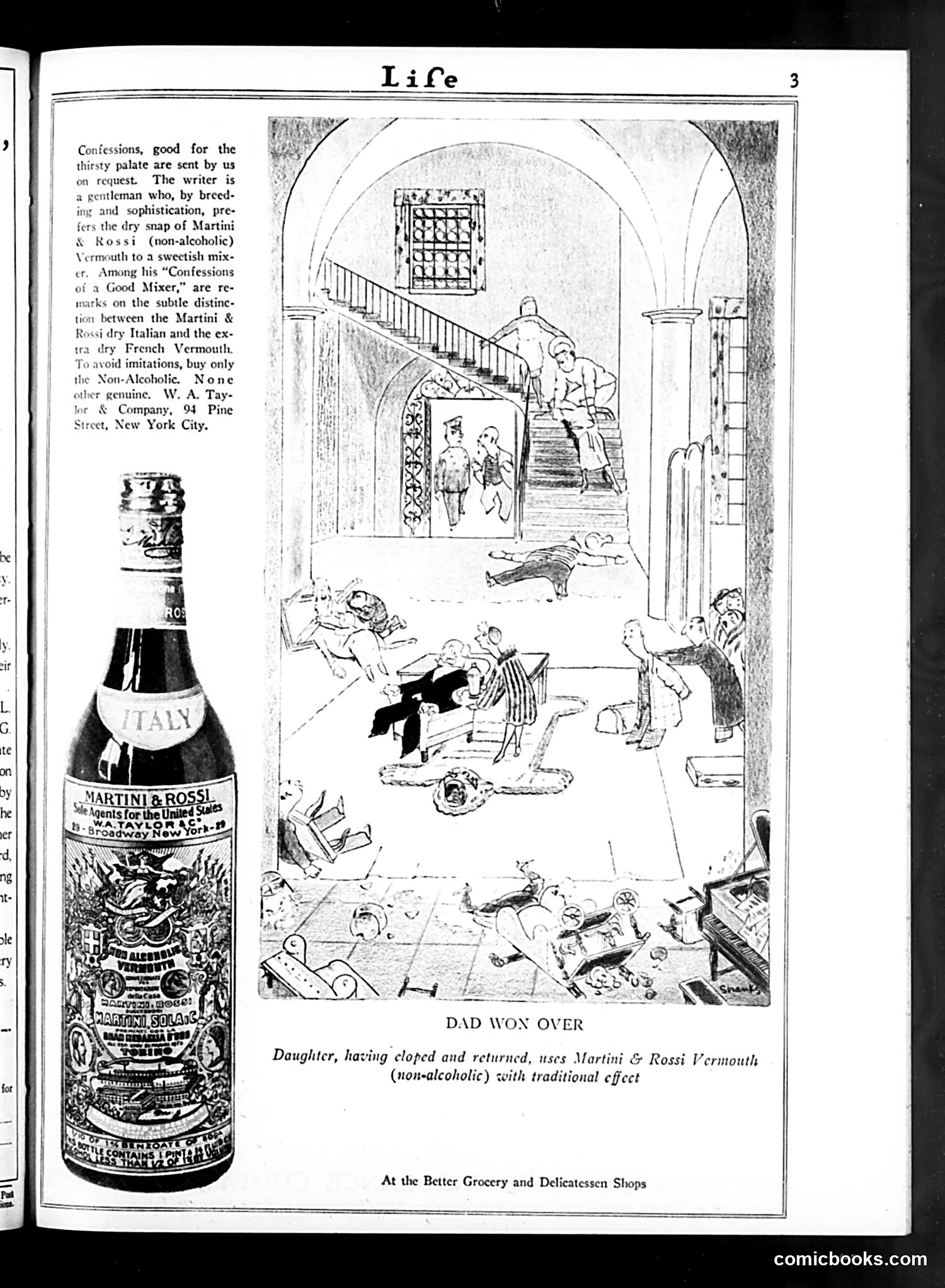
This page is primarily a **Martini & Rossi vermouth advertisement** disguised as editorial content in Life magazine. The cartoon titled "Dad Won Over" depicts a domestic scene where a daughter who "having eloped and returned, uses Martini & Rossi Vermouth (non-alcoholic) with traditional effect." The joke plays on the idea that serving this sophisticated drink helps reconcile family conflict—the non-alcoholic vermouth somehow smooths over the scandal of her elopement and return. The humor relies on the absurd premise that offering a fancy beverage could resolve serious domestic tension. The accompanying text promotes the product's authenticity while emphasizing its non-alcoholic nature, likely appealing to Prohibition-era sensibilities when alcohol was legally restricted in America.
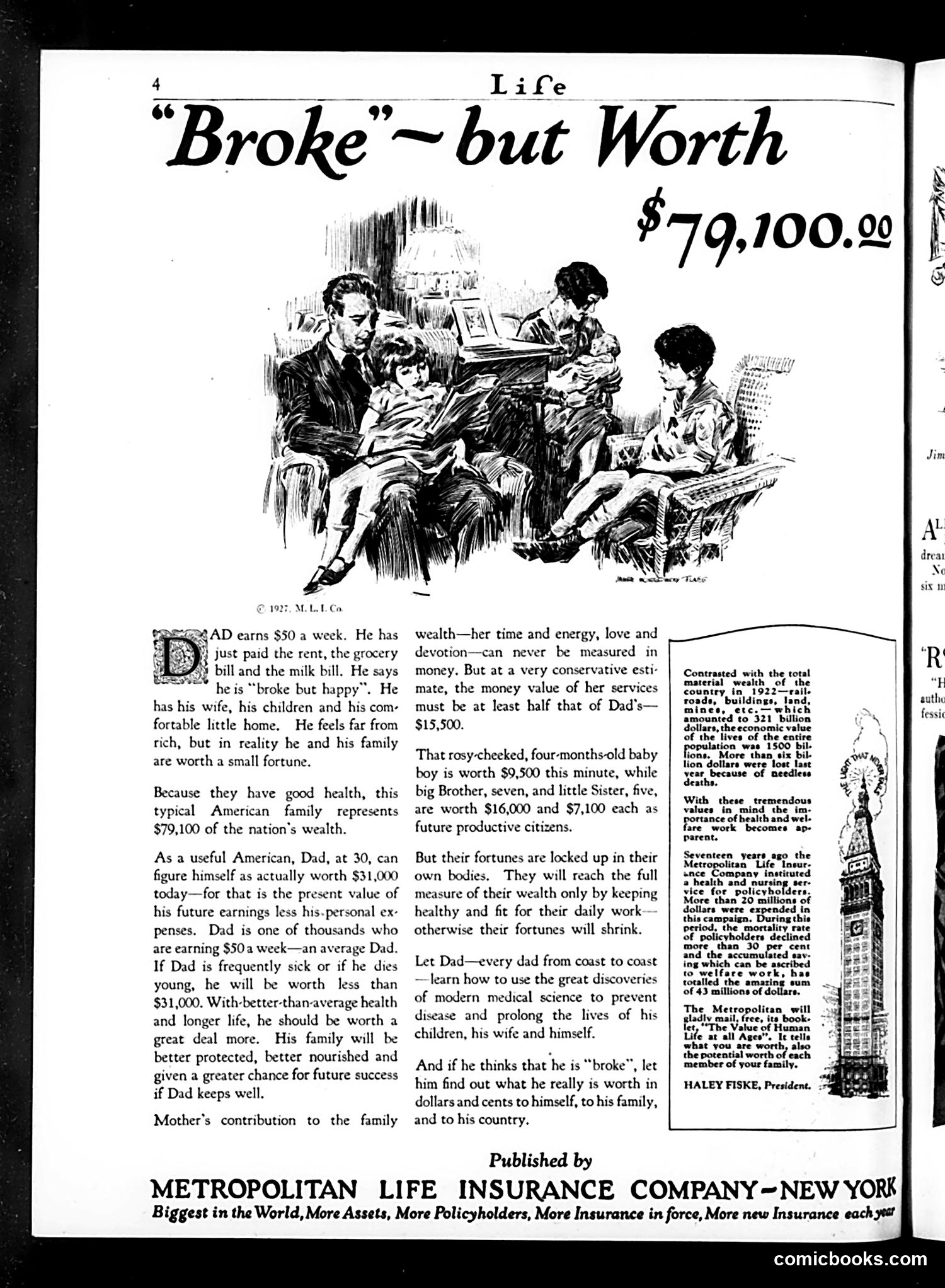
This is primarily a **Metropolitan Life Insurance advertisement**, not satire or political commentary. The page uses the headline "Broke—but Worth $79,100.00" to promote life insurance by reframing a working-class family's actual value. The illustration shows a father with children and a mother doing household work. The text argues that despite earning only $50/week and struggling financially, this "typical American family" possesses substantial hidden wealth—calculated at $79,100 through the combined earning potential and life value of all family members. The advertisement's message: life insurance protects this economic value. It appeals to working-class anxiety about financial security while suggesting that even "broke" families have significant worth worth protecting through insurance policies. This reflects 1920s-era marketing targeting ordinary Americans.
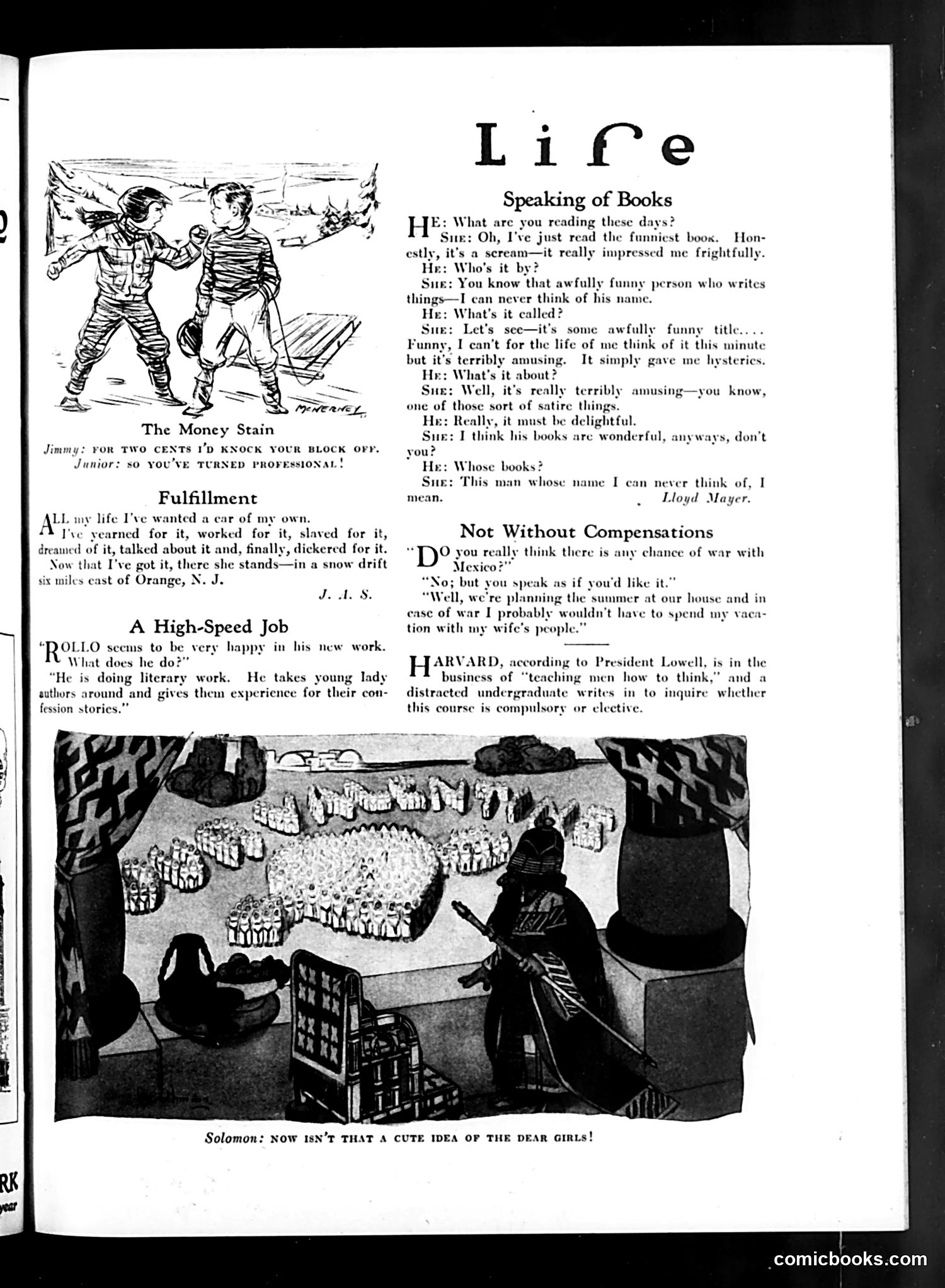
This page contains four distinct satirical pieces from Life magazine's "Speaking of Books" section and humor features. **"The Money Stain"** depicts two boys in a boxing stance, one offering to fight the other for two cents—satirizing petty disputes over trivial amounts. **"Fulfillment"** presents a man's lifelong desire for a car, which he finally obtains, only to find himself stuck in a New Jersey snowdrift—mocking the gap between dreams and reality. **"A High-Speed Job"** jokes about a man named Rollo doing "literary work" by taking young lady authors around and giving them "experience for their confession stories"—a sardonic commentary on dubious editorial practices. The large cartoon depicts what appears to be a military or governmental scene with silhouettes and fortifications, captioned "Solomon: Now isn't that a cute idea of the dear girls!"—likely satirizing women's involvement in wartime planning, though the specific reference remains unclear.
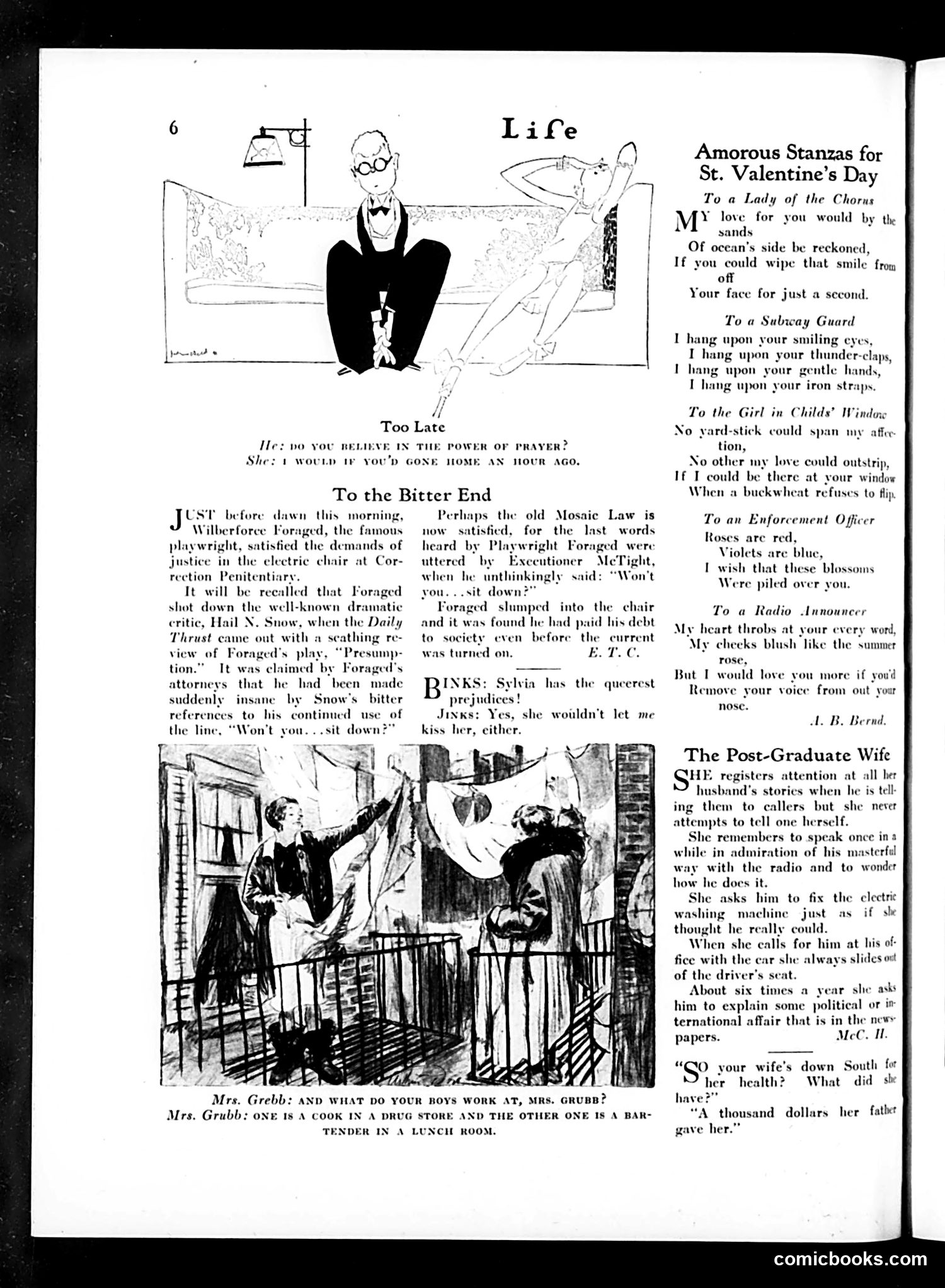
This page contains several pieces of satirical humor rather than a single political cartoon. **"Too Late"** (top): Shows a man slumped in a chair after learning his wife came home an hour ago—despite his prayer that she wouldn't. The joke plays on the powerlessness of prayer against domestic reality. **"To the Bitter End"** (middle): References playwright Forged's execution via electric chair at Sing Sing Prison. The text describes how Forged's bitter performances supposedly drove critic Uhl N. Snow insane, leading Snow to curse Forged's continued use of the phrase "Won't you sit down?"—which Forged allegedly repeats obsessively even facing execution. **"The Post-Graduate Wife"** (bottom right): Satirizes educated wives who bore their husbands by constantly referencing his stories or asking him to fix appliances, appearing uninterested in his actual accomplishments. The humor targets marital dynamics and domestic frustrations.
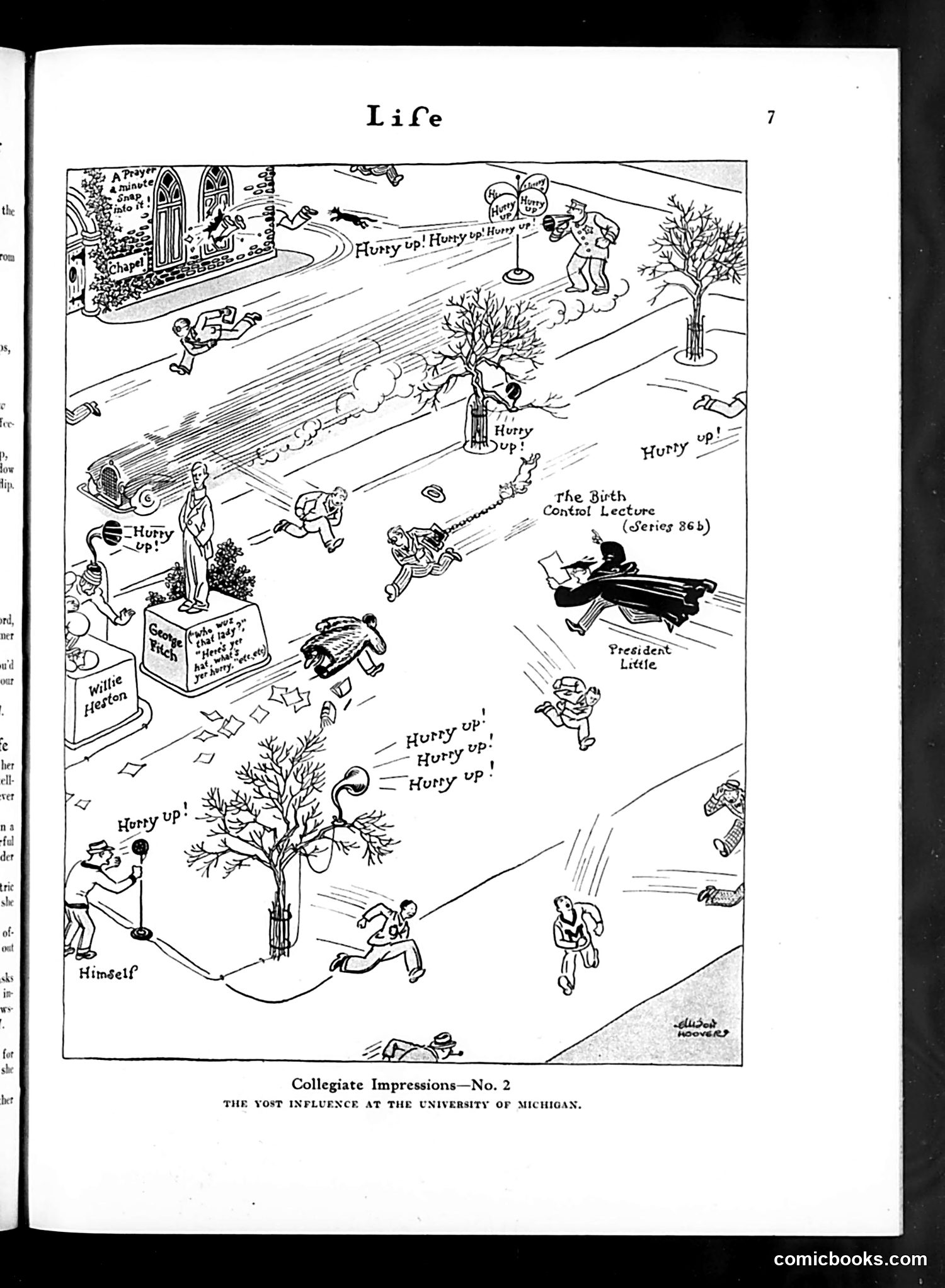
This satirical cartoon depicts campus life at the University of Michigan, with multiple figures labeled "Hurry up!" scattered throughout—suggesting a frenetic, rushed atmosphere. Key labeled figures include Willie Heston, George Felch, Himself, and President Little, along with a "Birth Control Lecture" reference. The cartoon appears to mock the University's hurried pace and the influence of unidentified figures or policies (the "VOST influence" remains unclear). The repeated "Hurry up!" exclamations emphasize frantic activity. References to Willie Heston and President Little suggest these were known campus personalities or administrators of the era. The overall satire critiques college culture's overwhelming pressure and perhaps administrative priorities the cartoonist found excessive or objectionable.
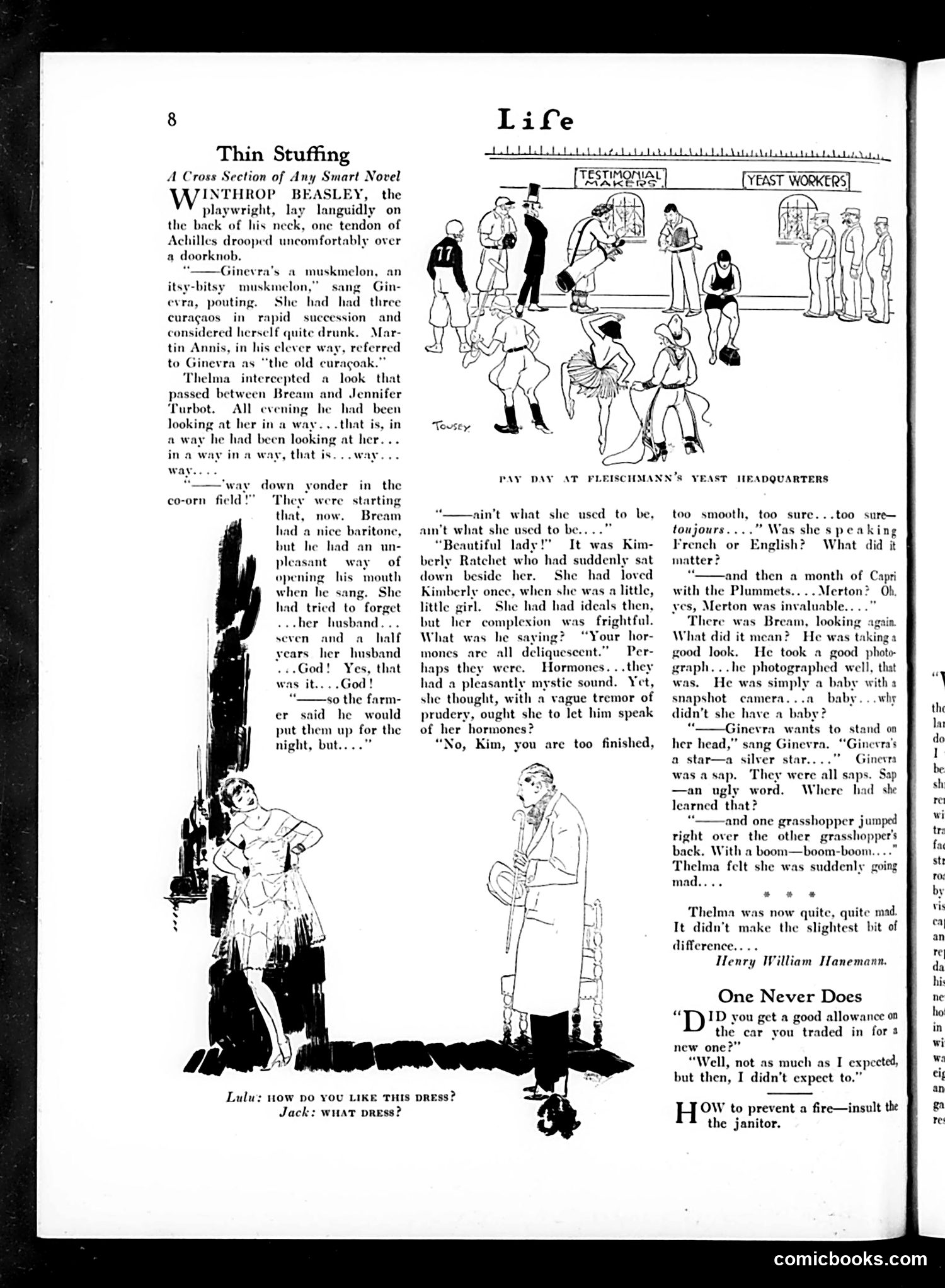
This page contains two separate pieces of satirical content: **"Thin Stuffing"** (left): A narrative story about Winthrop Beasley, a playwright who awkwardly pursues a woman named Thelma at a social gathering. The satire mocks pretentious artistic types and their clumsy social interactions. **"Pay Day at Fleischmann's Yeast Headquarters"** (top right): A cartoon depicting workers at a yeast company facility. The illustration satirizes workplace dynamics and labor conditions in an industrial setting, though the specific satirical point is unclear from the visible text. **"One Never Does"** (bottom right): A brief dialogue joke about allowances and trading in old items—light domestic humor. The overall tone is genteel, urbane satire targeting middle and upper-class social pretensions and workplace absurdities typical of 1920s-era Life magazine humor.
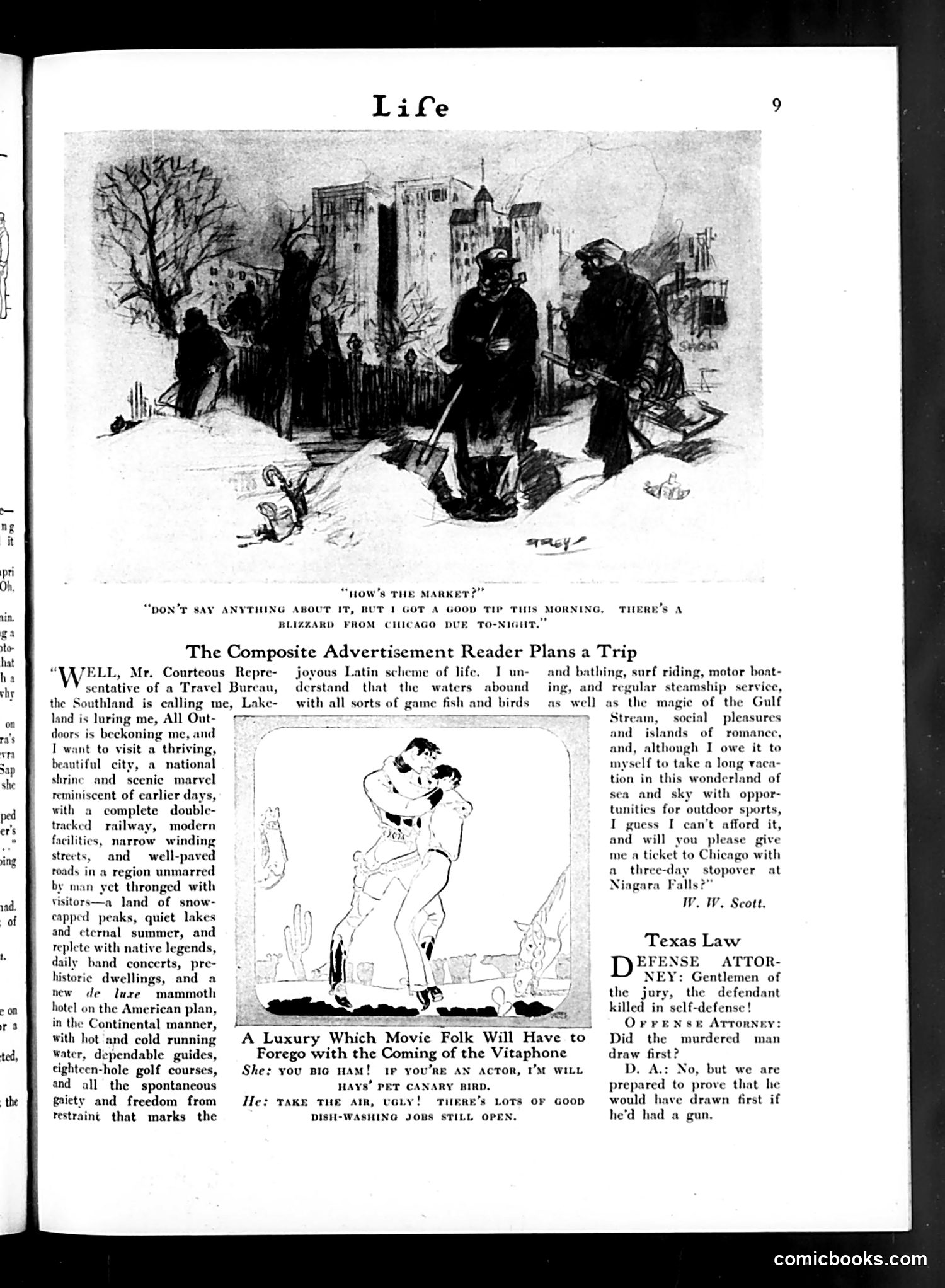
**Top Cartoon:** A winter street scene showing people shoveling snow near a bare tree and city buildings. The caption jokes about bad weather: someone got "a good tip this morning" about a blizzard coming from Chicago—implying the tip was useless since the blizzard arrived anyway. This is simple observational humor about weather and failed advice. **"The Composite Advertisement Reader Plans a Trip":** The main article features a man being pulled in opposite directions by conflicting vacation ads—one promoting the Southland (beaches, golf, warmth) and another promoting Niagara Falls. The satire targets how magazine advertisements oversell competing, mutually exclusive destinations to readers, creating absurd desire for impossible trips.
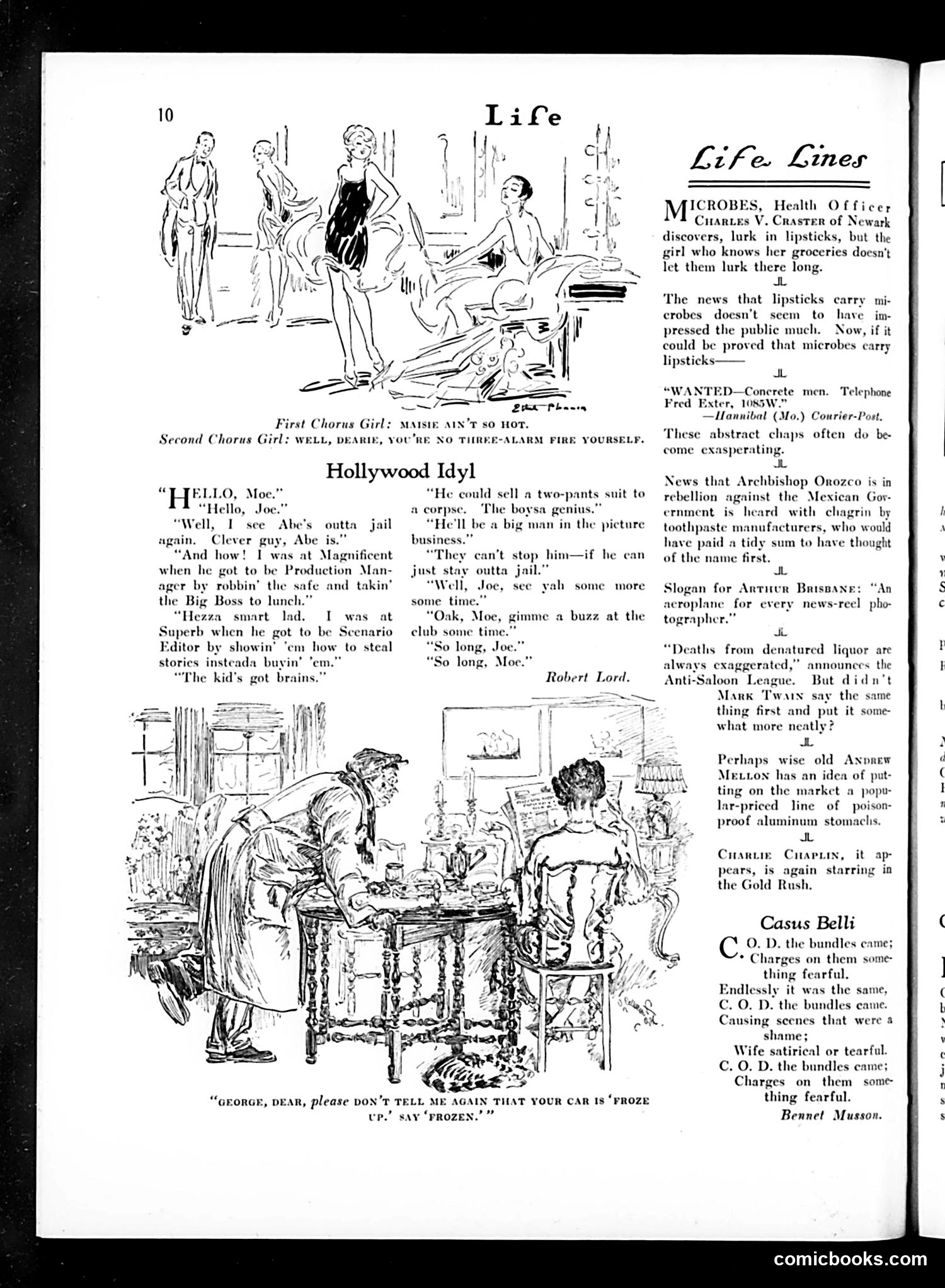
This page contains two distinct satirical sections: **"Hollywood Idyl"** depicts a conversation between two ex-convicts, "Moe" and "Joe," joking about their criminal past and current Hollywood connections. The satire mocks Hollywood's willingness to employ criminals and the industry's moral laxity—a common 1920s criticism of the film industry's ethical standards. **"Life Lines"** is a gossip/news column featuring brief satirical items about public figures and trends, including references to microbes in lipstick, Archbishop Onoozco, and Charlie Chaplin's "Gold Rush." These are lightweight society jabs at contemporary celebrities and consumer products. The bottom cartoon shows a domestic dispute about a car breaking down ("froze up"), illustrating marital tension over modern automotive technology—a relatable domestic satire of the automobile era.
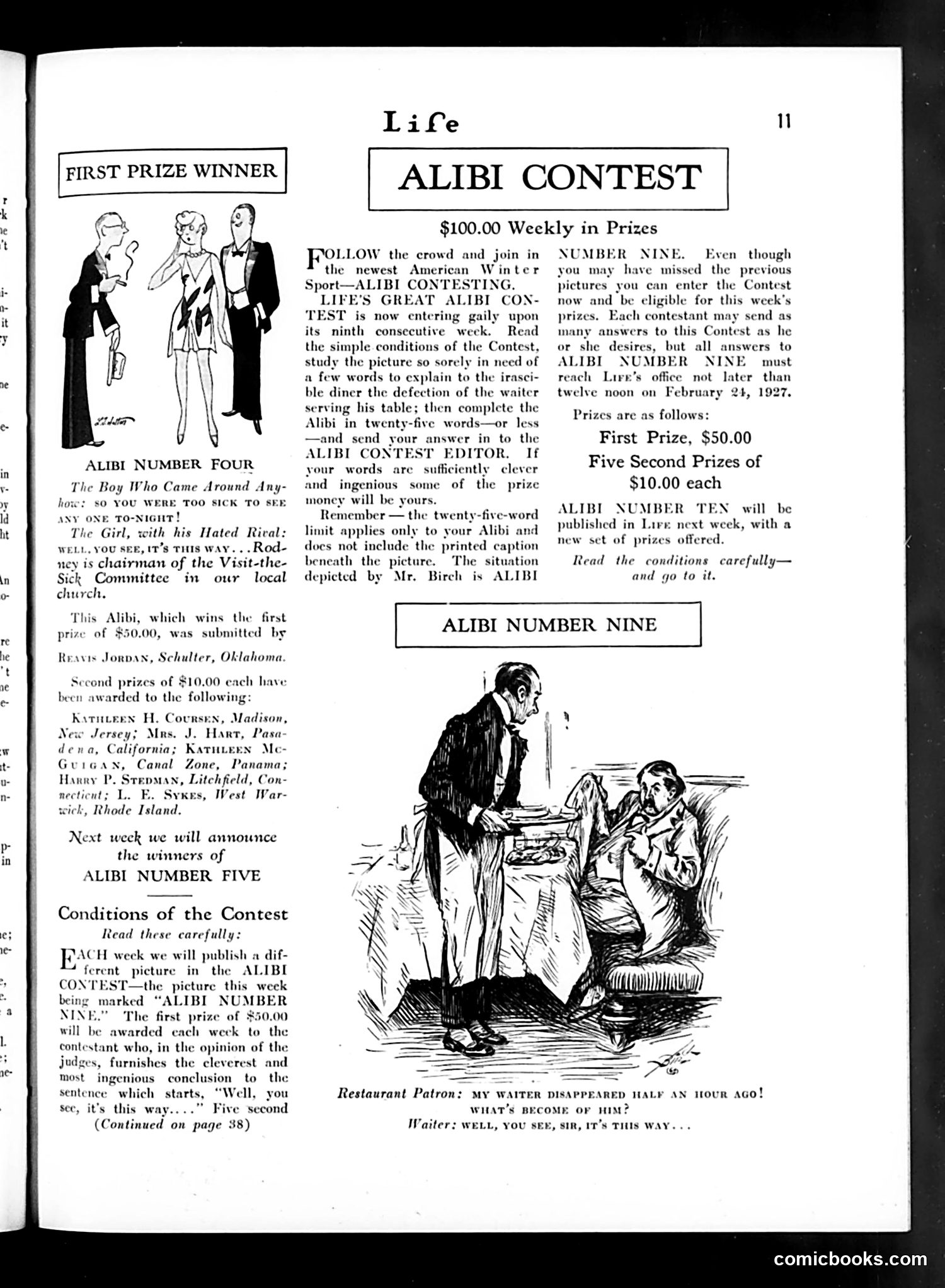
This page presents **Alibi Number Nine**, a weekly puzzle contest. The illustrated scenario shows a restaurant waiter and patron in a comedic situation: the patron complains that "my waiter disappeared half an hour ago! What's become of him?" The waiter responds evasively, "Well, you see, sir, it's this way..." The contest challenges readers to complete the waiter's excuse in 25 words or less—providing a creative "alibi" explaining his absence. This is satirical commentary on service failures in restaurants and the implausible excuses workers offer to customers. The contest offers $100 in weekly prizes ($50 first prize), encouraging public participation in this humorous social observation about everyday deceptions in the service industry.
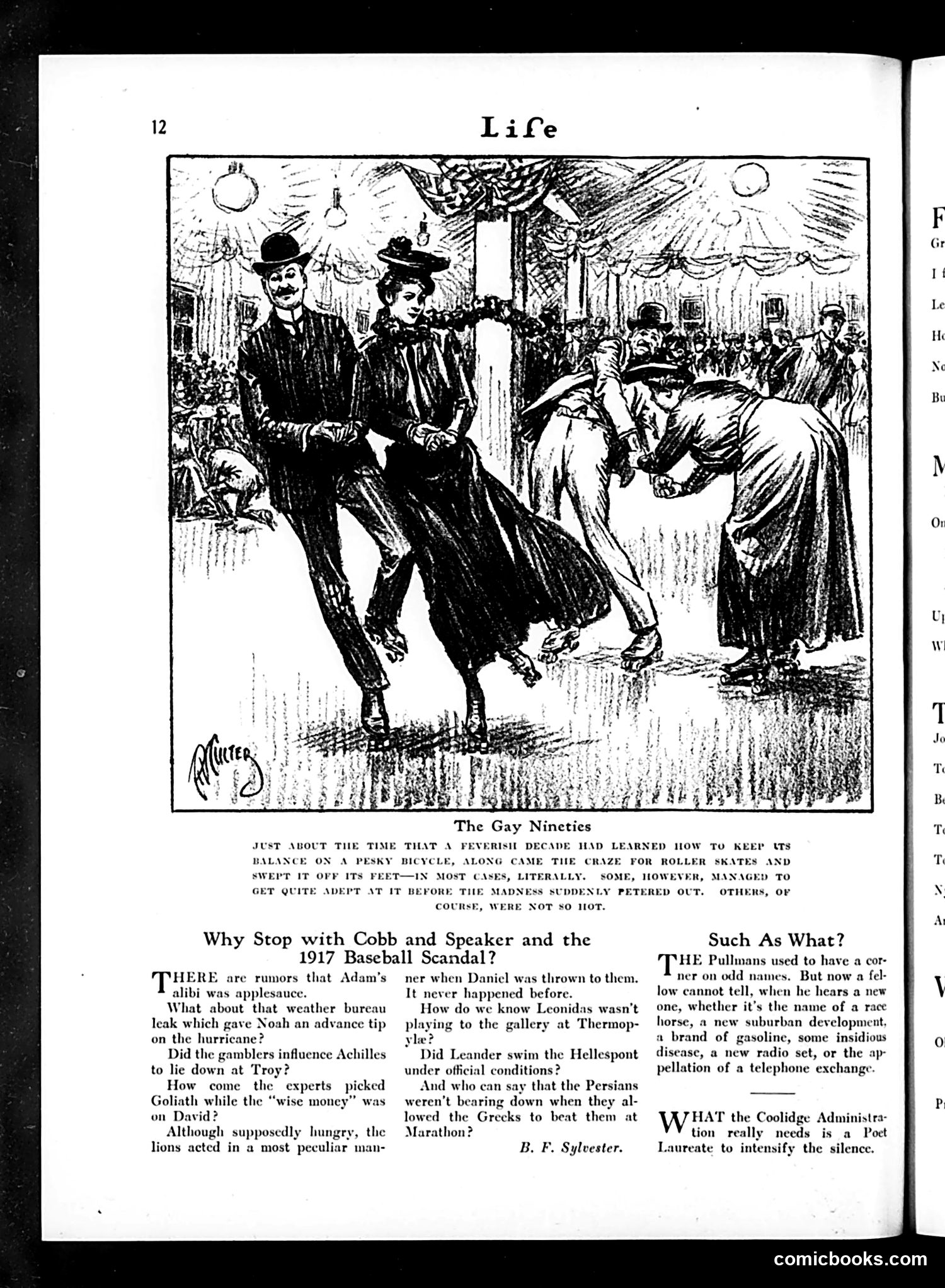
This cartoon satirizes the 1890s craze for roller skating and bicycles. The illustration shows elegantly dressed couples at what appears to be a social gathering, with one woman being swept along on roller skates—literally losing control and nearly falling, while her male companion tries to stabilize her. The caption's joke centers on the irony that during this era, people became so skilled at maintaining balance on these new vehicles that some "managed to get quite adept at it before the madness suddenly petered out." Others, the text notes wryly, "were not so hot"—clearly illustrated by the woman's precarious stance. This mocks both the fashionable obsession with these technologies and the uneven competence people displayed when adopting them.
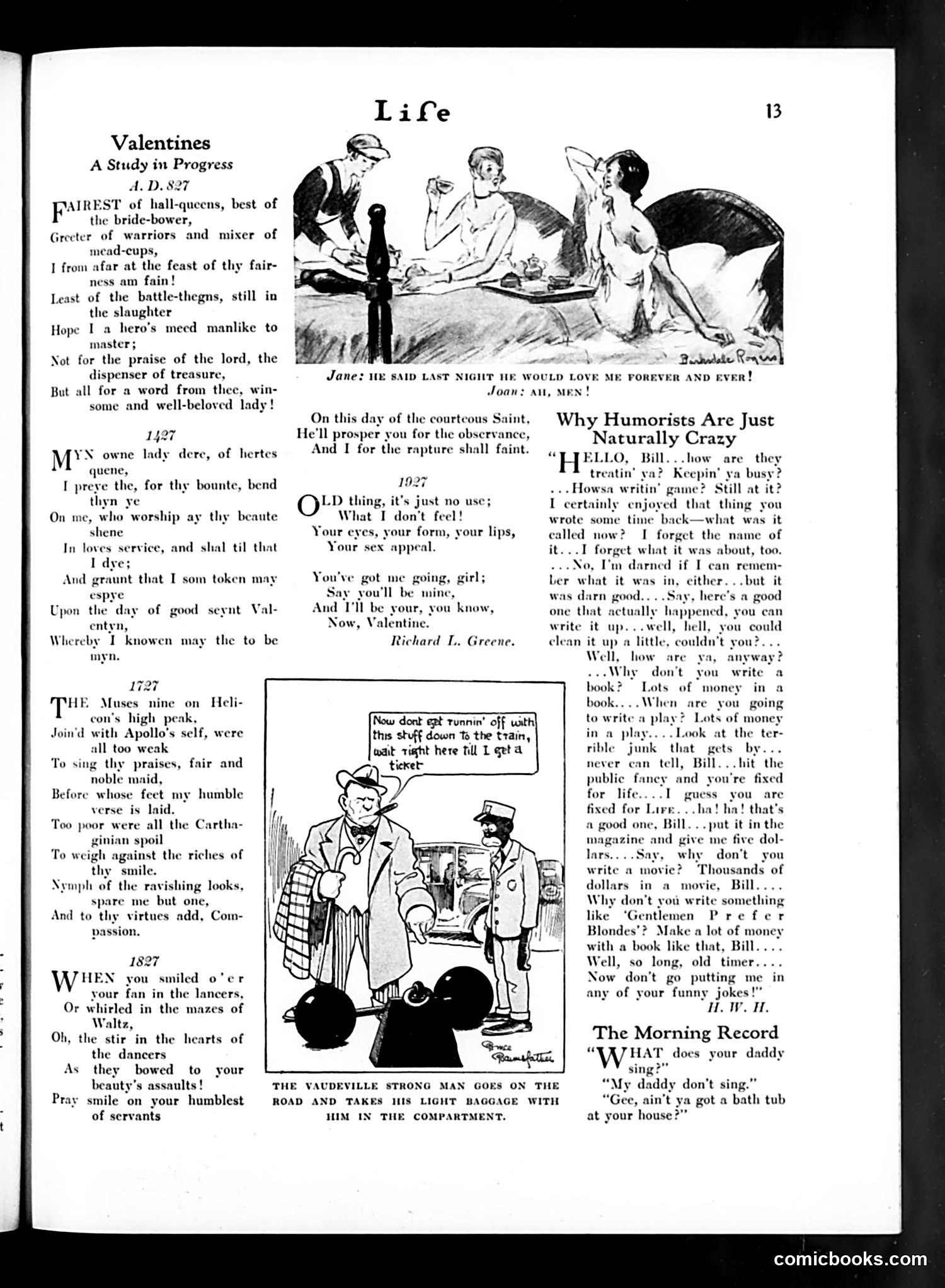
The main cartoon depicts "The Vaudeville Strong Man Goes on the Road and Takes His Light Baggage With Him in the Compartment." It shows a muscular performer and a porter struggling with an enormous, oversized piece of luggage—a visual joke about the contradiction between a strong man's professional persona and his actual traveling needs. The humor lies in the irony: despite his advertised strength, he travels with comically excessive baggage, requiring help to manage it. The right column contains "Why Humorists Are Just Naturally Crazy"—a satirical piece showing a writer receiving increasingly absurd writing suggestions from readers. The joke mocks both aspiring writers' unrealistic expectations and the public's presumption in offering unwanted creative advice to established authors.
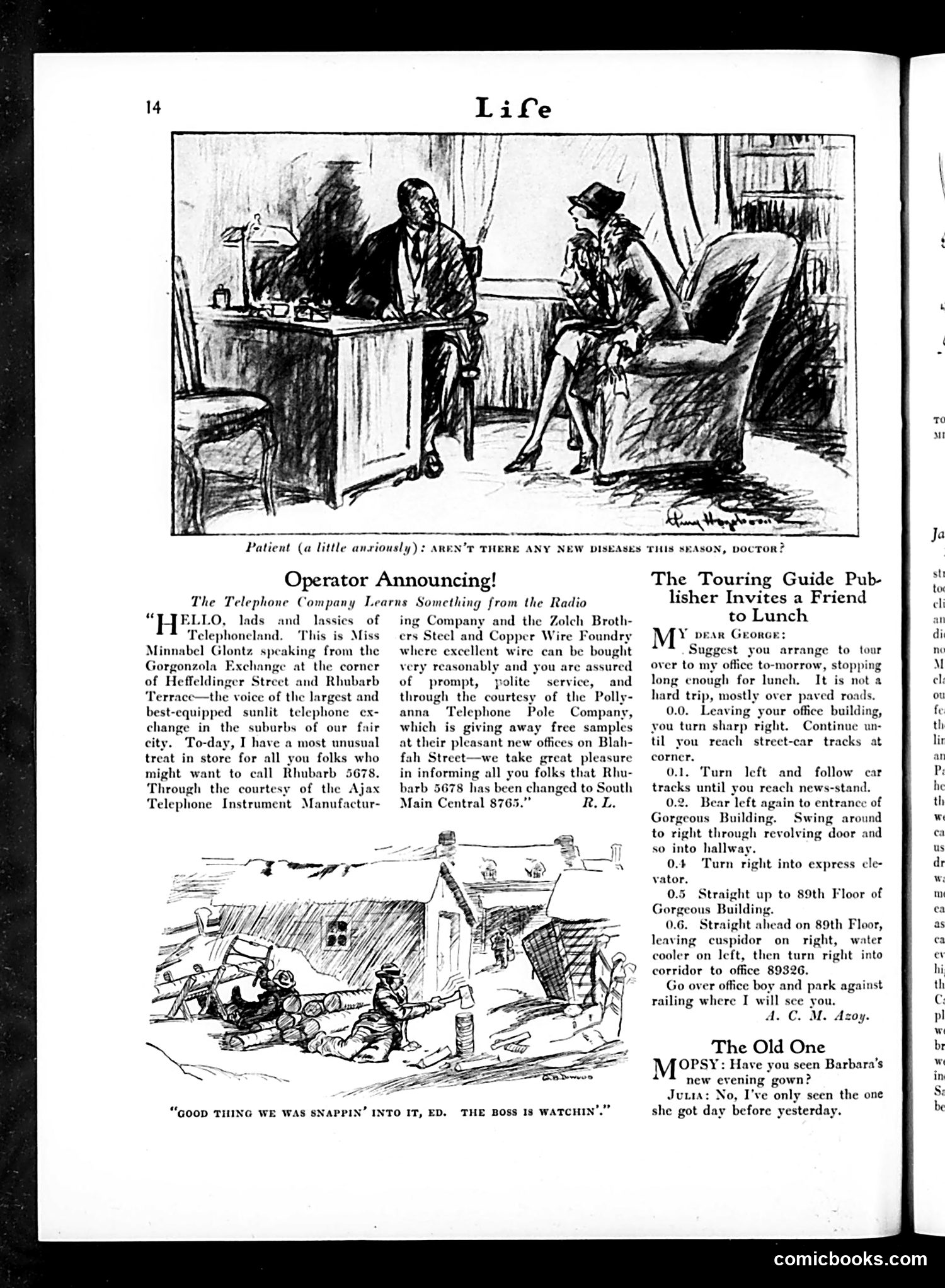
**Top Cartoon**: A patient anxiously asks a doctor, "Aren't there any new diseases this season, doctor?" The humor satirizes hypochondria—the tendency to imagine one has diseases—suggesting the patient actually *wants* a new illness to worry about, reflecting a broader cultural anxiety about health fads and medical trends of the era. **"Operator Announcing" Section**: This satirizes telephone company advertisements and corporate self-promotion, mocking how companies boast about their services while highlighting mundane details like wire foundry operations and address changes. **Bottom Illustration**: Two workers in what appears to be industrial or construction work, with the caption "Good thing we was snappin' into it, ed. The boss is watchin'." This reflects class tensions and workplace surveillance anxiety common to Depression-era satire.
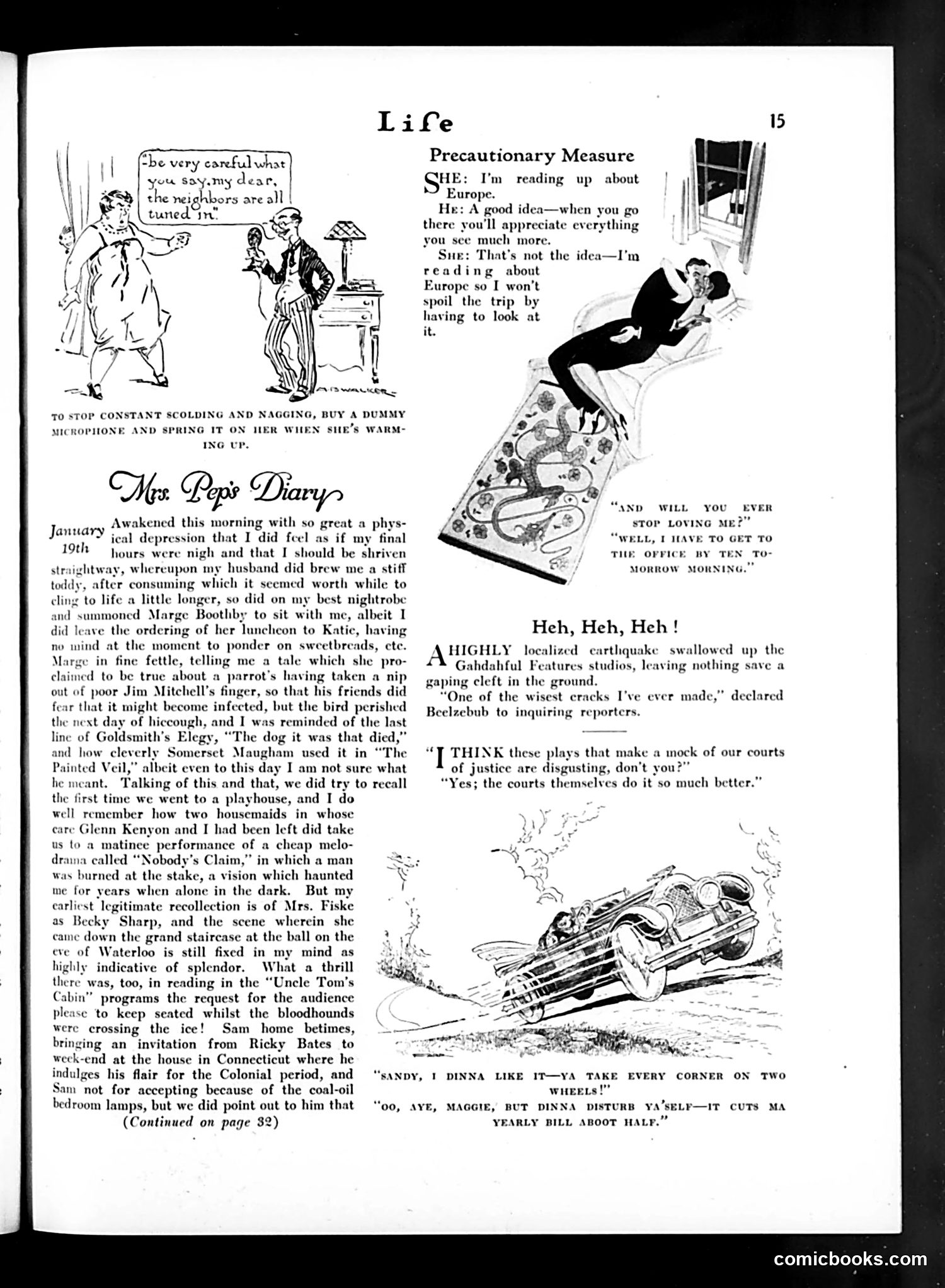
This page contains three distinct pieces of satirical humor: 1. **"Precautionary Measure"** (top): A cartoon mocking marital discord—a husband suggests his wife read about Europe to appreciate travel, but she's already reading about it to *avoid* looking at it during the trip itself. The joke targets wives seen as deliberately contrary. 2. **"Mrs. Pep's Diary"** (left): A lengthy diary entry recounting theatrical memories and social gossip from January 1921, written in gossipy, rambling style typical of period humor mocking women's supposed superficiality and chattiness. 3. **"Heh, Heh, Heh!"** (bottom): Two brief anecdotes—one about an earthquake at a film studio, another mocking courts as corrupt. The humor is observational rather than political. The page targets domestic life and social pretension through gendered stereotypes common to 1920s satire.
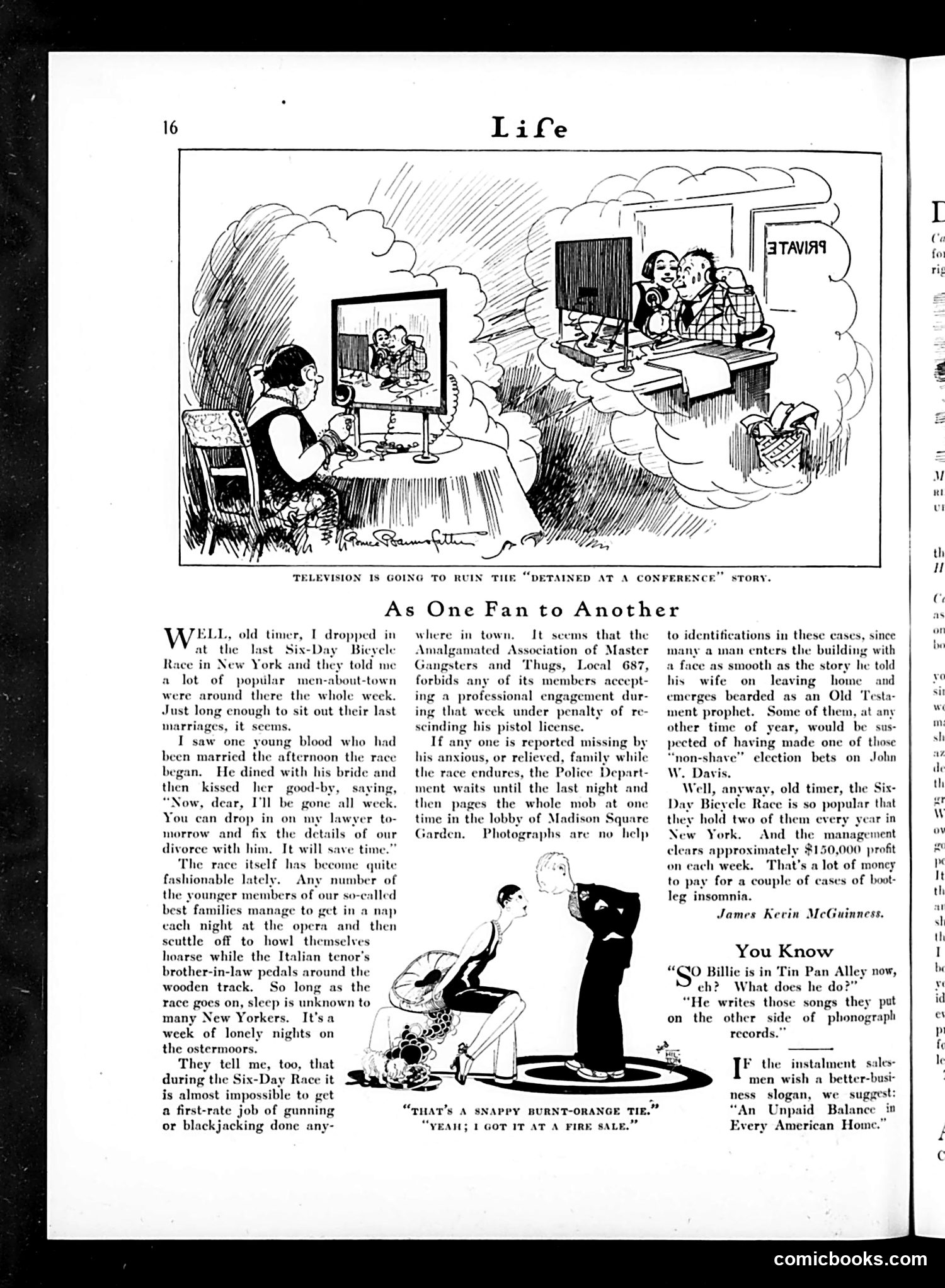
**Top Cartoon: "Television is Going to Ruin the 'Detained at a Conference' Story"** This satirizes how television will undermine traditional excuses. A person watches TV showing someone claiming to be "detained at a conference," while simultaneously viewing the actual conference scene in the same broadcast—exposing the lie. The joke reflects early television's potential to make it harder for people to fabricate alibis, as simultaneous broadcasting could contradict false stories about one's whereabouts. **"As One Fan to Another" Article & Cartoons** The column discusses Six-Day Bicycle Races and urban social life, with accompanying cartoons about marriage, legal matters, and entertainment. The lower cartoon about a "snappy burnt-orange tie" at a fire sale appears to be a separate humorous vignette about bargain shopping. The page reflects 1920s-30s urban American life and emerging television's social implications.
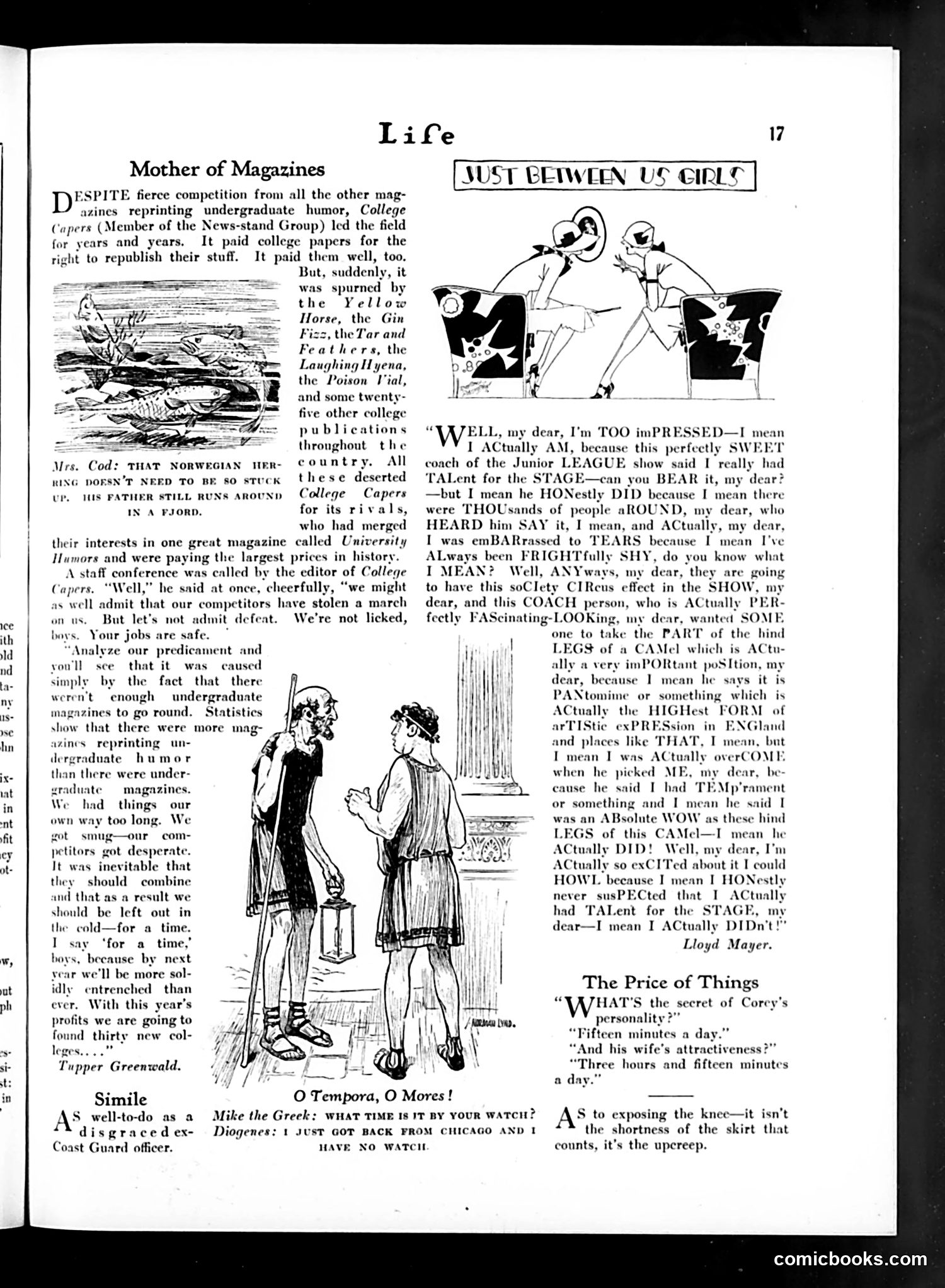
This page contains several satirical pieces about 1920s college culture and society: **"Mother of Magazines"** discusses how *College Capers* magazine, despite competition from publications like *Yellow Horse* and *Laughing Hyena*, became successful by republishing undergraduate humor. The satire critiques the lack of original collegiate publications, suggesting established magazines were simply repackaging student content rather than developing genuine talent. **"Just Between Us Girls"** parodies affected theatrical speech and exaggerated emotionalism, mocking girls discussing a circus performance with overwrought capitalization and affected language. The remaining short humor pieces mock everyday situations: a Norwegian woman fitting snugly in a fjord, a Greek character's missing watch, and observations about women's fashion—specifically that the "scandal" of short skirts isn't the length but the "uppercut" (exposure of undergarments).
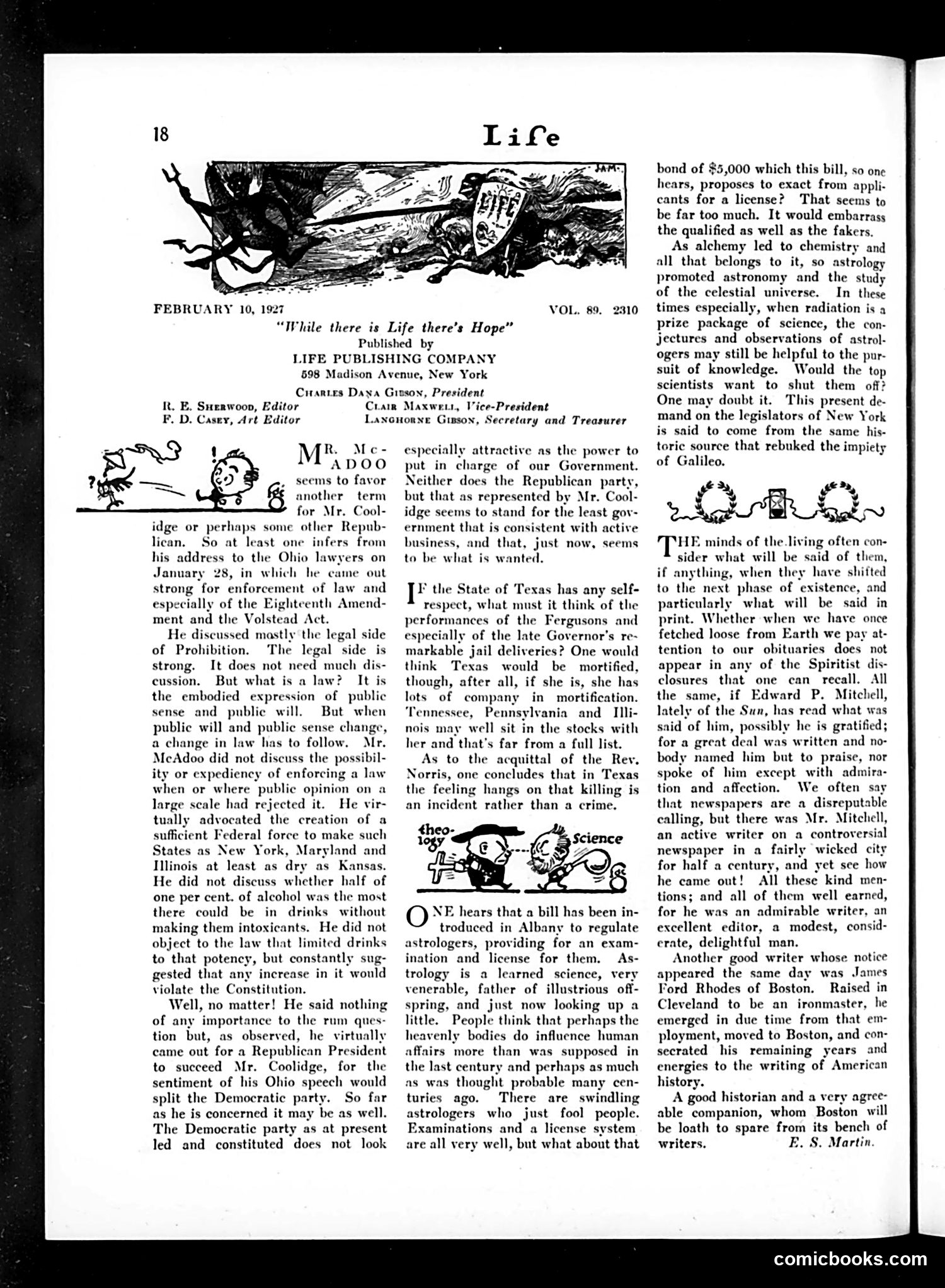
This page contains editorial commentary on contemporary political issues, not a single unified cartoon. The main illustration shows a small figure labeled "Mr. McAdoo" (William Gibbs McAdoo, a prominent Democrat and former Treasury Secretary). **The satire concerns:** 1. **McAdoo's Prohibition stance**: McAdoo gave a speech supporting strict enforcement of the Volstead Act (Prohibition). The editor mocks him for advocating a massive federal enforcement force while ignoring practical questions about public opinion actually supporting such laws. 2. **Political implications**: The editor notes McAdoo's rhetoric could split the Democratic Party, making Republican President Coolidge's do-nothing approach seem preferable by comparison. 3. **A secondary commentary** critiques Texas governors (the Fergusons) for corrupt "jail deliveries" and mentions Reverend Norris's acquittal for killing. 4. **Astrology regulation**: The page questions an Albany bill requiring expensive bonding ($5,000) for astrology licenses—too burdensome even for legitimate practitioners. The cartoons are minor illustrations accompanying these written opinions rather than standalone works.
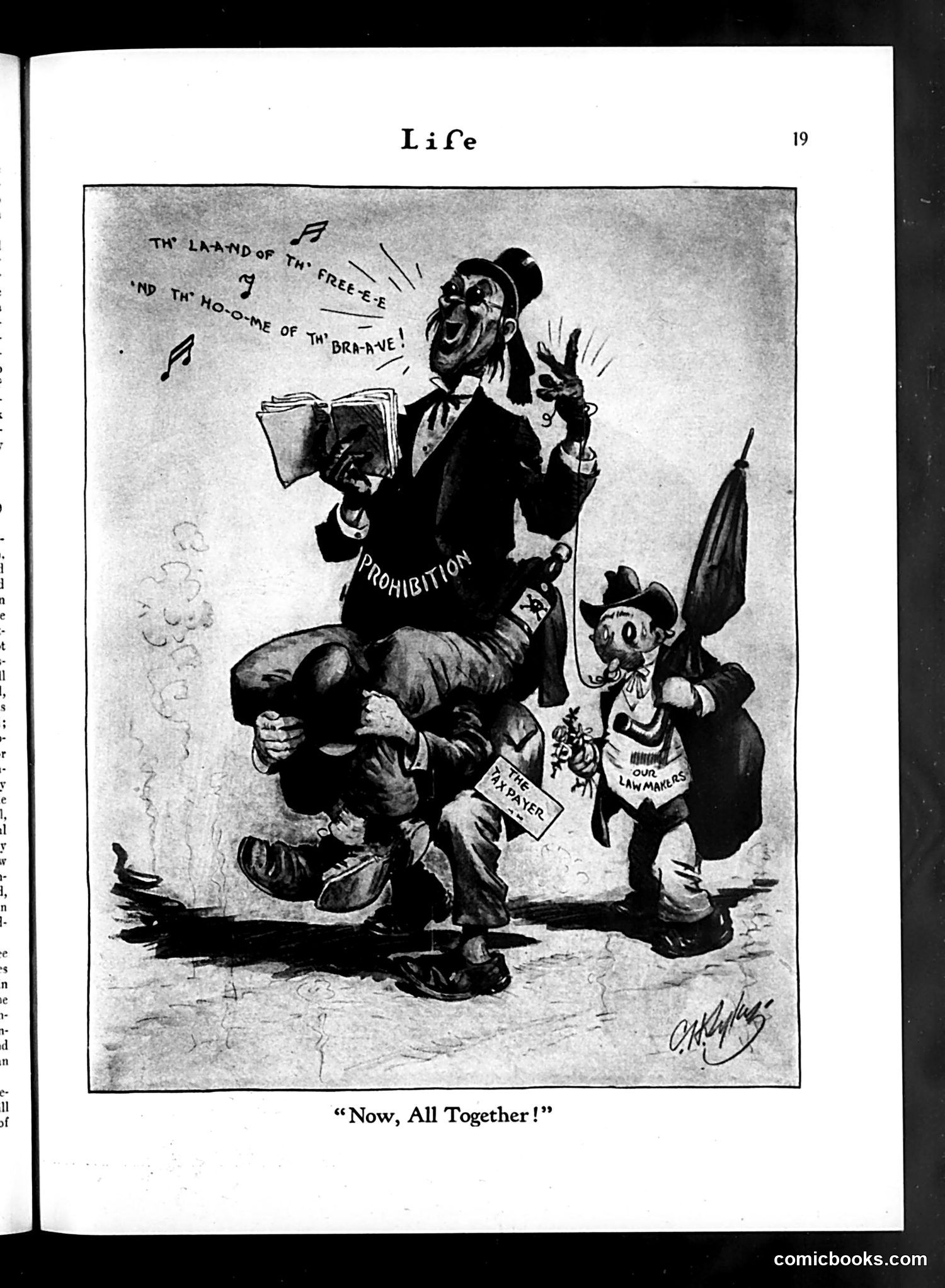
This satirical cartoon depicts a figure labeled "Prohibition" conducting like an orchestra conductor, singing "the land of the free-e-e and the ho-o-me of the bra-ave!" (patriotic song lyrics). The conductor wears a vest labeled "Prohibition" and holds a musical score. Below are caricatured figures labeled "Bootlegger" and what appears to be "Lawmaker," seemingly forced to participate in this musical performance against their will, holding signs reading "Our Lawmaker" and appearing distressed. **The satire**: The cartoon mocks Prohibition enforcement as absurdly hypocritical—celebrating American freedom while simultaneously criminalizing alcohol and forcing compliance through laws. The "all together" directive suggests forced participation in an unpopular policy, undermining the very freedoms the patriotic song celebrates.
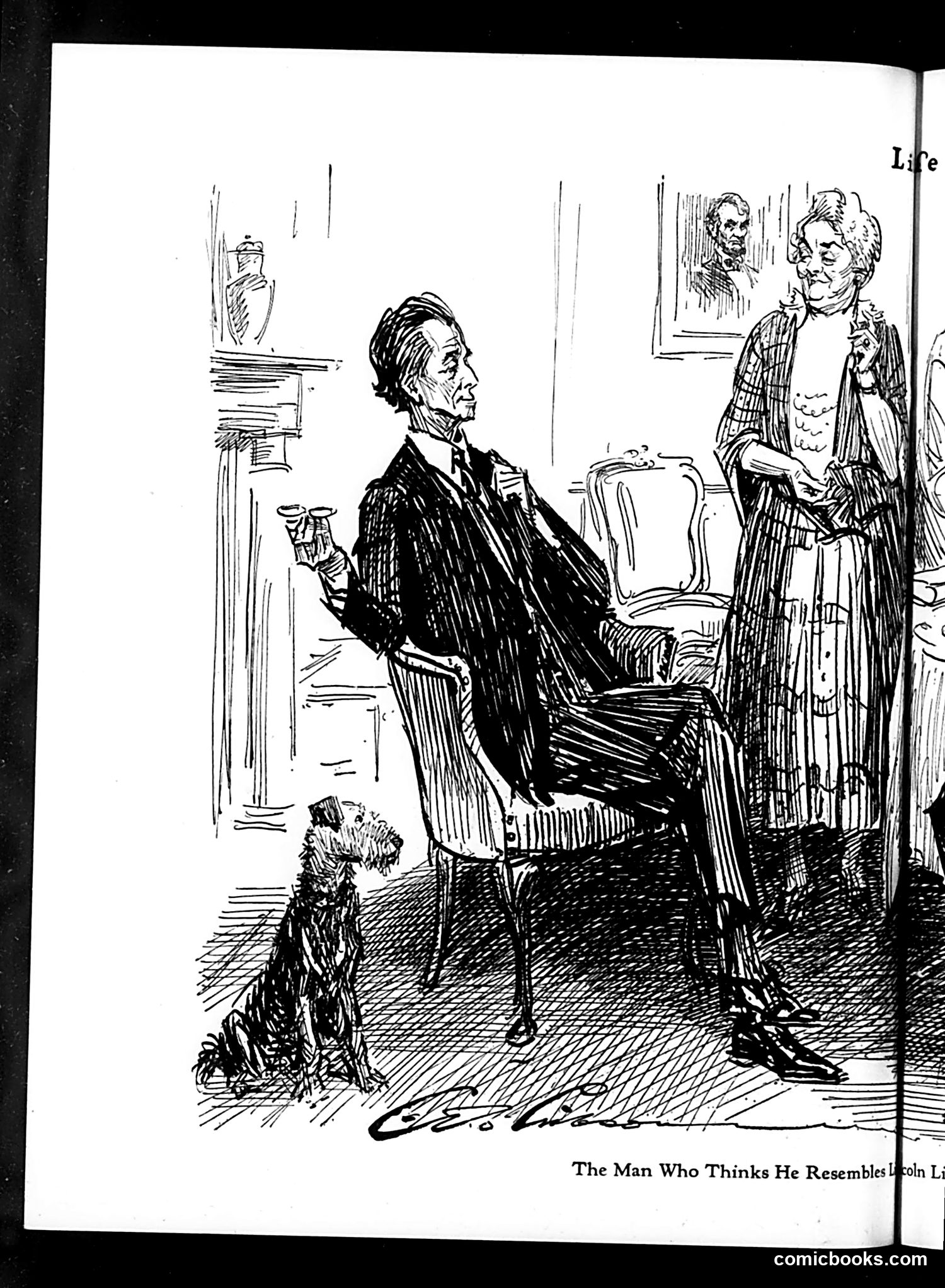
This cartoon depicts a seated gentleman holding a drink, being addressed by a standing man. The title suggests the seated figure believes he resembles Abraham Lincoln. The joke appears to be satirical commentary on vanity—mocking someone's delusional self-perception. A dog sits nearby, possibly adding to the humorous scene. The reference to Lincoln is significant; this likely dates to an era when Lincoln resemblance claims were either common fodder for humor or tied to specific political circumstances. The formal indoor setting and period clothing suggest this targets upper-class pretension. Without the magazine's date visible, the exact political context remains unclear, but the satire clearly ridicules narcissism and unfounded self-comparison to a historical figure.
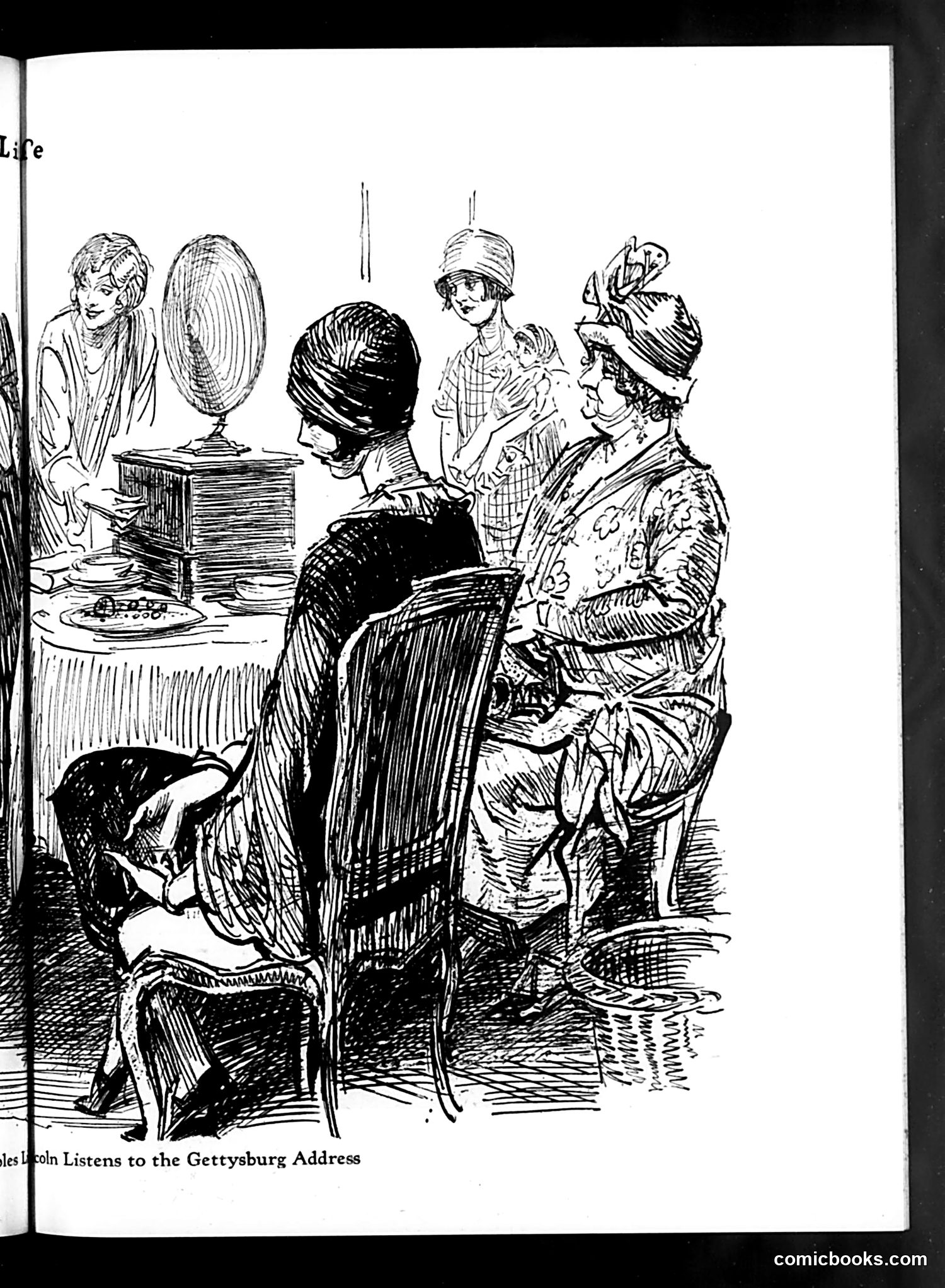
This satirical illustration depicts a scene where a Black man (labeled "Jes toln," likely a stereotypical character name from the era) sits listening while white women in fashionable 1920s dress gather around what appears to be a radio or speaker broadcasting Lincoln's Gettysburg Address. The satire likely mocks the irony of celebrating Lincoln's words about human equality and freedom while excluding or marginalizing Black Americans from full civic participation. The contrast between the iconic speech's ideals and the segregated social reality of 1920s America—where Black citizens remained disenfranchised and excluded from white social spaces—forms the cartoon's critical point. The fashionable women's indifference to the man's presence underscores this hypocrisy.
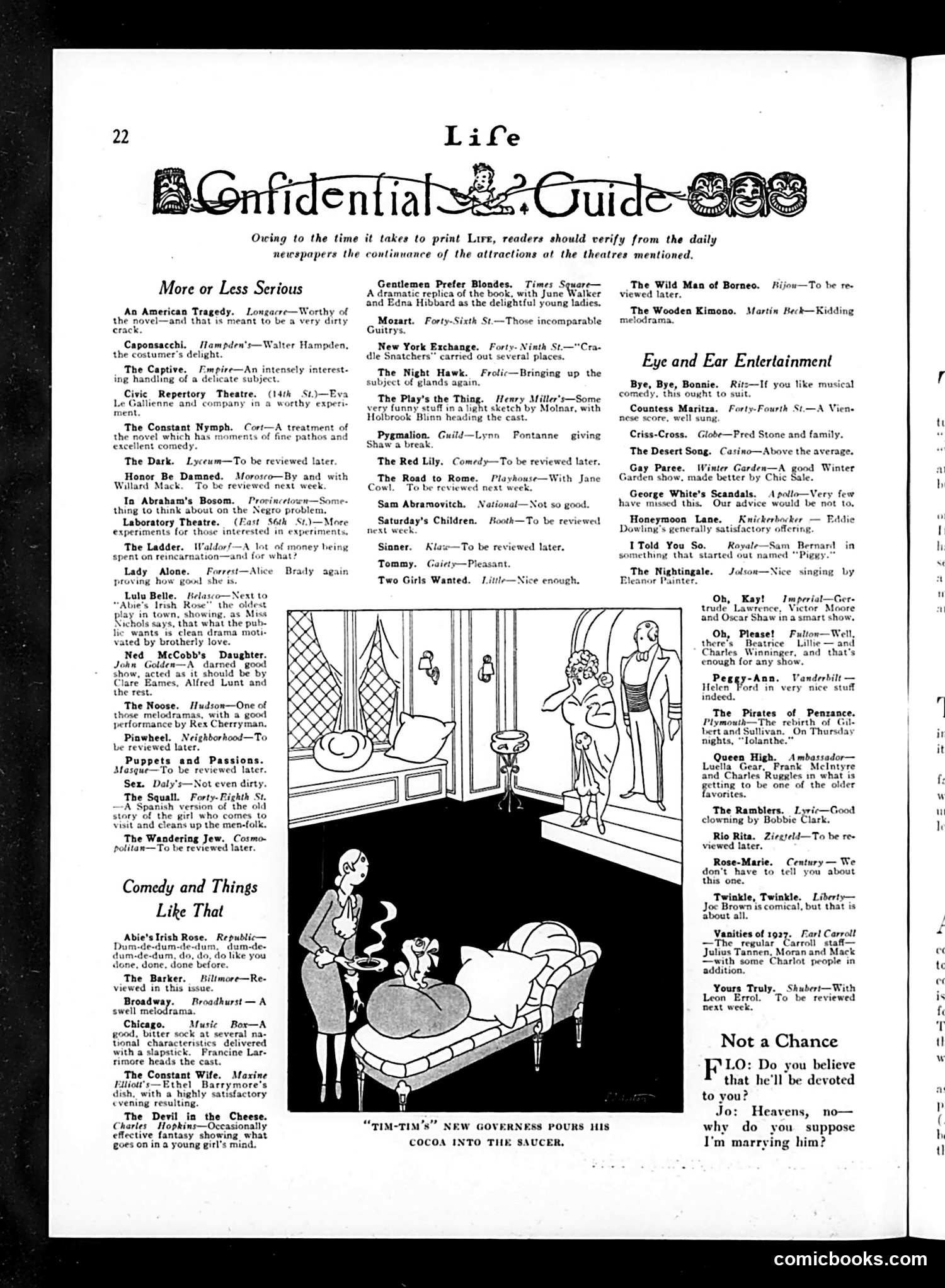
This is a humorous cartoon about a child's literal interpretation of adult instructions. The image shows a young boy ("Tim-Tim") and his new governess, who has apparently misunderstood or overzealously followed directions about proper tea service. Rather than pouring cocoa into a cup in the conventional manner, she's pouring it directly into the saucer—likely because she was told to serve it in a saucer or misheard some instruction about the serving method. The joke relies on the contrast between adult expectations of proper household conduct and a servant's comical misinterpretation, a common theme in early-twentieth-century humor. The cartoon satirizes both the strict formality of domestic service and the absurdity that can result from poor communication or overly literal instruction-following in upper-class households.
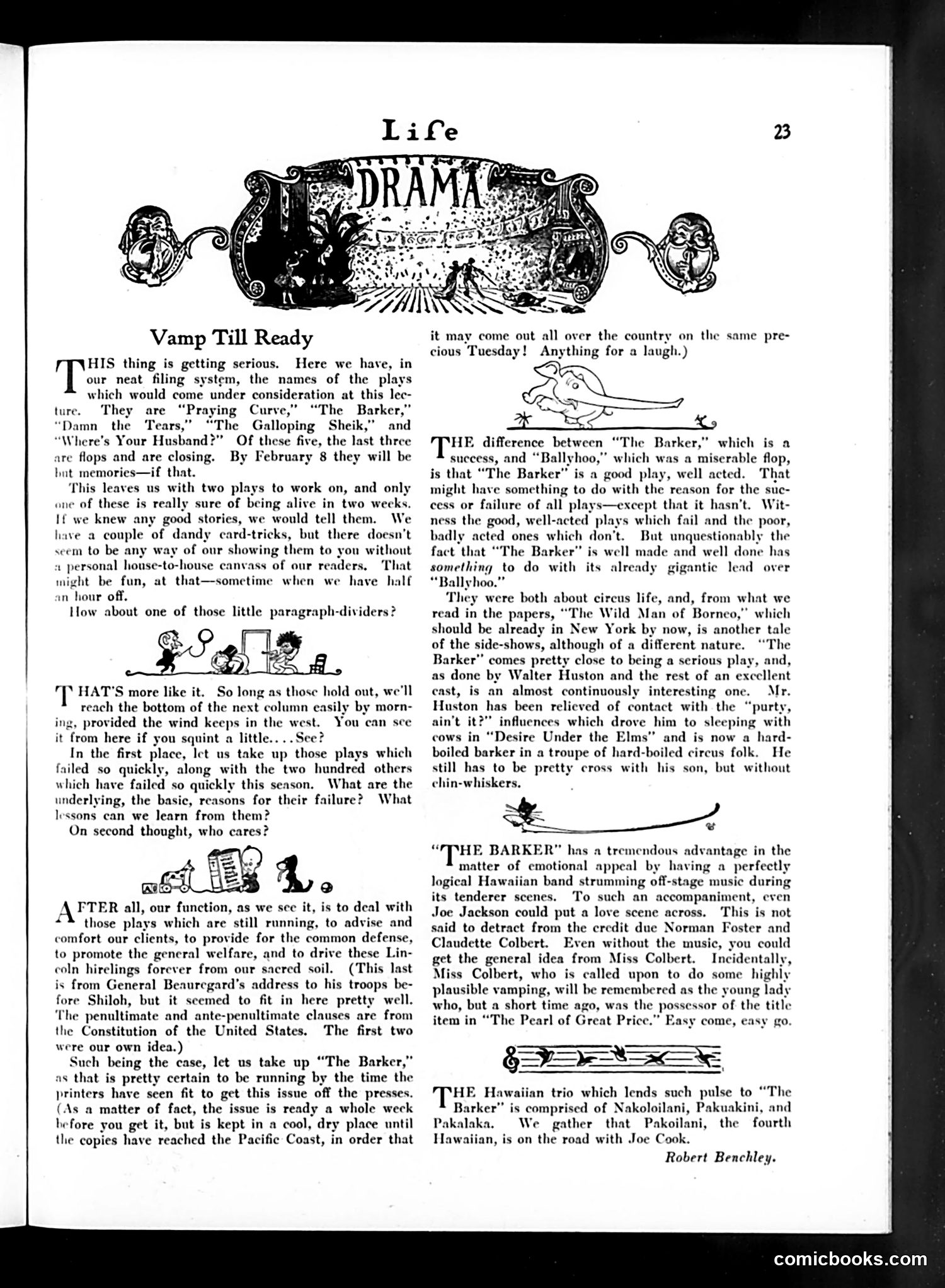
This is a theatrical review column discussing Broadway plays closing and opening in the early 1920s. The author uses self-aware, jokey commentary to discuss why certain plays succeed or fail. **Main points:** - Several plays are flopping and closing: "Praying Curve," "Damn the Tears," "The Galloping Sheik," and "Where's Your Husband?" - "The Barker" (a circus play starring Walter Huston) is succeeding while "Ballyhoo" (also circus-themed) failed - The author humorously concludes good acting and solid production matter for success, though the column feigns indifference ("who cares?") - References Walter Huston moving from sentimental roles in "Desire Under the Elms" to playing a hardened circus barker - Notes "The Barker" features a Hawaiian band for emotional appeal The humor relies on the columnist's deliberately contradictory tone—claiming not to care about theater while providing detailed analysis—and period-specific theatrical references modern readers would need context to understand.
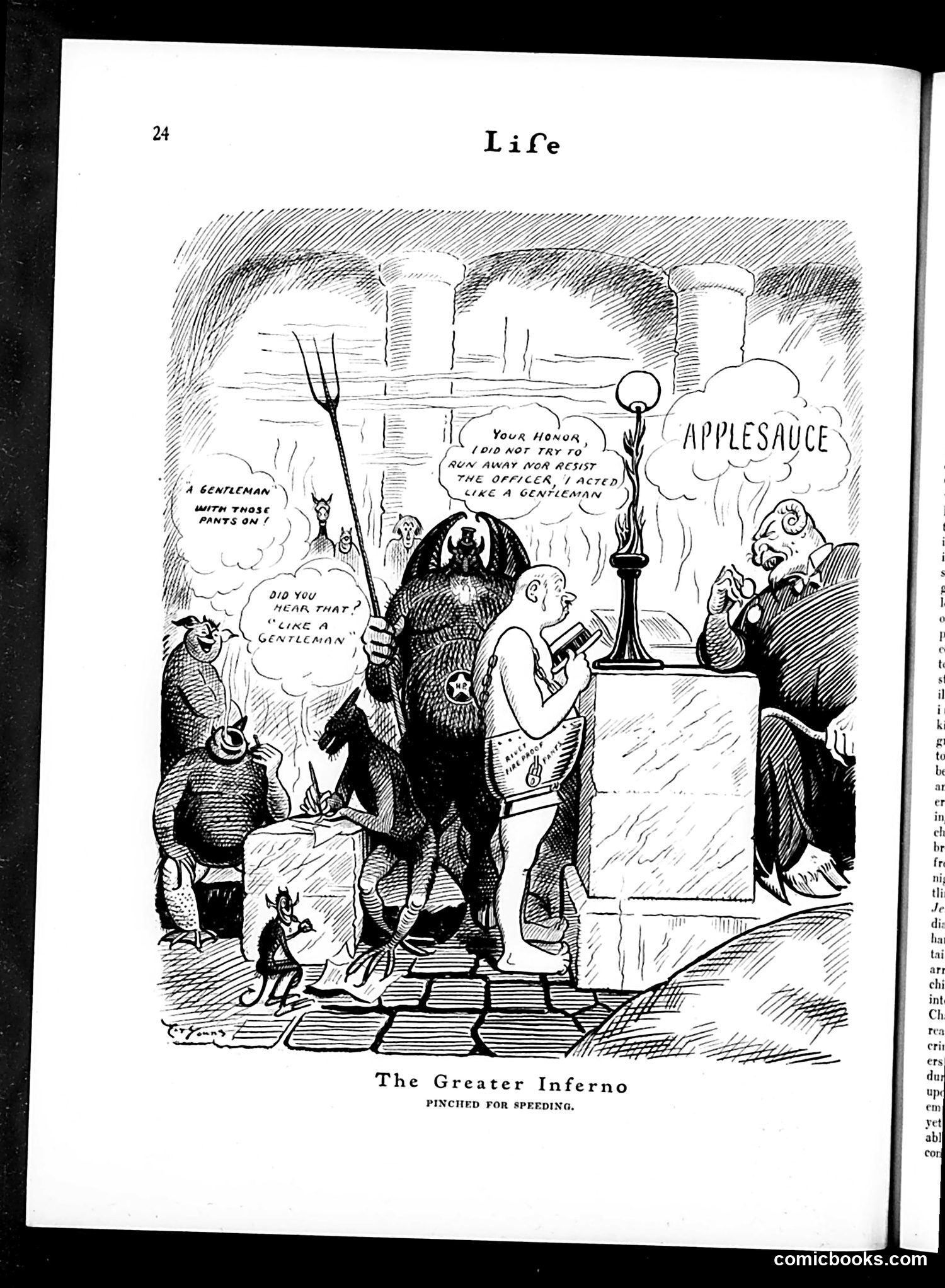
This cartoon satirizes a traffic stop scenario in Hell. A demonic officer has pulled over a speeding motorist, creating absurd dialogue about gentlemanly conduct. One figure protests "applesauce" (slang for nonsense/lies), while another claims he "did not try to run away nor resist the officer"—suggesting he's fabricating a defense or mocking excessive politeness in an infernal context. The joke appears to mock both the pretense of "acting like a gentleman" when caught breaking rules and the formality of traffic law enforcement. The title's reference to Dante's "Inferno" elevates this mundane modern problem (speeding tickets) to cosmic absurdity. The cartoon likely dates from the automobile era when speeding tickets were a relatively novel concern, making the exaggeration of sending someone to Hell for traffic violations humorous.
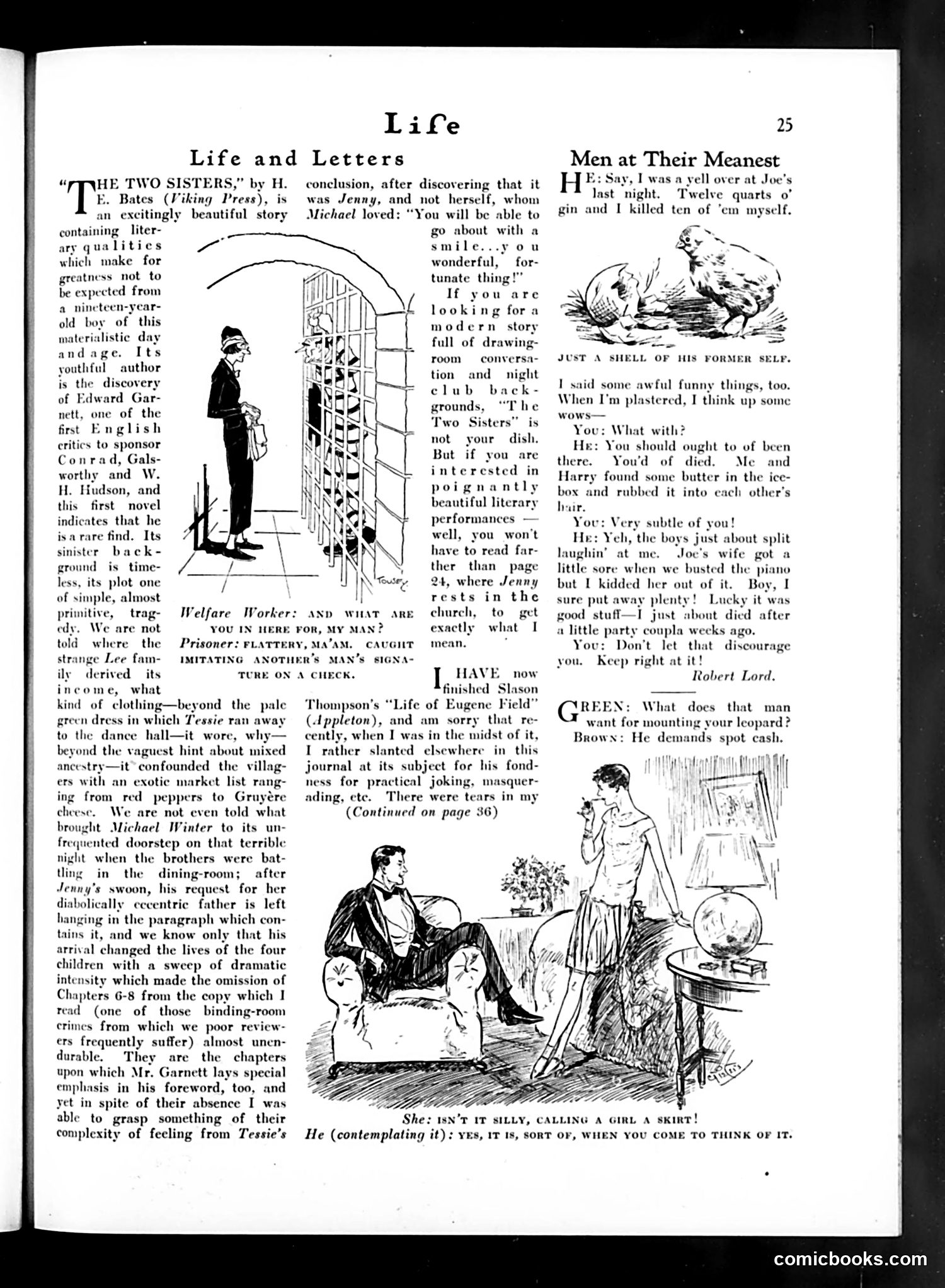
This page contains literary reviews and humor cartoons satirizing early 20th-century male behavior. **Literary Content:** Reviews of "The Two Sisters" by H.E. Bates and Thompson's "Life of Eugene Field," praising Bates as a promising young author discovered by critic Edward Garnett. **Cartoons:** 1. **"Welfare Worker"** (top): A social worker interrogates a prisoner caught imitating signatures on checks—satirizing petty crime and bureaucratic welfare investigations. 2. **"Men at Their Meanest"** (bottom section): A series mocking drunk masculine posturing. The "hero" brags about consuming gin and engaging in crude pranks (rubbing butter in hair, destroying a piano), while his listener offers deadpan, sarcastic responses. The satire targets male boasting about alcohol consumption and destructive "fun" as signs of immaturity and stupidity rather than admirable behavior. 3. **"Isn't It Silly"** (bottom right): A man questions calling a woman a "skirt"—likely satirizing reductive objectification of women, though the exact critique is unclear. The humor relies on readers recognizing and judging the foolishness being depicted.
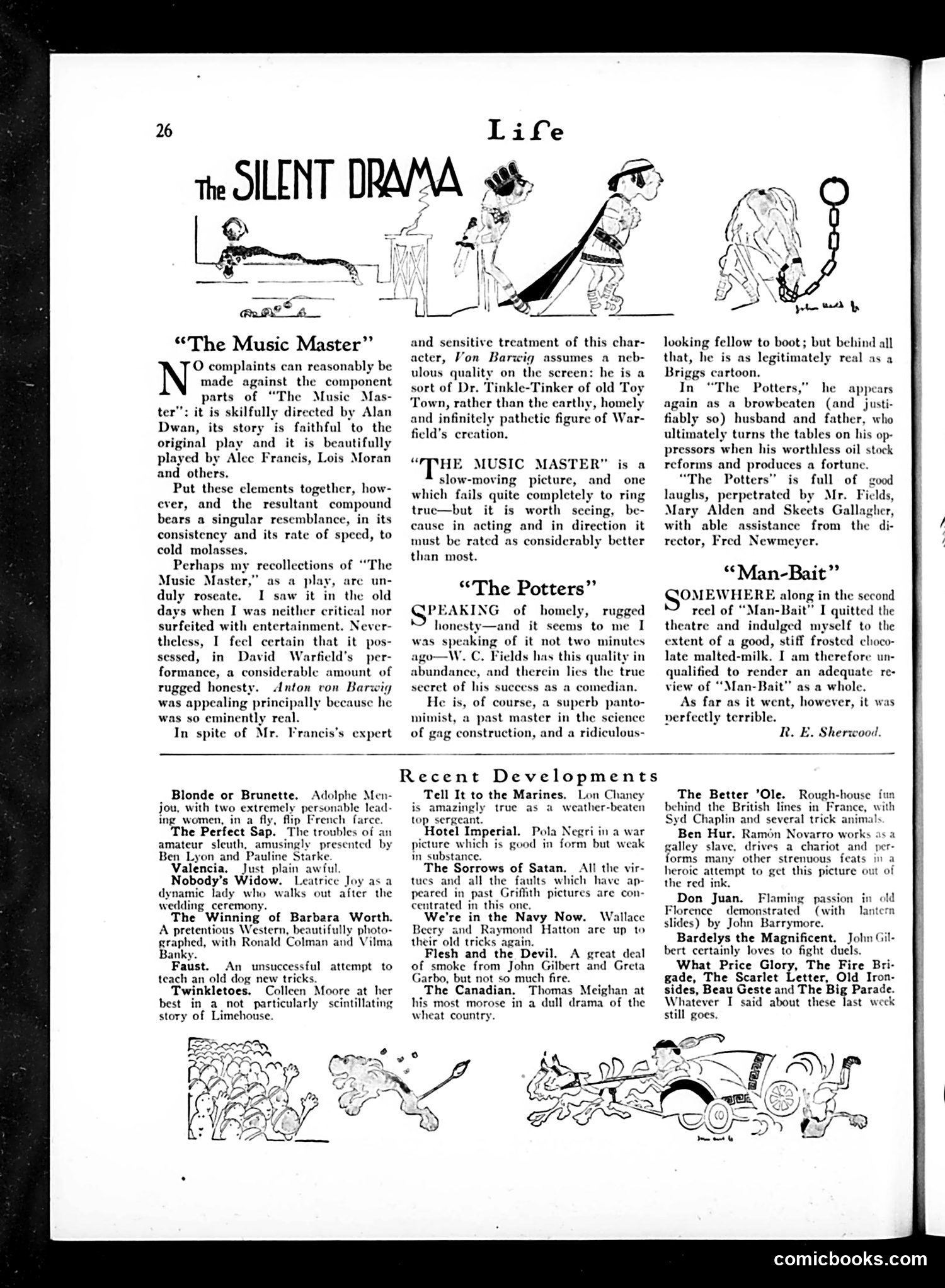
This page reviews several silent films. The critic praises **"The Music Master"** (directed by Alan Dwan, starring Alec Francis) for its technical qualities but criticizes it as slow and emotionally lifeless—the lead character lacks the "earthy, homely" realism of the original stage play. **"The Potters"** featuring **W.C. Fields** receives higher praise. Fields plays a downtrodden husband who gains fortune through an oil stock investment, ultimately dominating his family. The reviewer credits Fields's success to his combination of physical comedy skills and underlying authenticity (comparing him to a Briggs cartoon—likely George Briggs's comic strips). **"Man-Bait"** is dismissed as "perfectly terrible"—the reviewer actually left the theater partway through to get a malted milk, joking he's therefore "unqualified" to fairly review it. The page also briefly lists other current releases with one-line critiques. This reflects Life's role as a cultural tastemaker during Hollywood's silent era, when such reviews significantly influenced public moviegoing.
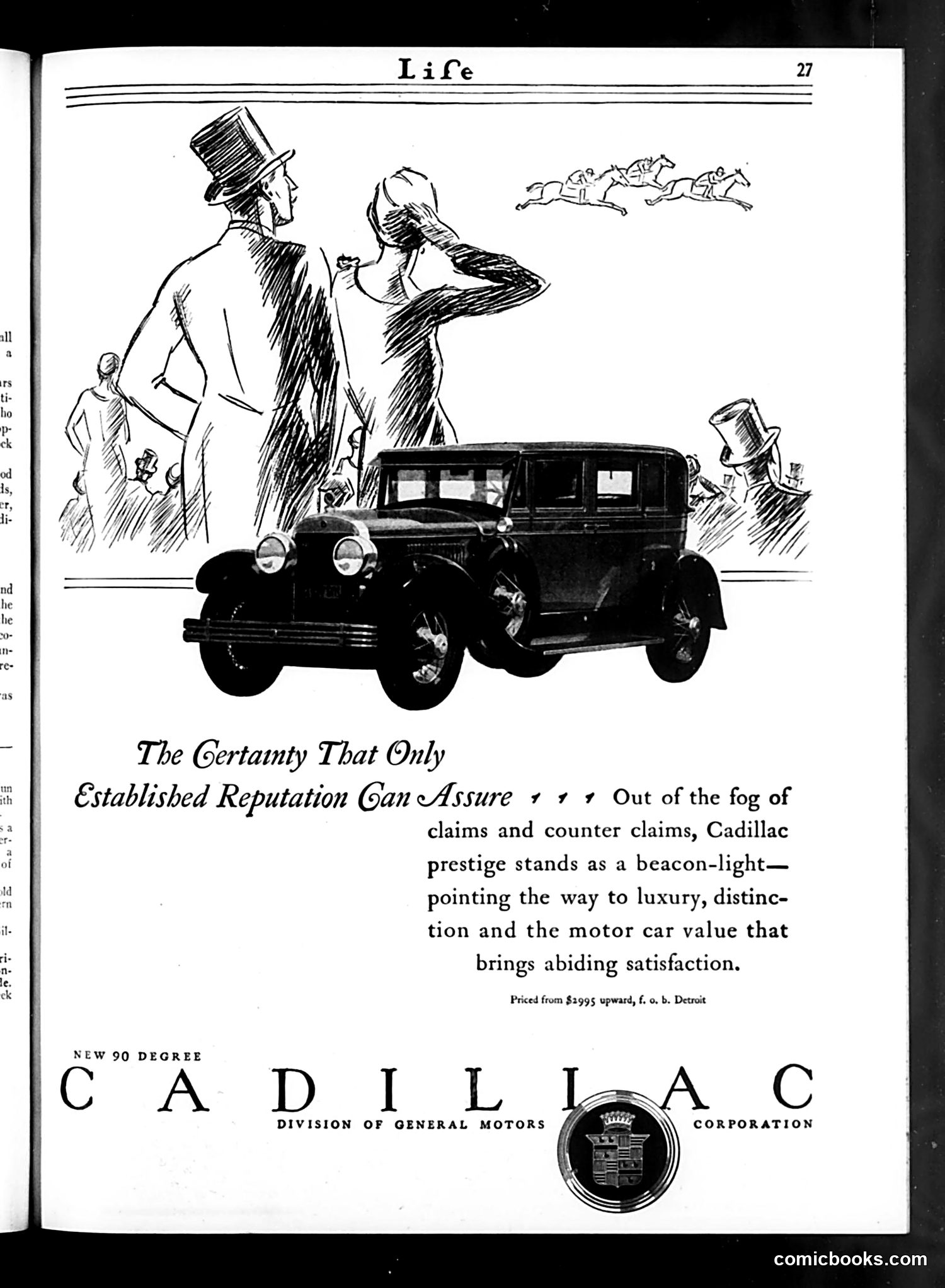
This is primarily **advertising content**, not political satire. The page shows a Cadillac automobile advertisement from Life magazine. The sketch above the car depicts wealthy figures in top hats observing horse racing in the background—imagery associated with upper-class leisure and status. The advertisement plays on this by positioning Cadillac as a luxury brand that signals social distinction and established reputation. The copy's claim that Cadillac "stands as a beacon-light" amid "claims and counter claims" likely references the competitive automobile market of the era, where numerous manufacturers made competing quality claims. The ad argues that Cadillac's prestige—earned through reputation—offers certainty to buyers, distinguishing it from lesser-known competitors. The pricing notation ("from $2995 upward, f.o.b. Detroit") anchors the luxury positioning to a concrete, premium price point.
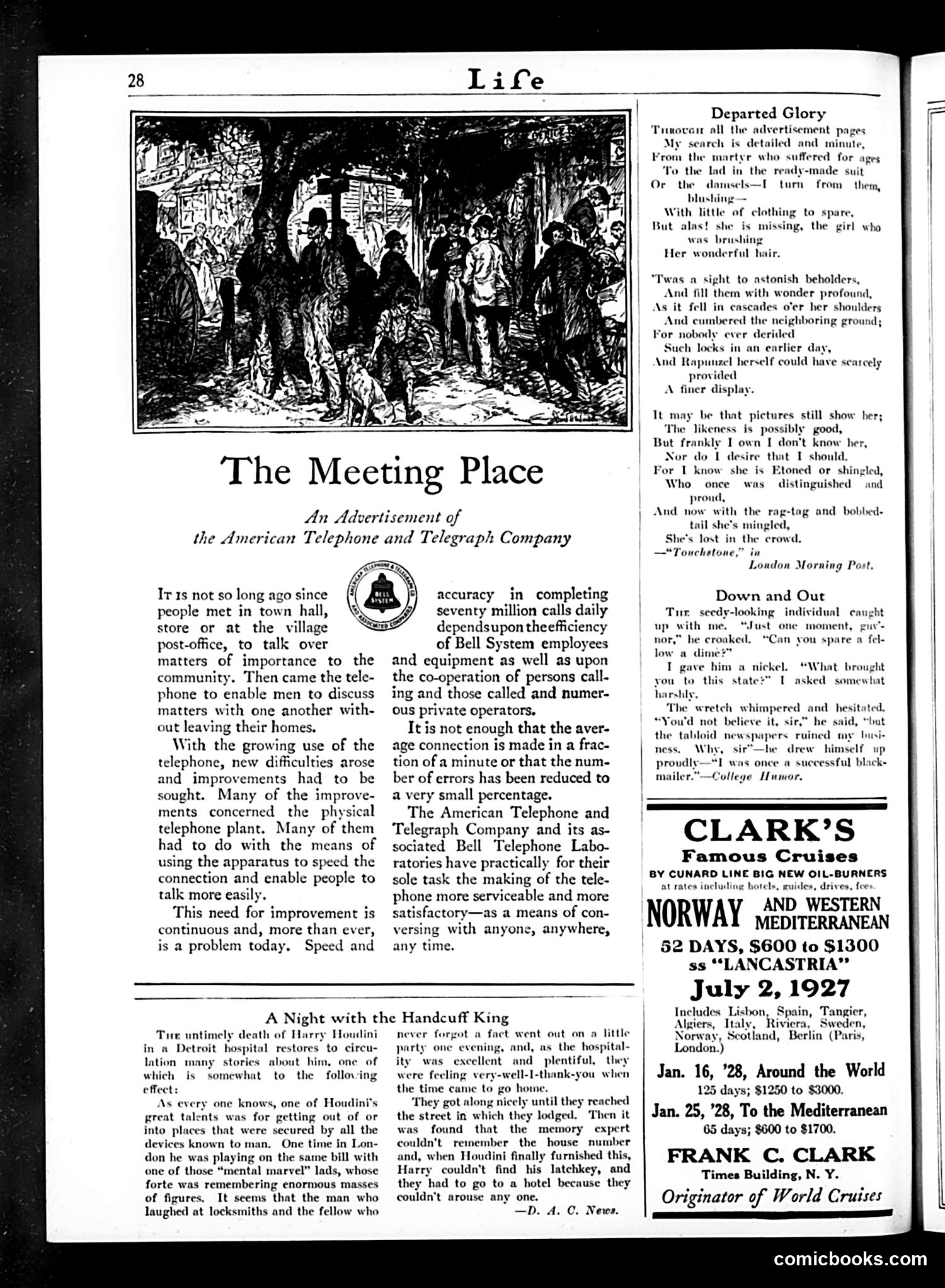
This page contains a **Bell Telephone advertisement** ("The Meeting Place") promoting AT&T's growing telephone infrastructure and reliability. The accompanying woodcut illustration depicts a crowded public gathering—likely a town hall or marketplace—representing the pre-telephone era when people gathered physically to discuss community matters. The ad argues that telephones have made such meetings unnecessary, enabling conversation from home, while emphasizing Bell's commitment to improving speed and connection accuracy to serve seventy million daily calls. The page also includes three lighter pieces: a humorous anecdote about magician Harry Houdini (who had recently died), a poem lamenting that modern women have abandoned elaborate long hair for fashionable "bobbed" cuts ("shingled"), and a brief joke about a destitute man begging for a dime. The content reflects 1920s preoccupations: technological advancement, nostalgia for earlier social customs, and changing women's fashion and independence.
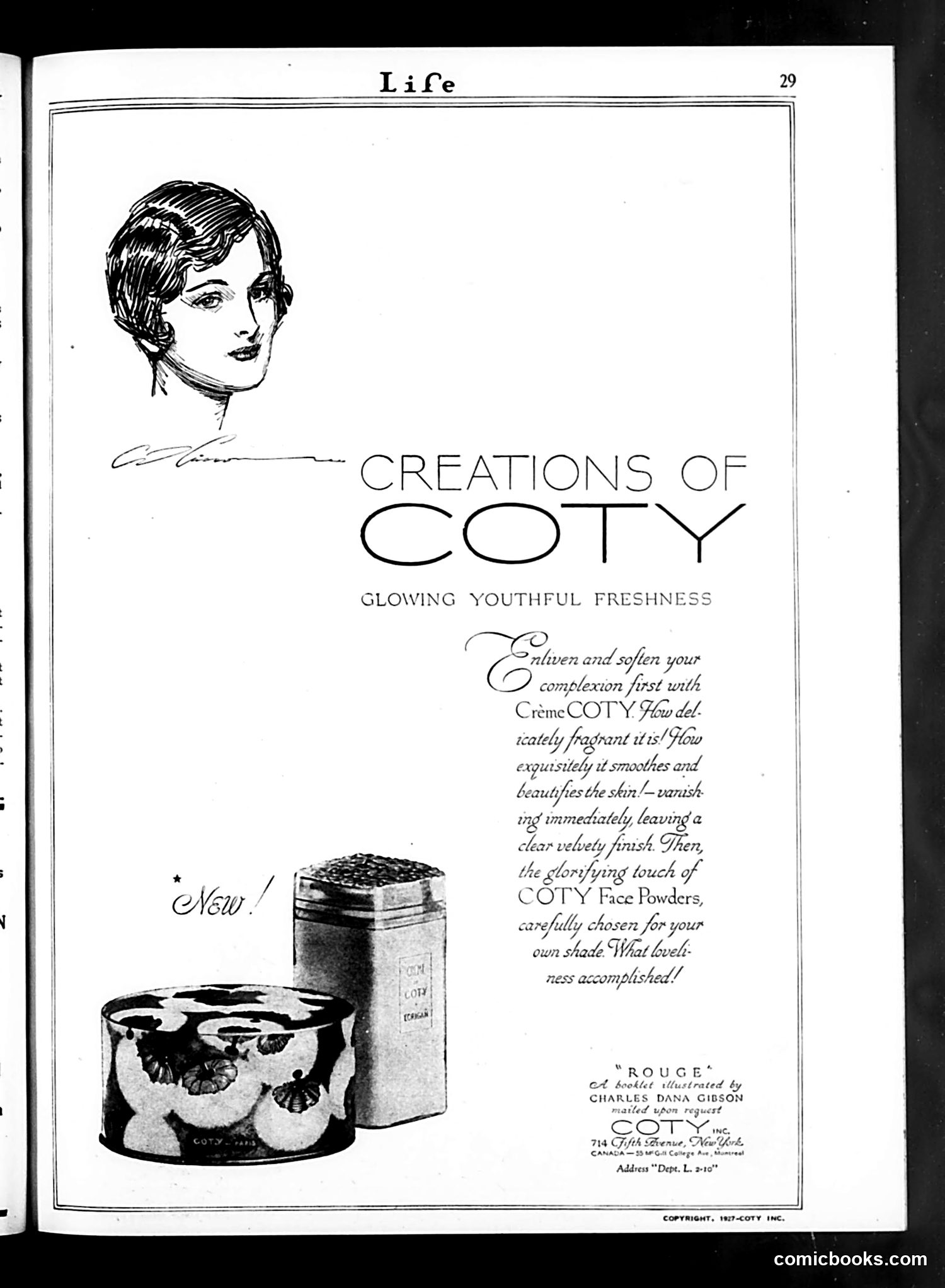
This page is **primarily an advertisement**, not political satire. It promotes Coty cosmetics products—specifically Crème COTY facial cream, face powder, and rouge—positioned as "Creations of COTY" offering "glowing youthful freshness." The visual elements include a stylized portrait of a woman's face (drawn by what appears to be a signature, possibly the artist's mark) at the top left, and product photography showing a decorative powder box and container below. The copy uses period-typical beauty marketing language, emphasizing that the cream "softens" and "beautifies the skin," leaving a "velvety finish," followed by coordinated face powders "carefully chosen for your own shade." This represents **1920s cosmetics advertising**—an era when beauty products were becoming mainstream consumer goods for women. There is no political cartoon or satire present; this is simply a commercial advertisement placed in Life magazine's pages.
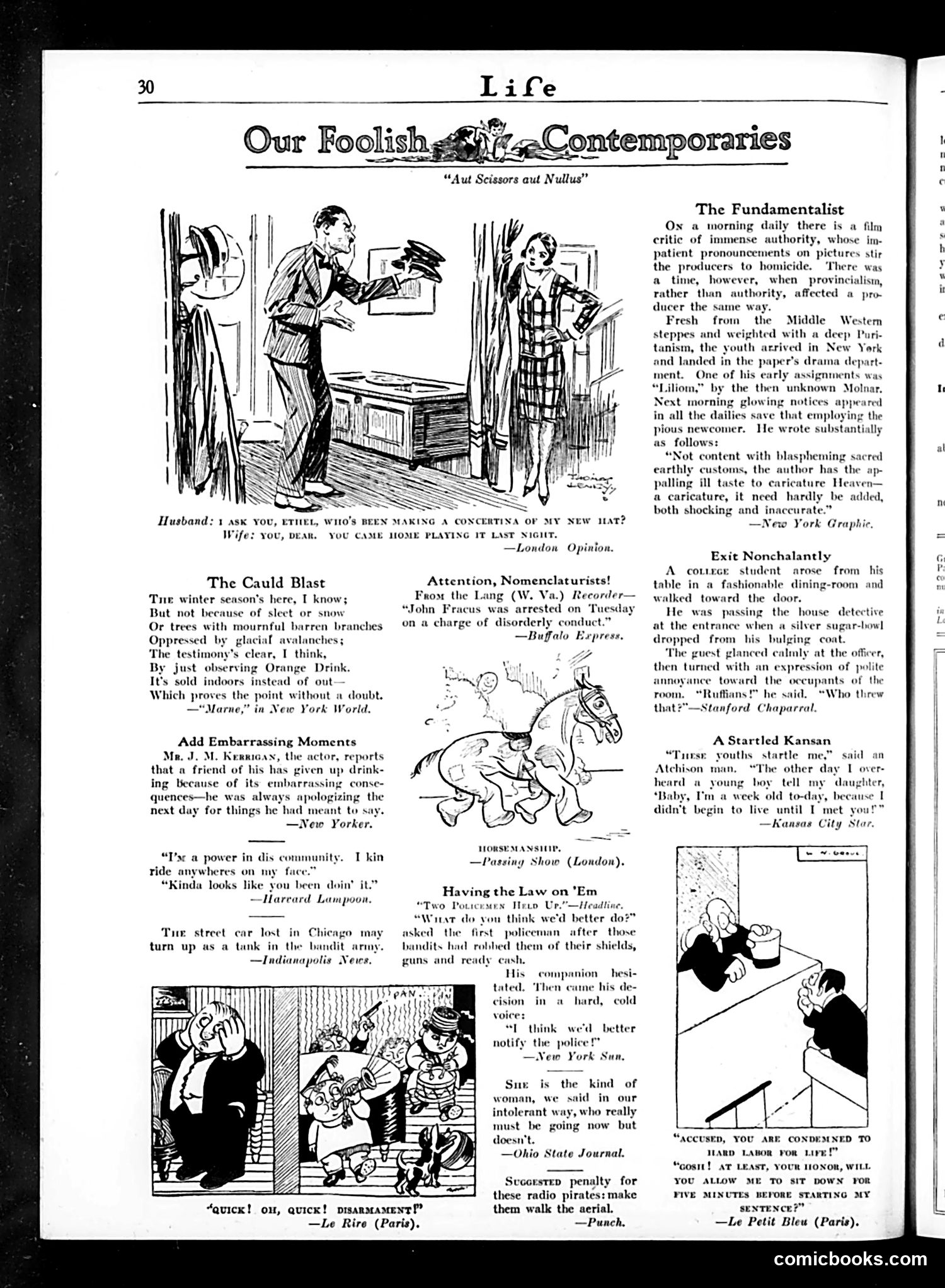
This is a collection of short satirical pieces and jokes lampooning early 20th-century American society and contemporary absurdities. **Top cartoon**: A husband asks his wife who ruined his new hat—she admits she wore it while he was out playing cards last night. The joke mocks spousal domestic friction. **"The Fundamentalist"**: A provincial Midwestern film critic, steeped in Puritanism, arrives in New York and condemns the play "Liliom" as blasphemous for depicting heaven. The satire targets rigid religious fundamentalism clashing with modern theater. **Other pieces mock**: radio pirates, police incompetence, social pretension, and embarrassing drunken behavior. **"Exit Nonchalantly"**: A hotel guest drops a sugar bowl but brazenly blames "ruffians" in the room—satirizing audacious dishonesty. The page combines international humor (quotes from London, Paris publications) with American social commentary, typical of Life's sophisticated satire for educated readers.
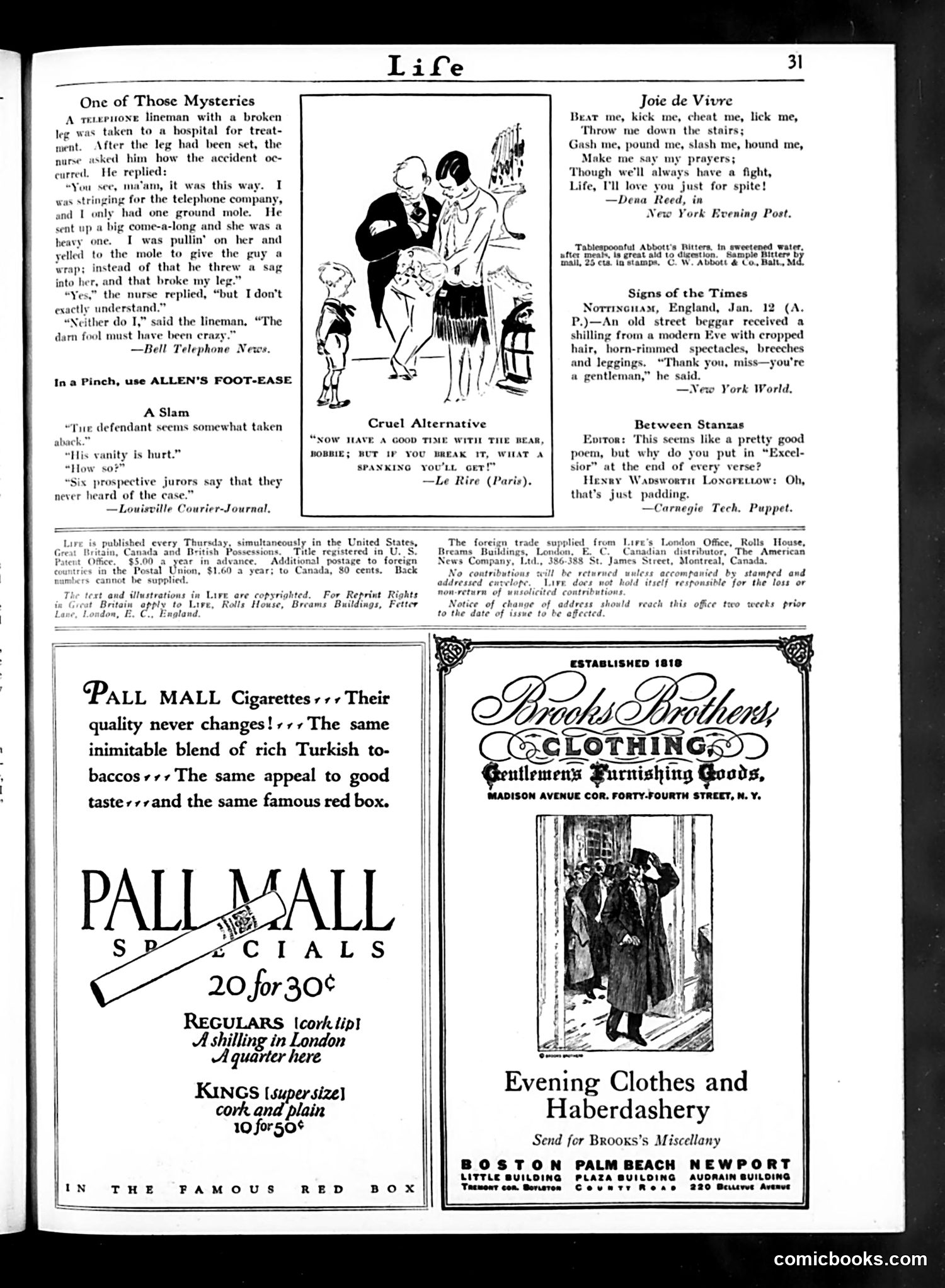
This page contains three brief humor pieces typical of Life's satirical format: **"One of Those Mysteries"**: A telephone lineman describes his accident using technical jargon ("come-a-long," "ground mole," "sag") so obscurely that even the nurse cannot understand him. The joke satirizes workplace specialized language—the lineman's explanation is technically accurate but utterly incomprehensible to outsiders. **"A Slam"**: A defendant is dismayed that jurors haven't heard of his case, viewing it as an insult to his importance. The humor mocks vanity and the assumption that one's legal troubles are noteworthy. **"Cruel Alternative"** (from Paris): A child asks about having fun with a bear, but learns the alternative is a spanking. It's a dark joke playing on parental discipline versus dangerous activity. The page also includes period advertisements for Pall Mall cigarettes and Brooks Brothers clothing, alongside brief humorous quotes under "Signs of the Times" and "Between Stanzas."
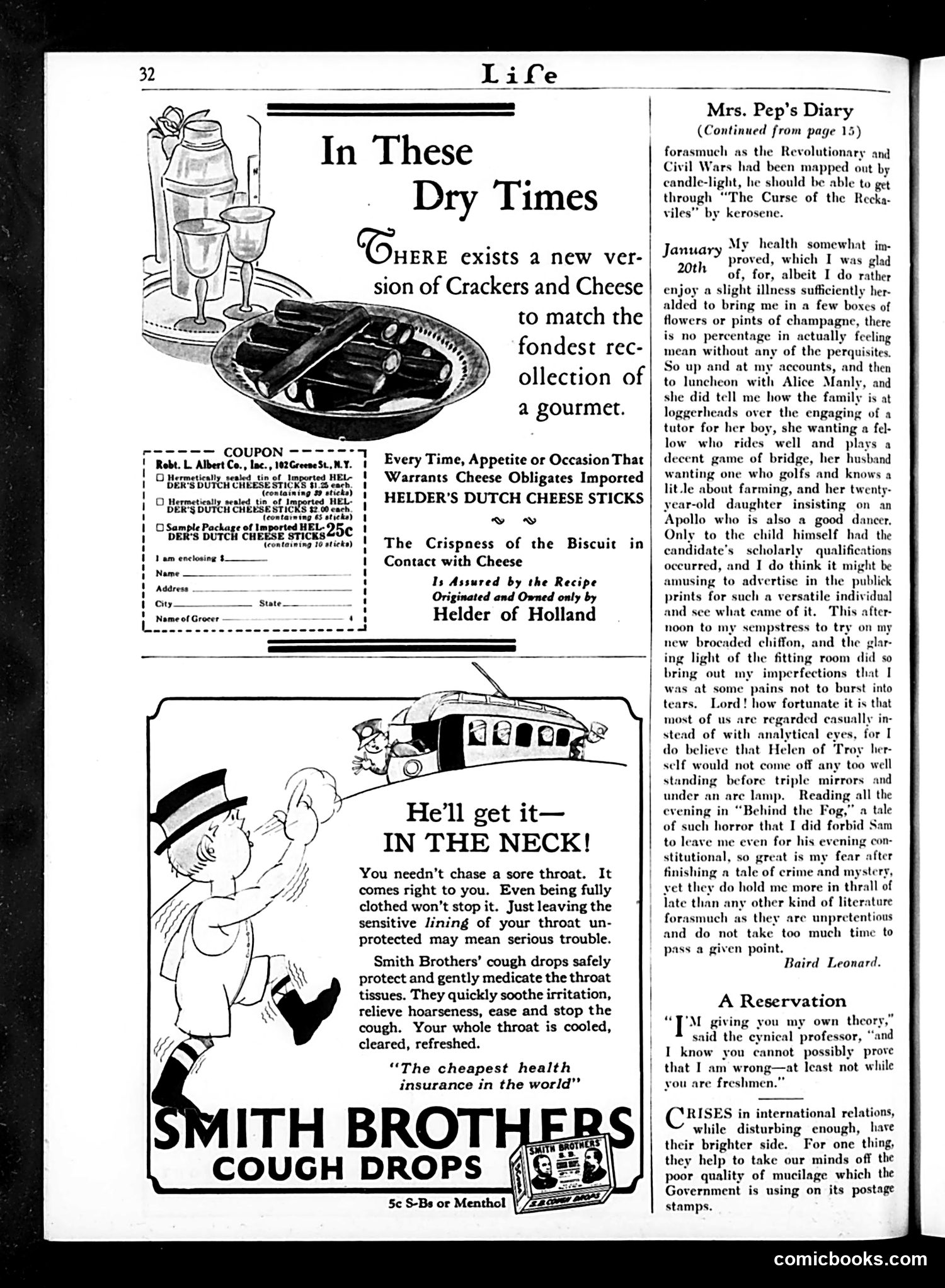
This page contains **advertisements and satirical diary entries** rather than political cartoons. The **"Mrs. Pep's Diary"** column mocks upper-class social anxieties of the era: a wealthy woman frets over hiring a tutor (the boy's parents can't agree on qualifications), worries about her appearance during dress fittings, and confesses addiction to crime fiction. The humor targets vanity and class preoccupations. The **Smith Brothers Cough Drops advertisement** uses slapstick cartoon humor—a man's neck being stretched by a train—to humorously illustrate that sore throats are unavoidable. The tagline "the cheapest health insurance in the world" promises affordable relief. The closing section **"A Reservation"** satirizes academia: a cynical professor smugly claims his theory is unfalsifiable because students can't contradict him while freshmen. A final joke mocks government incompetence—that poor-quality mucilage on postage stamps is a greater national concern than international crises. Overall, the page reflects 1920s-era satirical humor targeting consumer anxieties, class pretension, and bureaucratic ineptitude.
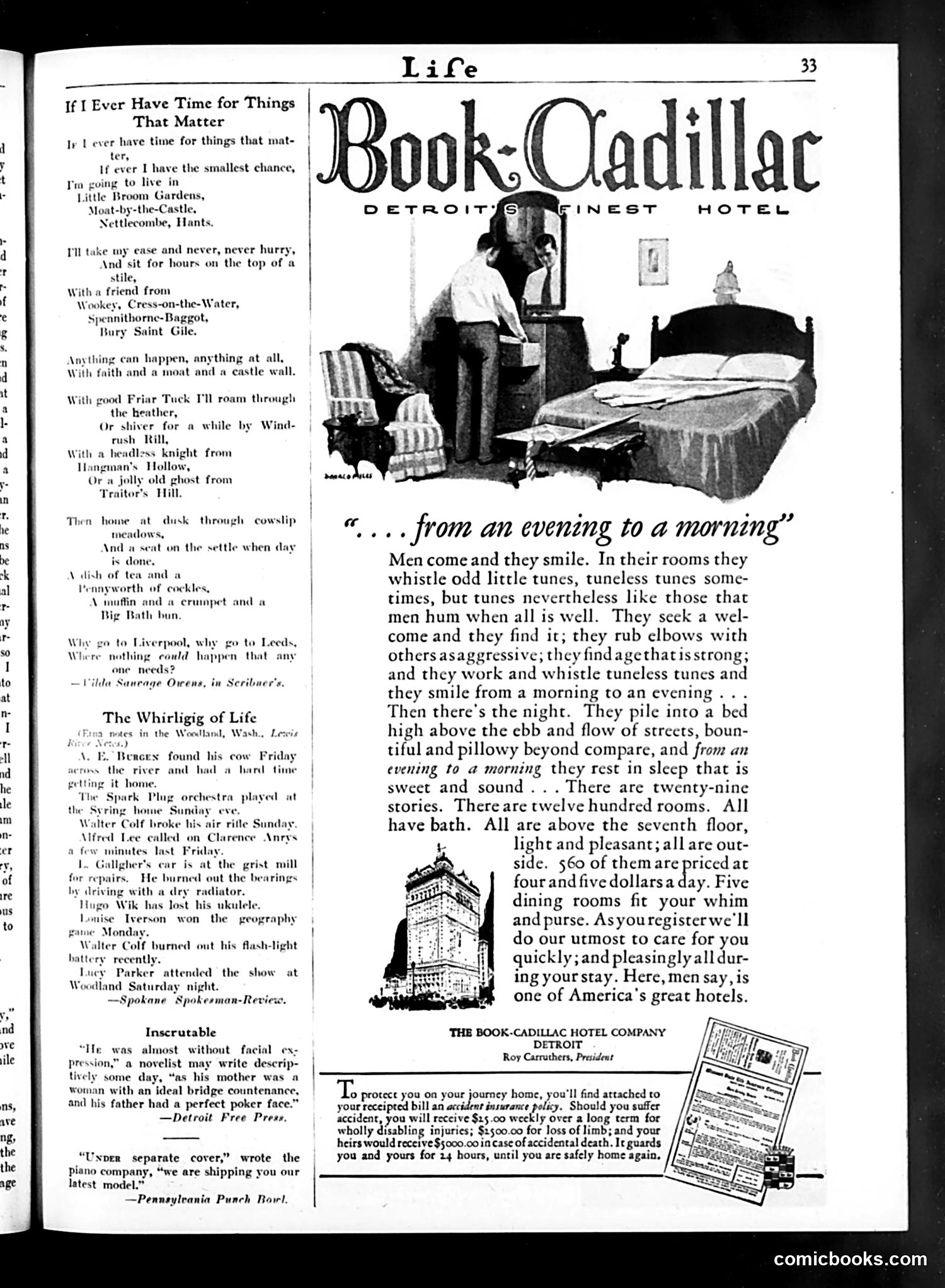
This page is primarily **advertising and light humor** rather than political satire. The main content is a full-page advertisement for the **Book-Cadillac Hotel in Detroit**, a luxury establishment marketing itself to traveling businessmen. The ad emphasizes comfort ("sweet and sound" sleep, quality dining) and affordability ($4-5 daily rates), positioning the hotel as "one of America's great hotels." It notably includes accidental death insurance—a selling point suggesting business travel's perceived risks. The surrounding content consists of three unrelated pieces: a whimsical poem about longing for quiet English countryside life; a local gossip column from Spokane titled "The Whirligig of Life"; and brief humorous observations about facial expressions and business correspondence. There are **no political cartoons** on this page. The humor is gentle and domestic—small-town mishaps and personal musings—reflecting Life's role as a general-interest magazine mixing advertising, light verse, and social observation rather than sharp political commentary.
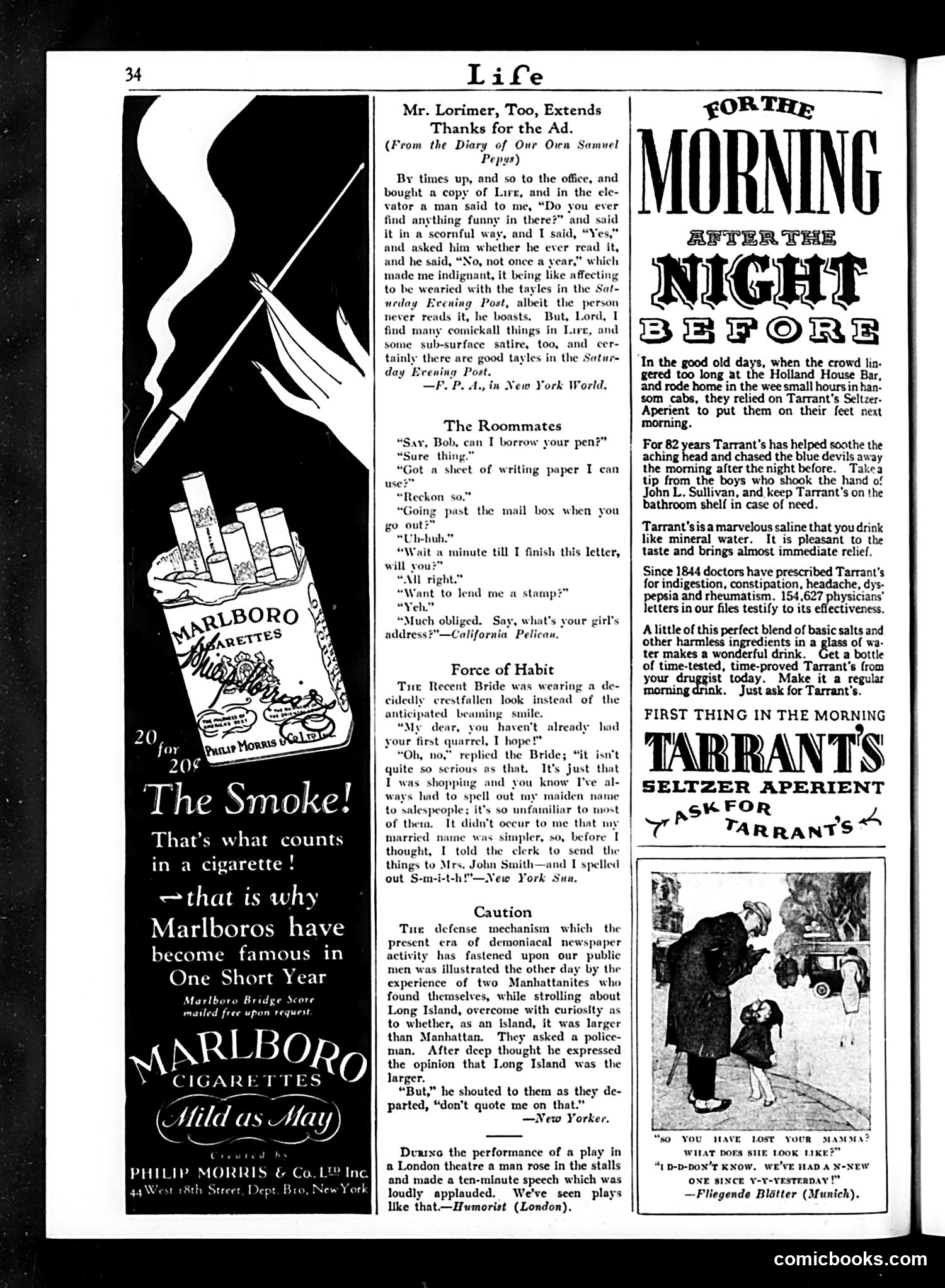
This *Life* magazine page (circa 1920s) contains several humorous pieces satirizing American social conventions and advertising. **The Marlboro ad** is notably ironic: it advertises cigarettes as "Mild as May," a marketing claim that became famous. Life's satirical framing—"Mr. Lorimer, Too, Extends Thanks for the Ad"—mocks both the absurd advertising and George Lorimer, editor of the *Saturday Evening Post*, who likely ran similar ads. **The humor pieces** (roommates, recent bride, policeman anecdote) are gentle observational comedy about everyday social awkwardness—borrowing items, marital confusion, and public figures avoiding accountability. These reflect 1920s concerns about changing social dynamics. **The Tarrant's Seltzer ad** is the page's centerpiece: a hangover remedy marketed nostalgically to men who frequented bars like the Holland House. The reference to "John L. Sullivan" (famous boxer, d. 1918) dates this, suggesting post-Prohibition drinking culture and the male social world of that era. The page blends editorial satire with period advertising, characteristic of *Life*'s approach to cultural commentary.
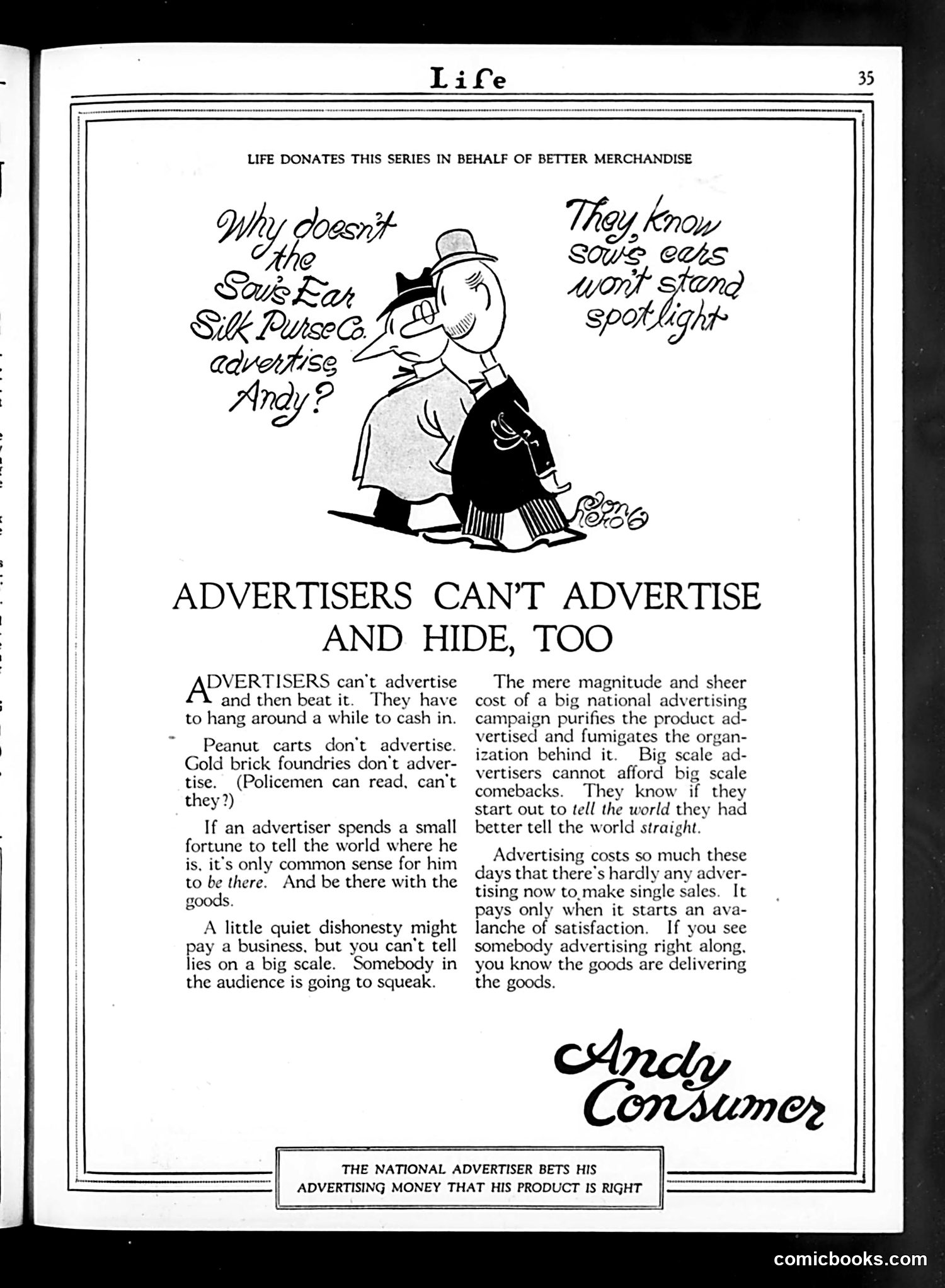
This *Life* magazine piece argues that large-scale national advertising inherently polices product quality. The cartoon shows a figure (likely representing an advertiser or product representative) speaking to "Andy Consumer." **The argument's logic:** Big advertisers must stand behind their claims because massive advertising campaigns are too expensive to risk on inferior products. Unlike small-time con artists ("gold brick foundries," scams), national companies making public promises face accountability—"somebody in the audience is going to squeak" if they lie. **The satire's point:** This is actually pro-advertising propaganda, not satire attacking advertising. *Life* argues that expensive national campaigns serve as quality guarantees. The sheer financial commitment proves the product works; otherwise the company couldn't sustain repeated advertising. **For modern readers:** This reflects early 20th-century trust in big business and assumes advertising investment equals product reliability—a claim modern consumers would likely find naive or self-serving.
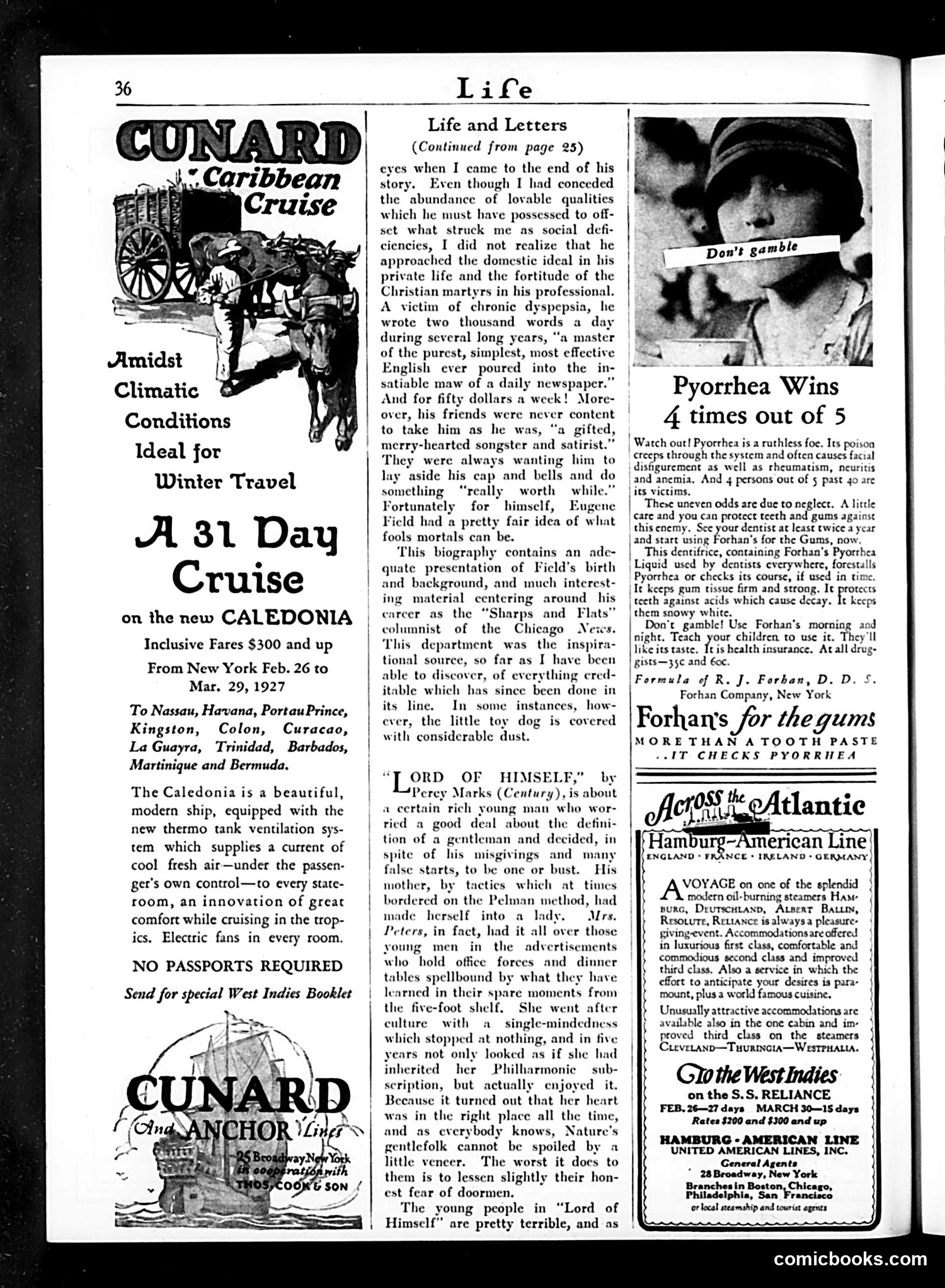
This page is primarily **advertising and literary content**, not political satire. The dominant features are cruise ship advertisements (Cunard's Caribbean voyage and Hamburg-American Line) and a "Life and Letters" book review section discussing Eugene Field's biography and a novel titled "Lord of Himself." The only substantive content is the **Forhan's toothpaste advertisement**, which uses health fear-mongering common to 1920s advertising. It claims pyorrhea (gum disease) affects "4 persons out of 5 past 40" and warns of serious complications like rheumatism and anemia—exaggerated medical claims typical of the era before strict FDA regulation. The page reflects 1927 consumer culture: leisure travel promotion and aggressive patent medicine marketing using pseudo-scientific health threats to drive sales. No political cartoons or satire are present; this is a standard magazine layout mixing editorial content with period advertisements.
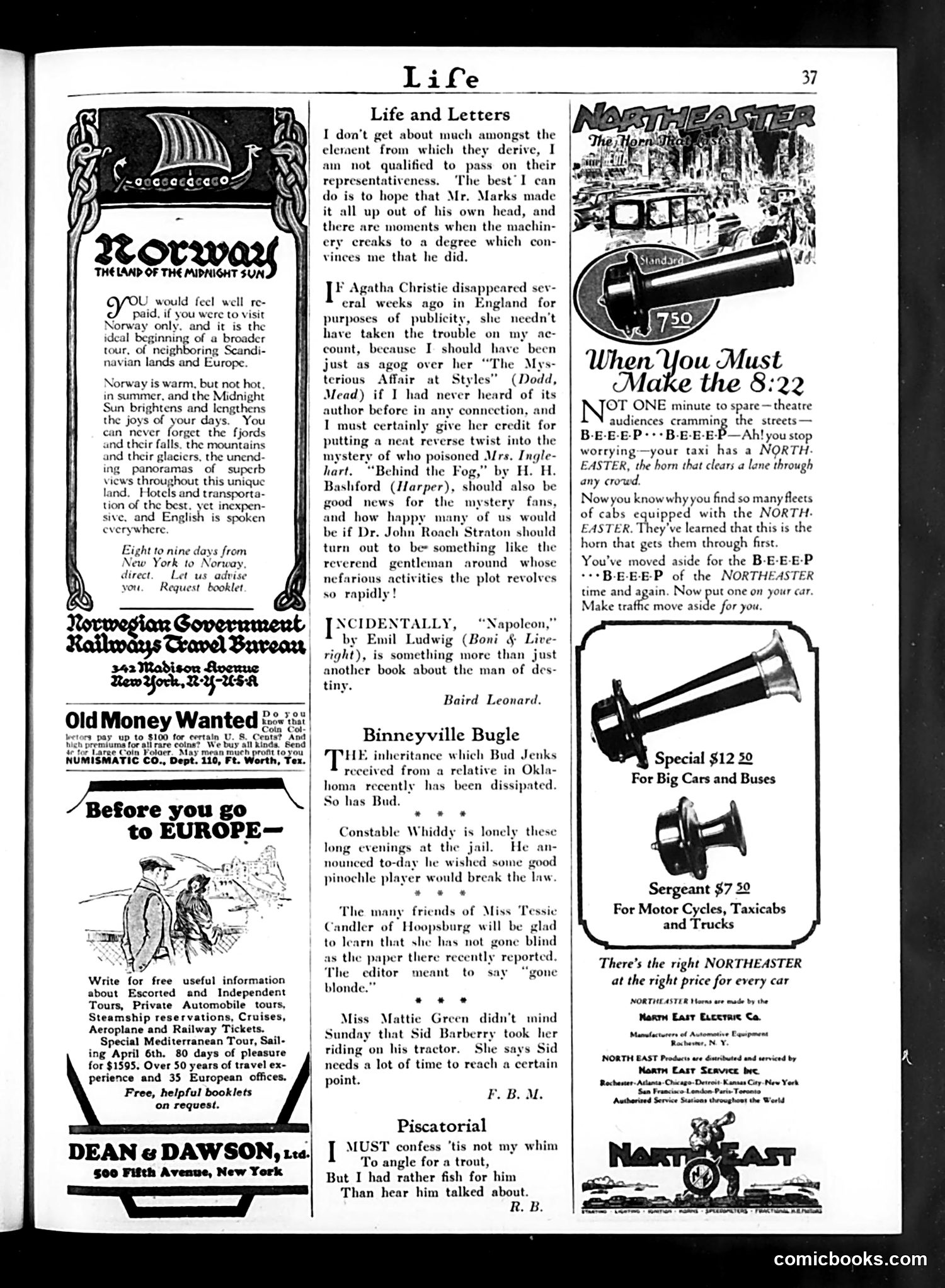
This page is primarily **advertising and lighter editorial content** rather than political satire. The main elements include: **Advertisements**: Norwegian travel promotion, coin collecting services, European tour booklet, and automobile horns (Northeaster brand). **"Life and Letters" section**: Book reviews discussing mystery novels by Agatha Christie and H.H. Bashford, plus commentary on Emil Ludwig's "Napoleon." The reviewer expresses skepticism about whether certain mystery plots are genuinely original. **"Binneyville Bugle"**: Humorous small-town gossip items—jokes about a man squandering an inheritance, a lonely jailer, and local romantic drama. These are gentle, folksy humor without political content. **"Piscatorial"**: A light poem about preferring to fish rather than hear fishing stories. The page reflects 1920s-era Life magazine's mix of consumer advertising, book criticism, and gentle humor. There are **no significant political cartoons or satirical commentary** present.
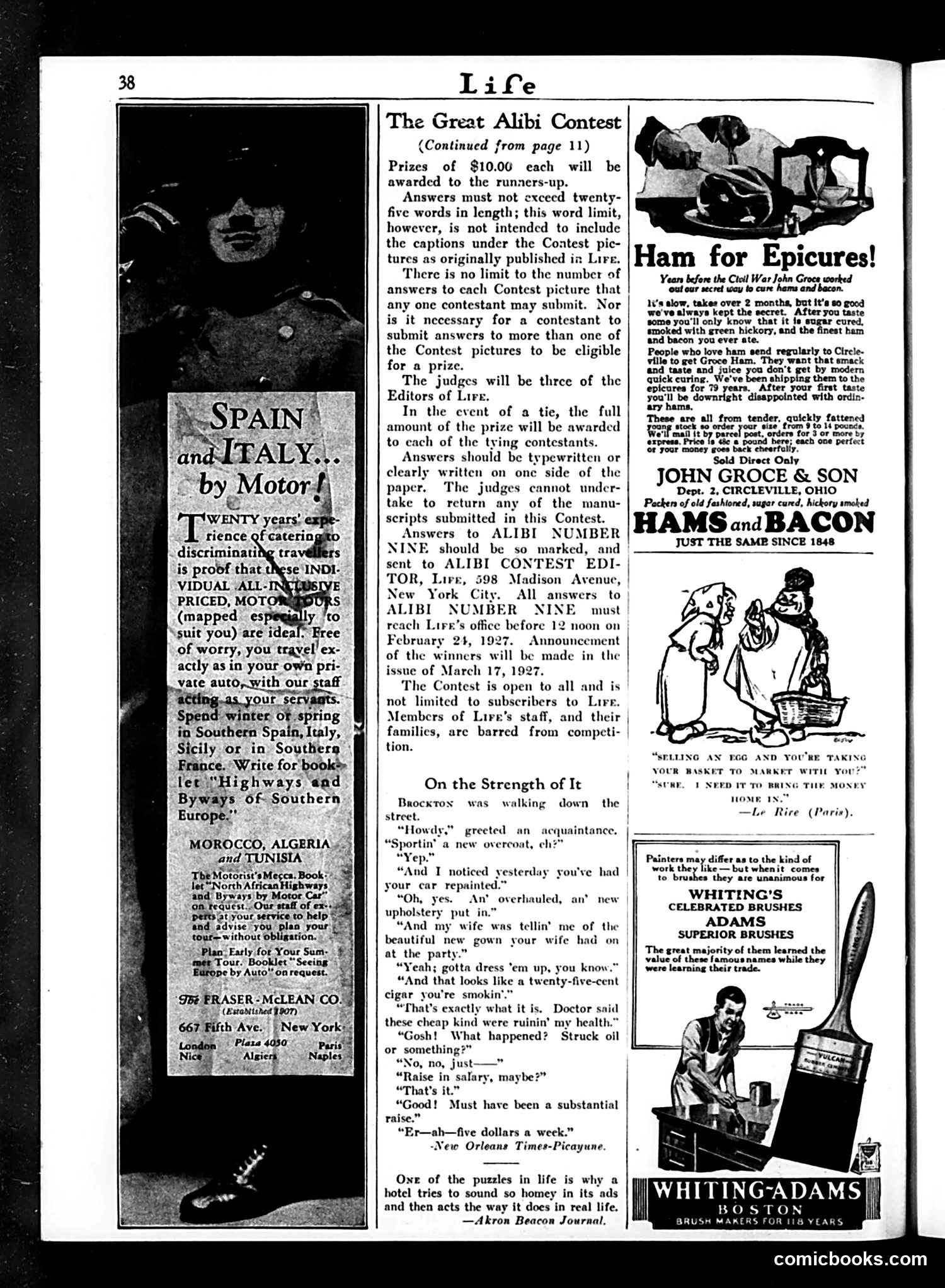
This page is primarily **advertising and contest announcements** rather than editorial cartoons. The main content includes: 1. **Contest Details**: Life magazine is running "The Great Alibi Contest," inviting readers to submit short answers (under 25 words) to contest pictures. Winners receive $10 prizes. 2. **Travel Advertisement** (left): Sir Fraser-McLean Co. advertises guided motor tours through Spain, Italy, and Southern Europe—luxury travel for the wealthy. 3. **Ham Advertisement** (right): John Groce & Son promotes hickory-smoked hams from Circleville, Ohio, claiming Civil War-era curing methods. 4. **Humor Snippet** ("On the Strength of It"): A brief comedic dialogue where a man boasts about his wife's new dress and car repairs, but when asked what caused his newfound wealth, admits it's merely a five-dollar weekly raise—satirizing working-class pretension and financial delusion. The page reflects 1920s consumer culture and aspiration more than political satire.
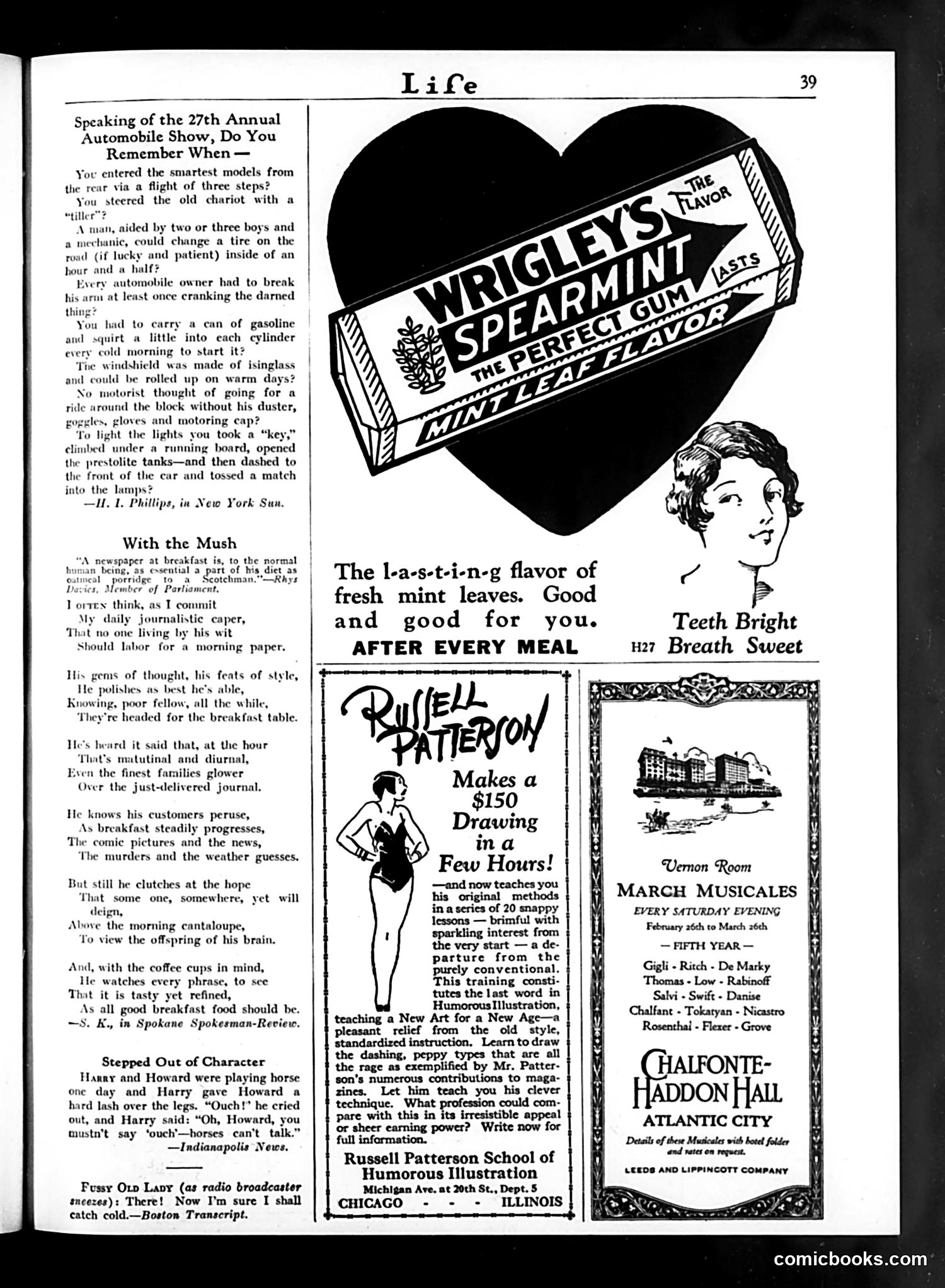
This page mixes nostalgic humor with period advertising. The main content is H.I. Phillips's satirical column recalling the 27th Annual Automobile Show, humorously listing the inconveniences of early motoring: three-step entrances, tiller steering, hour-long tire changes, hand-cranking engines, isinglass windshields, and elaborate driving costumes (dusters, goggles, caps). The satire celebrates modern automotive progress by mocking what drivers endured just years prior. Secondary content includes light humor pieces about breakfast newspaper readers and a child's misunderstanding about horses talking. The advertisements—Wrigley's Spearmint gum, Russell Patterson's drawing school, and March Musicales—are typical period placements targeting the magazine's middle-class readership. The overall tone is lighthearted nostalgia rather than sharp political satire, reflecting Life's role as a general-interest humor magazine of this era.
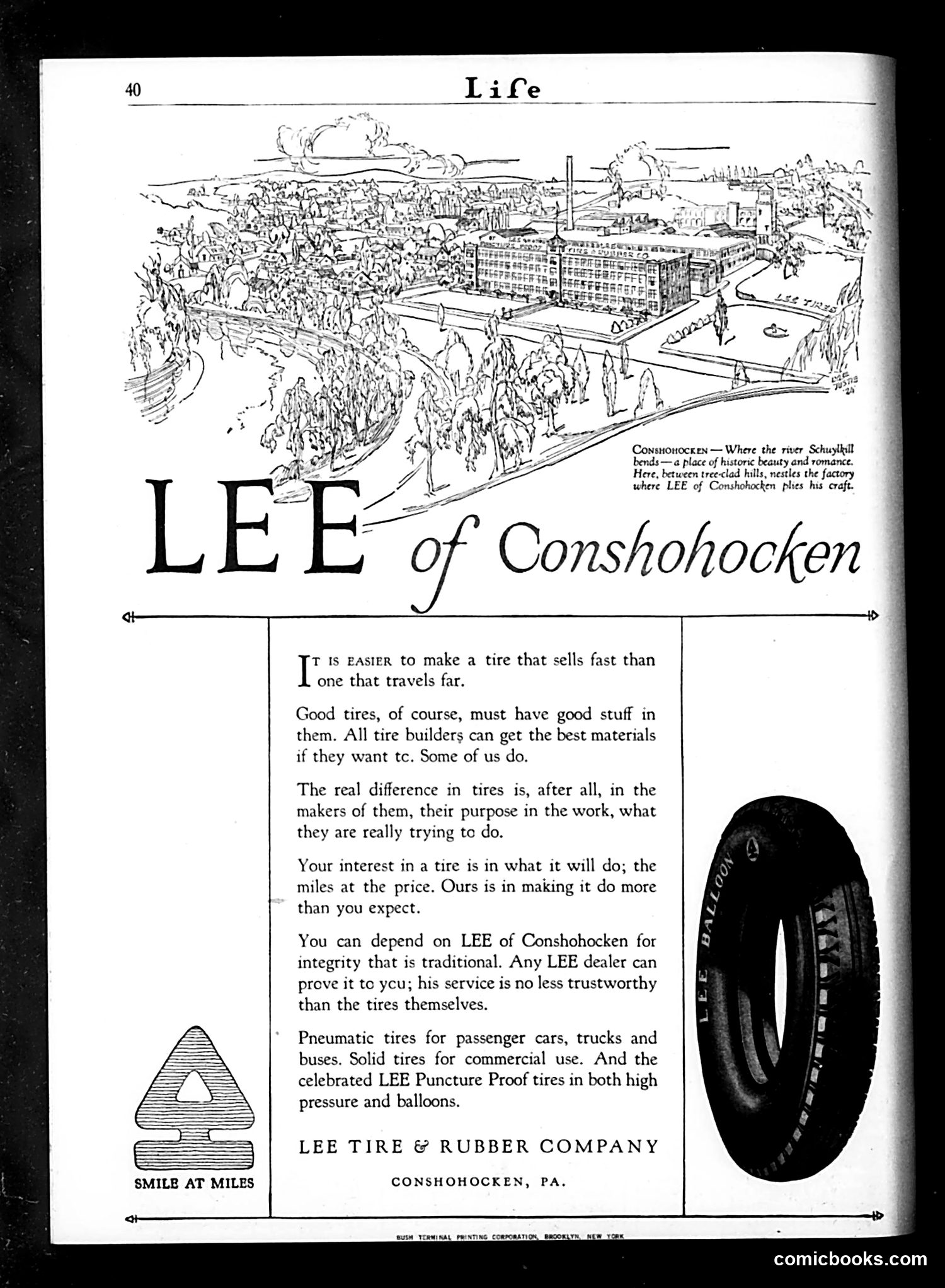
This is primarily a **full-page advertisement**, not satire or political content. It promotes LEE Tire & Rubber Company of Conshohocken, Pennsylvania. The page features: 1. **Top illustration**: An aerial sketch of the factory and surrounding Conshohocken landscape along the Schuylkill River, emphasizing "historic beauty and romance" to appeal to local pride and prestige. 2. **Marketing message**: The company argues that quality tires depend on maker's *integrity and purpose*, not just materials—claiming LEE prioritizes durability ("miles at the price") over quick sales. This positions them as trustworthy against competitors. 3. **Product range**: Lists pneumatic tires for passenger cars, trucks, buses, and solid tires for commercial use, including their "Puncture Proof" line. 4. **Visual elements**: A tire image and triangular logo with "SMILE AT MILES" suggests their brand promise of trouble-free mileage. The ad uses early 20th-century corporate rhetoric emphasizing American manufacturing virtue and dealer reliability.

I can see this is a mostly black page with minimal visible content - primarily a white vertical strip on the left edge and the "comicbooks.com" watermark in the lower right. The page appears to be either a blank or nearly blank section from a publication, possibly a title page, section divider, or advertising page with minimal text. Without clearer visible imagery or substantial OCR text to analyze, I cannot identify specific cartoons, political figures, or satirical content. The degraded image quality and darkness make it impossible to discern any distinct illustrations or caricatures that would be necessary to explain the historical context and meaning to a modern reader. If you have a clearer version of this page, I'd be better able to provide the detailed analysis you're requesting.