
Life, 1927-02-10 · page 28 of 43
Life — February 10, 1927 — page 28: what you’re looking at
What you’re looking at
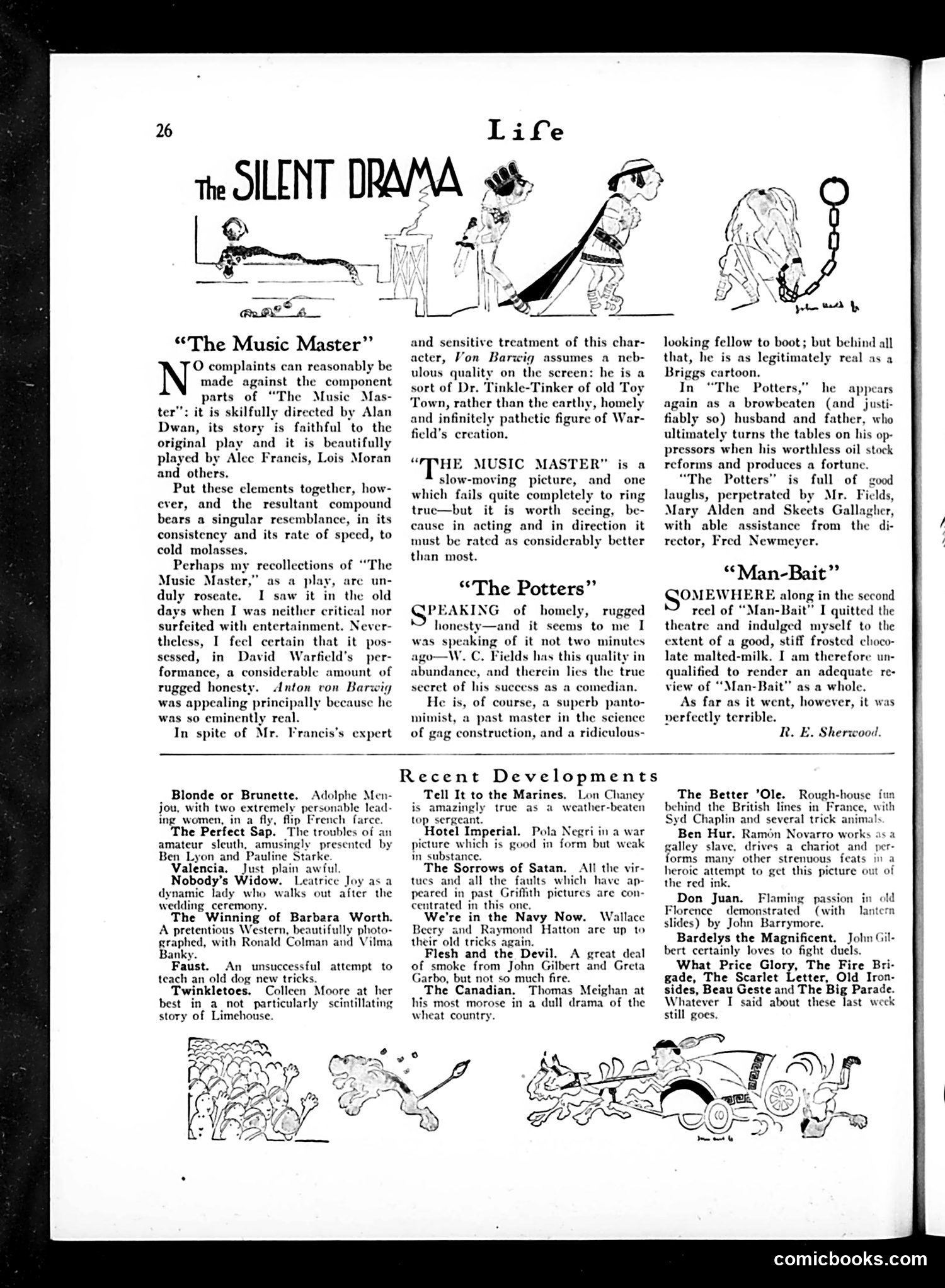
This page reviews several silent films. The critic praises **"The Music Master"** (directed by Alan Dwan, starring Alec Francis) for its technical qualities but criticizes it as slow and emotionally lifeless—the lead character lacks the "earthy, homely" realism of the original stage play. **"The Potters"** featuring **W.C. Fields** receives higher praise. Fields plays a downtrodden husband who gains fortune through an oil stock investment, ultimately dominating his family. The reviewer credits Fields's success to his combination of physical comedy skills and underlying authenticity (comparing him to a Briggs cartoon—likely George Briggs's comic strips). **"Man-Bait"** is dismissed as "perfectly terrible"—the reviewer actually left the theater partway through to get a malted milk, joking he's therefore "unqualified" to fairly review it. The page also briefly lists other current releases with one-line critiques. This reflects Life's role as a cultural tastemaker during Hollywood's silent era, when such reviews significantly influenced public moviegoing.
📄 Transcribed text from this page (OCR, searchable)
Machine-transcribed from the original scan — historical spelling and the odd misread are preserved.
“The Music Master” O complaints can reasonably be N made against the component parts of “The Music Mas- ter”: it is skilfully directed by Alan Dwan, its story is faithful to the original play and it is beautifully played by Alec Francis, Lois Moran and others. Put these elements together, how- ever, and the resultant compound bears a singular resemblance, in its consistency and its rate of specd, to cold molasses. Perhaps my recollections of ‘The Music Master,” as a play, are un- duly roseate. I saw it in the old days when I was neither critical nor surfeited with entertainment. Never- theless, I feel certain that it pos- sessed, in David Warfield’s per- formance, a considerable amount of rugged honesty. Anton von Barwig was appealing principally because he was so eminently real. In spite of Mr. Francis’s expert and sensitive treatment of this char- acter, Von Barwig assumes a neb- ulous quality on the screen: he is a sort of Dr. Tinkle-Tinker of old Toy Town, rather than the earthy, homely and infinitely pathetic figure of War- ficld’s creation. “"XHE MUSIC MASTER” is a slow-moving picture, and one which fails quite completely to ring true—but it is worth seeing, be- cause in acting and in direction it must be rated as considerably better than most. “The Potters” GPEAEING of homely, rugged XK honesty—and it seems to me I was speaking of it not two minutes ago—W. C. Fields has this quality in abundance, and therein lies the true secret of his success as a comedian. He is, of course, a superb panto- a past master in the science construction, and a ridiculous- looking fellow to boot; but behind all that, he is as legitimately real as a Briggs cartoon. In “The Potters,” he appears again as a browbeaten (and justi- fiably so) husband and father, who ultimately turns the tables on his op- pressors when his worthless oil stock reforms and produces a fortune. “The Potters” is full of good laughs, perpetrated by Mr. Fields, Mary Alden and Skeets Gallagher, with able assistance from the di- rector, Fred Newmeyer. ‘Man-Bait” Som EWHERE along in the second reel of ““Man-Bait’’ I quitted the theatre and indulged myself to the extent of a good, stiff frosted choco- late malted-milk. I am therefore un- qualified to render an adequate re- view of “Man-Bait” as a whole, As far as it went, however, it was verfectly terrible. R. E. Sherwood. Blonde or Brunette. Adolphe Men- jou, with two extremely personable lead- ing women, in a fly, flip French farce. The Perfect Sap. The troubles of an amateur sleuth, amusingly presented by Ben Lyon and Pauline Starke. Valencia. Just plain awful. Nobody’s Widow. Leatrice ] dynamic lady who walks out after the wedding ceremony. The Winning of Barbara Worth. A pretentious Western, beautifully photo- graphed, with Ronald Colman and Vilma Banky. Faust. An unsuccessful attempt to teach an old dog new tricks. Twinkletoes. Colleen Moore at her best in a_not particularly scintillating story of Limehouse. Recent Development Tell It to the Marines. Lon Chancy is amazingly as a weather-be: top sergeant. Hotel Imperial. Pola Negri in a war picture which is good in form but weak In substance. The Sorrows of Satan, All the vir- tues and all the faults which have peared in past Griffith pictures are con- centrated in this one. We're in the Navy Now. Wallace Beery and Raymond Hatton are up to their old tricks again. Flesh and the Devil. A great_deal of smoke from John Gilbert and Greta Garbo, but not so much fire. The Canadian. Thomas Meighan at his most morose in a dull drama of the wheat country. true The Better ’Ole. Rough-house fun behind the British lines in France, with Syd Chaplin and several trick animals Ben Hur. Ramon Novarro works as a galley slave, drives a chariot and_per- forms many other strenuous feats in a heroic attempt to get this picture out of the red ink. Don Juan. Flaming passion in old Florence demonstrated (with lantern slides) by John Barrymore. Bardelys the Magnificent. John Gil- bert certainly loves to fight duels. What Price Glory, The Fire Bri- gade, The Scarlet Letter, Old Iron- sides, Beau Geste and The Big Parade. Whatever I said about these last week still goes. td comicbooks.com