
Life, 1927-02-10 · page 20 of 43
Life — February 10, 1927 — page 20: what you’re looking at
What you’re looking at
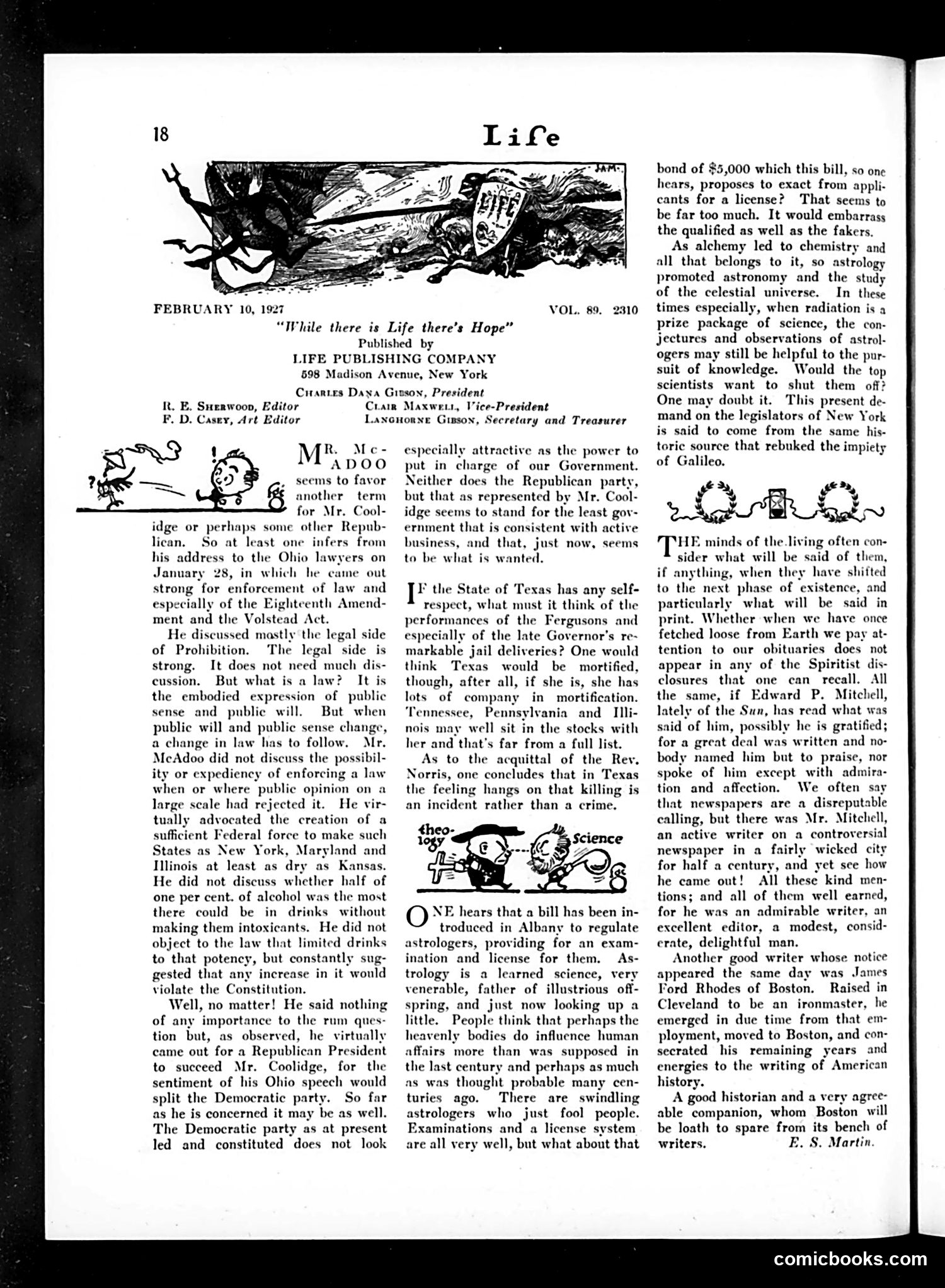
This page contains editorial commentary on contemporary political issues, not a single unified cartoon. The main illustration shows a small figure labeled "Mr. McAdoo" (William Gibbs McAdoo, a prominent Democrat and former Treasury Secretary). **The satire concerns:** 1. **McAdoo's Prohibition stance**: McAdoo gave a speech supporting strict enforcement of the Volstead Act (Prohibition). The editor mocks him for advocating a massive federal enforcement force while ignoring practical questions about public opinion actually supporting such laws. 2. **Political implications**: The editor notes McAdoo's rhetoric could split the Democratic Party, making Republican President Coolidge's do-nothing approach seem preferable by comparison. 3. **A secondary commentary** critiques Texas governors (the Fergusons) for corrupt "jail deliveries" and mentions Reverend Norris's acquittal for killing. 4. **Astrology regulation**: The page questions an Albany bill requiring expensive bonding ($5,000) for astrology licenses—too burdensome even for legitimate practitioners. The cartoons are minor illustrations accompanying these written opinions rather than standalone works.
📄 Transcribed text from this page (OCR, searchable)
Machine-transcribed from the original scan — historical spelling and the odd misread are preserved.
FEBRUARY 10, 1927 VOL, 89. 2310 “While there is Life there’s Hope” Published by LIFE PUBLISHING COMPANY 698 Madison Avenue, New York Cirartes Daya Ginson, President Cram Maxwett, Vice-President Laxouonxe Ginson, Secretary and Treasurer I. E. Suerwoon, Editor F, D. Casey, Art Editor M R. Mec- ADOO seems to favor another term for Mr. Cool- idge or perhaps some other Repub- lican. So at least one infers from his address to the Ohio lawyers on January 28, in which he came out strong for enforcement of law and especially of the Eighteenth Amend- ment and the Volstead Act. He discussed mastly the legal side of Prohibition. The legal side is strong. It does not need much dis- cussion. But what is a law? It is the embodied expression of public sense and public will. But when public will and public sense change, a change in law has to follow. Mr. McAdoo did not discuss the possibil- ity or expediency of enforcing a law when or where public opinion on a large scale had rejected it. He vir- tually advocated the creation of a sufficient Federal force to make such States as New York, Maryland and Illinois at least as dry as Kansas. He did not discuss whether half of one per cent. of alcohol was the most there could be in drinks without making them intoxicants. He did not object to the law that limited drinks to that potency, but constantly sug- gested that any increase in it would violate the Constitution. Well, no matter! He said nothing of any importance to the rum que: tion but, as observed, he virtually came out for a Republican President to succeed Mr. Coolidge, for the sentiment of his Ohio speech would split the Democratic party. So far as he is concerned it may be as well. The Democratic party as at present led and constituted does not look especially attractive as the power to put in charge of our Government. Neither does the Republican party, but that as represented by Mr. Cool- idge seems to stand for the least gov- ernment that is consistent with active business, and that, just now, seems to be what is wanted. I’ the State of Texas has any self- respect, what must it think of the performances of the Fergusons and especially of the late Governor's re- markable jail deliveries? One would think Texas would be mortified, though, after all, if she is, she has lots of company in mortification. ‘Tennessee, Pennsylvania and _IIli- nois may well sit in the stocks with her and that’s far from a full list. As to the acquittal of the Rev. Norris, one concludes that in Texas the feeling hangs on that killing is an incident rather than a crime, NE hears that a bill has been in- troduced in Albany to regulate astrologers, providing for an exam- ination and license for them. As- trology is a learned science, very venerable, father of illustrious off- spring, and just now looking up a little. People think that perhaps the heavenly bodies do influence human affairs more than was supposed in the last century and perhaps as much as was thought probable many cen- turies ago. There are swindling astrologers who just fool people. Examinations and a license system are all very well, but what about that bond of $5,000 which this bill, so one hears, proposes to exact from appli- cants for a license? That seems to be far too much. It would embarrass the qualified as well as the fakers. As alchemy led to chemistry and all that belongs to it, so astrology promoted astronomy and the study of the celestial universe. In these times especially, when radiation is a prize package of science, the con- jectures and observations of astrol- ogers may still be helpful to the pur- suit of knowledge. Would the top scientists want to shut them off? One may doubt it. This present de- mand on the legislators of New York is said to come from the same his- toric source that rebuked the impiety of Galileo. f hf ~ HE minds of the.living often con- sider what will be said of them, if anything, when they have shifted to the next phase of existence, and particularly what will be said in print. Whether when we have once fetched loose from Earth we pay at- tention to our obituaries does not appear in any of the Spiritist dis- closures that one can recall. All the same, if Edward P. Mitchell, lately of the Sun, has read what was said of him, possibly he is gratified; for a great deal was written and no- body named him but to praise, nor spoke of him except with admira- tion and affection. We often say that newspapers are a disreputable calling, but there was Mr. Mitchell, an active writer on a controversial newspaper in a fairly wicked city for half a century, and yet see how he came out! All these kind men- tions; and all of them well earned, for he was an admirable writer, an excellent editor, a modest, consid- erate, delightful man. Another good writer whose notice appeared the same day was James Ford Rhodes of Boston. Raised in Cleveland to be an ironmaster, he emerged in due time from that em- ployment, moved to Boston, and con- secrated his remaining years and energies to the writing of American history. A good historian and a very agree- able companion, whom Boston will be loath to spare from its bench of writers. E. S. Martin. comicbooks.com