
Life, 1927-02-10 · page 25 of 43
Life — February 10, 1927 — page 25: what you’re looking at
What you’re looking at
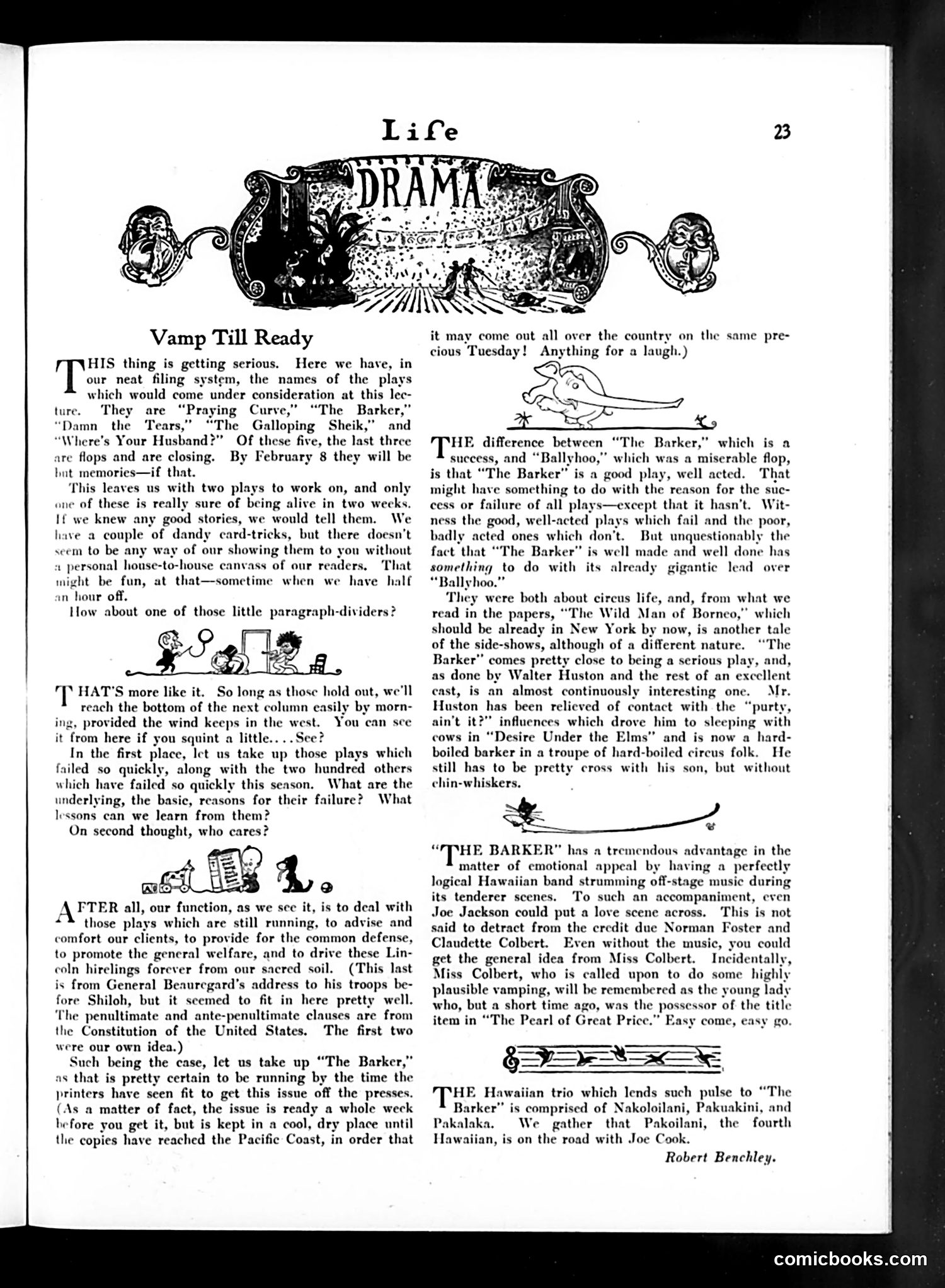
This is a theatrical review column discussing Broadway plays closing and opening in the early 1920s. The author uses self-aware, jokey commentary to discuss why certain plays succeed or fail. **Main points:** - Several plays are flopping and closing: "Praying Curve," "Damn the Tears," "The Galloping Sheik," and "Where's Your Husband?" - "The Barker" (a circus play starring Walter Huston) is succeeding while "Ballyhoo" (also circus-themed) failed - The author humorously concludes good acting and solid production matter for success, though the column feigns indifference ("who cares?") - References Walter Huston moving from sentimental roles in "Desire Under the Elms" to playing a hardened circus barker - Notes "The Barker" features a Hawaiian band for emotional appeal The humor relies on the columnist's deliberately contradictory tone—claiming not to care about theater while providing detailed analysis—and period-specific theatrical references modern readers would need context to understand.
📄 Transcribed text from this page (OCR, searchable)
Machine-transcribed from the original scan — historical spelling and the odd misread are preserved.
Vamp Till Ready HIS thing is getting serious. Here we have, in our neat filing system, the names of the plays which would come under consideration at this lec- They are “Praying Curve,” “The Barker,” mn the Tears,” “The Galloping Sheik,” and “Where's Your Husband?” Of these five, the last three are flops and are closing. By February 8 they will be but memories—if that. This leaves us with two plays to work on, and only one of these is really sure of being alive in two weeks. If we knew any good stories, we would tell them. We have a couple of dandy card-tricks, but there doesn’t seem to be any way of our showing them to you without a personal house-to-house canvass of our readers, That ght be fun, at that—sometime when we have half in hour off. How about one of those little paragraph-dividers ? T HAT'S more like it. So long as those hold out, we'll reach the bottom of the next column easily by morn- ing, provided the wind keeps in the west. You can sce it from here if you squint a little.. ..See? In the first place, Ict us take up those plays which failed so quickly, along with the two hundred others which have failed so quickly this season. What are the underlying, the basic, reasons for their failure? What lessons can we learn from them? On second thought, who cares? FTER all, our function, as we sce it, is to deal with +* those plays which are still running, to advise and comfort our clients, to provide for the common defense, to promote the general welfare, and to drive these Lin- coln hirelings forever from our sacred soil. (This last is from General Beauregard’s address to his troops be- fore Shiloh, but it seemed to fit in here pretty well. The penultimate and ante-penultimate clauses are from the Constitution of the United States. The first two were our own idea.) Such being the case, let us take up “The Barker,” as that is pretty certain to be running by the time the printers have seen fit to get this issue off the presses. (As a matter of fact, the issue is ready a whole weck before you get it, but is kept in a cool, dry place until the copies have reached the Pacific Coast, in order that it may come out all over the country on the same pre- cious Tuesday! Anything for a laugh.) HE difference between “The Barker,” which is a success, and “Ballyhoo,” which was a miserable flop, is that “The Barker” is a good play, well acted. That might have something to do with the reason for the suc- cess or failure of all plays—except that it hasn't. Wit- ness the good, well-acted plays which fail and the poor, badly acted ones wi But unquestionably the fact that “The Barker’ 1 made and well done has something to do with its already gigantic lead over “Ballyhoo.” They were both about circus life, and, from what we read in the papers, “The Wild Man of Borneo,” which should be already in New York by now, is another tale of the side-shows, although of a different nature. ‘The Barker” comes pretty close to being a serious play, and, as done by Walter Huston and the rest of an cllent cast, is an almost continuously interesting one. Mr. Huston has been relieved of contact with the “purty, ain't it?” influences which drove him to sleeping with cows in “Desire Under the Elms” and is now a hard- boiled barker in a troupe of hard-boiled circus folk. He still has to be pretty cross with his son, but without chin-whiskers. e “MOHE BARKER" has a tremendous advantage in the matter of emotional appeal by having a perfectly logical Hawaiian band strumming off-stage music during its tenderer scenes. To such an accompaniment, even Joe Jackson could put a love scene across. This is not said to detract from the credit due Norman Foster and Claudette Colbert. Even without the music, you could get the general idea from Miss Colbert. Incidentally, Miss Colbert, who is called upon to do some highly plausible vamping, be remembered as the young lady who, but a short time ago, was the possessor of the title item in “The Pearl of Great Price.” Easy come, easy go. SSS 2S5E=E HE Hawaiian trio which lends such pulse to “The Barker’ is comprised of Nakoloilani, Pakuakini, and Pakalaka. We gather that Pakoilani, the fourth Hawaiian, is on the road with Joe Cook. Robert Benchley. comicbooks.com