
A complete issue · 37 pages · 1926
Life — December 30, 1926
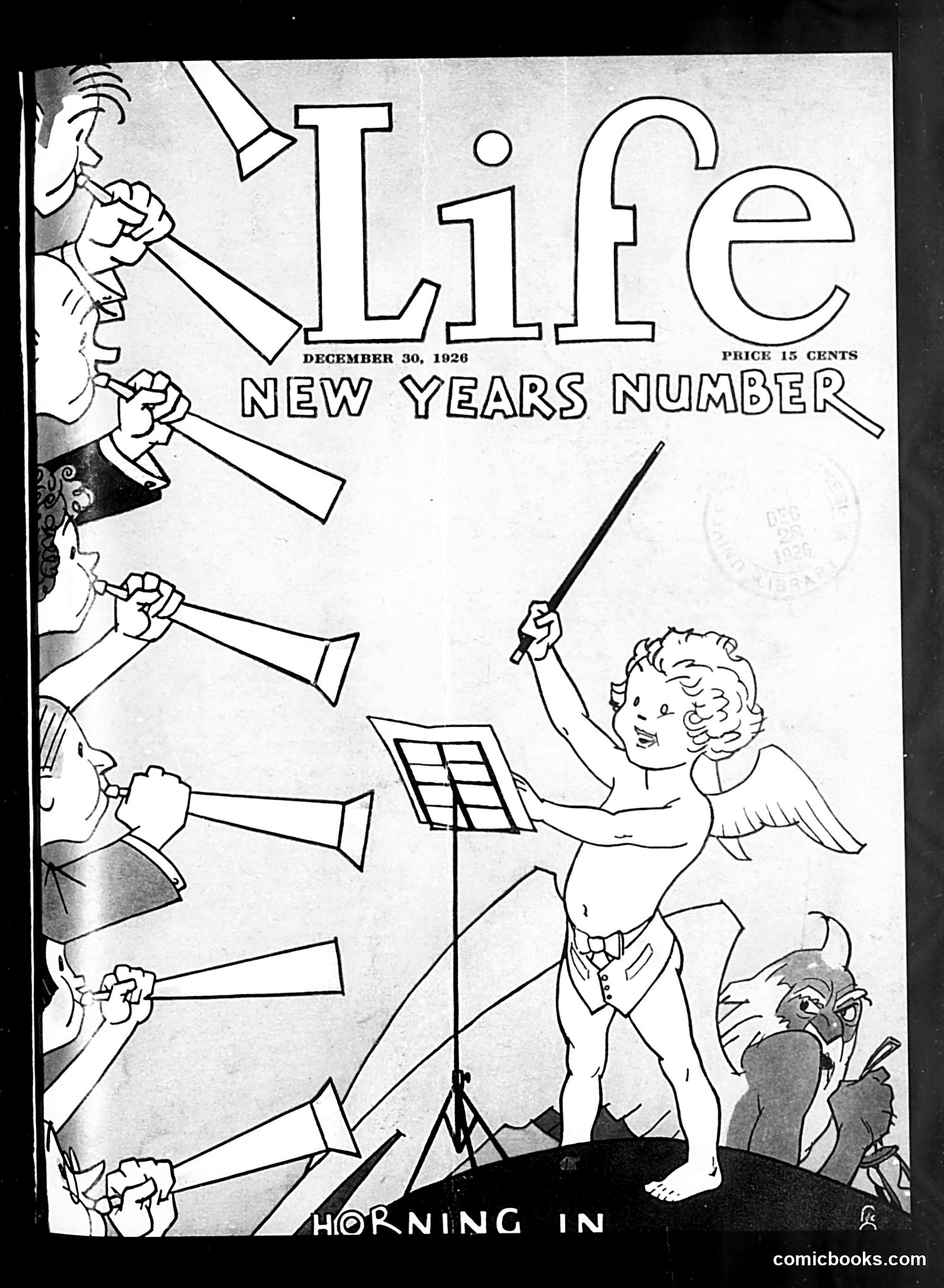
This is the cover of Life's New Year's issue celebrating the transition to 1927. The central image shows a cherub (representing the New Year) conducting an orchestra of figures blowing horns on the left side. The cherub wields a conductor's baton while standing over what appears to be a devil or imp figure at the bottom right—likely representing departing 1926. The joke plays on the classical "New Year baby" imagery, casting the incoming year as an angelic conductor bringing order and celebration, while symbolically dismissing the previous year as something mischievous or troublesome. The horns and festive atmosphere emphasize New Year's Eve revelry and optimism for the fresh start ahead.
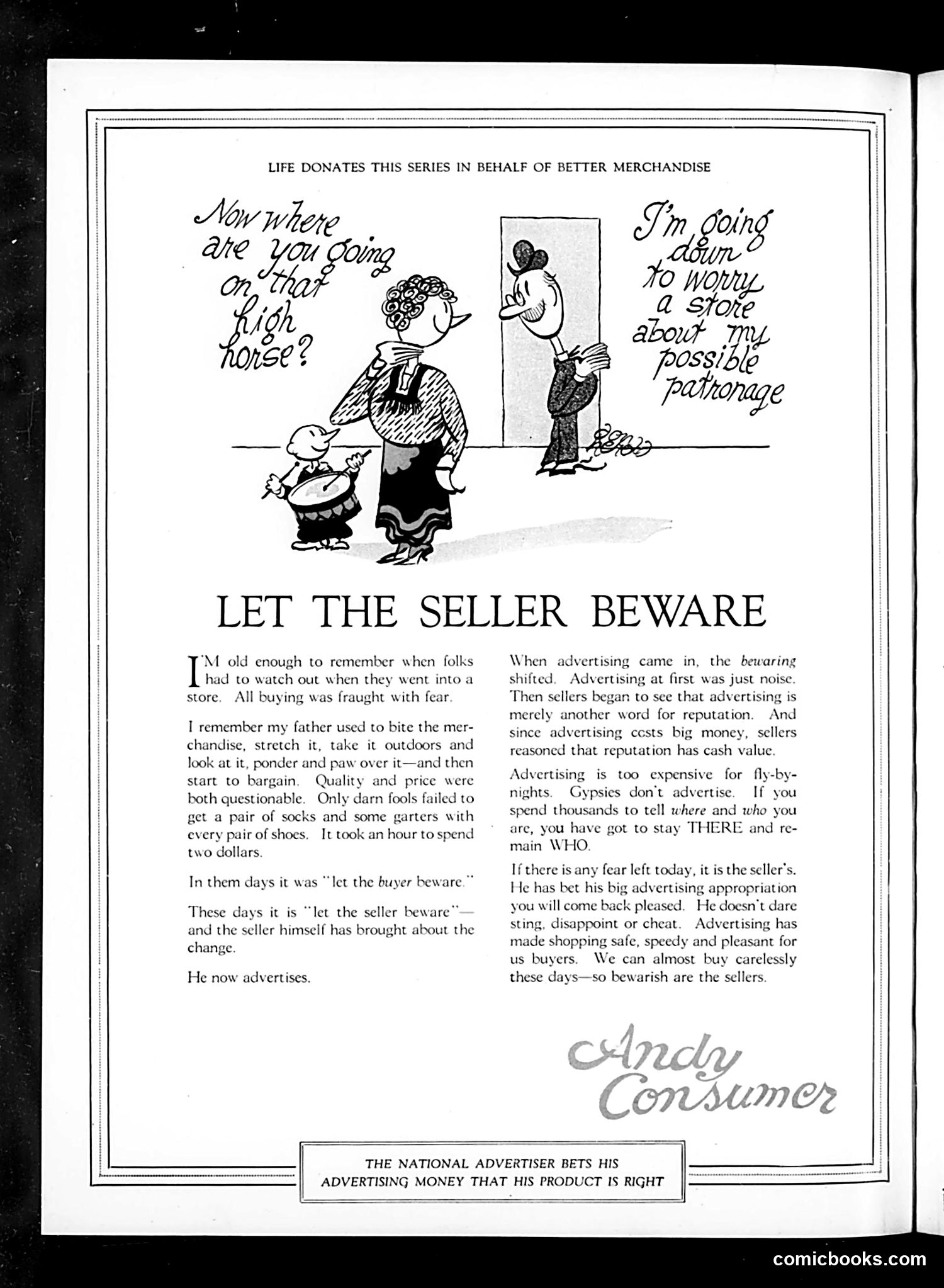
This page satirizes the shift in consumer power enabled by advertising. The cartoon shows a worried shopkeeper anxious about losing customers, while a confident consumer walks away. The text argues that in the old days, buyers had to be cautious ("let the buyer beware"). Now advertising has reversed the dynamic: sellers must compete for customers' trust by maintaining quality and reputation. The author claims advertising makes shopping safer and more pleasant by forcing sellers to behave ethically—they can't afford to disappoint customers or their advertised reputation suffers. The piece celebrates this as progress, though modern readers might recognize it as optimistic about advertising's regulatory power. The "Andy Consumer" signature suggests this reflects consumer advocacy messaging of the era.
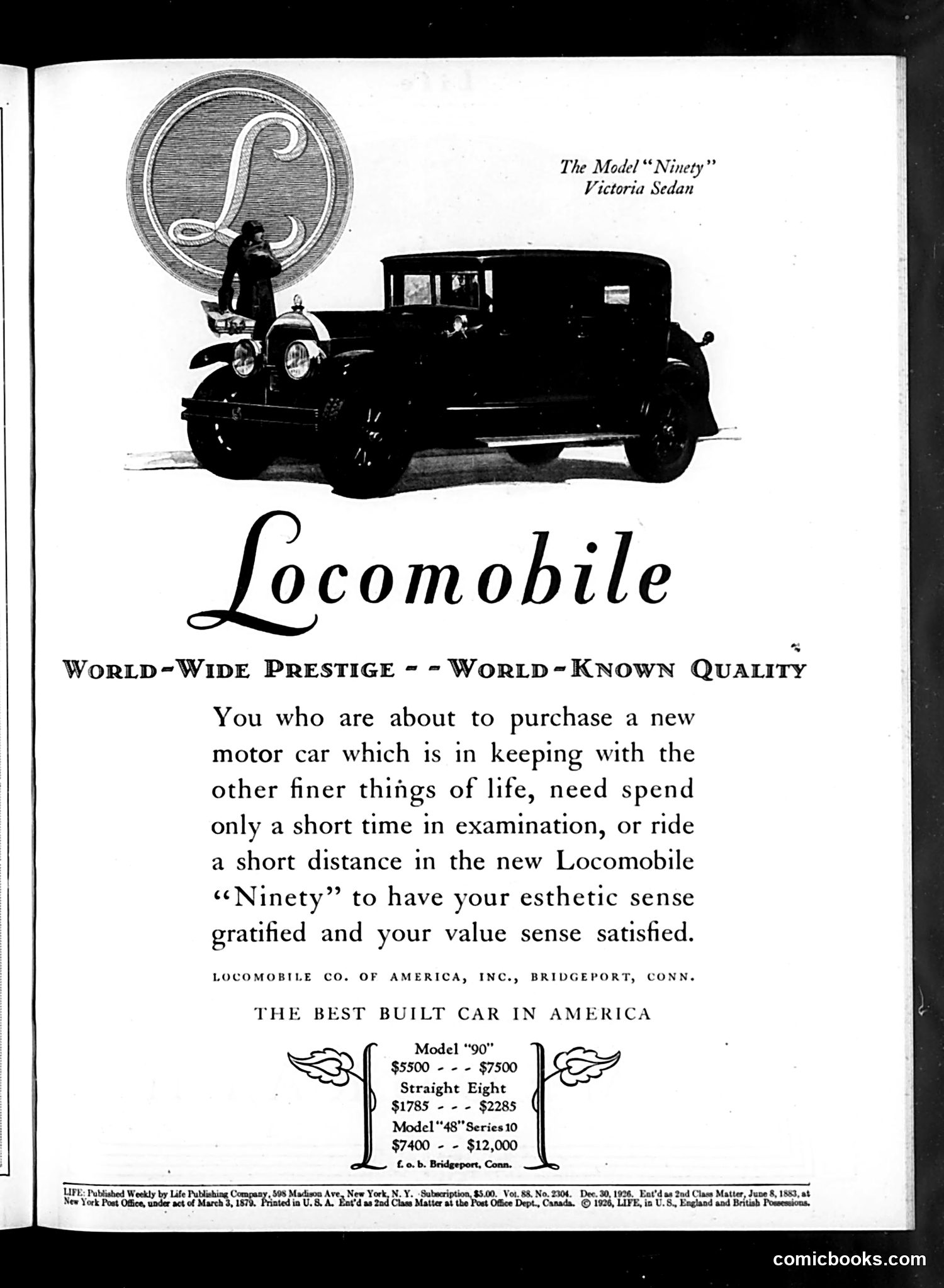
This page is primarily **a legitimate automobile advertisement**, not political satire. It promotes the Locomobile "Ninety" Victoria Sedan, marketed as "The Best Built Car in America" by Locomobile Co. of America in Bridgeport, Connecticut. The advertisement appeals to wealthy consumers by associating the vehicle with "finer things of life" and emphasizing both aesthetic and value satisfaction. The ornate "L" logo and elegant typography reinforce luxury positioning. Pricing ranges from $3,500-$7,500 for the Model "90" to $7,400-$12,000 for the Model "48" Series 10, positioning these as premium vehicles. **There is no political cartoon or satire present.** This is straightforward early-1920s automotive advertising from *Life* magazine's commercial pages.
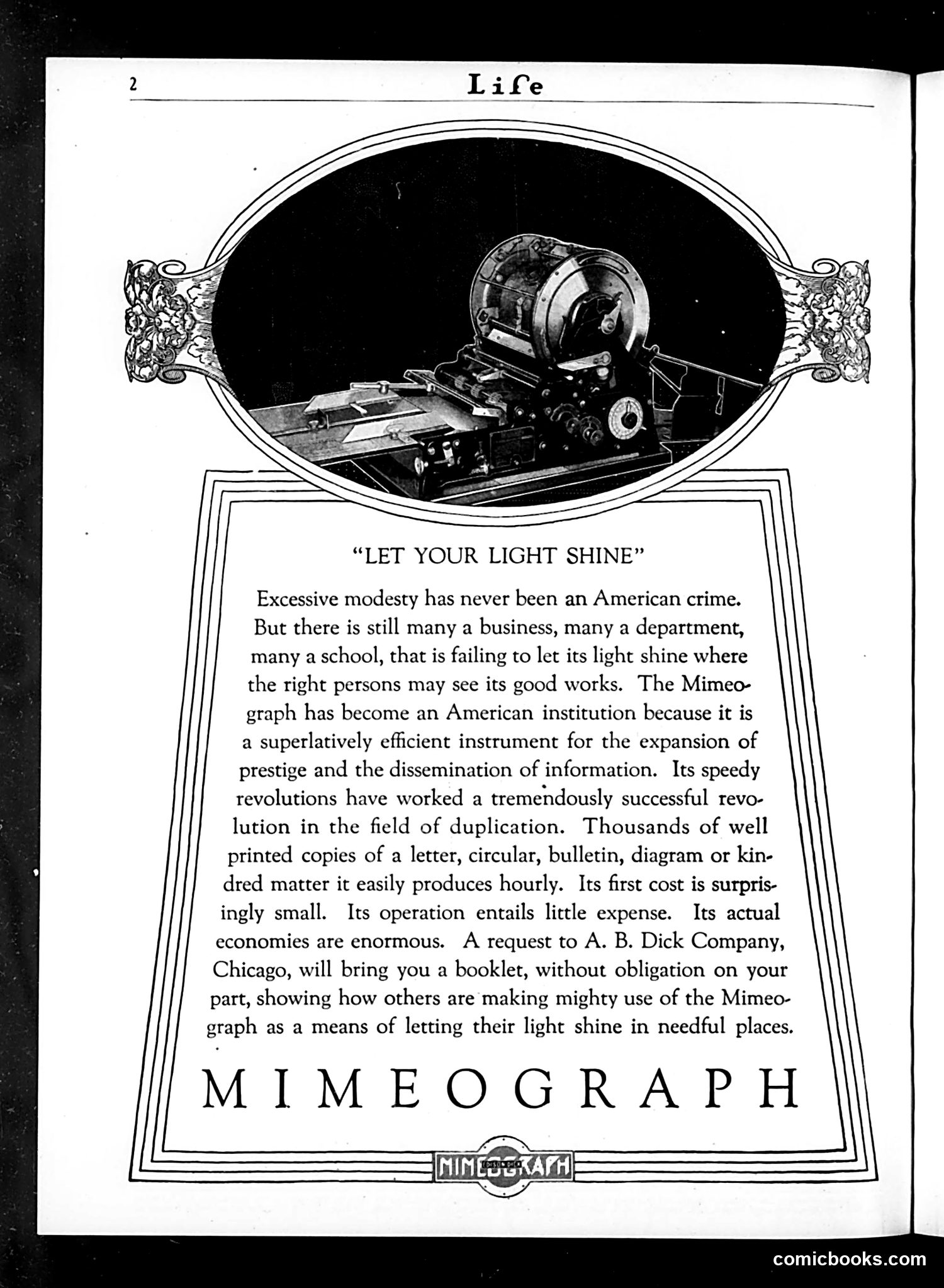
This is a **Mimeograph advertisement**, not a political cartoon. The page promotes the Mimeograph machine—an early duplicating device—using the Biblical phrase "Let Your Light Shine" as its slogan. The ad argues that businesses and institutions fail to publicize their accomplishments sufficiently. The Mimeograph, it claims, solves this problem by efficiently producing hundreds of printed copies of letters, bulletins, and documents at minimal cost. This allows organizations to "let their light shine" by disseminating information about their work to relevant audiences. The image shows the actual Mimeograph machine. The advertisement positions the device as an "American institution" essential for modern organizational communication and self-promotion.
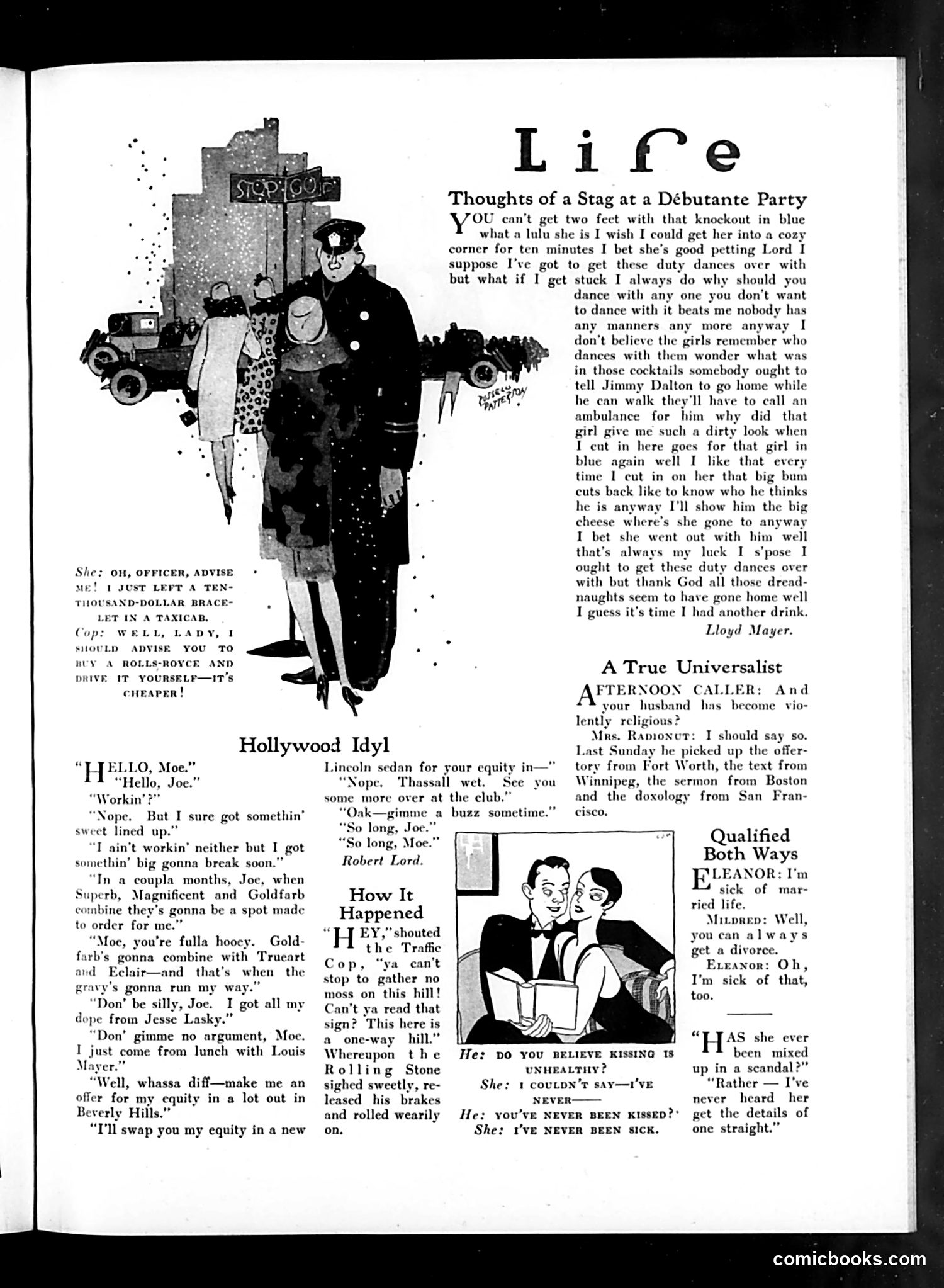
This page contains humorous social commentary typical of 1920s Life magazine. The main cartoon "Hollywood Idol" depicts a police officer and fashionable woman discussing a taxi ride and equity investments—satirizing how even ordinary people were speculating in stock during the Jazz Age boom. The "Life" column mocks a debutante party attendee's anxieties about dancing etiquette and social propriety, suggesting young people were obsessed with status and romantic maneuvering. "A True Universalist" jokes about a woman's husband becoming religious after picking up sermons from various cities—implying superficial, trendy spirituality rather than genuine faith. The remaining sections present brief comedic dialogues about marriage, divorce, and relationships, reflecting period anxieties about changing social mores, particularly regarding women's independence and modern courtship.
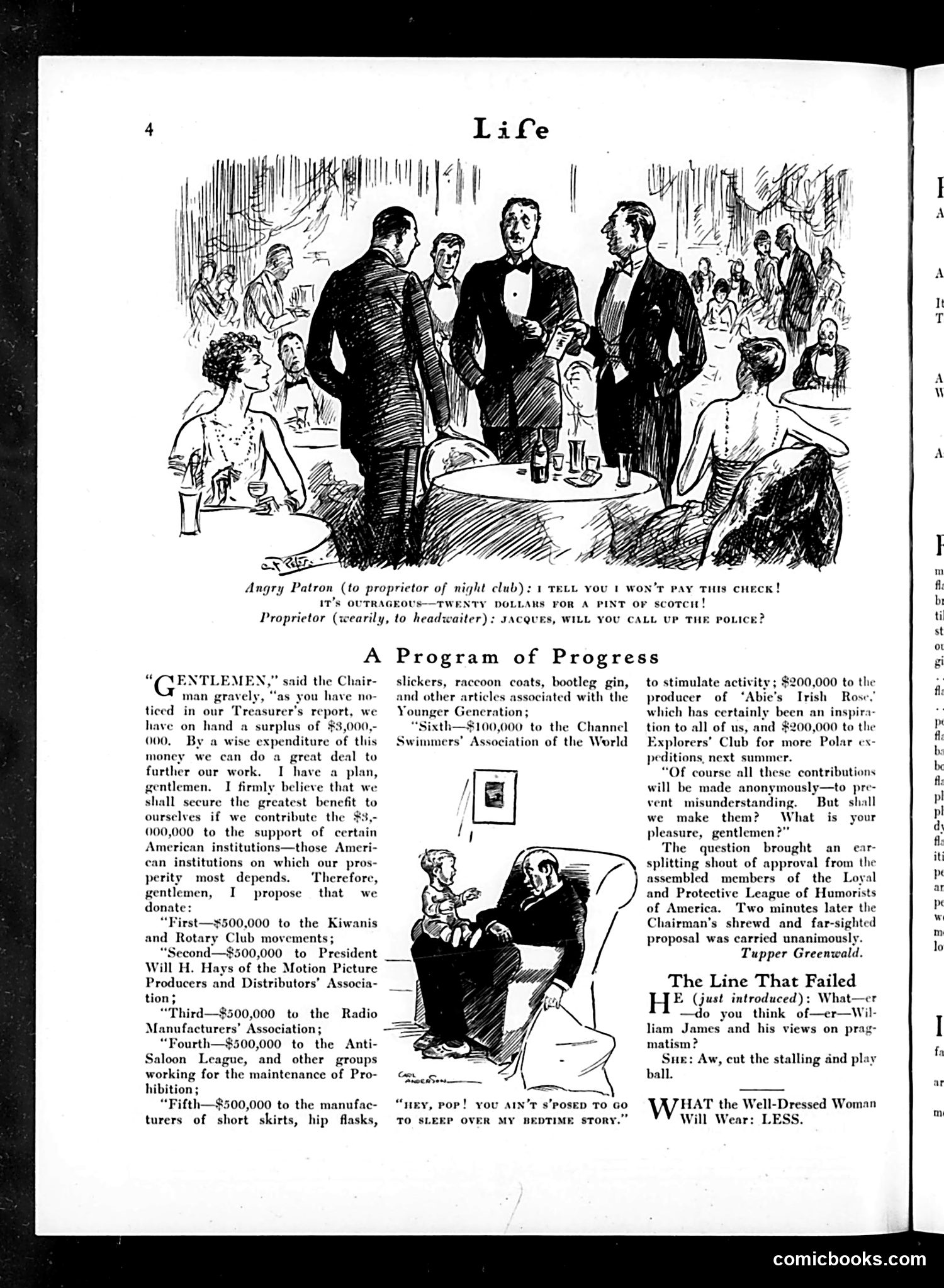
**Top Cartoon:** This depicts a nightclub scene satirizing Prohibition-era excess. An angry patron refuses to pay an inflated check ($20 for scotch), while the proprietor threatens to call police—inverting normal law enforcement expectations. The joke critiques both speakeasy profiteering and the absurdity of Prohibition enforcement, where illegal establishments operated openly with impunity. **"A Program of Progress":** This section mocks a charitable organization's fundraising proposal. The chairman proposes distributing $3 million surplus to various American institutions, including anti-Saloon leagues and short-skirt manufacturers—the latter pairing ridicules moral hypocrisy by lumping together temperance advocacy with fashion industry support. Both pieces satirize 1920s social contradictions and excess during Prohibition.
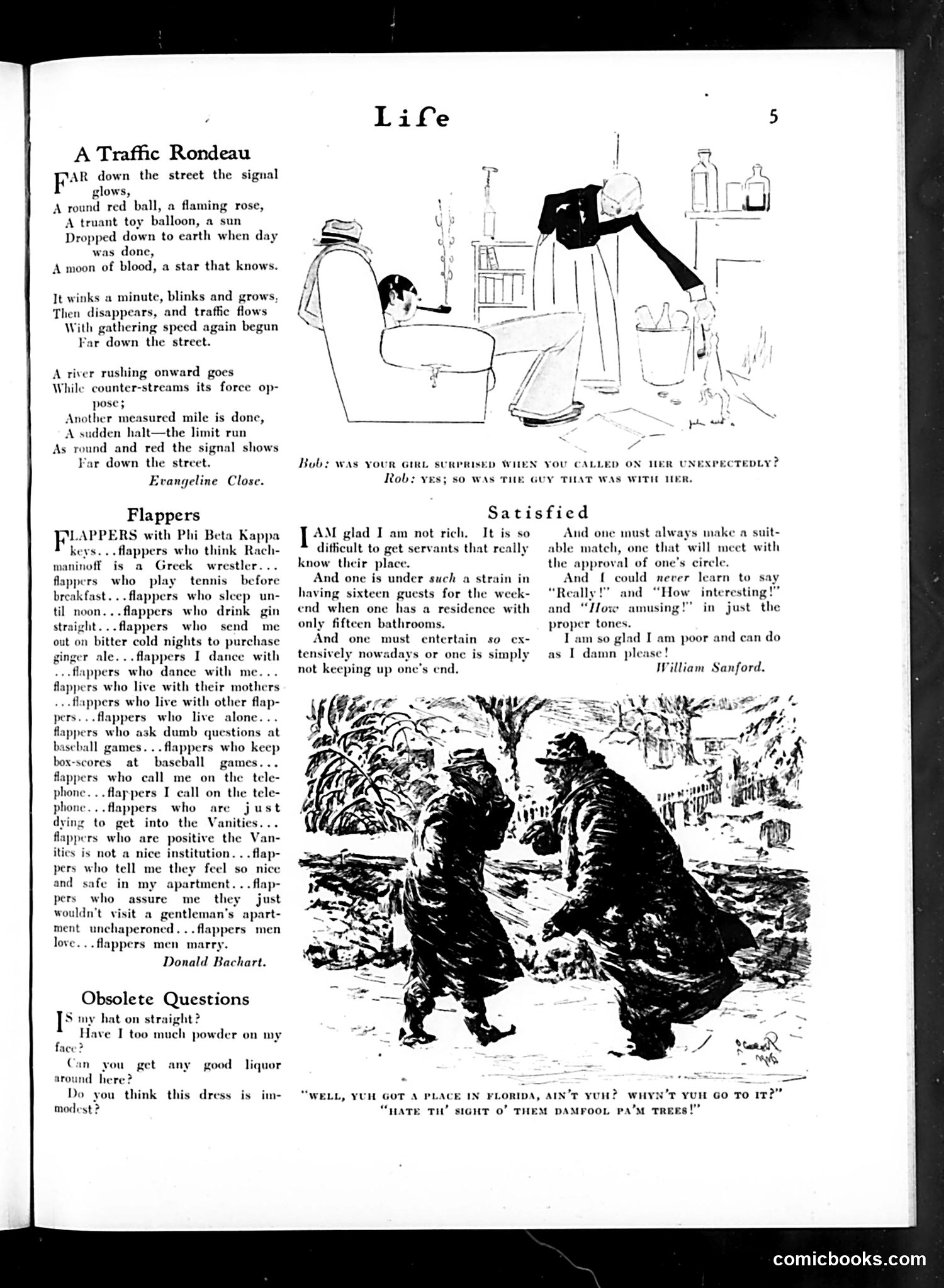
This page contains humorous commentary on 1920s social life, particularly targeting the "flapper" subculture. **"A Traffic Rondeau"** uses traffic signals as metaphor for life's interruptions and flow—poetic rather than political. **"Flappers"** satirizes young women of the Jazz Age through an extended list of complaints: flappers who sleep until noon, dance excessively, call men on telephones, attend Vanities shows, and generally flout social conventions. The piece mocks their behavior as frivolous and improper. **"Satisfied"** briefly critiques wealthy social climbers obsessed with appearing cultured. The cartoon at bottom depicts two working-class figures discussing relocating to Florida, making light of economic migration. Overall, the page reflects conservative attitudes toward 1920s youth culture and changing social norms, particularly regarding women's independence and behavior.
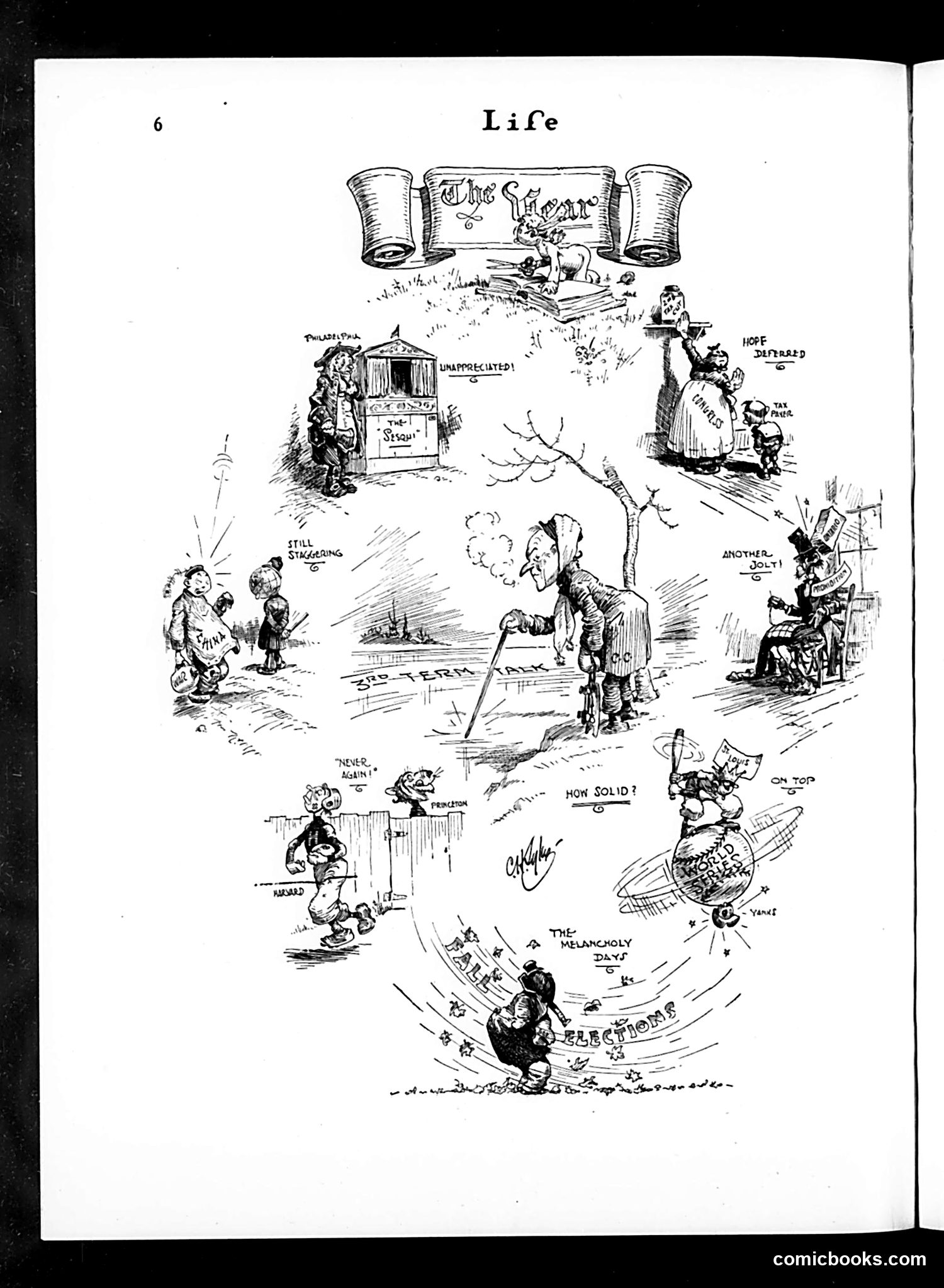
This is a cyclical satirical diagram titled "The Year," depicting various life situations arranged around a central figure. Each vignette is labeled with brief captions representing different phases or moods: - "Unappreciated" (top left) - "Hope Deferred" (top right) - "Still Struggling" (left side) - "Another Dolly" (right side) - "Never Again" (bottom left) - "How Solid?" (center) - "On Top" (right side) - "The Melancholy Days" and "Electome" (bottom) The cartoon satirizes the cyclical nature of human experience—alternating between optimism and disappointment, success and failure. It captures the recurring emotional and circumstantial ups-and-downs of ordinary life, suggesting that people perpetually cycle through similar challenges and temporary victories throughout the year.
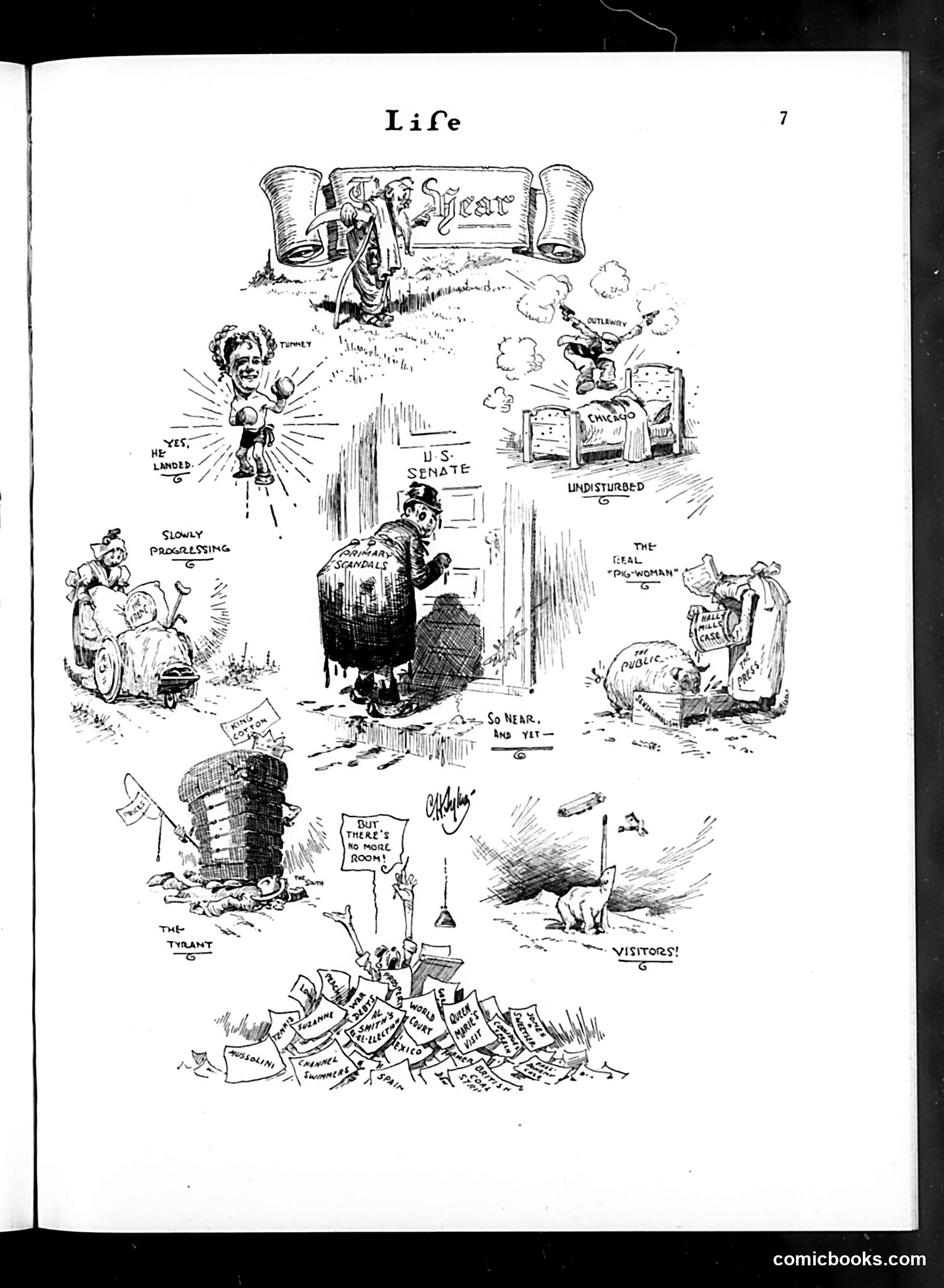
This page titled "Life" presents a satirical commentary on the year ahead through multiple vignettes. The central figure appears to be a politician or public figure labeled "SCANDALS" entering the U.S. Senate, suggesting anticipated governmental misconduct. Surrounding scenes depict various social concerns: "SLOWLY PROGRESSING" shows stalled reform, "YES HE LANDED" shows apparent political success, and "UNDISTURBED" suggests complacency in response to problems. "THE IDEAL POLICEMAN" and "THE TYRANT" offer contrasting visions of authority figures. At the bottom, scattered papers labeled with various political issues create visual chaos—suggesting overwhelming governmental problems. "VISITORS" references unwanted intrusions into civic life. The overall message critiques governmental dysfunction, delayed reform, and accumulating societal problems heading into the new year.
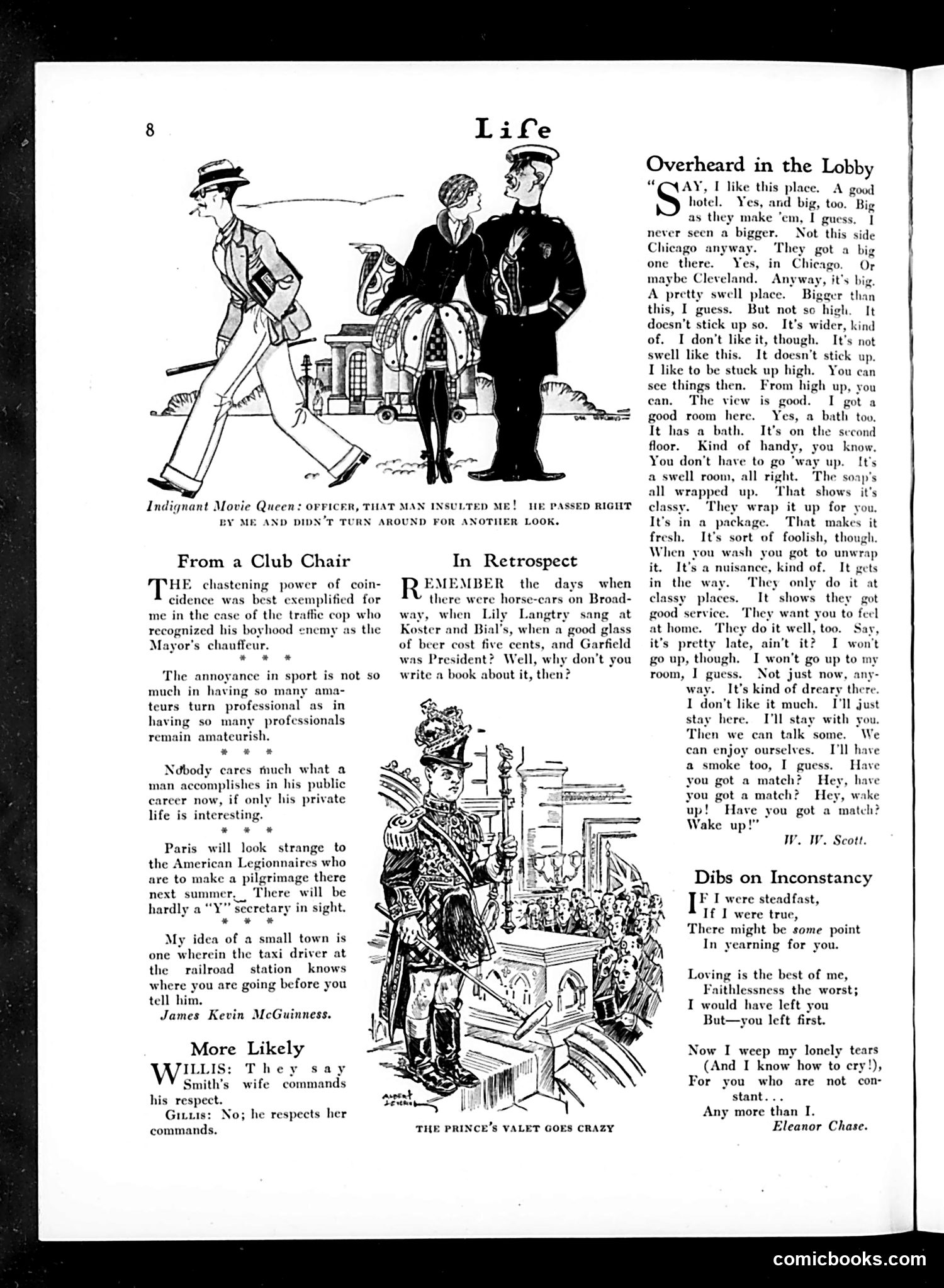
This page contains several satirical pieces about early 20th-century urban life and social conventions: **"The Prince's Valet Goes Crazy"** (center cartoon) depicts a European nobleman's servant having a mental breakdown, likely satirizing the absurdity of rigid class hierarchies and the strain of servitude. **"Overheard in the Lobby"** captures hotel guests discussing room amenities—soap wrapping, bathing facilities, service standards—poking fun at nouveau riche travelers unfamiliar with luxury hotels and their pretensions about accommodations. **"From a Club Chair"** and "In Retrospect"** offer social commentary on amateur vs. professional sports and nostalgia for earlier eras (horse-cars, theatrical performances). The page satirizes period anxieties: class performance, wealth display, and rapid modernization creating confusion among the social climbing classes.
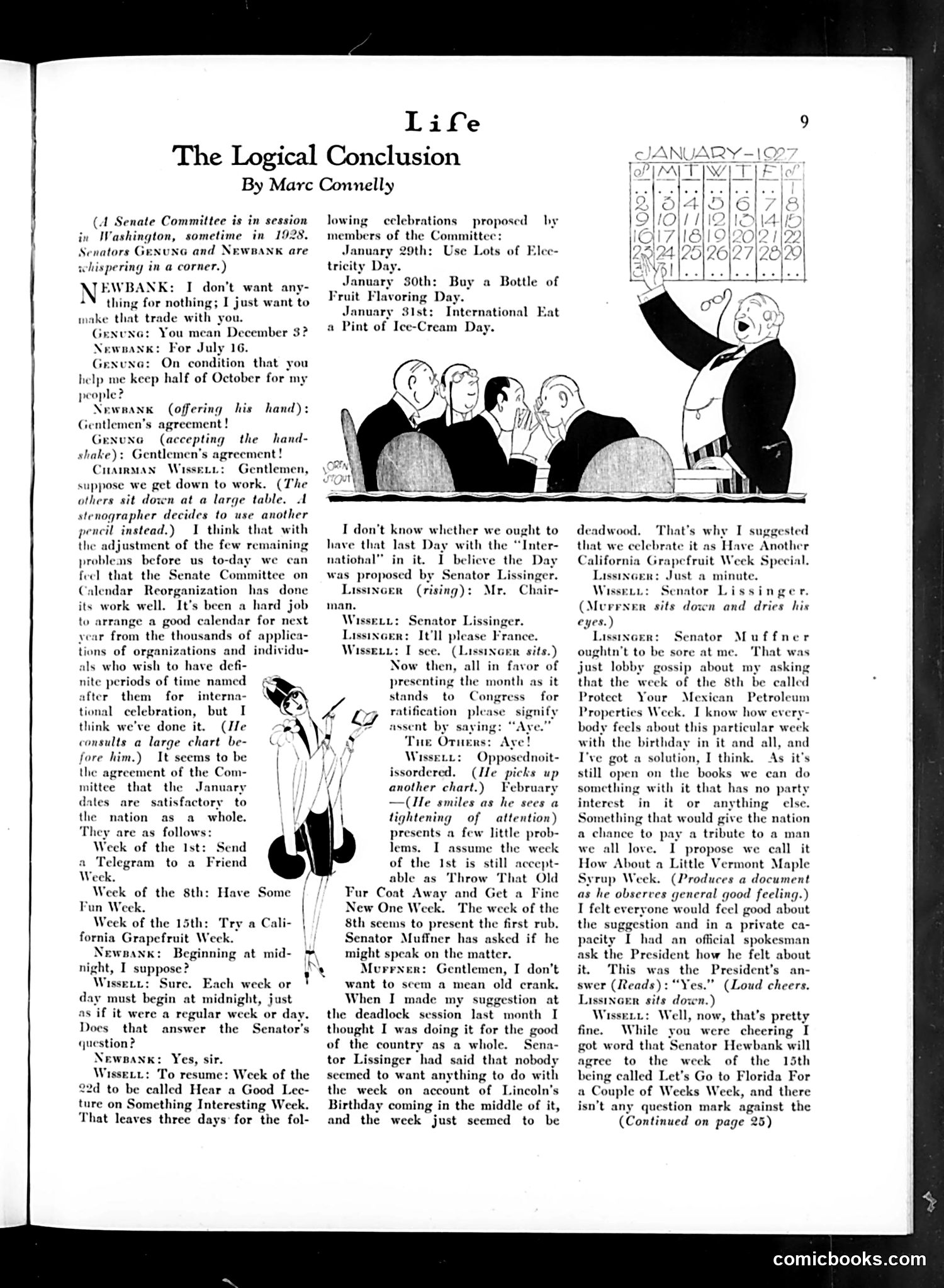
This satirical piece mocks a Senate committee's proposal to designate specific weeks for various national "celebrations"—like "Use Lots of Electricity Day" and "International Eat a Pint of Ice-Cream Day." The cartoon shows senators at a table while one gestures enthusiastically, illustrating the absurdity of their bureaucratic calendar reorganization. The satire targets how government committees create trivial, commercialized "observances" that fragment the year into marketing opportunities rather than meaningful commemorations. Senators Newbank, Genung, Lissinger, Muffner, and Wissell debate which invented weeks to ratify. The humor lies in exposing how legislative bodies waste time manufacturing fake holidays to appease special interests—a critique of institutional wastefulness and the commercialization of American life that remains relevant today.
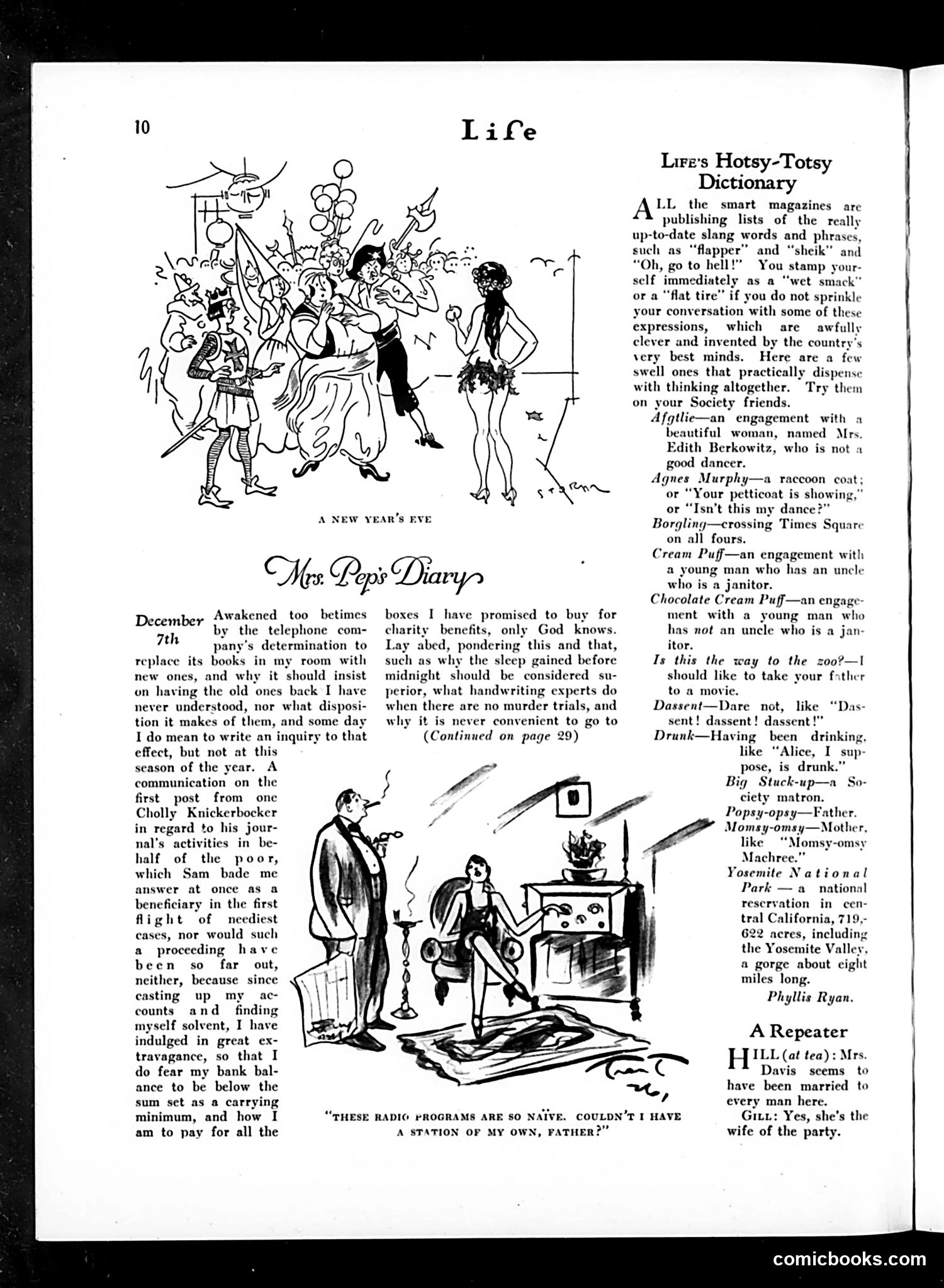
This page contains two satirical features typical of 1920s Life magazine: **"A New Year's Eve"** (top illustration): A chaotic party scene mocking post-Prohibition revelry—people dancing wildly with decorative balls and streamers, depicting the frantic social excess of the Jazz Age. **"Mrs. Pops's Diary"** (middle section): A domestic humor column from December 7th chronicling mundane household frustrations—replacing books, furniture deterioration, and financial strain. The accompanying cartoon shows a father questioning why he should fund radio programs for his home, satirizing early radio adoption costs. **"Life's Hotsy-Totsy Dictionary"** (right column): A glossary of contemporary slang terms ("flapper," "sheik," "aftallie") that mocks how magazines constantly publish new slang to seem current and relevant to younger readers—itself a meta-joke about magazine culture. The page captures 1920s consumer culture anxieties and generational language gaps humorously.
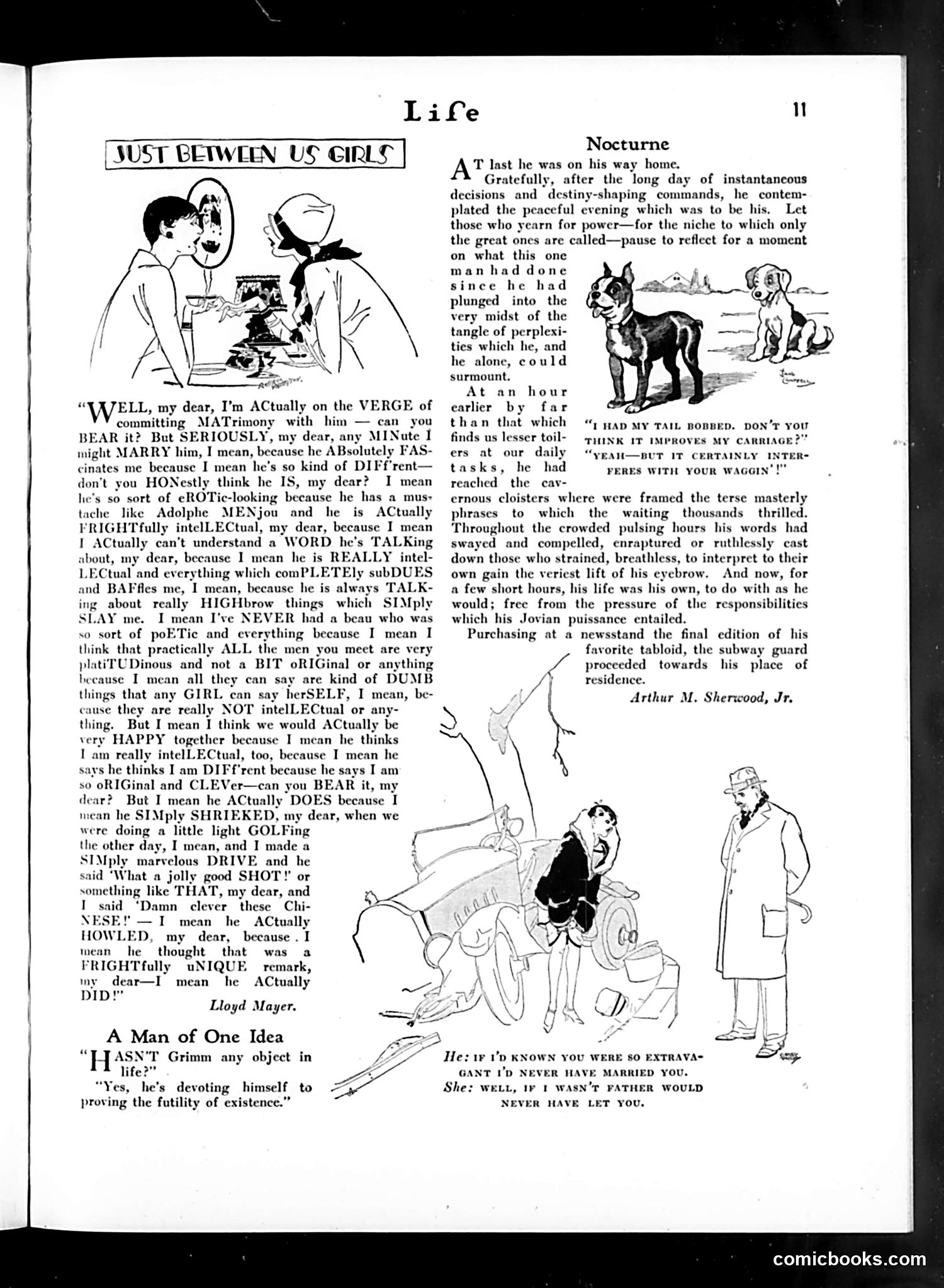
This page contains satirical commentary on relationships and gender dynamics from the early 20th century. **"Just Between Us Girls"** (left) mocks women who use elaborate verbal justifications to explain why they're marrying men they claim are intellectually inferior, emotionally unavailable, or otherwise unsuitable. The humor relies on the contradiction between women's stated feminist principles and their actual romantic choices—a critique of women's reasoning. **"Nocturne"** (right) presents a story about a powerful man who finds peace contemplating his dogs after a demanding day of leadership. The accompanying cartoon shows a marital conflict where the wife accuses the husband of being too extraordinary to marry. Both pieces satirize the gap between aspiration and reality in relationships, using exaggeration to expose social pretension.
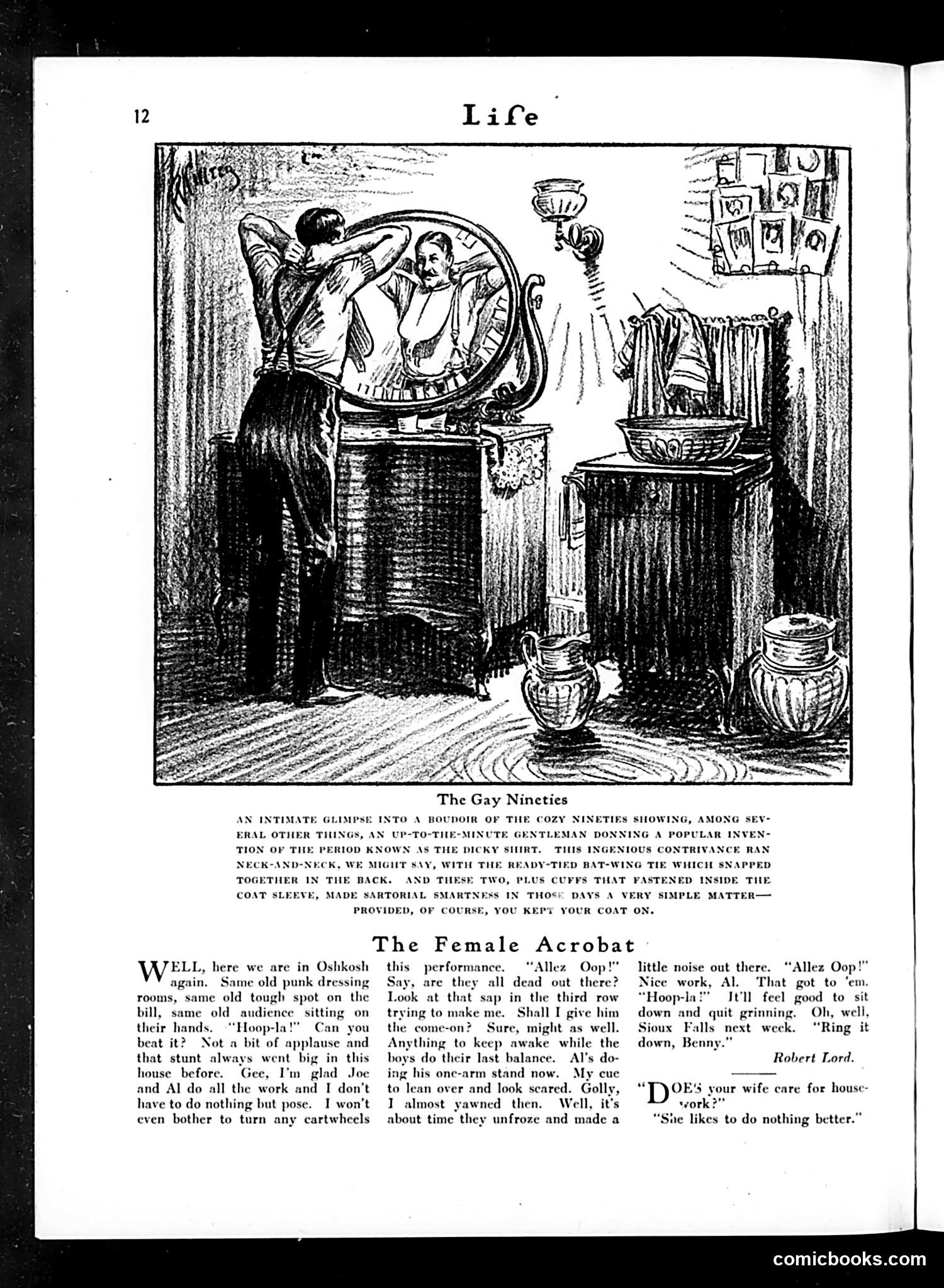
**"The Gay Nineties" cartoon** depicts two men examining a "dicky shirt"—a false shirt front that created the appearance of formal dress without requiring a full garment. The text explains this was a clever 1890s fashion hack: cuffs fastened inside the coat sleeve gave the illusion of a complete outfit while reducing laundry needs. This is satirizing the period's fashion pretensions and the gap between appearance and reality. **"The Female Acrobat" section** appears to be a humorous piece set in Oshkosh about a female acrobat's performance. The dialogue suggests she's struggling during her act ("Allez Oop!"), with audience members commenting on her difficulty staying awake and her poor balance. The accompanying joke about wives doing housework provides social commentary on gender roles of the era.
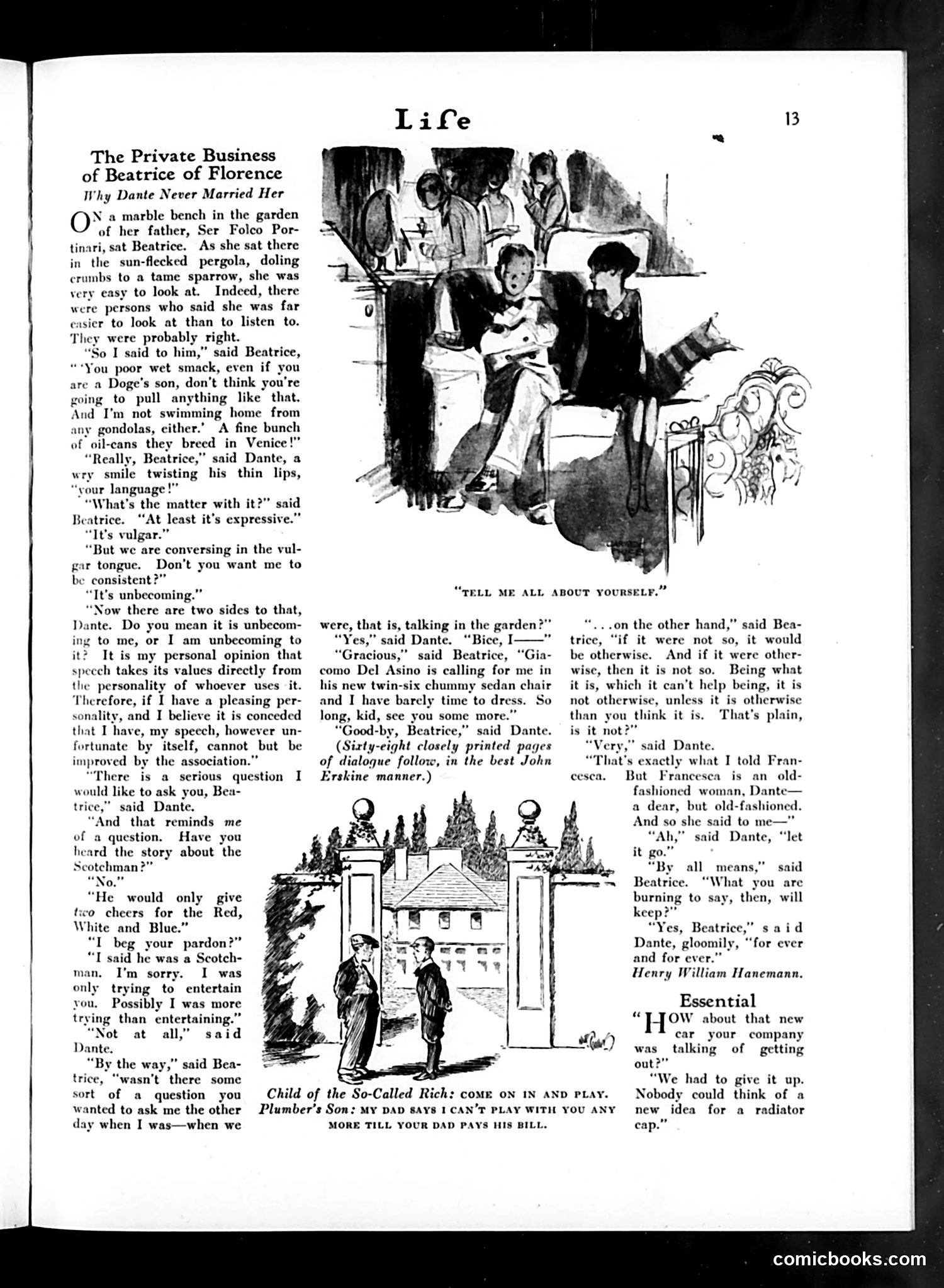
This page contains a literary/social satire titled "The Private Business of Beatrice of Florence: Why Dante Never Married Her." The main illustration shows a woman sitting with several admirers gathered around her in what appears to be a garden setting, with the caption "TELL ME ALL ABOUT YOURSELF." The text is a humorous dialogue between Dante (the medieval Italian poet) and Beatrice, discussing her direct, frank manner of speech. Dante criticizes her bluntness as "unbecoming," while Beatrice defends her honesty as preferable to artifice. The satire mocks both Victorian-era attitudes about "proper" feminine behavior and the romanticized literary tradition surrounding Dante's unrequited love for Beatrice. A separate joke at bottom-right titled "Essential" concerns a company unable to market a new radiator design.
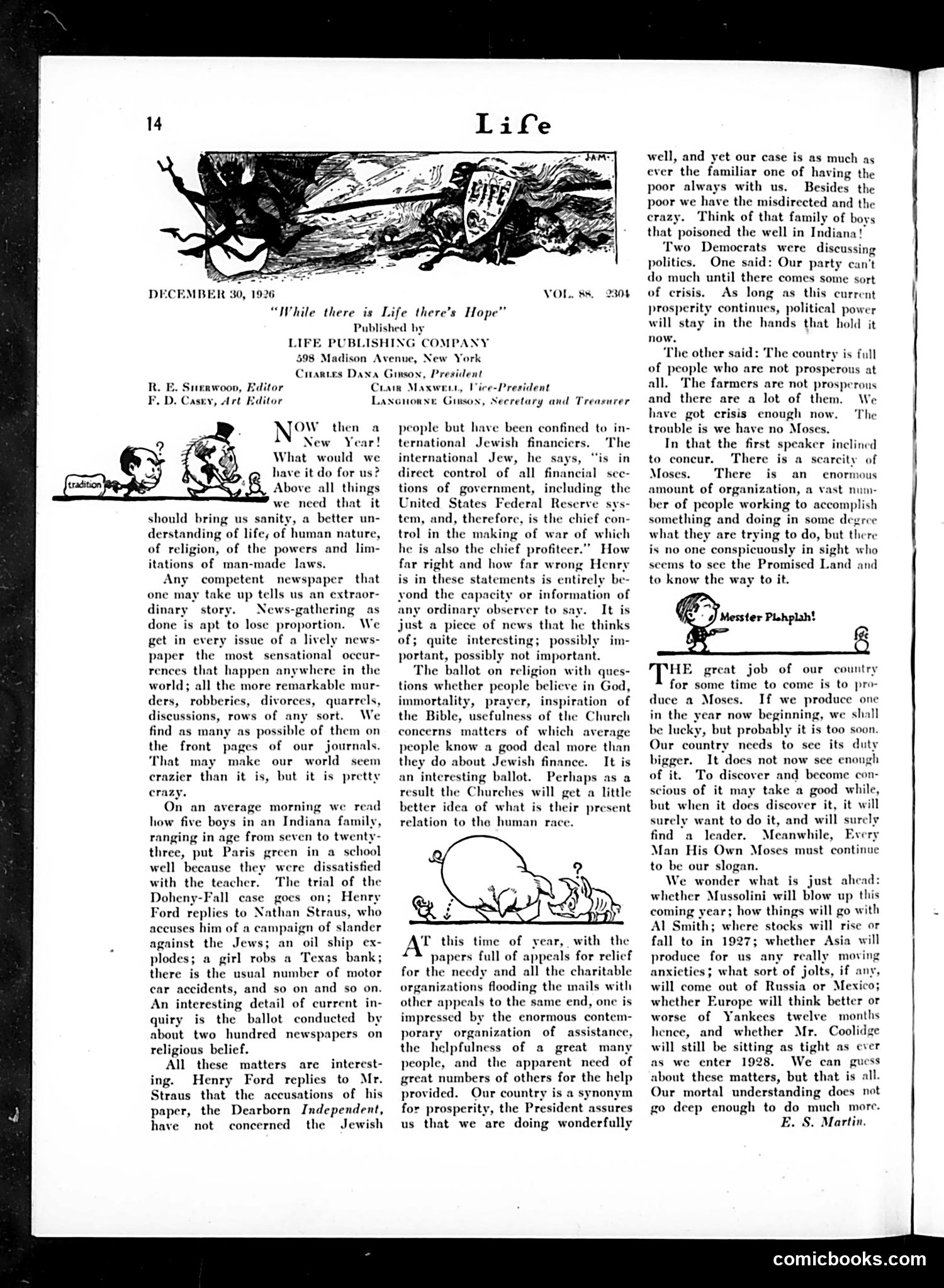
The page contains editorial commentary responding to Henry Ford's antisemitic statements. Ford had accused Jewish financiers of controlling governments and wars—a conspiracy theory the editor directly refutes as misinformation. The cartoon (top) depicts a poisoned well, illustrating how Ford's accusations contaminate public discourse. The imagery suggests his false claims spread like poison through society. The text mocks Ford's authority on financial matters, noting he lacks expertise to make such sweeping claims. The editor argues Ford conflates legitimate economic criticism with religious prejudice, and criticizes newspapers (like Ford's Dearborn Independent) for promoting these unfounded accusations. The piece uses satire to expose antisemitism as dangerous misinformation unworthy of serious consideration.
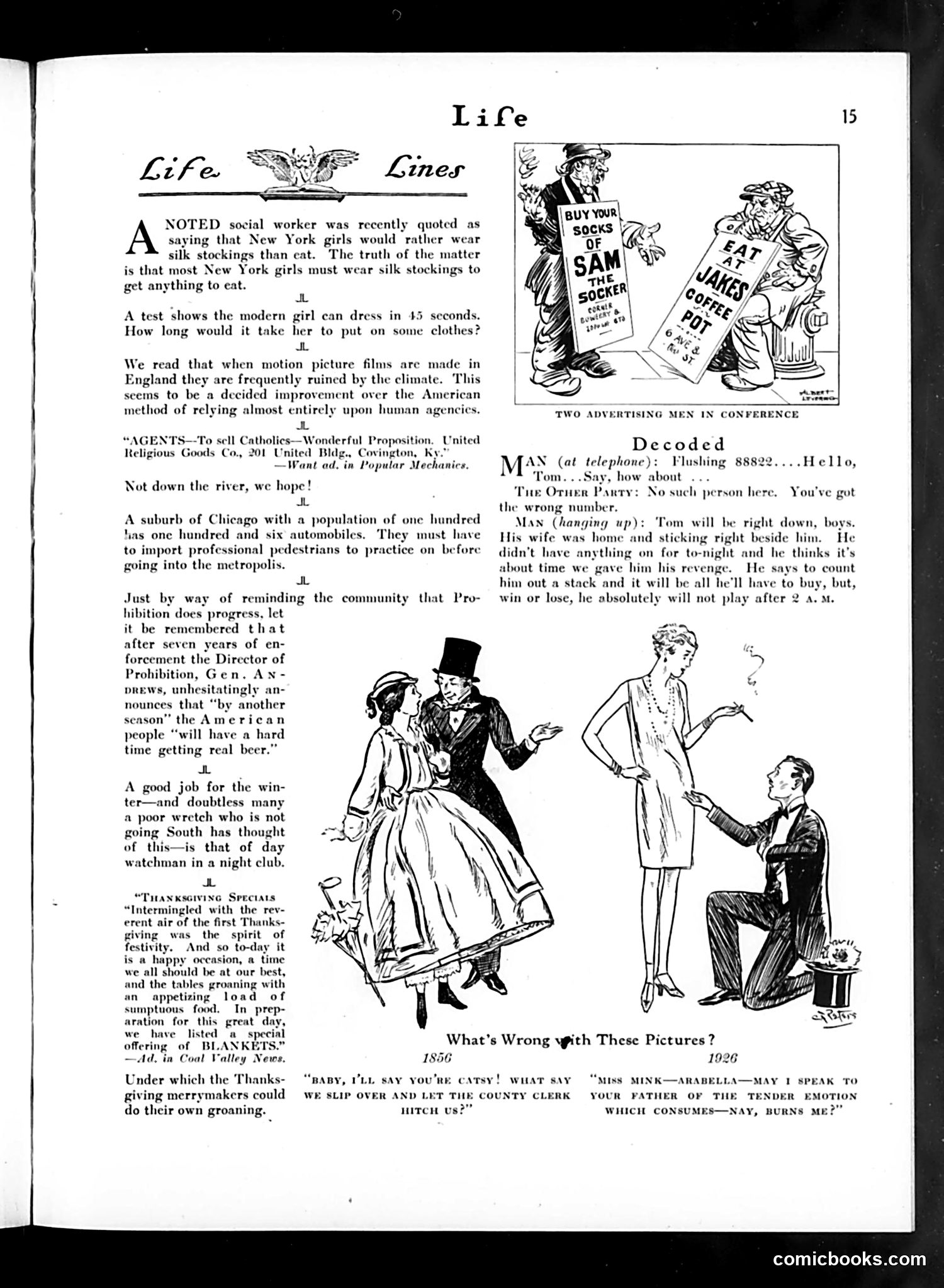
This page contains satirical commentary and illustrations typical of 1920s Life magazine. **Top cartoon** shows two advertising men with signs promoting various products ("Buy Your Socks of Sam the Socker," "Rat Snares," "Coffee Pot"). The satire appears to mock aggressive street-corner advertising and the commercialization of American cities. **"Decoded" section** is a humorous phone conversation about a man named Tom whose wife prevented him from gambling, establishing a comedic domestic scenario. **Bottom illustrations titled "What's Wrong with These Pictures?"** present romantic/social scenarios with accompanying captions that subvert expectations—a common satirical format. The left shows a formal couple in evening dress with crude dialogue; the right depicts a marriage proposal scene with sarcastic commentary about emotional manipulation. The overall page exemplifies 1920s satirical humor targeting advertising, consumerism, and gender relations.
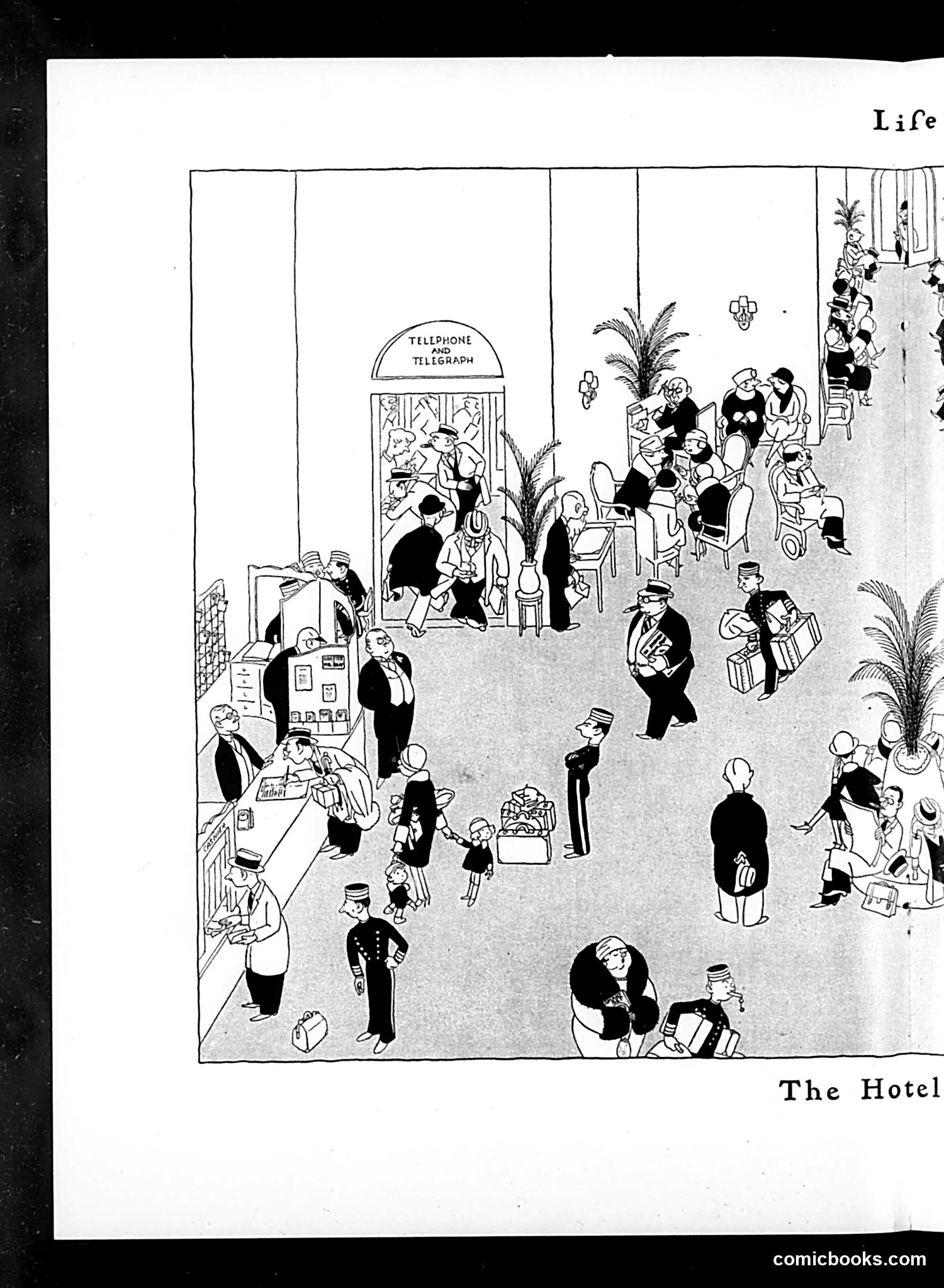
This is a satirical illustration of hotel life, depicting the bustling lobby and public spaces. The cartoon shows various social types and activities typical of early 20th-century American hotels: well-dressed businessmen and travelers, bellhops with luggage, people conducting transactions at the desk (marked "TELEPHONE AND TELEGRAPH"), and guests socializing in lounge areas with decorative plants. The satire appears to critique the hotel as a microcosm of society—showing different classes and occupations interacting in a contained space. The crowded, chaotic composition suggests commentary on modern urban commercial life, with its emphasis on transaction, communication technology, and the mixing of diverse social elements. The style and subject matter suggest this mocks the pretensions or absurdities of contemporary hotel culture.
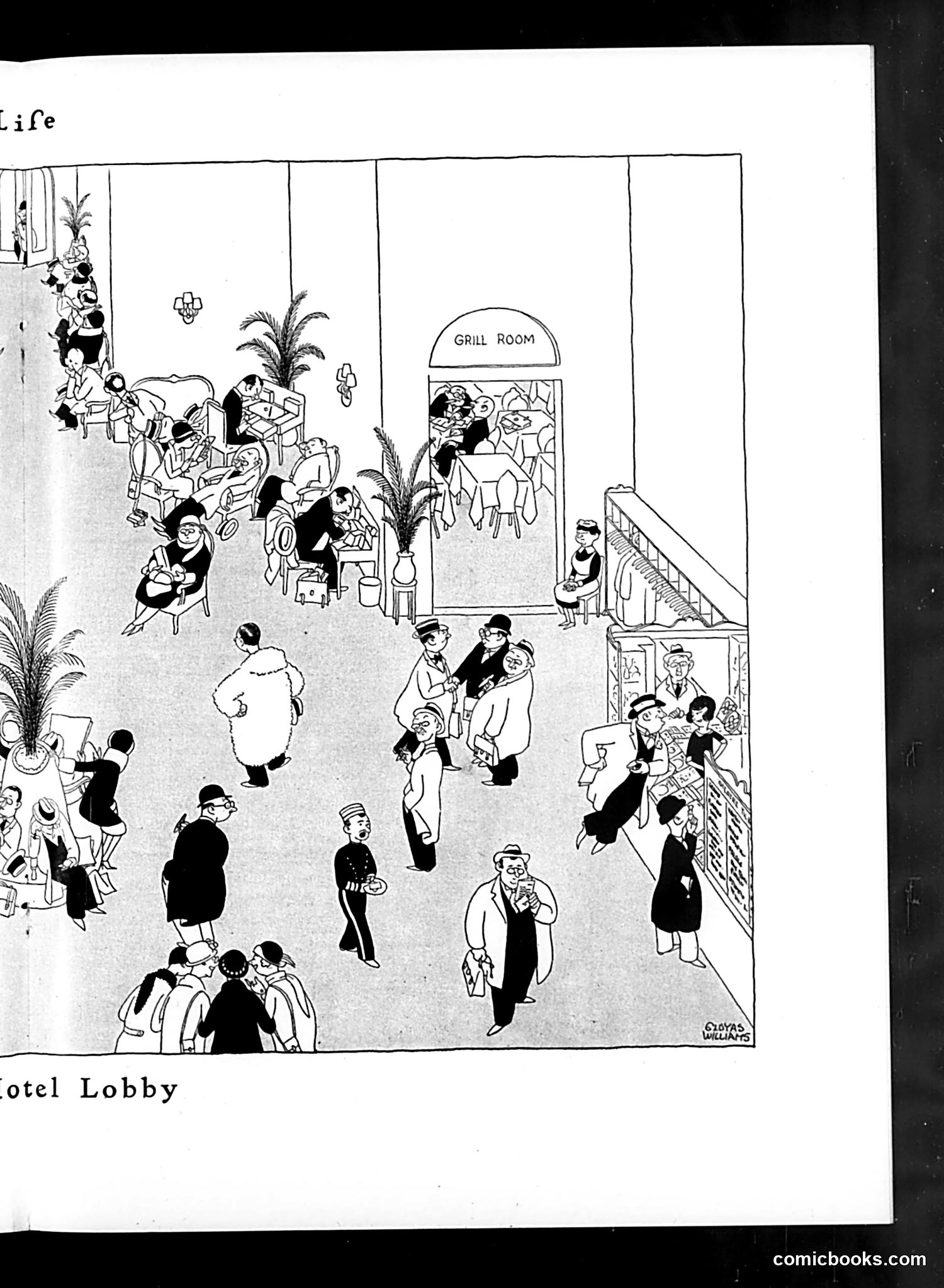
This illustration depicts a busy hotel lobby scene, labeled "Hotel Lobby" at bottom. The cartoon shows numerous well-dressed guests and staff circulating through an elegant space featuring potted plants and a "Grill Room" entrance. The style is typical of Life magazine's satirical social commentary from the early-to-mid 20th century. The satire appears to target hotel social dynamics and class distinctions—the mix of formally-dressed patrons, staff, and visitors suggests commentary on the performance of propriety and social hierarchies in such spaces. The crowded composition emphasizes the artificiality and bustling nature of hotel life. However, without clearer caricatures or labeled figures, the specific targets remain unclear. The cartoon likely mocks hotel culture or particular contemporary social pretensions, but precise historical context would require additional information about the publication date.
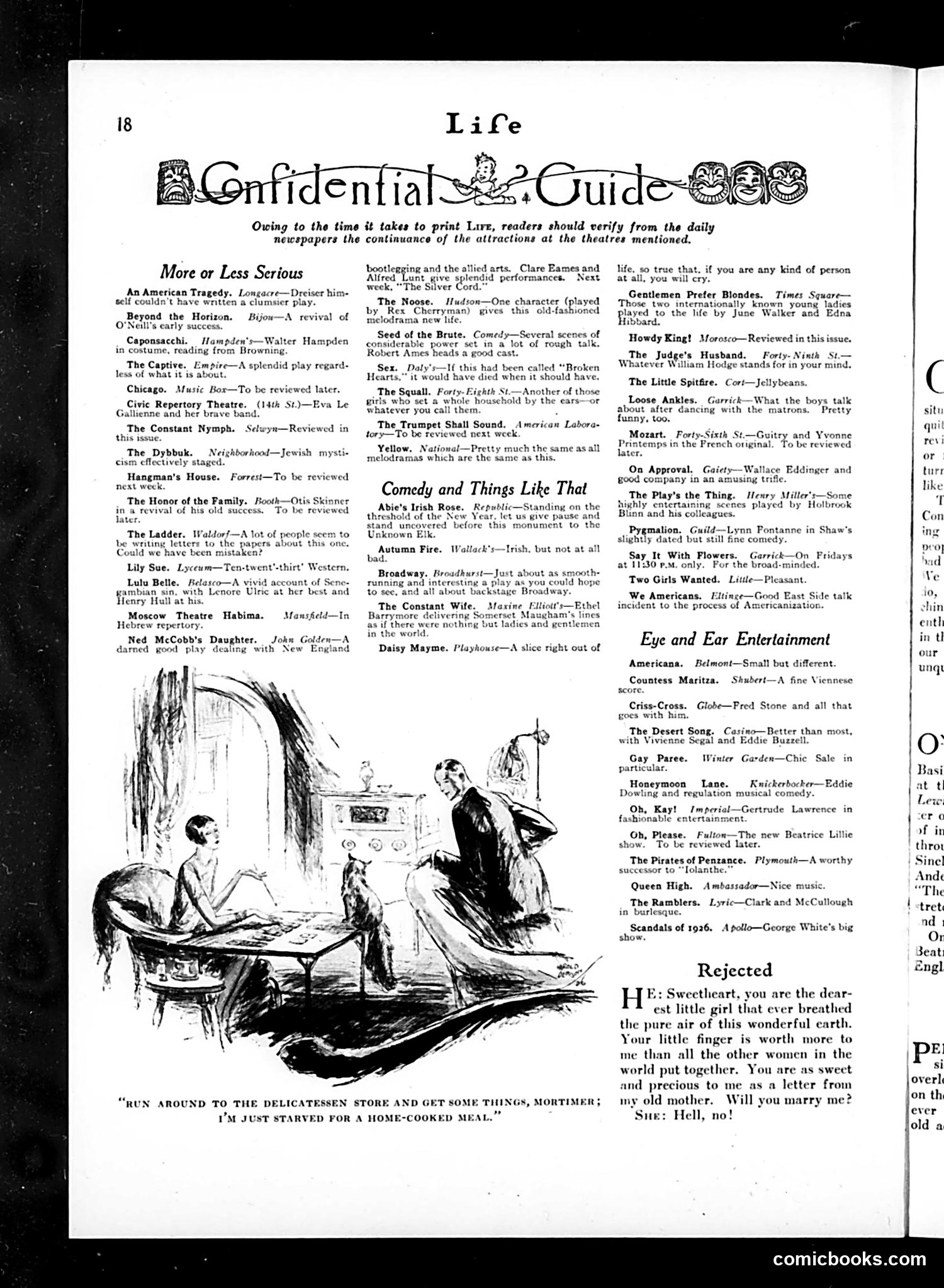
This page from *Life* magazine contains theater reviews and a cartoon illustrating a domestic scene. The cartoon shows a husband at a desk (apparently working or reading) while his wife addresses him, saying she's "starved for a home-cooked meal" and suggests he "run around to the delicatessen store and get some things." The satire targets the contrast between domestic expectations and modern urban reality: the wife wants a "home-cooked" meal but proposes buying prepared food from a delicatessen—undermining the very concept she invokes. This likely critiques 1920s urban culture where convenience was replacing traditional homemaking, or humorously captures the marital negotiation where wives delegate shopping to husbands. The cartoon reflects post-WWI American life when store-bought prepared foods were becoming more common and socially acceptable, even as traditional domestic ideals persisted.
This page is a theatrical review column discussing Broadway productions. The critic confesses to poor judgment reviewing "The Constant Nymph," admitting he was emotionally swayed rather than critically rigorous—falling asleep during performances, sympathizing with actors facing a cold opening-night audience, and later discovering the production had significant directorial and casting flaws he'd overlooked. The column also notes confusion about the Theatre Guild's scheduling of "Ned McCobb's Daughter" and "The Silver Cord" in alternating weeks rather than the three-week run initially reported. The critic acknowledges his own error here too. The tone is self-deprecating humor about theatrical criticism's subjectivity—how personal sentiment and circumstances cloud professional judgment. The numbered heading "Good-by 1927! Hello 1926!" is unclear without fuller context, though it appears ironic given the review's focus on recent 1926-1927 productions.
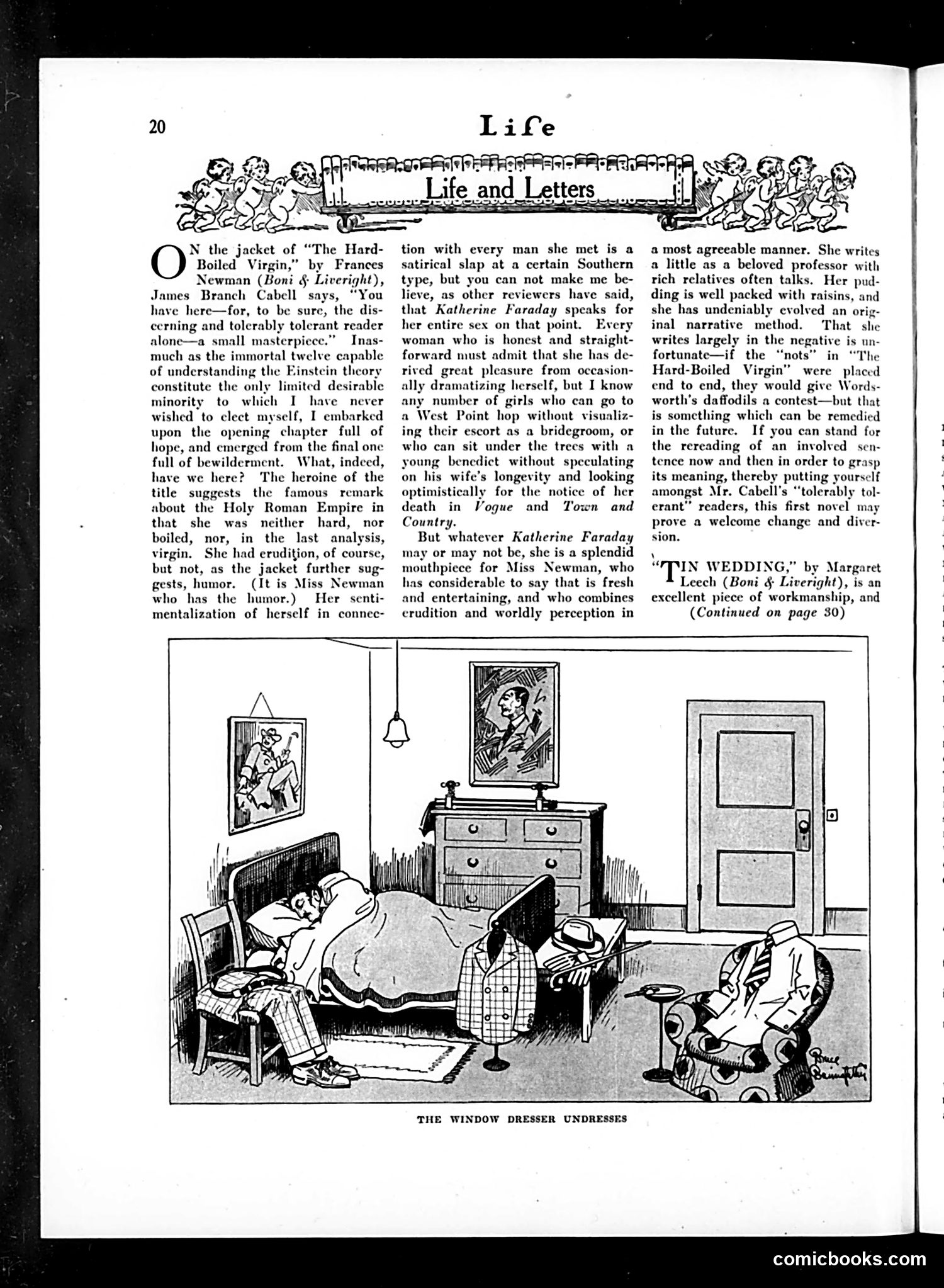
This cartoon satirizes the pretense and artificiality of retail display work. The illustration shows a window dresser—a professional who arranges store displays—in a disheveled bedroom, surrounded by casual clothes and messy belongings, contrasting sharply with the neat, curated window displays they create for the public. The joke targets the gap between professional image and private reality: the meticulous craftsperson who creates attractive, orderly retail presentations lives in apparent chaos. It's a commentary on performative versus authentic life—a theme echoing the page's literary discussion of Frances Newman's *The Hard-Boiled Virgin*, which explores the gap between how women present themselves socially versus their private thoughts. The cartoon suggests that creating appealing facades is exhausting work, leaving one's personal space neglected.
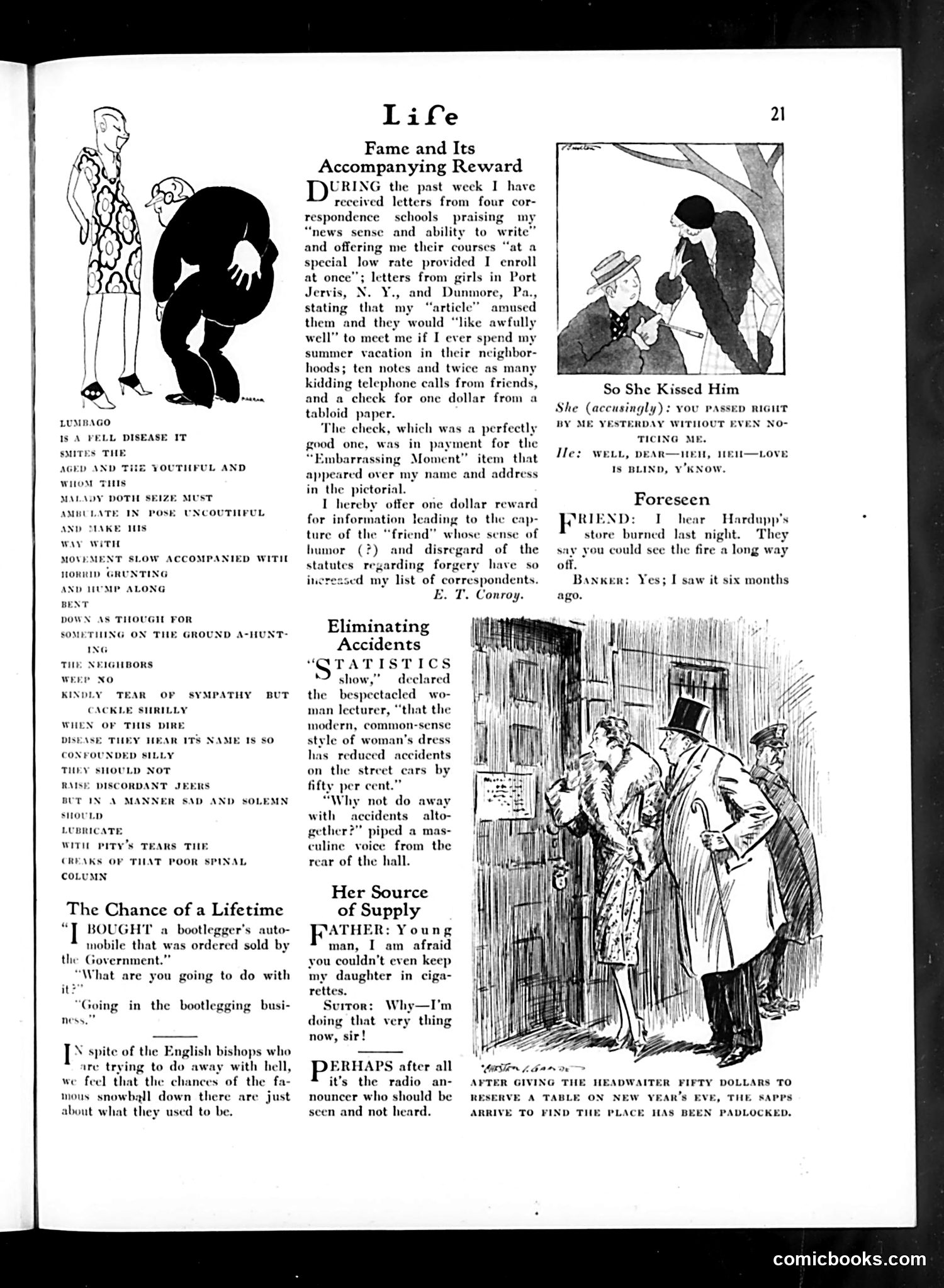
This page from *Life* magazine contains several satirical pieces reflecting early 20th-century American concerns: **"Fame and Its Accompanying Reward"** by E.T. Conroy mocks the hollow nature of minor celebrity. After publishing one article, Conroy receives solicitations from correspondence schools, romantic letters from strangers, and prank calls—but only a one-dollar payment. He humorously offers a dollar reward to identify who forged a letter using his name, satirizing how fleeting and ultimately worthless sudden notoriety can be. **"The Chance of a Lifetime"** jokes about Prohibition-era bootlegging. A man buys a government-seized bootlegger's car and plans to enter the smuggling business—the satire being that this "opportunity" will likely end badly. **"Eliminating Accidents"** mocks both a female lecturer's statistical claims about modern dress reducing streetcar accidents and a heckler's nonsensical response, satirizing pseudo-scientific social commentary. **"Her Source of Supply"** plays on Depression-era anxiety: a suitor cannot afford to keep a girl in cigarettes, yet boasts he's already doing so—implying either deception or that her "supply" comes from illicit sources. The cartoons use visual and textual humor to critique social pretension, economic desperation, and dubious claims.
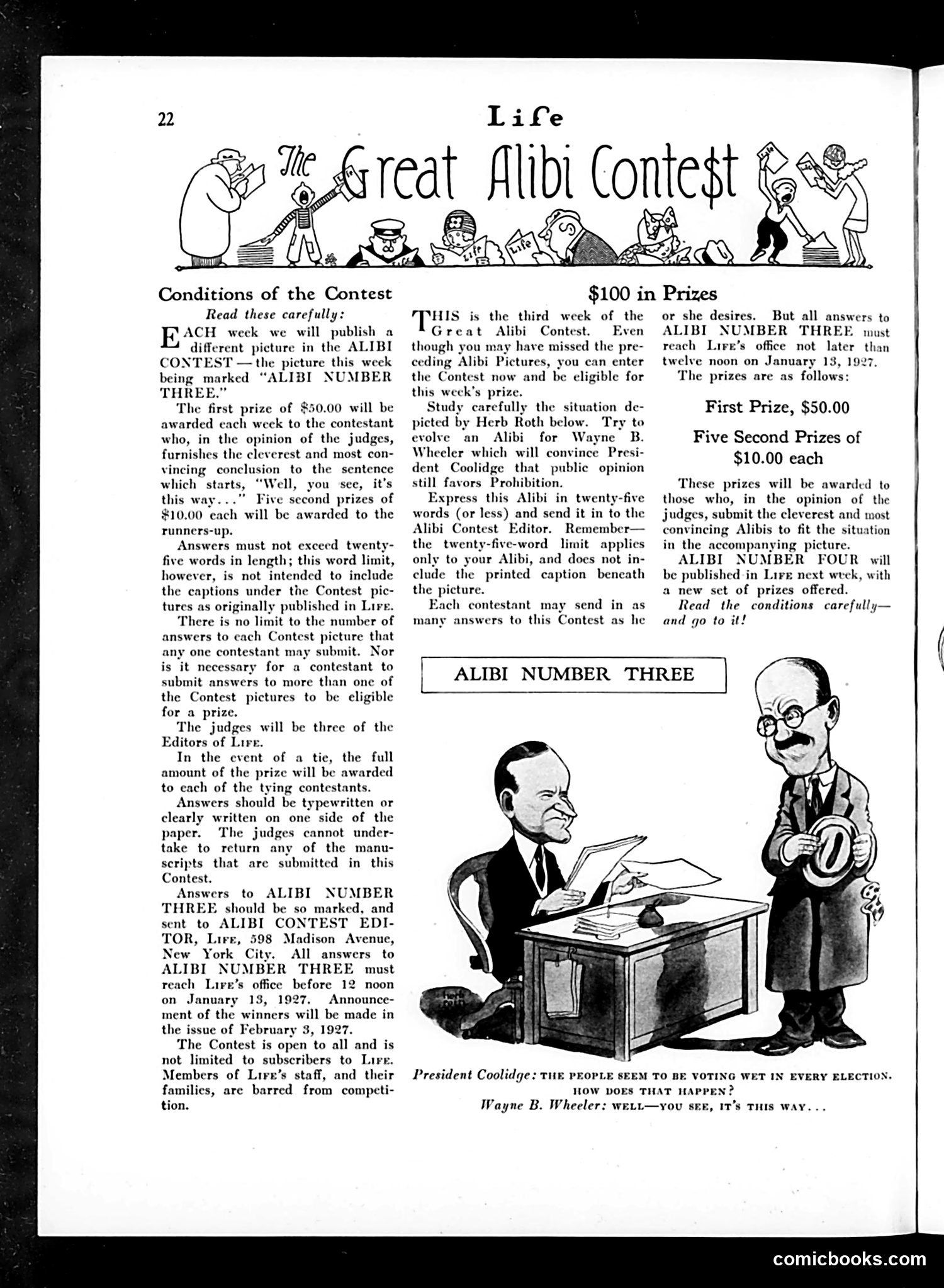
This is a reader-participation contest page from *Life* magazine (January 1927). The cartoon depicts a political exchange between President Calvin Coolidge and **Wayne B. Wheeler**, a prominent Prohibition advocate and Anti-Saloon League leader. The satire targets the contradiction between Wheeler's dry (Prohibition) stance and public voting patterns favoring "wet" (anti-Prohibition) candidates. Readers are invited to complete Wheeler's excuse—his "alibi"—explaining away this disconnect to convince Coolidge that Americans still support Prohibition, despite electoral evidence to the contrary. This mocks Prohibition's unpopularity and the intellectual gymnastics its defenders performed to deny public opposition. The contest itself is satirical commentary on how unconvincing such alibis would necessarily be, given the obvious gap between Prohibition policy and democratic will.
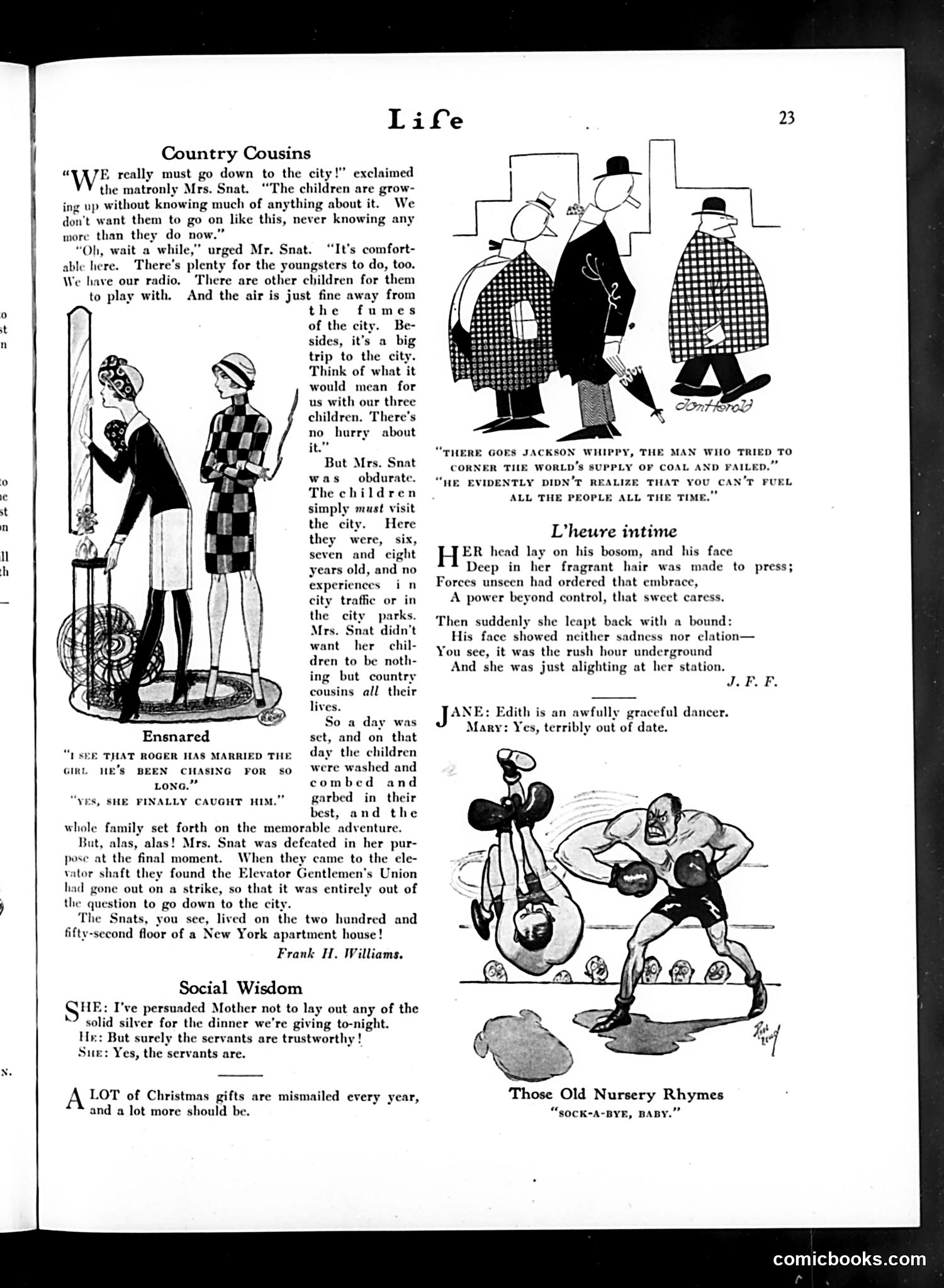
This multi-panel page satirizes early 1920s urban anxieties and labor unrest. **"Country Cousins"** (Frank H. Williams): A rural family debates visiting New York City to expose their children to urban life. The joke: they live on the 252nd floor of an apartment building, so when the Elevator Gentlemen's Union strikes, they're literally stranded and cannot descend to the city. The satire mocks both the era's nascent elevator/union labor disputes and the absurdity of being "in" the city yet unable to access it—commentary on how labor strikes could paralyze modern urban infrastructure. **Other items**: "L'heure intime" is a brief romantic poem about a couple's intimate subway moment interrupted by her station stop. "Social Wisdom" jokes about servant trustworthiness. The Jackson Whippy cartoon references his failed 1921 coal supply campaign ("you can't fuel all the people all the time"), likely alluding to post-WWI fuel shortages and labor conflicts. The page reflects 1920s concerns: labor unionism, modern transportation systems, and urban-versus-rural life.
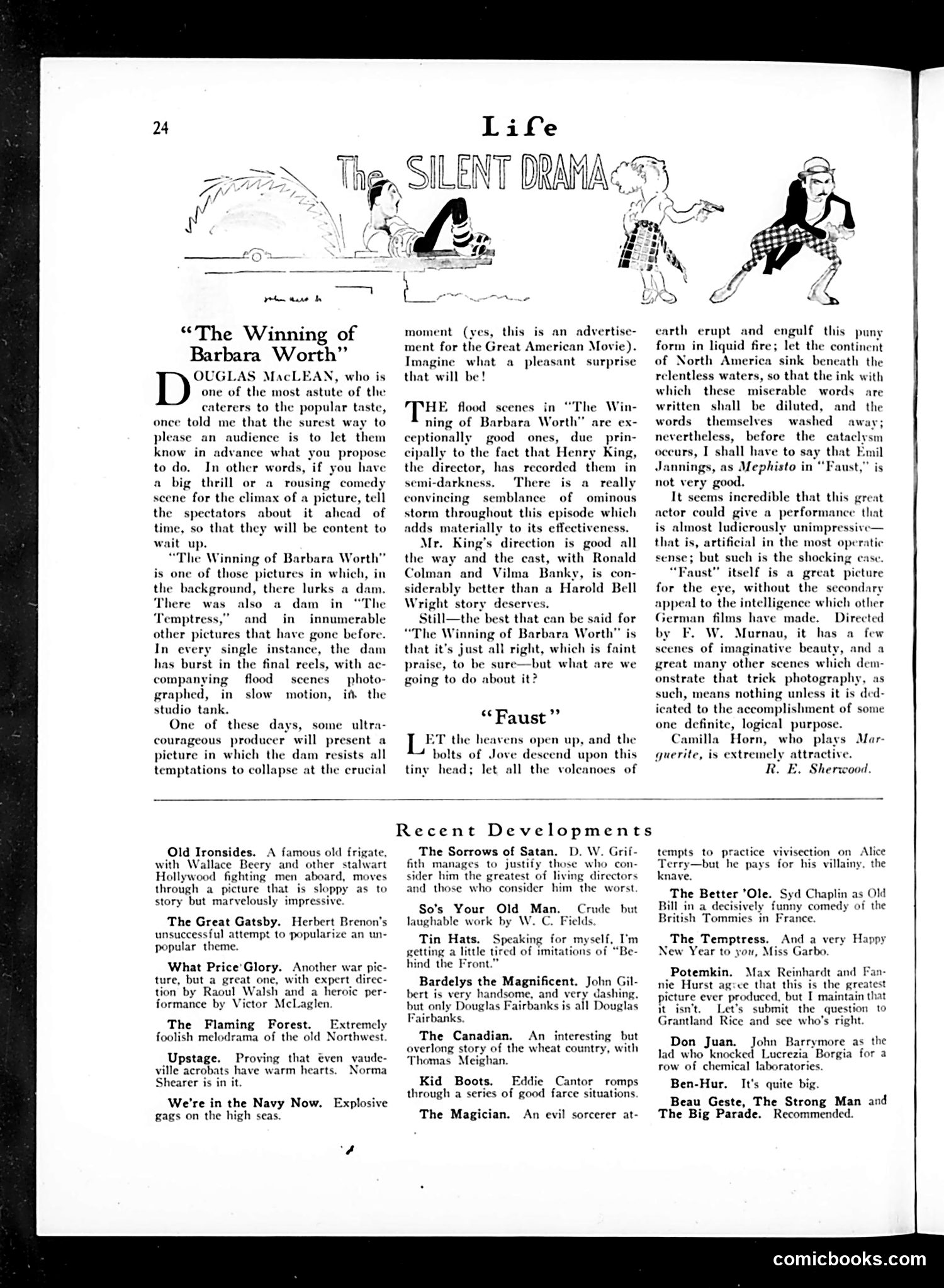
This page reviews 1920s silent films. The top cartoon satirizes a common Hollywood formula: dams that predictably collapse in climactic flood scenes. The critic notes that producers announce thrills beforehand to keep audiences patient, then jokes that some brave producer might actually show restraint—imagining a dam that *doesn't* burst as a shocking novelty. The reviews below critique specific films. "The Winning of Barbara Worth" receives faint praise despite good flood photography. The "Faust" review mocks Emil Jannings' performance as Mephisto as surprisingly poor, suggesting even great actors can disappoint. Other entries humorously assess popular films: Harold Bell Wright's stories are deemed unworthy of their directors; Douglas Fairbanks is praised as incomparably stylish; and W.C. Fields' work is called "crude but laughable." The satire targets both predictable studio formulas and inconsistent acting quality in early cinema.
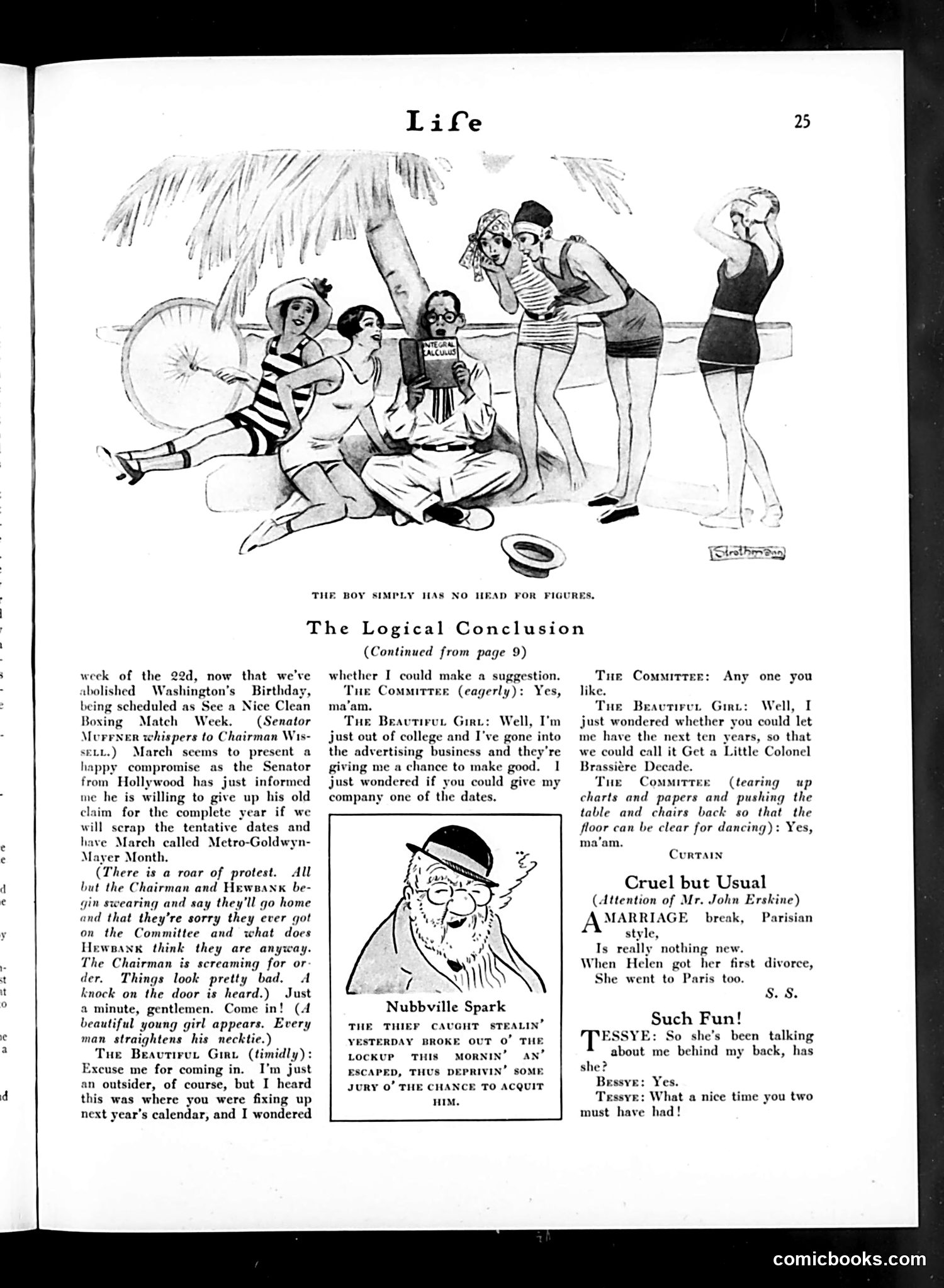
This page satirizes 1920s corporate influence on American institutions and gender dynamics. **Main Cartoon ("The Logical Conclusion"):** A congressional committee debates renaming months to honor corporations and industries. A senator from Hollywood proposes "Metro-Goldwyn-Mayer Month." When a beautiful young woman enters and requests advertising space for her brassieres company, the committee instantly abandons all principles, granting her a month called "Brassiére Decade." The satire attacks: corporate colonization of public time/calendars, male committee members' susceptibility to female beauty over principle, and the absurdity of treating sacred calendar months as advertising real estate. **Smaller items** include cynical jokes about divorce (Helen of Troy going to Paris), criminal justice (a thief escaping), and gossip, typical of the magazine's satirical miscellany. The cartoonist (Strathmore, visible in signature) mocks both corporate greed and the supposed seriousness of governmental deliberation.
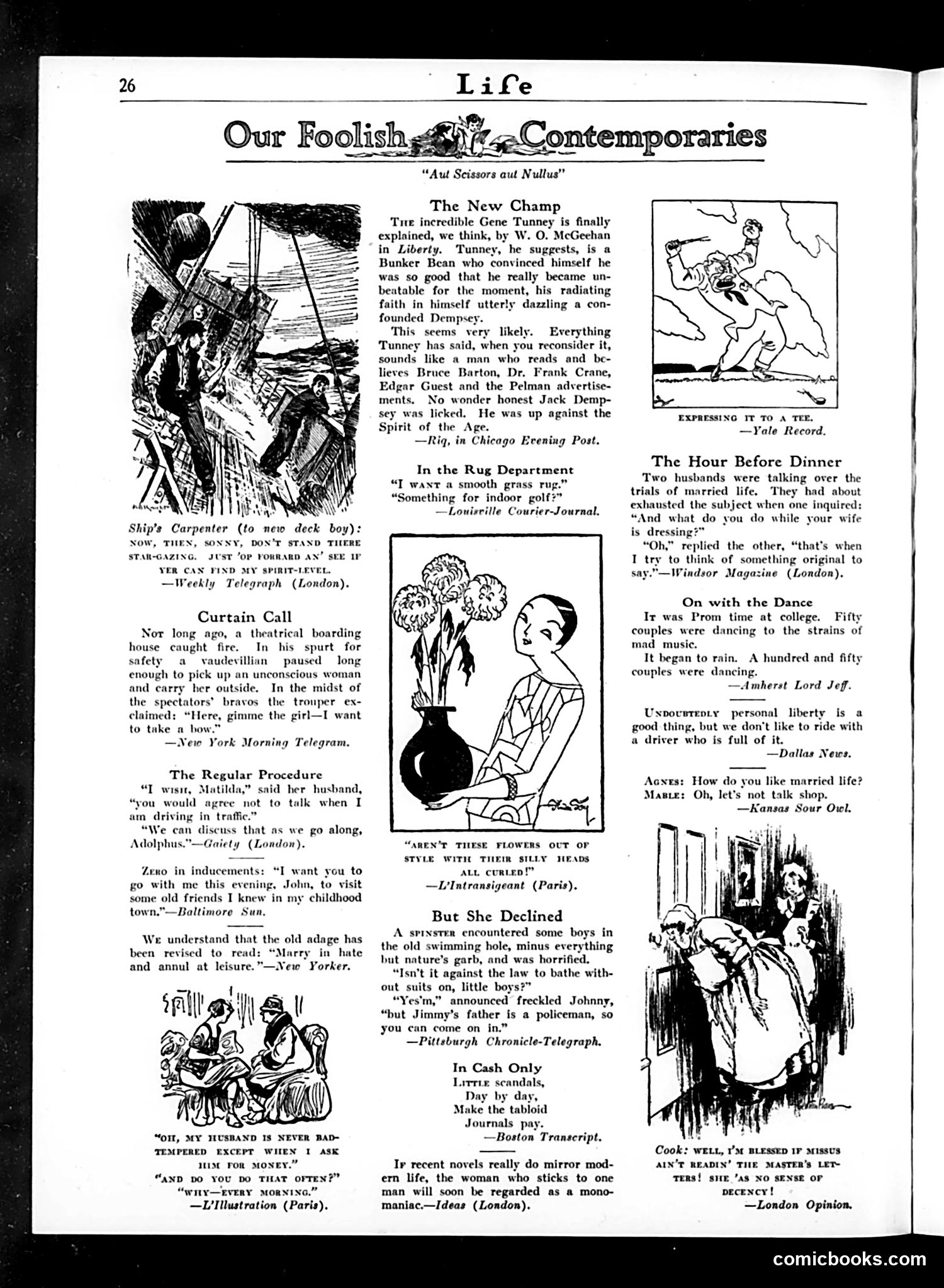
This is a collection of short satirical jokes and comic observations from various international sources, typical of Life's "Our Foolish Contemporaries" feature. **Key themes:** - **Gender and marriage**: Multiple jokes mock domestic friction—wives who talk while husbands drive, husbands seeking excuses during dressing time, wives reading husbands' private letters. - **Social pretension**: A vaudevillian actor prioritizes taking a bow over heroic rescue; jokes about people's self-absorption. - **Gene Tunney reference**: The boxing champion is satirized as someone who succeeded through positive thinking and self-help philosophy rather than actual skill, a dig at popular motivational writers like Bruce Barton. - **Sexual propriety**: A joke about boys swimming nude—shocking to Victorian sensibilities—solved by a policeman's son's logic. - **Class and labor**: Opening joke mocks a dim sailor; servant overhears master's letters. The humor reflects 1920s anxieties about modernity, marriage, and changing social norms, using international sources to suggest these follies are universal.
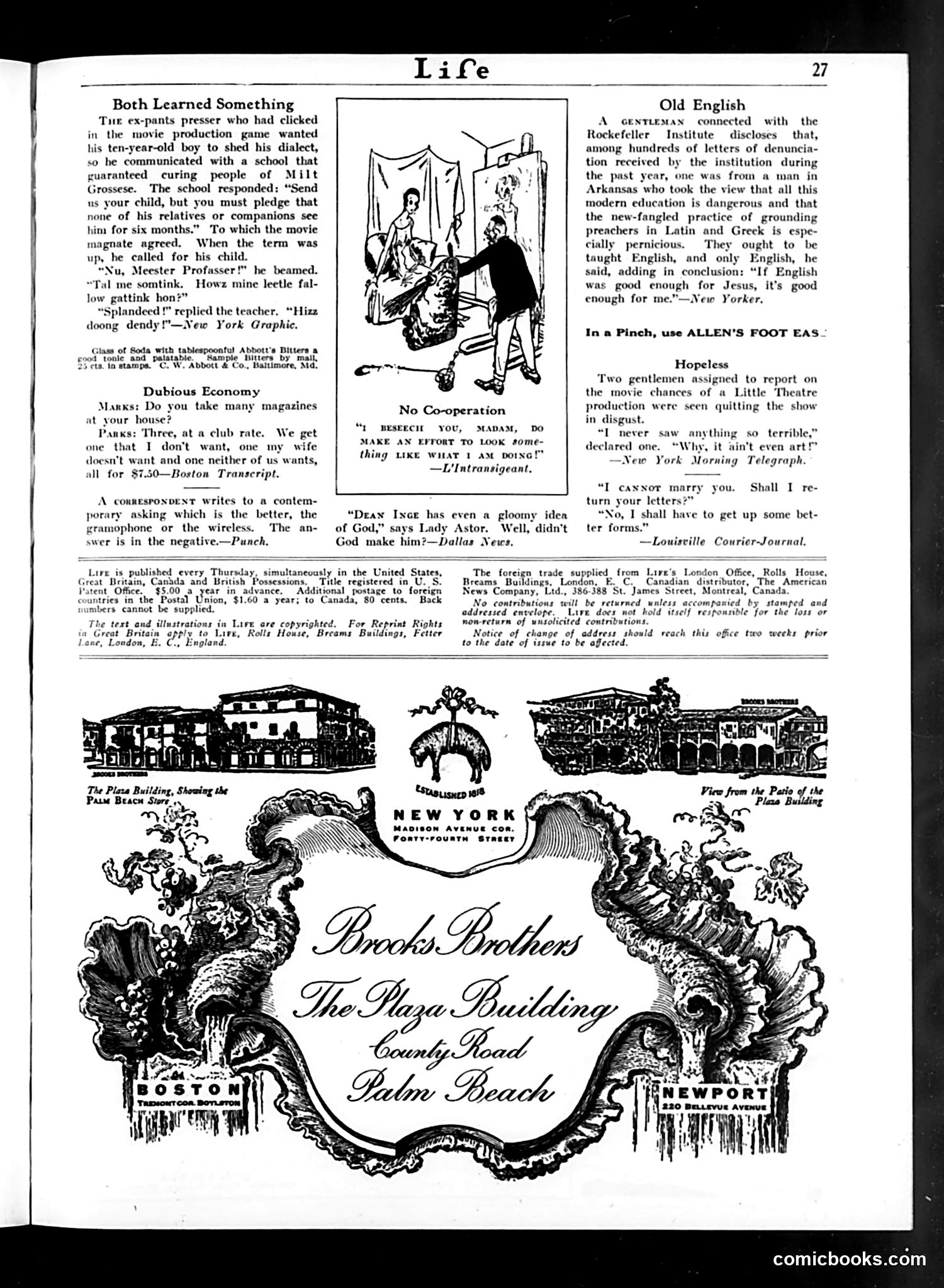
This page contains several satirical short pieces typical of Life's humor format: **"Both Learned Something"** mocks ethnic assimilation anxieties. A movie producer wants his son's Yiddish-inflected speech ("Milt Grossese") corrected by a school. The joke: the child succeeds but the father still speaks in dialect, suggesting assimilation's limits across generations. **"Old English"** satirizes anti-modern religious sentiment through a letter the Rockefeller Institute received from an Arkansas man opposing teaching Latin and Greek to preachers—claiming English sufficed for Jesus, so it should suffice now. The humor lies in the absurdist logic and implied resistance to scientific/educational progress. **"No Co-operation"** and "Dubious Economy"** are brief comic exchanges about magazine subscriptions and marriage proposals—light domestic humor. **"Hopeless"** mocks a Little Theatre production's poor quality. The page is primarily **humorous commentary on American social anxieties**: immigration/assimilation, educational modernization, and class tensions. The bottom half contains a Brooks Brothers advertisement featuring Palm Beach real estate.
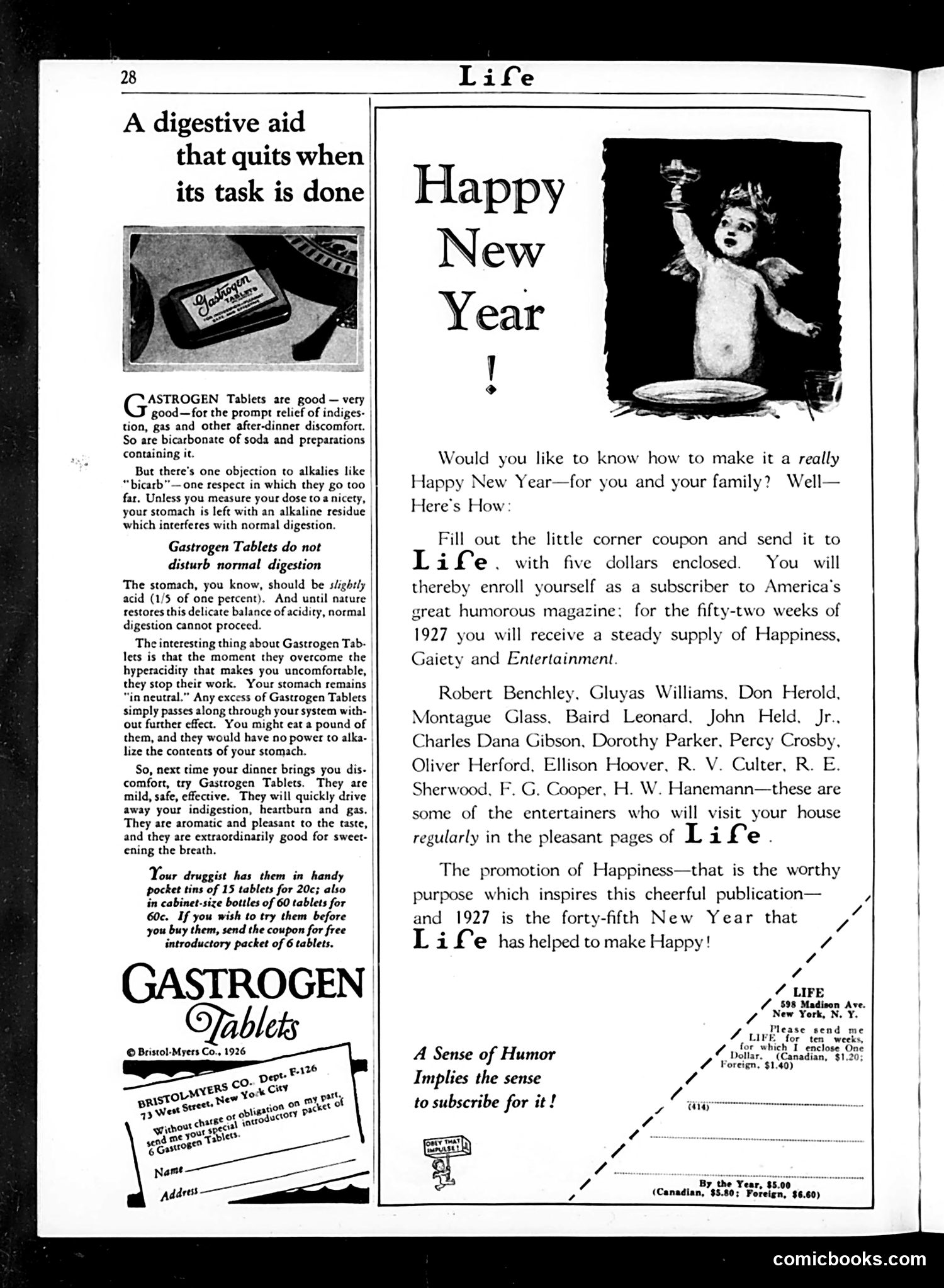
This page combines two advertisements with a subscription pitch for *Life* magazine. **Left side:** A Gastrogen Tablets ad (Bristol-Myers Co.) promoting an antacid that supposedly stops working once it neutralizes stomach acid, unlike regular baking soda which can leave excess alkaline residue. The ad emphasizes the product's self-limiting action—a selling point for 1926 consumers concerned about over-medication. **Right side:** *Life* magazine's New Year subscription promotion (1927). It lists famous contemporary humorists and cartoonists—Robert Benchley, Dorothy Parker, Percy Crosby, John Held Jr., and others—as regular contributors. The pitch equates subscribing to the magazine with ensuring family happiness and entertainment for the coming year. **The implicit humor:** Pairing a digestive aid ad with a happiness-promoting magazine subscription creates an unintentional joke: one product stops discomfort, the other starts it—suggesting readers need both remedies to survive 1927. The page reflects *Life*'s identity as a humor and satire magazine for literate, middle-class readers of the Jazz Age.
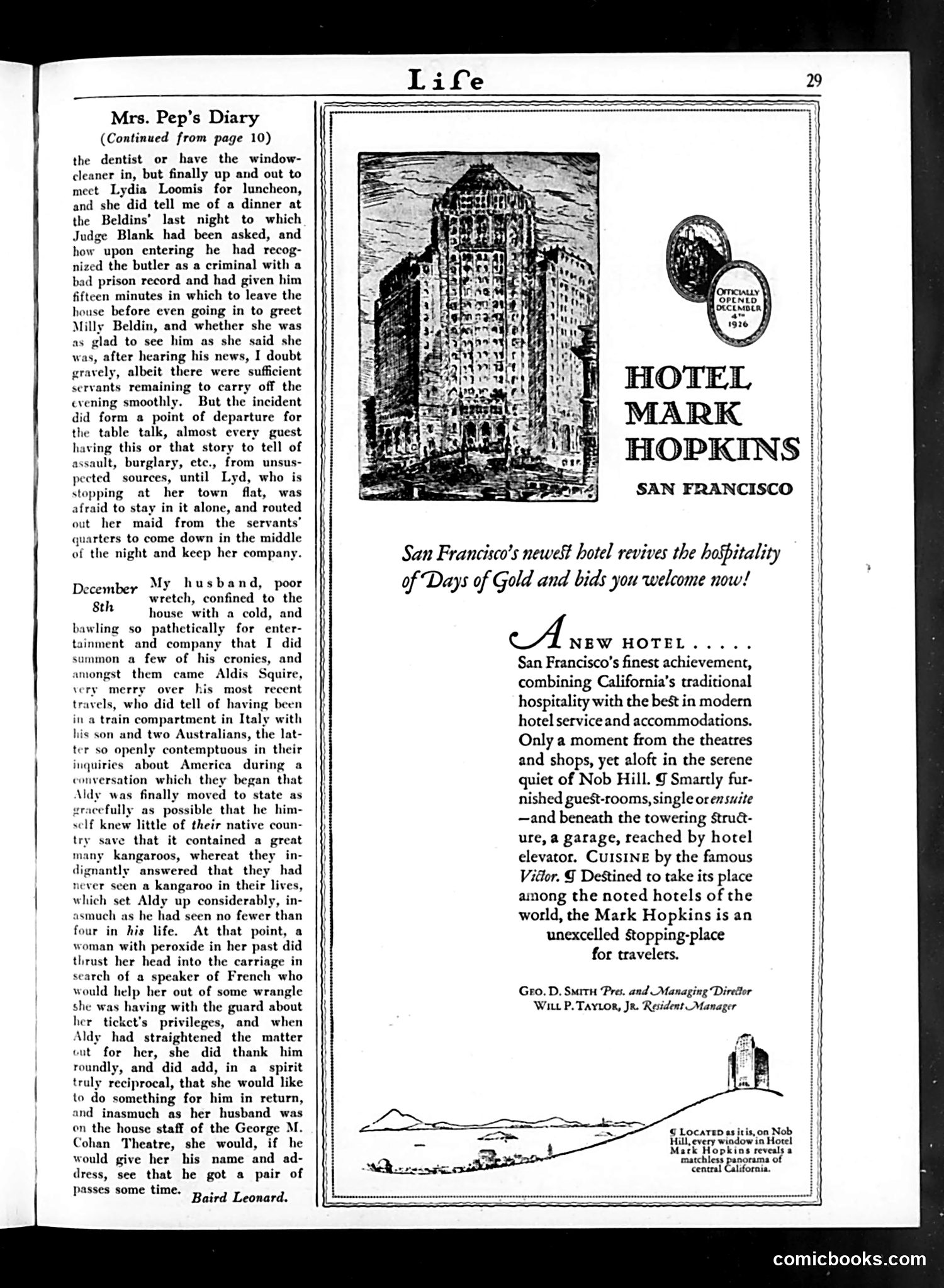
This page contains two distinct elements: **Left side - "Mrs. Pep's Diary"**: A serialized humor column (continued from page 10) written in arch, society-page style. It records gossipy anecdotes from a wealthy woman's social circle—a dentist visit, a dinner party where a judge recognizes the butler as an ex-convict, train compartment encounters with Australians debating kangaroos, and a chance meeting with a peroxide-blonde woman seeking French translation help. The satire targets upper-class pretension and the trivial concerns of leisure society, with barbed observations about servants, social anxiety, and romantic reciprocity. **Right side - Advertisement**: A full-page hotel ad for the Mark Hopkins in San Francisco, emphasizing luxury, location near theaters on Nob Hill, modern amenities (garage, elevator), and fine dining. The copy appeals to travelers seeking elegant accommodation. The page is primarily a humor column with substantial advertising—typical of Life magazine's mixed content model during this period.
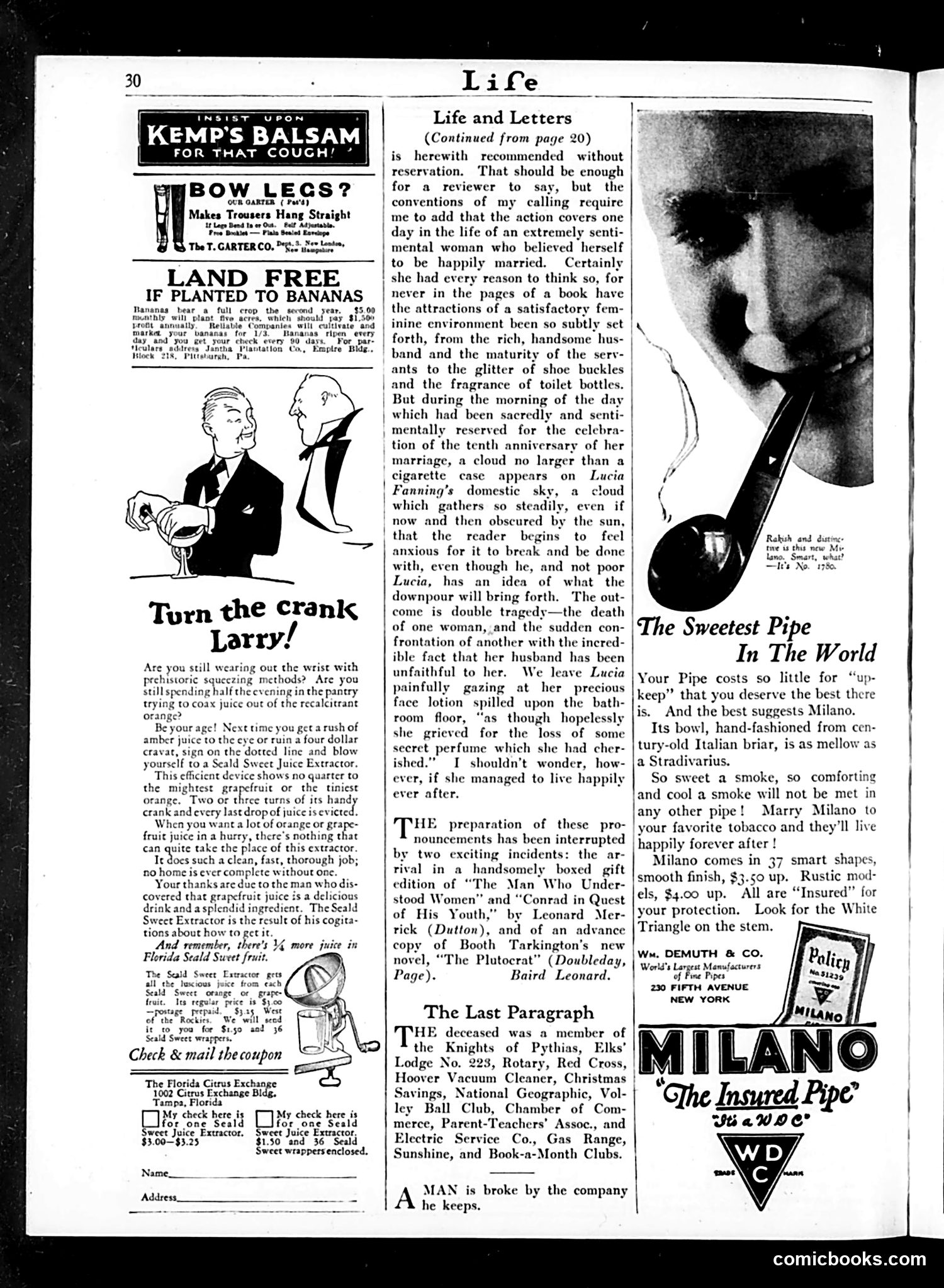
This page contains **mostly advertisements** interspersed with book reviews and a gossip column. The cartoons/ads mock everyday consumer products and domestic frustrations: - **"Bow Legs?"** advertises a garter to straighten trousers - **"Turn the Crank Larry!"** ridicules manual juice extraction, promoting the "Seald Sweet Juice Extractor" as a modern labor-saving device - **"Land Free if Planted to Bananas"** is a dubious land scheme promising easy agricultural profit The **"Life and Letters"** column reviews a novel about a sentimental woman whose ten-year marriage is disrupted by discovery of her husband's infidelity—a melodramatic domestic tragedy typical of period fiction. **"The Sweetest Pipe"** advertises Milano brand pipes as status symbols. The humor relies on contrasting *primitive* old methods (hand-squeezing juice, manual labor) with *modern* conveniences, while the book review epitomizes sentimental domestic fiction popular among the magazine's middle-class audience. The page targets aspirational consumer culture.
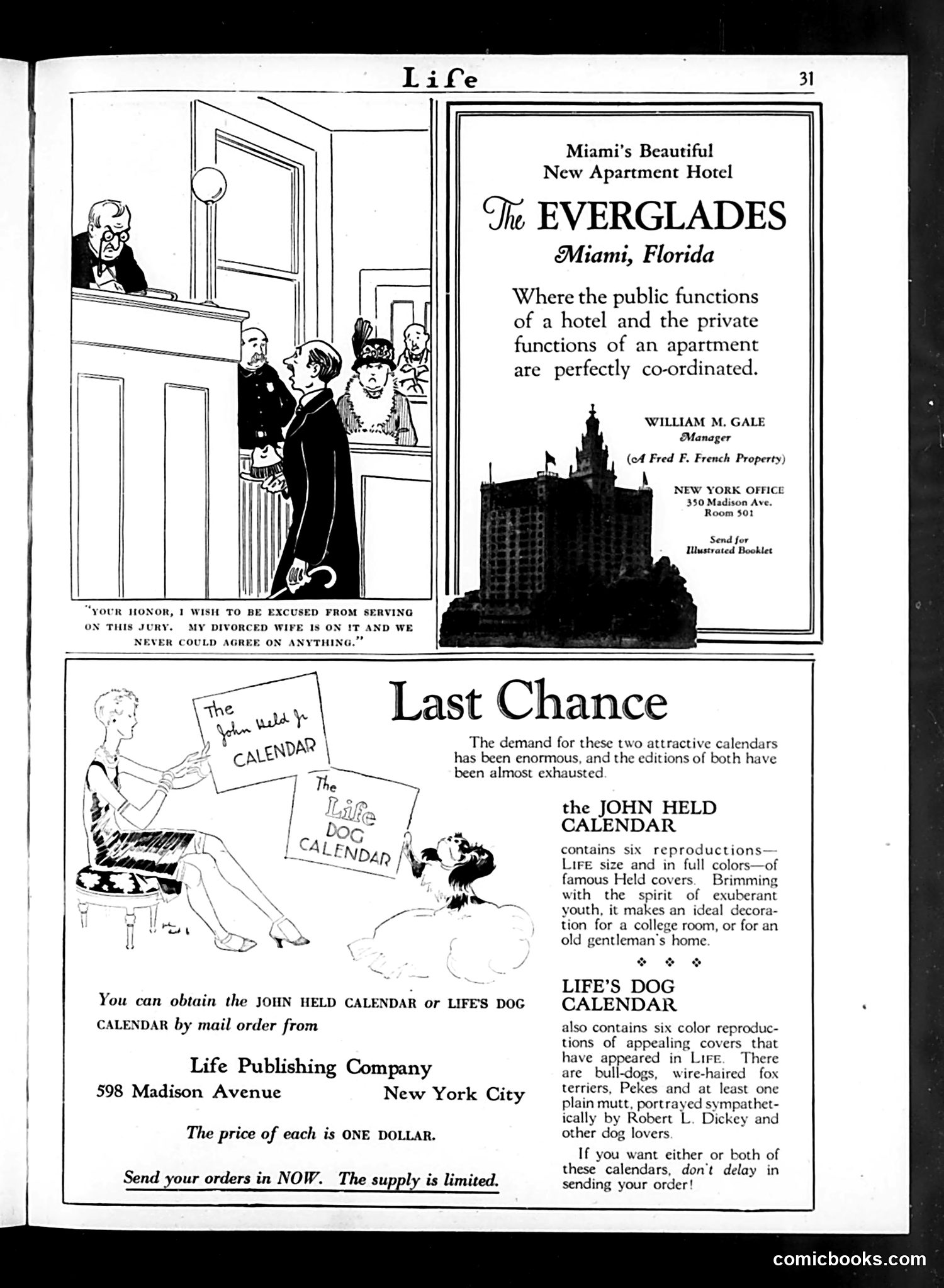
This page combines a satirical cartoon with product advertisements. The main cartoon depicts a jury duty excuse: a man tells a judge he should be excused because his ex-wife also serves on the jury, and they "never could agree on anything." The joke satirizes divorce culture and suggests marital conflict is so fundamental that even strangers would recognize its incompatibility—playing on 1920s anxieties about rising divorce rates. The page also advertises The Everglades hotel in Miami and two calendars featuring artwork by John Held (known for depicting "flapper" culture) and dog illustrations by Robert L. Dickey. The calendar ads emphasize limited supply to encourage immediate purchase—common marketing tactics of the era. This appears to be from Life magazine's golden age of social satire, blending humor about contemporary domestic issues with commercial content.
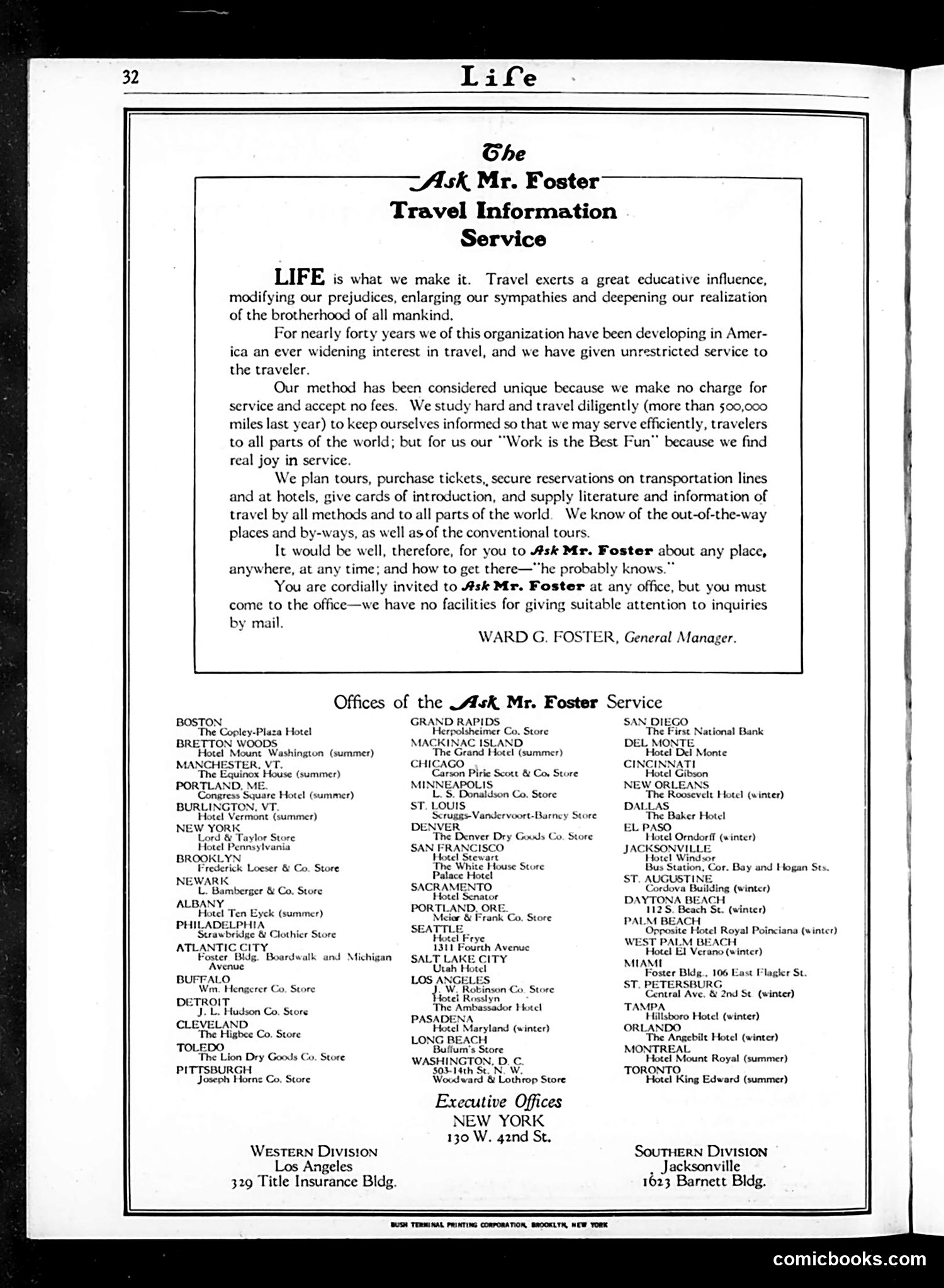
This is not a cartoon or satirical content—it's a **full-page advertisement** for the Ask Mr. Foster Travel Information Service, a real travel agency that operated for nearly forty years. The ad explains their business model: they provide free travel planning (tours, tickets, hotel reservations, introductions) with no fees charged to customers. They claim expertise from traveling over 500,000 miles annually to serve travelers "to all parts of the world." The page then lists dozens of office locations across major American cities and resort destinations, plus three executive offices (New York, Los Angeles, Jacksonville), showing the company's substantial national reach. **For a modern reader:** This represents pre-internet travel planning—when travelers needed to visit physical offices or write by mail to get professional advice about destinations, transportation, and accommodations. The emphatic tone about their free service and extensive knowledge reflects a business model that would become obsolete with online travel booking.
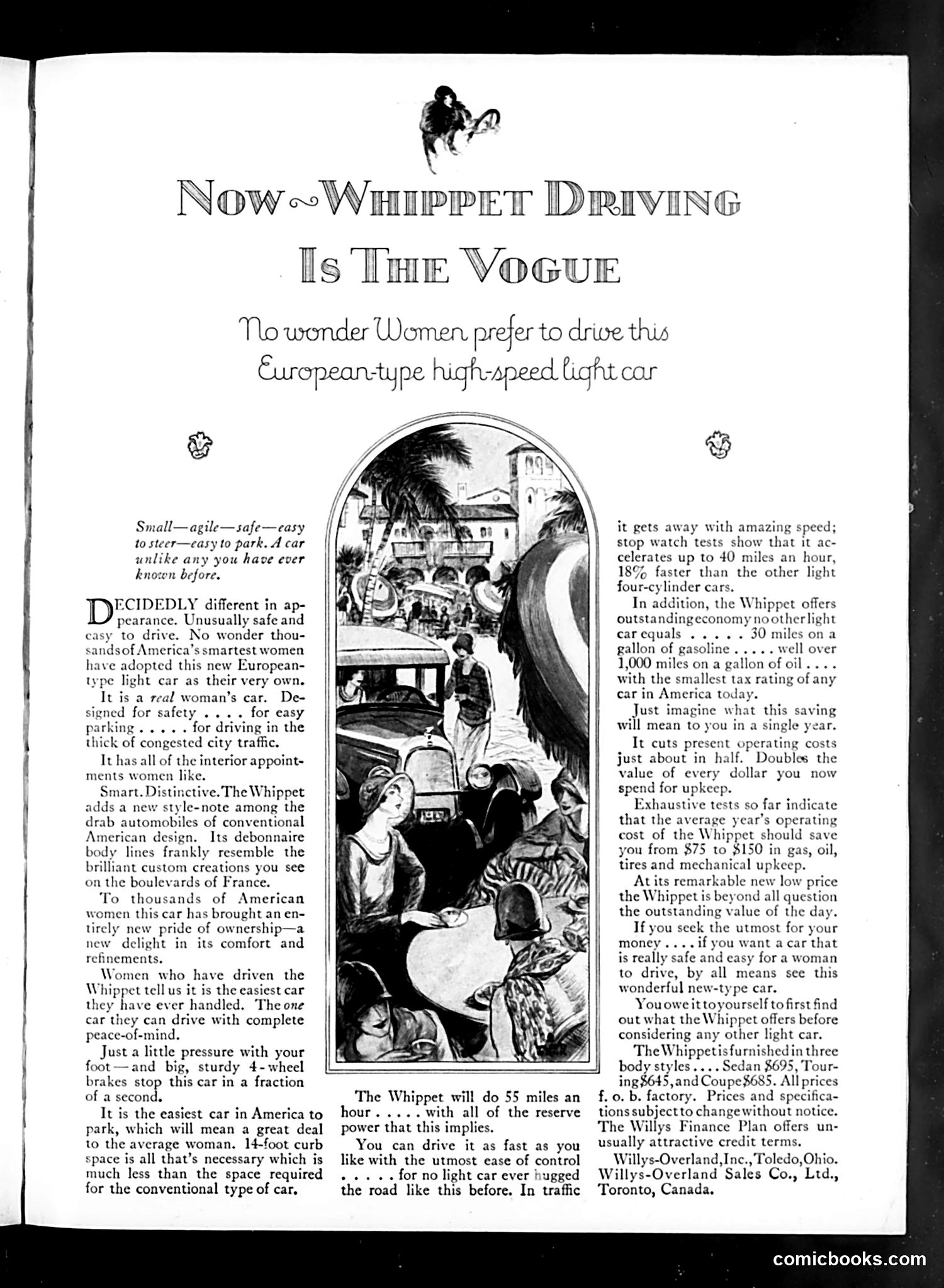
This is primarily a **car advertisement**, not satire or political commentary. The page promotes the Whippet, a European-style light automobile manufactured by Willys-Overland. The central illustration depicts well-dressed women examining and driving the car, reflecting 1920s marketing that positioned the vehicle as particularly appealing to female drivers. The text emphasizes "woman's car" messaging—highlighting ease of parking, safety, and ease of steering as features women supposedly prefer. The satirical element, if any, is subtle: the ad's heavy-handed gendering of automotive features (small size, safety, simplicity) for women readers. The phrase "it is a real woman's car" suggests conventional assumptions about female capabilities and preferences. Key selling points mentioned: 40 mph speed, 30 miles per gallon fuel economy, low operating costs ($75-$150 annually), and modest pricing ($645-$695). The advertisement targets American women's "entirely new pride of ownership" in automobiles—reflecting 1920s women's increasing independence and consumer power.
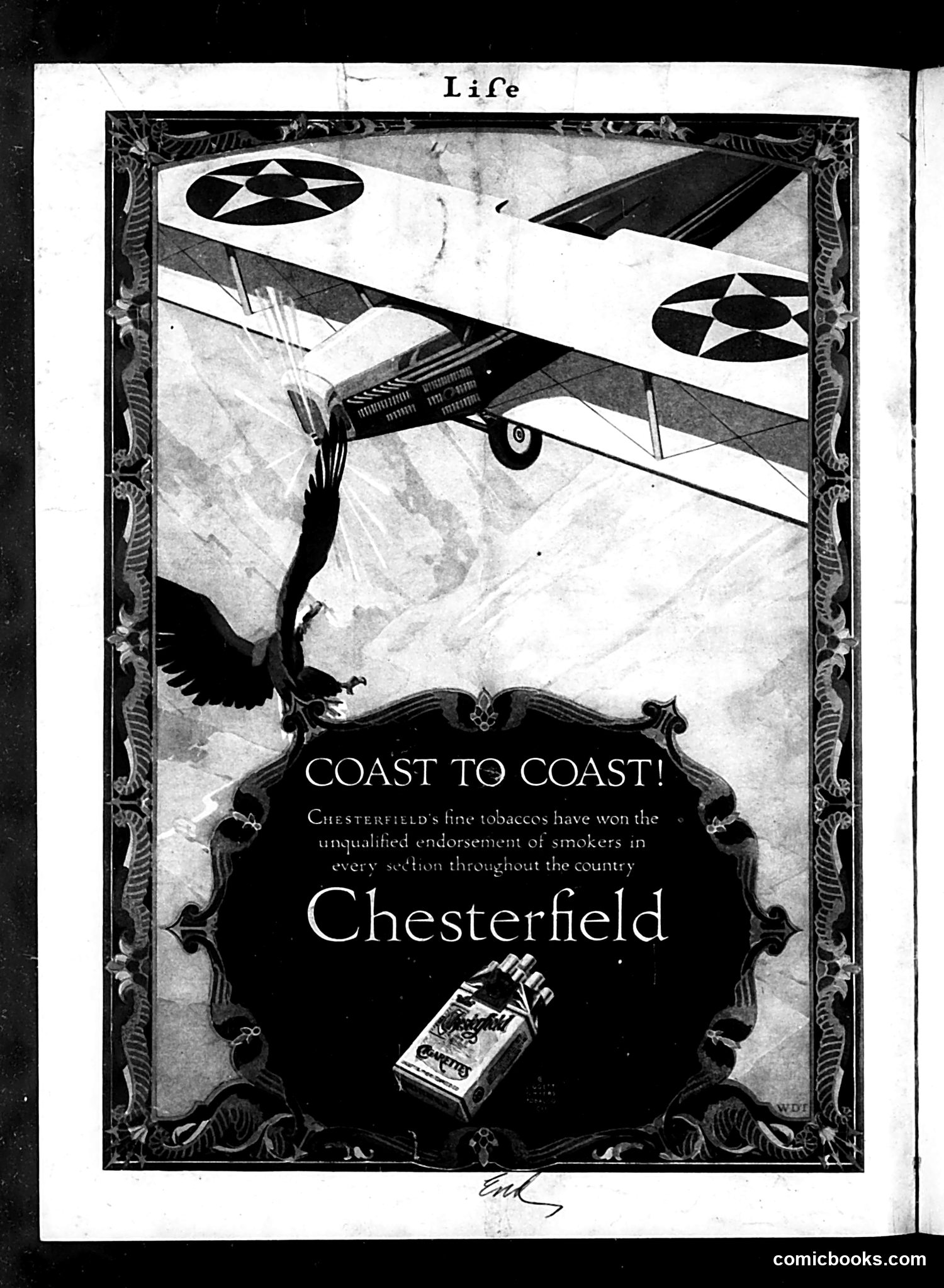
This is a **cigarette advertisement**, not a political cartoon. It features a military aircraft viewed from below, with military star insignias visible on the wings. The plane appears to be performing an aerial maneuver or dive. The ad's "Coast to Coast!" headline and imagery suggest **national reach and modernity**—linking Chesterfield cigarettes to aviation, which represented cutting-edge technology and progress in this era. The military aircraft imagery likely appeals to patriotic sentiment and masculine ideals. The advertisement claims Chesterfield tobacco has won "unqualified endorsement of smokers in every section throughout the country," using the aviation motif to emphasize widespread popularity and national scope. This is straightforward product marketing rather than satire.

I can see this is a blank or nearly blank page from what appears to be a Life magazine issue, with only "comicbooks.com" visible at the bottom right—which appears to be a modern watermark rather than original content. The page itself contains no visible cartoons, illustrations, text, or other substantive content that would allow me to identify political figures, social references, or satirical commentary. Without actual cartoon imagery or OCR'd editorial content from the original publication, I cannot explain what this page's satire or jokes meant to contemporary readers. This appears to be either a blank page from the original publication or a page where the content has not scanned clearly.