
Life, 1926-12-30 · page 26 of 37
Life — December 30, 1926 — page 26: what you’re looking at
What you’re looking at
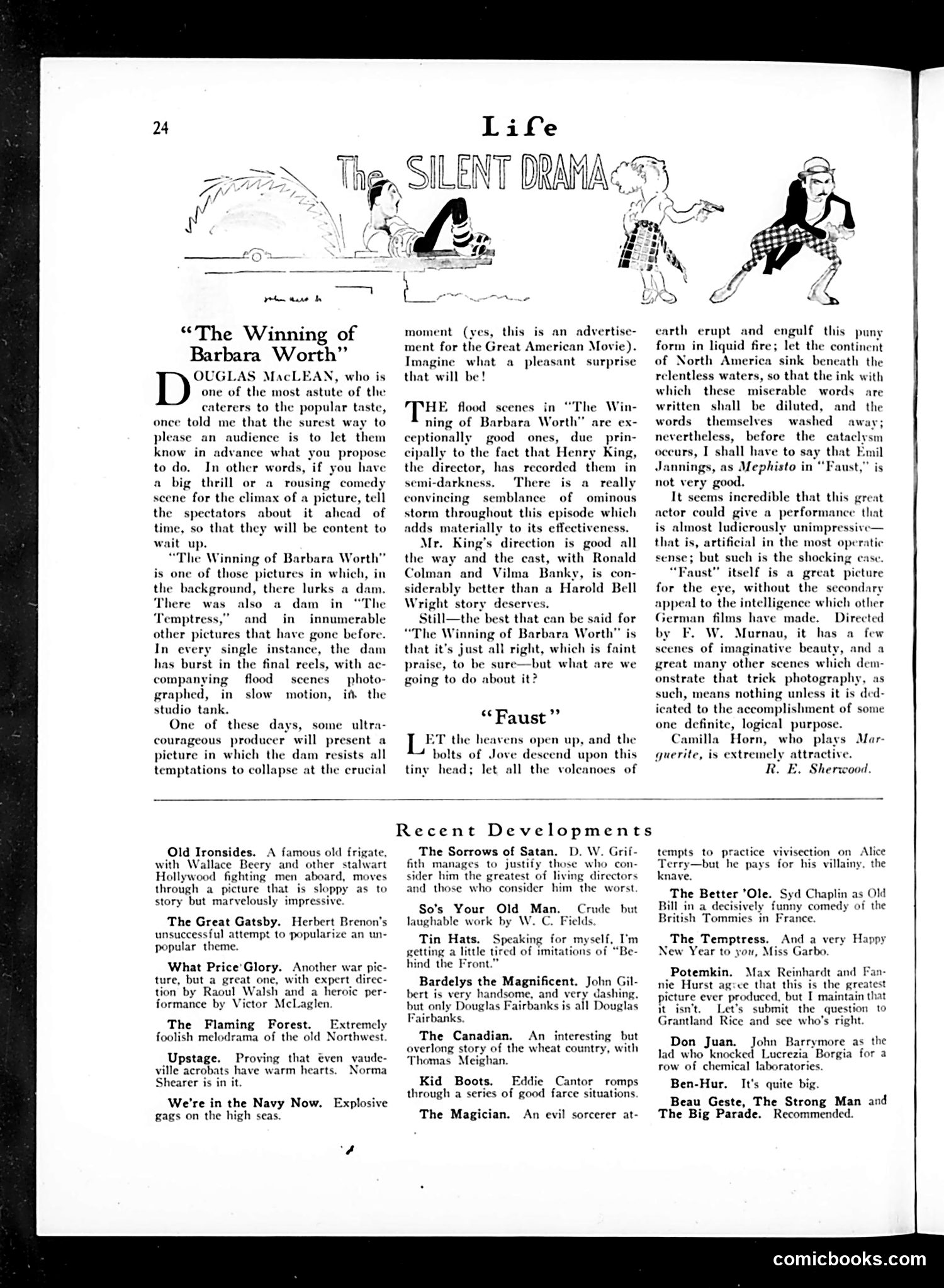
This page reviews 1920s silent films. The top cartoon satirizes a common Hollywood formula: dams that predictably collapse in climactic flood scenes. The critic notes that producers announce thrills beforehand to keep audiences patient, then jokes that some brave producer might actually show restraint—imagining a dam that *doesn't* burst as a shocking novelty. The reviews below critique specific films. "The Winning of Barbara Worth" receives faint praise despite good flood photography. The "Faust" review mocks Emil Jannings' performance as Mephisto as surprisingly poor, suggesting even great actors can disappoint. Other entries humorously assess popular films: Harold Bell Wright's stories are deemed unworthy of their directors; Douglas Fairbanks is praised as incomparably stylish; and W.C. Fields' work is called "crude but laughable." The satire targets both predictable studio formulas and inconsistent acting quality in early cinema.
📄 Transcribed text from this page (OCR, searchable)
Machine-transcribed from the original scan — historical spelling and the odd misread are preserved.
rhea h “The Winning of Barbara Worth” OUGLAS MacLE who is D one of the most astute of the caterers to the popular taste, once told me that the surest way to please an audience let them know in advance what you propose to do. In other words, if you have a big thrill or a rousing comedy scene for the climax of a picture, tell the spectators about it ahead of time, so that they will be content to wait up. The Winning of Barbara Worth” is one of those pictures in which, in the background, there lurks a dam. There was also a dam in “The Temptress,” and in innumerable other pictures that have gone before. In every single instance, the dam has burst in the final reels, with ac- companying flood scenes _ photo- graphed, in slow motion, ifs the studio tank. One of these days, some ultra- courageous producer will present a picture in which the dam resists all temptations to collapse at the ert Life moment (yes, this is an advertise ment for the Great American Movie). Imagine what a pleasant surprise that will be! THE flood scenes in “The Win- ning of Barbara Worth” are ex- ceptionally good ones, due prin- cipally to the fact that Henry King, the director, has recorded them in semi-darkness. There is a really convincing semblance of ominous storm throughout this episode which adds materially to its effectiveness. Mr. King’s direction is good all the way and the cast, with Ronald Colman and Vilma Banky, is con- siderably better than a Harold Bell Wright story deserves. Still—the best that can be said for “The Winning of Barbara Worth” is that it’s just all right, which is faint praise, to be sure—but what are we going to do about it? “Faust’ . the heavens open up, and the bolts of Jove descend upon this head; let all the volcanoes of L tiny Old Ironsides. A famous old frigate, with Wallace Beery and other stalwart Hollywood fighting men aboard, moves through a picture that is sloppy as to story but marvelously impressive. The Great Gatsby. Herbert Brenon’s unsuccessful attempt to popularize an un- popular theme. What Price'Glory. Another war pic- ture, but a great one, with expert direc- tion by Raoul Walsh and a heroic per- formance by Victor Mc! n The Flaming Forest. Extremely foolish melodrama of the old Northwest. Proving that éven vaude- Upstage. Norma ville acrobats have warm hearts. Shearer is in it. We're in the Navy Now. gags on the high seas. Explosive Recent Developments The Sorrows of Satan. D. W. Grif- fith manages to justify those who con- sider him the greatest of living directors and those who consider him the worst So's Your Old Man. Crude laughable work by W. C. Fields. Tin Hats. Speaking for myself, I'm getting a little tired of imitations of “Be- hind the Front.” Bardelys the Magnificent. John Gil- bert is very handsome, and very dashing, but only Douglas Fairbanks is all Douglas Fairbanks. The Canadian. An interesting but overlong story of the wheat country, with Thomas Meighan. Kid Boots. Eddie Cantor romps through a series of good farce situations. but The Magician. An evil sorcerer at- earth erupt and engulf this puny form in liquid fire; let the continent of North America sink beneath the relentless waters, so that the ink with which these miserable words are written shall be diluted, and the words themselves washed ; nevertheless, before the occurs, I shall have to say that Jannings, as Mephisto in “Faust,” is not very good. It seems incredible that this great actor could give a performance that is almost ludicrously unimpressive— that is, artificial in the most operatic sense; but such is the shocking case. ust” itself is a great picture for the eye, without the secondary appeal to the intelligence which other rman films have made. Directed by F. W. Murnau, it has a few scenes of imaginative beauty, and a great many other scenes which dem- onstrate that trick photography, as uch, means nothing unless it is ded- ted to the accomplishment of some one definite, logical purpose. illa Horn, who plays is extremely attractive. R. E. Sherwood. Mar- guerite tempts to practice vivisection on Alice Terry—but he pays for his villainy, the knave. The Better 'Ole. Syd Chaplin as Old Bill in a decisively funny comedy of the British Tommies in France. The Temptress. And a very Happy New Year to you, Miss Garbo. Potemkin. Max Reinhardt and F nie Hurst agree that this is the great picture ever produced, but I maintain tv at it isn’t. Let's submit the question to ¢ tland Rice and see who's right. Don Juan. John Barrymore as the lad who knocked Lucrezia Borgia row of chemical laboratories. Ben-Hur. It's quite big. Beau Geste, The Strong Man and The Big Parade. Recommended. comicbooks.com