
Life, 1926-12-30 · page 22 of 37
Life — December 30, 1926 — page 22: what you’re looking at
What you’re looking at
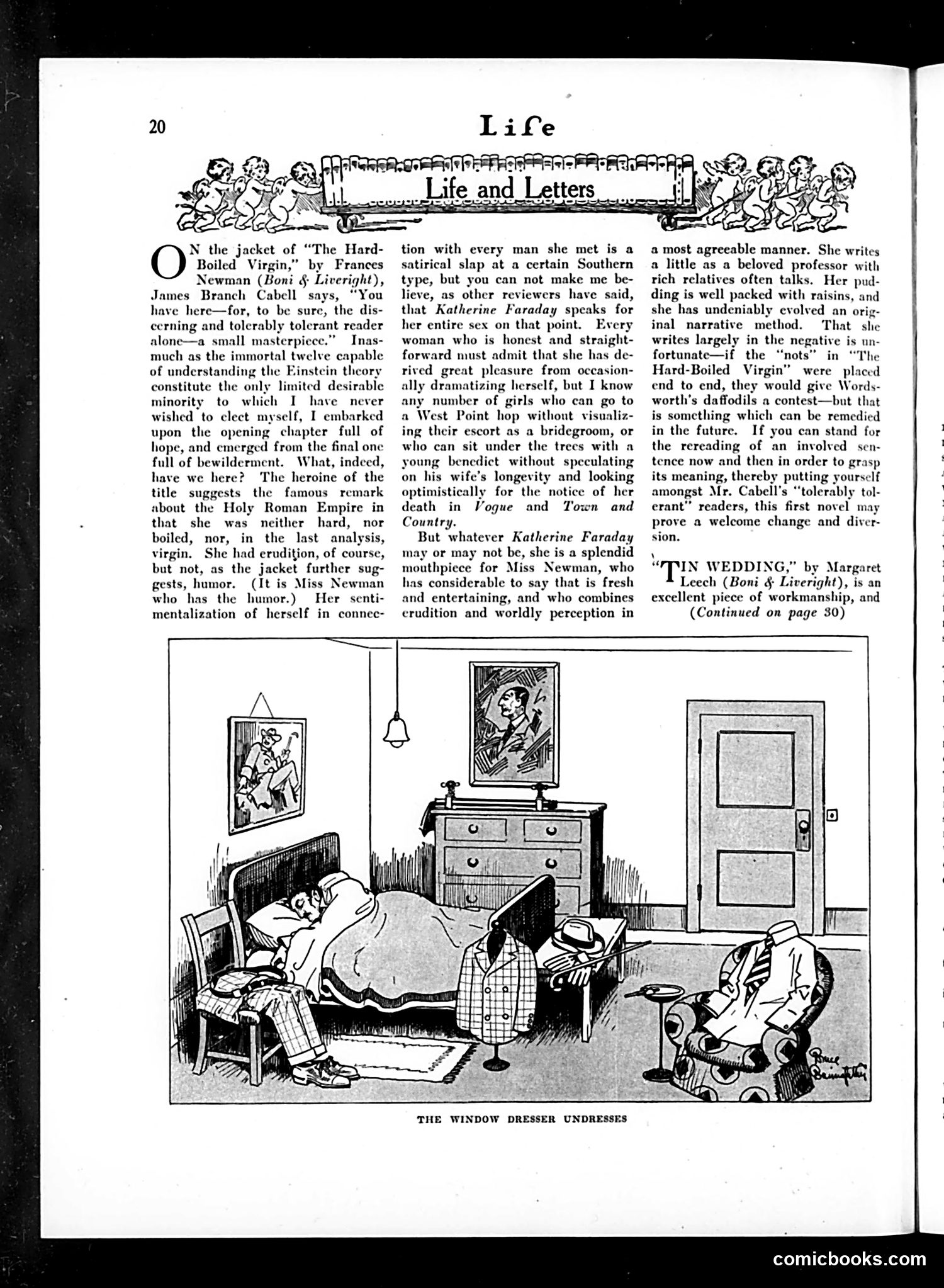
This cartoon satirizes the pretense and artificiality of retail display work. The illustration shows a window dresser—a professional who arranges store displays—in a disheveled bedroom, surrounded by casual clothes and messy belongings, contrasting sharply with the neat, curated window displays they create for the public. The joke targets the gap between professional image and private reality: the meticulous craftsperson who creates attractive, orderly retail presentations lives in apparent chaos. It's a commentary on performative versus authentic life—a theme echoing the page's literary discussion of Frances Newman's *The Hard-Boiled Virgin*, which explores the gap between how women present themselves socially versus their private thoughts. The cartoon suggests that creating appealing facades is exhausting work, leaving one's personal space neglected.
📄 Transcribed text from this page (OCR, searchable)
Machine-transcribed from the original scan — historical spelling and the odd misread are preserved.
N the jacket of “The Hard- O Boiled Virgin,” by Frances Newman (Boni § Liveright), James Branch Cabell ‘ have here—for, to be sure, the dis- ecrning and tolerably tolerant reader alone—a small masterpiece.” Inas- much as the immortal twelve capable of understanding the Einstein theory constitute the only limited desirable minority to which I have never wished to clect myself, I embarked upon the opening chapter full of hope, and emerged from the final one full of bewilderment. What, indeed, have we here? The heroine of the title suggests the famous remark about the Holy Roman Empire in that she was neither hard, nor boiled, nor, in the last analysis, virgin. She had erudition, of course, but not, as the jacket further sug- gests, humor. (It is Miss Newman who has the humor.) Her senti- mentalization of herself in connec- tion with every man she met is a satirical slap at a certain Southern type, but you can not make me be- lieve, as other reviewers have said, that Katherine Faraday speaks for her entire sex on that point. Every woman who is honest and straight- forward must admit that she has de- rived great pleasure from occasion- ally dramatizing herself, but I know y number of girls who can go to a West Point hop without visualiz- ing their escort as a bridegroom, or who can sit under the trees with a young benedict without speculating on his wife’s longevity and looking optimistically for the notice of her death in Vogue and Town and Country. But whatever Katherine Faraday may or may not be, she is a splendid mouthpiece for Miss Newman, who has considerable to say that is fresh and entertaining, and who combines erudition and worldly perception in a most agreeable manner. She writes a little as a beloved professor with rich relatives often talks. Her pud- ding is well packed with raisins, and she has undeniably evolved an orig- inal narrative method. That she writes largely in the negati un- fortunate—if the “not “The Hard-Boiled Virgin” were placed end to end, they would give Words- worth’s daffodils a contest—but that is something which can be remedied in the future. If you can stand for the rereading of an involved sen- tence now and then in order to grasp its meaning, thereby putting yourself amongst Mr. Cabell’s “‘tolerably tol- erant” readers, this first novel may prove a welcome change and diver- sion. \ a N WEDDING,” by Margaret eech (Boni § right), is an excellent piece of workmanship, and (Continued on page 30) THE WINDOW DRESSER UNDRESSES comicbooks.com