
Life, 1926-12-30 · page 16 of 37
Life — December 30, 1926 — page 16: what you’re looking at
What you’re looking at
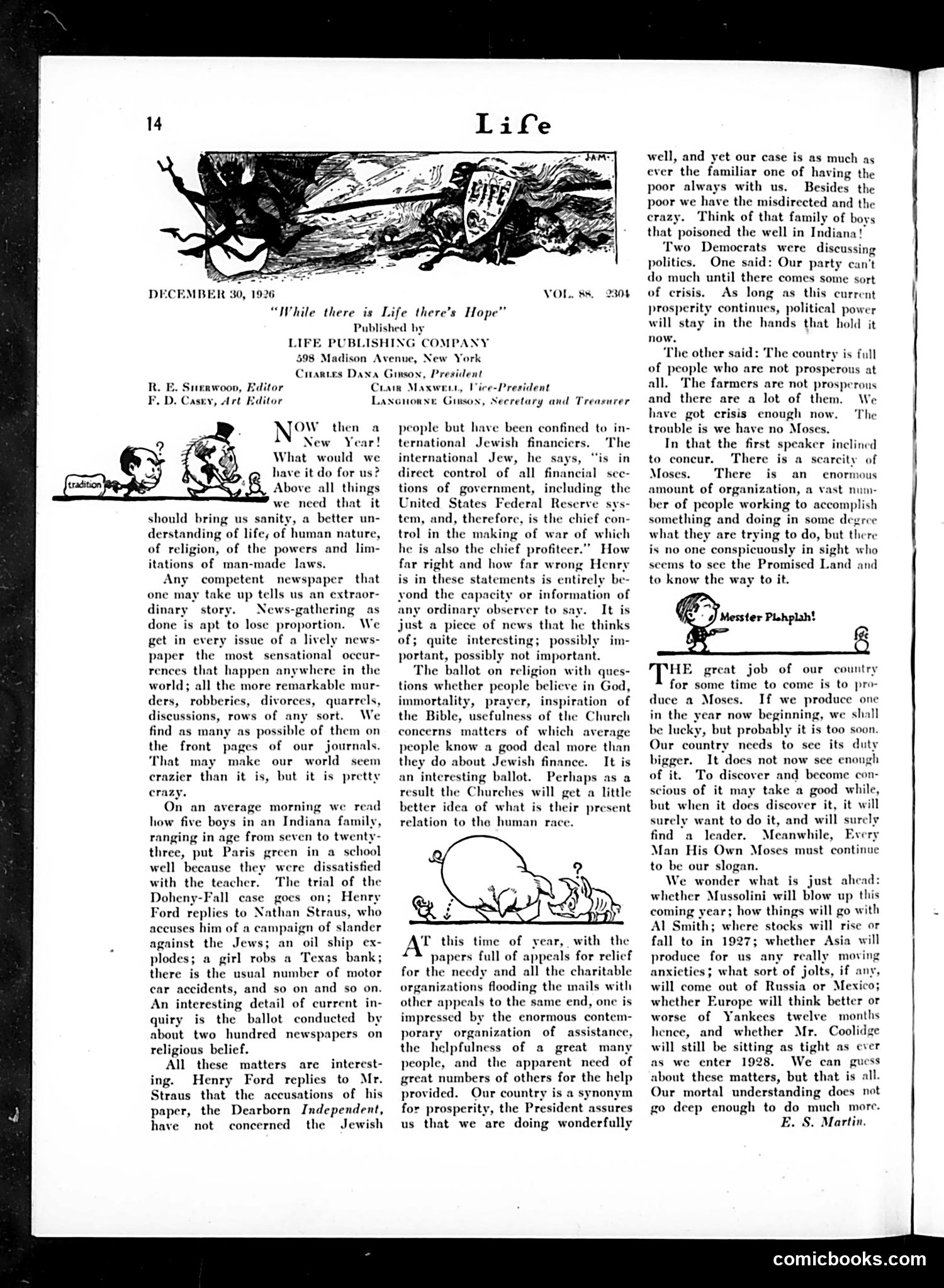
The page contains editorial commentary responding to Henry Ford's antisemitic statements. Ford had accused Jewish financiers of controlling governments and wars—a conspiracy theory the editor directly refutes as misinformation. The cartoon (top) depicts a poisoned well, illustrating how Ford's accusations contaminate public discourse. The imagery suggests his false claims spread like poison through society. The text mocks Ford's authority on financial matters, noting he lacks expertise to make such sweeping claims. The editor argues Ford conflates legitimate economic criticism with religious prejudice, and criticizes newspapers (like Ford's Dearborn Independent) for promoting these unfounded accusations. The piece uses satire to expose antisemitism as dangerous misinformation unworthy of serious consideration.
📄 Transcribed text from this page (OCR, searchable)
Machine-transcribed from the original scan — historical spelling and the odd misread are preserved.
VOL, 88, 2304 “While there is Life there’s Hope” Published by LIFE PUBLISHING COMPANY 598 Madison Avenue, New York Crartes Dana Ginsox, President R. E. Sierwoon, Editor F, D. Casey, Art Editor OW then a IN New Year! What would we have it do for us? Above all things we need that it should bring us sanity, a better un- derstanding of life, of human nature, of religion, of the powers and lim- itations of man-made laws. Any competent newspaper that one may take up tells us an extraor- dinary story. News-gathering as done is apt to lose proportion. We get in every issue of a lively news- paper the most sensational occur- rences that happen anywhere in the world; all the more remarkable mur- ders, robberi divorces, quarrels, discussions, rows of any sort. We find as many as possible of them on the front pages of our journals. That may our world seem crazier than it is, but it is pretty crazy. On an average morning we read how five boys in an Indiana fami ranging in age from seven to twenty- three, put Paris green in a school well because they were dissatisfied with the teacher. The trial of the Doheny-Fall case goes on; Henry Ford replies to Nathan Straus, who accuses him of a campaign of slander against the Jews; an oil ship ex- plodes; a girl robs a Texas bank; there is the usual number of motor car accidents, and so on and so on. An interesting detail of current in- quiry is the ballot conducted by about two hundred newspapers on religious belief. All these matters are interest- ing. Henry Ford replies to Mr. Straus that the accusations of his paper, the Dearborn Independent, have not concerned the Jewish Crate Maxwent, Laxcuonse Ginsox, Secretary and Treasurer Vice-President people but have been confined to in- The ternational Jewish financiers. international Jew, he s direct control of all fi tions of government, including the United States Federal Reserve sys- tem, and, therefore, is the chief con- trol in the making of war of which he is also the chief profiteer.” How far right and how far wrong Henry is in these statements is entirely be- yond the capacity or information of any ordinary observer to say. It is just a piece of news that he thinks of; quite interesting; possibly im- portant, possibly not important. The ballot on religion with ques- tions whether people believe in God, immortality, prayer, inspiration of the Bible, usefulness of the Church concerns matters of which average people know a good deal more than they do about Jewish finance. It is an interesting ballot. Perhaps as a result the Churches will get a little better idea of what is their present relation to the human race. this time of year, with the papers full of appeals for relicf for the needy and all the charitable organizations flooding the mails with other appeals to the same end, one is impressed by the enormous contem- porary organization of assistance, the helpfulness of a great many people, and the apparent need of great numbers of others for the help provided. Our country is a synonym for prosperity, the President assures us that we are doing wonderfully well, and yet our case is as much as ever the familiar one of having the poor always with us. Besides the poor we have the misdirected and the crazy. Think of that family of boys that poisoned the well in Indiar Two Democrats were discussing politics. One said: Our party can't do much until there comes some sort of crisis. As long as this current prosperity continues, political power will stay in the hands that hold it now. The other said: The country is full of people who are not prosperous at all. The farmers are not prosperous and there are a lot of them. We have got crisis enough now. The trouble is we have no Moses. In that the first speaker inclined to concur. There a scarcity of Moses. There is an enormous amount of organization, a vast num- ber of people working to accomplish something and doing in some degree what they are trying to do, but there is no one conspicuously in sight who scems to see the Promised Land and to know the way to it. HE great job of our country for some time to come is to pro- duce a Moses. If we produce one in the year now beginning, we shall be lucky, but probably it is too soon. Our country needs to see its duty bigger. It does not now see enough of it. To discover and become con- scious of it may take a good while, but when it does discover it, it will surely want to do it, and will surcly find a leader. Meanwhile, Every Man His Own Moses must continue to be our slogan. We wonder what is just ahead: whether Mussolini will blow up this coming year; how things will go with Al Smith; where stocks will rise or fall to in 1927; whether Asia will produce for us any really moving anxieties; what sort of jolts, if any, will come out of Russia or Mexico; whether Europe will think better or worse of Yankees twelve months hence, and whether Mr. Coolidge will still be sitting as tight as ever as we enter 1928. We can guess about these matters, but that is all. Our mortal understanding does not go deep enough to do much more. E. S. Martin. comicbooks.com