
A complete issue · 36 pages · 1926
Life — October 28, 1926
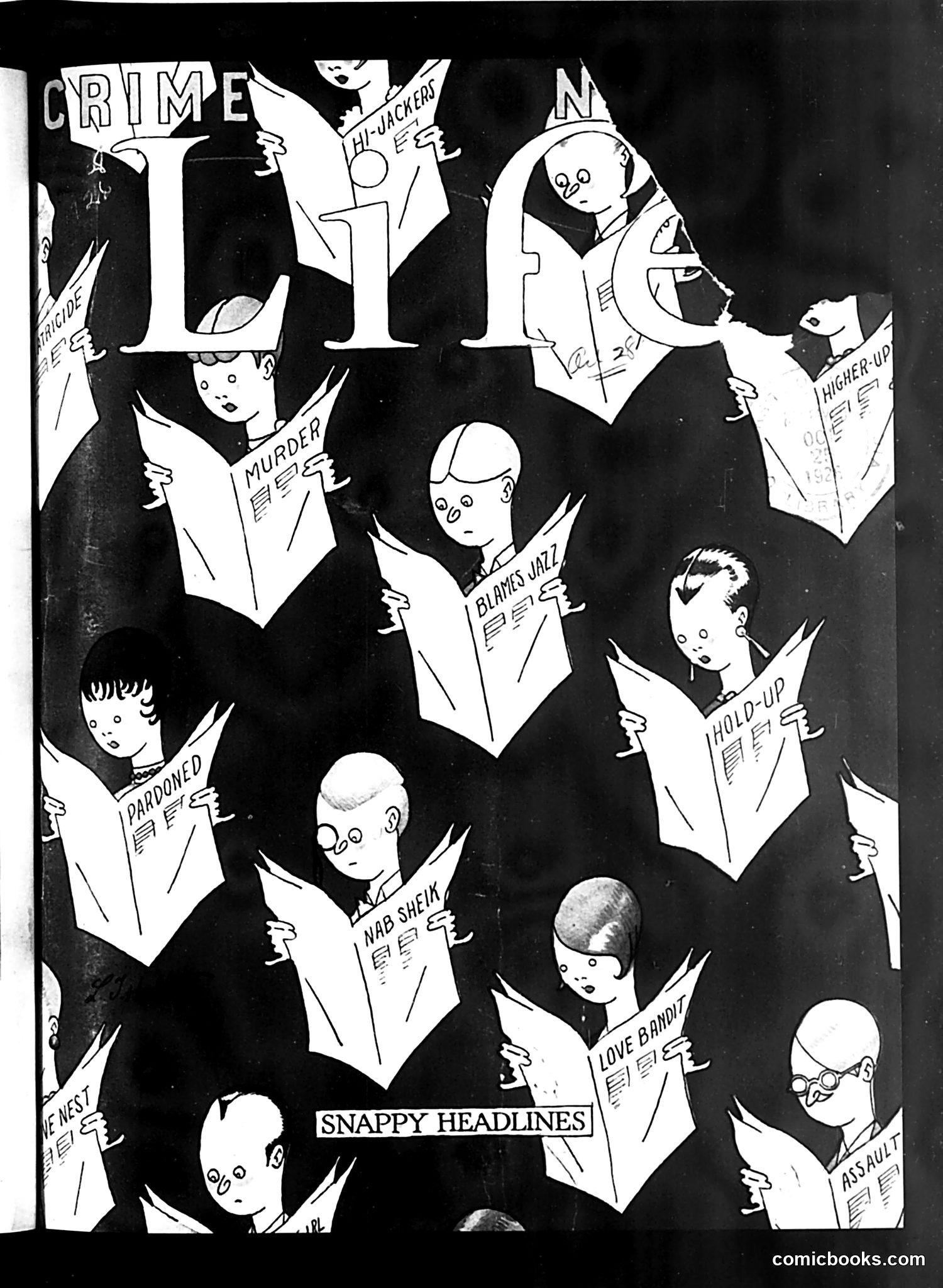
This page satirizes sensationalist newspaper journalism of the early 20th century. The large "LIFE" letters form a frame containing cartoon figures reading newspapers with exaggerated, lurid headlines: "CRIME," "HI-JACKER," "MURDER," "BLAMES JAZZ," "HOLD-UP," "NAB SHEIM," "LOVE BANDIT," "ASSAULT," and others partially visible. The satire mocks how newspapers exploited scandalous, violent, and moralistic stories to attract readers. The simple, wide-eyed cartoon faces suggest a gullible public eagerly consuming sensational crime reporting and jazz-age moral panic. The repetition emphasizes how pervasive and uniform such sensationalism had become in American journalism and popular culture during this period.
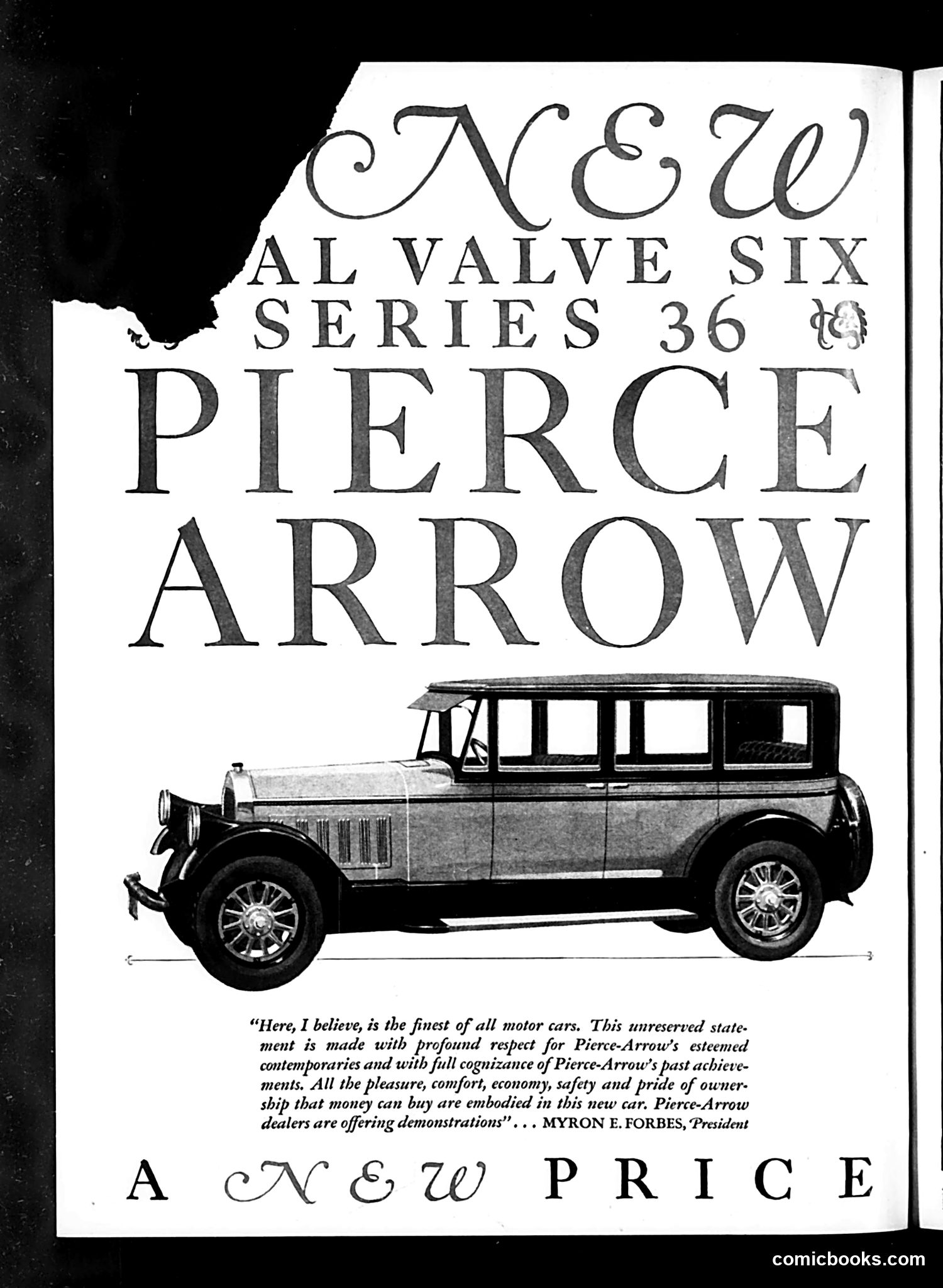
This is primarily **automobile advertising**, not satire or political content. It's a Pierce-Arrow car advertisement from what appears to be the 1920s era, featuring their "Six Series 36" model with a new price point. The page includes a quote from Myron E. Forbes (Pierce-Arrow's President) claiming this is "the finest of all motor cars," emphasizing qualities like pleasure, comfort, economy, safety, and pride of ownership. The statement aims to position Pierce-Arrow as a luxury vehicle competing with other high-end manufacturers of the period. The large illustration shows the automobile's side profile—a sedan-style touring car typical of 1920s design. This is commercial promotion, not editorial commentary or satire.
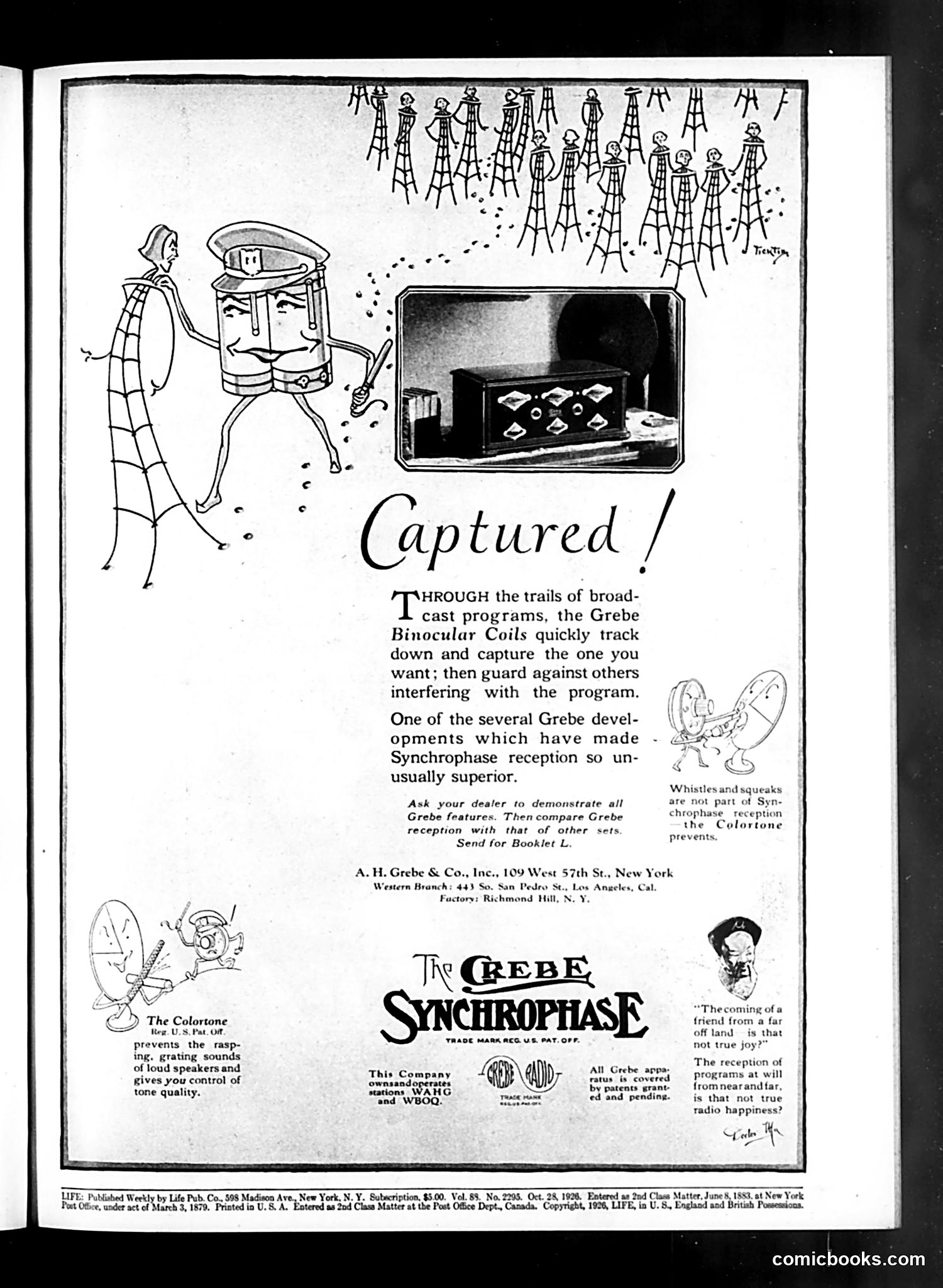
This is primarily a **radio receiver advertisement**, not political satire. The page promotes the Grebe Synchronase radio set, manufactured by A.H. Grebe & Co., Inc. The cartoon uses playful metaphors: soldiers on stilts (top) represent radio broadcast signals being "captured" by the Grebe's binocular coils. The anthropomorphic radio character with a military uniform humorously depicts the device as "capturing" programs from the airwaves while preventing interference. Supporting features highlighted include the Colortone (preventing speaker distortion) and mentions that competitors' radios produce unwanted whistles and squeaks—problems the Synchronase claims to solve. This reflects early 1920s radio technology marketing, when radio reception was still novel and needed explanation through visual metaphor for consumers unfamiliar with wireless technology.
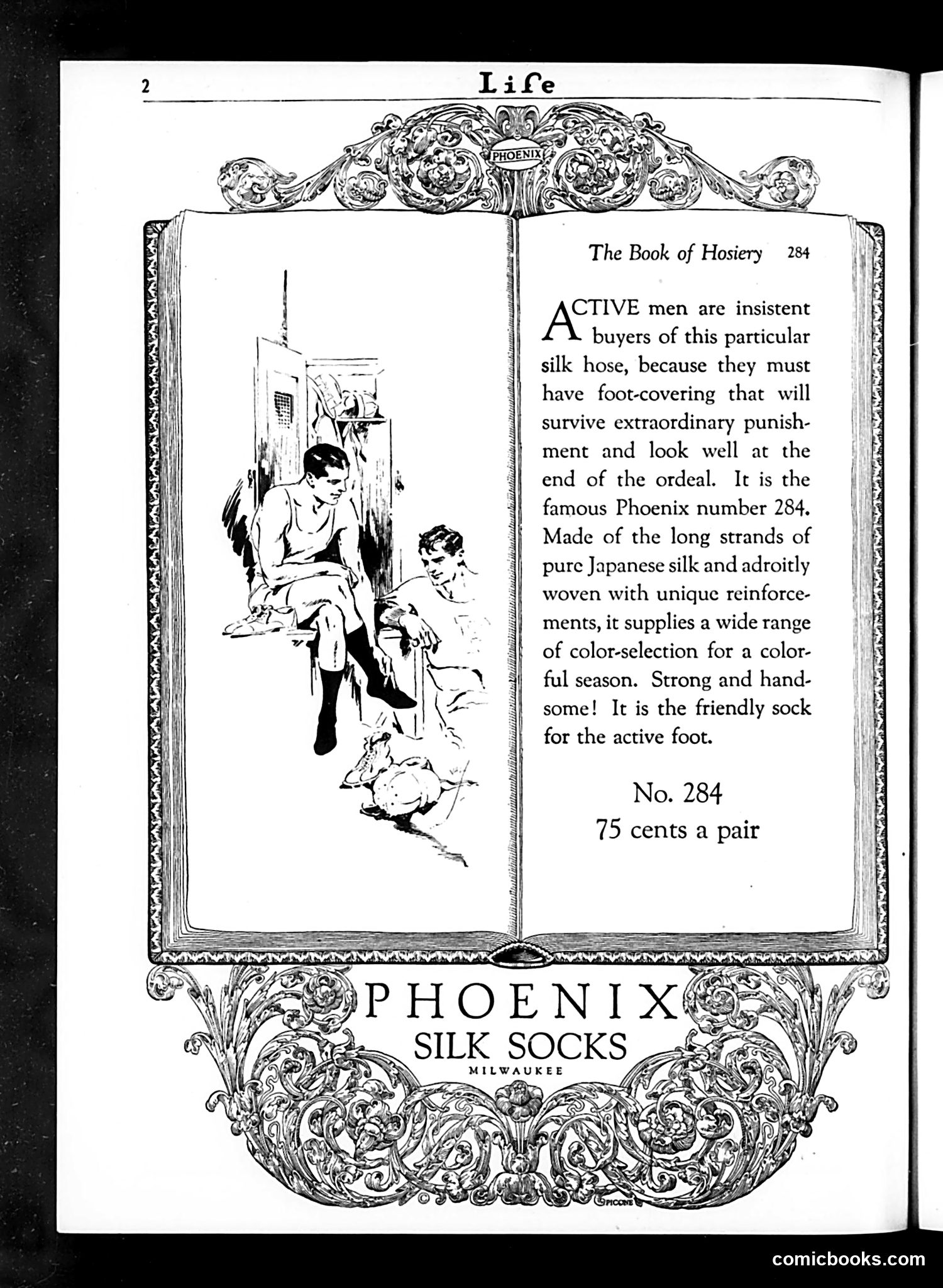
This is primarily an **advertisement**, not satire or editorial content. It's a full-page ad for Phoenix Silk Socks (No. 284) manufactured in Milwaukee, costing 75 cents per pair. The illustration depicts an active man (possibly a laborer or athlete) in motion with children, emphasizing durability and practicality. The text targets "active men" who need hosiery that can withstand "extraordinary punishment" while remaining aesthetically pleasing. There is **no political satire or cartoon** on this page. The ornate decorative borders and "Life" magazine branding are standard period design elements. The content is straightforward product marketing aimed at working or athletic men, highlighting the socks' Japanese silk construction and reinforced weaving as selling points.
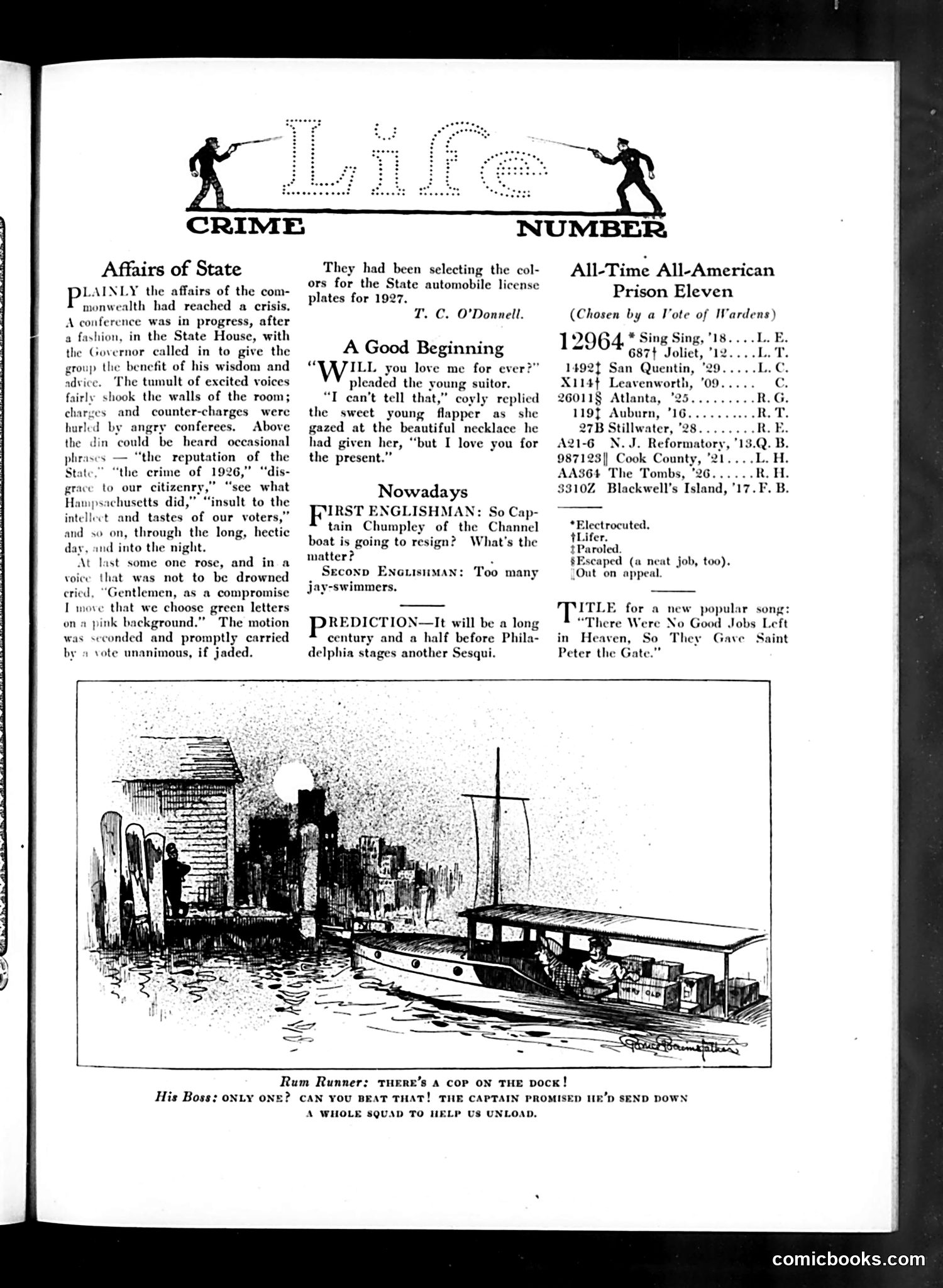
This page satirizes Prohibition-era crime and prison conditions. The "Crime Number" header frames the content as commentary on contemporary criminal justice. The main cartoon depicts a rum-running operation at a dock. A "Rum Runner" warns his boss that "there's a cop on the dock," with the boss dismissively responding that the captain promised to send "a whole squad to help us unload"—satirizing widespread police corruption during Prohibition. The joke suggests police were routinely bribed to assist bootleggers. The "All-Time All-American Prison Eleven" list is darkly humorous, presenting famous criminals as if selecting a sports team, with footnotes indicating executions, paroles, and escapes. This mocks both celebrity criminal status and prison conditions during this period.
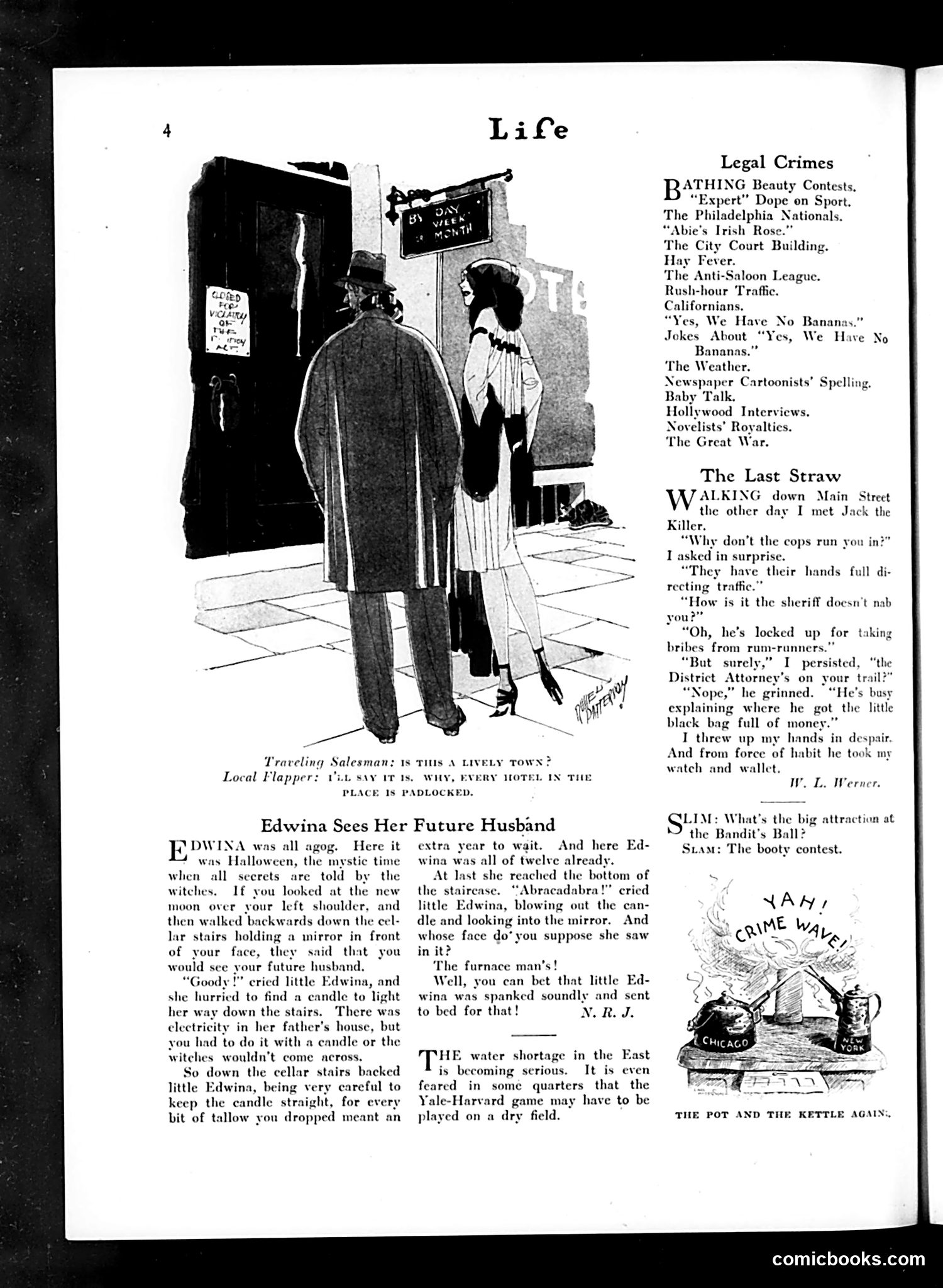
This page contains three distinct pieces of satirical content: **"Traveling Salesman"** (top): A cartoon joke mocking the ubiquitous "traveling salesman" humor genre popular in early 20th-century magazines. The caption jokes that every hotel in town is "padlocked," playing on the salesman's reputation for romantic conquests. **"Edwina Sees Her Future Husband"** (middle): A Halloween-themed story about a girl using mirror divination to glimpse her future spouse—a common folk superstition. The story's twist reveals the "future husband" is actually the furnace man, offering class-based humor common to the era. **"The Pot and the Kettle Again"** (bottom right): A small cartoon referencing the proverb, likely commenting on crime or hypocrisy between cities (Chicago and New York visible). The page reflects 1920s popular culture preoccupations: working-class humor, supernatural folklore, and urban satire.
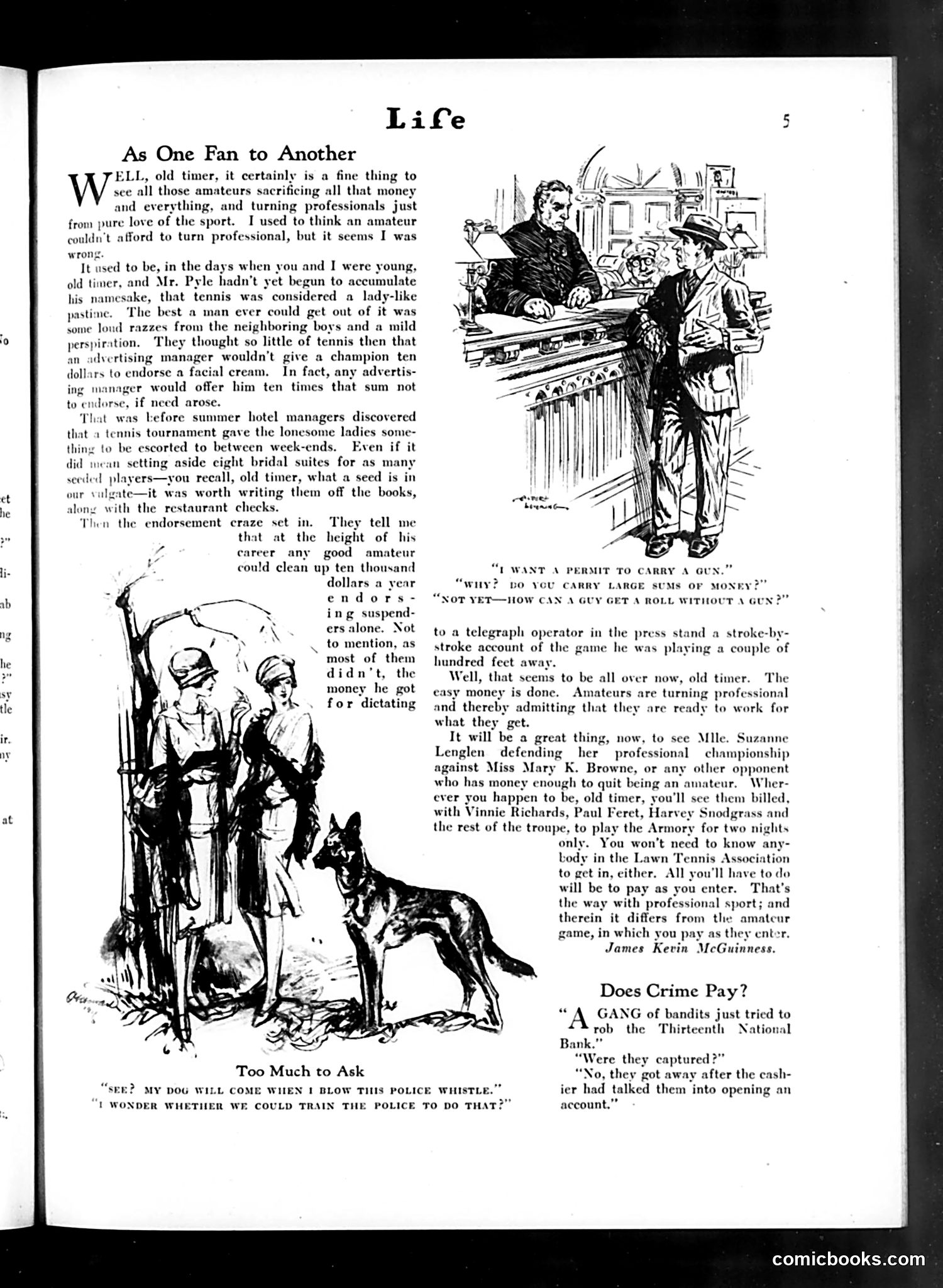
This page contains a humorous essay by James Kewin McGuinness discussing amateur versus professional tennis. The author argues that amateurs can now turn professional without shame, citing how wealthy society ladies once sponsored amateur tournaments for prestige and endorsements—though advertisers nominally avoided direct payment. The accompanying cartoons illustrate related social commentary: "Too Much to Ask" depicts someone trying to train a dog with a police whistle, humorously questioning authority's usefulness. The other cartoon shows what appears to be a betting or gambling scene related to sports, suggesting the casual financial stakes involved in amateur athletics. The piece reflects early 20th-century attitudes about amateurism, class, and the blurred lines between amateur and professional sports.
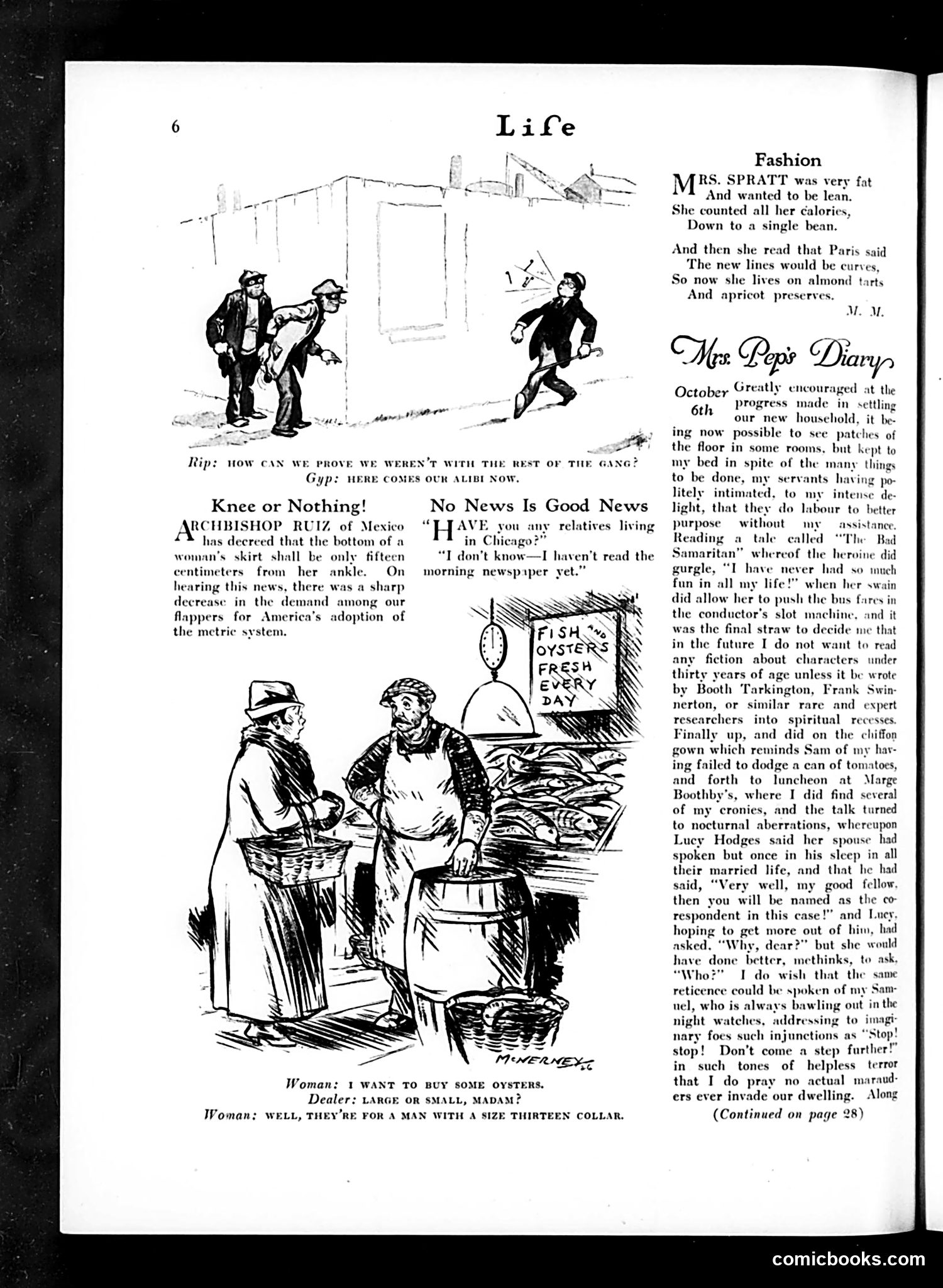
This page contains two satirical pieces about everyday urban life, likely from the early 20th century. **"Knee or Nothing!"** mocks the adoption of the metric system in America. The cartoon shows an oyster vendor and customer, with dialogue about oyster sizes. The satire suggests resistance to metric measurements—the dealer offers sizes by collar measurement instead of metric units, poking fun at Americans' reluctance to abandon traditional measurement systems. **"No News Is Good News"** presents a domestic humor piece about a woman reading sensationalist fiction and becoming increasingly paranoid about intruders and crime. The satire targets both pulp literature's exaggerated danger narratives and the anxieties they created in readers. The **Fashion** section parodies diet trends and Paris fashion trends.
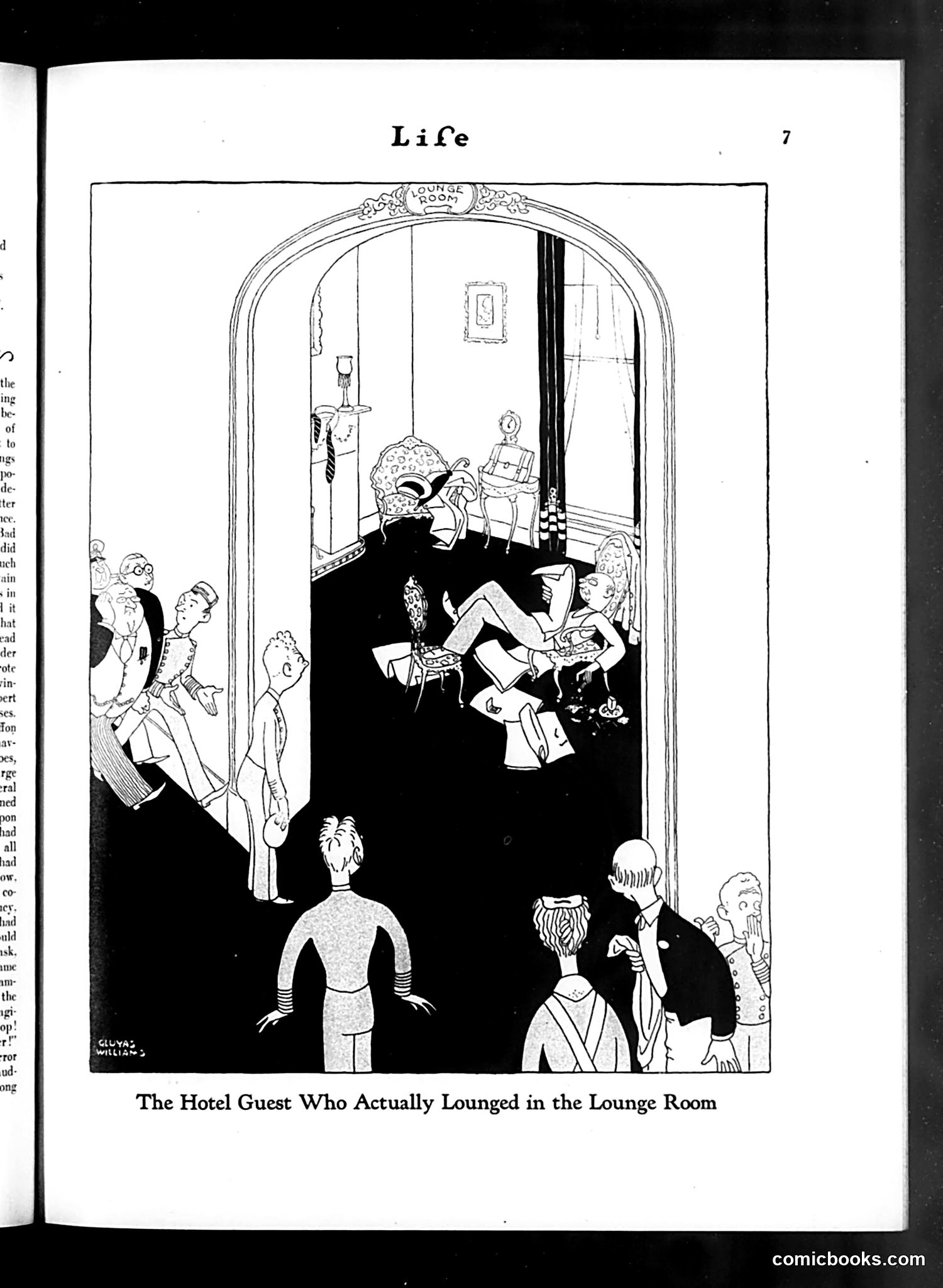
This is a single-panel satirical cartoon titled "The Hotel Guest Who Actually Lounged in the Lounge Room." The image shows a humorous social observation: while most hotel guests (seen outside the lounge peering in) never use the decorative lounge room despite its elegant furnishings and inviting atmosphere, one unusual guest is actually relaxing there—reclining on furniture with drinks and entertainment. The satire targets both hotels and human behavior: it mocks hotels for maintaining expensive, ornate "lounge rooms" that guests typically avoid in favor of their private rooms, and it humorously comments on the paradox of amenities that exist primarily for show rather than actual use. The cartoon celebrates the rare individual who actually takes advantage of the provided space.
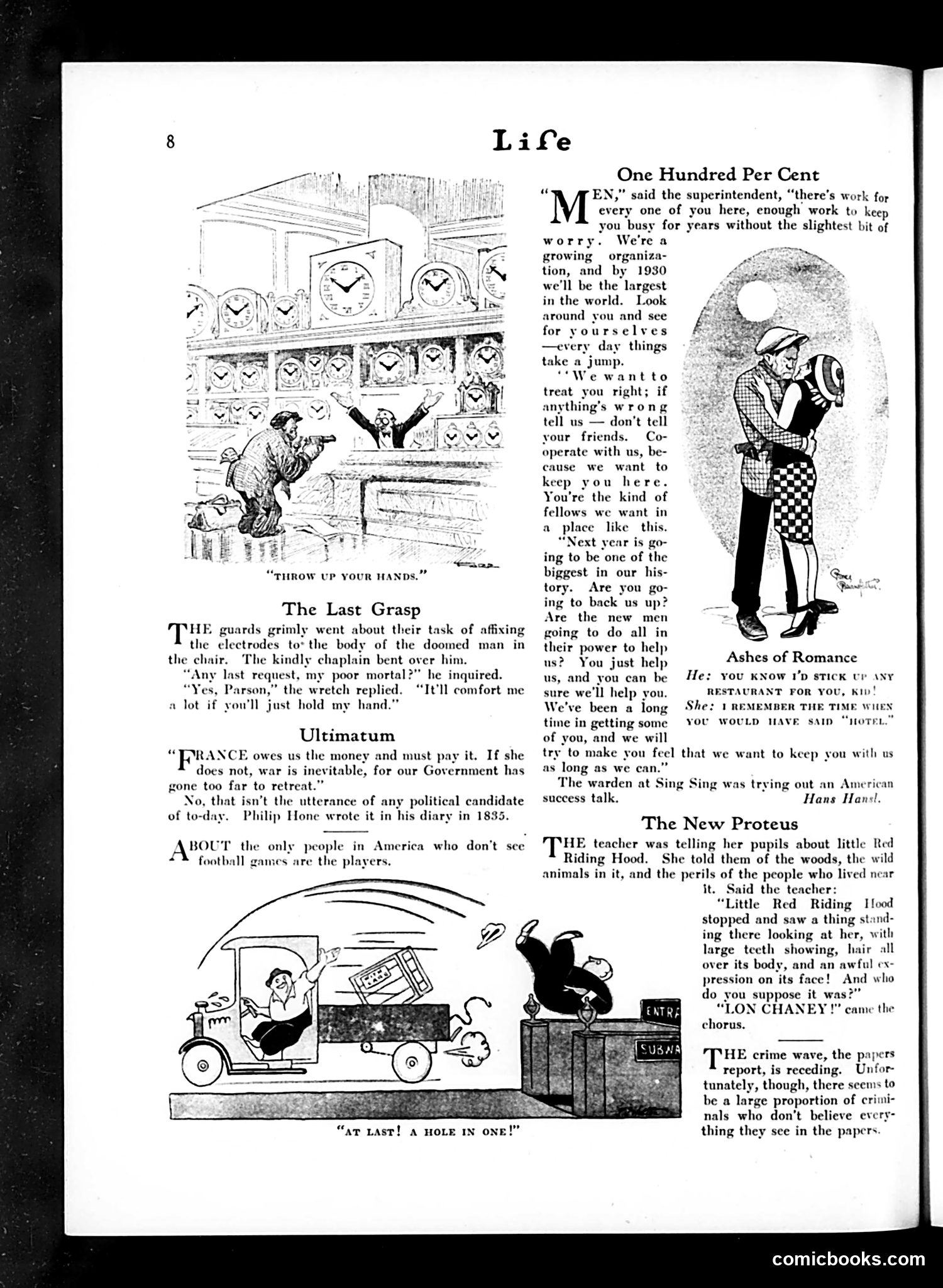
This page contains four separate satirical pieces: 1. **"The Last Grasp"**: A condemned man requests comfort from a chaplain before execution, asking for his hand—dark humor about capital punishment. 2. **"One Hundred Per Cent"**: A superintendent addresses factory workers, promising job security and growth if they remain loyal and don't complain publicly. This satirizes early 20th-century corporate paternalism and the suppression of labor organizing. 3. **"Ultimatum"**: A brief political quote about France's war debt, likely referencing post-WWI reparations disputes. 4. **"At Last! A Hole in One"**: A cartoon mocking Americans' obsession with golf, showing a golfer celebrating while traffic chaos erupts—commentary on the sport's popularity during the 1920s. 5. **"The New Proteus" and "Ashes of Romance"**: Brief humor pieces about children's stories and romantic disappointment.
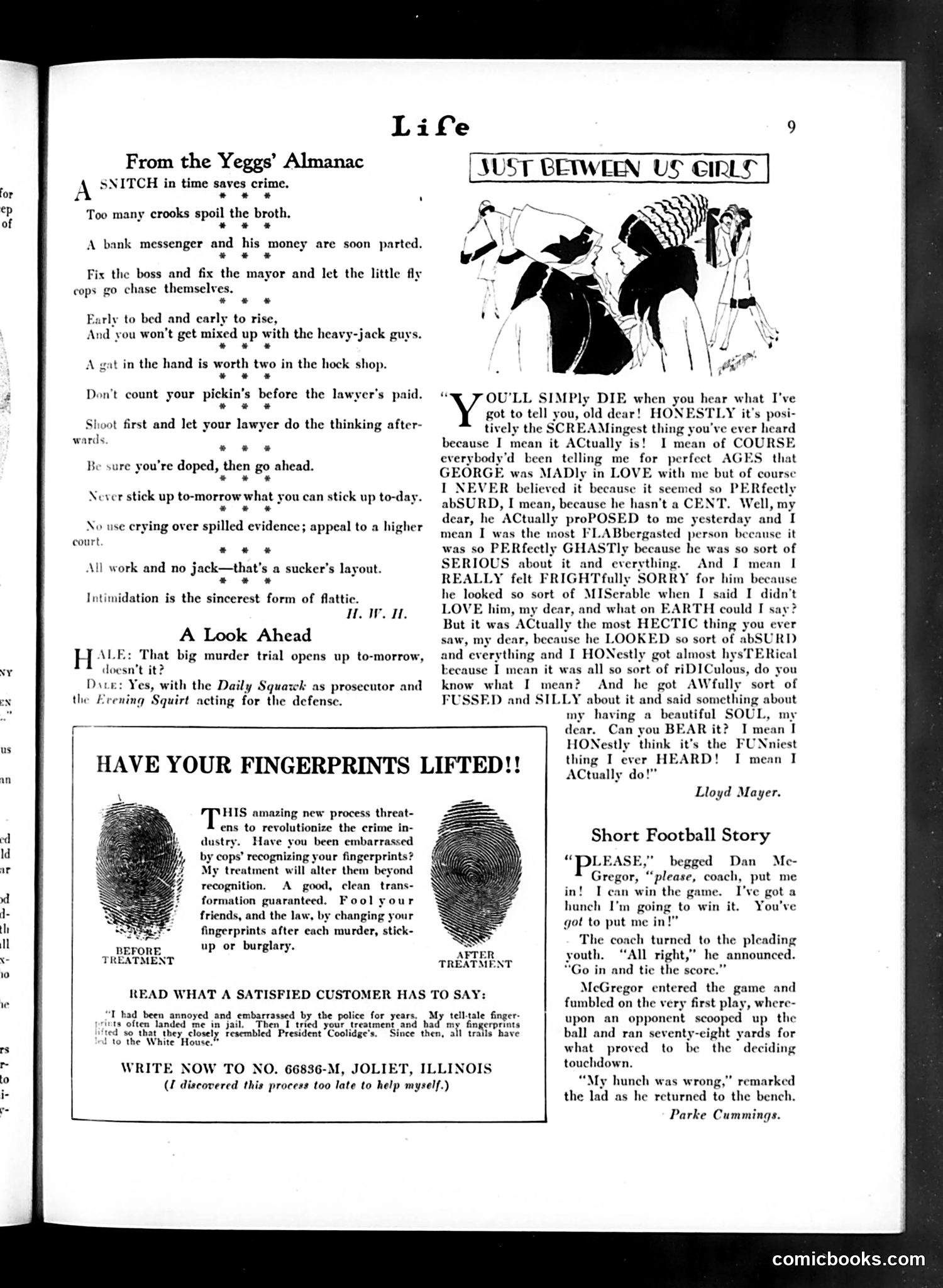
This page contains **"Must Between Us Girls,"** a humorous column where a woman describes her exaggerated romantic disappointment with someone named George. The satire mocks excessive emotional drama and overwrought language—she uses all-caps words like "HONESTLY," "HECTIC," and "FUSSED" to describe his minor flaws (being "ghastly serious" and miserable-looking). The central advertisement promotes **fingerprint-lifting services** to help people embarrassed by police involvement, presenting it as crime prevention. This appears to be satirical commentary on emerging forensic technology. The page also includes "A Look Ahead" (previewing a murder trial in newspapers) and "Short Football Story," a brief anecdote mocking a football player's excuse about his lunch affecting performance. The humor targets melodrama, forensic novelty, and sports clichés.
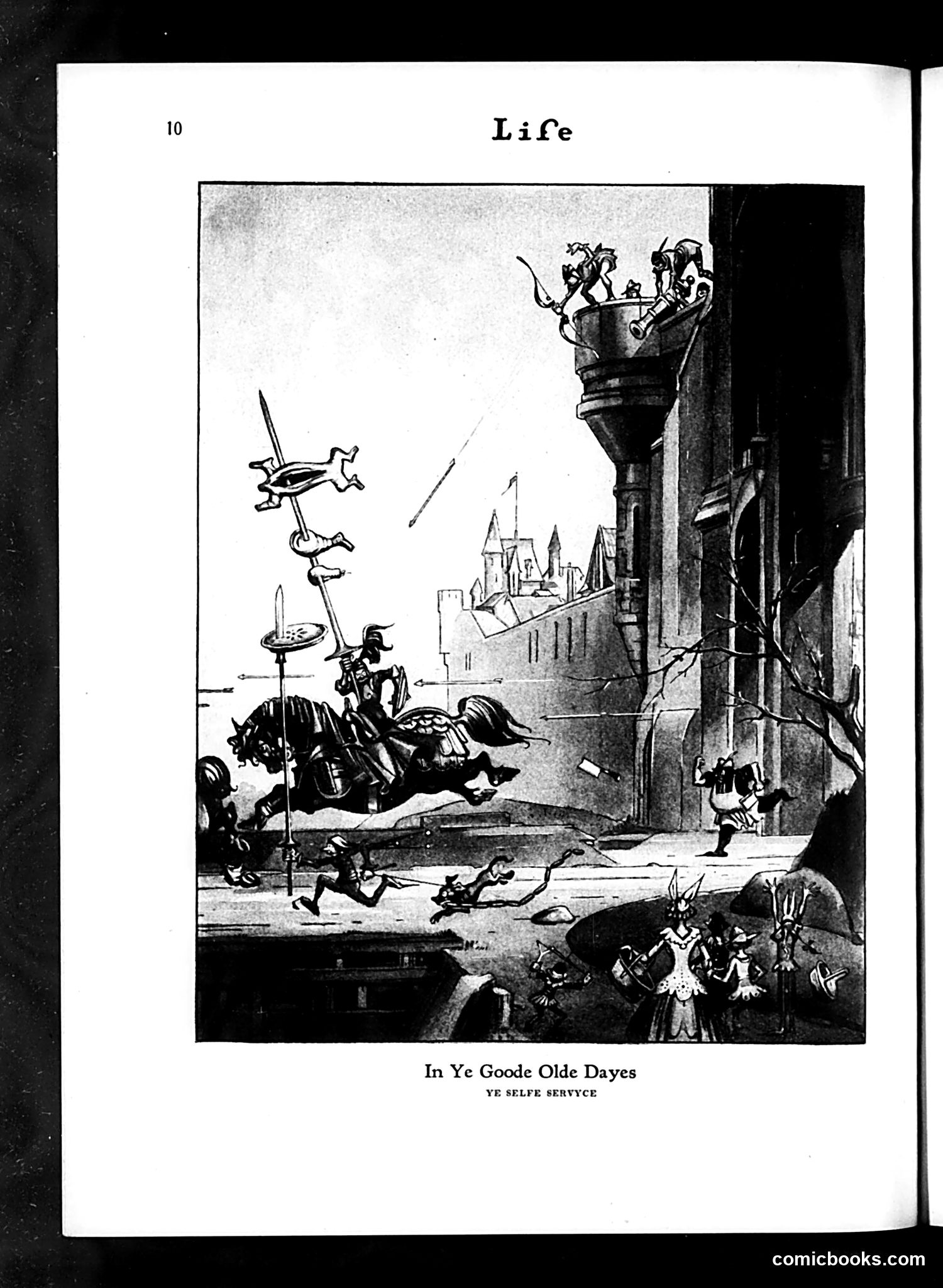
This satirical illustration depicts a medieval town scene where chaos erupts around a mounted knight. The caption's subtitle "Ye Selfe Servyce" (self-service) suggests the satire targets modern self-service practices by ironically showing their supposed historical precedent. The scene shows armed figures, demons or devils, and running people in a medieval setting with castle walls. The joke appears to be that "self-service" in medieval times meant literally taking what you wanted by force—the knight on horseback and armed figures represent violent self-appropriation rather than the orderly modern retail concept. This likely mocks contemporary American self-service stores (emerging in the early 20th century) by humorously suggesting such individualistic, unregulated commerce is barbaric or lawless.
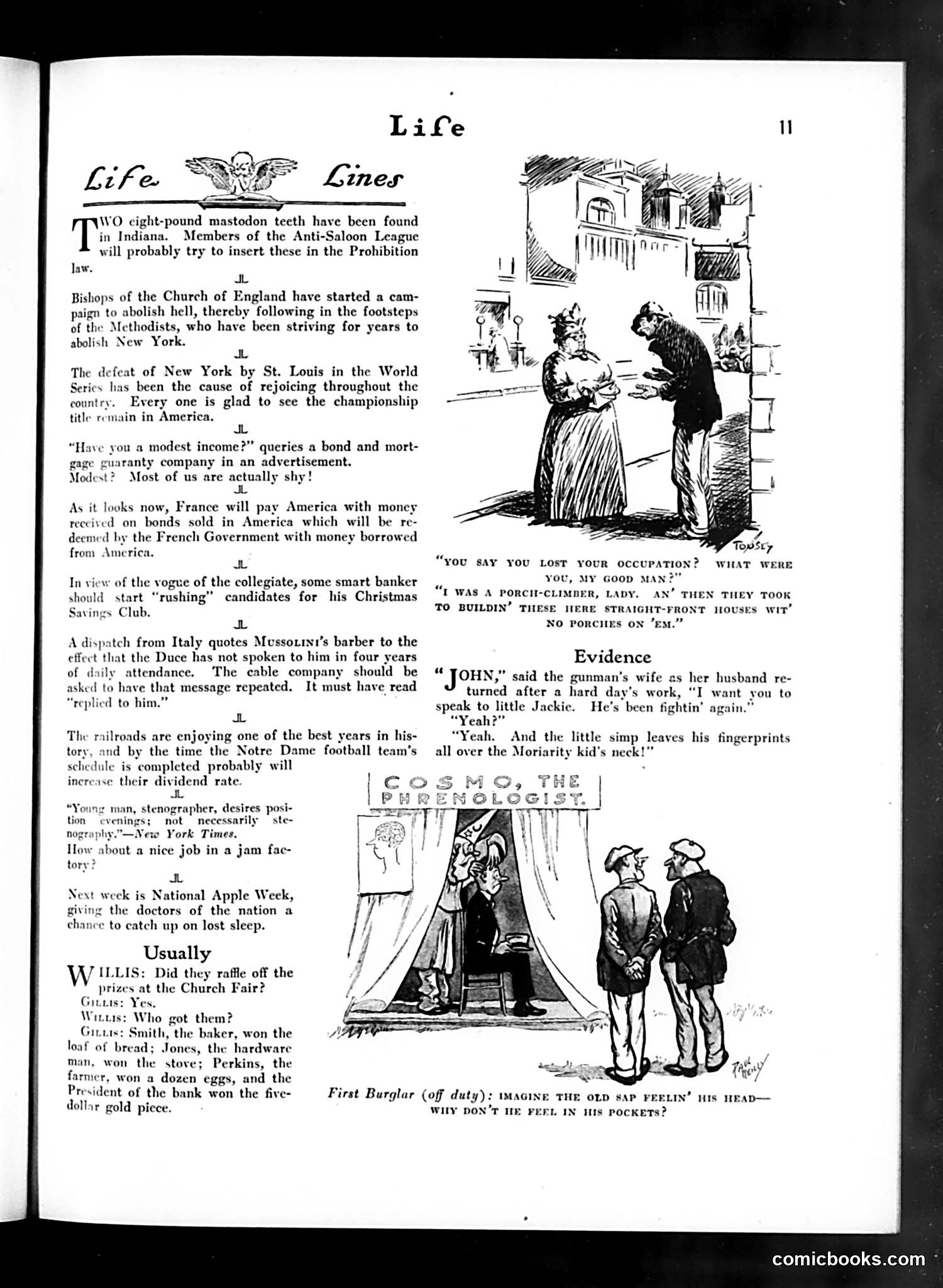
This page contains satirical "Life Lines" (short jokes) and two cartoons commenting on American social life, likely from the 1920s era. The top cartoon depicts a woman questioning a man about his lost occupation, claiming he was "a porch-climber" before they built "straight-front houses" without porches—a reference to burglary, sarcastically blaming architectural change for unemployment. The lower cartoon titled "Evidence" shows a gunman's wife suspicious her husband is "fightin' again" because their child has fingerprints on his neck, implying domestic violence in criminal circles. The "Cosmo, the Dareologist" panel jokes about a magician's act involving an escape from a predicament. Overall, the page satirizes poverty, crime, unemployment, and domestic dysfunction through dark humor typical of interwar American comedy.
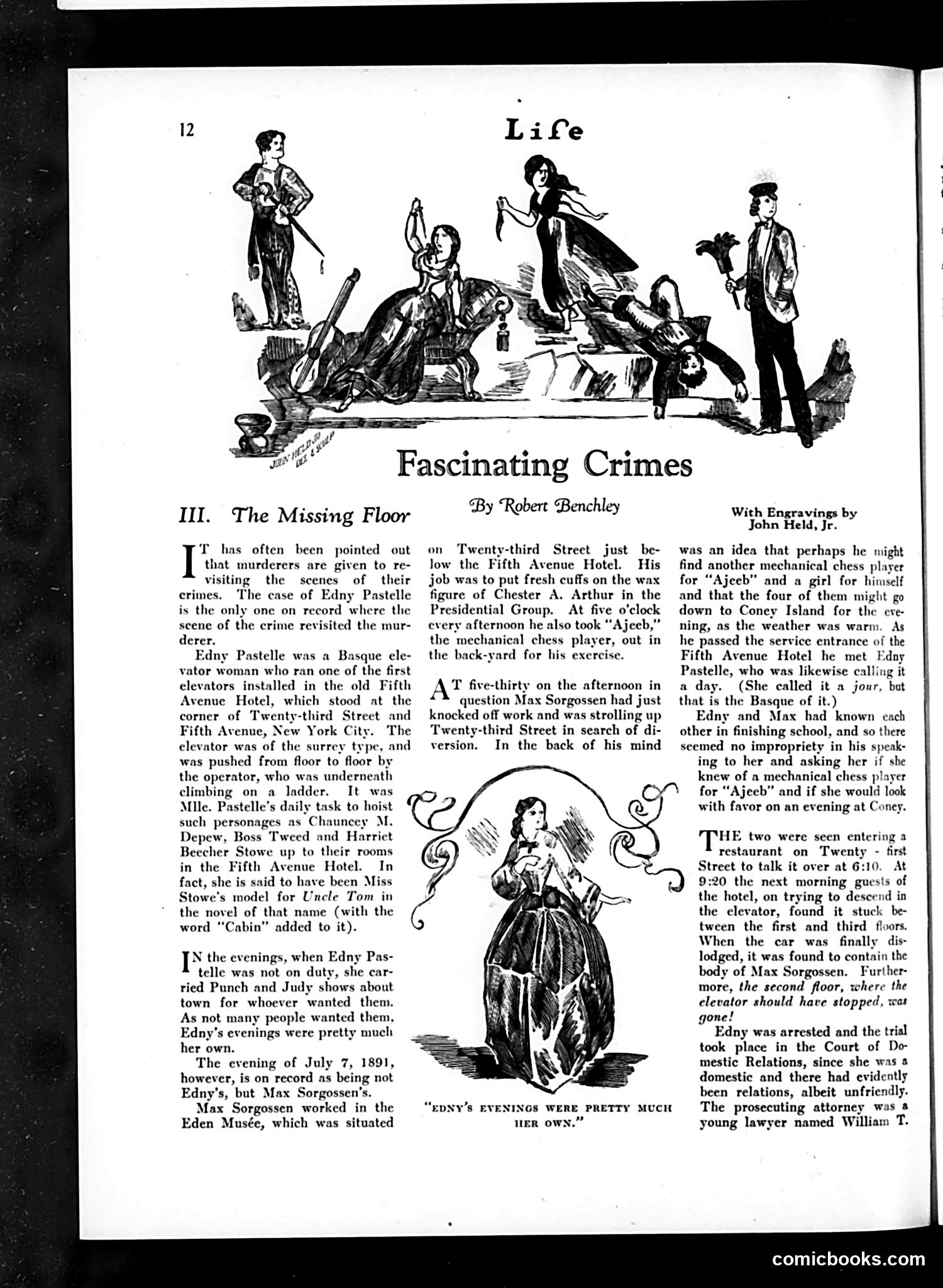
This page presents "Fascinating Crimes," a serialized true crime story by Robert Benchley about the Edny Pastelle case. The illustration shows a woman in period dress (appearing to be late 1800s). The narrative describes a murder mystery involving Edny Pastelle, a Basque elevator operator at the Fifth Avenue Hotel in New York City. Max Sorgossen was found dead in an elevator stuck between the first and third floors—mysteriously skipping the second floor entirely. The body suggests foul play occurred during the elevator's operation. The story emphasizes the sensational aspects typical of crime journalism of that era: detailed victim descriptions, suspicious circumstances, and the subsequent trial. This appears designed to entertain readers with dark, real-world criminal cases presented as dramatic narrative.
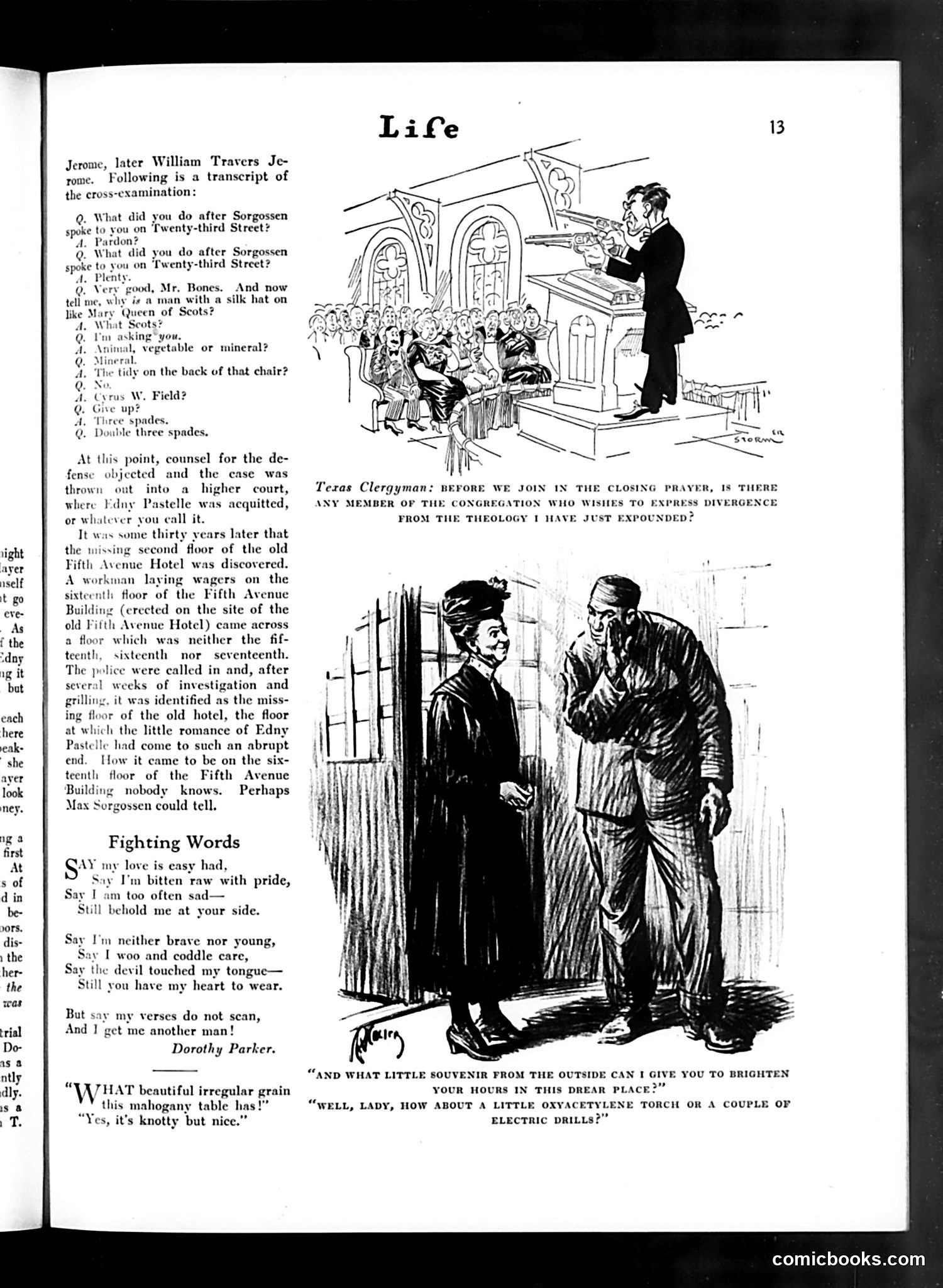
The top cartoon depicts a Texas clergyman posing a provocative theological question to his congregation during closing prayer, asking if anyone wishes to "express divergence from the theology I have just expounded." The satire mocks authoritarian religious leadership that demands conformity while pretending to invite dissent. The bottom illustration shows a man and woman in what appears to be a tenement or modest dwelling. The man offers the woman "a little oxyacetylene torch or a couple of electric drills" as souvenirs from "outside" to brighten her dreary living conditions. The joke satirizes poverty and the absurdity of offering working-class people industrial tools as gifts to improve their bleak circumstances—highlighting class disparities and tone-deaf charity.
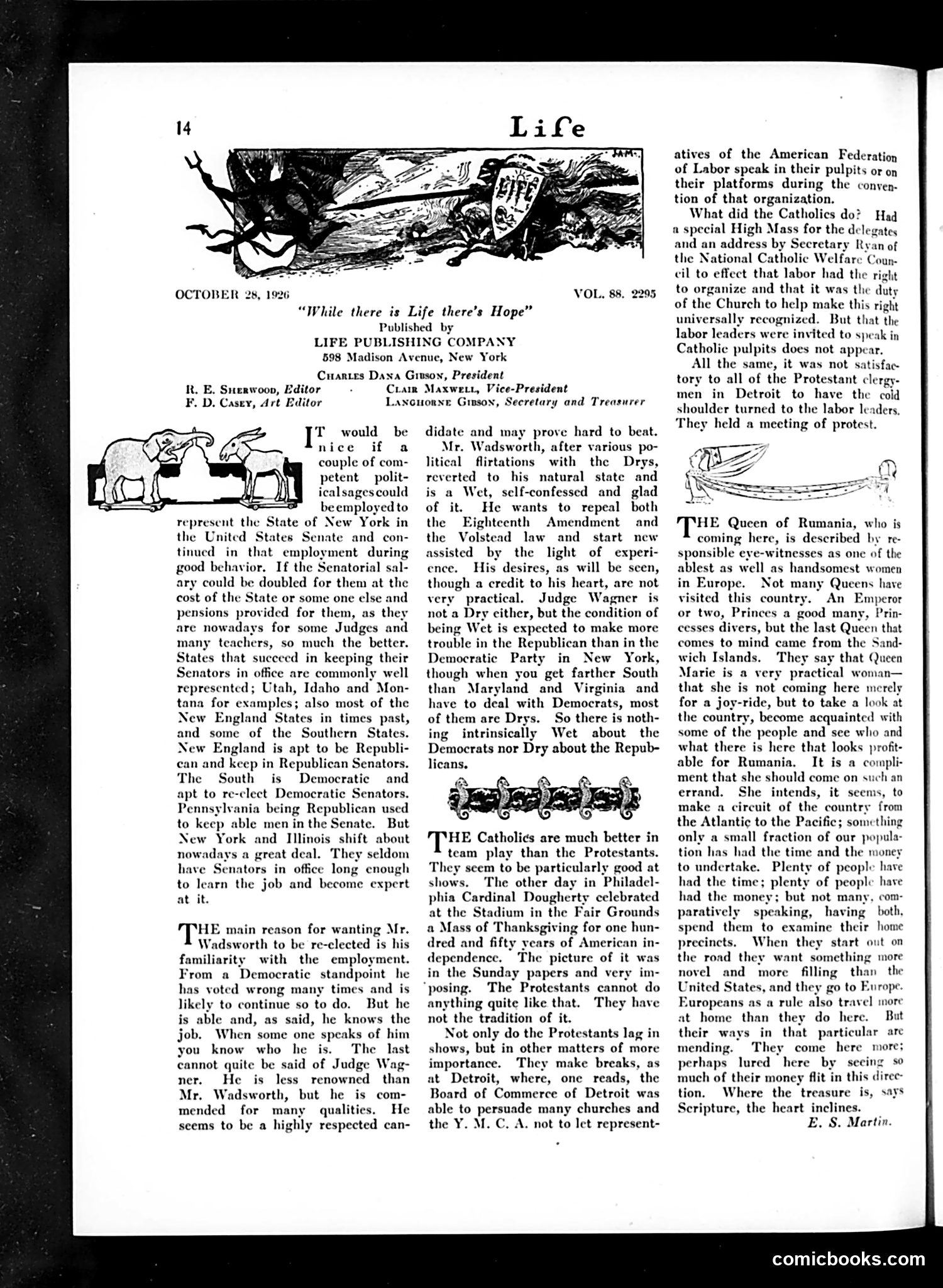
The page's main cartoon depicts two elephants labeled to represent the State of New York in the U.S. Senate, illustrating a satirical point about senatorial representation. The accompanying editorial text critiques Mr. Wadsworth—apparently a politician being considered for Senate—for his inconsistency: he's been a "Wet" (opposing Prohibition) but wants to repeal both the Eighteenth Amendment and Volstead law, then restart "assisted by the light of experience." The satire suggests Wadsworth's flip-flopping positions lack credibility. The article notes Republicans generally keep Senate seats longer and become experts, contrasting this with Democratic vulnerability in certain regions. The page also discusses Catholic versus Protestant organizational efforts, and includes a note about Romania's Queen visiting America—largely unrelated social commentary typical of Life's mixed-content format.
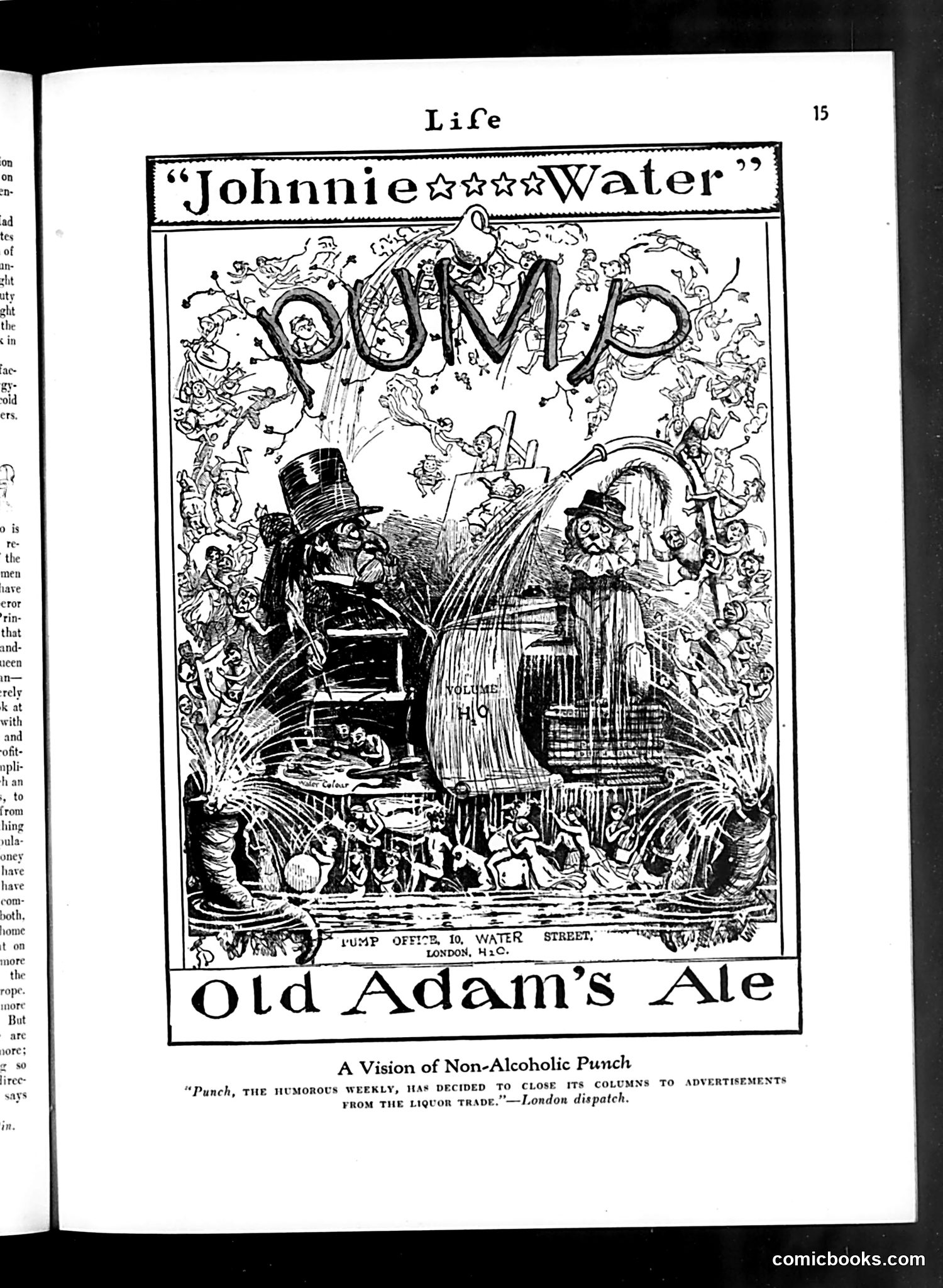
This is a satirical advertisement mockery from Life magazine. The headline plays on "Johnnie Walker" (the famous whisky brand) by substituting "Water," while the lower text promises "Old Adam's Ale"—a humorous period term for plain water. The central illustration shows two caricatured figures in top hats dispensing water in exaggerated abundance, surrounded by chaotic crowds. This satirizes the temperance movement's push against alcohol consumption. The caption notes that Punch magazine (a competitor humor publication) has "decided to close its columns to advertisements from the liquor trade," which Life mocks here. The joke suggests that if alcohol advertising were banned, only water advertisements would remain—presenting temperance advocates' vision as absurd.
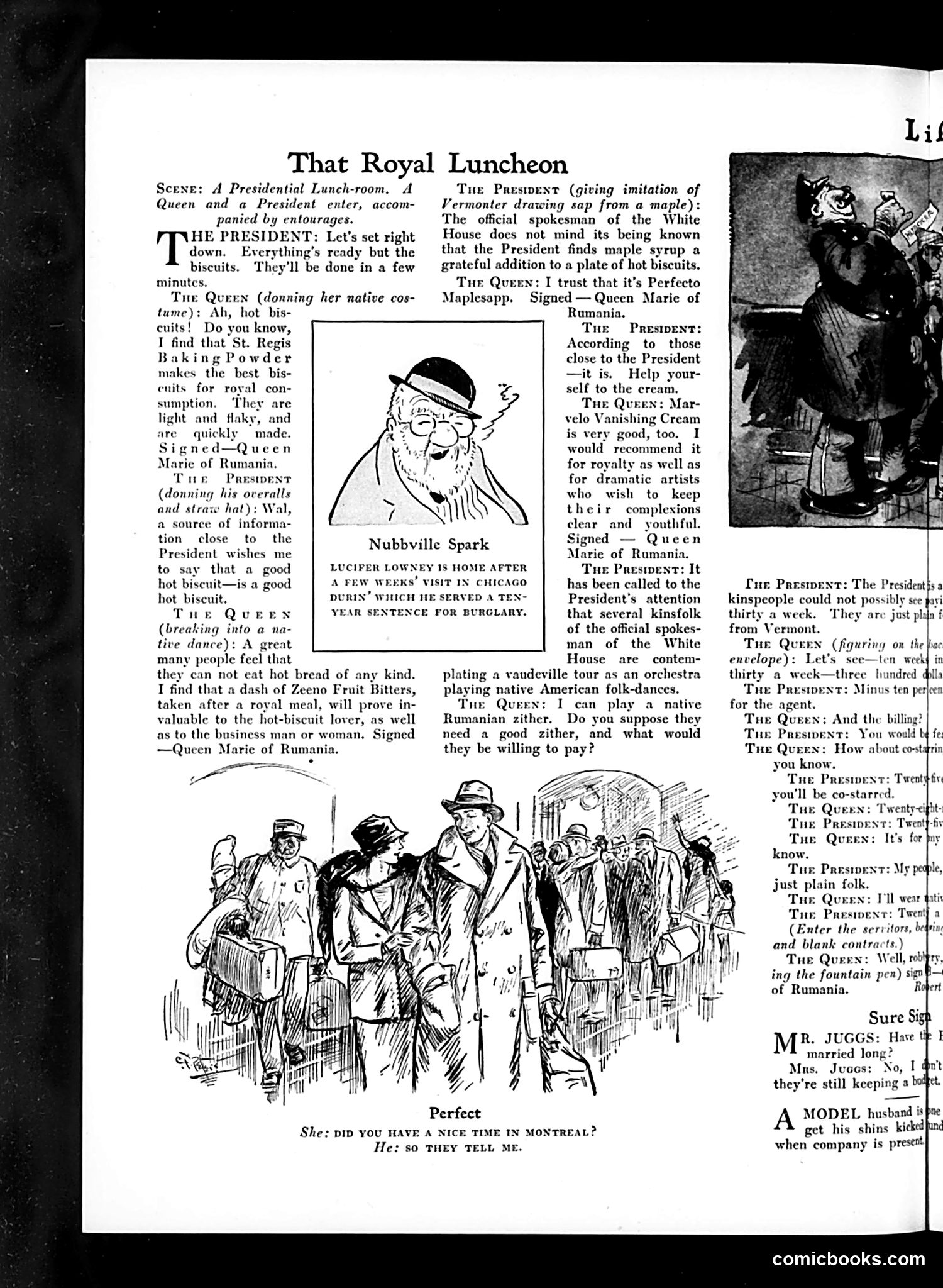
This page satirizes a formal White House luncheon between the U.S. President and visiting royalty (identified as the Queen of Rumania through signatures). The main cartoon depicts the President and Queen exchanging pleasantries about food, beauty products, and cultural differences—the dialogue reveals the awkwardness of diplomatic small talk. The central figure "Nubbville Spark" appears to be a caricatured servant or official involved in the event. The satire mocks the artificiality of formal state dinners: both hosts strain to find conversation, discuss trivial matters (maple syrup, cosmetics, zithers), and pretend interest they don't feel. The lower illustration shows crowds witnessing this "Perfect" but stilted diplomatic encounter, labeled "She: DID YOU HAVE A NICE TIME IN MONTREAL? / He: SO THEY TELL ME"—suggesting participants merely repeat what others have told them rather than having genuine experiences.
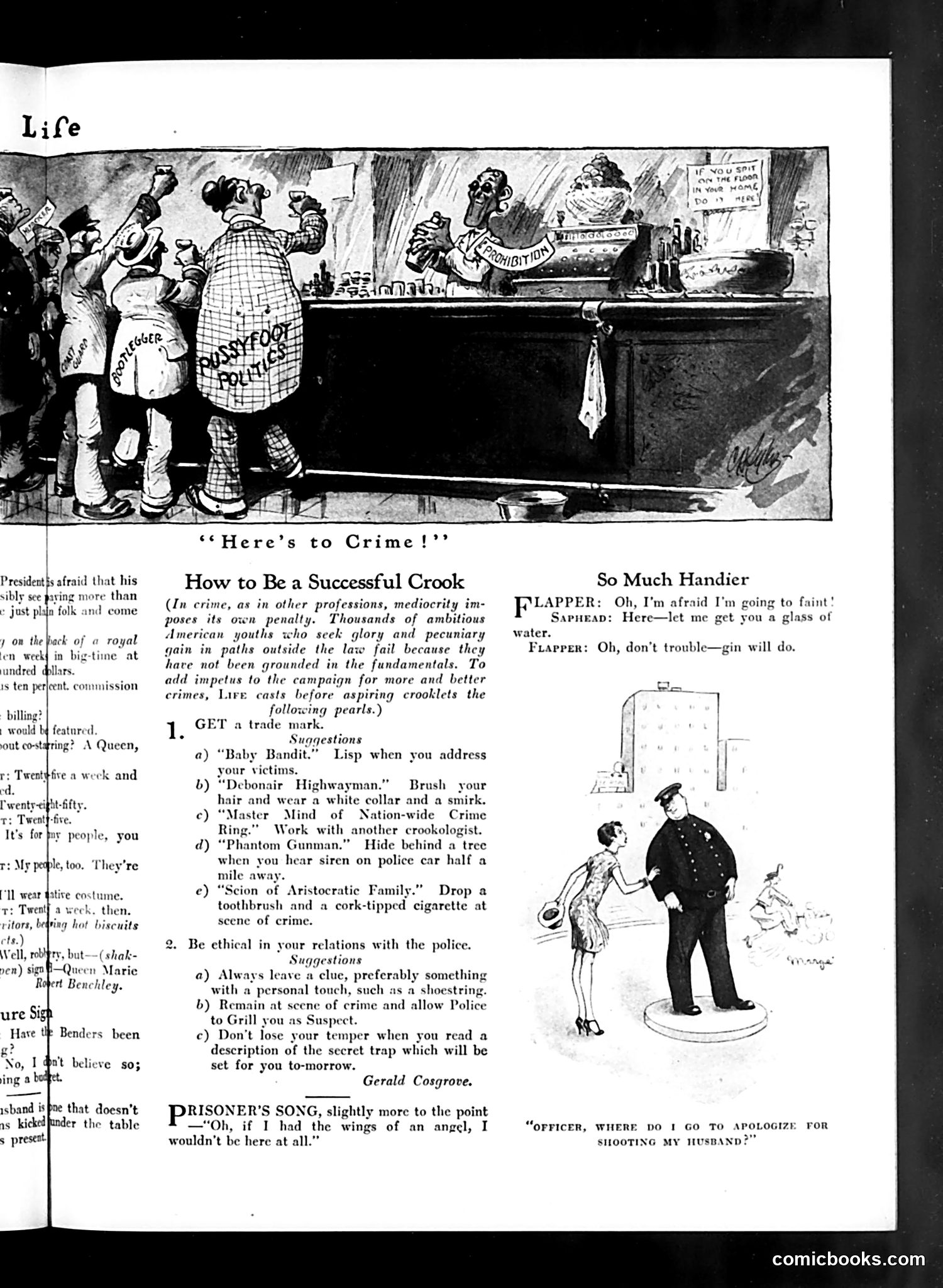
The top cartoon titled "Here's to Crime!" satirizes Prohibition-era corruption. It depicts a bartender serving drinks at what appears to be an illegal speakeasy, with patrons labeled "Bootlegger," "Polly Food" (likely "Policy"), and others. The sign reads "Prohibition," mocking how the law created criminal enterprises rather than eliminating drinking. Below, "How to Be a Successful Crook" by Gerald Cosgrove offers tongue-in-cheek advice on committing crimes—adopting nicknames like "Baby Bandit" and "Master Mind of Nation-wide Crime Ring"—satirizing organized crime's prevalence during Prohibition. The smaller cartoon "So Much Handier" shows a woman faint at news, with caption "Officer, where do I go to apologize for shooting my husband?"—darkly joking about domestic violence and legal impunity.
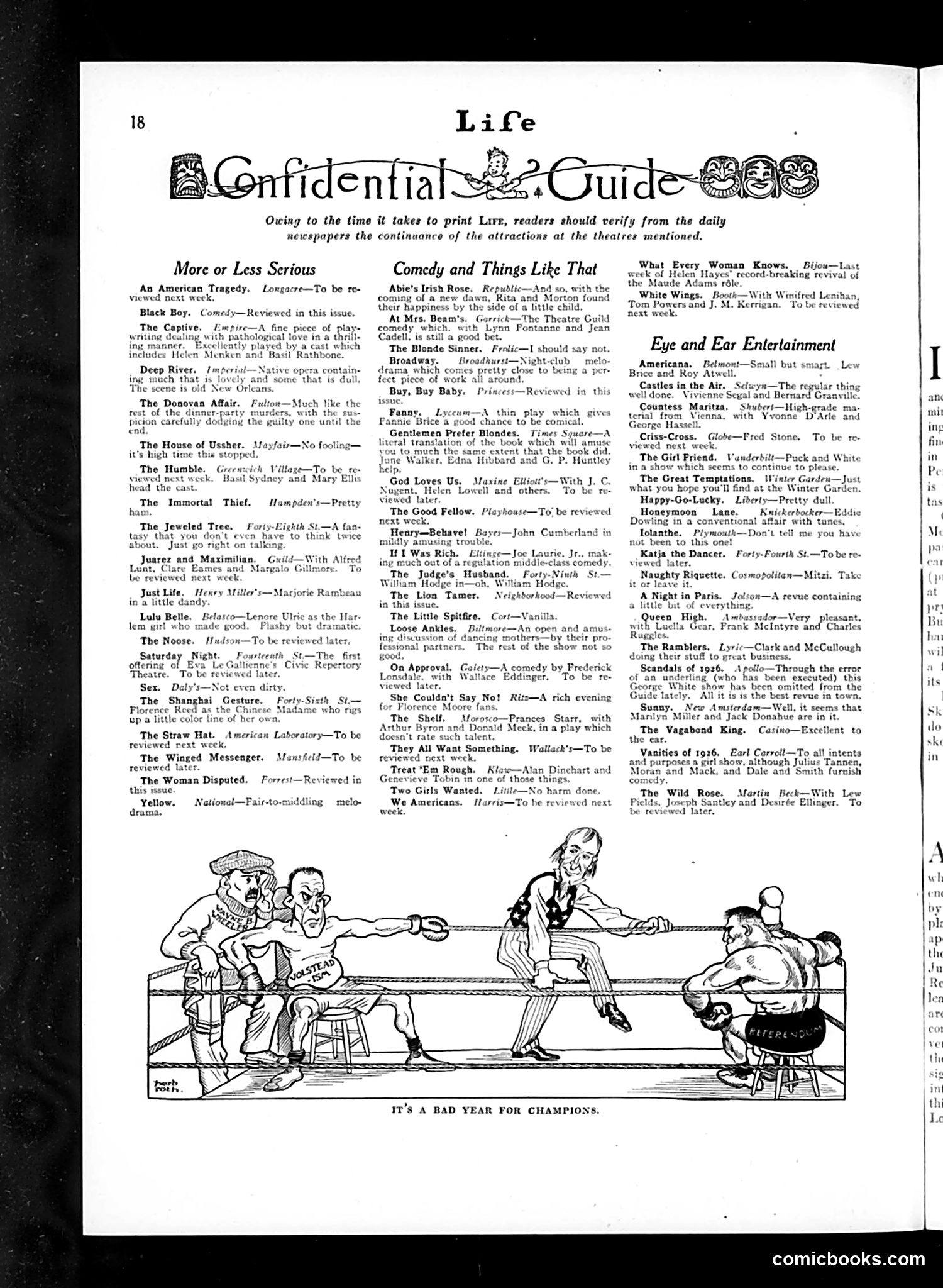
This page is a **theater guide and review section** from Life magazine's arts coverage—not a political cartoon. The small cartoon at the bottom ("It's a Bad Year for Champions") depicts a boxing match, likely satirizing the state of professional boxing or current boxing champions, though without clear historical context, the specific target is unclear. The bulk of the page lists Broadway shows with brief critical notices. Reviewers comment on current productions like *Abie's Irish Rose* (a popular comedy about Irish-Jewish romance), *Gentlemen Prefer Blondes*, and *The Noose*. The tone is gossipy and irreverent—typical of Life's satirical voice—with quips like dismissing one show as "I should say not" or noting another "is still a good bet." The "Eye and Ear Entertainment" section covers musicals and variety shows. This reflects 1920s Broadway's golden age, when Life served as essential reading for New York theatergoers wanting witty, current reviews.
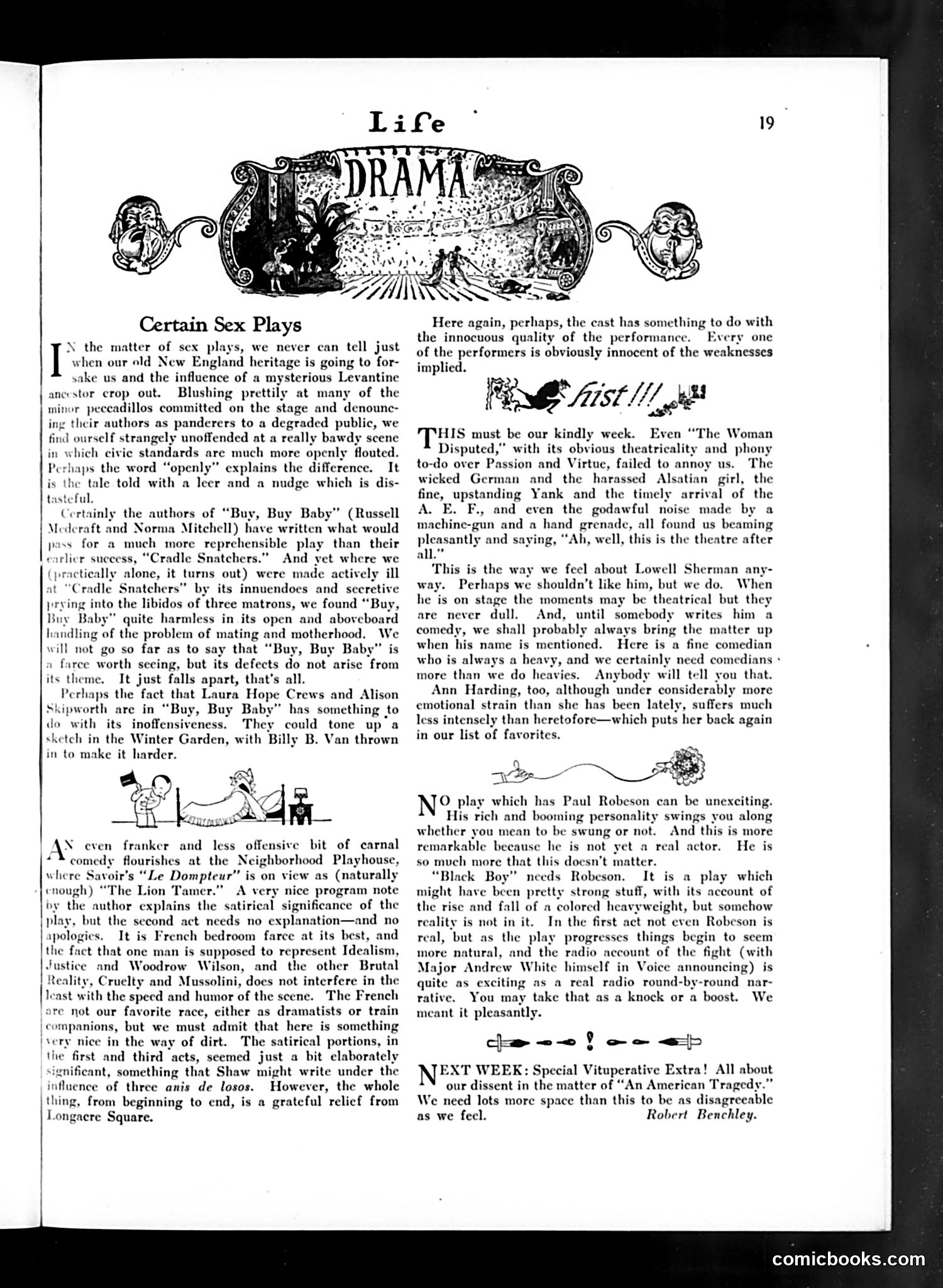
This theater review critiques contemporary Broadway plays, distinguishing between *offensive* and *acceptable* depictions of sexual content. The author argues that openly bawdy scenes are less objectionable than plays that use innuendo and secrecy—the "leer and nudge" approach to sexuality offends New England sensibilities more than frank treatment does. The review praises specific productions: "Buy, Buy Baby" (despite being about mating and motherhood), the French farce "The Lion Tamer" at the Neighborhood Playhouse, and "The Woman Disputed." The author credits strong casts—particularly actors Laura Hope Crews, Alison Skipworth, Lowell Sherman, and Ann Harding—with making morally questionable material palatable through talented, "innocent" performances. The underlying argument: honest vulgarity presented skillfully is preferable to suggestive prudishness. This reflects 1920s-era debates about theatrical decency and changing American moral standards.
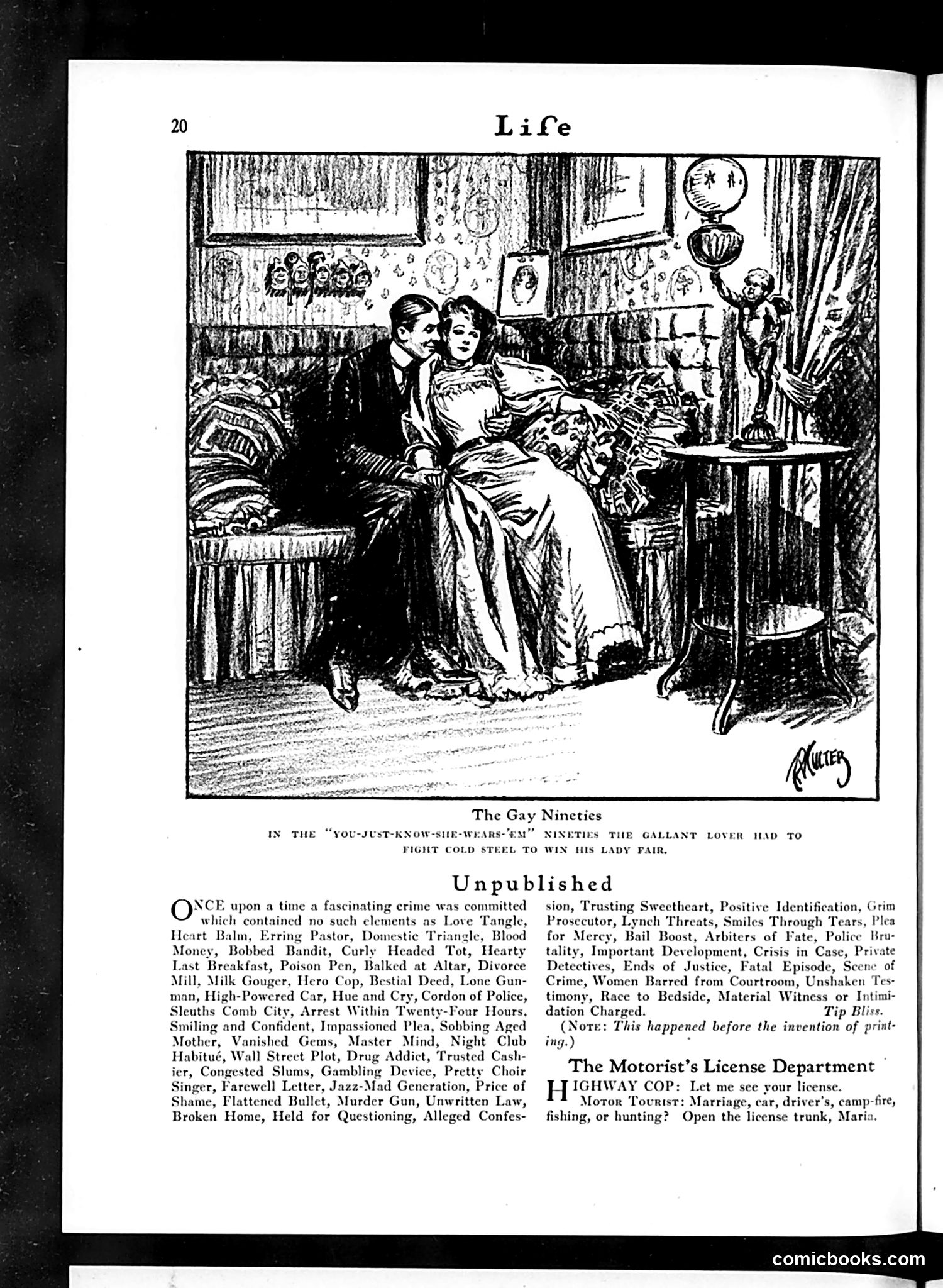
**The top cartoon** depicts a romantic scene from the 1890s ("Gay Nineties"), captioned with a period cliché: the gallant suitor had to literally fight rivals with swords to win his beloved. The satire is nostalgic—contrasting old-fashioned romantic drama with modern courtship. **"Unpublished"** is satirical commentary on crime reporting. Life ridicules contemporary sensational journalism by listing *every* melodramatic crime-story cliché (bobbed bandits, jazz-mad generation, unwritten law, etc.), then jokes that such a crime couldn't actually exist because it contains "no such elements." The satire mocks how formulaic and overwrought 1920s-era true-crime coverage had become—every crime hit the same predictable narrative beats. **"The Motorist's License Department"** is a brief joke: a highway cop asks a motorist what activities he engages in (marriage, driving, camping, fishing), then absurdly asks him to open his "license trunk" as if licenses covered all life activities. It satirizes bureaucratic overreach and the proliferation of licensing requirements.
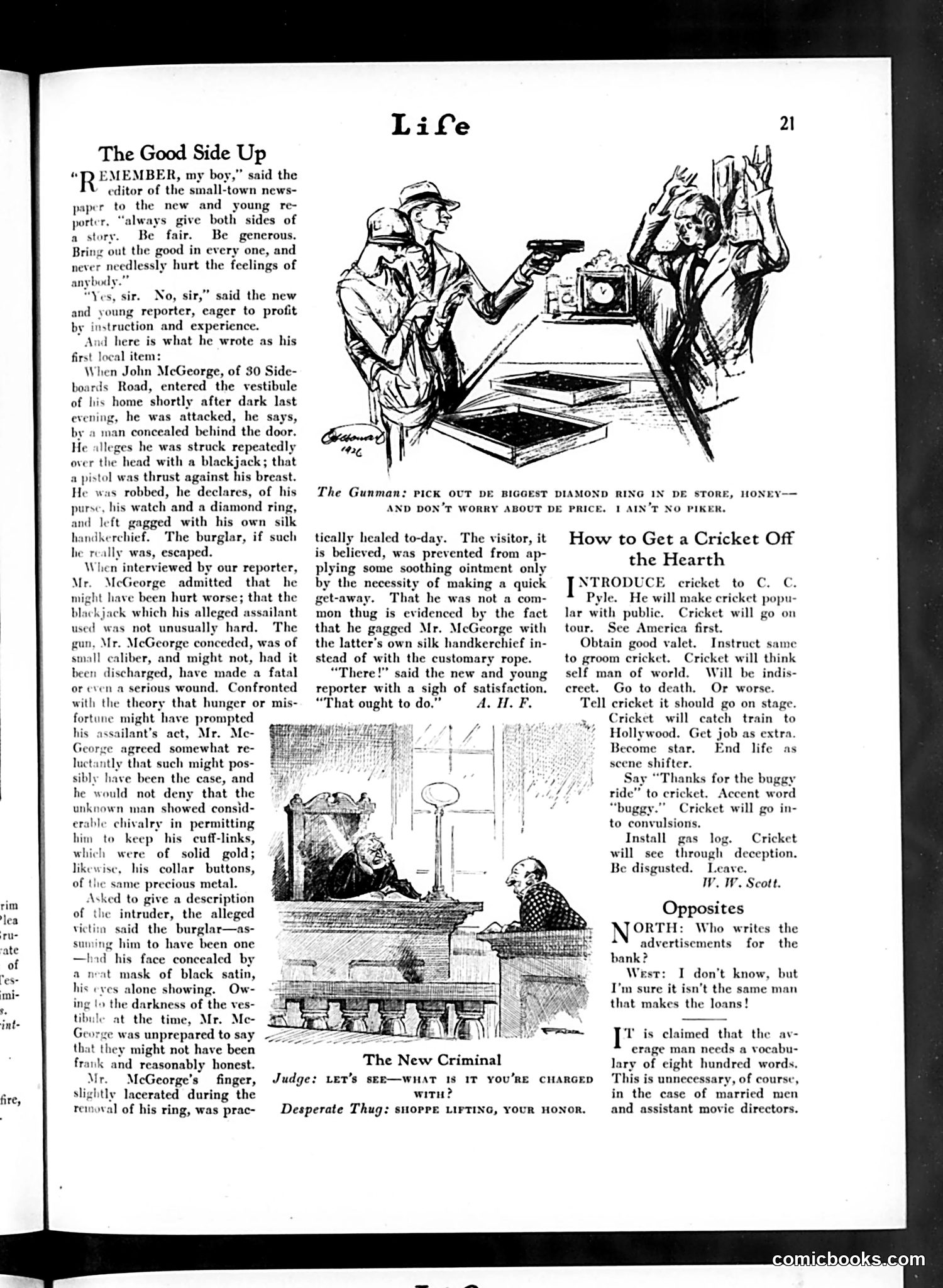
**"The Good Side Up"** satirizes naive journalistic ethics. A young reporter is instructed to present "both sides" fairly. His first article about John McGeorge's robbery does so absurdly—he finds mitigating circumstances for the burglar (hunger, the gun's small caliber, the thief's "chivalry" in letting McGeorge keep his gold cufflinks). The satire targets excessive "balance" in reporting that becomes ridiculous when applied to serious crime. **"The New Criminal"** mocks how crime has allegedly become genteel. A burglar charged with "store lifting" (shoplifting) rather than robbery represents petty, non-violent crime replacing violent street robbery—suggesting modernization has made criminals less dangerous or sensational. **"How to Get a Cricket Off the Hearth"** appears to reference C.C. Pyle, a 1920s sports promoter famous for promoting marathons and other spectacles. The joke sarcastically suggests introducing a cricket to Pyle would commercialize and destroy it. **"Opposites"** are brief, cynical one-liners about bank advertising versus lending practices, and vocabulary needs for married men. The page emphasizes satirical commentary on journalism, crime, and American commercialism typical of early 20th-century Life magazine.
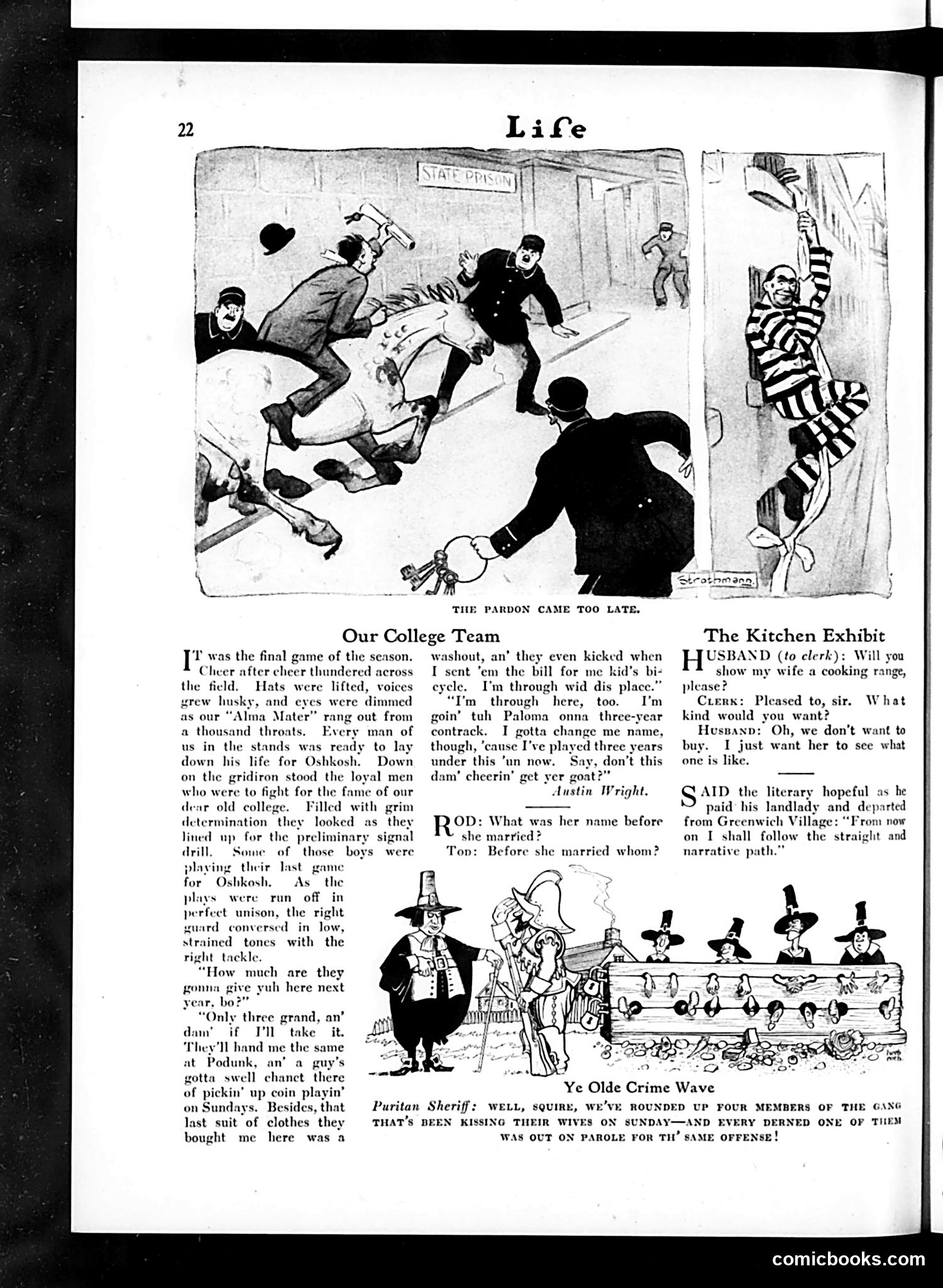
This page contains three unrelated satirical pieces typical of early 20th-century Life magazine: **"Our College Team"** mocks college football's commercialization. Players discuss their salaries and endorsement deals rather than school loyalty, revealing that athletes are mercenaries changing names to hide previous contracts—a critique of professionalism corrupting amateur sports. **"The Kitchen Exhibit"** is a brief joke: a husband wants his wife merely to *see* a cooking range, not buy one—implying he has no intention of upgrading their kitchen. **"Ye Olde Crime Wave"** satirizes Puritanical moral enforcement. A sheriff boasts of catching gang members whose crime is kissing their wives on Sunday—violating strict religious codes. The absurdity is that these "criminals" keep reoffending despite parole, mocking both excessive religious regulation and ineffective punishment systems. All three pieces use humor to critique American social institutions: commercial athletics, domestic consumerism, and religious extremism.
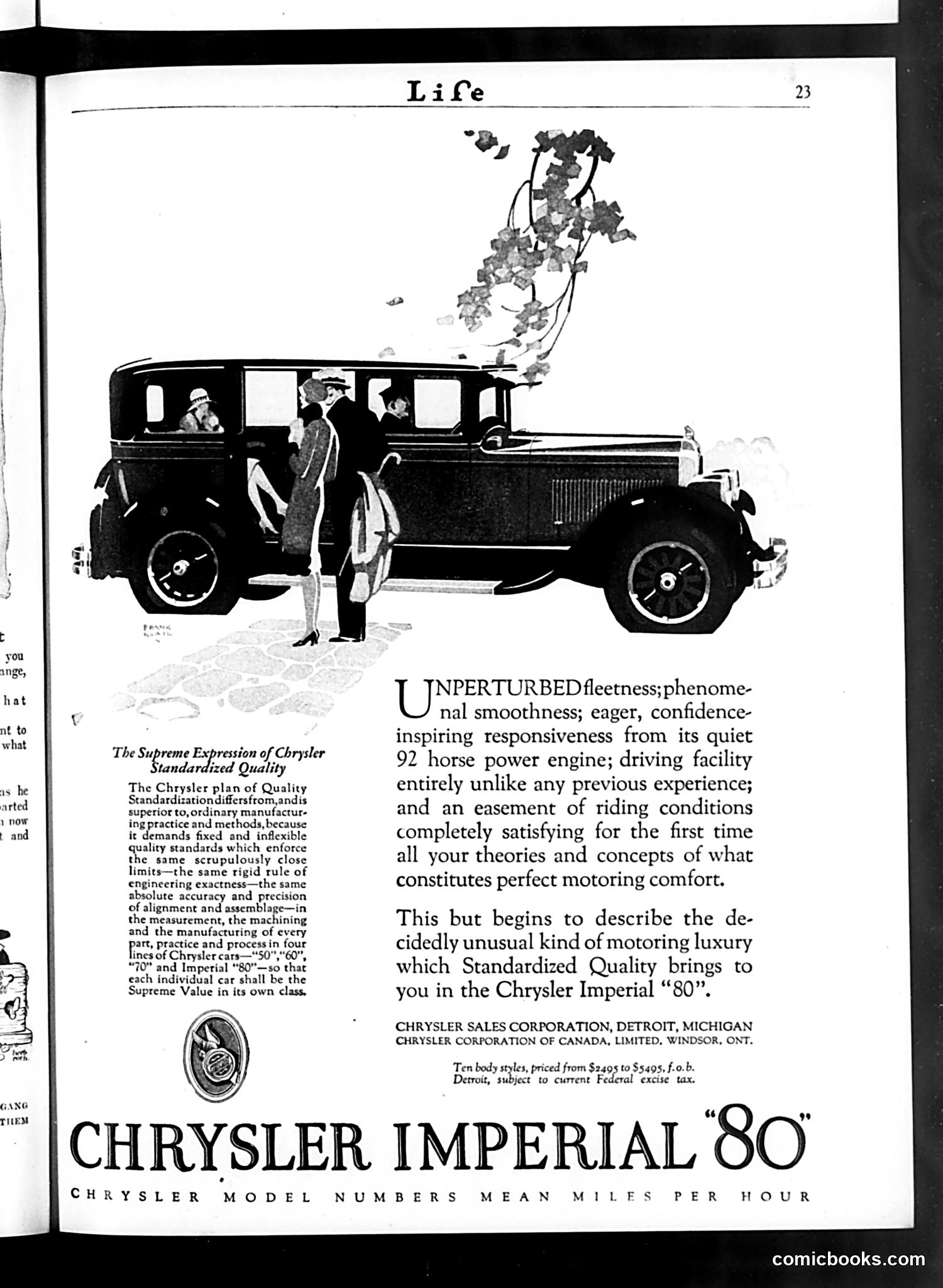
This is **not a cartoon or satire**—it's a straightforward automobile advertisement, not political commentary. The page shows a 1920s-era Chrysler Imperial "80" sedan with well-dressed figures (a woman and man) standing beside it, examining the vehicle. The ad emphasizes the car's engineering quality, smooth 92-horsepower engine, and comfort features. The humor or social observation here is subtle and implicit rather than satirical: the advertisement's grandiose language ("Supreme Expression," "Unperturbed fleetness," "decidedly unusual kind of motoring luxury") reflects the aspirational marketing of the Jazz Age, when automobiles represented wealth and modernity. The fashionably dressed couple embodies the target consumer—affluent, stylish, and appreciative of technological advancement. There is **no political message or caricature** visible. This is period advertising that reveals contemporary attitudes about consumer goods and status, rather than deliberate satire.
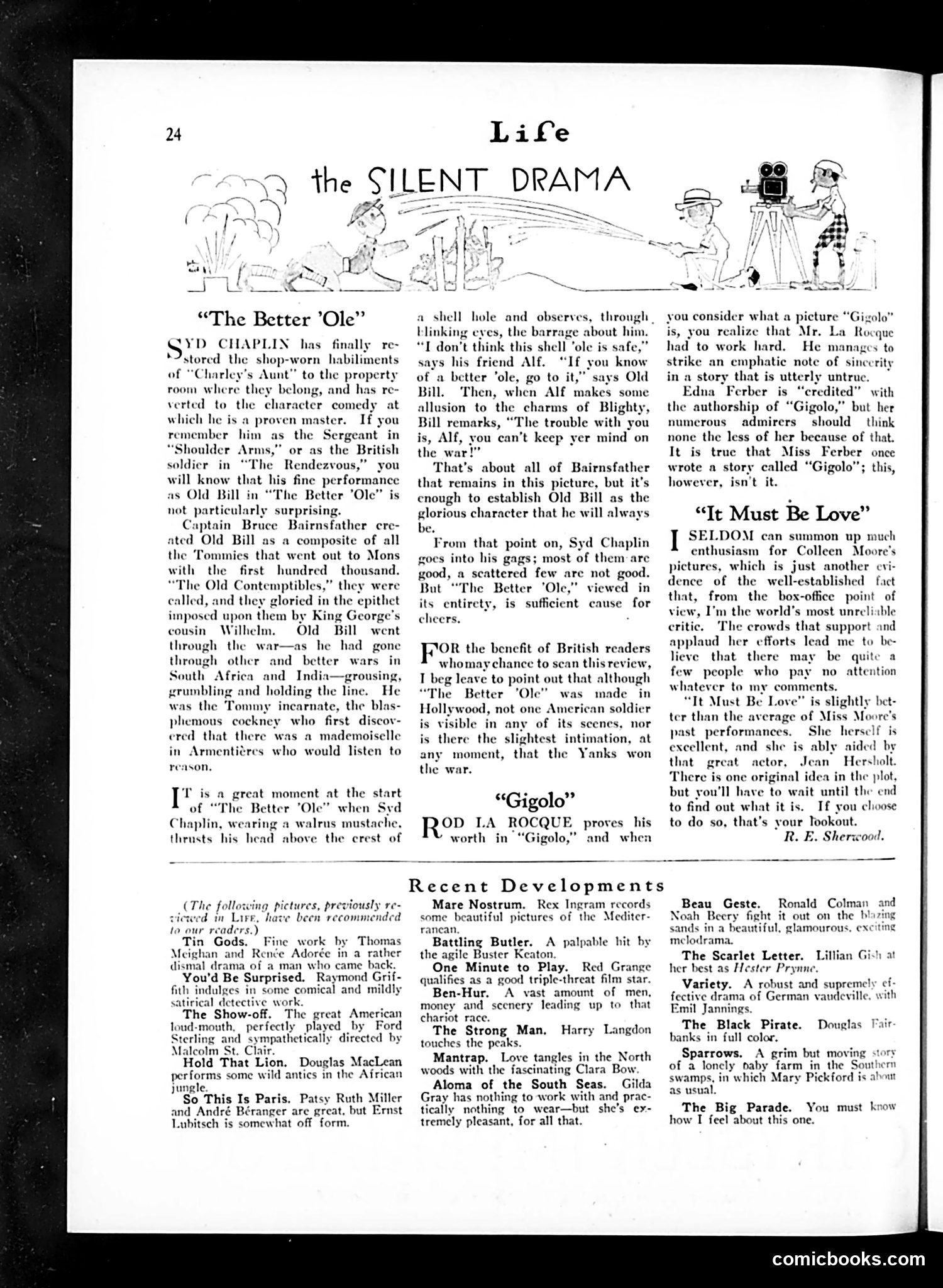
This page reviews silent films, focusing on three movies. The header illustration shows filmmaking equipment and personnel from the silent film era. **"The Better 'Ole"** stars Syd Chaplin (brother of Charlie) as Old Bill, a character created by cartoonist Captain Bruce Bairnsfather. Old Bill represents the archetypal British "Tommy" (soldier) who fought in World War I—specifically the "Old Contemptibles" who fought at Mons in 1914. The character embodies the working-class British soldier's resilience and dark humor through the war, including time in France. The review notes pointedly that although made in Hollywood, the film contains *no American soldiers* and makes no suggestion Americans won the war—a notable editorial observation about accurate WWI representation. The other two reviews cover "Gigolo" and "It Must Be Love," offering mixed assessments of those pictures and their stars. This is primarily a film review section, not political satire.
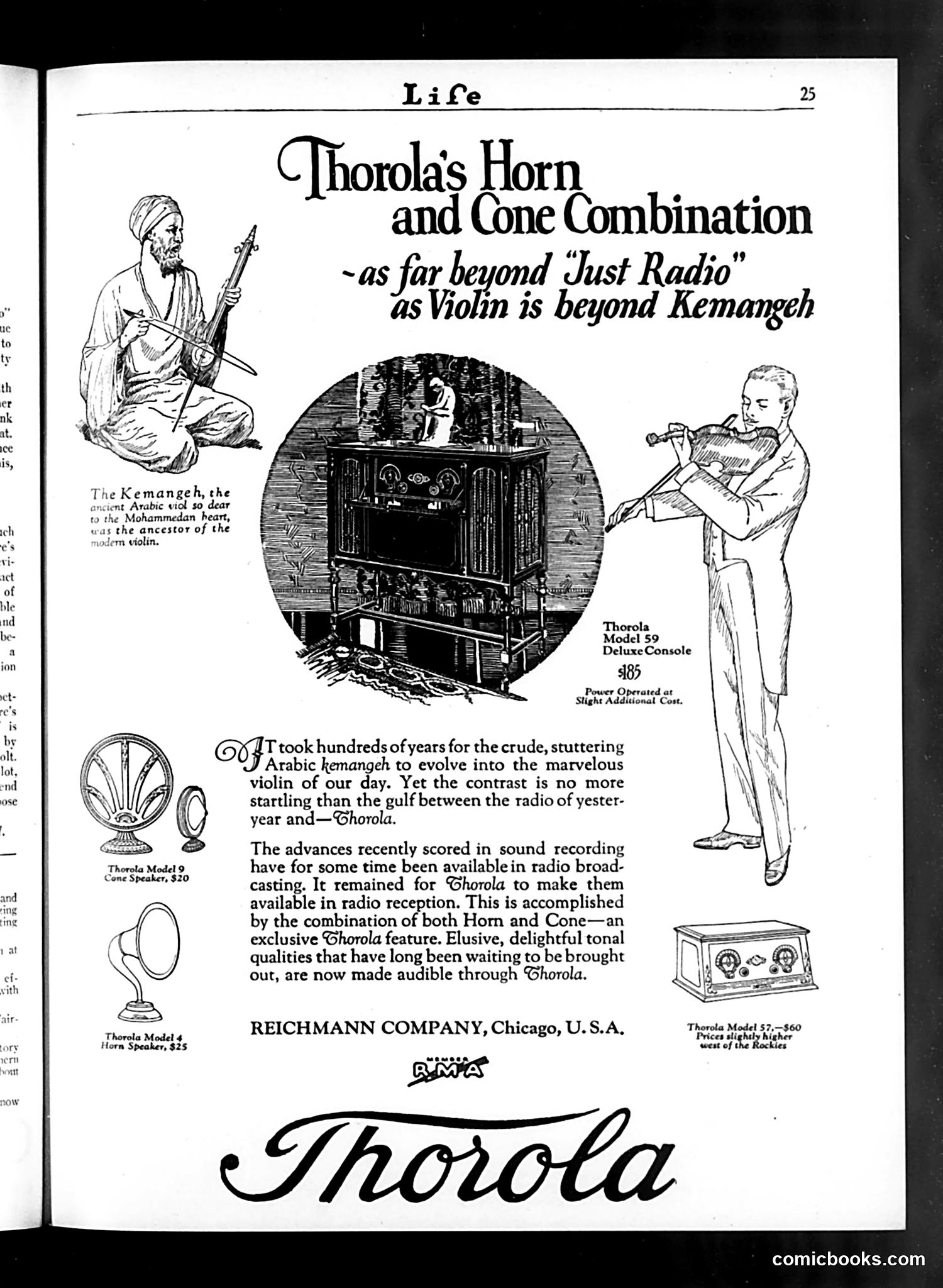
This is **not a cartoon or satire**—it's a straightforward **product advertisement** for Thorola radios, published by Reichmann Company of Chicago. The page uses a historical analogy to market the product: just as the crude Arabic kemangeh (a bowed stringed instrument) evolved over centuries into the modern violin, so has radio technology advanced dramatically. The text claims Thorola represents a revolutionary leap in radio reception through its exclusive "Horn and Cone Combination" design. The imagery shows: - A musician playing kemangeh (left) - The Thorola Model 59 deluxe console radio (center) - A man playing violin (right) - Various Thorola speaker models displayed The advertisement's purpose is straightforward product promotion—positioning Thorola as the cutting-edge evolution of radio technology, making superior sound quality "audible" to consumers. There is no political commentary or satirical intent; this appears in Life magazine's advertising section.
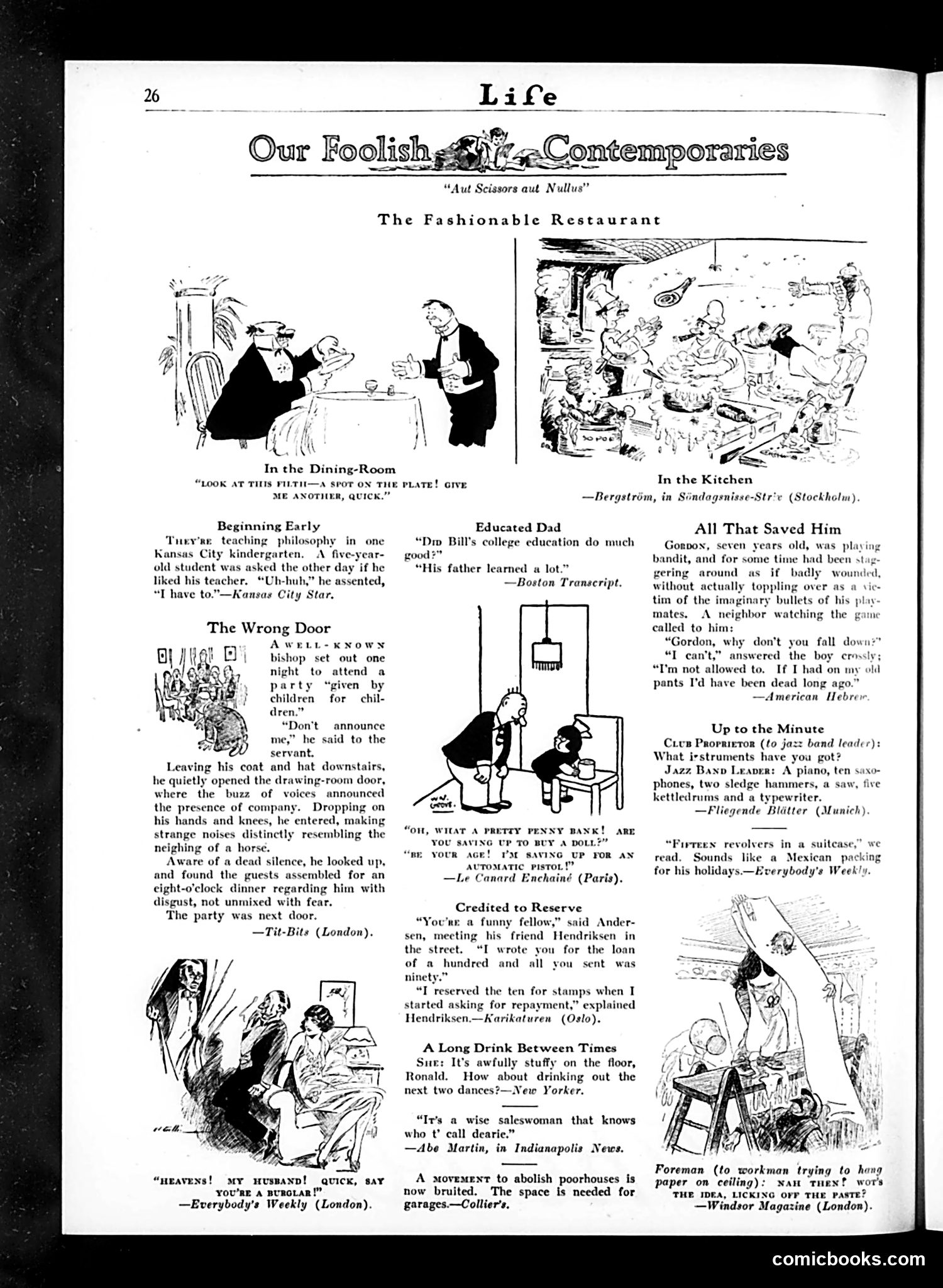
This page collects humorous anecdotes and cartoons satirizing everyday social absurdities. Key sketches include: **"The Fashionable Restaurant"**: A diner complains about a spot on his plate while the kitchen depicted shows chaotic conditions—mocking the gap between diners' pretensions and actual restaurant standards. **"The Wrong Door"**: A bishop, attempting to surprise children at a party, crawls on all fours neighing like a horse—only to discover he's entered the wrong room during a formal dinner, creating mortification. **"All That Saved Him"**: A seven-year-old boy can't convincingly play-act being shot because his good pants lack holes; his old pants' wear would make the fiction believable—satirizing childhood play and poverty simultaneously. Other sketches mock modern absurdities: a jazz band including sledge hammers and typewriters, workers licking paste while hanging ceiling paper, and a cheapskate who reserves ten cents in postage when requesting a hundred-dollar loan. The humor targets social pretension, modern chaos, and human foolishness across classes.
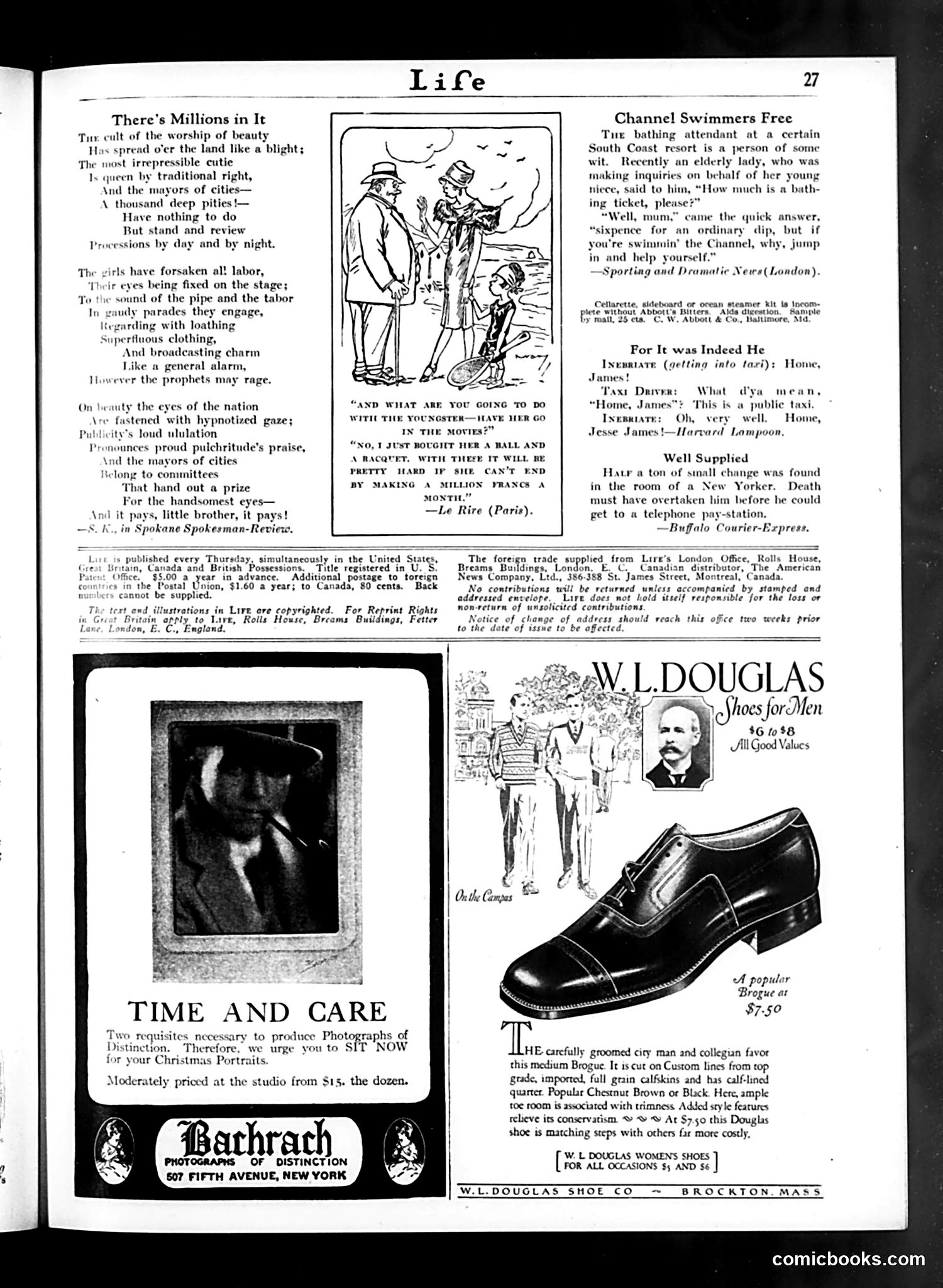
This page contains multiple brief satirical pieces typical of Life magazine's humor format: **Main Cartoon/Poem**: "There's Millions in It" mocks the 1920s obsession with beauty culture and celebrity. The poem satirizes how beauty pageants and "cutie" worship have consumed American society—mayors hold parades, girls abandon labor for stage careers, and cities award prizes for physical attractiveness. The satire targets both the commercialization of beauty and society's collective hypnosis by it. **Supporting Jokes**: - "Channel Swimmers Free" jokes about free admission (if you swim across the English Channel yourself) - "For It Was Indeed He" plays on mistaking a taxi driver for "Home, James" (a butler), confusing him with outlaw Jesse James - "Well Supplied" darkly jokes about a wealthy man dying before reaching a pay phone **Advertisements**: The page includes ads for portrait photography and W.L. Douglas shoes, typical period marketing. The overall tone reflects 1920s concerns about commercialism, celebrity culture, and changing social values.
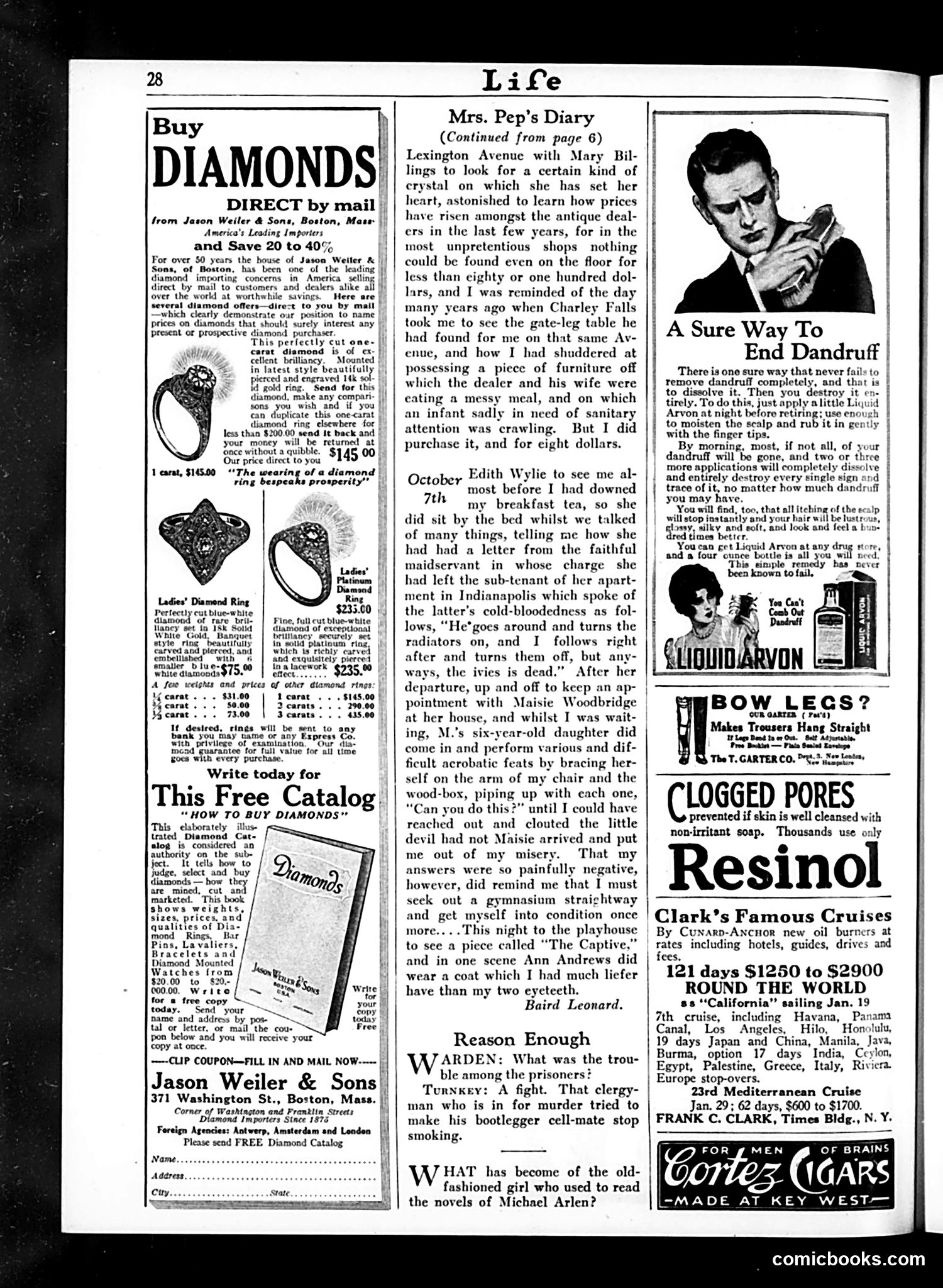
This page is primarily **advertising**, not satirical content. It features diamond sales pitches and product advertisements typical of early 20th-century magazines. The main content is Jason Weiler & Sons' diamond catalog advertisement, emphasizing mail-order purchasing and cost savings (20-40% off). The copy uses period appeals: diamonds signal "prosperity," and the company's decades-long reputation legitimizes direct buying. The other content—"Mrs. Pep's Diary" (a serialized domestic column), and advertisements for dandruff remedy, bow legs treatment, world cruises, and cigars—represent standard Life magazine filler. These ads reflect contemporary consumer anxieties: social respectability through jewelry ownership, and physical appearance anxieties. There is **no identifiable political cartoon or satirical commentary** on this particular page. It's a straightforward commercial and lifestyle content page from an era when Life magazine balanced humor with significant advertising revenue.
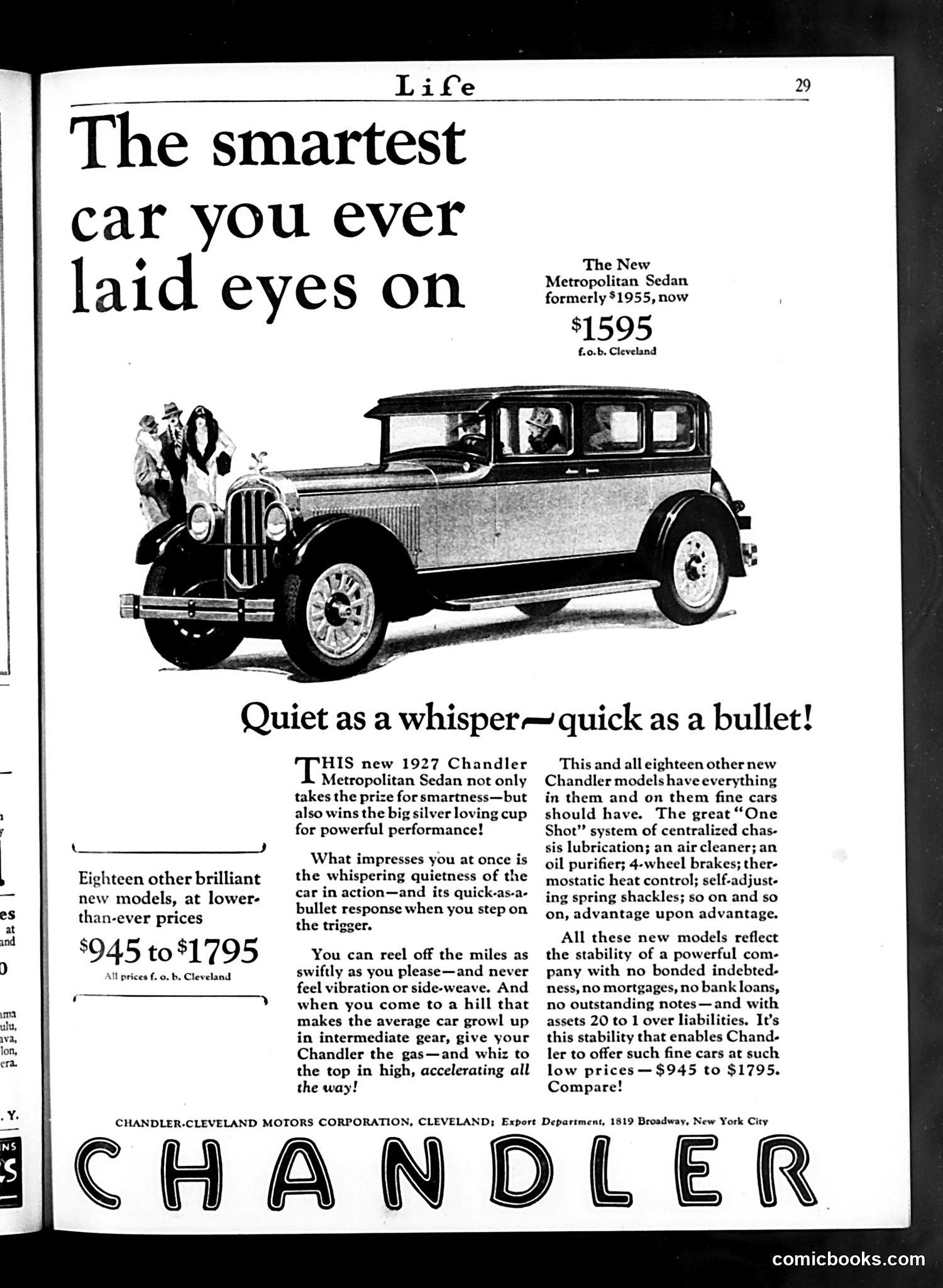
This is a **car advertisement**, not political satire or a cartoon. It appears on page 29 of Life magazine (likely 1920s, given the 1927 Chandler model reference). The ad promotes the new Chandler Metropolitan Sedan, emphasizing: - **Price reduction**: formerly $1955, now $1595 - **Performance claims**: "quiet as a whisper—quick as a bullet" (contrasting quietness with speed) - **Technical features**: centralized lubrication, air cleaner, four-wheel brakes, thermostat control - **Financial stability pitch**: the company has "no bonded indebtedness, no mortgages, no bank loans"—a selling point suggesting reliability during economically uncertain times The illustration shows a well-dressed couple admiring the car, a standard advertising trope of the era positioning automobiles as status symbols. There is no satire or political commentary here—this is straightforward product marketing aimed at middle-class buyers seeking affordable, well-engineered vehicles.
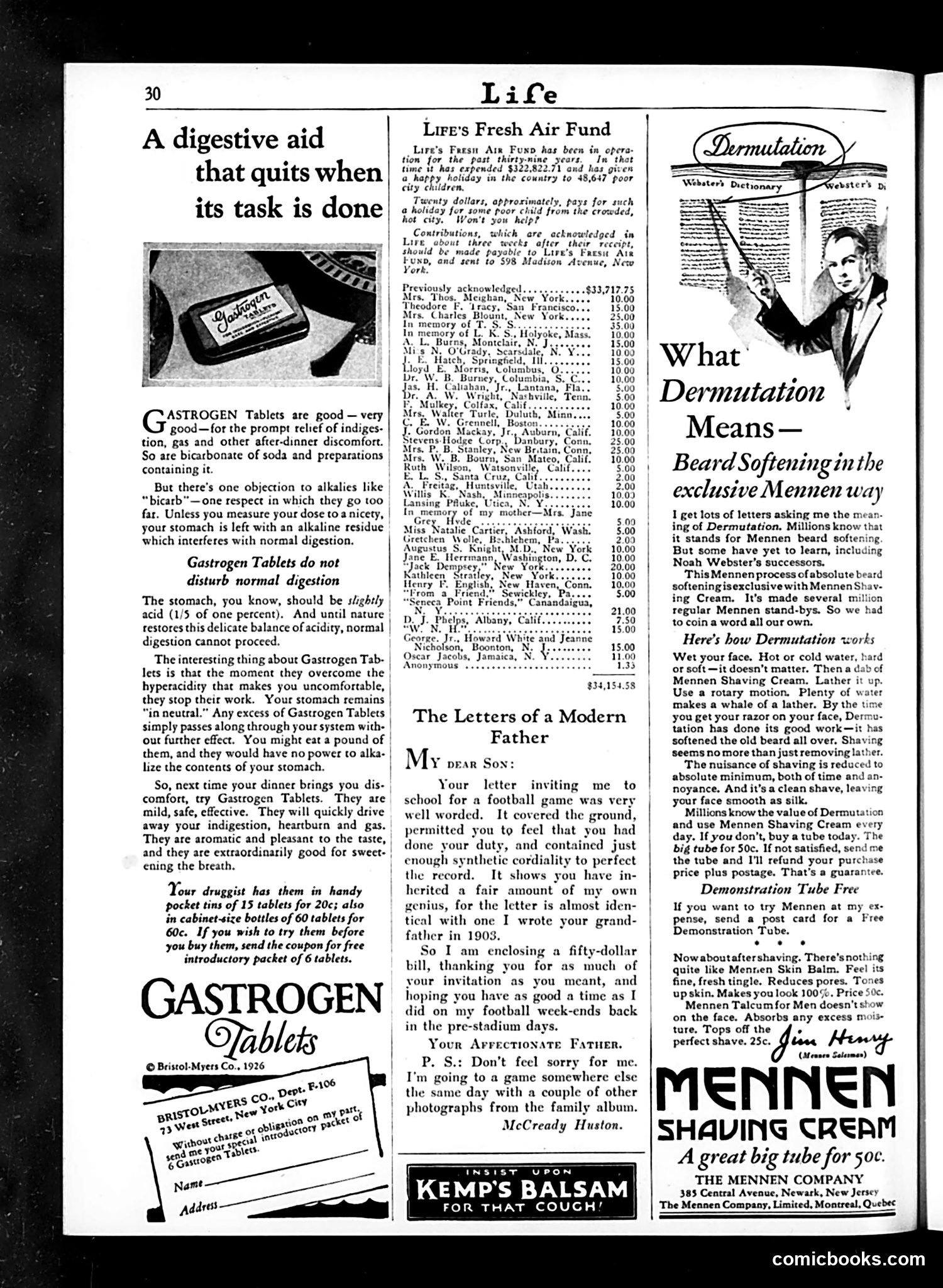
This page is primarily **advertising and charity notices**, not political satire. The main content includes: 1. **Gastrogen Tablets advertisement**: A digestive aid claiming superiority because it doesn't leave alkaline residue after doing its job—a humorous personification of the product as self-aware and responsible. 2. **Life's Fresh Air Fund notice**: A charity appeal detailing contributions toward sending poor city children on countryside holidays. Lists donors and amounts contributed. 3. **"The Letters of a Modern Father"**: A humorous advice column where a father responds to his son's football game invitation with dry wit, noting the letter's "synthetic cordiality" and enclosing $50. The satire targets generational similarities in formal, somewhat insincere family correspondence. 4. **Mennen Shaving Cream advertisement**: Promotes beard-softening cream as the "exclusive Mennen way." There is no political cartoon or significant social satire here—this is a typical 1920s magazine page mixing commercial advertisements with light domestic humor.
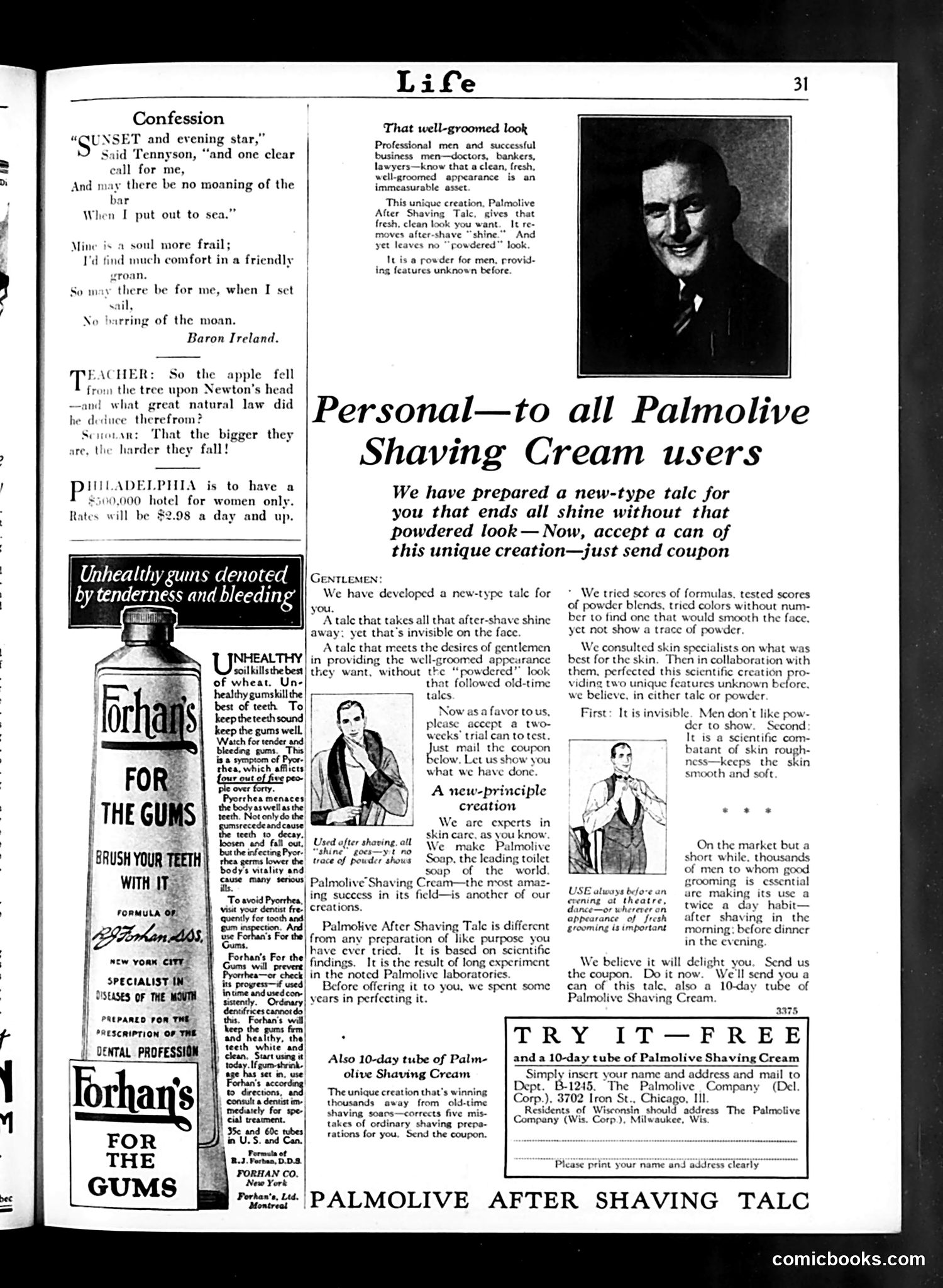
This page is primarily **advertising**, dominated by Palmolive product promotions, with small satirical content scattered throughout. **The Satirical Elements:** 1. **"Confession" by Baron Ireland** – A humorous poem playing on Tennyson's famous lines about death at sea, substituting existential dread with complaint about lacking "a friendly groan." 2. **Teacher/Scholar joke** – A simple pun: when asked what natural law Newton deduced from the apple, the student answers "the bigger they fall" (reversing the saying "the bigger they are, the harder they fall"). 3. **Philadelphia hotel note** – A brief, dry joke about a new women-only hotel charging $2.98/day, implying surprise at both the concept and modest pricing. **The Advertisements:** Most of the page features Forhan's gum treatment and extensive Palmolive shaving product copy, typical of 1920s health-conscious marketing emphasizing hygiene and professional appearance. The ads reflect period anxieties about pyorrhea and masculine grooming standards.
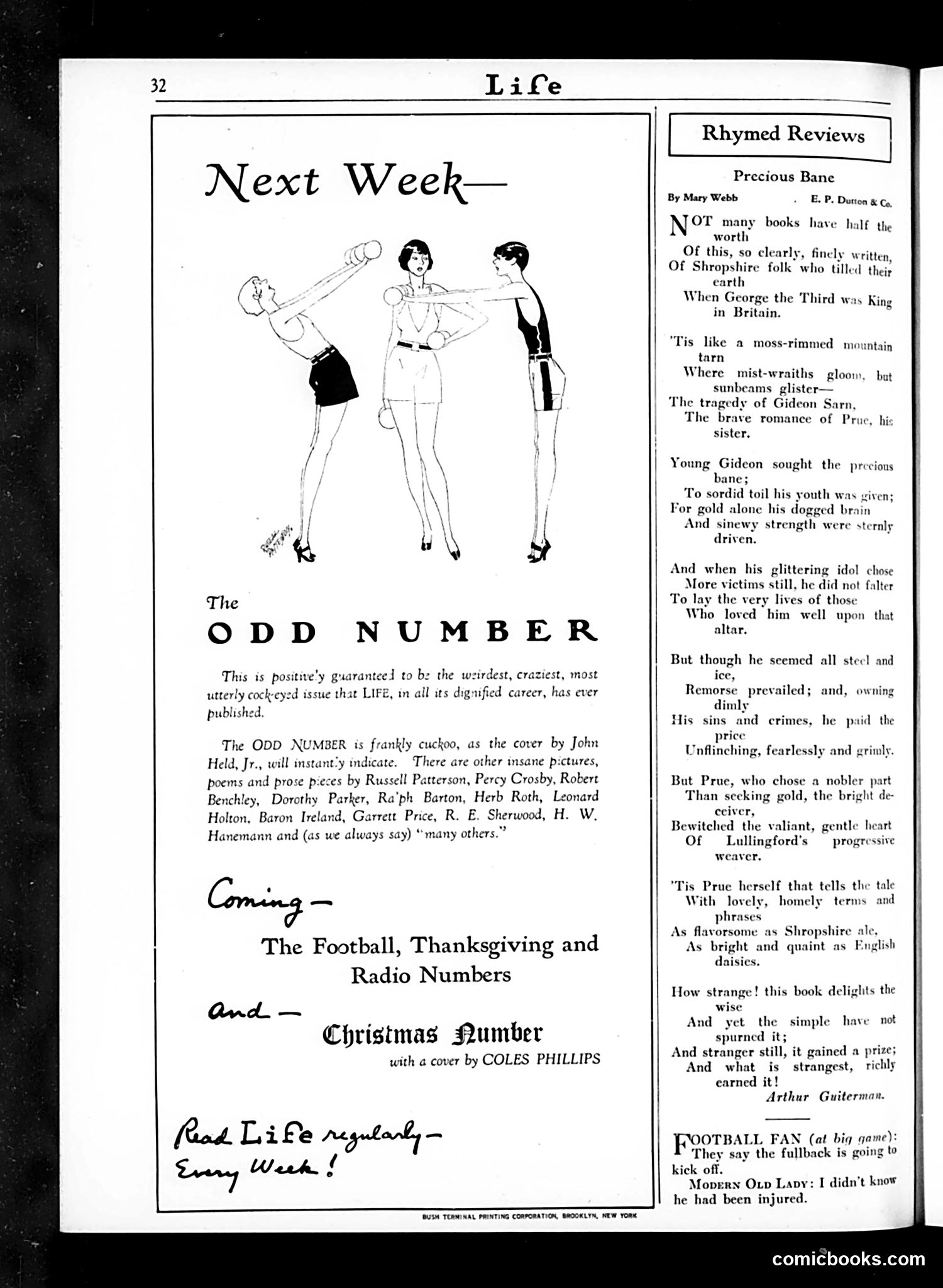
This page announces Life magazine's upcoming "Odd Number"—a deliberately absurd special issue. The left side features a stylized illustration of three fashionably dressed 1920s women by John Held Jr., promoting the issue as "frankly cuckoo" and "the weirdest, craziest" issue ever published. The text lists prominent satirical writers (Benchley, Parker, Sherwood) contributing comedic pieces. The right side contains a poetry review of Mary Webb's novel *Precious Bane*, summarizing its tragic plot about rural Shropshire characters. Below is a brief joke playing on modern language: a "Football Fan" misunderstands "kick off" as an injury rather than the game's opening action—likely satirizing non-sports enthusiasts or the emerging radio broadcasts making football terminology accessible to general audiences. The page primarily advertises upcoming special issues and book reviews rather than presenting political commentary.
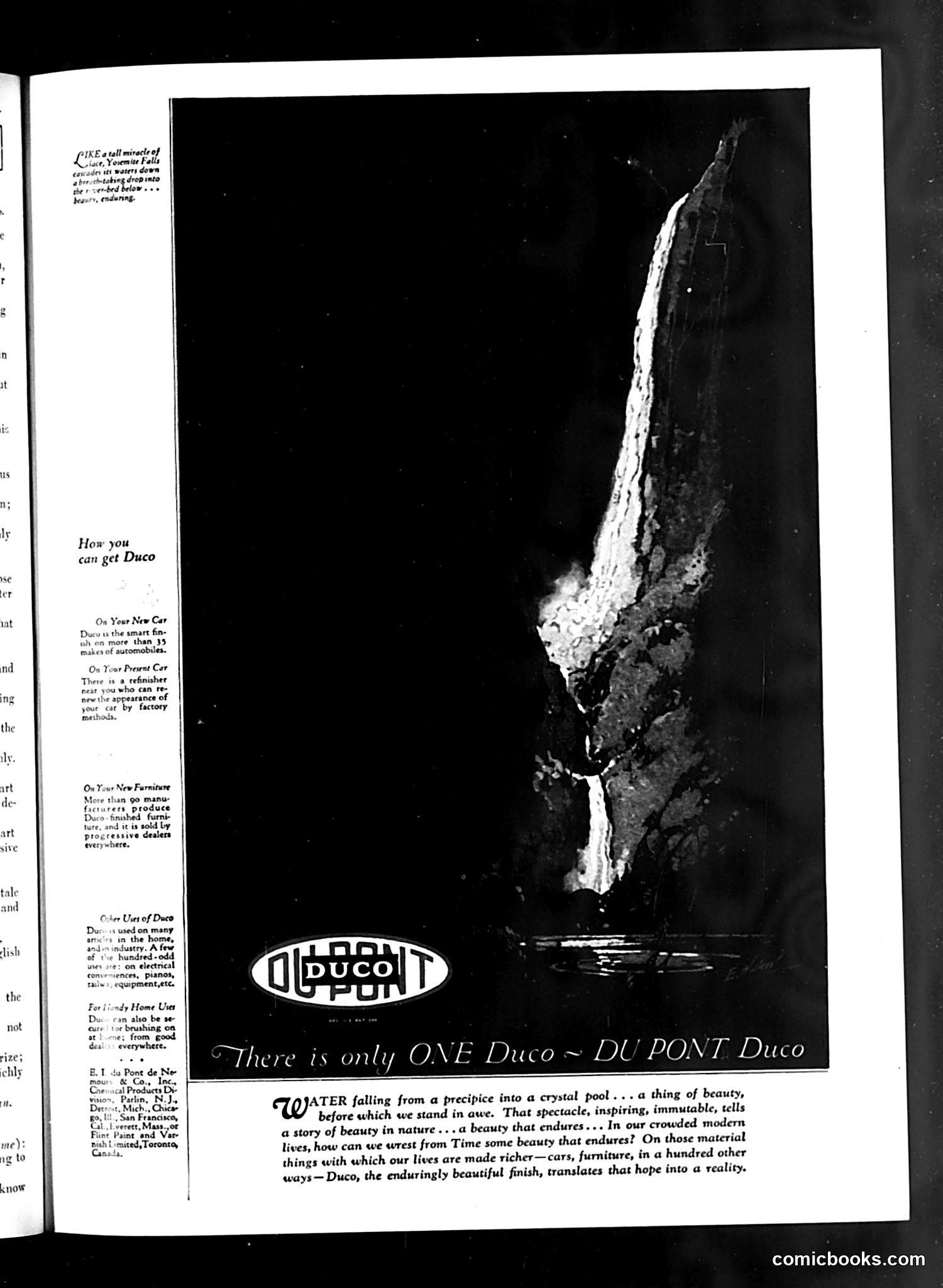
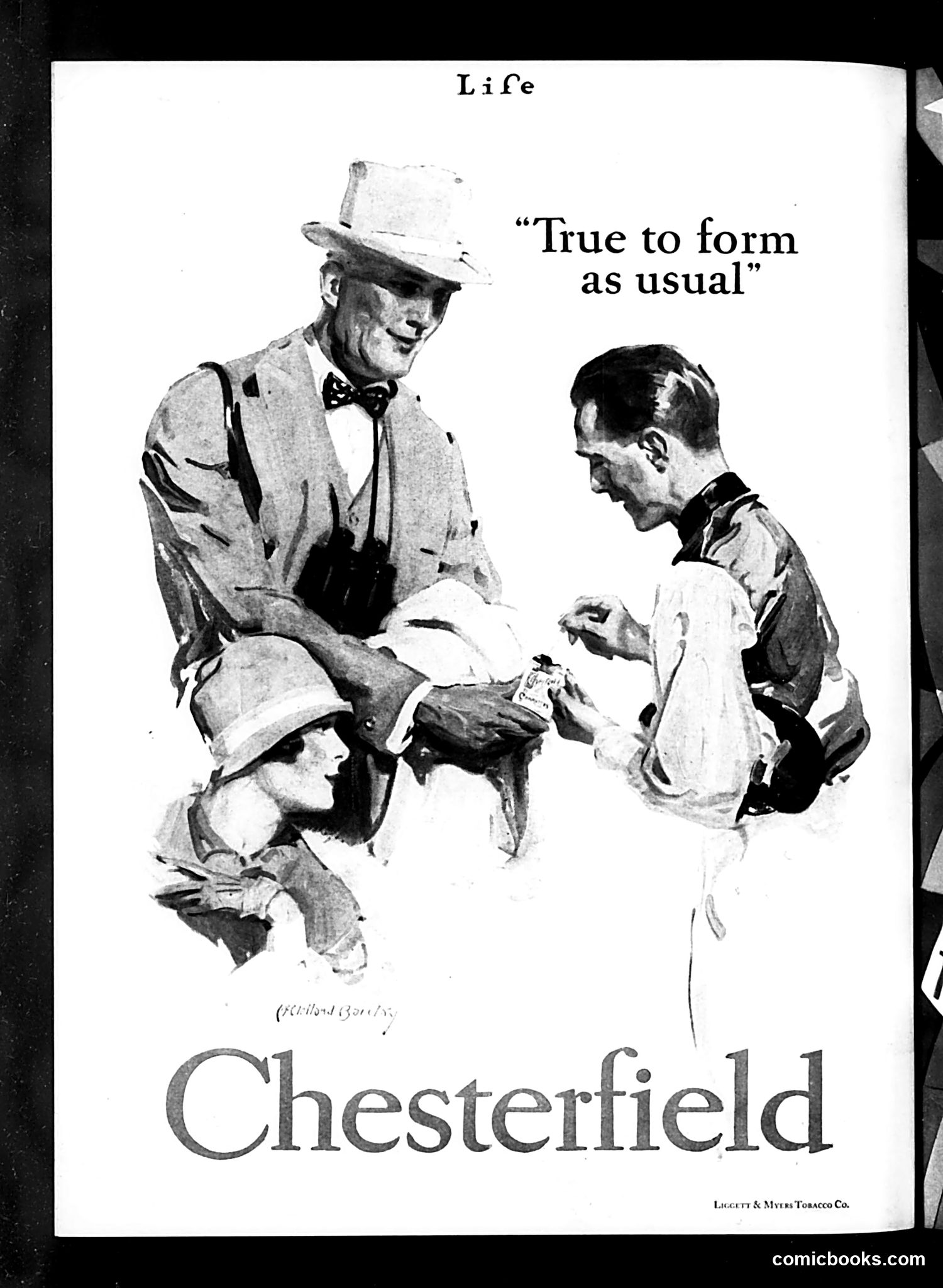
This is a **Chesterfield cigarette advertisement** from Life magazine, not political satire. The image shows three figures—an older man in a cowboy hat and bow tie, a younger man, and a small child—in what appears to be a casual, friendly interaction. The phrase "True to form as usual" suggests the advertisement is emphasizing **Chesterfield's consistency and reliability** as a product. The ad uses Americana imagery (the cowboy attire) to evoke rugged authenticity and trustworthiness. This represents **vintage tobacco marketing**, which commonly featured wholesome family scenes and idealized American characters to normalize and promote cigarette consumption—a practice that would become heavily regulated later.