
Life, 1926-10-28 · page 23 of 36
Life — October 28, 1926 — page 23: what you’re looking at
What you’re looking at
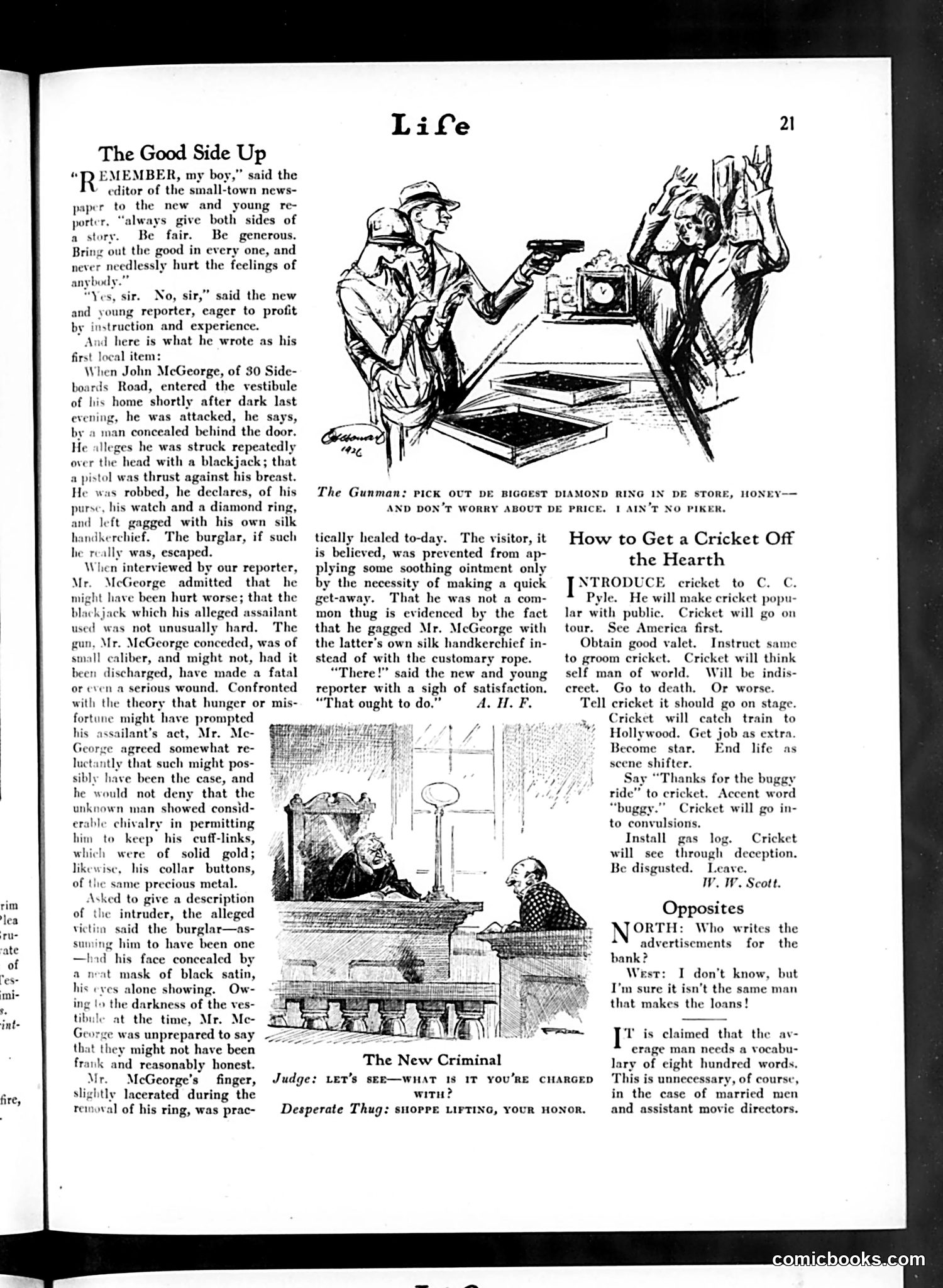
**"The Good Side Up"** satirizes naive journalistic ethics. A young reporter is instructed to present "both sides" fairly. His first article about John McGeorge's robbery does so absurdly—he finds mitigating circumstances for the burglar (hunger, the gun's small caliber, the thief's "chivalry" in letting McGeorge keep his gold cufflinks). The satire targets excessive "balance" in reporting that becomes ridiculous when applied to serious crime. **"The New Criminal"** mocks how crime has allegedly become genteel. A burglar charged with "store lifting" (shoplifting) rather than robbery represents petty, non-violent crime replacing violent street robbery—suggesting modernization has made criminals less dangerous or sensational. **"How to Get a Cricket Off the Hearth"** appears to reference C.C. Pyle, a 1920s sports promoter famous for promoting marathons and other spectacles. The joke sarcastically suggests introducing a cricket to Pyle would commercialize and destroy it. **"Opposites"** are brief, cynical one-liners about bank advertising versus lending practices, and vocabulary needs for married men. The page emphasizes satirical commentary on journalism, crime, and American commercialism typical of early 20th-century Life magazine.
📄 Transcribed text from this page (OCR, searchable)
Machine-transcribed from the original scan — historical spelling and the odd misread are preserved.
The Good Side Up “PD EMEMBER, ny boy,” said the editor of the small-town news- paper to the new and young re- porter, “always give both sides of a story. Be fair. Be generous. ut the good in every one, and needlessly hurt the feelings of No, sir,” said the new and young reporter, eager to profit by instruction and experience. “And here is what he wrote as his first local item: When John McGeorge, of 30 Side- boards Road, entered the vestibule of his home shortly after dark last evening, he was attacked, he says, by a man concealed behind the door. He alleges he was struck repeatedly over the head with a blackjack; that a pistol was thrust against his breast. He was robbed, he declares, of his purse, his watch and a diamond ring, and left gagged with his own silk handkerchief. The burglar, if such he really was, escaped. When interviewed by our reporter, McGeorge admitted that he have been hurt worse; that the blackjack which his alleged assailant used was not unusually hard. The gun, Mr. McGeorge conceded, was of small caliber, and might not, had it been discharged, have made a fatal or even a serious wound. Confronted with the theory that hunger or mis- fortune might have prompted lant’s act, Mr. Me- agreed somewhat re- itly that such might pos- sibly have been the case, and he would not deny that the unknown man showed consid- erable chivalry in permitting him to keep his cuff-links, which were of solid gold; likewise, his collar buttons, of the same precious metal. Asked to give a description of the intruder, the alleged victiin said the burglar—as- suming him to have been one —tad his face concealed by a neat mask of black satin, his eyes alone showing. Ow- ing !» the darkness of the ves- tibule at the time, Mr. Me- G was unprepared to say that they might not have been frank and reasonably honest. Mr. McGeorge’s finger, slightly lacerated during the removal of his ring, was prac- ssa The Gunman: pick OUT DE BIGGEST DIAMOND RING IN DE STORE, HONEY— AND DON’T WORRY ABOUT DE PRICE. tically healed to-day. The visitor, it is believed, was prevented from ap- plying some soothing ointment only by the necessity of making a quick get-away. That he was not a com- mon thug is evidenced by the fact that he gagged Mr. McGeorge with the latter’s own silk handkerchief in- stead of with the customary rope. “There!” said the new and young reporter with a sigh of satisfaction. “That ought to do.” A..F. The New Criminal Judge: Let’s sEE—WHAT 18 IT YOU'RE CHARGED witn? Desperate Thug: stopre LirtiNG, youR HONOR. 1 AIN'T No PI How to Get a Cricket Off the Hearth NTRODUCE cricket to C. C. Pyle. He will make cricket popu- lar with public. Cricket will go on tour. See America first. Obtain good valet. Instruct same to groom cricket. Cricket will think self man of world. Will be indis- erect. Go to death. Or worse. Tell cricket it should go on stage. Cricket will catch train to Hollywood. Get job as extra. Become star. End life as scene shifter. Say “Thanks for the buggy icket. Accent word ‘ Cricket will go in- to convulsions. Install gas log. Cricket will see through deception. Be disgusted. Leave. W.W. Scott. Opposites NJ ORTH: Who writes the + advertisements for the bank? West: I don’t know, but I'm sure it isn’t the same man that makes the loans! T is claimed that the av- erage man needs a vocabu- lary of cight hundred words. This is unnecessary, of course, in the case of married men and assistant movie directors.