
Life, 1926-10-28 · page 7 of 36
Life — October 28, 1926 — page 7: what you’re looking at
What you’re looking at
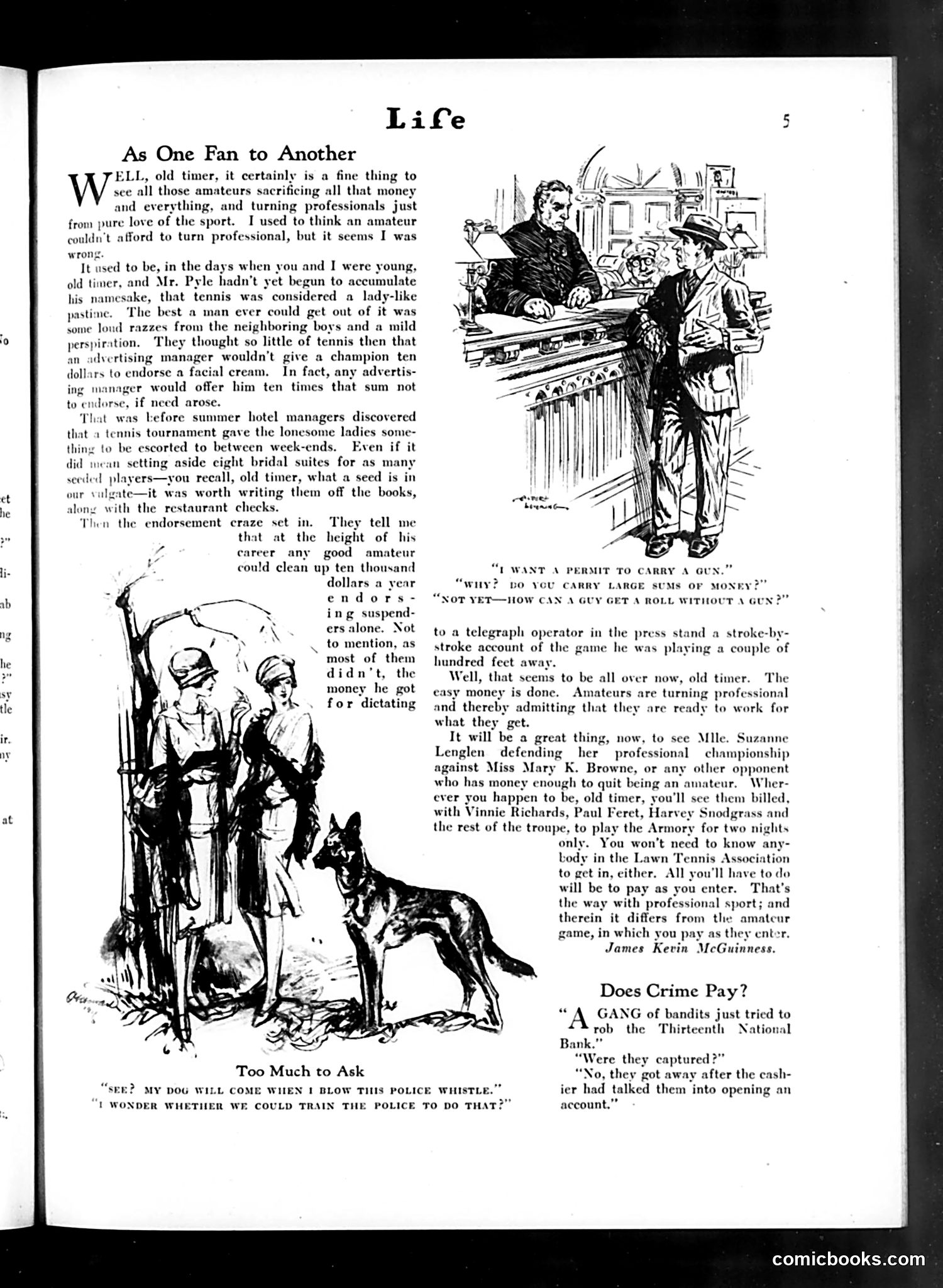
This page contains a humorous essay by James Kewin McGuinness discussing amateur versus professional tennis. The author argues that amateurs can now turn professional without shame, citing how wealthy society ladies once sponsored amateur tournaments for prestige and endorsements—though advertisers nominally avoided direct payment. The accompanying cartoons illustrate related social commentary: "Too Much to Ask" depicts someone trying to train a dog with a police whistle, humorously questioning authority's usefulness. The other cartoon shows what appears to be a betting or gambling scene related to sports, suggesting the casual financial stakes involved in amateur athletics. The piece reflects early 20th-century attitudes about amateurism, class, and the blurred lines between amateur and professional sports.
📄 Transcribed text from this page (OCR, searchable)
Machine-transcribed from the original scan — historical spelling and the odd misread are preserved.
Life As One Fan to Another ELL, old timer, it certainly is a fine thing to W ee all those amateurs sacrificing all that money and everything, and turning professionals just from pure love of the sport. I used to think an amateur couldn't afford to turn professional, but it seems I was wrong, It used to be, in the days when vou and I were young, old timer, and Mr. Pyle hadn't yet begun to accumulate his name , that tennis was considered a lady-like pastime. The best a man ever could get out of it was some loud razzes from the neighboring boys and a mild perspiration. They thought so little of tennis then that an advertising manager wouldn't give a champion ten dollars to endorse a facial cream. In fact, any advertis- ing manager would offer him ten times that sum not to endorse, if need arose. That was before summer hotel managers discovered that a tennis tournament gave the lonesome ladies some- thing to be escorted to between week-ends. Even if it did wnean setting aside cight bridal suites for y you recall, old timer, what a seed is in our valgs it was worth writing them off the books, along with the restaurant checks. Then the endorsement craze set in. They tell me that at the height of his career any good amateur could clean up ten thousand “L WANT A PERMIT TO CARRY A GUN.” dollars a year “wy? po CARRY LARGE SUMS OF MONEY endors- “Nor yet—now CAN A GUY GET A ROLL WITHOUT A GUN? ing suspend- ers alone. Not to a telegraph operator in the press stand a stroke-by- . to mention, as stroke account of the game he was playing a couple of most of them hundred feet aw Ye didn’t, the Well, that seems to be all over now, old timer. The money he got sy money is done. Amateurs are turning professional for dictating and thereby admitting that they are ready to work for what they get. It will be a great thing, now, to see Mlle. Suzanne Lenglen defending her professional — championship against Miss Mary K. Browne, or any other opponent who has money enough to quit being an amateur. Wher- ever you happen to be, old timer, you'll see them billed, with Vinnie Richards, Paul Feret, Harvey Snodgrass 4 the rest of the troupe, to play the Armory for two n only. You won't need to know any- body in the Lawn Tennis Associ: to get in, either. All you'll have to do will be to pay as you enter. That's the way with professional sport; and therein it differs from the amateur game, in which you pay as they enter. James Kevin McGuinness. Does Crime Pay? “A GANG of bandits just tried to rob the Thirteenth National Bank.” “Were they captured?” Too Much to Ask “No, they got away after the cash- “ser? MY DOG WILL COME WHEN 1 BLOW TIIIS POLICE WHISTLE.” ier had talked them into opening an “1 WONDER WHETHER WE COULD TRAIN THE POLICE TO DO THAT?” account.”” comicbooks.com