
Life, 1926-10-28 · page 21 of 36
Life — October 28, 1926 — page 21: what you’re looking at
What you’re looking at
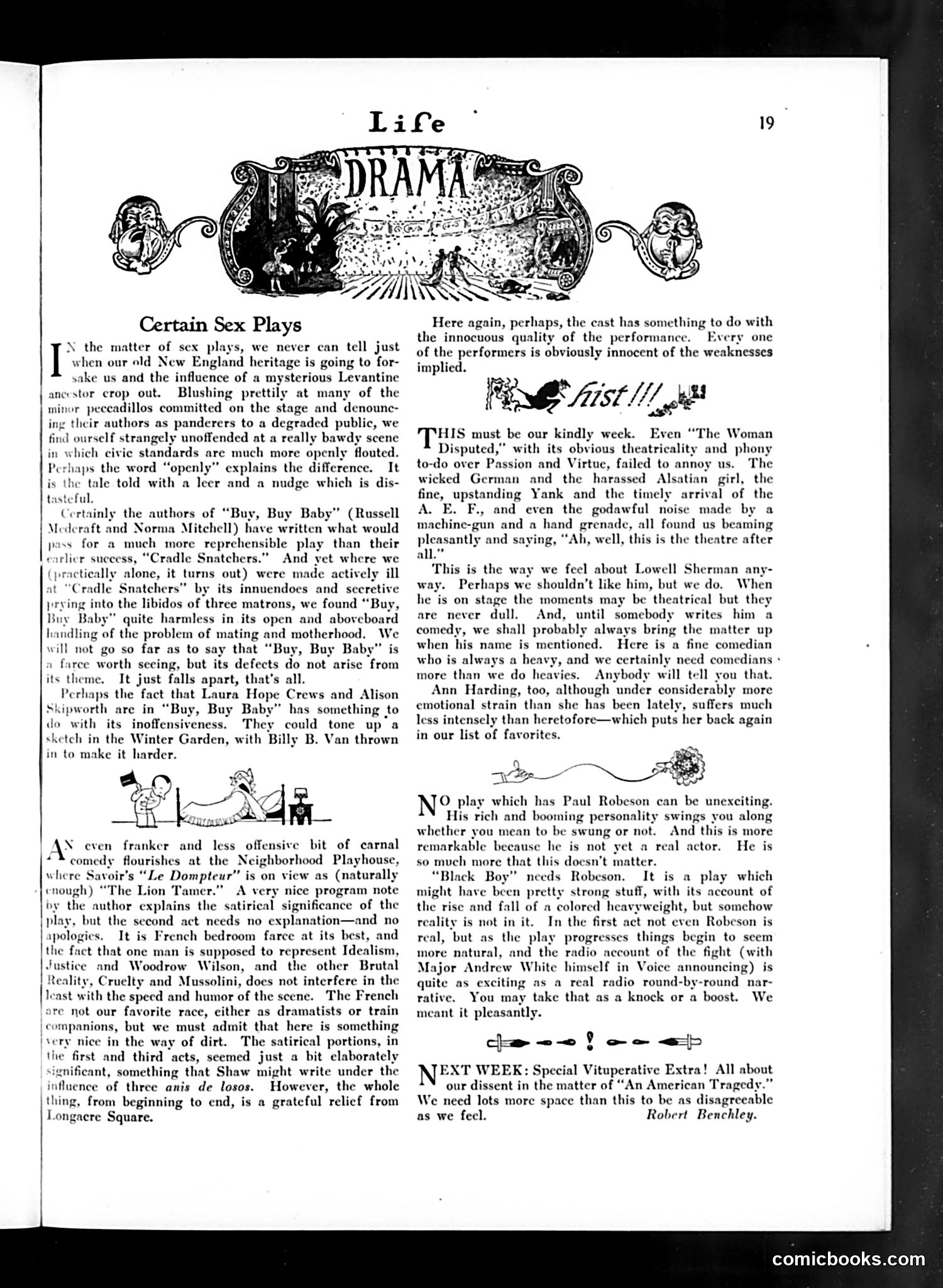
This theater review critiques contemporary Broadway plays, distinguishing between *offensive* and *acceptable* depictions of sexual content. The author argues that openly bawdy scenes are less objectionable than plays that use innuendo and secrecy—the "leer and nudge" approach to sexuality offends New England sensibilities more than frank treatment does. The review praises specific productions: "Buy, Buy Baby" (despite being about mating and motherhood), the French farce "The Lion Tamer" at the Neighborhood Playhouse, and "The Woman Disputed." The author credits strong casts—particularly actors Laura Hope Crews, Alison Skipworth, Lowell Sherman, and Ann Harding—with making morally questionable material palatable through talented, "innocent" performances. The underlying argument: honest vulgarity presented skillfully is preferable to suggestive prudishness. This reflects 1920s-era debates about theatrical decency and changing American moral standards.
📄 Transcribed text from this page (OCR, searchable)
Machine-transcribed from the original scan — historical spelling and the odd misread are preserved.
Certain Sex Plays N the matter of sex plays, we never can tell just when our old New England heritage is going to for- sake us and the influence of a mysterious Levantine ancestor crop out. Blushing prettily at many of the minor peccadillos committed on the stage and denounc- ing their authors as panderers to a degraded public, we find ourself strangely unoffended at a really bawdy scene in which civic standards are much more openly flouted. Perhaps the word “openly” explains the difference. It is the tale told with a leer and a nudge which is dis- tasteful. Certainly the authors of “Buy, Buy Baby” (Russell Mederaft and Norma Mitchell) have written what would pass for a much more reprehensible play than their earlier success, “Cradle Snatchers.” And yet where we (practically alone, it turns out) were made actively ill at “Cradle Snatchers” by its innuendoes and secretive prying into the libidos of three matrons, we found “Buy, Buy Baby” quite harmless in its open and aboveboard handling of the problem of mating and motherhood. We will not go so far as to say that “Buy, Buy Baby’’ is 1 farce worth seeing, but its defects do not arise from its theme. It just falls apart, that’s all. Perhaps the fact that Laura Hope Crews and Alison Skipworth are in “Buy, Buy Baby’ has something to do with its inoffensiveness. They could tone up a sketch in the Winter Garden, with Billy B. Van thrown in to make it harder. Kou Ade even franker and less offensive bit of carnal comedy flourishes at the Neighborhood Playhouse, where oir’s “Le Dompteur” is on view as (naturally enough) “The Lion Tamer.” A very nice program note by the author explains the satirical significance of the jplay, but the second act needs no explanation—and no apologies. It is French bedroom farce at its best, and the fact that one man is supposed to represent Idealism, Justice and Woodrow Wilson, and the other Brutal ity, Cruelty and Mussolini, does not interfere in the st with the speed and humor of the scene. The French are not our favorite race, either as dramatists or train companions, but we must admit that here is something |very nice in the way of dirt. The satirical portions, in the first and third acts, seemed just a bit elaborately gnificant, something that Shaw might write under the influence of three anis de losos. However, the whole thing, from beginning to end, is a grateful relief from Longacre Square. Here again, perhaps, the cast has something to do with the innocuous quality of the performance. Every one of the performers is obviously innocent of the weaknesses implied. PEE StH, ood HIS must be our kindly week. Even ‘The Woman Disputed,” with its obvious theatricality and phony to-do over Passion and Virtue, failed to annoy us. The wicked German and the harassed Alsatian girl, the fine, upstanding Yank and the timely arrival of the A. E. F., and even the godawful noise made by a machine-gun and a hand grenade, all found us beaming pleasantly and saying, “Ah, well, this is the theatre after all.” This is the way we feel about Lowell Sherman any- way. Perhaps we shouldn't like him, but we do. When he is on stage the moments may be theatrical but they are never dull, And, until somebody writes him a comedy, we shall probably always bring the matter up when his name is mentioned. Here is a fine comedian who is always a heavy, and we certainly need comedians more than we do heavies. Anybody will tell you that. Ann Harding, too, although under considerably more emotional strain than she has been lately, suffers much less intensely than heretofore—which puts her back again in our list of favorites. os SREY Vn \_ FS} N° play which has Paul Robeson can be unexciting. His rich and booming personality swings you along whether you mean to be swung or not. And this is more remarkable because he is not yet a real actor. He is so much more that this doesn’t matter. Black Boy’ needs Robeson. It is a play which might have been pretty strong stuff, with its account of the rise and fall of a colored heavyweight, but somehow reality is not in it. In the first act not even Robeson is real, but as the play progresses things begin to seem more natural, and the radio account of the fight (with Major Andrew White himself in Voice announcing) is quite as exciting as a real radio round-by-round nar- rative. You may take that as a knock or a boost. We meant it pleasantly. XT WEEK: Special Vituperative Extra! All about our dissent in the matter of “An American Tragedy.” We need lots more space than this to be as disagreeable as we feel. Robert Benchley. comicbooks.com