
A complete issue · 44 pages · 1926
Life — October 14, 1926
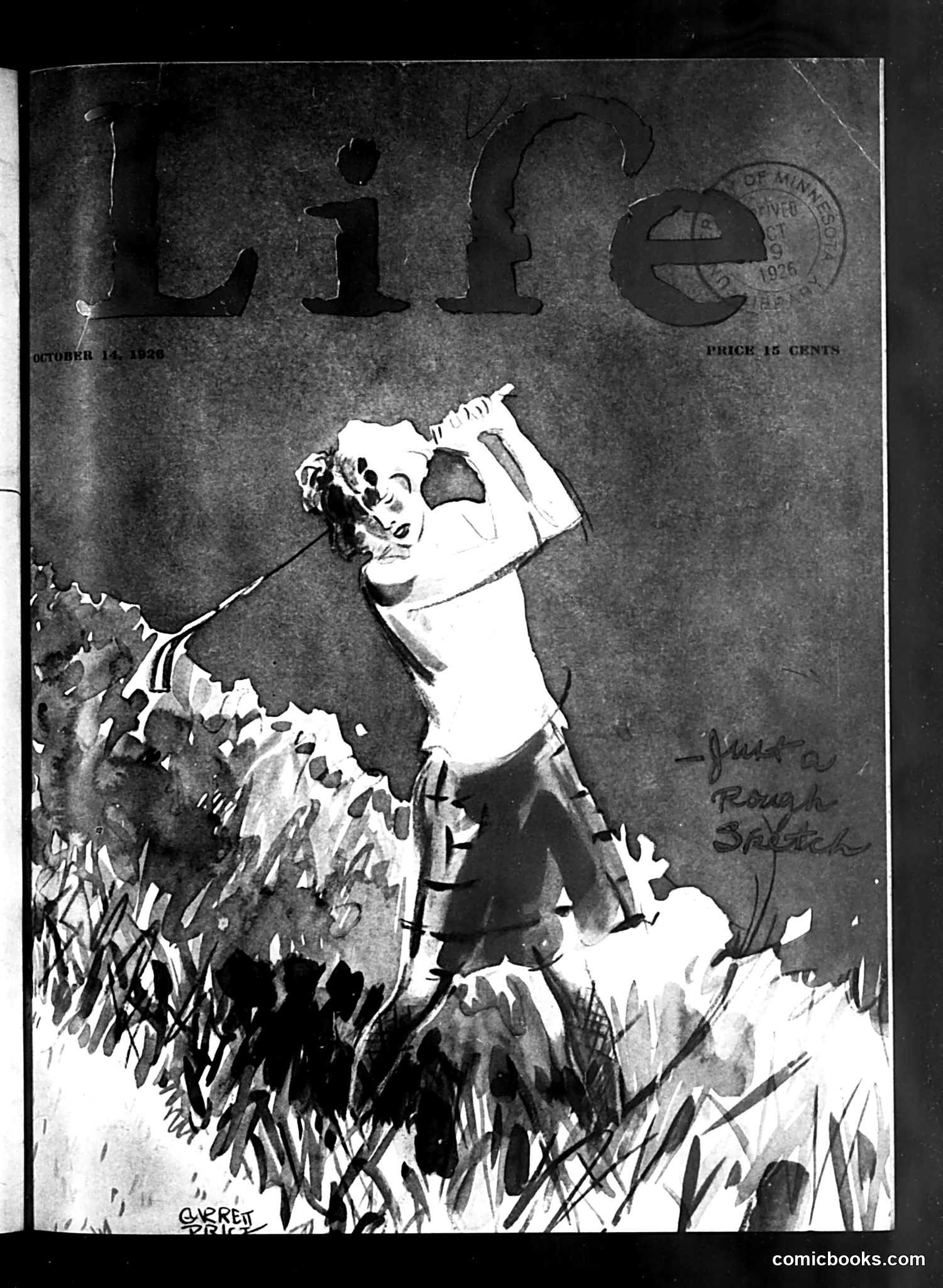
**October 14, 1926 | Price: 15 cents** This cover features a caricatured figure with exaggerated facial features wielding an axe or hatchet among dried corn stalks. The artistic style suggests political satire, though the specific identity of the figure remains unclear without additional context. The handwritten annotation "Rough Sketch" indicates this may be preliminary artwork. The corn and rural setting suggest agricultural themes relevant to 1926 America. The aggressive pose with the weapon could reference destructive policies or attitudes toward farming. However, without definitive identification of the caricatured figure or specific event referenced, the exact satirical target—whether political figure, economic force, or social trend—cannot be determined with certainty from the image alone.
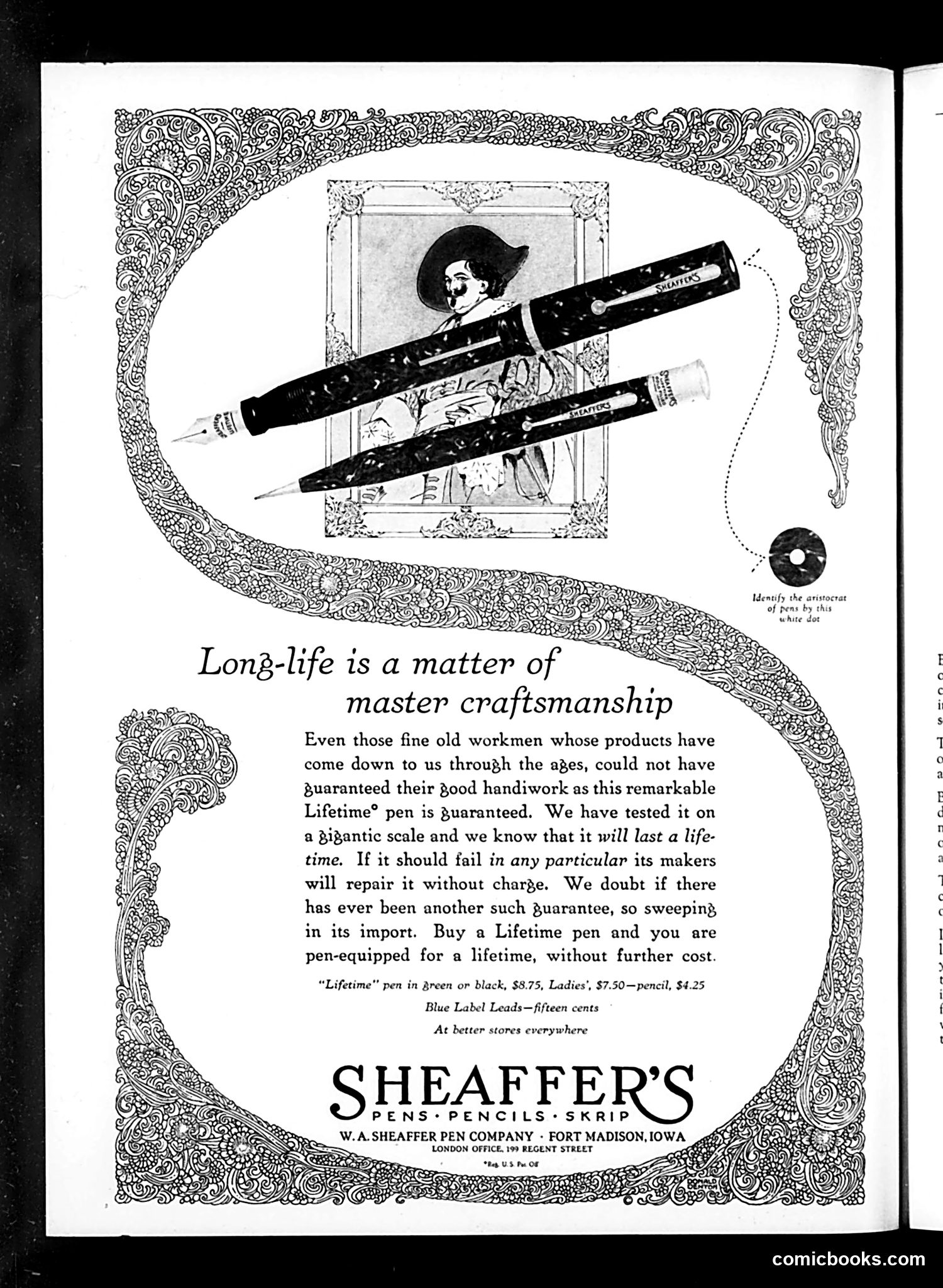
This page is primarily **advertising, not satire or political commentary**. It's a full-page advertisement for Sheaffer pens, a major American writing instrument manufacturer based in Fort Madison, Iowa. The ad features decorative ornamental borders and images of Lifetime pens (in green and black) alongside a small portrait illustration. The marketing message emphasizes the pen's durability and lifetime warranty—an unusual guarantee for the era. The text claims the Lifetime pen will last indefinitely and be repaired free if it fails. Pricing information is provided: fountain pens at $8.75 (green/black), ladies' version at $7.50, pencils at $4.25, and Blue Label Leads at fifteen cents. This represents straightforward commercial advertising from the early 20th century, not editorial cartooning or satire.
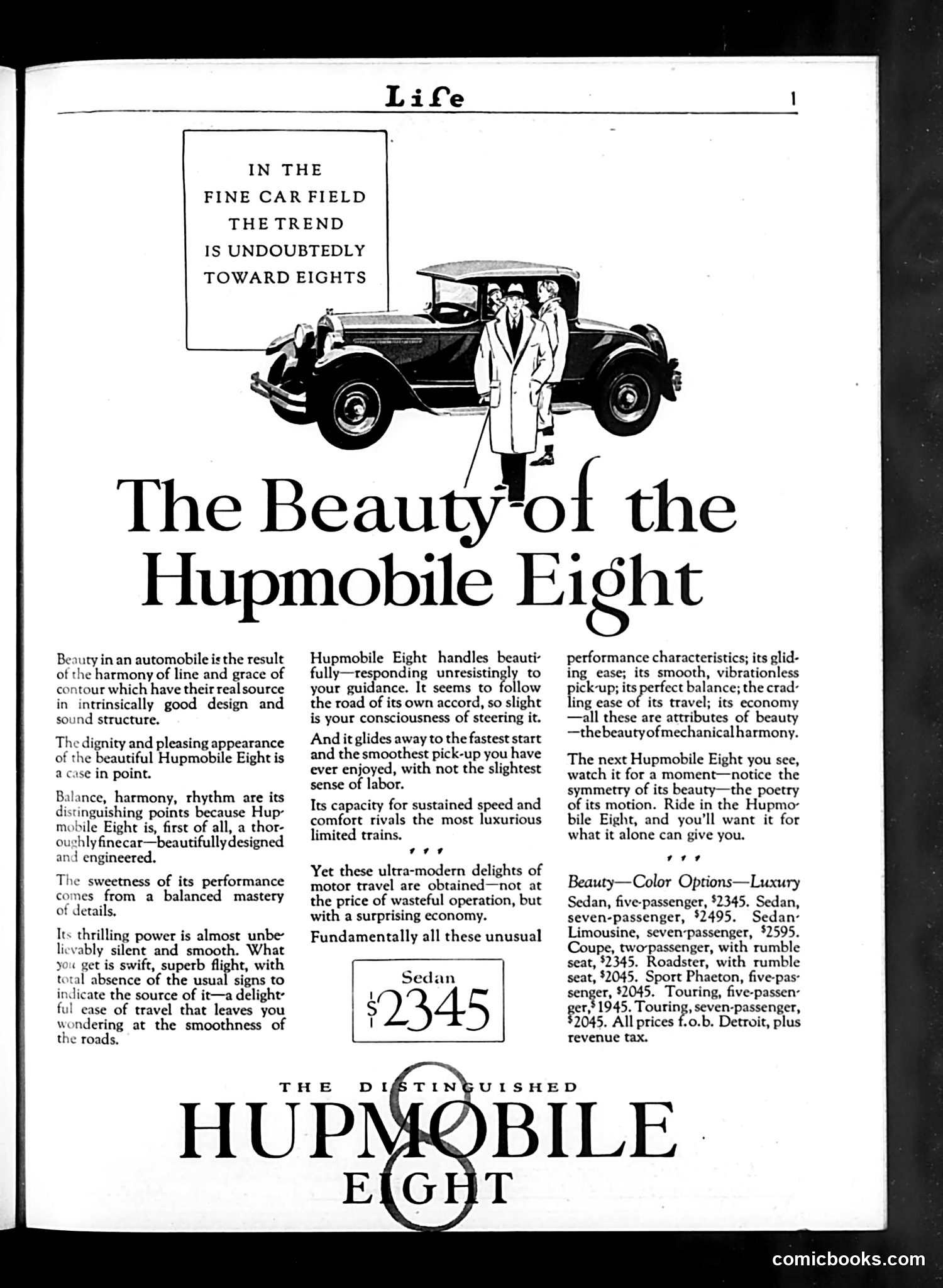
This is **not a political cartoon or satire**—it's a straightforward automobile advertisement for the Hupmobile Eight, appearing in *Life* magazine. The page promotes the car's aesthetic and mechanical qualities, using the language of luxury marketing: "beauty," "harmony," "balance," and "rhythm." The illustration shows well-dressed figures admiring the vehicle, a common advertising convention of the era. The "$2345" price point (for the Sedan model) and detailed trim options suggest this targets middle-to-upper-class buyers. The advertisement emphasizes the Eight-cylinder engine as a desirable feature—"the trend is undoubtedly toward eights"—reflecting 1920s automotive competition based on engine size and performance. This represents commercial content typical of *Life* magazine's mixed editorial-advertising format, not satirical commentary.
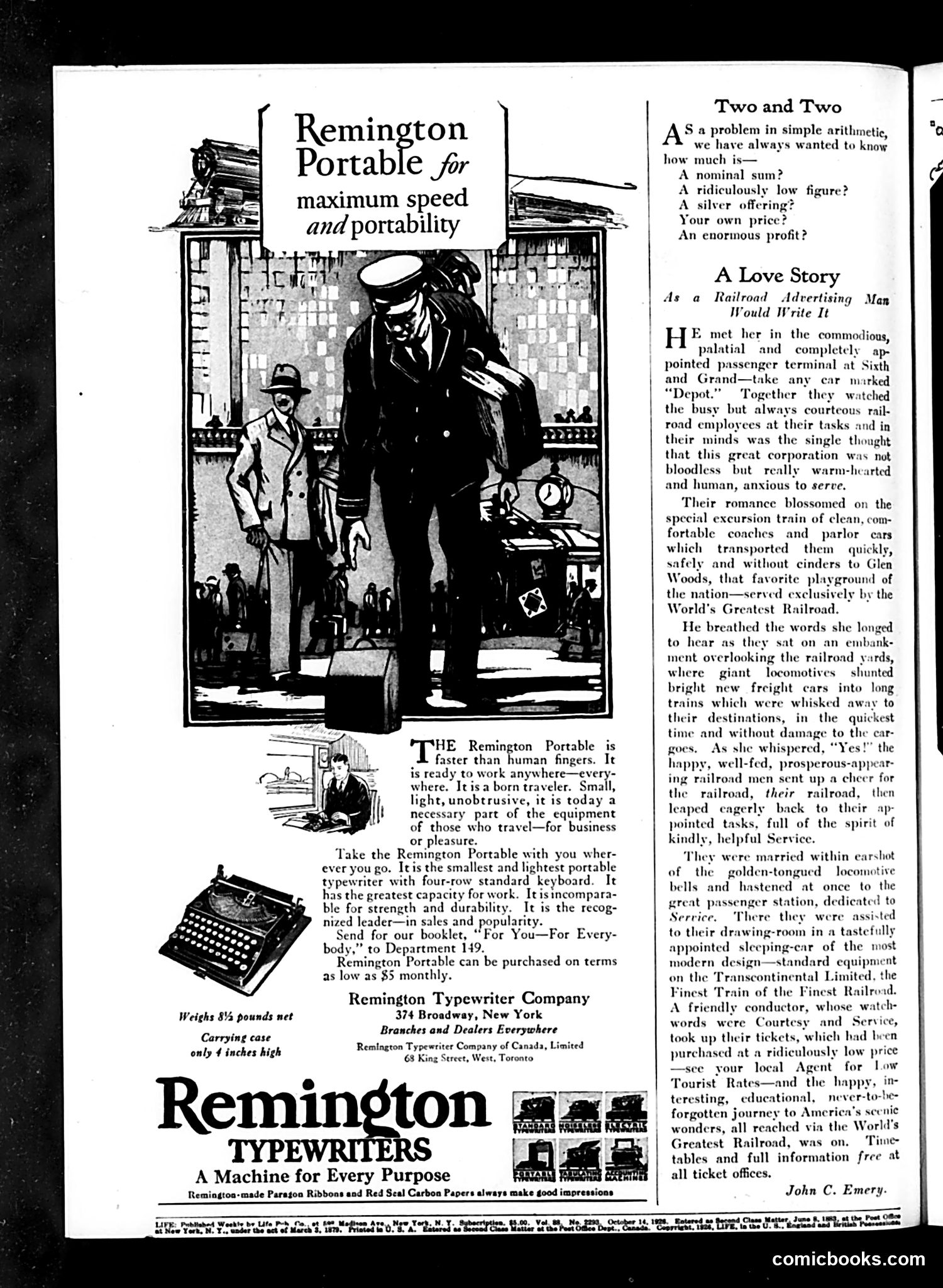
This page is primarily **advertising**, not satire or political commentary. The left side features a Remington Portable typewriter ad with an illustration of a large conductor or railroad official dwarfing smaller figures at a train station. The copy emphasizes the typewriter's portability and speed—"faster than human fingers." The right side contains "A Love Story As a Railroad Advertising Man Would Write It," a humorous advertisement disguised as romantic fiction. It satirizes **railroad advertising copy itself**—the overwrought, purple prose railroads used to market their services. The story parodies how advertisers romanticized train travel, describing locomotives and coaches in flowery language while promoting specific railroad services and tourist routes. Both ads use humor to sell products, but neither engages political or social critique.
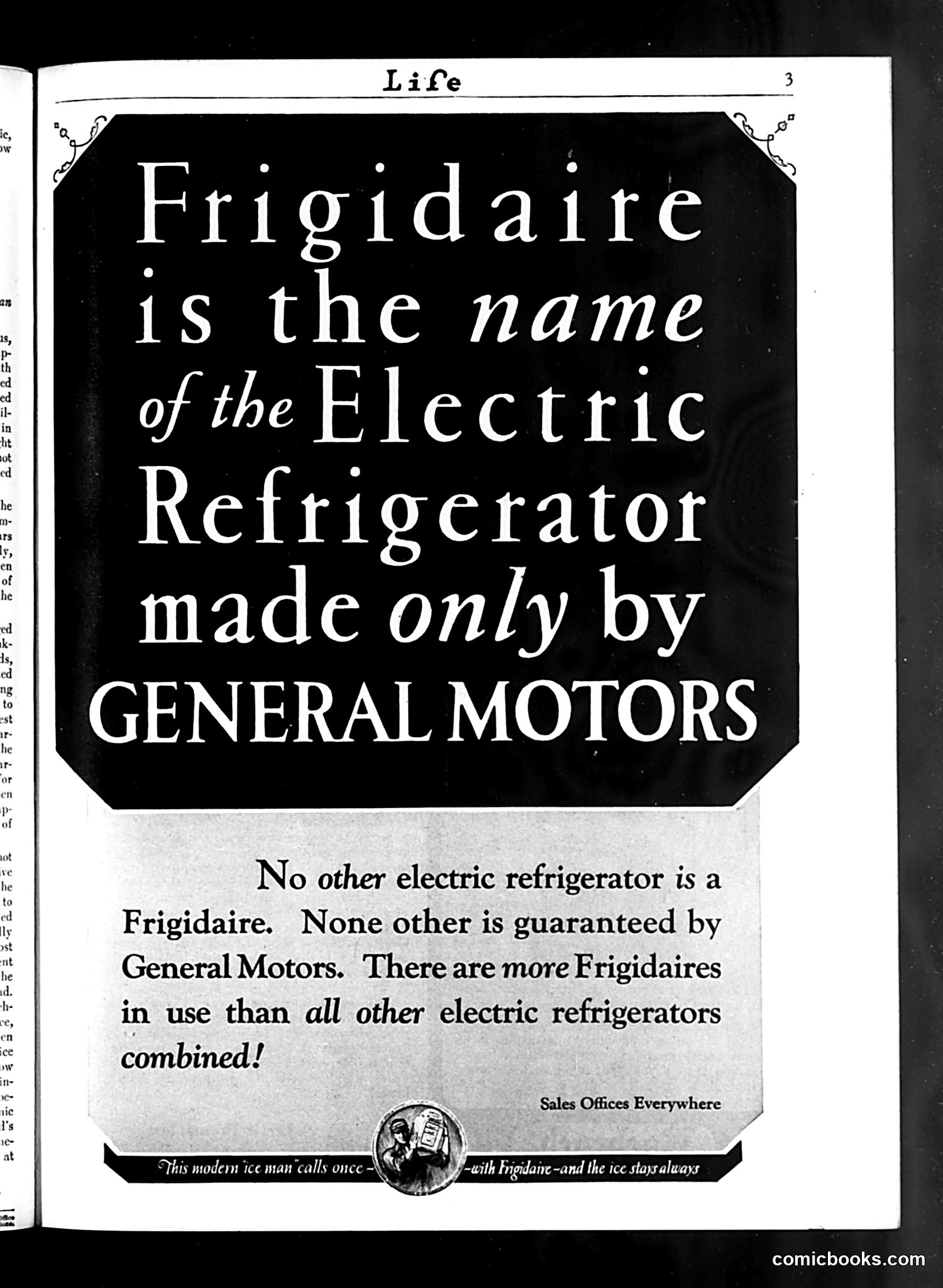
This page is **primarily an advertisement**, not a satirical cartoon or political content. It's a Frigidaire electric refrigerator ad from Life magazine (page 3). The ad makes bold commercial claims: Frigidaire is the only electric refrigerator made by General Motors, and there are "more Frigidaires in use than all other electric refrigerators combined!" The small illustration at bottom shows "the modern ice man" calling on customers with Frigidaire—a reference to the obsolete profession of ice delivery, which electric refrigerators were replacing. The joke is that this occupation is becoming outdated. This reflects early 20th-century marketing positioning Frigidaire as the dominant, trustworthy refrigerator brand during the transition from ice-box to electric cooling technology.
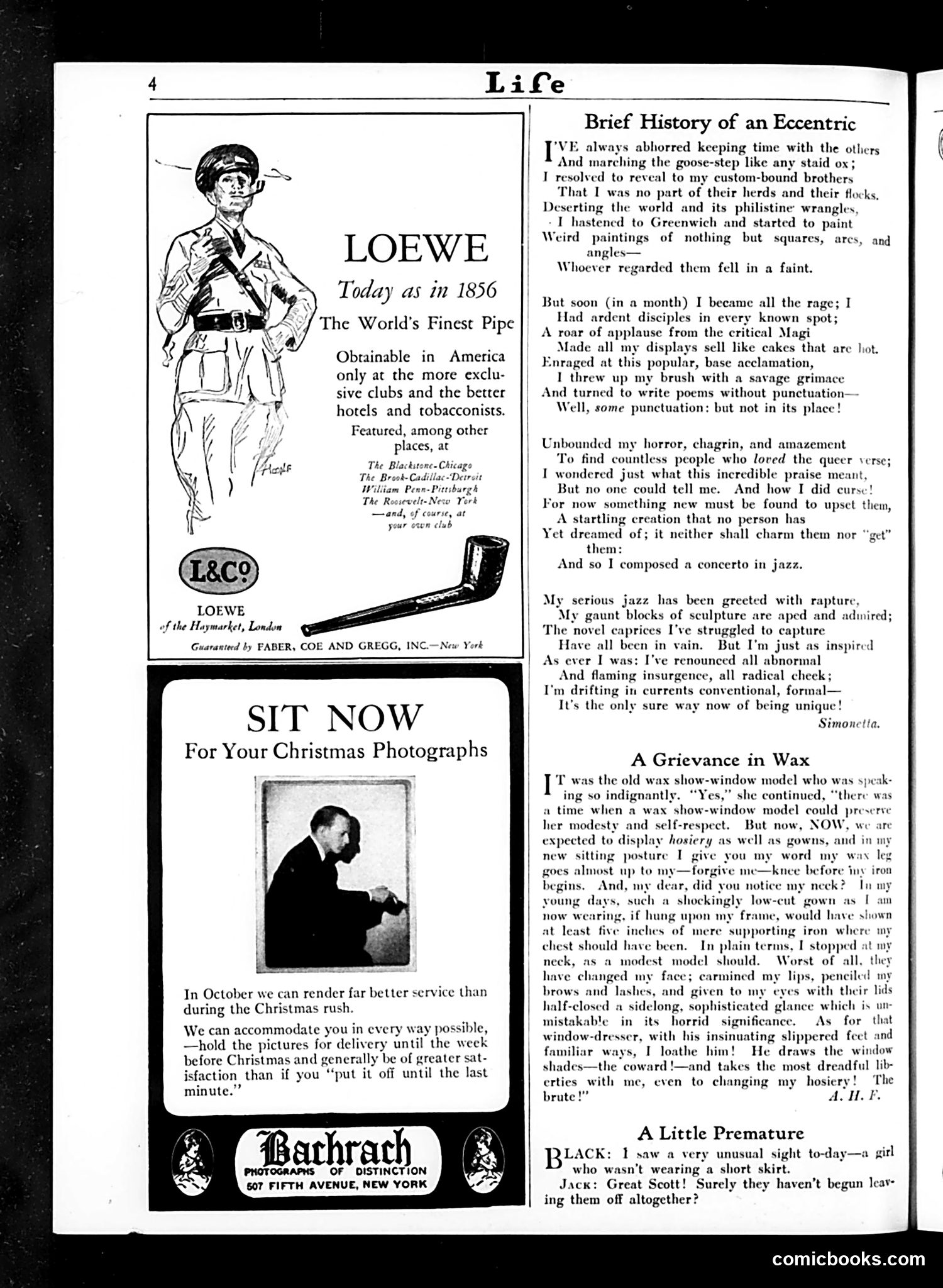
This page is primarily **advertising and humorous fiction** rather than political satire. The left side features a **Loewe pipe advertisement** (1856 product), showing a man in military dress. Below is a **Bachrach photography studio ad** promoting Christmas portrait sittings in October to avoid holiday rush. The right side contains three **humor pieces**: 1. "Brief History of an Eccentric" — a poem by "Simonetta" mocking an artist who became obsessed with modernist art movements (jazz concerts, abstract sculpture, radical poetry) after initially painting conventional landscapes. 2. "A Grievance in Wax" — satire about a wax museum model complaining she's displayed in undignified poses and revealing clothing. 3. "A Little Premature" — a brief joke about a girl not wearing a skirt. These are light social satire targeting artistic pretension and changing fashion standards.
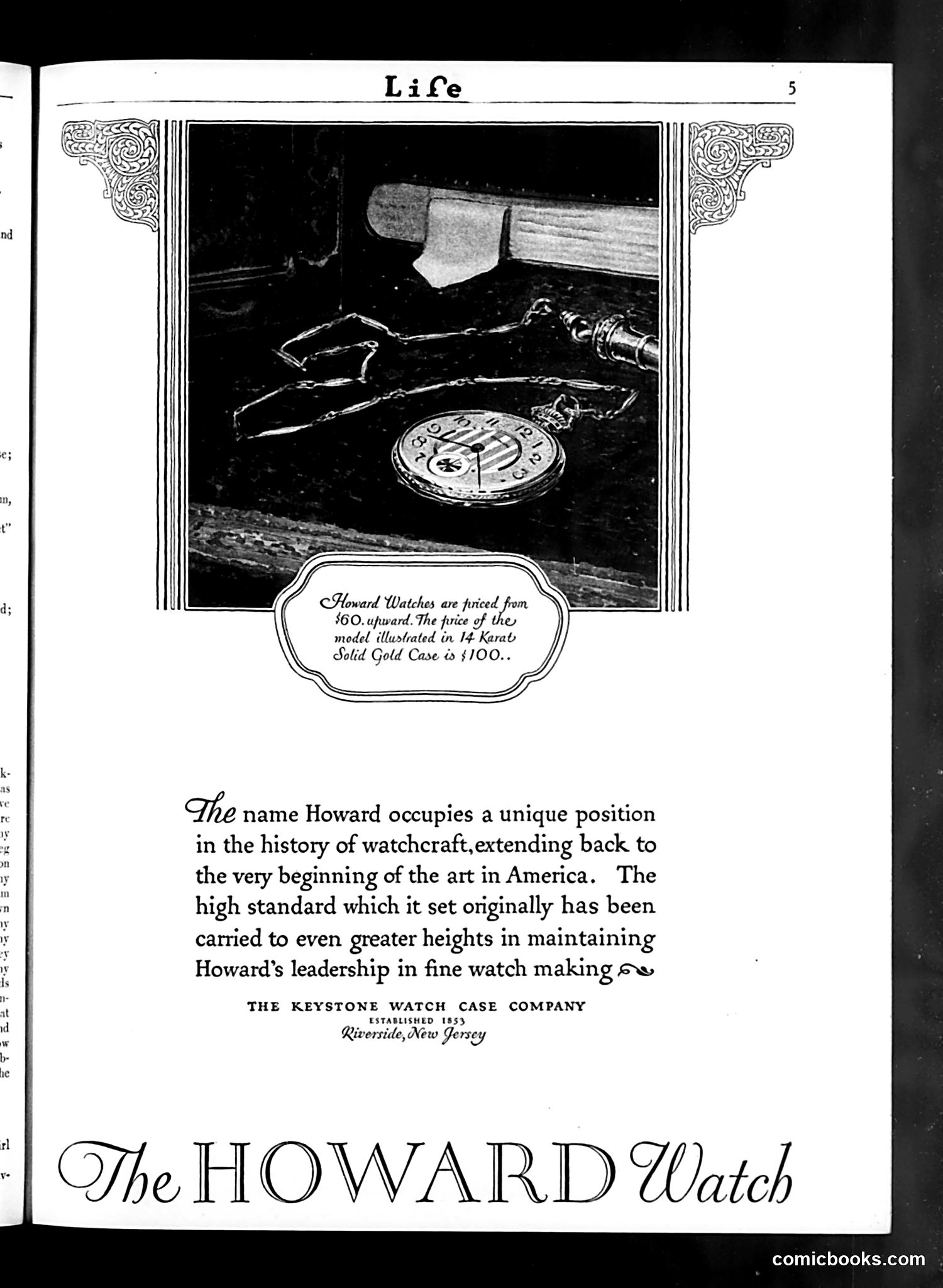
This is an advertisement for Howard watches, not a political cartoon. The page displays a photograph of a pocket watch with its case opened, along with watch tools and components arranged artfully around it. The advertisement claims that Howard watches are "priced from $60 upward," with the model shown in a 14-karat solid gold case costing $100. The text emphasizes Howard's historical importance in American watchmaking, describing the brand's "unique position" dating back to "the very beginning of the art in America." This is straightforward commercial advertising positioning Howard as a premium, heritage timepiece brand. The Keystone Watch Case Company of Riverside, New Jersey manufactured these watches. There is no satire or political content on this page.
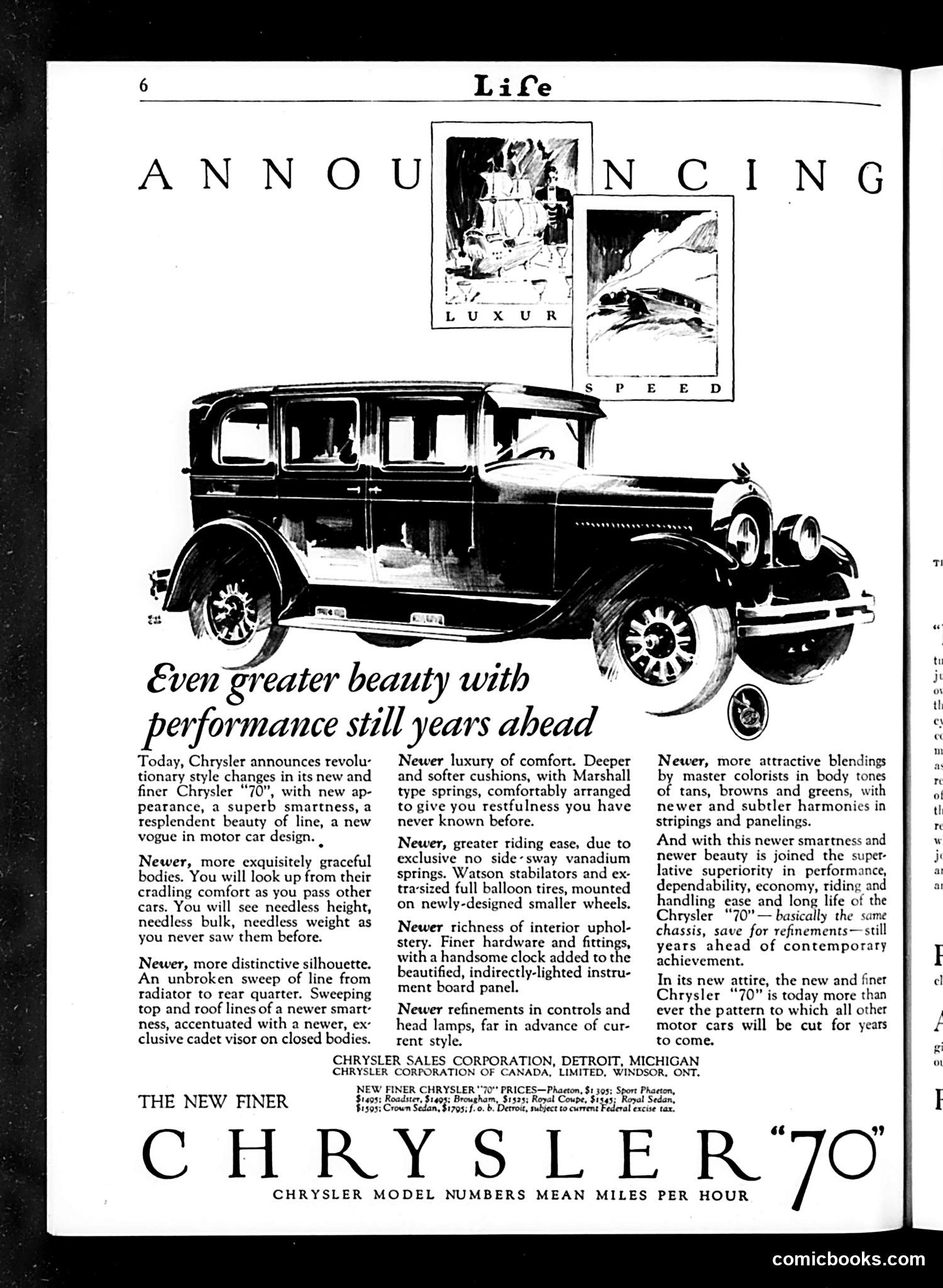
This is a **Chrysler automobile advertisement**, not political satire or a cartoon. The page announces the new Chrysler "70" model with claims of revolutionary improvements: graceful body design, reduced weight and bulk, new interior luxury, improved riding ease, better controls, and attractive color options. The two small illustrations in the upper right (labeled "LUXUR" and "SPEED") appear to be product highlights rather than satirical commentary. The large central image shows the vehicle itself in a detailed technical illustration style typical of 1920s advertising. There is no political cartoon or satirical content on this page. It is straightforward commercial advertising from *Life* magazine's advertising section, promoting automotive features and performance to potential buyers.
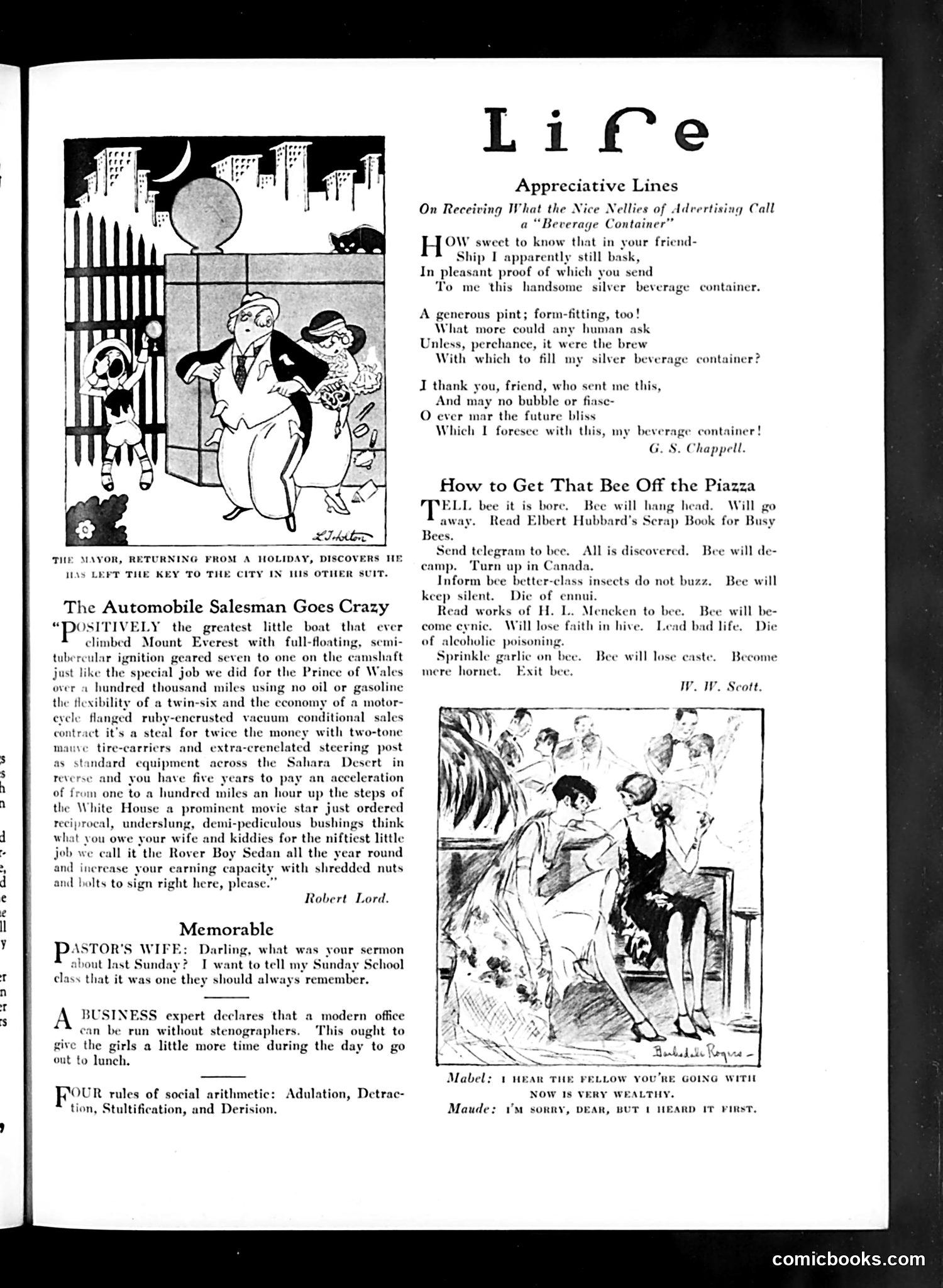
This page contains humor pieces rather than political cartoons. The main cartoon (top left) shows a mayor returning from holiday discovering his gift—a silver beverage container—has arrived, with appreciative verses by G.S. Chappell praising the sender's generosity. Below, "The Automobile Salesman Goes Crazy" is a humorous ad-style piece mocking over-the-top sales pitches, using exaggerated claims about a vehicle's capabilities (Mount Everest climbing, desert crossing) to satirize aggressive 1920s advertising language. The bottom cartoon depicts a social comedy about wealth: "Mabel" overhears her companion is now wealthy, expressing surprise since she "heard it first"—poking fun at how gossip and social status updates spread among society circles. The page is primarily light social satire and humor rather than serious political commentary.
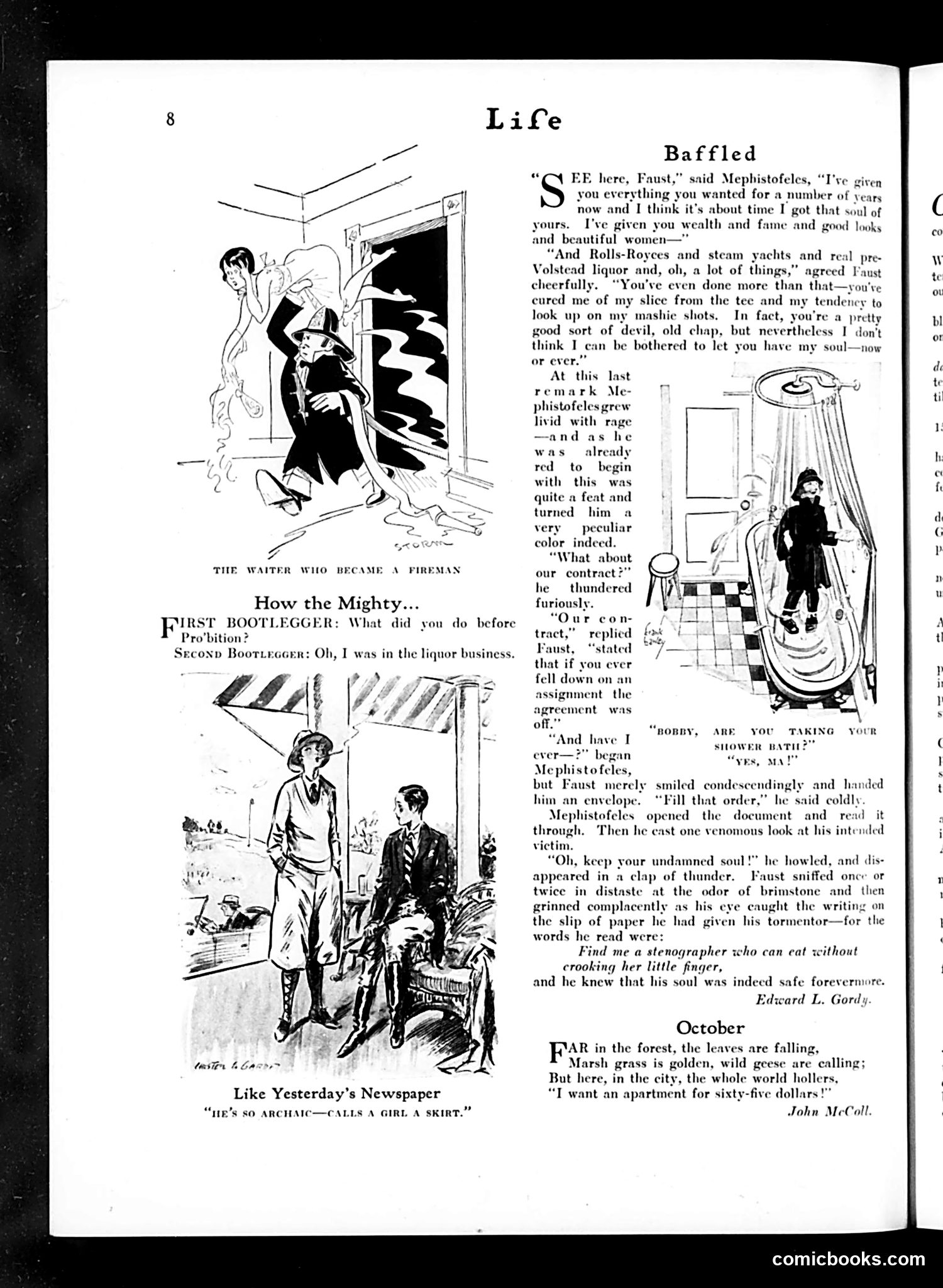
This page contains three separate satirical pieces: **"Baffled"** (top right): A story about Mephistofeles (the devil figure from Faust legend) becoming frustrated with Faust because he's already obtained everything promised—wealth, fame, women—yet remains unsatisfied. The joke is that modern material success doesn't bring happiness, leaving even the devil baffled. **"How the Mighty..."** (bottom left): A comic dialogue between two bootleggers discussing their prior occupations. The first worked as a waiter; the second in liquor. The satire mocks Prohibition-era bootleggers and organized crime. **"October"** (bottom right): A short poem by John McCall contrasting autumn's natural beauty with urban poverty ("I want an apartment for sixty-five dollars"). These pieces collectively satirize modern American materialism, criminal enterprise during Prohibition, and economic inequality.
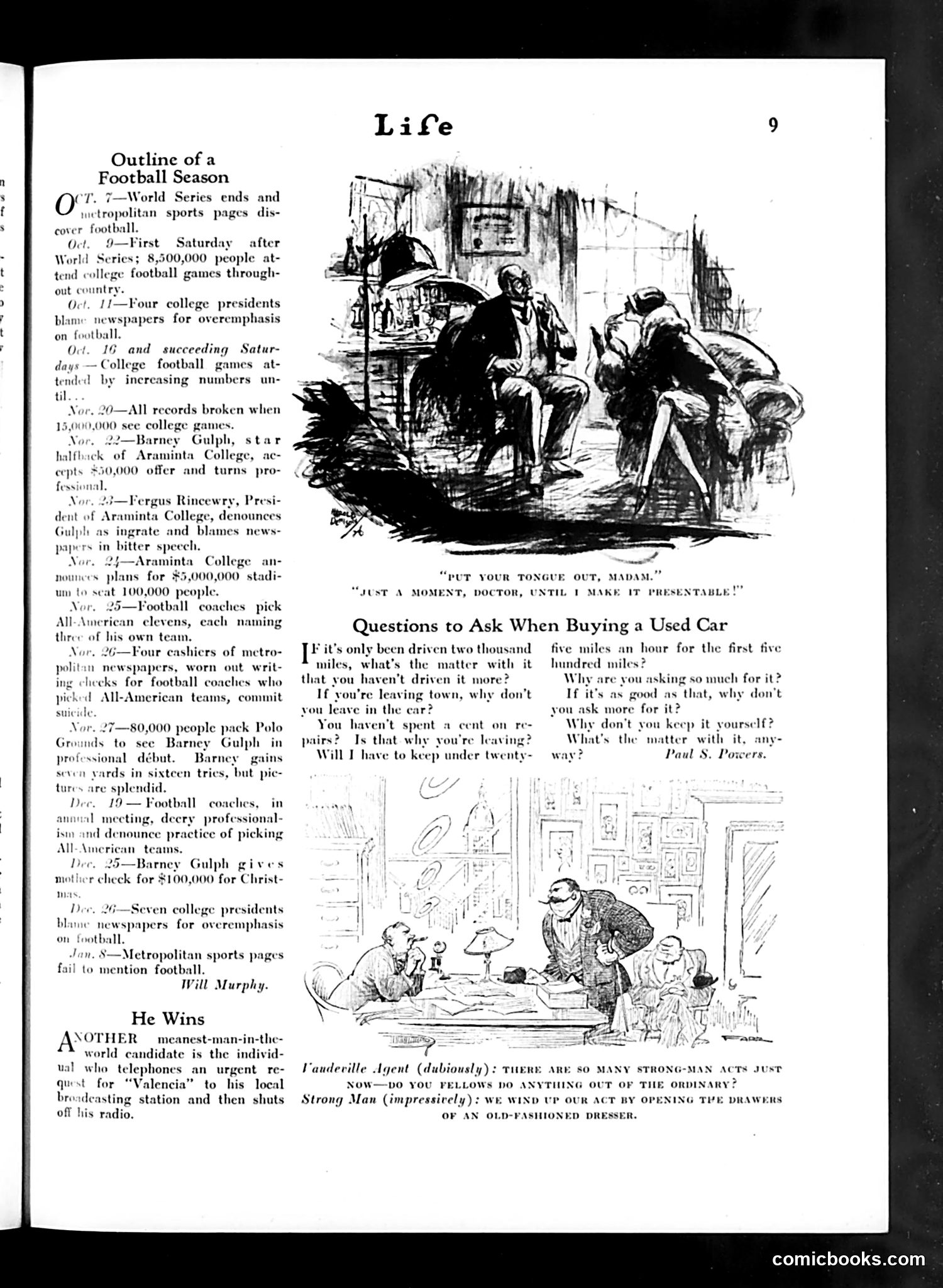
This page contains three distinct pieces of satirical content: **"Outline of a Football Season"** (left column): A timeline mocking college football's dominance in American life, suggesting newspapers over-emphasized the sport and that it caused various social disruptions. **Top cartoon**: Shows men in discussion with caption "Put your tongue out, madam" / "Just a moment, doctor, until I make it presentable!" — appears to satirize social pretension or dishonest behavior masked for public appearance. **"Questions to Ask When Buying a Used Car"**: Practical consumer advice humorously presented, poking fun at used-car salesmen's deceptive practices. **Bottom cartoon** (captioned about "Strong-Man Acts"): Depicts men discussing opening a dresser drawer, mocking exaggerated "strongman" performers from vaudeville who claimed superhuman feats. The humor lies in contrasting their supposed strength with mundane domestic tasks.
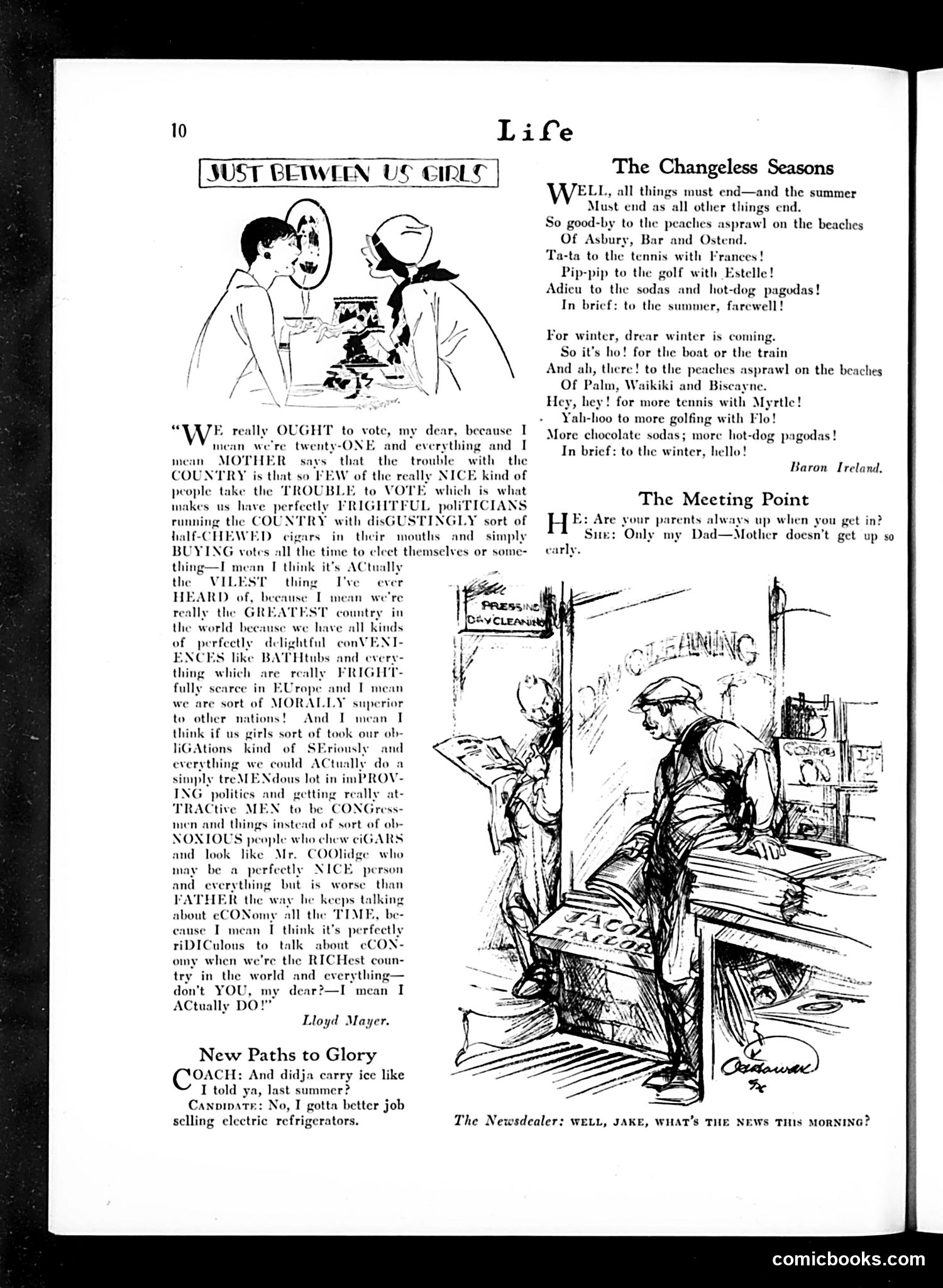
This page contains three satirical pieces mocking early-20th-century American politics and social conventions: 1. **"Just Between Us Girls"** cartoon depicts two women discussing voting rights. One argues women should vote because they're "twenty-one" and deserve political participation. The other sarcastically responds that women are "morally superior" to men—implying that if women truly were superior, they wouldn't need to engage in the "vilest" and most corrupt aspects of politics like buying votes with cigars and money. 2. **"The Changeless Seasons"** is a brief poem about summer and winter pleasures. 3. **"The Meeting Point"** cartoon shows a woman waiting by a sign marked "CLEVELAND," asking when her parents wake up; her father's only response is about the newspaper. The page satirizes female suffrage debates and gender dynamics of the era.
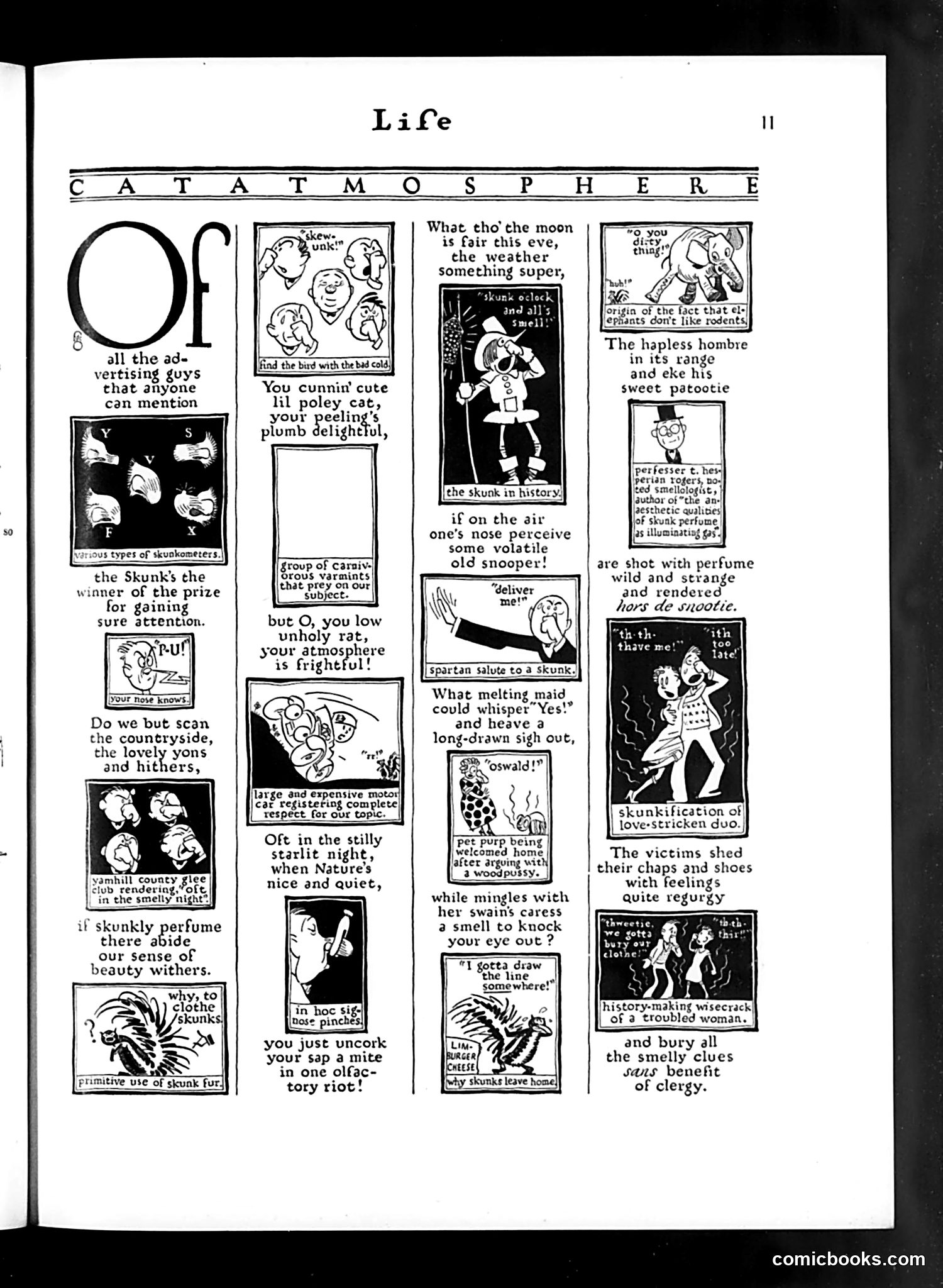
This page is a humorous essay celebrating skunks, structured as mock-serious commentary on the animal's qualities. The piece uses visual gags and satirical descriptions to lampoon human pretensions. The satire mocks: - **Advertising culture**: references to perfume and cosmetics (skunks as unwitting beauty entrepreneurs) - **Polite society**: the contrast between skunks' natural "perfume" and civilized people's efforts to mask odors - **Romance and courtship**: multiple jokes about skunks' scent attracting (or repelling) potential mates - **Social conventions**: descriptions of chaos caused by skunk encounters, presented in faux-scholarly language The cartoons show various scenarios of skunks disrupting human situations. The overall effect is absurdist humor, treating a pest animal with exaggerated dignity while ridiculing human social anxieties about appearance and propriety.
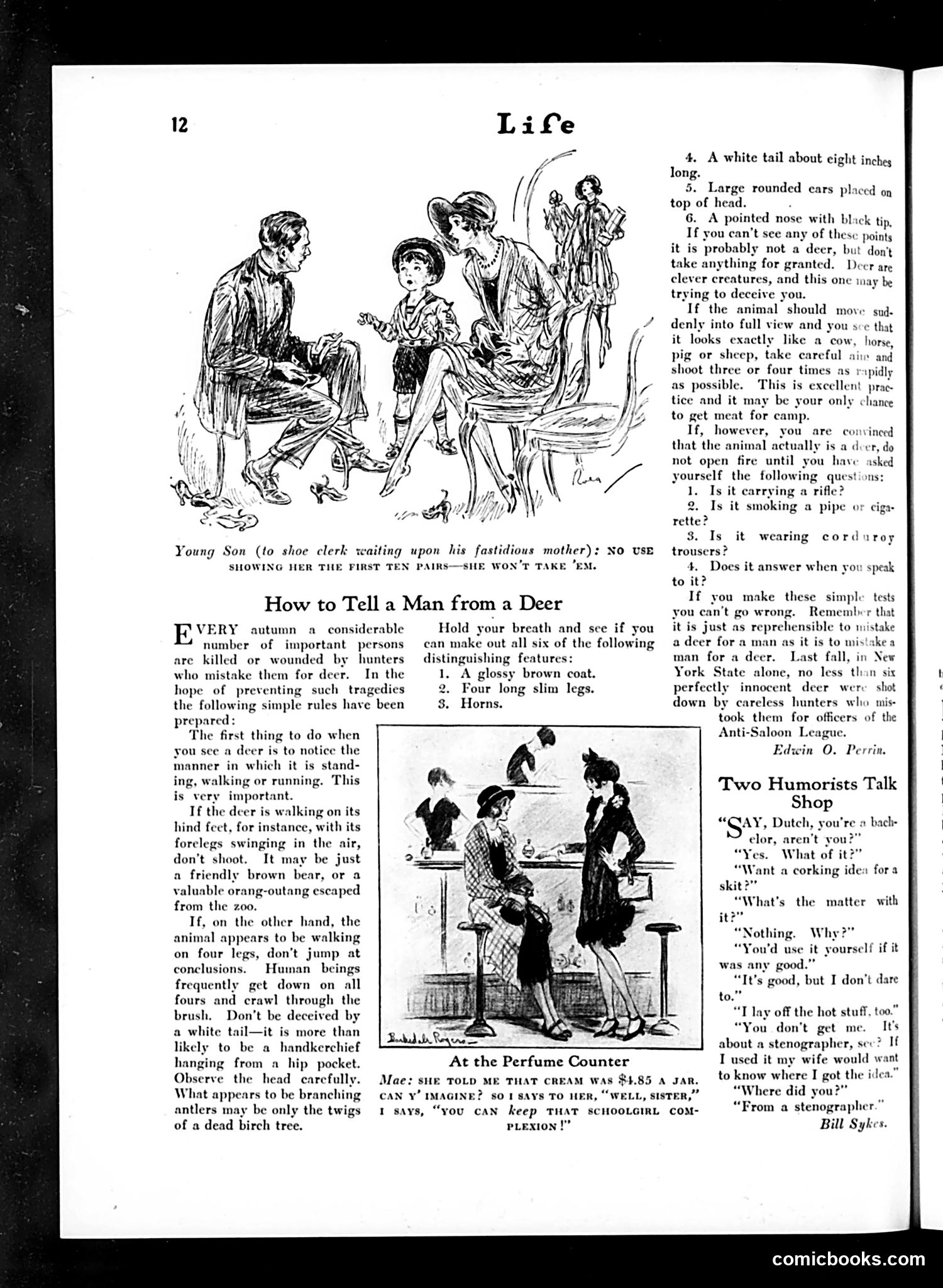
This page contains three distinct pieces of humor content: 1. **Top illustration**: A domestic scene showing a young son displaying new shoes to his mother, captioned "Young Son (to shoe clerk waiting upon his fastidious mother): NO USE SHOWING HER THE FIRST TEN PAIRS—SHE WON'T TAKE 'EM." The joke satirizes a fastidious (overly particular) mother's impossible standards as a consumer. 2. **"How to Tell a Man from a Deer"**: A practical guide distinguishing between humans and deer to prevent accidental hunting deaths. It lists identifying features (glossy coat, horns, slim legs) and behavioral tests (does it carry a rifle? smoke a pipe?). This reflects real safety concerns during hunting season. 3. **"At the Perfume Counter"** and **"Two Humorists Talk Shop"**: Brief comic dialogues about consumer products and stenographers, representing typical Life magazine humor of the period.
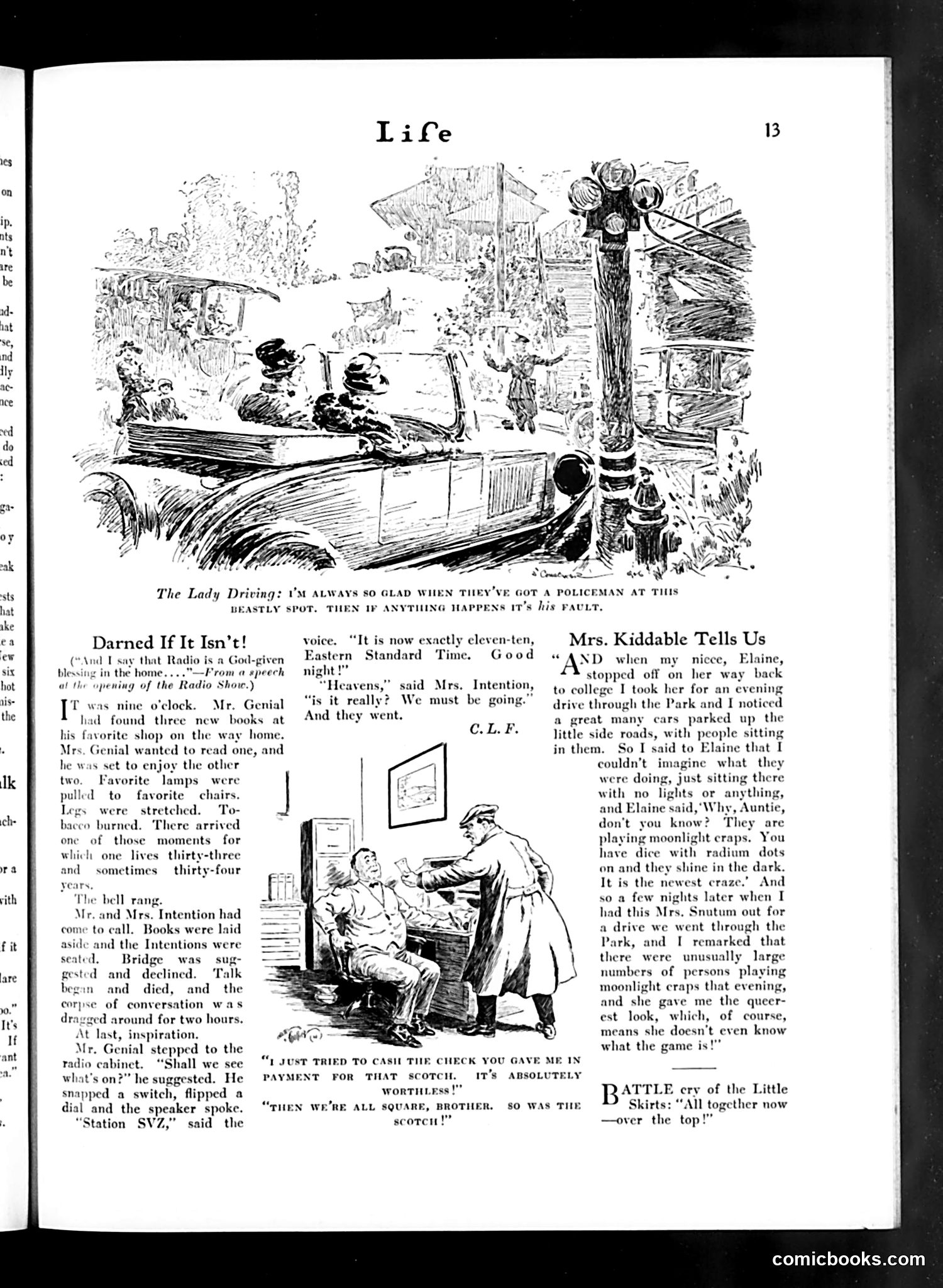
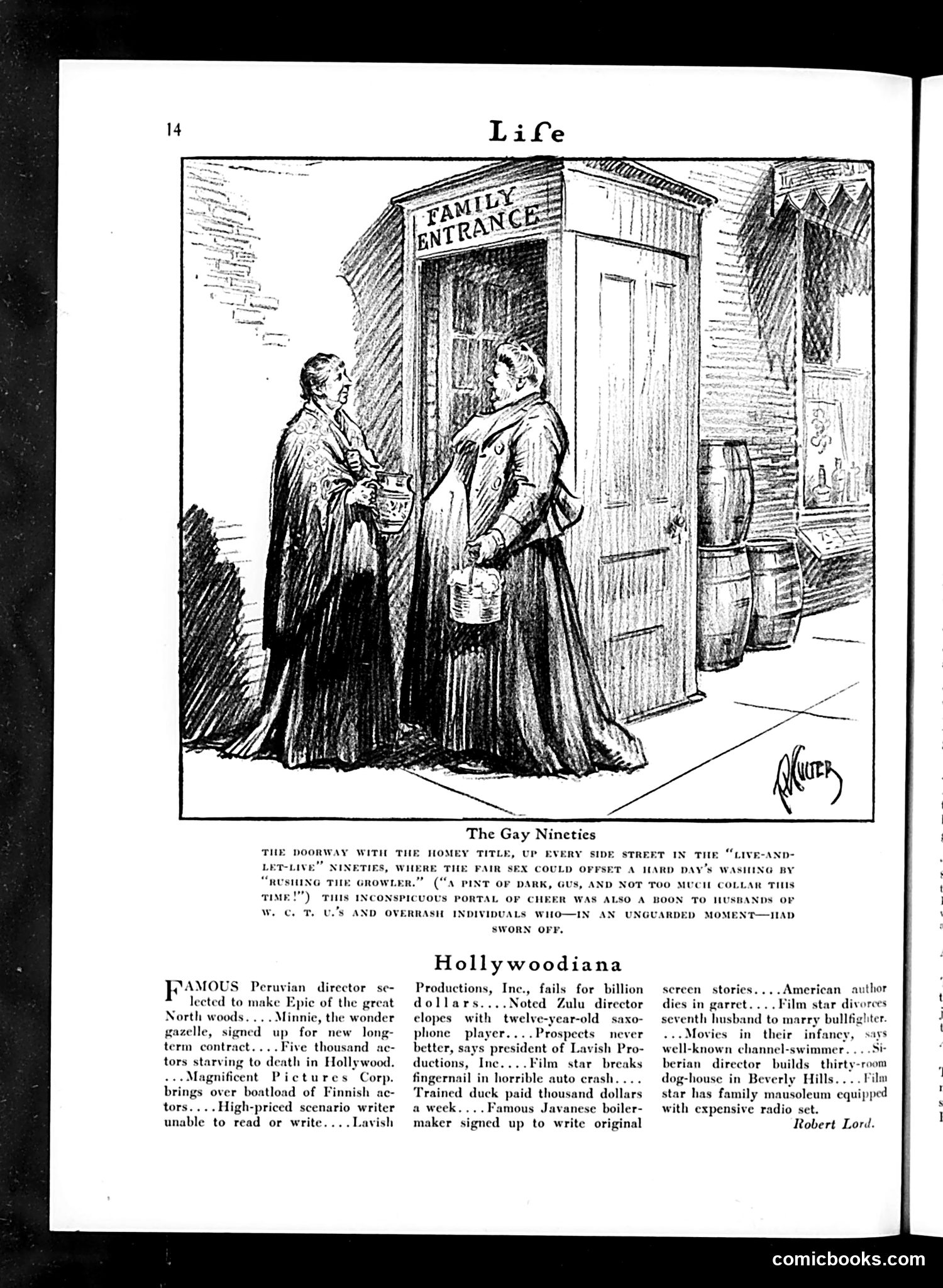
This page from *Life* magazine features a cartoon titled "The Gay Nineties" depicting two women at a "Family Entrance" doorway. The accompanying text satirizes a specific social practice: during the 1890s, women could enter certain establishments (likely saloons or theaters) through separate "family entrances" to avoid the stigma of being seen entering through the main entrance where less reputable activities occurred. The joke critiques this hypocrisy—the caption notes these entrances allowed "the fair sex" to offset moral disapproval while husbands engaged in questionable behavior. The cartoon mocks the pretense that separate entrances provided respectability when everyone knew what was actually happening inside. The "Hollywoodiana" section below contains brief Hollywood gossip items unrelated to the main cartoon.
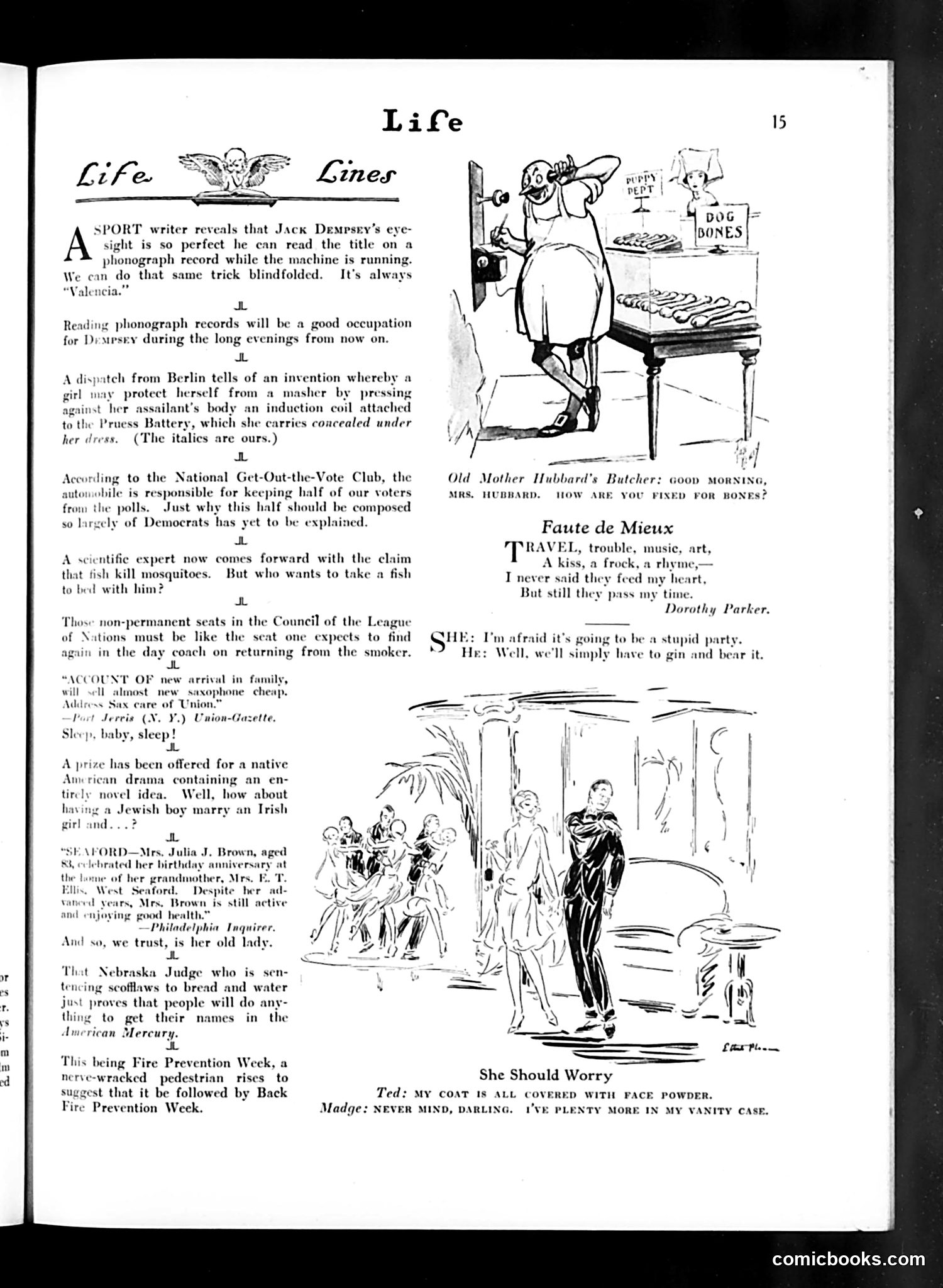
The page contains satirical "Life Lines" commentary and two illustrated cartoons. **Top cartoon** ("Old Mother Hubbard's Butcher"): Shows a butcher with a customer asking about bones, likely satirizing post-WWI meat rationing or shortages affecting ordinary households. **Bottom cartoon** ("She Should Worry"): Depicts a couple at what appears to be a formal event. The woman wears face powder despite her coat being covered in it; her companion dismisses her concern, joking he has "plenty more in my vanity case." This mocks the era's cosmetics obsession and women's vanity, a common satirical theme in 1920s magazines. The "Life Lines" section contains brief social commentary on topics like Jack Dempsey, inventions, and politics—typical of the magazine's gossipy, observational humor targeting contemporary urban culture and current events.
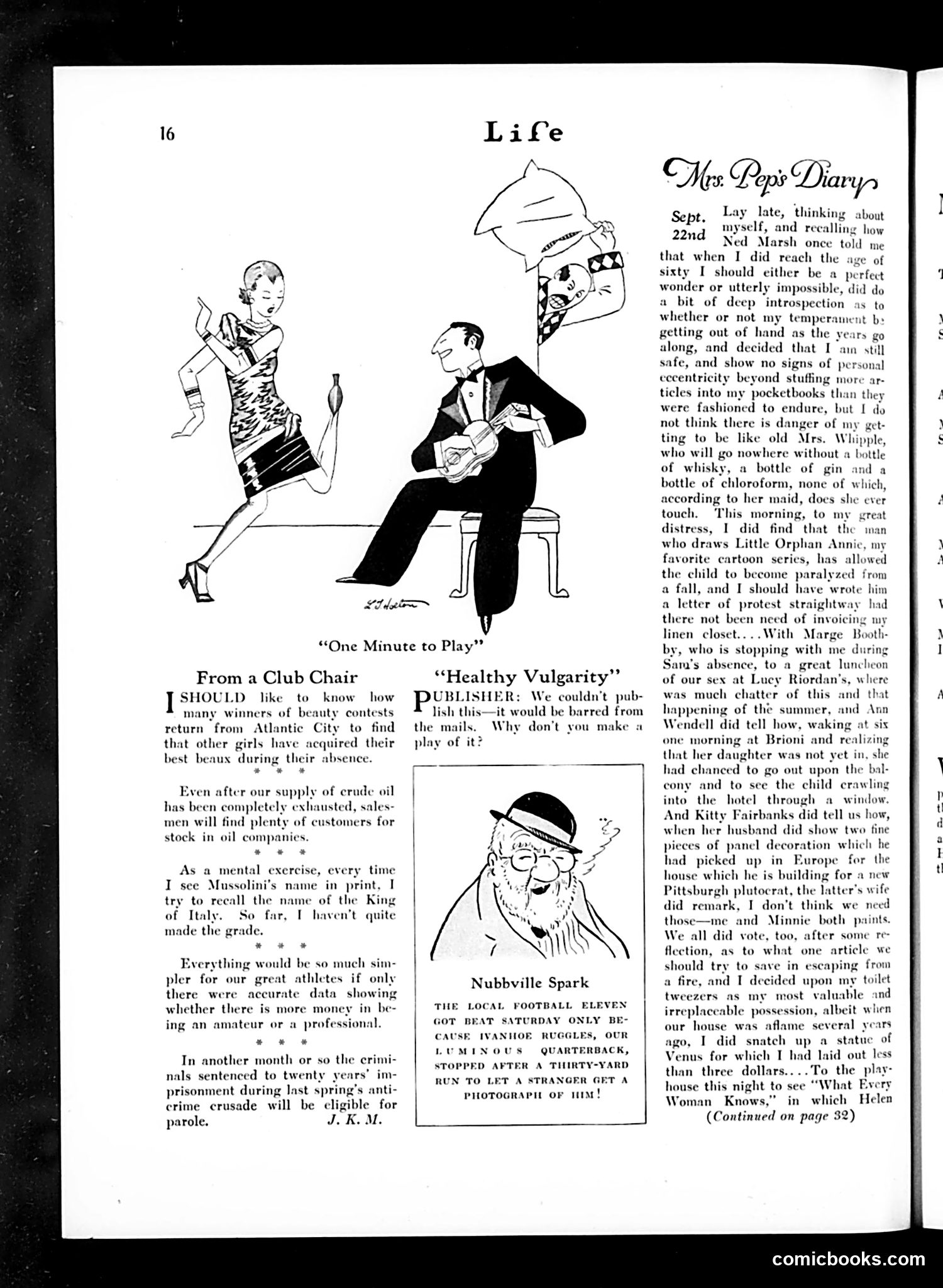
This page contains three separate satirical items from *Life* magazine: 1. **"One Minute to Play"** — A cartoon showing a man in formal wear apparently caught off-guard by a woman in athletic/casual dress, likely satirizing changing gender norms and women's increasing participation in sports and leisure activities during this era. 2. **"From a Club Chair"** — A column discussing beauty contests and crude oil supplies, suggesting satirical commentary on commercial and social priorities. 3. **"Nubbville Spark"** — A brief note about a local football player photographed with a stranger, appearing to be small-town gossip-style humor. 4. **"Mrs. Pop's Diary"** — A lengthy diary entry discussing the author's reflections on aging and social observations, with mentions of cartoonist developments and summer social events. The overall tone reflects early-to-mid 20th century satirical humor targeting gender roles, social pretension, and contemporary culture.
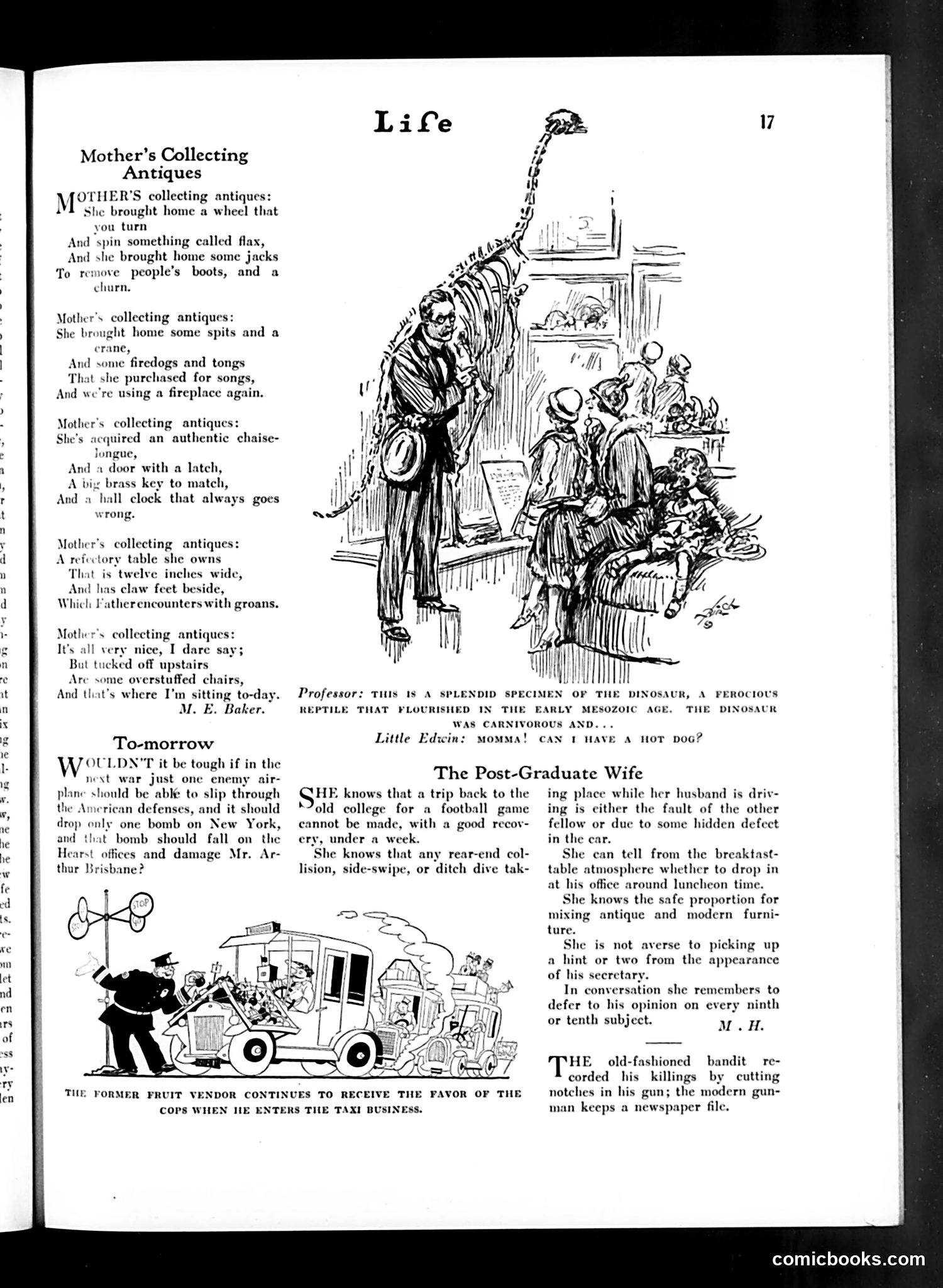
This page contains three separate humorous pieces: 1. **"Mother's Collecting Antiques"** (poem by M.E. Baker): A satirical verse about a mother accumulating household junk—broken wheels, flax, boot jacks, firedogs, tongs, a chaise-tongue door, and a refectory table—all justified as valuable "antiques." The joke mocks the 1920s fad for collecting old items as authentic period pieces. 2. **"To-morrow"**: A cartoon showing a fruit vendor operating a taxi, suggesting that during wartime (likely WWI), even street vendors diversified into taxi services to survive economically. 3. **"The Post-Graduate Wife"**: A prose piece describing an educated woman's domestic management skills—her ability to maintain proper household atmosphere and subtly defer to her husband's opinions—satirizing the expectations placed on wives of educated men. The dinosaur illustration appears unrelated editorial content.
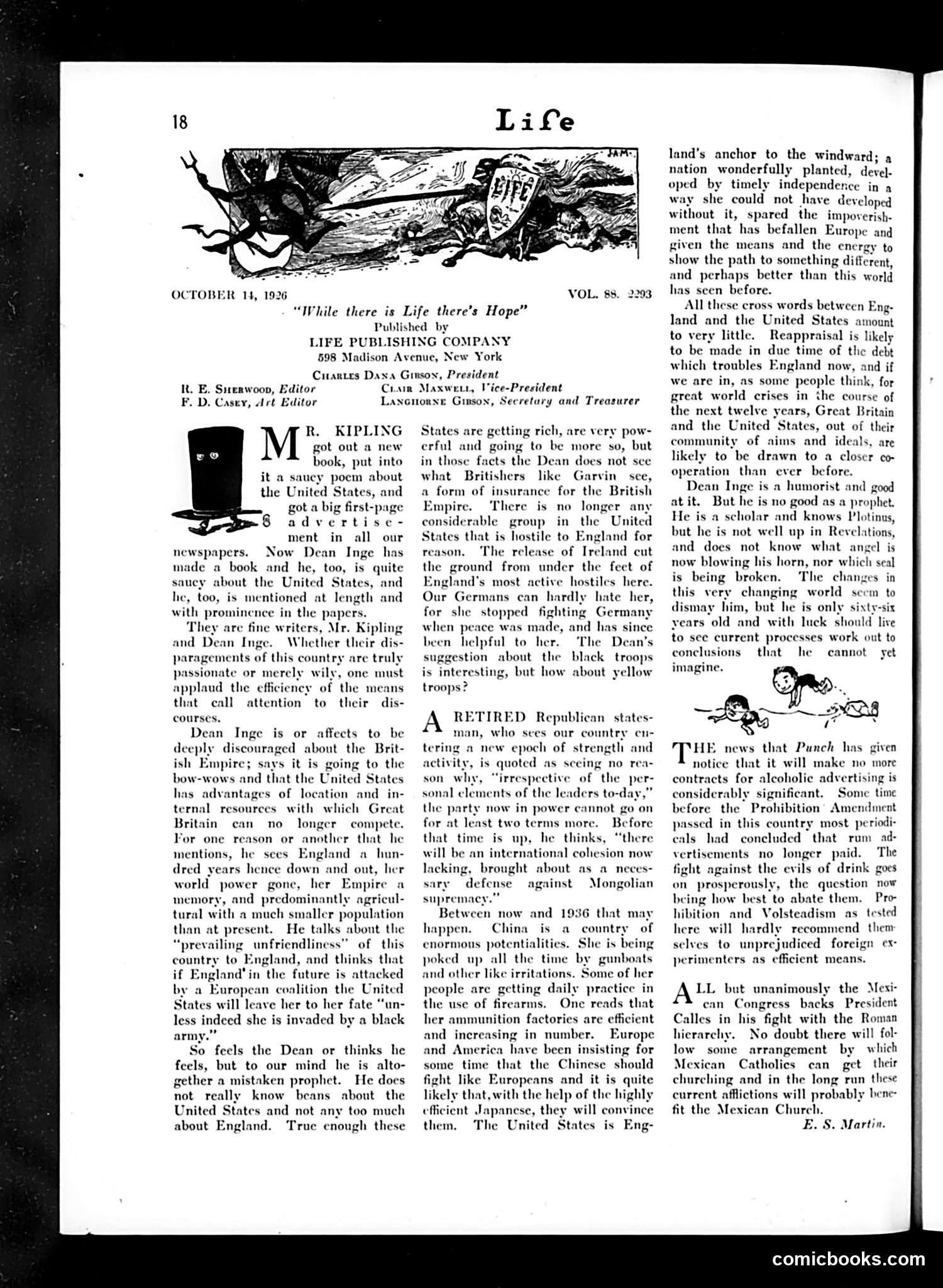
This page contains editorial commentary on two British writers' criticisms of America. **Rudyard Kipling** and **Dean Inge** (a prominent Anglican clergyman) had each published books disparaging the United States, receiving prominent newspaper coverage. The Life editors acknowledge these are "fine writers" but suggest their criticism may be strategically designed to generate publicity. The main satirical point: Dean Inge's pessimistic predictions about Britain's decline and America's potential abandonment of Britain are dismissed as misguided prophecy. The editors argue Inge fundamentally misunderstands American sentiment—Irish-American hostility toward Britain has diminished with Irish independence, and Germany is no longer an enemy. They characterize Inge as uninformed about both countries. A secondary piece discusses a retired Republican politician's confidence in Republican electoral dominance through 1936, and comments on China's growing military capacity—potentially concerning given Japanese involvement. The cartoon's specific content is unclear from the image quality, but appears related to these geopolitical themes.
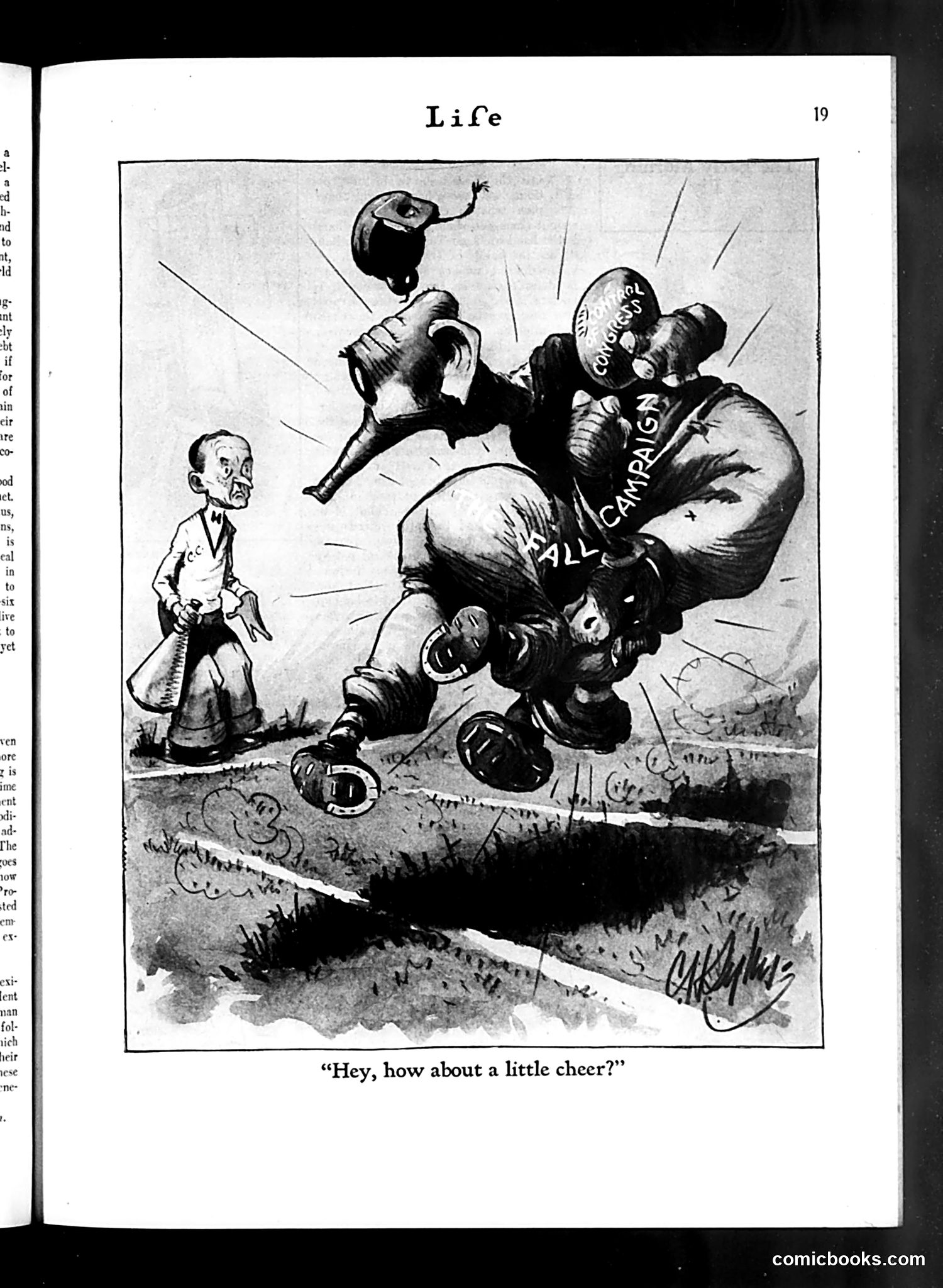
This editorial cartoon depicts a large, grotesque figure labeled "CAMPAIGN" carrying multiple smaller figures (appearing to represent political candidates or issues) while jumping over a chasm or trench. A diminished figure on the left watches, asking "Hey, how about a little cheer?" The satire suggests that political campaigns are chaotic, overcrowded spectacles where multiple competing interests are precariously balanced. The small figure's ironic request for "cheer" implies public enthusiasm is difficult to muster for such a messy process. The chasm likely represents the gap between campaign promises and reality, or obstacles facing voters. The cartoon critiques how campaigns juggle contradictory agendas while asking citizens to support them enthusiastically. The exact election or year is unclear without additional context.
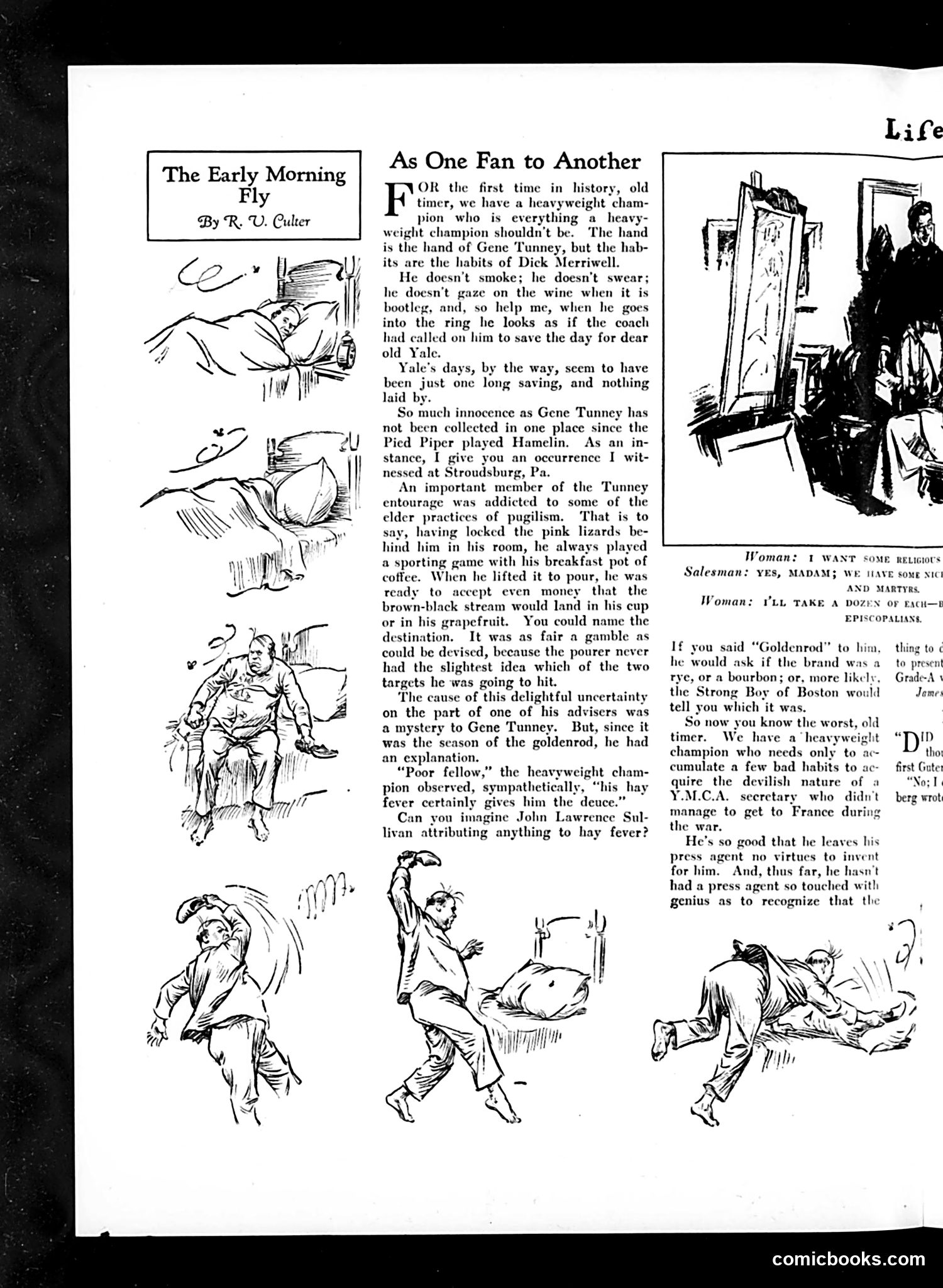
This page satirizes **Gene Tunney**, the heavyweight boxing champion, for being unusually virtuous and wholesome—the opposite of what boxing champions "should" be. The author contrasts Tunney with **John Lawrence Sullivan**, a legendary 19th-century boxer known for heavy drinking and rough behavior. The joke: Tunney is so innocent and clean-living (doesn't smoke, swear, or drink bootleg liquor; has Yale-like sportsmanship) that when a staff member's poor coffee-pouring aim is observed, Tunney charitably attributes it to hay fever rather than understanding it's gambling behavior. The punchline mocks that old-time boxers like Sullivan would recognize such vices immediately—suggesting Tunney's virtue makes him almost comically naive. The small cartoon on the right depicts a religious salesman selling "religions and martyrs" to an Episcopalian customer, a separate satirical joke about denominational shopping. The "Early Morning Fly" cartoon series (left) appears unrelated.
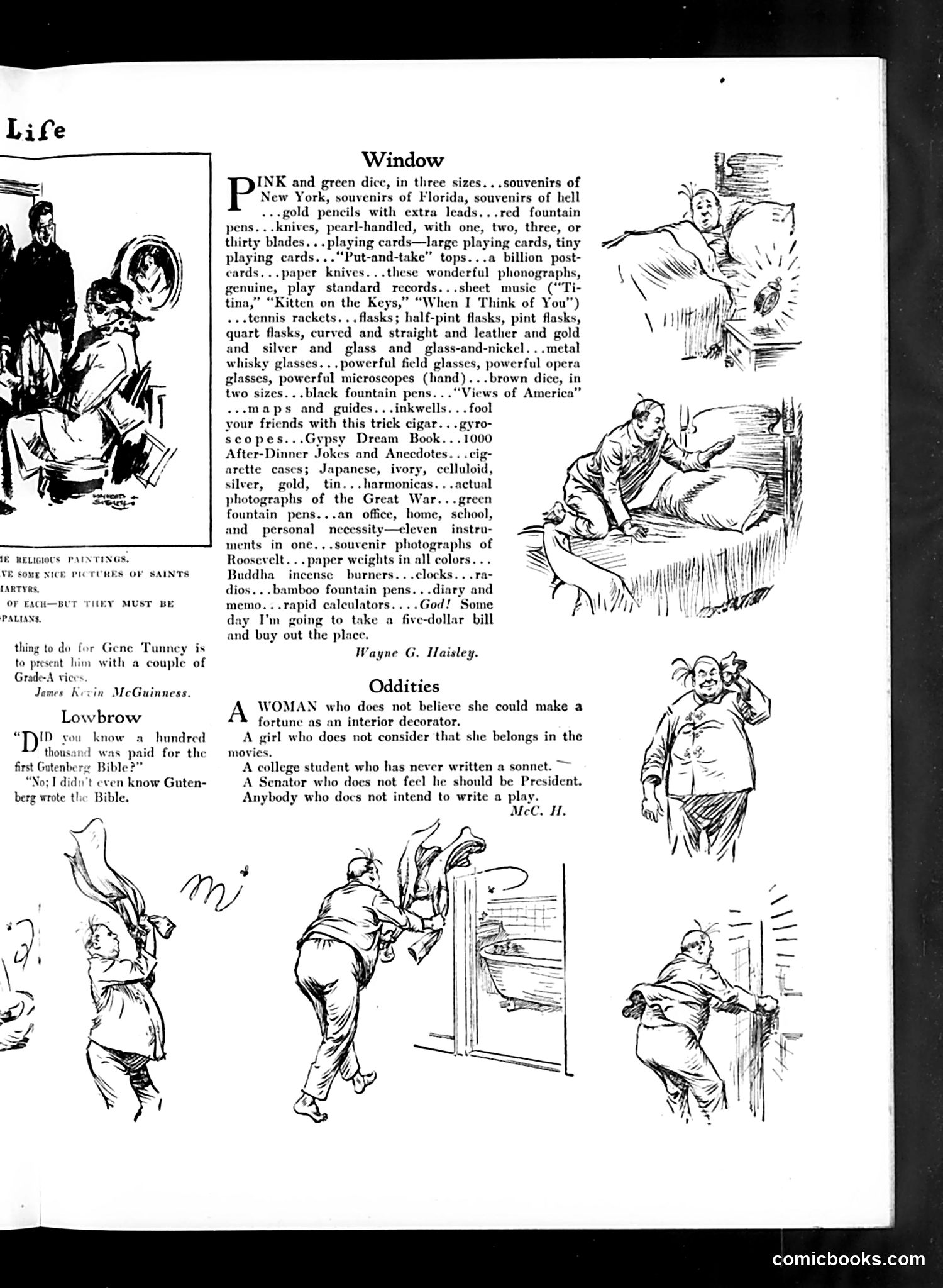
This page from *Life* magazine contains three distinct sections of satirical humor: **"Window"** is a humorous stream-of-consciousness catalog of commercial gift items—dice, flasks, fountain pens, phonographs, maps—mocking the consumerism and gift-buying culture of the era. The author ends by sarcastically stating he'd like to buy out the entire shop with a five-dollar bill, highlighting the absurd excess of merchandise. **"Lowbrow"** is a brief joke about someone unfamiliar with the Gutenberg Bible, confusing it as something the printer Gutenberg personally wrote—satirizing ignorance and class pretension. **"Oddities"** lists improbable types of people (women uninterested in interior design, girls unambitious for movies, senators without presidential aspirations, anyone not wanting to write plays), mocking the era's stereotypical expectations and the assumed universal ambitions of different social groups. The crude sketches accompanying these sections are generic comic illustrations. Overall, the page satirizes consumer culture, literary pretension, and unrealistic social expectations of the period.
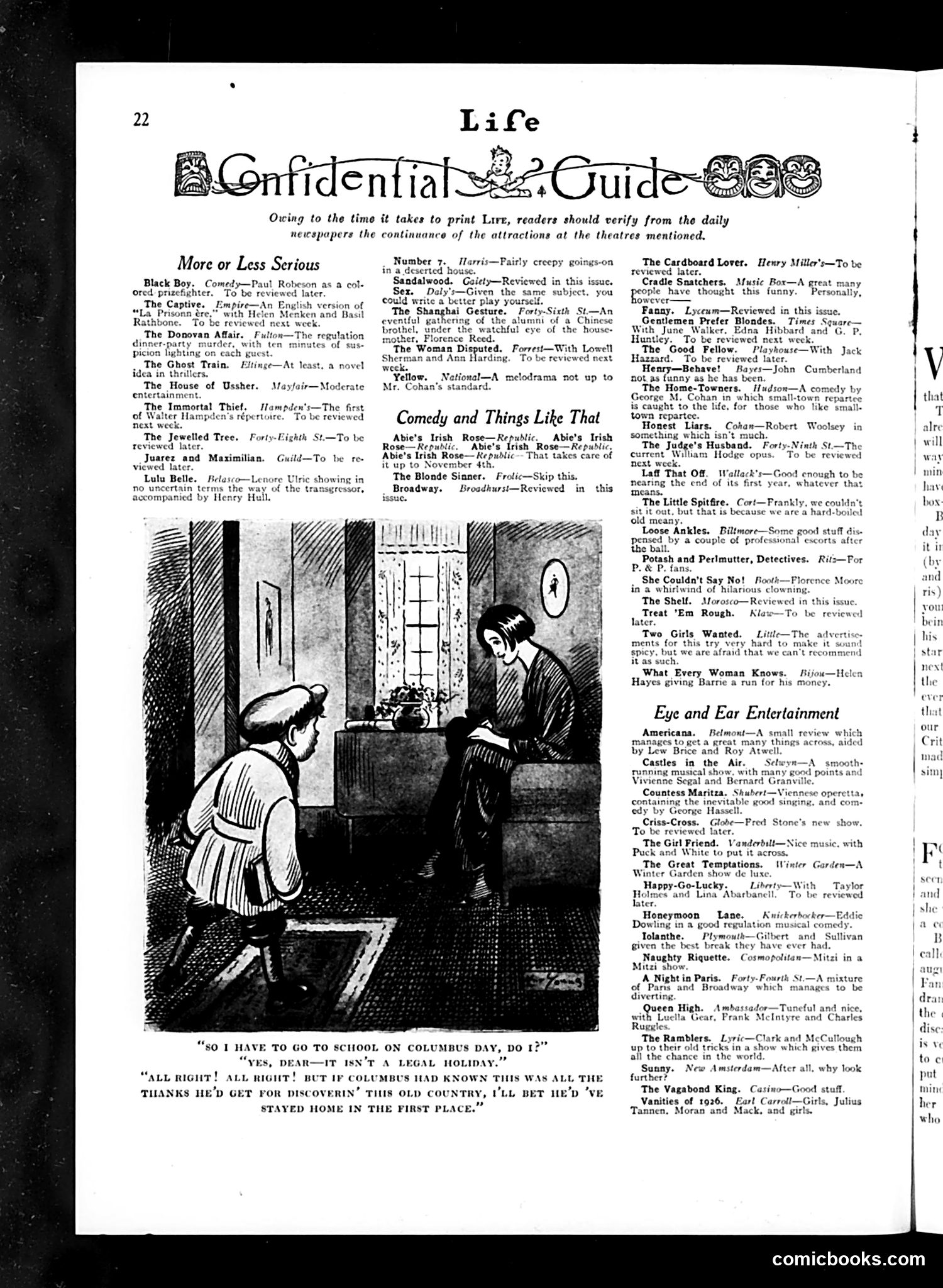
The main illustration depicts a domestic scene where a child asks a parent about missing school on Columbus Day. The parent responds that Columbus Day isn't a legal holiday, then sarcastically suggests Columbus would regret discovering America if he knew the country would "stay home in the first place." **The Satire:** This is social commentary on American ingratitude and complaint. The joke mocks citizens who grumble about America while enjoying its benefits—here represented by a child wanting a day off from school. The parent's sarcastic retort suggests that if Columbus had foreseen a nation of perpetually dissatisfied complainers, he wouldn't have bothered exploring. **Historical Context:** Published during the 1920s in *Life* magazine, this reflects post-WWI American discourse. There's underlying tension about national identity and immigrant/citizen attitudes toward America. The page itself is a theater guide with brief reviews—standard *Life* content for the era—making this cartoon a satirical interlude within entertainment listings.
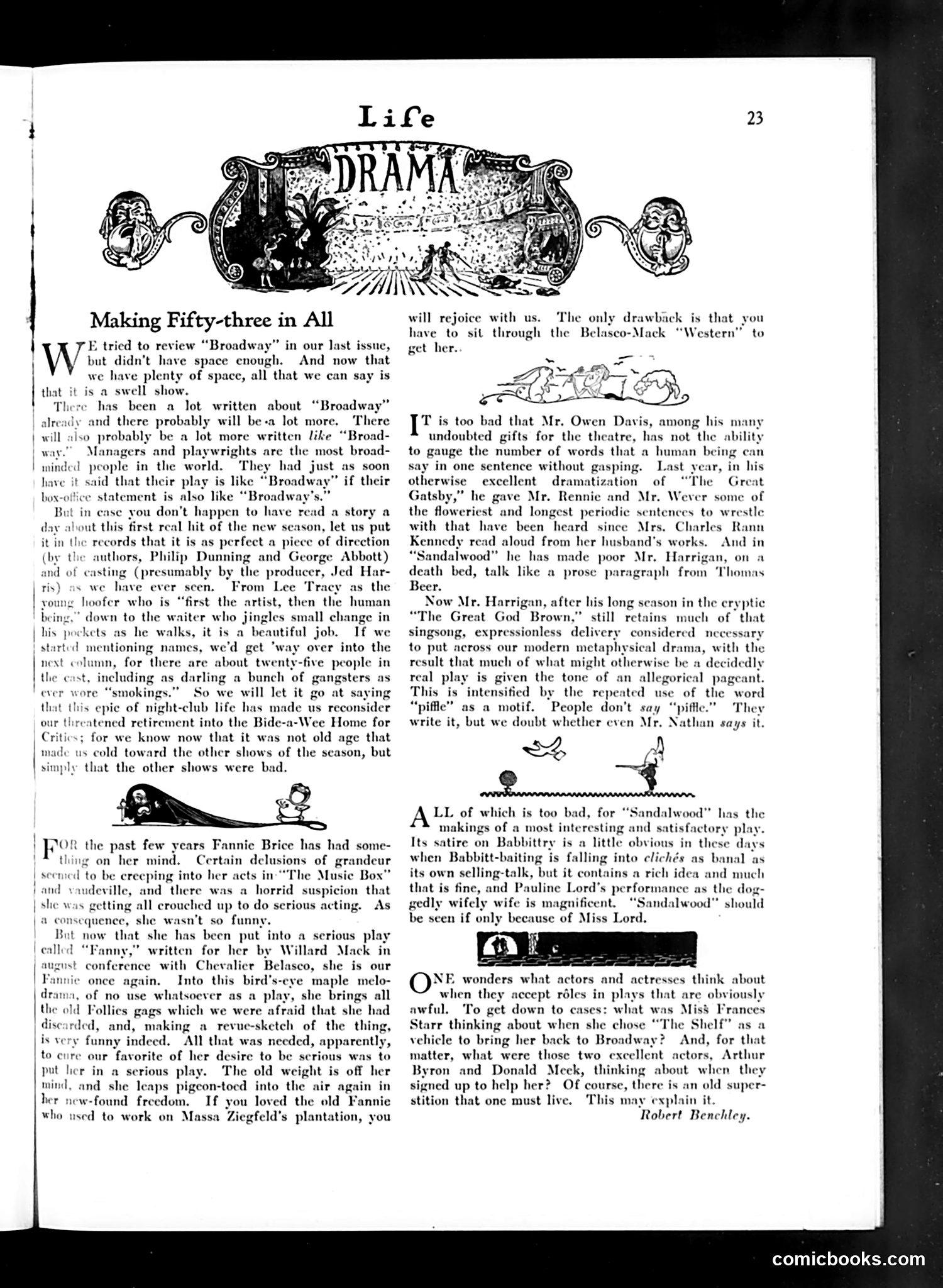
This page reviews current Broadway productions. The main critiques focus on: **"Broadway"** — Praised as excellently directed and cast, particularly Lee Tracy in the lead role. The reviewer notes it's become the season's hit show, with managers now claiming their plays resemble it. **Fannie Brice in "Fanny"** — The comedian, who'd been pursuing serious acting, returns to comedy in this Willard Mack/David Belasco production. The reviewer celebrates her return to her old vaudeville humor, suggesting her "desire to be serious" needed curing through actual serious drama. **Owen Davis's plays** — Criticized for verbose dialogue; his characters deliver unrealistically long sentences without pausing for breath. The example given is "Sandalwood," where ill protagonist Mr. Harrigan speaks in lengthy prose paragraphs, undermining the play's emotional impact. The satire targets theatrical pretension—actors pursuing seriousness, playwrights overcomplicating language—while celebrating genuine entertainment value.
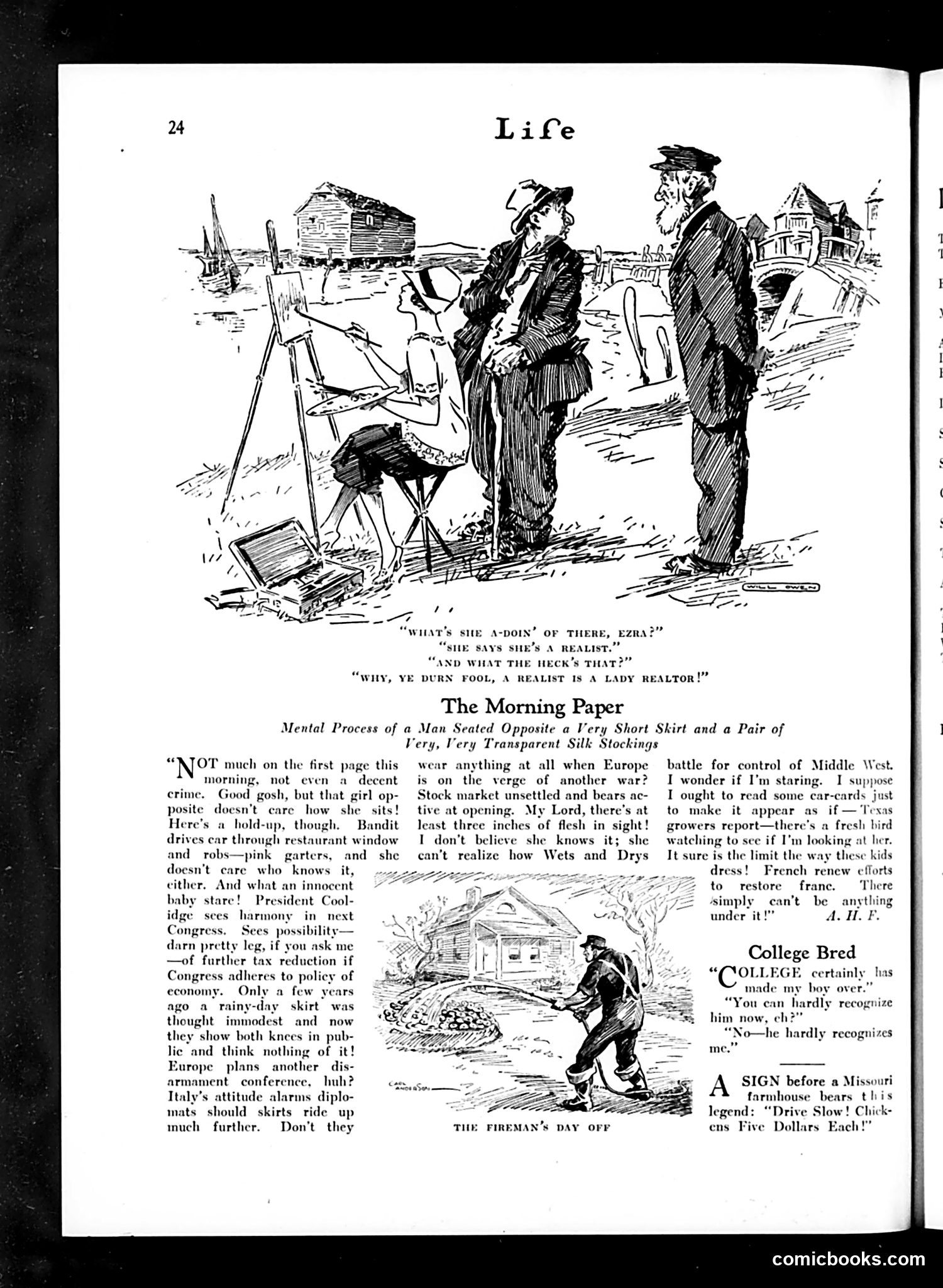
This page satirizes the distracted male consciousness. The top cartoon shows men discussing a woman painter, with the punchline that a "realist" is a female real estate agent—mocking both the art world and women entering business. The main feature, "The Morning Paper," depicts a man's fragmented thoughts while commuting. He attempts to read the newspaper but is distracted by a woman's exposed legs and transparent stockings across from him. His mental stream jumps between genuine news (stock market, European diplomacy, Prohibition debates) and his struggle not to stare. The satire works on two levels: it mocks male behavior and society's shock at women's changing fashion (shorter skirts, visible legs) in the 1920s. The man considers this immodest—"a few years ago a rainy skirt was thought immodest"—yet can't stop looking. The joke critiques both male distraction and generational hypocrisy about women's liberation and changing dress codes.
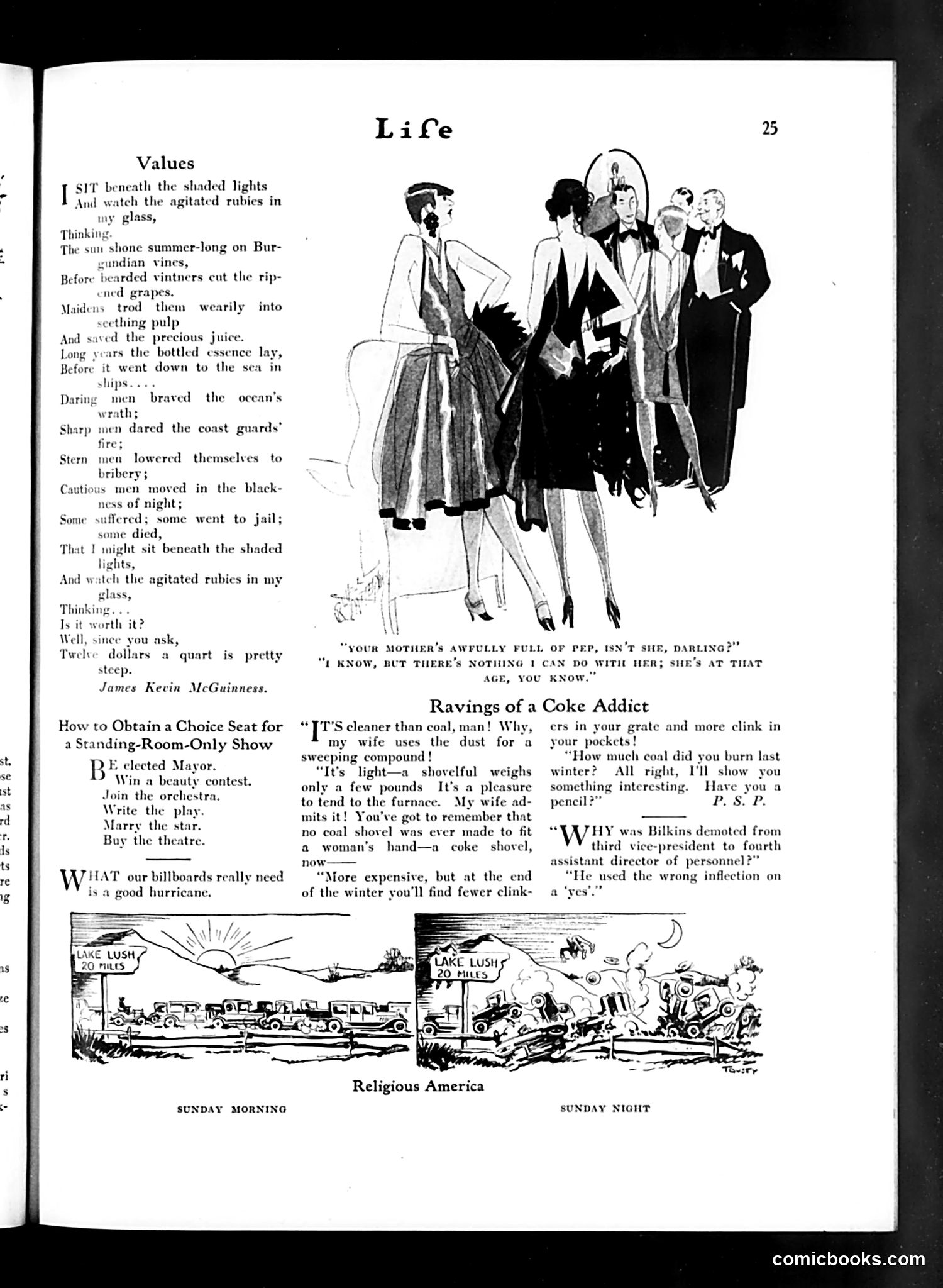
This page contains several satirical pieces typical of Life's humor: **"Values"** (poem by James Kevin McGuinness): A meditation on the human cost of luxury goods—specifically wine. The poem traces how wine reaches a drinker's glass through the dangerous, illegal efforts of smugglers and criminals during Prohibition. The irony: Is a $12 bottle of wine worth all this human suffering? **"How to Obtain a Choice Seat"**: Absurdist humor listing impractical methods to get theater seats (become mayor, marry the star, buy the theater). **"Ravings of a Coke Addict"**: A testimonial praising coke (the fuel) over coal, with comic exaggeration about its cleanliness and convenience for housewives. **"Religious America"** (cartoons): Two contrasting scenes labeled "Sunday Morning" and "Sunday Night" at Lake Lush showing traffic patterns—implying Americans are more devoted to weekend recreation than religious observance. The "good hurricane" billboard joke suggests destructive weather might clear cluttered roadsides. All content satirizes American consumer culture and hypocrisy.
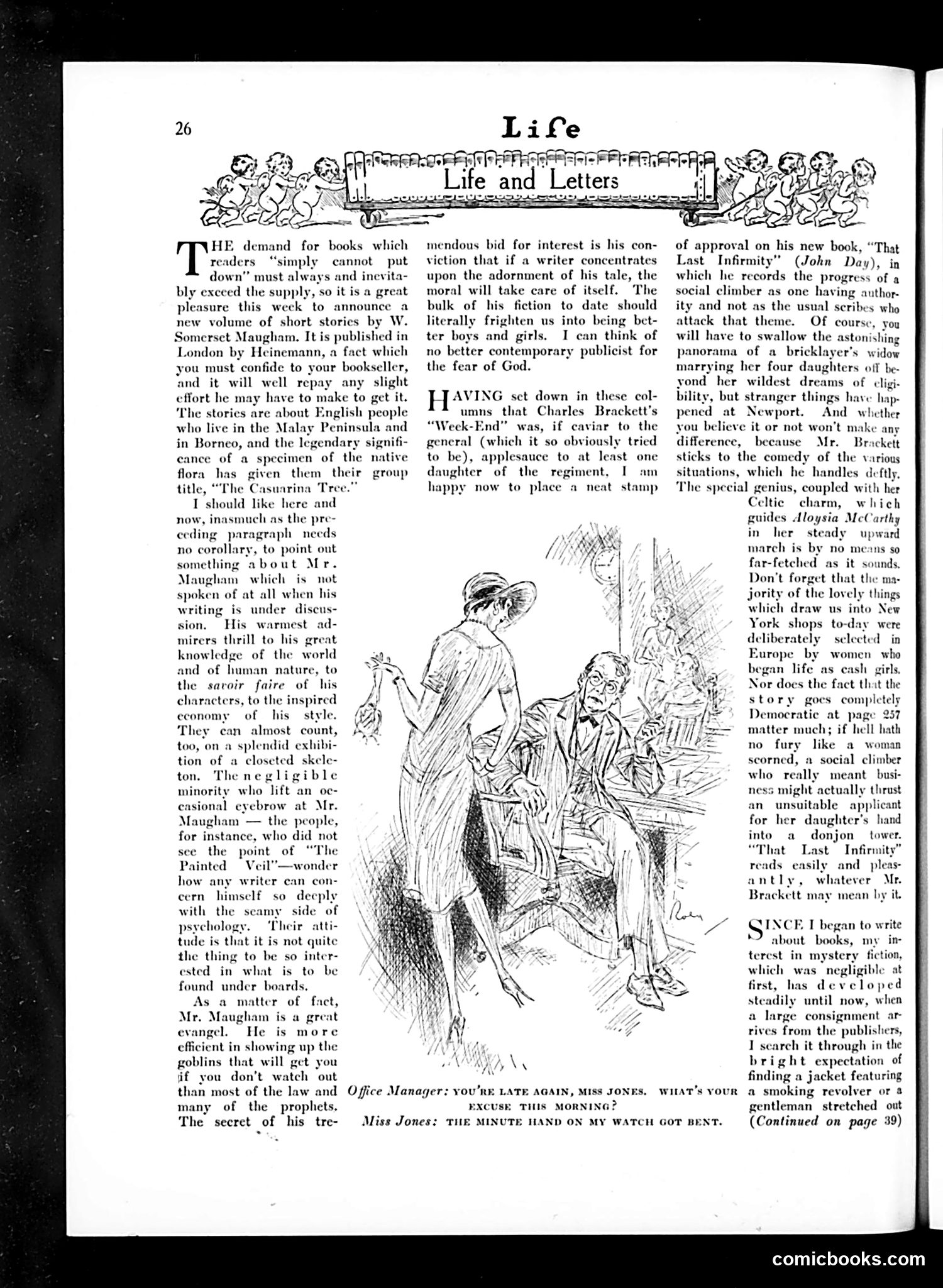
This page from *Life* magazine contains a book review column ("Life and Letters") discussing new works by W. Somerset Maugham and Charles Brackett. The **central cartoon** shows an office manager confronting his secretary Miss Jones about chronic lateness. Her excuse—"the minute hand on my watch got bent"—is absurdly implausible, representing the kind of transparent lies workers tell employers. The satire targets both the employee's obvious dishonesty and perhaps the employer's weary acceptance of such excuses. The accompanying text praises Maugham's ability to expose human moral failings and psychological complexity, positioning him as more honest than conventional moralists. Brackett's novel about a "social climber" protagonist is endorsed despite its implausible premise—the reviewer finds merit in Brackett's comedic treatment regardless of realism. The humor assumes readers understand early-20th-century publishing gossip and social anxieties about class mobility and female ambition.
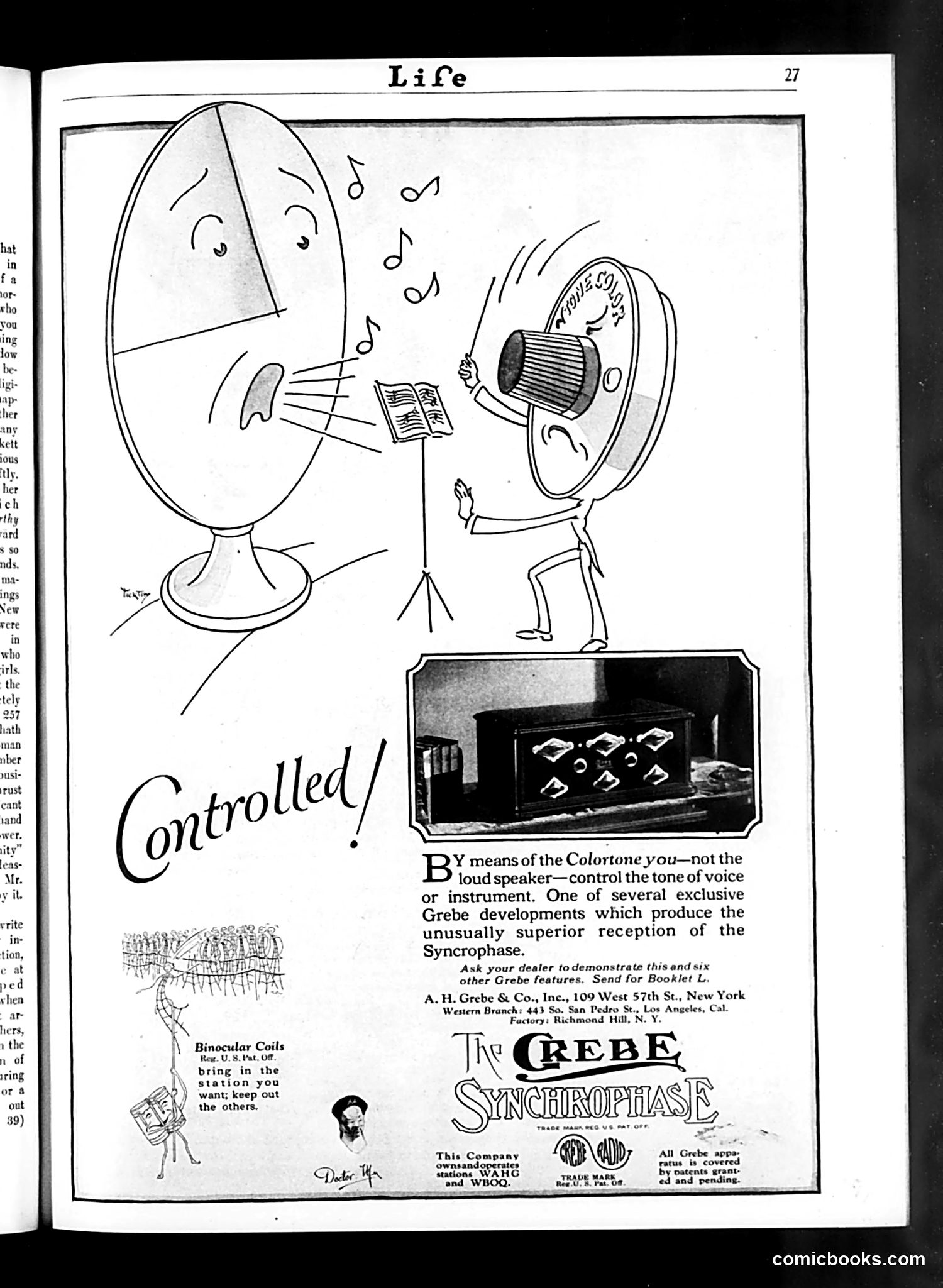
This page is primarily **advertising for Grebe radio receivers**, not political satire. The cartoon satirizes radio technology itself rather than political figures. The illustration shows a figure playing music from sheet music into a large horn/speaker (left), while another figure operates a Grebe Syncrophase radio receiver (right), controlling the incoming audio quality. Musical notes float between them. **The joke:** The caption "Controlled!" suggests that unlike a "loud speaker" (which blasts uncontrolled sound), the Grebe receiver lets you control the tone and quality of what you hear—you're not at the mercy of poor transmission. The smaller cartoon below shows "Binocular Coils" that "bring in the station you want; keep out the others"—a visual pun on the radio technology's selective reception capabilities. This reflects 1920s radio enthusiasm, when receiver quality and selectivity were major selling points for early radio sets.
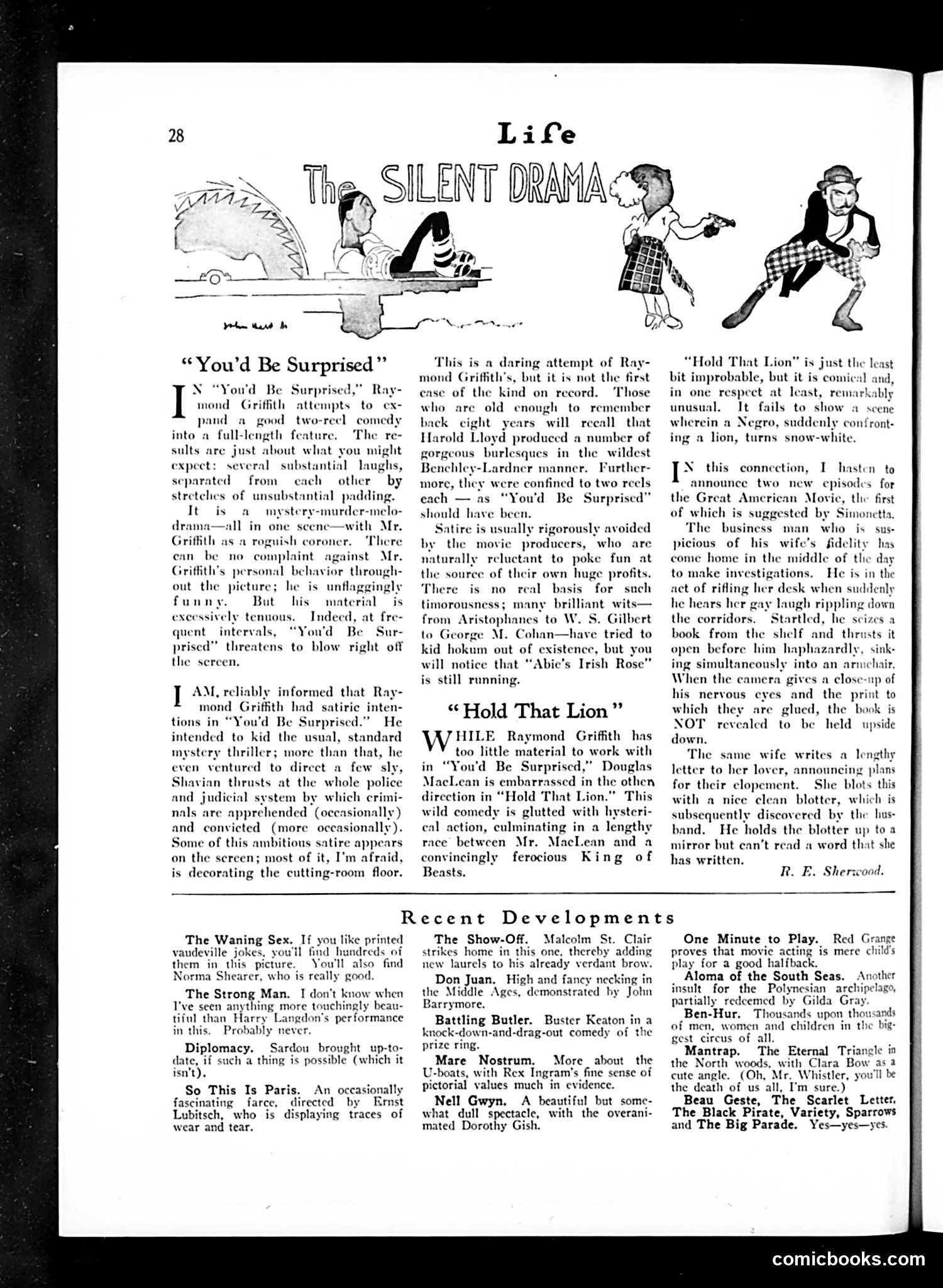
This page reviews silent films, primarily discussing Raymond Griffith's "You'd Be Surprised" and Douglas MacLean's "Hold That Lion." The reviewer critiques Griffith's attempt to expand a two-reel comedy into feature length, praising his personal performance but finding the material thin. Griffith apparently intended social satire—mocking standard mystery thrillers and poking fun at police and judicial systems—but much of this satire ended up on the cutting-room floor. The review of "Hold That Lion" notes it's overstuffed with farcical action, culminating in a race with a real lion. The reviewer finds it unusual and noteworthy that the film *avoids* a racist trope common in cinema: showing a Black character turning "snow-white" with fear upon encountering the lion—a dehumanizing caricature the reviewer apparently found typical of contemporary films. The small illustrations show silent-film-style physical comedy and slapstick situations typical of the era.
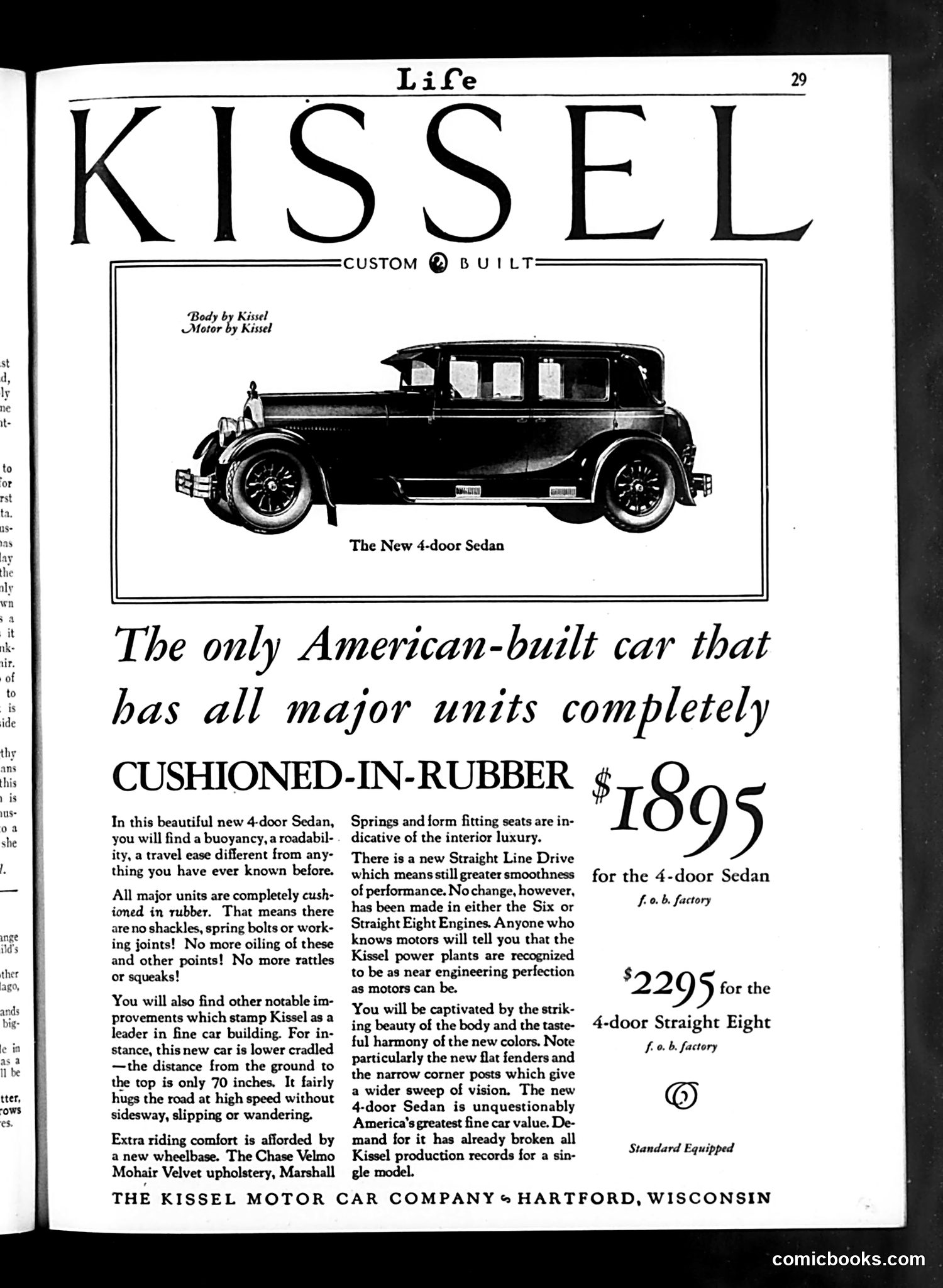
This page is not a cartoon or satire—it is a **straightforward automobile advertisement** for the Kissel Motor Car Company of Hartford, Wisconsin. The ad promotes the new 4-door Sedan, emphasizing its innovative "cushioned-in-rubber" design for all major mechanical units, claiming this eliminates rattling, squeaking, and maintenance problems. It highlights other features: low profile (70 inches), smooth ride, luxury upholstery, and flat fenders for improved visibility. Pricing is listed at $1,895 for the standard 4-door Sedan and $2,295 for the Straight Eight model (f.o.b. factory). This appears in *Life* magazine's advertising section. There is no political or social satire here—merely period automotive marketing emphasizing comfort and engineering superiority as selling points to potential buyers of this mid-range American automobile.
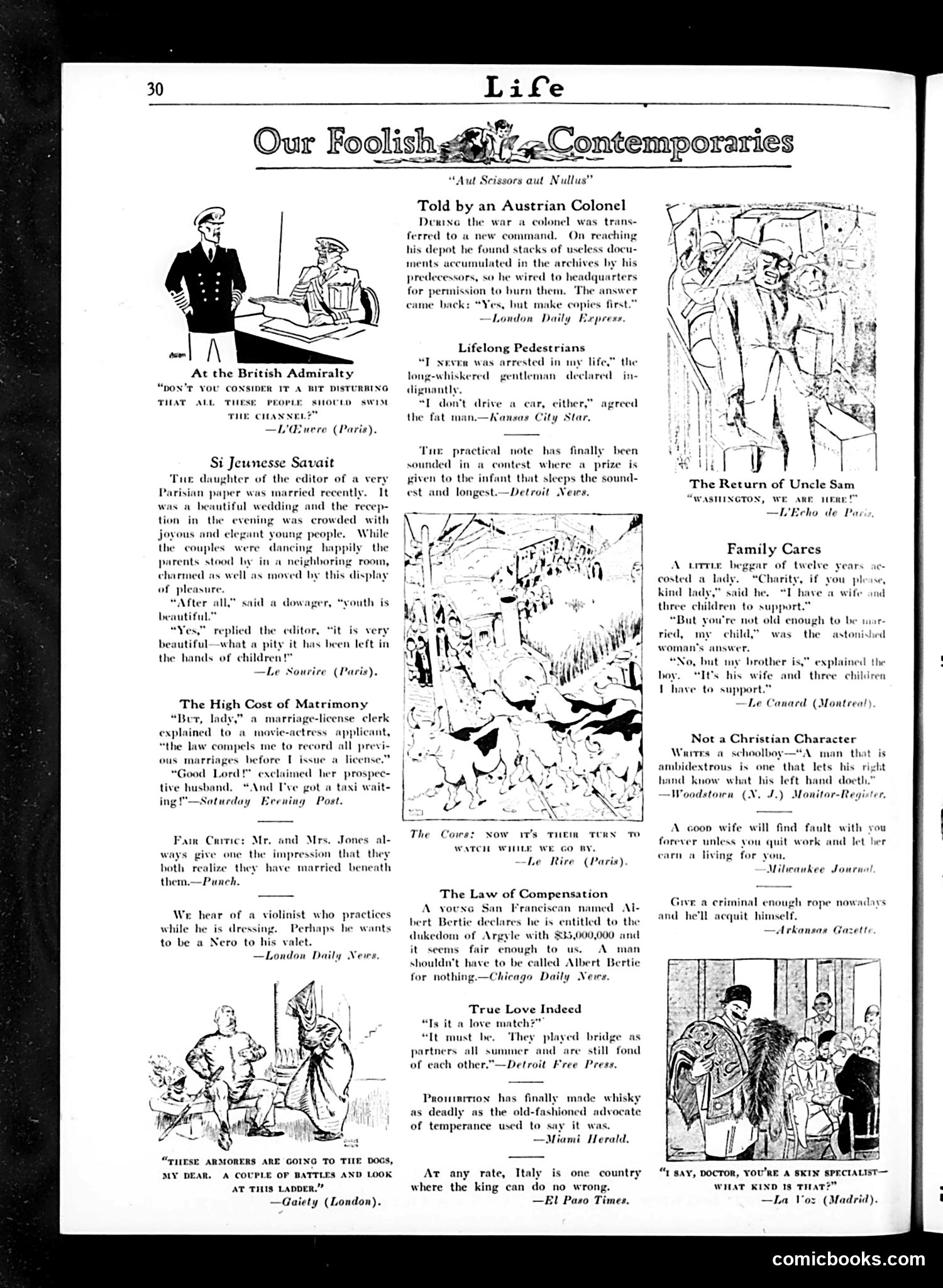
This page collects satirical brief jokes and observations from international newspapers, lampooning human folly across various topics. **Key items:** - **Austrian Colonel anecdote**: Mocks bureaucratic absurdity—a military officer requests permission to destroy useless documents; headquarters approves only if he makes copies first, satirizing mindless administrative procedure. - **Lifelong Pedestrians**: A man arrested seven times claims he never drives—the fat man agrees he doesn't drive either, suggesting both are equally law-abiding through avoidance rather than virtue. - **High Cost of Matrimony**: A groom complains about marriage-license fees while a taxi waits outside, mocking hasty marriages and the financial burden of legal formalities. - **Law of Compensation**: A San Franciscan named Albert Bertie claims entitlement to a Scottish dukedom—the joke being his ridiculous name justifies any complaint about life's injustices. - **Not a Christian Character**: A schoolboy defines "ambidextrous" as letting one hand not know what the other does—a pun inverting the biblical moral principle. The cartoons illustrate these written jokes with period-appropriate illustrations.
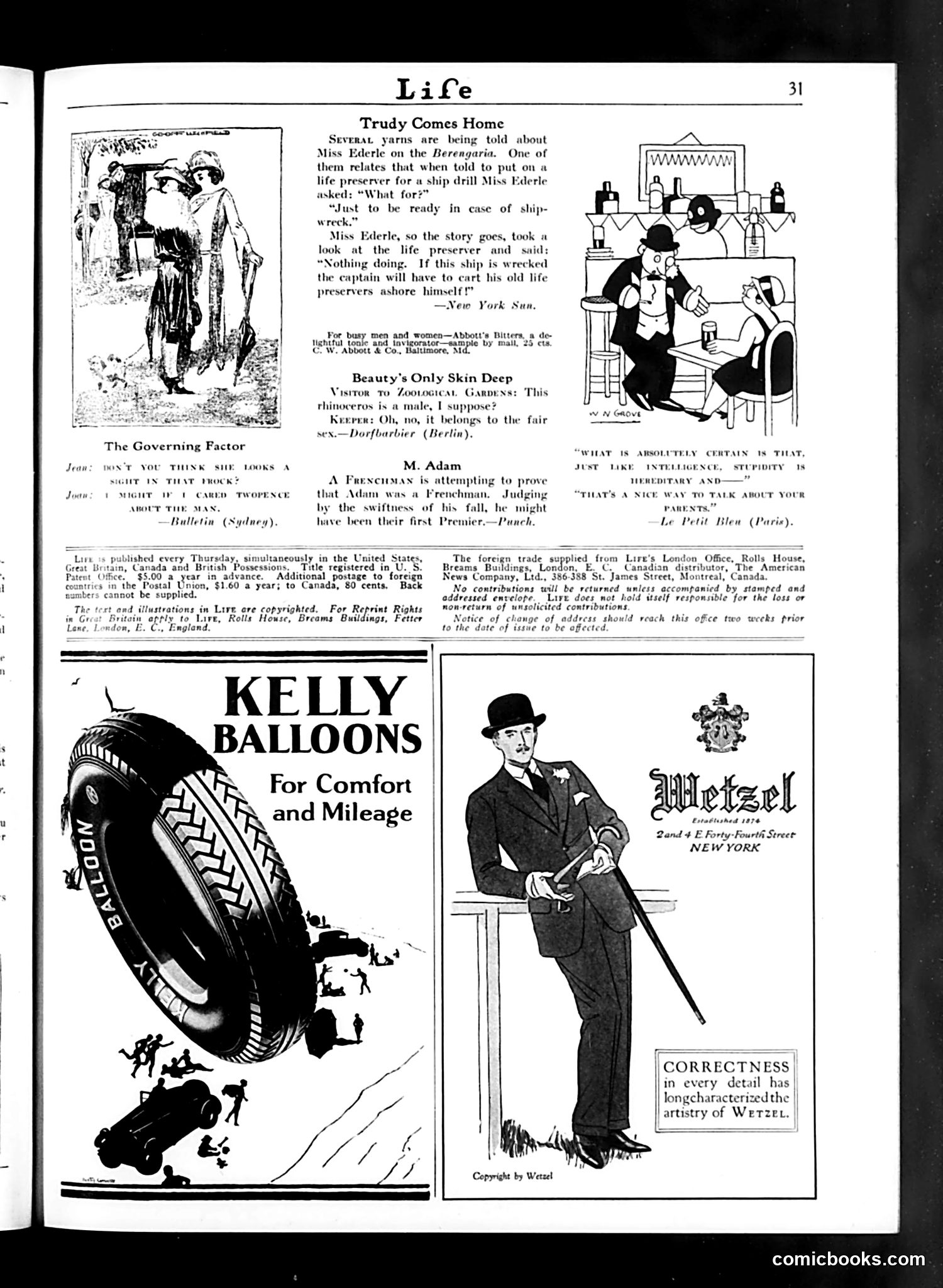
This page contains three distinct humor pieces from Life magazine: **"Trudy Comes Home"** references swimmer Gertrude Ederle, who famously swam the English Channel in 1926. The joke plays on her fearlessness: when instructed to wear a life preserver during a ship drill aboard the *Berengaria*, she reportedly quipped that if the ship wrecked, the captain would have to retrieve his old preservers from shore himself—implying her swimming ability made the device unnecessary. **"Beauty's Only Skin Deep"** is a brief zoo joke where a visitor mistakes a rhinoceros for male, but learns it's female, suggesting the rhino is unattractive enough to be indistinguishable by gender. **"M. Adam"** presents a Frenchman attempting to prove Adam was French. The joke's logic: Adam fell so swiftly from grace that he might have been France's first Premier (implying French leadership causes rapid collapse). Two advertisements occupy the lower half: Kelly Balloons (tires) and Wetzel (formally dressed men's fashion), typical commercial content for the era.
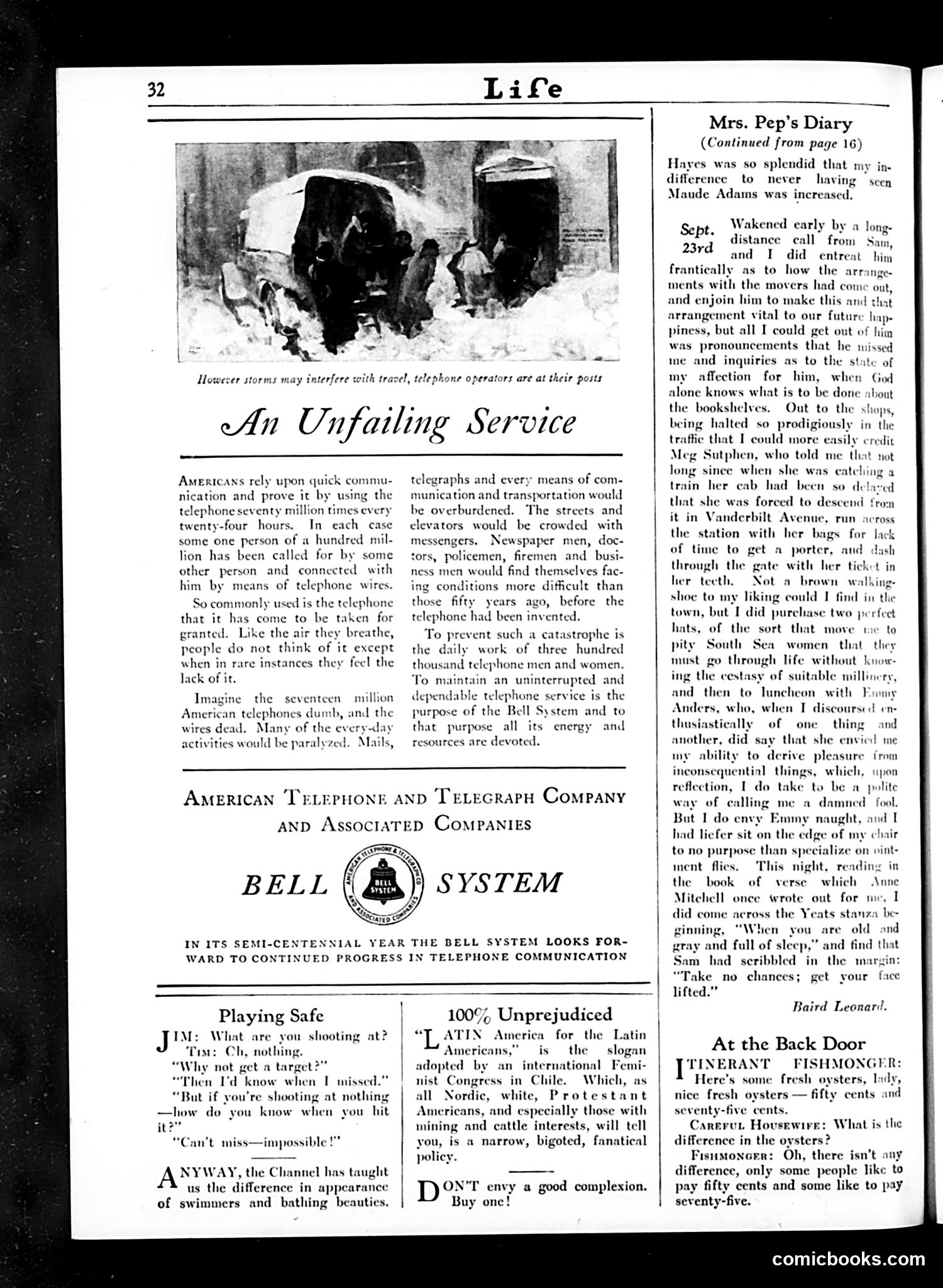
This page is primarily a **Bell System telephone company advertisement** disguised as editorial content, emphasizing the telephone's indispensability to American life. The photograph shows telephone operators maintaining service during winter storms—a visual argument for their reliability and dedication. The accompanying text argues that 17 million telephones and 300,000 workers enable civilization; their absence would paralyze society. This is corporate propaganda framing telephone infrastructure as essential public service. The page also contains unrelated humor items ("Playing Safe," "100% Unprejudiced") and "Mrs. Pep's Diary"—a satirical column mocking upper-class women's preoccupations with trivial matters (shopping, dinner parties, complaints about servants). The "100% Unprejudiced" section sarcastically criticizes a feminist congress promoting Latin American interests as "narrow" and "fanatical"—reflecting the era's dismissal of women's and racial-justice movements. The overall effect: corporate promotion mixed with light satire targeting women's vanity and progressive causes.
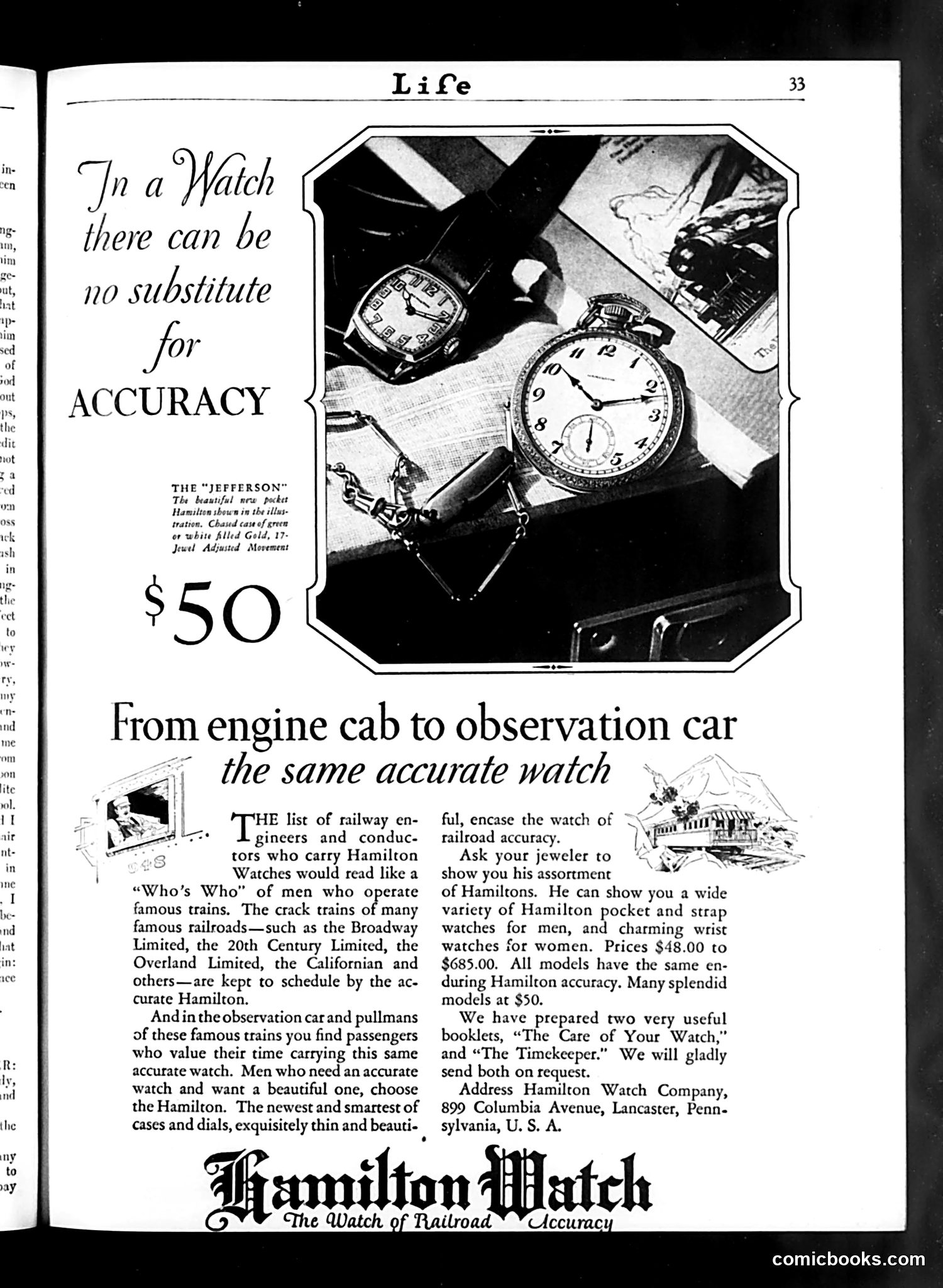
This is a **watch advertisement**, not satire or political commentary. The page promotes Hamilton pocket watches ($50-$685) by emphasizing their accuracy and reliability for railroad professionals. The imagery shows multiple Hamilton watches displayed together, with text highlighting their use by famous train operators—mentioning specific railways like the Broadway Limited and 20th Century Limited. The central claim is that railroad engineers, conductors, and passengers depend on Hamilton's precision to maintain schedules. The marketing strategy links the brand to prestige and professional trustworthiness: if railroad companies (then symbols of modern engineering excellence) rely on these watches, consumers should too. The "Jefferson" model pictured is presented as an example combining beauty with function. For modern readers: this reflects an era when mechanical watches were essential professional tools, not luxury accessories, and when railroad operations represented cutting-edge American industry worthy of advertising association.
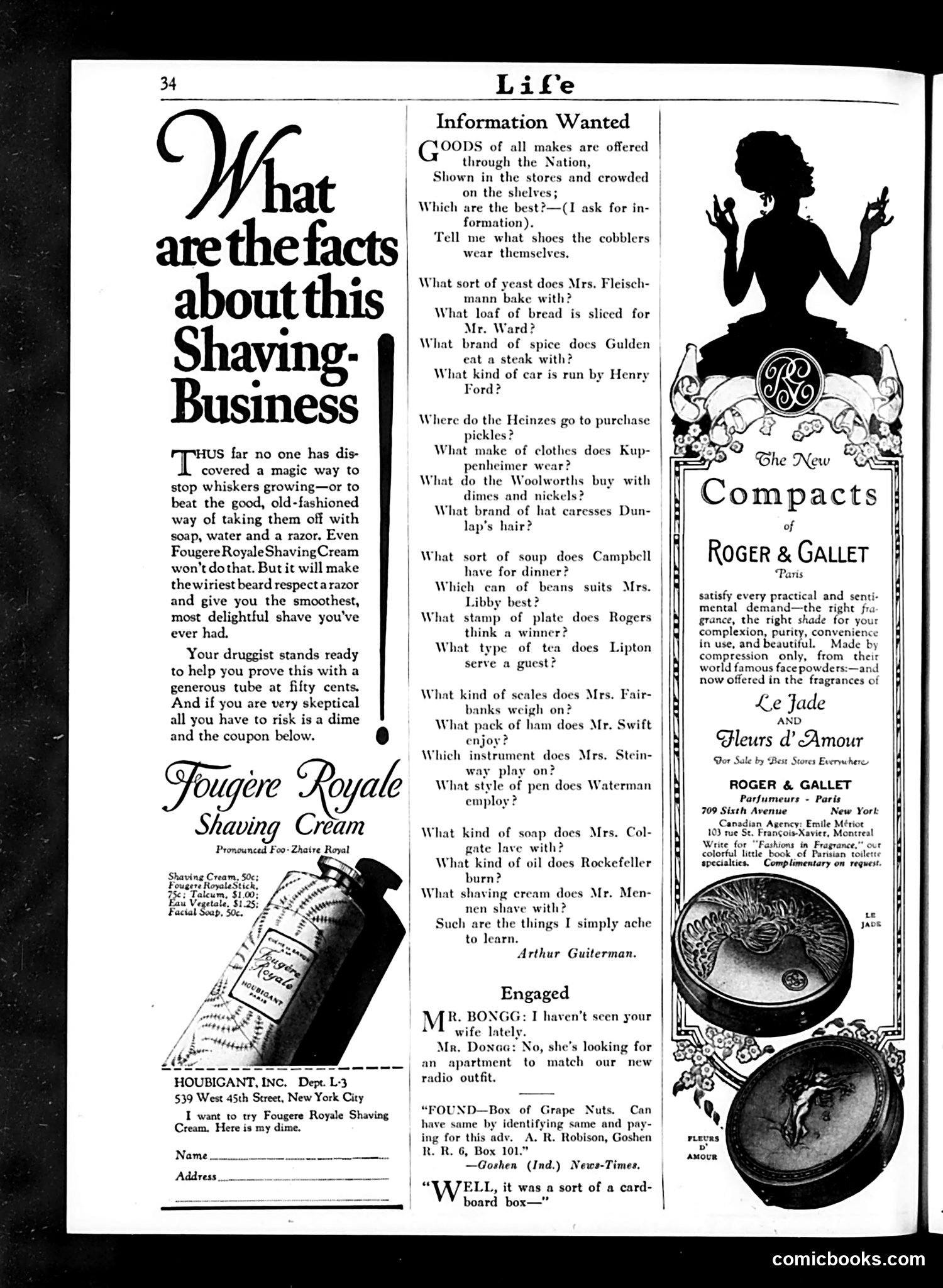
This page combines advertisements with satirical content typical of Life magazine's humor. **Main Feature - "What are the facts about this Shaving Business":** A Fougere Royale shaving cream advertisement using frank honesty as its sales pitch. Rather than making magical claims, it admits no product stops whisker growth—only traditional soap, water, and razor work. The satire lies in this refreshing candor: advertising typically made exaggerated promises, so admitting limitations while claiming superior results was humorously disarming. **"Information Wanted" Poem by Arthur Guiterman:** This satirizes celebrity endorsements and brand loyalty. The poem humorously lists famous industrialists and business figures (Ford, Heinz, Woolworth, Rockefeller, etc.), asking which products *they personally use*—implying consumers naively trust that famous wealthy people's brand choices guarantee quality. It mocks the assumption that knowing what successful people buy will somehow benefit ordinary customers. **Lower content** includes brief humorous anecdotes and Roger & Gallet perfume/compact advertisements—standard magazine fare of the era. The page's overall theme critiques consumer culture and advertising claims.
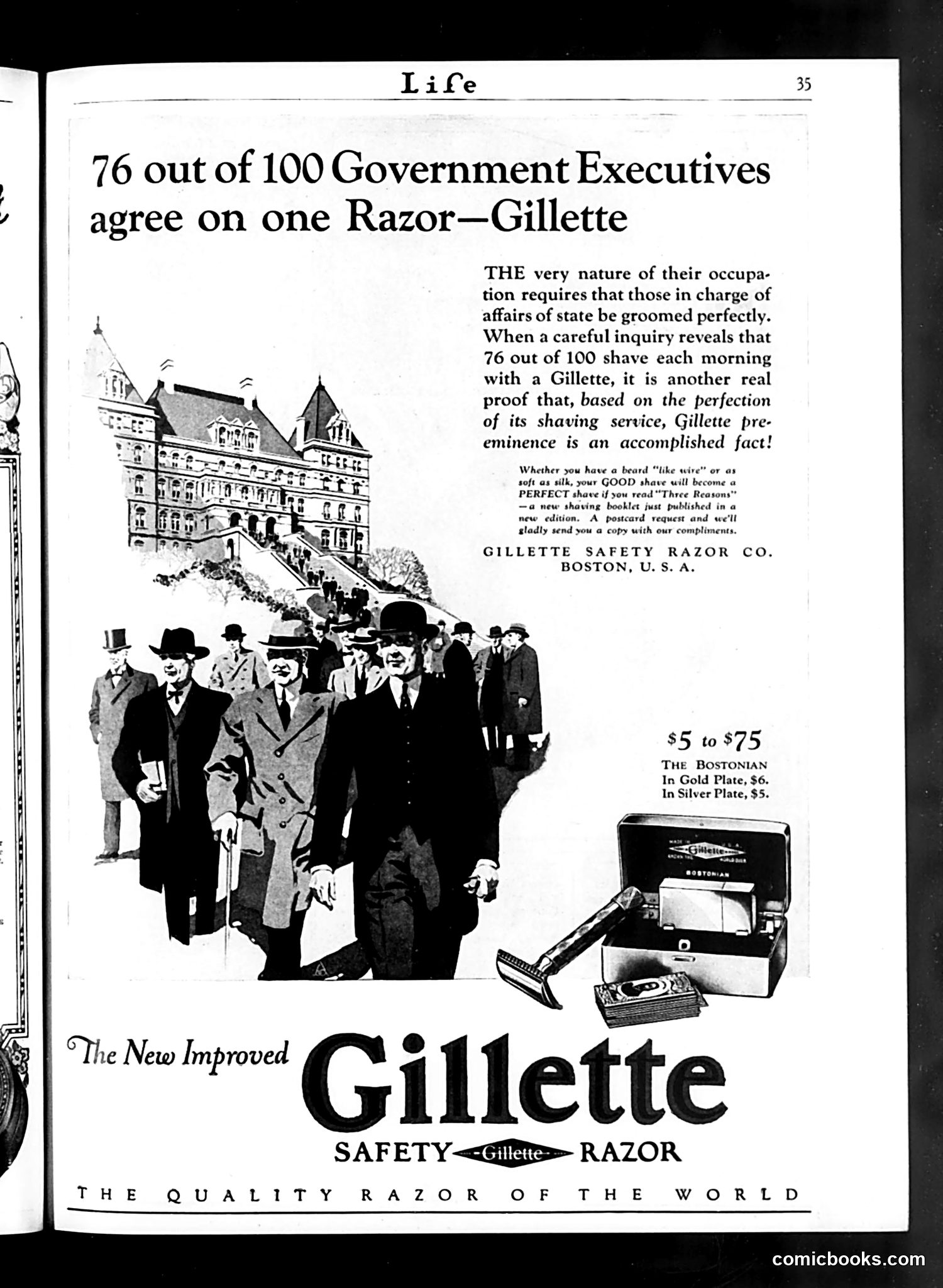
This is a **Gillette Safety Razor advertisement**, not political satire. The page uses a marketing claim that "76 out of 100 Government Executives" use Gillette razors to establish product credibility. The illustration shows a group of formally dressed men (appearing to be government officials based on the context) walking together, establishing visual authority. The accompanying text argues that government leaders' need for perfect grooming makes their choice of Gillette significant endorsement. The ad includes product pricing ($5-$75) and promotes "The Bostonian" model, plus a free shaving booklet offer. For modern readers, the notable element is the **advertising strategy itself**: using vague statistical claims ("76 out of 100") and appeals to authority rather than actual product specifications—a technique now heavily regulated by the FTC. The assumption that government officials' shaving habits should influence consumer choices reflects early 20th-century marketing practices now considered questionable.
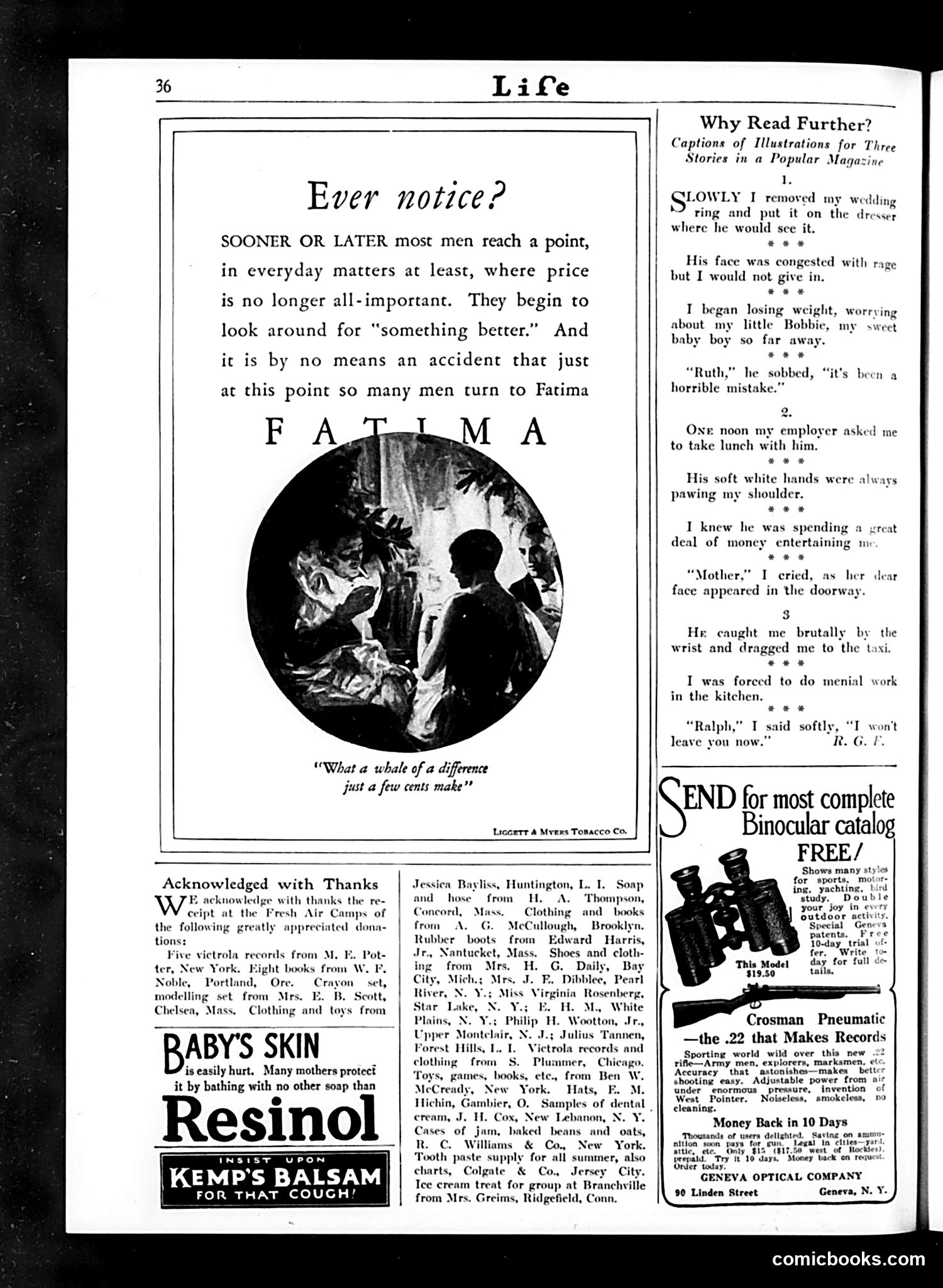
This page contains a **cigarette advertisement** for Fatima tobacco positioned as satirical commentary. The central cartoon shows a man discovering a woman in glamorous dress, with text reading "Ever notice? SOONER OR LATER most men reach a point...where price is no longer all-important. They begin to look around for 'something better.'" The joke equates a man's preference upgrade—from cheaper to premium cigarettes—with romantic temptation. The tagline "What a whale of a difference just a few cents make" sarcastically suggests that small price increases justify trading up, whether in tobacco or (implicitly) in women. The page also features story captions from three serialized magazine stories depicting domestic drama: infidelity, workplace harassment, and marital conflict—common pulp fiction themes of the era. The remainder comprises typical period advertisements for soap, cough medicine, binoculars, and air rifles, alongside acknowledgments of charitable donations to Fresh Air Camps.
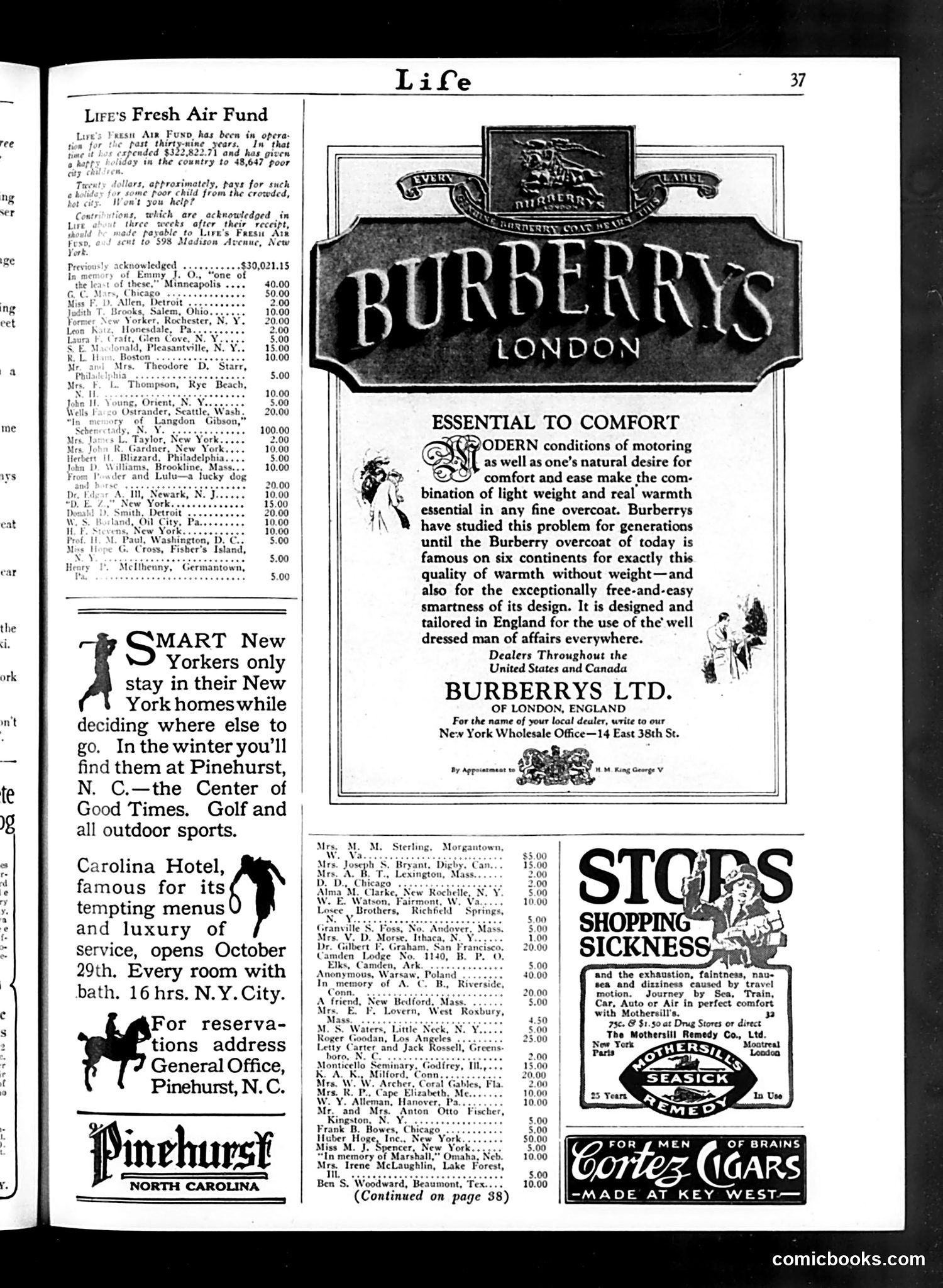
This page is primarily **advertisements and charity announcements** rather than editorial cartooning. The main content includes: 1. **Life's Fresh Air Fund** (left column)—a charitable appeal describing the magazine's long-running program providing poor children from crowded cities a day in the country. The list shows donations from readers, a common fundraising practice of the era. 2. **Burberrys overcoat advertisement** (center)—promoting English-tailored coats emphasizing warmth without bulk, marketed to affluent travelers and "well dressed man of affairs." 3. **Resort/hotel advertisements**—Pinehurst, North Carolina and Carolina Hotel promoting luxury leisure travel for wealthy New Yorkers. 4. **Patent medicine ads**—including "Mothersill's" for motion sickness and "Cortez Cigars." The page reflects early 20th-century Life magazine culture: mixing charitable causes with luxury goods advertising, targeting an affluent readership. No political satire or caricature is present—this is a commercial/philanthropic page.
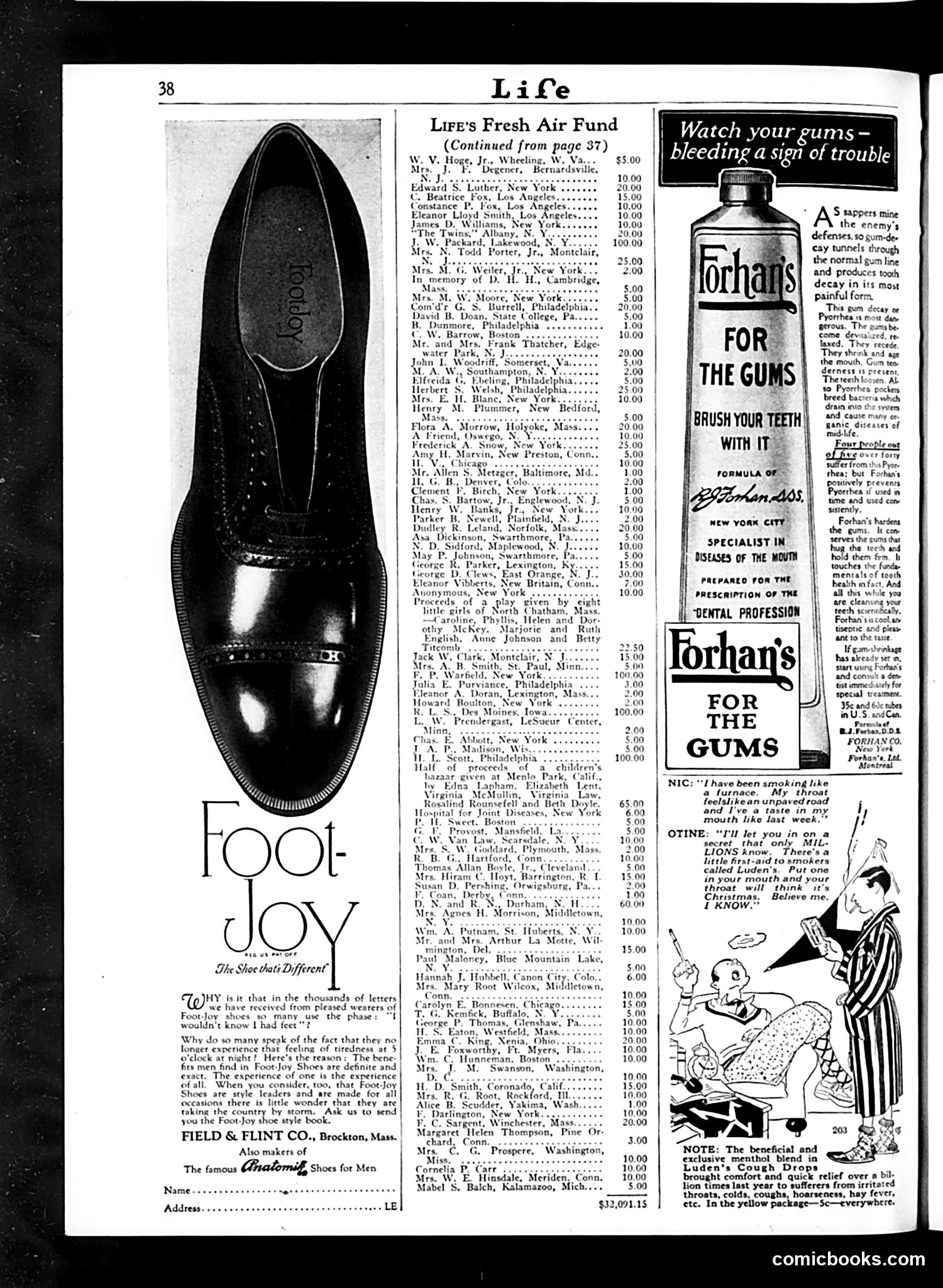
This page is primarily **advertising and fundraising**, not political satire. The dominant content includes: **Left side:** A "Foot-Joy" shoe advertisement featuring a photograph of a women's shoe, emphasizing comfort ("The Shoe that's Different"). **Center:** A continuation of "Life's Fresh Air Fund"—a charitable fundraising list naming donors and their contributions, ranging from $1 to $100. This was a genuine philanthropic initiative. **Right side:** Two product advertisements: 1. **Forhan's for the Gums**—a dental product claiming to prevent pyorrhea (gum disease), with testimonial-style copy 2. **Luden's Cough Drops**—advertised to smokers with a humorous dialogue between characters "Nic" and "Otine" The only satirical element is the mild humor in the Luden's ad, where a smoker describes his throat as "an unpaved road." Otherwise, this is a standard magazine page mixing charitable fundraising with commercial advertising typical of 1920s-era publications.
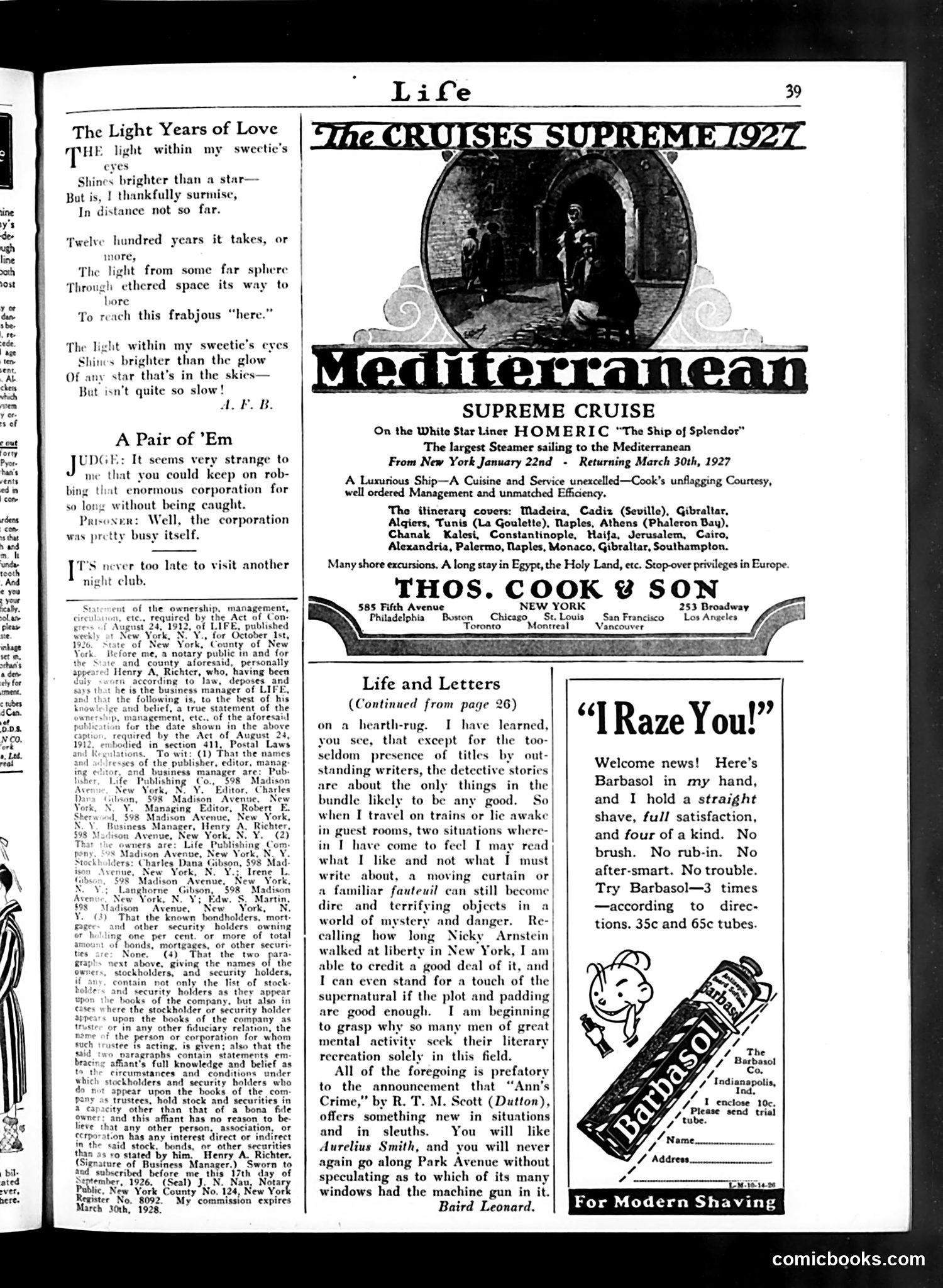
This page contains primarily **light humor and advertising** rather than political satire. The poems ("The Light Years of Love" and "A Pair of 'Em") are gentle romantic and observational jokes typical of Life's humor column. The first cleverly plays on starlight taking years to reach Earth. The second makes a mild joke about corporate malfeasance—a prisoner claims he robbed a corporation undetected because the corporation itself was "busy" (presumably engaged in its own questionable dealings). This is **gentle social commentary** suggesting corporations were seen as inherently corrupt or untrustworthy by 1927 readers. The bulk of the page is dominated by **Thomas Cook & Son's Mediterranean cruise advertisement**, promoting a luxury voyage on the White Star Liner *Homeric* visiting Egypt, the Holy Land, and European ports—highlighting leisure travel for the wealthy during the prosperous 1920s. The remainder discusses literary contributions and includes a **Barbasol shaving cream advertisement**. There is no significant political cartoon or satire on this page.
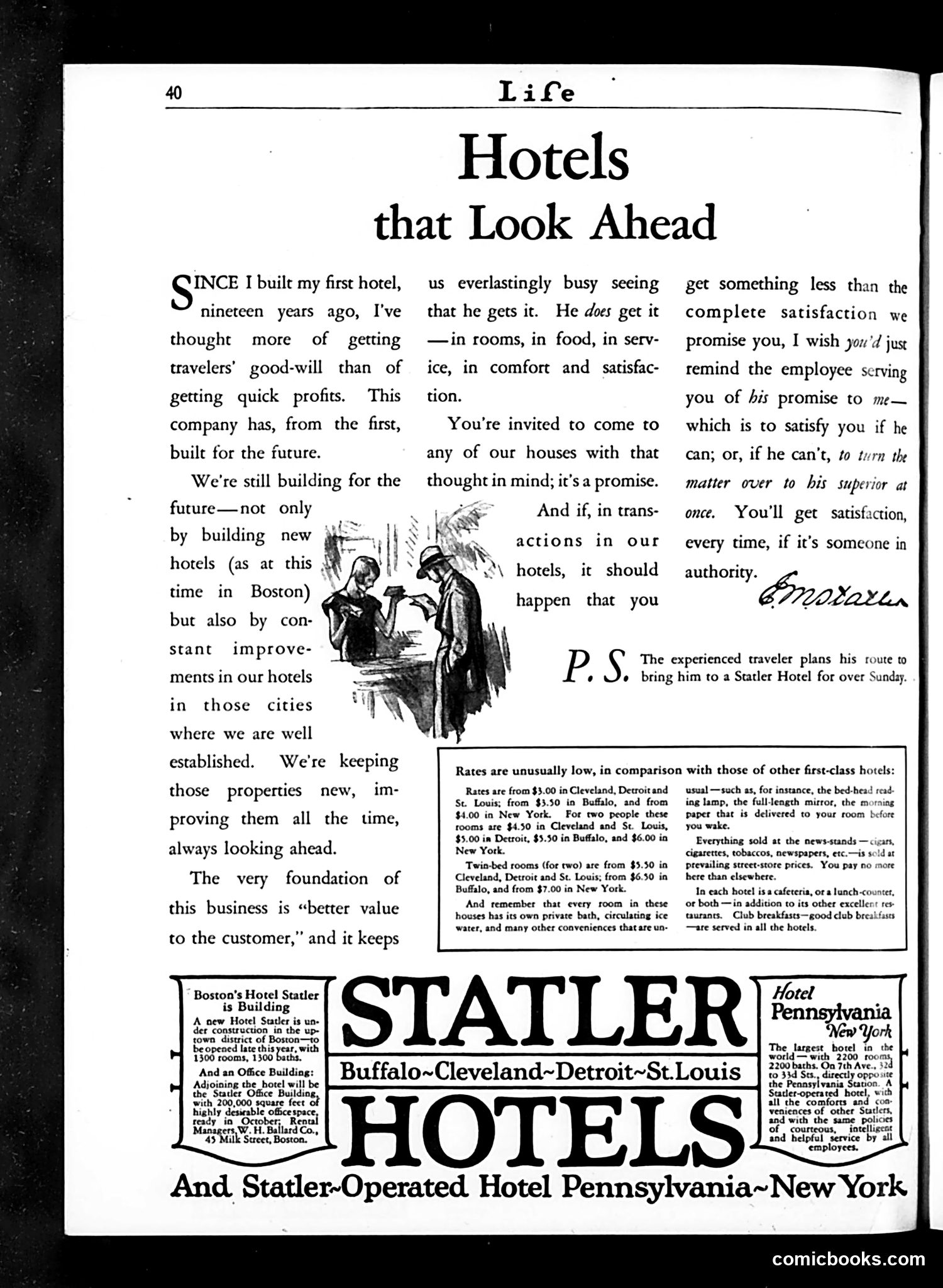
This is primarily a **Statler Hotels advertisement** masquerading as editorial content. The page features a signed message (appears to be from E.M. Statler, the hotel chain's founder) promoting the company's philosophy of customer service and expansion. The small **sketch** shows two figures in period dress (appearing to be early 20th-century travelers or hotel patrons) in conversation—likely illustrating the "experienced traveler" referenced in the P.S., suggesting word-of-mouth satisfaction drives business. **The pitch:** Statler Hotels emphasizes building "for the future" through constant improvement and competitive pricing. The text appeals to travelers' desire for reliable quality and value—positioning Statler as the thinking person's hotel choice. The promise emphasizes employee accountability ("turn the matter over to his superior") as a service guarantee. This reflects **early 1900s business marketing**: targeting middle-class travelers by promising efficiency, modern amenities (private baths, reading lamps, morning newspapers), and democratized luxury through low rates. There's no satire here—it's straightforward corporate self-promotion framed as customer-focused philosophy.
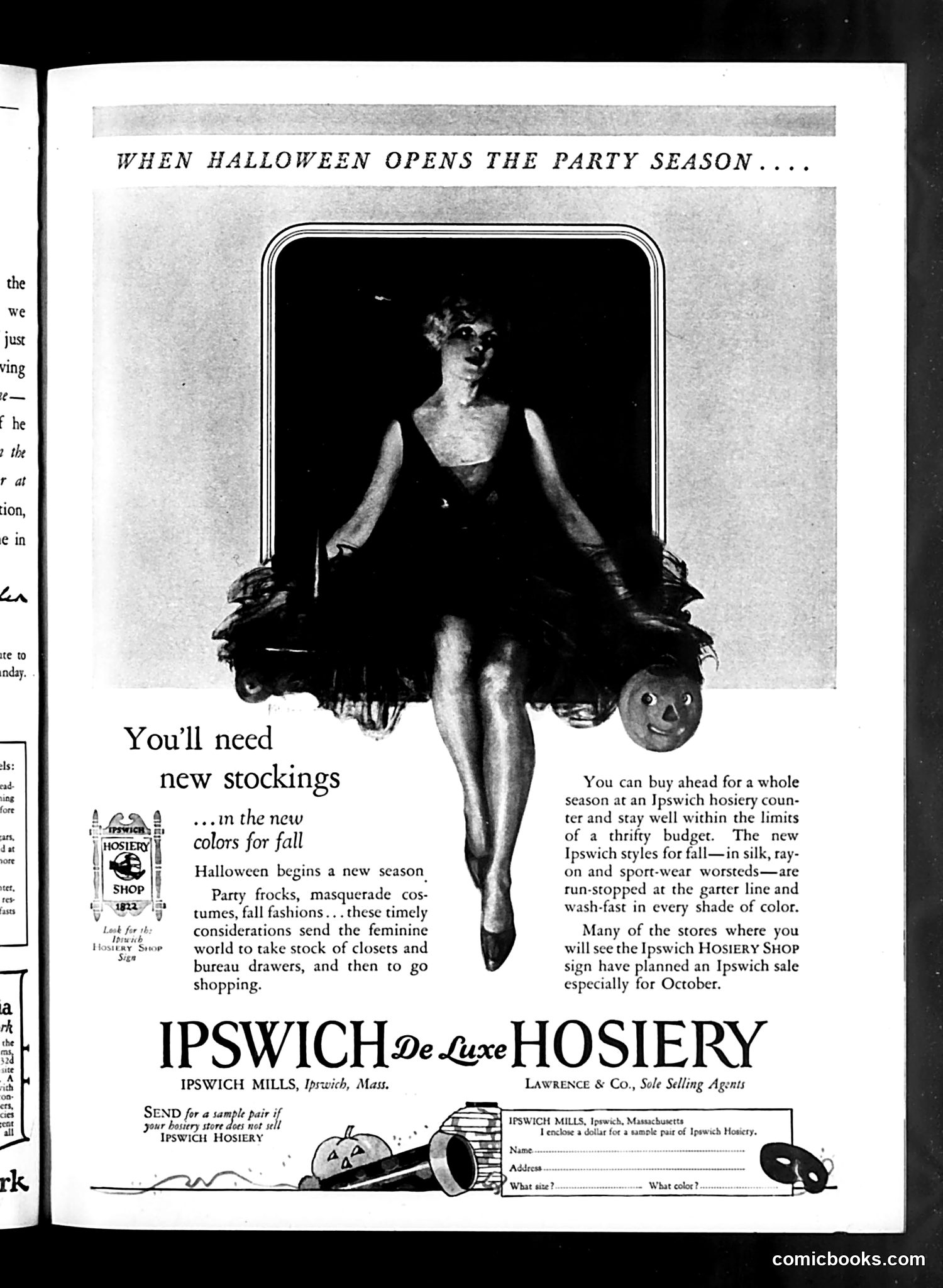
This is **primarily a commercial advertisement**, not political satire. It uses Halloween as a seasonal hook to market women's stockings. The image shows a woman in a black dress with a pumpkin and witch's hat—Halloween imagery meant to catch readers' attention. The copy plays on the idea that Halloween "opens the party season," positioning new hosiery as essential for the upcoming social calendar of costume balls and fall festivities. The advertisement emphasizes practical selling points: stockings in new fall colors, durability ("wash-fast"), variety of materials (silk, rayon, worsteds), and affordability ("thrifty budget"). It notes that participating stores will hold special October sales. There is no political satire or caricature here—this is straightforward mid-twentieth-century consumer advertising targeting women shoppers, leveraging a holiday to drive seasonal purchasing.
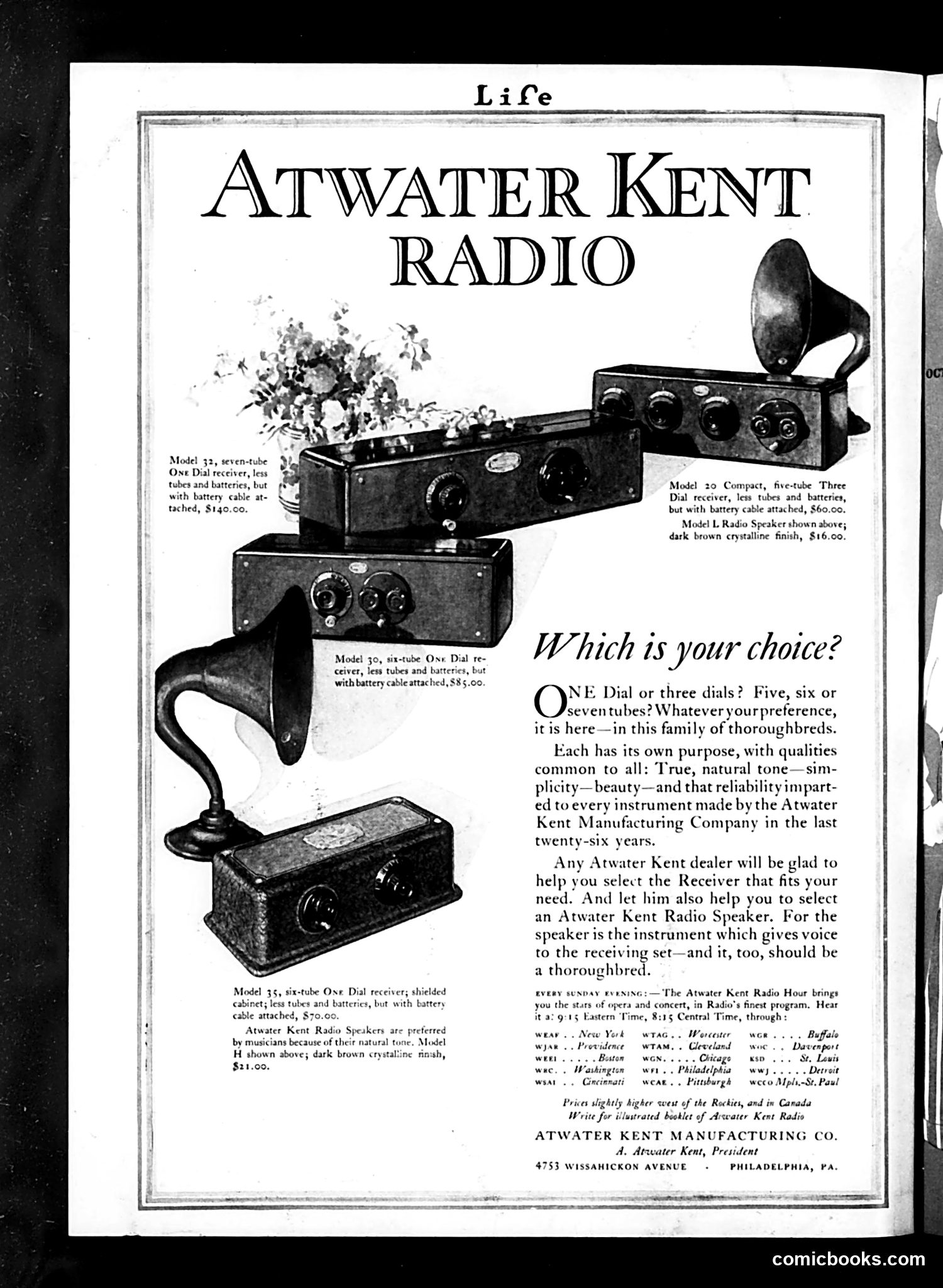
This is **not a cartoon or satire page**—it's a straightforward **advertisement for Atwater Kent radios**, a major American manufacturer of the era. The page showcases multiple radio receiver models (priced $60-$140) and speakers, displaying the variety available to consumers. The headline "Which is your choice?" is a marketing device inviting buyers to select based on their preferences and budget. The content emphasizes the company's 26-year reputation and the quality of their products, positioning radios as desirable consumer goods. A notable feature is promotion of "The Atwater Kent Radio Hour," a sponsored radio program airing on multiple stations across the country—an early example of **branded entertainment/radio programming**. The listed call letters (WJZ, WEAF, WRC, etc.) indicate the widespread radio network broadcasting this program nationally. This represents radio's emergence as a **mass-market consumer product and advertising medium** in early-to-mid twentieth century America. There is no satire intended; this is period commercial marketing.