
Life, 1926-10-14 · page 25 of 44
Life — October 14, 1926 — page 25: what you’re looking at
What you’re looking at
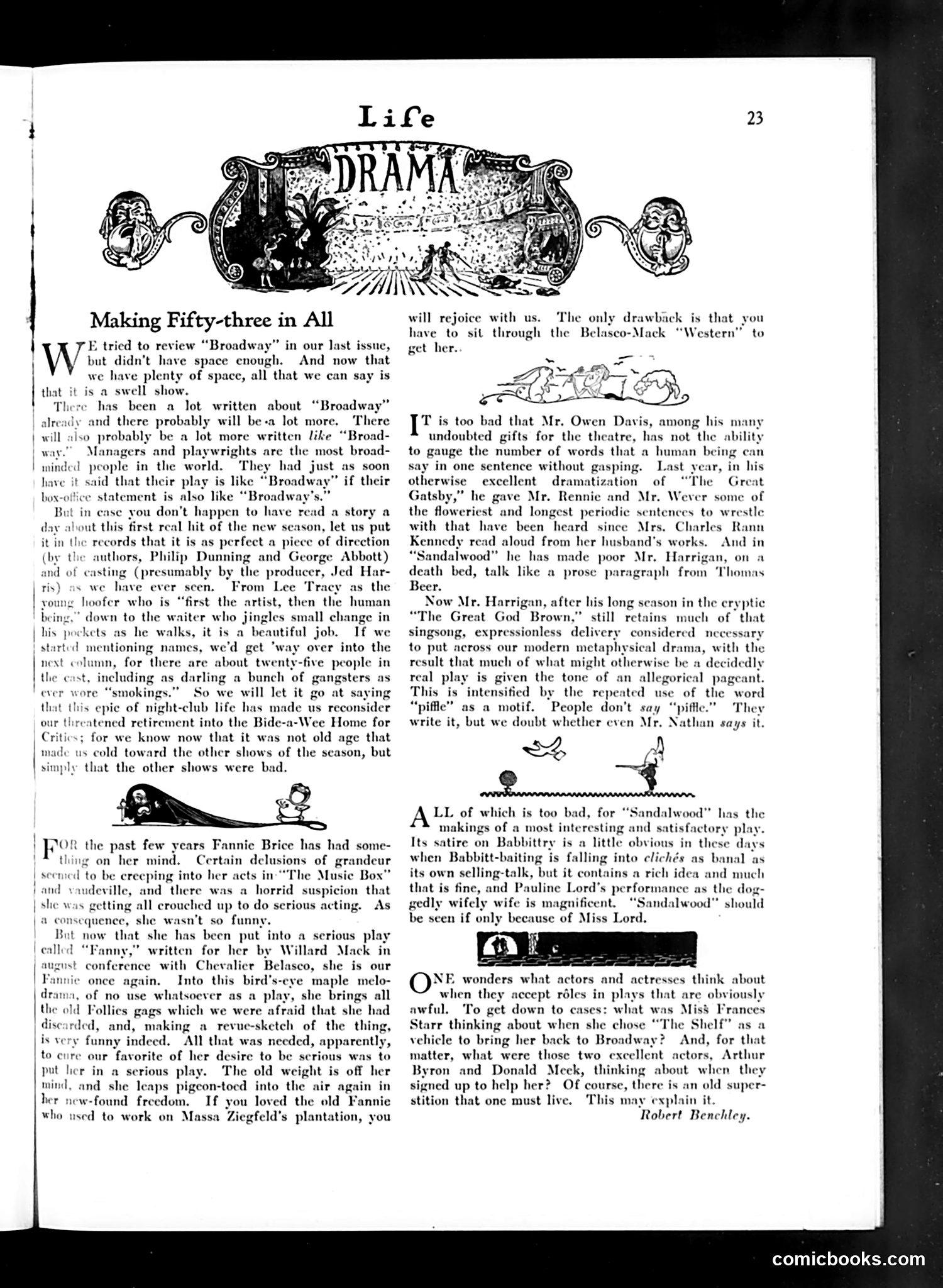
This page reviews current Broadway productions. The main critiques focus on: **"Broadway"** — Praised as excellently directed and cast, particularly Lee Tracy in the lead role. The reviewer notes it's become the season's hit show, with managers now claiming their plays resemble it. **Fannie Brice in "Fanny"** — The comedian, who'd been pursuing serious acting, returns to comedy in this Willard Mack/David Belasco production. The reviewer celebrates her return to her old vaudeville humor, suggesting her "desire to be serious" needed curing through actual serious drama. **Owen Davis's plays** — Criticized for verbose dialogue; his characters deliver unrealistically long sentences without pausing for breath. The example given is "Sandalwood," where ill protagonist Mr. Harrigan speaks in lengthy prose paragraphs, undermining the play's emotional impact. The satire targets theatrical pretension—actors pursuing seriousness, playwrights overcomplicating language—while celebrating genuine entertainment value.
📄 Transcribed text from this page (OCR, searchable)
Machine-transcribed from the original scan — historical spelling and the odd misread are preserved.
Making Fifty-three in All JE tried to review “Broadway” in our Jast issue, VW but didn’t have space enough. And now that we have plenty of space, all that we can say is that it is a swell show, has been a lot written about “Broadway” already and there probably will be-a lot more. There | will also probably be a lot more written like “Broad- are the most broad- way.” Managers and playwrights minded people in the world. They had just as soon have it said that their play is like “Broadway” if their box-oftice statement is also like “Broadway's. But in ease you don’t happen to have read a story a day about this first real hit of the new season, let us put it in the records that it is as perfect a piece of direction (by the authors, Philip Dunning and George Abbott) and of casting (presumably by the producer, Jed Har- ris) as we have ever scen. From Lee Tracy as the | xoung hoofer who is “first the artist, then the human being,” down to the waiter who jingles small change in | his kets as he walks, it is a beautiful job. If we started mentioning nes, we'd get ’way over into the next column, for there are about twenty-five people in the east, including as darling a bunch of gangsters as ever wore “smnokings.” So we will let it go at saying that this epie of night-club life has made us reconsider our tlreatened retirement into the Bide-a-Wee Home for Critics; for we know now that it was not old age that } made us cold toward the other shows of the season, but simply that the other shows were bad. Li }ror the past few years Fannie Brice has had some- hing on her mind. Certain delusions of grandeur seenied to be creeping into her acts in“The Music Box” }and vaudeville, and there was a horrid suspicion that © was getting all crouched up to do serious acting. As | 2 consequence, she wasn’t so funny. But now that she has been put into a serious play called yy,” written for her by Willard Mack in | august conference with Chevalict Belasco, she is our Fannie once again, Into this bird's-eye maple melo- | drama, of no use whatsoever as a play, she brings all | the old Follies gags which we were afraid that she had discarded, and, making a revue-sketch of the thing, is very funny indeed. All that was needed, apparently, to cure our favorite of her desire to be serious was to | put her in a ous play. The old weight is off her | mind, and she leaps pigeon-tocd into the air again in her new-found freedom, If you loved the old Fannie ed to work on Massa Ziegfeld’s plantation, you 23 will rejoice with us. The only drawback is that you have to sit through the Belasco-Mack “Wes to get her. 4 » (OTR, EARLIER, T is too bad that Mr. Owen Davis, among his many undoubted gifts for the theatre, has not the abi to gauge the number of words that a human be say in one sentence without gasping. Last year, in his otherwise excellent dramatization of “The Great Gatsby,” he gave Mr. Rennie and Mr. Wever some of the floweriest and longest periodic sentences to wrestle with that have been heard since Mrs. Charles Rann Kennedy read aloud from her husband's works. And in “Sandalwood” he has made poor Mr. Harrigan, on a death bed, talk like a prose paragraph from ‘Thomas Beer. Now Mr. Harrigan, after his long season in the eryptic “The Great God Brown,” still retains much of that singsong, expressionless delivery considered necessary to put across our modern metaphysical drama, with the result that much of what might otherwise be a decidedly real play is given the tone of an allegorical pageant. This is intensified by the repeated use of the word “piffle” as a motif. People don’t say “piffe.” They write it, but we doubt whether even Mr. Nathan says it. i Se LL of which is too bad, for “Sandalwood” has the makings of a most interesting and satisfactory play. Its satire on Babbittry is a little obvious in these when Babbitt-baiting is falling into clichés as banal a its own selling-talk, but it contains a rich idea and mich that is fine, and Pauline Lord’s performance as the dog- 5 gedly wifely wife is magnificent. “Sandalwood” should be seen if only because of Miss Lord. NE wonders what actors and actresses think about when they accept réles in plays that are obviously awful. To get down to cases: what was Mis’ Starr thinking about when she chose “The Shelf” as a vehicle to bring her back to Broadway? And, for that matter, what were those two excellent actors, Arthur Byron and Donald Meek, thinking about when they signed up to help her? Of course, there is an old super- stition that one must live. This may explain it. Robert Benchley. ances comicbooks.com