
Life, 1926-10-14 · page 20 of 44
Life — October 14, 1926 — page 20: what you’re looking at
What you’re looking at
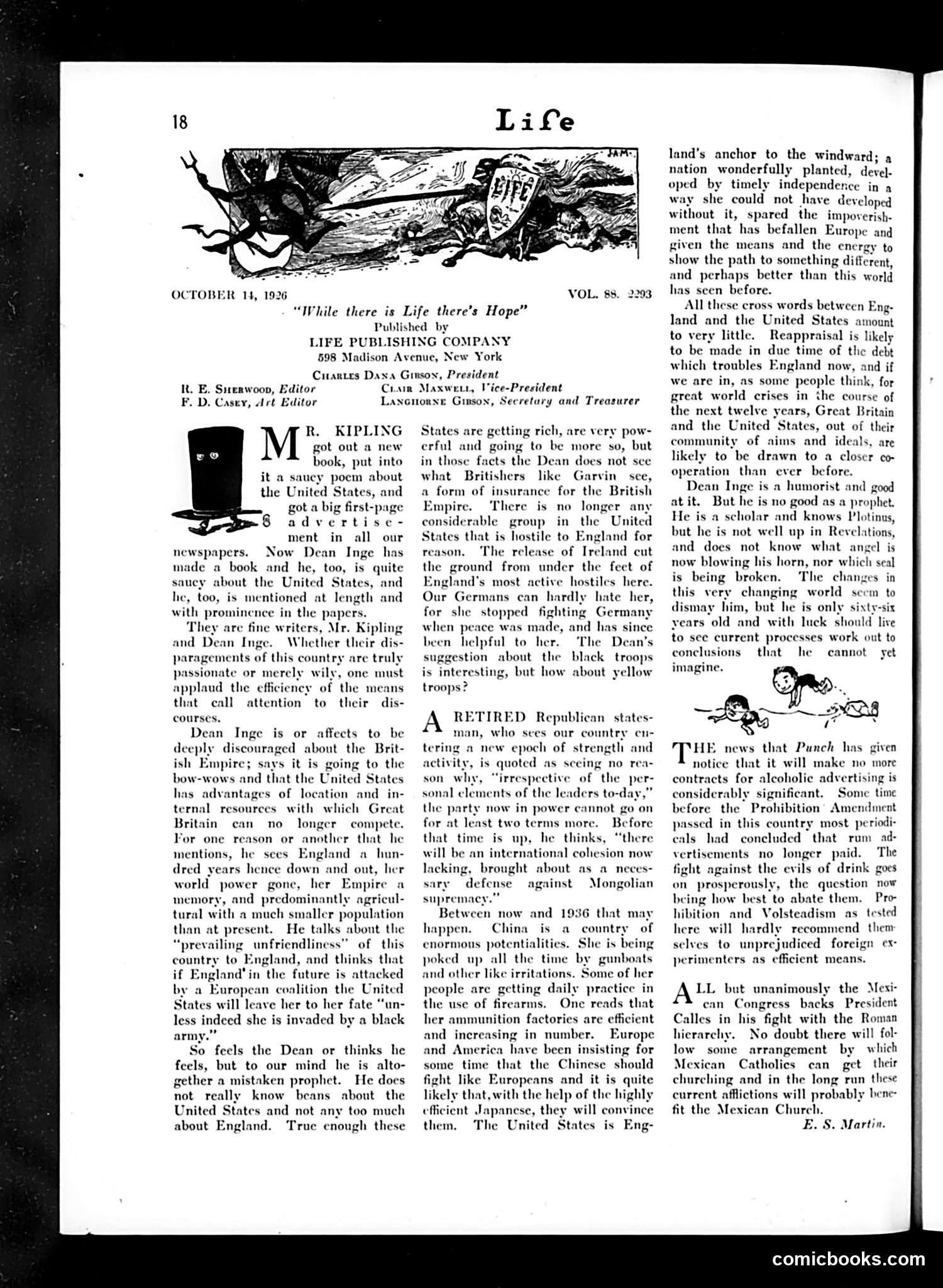
This page contains editorial commentary on two British writers' criticisms of America. **Rudyard Kipling** and **Dean Inge** (a prominent Anglican clergyman) had each published books disparaging the United States, receiving prominent newspaper coverage. The Life editors acknowledge these are "fine writers" but suggest their criticism may be strategically designed to generate publicity. The main satirical point: Dean Inge's pessimistic predictions about Britain's decline and America's potential abandonment of Britain are dismissed as misguided prophecy. The editors argue Inge fundamentally misunderstands American sentiment—Irish-American hostility toward Britain has diminished with Irish independence, and Germany is no longer an enemy. They characterize Inge as uninformed about both countries. A secondary piece discusses a retired Republican politician's confidence in Republican electoral dominance through 1936, and comments on China's growing military capacity—potentially concerning given Japanese involvement. The cartoon's specific content is unclear from the image quality, but appears related to these geopolitical themes.
📄 Transcribed text from this page (OCR, searchable)
Machine-transcribed from the original scan — historical spelling and the odd misread are preserved.
OCTOBER 14, 1926 “While there is Life there’s Hope” Published by LIFE PUBLISHING COMPANY 598 Madison Avenue, N w York Cuantes Dana Giuson, President Rt. E. Sienwoop, Editor F. D. Casty, Art Editor R. KIPLING M got out a new book, put into it a saucy poem about the United States, and got a big first-page advertise- ment in all our newspapers. Now Dean Inge has made a book and he, too, is quite saucy about the United States, and he, too, is mentioned at length and with prominence in the papers. They are fine writers, Mr. Kipling and Dean Inge. Whether their dis- paragements of this country are truly passionate or merely wily, one must applaud the efficiency of the means that call attention to their dis- courses. Dean Inge is or affects to be deeply discouraged about the Brit- ish Empire; says it is going to the bow-wows and that the United States has advantages of location and in- resources with which Great ain can no longer compete. For one reason or another that he mentions, he sees England a hun- dred years hence down and out, her world power gone, her Empire a memory, and predominantly agricul- tural with a much smaller population than at present. He talks about the “prevailing unfriendliness” of this country to England, and thinks that if England’in the future is attacked by a European coalition the United States will leave her to her fate “‘un- less indeed she is invaded by a black army.” So feels the Dean or thinks he feels, but to our mind he is alto- gether a mistaken prophet. He does not really know beans about the United States and not any too much about England. True enough these Cram Maxwewt, Vice-President Lanouorne Ginson, Secretary and Treasurer States are getting rich, are very pow- erful and going to be more so, but in those facts the Dean does not sce what Britishers like Garvin sce, a form of insurance for the British Empire. There is no longer any considerable group in the United States that is hostile to England for reason. The release of Ireland cut the ground from under the feet of England's most active hostiles here. Our Germans can hardly hate her, for she stopped fighting Germany when peace was made, and has since been helpful to her. The Dean's suggestion about the black troops is interesting, but how about yellow troops? RETIRED Republican states- man, who sees our country cn- tering a new epoch of strength and activity, is quoted as sceing no rea son why, “irrespective of the per- nents of the leaders to-day,” the party now in power cannot go on for at least two terms more. Before that time is up, he thinks, “there will be an international cohesion now lacking, brought about as a_neces- sary Mongolian sonal ¢ Betwe happen. — Chi enormous potentialities. She is being poked up all the time by gunboats and other like irritations. Some of her people are getting daily practice in the use of firearms. One reads that her ammunition factories are efficient and increasing in number. Europe and America have been insisting for some time that the Chinese should fight like Europeans and it is quite likely that, with the help of the highly efficient Japanese, they will convince them. The United States is Eng- n now and 1936 that may country of land’s anchor to the windward; a nation wonderfully planted, devel- oped by timely independence in a way she could not have developed without it, spared the impoverish- ment that has befallen Europe and given the means and the energy to show the path to something different, and perhaps better than this world has seen before. All these cross words between Eng- land and the United States amount to very little. Reappraisal is likely to be made in due time of the debt which troubles England now, and if we are in, as some people think, for great world crises in the course of the next twelve years, Great Britain and the United States, out of their community of aims and ideals, are likely to be drawn to a closer co- operation than ever before. Dean Inge is a humorist and good atit. But he is no good as a prophet. He is a scholar and knows Plotinus, but he is not well up in Revelations, and does not know what angel is now blowing his horn, nor which seal is being broken. The changes in this very changing world scem to dismay him, but he is only sixty-six years old and with luck should live to see current processes work out to conclusions that he cannot yet imagine. = ee at) news that Punch has given notice that it will make no more contracts for alcoholic advertising is considerably significant. Some time before the Prohibition’ Amendment passed in this country most periodi- cals had concluded that rum ad- vertisements no longer paid. The fight against the evils of drink goes on prosperously, the question now being how best to abate them. Pro hibition and Volsteadism as_ tested here will hardly recommend them selves to unprejudiced foreign ex perimenters as efficient means. LL but unanimously the Mexi- can Congress backs President Calles in his fight with the Roman hierarchy. No doubt there will fol- low some arrangement by which Mexican Catholics can get their churching and in the long run these current afflictions will probably bene fit the Mexican Church, Martin. comicbooks.com