
A complete issue · 40 pages · 1926
Life — September 23, 1926
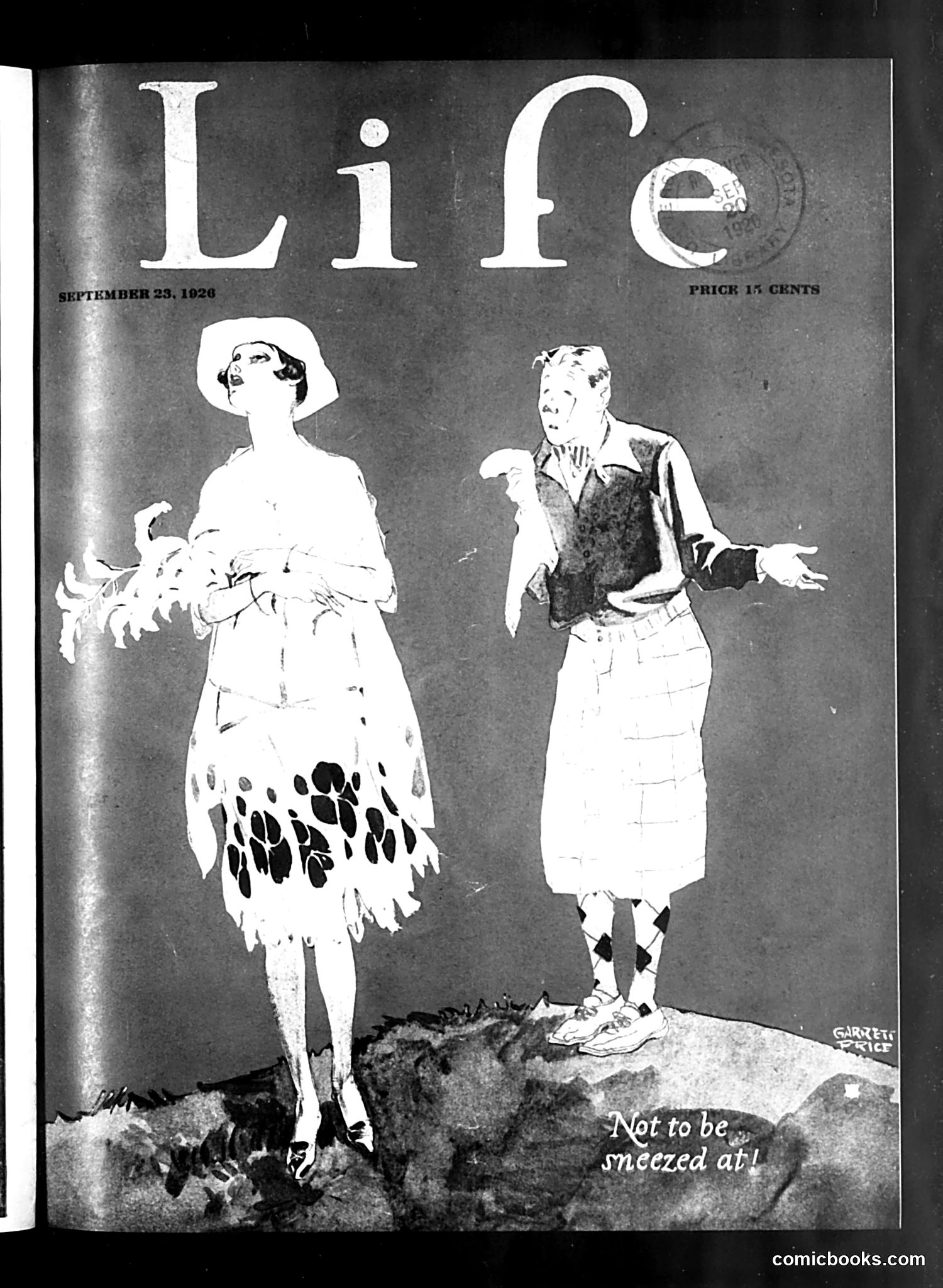
This satirical cover depicts two figures in a comedic confrontation over romantic or social matters. The woman on the left, wearing an elegant dress with a feathered hem and cloche hat (typical 1920s flapper style), holds flowers and appears aloof. The man on the right, dressed in working-class attire with a vest, gestures in exasperation or pleading. The caption "Not to be squeezed at!" suggests the joke concerns unwanted physical advances or overly familiar behavior. The image appears to satirize dating rituals and class differences of the Jazz Age era—likely mocking either male persistence in courtship or tensions between social classes during romantic encounters. The sophisticated woman's apparent rejection of the working-class suitor drives the humor.
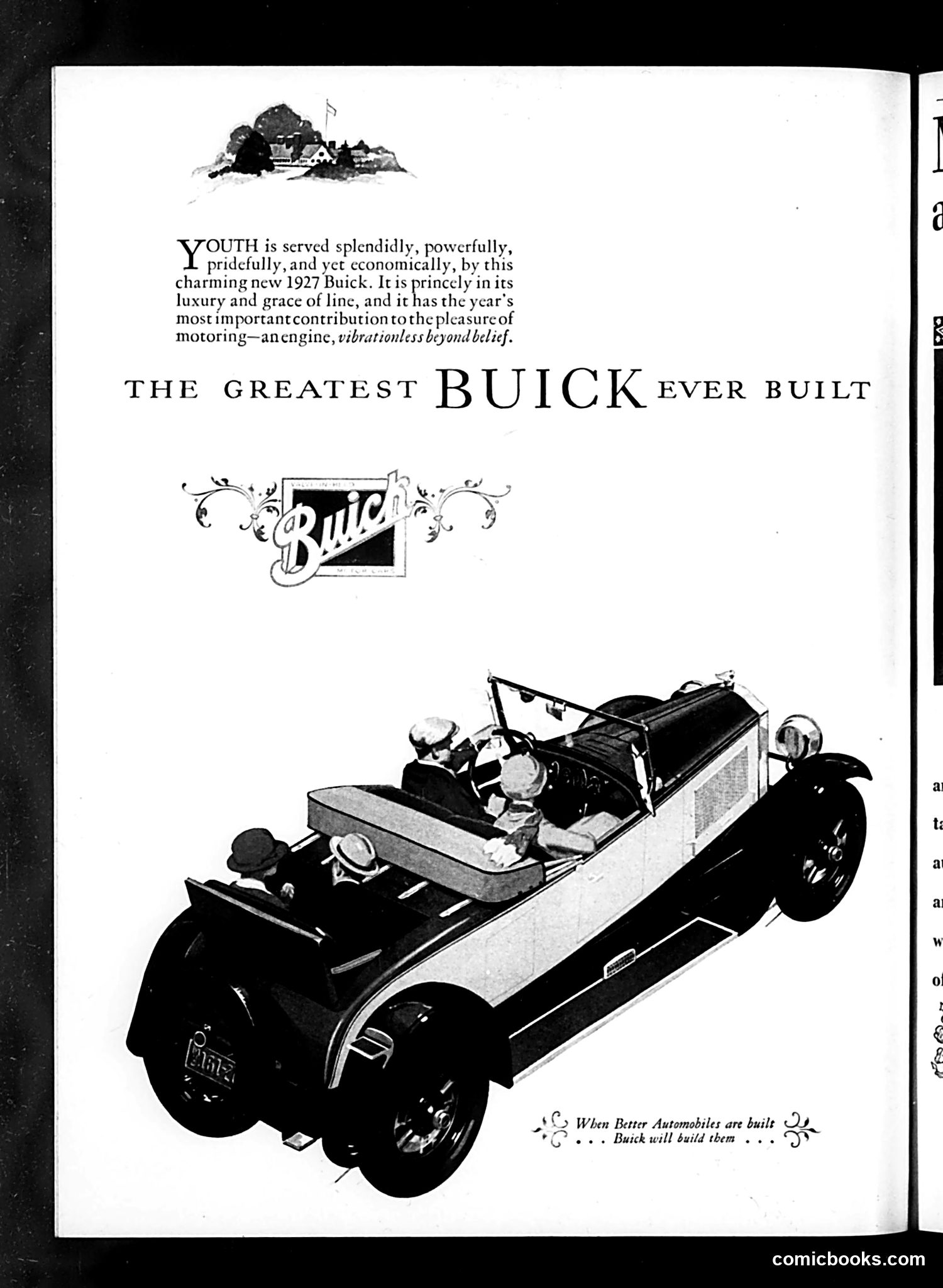
This is **not a cartoon or satire**—it's a **1927 Buick automobile advertisement**. The page advertises the 1927 Buick as "the greatest Buick ever built," targeting youth with claims of luxury, grace, and an engine "vibrationless beyond belief." The ad emphasizes affordability alongside elegance. The image shows a convertible roadster with passengers in period dress, visually reinforcing the car's appeal to young, stylish buyers. The decorative Buick logo and the closing tagline "When Better Automobiles are built . . . Buick will build them" are typical advertising flourishes of the era. There is no political commentary, caricature, or satire present—this is straightforward commercial marketing.
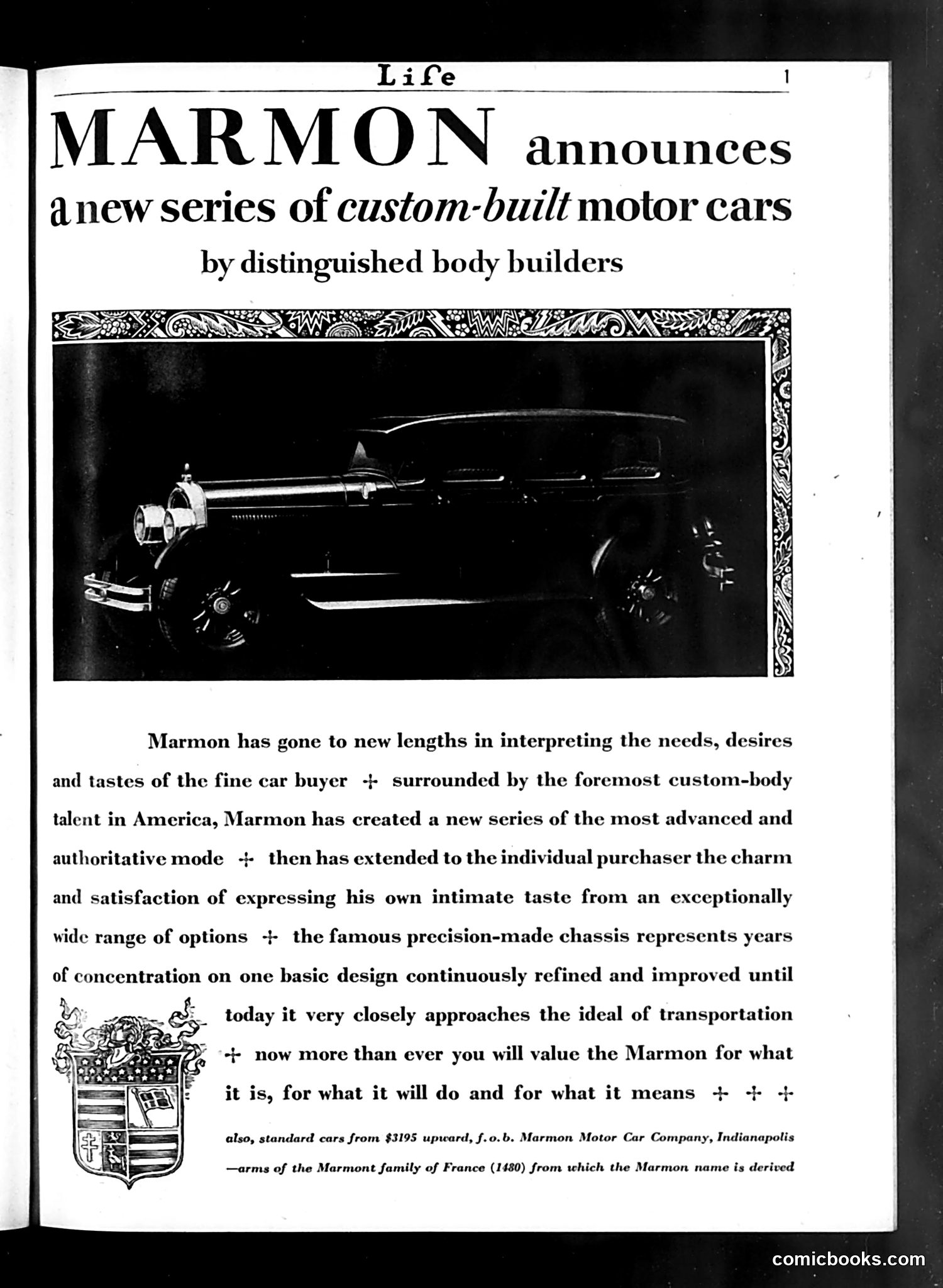
This is **not satirical content** but rather a straightforward **luxury automobile advertisement** from Life magazine. The page announces Marmon's new "custom-built motor cars" by distinguished coachbuilders. The advertisement emphasizes that Marmon offers wealthy buyers individualized vehicles combining a precision-engineered chassis with custom body designs reflecting personal taste. The text appeals to affluent consumers seeking exclusivity and refined transportation. Starting prices of "$3195 upward" positioned Marmon as a premium product. The heraldic coat of arms references the Marmont family of France (dating to 1480), lending European prestige to the brand. This represents typical early 20th-century American luxury car marketing targeting the wealthy elite.
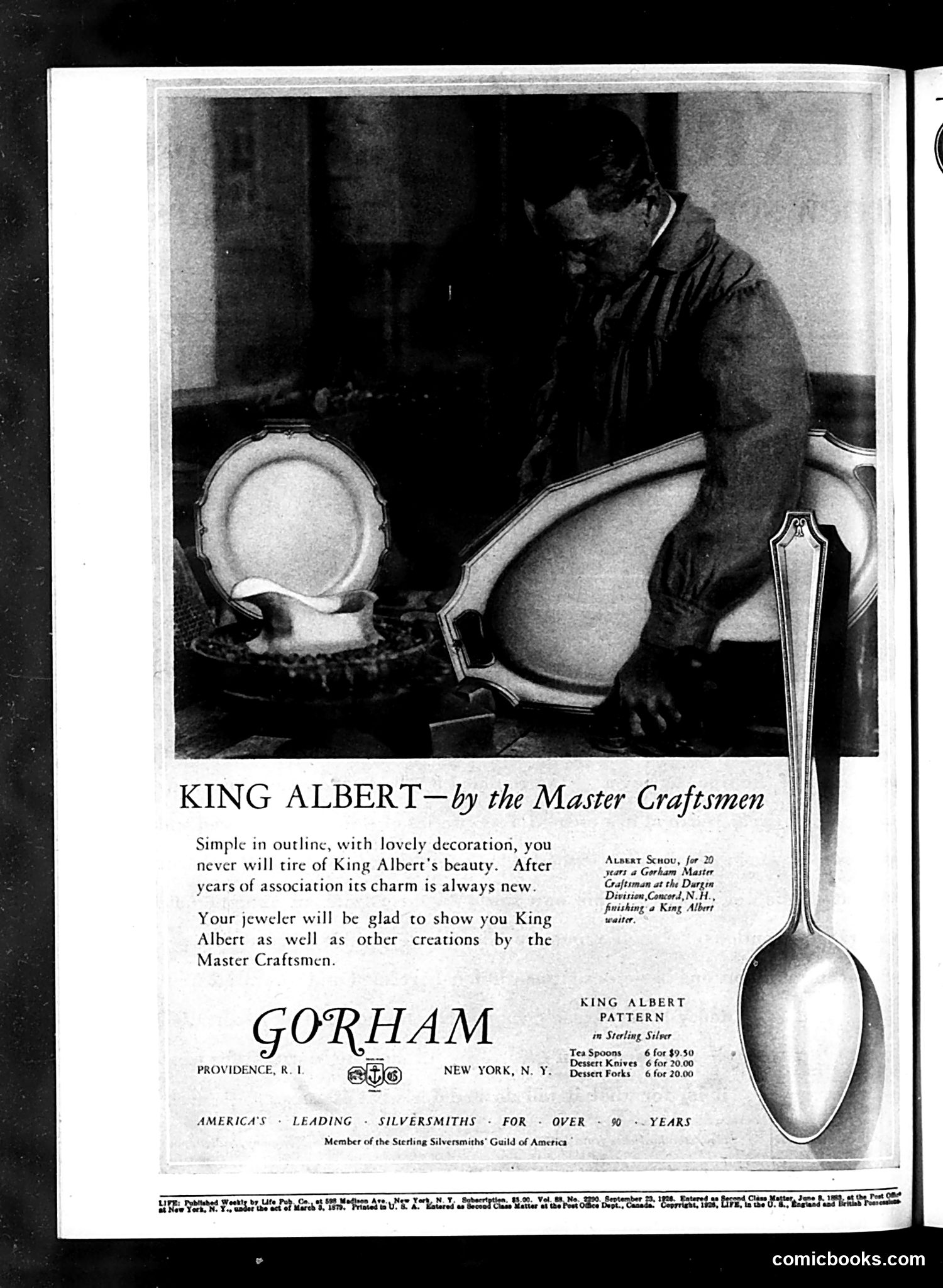
This is not a political cartoon or satire—it's a **straightforward advertisement** for Gorham silverware. The page shows a craftsman examining decorative serving pieces (bowls and a spoon) from Gorham's "King Albert" pattern in sterling silver. The image demonstrates the pattern's simple, elegant design and the quality of master craftsmanship. The text emphasizes that the pattern remains beautiful and charming after years of use, and encourages jewelers to stock it. Pricing information is provided for tea spoons, dessert knives, and dessert forks. Gorham, based in Providence, Rhode Island, is identified as "America's leading silversmiths for over 90 years." This is a period advertisement typical of Life magazine, which contained substantial advertising alongside its satirical content.
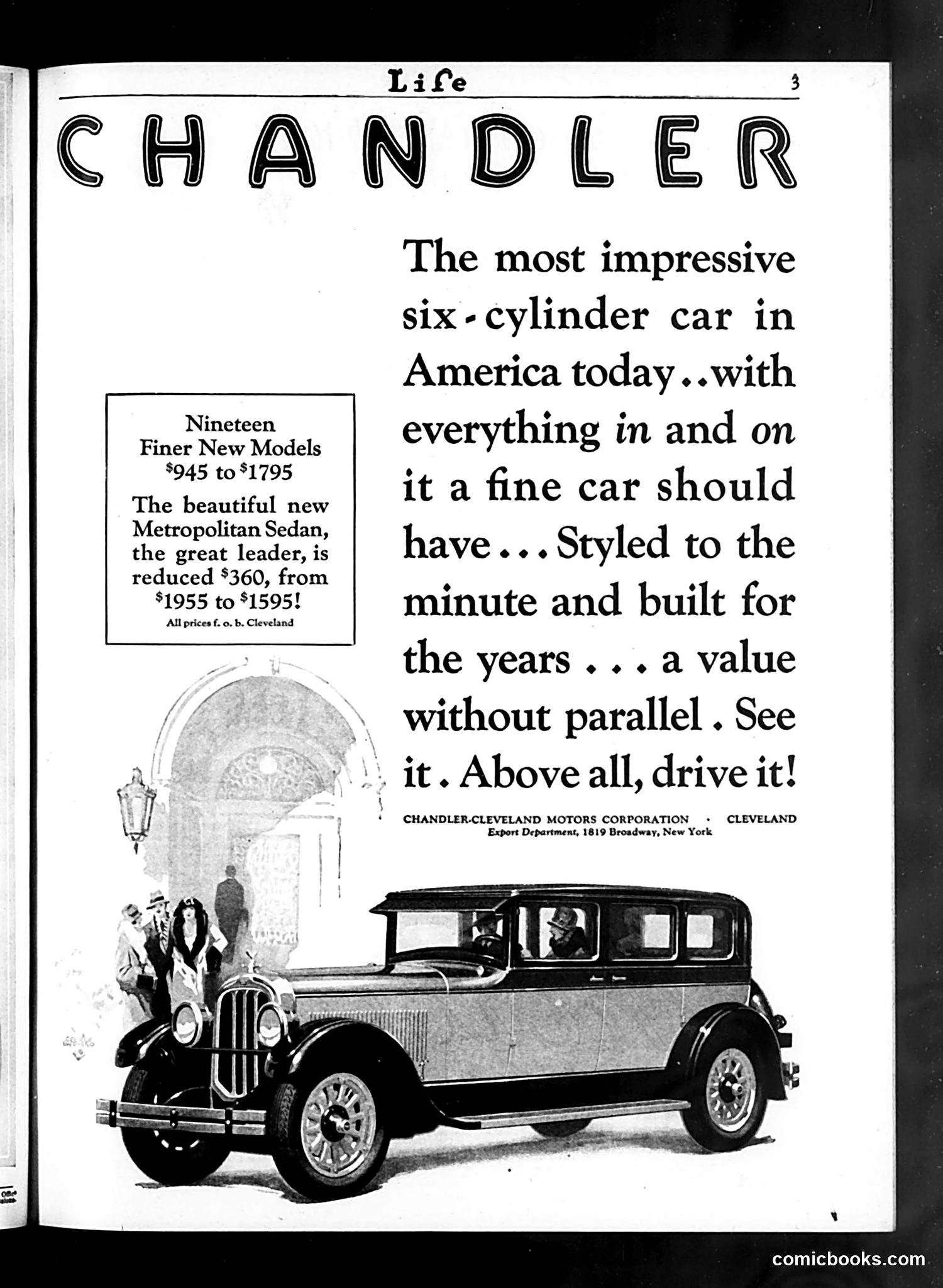
This page is primarily a **Chandler automobile advertisement**, not political satire. It promotes the Chandler as "the most impressive six-cylinder car in America today," emphasizing luxury features and styling. The ad highlights nineteen new models priced $945–$1795, with the Metropolitan Sedan reduced from $1955 to $1595. The text promises comprehensive quality: "everything in and on it a fine car should have...Styled to the minute and built for the years...a value without parallel." The illustration shows a well-dressed couple admiring the sedan outside an elegant building, suggesting aspiration and refinement. This is straightforward commercial promotion typical of 1920s-era Life magazine advertising, not editorial commentary or satire.
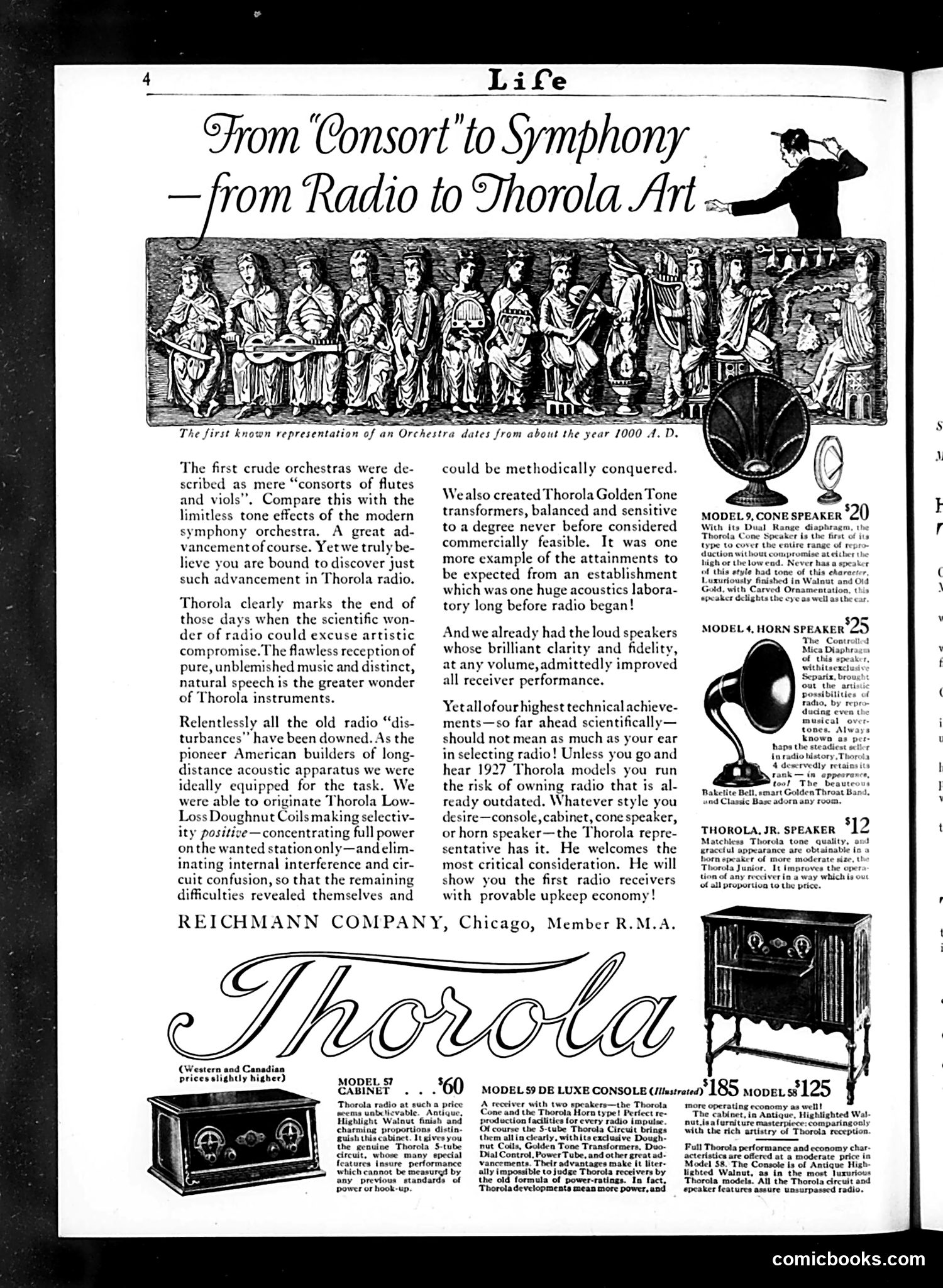
This is primarily a **Thorola radio advertisement**, not a satirical political cartoon. The page header "From 'Consort' to Symphony—from Radio to Thorola Art" uses historical framing to position Thorola radios as the modern evolution of music technology. The medieval woodcut at top depicting an orchestra "from about the year 1000 A.D." serves as a visual joke: it creates a humorous contrast between ancient musical ensembles and modern radio receivers. The satire is gentle—suggesting that Thorola represents such a technological leap that it's like comparing orchestras across a millennium. The rest is straightforward product advertising for various Thorola speaker and radio models with prices ($12–$185), marketed to consumers as superior sound quality alternatives to competitors.
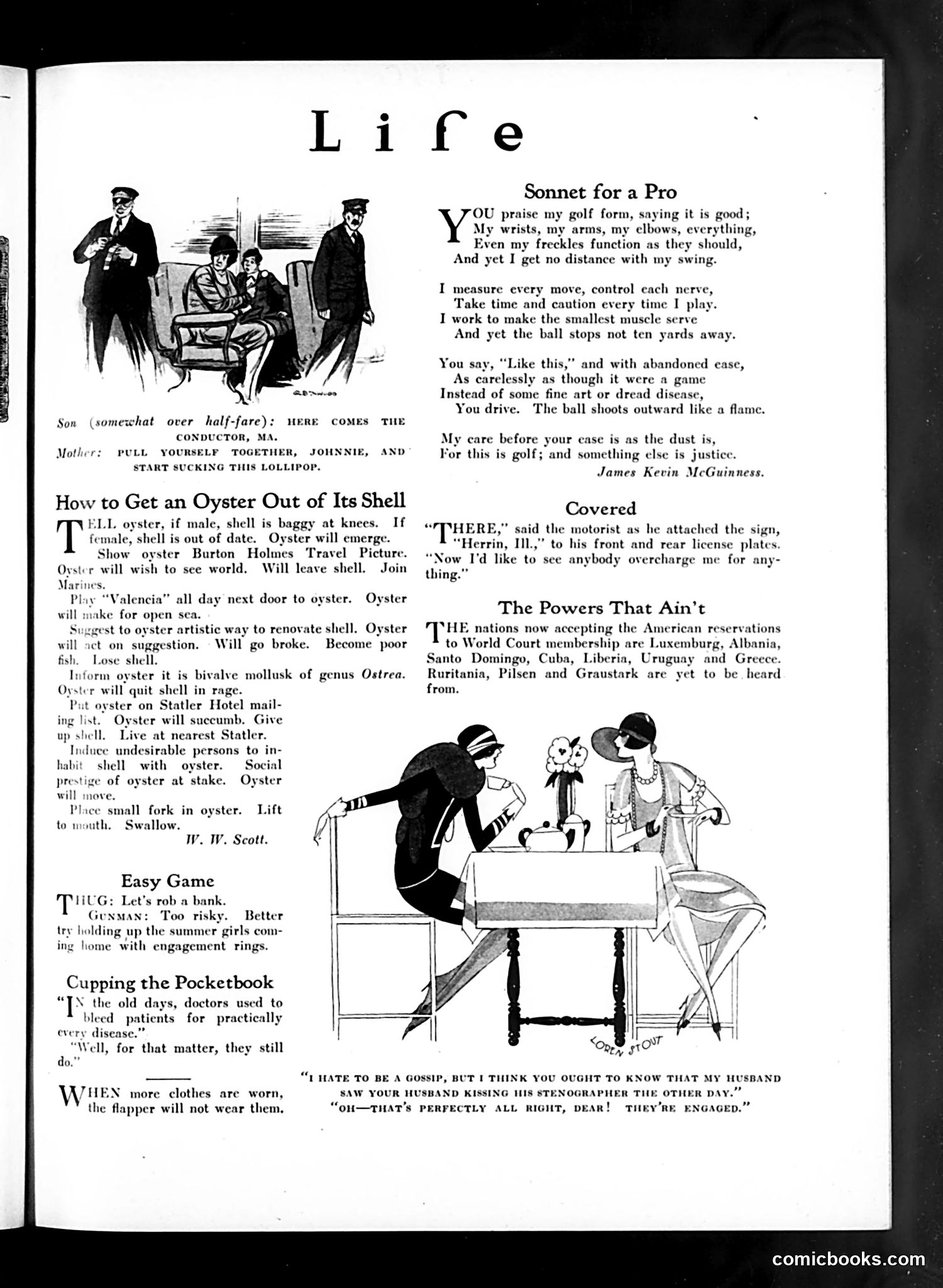
This page from *Life* magazine contains several satirical pieces: **"Sonnet for a Pro"** mocks golfers obsessed with technique and form while unable to hit the ball far—a critique of over-analysis paralyzing performance. **"How to Get an Oyster Out of Its Shell"** offers absurdist humor about oyster behavior, written in deadpan style by W.W. Scott. **"The Powers That Ain't"** references real 1920s politics, noting which nations have accepted American World Court membership reservations. The accompanying cartoon shows a gossipy couple—likely satirizing how political news spreads through social channels. **"Easy Game"** and **"Cupping the Pocketbook"** are brief, cynical one-liners typical of the magazine's humor format. The bottom cartoon caption involves marital infidelity humor—a common satirical target of the era. Overall, the page exemplifies *Life*'s blend of social commentary, wordplay, and gentle mockery of contemporary American life and politics.
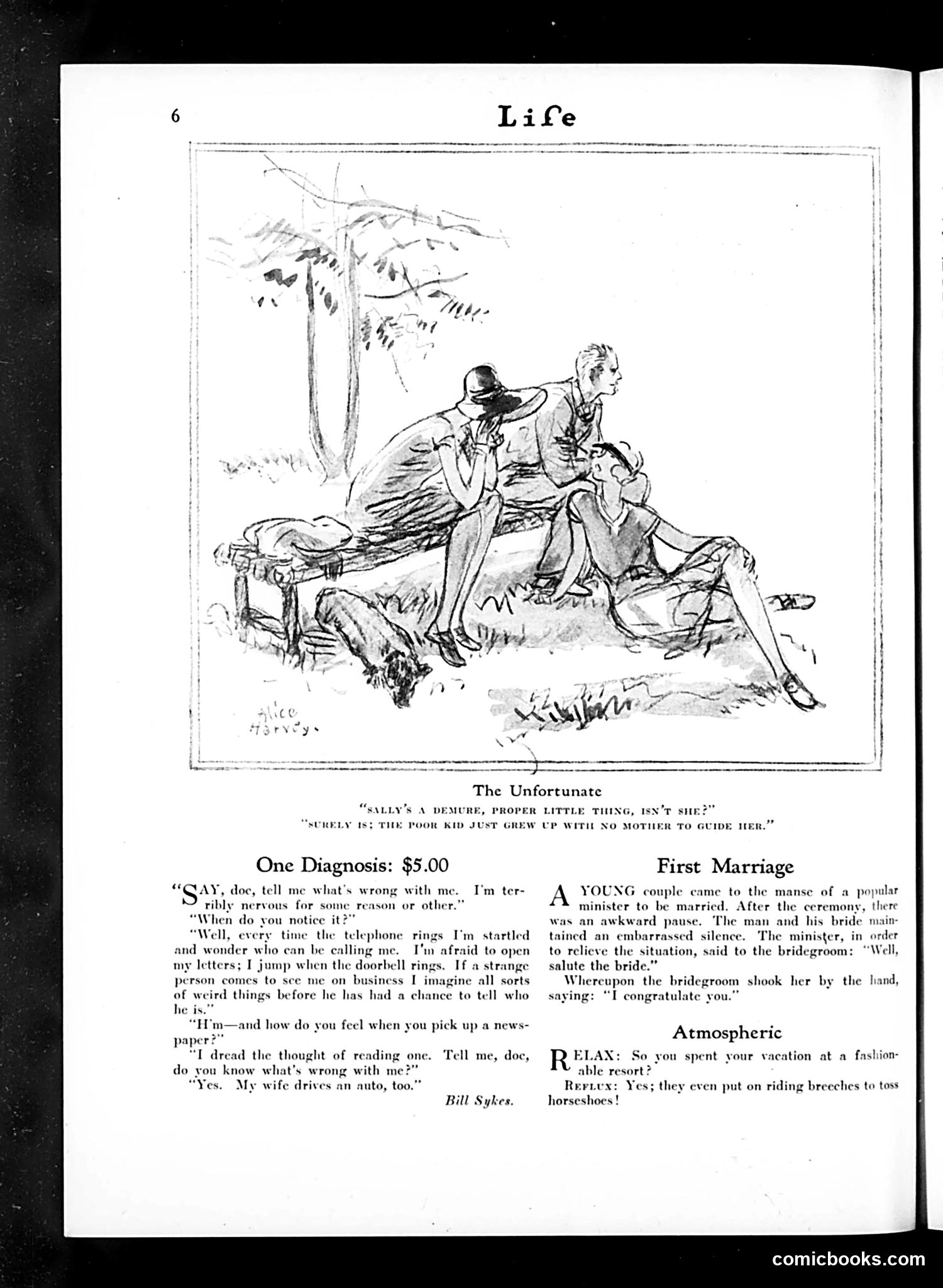
This page contains three separate humorous sketches rather than a political cartoon. **"The Unfortunate"** (top): A sketch depicting a woman with two children, illustrating social commentary about single motherhood and poverty—the caption notes the children "grew up with no mother to guide her," suggesting abandonment or illegitimacy. **"One Diagnosis" and "First Marriage"**: Two short comedic pieces satirizing modern married life—one about a nervous husband, another about an awkward newlywed moment where the bride is "congratulated." **"Atmospheric"**: A brief joke about vacation behavior, mocking pretentious resort fashion (riding breeches and horseshoes). These sketches represent typical early-20th-century *Life* magazine humor: gentle satire of domestic situations, social anxieties, and class pretensions, aimed at middle-class readers.
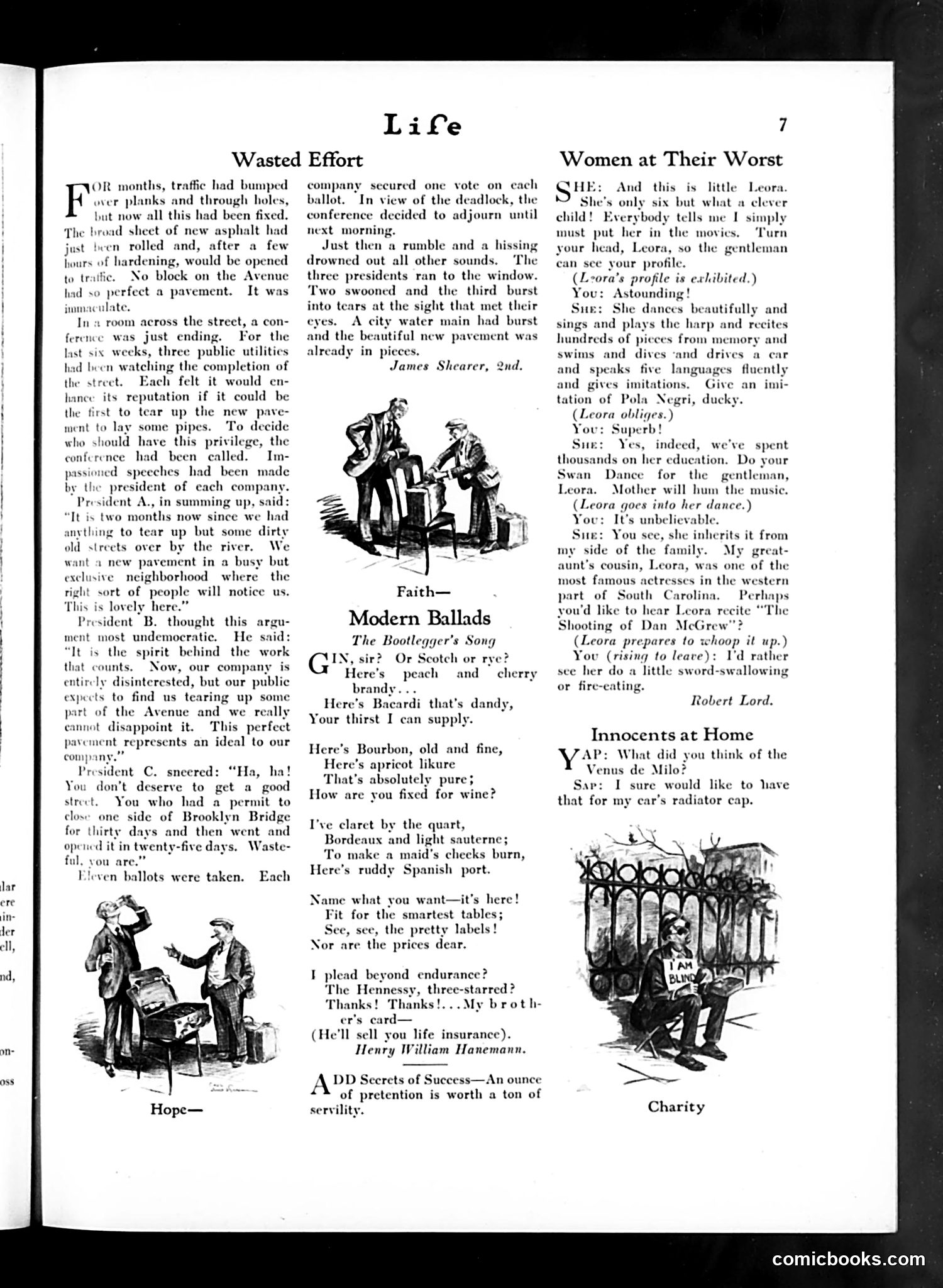
This page satirizes bureaucratic inefficiency and social pretension. **"Wasted Effort"** (left column) mocks a municipal conference about laying new asphalt pavement. Three company presidents argue endlessly over who should get the contract, their disagreement preventing any actual work. The cartoon illustrates how corporate self-interest and procedural delays obstruct public projects—a common complaint about early 20th-century American infrastructure. **"Modern Ballads"** (right side) presents humorous pseudo-poems about drinking. "The Bootlegger's Song" and other verses catalog various alcoholic beverages (peach brandy, Bordeaux, Hennessy) with winking references to Prohibition-era smuggling and consumption. The humor depends on readers' familiarity with bootlegging during alcohol prohibition. Both sections use satire to critique waste and hypocrisy in American society.
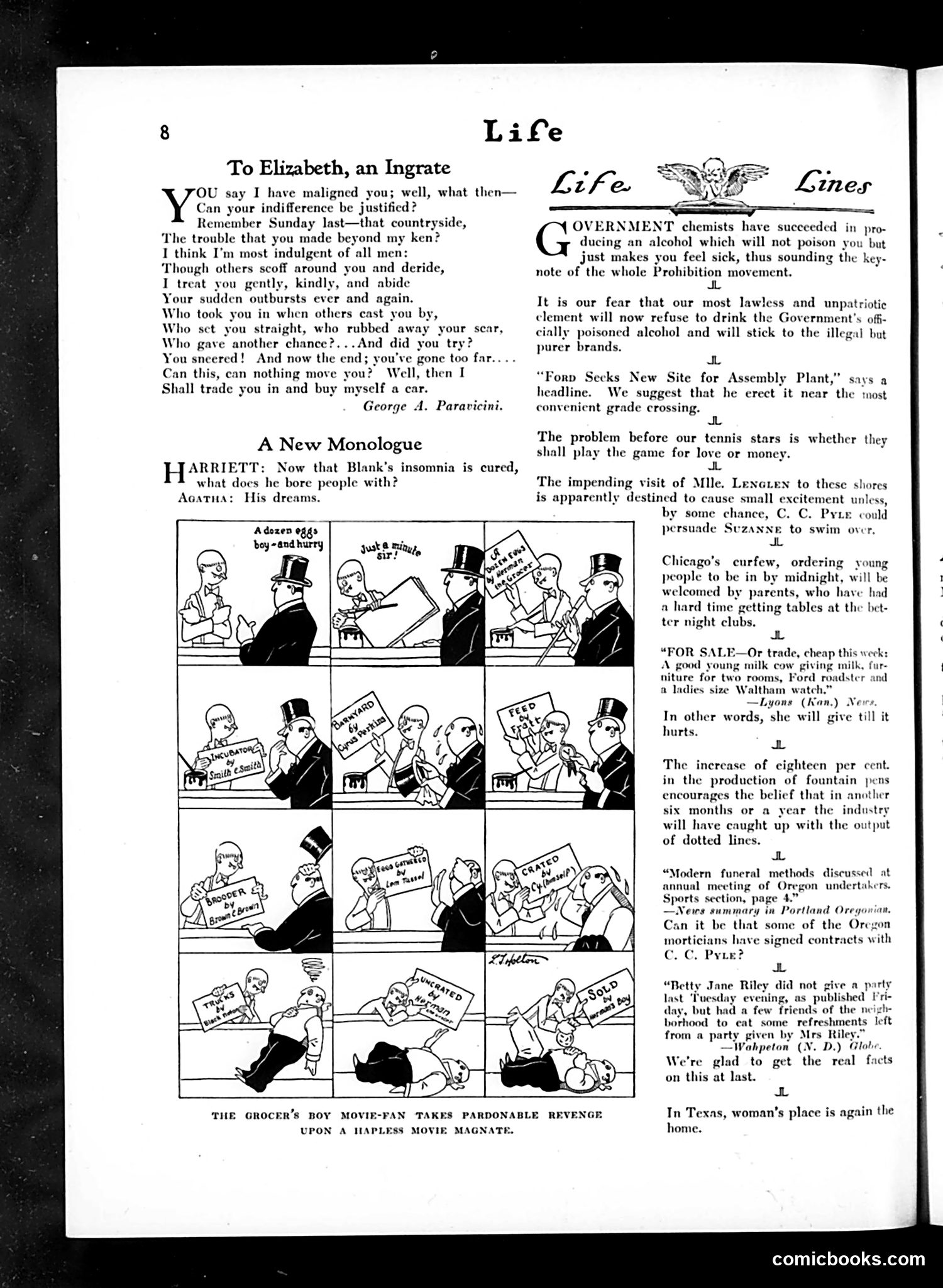
This comic strip depicts a grocer's delivery boy gaining revenge on a movie producer by bombarding him with rejected movie scenarios. The boy, frustrated by the studio's repeated rejections (shown by his stack of labeled submissions), systematically hands the magnate increasingly absurd pitches—each meeting the same dismissal. The final panels show the boy's "pardonable revenge": he literally buries the executive under an avalanche of rejected scripts. The satire targets early Hollywood's gatekeeping and dismissiveness toward unsolicited screenplays. It mocks both the studio system's arrogance and the persistent desperation of aspiring screenwriters seeking their break, presenting the scenario as comeuppance for the executive's condescension.
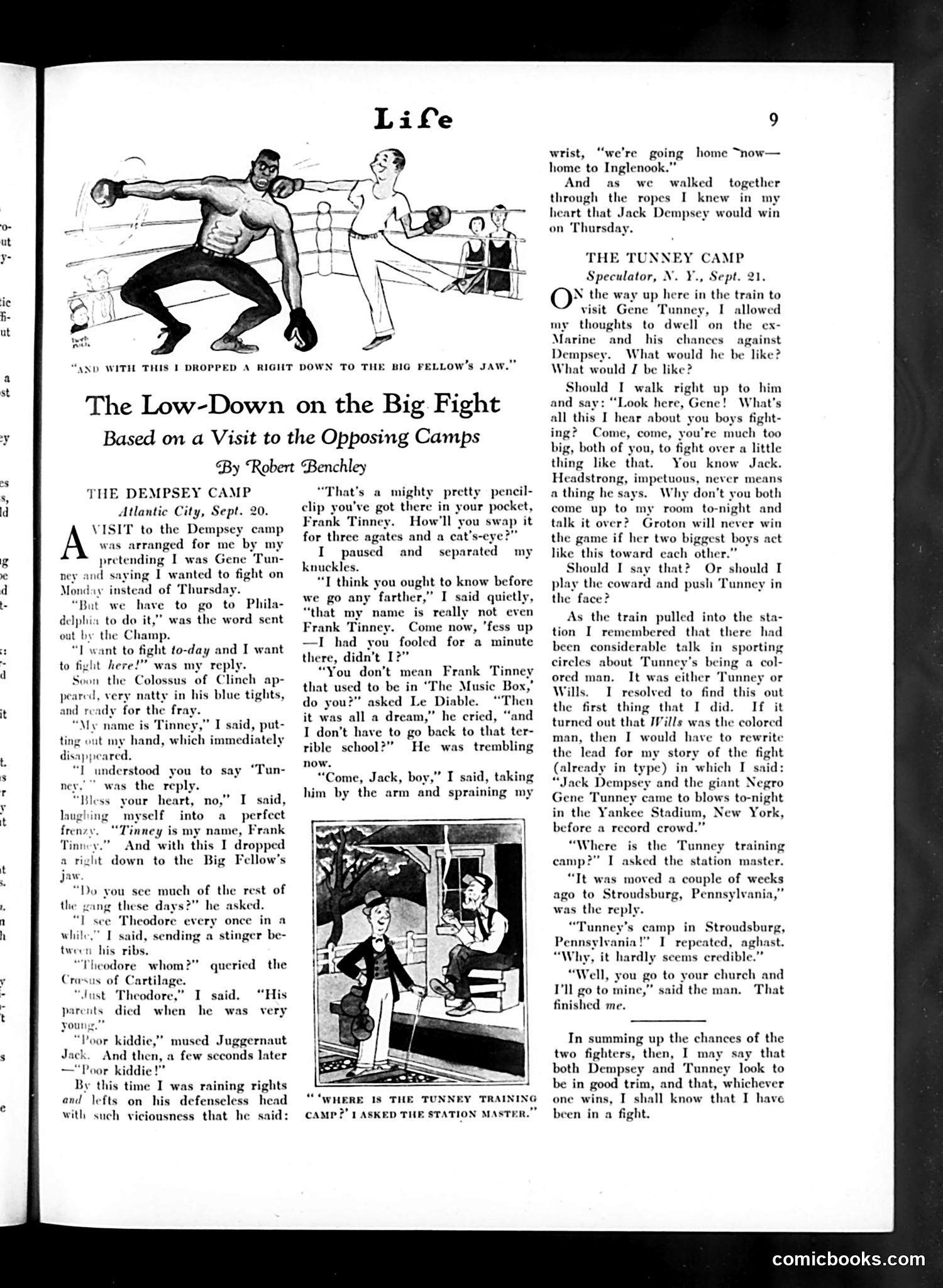
This is a sports article by Robert Benchley about the Dempsey-Tunney heavyweight boxing match (referenced as occurring in September). The illustration shows a boxing scene with exaggerated, caricatured figures in a dynamic fighting pose. The article describes Benchley's visits to both fighters' training camps—Dempsey's in Atlantic City and Tunney's in Stroudsburg, Pennsylvania. It presents humorous observations about the fighters' personalities and training, with Benchley interviewing various people about the upcoming bout. The satire appears gentle, mocking the overwrought language and personalities in boxing culture rather than delivering sharp political commentary. The cartoonish illustration complements Benchley's comedic, conversational writing style about a major sports event of the era.
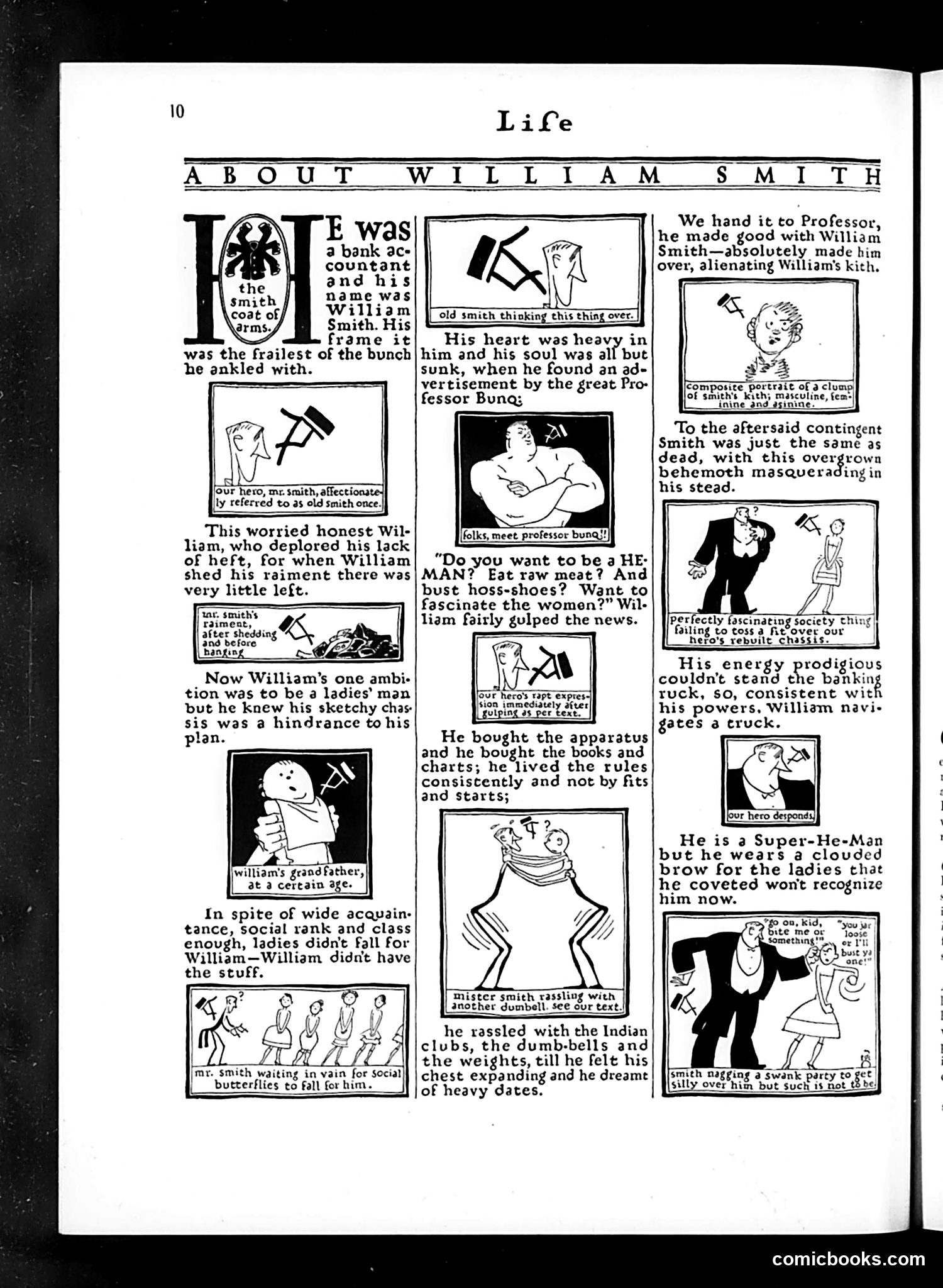
This is a satirical biographical sketch of "William Smith," a bank accountant whose name and coat of arms suggest he's meant as an everyman character. The humor derives from Smith's comical inadequacy: he's the "frailest of the bunch" he ankled with, lacks social standing despite wide acquaintance, and fails to attract women. The satire mocks Smith's attempts at self-improvement—he pursues bodybuilding (Indian clubs, dumbbells), reads about becoming a "He-Man," and seeks to impress society. Yet he remains unsuccessful and unmemorable to women, who can't even recognize him afterward. The cartoon ridicules masculine insecurity and the era's commercialized self-help culture promising transformation through purchased apparatus and lifestyle changes—a timeless satirical target.
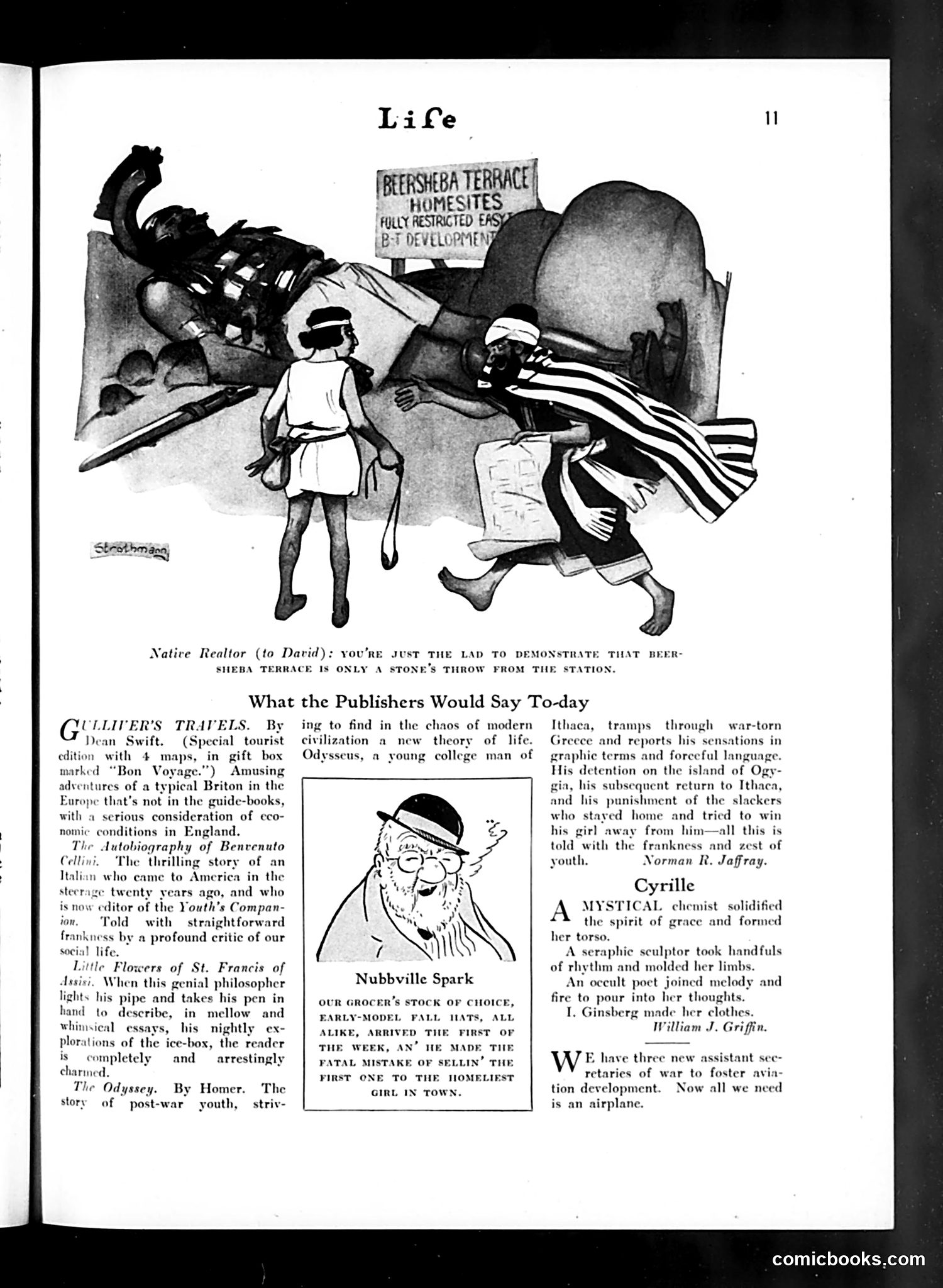
This political cartoon satirizes real estate development in what appears to be early 20th-century urban America. The sign reads "BEERSHEBA TERRACE HOMESITES—FULLY RESTRICTED EASY B-T DEVELOPMENT," referencing segregationist housing practices of the era. The cartoon depicts a Native American figure (labeled "Native Realtor") gesturing toward development while speaking to a suited businessman ("David"). The joke inverts historical displacement: the Native American—traditionally dispossessed of land—now ironically sells restricted residential plots, suggesting the absurdity and moral irony of "restricted" (racially exclusive) developments. The artist uses this inversion to critique both segregationist housing policies and America's historical treatment of Indigenous peoples, implying that modern real estate practices perpetuate similar injustices.
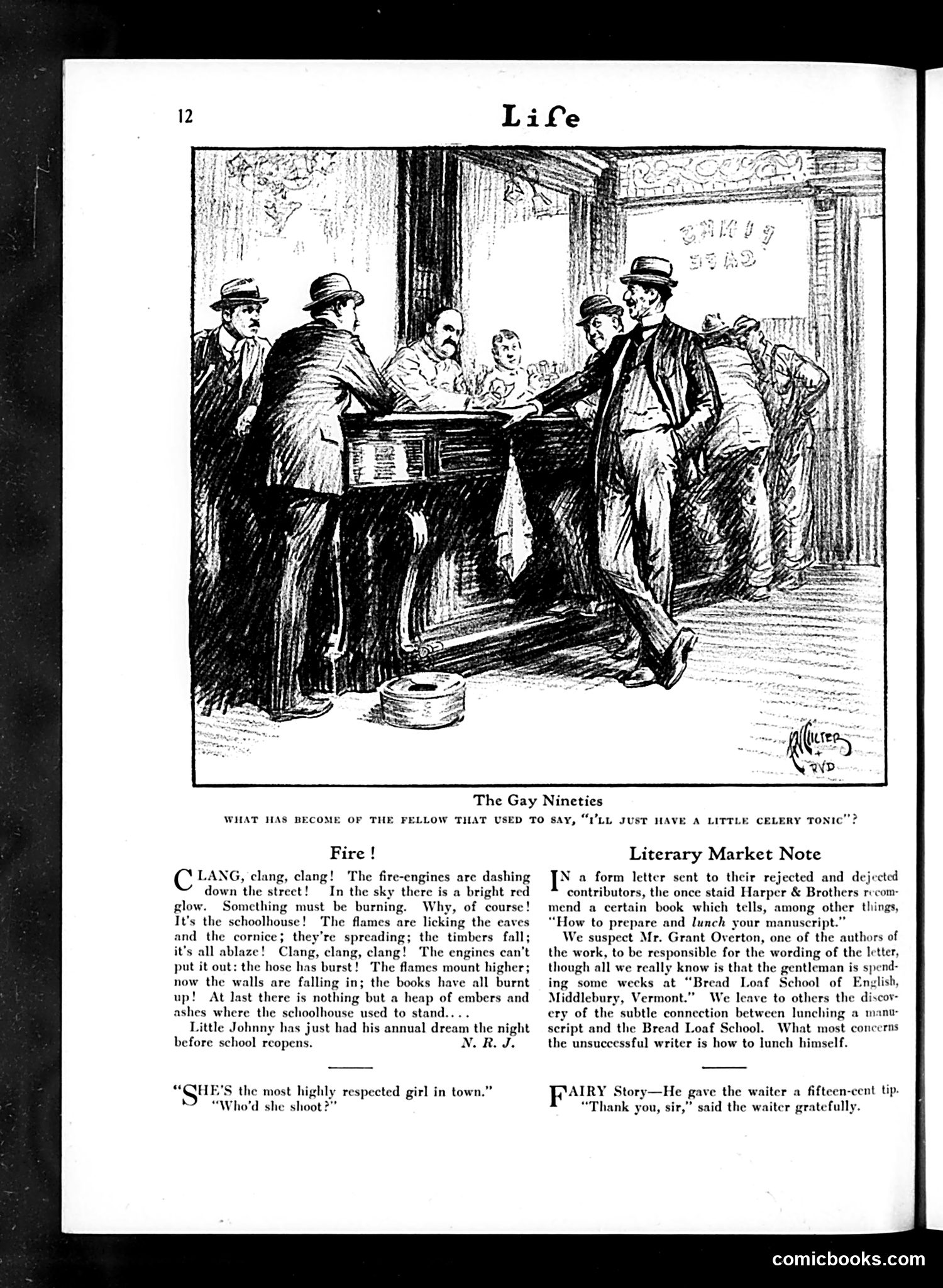
The main cartoon depicts a man at a counter or bar asking for "a little celery tonic"—a common 1890s health drink. The caption notes this was something "the fellow used to say" in the Gay Nineties era. The satire appears to be about how people's habits and preferences have changed. The man's polite request for a mild, healthful tonic contrasts implicitly with modern (to Life's 1910s-1920s readers) drinking preferences, likely alluding to Prohibition-era changes or the decline of such quaint Victorian remedies in favor of stronger alcohol or other modern substances. The remaining content includes short humorous items and a "Literary Market Note" about manuscript submissions, typical of Life's miscellaneous humor-magazine format.
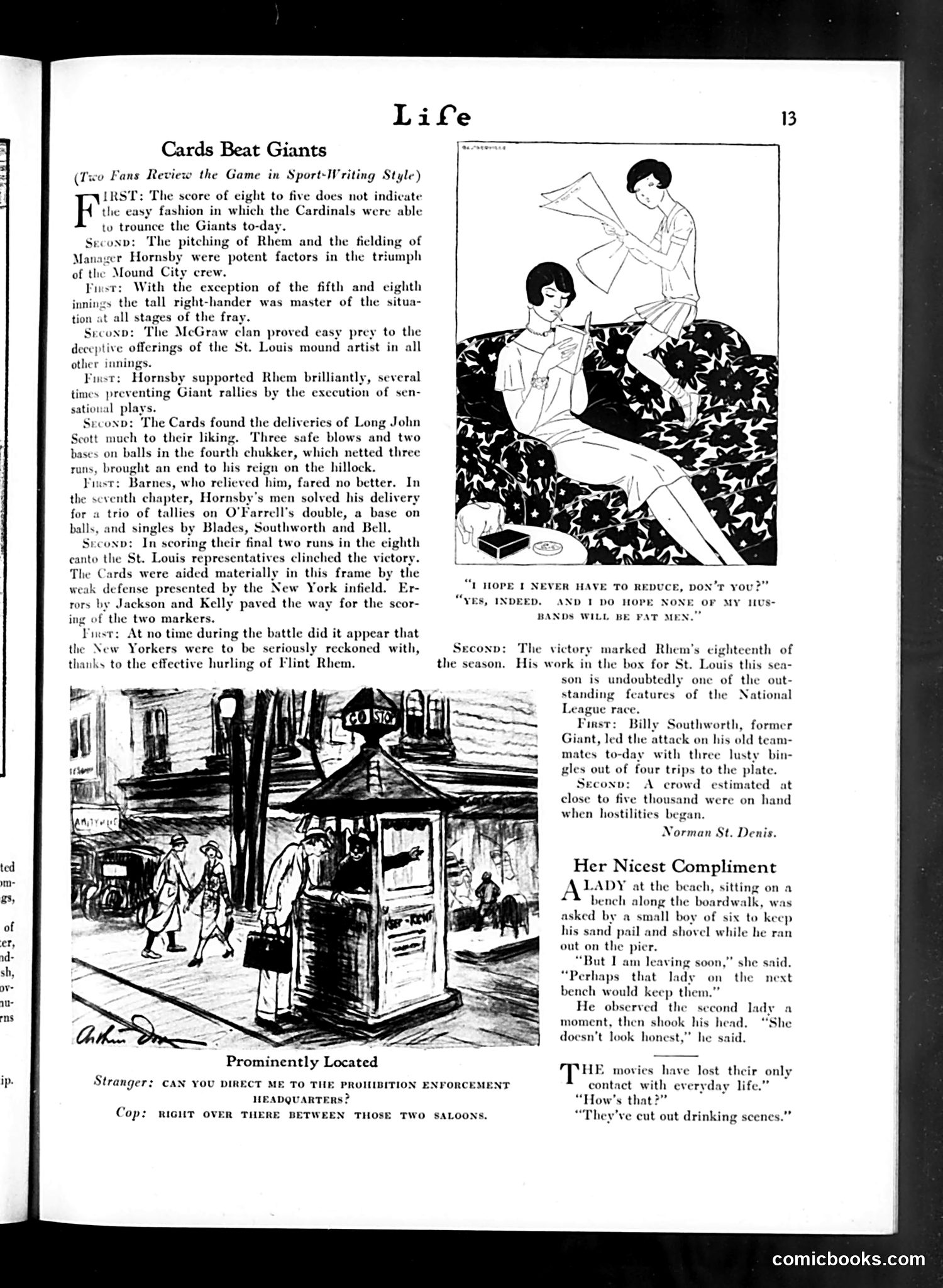
This page contains sports reporting and humor rather than political cartoons. The top section reviews a Cardinals-Giants baseball game, using "sport-writing style" to analyze key moments. The detailed play-by-play mentions players like "Long John" and Manager Hornsby. The middle illustration depicts a dock or pier scene, labeled "Prominently Located." A police officer directs a stranger to "prohibition enforcement headquarters" between "those two saloons"—satirizing the contradiction of Prohibition-era enforcement, where illegal drinking establishments operated openly near official enforcement offices. The bottom piece, "Her Nicest Compliment," is a humorous anecdote about a woman and boy at a beach, followed by a joke about movies eliminating "everyday life" by cutting drinking scenes—another Prohibition-era reference showing how alcohol's legal ban affected entertainment content.
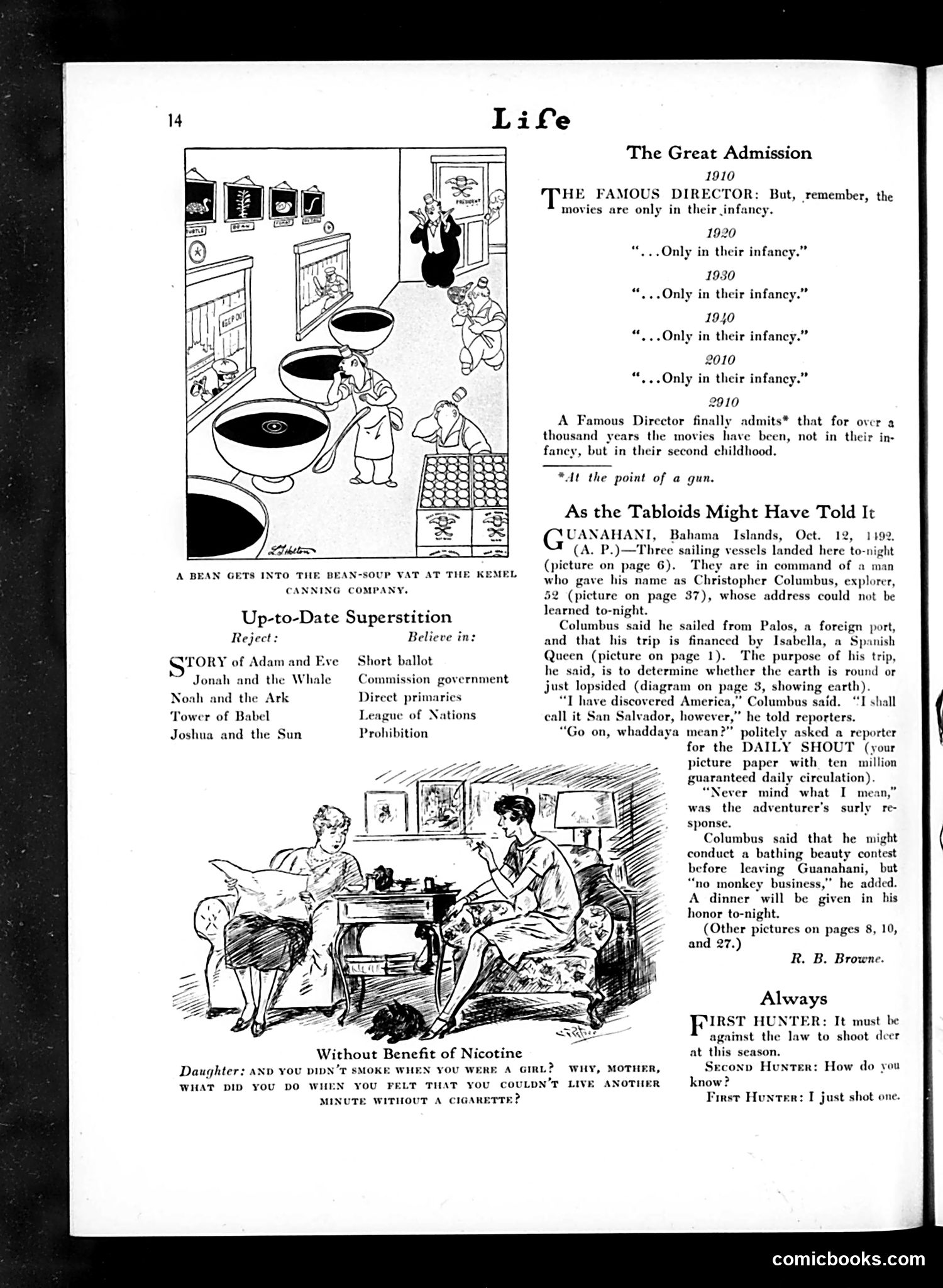
This page contains several satirical pieces: **"The Great Admission"** mocks film directors' claims that movies are only in their "infancy," repeating this excuse from 1910 through 2910—suggesting the industry will perpetually use immaturity as justification for mediocre content. **"A Bean Gets Into the Bean-Soup Vat"** is a visual joke about industrial food production, showing beans entering commercial soup manufacturing—likely satirizing concerns about mass-produced food quality and safety. **"Up-to-Date Superstition"** pairs old religious stories with modern institutions (primaries, prohibition, etc.), suggesting contemporary institutions have become quasi-religious beliefs. **"Without Benefit of Nicotine"** depicts a mother questioning her daughter about not smoking—reversing typical parental concerns to satirize changing social attitudes toward women and smoking. The Columbus piece appears to be humorous reporting about exploration.
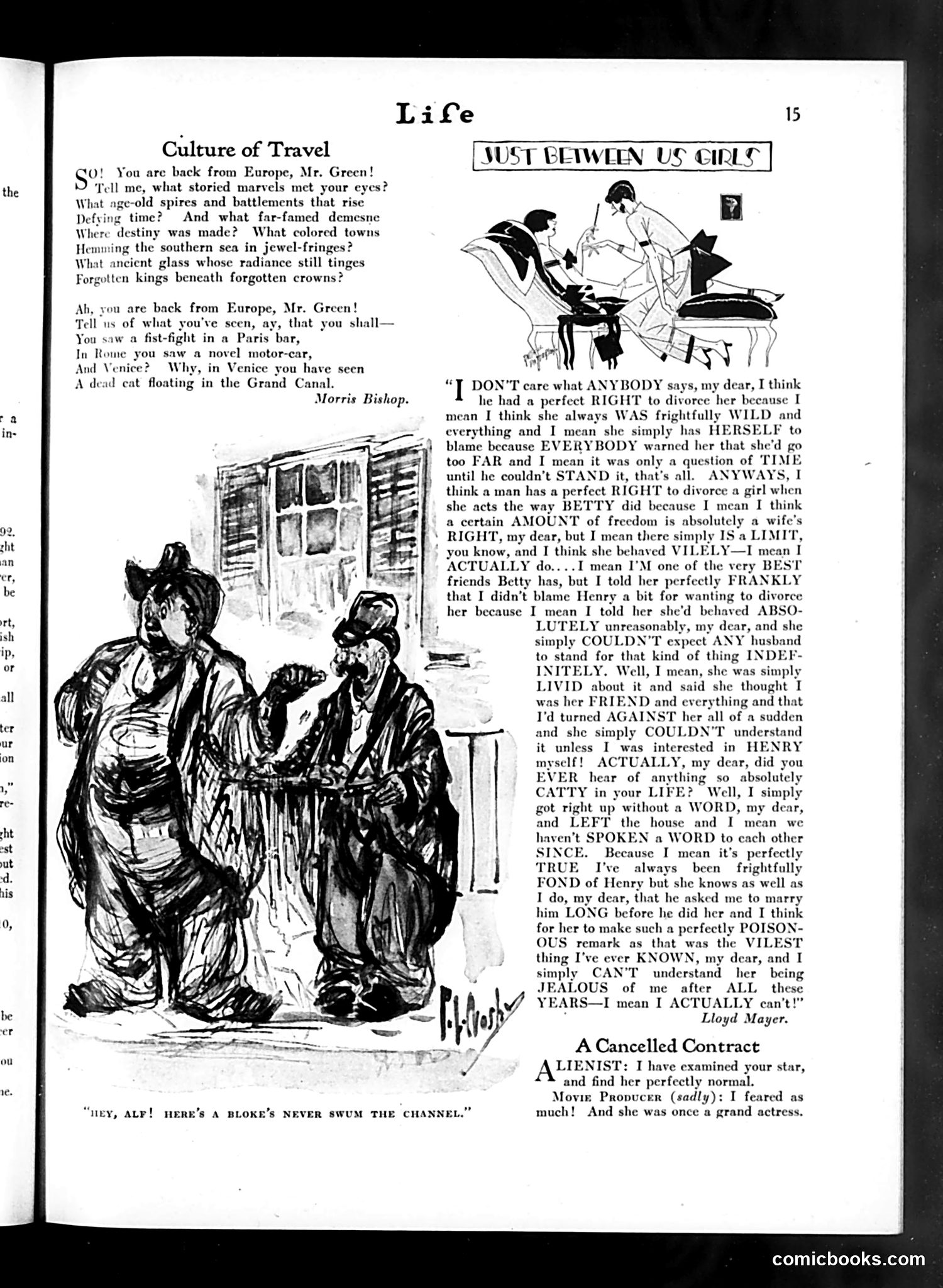
The left cartoon illustrates Morris Bishop's poem "Culture of Travel"—a humorous complaint that returning European travelers bore people with endless tales of sights, architecture, and romantic mishaps (fist-fights in Paris bars, dead cats in Venice canals). The figures appear to be continental Europeans, possibly Venetian gondoliers, depicted in period dress. The right section, "Just Between Us Girls," presents a woman's bitter monologue about divorce. She defends her ex-husband's right to leave while attacking his new girlfriend Betty as "wild" and irresponsible. The satire critiques women's contradictory attitudes: demanding freedom while policing other women's behavior, and confiding in friends while remaining coldly silent to the husband himself. It's social commentary on female friendship dynamics and marital hypocrisy.
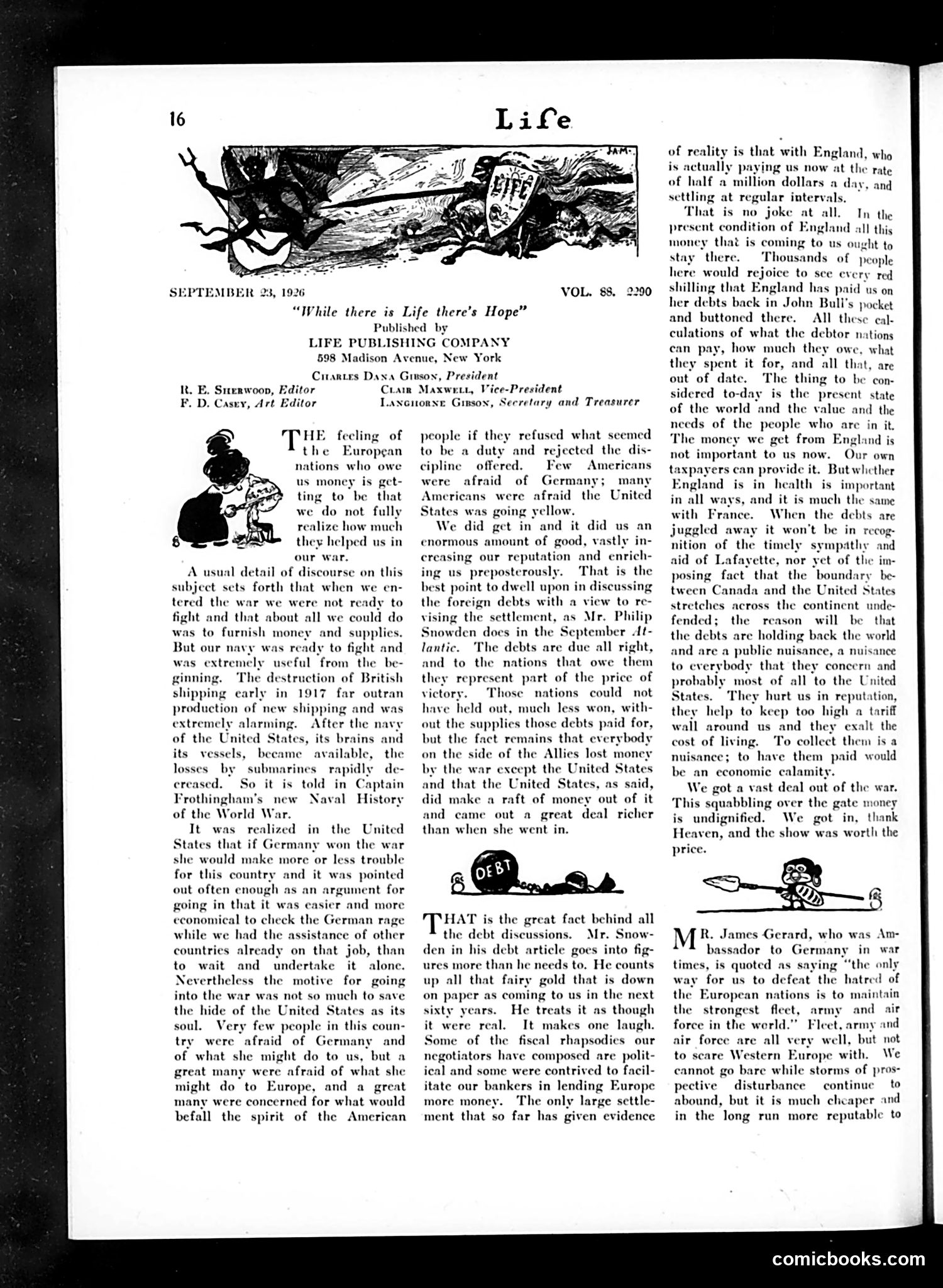
This page contains editorial commentary on post-World War I war debts owed by European nations to the United States. The text discusses whether America should forgive these debts or demand repayment. The small cartoon (labeled "DEBT") shows a figure buried or crushed under financial obligations—a visual metaphor for Europe's crushing war debt burden. The article argues that while Germans feared American economic power and some Americans feared Germany's potential resurgence, the real issue is Europe's unpaid debts. The author contends that collecting these debts is a "nuisance" but necessary, and that forgiving them would set a dangerous precedent for American creditors. The piece advocates maintaining a hard line on debt collection while acknowledging the political sensitivity of the issue.
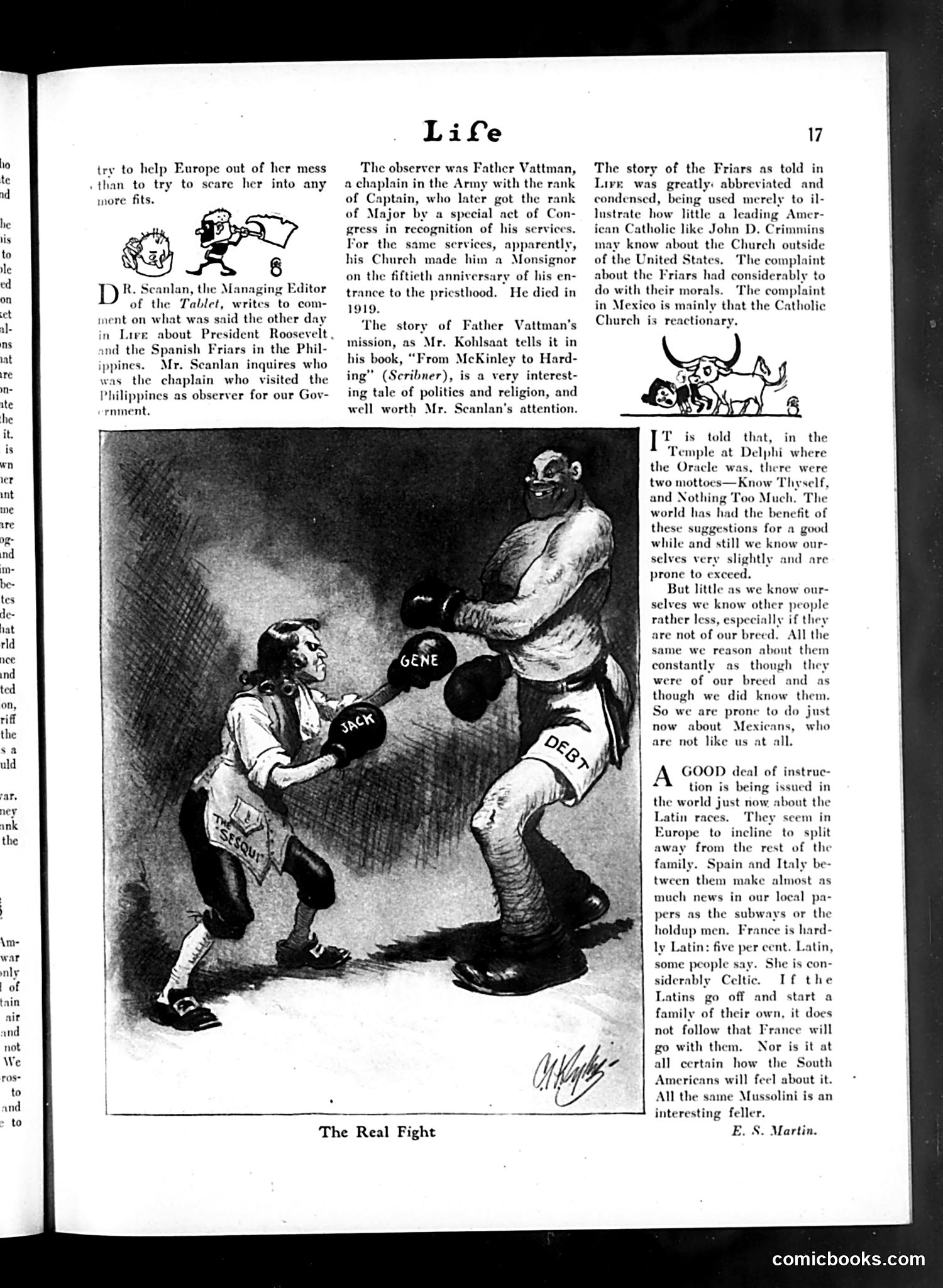
This cartoon depicts a boxing match between three labeled figures: "Jack" (likely representing the U.S.), "Gene," and "Debt." The composition suggests internal American conflict rather than external warfare. The text references Father Vattman's missionary work and discusses European and Latin American affairs, but the cartoon's labels indicate it's satirizing domestic economic struggle. "Jack" appears to represent American interests or the common citizen, battling against "Debt" while "Gene" (unclear which specific figure this represents—possibly an industrial or political entity) also participates. The satire critiques post-WWI American economic turmoil and internal financial pressures, presenting economic "enemies" as combatants in a domestic struggle rather than foreign threats.
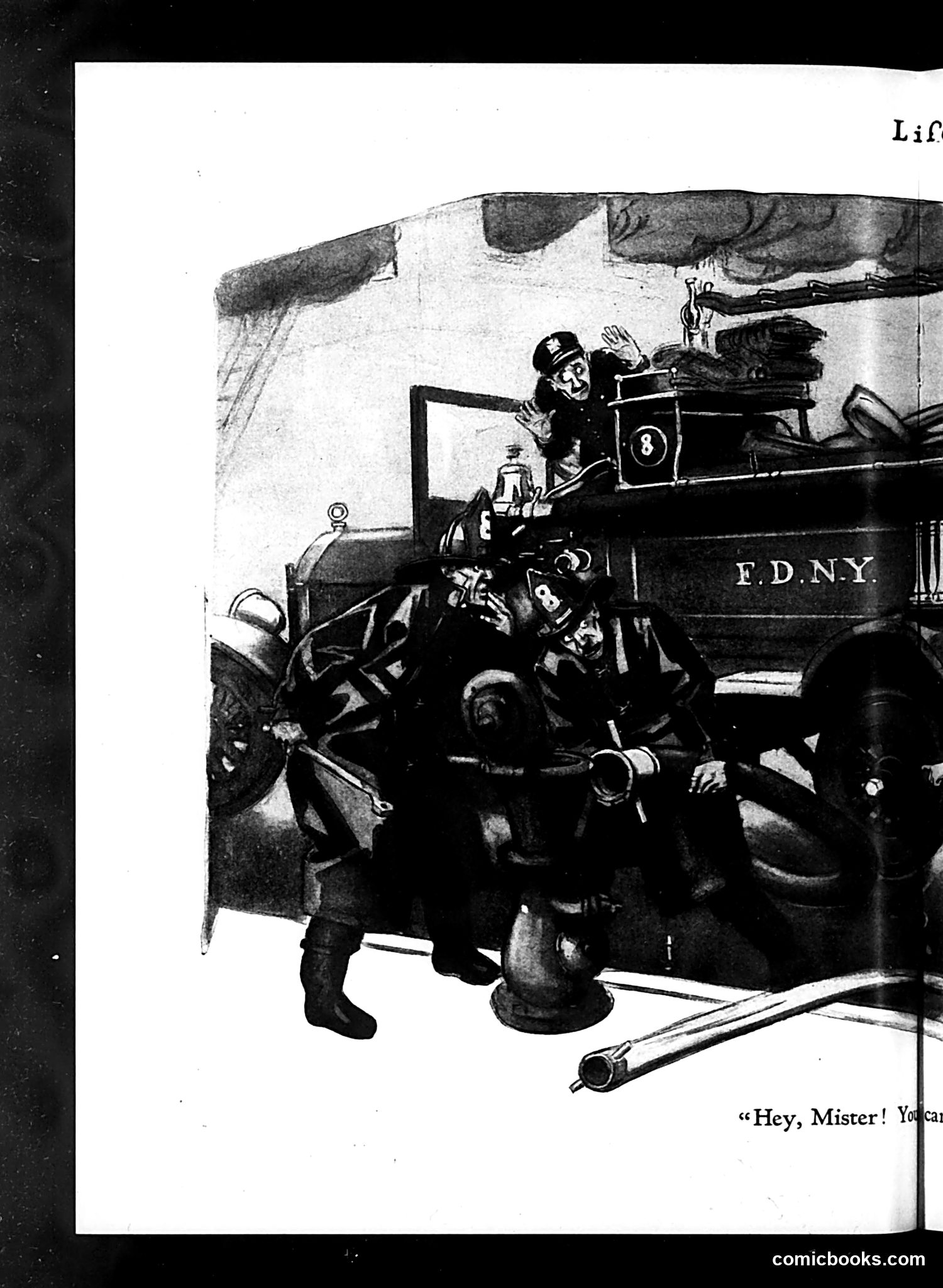
This appears to be a vintage Life magazine illustration showing FDNY (Fire Department of New York) firefighters with their equipment truck. The image depicts what looks like early-to-mid 20th century firefighting personnel in their characteristic helmets and uniforms gathered around a fire truck marked with the number 8. The partially visible caption at bottom reads "Hey, Mister! You can..." but is cut off, making the complete satirical point unclear. Without the full text, the specific joke or social commentary cannot be definitively identified. The illustration itself appears to be documenting or humorously commenting on New York City firefighting operations, but the exact satirical intent remains uncertain from this cropped page.
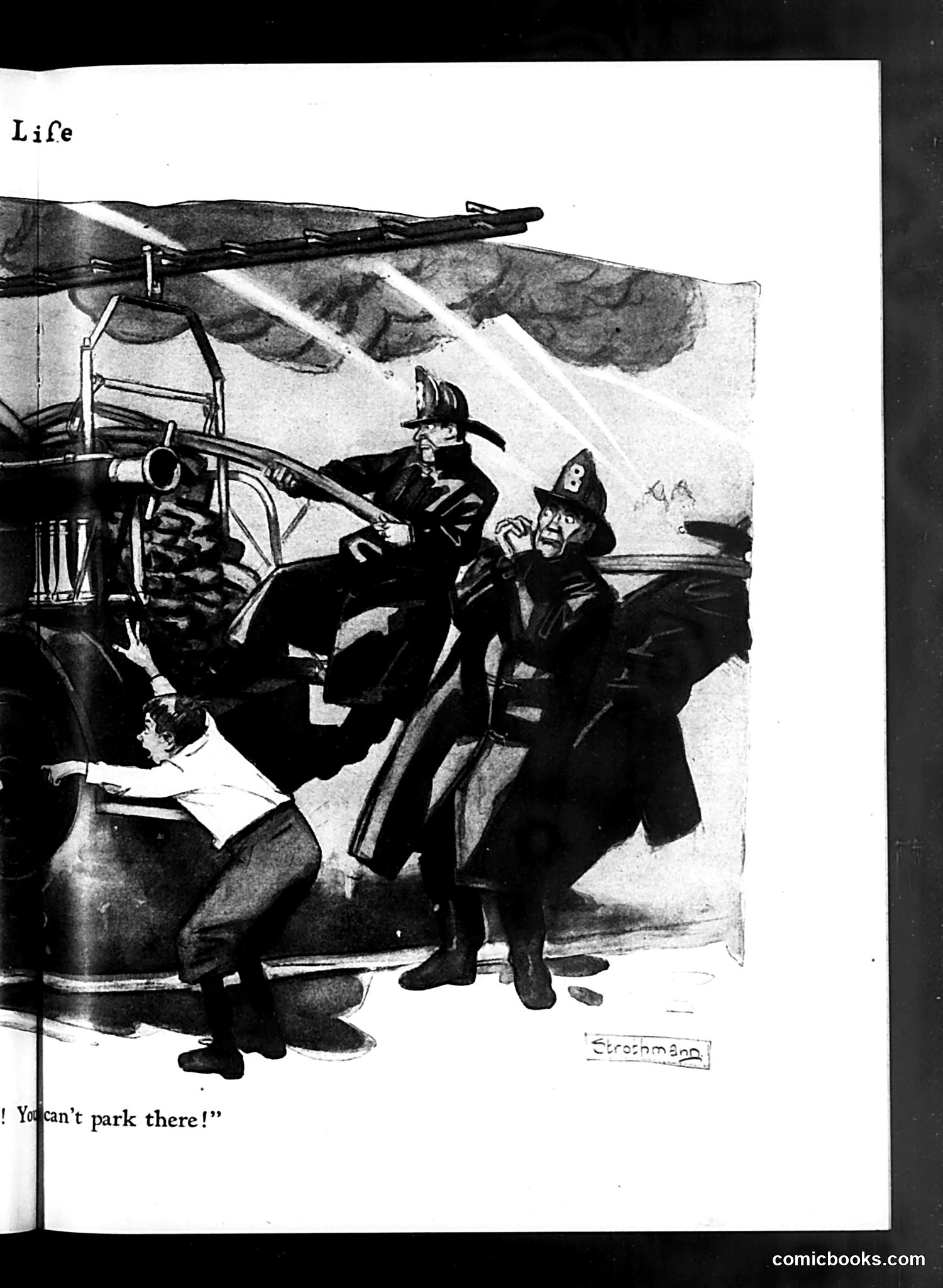
This is a satirical cartoon by Strohmann showing two firefighters confronting a driver who has parked illegally near a fire hydrant. One firefighter points authoritatively while saying "You can't park there!" The cartoon satirizes bureaucratic enforcement and the clash between emergency services and ordinary citizens' convenience. The humor lies in the absurdity of strictly enforcing parking regulations in what appears to be an urgent or dramatic situation—the firefighters' formal uniforms and the fire truck suggest they have serious business, yet they're stopping to enforce a minor parking violation. This reflects early-to-mid 20th century American satire about rules, authority, and the sometimes misplaced priorities of officials. The joke mocks both rigid rule-enforcement and drivers' casual disregard for parking laws.
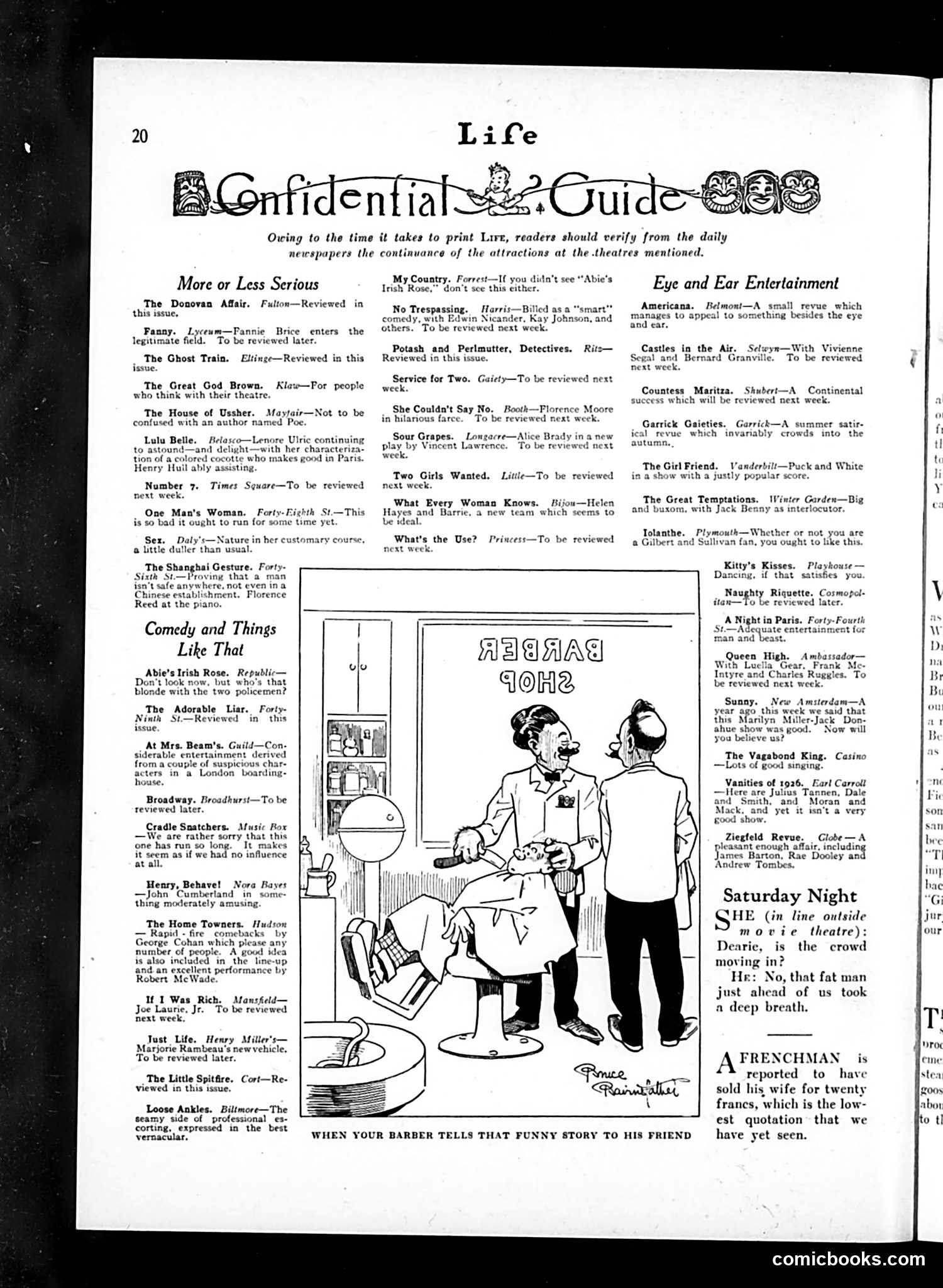
The central cartoon depicts a barber enthusiastically telling an animated story to his customer while cutting hair. The caption reads: "WHEN YOUR BARBER TELLS THAT FUNNY STORY TO HIS FRIEND." **What this satirizes:** The archetypal garrulous barber—a stock character in American humor representing the working-class gossip who regales customers with elaborate anecdotes, often exaggerated or dubious. The cartoon captures the barber's theatrical gesticulation and the customer's somewhat captive, patient demeanor. **The joke:** Barbers were notorious for monopolizing conversation, trapping customers in the chair who couldn't easily escape. This page appears from *Life's* "Confidential Guide"—theater reviews with humorous asides—so the barber's story-telling parallels theatrical entertainment, albeit uninvited and inescapable. The illustration is signed by what appears to be "Bruce Bairnsfather" or similar, and captures a relatable social observation about working-class American life in the 1920s.
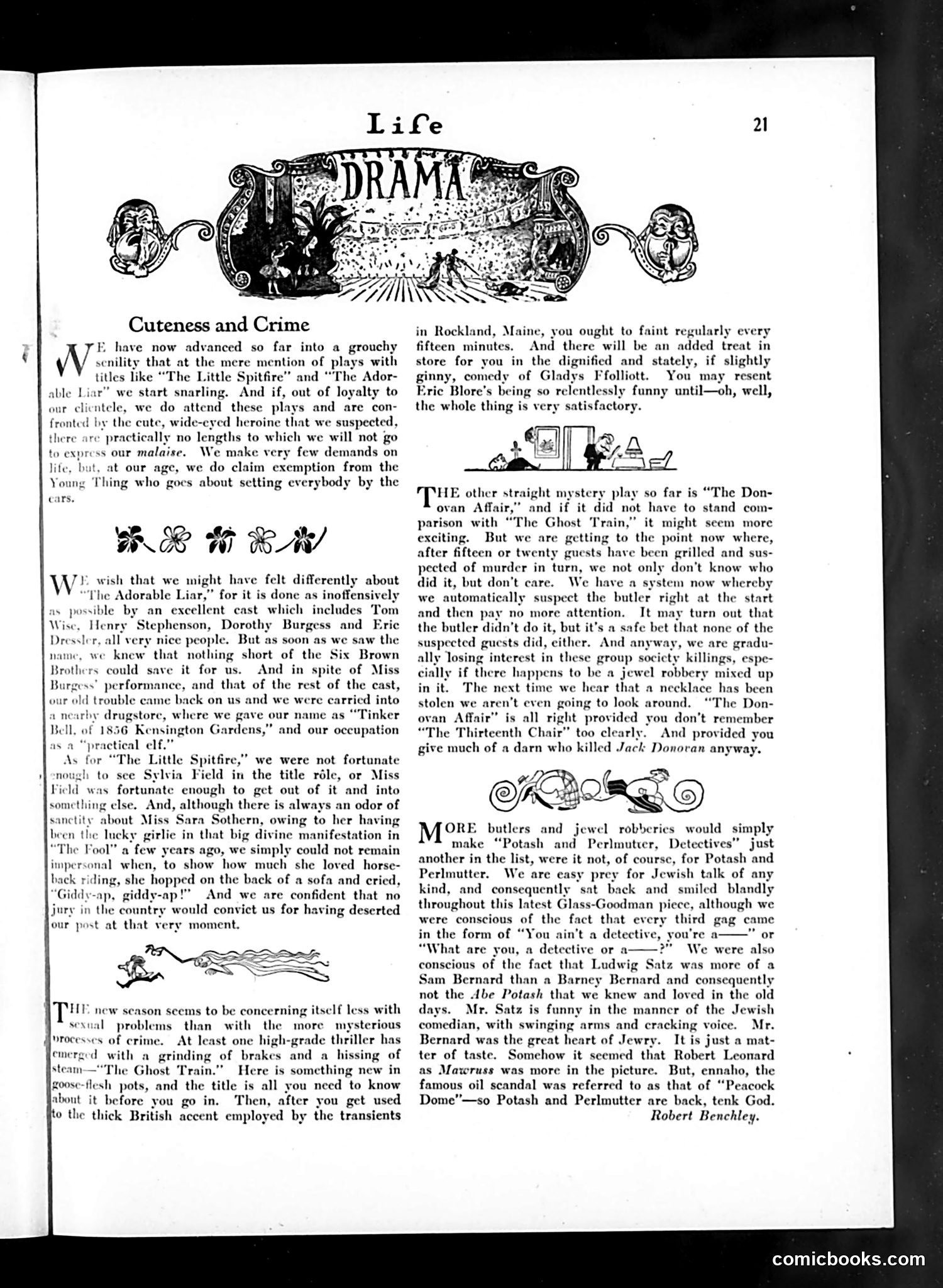
This is a theater review by Robert Benchley critiquing contemporary Broadway plays. The satire targets two specific trends: **"Cuteness" Problem**: Benchley expresses exasperation with saccharine comedies like "The Adorable Liar" and "The Little Spitfire"—plays built around adorable heroines performing calculated cuteness. He describes his visceral irritation at the "cute, wide-eyed heroine," so acute he must flee to drugstores. The humor lies in his over-the-top desperation to escape sentimentality. **Crime/Mystery Fatigue**: He mocks the proliferation of murder-mystery plays like "The Ghost Train" and "The Donovan Affair." Benchley satirizes the genre's predictability—audiences automatically suspect the butler, lose interest in jewel robberies, and stop caring *who* committed the murder. The joke: mystery plots have become so formulaic and convoluted that engagement is impossible. The underlying critique is that Broadway has abandoned substantive drama for either cloying sentiment or lazy thriller clichés.
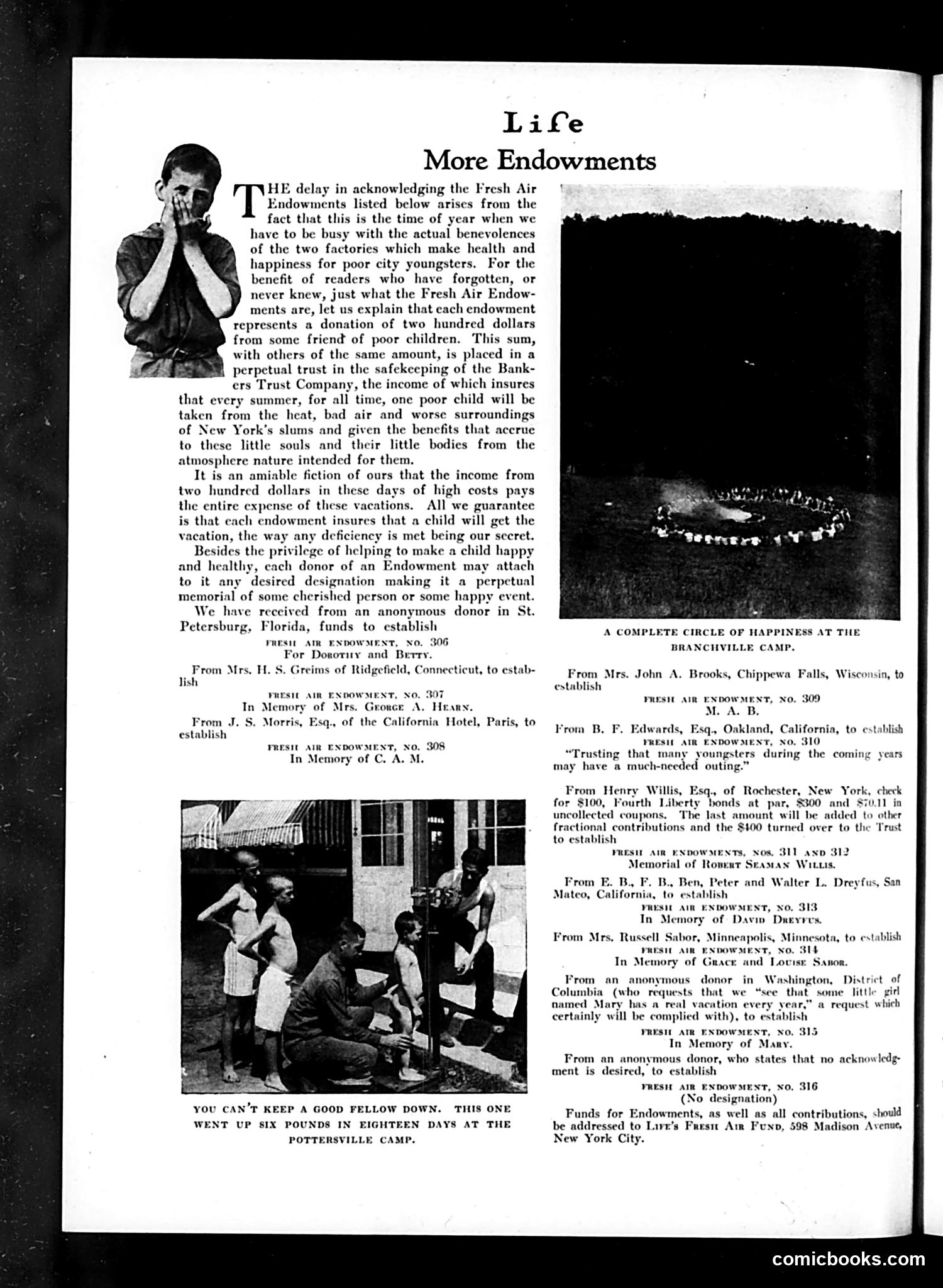
This is **not satire or political cartoon**—it's a charitable fundraising announcement. Life magazine's "Fresh Air Fund" provided summer vacations for poor children from New York City slums, removing them temporarily from urban heat and pollution. The page lists recent donations of $200 endowments (producing perpetual annual funding for one child's vacation). The two photographs show actual results: undernourished city children at camps like Pottersville and Branchville, where the bottom image caption proudly notes one boy gained six pounds in eighteen days. The appeal addresses early-20th-century urban poverty and Progressive Era concerns about public health. Donors could memorialize deceased loved ones through their contributions. The page combines moral messaging with concrete evidence of the program's physical benefits to child welfare.
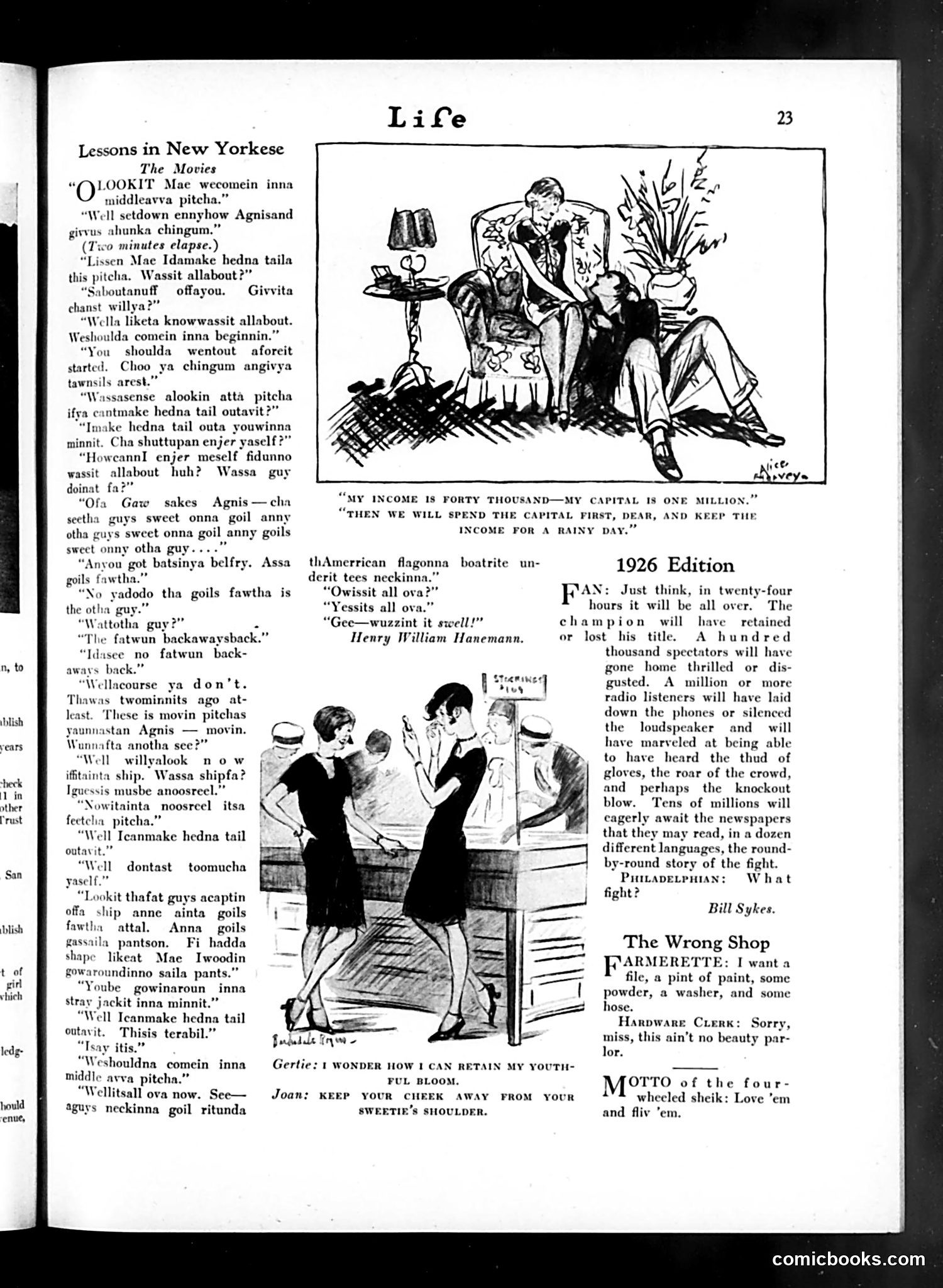
This page contains three distinct pieces of humor: **"Lessons in New Yorkese: The Movies"** satirizes working-class New York dialect and cinema-goers' behavior. Two women attend a film, constantly interrupting each other with questions about the plot while also talking loudly—a common complaint about theater audiences. The exaggerated phonetic spelling ("Lookit," "Wassit," "inna") mocks New York working-class speech patterns. **"1926 Edition"** discusses an upcoming boxing championship, likely heavyweight title fight. The caption celebrates modern technology—radio broadcasts reaching millions globally in multiple languages—as a marvel of the era. A reader asks "What fight?" suggesting even this major sporting event wasn't universally known. **"The Wrong Shop"** is a brief joke: a woman enters what appears to be a hardware store asking for beauty supplies (powder, washer), and the clerk confirms it's not a beauty parlor, implying she's in the wrong place. The small cartoon below shows dating advice about physical affection, typical of 1920s humor about courtship.
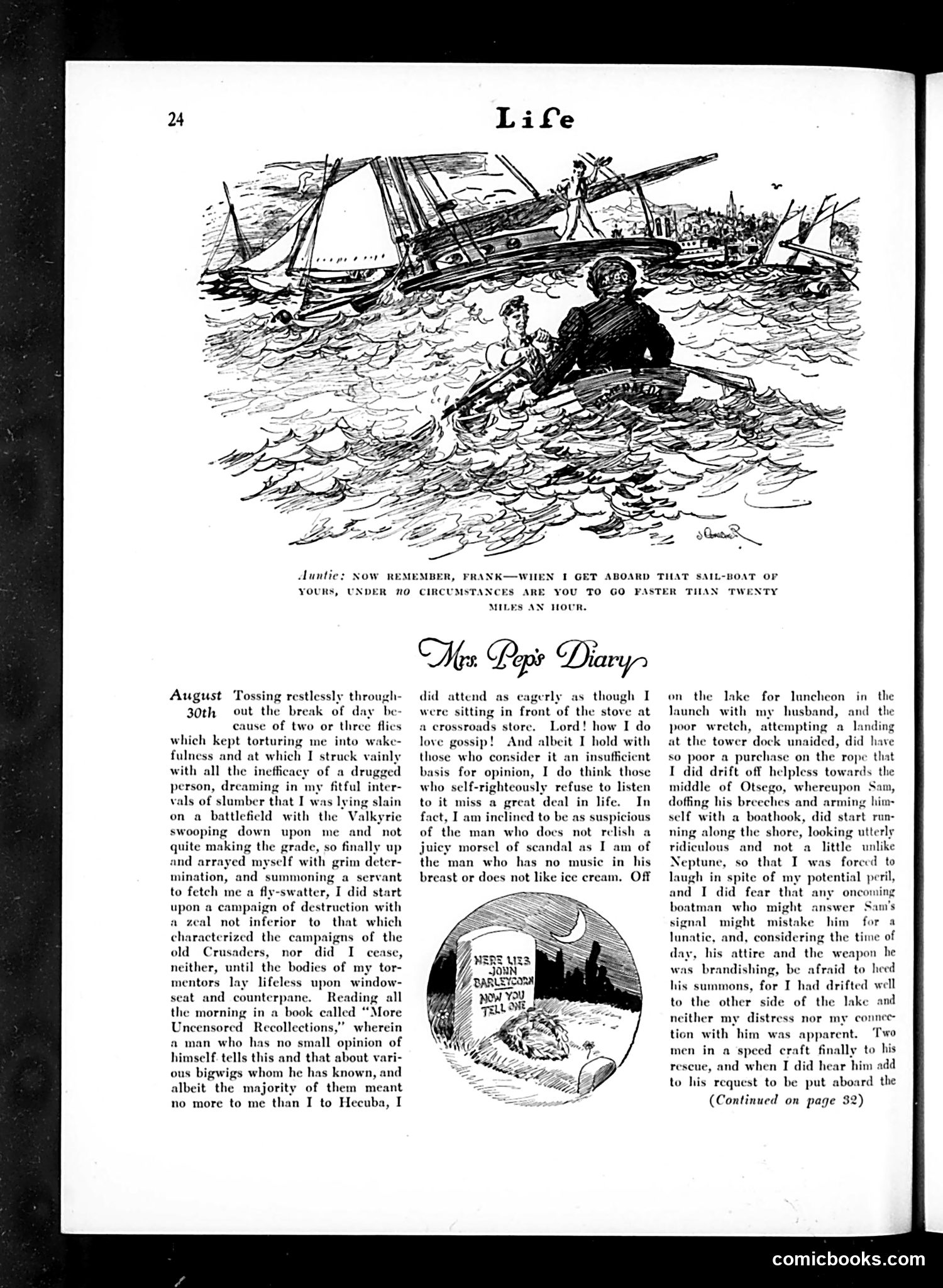
This is a page from *Life* magazine featuring "Mrs. Pep's Diary," a humorous column. The top cartoon satirizes reckless boating—a woman warns her friend Frank that when she boards his sailboat, he must not exceed twenty miles per hour, likely a jab at wealthy leisure-class show-offs who speed dangerously on lakes. The diary entry below is comedic domestic narrative: the author describes swatting flies with crusader-like determination, then gossiping about celebrity memoirs ("More Uncensored Recollections"), before recounting a mishap where she drifts helplessly on a lake after her husband fails to secure the boat. Her husband Sam comically runs along the shore nearly naked with a boathook, looking like "Neptune," which she fears will make rescuers think he's a lunatic. The humor targets upper-class leisure activities, marital mishaps, and vanity—typical satirical fare for *Life* magazine's educated, affluent readership.
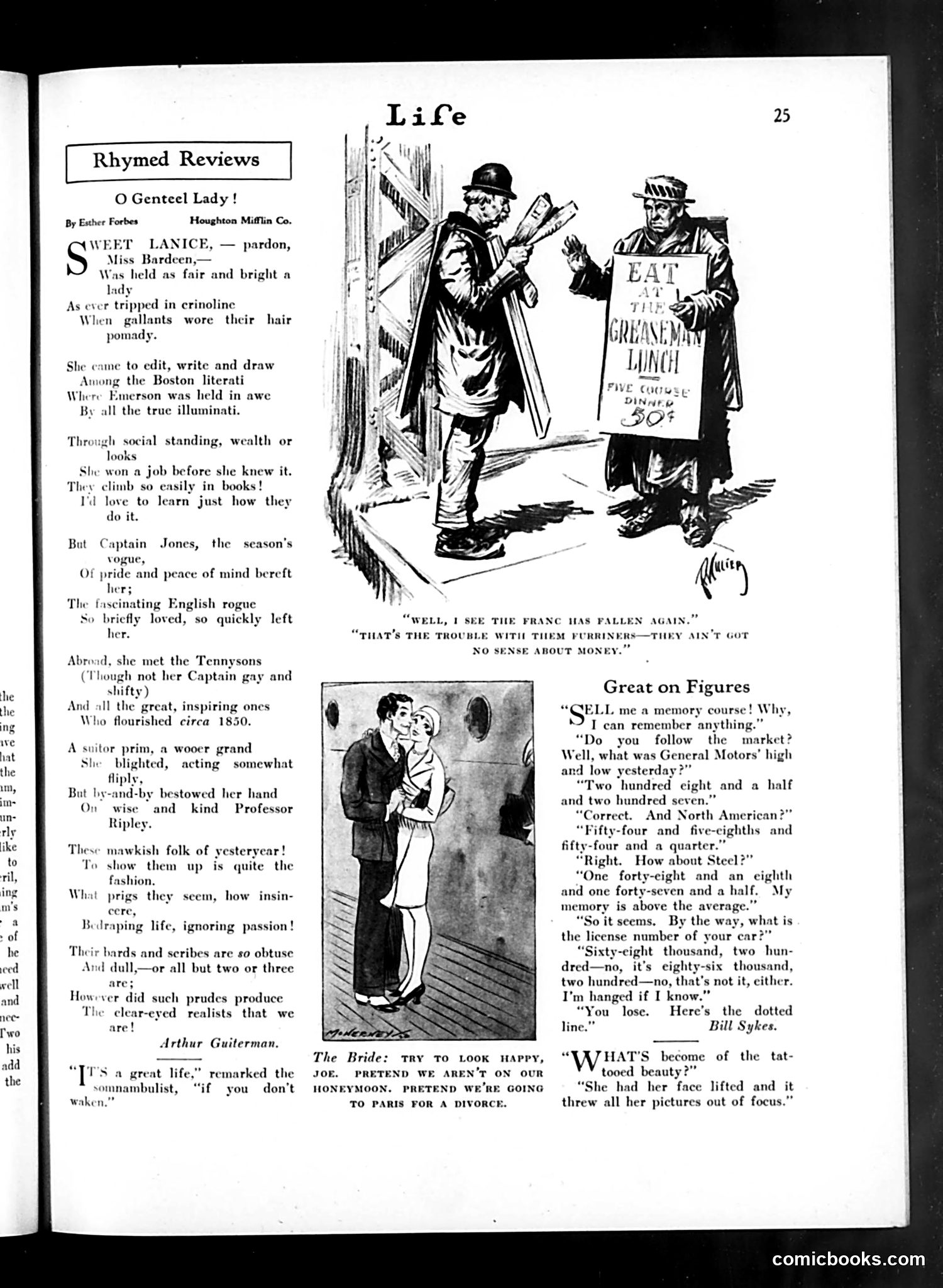
**Top Cartoon:** Two shabby men on a street corner illustrate economic hardship during what appears to be the Great Depression era. One holds a sign advertising "Eat at the Grandma Lunch" for 50 cents; the other displays a sign about "The Franc has Fallen Again." The caption mocks working-class men's lack of financial literacy—they can't manage money despite exposure to economic news. The satire targets the gap between awareness of market collapse and personal poverty. **"Great on Figures":** A joke about selective memory. A man boasts he can memorize anything and recites stock market figures perfectly (General Motors, North American, Steel prices). When asked his own car's license number, he's completely blank. The satire skewers people obsessed with stocks and market data while remaining oblivious to mundane personal details—a critique of 1920s-era investment culture and misplaced priorities. Both pieces satirize American attitudes toward money and finance during the pre-Depression period.
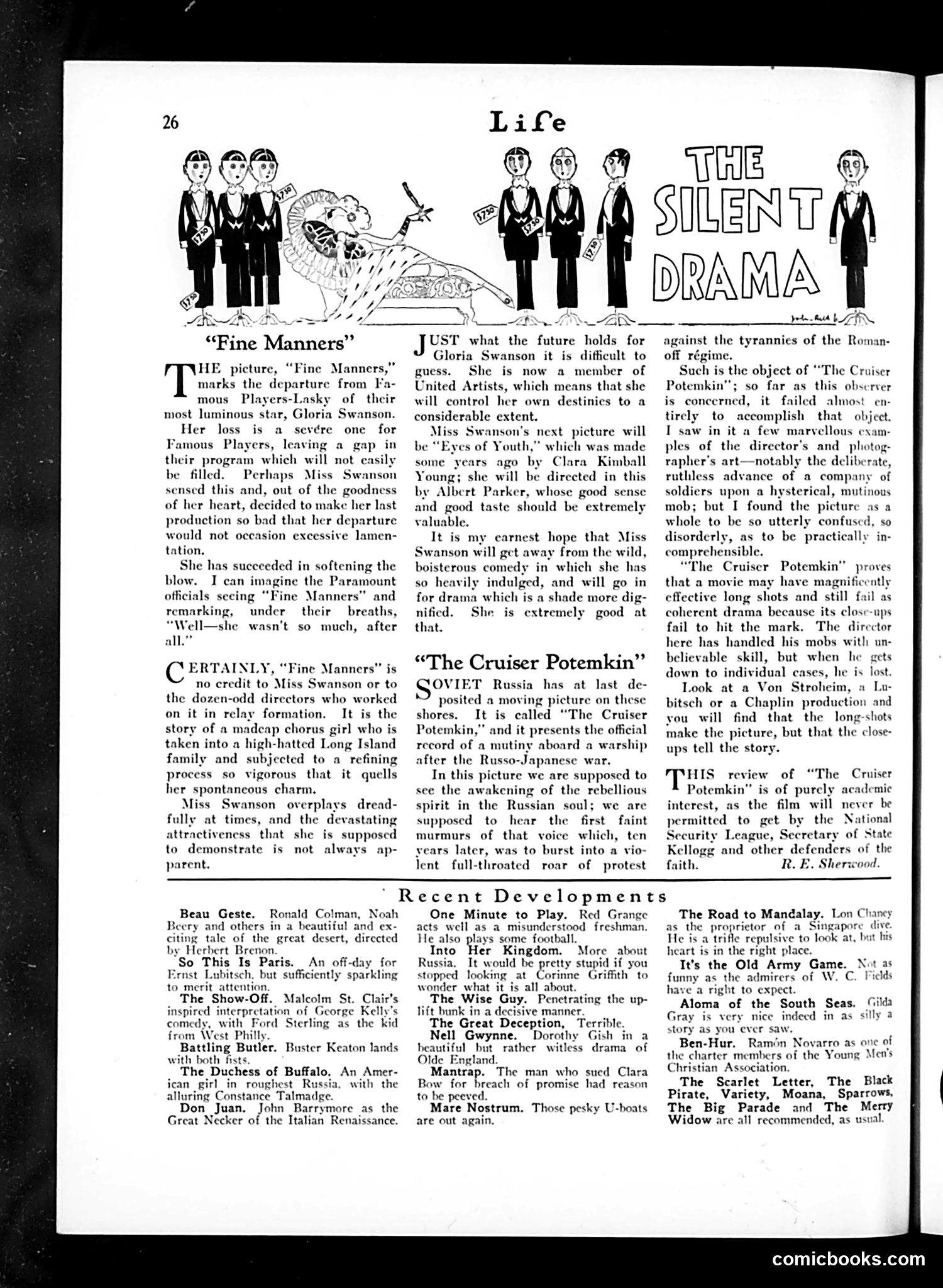
This page contains three film reviews. The top cartoon illustrates the "Fine Manners" review, showing Gloria Swanson's departure from Famous Players-Lasky studio. The critic savagely mocks her final film with that studio, suggesting she deliberately made it bad so her exit wouldn't be lamented. The review is a hatchet job on both the film and Swanson's overacting. The main review concerns "The Cruiser Potemkin," Soviet Russia's first major film export. The critic acknowledges its artistic merit—particularly impressive crowd scenes—but deems it ultimately "confused" and "incomprehensible." Notably, the reviewer predicts censorship will prevent American distribution, referencing the "National Security League" and "defenders of the faith" opposing the film's revolutionary themes about Russian naval mutiny and anti-tsarist sentiment. The page reflects post-WWI American anxiety about Soviet propaganda while grudgingly admitting Soviet cinema's technical sophistication.
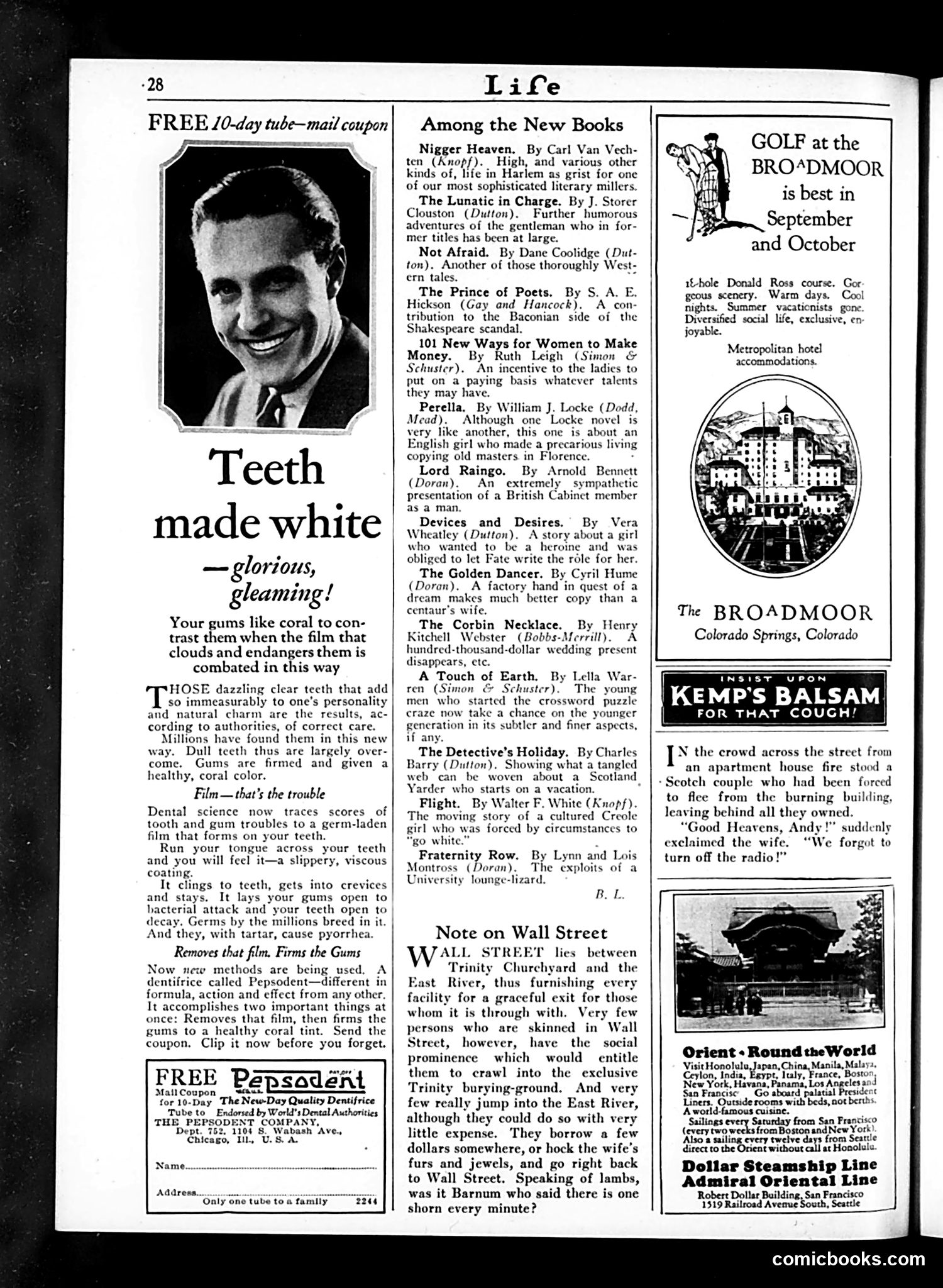
This is primarily an **advertisement page**, not a satirical cartoon. The dominant content is a **Pepsodent toothpaste ad** featuring a smiling man's portrait and copy promoting the product's ability to remove "film" from teeth and firm gums. The ad employs early 20th-century advertising rhetoric about dental science and hygiene, claiming Pepsodent uniquely removes a "germ-laden film" through a new method. The dramatic language ("glorious, gleaming") and appeal to vanity ("adds so immeasurably to one's personality") typify period marketing. The page also includes: a free sample coupon, book reviews (including Carl Van Vechten's *Nigger Heaven* about Harlem life), and a brief note about Wall Street's literal geography and figurative dangers—likely a light joke about financial ruin. There is no political satire visible; this is straightforward commercial content with literary notices.
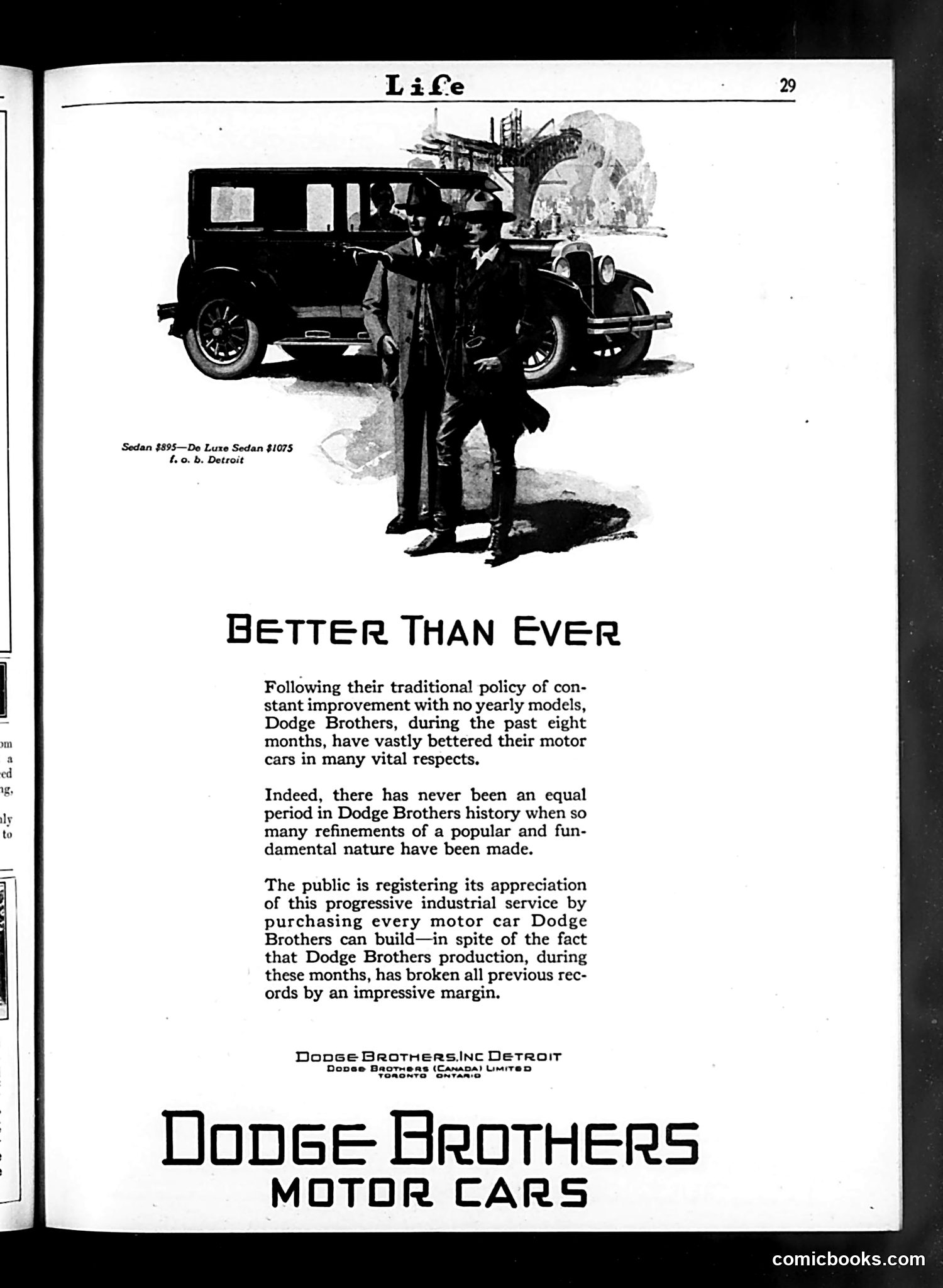
This is a **Dodge Brothers automobile advertisement**, not satire or political commentary. The page features a 1920s-era sedan illustration with two businessmen standing beside it. The ad's messaging emphasizes Dodge's manufacturing philosophy: continuous improvement without annual model changes (contrasting with competitors like Ford). The text boasts that during "the past eight months," Dodge has made significant refinements while simultaneously breaking production records—claiming high demand despite (or because of) this approach. For modern readers: this reflects early automotive industry competition around planned obsolescence and manufacturing efficiency. Dodge positioned itself as offering steady quality improvement rather than flashy yearly redesigns, marketing this as both progressive industrial practice and consumer value. The page is **purely commercial advertising** from *Life* magazine, likely from the mid-1920s based on the car design and typography. There is no cartoon, satire, or political content—just period marketing copy and product imagery.
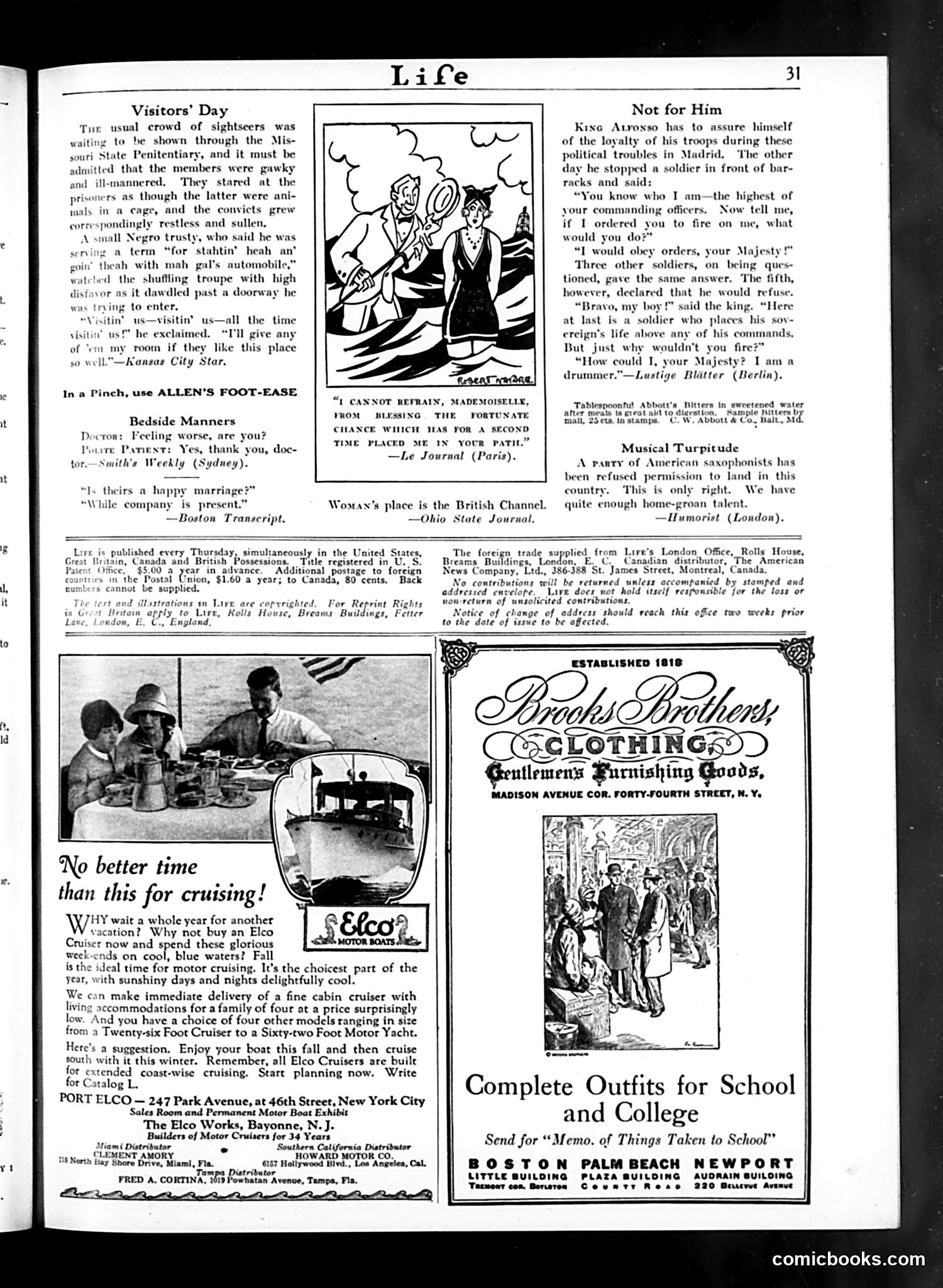
This page contains several brief satirical pieces typical of *Life* magazine's humor format: **"Visitors' Day"** depicts a Missouri penitentiary tour where a Black trusty prisoner, serving time for automobile theft, expresses disdain at gawking visitors treating inmates like "animals in a cage." The satire critiques the voyeuristic entertainment of prison tours and the dehumanization of incarcerated people. **"Not for Him"** concerns King Alfonso of Spain testing soldiers' loyalty during Madrid political turmoil. Four soldiers pledge obedience; the fifth refuses—not from disloyalty but because he's a drummer, unable to fire a gun. The joke mocks military hierarchy and the absurdity of loyalty oaths. **"Musical Turpitude"** briefly notes American saxophonists denied entry to Britain, sarcastically suggesting the country has "enough home-grown talent." This likely references 1920s jazz anxieties—American jazz was often viewed as culturally threatening in Britain. The page is predominantly **advertising** (Elco boats, Brooks Brothers clothing).
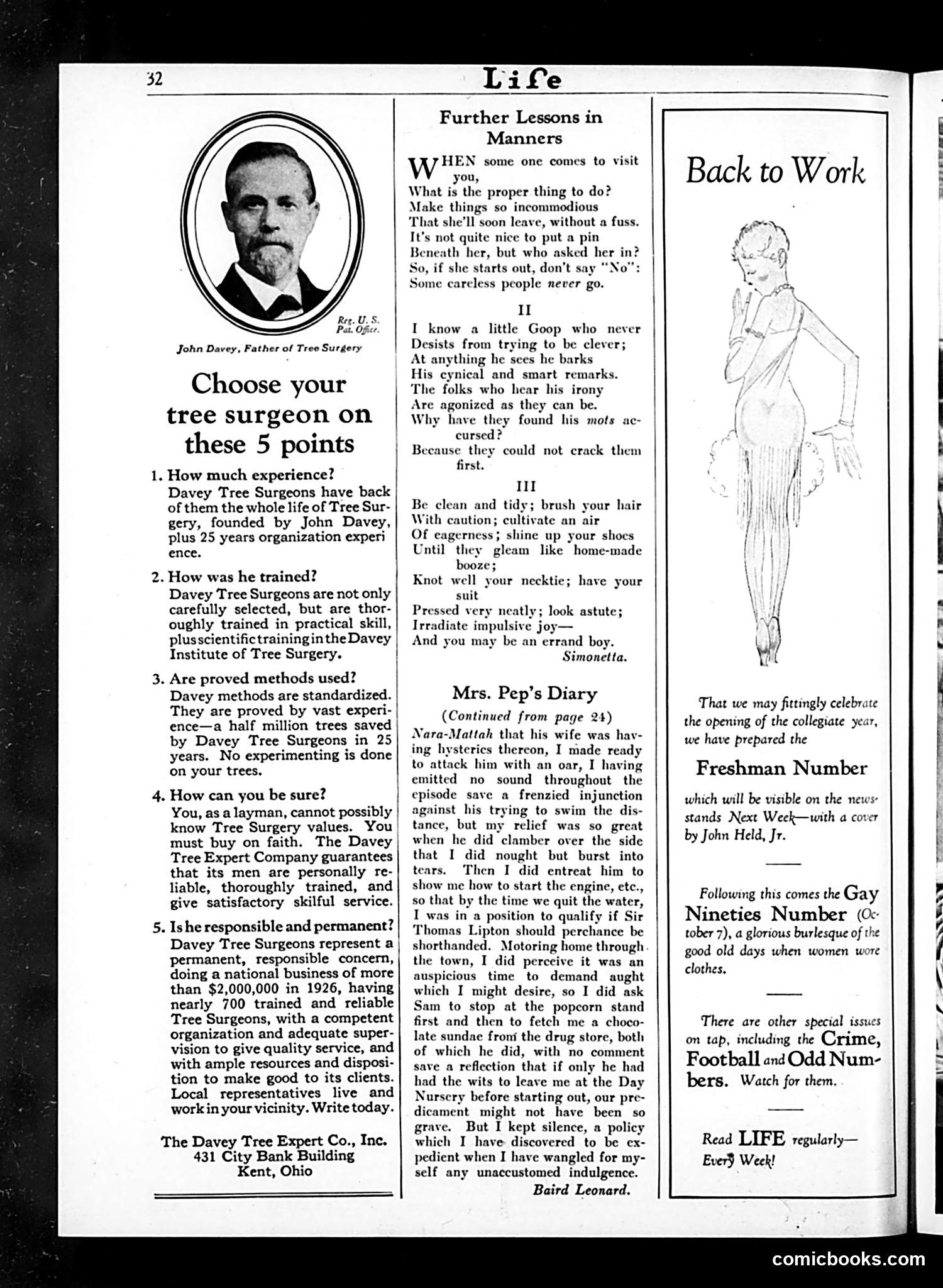
This page contains **advertising and satirical social commentary** typical of 1920s Life magazine. **The Advertisement:** The top-left features John Davey, founder of tree surgery as a profession. The Davey Tree Expert Company uses five reassurance points to market professional tree care—essentially arguing that consumers must "buy on faith" in an unfamiliar service. This reflects early 20th-century anxieties about trusting specialized professionals. **The Satire:** The center column, "Further Lessons in Manners," mocks both rude hosts and insufferable dinner guests through verse. The "Goop" character who constantly makes clever, cutting remarks represents the tiresome intellectual show-off—someone trying too hard to appear witty. The final verse about grooming yourself to become "an errand boy" offers ironic social advice. **Mrs. Pep's Diary** recounts a boating mishap written in deliberately overwrought, fussy language—satirizing breathless society column writing. The page announces an upcoming "Freshman Number" with cover art by John Held Jr., a prominent cartoonist of the era.
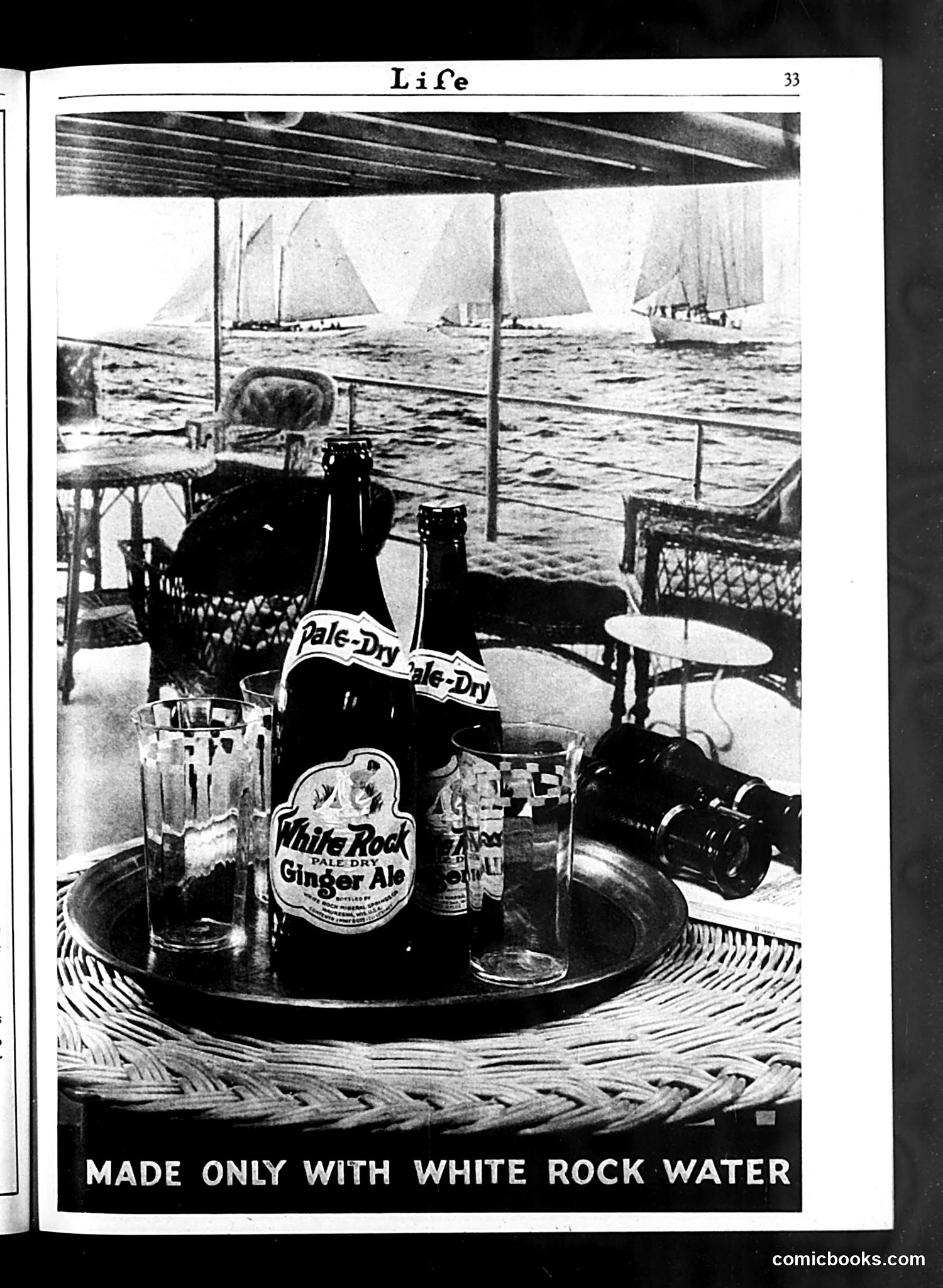
This is a **full-page advertisement** for White Rock Ginger Ale and Pale-Dry (appears to be another beverage product). The image shows bottles and glasses arranged on a table under a canvas awning, with sailboats visible on the water in the background—establishing a leisurely, upscale recreational setting. The tagline "MADE ONLY WITH WHITE ROCK WATER" emphasizes the product's purity and quality ingredient. The sophisticated nautical scene appeals to affluent consumers enjoying leisure activities. This is **not satire or political commentary**—it's straightforward commercial advertising placed in *Life* magazine, likely from the early-to-mid 20th century. The page demonstrates how *Life* (primarily known for humor and social commentary) also sold advertising space to branded products targeting its educated, wealthy readership.
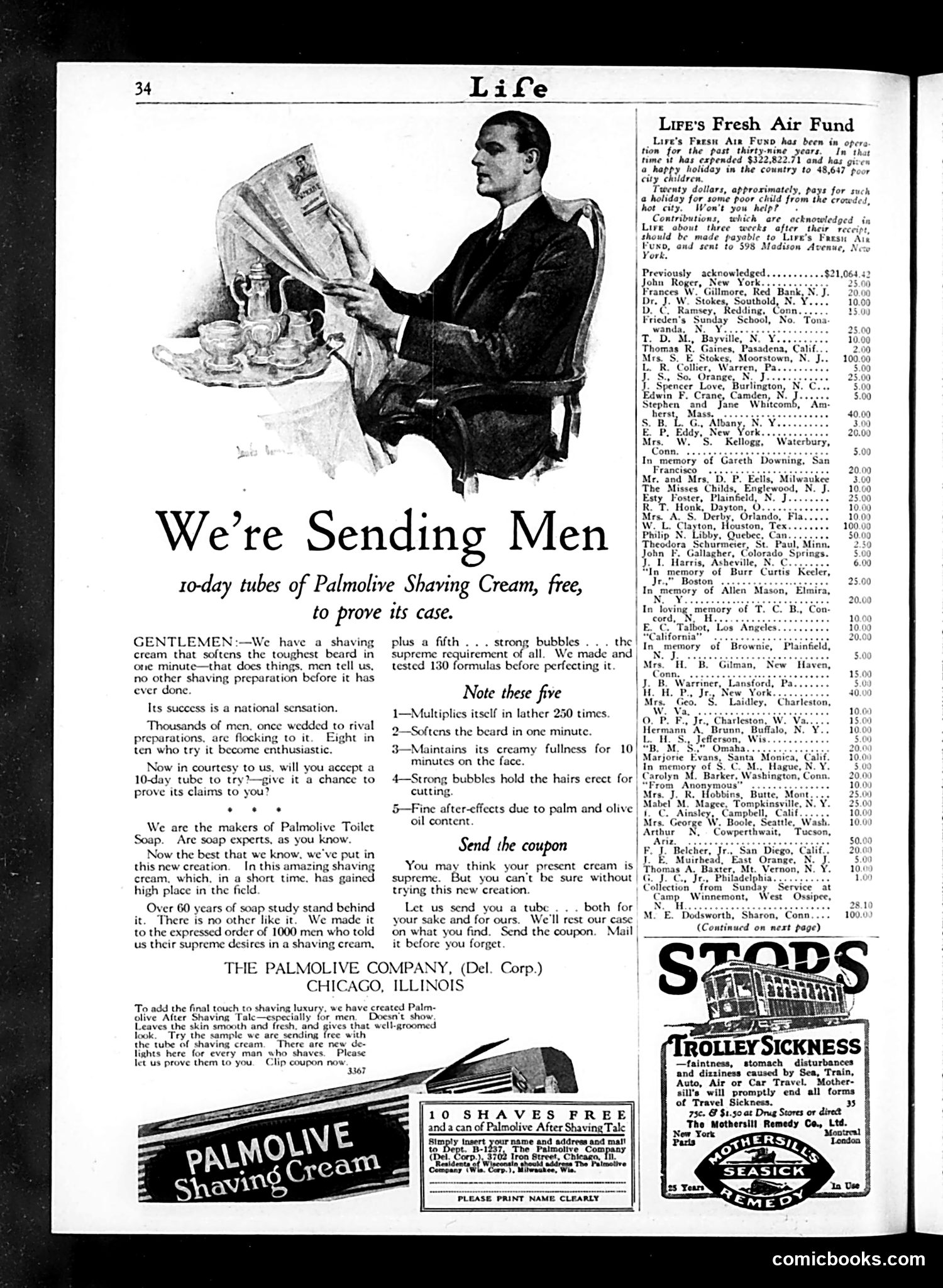
This page is **primarily advertising**, not satire or political commentary. The dominant content is a **Palmolive Shaving Cream advertisement** featuring an illustration of a man examining the product. The ad makes product claims (softens beard in one minute, multiplies lather 250 times, etc.) and offers a free 10-day tube as a trial, with a coupon to mail. The right column contains **Life's Fresh Air Fund**, a genuine charitable initiative that has operated for 39 years, providing country holidays for poor city children. It lists donors and contribution amounts. A secondary ad for **Palmolive After Shaving Talc** and a **"Stops Trolley Sickness"** remedy ad also appear. There is **no political cartoon or satire** on this page—it reflects early 20th-century magazine content mixing commercial advertising with philanthropic appeals to readers.
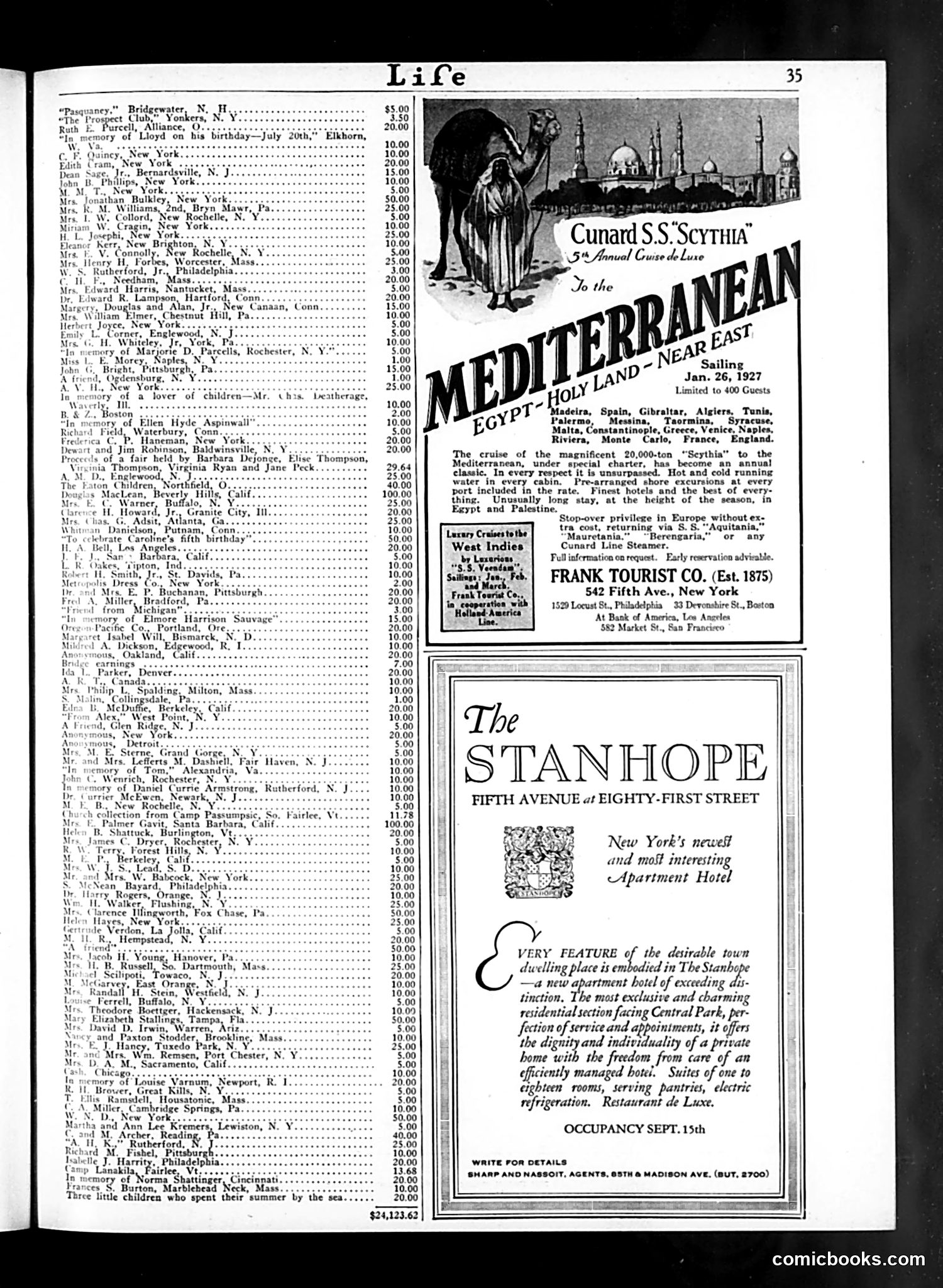
This page is primarily **advertising and subscription notices**, not political satire. The left column consists of a long list of Life magazine subscribers/donors with their locations and contribution amounts (ranging from $1 to $100), totaling $24,123.62. The right side features three travel and hotel advertisements: 1. **Cunard S.S. Scythia cruise** — advertising a Mediterranean luxury cruise departing January 26, 1927, visiting Egypt, Palestine, and European ports. Appeals to affluent readers with amenities like "hot and cold running water in every cabin." 2. **Frank Tourist Co.** — promoting additional luxury travel options to the West Indies. 3. **The Stanhope Hotel** — New York's "newest and most interesting Apartment Hotel" on Fifth Avenue at 81st Street, emphasizing exclusive residential amenities and Central Park views. **No political cartoons appear on this page.** It's a typical magazine interior page mixing donor acknowledgments with luxury travel/lifestyle advertising targeting wealthy readers of the 1920s.
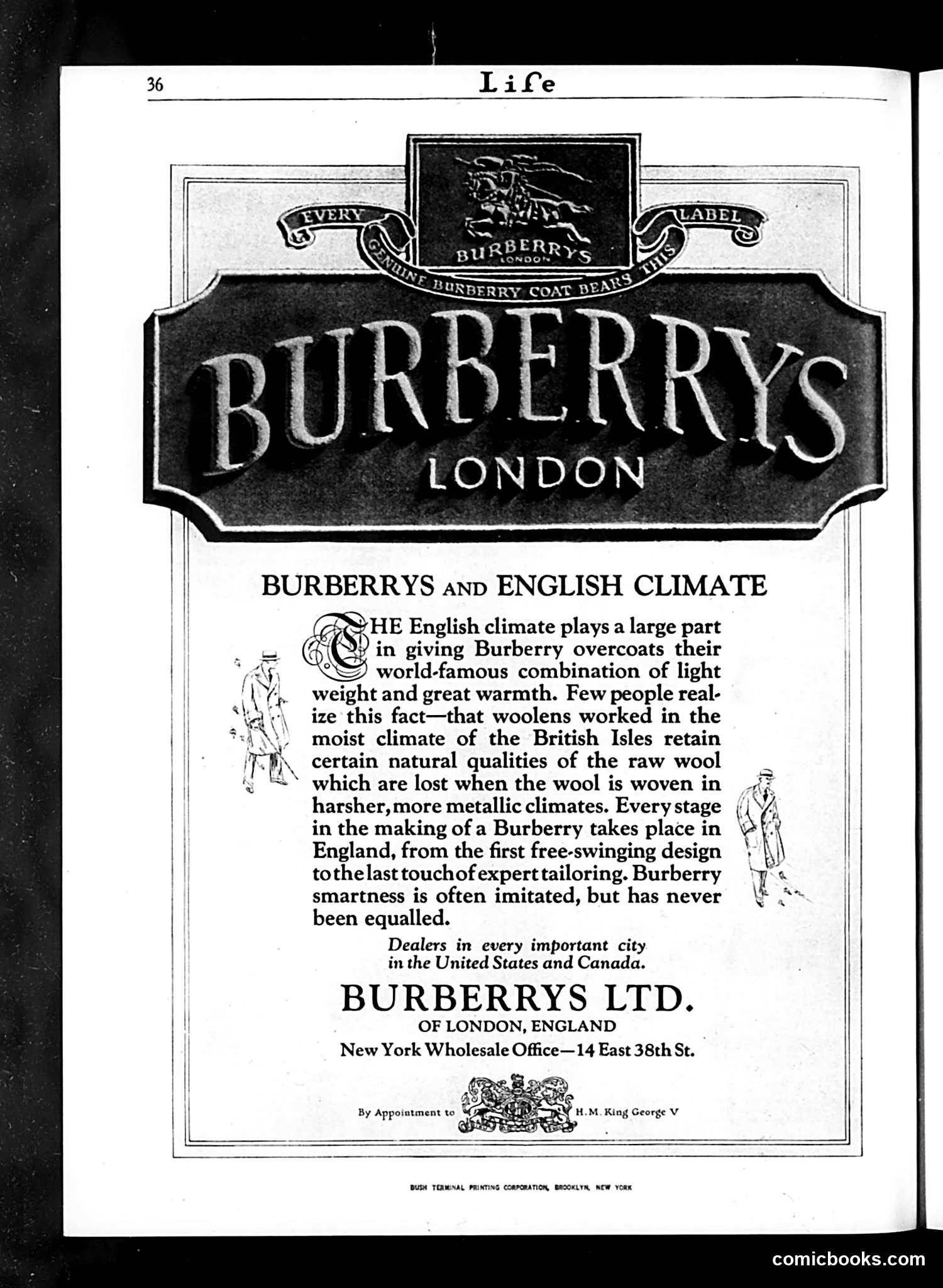
This is a full-page advertisement for Burberrys overcoats, not a political cartoon. The ad appears in *Life* magazine (page 36) and promotes the luxury British clothing brand's products. The advertisement's strategy is to link product quality to English nationalism and climate. It argues that Burberrys' superiority derives from being manufactured entirely in England, where the moist British climate supposedly preserves special properties in wool that are lost in "harsher, more metallic climates." The ad emphasizes that while "Burberry smartness is often imitated, but has never been equalled." Notable is the royal warrant at bottom: "By Appointment to H.M. King George V," conferring prestige through royal association. The ad targets American and Canadian dealers, marketing English craftsmanship and exclusivity to North American consumers during what appears to be the interwar period. There is no satire or cartoon content on this page—it's straightforward luxury brand advertising.
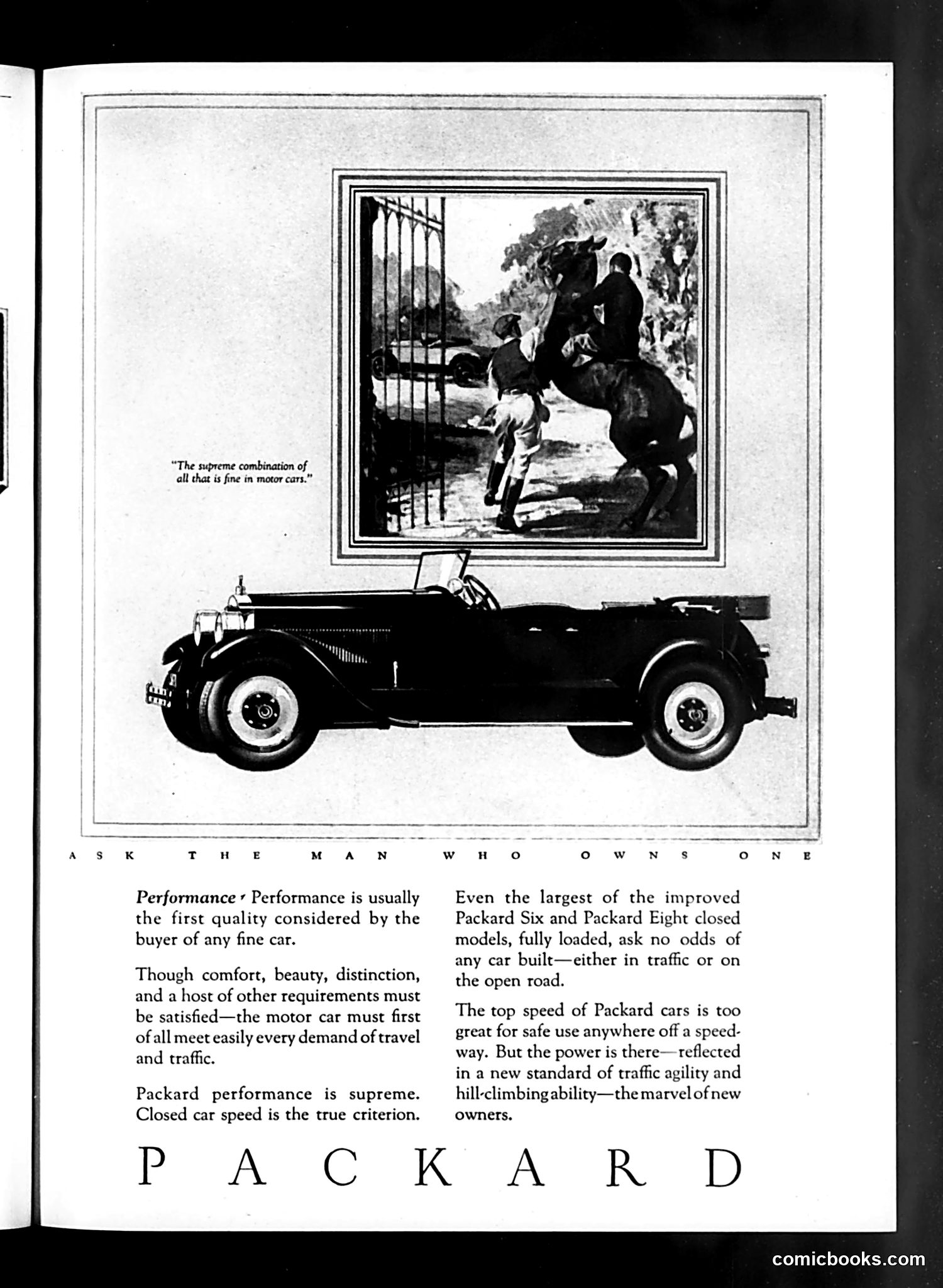
This is not satire—it's a **genuine luxury car advertisement** from Life magazine. The page promotes Packard automobiles, emphasizing performance as the primary selling point for "fine car" buyers. The framed scene above the car depicts an aristocratic or wealthy scenario (a man on horseback approaching what appears to be an estate gate), establishing the aspirational lifestyle associated with owning a Packard. This imagery targets affluent consumers. The text argues that while comfort and beauty matter, **performance—specifically closed-car speed and hill-climbing ability—defines a quality automobile**. The copy acknowledges the car's power exceeds safe speeds but frames this excess as desirable proof of engineering superiority. This reflects early 20th-century automotive marketing that equated mechanical prowess with status and prestige among wealthy buyers.
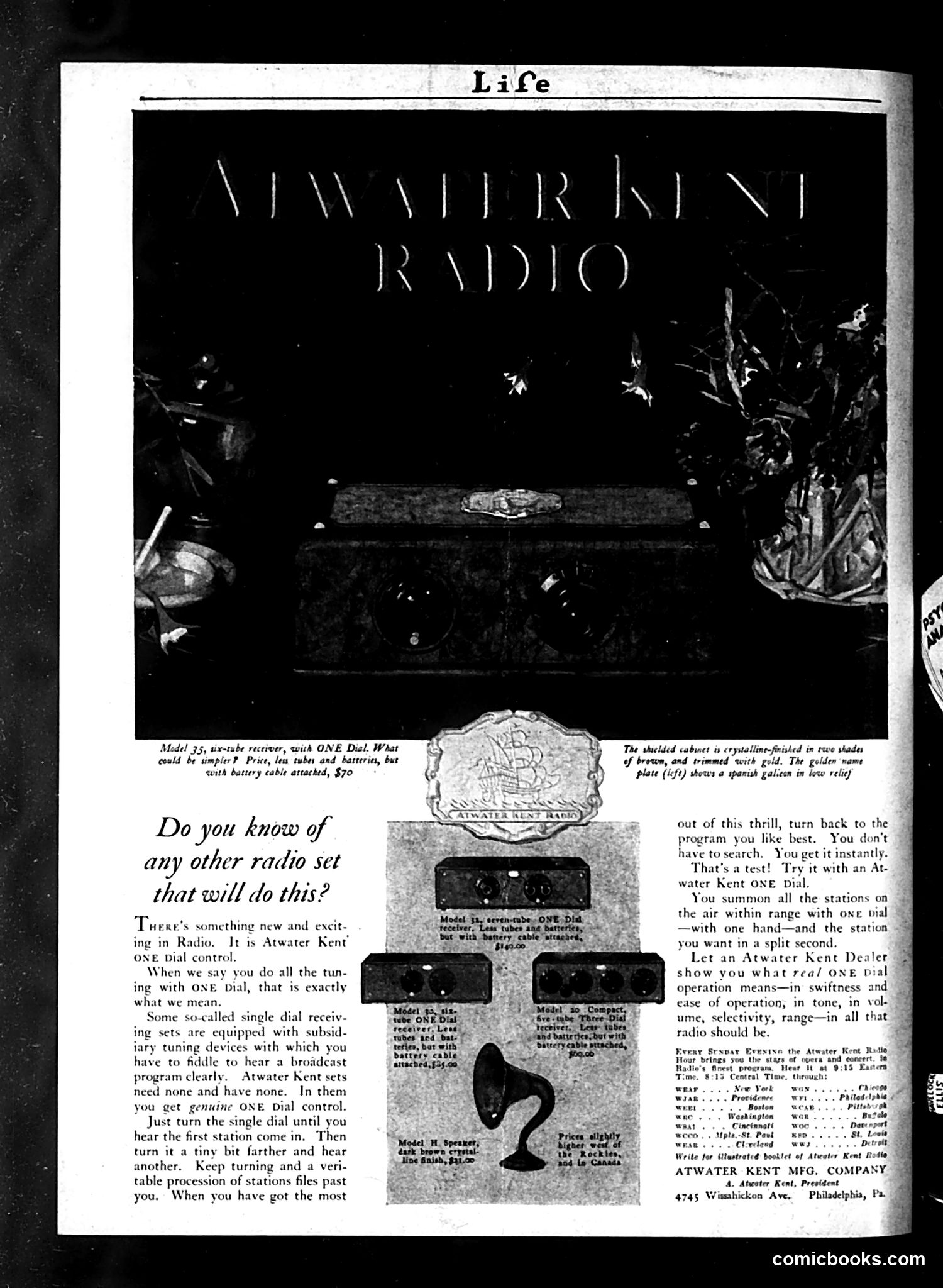
This page is primarily a **Atwater Kent radio advertisement**, not political satire. It promotes their "ONE Dial" radio receiver model, emphasizing its revolutionary simplicity compared to competitors. **The "Satire"** is commercial rather than political: the ad mocks other radio manufacturers' overly-complicated multi-dial systems, where users had to "fiddle" with subsidiary tuning devices. Atwater Kent's innovation—a single dial to tune all stations—is presented as superior. **Visual elements** show various radio cabinet models with different finishes (wood, crystalline, gold trim). The text sarcastically asks "Do you know of any other radio set that will do this?"—a rhetorical challenge to competitors. **Context for modern readers**: This reflects the 1920s radio boom when receiver design was rapidly evolving. "Single dial" control was genuinely innovative marketing. The ad emphasizes ease-of-use and aesthetic cabinet design as selling points to the general public discovering radio technology. This is **product advertising masquerading as editorial commentary**, not political commentary.