
Life, 1926-09-23 · page 19 of 40
Life — September 23, 1926 — page 19: what you’re looking at
What you’re looking at
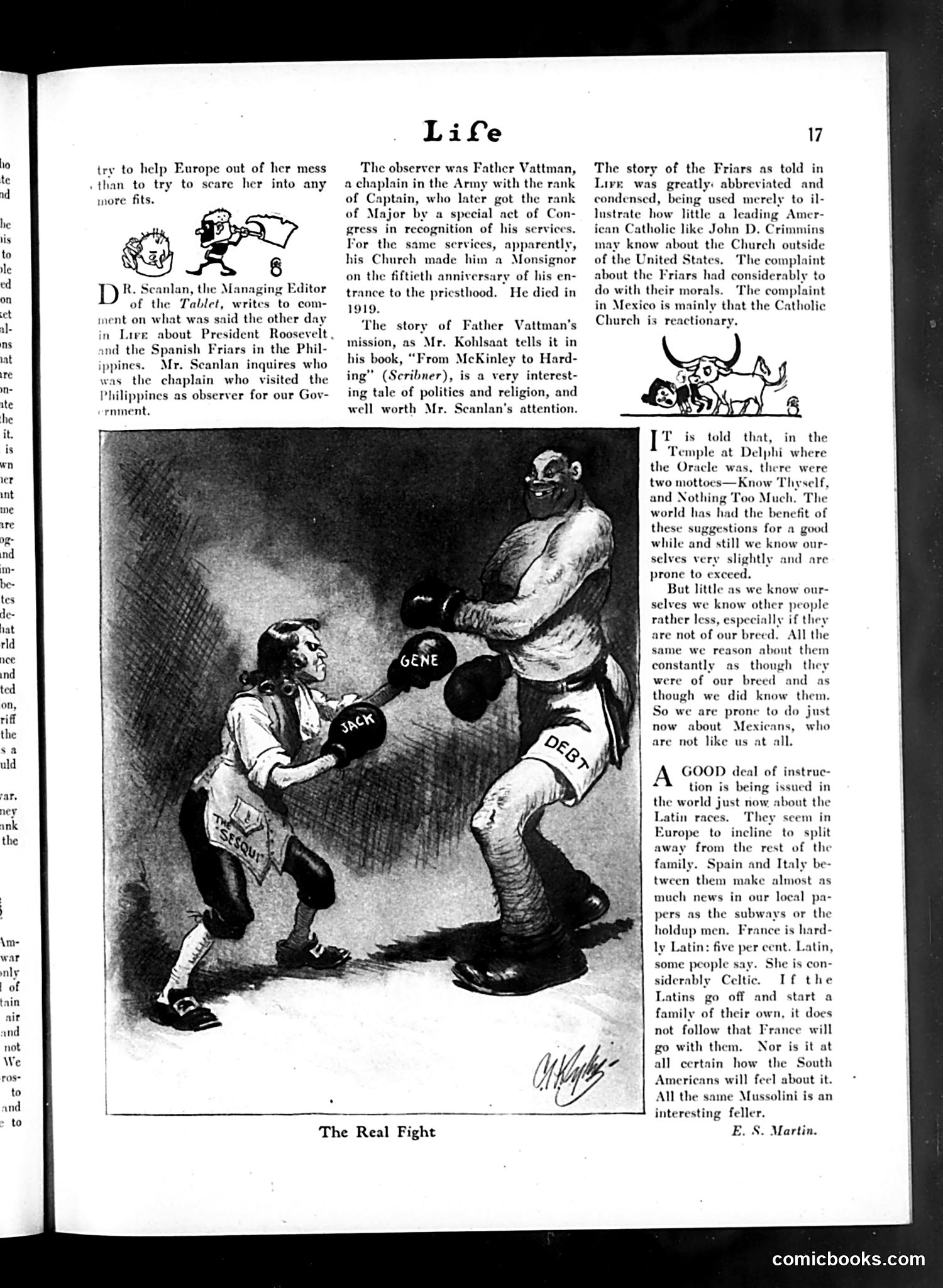
This cartoon depicts a boxing match between three labeled figures: "Jack" (likely representing the U.S.), "Gene," and "Debt." The composition suggests internal American conflict rather than external warfare. The text references Father Vattman's missionary work and discusses European and Latin American affairs, but the cartoon's labels indicate it's satirizing domestic economic struggle. "Jack" appears to represent American interests or the common citizen, battling against "Debt" while "Gene" (unclear which specific figure this represents—possibly an industrial or political entity) also participates. The satire critiques post-WWI American economic turmoil and internal financial pressures, presenting economic "enemies" as combatants in a domestic struggle rather than foreign threats.
📄 Transcribed text from this page (OCR, searchable)
Machine-transcribed from the original scan — historical spelling and the odd misread are preserved.
try to help Europe out of her mess .than to try to scare her into any more fits. R, Scanlan, the Managing Editor of the Tablet, writes to com- ment on what was said the other d. n Lire and the Spanish Friars in the Phil- ippines. Mr. Scanlan inquires who was the chaplain who visited the Philippines as observer for our Gov- rnment. about President Roosevelt , Life The observer was Father Vattman, a chaplain in the Army with the rank of Captain, who later got the of Major by a special act of Con- gress in recognition of his services. For the same services, apparently, his Church made him a Monsignor on the fiftieth anniversary of his en- trance to the priesthood. He died in 1919. The story of Father Vattman’s mission, as Mr. Kohlsaat tells it in his book, “From McKinley to Hard- ing” (Scribner), is a very interest- ing tale of politics and religion, and well worth Mr. Scanlan’s attention. 17 The story of the Friars as told in Lire was greatly: abbreviated and condensed, being used merely to lustrate how little a leading Ame ican Catholic like John D. Crimmins may know about the Church outside of the United States. The complaint about the Friars had considerably to do with their morals. The complaint in Mexico is mainly that the Catholic Church is react is told that, in the mple at Delphi where the Oracle was, there were two mottoes—Know Thyself, and Nothing Too Much, The world has had the benefit of these suggestions for a good while and still we know our- selves very slightly and are prone to exceed. But little as we know our- selves we know other people rather less, especially if they are not of our breed. All the same we reason about them constantly as though they were of our breed and as though we did know them. So we are prone to do just now about Mexicans, who are not like us at all. A GOOD deal of instruc- *% tion is being issued in the world just now about the atin races. They seem in rope to incline to split from the rest of the ly. Spain and Italy be- tween them make almost as much news in our local pa- pers as the subways or the holdup men. France is hard- ly Latin: five per cent. Latin, some people say. She is con- siderably Celt If the Latins go off and start a family of their own, it does not follow that France will go with them. Nor is it at all certain how the South Americans will feel about it. All the same Mussolini is an The Real Fight interesting feller. E. S. Martin. comicbooks.com