
Life, 1926-09-23 · page 23 of 40
Life — September 23, 1926 — page 23: what you’re looking at
What you’re looking at
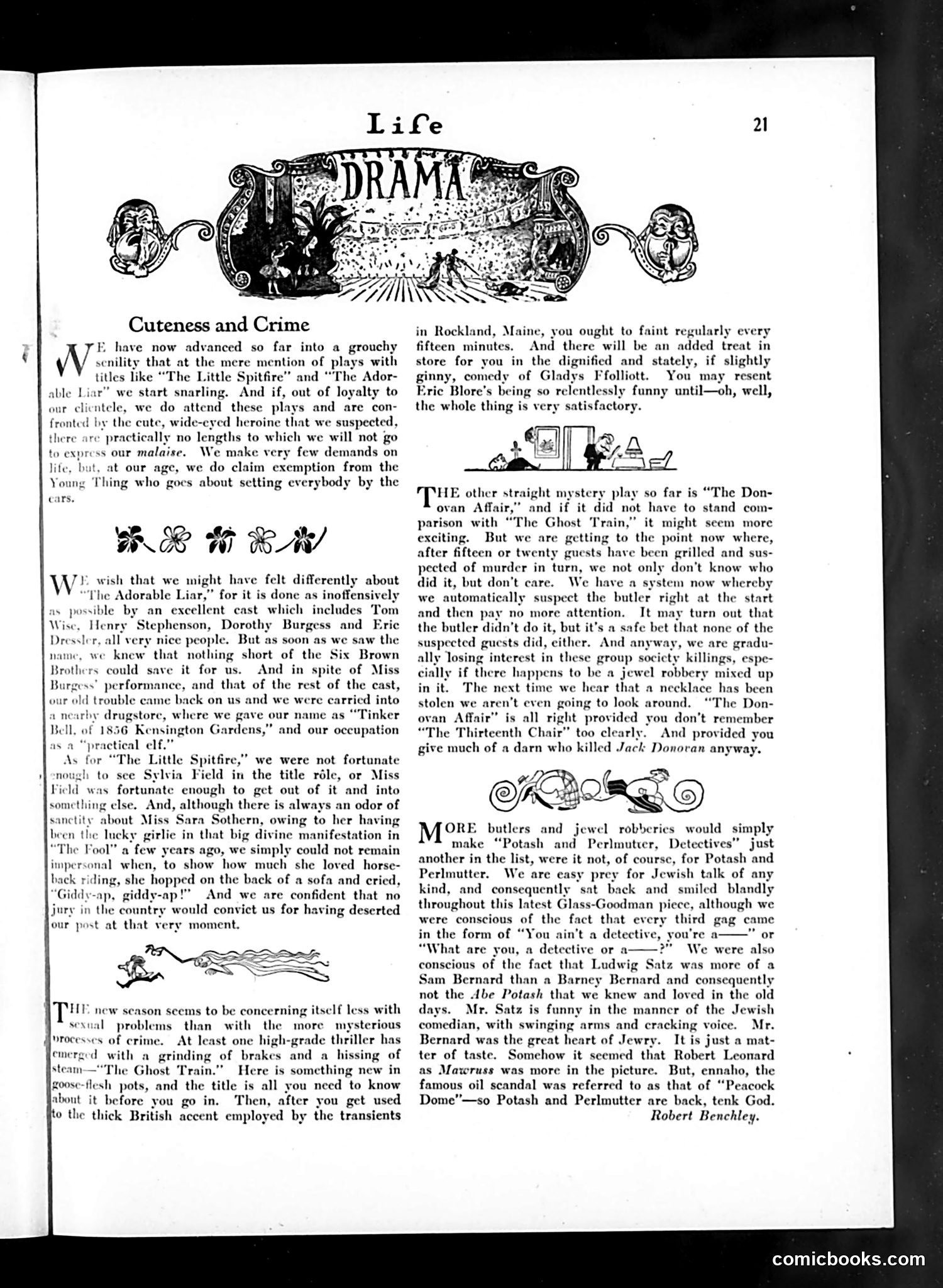
This is a theater review by Robert Benchley critiquing contemporary Broadway plays. The satire targets two specific trends: **"Cuteness" Problem**: Benchley expresses exasperation with saccharine comedies like "The Adorable Liar" and "The Little Spitfire"—plays built around adorable heroines performing calculated cuteness. He describes his visceral irritation at the "cute, wide-eyed heroine," so acute he must flee to drugstores. The humor lies in his over-the-top desperation to escape sentimentality. **Crime/Mystery Fatigue**: He mocks the proliferation of murder-mystery plays like "The Ghost Train" and "The Donovan Affair." Benchley satirizes the genre's predictability—audiences automatically suspect the butler, lose interest in jewel robberies, and stop caring *who* committed the murder. The joke: mystery plots have become so formulaic and convoluted that engagement is impossible. The underlying critique is that Broadway has abandoned substantive drama for either cloying sentiment or lazy thriller clichés.
📄 Transcribed text from this page (OCR, searchable)
Machine-transcribed from the original scan — historical spelling and the odd misread are preserved.
Cuteness and Crime ; have now advanced so far into a grouchy WV ility that at the mere mention of plays with titles like “The Little Spitfire” and “The Ador- able Liar” we start snarling. And if, out of loyalty to our clicntele, we do attend these plays and are con- fronted by the cute, wide-eyed heroine we suspected, there are practically no lengths to which we will not go to express our malaise. We make very few demands on life, but, at our age, we do claim exemption from the zg Thing who goes about setting everybody by the WE EAS W! wish that we might have felt differently about Phe Adorable Liar,” for it is done as inoffensively as possible by an excellent cast which includes Tom Wise, Henry Stephenson, Dorothy Burgess and Eric Dressler, all very nice people. But as soon as we saw the name, we knew that nothing short of the Six Brown Brothers could save it for us. And in spite of Miss Burgess’ performance, and that of the rest of the cast, our old trouble came back on us and we were carried into nearby drugstore, where we gave our name as “Tinker Bell, of 1856 Kensington Gardens,” and our occupation practical elf.” As for “The Little Spitfire,” we were not fortunate to sce Sylvia Field in the title réle, or Miss Field was fortunate enough to get out of it and into something else. And, although there is always an odor of sanctity about Miss Sara Sothern, owing to her having been the lucky girlie in that big divine manifestation in “The Fool” a few years ago, we simply could not remain impersonal when, to show how much she loved horse- back riding, she hopped on the back of a sofa and cried, “Giddy-ap, giddy-ap!" And we are confident that no jury in the country would convict us for having deserted our post at that very moment. asa Tee new season seems to be concerning itself less with sexual problems than with the more mysterious Arocesses of crime. At least one high-grade thriller has emerged with a grinding of brakes and a hissing of steam—"The Ghost Train.” Here is something new in goose-flesh pots, and the title is all you need to know about it before you go in. Then, after you get used © the thick British accent employed by the transients in Rockland, Maine, you ought to faint regularly every fifteen minutes. And there will be an added treat in store for you in the dignified and stately, if slightly ginny, comedy of Gladys Ffolliott. You may resent Eric Blore’s being so relentlessly funny until—oh, well, the whole thing is very HE other straight mystery play so far is “The Don- ovan Affair,” and if it did not have to stand com- parison with “The Ghost Train,” it might seem more exciting. But we are getting to the point now where, after fifteen or twenty guests have been grilled and sus- pected of murder in turn, we not only don’t know who did it, but don’t care. We have a system now whereby we automatically suspect the butler right at the start and then pay no more attention. It may turn out that the butler didn’t do it, but it’s a safe bet that none of the suspected guests did, either. And anyway, we are gradu- ally losing interest in these group socicty killings, espe- cially if there happens to be a jewel robbery mixed up in it. The next time we hear that a necklace has been stolen we aren't even going to look around. ‘The Don- ovan Affair” is all right provided you don’t remember “The Thirteenth Chair” too clearly. And provided you give much of a darn who killed Jack Donovan anyway. ORE butlers and jewel robberies would make “Potash and Perlmutter, Detective: another in the list, were it not, of course, for Potash and Perlmutter. We are easy prey for Jewish talk of any kind, and consequently sat back and smiled blandly throughout this latest Glass-Goodman piece, although we were conscious of the fact that every third gag came in the form of “You ain't a detective, you're a or “What are you, a detective or a: We were also conscious of the fact that Ludwig Satz was more of a Sam Bernard than a Barney Bernard and consequently not the Abe Potash that we knew and loved in the old days. Mr. Satz is funny in the manner of the Jewish comedian, with swinging arms and cracking voice. Mr. Bernard was the great heart of Jewry. It is just a mat- ter of taste. Somehow it seemed that Robert Leonard as Mawruss was more in the picture. But, ennaho, the famous oil scandal was referred to as that of “Peacock Dome’”—so Potash and Perlmutter are back, tenk God. Robert Benchley. comicbooks.com